
Milton City Zoning Code
ARTICLE 16
- SIGN STANDARDS
16.1 - APPLICABILITY
Any sign erected, altered, or maintained after the effective date of this Ordinance shall conform to the following regulations.
(Ord. No. 1992-23, § I, 10-10-2023)
16.2 - PURPOSE AND INTENT
Signs perform an important function in identifying and promoting properties, businesses, services, residences, events, and other matters of interest to the public. The intent of this Article is to regulate all signs within the City of Milton to ensure that they are appropriate for their respective uses, in keeping with the appearance of the affected property and surrounding environment, and protective of the public health, safety, and general welfare by:
A.
Setting standards and providing uniform controls that permit reasonable use of signs and preserve the character of the City of Milton.
B.
Prohibiting the erection of signs in such numbers, sizes, designs, illumination, and locations as may create a hazard to pedestrians and motorists.
C.
Avoiding excessive conflicts from large or multiple signs, so that permitted signs provide adequate identification and direction while minimizing clutter, unsightliness, and confusion.
D.
Establishing a process for the review and approval of sign permit applications.
E.
Ensuring sign design that builds on the traditional Neighborhood image and visual environment the City of Milton seeks to promote.
(Ord. No. 1992-23, § I, 10-10-2023)
16.3 - PROHIBITED SIGNS
A.
The following signs are prohibited from placement, construction, installation, and/or use within the City of Milton. Signs determined to be in violation with these regulations may be removed in accordance with Subsection 16.10 of these regulations.
(1)
Abandoned Signs;
(2)
Snipe Signs;
(3)
Signs that are in violation of the Florida building code;
(4)
Any sign that, in the Planning and Development Director's opinion, does or will constitute a safety hazard;
(5)
Signs with visible moving, revolving, or rotating parts or visible mechanical movement of any description or other apparent visible mechanical means, except for traditional barber poles or tri-face signs revolving no more than six times per minute (i.e., see the same face again);
(6)
Signs with the optical illusion of movement by means of a design that presents a pattern capable of giving the illusion of motion or changing of copy;
(7)
Signs with lights or illuminations that flash, move, rotate, scintillate, blink, flicker, or vary in intensity or color, except for time-temperature-date signs and other approved electric variable message signs;
(8)
Strings of lightbulbs used on commercially developed parcels for commercial purposes on any street fronting portion of the structure, other than traditional holiday decorations;
(9)
Signs, commonly referred to as wind signs, consisting of one or more pennants, ribbons, spinners, streamers or captive balloons, or other objects or material fastened in such a manner as to move upon being subjected to pressure by wind, except as provided in Subsection 16.7.b(2) of this Article.
(10)
Signs that incorporate projected images, emit any sound that is intended to attract attention, or involve the use of live animals;
(11)
Signs that emit audible sound, odor, or visible matter such as smoke or steam;
(12)
Signs or sign structures that interfere in any way with the free use of any fire escape, emergency exit, or standpipe, or that obstruct any window to such an extent that light or ventilation is reduced to a point below that required by any provision of these regulations or other ordinance of the city/county;
(13)
Signs that resemble any official sign or marker erected by any governmental agency, or that by reason of position, shape or color, would conflict with the proper functioning of any traffic sign or signal, or be of a size, location, movement, content, color, or illumination that may be reasonably confused with or construed as, or conceal, a traffic control device;
(14)
Signs that obstruct the vision of pedestrians, cyclists, or motorists traveling on or entering public streets;
(15)
Signs, within ten feet of a public right-of-way.
(16)
Signs within 100 feet of traffic-control lights that contain red or green lights that might be confused with traffic control lights;
(17)
Signs that are of such intensity or brilliance as to cause glare or impair the vision of any motorist, cyclist, or pedestrian using or entering a public way, or that are a hazard or a nuisance to occupants of any property because of glare or other characteristics;
(18)
Signs that contain any lighting or control mechanism that causes unreasonable interference with radio, television, or other communication signals;
(19)
Searchlights used to advertise or promote a business or to attract customers to a property;
(20)
Signs that are painted, pasted, or printed on any curbstone, flagstone, pavement, or any portion of any sidewalk or street, except house numbers and traffic control signs;
(21)
Signs placed upon trees, benches, bus shelters or waste receptacles, except as may be authorized in writing pursuant to F.S. § 337.407;
(22)
Signs erected on public property, or on private property (such as private utility poles) located on public property, other than signs erected by public authority for public purposes and signs authorized in writing pursuant to F.S. § 337.407;
(23)
Signs erected over or across any public street, except as may otherwise be expressly authorized by these regulations, and except governmental signs erected by or on the order of a public officer;
(24)
Signs displaying copy that is harmful to minors as defined by these regulations;
(25)
Signs attached to any vehicle, craft, or structure in or on a water body designed or used for the primary purpose of displaying advertisements. Provided, however, that this section shall not apply to any vehicle, craft, or structure which displays an advertisement or business notice engaged in the usual business or regular work of the owner, and not used to merely, mainly or primarily to display advertisement;
(26)
Placing of handbills or advertising materials on the windshields of vehicles shall be a violation of these regulations, unless permission to do so is first obtained from the owner and person in possession of such vehicle;
(27)
Inflatable signs/Balloon signs—Inflatable signs include air-inflated objects, which may be of various shapes, made of flexible fabric, resting on the ground or structure and are generally equipped with a portable blower motor that provides a constant flow of air into the device. This includes the term balloon signs.
(28)
Signs on or against roof slopes of less than 45 degrees.
(29)
Any sign which exhibits statements, words, or pictures of obscene or pornographic subjects, including but not limited to; offensive language, illegal activities such as drug use or the advocation of such, offensive gestures, libel, abuse, nudity, combative or threatening language, or any material that is patently offensive to contemporary standards in the adult community as a whole with respect to what is suitable for viewing by minors and taken as a whole, lacks serious literary, artistic, political, or scientific value.
B.
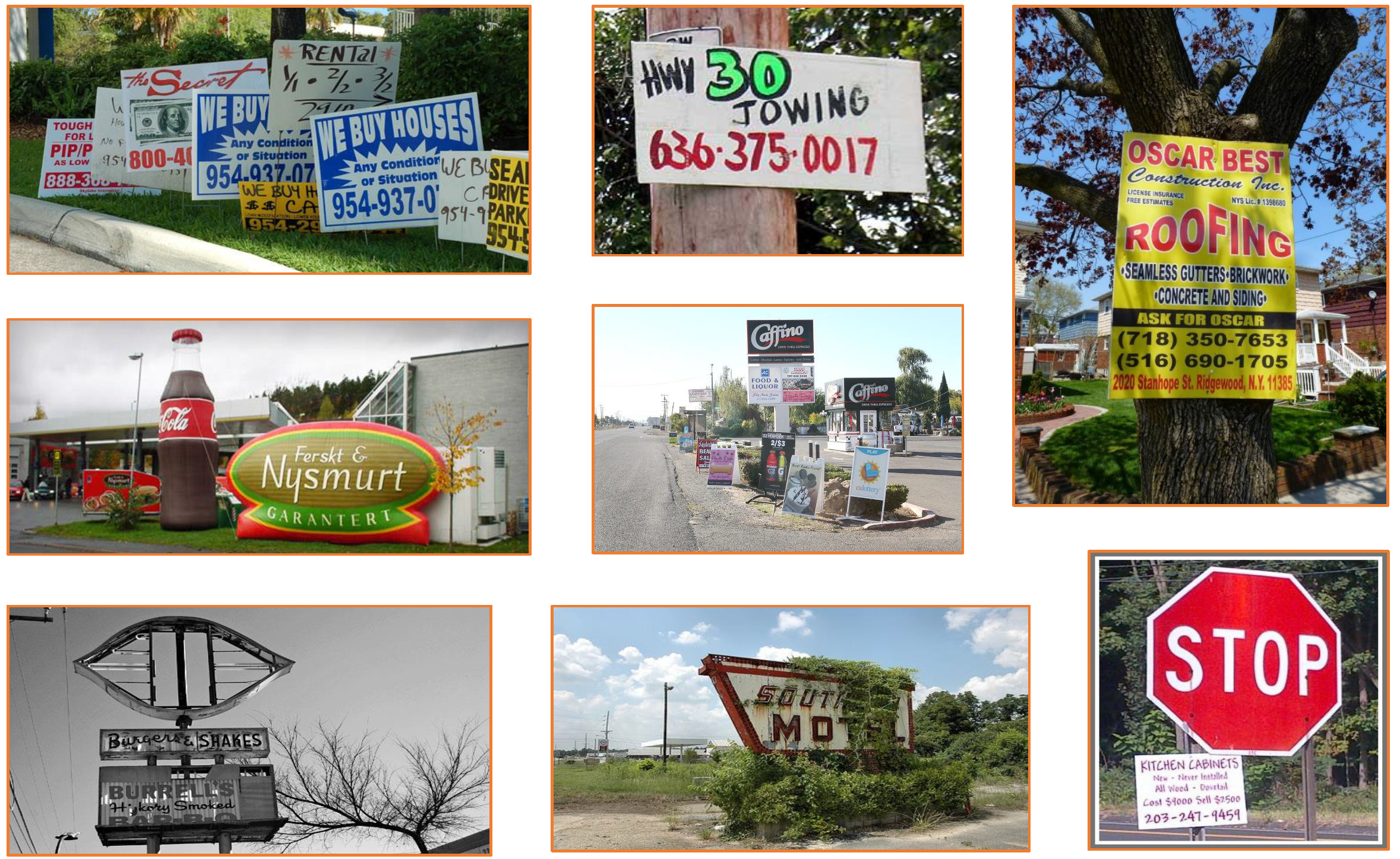
Examples of Prohibited Signage:
(Ord. No. 1992-23, § I, 10-10-2023)
16.4 - EXEMPT SIGNS
A.
The following signs shall be allowed without a sign permit and shall not be included in the determination of the type, number, or area of signage allowed within a zoning district, provided such signs comply with the regulations in this section, if any.
(1)
Official traffic signs.
(2)
Government/regulatory signs.
(3)
Signs inside a building, or other enclosed facility, which are not meant to be viewed from the outside, and are located greater than three (3) feet from any window.
(4)
Holiday and seasonal decorations.
(5)
Personal expression signs, including political signs, provided that they meet the following:
a.
Do not exceed three (3) sq. ft. in area per sign and nine (9) sq. ft. total;
b.
Are non-commercial in nature and contain no advertising;
c.
Are not harmful to minors as defined in this article; and
d.
Are not illuminated.
e.
Are located on private property with owner consent.
f.
Political signs shall conform to the requirements provided in Subsections 16.7(c) and 16.9.
g.
Total height of all sign components, including frame and support structures, does not exceed six (6) feet.
h.
Do not cause a hazard to the health, safety, or general welfare of pedestrians and vehicular traffic.
i.
Are not in conflict to Section 16.3.
(6)
Address signs—Up to two (2) signs stating address, number and/or surname of occupants of the premises and which do not include any commercial advertising.
a.
Residential districts. Signs not to exceed three (3) sq. ft. in area.
b.
Non-residential districts. Signs not to exceed five (5) sq. ft. in area.
(7)
Public signs—Signs erected or required by government agencies or utilities, including traffic, utility, safety, railroad crossing, and identification or directional signs for public facilities.
(8)
Private drive signs—One (1) sign per driveway entrance, not to exceed two (2) sq. ft. in area.
(9)
Security and Public warning signs which indicate the dangers of trespassing, swimming, animals' present, and/or similar hazards.
a.
Residential districts. Signs not to exceed two (2) sq. ft. in area.
b.
Non-residential districts. Maximum of one (1) large sign per property, not to exceed five (5) sq. ft. in area. All other posted security and warning signs may not exceed two (2) sq. ft. in area.
(10)
Flags:
a.
American and Governmental flags are exempt when displayed in accordance with standard display practices.
b.
Location. Flags and flagpoles shall not be located within any right-of-way.
c.
Height. Flags shall have a maximum height of 30 ft.
d.
Number. The number of flags, which may be displayed on any one parcel of land will be determined by the total square footage of the flag. The square footage allowable will be determined to be equal to the square footage of the total signage requirements for the building structure. The number of flags allowable will be the square footage divided into the allowable square footage (e.g., 48 total square footage of signage allowable divided by two-square foot per flag equals 24 flags). Flags will not decrease the allowable sign square footage.
e.
Size. Maximum flag size is 24 sq. ft. in residential districts, 35 sq. ft. in all other districts.
f.
Flags containing commercial messages may be used as permitted freestanding or projecting signs, and, if so used, the area of the flag shall be included in, and limited by the computation of allowable area for signs on the property and require permit application.
(11)
Legal notices and official instruments.
(12)
Vending machine signs and signs of a similar nature.
(13)
Memorial signs, tablets, Public monument or historical identification signs, including plaque signs up to four (4) sq. ft. in area.
(14)
Signs which are a permanent architectural feature of a building or structure, existing at the time of adoption of this ordinance.
(15)
Signs carried by a person.
(16)
Decorative flags and bunting for a celebration, convention, or commemoration of significance to the entire community when authorized by the city council for a prescribed period of time.
(17)
On-Premises Directional signs, shall not be counted as part of the allowable permanent signage area provided they do not contain any commercial messaging and meet the following:
a.
Area. No single directional sign shall exceed four (4) sq. ft. in area.
b.
Height. Directional signs shall have a maximum height of five (5) ft.
c.
Number allowed. Maximum of three (3).
d.
Illumination. Directional signs may be internally lit only.
e.
Shall be constructed as permanent signage in locations that do not disturb the flow of traffic or cause any other safety hazards.
(18)
One (1) unlighted window sign, advertising the sale, rental or lease of the premises or property upon which said sign is located. Such sign shall not exceed six square feet in sign area;
(19)
Incidental Signs as defined in Article 2 of this Code.
(20)
"For Sale" Signs.
a.
One "For Sale" sign constructed of wood and/or metal or other acceptable plastic or composite material not to exceed six (6) feet in area and four (4) feet in height, shall be allowed without a permit.
(21)
Menu signs, as defined in Article 2 of this Code, which are 50 square feet in size or less.
B.
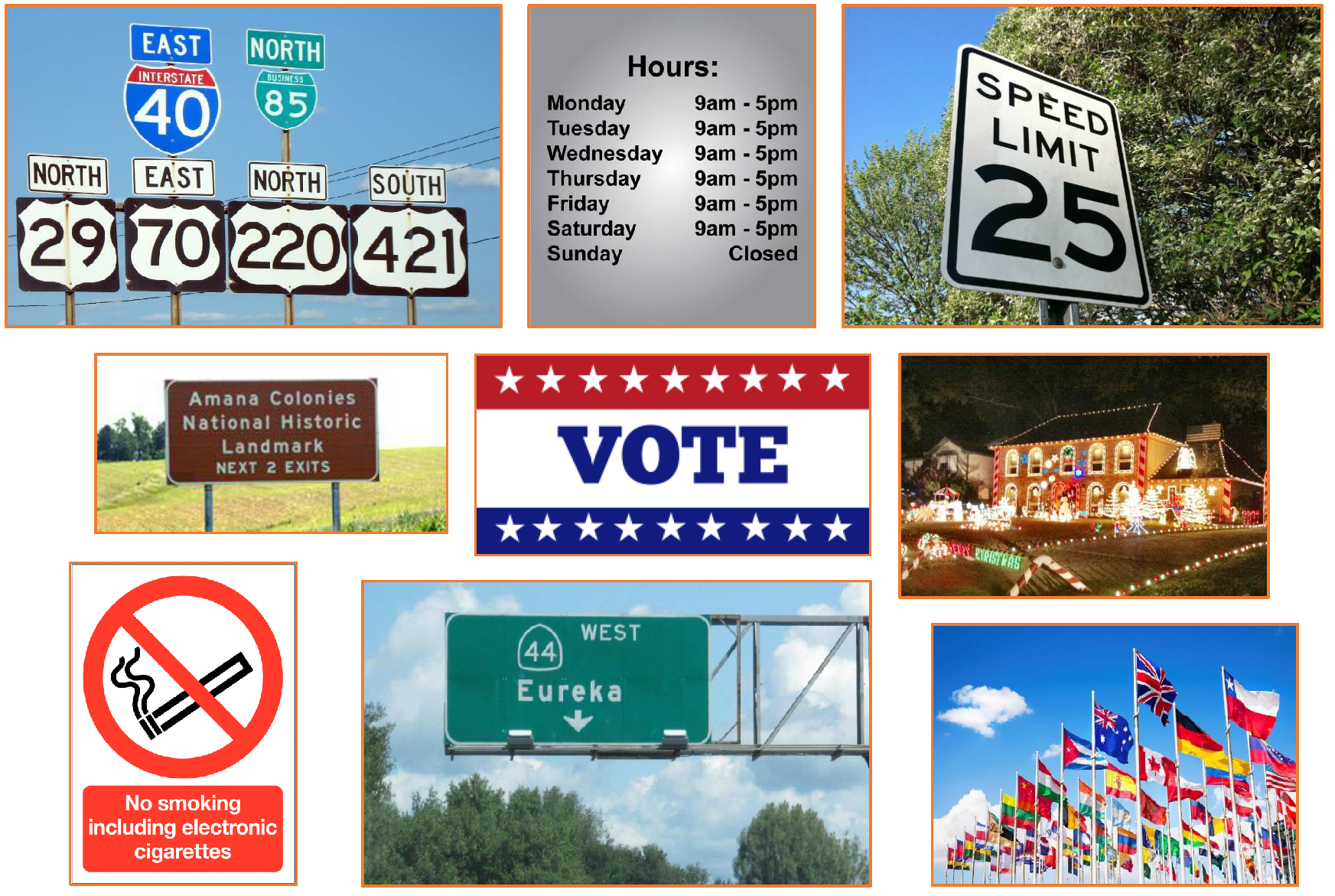
Examples of Exempt Signage:
(Ord. No. 1992-23, § I, 10-10-2023)
16.5 - PERMITS AND APPLICATIONS
A.
Permitting.
(1)
It shall be unlawful for any person, firm, or corporation to erect, alter, repair, or relocate any sign within the City of Milton without first obtaining a sign permit, unless the sign is specifically exempt from the permit requirements as outlined in § 5[section 16.4], Exempt Signs.
(2)
In order to apply for a sign permit, the applicant must complete an Application for Sign Permit form and be able to provide the following information, in writing, to the Planning and Development Department of the City of Milton.
a.
Name of organization and location.
b.
Name, address, and telephone number of the property owner, and the signature of the property owner or duly authorized agent for the owner.
c.
Contact person and contact information.
d.
Description of the activities occurring on the site where the sign will be installed.
e.
Description of any existing signage that will remain on the site.
f.
Identification of the type of sign(s) to be erected by the applicant.
g.
Site plan depicting the locations of proposed signage and existing remaining signage.
h.
Two copies of a plan drawn to scale depicting:
i.
Lot dimensions, building frontage, and existing cart-ways, rights-of-way and driveways.
ii.
The design of each sign face and sign structure, including dimensions, total area, sign height, depth, color scheme, structural details, materials, lighting scheme and proposed location.
iii.
Building elevations, existing and proposed façades, façade area, parapet walls, eave-line and the location and size of all proposed and existing permanent signage.
iv.
Current photographs showing existing signs on the premises and certifying the date on which photographs were taken.
i.
Engineering as per Section 16.6(8).
(3)
A permit fee, to be established from time to time by Resolution of the City of Milton, shall be paid.
(4)
Applications for proposed signs located within the Historic District or within a Community Redevelopment Area shall require additional review by the appropriate bodies and may in turn necessitate the submission of additional copies.
(5)
Attach the State of Florida Department of Transportation's fully completed application, if applicable.
B.
Permit Cost.
(1)
Sign permit fees shall be adopted by resolution within the annual Resolution establishing the schedule of fees.
(2)
There shall be a fee based on the signs' proposed display time frame. Permanent and Temporary signs shall each have fee amounts equivalent to the maximum display time frame for each sign class.
(Ord. No. 1992-23, § I, 10-10-2023)
16.6 - PERMANENT SIGNAGE STANDARDS
A.
Generally.
(1)
All permanent signs not expressly exempted by these regulations as per Section 16.4 above, shall require a permit prior to the start of sign construction.
(2)
It shall be unlawful to erect or cause to be erected, maintain or cause to be maintained, any sign not expressly authorized by, or exempted by these regulations.
(3)
All permanent signs must comply with the following design, construction and location standards. Information about the size, location and design shall be presented to the zoning coordinator on forms acceptable to the Planning and Development Department.
(4)
Construction and Maintenance Standards.
a.
All signs shall be constructed of durable materials, using noncorrosive fastenings; shall be structurally safe and erected or installed in strict accordance with this Code and applicable Florida Building Code; and shall be maintained in safe condition and good repair at all times so that all sign information is clearly legible.
b.
All signs, including their supports, braces, guys and anchors, electrical parts and lighting fixtures, and all painted and display areas, shall be maintained in accordance with the building and electrical codes adopted by the City and County, and shall present a neat and clean appearance.
c.
The vegetation around, in front of, behind, and underneath the bottom edge of pole signs and the base of ground signs for a distance of ten feet shall be neatly trimmed and free of weeds, rubbish, trash, and debris which could constitute a fire hazard, a health hazard, or which appear unsightly to passersby.
(5)
Illumination standards.
a.
Sign lighting may not be designed or located to cause confusion with traffic lights.
b.
Illumination by floodlights or spotlights is permissible so long as none of the light emitted shines directly onto an adjoining property or into the eyes of the motorists or pedestrians using or entering public streets. Any relevant State and Federal regulations shall apply.
c.
Illuminated signs shall not have lighting mechanisms that project more than 18 inches perpendicularly from any surface of the sign.
(6)
Location Standards.
a.
No sign shall be placed in such a position as to endanger pedestrians, bicyclists, or traffic on a street by obscuring the view or by interfering with official street signs or signals by virtue of position or color.
b.
No sign shall occupy a sight triangle. (See Subsection 2.2.)
(7)
Clearance Standards.
a.
Over pedestrian ways.
i.
All signs which extend over sidewalks, pedestrian walkways, and other spaces used by pedestrians shall provide a minimum of eight (8) feet of clearance from sign bottom.
b.
Over vehicular ways.
i.
All signs which extend over vehicular areas, including driveways, alleys, parking areas, loading areas, and any other areas shall provide a minimum of 14 feet of clearance from sign bottom.
(8)
Signs required to be certified by a Florida registered engineer.
a.
The following signs shall be designed and certified by a state-registered engineer:
i.
Building signs that project perpendicularly from the surface to which it is attached and that are more than 24 square feet in area.
ii.
Ground signs of more than ten feet in height and 100 square feet in area.
(9)
Content Restrictions.
a.
Permanent signs may display any message so long as it is not harmful to minors as defined by these regulations.
(10)
Sign Area.
a.
Building Signs, unless otherwise provided by this Code, are limited in size by the principal building's street facing façade. The façade area shall be measured by determining the area within a two-dimensional geometric figure coinciding with the edges of the walls, windows, doors, parapets, marquees, and roofs with slopes of less than 45 degrees. (See Subsection 2.2(P).)
i.
The façade area of individual tenants in a multi-tenant building shall be determined by that area between the two interior (shared) walls or the interior wall and the exterior wall of each individual unit.
(11)
Number of Signs.
a.
The number of signs shall be the number of noncontiguous sign faces. Multiple noncontiguous sign faces may be counted as a single sign if all the sign faces are included in the geometric figure used for determining the sign area. (See Subsection 2.2(P).)
b.
Special situations.
i.
Where two sign faces are placed back-to-back and are at no point more than three feet apart, it shall be counted as one sign.
ii.
If a sign has four faces arranged in a square, rectangle or diamond, it shall be counted as two signs. (See Subsection 2.2(P).)
B.
Permanent On-Premises Signage Standards in the C-1, C-2, C-3 and SSC-RC Zoning Districts.
(1)
Types allowed.
a.
A permanent on-premise sign may be a ground or building sign.
i.
Ground signs include Monument and Pole signs.
ii.
Building Signs include Wall signs, Roof signs, Awning Signs, Canopy Signs, Marquee Signs, and any other type of sign that is permanently applied to or affixed to building surfaces, including Window Signs.
b.
Any sign, which becomes non-conforming, except permanent outdoor advertising signs, as a result of the passage of these regulations shall be governed by Article 10, Nonconformities.
(2)
Building Signs.
a.
Signage for each business shall be permitted.
b.
Building signage area shall not exceed ten percent of the principal building's street facing façade area.
i.
In no case shall the allowed building signage exceed 180 square feet.
c.
Theatre allowance. In addition to the requirements of this section, theatres shall be allowed advertising space to display movie schedules and movie posters as follows:
i.
For movie schedules, a theatre may have an additional display area not to exceed 48 square feet; and
ii.
For each screen an additional 12 square feet will be allowed for movie posters.
d.
Relationship to building features.
i.
A building sign shall not extend beyond any edge of the surface to which it is attached, nor disrupt a major architectural feature of the building.
e.
Maximum projection.
i.
A building sign may project no more than four feet perpendicularly from the surface to which it is attached.
ii.
Signs which project perpendicularly from the surface to which it is attached and that are more than 24 square feet in area are required to be certified by a registered engineer.
f.
Maximum window coverage.
i.
The combined area of permanent and temporary signs placed on or behind windows shall not exceed 25 percent of the total window area at the same floor level on the same side of the building or unit upon which the signs are displayed.
(3)
Ground Signs.
a.
Signs at intersections and driveways shall provide a 25-foot sight triangle.
b.
The leading edge of all signs shall have a ten-foot minimum setback from any right-of-way.
c.
The permissible number, area, spacing and height of permanent ground signs shall be determined in accordance to the following:
d.
For signs within the C-1, C-2, C-3, and SSC-RC Zoning Districts, the following restrictions apply in addition to all other applicable regulations:
i.
Development entrance signs shall be limited to ground signs.
ii.
Ground signs shall be limited to base and sign structure and shall be constructed of materials such as brick, stone, stucco, wood or metal consistent with the architecture and exterior treatment of the building(s) in the development.
iii.
The maximum sign area of any ground sign and/or pole sign, inclusive of any border and trim, but excluding the base, apron, supports and other structural members, shall be:
1)
Ground signs on lots with more than one tenant shall be no greater than 150 square feet in sign area. Pole signs on lots with more than one tenant shall be no greater than 80 square feet in sign area.
2)
Ground signs on lots with one tenant shall be no greater than 100 square feet in sign area. Pole signs on lot with one tenant shall be no greater than 50 square feet in sign area.
e.
Additional Signage Requirements for Commercial Zoning Districts.
Table 16.5.1. Minimum Sign Distances
i.
The minimum distances in Table 16.5.1 shall apply to signage for all multiple-occupancy complexes.
ii.
Anchor stores in excess of 30,000 square feet shall be allowed to install a separate sign, along one street frontage:
1)
To be setback a minimum of ten feet from the property line;
2)
Not to exceed 100 square feet in sign area;
3)
Be no closer than 100 lineal feet to another sign on that right-of-way.
f.
For signs within the R-U, CON, PE and REC zoning districts the following restrictions apply:
Table 16.5.2. Sign Area and Distance Standards in the R-U, CON, P-E, and REC Zoning Districts.
(4)
Banners.
a.
Banners can be approved as permanent Buildingor temporary Ground Signs.
b.
No banner shall exceed 32 square feet within any zoning district.
i.
One banner per business will be allowed in the C-1, C-2, C-3, and SSC-RC zoning districts, with a size not to exceed ten percent of the principal building's street facing façade.
ii.
Banners in all other districts will be permitted as temporary signs only and shall be limited by the Temporary Sign standards identified below in Subsection 16.7.
iii.
Banners in all zoning districts may be approved as temporary Ground Signs.
iv.
Banners on multi-tenant properties will be permitted as temporary signs only and shall be limited by the Temporary Sign standards identified below in Subsection 16.7.
c.
Banners are to be well maintained, in good condition and not create a traffic hazard.
(5)
Digital Display Signs (Electrical Variable Message Signs). Digital display signs are subject to the following regulations in addition to all other requirements established in this Section.
a.
Digital displays are permitted in the form of freestanding, pole, monument, and wall signs, both on-premises and off-premises, in accordance with these regulations.
b.
A digital display shall have the same height limits as for other permitted signs of the same type and location.
c.
Digital Display signs are permitted in C1, C2, C3, and SSC-RC zoning districts.
d.
When used as an on-premises sign, digital displays shall not exceed more than 30% of the total sign area permitted on the site.
i.
On-premise signs with a digital display component may be allowed an additional 20% in permitted sign area provided the following conditions are met:
1)
The applicant/owner of the site where the sign is to be located, shall provide 20% more landscaping, in excess of what is required by this Code.
2)
The additional landscaping will be in the form prescribed in Article 12.
3)
The additional landscaping shall be installed within the landscaped area immediately adjacent to the sign.
e.
Where permitted, one (1) digital display sign is permitted per property.
f.
Any Digital Display containing animation, streaming video, or text or images which flash, pulsate, move, or scroll is prohibited. Each complete message must fit on one screen.
g.
One message/display may be brighter than another, but each individual message/display must be static in intensity.
h.
The content of a digital display must transition by changing instantly, with no transition graphics (e.g., no fade-out or fade-in).
i.
The sign shall contain a default design which shall freeze the sign message in one position if a malfunction should occur.
j.
Conversion of a permitted non-digital sign to a digital sign requires the issuance of a permit pursuant to these regulations.
k.
The addition of any digital display to a nonconforming sign is prohibited.
l.
All digital displays must be kept in complete working order, disrepair of any component, including by not limited to; sign casing, frame, enclosures, pixels, bulbs, or any other malfunction shall be considered a public nuisance and can be enforced pursuant to Subsection 16.10 (D).
m.
Public Service Announcements:
i.
The owner of every digital sign shall coordinate with the local authorities to display, when appropriate, emergency information important to the traveling public.
C.
Permanent Signage Standards in Residential Districts.
(1)
Non-Residential Use Sign Standards.
a.
Signs in municipal parks are not subject to the restrictions contained in this subsection.
b.
Ground Signs. Within all residential districts for permitted non-residential uses and approved special exceptions, one sign of 32 square feet, not exceeding eight feet in height, non-animated, may be located on the premises. Said sign may be externally or internally lit and shall be constructed so as not to constitute a safety hazard and shall conform to the other requirements of these regulations pertaining to commercial signage.
c.
Wall sign. Within all residential districts for permitted non-residential uses and approved special exceptions, one sign shall be permitted, per occupancy, per street frontage. The sign shall be limited to a maximum area of 12 square feet, shall be non-animated, shall be externally lit only, shall be constructed so as not to constitute a safety hazard, and shall conform to any other requirements of these regulations pertaining to commercial signage.
i.
Additional, one wall-mounted sign, not exceeding ten (10) square feet in area, is permitted at any side or rear entrance which is open to the public. Such wall signs may be externally lit only.
1)
Blade and hanging signs shall be, at minimum, eight (8) feet above grade.
2)
Signs that do not project from the surface, such as placard type signs, shall have a minimum distance above grade of four (4) feet.
(2)
General Home Occupation Sign Standards.
a.
Pole signs are prohibited.
b.
Digital display signs are prohibited.
c.
A single ground sign shall be permitted per home occupation.
i.
Sign area shall not exceed 6 square feet.
ii.
Shall not be located in any Right-of-way.
iii.
Sign shall be non-illuminated.
iv.
The sign shall be permanent in nature.
d.
Additionally, a single wall sign shall be permitted per home occupation.
i.
Sign shall not exceed 4 square feet.
ii.
Sign shall be non-illuminated.
D.
Permanent Signage Standards in the D-CM and R-C1 Zoning Districts. The following standards take precedence in the Downtown Core Mixed-Use (D-CM) and the Residential/Commercial Zoning Districts.
Table 16.5.3. Mixed-Use and Non-Residential Sign Standards in the D-CM and R-C1 Zoning Districts
(1)
Table 16.5.3 Notes.
a.
One (1) wall sign per tenant per street frontage, up to a maximum of two (2) signs per tenant. Where a property has entrances facing both a street and a parking lot, an additional sign is permitted to face the parking lot.
i.
Where properties are permitted two (2) wall signs, the maximum allowable sign area may be combined into one sign or shared at any ratio between the signs, provided the total allowable wall signage area is not exceeded.
b.
A logo shall be permitted on the canopy or awning not to exceed 30% of the canopy/awning area or a maximum of ten (10) square feet, whichever is less.
c.
Canopy roof signs shall be considered a wall sign but shall be limited to 20 sq. ft.
d.
One (1) projecting sign per ground floor establishment, plus one (1) sign per building entrance serving one or more commercial tenants without a ground floor entrance is permitted.
e.
Within the D-CM, a maximum of 15% of the total window area of any single storefront may be used for permanent signs that are etched, painted, or otherwise permanently affixed to the window. A maximum of 25% of the total window area of any single storefront may be covered by a combination of permanent and temporary window signs.
f.
Window signs with external illumination, shall be permitted, provided the presence of the illumination does not create any external glare or safety concerns.
E.
Signs at Entrances to Residential Developments.
(1)
Permanent ground/monument sign(s) only, may be displayed at the entrance(s) to residential developments.
a.
The Main entrance sign may have two faces of equal size or may be two single-faced structures of equal size located on each side of the entrance. No face of the sign shall exceed 32 square feet in size, and may be externally illuminated from below only.
i.
The secondary or alternative entrance may have two faces of equal size or may be two single-faced structures of equal size located on each side of the entrance. No face of the sign shall exceed 18 square feet in size, and may be eternally illuminated from below only.
b.
When considering the placement of such signs, the Development Approval Authority shall consider the location of public utilities, sidewalks and future street widening.
c.
The Development Approval Authority shall ensure that such signs shall be maintained perpetually by the developer, sign owner, pertinent owners' association or some other person who is legally accountable under a maintenance arrangement approved by the City Manager. If no accountable person accepts legal responsibility to maintain the signs and no other provision has been made for the maintenance of them, the signs shall be removed by the developer or owner.
d.
The Development Approval Authority shall have the ability to review each application for a subdivision sign on a case by case basis.
(2)
Location in the Public Right-of-way shall require City Council Approval.
(3)
Multi-family and Apartment Sign Standards.
a.
Letter and logo height maximum is 24 inches.
b.
Applied letters shall be constructed of painted cast metal, bronze, brass, or black anodized aluminum.
c.
Applied plastic letters are not permitted.
F.
Examples of Permanent On-Premises Signage:

G.
Permanent Off-Premises Signage Standards.
(1)
Billboard Restrictions.
a.
Billboards are permitted in the following locations:
i.
The C-1, C-2, C-3, and SSC-RC Zoning Districts which abut Highways 87, 89, and 90 and along County Road 184 only.
b.
No billboard may exceed 300 square feet in size for a two-lane road and 378 square feet in size for a four-lane road, except for extensions (protrusions) of less than ten percent of the sign face.
c.
No billboard, or combination of signs, shall exceed 12 feet in sign face height. The maximum height to the top of the sign shall not exceed 50 feet, excluding protrusion, from the crown of the road on which the sign faces. For each added foot of height above 35 feet, up to the maximum height of 50 feet, the sign shall be setback from the right-of-way an additional foot. The setback shall be measured from the closet or leading edge of the sign to the right-of-way.
d.
No billboard, or combination of signs, may exceed 36 feet in width.
e.
No billboard may be closer than 15 feet from any right-of-way, and meet normal building setback line requirements, nor:
i.
Closer than 1,000 feet from any other billboard on the same side of the thoroughfare to which the permanent advertising sign is directed along any state road or;
ii.
Closer than 1,500 feet from any other billboard on the same side of the thoroughfare to which the permanent advertising sign is directed along any road way other than a state road; and
f.
No portion of a billboard shall be located within 75 feet of an intersection right-of-way, nor within 100 feet of any residence, residential use, residential zone, church, or school property line. Spacing shall be determined based on signs that have received the necessary city permit pursuant to these regulations, and signs having received prior authorization shall have priority over a later applicant in determining compliance with the spacing restrictions. Where two applications from different persons conflict with each other, so that only one of the applications may be granted, the first application received by the department will be the first considered for approval. The second application shall remain pending until resolution of the first application. The second applicant shall be advised in writing of the first application and when the first application is acted upon. If the first application considered is granted, the second application shall be denied. If the first application is denied, the second application shall then be considered for approval.
g.
There shall be no more than one billboard per lot. Vertically or horizontally stacked signs shall not be permitted.
h.
Digital, sequencing, and multi-message billboards:
i.
Digital displays are permitted in the form of off-premises billboards.
ii.
A digital display billboard shall have the same height limits as for other permitted billboards of the same type and location.
iii.
Digital Display billboards are permitted in C1, C2, C3, and SSC-RC zoning districts.
iv.
Any Digital Display containing animation, streaming video, or text or images which flash, pulsate, move, or scroll is prohibited. Each complete message must fit on one screen.
v.
One message/display may be brighter than another, but each individual message/display must be static in intensity.
vi.
The content of a digital display must transition by changing instantly, with no transition graphics (e.g., no fade-out or fade-in).
vii.
The billboard shall contain a default design which shall freeze the message in one position if a malfunction should occur.
viii.
Conversion of a permitted non-digital billboard to a digital billboard requires the issuance of a permit pursuant to these regulations.
ix.
The addition of any digital display to a nonconforming billboard is prohibited.
x.
All digital displays must be kept in complete working order, disrepair of any component, including by not limited to; sign casing, frame, enclosures, pixels, bulbs, or any other malfunction shall be considered a public nuisance and can be enforced pursuant to Subsection 16.10 (D).
(2)
Construction and Maintenance.
a.
All plans for billboards shall be certified by a licensed engineer registered in Florida.
b.
All billboards shall be constructed in accordance with industry-wide standards established by the Outdoor Advertising Association of America and the Institute of Outdoor Advertising, or their successor organizations. All billboards shall be structurally sound and maintained in good condition and in compliance with the Florida Building Code.
c.
The rear face of a single-face, billboard shall be painted and maintained with a single neutral color as approved by [municipality].
d.
Every three years, the owner of the billboard shall have a structural inspection made of the billboard by a licensed engineer registered in Florida and shall provide to the [municipality] a certificate certifying that the billboard is structurally sound.
e.
All billboards shall be identified on the structure with the name, address, and phone number of the owner of such sign.
f.
Landscaping shall be provided at the base of all billboards.
i.
Trees and shrubbery, including evergreen and flowering trees, of sufficient size and quantity shall be used to achieve the purpose of this Section.
ii.
Trees greater than four (4) inches in diameter removed for construction of the sign shall be replaced on-site at a ratio of one (1) replacement tree for each removed tree using native species no less than three (3) inches in diameter.
g.
All billboards shall comply with any and all applicable zoning regulations and any and all other local, state and/or federal regulations. In the event any other applicable regulation is in conflict with the provisions of this Section, the more strict regulation shall apply.
(3)
Other Permanent Off-Premises Signs.
a.
Off-Premises signs which do not meet the definition of billboard are subject to the following regulations:
i.
Off-Premises advertising signs are prohibited.
ii.
A maximum number of two (2) off-premise directional signs shall be permitted with approval from the department.
iii.
All off-premises directional signs shall require written approval from the property owners where the signs are to be placed.
iv.
Off-Premises directional signs are limited to 6 square feet in area. Churches, shelters and other institutions may have off-premises directional signs that are up to 10 square feet in area. These signs must be static in nature, but may be lit internally if desired.
v.
Off-Premises directional signs shall not be placed in any Public Right-of-way.
(Ord. No. 1992-23, § I, 10-10-2023; Ord. No. 02-25, 3-11-2025)
16.7 - TEMPORARY SIGN STANDARDS
A.
Generally.
(1)
All temporary signs shall require a Temporary Sign permit.
(2)
Temporary sign permits shall be active for 30 consecutive days and may be renewed 4 times in any 365 day period once the initial 30 day time period has lapsed, unless otherwise provided for in this article.
(3)
Temporary signs that comply with the requirements in this subsection shall not be included in the determination of the type, number, or area of permanent signs allowed on a property.
(4)
All temporary signs must comply with the following design, construction and location standards.
(5)
Information about the size, location and design shall be presented to the zoning coordinator on forms acceptable to the Planning and Development Department.
(6)
No temporary sign shall be located within any Public Right-of-way.
(7)
Off-premises temporary signs are prohibited.
(8)
Temporary Sign Content.
a.
Temporary sign may display any message so long as it is not:
b.
Harmful to minors as defined by these regulations; and
c.
Advertising, as defined by these regulations, except that advertising for the following purposes may be displayed:
i.
To indicate that an owner, either personally or through an agent, is actively attempting to sell, rent or lease the property on which the sign is located;
ii.
To indicate the grand opening of a business or other activity. Grand Opening and Going Out of Business themed signs may be erected for a period not to exceed thirty (30) days and no more than one (1) occurrence per year per business.
iii.
To identify construction in progress. Such message shall not be displayed more than 60 days prior to the beginning of actual construction of the project, and shall be removed within 30 days of construction completion. If construction is discontinued for a period of more than 60 days, the message shall be removed, pending initiation or continuation of construction activities;
iv.
To indicate the existence of a new business, or a business in a new location, if such business has no permanent signs. Such message may be displayed for a period of no more than 30 days or until installation of permanent signage, whichever shall occur first;
v.
To announce or advertise such temporary uses as fairs, carnivals, circuses, revivals, sporting events, flea markets, special events, or any public, charitable, educational or religious event or function. Such sign shall be removed within 48 hours after the special event; and
vi.
When governmental action impedes or denies access to commercial premises, temporary signage, not to exceed 20 square feet for each road frontage shall be allowed during the term of the governmental action that generated the impediment.
(9)
Temporary Sign Types.
a.
Temporary signs may be ground or building signs.
b.
Temporary signs shall not be an electric or digital display sign.
c.
Temporary signs shall not be illuminated.
(10)
Any temporary sign not complying with the requirements of these regulations is illegal and subject to immediate removal.
B.
Non-Residential Zoning Districts.
(1)
Non-Residential parcels or units within multi-tenant complexes, in the C-1, C-2, C-3, and the SSC-RC zoning districts may display one square foot of temporary signage per ten feet of street frontage up to a maximum of 100 square feet.
a.
Free Standing Yard Signs.
i.
No individual sign shall exceed 60 square feet,
ii.
No individual sign shall exceed ten feet in height.
iii.
Signs must be spaced at least 100 feet apart.
iv.
Number per lot shall not exceed two (2) signs.
v.
Banners may not exceed 32 square feet in area.
vi.
Shall be maintained in a good condition.
vii.
Shall not pose any safety concerns nor impede the flow of traffic.
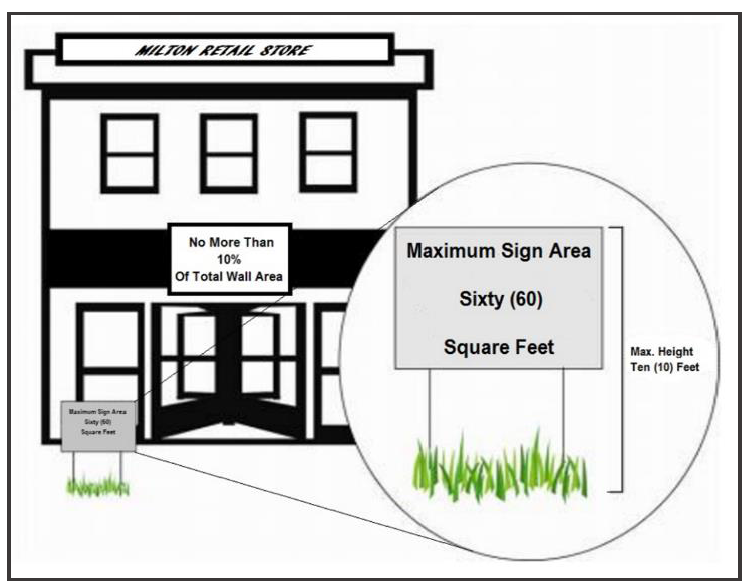
Figure 16.6.1. Front Yard Signage
b.
Walls Signs.
i.
Total square footage shall not exceed 10% of the wall(s) on which they are located or a maximum of 60 square feet, whichever is less.
ii.
Shall not pose any safety concerns nor impede pedestrian traffic.
iii.
Banners may not exceed 32 square feet in area and shall not cover greater than 10% of window area per wall.
(2)
Wind Signs.
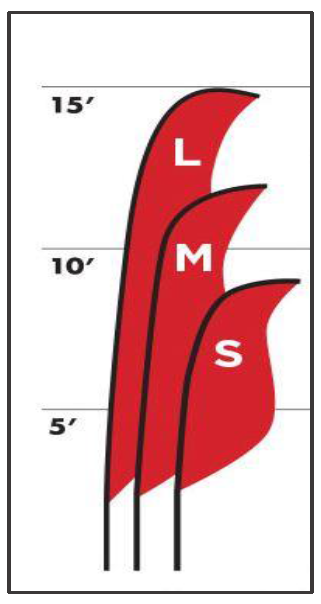
Figure 16.6.2. Wind Sign Diagram
a.
In addition to the above allowed temporary signage, signs, commonly referred to as wind signs, also known as feather, tear drop, and blade flags, commonly consisting of a pole and a suspended sign made of a flexible material such as canvas, sail cloth, or plastic and fastened in such a manner as to move upon being subjected to pressure by wind, shall be, from the date of Business License issuance, temporarily permitted for a period of time not to exceed 30 consecutive days during four differing periods each calendar year.
i.
The permit for the wind sign shall be renewable after the initial 30 day period has lapsed on no more than three additional 30 day periods each during the first year and four periods each subsequent calendar year.
b.
A sign permit for the placement of a wind sign must be obtained prior to the placement of any wind signs each time said signs are displayed in compliance with section a. above.
c.
Wind sign placement shall be limited by the following:
i.
Wind signs are prohibited outside of the C1, C2, C3, and SSC-RC zoning districts.
ii.
Wind signs shall be limited to one sign per pole.
iii.
The number of wind signs shall be limited to two per street frontage or parcel and no more than one wind sign per mobile food vendor. Mobile food vendor wind signs do not count towards the two per street frontage or parcel limit.
1)
Businesses on lots of 500 feet of street frontage or more, shall be permitted one additional wind sign.
2)
Businesses in multi-tenant complexes shall be limited to one wind sign. In no case shall the total number of wind signs exceed four (4), not including wind signs as authorized to mobile food vendors.
iv.
Wind signs shall be constructed of nylon, canvas, or plastic materials only.
v.
Wind signs shall be maintained in a good condition without fraying and tearing for the life of the permit.
vi.
Each wind sign shall be limited to 24 square feet in area.
vii.
Wind sign height shall not exceed 15 feet.
viii.
Wind signs shall not be permitted in any public or private right-of-way.
ix.
Permitting fees shall be as established in the City of Milton's annual fee resolution.
(3)
Non-Residential parcels or units within multi-tenant complexes, in the D-CM and R-C1 zoning districts may display temporary signage as follows.
a.
Walls Signs.
i.
Total square footage shall not exceed ten (10) percent of the wall(s) on which they are located or a maximum of 60 square feet, whichever is less.
ii.
Shall not pose any safety concerns nor impede pedestrian traffic.
iii.
Banners may not exceed ten (10) percent of the square footage of the street (front) face of the unit or store front or 32 square feet in area, whichever is less and shall not cover greater than 25 percent of window area per wall.
C.
Residential Zoning Districts. Parcels within the R-1AA, R-1A, R-1, R-2, and R-3 zoning districts may display temporary signage as follows:
a.
Free Standing Yard Signs.
i.
A parcel located in any residential zone may display no more than four temporary signs per lot with an aggregate sign area of no more than twelve (12) square feet.
ii.
No individual sign shall exceed six square feet, nor exceed five feet in height.
b.
Wall Signs and Banners.
i.
In lieu of free standing yard signs, one banner or wall sign may be attached to the primary structure.
ii.
Wall signs and banners may not exceed eighteen (18) square feet in area.
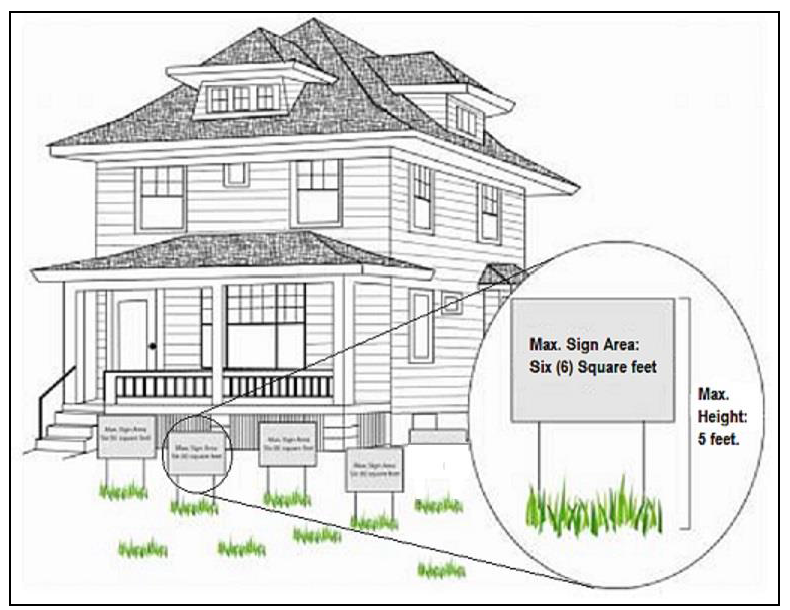
Figure 16.6.3. Residential District Temporary Signage
D.
Sign Standards in the Historic District. Signs in the historic district shall be regulated in accordance with the requirements for the land use district in which the proposed development activity is located. In addition, the provisions contained in the supplementary design review regulations within the Historic District, regarding sign patterns and colors, etc., shall apply.
E.
Sign Standards in Community Redevelopment Areas. Signs in the designated Community Redevelopment Areas shall be regulated in accordance with the requirements for the land use district in which the proposed development activity is located. In addition, the provisions contained the supplementary design review regulations within the Community Redevelopment Areas, regarding sign patterns and color, etc., shall apply.
(Ord. No. 1992-23, § I, 10-10-2023)
16.8 - PORTABLE SIGN STANDARDS
A.
Generally.
(1)
Portable Signs shall be permitted as Permanent Signs in the D-CM, R-C1, and SSC-RC zoning districts only.
(2)
Permitted portable signage include A-Frame and Poster Frame type signs only.
(3)
Businesses shall be permitted one Portable Sign per public entrance in addition to all other permanent and temporary signage permitted by this Article.
(4)
Portable Signs shall comply with the following standards:
a.
Required Dimensions: Portable signs shall be a minimum of 28 inches tall and shall not exceed 48 inches in height. Portable signs shall not exceed 24 inches in width. The portable structure shall be a minimum of 18 inches in width.
b.
Portable signs shall contain information and advertising for the business placing the sign only and shall not contain any endorsement or logos for any other business off-premises.
c.
Portable signs shall not block building entrances or exits.
d.
Portable signs shall have a locking arm or other device to stabilize the structure.
e.
Portable signs shall comply with the accessibility requirements of Florida Statutes.
f.
Portable signs shall be displayed only during the hours of operation of the business being advertised.
g.
Portable A-frame signs shall be located abutting the building or the curb of the street.
h.
Portable signs shall not block access to parking spaces or block traffic lanes.
i.
A minimum sidewalk clearance or pathway of five (5) feet (60 inches) in width shall be maintained.
j.
Portable signs shall comply with the sight visibility triangle requirements set forth in this Code.
k.
Businesses with street level public access shall place their portable sign(s) within the tenant frontage of the business only.
l.
Multi-tenant developments shall be permitted one Portable sign per each common exterior public business entrance.
m.
Portable signs shall not be illuminated.
n.
Portable signs shall be spaced a minimum of 15 linear feet from all other Portable signs.
o.
The City of Milton may require the temporary removal of Portable signs during special events.
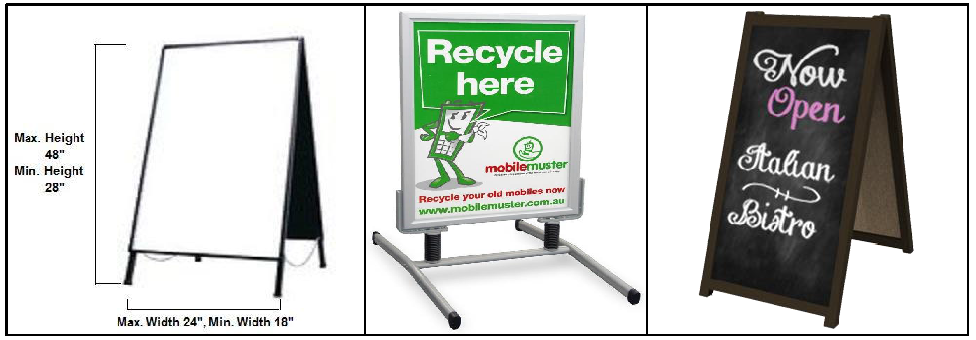
Figure 16.7.1. Portable Sign Diagram and Examples
(Ord. No. 1992-23, § I, 10-10-2023)
16.9 - OTHER ADVERTISING AND SIGNAGE STANDARDS
A.
Usage and Removal of Political Campaign Advertisement.
(1)
Candidate Responsibility. Each candidate, whether federal, state, county or city, shall not engage in nor perform Campaign Activity, as defined in Part II of the City of Milton Code of Ordinances, Chapter 4, Section 4-34, until a period of 100 days prior to the scheduled date of the election for councilmember or mayor as regulated by Section 4-35—Regulation of Campaign Activity.
(2)
Candidate Responsibility. Each candidate, whether federal, state, county or city, displaying or causing to be displayed any political campaign advertisement within the city shall make a good faith effort to remove all of his or her political campaign advertisements within 30 days after:
a.
Withdrawal of his or her candidacy;
b.
Having been eliminated as a candidate; and
c.
Being elected to office. However, the candidate shall not be required to remove those political campaign advertisements which are in the form of approved general advertising signs used by an outdoor advertising business as provided in F.S. Ch. 479. The provisions herein shall not apply to political campaign advertisements placed on motor vehicles, or campaign messages designated to be worn by a person.
d.
The city clerk shall notify all candidates whose political campaign advertisements might be displayed in the city in writing of the provisions of this section by U.S. mail or by hand delivery.
(3)
Individuals who intend to seek election or re-election as a councilmember or mayor are prohibited from displaying or causing to be displayed any political campaign advertisements within the city prior to filing a written acceptance of their nomination as a candidate pursuant to Article V the City Charter.
(4)
Placement. No political campaign advertisement shall be erected, posted, painted, tacked, nailed, or otherwise displayed, placed or located on or above the right-of-way of any street or highway located within the city, or affixed to any tree located within the city.
(5)
Enforcement. If political campaign advertisements are not removed within the specified period, the city shall have the authority, through the code enforcement officer, to remove such advertisements and to charge the candidate the actual cost of removal, or the sum as currently established or as hereafter adopted by resolution of the city council from time to time, whichever is greater. Funds collected for removing such advertisements shall be deposited to the city's general revenue.
B.
Utility Signage.
A.
Public utility signs that identify the location of underground utility lines and facilities, high voltage lines and facilities, and other utility facilities and appurtenances are permitted so long as they do not exceed three feet in height, and so long as the sign face does not exceed one-half square foot.
C.
Wall Graphics.
(1)
Within the historic district.
a.
No new additional wall graphics will be allowed on a regulated historic structure or a contributing historic structure unless approved by the historic preservation board. New wall graphics on regulated historic structures shall be historically correct for the period and shall be based on the best historical information available and the guidelines established in this section. The city Planning and Development Department shall be allowed to approve the replacement in kind of an existing wall graphic provided there are no changes to the wall graphic.
b.
Wall graphics will be allowed on structures within the historic district, only if meeting the following regulations:
i.
Depict events within the 1820 to 1939 era;
ii.
No living person shall be depicted; and
iii.
The wall graphic shall be reviewed and approved by the city historic preservation board.
(2)
Application process and requirements.
a.
Pre-board meeting/application.
i.
The applicant shall prepare a sign application.
ii.
The location of the wall graphic shall be specific as to the exact location of the graphic on the structure.
iii.
A written concept and rational for the wall graphic shall be submitted with the sign application.
iv.
A concept sketch shall accompany the sign application.
v.
The application and supporting data shall be provided to the Planning and Development Department no later than ten days prior to any required board meeting.
b.
Wall graphic permits shall be valid for a period of six months. Upon application a one-time extension may be granted, not to exceed three months.
c.
Second meeting.
i.
The final location of the wall graphic.
ii.
The final size (length and width) of the graphic.
iii.
An artist sketch or rendition of the wall graphic. This can be a black and white rendition.
iv.
A copy of the artist contract.
v.
A copy of the building or building owner contract, which includes maintenance of the wall graphic.
vi.
A description of the wall preparation, specifications on the paint to be used for the wall graphic, specifications on the overcoat and/or protective coat to be used and a description of the colors to be used in the graphic.
d.
Third meeting.
i.
Prior to placing the wall graphic on the approved site, the sponsor shall provide the Planning and Development Department a full color rendition of the wall graphic. If the presented rendition is substantially in accordance with the previously approved application, the Planning and Development Department shall issue the:
1)
Development order;
2)
Certificate of appropriateness; and
3)
Permit.
ii.
Should the rendition deviate from the submitted application the Planning and Development Department shall present the color rendition, the original application and comments for consideration at a meeting under subsection (2)(b) of this section.
(3)
Within the city, excluding the historic district.
a.
Wall graphics will be allowed only in commercial districts.
b.
Wall graphics will be allowed only on commercial buildings.
c.
Allowable wall graphics shall include:
i.
Depictions that pertain to the building or structure;
ii.
The city's history or heritage; or
iii.
The history or heritage of the greater Milton area. Such area may include an area of ten miles from the intersection of the Blackwater River and Highway 90.
iv.
Artwork that, in the opinion of the Planning Director, adds value to and is in line with the City's aesthetic, cultural, and zoning district characteristics and is not harmful to minors.
d.
Submittal to and approval shall be obtained from the city Planning and Development Department prior to any work being performed.
(Ord. No. 1992-23, § I, 10-10-2023)
16.10 - UNSAFE, UNLAWFUL, AND ABANDONED SIGNS
A.
Removal of Unsafe, Unlawful, or Abandoned Signs.
(1)
The owner, person, or firm maintaining a sign shall remove the sign when it becomes unsafe, is in danger of falling, or it becomes so deteriorated that it no longer serves a useful purpose of communication, or it is determined by the Planning Department to be a nuisance, unsafe, or it is unlawfully erected in violation of any of the provisions of this Article.
a.
The Department may remove or cause to be removed the sign at the expense of the owner and/ or lessee in the event of the owner or the person or firm maintaining the sign has not complied with the terms of a Notice of Noncompliance within thirty (30) days of the date of receipt of the notice. In the event of immediate danger, the Department may remove the sign immediately upon the issuance of notice to the owner, person, or firm maintaining the sign.
B.
Abandoned Signs.
(1)
It shall be the responsibility of the owner of any property upon which an abandoned sign is located to remove such sign within 365 days of the sign becoming abandoned as defined in this section. Removal of an abandoned sign shall include the removal of the entire sign including the sign face, supporting structure, and structural trim.
(2)
Where the owner of the property on which an abandoned sign is located fails to remove such sign in a 365 days the Department may remove or have such sign removed.
a.
Any expense directly incurred in the removal of such sign shall be charged to the owner of the property. Where the owner fails to pay, the City may file a lien upon the property for the purpose of recovering all reasonable costs associated with the removal of the sign.
(3)
Any Temporary sign not complying with the requirements of this Article is illegal and subject to immediate removal without notice.
C.
Nonconforming Signs.
(1)
Nonconforming signs are subject to Article 10, Nonconforming Structures Uses of Land: land with Minor Structures Only. Should an existing nonconforming sign be damaged and/or destroyed, the sign location shall be preserved for a period of up to six months; provided the following conditions are met or exceeded:
a.
The sign shall be reconstructed within a six-month period from the date of the incident which damaged the original sign; and
b.
The reconstructed sign shall meet all other size, setback and height requirements of these regulations.
(2)
Consistent with F.S. § 479.15, harmony of regulations, nonconforming outdoor signs may be relocated or reconstructed in accordance with that statute, as amended, such that the city will not be responsible for just compensation for removal.
(3)
Signs on the Premises of Legally Non-Conforming Uses.
a.
Signs on the premises of legally nonconforming uses may remain until the existing use of the premises is discontinued.
b.
If a sign wears out or is damaged (including rust, faded colors, discoloration, holes, or missing parts or informational items), or is changed for any other reason, the number, size, and area of all signs relating to the premises shall conform to these regulations.
D.
Enforcement and Penalty.
(1)
A Code Enforcement Officer and/or the City Police Department shall enforce these regulations.
(2)
A Code Enforcement Officer or a Police Officer may, in his or her own discretion, remove a sign, which is in violation of these regulations.
(3)
Snipe signs and temporary signs found out of compliance with this Code may be removed by a code enforcement officer at the owner's expense.
a.
The owner of the sign, as determined by the Code Enforcement Officer, shall be charged the actual cost of removal, or the sum as currently established or as hereafter adopted by resolution of the city council from time to time, whichever is greater.
(Ord. No. 1992-23, § I, 10-10-2023)

