
Minneapolis City Zoning Code
CHAPTER 565
- DEFINITIONS
565.10. - Definitions.
Unless otherwise expressly stated, or unless the context clearly indicates a different meaning, the words and phrases in this chapter of definitions shall, for the purposes of this zoning ordinance, have the meanings indicated. Additional definitions may be found within specific chapters of this zoning ordinance. All words and phrases not defined shall have their common meaning.
565.20. - Definitions beginning with A.
Affordable housing. Residential housing affordable to and occupied by households earning a percentage of the area median household income as specified in the Unified Housing Policy.
Alley. A service roadway within a right-of-way providing a secondary means of motor vehicle access to abutting property and not intended for general traffic circulation.
Alternative financial establishment. A person, firm, association, corporation or partnership engaged in the business or service of check-cashing or making loans to be repaid in one (1) lump sum or in installments over a set period of time, either collateralized or not, for which there is a fee or service charge, or interest received, including but not limited to loans collateralized by personal check, payroll check, wage assignment or personal property title, or collateralized with the promise to relinquish possession of any personal property upon default. Alternative financial establishment includes but is not limited to consumer small loan lenders, currency exchanges, industrial loan and thrifts, and regulated loan companies, as defined and licensed by the Minnesota Department of Commerce. Alternative financial establishment does not include federal or state chartered banks, credit unions, or savings banks, nor does it include a person, firm, association, corporation or partnership that provides the service of cashing checks, drafts, money orders, or travelers' checks for a fee, incidental to the person's primary business and the charge for cashing a check or draft does not exceed one dollar ($1.00) or one (1) percent of the value of the check or draft, whichever is greater. An alternative financial establishment shall not include any use which could be defined as a pawnshop.
Ammunition. Cartridge cases, primers, bullets, or propellant powder designed for use in any firearm.
Amphitheater. An outdoor venue used for music, entertainment, performances, and similar public assembly events.
Animal boarding. A facility or service where animals are kept or maintained (day or overnight), for the care, training, exercising, and/or socializing by a person other than the owner of the animals for a fee. Animal boarding may include incidental grooming, dog walkers or training services. Animal boarding does not include facilities that provide breeding of animals, selling of animals, or facilities whose primary source of revenue is licensed veterinarian services.
Animal shelter. A facility that houses homeless, lost, or abandoned animals or provides temporary boarding services for domestic animals.
Antique firearm. Any firearm (including any firearm with a matchlock, flintlock, percussion cap or similar type of ignition system) manufactured in or before 1898.
Antiques and collectibles store. An establishment where used property or cultural or collectible objects such as stamps, coins, sports memorabilia, and art works are sold for collective purposes, where all or a substantial part of the value of the property is derived from its age, uniqueness or historical association.
Apiary. The assembly of one (1) or more colonies of honeybees at a single location.
Aquaculture. The cultivation, maintenance, and harvesting of aquatic species.
Aquaponics. The combination of aquaculture and hydroponics to grow food or ornamental crops and aquatic species together in a recirculating system without any discharge or exchange of water.
Arbor. A landscape structure consisting of an open frame with horizontal and/or vertical latticework often used as a support for climbing food or ornamental crops. An arbor may be freestanding or attached to another structure.
Assisted living. A facility registered with the Minnesota Department of Health (DOH) where individualized home care aide services or home management services are provided to residents either by the management or by providers under contract with the management.
Automobile repair, major. An establishment engaged in performing repairs to, and the servicing of, passenger automobiles, where gasoline or other automobile engine fuel (store only in underground tanks), motor oil, lubricants, grease and minor accessories may be sold. Major repair may include all activities or repair or servicing of automobiles allowed in a minor automobile repair establishment, and rebuilding or reconditioning of passenger automobiles, body, frame or fender straightening, replacement or repair, painting or rust-proofing, or other similar repair or servicing of automobiles. Such work excludes commercial wrecking or dismantling, scrap/salvage yards, tire recapping and truck-tractor repair. In addition, household and convenience items, food or other miscellaneous retail goods commonly associated with the same also may be sold.
Automobile repair, minor. An establishment engaged in performing repairs to, and the servicing of, passenger automobiles, where gasoline or other automobile engine fuel (stored only in underground tanks), motor oil, lubricants, grease, and minor accessories may be sold. Minor repair may include muffler replacement, oil changing and lubrication, tire repair and replacement except tire recapping, wheel alignment, brake repair, suspension repair, engine repair and replacement, transmission repair and replacement, flushing of radiators, servicing of air conditioners, audio installation, detailing, and other activities of repair or servicing of automobiles, except rebuilding or reconditioning of passenger automobiles, body, frame or fender straightening, replacement or repair, painting or rustproofing. In addition, household and convenience items, food or other miscellaneous retail goods commonly associated with the same also may be sold.
Awning. A roof-like cover, often constructed of fabric, plastic, vinyl, metal or glass, designed and intended for protection from the elements or as a decorative embellishment, and which projects from a wall of a structure.
565.30. - Definitions beginning with B.
Bank or financial institution. A bank, trust company, bank and trust company, or savings bank organized under the laws of the State of Minnesota, or any national banking association or affiliate exercising trust powers in Minnesota. A bank or financial institution shall not include any use which could be defined as an alternative financial establishment.
Banner. A piece of fabric or similar lightweight material generally with no enclosing framework, which is designed either for decoration or to provide signage, and which may be mounted to a pole or building at one (1) or more edges.
Bar. A use primarily engaged in the sale of alcoholic beverages for consumption on the premises that is not a nightclub, restaurant or theater. A bar may also be referred to as a cocktail lounge, pub, saloon, or tavern. Providing live entertainment or recorded music with or without a stage may be incidental and accessory to the principal use in terms of floor area, but is not the primary attraction during business hours open to the public. An entrance fee is not typically charged during open hours of operation, but may be charged to view the entertainment.
Bay window. A projection from a building primarily constructed of windows that is one (1) or more feet above the adjacent grade.
Bed and breakfast home. An establishment in a private dwelling that provides temporary accommodations to overnight guests for compensation. Bed and breakfast homes are distinguished from short-term rental units by the use standards in this zoning ordinance.
Birth center. A facility licensed by the Department of Health (DOH) for the primary purpose of performing low-risk deliveries that is not a clinic or hospital and where births are planned to occur away from a residence. Additional services provided may include prenatal care, parenting classes and postpartum care.
Block. A tract of land bounded by streets, or by a combination of streets, railroad rights-of-way, shorelines, waterways or boundary lines of the corporate limits of the city.
Block face. The half block area of property facing a street. Corner properties shall be considered part of two (2) block faces, one (1) for each of the two (2) intersecting streets.
Board and care home. A facility licensed by the Minnesota Department of Health (DOH) where one (1) or more persons who are not capable of self-preservation receive personal or custodial care (assistance with bathing, dressing and supervision).
Board of adjustment. The board of adjustment of the City of Minneapolis.
Brewery or distillery. A use engaged in primarily producing liquor that may or may not include a taproom, tasting room, or dining area. Providing live entertainment or recorded music with or without a stage may be incidental and accessory to the principal use in terms of floor area, but is not the primary attraction during business hours open to the public. An entrance fee is not typically charged during open hours of operation, but may be charged to view the entertainment.
Building. Any structure having a roof supported by columns or walls and intended for the shelter, housing or enclosure of any individual, animal, process, equipment, goods, or materials of any kind.
Building official. The individual designated by the director of the department of community planning and economic development to serve as the city's building official pursuant to Minn. Statutes, Section 326B.133.
Bulk regulations. Standards and controls that establish the maximum size of structures and the buildable area within which structures may be located, including height, floor area ratio, gross floor area, lot coverage, and yard requirements, but excluding residential density regulations.
565.40. - Definitions beginning with C.
Cannabis business. A commercial enterprise involved in cultivating, processing, distributing, or selling cannabis for recreational or medical use. For zoning purposes, "cannabis business" pertains to the land use activity at a site, not the state-issued license. Such businesses are subject to the specific use standards found in Chapter 545, Article II, Specific Use Standards, which apply to each use occurring on the property.
Cannabis cultivation. Planting, growing, harvesting, drying, curing, grading, or trimming of cannabis plants, cannabis flower, hemp plants, or hemp plant parts for recreational or medical use.
Cannabis delivery service. A person or entity that purchases cannabis flower, cannabis products, lower-potency hemp edibles, and hemp-derived consumer products from cannabis and lower-potency hemp edible businesses and transports and delivers those products to customers.
Cannabis dispensary. An entity that acquires, possesses, transfers, sells, dispenses, or distributes medical or recreational cannabis, products containing cannabis, and related supplies and products to the public.
Cannabis or lower-potency hemp edible manufacturing. An entity that creates cannabis concentrate and manufactures cannabis products and hemp-derived consumer products for recreational or medical public consumption; an entity that purchases hemp and artificially derived cannabinoids to make hemp concentrate, and manufactures artificially derived cannabinoids and hemp edibles for public consumption; an entity that packages and labels lower-potency hemp edibles for sale to customers; an entity that sells hemp concentrate, artificially derived cannabinoids, and lower-potency hemp edibles to other cannabis businesses and hemp businesses.
Cannabis testing facility. A facility licensed to obtain and test immature cannabis plants and seedlings, cannabis flower, cannabis products, hemp plant parts, hemp concentrate, artificially derived cannabinoids, lower-potency hemp edibles, and hemp-derived consumer products.
Cannabis transporter. An entity that transports immature cannabis plants and seedlings, cannabis flower, cannabis products, artificially derived cannabinoids, hemp plant parts, hemp concentrate, lower-potency hemp edibles, and hemp-derived consumer products from a cannabis business to a cannabis business.
Cannabis wholesaler. An entity that obtains, stores, and sells or otherwise transfers medical or recreational cannabis or hemp seeds, plants, flower, or other products for the purpose of resale or other transfer to a cannabis business, but not to consumers.
Canopy. A structure, often constructed of fabric, plastic, vinyl, metal or glass, with supports attached to the ground, sheltering an area or forming a sheltered walk to the entrance of a building.
Canopy tree. A deciduous tree that commonly grows to a mature height of thirty-five (35) feet or greater.
Child care center. A facility, other than a family or group family day care home, in which a child care program is operated for children under thirteen (13) years of age. A child care center may include a facility, such as a preschool or early childhood learning center, in which educational programs are provided for children up to an age eligible to enter kindergarten or their parents.
City. The City of Minneapolis.
City assessor. The City Assessor of the City of Minneapolis or their authorized representative.
City finance officer. The City Finance Officer of the City of Minneapolis or his or her authorized representative.
City council. The City Council of the City of Minneapolis.
City engineer. The director of the department of public works or their designee.
City planning commission. The City Planning Commission of the City of Minneapolis.
Clinic. An establishment where patients are admitted for medical or dental exams and treatment on an outpatient basis only. A use providing only counseling services shall not be considered a clinic.
Club or lodge. An establishment in which a limited group of people are organized to pursue common social or fraternal goals, interests or activities, and usually characterized by certain membership restrictions, payment of fees or dues, regular meetings and a constitution or bylaws.
Cluster development. A unified development of not less than two (2) dwelling units or rooming units, either attached or detached, in which one (1) or more principal buildings are grouped together in order to preserve common space for the benefit of the residents of the development. Cluster development allows flexibility in the location of residential structures and the size of individual lots in order to encourage a variety of housing types and the efficient use of land. Rooming units shall only be allowed as generally allowed for congregate living uses. Nonresidential uses shall only be allowed as allowed by this ordinance.
Coffee shop. An establishment engaged principally in the sale of coffee and other nonalcoholic beverages for consumption on the premises or for carryout, which may also include the sale of a limited number of food items.
Cold frame. An unheated outdoor structure built close to the ground, typically consisting of, but not limited to, a wooden or concrete frame and a top of glass or clear plastic, used for protecting seedlings and plants from cold weather.
Commercial speech. Speech advertising a business, profession, commodity, service or entertainment.
Common lot development. A development of two (2) or more dwelling units with two (2) principal residential structures on a shared zoning lot that is not a cluster development or a planned unit development.
Communication exchange. A building where phone calls are switched to and from major feeder lines, where internet service providers route internet traffic between their networks, or where some other form of electronic communication exchanges occur. Communication exchange shall not include a telecommunication tower, antenna or base site.
Community center. An establishment operated by a non-profit organization or government agency, which includes recreational and cultural facilities, meeting rooms, social service facilities and public health facilities, or any combination thereof, and that is not a public park. Community center uses may include after-school programs and tutoring.
Community correctional facility. A facility where one (1) or more persons placed by the court, court services department, parole authority, or other correctional agency having dispositional power over a person charged with or convicted of a crime or adjudicated delinquent reside on a twenty-four (24) hours per day basis, under the care and supervision of the Department of Corrections (DOC) or Hennepin County, or licensed by the Department of Corrections as a corrections facility, excluding detention facilities. The maximum capacity shall not exceed thirty-two (32) persons.
Community garden. A use in which land managed by a group of individuals is used to grow food or ornamental crops for donation or for use by those cultivating the land and their households. Community gardens may be divided into separate plots for cultivation by one (1) or more individuals or may be farmed collectively by members of the group and may include common areas maintained and used by group members.
Community provisions facility. A facility that provides services such as a food shelf, free clothing, meals or supplies, or day shelter. Ancillary services such as counseling or vocational training may be provided. Treatment for chemical dependency and overnight shelter are prohibited.
Community supported agriculture drop-off/pick up. Location where a farmer delivers or distributes farm shares and individuals pick up their shares at a set time weekly, biweekly or monthly.
Composting. The natural degradation of organic material, such as yard and food waste, into soil.
Contractor's office. An office providing building construction or property maintenance services, and which does not involve indoor and/or outdoor storage of building materials, machinery or equipment. Examples include but are not limited to plumbing, electrical and cleaning contractors.
Contractor's yard. An establishment providing general contracting or building construction services, and which involves indoor or outdoor storage of building materials, machinery or equipment.
Convention center, public. A convention center operated by the City of Minneapolis.
Crushing and processing for recycling or disposal of concrete, asphalt, and rock. A use in which the principal activity is performed in an open area where concrete, asphalt, rock, brick, cement, or other similar paving or building materials are crushed, ground, pulverized, bought, sold, exchanged, stored, mixed, packed, disassembled, or handled. A concrete, asphalt and rock crushing facility does not include:
a.
The use on a public roadway construction or repair project approved by the city engineer of equipment which directly moves along the roadway surface and grinds, or grinds, reconstitutes and resurfaces the roadway; or
b.
The temporary on-site crushing, grinding, or pulverizing of a razed building, parking area or structural materials, which are subject to Chapter 389 of the Minneapolis Code of Ordinances.
Curb level. The level of the established curb in front of a building or structure measured at the center of such front. Where no curb elevation has been established, the city engineer shall establish such curb elevation.
(Ord. No. 2024-041, § 14, 10-31-2024; Ord. No. 2025-023, § 87, 5-15-2025)
565.50. - Definitions beginning with D.
Daily living skills. Personal management and social skills, including but not limited to home care maintenance, food preparation, personal care, money management, and child rearing skills, that are necessary for adequate functioning on an independent basis.
Day care.
Family day care. Day care for no more than ten (10) children at one (1) time, of which no more than six (6) are under school age, and which is licensed to operate as a family day care home.
Group family day care. Day care for no more than fourteen (14) children at one (1) time and which is licensed to operate as a group family day care home.
Day labor agency. An establishment engaged in the temporary employment of persons on a daily basis where persons wait on the premises for work assignments or transportation to work assignments.
Demolition. The act of moving or razing a building, including the removal, substantial removal, or relocation of sixty (60) percent or more of the building's exterior within any five (5) year period, excluding additions constructed within the five (5) year period. The building's roof shall constitute twenty (20) percent of the total exterior above the finished floor of the first story. The remainder shall be a calculation of the percent change to the perimeter of the building, measured per story, in linear feet. For the purpose of this definition, removal shall include any adjustment to fenestration or wall location from the finished floor to the surface of the floor above.
Developmental achievement center. A facility in which a program of care, supervision, training or habilitation services, including adult day care, that is licensed by the Minnesota Department of Human Services (DHS) is provided to functionally impaired persons for less than twenty-four (24) hours per day.
Dormitory. A building operated by a college or university offering an accredited course of study, which is occupied only by university or college students and support staff who receive from the dormitory lodging or meals on the premises for compensation.
Drive-through facility. A facility which accommodates automobiles and from which the occupants of the automobiles may make purchases or transact business, including the stacking spaces in which automobiles wait. Examples include but are not limited to drive-up windows, menu boards, order boards or boxes, drive-in restaurants, and drive-up banks and automated teller machines. Drive-through facilities shall not include the direct refueling of motor vehicles, car washes, parking spaces used for customer pick-up or loading of goods or products purchased on-site or prior to the customer's arrival, or parking and loading spaces used for the donation of secondhand goods.
Driveway. The area used for vehicular access to an off-street parking area from a street or alley. Driveway shall also include the area used for vehicular access to areas of the zoning lot other than an off-street parking area.
Drug store. A convenience retail store with a pharmacy.
Dwelling. A building, or portion thereof, containing one (1) or more dwelling units, designed or used exclusively for human habitation.
Accessory dwelling unit. A dwelling unit that is located on the same lot as a principal residential structure to which it is accessory, and that is subordinate in area to the principal dwelling.
Multiple-family dwelling. A building, or portion thereof, containing three (3) or more dwelling units, not including an accessory dwelling unit.
Single-family dwelling. A building containing one (1) dwelling unit only, except that the structure may also contain an accessory dwelling unit where expressly authorized pursuant to this ordinance. A detached accessory dwelling unit shall not be considered a single-family dwelling unit for the purposes of this ordinance.
Two-family dwelling. A building containing two (2) dwelling units only, neither of which is an accessory dwelling unit, and each of which is separated from the other by an unpierced wall extending from ground to roof for at least eighty (80) percent of the length of the structure or an unpierced ceiling and floor extending from exterior wall to exterior wall.
Three-family dwelling. A building containing three (3) dwelling units only, none of which are an accessory dwelling unit, and that are attached vertically or horizontally.
Dwelling unit. One (1) or more rooms, designed, occupied, or intended for occupancy as a separate contiguous living quarter, with a single kitchen facility, sleeping area, and bathroom provided within the unit for the exclusive use of a single household.
(Ord. No. 2025-023, § 88, 5-15-2025)
565.60. - Definitions beginning with E.
Educational arts center. A facility owned and operated by a non-profit organization where lessons in the performing and visual arts are offered, including music, theater and dance.
Emergency shelter. Any facility that provides sleeping accommodations and restroom facilities on a day-to-day basis to persons without permanent housing, for periods of greater than twenty-four (24) hours and less than six (6) months.
Entertainment venue. A building, facility, room, or portion thereof used for events or shows where activities are generally of a spectator nature that typically charge an entrance fee, but are not an amphitheater, convention center, nightclub, reception or meeting hall, regional sports arena, or theater (indoor). Spectator areas are primarily for standing room with limited seating. Business hours open to the public are set around scheduled events or shows.
Exhibition or temporary market. A temporary exhibition, sale, flea market, show or exposition of arts, crafts, antiques, or secondhand goods sold at tables, stalls, or booths at a fixed location.
565.70. - Definitions beginning with F.
Family. A person or persons as defined in Chapter 244 of the Minneapolis Code of Ordinances.
Farmers' market. A publicly or privately operated, open-air establishment where primarily agricultural products such as raw vegetables, fruits, syrups, herbs, flowers, plants, nuts or handcrafted items are sold. Non-agricultural products may be sold but the area dedicated to such products shall not occupy more than twenty-five (25) percent of the total sales area. Canopies may be allowed in order to provide protection from the elements for both the operators and the products.
Farmstand. A temporary structure for the display and sale of food or ornamental crops grown at a community garden, market garden or urban farm.
Fence. A structure providing a barrier or screening, but not protection against the elements, erected to provide privacy or security which defines a private space and enhances the design of individual sites.
Firearm. Any device, designed to be used as a weapon, which will or is designed to or may readily be converted to expel a projectile by the action of an explosive or other form of combustion, but excluding antique firearm, "BB" gun, scuba gun, stud or nail gun used in the construction industry, or pop gun or toy gun.
Firearms dealer. Any person engaged in the sale, lease, trade or other transfer of firearms or ammunition at wholesale or retail. Firearms dealer shall not include any person engaged only in the business of repairing firearms.
Floor area, gross (GFA). The gross floor area of a building is the sum of the gross horizontal areas of the several floors of the building measured from the exterior faces of the exterior walls, or from the centerline of walls separating two (2) buildings. The gross floor area of a building shall include basement floor area when one-half (½) or more of the basement height is above natural grade for more than fifty (50) percent of the total perimeter. The gross floor area shall also include elevator shafts and stairwells to each floor, penthouses, attic space having headroom clearances that meet building code minimum ceiling heights, interior balconies and mezzanines, enclosed porches, floor area devoted to accessory uses, and floor space used for mechanical equipment, except equipment located on the roof, unless otherwise specified in this chapter. The gross floor area of structures devoted to bulk storage of materials, including but not limited to grain elevators and petroleum storage tanks, shall be determined on the basis of height in feet, assuming one (1) floor for each fourteen (14) feet in height. In determining the gross floor area of an individual use within a multiple tenant building, the gross floor area is the sum of the gross horizontal areas measured from the interior faces of the interior walls of the space occupied by the use. Gross floor area shall include space devoted to structured off-street parking or loading facilities, including aisles, ramps and maneuvering space. Detached structures accessory to residential uses with three (3) units or less shall not count toward the gross floor area for the purpose of calculating the maximum floor area allowed on a lot.
Floor area ratio. The floor area ratio of the building or buildings on any zoning lot is the gross floor area of the building or buildings on that zoning lot divided by the area of such zoning lot.
Fraternity or sorority. A building which is occupied only by a group of university or college students and support staff who are associated together in a fraternity or sorority, which is officially recognized by a college or university offering an accredited course of study, and who receive from the fraternity or sorority lodging or meals on the premises for compensation.
Frontage. All the property abutting one (1) side of a street between the two (2) nearest intersecting streets measured along the line of the street, or if dead ended, then all of the property abutting on one (1) side between an intersecting street and the dead end of the street. In addition, frontage shall include all property abutting a limited access roadway right-of-way.
Primary frontage. For the purposes of applying the on-premises sign regulations, the frontage toward which the use faces or is oriented. Only one (1) such primary frontage shall be allowed on a zoning lot.
Secondary frontage. For the purposes of applying the on-premises sign regulations, a frontage that is not the primary frontage.
565.80. - Definitions beginning with G.
Gas station. An establishment that includes the sale or dispensing of gasoline, diesel fuel, or any other internal combustion engine fuel to the public.
Golf course. A tract of land laid out for at least nine (9) holes for playing the game of golf and improved with tees, greens, fairways, and hazards and that may include a clubhouse, shelter or other appurtenant structures. Practice driving ranges may also be located on the golf course. Miniature golf courses shall not be included in this definition.
Goods and services corridor. A linear feature mapped in the city's comprehensive plan providing guidance related to commercial activity.
Grade. The lowest point of elevation of the surface of the ground, paving or sidewalk within the area between the building and the property line or, when the property line is more than five (5) feet from the building, between the building and a line five (5) feet from the building.
Grade, natural. The grade of a site before it is modified by moving earth, adding or removing fill, or installing a berm, retaining wall or other earthwork feature. Natural grade is determined by reference to a survey, or other information as determined by the zoning administrator.
Greenhouse. A permanent structure that is devoted to the protection or cultivation of food or ornamental crops and constructed at least partially with glass, glass-like, or translucent material to optimize growing conditions with natural light.
Grocery store. A retail sales and services establishment where a majority of the sales area is dedicated to the sale of food products such as staple foods and accessory food items.
565.90. - Definitions beginning with H.
Habitable. Suitable for a person to live in. References to habitable spaces, areas, and portions of dwellings or principal structures shall include kitchens, hallways, bathrooms, closets, and unfinished areas easily converted to livable spaces, such as attics and basements, but does not include an attached accessory use designed or intended to be used for the parking of vehicles. References to habitable buildings shall include all habitable spaces and all attached structures to the habitable space including an attached accessory use designed or intended to be used for the parking of vehicles.
Height, structure or building. The vertical distance from the natural grade measured either at the curb level or at a point ten (10) feet away from the front center of the structure or building, whichever is closer, to the top of the highest point of the structure, unless otherwise exempted or defined in this ordinance. Where the roof is the highest point of the structure, height is measured to the top of the highest point of the roof on a flat or shed roof, the deck line on a mansard roof, or the average distance between the eave edge and the ridge level for gable, hip and gambrel roofs. Dormers exceeding fifty (50) percent of the building width below a gable, hip and gambrel roof shall be included in the measured vertical distance. On a corner lot, height shall be measured on that side of a building facing the front lot line. On a through lot, height shall be measured on that side of a building facing the front lot line where the natural grade is lowest.
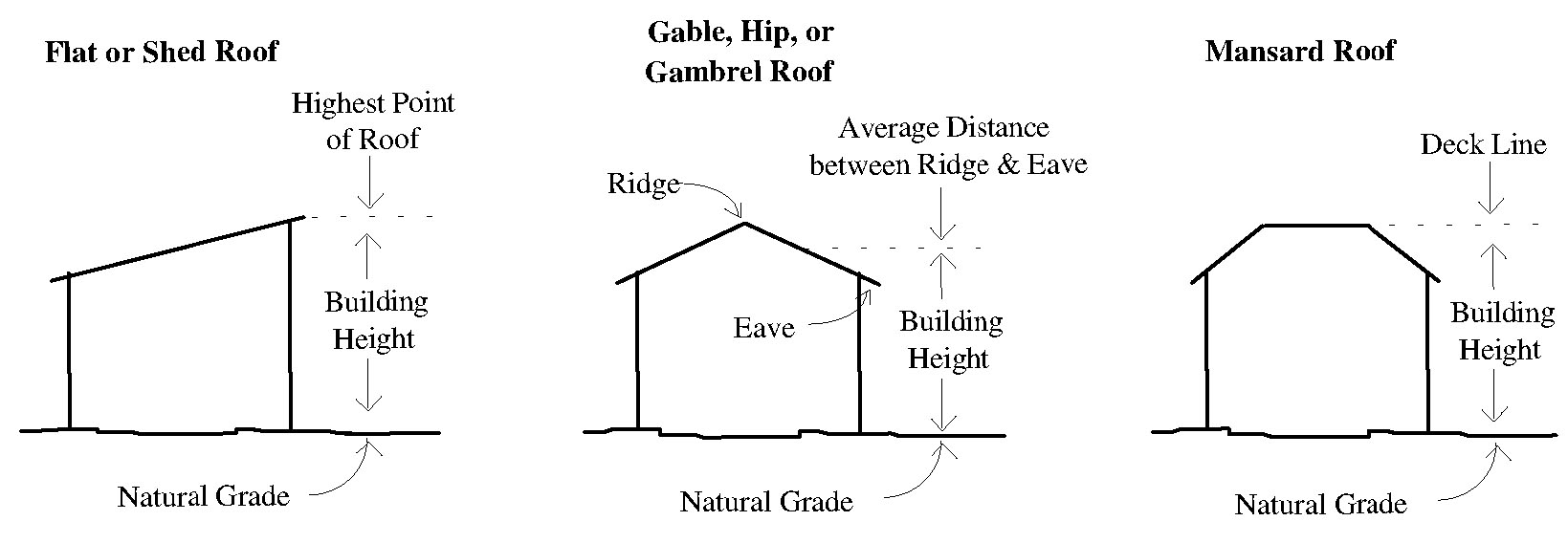
Height, structure or building
Home occupation. An occupation or profession carried on by a member of the household residing on the premises, conducted as an incidental and accessory use of a residential use. Also referred to as live-work.
Hoop house. A temporary or permanent structure typically made of, but not limited to, piping or other material covered with translucent material for the purposes of growing food or ornamental crops. A hoop house is considered more temporary than a greenhouse.
Hospital. An establishment where patients are admitted for medical, surgical, or psychiatric treatment for outpatient and/or inpatient, overnight accommodation.
Hospitality residence. A facility owned and operated by a non-profit organization that provides temporary housing to families of children being treated for life-threatening illnesses.
Hotel or hostel. An establishment containing rooming units providing short-term, temporary lodging accommodations to the general public, with rooms having access to the outside through an interior hallway connected to the main lobby of the building, and which may provide additional services such as restaurants, meeting rooms, entertainment, and recreational facilities. A hotel shall not include any use which could be defined as a motel.
Hours open to the public. The time during which a use is open to or does receive clients, customers, members, or guests.
Hydroponics. The growing of food or ornamental crops, in a water and fertilizer solution containing the necessary nutrients for plant growth.
(Ord. No. 2025-023, § 89, 5-15-2025)
565.100. - Definitions beginning with I.
Impervious surface. Any material which significantly reduces or prevents natural absorption of stormwater into the soil and cause water to run off the surface in greater quantities and at an increased rate of flow. Impervious surfaces include, but are not limited to, buildings or other structures with roofs, sidewalks, and all stone, brick, concrete, or asphalt surfaces.
Indoor recreation area. An establishment providing indoor recreation facilities such as bowling, pool/billiards, table tennis, and video and arcade games.
Inebriate housing. A facility that provides housing twenty-four (24) hours per day to persons who are chemically dependent and considered to be handicapped persons under the Federal Fair Housing Amendments Act of 1988. It does not include any facility licensed by the Minnesota Department of Human Services (DHS), Minnesota Department of Corrections (DOC), or any other county, state, or federal community correctional facility.
Intentional community. A group of two (2) or more persons living together as a single household, sharing in the management of resources and household expenses, that meets the requirements of Chapter 244, Housing Maintenance Code. An intentional community shall share an entire dwelling unit and may not function as a rooming house unless it is part of an intentional community cluster development.
Intentional community cluster development. An establishment operated by a non-profit organization, government agency, or healthcare agency, which includes dwelling units or rooming units and a common building with shared facilities.
Intermodal containerized freight facility. A facility that serves as a transfer point for containerized freight between rail and truck transportation modes. The principal activity is the transfer of freight containers or truck semitrailers between rail cars and trucks.
565.120. - Definitions beginning with K.
Kitchen. A room or area for the cooking or preparation of meals. At minimum, a kitchen shall be comprised of storage and workspace, a sink, a refrigerator, an oven, and a stove. Appliance components may be combined so long as all components are provided.
565.130. - Definitions beginning with L.
Laboratory, medical or dental. An establishment primarily engaged in providing professional analytic or diagnostic services to the medical profession, or to the patient, on direction of a physician; or an establishment primarily engaged in making dentures, artificial teeth, and orthodontic appliances to order for the dental profession.
Landscaping material sales. An establishment where products related to the planting, maintaining, or harvesting of trees, shrubs, plants, grasses or sod, fertilizers, soils, chemicals, or other goods and related products are sold to lawn and garden supply stores, landscape contractors, other retail outlets, or directly to the consumer in bulk quantity using heavy equipment to load, unload, or deliver products. Includes the sale and loading or unloading of bulk rock, mulch, soil, or similar materials utilizing heavy equipment.
Lawn and garden supply store. An establishment where products related to the planting, maintaining, or harvesting of trees, shrubs, plants, grasses or sod, fertilizers, soils, chemicals or other goods and related products are sold in small quantity to the public. Does not include the use of heavy equipment to load, unload, or deliver product to the consumer.
Library, public. A library operated by Hennepin County.
Licensing official. The individual designated by the director of the department of community planning and economic development to serve as the city's licensing official or their authorized representative.
Limited access roadway. Those roadways and roadway segments, including entrance and exit ramps and approaches, that are designated to prohibit nonmotorized traffic, and include I-35W, I-94, I-394, and Highway 62.
Limited production and processing. Small-scale assembly, disassembly, fabrication, manufacturing, cleaning, servicing, packaging, sorting or other handling of goods or materials, either as an intermediate input for further production or processing, or for final sale, use or consumption in a manner that is consistent and compatible with retail sales and services. Limited production and processing does not include processing of raw materials or production of primary materials, except for food and beverage products, and shall not include any use which may be classified as a moderate- or high-impact production and processing use. Wholesale and off-premises sales accessory to limited production or processing uses shall be permitted.
Limousine service. An establishment owning, leasing or operating by contract limousines and providing some or all of the following services such as dispatching, advertising, maintenance, insurance, record keeping, driver assignments and other related services.
Loading space. An off-street space or berth used for the temporary parking of a vehicle while loading or unloading cargo, products or materials from such vehicle.
Lot. A designated parcel, tract or area of land established by plat, subdivision or as otherwise permitted by law.
Corner lot. A lot with frontage on two (2) or more streets at their intersection or on two (2) parts of the same street forming an interior angle of less than one hundred thirty-five (135) degrees.
Reverse corner lot. A corner lot that includes more than one (1) lot line adjacent to streets of which one (1) lot line is substantially a continuation of the front lot line of the adjacent property to the rear.
Through lot. A lot that fronts upon two (2) generally parallel streets or that fronts upon two (2) streets that do not intersect at the boundaries of the lot.
Zoning lot. A single, buildable parcel of land under common ownership or control, occupied by one (1) or more principal buildings or uses, accessory buildings or uses, and all yards and open spaces, as required by the zoning ordinance. A zoning lot may consist of more than one (1) platted lot, but shall not be separated by a public street.
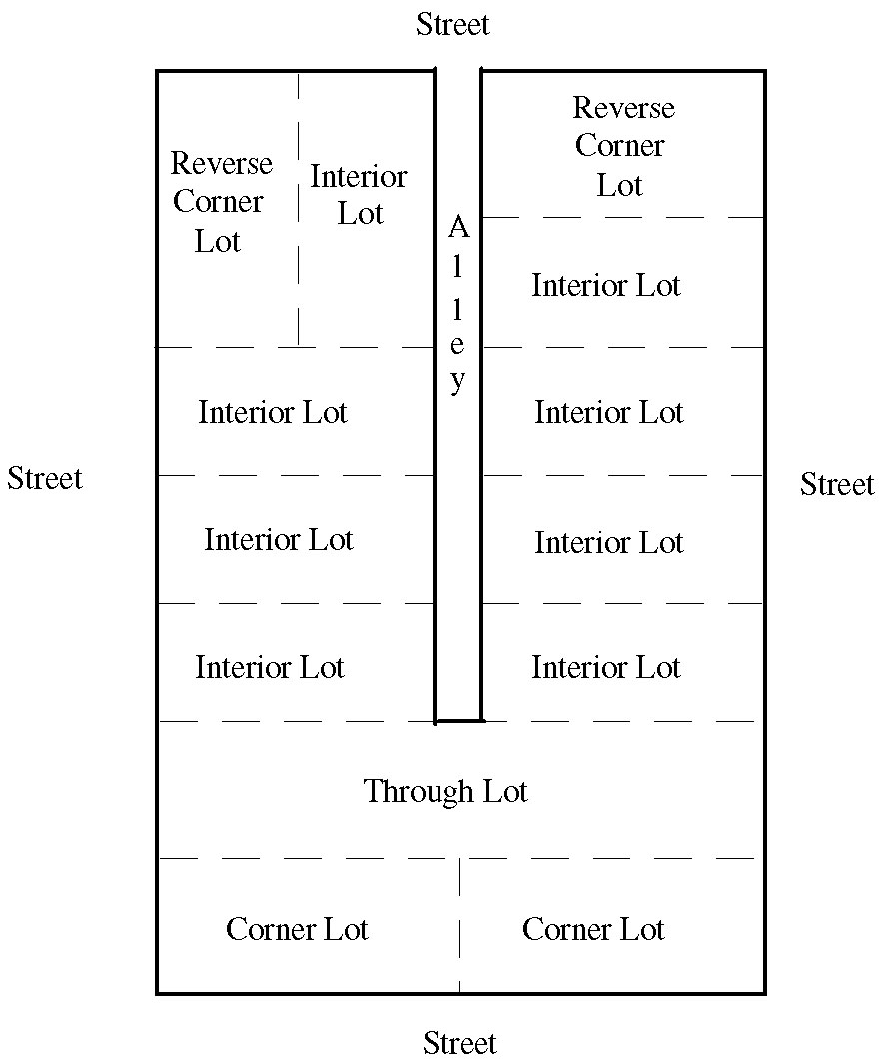
Zoning lot
Lot area. The area bounded by the front, side and rear lot lines, but not including any area occupied by the waters of a duly recorded lake, river, street or alley right-of-way.
Lot coverage. The area covered by principal and accessory structures. Lot coverage shall not include awnings, canopies, balconies, eaves, and signs that meet the standards for permitted obstructions in required yards.
Lot depth. The average distance between the front lot line and the rear lot line of a lot.
Lot line. A line of record bounding a lot that divides one (1) lot from another lot or from a public or private street or alley or any other public space.
Corner side lot line. A side lot line which adjoins a public street.
Front lot line. A boundary of a lot which is along an existing or dedicated public street, but not an alley. On a corner lot, the front lot line shall be the lot line that is in line with the predominant platting orientation of the block.
Rear lot line. The lot line opposite and most distant from the front lot line. In the case of triangular or otherwise irregularly shaped lots, a line ten (10) feet in length entirely within the lot, parallel to and at a maximum distance from the front lot line.
Side lot line. Any boundary of a lot which is not a front lot line or a rear lot line.
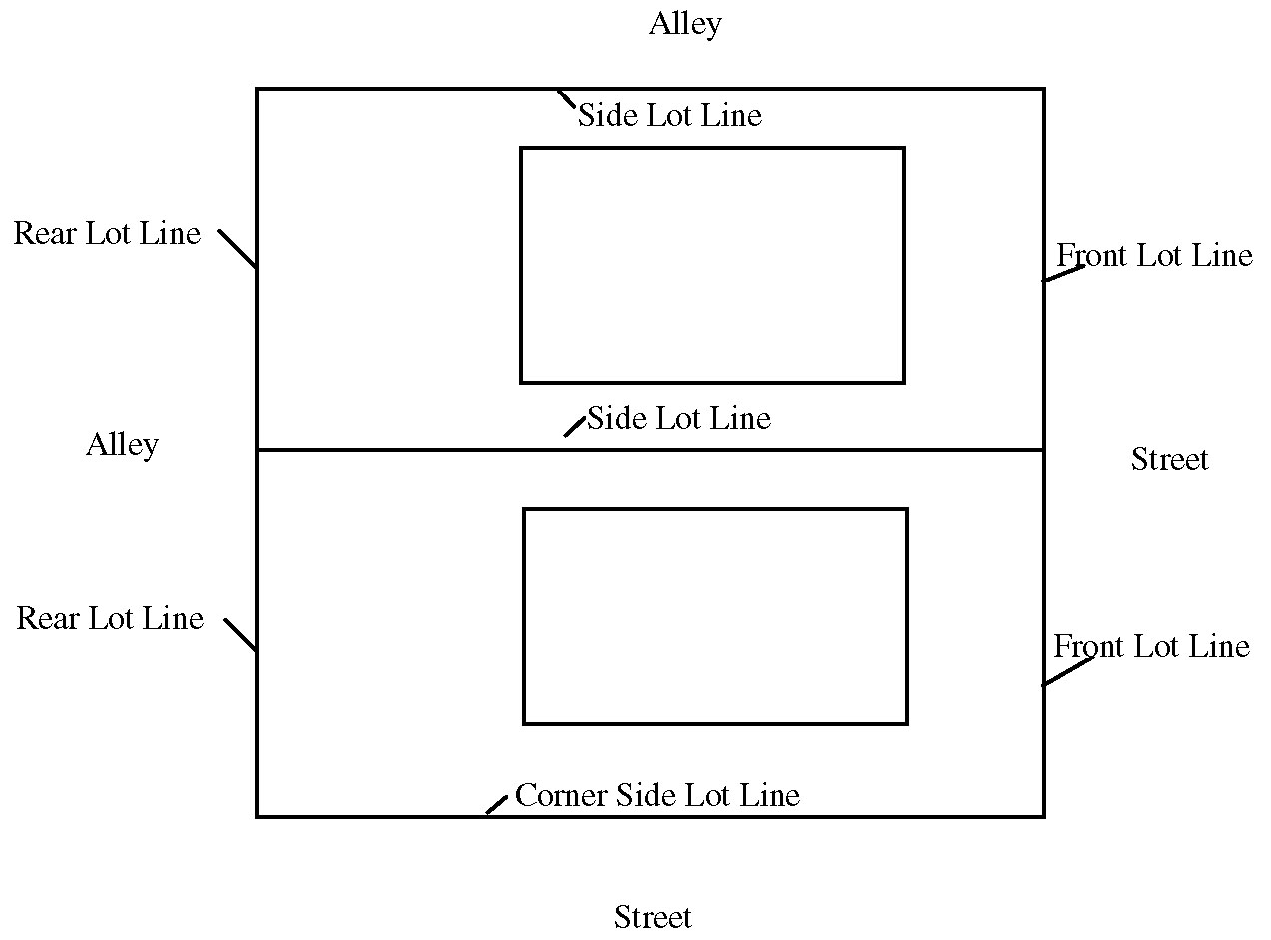
Lot Lines
Lot of record. A parcel of land of which the plat, deed, or similar instrument has been duly recorded in the Office of the Hennepin County Recorder or Registrar of Titles.
Lot width. The distance between the side lot lines of a lot measured along a straight line parallel to the front lot line immediately in back of the required front yard. Where no front yard is required, lot width is the distance between the side lot lines of a lot measured along the front lot line.
Lower-potency hemp edible business. A lower-potency hemp edible manufacturer, lower-potency hemp edible retailer, or any business that produces, manufactures, transports, or sells lower-potency hemp edible products. Such businesses are subject to the specific use standards found in Chapter 545, Article II, Specific Use Standards, which apply to each use occurring on the property. All lower-potency hemp edible businesses must be licensed by the State of Minnesota prior to operation.
Lower-potency hemp edible retailer. An entity that possesses, transfers, sells, dispenses, or distributes lower-potency hemp edible products and related supplies and products.
Luminance. The physical measure of brightness or light emanating from an object with respect to its size. The unit of measurement for luminance is nits, which is the total amount of light emitted from a sign divided by the surface area of the sign (candela per square meter).
(Ord. No. 2024-041, § 15, 10-31-2024; Ord. No. 2025-023, § 90, 5-15-2025)
565.140. - Definitions beginning with M.
Manufactured home park. A development of two (2) or more manufactured homes as defined in Minn. Statutes, Chapter 327.
Market garden. An establishment where food or ornamental crops are grown on the ground, on a rooftop or inside a building, to be sold or donated.
Marquee. A permanent, roof-like structure projecting over an entryway, parallel to the ground, generally designed and constructed to provide protection from the elements.
Massage and bodywork establishment. Any establishment wherein massage and/or bodywork is offered or provided to members of the public.
Mayor. The Mayor of the City of Minneapolis.
Medical helistop. An identifiable landing area for discharging and picking up passengers and goods, by helicopter or similar vertical lift aircraft, located on the property of a hospital. No refueling or servicing of aircraft, or permanent facilities, including terminals, hangars, warehousing or storage, are permitted.
Medication-assisted treatment site. A facility licensed by the state of Minnesota, providing short-term in-patient care to persons with substance use disorders undergoing medically-assisted detoxification or withdrawal treatment. Not to include similarly licensed services within an existing state licensed hospital.
Mini-market. A type of farmers market, limited to five (5) or fewer market vendors, whose primary purpose is to improve access to locally grown agricultural products.
Motel. An establishment containing rooming units designed primarily for temporary, short-term accommodations with rooms having a separate entrance providing direct access to the outside.
Motor freight terminal. A building or area in which freight is assembled or stored for routing in intrastate or interstate shipment, and which is not a package delivery service.
Motorized scooter. Any two (2) wheeled device that is powered by an electric motor or an internal combustion engine that has handlebars, wheels up to ten (10) inches in diameter and is designed to be stood or sat upon by the operator. This definition excludes motorcycles and segways.
Mural. A hand-painted, hand-tiled, or digitally printed work of visual art that is either affixed to or painted directly on the exterior wall of a structure with the permission of the property owner. A mural does not include displays with electrical or mechanical components or a changing image art display.
565.150. - Definitions beginning with N.
Neighborhood electric vehicle. A four-wheeled, battery powered electric motor vehicle that, for the purposes of this zoning ordinance, includes both neighborhood electric vehicles and medium speed electric vehicles as defined in Minn. Statutes, Section 169.011.
Nightclub. An assembly use engaged in the sale of alcoholic beverages for consumption on the premises within a building, facility, room, or portion thereof containing a stage used for live or recorded music and with minimal or no seating. Providing entertainment is the predominant attraction during business hours open to the public and an entrance fee is typically charged.
Non-commercial speech. Dissemination of messages not classified as commercial speech which include, but are not limited to, messages concerning political, religious, social, ideological, public service, and informational topics.
Nonconforming lot, legal. A lot of record, lawfully existing on the effective date of this chapter or amendment thereto that does not comply with one (1) or more of the lot area or lot width regulations applicable in the district in which it is located.
Nonconforming structure, legal. A structure or portion thereof, lawfully existing on the effective date of this chapter or amendment thereto that does not comply with one (1) or more of the bulk regulations applicable in the zoning district in which it is located.
Nonconforming use, legal. A use of land or structures, lawfully existing on the effective date of this chapter or amendment thereto that currently is not allowed, or that does not comply with one (1) or more of the regulations applicable in the zoning district in which it is located.
Nursing home. A facility for aged, chronically ill, or incurable persons licensed by the Minnesota Department of Health providing nursing care and related medical services.
565.160. - Definitions beginning with O.
Outdoor recreation area. An establishment providing outdoor recreation facilities such as a golf driving range, skating rink, miniature golf course or other nonmotorized amusement. An outdoor recreation area shall not include an outdoor theater.
Outdoor sales and display. The outdoor placement or presentation of goods, materials or merchandise for sale on the premises.
Outdoor storage. The outdoor placement or depositing of goods, materials, equipment, stock or supplies.
Overlay district. A zoning district that encompasses one (1) or more primary zoning districts or portions thereof and that imposes additional requirements, or relaxes one (1) or more standards required by the primary zoning district.
Overnight shelter. A facility providing temporary housing for a period of time not to exceed twenty-four (24) hours to persons without permanent housing.
565.170. - Definitions beginning with P.
Package delivery service. A use which transports individual packages for expedited delivery in single rear axle straight trucks or smaller vehicles, where no single item weighs over one hundred fifty (150) pounds.
Park, neighborhood. A public park less than six (6) acres, designed to serve a single neighborhood.
Park, public. A park operated by the City of Minneapolis, including all park buildings.
Parking aisle. The clear area for either one- or two-way traffic movement and maneuvering between rows of parking spaces.
Parking facility. An area, either a parking lot or garage, that provides short-term or long-term off-street parking for motor vehicles. Parking facility includes designated locations for vehicles engaged in loading or unloading of passengers or goods. Parking facility does not include commercial or industrial yard areas for storage, handling, processing, pickup or delivery of goods, materials or equipment, such as building materials sales yards, scrap/salvage yards, metal milling facilities, contractor's yards and other similar uses. A parking facility may be a principal or an accessory use.
Parking garage. A structure or any portion thereof designed for the parking of one (1) or more motor vehicles, not including display or storage of motor vehicles for sale.
Parking lot. A ground level, open area used for the short-term or long-term parking of motor vehicles. A parking lot includes the top level of a parking garage when one-half (½) or more of the top level is within four (4) feet above or below the adjacent sidewalk grade.
Parking space. A space of definite length and width designed for parking of motor vehicles within a parking area that is directly accessible to a parking aisle or driveway. Said space shall be exclusive of such drives, aisles or entrances giving access thereto, and curbing.
Pawnshop. An establishment where money is loaned on security of personal property pledged as collateral for the loan and where such pledged items may be sold to the general public.
Performing, visual or martial arts school. A facility providing lessons for artistic activities including, but not limited to dance, music, painting, karate, and yoga. A performing, visual or martial arts school shall not include shower facilities.
Pergola. A building-like structure with columns supporting an elevated trellis over which vines or plants may grow.
Pet supply store. An establishment that primarily sells food and other supplies for household pets. Commercial establishments that sell dogs, cats, and rabbits from breeders are not allowed.
Phased development. Two (2) or more development projects undertaken or to be undertaken by the same developer or proposer that the city determines will have effects on the same geographic area and that are or will be undertaken over a limited period of time.
Planned unit development. A large-scale integrated development, often including two (2) or more uses, planned and developed under unified ownership or control.
Planning director. The director of the department of community planning and economic development or their designee.
Plaza. An exterior open space designed for community gathering that is primarily hardscaped and accessible to the public, fronting along a public street, public sidewalk, or public pathway. Plazas shall include those on privately-owned property, public property and public right-of-way intended for active or passive use by the general public for circulation, seating, or activity space.
Primary building wall. For the purpose of applying on-premises sign regulations, a primary building wall is an exterior building wall that faces a street or public pathway, or an exterior building wall that faces an on-site accessory parking area. When the exterior building walls are not parallel to a street, they shall be assigned to the street frontage to which they are most oriented.
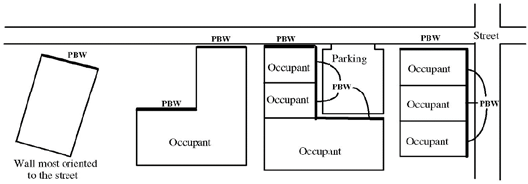
PBW = Primary Building Wall
Principal entrance. A door, other than a vehicle access door, that is designed as a principal means of access by the customers, occupants, employees or guests of the building. A building may have more than one (1) principal entrance.
Produce and craft market. A recurring event, held outdoors or in another defined place, on designated days and times, where market vendors consisting of agricultural producers, home processors, food market manufacturers, food market distributors and craft producers that manufactures or crafts non-food goods by the force of their own labor, are organized for the purpose of selling their products directly to the public. A minimum of thirty (30) percent of market vendors in produce and craft markets shall be food market vendors (agricultural producers, food market manufacturers, food market distributors, or home processors).
Production or processing. The assembly, disassembly, fabrication, manufacture, cleaning, servicing, packaging, sorting or other handling of goods or materials, either as an intermediate input for further production or processing, or for final sale, use or consumption.
Public pathway. Any publicly owned pathway, greenway, or bike trail, including but not limited to the Midtown Greenway, Loring Greenway, or the Humboldt Greenway.
Public realm. Open spaces (public and semi-public) such as streets, sidewalks, bike paths, parks, and plazas, but not including parking lots, where buildings interface with public/semi-public open space.
(Ord. No. 2025-023, § 91, 5-15-2025)
565.190. - Definitions beginning with R.
Railroad right-of-way. A strip of land with tracks and auxiliary facilities for track operation such as signals or crossing arms, but not including freight depots or stations, loading platforms, train sheds, warehouses, car or locomotive shops or car yards.
Reception or meeting hall. Also known as a banquet hall or a rental hall. A building, facility, room, or portion thereof, which is rented, leased, or otherwise made available to any person or group for a private event or function, that is not open to the general public, whether or not a fee is charged.
Recycling center. A use performed in an enclosed building where scrap or salvage materials are bought, sold, exchanged, stored, baled, packed, disassembled, or handled through hand or mechanical means, including but not limited to scrap iron and other metals, paper, rags, bottles, plastics, and aluminum cans. A recycling center shall not include automobile wrecking or dismantling; processing of used tires; milling, shredding, crushing, or grinding; or the use of any chemical processing or cleaning.
Recycling facility. A use performed in an enclosed building where scrap or salvage materials are shredded, milled, crushed, ground, bought, sold, exchanged, stored, baled, packed, disassembled, or handled, including but not limited to scrap iron and other metals, paper, rags, rubber tires, bottles, plastics, and aluminum cans. A recycling facility shall not include automobile wrecking or dismantling or metal shredding.
Regulatory services director. The director of the department of regulatory services or their designee.
Religious place of assembly. A church, synagogue, temple, mosque, or other facility that is used for prayer by persons of similar beliefs, or a special purpose building that is architecturally designed or particularly adapted for the primary use of conducting, on a regular basis, religious services and associated accessory uses by a religious congregation.
Research, development and testing laboratory. An establishment in which facilities for scientific research, investigation, testing or experimentation are located, but not facilities for the manufacture of products, except as incidental to the main purpose of the laboratory.
Residential hospice. A facility that provides twenty-four-hour per day residential and support services in a home-like setting for hospice patients as an integral part of the continuum of home care provided by a hospice licensed by the Minnesota Department of Health.
Restaurant. An establishment engaged in on-site food preparation with adequate kitchen facilities for retail sale of food and beverages, which may include table service to customers or preparation for off-site consumption. This includes establishments previously known as sit down restaurants, fast food restaurants, and delicatessens. The use may include the incidental sale of alcoholic beverages, provided the use complies with the requirements of Title 14, Liquor and Beer, of the Minneapolis Code of Ordinances and Chapter 4 of the Minneapolis City Charter. A restaurant is distinguished from a nightclub, bar, or entertainment venue, but may include live entertainment or recorded music that is incidental and accessory to the principal use in terms of floor area and is not the primary attraction during business hours open to the public. An entrance fee is not typically charged to view the entertainment.
Roof, flat. A roof slope with a two-foot rise over a twelve-foot run or less.
Rooming unit. One (1) or more rooms, designed, occupied or intended for occupancy as a separate living quarter that is not a dwelling unit.
565.200. - Definitions beginning with S.
School, K—12. A use which meets state requirements for elementary or secondary education.
School, vocational or business. A use which meets state requirements for a vocational or business school.
Scrap/salvage yard, metal milling facility. A use where scrap or salvage materials are shredded, milled, crushed, ground, bought, sold, exchanged, stored, baled, packed, disassembled or handled, including but not limited to scrap iron and other metals, paper, rags, rubber tires, bottles, plastics and aluminum cans. A scrap/salvage yard, metal milling facility may include automobile wrecking or dismantling.
Secondhand goods store. An establishment other than an antiques and collectibles store, used bookstore, clothing consignment store or pawnshop, which engages in the sale of used clothing, furniture, household appliances or other household items.
Service area canopy. A roof-like structure attached to or detached from the principal building that provides overhead protection to exterior customer service areas.
Service bay. An enclosed area designed and used for the service of not more than one (1) motor vehicle at a time.
Sexually oriented use. An adult entertainment center, adults-only bookstore or video store, adults-only motion picture theater, or any other use that is distinguished or characterized by an emphasis on matters or conduct depicting, describing or relating to nudity, sexual conduct, sexual excitement or sadomasochism. The definitions below are applicable to sexually oriented uses:
a.
Adult entertainment center. An enclosed building or a part of an enclosed building, wherein an admission is charged for entrance into the facility, or for food, alcoholic beverages or other beverages intended for consumption within the facility, wherein may be observed, or which contains one (1) or more mechanisms which when activated permit a customer to view, one (1) or more live persons unclothed or in such attire, costume or clothing as to expose to view any portion of the female breast below the top of the areola, or any portion of the male or female pubic hair, anus, cleft of the buttocks, vulva or genitals.
b.
Adults-only bookstore or video store. An establishment having as a substantial or significant portion of its stock in trade for sale, rental or display, books, magazines, periodicals, films, videos, digital video disks, slides, or other media, which are distinguished or characterized by an emphasis on matters depicting, describing or relating to nudity, sexual conduct, sexual excitement or sadomasochism, or an establishment with a segment or section devoted to the sale, rental or display of such material which comprises fifteen (15) percent or more of the total sale, rental or display area of such establishment, or five hundred (500) square feet, whichever is less. An adults-only bookstore or video store also shall include an establishment that offers films, videos, digital video disks, slides or similar media for viewing on premises.
c.
Adults-only motion picture theater. An enclosed building used regularly and routinely for presenting programs or material distinguished or characterized by an emphasis on matters depicting, describing or relating to nudity, sexual conduct, sexual excitement or sadomasochism, for observation by patrons therein.
d.
Nudity. The showing of the human male or female genitals, pubic area or buttocks with less than a fully opaque covering, or the showing of the female breast with less than a fully opaque covering of any portion thereof below the top of the areola, or the depiction of covered male genitals in a discernibly turgid state.
e.
Sadomasochism. The derivation of sexual pleasure from the infliction of pain or from the condition of being fettered, bound or otherwise physically restrained.
f.
Sexual conduct. Acts of masturbation, sexual intercourse or fondling or other erotic physical contact with a person's genitals, pubic area, buttocks, anus or, if such person be a female, her breast.
g.
Sexual excitement. The condition of human male or female genitals when in a state of sexual stimulation or arousal.
Shopping center. A unified development of three (3) or more ground floor commercial uses, excluding offices and medical facilities, operated under common ownership or management, which may be connected by a common wall or may be freestanding, and which may include common parking and signage. A shopping center shall not include:
a.
A storefront building or group of storefront buildings where each use includes a separate principal customer entrance facing the street.
b.
A commercial or mixed-use building with a separate principal customer entrance for each ground floor use with street frontage with any on-site parking facilities located at the interior or rear of the site.
Sign. A structure, fixture, placard, announcement, declaration, image, device, demonstration, logo or insignia used for direction, information, identification, attraction, or to advertise or promote any business, product, activity, service, interest or entertainment.
Animated sign. A sign with a progression of frames which give the illusion of motion, moving objects, moving patterns or bands of lights and shapes; or that gives the visual impression of movement.
Awning sign. A sign printed on or in some fashion attached directly to an awning.
Back-to-back sign. A sign structure with two (2) sign faces oriented in opposite directions and spread not more than two (2) feet apart.
Balloon sign. A sign consisting of a bag or similar device made of lightweight material supported by helium, hot, or pressurized air, which is greater than eighteen (18) inches in diameter.
Building sign. A sign attached to a building, including but not limited to an awning, canopy, or marquee, wall, projecting or window sign.
Building wrap sign. A digitally printed sign that is affixed directly on to the exterior wall of a structure and may cover multiple stories, facades, windows, or other architectural features. A building wrap sign is not a mural or painted wall sign.
Canopy sign. A sign printed on or in some fashion attached directly to a canopy.
Changeable copy sign, dynamic. A sign or portion thereof with illuminated letters or numbers only that can be electronically changed or rearranged without altering the face or the surface of the sign.
Changeable copy sign, manual. A sign or portion thereof with letters or numbers only that can be manually changed or rearranged without altering the face or the surface of the sign.
Directory sign. A sign that identifies the name and location of tenants within a multi-tenant structure or campus. Directory signs may include logos, directional arrows, and addresses or suite numbers but shall not advertise products or services.
Dynamic sign. A sign, or any element of a sign, which provides the ability to change text or images, or exhibits changing effects in order to provide intermittent illumination or the illusion of such illumination, or any series of imagery or display which may appear to move or change, including changes produced by any electronic method. A dynamic sign is not a changeable copy sign, dynamic.
Flag sign. A sign consisting of fabric or similar lightweight material attached at one end of the material, usually to a staff or pole, so as to allow movement of the material by atmospheric changes and which contains distinctive colors, patterns, symbols, emblems, insignia, or other symbolic devices.
Flashing off-premises sign. A sign which exhibits changing light or color effect by any means, so as to provide intermittent illumination or the illusion of intermittent flashing light by any means. Also, any mode of lighting which resembles zooming, twinkling or sparkling.
Freestanding sign. A sign which has supporting framework that is placed on, or anchored in, the ground and which is independent of any building or other structure.
Identification sign. A sign containing principally the name of the individual or establishment occupying the premises, and which also may include the street address, telephone number or other information identifying the use.
Illuminated sign. A sign lighted by or exposed to artificial lighting either on or in the sign or directed toward the sign.
Interior sign. A sign which is located within the interior of any building, or within an enclosed courtyard, that is not visible from the property line or public right-of-way.
Light projection sign. A sign which is an image displayed on a building façade and conveyed to the building façade via beams of light.
Marquee sign. A building sign painted on or attached to a marquee.
Mixed-premises sign. An on-premises sign that includes secondary off-premises advertising subordinate in scale, time and appearance to the on-premises sign message.
Monument sign. A freestanding sign with its sign face mounted on the ground, on a solid base at least as wide as the sign, or on one (1) or more poles or beams with not more than one (1) foot of open area between the sign face and the ground or base.
Off-premises advertising sign or billboard. A sign which directs attention to a business, establishment, product, service, interest, activity or entertainment not exclusively related to the premises where such sign is located.
On-premises sign. A sign which directs attention to or promotes a business, establishment or activity conducted, or a product, service, interest or entertainment sold or offered, on the premises where such sign is located.
Painted wall sign. A wall sign utilizing hand-painting or hand-tiling that is either affixed to or painted directly on the exterior wall of a structure but does not obscure or cover windows.
Pole sign. A freestanding sign which has its supportive structure anchored in the ground or on a solid base not at least as wide as the sign, or which has a sign face elevated above the ground or base by one (1) or more poles or beams and with an open area between the sign face and the ground or base of more than one (1) foot.
Portable sign. A sign which is designed or intended to be moveable, including by trailer or on its own wheels, even though the wheels of such sign may be removed.
Projecting sign. A sign which projects from a wall of a building in such manner that the sign face is perpendicular to the wall, or a sign which is suspended from a soffit or other permanent roof overhang.
Roof sign. A sign which is mounted on the roof of a building or which projects above the top of the wall of a building with a gambrel, gable or hip roof.
Service area canopy sign. A sign which is part of, or attached to, a service area canopy.
Snipe sign. A sign of any material, including but not limited to paper, cardboard, wood or metal, attached to any object and having no application to the premises where located.
Stringer sign. A sign that is made of commercial or decorative pennants, flags or streamers which are attached to a string, rope or cable.
Temporary sign. A banner, pennant, poster or advertising display constructed of paper, cloth, canvas, plastic sheet, cardboard, wallboard, plywood or other like materials that is intended to be, or is determined by the zoning administrator to be, displayed for a limited period of time.
Wall sign. A sign attached parallel to, or painted on, a wall, which is supported by such wall, and which displays only one (1) sign surface, or a sign attached parallel to, or within forty-five (45) degrees of parallel, or painted on, the surface of the lower slope of a mansard roof.
Window sign. A sign that is placed inside a window or upon the surface of a window and is visible or is intended to be viewed from the exterior of the window.
Sign face. The surface of the sign upon, against or through which the message or the sign is exhibited.
Sign structure. A structure including the supports, uprights, bracing and framework which supports or is capable of supporting a sign.
Single room occupancy housing. A facility providing housing that is operated by a non-profit organization, government agency, or healthcare agency, as defined in and meeting the requirements of Chapter 244, Housing Maintenance Code. It does not include:
a.
State credentialed care facilities.
b.
Supportive housing.
Single room occupancy housing unit. Any rooming unit, operated by a non-profit organization, government agency, or healthcare agency, as defined in and meeting the requirements of Chapter 244, Housing Maintenance Code.
Skyway. An enclosed, elevated pedestrian bridge extending from building face to building face that spans a public street, public alley, or is located within private property.
Snow storage site. A use in which a principal activity is the storage of snow, transported from an off-site location.
Sports and health facility. An establishment for the conduct of indoor sports and exercise activities, which may include related locker and shower rooms, offices and classrooms. A sports and health facility shall not include any use which could be defined as an indoor recreation area.
State credentialed care facility. A congregate living use where two (2) or more persons reside under the care and supervision of a program licensed by the State of Minnesota or Hennepin County providing supportive services for a period of more than thirty (30) days, including assisted living, board and care home, and nursing home facilities. State credentialed care facilities shall not include:
a.
Inebriate housing.
b.
Any facility licensed by the Minnesota Department of Corrections (DOC) or any other County, State, or Federal community corrections facility.
c.
Fraternities, sororities, or other student housing.
d.
Single room occupancy housing, as defined in this ordinance.
e.
Any facility providing in-patient treatment for active use of illegal substances.
Storefront building. A mixed-use or multiple story building, which may share a common wall with one (1) or more buildings, all of which front within five (5) feet of a front lot line or public sidewalk, and where each ground floor use includes a separate principal customer entrance facing the street.
Story. That portion of a building included between the upper surface of any floor and the upper surface of the floor next above, except that the topmost story shall be that portion of a building included between the upper surface of the topmost floor and the ceiling or roof above. If the finished floor surface directly above a basement, cellar or unused under floor space is more than six (6) feet above grade, for more than fifty (50) percent of the total perimeter, or is more than twelve (12) feet above grade at any point, such basement, cellar or unused underfloor space shall be considered a story. Rooftop features used exclusively for mechanical equipment, elevators, and stairways shall not be considered a story. Mezzanines, as determined by the building code, shall not be considered a story.
Story, half. A partial story that meets the following criteria:
a.
The half story will be located on a principal residential structure with a hip or gable roof and a height of two and one-half (2.5) stories or less. A partial story located on any other structure or on a principal residential structure with a height greater than two and one-half (2.5) stories shall be considered a full story.
b.
Habitable space located under a gable or hip roof and all of the roof rafters shall be located within two (2) feet of the floor joists, except at gable ends or where dormers are allowed.
c.
Dormers on the half story will meet the following standards:
1.
The total width of all dormers on any façade will not exceed fifty (50) percent of the width of the wall of the floor below the half story roof.
2.
Dormers will be located no closer than three (3) feet from any end-of-house corner of the floor below and any gable end wall.
3.
Dormers will not extend beyond the wall below and will not interrupt the eave edge of the hip or gable roof.
Street. A right-of-way which affords a primary means of motor vehicle access to abutting property.
Structure. Anything constructed or erected with a more or less fixed location on the ground or in or over a body of water. A structure shall include, but not be limited to, buildings, fences, walls, signs, canopies, decks, patios, antennae, piers, docks and any objects or things permanently attached to the structure.
Accessory structure. A structure detached from a principal structure, incidental and subordinate to the principal structure or use, including but not limited to garages, sheds, above-ground swimming pools, and fences.
Principal residential structure. Any structure containing a principal residential use.
Temporary structure. A structure intended to be established for an intermittent period of time or a structure of such construction that is not permanent in nature. Structures utilizing materials not designed for permanent structures, such as plastic or canvas tarps, for protection from the elements shall be considered a temporary structure, unless a building permit has been obtained and the exterior materials are applied and installed to industry standards.
Supportive housing. A facility that provides housing for twenty-four (24) hours per day and requires participation by residents in programs or services designed to assist residents with improving daily living skills, securing employment or obtaining permanent housing. It does not include:
a.
Senior housing with services designed specifically to serve the needs associated with the aging of the residents.
b.
Inebriate housing.
c.
Any facility licensed by the Minnesota Department of Human Services (DHS), Department of Health (DOH) or Minnesota Department of Corrections (DOC).
d.
Any other county, state or federal community correctional facility.
e.
Fraternities, sororities or other student housing.
f.
Any facility owned, leased or operated by the Minneapolis Public Housing Authority (MPHA).
g.
The use of one (1) dwelling unit on one (1) zoning lot.
(Ord. No. 2025-023, § 92, 5-15-2025; Ord. No. 2025-054, § 17, 11-20-2025)
565.210. - Definitions beginning with T.
Taxicab service. An establishment which provides taxicab facilities and services such as radio dispatching, color rights, advertising, telephone listings, maintenance, insurance and driver assignments.
Theater, indoor. A building, facility, room, or portion thereof used for live performances or presentations or motion pictures where spectators primarily utilize fixed seating.
Towing service. An establishment engaged in the towing or storage of damaged or impounded vehicles. Such use shall not include the wrecking or dismantling of vehicles.
Top plate. The part of a stud wall directly below and abutting the roof rafters.
Trellis. A framework over which vines and plants may grow that is not a pergola. A freestanding trellis or a trellis attached to and supported by a building extending out from the building more than five (5) feet shall be considered a fence.
565.220. - Definitions beginning with U.
Urban farm. An establishment where food or ornamental crops are grown or processed to be sold or donated that includes, but is not limited to, outdoor growing operations, indoor growing operations, greenhouses, vertical farms, aquaponics, aquaculture, cannabis cultivation, hydroponics, and rooftop farms.
Use. The purpose or activity for which the land or buildings thereon are designed, arranged, intended, occupied or maintained.
Accessory use. A use of land or of a building or portion thereof incidental and subordinate to a principal use.
Conditional use. A use which, because of its unique characteristics, cannot be properly classified as a permitted use in a district but which may be allowed in such zoning district upon demonstrating that such use will comply with all of the conditions and standards of this zoning ordinance.
Permitted use. A use which may be established in a particular district or districts.
Principal use. The main use of land or buildings as distinguished from subordinate or accessory uses. A principal use may be either permitted or conditional.
(Ord. No. 2024-041, § 16, 10-31-2024)
565.230. - Definitions beginning with V.
Variance. Departure from the literal requirements of this zoning ordinance where practical difficulties exist because of special conditions or circumstances unique to a site.
Vehicle. A vehicle shall include the following:
a.
Commercial vehicle. A motor vehicle designed and registered as a truck and licensed under the motor carrier laws of the State of Minnesota for the transportation of property but not persons, or a motor vehicle designed primarily for the movement of property or special purpose equipment, or a motor vehicle that is designed to carry ten (10) or more persons or any number of persons for a fee. Commercial vehicle includes vehicles commonly called trucks, delivery vans, buses, taxicabs, limousines, and other similar vehicles.
b.
Inoperable vehicle. A vehicle that is abandoned or lacking vital component parts essential to its mechanical functioning, including but not limited to the engine, drive train, and wheels; or a vehicle that is so mechanically defective as to be unsafe for operation; or a vehicle that does not display a current license plate, current license tab, or current registration.
c.
Motor vehicle. A vehicle that has its own motive power and that is used for the transportation of people or goods on streets. Motor vehicle includes passenger automobiles, trucks and commercial vehicles, and recreational vehicles with motive power, except electric-assisted bicycles and motorized bicycles as defined by Minnesota Statutes, Section 169.011.
d.
Passenger automobile. A motor vehicle designed to carry less than ten (10) persons, including the driver. Passenger automobile includes vehicles commonly called cars, minivans, passenger vans, sport utilities, motorcycles and pickups, and that is not a commercial vehicle.
e.
Recreational vehicle. A vehicle with or without motive power, which is designed for sport or recreational use or which is designed for human occupancy on an intermittent basis. Recreational vehicles include, but are not limited to, snowmobiles, boats, trailers, motor homes, campers, all-terrain vehicles and similar items for personal recreation.
(Ord. No. 2025-023, § 93, 5-15-2025)
565.240. - Definitions beginning with W.
Wet bar. A secondary beverage preparation area not intended as a kitchen. A wet bar may consist of no more than the following: storage and workspace, single-basin sink and under-counter refrigerator.
Wholesale establishment. A business establishment engaged primarily in selling to retailers for resale.
565.260. - Definitions beginning with Y.
Yard. An open space on the same zoning lot with a use, building or structure which is unoccupied and unobstructed from its lowest surface level to the sky, except as otherwise provided by this zoning ordinance. A yard extends along a lot line and to a depth or width specified in the yard requirements for the zoning district in which such zoning lot is located.
Corner side yard. A yard located immediately adjacent to and extending along the corner side lot line between the front yard and the rear lot line.
Front yard. A yard located immediately adjacent to and extending along the full length of the front lot line between the side lot lines.
Interior side yard. A yard located immediately adjacent to and extending along another zoning lot or an alley between the front yard and the rear lot line.
Rear yard. A yard located immediately adjacent to and extending along the length of the rear lot line between the side yards.
Side yard. Either a corner side yard or an interior side yard, unless otherwise specified by this zoning ordinance.
Landscaped yard. A front, side or rear yard that is required to be landscaped, as specified in this zoning ordinance.
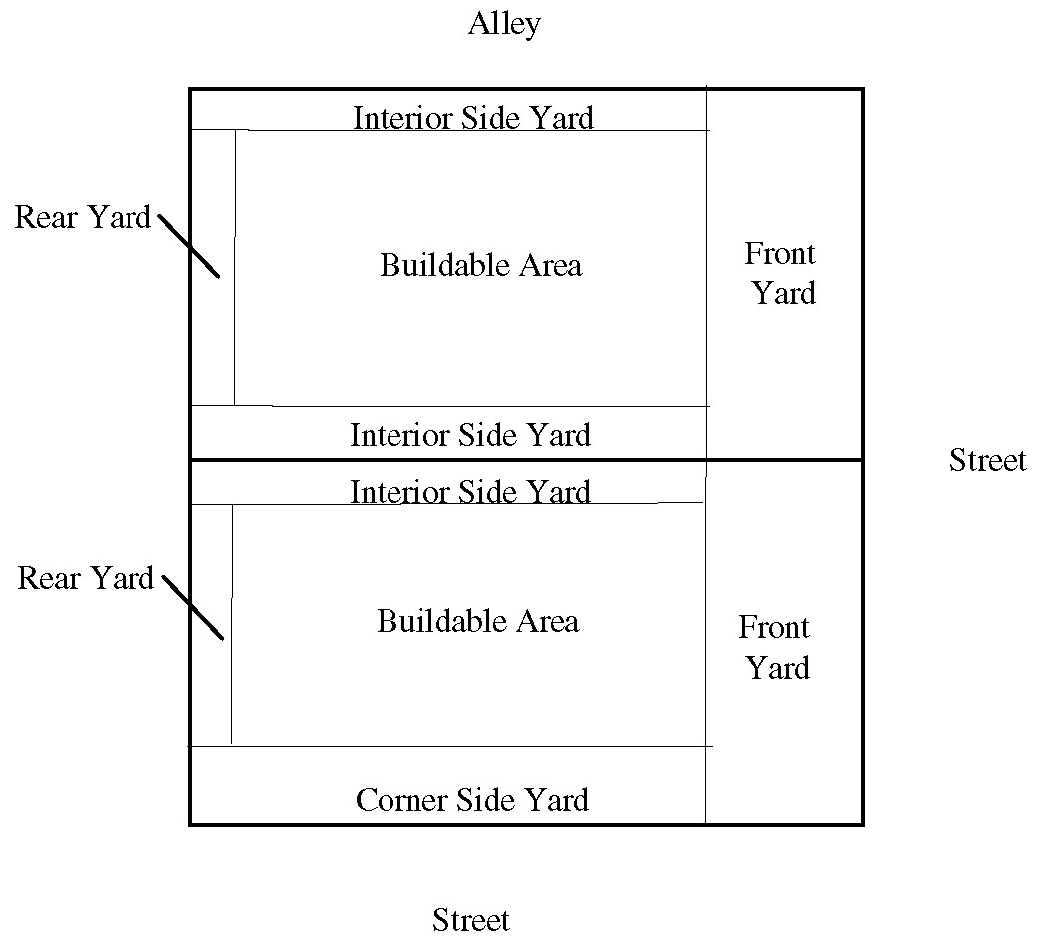
565.270. - Definitions beginning with Z.
Zoning administrator. The individual designated by the director of the department of community planning and economic development to serve as the city's zoning administrator or their authorized representative.
Zoning district. An area or areas within the limits of the city within which uniform regulations and requirements govern the use, placement, spacing and size of land and structures.

