
Minneapolis City Zoning Code
CHAPTER 540
- BUILT FORM OVERLAY DISTRICTS
540.10. - Purpose.
The BF Built Form Overlay Districts are established to guide the scale of development in a manner that aligns with the planned development patterns of each district by regulating features such as building height, floor area, yards, lot coverage, impervious surfaces, and lot sizes.
540.20. - District names and descriptions.
The built form overlay district names and descriptions are set forth in Table 540-1, Built Form Overlay District Names and Descriptions.
Table 540-1 Built Form Overlay District Names and Descriptions
(Ord. No. 2025-057, § 2, 12-11-2025)
540.30. - Relationship to other applicable regulations.
Property shall be subject to the provisions of the primary zoning district, the built form overlay district, and any other overlay district from Chapter 535, Overlay Districts, in which the property is located. Because overlay district regulations may be more or less restrictive than the primary zoning district or built form overlay district, where the provisions of the overlay, built form overlay, or primary zoning districts are in conflict, the provisions of the overlay district from Chapter 535, Overlay Districts, shall govern.
540.40. - Established boundaries.
The built form overlay district designation shall be shown on the zoning map in addition to the primary zoning district designation.
540.100. - Purpose.
Maximum floor area ratio regulations are established to govern the overall bulk of buildings to align with the planned scale of development in each built form overlay district. These regulations work in conjunction with other built form regulations to govern the bulk and placement of buildings as well as requiring open spaces in some contexts. Maximum floor area ratio may not be achievable in districts with lot coverage and impervious surface regulations. Minimum floor area ratio regulations are established to prevent the underutilization of property, particularly in areas near substantial public transit investments.
540.110. - Maximum floor area ratio.
(a) In general. The maximum floor area ratio requirements of principal structures, except cluster developments, shall be as set forth within Table 540-2, Maximum Floor Area Ratio.
(b)
Cluster developments. The maximum floor area ratio requirements of cluster developments shall be as set forth within Table 540-3, Maximum Floor Area Ratio for Cluster Developments.
Table 540-2 Maximum Floor Area Ratio
Table 540-3 Maximum Floor Area Ratio for Cluster Developments
(Ord. No. 2025-057, § 3, 12-11-2025)
540.120. - Gross floor area computation for single-, two-, or three-family dwellings.
(a) In general. In single-, two-, or three-family dwellings, floor area shall be counted twice for each story with a ceiling height greater than fourteen (14) feet. Gross floor area for single-, two-, or three-family dwellings shall not include the following:
(1)
Detached accessory structures.
(2)
Open porches.
(3)
Basement floor area if the finished floor of the first story is forty-two (42) inches or less from natural grade for more than fifty (50) percent of the total perimeter.
(4)
Half story floor area.
(b)
Gross floor area on small lots. Where the lot area is such that the maximum floor area ratio of a single, two-, or three-family dwelling would normally result in allowed gross floor area of less than two thousand five hundred fifty (2,500) square feet, the allowed floor area shall be two thousand five hundred (2,500) square feet, notwithstanding Table 540-2, Maximum Floor Area Ratio. All other requirements for the district in which the lot is located shall be met.
(c)
One-time increase for buildings that are near or exceed maximum floor area. In the BFI1 Interior 1 and BFI2 Interior 2 Built Form Overlay Districts, single-, two-, and three-family dwellings existing on January 1, 2008, that exceed the maximum floor area ratio, or building additions that would cause the building to exceed the maximum floor area ratio, may increase the gross floor area one (1) time by no more than five hundred (500) square feet. In the BFI3 Interior 3 Built Form Overlay District, single-family dwellings existing on January 1, 2008, that exceed the maximum floor area ratio, or building additions that would cause the building to exceed the maximum floor area ratio, may increase the gross floor area one (1) time by no more than five hundred (500) square feet.
540.130. - Minimum floor area ratio.
(a) In general. The minimum floor area ratio requirements of principal structures located in the built form overlay districts shall be as set forth within Table 540-4, Minimum Floor Area Ratio. Floor area devoted to parking or loading shall not be counted toward compliance with the minimum floor area ratio. Minimum floor area ratio regulations shall not apply to the expansion of buildings existing on the effective date of this ordinance.
Exceptions. Minimum floor area ratio requirements shall not apply to the following:
(1)
Public parks and open spaces;
(2)
Standalone production uses located in the PR2 Production and Processing District;
(3)
Principal uses without a principal structure;
(4)
Basic utilities; or
(5)
Development on lots existing on the effective date of this ordinance with less than five thousand (5,000) square feet of area.
Table 540-4 Minimum Floor Area Ratio
(Ord. No. 2025-057, § 4, 12-11-2025)
540.200. - Purpose.
These regulations are established to allow an increase in allowed floor area ratio in conjunction with providing specified features that advance the goals of the comprehensive plan.
540.210. - Administrative review of applications.
The zoning administrator shall conduct the administrative review of all applications for floor area ratio premiums. All findings and decisions of the zoning administrator shall be final, subject to appeal to the city planning commission, as specified in Chapter 525, Administration and Procedures.
540.220. - Floor area ratio premiums.
Floor area ratio premiums, as specified in Chapter 540, Article VI, Premiums, shall be available, subject to the provisions of this article and provided all other requirements of this zoning ordinance are met. When a development qualifies for a premium, the value of the premium shall be added to the allowed maximum floor area ratio, resulting in an increase in the allowed maximum.
540.230. - Single-, two-, and three-family dwellings and congregate living uses.
(a) In general. Except as authorized in this section, floor area ratio premiums shall not be applicable to single-, two-, and three-family dwellings or congregate living uses with three (3) or fewer dwelling or rooming units.
(b)
Affordable housing floor area premium. A floor area ratio premium of one-tenth (0.1) per unit, not counting the first unit, shall be authorized for two- and three-family dwellings or congregate living uses with two (2) or three (3) dwelling or rooming units when at least one (1) of the units are affordable to and occupied by a household(s) with an income at or below sixty (60) percent of the area median income, adjusted for bedroom and family size, and where the owner is participating in a federal housing subsidy program and/or participating in a state or local housing program where the rent or sale price and income restrictions of the affordable unit(s) are evidenced by a declaration or ground lease that will be recorded against the property, or where the owner is the Minneapolis Public Housing Authority or an affiliated entity.
(c)
Environmental sustainability floor area premium. In the BFI2 Interior 2 and BFI3 Interior 3 Built Form Overlay Districts, a floor area ratio premium of one-tenth (0.1) shall be authorized for two- and three-family dwellings or congregate living uses with two (2) or three (3) dwelling or rooming units when the building is certified as environmentally sustainable through a green building program authorized for this purpose by the zoning administrator.
540.240. - Number of allowed premiums and value of each premium.
The maximum number of eligible premiums in each built form overlay district, and the value of each premium, shall be as specified in Table 540-5, Number of Allowed Premiums and Value of Each Premium. For specific use premiums, the use must be allowed by the zoning district or districts in which the property is located for a development to be eligible for the premium.
Table 540-5 Number of Allowed Premiums and Value of Each Premium
*The BFI3 Interior 3 Built Form Overlay District shall only be eligible for the Enclosed Parking premium and no others.
(Ord. No. 2025-057, § 5, 12-11-2025)
540.300. - Purpose.
These regulations are established to promote the preservation and rehabilitation of historic resources by allowing the transfer of undeveloped floor area from zoning lots containing locally designated historic structures, or structures that have been determined to be eligible to be locally designated as historic structures, to other zoning lots.
540.310. - Definitions.
As used in this article, the following words shall mean:
Heritage preservation commission. The heritage preservation commission of the City of Minneapolis.
Receiving site. The zoning lot on which transferred floor area is to be developed.
Sending site. The zoning lot containing a locally designated historic structure or a structure determined to be eligible to be locally designated as a historic structure, as provided in Chapter 599 of the Minneapolis Code of Ordinances, Heritage Preservation, and from which undeveloped floor area is to be transferred.
540.320. - Eligible areas.
The transfer of development rights shall be limited to sending sites and receiving sites located within the downtown districts.
540.330. - Application for transfer of development rights.
Any person having a legal or equitable interest in land that qualifies as a sending site may file an application for transfer of development rights on a form approved by the zoning administrator, as provided in Chapter 525, Administration and Procedures.
540.340. - Administrative review of applications.
The planning director shall conduct the administrative review of all applications for transfer of development rights. All findings and decisions of the planning director shall be final, subject to appeal to the city planning commission, as specified in Chapter 525, Administration and Procedures.
540.350. - Transfer of development rights conditions and guarantees.
Any approval of an application for transfer of development rights shall be subject to the following conditions:
(1)
The maximum amount of undeveloped floor area that may be transferred from the sending site shall be the difference between the gross floor area of development on the sending site and the maximum gross floor area permitted by the zoning district regulations.
(2)
The floor area of the receiving site may be increased by up to thirty (30) percent of the maximum gross floor area permitted by the zoning district regulations, except where the receiving site is adjacent to the sending site, provided all other requirements of this zoning ordinance are met. For the purposes of this section, where a sending site is adjacent to a receiving site, they may be considered a single zoning lot.
(3)
The transfer of development rights shall be limited to four (4) such transfers from any sending site.
(4)
The development potential of the sending site shall be reduced by the amount of undeveloped floor area transferred for the life of the principal structure on the receiving site whose construction is made possible by the transfer.
(5)
Following the transfer of development rights, the historic structure on the sending site, if undesignated, shall be subject to the same restrictions that are applicable to locally designated historic structures and the recommendations contained in the Secretary of the Interior's Standards for Rehabilitation.
(6)
The transfer of development rights shall not result in the destruction of a locally designated historic structure or structure determined to be eligible to be locally designated as historic on the receiving site.
(7)
The approval of the transfer of development rights shall be filed by the applicant with the Office of the Hennepin County Recorder or Registrar of Titles in the form of a conservation easement or similar restriction acceptable to the city which shall specify the amount of undeveloped floor area transferred to the receiving site and the reduction in the development rights of the sending site.
(8)
No building permit or other approval for the construction or establishment of transferred development rights on the receiving site shall be granted by the city until the historic structure on the sending site has been rehabilitated pursuant to the applicable guidelines of the heritage preservation commission and the recommendations contained in the Secretary of the Interior's Standards for Rehabilitation, if necessary, or until a plan for such rehabilitation has been submitted to and approved by the heritage preservation commission.
(9)
Such additional conditions and guarantees as the planning director deems reasonable and necessary to protect the public interest and to ensure compliance with the standards and purposes of this zoning ordinance and policies of the comprehensive plan.
540.400. - Purpose.
Maximum height regulations are established to govern the overall height of principal buildings to align with the planned building height of each built form overlay district. These regulations work in conjunction with other built form regulations to govern the scale of buildings. Minimum height regulations are established to prevent the underutilization of property, particularly in areas near substantial public transit investments.
540.410. - Maximum height for principal structures.
(a) In general. The maximum height requirements of principal buildings located in the built form overlay districts shall be as set forth within Table 540-6, Maximum Height by District, and Table 540-7, Other Maximum Height Requirements by Use.
(b)
Exemptions. Except in the SH Shoreland Overlay District and when not allowed in the MR Mississippi River Corridor Critical Area Overlay District, the following may be exempt from the maximum height requirements of principal structures as set forth within each built form overlay district:
(1)
Communication antennas, wind energy conversion systems, and solar energy systems otherwise allowed by administrative review in Chapter 550, Development Standards.
(2)
Parapets not exceeding three (3) feet, except where located on single-, two-, or three-family dwellings or cluster developments.
(3)
Railings up to four (4) feet in height as measured from the roof, and not more than sixty (60) percent opaque.
(4)
Rooftop features used exclusively for mechanical equipment, elevators, or stairways, provided all of the following conditions are met:
a.
Such building features are not located on single-, two-, or three-family dwellings.
b.
The combined coverage of such building features shall not occupy more than thirty (30) percent of the roof area of the floor below.
c.
Such building features may extend up to sixteen (16) feet above the roof of the floor below.
d.
Where located within fifteen (15) feet of the wall of the floor below, such building features shall not exceed twenty (20) feet in width as measured parallel to the adjacent wall.
(5)
Rooftop features used exclusively for mechanical equipment, elevators, or stairways on single-, two-, or three-family dwellings, provided all of the following conditions are met:
a.
Such building features may extend up to ten (10) feet above the roof of the floor below.
b.
The combined coverage of such building features shall not occupy more than one hundred fifty (150) square feet of the roof area.
(c)
Existing buildings. Principal buildings existing on the effective date of this ordinance, that exceed the maximum height requirements shall be considered legally conforming, except that additions to such buildings or other redevelopment shall be subject to the standards of this chapter.
Table 540-6 Maximum Height by District
Table 540-7 Other Maximum Height Requirements by Use
*Notwithstanding the height limitations of this chapter, the maximum height of single-, two-, and three-family dwellings may be increased to thirty-five (35) feet when the established height of a minimum of fifty (50) percent of the single-, two-, and three-family dwellings within one hundred (100) feet of the subject site exceed the maximum height. The highest point of a gable, hip, or gambrel roof shall not exceed forty (40) feet.
(Ord. No. 2025-023, § 19, 5-15-2025; Ord. No. 2025-057, § 6, 12-11-2025)
540.420. - Minimum height for principal structures.
(a) In general. The minimum height requirements of principal structures located in the built form overlay districts shall be as set forth within Table 540-8, Minimum Height. The minimum height requirement shall apply to at least fifty (50) percent of the building footprint in the BFC6 Corridor 6 and BFT10 Transit 10 Built Form Overlay Districts. In all other districts, the minimum height requirement is satisfied if any portion of a building on the zoning lot complies with the minimum.
(b)
Existing buildings. Buildings existing on the effective date of this ordinance, that do not comply with the minimum height requirements shall be considered legally conforming, except that additions to such buildings or other redevelopment shall be subject to the minimum height standards of this chapter when the resulting floor area of the building is equal to or greater than double the existing gross floor area.
(c)
Exceptions. Minimum height requirements shall not apply to the following:
(1)
Public parks and open spaces;
(2)
Standalone production uses located in the PR2 Production and Processing District;
(3)
Principal uses without a principal structure;
(4)
Basic utilities; or
(5)
Development on lots existing on the effective date of this ordinance with less than five thousand (5,000) square feet of area.
Table 540-8 Minimum Height
(Ord. No. 2025-057, § 7, 12-11-2025)
540.500. - Purpose.
These regulations are established to identify where an increase of the maximum height requirements of a principal structure may be considered administratively. In order to be approved, the proposal must be consistent with the spirit and intent of the comprehensive plan and must further achieve the goals of the comprehensive plan.
540.510. - Application for increasing maximum height.
(a) In general. Any person having a legal or equitable interest in land, subject to the requirements of this section, may file an application to increase the height of a principal structure on a form approved by the zoning administrator, as specified in Chapter 525, Administration and Procedures.
(b)
Ineligible uses and locations. The following uses and property locations shall not be eligible for an application to administratively increase the height of a principal structure:
(1)
Any property located in an interior built form overlay district.
(2)
A single-, two-, or three-family dwelling or cluster development located in any built form overlay district.
540.520. - Administrative review of applications.
(a) In general. The zoning administrator, in consultation with the planning director, shall approve or deny such application. The zoning administrator may impose such conditions and require such guarantees deemed reasonable and necessary to protect the public interest and to ensure compliance with the standards and purposes of this zoning ordinance and policies of the comprehensive plan. If proposed as part of a project that includes a separate land use application, the height increase shall be reviewed concurrently with said application. Unless a site plan review application is not required, the decision date shall coincide with the city planning commission action on the site plan review application.
(b)
Appeals. Notwithstanding the provisions of Chapter 525, Administration and Procedures, decisions of the zoning administrator regarding the administrative review of height increases shall be subject to appeal to the city council.
540.530. - Maximum allowed height increase.
Where allowed, the maximum height requirements of principal structures may be increased up to the limits identified in Table 540-9, Maximum Allowed Height Increase, provided all applicable sections of this article are met.
Table 540-9 Maximum Allowed Height Increase
(Ord. No. 2025-057, § 8, 12-11-2025)
540.540. - Required premiums.
(a) In general. Adequate premiums shall be provided as identified in Table 540-10, Allowed Height Increase per Premium in the Corridor and Parks Built Form Overlay Districts or Table 540-11, Allowed Height Increase per Premium in the Transit and Production Built Form Overlay Districts, as applicable, in order to be eligible to achieve the intended height increase. Premiums provided shall comply with the standards of section 540.640, Height Increase Premiums. For specific use premiums, the use must be allowed by the zoning district or districts in which the property is located for a development to be eligible for the premium.
(b)
Existing buildings. Where projects within these districts already exceed the applicable height limits or an addition is too small to trigger site plan review, one (1) of the following may be provided in lieu of the premiums in Table 540-10, Allowed Height Increase per Premium in the Corridor and Parks Built Form Overlay Districts or Table 540-11, Allowed Height Increase per Premium in the Transit and Production Built Form Overlay Districts, provided the additional floor area does not exceed two thousand five hundred (2,500) square feet and such exception occurs only one (1) time in any five-year period:
(1)
Green roof, subject to the following standards: Installation of an extensive, intensive, semi-intensive, modular, or integrated green roof system that covers the roof area of the addition or an equivalent area elsewhere on the building.
(2)
Living wall system, subject to the following standards: Provide a living wall system on at least one (1) building elevation. The living wall shall be composed of panels that total a minimum of sixty (60) percent of the wall area on the building elevation, or five hundred (500) square feet, whichever is greater. Window area is included in the calculation of the wall area, but in no case shall the living wall cover windows. Not less than twenty (20) percent of the plantings shall provide greenery year-round.
(3)
Enhanced stormwater management and native landscaping, subject to the following standards: Not less than fifty (50) percent of the site not occupied by buildings including all required landscaped yards shall be landscaped per the standards in Chapter 550, Article V, Site Plan Review Standards. Provide capacity for infiltrating stormwater generated onsite with artful rain garden design, or subterranean stormwater collection and filtration system, that serves as a visible and/or visually appealing amenity. Rain garden designs shall be visually compatible with the form and function of the space and shall include for long-term maintenance of the design. Native species plantings shall be prioritized on the landscaping plan, including plantings that support pollinators.
(4)
Art feature, subject to the following standards: Provision of art that shall strive to promote quality design, enhance a sense of place, contribute to a sense of vitality, show value for artist and artistic processes, and use resources wisely. The art shall be maintained in good order for the life of the principal structure. The art shall be located where it is highly visible to the public. If located indoors, such space shall be clearly visible and easily accessible from adjacent sidewalks or streets. The art shall be valued at not less than one-fourth (¼) of one (1) percent of the capital cost of the principal structure.
(5)
Shared bicycles and electric vehicle chargers, subject to the following standards: Public access to shared bicycles available for short-term use as defined in section 555.230 of the Minneapolis Code of Ordinances. Applies to mixed-use and nonresidential uses only. A minimum of ten (10) shared bicycles and four (4) electric vehicle chargers per one (1) commercial use must be provided to qualify as an amenity. Bicycle parking spaces and racks shall be located in an area that is convenient and visible from the principal entrance of the building.
Table 540-10 Allowed Height Increase per Premium in the Corridor and Parks Built Form Overlay Districts
Table 540-11 Allowed Height Increase per Premium in the Transit and Production Built Form Overlay Districts
(Ord. No. 2025-057, § 9, 12-11-2025)
540.550. - Required findings.
Before approval of an administrative height increase, and in addition to providing the required premium or premiums, the zoning administrator shall find:
(1)
The building furthers principles of human scale design and massing, particularly facing the public realm in the lower floors of the building.
(2)
The portion of the building receiving the height increase responds to a change in built form on adjacent properties in less intense built form overlay districts with a gradual transition in height and scale.
(3)
The building form and massing is distributed and oriented in a manner appropriate to the scale and proportion of the built surroundings to reasonably address the impact of shadowing on adjacent properties, the public realm, and existing solar energy systems, and to allow access to light and air of adjacent properties.
(4)
Exterior materials are consistent and compatible on all sides of the building.
540.600. - Purpose.
These premiums are established to promote development of exceptional quality by allowing the maximum height and floor area ratio of structures on a zoning lot to be increased where it is determined that the development on such zoning lot includes features that further advance policies of the city's comprehensive plan and that contribute positively to the design and function of the applicable built form overlay districts.
540.610. - Limitations on premiums.
Except as specified in Table 540-13, Floor Area Ratio Premiums Authorized in Transit 30A, Transit 30B, and Core 50, a zoning lot may not be awarded multiple floor area ratio increases or multiple height increases by providing the same type of premium. However, the same type of premium may be used to achieve both a floor area ratio increase and a height increase.
(Ord. No. 2025-057, § 10, 12-11-2025)
540.620. - Compliance with premiums.
Except as allowed by the affordable housing premium, all premiums shall be maintained for the life of the principal structure. The length of compliance with the affordable housing premium shall be as required by the Unified Housing Policy.
540.630. - Floor area ratio premiums.
The allowed premiums for the BFI3 Interior 3, BFC3 Corridor 3, BFC4 Corridor 4, BFC6 Corridor 6, BFC10 Transit 10, BFT15 Transit 15, BFT20 Transit 20, BFPA Parks, and BFPR Production Built Form Overlay Districts shall be as specified in Table 540-12, Floor Area Ratio Premiums Authorized in Interior 3, Corridor 3, Corridor 4, Corridor 6, Transit 10, Transit 15, Transit 20, Parks, and Production. The allowed premiums for the BFT30A Transit 30A, BFT30B Transit 30B, and BFC50 Core 50 Built Form Overlay Districts shall be as specified in Table 540-13, Floor Area Ratio Premiums Authorized in Transit 30 and Core 50. The maximum number of eligible floor area ratio premiums in each built form overlay district, and the value of each premium, is specified in Article III, Increasing Maximum Floor Area.
Table 540-12 Floor Area Ratio Premiums Authorized in Interior 3*, Corridor 3, Corridor 4, Corridor 6, Transit 10, Transit 15, Transit 20, Parks, and Production
*The Interior 3 Built Form Overlay District shall only be eligible for the Enclosed Parking premium and no others.
Table 540-13 Floor Area Ratio Premiums Authorized in Transit 30A, Transit 30B and Core 50
(Ord. No. 2025-023, § 20, 5-15-2025; Ord. No. 2025-057, § 11, 12-11-2025)
540.640. - Height increase premiums.
(a) In general. The allowed premiums for height increases in the corridor, transit, parks, and production built form overlay districts shall be as specified in Table 540-14, Height Increase Premiums. All applicable standards shall be met to be eligible for a premium.
(b)
Exceptions. Exceptions to the height increase premium standards of this article may be approved where the alternative meets the intent of the standards and includes an exceptional design or style that will enhance the area or that is more consistent with the design of the site.
Table 540-14 Height Increase Premiums
(Ord. No. 2025-023, § 22, 5-15-2025)
540.700. - Purpose.
Minimum lot dimension regulations are established to ensure that sufficient area is provided to meet the functional needs of different land uses and to reinforce existing or planned development patterns in each built form overlay district. Maximum lot area regulations are established to work in conjunction with other built form regulations to limit the scale of new development in a manner consistent with the intent of individual built form overlay districts.
540.710. - Minimum lot area.
Lot area provided for an existing structure or use shall not be reduced below, or further reduced if already less than, the minimum requirements of the zoning code for equivalent new construction. No minimum lot area allocated to any structure or use shall be used to satisfy minimum lot area requirements for any other structure or use.
540.720. - Specific minimum and maximum lot dimension requirements.
(a) In general. Minimum and maximum lot dimension requirements shall be as set forth in Table 540-15, Lot Dimension Requirements. The requirements of Table 540-16, Minimum Lot Dimension Requirements by Built Form Overlay District and Table 540-17, Maximum Lot Area Requirements by Built Form Overlay District only apply when indicated in Table 540-15, Lot Dimension Requirements. Nothing in this section shall be construed to authorize uses not otherwise allowed in a primary zoning district as set forth in Table 545-1, Uses Allowed. All primary zoning districts are included in the table for each use category to clarify lot dimension requirements for any legal nonconforming uses.
(b)
Abbreviations. For purposes of Table 540-15, Lot Dimension Requirements, "sq. ft." shall mean square feet, "ft." shall mean feet, and "CUP" shall mean conditional use permit.
(c)
Planned unit developments. The minimum lot area for planned unit developments shall be one-half (½) acre, except as otherwise authorized by this zoning ordinance. Maximum lot area for planned unit developments shall be determined by conditional use permit.
(d)
Mixed-use developments. Notwithstanding Table 540-15, Lot Dimension Requirements, residential uses as part of a mixed-use development with both residential and nonresidential uses shall not be subject to minimum lot area requirements except for any minimum lot area required for the nonresidential use.
Table 540-15 Lot Dimension Requirements
1 Or in Interior 1 and Interior 2 built form overlay districts, a minimum lot area per principal structure of the average of the single-, two-, and three-family zoning lots located in whole or in part within three hundred fifty (350) feet, where the average lot area is nine thousand (9,000) square feet or more. Where a greater minimum lot area requirement applies, the maximum lot area requirement per principal structure shall be one hundred thirty (130) percent of said average minimum lot area.
Table 540-16 Minimum Lot Dimension Requirements by Built Form Overlay District
Table 540-17 Maximum Lot Area Requirements by Built Form Overlay District
540.730. - Conflicting minimum and maximum lot area.
In the event that a minimum lot area requirement of an allowed use exceeds the maximum lot area requirement of a built form overlay district, the maximum lot area requirement shall be one hundred thirty (130) percent of the minimum lot area.
540.740. - Zoning lots nonconforming as to maximum lot area.
(a) In general. Existing zoning lots nonconforming as to the maximum lot area shall have all of the rights of a conforming lot, except as otherwise provided in this section.
(b)
Single-, two-, and three-family dwellings. Where allowed as a permitted or conditional use, single-, two-, and three-family dwellings shall be allowed on existing lots nonconforming as to the maximum lot area.
(c)
Residential uses with four (4) or more units. New development that includes four (4) or more residential units on a zoning lot that exceeds the maximum permitted lot area may only be developed as a cluster development, common lot development or planned unit development. The maximum permitted lot area in a cluster development or planned unit development shall be determined by conditional use permit. The maximum permitted lot area in a common lot development shall not exceed the district maximum by more than thirty (30) percent. Reuse of a residential structure existing on the effective date of the ordinance, for a permitted or conditional use with four (4) or more residential units, and additions to such structures, shall be allowed on an existing zoning lot that exceeds the maximum permitted lot area and shall not require an application for a cluster development or planned unit development.
(d)
Authorized variance of maximum lot area. Any person having a legal or equitable interest in a property may file an application for a variance to increase the maximum lot area by up to thirty (30) percent, as provided in Chapter 525, Administration and Procedures. Existing lots that exceed the maximum permitted lot area may only be increased by variance up to thirty (30) percent above the district maximum. Existing lots that exceed the maximum lot area by more than thirty (30) percent shall not be eligible to further expand the lot by variance.
540.800. - Purpose.
Yard controls provide for the orderly development and use of land and to minimize conflicts among land uses by regulating the dimension and use of yards in order to provide adequate light, air, open space and separation of uses. Yard controls also play a role in stormwater management, defining public and private spaces, and creating a landscape buffer for ground level residential uses.
540.810. - Required yards.
(a) In general. Yard requirements shall be as specified in this article. Yards provided for an existing structure or use shall not be reduced below, or further reduced if already less than, the minimum requirements of the zoning code for equivalent new construction, except as otherwise provided in Chapter 545, Article VI, Nonconforming Uses and Structures. All yards and other open spaces allocated to a structure or use shall be located on the same zoning lot as such structure or use. No required yards or other open spaces allocated to any structure or use shall be used to satisfy yard or other open space requirements for any other structure or use.
(b)
Landscaping. Except as otherwise allowed in Table 540-22, Permitted Obstructions in Required Yards, required yards at the ground level shall be covered with turf grass, native grasses or other perennial flowering plants, vines, shrubs, trees, or edible landscaping. Wood mulch, other organic mulches and landscape rock may be used in planting beds and in maintenance strips adjacent to a building, but are not a suitable alternative to plant cover. Areas wider than two (2) feet with wood mulch, other organic mulches or landscape rock shall contain plantings spaced not less than two (2) feet apart or as specified per the planting instructions. Landscape rock that is easily disturbed shall be at least five (5) feet or more from a public sidewalk or a shared property line.
540.820. - Yard requirements for outdoor uses.
Where a lot is to be occupied for a use without buildings, the required front, side and rear yards shall be provided and maintained, except as otherwise provided in this zoning ordinance.
540.830. - Reverse corner lots.
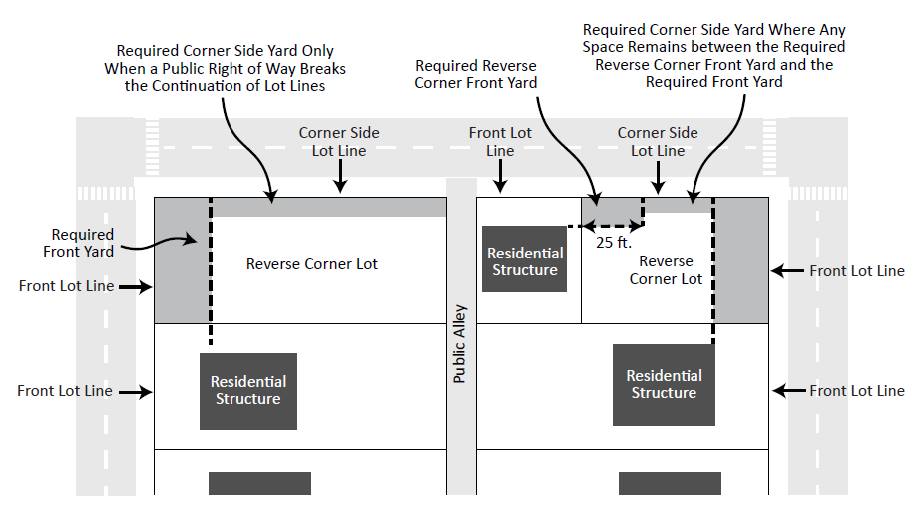
On a reverse corner lot, both lot lines that abut the street shall be considered front lot lines. The required front yard shall be provided and maintained along the front lot line aligned with the original platting orientation of the parcel, and the reverse corner front yard shall not be less than the established front yard of the closest principal building originally designed for residential purposes located on the same block face for the first twenty-five (25) feet from a shared property line, as shown in Figure 540-1. Reverse corner front yard setbacks shall not be applied when crossing an alley or other public right-of-way. This section does not authorize a reverse corner front yard that is less than the minimum corner side yard requirement.
Figure 540-1 Reverse Corner Lots
540.840. - Through lots.
On a through lot, both lot lines that abut the street shall be considered front lot lines. The required front yard shall be provided and maintained along each front lot line.
(Ord. No. 2025-023, § 23, 5-15-2025)
540.850. - Front yard requirements in urban neighborhood and residential mixed-use districts.
(a) In general. The minimum front yard requirements for uses located in the urban neighborhood and residential mixed-use districts shall be as set forth in Table 540-18, Minimum Front Yard Requirements in Urban Neighborhood and Residential Mixed-Use Districts, except as otherwise required in this section.
(b)
Front yard increased, interior built form overlay districts. The required front yard shall be increased in the interior built form overlay districts where the established front yard of the closest principal building originally designed for residential purposes located on the same block face on either side of the property exceeds the front yard required by the zoning district. In such case, the required front yard shall be not less than such established front yard, provided that where there are principal buildings originally designed for residential purposes on both sides of the property, the required front yard shall be not less than that established by a line joining those parts of both buildings nearest to the front lot line, not including any obstructions allowed by Table 540-22, Permitted Obstructions in Required Yards. In determining an increase in the required front yard, one (1) of the nearest principal residential structures may be removed from consideration where such structure exceeds the established front yard of any other such building on the same block face by twenty-five (25) feet or more and there are no fewer than four (4) principal residential structures on the block face, including the proposed structure. In such instance, the next-nearest principal building originally designed for residential purposes shall be incorporated in determining the increased front yard.
(c)
Front yard decreased, in general. The required front yard may be decreased where the established front yard of the majority of the principal structures on the same block face are less than the front yard required by the urban neighborhood or residential mixed-use zoning district, provided the decreased front yard shall not be less than the established front yard of the principal structures on either side of the property. The front yard is established by a line joining those parts of both buildings nearest to the front lot line, not including any obstructions allowed by Table 540-22, Permitted Obstructions in Required Yards or attached garages.
(d)
Front yard decreased in residential mixed-use districts. In addition to section (c) above, the minimum front yard requirement may be eliminated where adjacent to a goods and services corridor in the residential mixed-use districts when the mixed-use commercial and residential floor area ratio premium standards are met provided an unobstructed site triangle of not less than twenty (20) feet from a street or alley intersection is maintained. Only the required front yard adjacent to the goods and services corridor may be eliminated via this provision.
Table 540-18 Minimum Front Yard Requirements in Urban Neighborhood and Residential Mixed-Use Districts
(Ord. No. 2025-023, § 23, 5-15-2025; Ord. No. 2025-057, § 12, 12-11-2025)
540.860. - Corner side yard requirements in urban neighborhood and residential mixed-use districts.
(a) In general. The minimum corner side yard requirements for uses located in the urban neighborhood and residential mixed-use districts shall be as set forth in Table 540-19, Minimum Corner Side Yard Requirements in Urban Neighborhood and Residential Mixed-Use Districts, except as otherwise required in this section.
(b)
Corner side yard decreased in residential mixed-use districts. When the mixed-use commercial and residential floor area ratio premium standards are met in the residential mixed-use districts, the corner side yard requirement may be eliminated where adjacent to a goods and services corridor provided an unobstructed site triangle of not less than twenty (20) feet from a street or alley intersection is maintained. Only the required corner side yard adjacent to the goods and services corridor may be eliminated via this provision.
(c)
Corner side yard decreased, goods and services corridors. In the BFC6 Corridor 6, BFT10 Transit 10, BFT15 Transit 15, BFT20 Transit 20, BFT30A Transit 30A, and BFT30B Transit 30B Built Form Overlay Districts, the corner side requirement may be reduced to ten (10) feet where fronting on a goods and services corridor.
Table 540-19 Minimum Corner Side Yard Requirements in Urban Neighborhood and Residential Mixed-Use Districts
*Not including authorized height exemptions in Article V, Height of Principal Buildings.
(Ord. No. 2025-023, § 24, 5-15-2025; Ord. No. 2025-057, § 13, 12-11-2025)
540.870. - Interior side and rear yard requirements in urban neighborhood and residential mixed-use districts.
(a) In general. The minimum interior side and rear yard requirements for uses located in the urban neighborhood and residential mixed-use districts shall be as set forth in Table 540-20, Minimum Interior Side and Rear Yard Requirements In the Urban Neighborhood and Residential Mixed-Use Districts, except as otherwise required in this section.
(b)
Interior side yard increased. Increased interior side yard requirements shall be provided in the urban neighborhood and residential mixed-use districts in the following circumstances:
(1)
When the length of a building along an interior side property line exceeds seventy-five (75) percent of the depth of the lot, the required interior side yard shall be increased by an additional two (2) feet.
(2)
Where a side lot line in the BFC6 Corridor 6 Built Form Overlay District or any transit built form overlay district abuts a side lot line in an BFI1 Interior 1 or BFI2 Interior 2 Built Form Overlay District, the required interior side yard shall be increased by an additional five (5) feet for any building sixty-four (64) feet or taller in height.
(3)
The minimum width of interior side yards for residential uses with a principal entrance facing the interior lot line, shall be not less than fifteen (15) feet, unless a greater width is required by the regulations governing interior side yards in the district in which the structure is located. The increased interior side yard requirement shall not apply to the following:
a.
Converting a single-family dwelling to a two- or three-family dwelling, or converting a two-family dwelling to a three-family dwelling, where a side-facing entrance existing on the effective date of this ordinance becomes a principal entrance.
b.
Subdividing a property in a manner that that would result in less than a fifteen (15) foot side yard adjacent to a side-facing entrance existing on the effective date of this ordinance.
(c)
Institutional and civic uses. In the BFI1 Interior 1 and BFI2 Interior 2 Built Form Overlay Districts, the minimum interior side yard requirement for institutional and civic uses exceeding twenty-eight (28) feet in height shall be seven (7) feet.
Table 540-20 Minimum Interior Side and Rear Yard Requirements
In the Urban Neighborhood and Residential Mixed-Use Districts
*Not including authorized height exemptions in Article V, Height of Principal Buildings.
540.880. - Yard requirements in commercial mixed-use, downtown, production, and transportation districts.
(a) In general. Except as otherwise required in this section, uses located in the commercial mixed-use, downtown, production and transportation districts shall not be subject to minimum yard requirements. Where ground level yards are required, such yards shall be landscaped as specified in Chapter 550, Article V, Site Plan Review Standards and shall be otherwise unobstructed from the ground level to the sky, except as allowed as a permitted obstruction in this article.
(b)
Front yard requirements. Front yard requirements shall apply as follows, except no front yard requirement shall apply where the front lot line abuts a goods and services corridor.
(1)
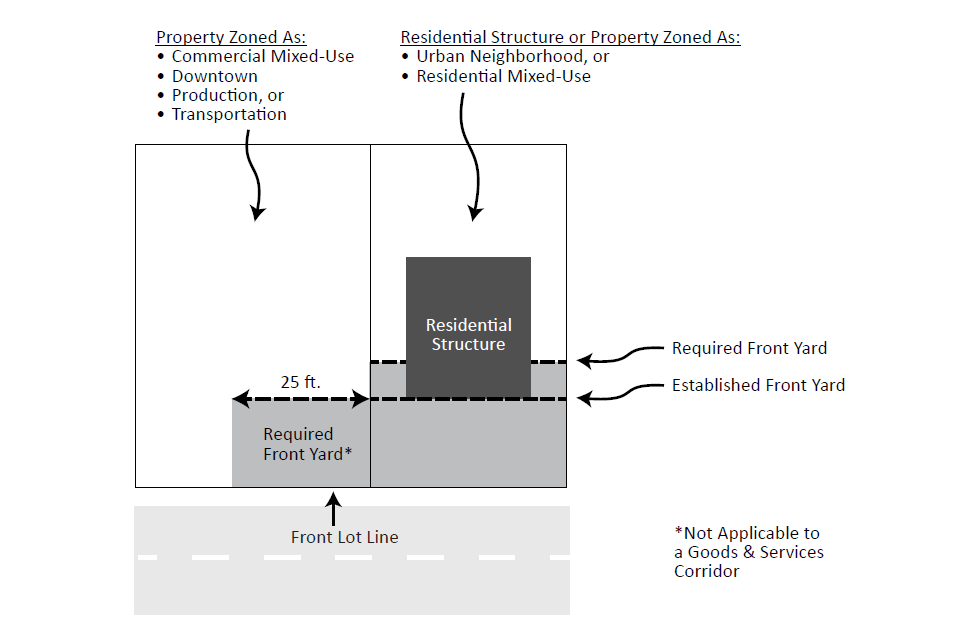
Where a street frontage includes property zoned as an urban neighborhood or residential mixed-use district and property zoned as a commercial mixed-use, downtown, production and transportation district, a front yard equal to the lesser of the front yard required by such urban neighborhood or residential mixed-use district or the established front yard of any structure used only for permitted or conditional residential purposes shall be provided in the commercial mixed-use, downtown, production and transportation district for the first twenty-five (25) feet from such urban neighborhood or residential mixed-use district boundary as shown in Figure 540-2.
(2)
Where a street frontage includes an adjacent structure used only for permitted or conditional residential purposes in a commercial mixed-use, downtown, production and transportation district, a front yard equal to the lesser of the front yard required by the district or the established front yard of such residential structure shall be provided in the commercial mixed-use, downtown, production and transportation district for the first twenty-five (25) feet from such residential property as shown in Figure 540-2.
Figure 540-2 Front Yard Requirement for Nonresidential Districts that Share Frontage
with
Residential Districts and Structures
(c)
Interior side yard requirements.
(1)
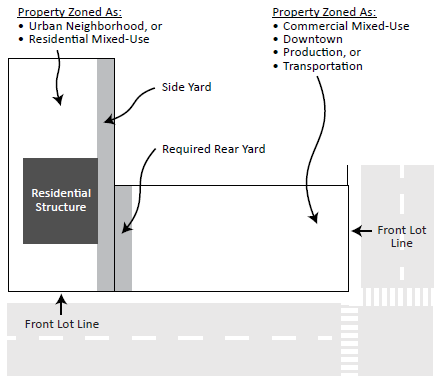
Where a side lot line abuts a side or rear lot line in an urban neighborhood or residential mixed-use district, then the applicable side yard requirements of the adjacent district shall apply as shown in Figure 540-3. Where a side lot line in the BFC6 Corridor 6 Built Form Overlay District or any transit built form overlay district abuts a side lot line in the BFI1 Interior 1 or BFI2 Interior 2 Built Form Overlay District, the required interior side yard shall be increased by an additional five (5) feet for any building sixty-four (64) feet or taller in height.
(2)
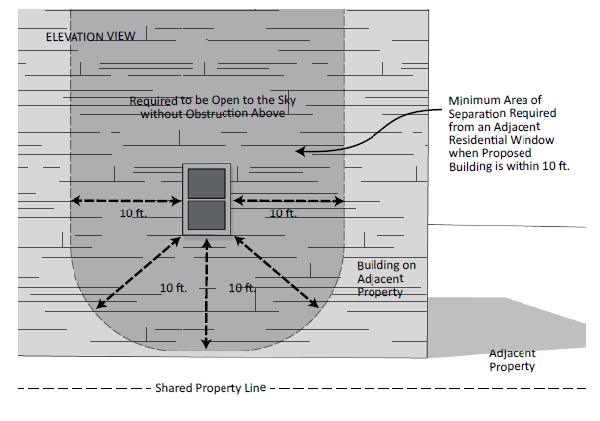
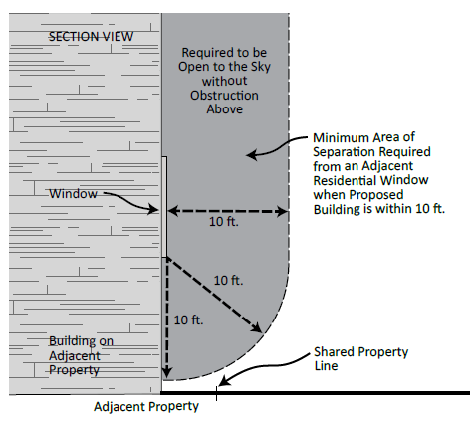
Where a side lot line abuts a commercial mixed-use, downtown, production and transportation zoning district, no minimum side yard shall apply, except that a structure shall not be constructed within ten (10) feet of a window facing the shared lot line and serving a residential use on the adjacent property as shown in Figure 540-4. In such instance where the adjacent use includes a residential window within ten (10) feet of the side lot line, the ten (10) feet clearance shall also be open to the sky without obstruction above.
Figure 540-3 Interior Side Yard Requirement for Nonresidential Districts Abutting Residential Districts
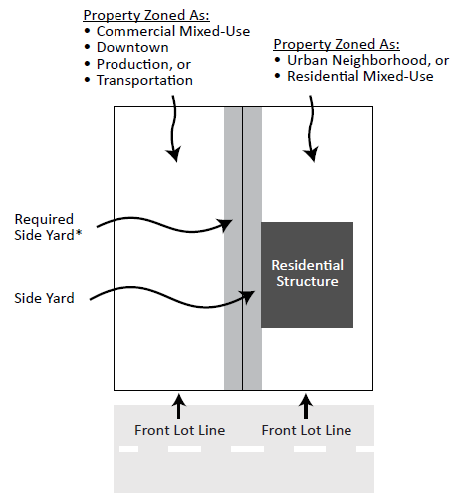
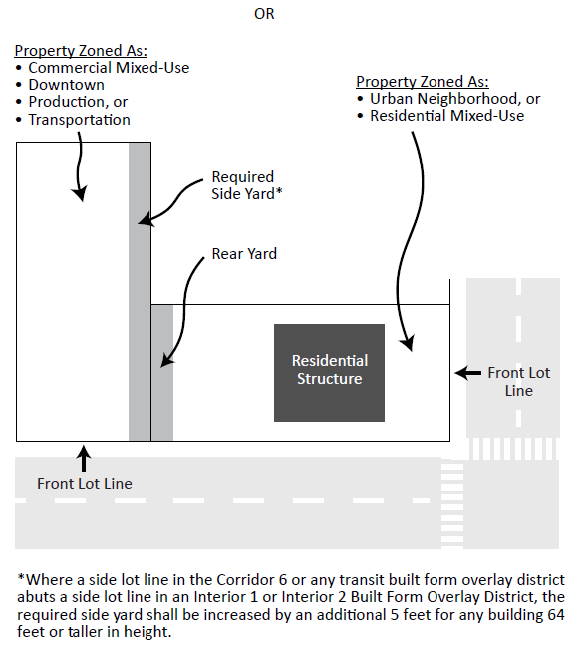
Figure 540-4 Interior Side and Rear Yard Window Clearance Requirement
(d)
Rear yard requirements.
(1)
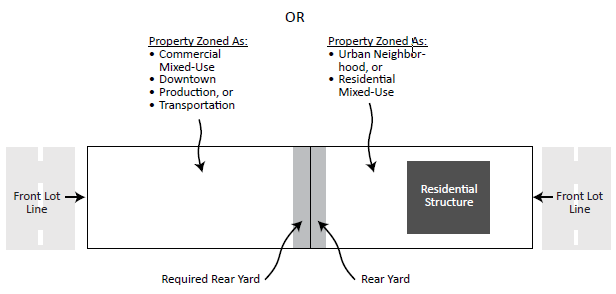
Where a rear lot line abuts a side or rear lot line in an urban neighborhood or residential mixed-use district, then the applicable side yard requirements of the adjacent district shall apply as shown in Figure 540-5.
(2)
Where a rear lot line abuts a commercial mixed-use, downtown, production and transportation zoning district, no minimum rear yard shall apply, except that a structure shall not be constructed within ten (10) feet of a window facing the shared lot line and serving a residential use on the adjacent property as shown in Figure 540-4. In such instance where the adjacent use includes a residential window within ten (10) feet of the side lot line, the ten (10) feet clearance shall also be open to the sky without obstruction above.
Figure 540-5 Rear Yard Requirement for Nonresidential Abbuting Residential Districts
(e)
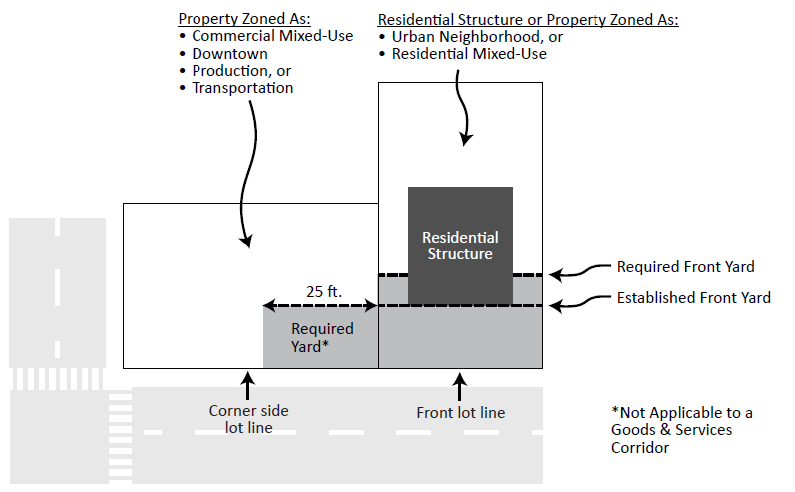
Reverse corner side yard requirements. Where the extension of a corner side lot line coincides with a front lot line in an adjacent urban neighborhood or residential mixed-use district, or with a front lot line of a structure used only for permitted or conditional residential purposes, a yard equal to the lesser of the front yard required by such urban neighborhood or residential mixed-use district or the established front yard of such residential structure shall be provided along such side lot line for the first twenty-five (25) feet from such urban neighborhood or residential mixed-use district boundary or residential property, as shown in Figure 540-6. Such front yard requirement in commercial mixed-use, downtown, production and transportation districts shall not apply where the front lot line abuts a goods and services corridor.
Figure 540-6 Reverse Corner Side Yard Requirement in Nonresidential Districts
(f)
Yard requirements for single- and two-family dwellings and state credentialed care facilities serving six (6) or fewer persons. The minimum yard requirements for single- and two-family dwellings and state credentialed care facilities serving six (6) or fewer persons shall be as set forth in Table 540-21, Yard Requirements for Single- and Two-family Dwellings and State Credentialed Care Facilities Serving 6 or Fewer Persons in the Commercial Mixed-Use, Downtown, Production and Transportation Districts.
Table 540-21 Yard Requirements for Single- and Two-family Dwellings and State Credentialed Care Facilities Serving 6 or Fewer Persons in the Commercial Mixed-Use, Downtown, Production and Transportation Districts
(Ord. No. 2025-023, § 25, 5-15-2025)
540.890. - Obstructions in required yards.
(a) In general. All required yards shall remain open and unobstructed from ground level to the sky, except as otherwise provided below.
(b)
Permitted obstructions. Accessory uses and structures and projections of the principal structure may be located in a required yard only as indicated by a "P" for permitted in Table 540-22, Permitted Obstructions in Required Yards.
(c)
Nonresidential uses. Notwithstanding Table 540-22 Permitted Obstructions in Required Yards, required interior side yards for nonresidential uses shall remain unobstructed from the ground level to the sky, except that fencing and retaining walls shall be allowed. Where a rear yard abuts a required side yard, such rear yard shall remain unobstructed from the ground level to the sky, except that fencing shall be allowed.
(d)
Additional limitations. In no case shall any permitted obstruction be located closer than one (1) foot from the property line, except for driveways, walkways, fences, detached accessory buildings, the storage of firewood and containers for the removal of household refuse, subject to the provisions of this section.
(e)
Interior side yards for detached buildings accessory to residential uses. The interior side yard requirement for a detached accessory building may be reduced to one (1) foot when the entire accessory building is located in the rear forty (40) feet or rear twenty (20) percent of the lot, whichever is greater, provided that the accessory building shall be located not less than ten (10) feet from any habitable portion of a principal structure on the adjoining lot. Where vehicle access doors face the interior side lot line, no reduction of the required yard is permitted on the side with the vehicle access doors. Further, the required side yard for a detached accessory building may be eliminated where adjoining property owners construct detached garages sharing a common wall and which are located in the rear forty (40) feet. Where the interior side yard is reduced, eaves, including gutters, shall not be less than six (6) inches from the property line, except where a common wall is allowed.
(f)
Rear yards for detached buildings accessory to residential uses. The rear yard requirement for a detached accessory building may be reduced to one (1) foot, except where vehicle access doors face the rear lot line, in which case no reduction of the required yard is permitted. Further, where a rear yard abuts a required side yard no reduction of the required yard is permitted unless the entire accessory building is located in the rear forty (40) feet or rear twenty (20) percent of the lot, whichever is greater, and is located behind the rear wall of the principal structure on the adjacent property to the rear. The required yard along such adjacent property may be eliminated where adjoining property owners construct detached garages sharing a common wall and which are located in the rear forty (40) feet of both properties. Where the rear yard is reduced, eaves, including gutters, shall not be less than six (6) inches from the property line, except where a common wall is allowed.
(g)
Accessory buildings on reverse corner lots. An accessory building shall be no closer to the side lot line adjacent to the street than a distance equal to two-thirds (⅔) of the depth of the required front yard specified in the yard requirements table of the district of the adjacent property to the rear. Further, an accessory building shall not be located within five (5) feet of a rear lot line that coincides with the side lot line of a property in an urban neighborhood or residential mixed-use district. However, where the entire accessory building is located in the rear forty (40) feet or rear twenty (20) percent of the lot, whichever is greater, and is located not less than ten (10) feet from any habitable portion of a principal residential use on the adjacent property, only one (1) foot shall be required along such adjacent property line, except as otherwise prohibited by this zoning ordinance. Further, the required yard along such adjacent property may be eliminated where adjoining property owners construct detached garages sharing a common wall and which are located in the rear forty (40) feet.
(h)
Interior side yards for driveways accessory to residential uses. The yard requirement for a driveway may be eliminated where adjoining property owners share a common driveway.
(i)
Rear yards. For purposes of Table 540-22 Permitted Obstructions in Required Yards, a rear yard abutting a required side yard shall be considered an interior side yard and shall be subject to the permitted obstructions regulations for such interior side yard.
Table 540-22 Permitted Obstructions in Required Yards
(Ord. No. 2025-023, § 26, 5-15-2025)
540.900. - Purpose.
Maximum lot coverage and maximum impervious surface coverage standards are established to combat the urban heat island effect, promote adequate space for landscaping, reinforce existing or planned development patterns, and to reduce stormwater runoff and encourage the natural absorption of stormwater into the soil.
540.910. - Maximum lot coverage.
Maximum lot coverage requirements shall be as set forth in Table 540-23, Maximum Lot Coverage by District.
Table 540-23 Maximum Lot Coverage by District
(Ord. No. 2025-057, § 14, 12-11-2025)
540.920. - Maximum impervious surface coverage.
(a) In general. Maximum impervious surface coverage requirements shall be as set forth in Table 540-24, Maximum Impervious Surface Coverage by District.
(b)
Exception. Impervious surfaces shall not cover more than sixty-five (65) percent of any zoning lot with less than six thousand (6,000) square feet of lot area and no access to a public alley or a second street frontage, provided one (1) the following conditions are met:
(1)
The zoning lot is in the BFPA Parks Built Form Built Form Overlay District.
(2)
The zoning lot is in the BFI1 Interior 1 or BFI2 Interior 2 Built Form Overlay District and an urban neighborhood and residential mixed-use district.
Table 540-24 Maximum Impervious Surface Coverage by District
(Ord. No. 2025-023, § 27, 5-15-2025; Ord. No. 2025-057, § 15, 12-11-2025)

