
Minneapolis City Zoning Code
CHAPTER 560
- SIGNS
560.10. - Findings, purpose and intent.
(a) Findings. The city council hereby finds as follows:
(1)
Exterior signs have a substantial impact on the character and quality of the environment.
(2)
Signs provide an important medium through which individuals may convey a variety of messages.
(3)
Signs can create traffic hazards, aesthetic concerns, and be potentially detrimental to property values, thereby adversely affecting the public health, safety and welfare.
(4)
The regulation of signs within the city has had a positive impact on traffic safety and the appearance of the community.
(b)
Purpose and intent.
(1)
Regulations governing on-premises signs are established to allow effective signage appropriate to the planned character of each zoning district, to promote an attractive environment by minimizing visual clutter and confusion, to minimize adverse effects on nearby property, and to protect the public health, safety and welfare.
(2)
Regulations governing off-premises advertising signs and billboards are established to minimize the visual blighting effects caused by off-premises advertising signs and billboards by regulating their location, size, height and spacing, luminance and frequency of image change; to encourage the removal of signs and billboards that do not conform to the regulations of this chapter; and to protect the public health, safety and welfare.
560.20. - Severability.
If any section, subsection, sentence, clause, or phrase of these sign regulations are for any reason held to be invalid, such decision shall not affect the validity of the remaining portions of the regulations. The city council hereby declares that it would have adopted the sign regulations in each section, subsection, sentence, or phrase thereof, irrespective of the fact that any one (1) or more sections, subsections, sentences, clauses, or phrases be declared invalid.
560.30. - Substitution clause.
The owner of any sign which is otherwise allowed by this sign ordinance may substitute non-commercial copy in lieu of any other commercial or non-commercial copy. This substitution of copy may be made without any additional approval or permitting. The purpose of this provision is to prevent any inadvertent favoring of commercial speech over non-commercial speech, or favoring of any particular non-commercial message over any other non-commercial message. This provision prevails over any more specific provision to the contrary.
560.40. - Scope of regulations.
The sign regulations set forth in this chapter shall apply to all structures and all land uses, except as otherwise provided in this zoning ordinance. When a sign is subject to more than one (1) classification of sign type, all regulations governing the various classifications shall be applicable to such sign.
560.50. - Compliance with standards.
No person shall place, erect or maintain a sign, nor shall a lessee or owner permit property under their control to be used for such sign, which does not conform to the requirements of this chapter, Chapter 95, Projections and Encroachments of the Minneapolis Code of Ordinances, and all other applicable regulations.
560.60. - Exempt signs.
(a) On-premises. The following on-premises signs shall be exempt from the regulations of this chapter:
(1)
Official public notices or signs required by local, state or federal regulations.
(2)
Governmental signs, including but not limited to traffic control and other regulatory purpose signs, street signs, informational signs, danger signs and railroad crossing signs.
(3)
Official government flags and emblems, provided such signs shall not be placed or maintained in the public right-of-way.
(4)
Incidental notification signs, provided each sign shall not exceed three (3) square feet in area, not more than two (2) such signs shall be located on a zoning lot, and such signs shall not be placed or maintained in the public right-of-way and shall not be illuminated.
(5)
Historic plaques placed by recognized historical agencies, provided such signs shall not be placed or maintained in the public right-of-way, shall not be illuminated, and shall not exceed four (4) square feet in area.
(6)
Religious symbols attached to institutional and civic buildings, provided such symbols shall not be placed or maintained in the public right-of-way and shall not be illuminated.
(7)
Interior signs.
(8)
Murals.
(9)
Address signs less than one (1) square foot in area, not to exceed two (2) such signs per zoning lot.
(10)
Directory signs, provided such sign shall be attached to a structure as a wall sign or window sign or shall be a monument sign, and shall not exceed eight (8) feet in height and twenty-four (24) square feet in area, and shall be located within fifteen (15) feet of a principal building entrance with skyway access within the downtown skyway system.
(11)
Painted wall signs located on primary and non-primary building walls in the commercial mixed-use, downtown, production, and transportation districts, provided the painted wall shall comply with the following regulations:
a.
Painted wall signs shall comply with the maximum height of wall signs for the district where the sign is located as specified in:
1.
Table 560-2, Specific Standards for Signs in the RM2, RM3, and Commercial Mixed-Use Districts;
2.
Table 560-3, Specific Standards for Signs in the Downtown Districts; and
3.
Table 560-4, Specific Standards for Signs in the Production and Transportation Districts.
b.
Painted wall signs shall not obscure visibility into and out of a structure through windows.
c.
Painted wall signs located on landmarks, nominated properties under interim protection, or on structures located within historic districts, shall be subject to all applicable requirements of Chapter 599 of this Code.
(b)
Off-premises. The following off-premises signs shall be exempt from the regulations of this chapter:
(1)
Temporary signs relating to civic, cultural, and sports organizations, and events associated with such organizations, provided the temporary sign shall comply with the following regulations:
a.
Temporary signs related to civic, cultural, and sports organizations, and events associated with such organizations, shall be located in the downtown districts.
b.
Temporary signs related to civic, cultural, and sports organizations, and events associated with such organizations, shall be allowed for ninety (90) days maximum.
c.
Temporary signs related to civic, cultural, and sports organizations, and events associated with such organizations, shall be subject to the city engineer's authority over the right-of-way, in accordance with Chapters 95, 427, 429, and 430 of this Code, as applicable.
d.
Temporary signs related to civic, cultural, and sports organizations, and events associated with such organizations, located on landmarks, nominated properties under interim protection, or on structures located within historic districts, shall be subject to all applicable requirements of Chapter 599 of this Code.
(2)
Off-premises signs located on city-owned properties in the downtown districts or Opportunity Billboard Districts, constructed pursuant to an explicit agreement with the City.
(Ord. No. 2025-054, § 3, 11-20-2025)
560.70. - Prohibited signs.
The following signs shall be prohibited in all zoning districts, except as otherwise specified in this chapter:
(1)
A mural that does not have permission of the owner of the property on which it is located or is graffiti.
(2)
Audible signs.
(3)
Any sign not listed as either permitted or conditional or any sign not determined by the zoning administrator to be substantially similar to a sign listed as permitted or conditional in the manner provided for in Chapter 525, Administration and Procedures, governing determination of substantially similar uses.
(4)
Any sign relating to sexually oriented uses and prohibited by the regulations governing such uses in this ordinance.
(5)
Backlit awning or canopy signs.
(6)
Balloon signs.
(7)
Dynamic and dynamic changeable copy roof signs, on-premises.
(8)
Freestanding flag signs.
(9)
Off-premises roof signs that project beyond the face of any wall of the building on which they are mounted.
(10)
Off-premises signs painted on the exterior of a building.
(11)
Off-premises signs that do not comply with the regulations of this chapter.
(12)
On-premises signs with moving or swinging parts or elements, except in the downtown districts and CM4 District or as a window sign.
(13)
Searchlights and strobe lights, except as allowed in section 545.720, Permitted temporary uses and structures.
(14)
Signs attached to skyway bridges and intended to be read from the public right-of-way, except the following:
a.
Temporary on-premises signs in the downtown districts as allowed in Chapter 550, Article XV of this Code, for all permitted skyways.
b.
Temporary off-premises signs relating to civic, cultural, and sports events, as allowed in section 560.60 of this Code.
(15)
Signs placed on or painted on a motor vehicle or trailer and parked with the primary purpose of providing signage.
(16)
Signs placed or maintained on natural features.
(17)
Snipe signs.
(18)
Stringer signs.
(Ord. No. 2025-054, § 4, 11-20-2025)
560.80. - Nonconforming signs.
(a) Relocation. Signs and sign structures which are moved shall be brought into compliance with all applicable regulations of this chapter.
(b)
Reconstruction. Nonconformities that are completely or substantially reconstructed that include changes to building placement or design shall be subject to the findings and procedures for expansion or alteration of nonconforming uses and structures as specified in Chapter 545, Use Regulations.
(c)
On-premises signs. A nonconforming on-premises sign shall be subject to the provisions of section 560.170, Maintenance and repair.
(d)
Off-premises signs. The following provisions shall apply to nonconforming signs:
(1)
Off-premises signs lawfully existing at the time of adoption of this chapter which do not conform to the regulations of this chapter may continue to exist, but shall not be enlarged, relocated, or altered to include electronic lighting devices, except in compliance with this chapter.
(2)
Maintenance and repair, including replacement, restoration, improvement, and changing of off-premises sign messages is allowed. Conversion of an existing non-conforming off-premises sign to include digital or electronic elements or animation shall be subject to provisions of this chapter.
(3)
Following damage or destruction, replacement of a nonconformity shall mean that the off-premises sign face or sign structure, if reinstated with a nonconformity as allowed under the terms of this chapter, shall be reconstructed to match the conditions that preceded damage or destruction. Nonconformities that are completely or substantially reconstructed that include changes to the placement or design, including use of electronic elements or animation, of the off-premises sign face or sign structure shall be subject to section 545.940, Expansion or alteration of nonconforming uses and structures.
(4)
A nonconforming off-premises sign which is damaged or destroyed by any cause or means to the extent that the cost of restoration exceeds one-half (½) of its replacement cost and no building permit for reconstruction or replacement of the nonconforming structure is applied for within one hundred eighty (180) days of date the property is damaged or destroyed, shall not be reconstructed except in conformity with all applicable regulations of this chapter. When a building permit to reconstruct or replace the nonconforming off-premises sign face or sign structure in its pre-existing design and not enlarge, relocate or expand the nonconforming off-premises sign face or sign structure is applied for within one hundred eighty (180) days of the date the property is damaged or destroyed, such permit shall be approved notwithstanding the cost of the restoration and its relationship to the market value of the structure. Use of digital or electronic elements or animation for reconstruction or replacement of a nonconforming off-premises sign shall be subject to all applicable regulations of this chapter. Reasonable conditions may be imposed by the zoning administrator to mitigate any newly created impact on adjacent property.
(5)
A nonconforming off-premises sign which is discontinued for a continuous period of one (1) year shall be deemed to be abandoned and may not thereafter be reestablished or resumed except in conformity with all applicable regulations of this chapter.
(6)
A painted wall sign with changed advertising copy or graphics painted over an existing nonconforming painted wall sign shall be prohibited.
(Ord. No. 2025-054, § 5, 11-20-2025)
560.90. - Illumination of signs.
(a) On-premises, in general. All on-premises lighted signs shall comply with the performance standards governing lighting contained in Chapter 550, Development Standards, and may be illuminated as follows where allowed by Table 560-1, Specific Standards for Signs in the Urban Neighborhood and RM1 Districts, Table 560-2, Specific Standards for Signs in the RM2, RM3 and Commercial Mixed-Use Districts, Table 560-3, Specific Standards for Signs in the Downtown Districts, and Table 560-4, Specific Standards for Signs in the Production Districts, and subject to all other applicable regulations of this chapter:
(1)
Backlit. A light source contained within the sign element or sign cabinet that illuminates by shining through a translucent surface or sign face, except where only the letters, numbers or logos of the sign copy are illuminated.
(2)
External. A light source outside the sign element or sign cabinet that illuminates by directing light onto the sign surface, such as by floodlight or spotlight.
(3)
Internal. A light source contained within the sign cabinet that illuminates by directing light onto the sign surface, or that illuminates only the letters, numbers or logos of the sign copy, and which is not backlit.
(b)
Lighted on-premises signs in the urban neighborhood or residential mixed-use districts. Lighted signs in the urban neighborhood or residential mixed-use districts shall not be backlit, shall be no closer than twenty (20) feet from the nearest urban neighborhood district or residential mixed-use district property line, and shall be illuminated only by white or amber light.
(c)
Lighted on-premises signs in all other districts. Lighted signs facing and on property adjacent to or across a street or alley from an urban neighborhood or residential mixed-use district shall not be backlit, and shall be no closer than twenty (20) feet from the nearest urban neighborhood district or residential mixed-use district boundary.
(d)
Off-premises lighted signs. All off-premises lighted signs shall comply with the performance standards governing lighting contained in Chapter 550, Development Standards. Off-premises signs that employ electronic devices shall be subject to the applicable provisions of the billboard district where the sign is located, as established by Table 560-5, General Billboard District Standards, Table 560-6, Opportunity Billboard District Standards, or Table 560-7, Downtown East or Downtown West Entertainment Billboard District Standards. Illuminated off-premises signs shall not exceed the maximum luminance standard provided in the applicable billboard district in which it is located.
(e)
Flashing or animated off-premises signs. Flashing or animated off-premises signs shall be subject to the applicable provisions of the district where the sign is located and subject to all other applicable regulations of this chapter.
(1)
Downtown East or Downtown West Entertainment Billboard District. Flashing, blinking, and/or animated off-premises signs, including but not limited to traveling lights or other means not providing constant illumination, shall be permitted in the Downtown Entertainment Billboard District.
(2)
Downtown Entertainment Area. Flashing off-premises signs shall be permitted in this area provided the messages and/or imagery are displayed in a static manner for a minimum of eight (8) seconds. Animated off-premises signs shall be prohibited in the Downtown Entertainment Area.
(3)
Downtown Opportunity Billboard District. Flashing and/or blinking off-premises signs shall be permitted in the Downtown Opportunity Billboard District provided that outside the Downtown Entertainment Billboard Districts and Downtown Entertainment Area flashing signs containing changing written messages shall be limited to the news, weather, time or other public service message with a vertical dimension that shall not exceed two (2) feet.
(4)
Limited Access Roadway Opportunity Billboard District.
a.
Flashing off-premises signs shall only be permitted on Interstate 94 and on Interstate 35-W north of 31st Street East, subject to the following:
1.
The messages and/or imagery shall be displayed in a static manner for a minimum of eight (8) seconds.
2.
Flashing signs shall be a minimum of two thousand five hundred (2,500) feet from any other off-premises flashing sign reading to the same directional traffic.
b.
Flashing off-premises shall comply with all applicable provisions of this ordinance, except that existing nonconforming off-premises signs shall be allowed to be converted to flashing off-premises signs and shall not be subject to section 545.940, expansion or alteration of nonconforming uses and structures, for the conversion, provided the dimensions, height and orientation of the sign match the conditions that preceded the conversion, and the sign meets the requirements of this section.
(Ord. No. 2025-023, § 85, 5-15-2025; Ord. No. 2025-054, § 6, 11-20-2025)
560.100. - Specific on-premises sign requirements.
All on-premises signs shall be regulated by this article, except as otherwise required in this zoning ordinance.
560.110. - Computations.
(a) Sign face area.
(1)
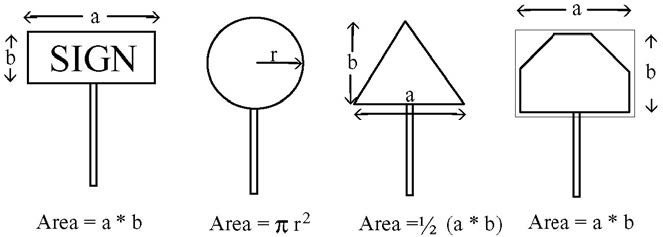
Framed signs. The area of a sign face enclosed in a frame or cabinet shall be determined on the basis of the outer dimensions of the frame or cabinet surrounding the sign face. Where the frame or cabinet is not in the shape of a rectangle, square, triangle or circle, the sign face area shall be determined by calculating the area of an imaginary rectangle drawn around the frame or cabinet.
Sign Face Area
(2)
Back-to-back signs. When the faces of a back-to-back sign are parallel or within thirty-five (35) degrees of parallel, the sign face area shall be determined on the basis of only one (1) side of such sign. If the sign faces are not within thirty-five (35) degrees of parallel, the sign face area shall be determined on the basis of the sum of the areas of each sign face.
(3)
Freestanding signs. For freestanding signs that have a solid base, the size of the base shall not be included in the total sign face area.
(4)
Three (3) dimensional signs. For globe signs, three (3) dimensional, three (3) or more sided signs, or signs with indistinct sign faces, the sign face area shall be determined on the basis of the maximum surface area visible at any one (1) time.
(5)
Individual elements. When signs are constructed of individual elements attached to a building or wall, the sign face area shall be determined by calculating the area of an imaginary rectangle drawn around the sign elements.
(6)
Awnings, canopies and marquees. When signs are incorporated into awnings, canopies and marquees, the sign area shall be determined by computing the area of an imaginary rectangle drawn around the sign. Legally nonconforming backlit awnings and canopies, with or without signage, shall be considered a sign and shall be included in the calculation of total permitted building sign area.
(7)
Banners. When signs are incorporated into banners, the sign area shall be determined on the basis of the outer dimensions of the banner.
(8)
Building facades. Backlit building facades, with or without signage, shall be included in the calculation of total permitted building sign area.
(b)
Sign height. Sign height shall be calculated as the vertical distance from the natural grade measured at a point either at the curb level or ten (10) feet away from the front center of the sign, whichever is closer, to the upper-most point used in measuring the area of a sign.
560.120. - On-premises sign permitting, installation and maintenance.
(a) Sign hangers to be licensed. No person shall install, reconstruct, alter, repair or remove any sign or submit a sign permit application without first having secured a sign hanger's license from the licensing official.
(b)
Permits required. No person shall install any sign without first obtaining a permit from the zoning administrator. An application for a sign permit shall be filed on a form approved by the zoning administrator along with all supporting documentation including the permit fee. The fee for such permit shall be as set forth in Chapter 525, Administration and Procedures.
(c)
Exceptions. No sign permit shall be required for the installation of the following signs:
(1)
Any sign that is less than eight (8) square feet in area.
(2)
Portable signs less than twelve (12) square feet in area.
(3)
Temporary signs less than eight (8) square feet in area and six (6) feet in height.
(4)
Signs placed on the inside of any building that are not visible or intended to be visible from the exterior of the building.
(5)
Window signs, except a dynamic sign.
(6)
Replacement of the sign face, changeable panel, or changeable copy portion of an approved sign having a stationary framework or structure where no change is made to the sign's size, structure, or electrical components.
(7)
On-premises incidental signs guiding traffic safely to parking spaces, loading spaces, stacking lanes, entry and exit drives, direction of traffic flow, and pedestrian ways that do not exceed four (4) square feet in area and four (4) feet in height and that bear no commercial speech.
(Ord. No. 2025-054, § 7, 11-20-2025)
560.130. - Mounting of signs.
All signs shall be mounted in one (1) of the following manners:
(1)
Flat against a building or wall.
(2)
Back-to-back in pairs or otherwise arranged in such a manner so that the back of the signs will be screened from public view.
(3)
Otherwise mounted so that the backs of all signs showing to public view, including all parts of the sign structure, shall be painted a dark or neutral color and shall be well maintained.
560.140. - Installation of signs.
Signs shall be subject to the provisions of the building code and state electrical code.
560.150. - Height over public property.
(a) Public streets, public sidewalks or public pathways. Unless a greater height is required by Chapter 95, Projections and Encroachments, the minimum height of a sign that projects over a public street, public sidewalk or public pathway shall be located not less than eight (8) feet above the ground or pavement. Signs that do not project more than six (6) inches from the building are exempt from this provision.
(b)
Public alley. The minimum height of a sign that projects over a public alley shall be located not less than fifteen (15) feet above the ground or pavement.
560.160. - Signs not to be a traffic hazard.
No sign shall be installed in a way that obstructs clear vision of persons using the streets, or may be confused with any authorized traffic sign, signal, or device. In addition, a sign in direct line of vision of any traffic signal, from any point in the traffic lane from a position opposite the near sidewalk line to a position one hundred fifty (150) feet before said sidewalk line, shall not have red, green or amber illumination.
560.170. - Maintenance and repair.
(a) Maintenance required. All signs shall be kept in good repair and free from peeling paint, rust, damaged or rotted supports, framework or other material, broken or missing faces or missing letters. The zoning administrator may order the removal of any sign that is not maintained.
(b)
Activities considered normal maintenance and repair. Normal maintenance and repair shall include activities such as replacement, restoration or improvement. Following damage or destruction, replacement of a nonconformity shall mean that the sign face or sign structure and site, if reinstated with a nonconformity as allowed under the terms of this chapter, shall be reconstructed to match the conditions of the sign face or sign structure that preceded damage or destruction. Reasonable conditions may be imposed by the zoning administrator to mitigate any newly created impact on adjacent property.
(c)
Items not considered normal maintenance and repair. Changes made to the location, size, height or bulk of the sign or addition of illumination are not considered normal maintenance and repair and shall require that a nonconforming sign be brought into conformance with all requirements of this chapter.
560.180. - Unsafe signs.
Signs which are deemed unsafe by the zoning administrator shall be either repaired or removed immediately.
560.190. - Complete removal of signs.
Whenever a sign of any type is removed, either intentionally, accidentally or by an act of nature, all supporting brackets, frames or other structural elements shall be removed completely.
560.200. - Surface repair.
Any surface from which a sign has been moved or removed shall be repaired with materials which match the existing background.
560.210. - Specific sign standards by zoning districts.
(a) In general. All on-premises signs shall conform to the applicable standards of Table 560-1, Specific Standards for Signs in the Urban Neighborhood and RM1 Districts, Table 560-2, Specific Standards for Signs in the RM2, RM3 and Commercial Mixed-Use Districts, Table 560-3, Specific Standards for Signs in the Downtown Districts, and Table 560-4, Specific Standards for Signs in the Production and Transportation Districts, and all other applicable regulations of this chapter.
(b)
Abbreviations. For purposes of Table 560-1, Specific Standards for Signs in the Urban Neighborhood and RM1 Districts, Table 560-2, Specific Standards for Signs in the RM2, RM3 and Commercial Mixed-Use Districts, Table 560-3, Specific Standards for Signs in the Downtown Districts, and Table 560-4, Specific Standards for Signs in the Production Districts, the following abbreviations shall apply:
1.
"CUP" shall mean conditional use permit;
2.
"sq. ft." shall mean square feet.
3.
"ft." shall mean feet.
(c)
References to primary building wall. For purposes of Table 560-1, Specific Standards for Signs in the Urban Neighborhood and RM1 Districts, Table 560-2, Specific Standards for Signs in the RM2, RM3 and Commercial Mixed-Use Districts, Table 560-3, Specific Standards for Signs in the Downtown Districts, and Table 560-4, Specific Standards for Signs in the Production Districts, references to "primary building wall" shall be measured in linear feet.
(d)
Sign location. Except where otherwise allowed in this ordinance, signs shall be placed on a primary building wall.
(e)
Institutional and public uses. Notwithstanding the provisions of Table 560-2, Specific Standards for Signs in the RM2, RM3 and Commercial Mixed-Use Districts, Table 560-3, Specific Standards for Signs in the Downtown Districts, and Table 560-4, Specific Standards for Signs in the Production and Transportation Districts, signs accessory to the following institutional and public uses shall be regulated by the standards of Table 560-1, Specific Standards for Signs in the Urban Neighborhood and RM1 Districts:
1.
Public libraries.
2.
Parks and public open spaces.
3.
Religious places of assembly.
4.
Schools, grades K—12.
Table 560-1 Specific Standards for Signs in the Urban Neighborhood and RM1 Districts
1 Monument signs, where allowed, may be located in a required front or corner side yard but shall be no closer than ten (10) feet from the nearest property line abutting an urban neighborhood or residential mixed-use district.
Table 560-2 Specific Standards for Signs in the RM2, RM3 and Commercial Mixed-Use Districts
1 Where a building contains a nonresidential use above the ground floor, one (1) sign for such use not higher than thirty-four (34) feet shall be allowed.
Table 560-3 Specific Standards for Signs in the Downtown Districts
1 The Downtown Entertainment Area sign regulations shall govern all uses that have their main public entrance facing Hennepin Avenue within the following locations: (a) The north side of Hennepin Avenue between Tenth Street and Fifth Street, and (b) The south side of Hennepin Avenue between Ninth Street and Sixth Street.
Table 560-4 Specific Standards for Signs in the Production and Transportation Districts
(Ord. No. 2025-023, § 86, 5-15-2025; Ord. No. 2025-054, §§ 8—11, 11-20-2025)
560.220. - Special provisions for specific uses.
(a) Multiple tenant buildings.
(1)
Master sign plan required. Any application for a sign permit for a multiple tenant building shall include a master sign plan for the building. Said plan shall be drawn to scale and fully dimensioned, showing any signage to be provided in compliance with the Minneapolis Code of Ordinances.
(2)
Allocation of signage. The property owner or the property owner's designee shall be responsible for allocating the allowable sign area among the tenants of a multiple tenant building.
(b)
Nonconforming uses. Newly established signs accessory to nonconforming nonresidential uses in the urban neighborhood and RM1 districts shall be limited to one (1) non-illuminated, flat wall identification sign, not to exceed sixteen (16) square feet in area and fourteen (14) feet in height. In addition, on a corner lot, two (2) such signs per building, except as otherwise allowed in the manner provided for in Chapter 545, Use Regulations, governing expansion or alteration of legal nonconforming uses and structures. Newly established signs accessory to nonconforming uses in the RM2, RM3, commercial mixed-use, downtown, production and transportation districts shall be subject to the regulations of the district in which it is located.
(c)
Planned unit developments. Signs accessory to planned unit developments shall be allowed as follows:
(1)
As specified in Section 560.210, Specific sign standards by zoning district; or
(2)
As approved by the conditional use permit, as specified in Chapter 550 of this Code.
(d)
Sexually oriented uses. All sexually oriented uses shall comply with the following sign requirements, notwithstanding any other provision of this ordinance:
(1)
All signs shall be flat wall signs or window signs.
(2)
Signs may be illuminated, except that flashing signs, including signs containing changing written messages, and signs with moving or swinging parts or elements shall be prohibited.
(3)
The amount of allowable sign area shall be one (1) square foot of sign area per foot of lot frontage on a street. Window signs shall be included in the calculation of total allowed sign area.
(4)
Window sign area shall be limited by the amount of total allowable sign area for the use, except that no merchandise or pictures of the products or entertainment on the premises shall be displayed in window areas or any area where they can be viewed from outside the building.
(e)
Secondhand goods store. Portable signs, temporary signs, backlit signs and freestanding signs shall be prohibited for all secondhand goods stores.
(f)
Tobacco products shop. Portable signs, temporary signs, backlit signs and freestanding signs shall be prohibited for all tobacco products shops.
(g)
Alternative financial establishment. Portable signs, temporary signs, backlit signs and freestanding signs shall be prohibited for all alternative financial establishments.
(h)
Pawnshop. Portable signs, temporary signs, backlit signs and freestanding signs shall be prohibited for all pawnshops.
(i)
Cannabis businesses. Portable signs, temporary signs, backlit signs, and freestanding signs shall be prohibited for all cannabis businesses.
(j)
Lower-potency hemp edible businesses. Portable signs, temporary signs, backlit signs, and freestanding signs shall be prohibited for all lower-potency hemp edible businesses.
(Ord. No. 2024-041, § 13, 10-31-2024; Ord. No. 2025-054, § 12, 11-20-2025)
560.230. - Special provisions for specific types of on-premises signs.
(a) Awning, canopy and marquee signs. Awning, canopy and marquee signs shall be painted on or affixed to an awning, canopy or marquee. No such sign shall extend outward from the awning, canopy or marquee on which it is located. Awning, canopy and marquee signs shall be included in the calculation of the total permitted building sign area.
(b)
Banners.
(1)
Commercial banners. Commercial banners shall be considered signs and therefore shall be included in calculating the total sign area of the site and shall be regulated as such. A commercial banner shall be considered a wall sign or a projecting sign.
(2)
Decorative banners. Decorative banners shall be allowed in all districts, provided such banners comply with the following:
a.
Commercial messages or logos shall be prohibited from decorative banners.
b.
Decorative banners shall be exempt from the total allowable sign area for a site, provided the maximum aggregate area for decorative banners shall not exceed fifteen (15) percent of the total allowable sign area for a parcel, except that at least one (1) decorative banner not exceeding eight (8) square feet shall be allowed on a zoning lot.
c.
The height of decorative banners shall comply with the district regulations for sign height.
(c)
Changeable copy sign, dynamic. The dynamic changeable copy sign shall be limited to letters or numbers only. The background of the dynamic changeable copy sign shall be black and the text shall be colored.
(1)
Number of signs. There shall not be more than one (1) dynamic changeable copy sign located on a zoning lot.
(2)
Location. The dynamic changeable copy sign shall be located on a primary building wall or be part of a freestanding sign. If the dynamic changeable copy sign is part of a freestanding sign, the dynamic changeable copy portion shall be part of the continuous display surface of the sign. Except in the downtown districts, a dynamic changeable copy sign shall not be part of a projecting sign.
(3)
Size. The maximum size of the dynamic changeable copy sign shall be sixteen (16) square feet. Dynamic changeable copy signs shall be included in the calculation of the total permitted sign area.
(4)
Height. Notwithstanding Tables 560-2, Specific Standards for Signs in the RM2, RM3 and Commercial Mixed-use Districts, 560-3, Specific Standards for Signs in the Downtown Districts, and 560-4, Specific Standards for Signs in the Production and Transportation Districts, the maximum height of a dynamic changeable copy sign attached to a building shall be fourteen (14) feet, or top of wall, whichever is less.
(5)
Duration of message. The copy of the dynamic changeable copy sign shall remain static for a period of not less than fifteen (15) minutes. The transition from one (1) message to the next shall be direct and immediate, without any special effects.
(6)
Image characteristics and transition. Dynamic changeable copy signs shall have a pitch of not greater than twenty (20) millimeters between each pixel. Special effects, including but not limited to dissolving, fading, scrolling, starbursts and wiping shall be prohibited.
(7)
Luminance. Between sunrise and sunset, the maximum luminance shall be five thousand (5,000) nits, and between sunset and sunrise, the maximum luminance shall be five hundred (500) nits. All signs with a dynamic display having illumination by means other than natural light must be equipped with an automatic dimmer control or other mechanism that automatically controls the sign's brightness to comply with this requirement. Except for institutional and civic uses, the dynamic changeable copy sign shall not display messages or be illuminated when the use is closed.
(d)
Dynamic signs. Except where allowed as-of-right in the downtown districts and the Downtown Entertainment Area, dynamic signs may be allowed as a conditional use, subject to the provisions of Chapter 525 of this Code, and the following:
(1)
Number of signs. There shall not be more than one (1) dynamic sign located on a zoning lot.
(2)
Location. Dynamic signs shall be subject to the following location restrictions:
a.
The dynamic sign shall be located on a primary building wall or be part of a freestanding sign. If the dynamic sign is part of a freestanding sign, the dynamic portion shall be part of the continuous display surface of the sign. Except in the downtown districts, a dynamic sign shall not be part of a projecting sign. Dynamic signs shall be prohibited in PR1 Production Mixed-Use District.
b.
The dynamic sign shall be located on a lot of not less than twelve thousand (12,000) square feet.
c.
The dynamic sign shall be no closer than one hundred (100) feet from the nearest urban neighborhood or residential mixed-use district property line.
d.
The dynamic sign shall be located on a lot that is part of an area of at least six hundred sixty (660) feet of continuous commercial mixed-use, downtown, or production zoning fronting along the same side of the street as the lot, without interruption by an urban neighborhood or residential mixed-use district.
(3)
Height. Notwithstanding Table 560-3, Specific Standards for Signs in the Downtown Districts, and 560-4, Specific Standards for Signs in the Production and Transportation Districts, the maximum height of a dynamic sign attached to a building shall be fourteen (14) feet, or top of wall, whichever is less.
(4)
Size. Dynamic signs shall not exceed thirty-two (32) square feet. Dynamic signs shall be included in the calculation of the total permitted sign area.
(5)
Duration of message. The sign message shall remain static for a period of not less than sixty (60) seconds. The transition from one (1) message to the next shall be direct and immediate, without any special effects.
(6)
Image characteristics and transition. Dynamic signs shall have a pitch of not greater than twenty (20) millimeters between each pixel. Special effects, including but not limited to dissolving, fading, scrolling, starbursts and wiping shall be prohibited.
(7)
Luminance. Between sunrise and sunset, the maximum luminance shall be five thousand (5,000) nits, and between sunset and sunrise, the maximum luminance shall be five hundred (500) nits. All signs with a dynamic display having illumination by means other than natural light must be equipped with an automatic dimmer control or other mechanism that automatically controls the sign's brightness to comply with this requirement. Except for Institutional and Civic Uses, the dynamic sign shall not display messages or be illuminated when the use is closed.
(e)
Fence signs.
(1)
In general. Signs attached to fences shall be included in the calculation of maximum wall sign area allowed on a site and shall be regulated as such. Signs attached to fences shall not project beyond the edge of the fence.
(2)
In required yards. Signs attached to fences, retaining walls or other similar structures may be located within a required yard, provided such sign, including the back of such sign, shall not be visible from any urban neighborhood or residential mixed-use district abutting such required yard.
(f)
Freestanding signs.
(1)
In general. Except for portable and temporary signs, not more than one (1) freestanding sign shall be permitted on a zoning lot, except as otherwise permitted in this chapter.
(2)
Institutional and civic uses in the RM2 and RM3 Districts. Notwithstanding Table 560-2, Specific Standards for Signs in the RM2, RM3 and Commercial Mixed-Use Districts, not more than one (1) freestanding sign shall be permitted per frontage.
(3)
Base of sign. Landscaping or other decorative materials designed to screen the base of the freestanding sign and any light fixtures shall be provided. Such landscape or decorative materials shall be capable of screening the base of the sign all year and shall be well maintained.
(g)
Light projection signs.
(1)
In general. Light projection signs shall not be permitted, except in the Downtown Entertainment Area, subject to the regulations for on-premises wall signs as specified in Table 560-3, Specific Standards for Signs in the Downtown Districts.
(2)
Number of signs. There shall be not more than one (1) light projection sign located on a zoning lot, except where otherwise allowed in this chapter.
(3)
Sending and receiving site approval. An application for a light projection sign must include letters of approval from the owners of the building where the light projection image will appear and the property where the light projection will originate.
(4)
Location. Light projection signs shall be subject to the following location restrictions:
a.
Light projection devices shall not be installed within the public right-of-way.
b.
The light projection sign shall not project onto, fully or partially, any property, structure, or public right-of-way other than the structure where the image will appear.
c.
The light projection sign shall not shine onto the façade of a residential or lodging use where windows are located.
(5)
Operation standards. Light projection signs shall be subject to the city engineer's authority to deny or remove items to protect the public health, safety, and welfare, and prevent interference with the safety and convenience of ordinary travel over the right-of-way, in accordance with Chapters 95, 427, 429 and 430 of this Code, and the following standards:
a.
Light projection signs shall not impair the vision of or distract a driver of a vehicle.
b.
Light projection signs shall be located at minimum twenty (20) feet above grade or above the first story of the structure, whichever is greater.
c.
The display of light projection signs shall be limited to the hours of 7:00 a.m. to 2:00 a.m.
d.
Light projection signs shall not be flashing or animated.
e.
Light projection signs shall not exceed three hundred (300) lumens per square meter (lux) as measured at any point on the projected surface.
f.
The brightness of any projection may not exceed three-tenths (0.3) of a footcandle above ambient light levels as measured at the property line of any adjacent property.
g.
Projection devices must include automatic dimming technology responsive to ambient light levels.
(h)
Mixed-premises signs.
(1)
In general. Mixed-premises signs shall not be permitted, except in downtown districts, subject to the regulations for on-premises wall signs or freestanding signs as specified in Table 560-3, Specific Standards for Signs in the Downtown Districts.
(2)
Display. Off-premises advertising shall be limited to no more than twenty (20) percent of the display time or physical space of a sign at any given time.
(3)
Height. Mixed-premises signs shall not be eligible for exemptions for wall signs under Table 560-3, Specific Standards for Signs in the Downtown Districts.
(i)
Non-commercial speech. Notwithstanding any other provisions of these sign regulations, all signs of any size containing non-commercial speech may be posted from August 1 in any general election year until ten (10) days following the general election and thirteen (13) weeks prior to any special election until ten (10) days following the special election. These signs shall not be posted on the public right-of-way, including boulevard trees and utility poles.
(j)
Portable signs.
(1)
Limits. Portable signs shall not exceed twelve (12) square feet in area, shall not be illuminated, and shall be of sufficient weight to prevent movement by wind.
(2)
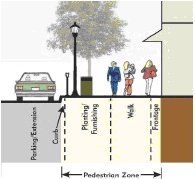
On the public right-of-way. Portable signs allowed on the public right-of-way shall be placed in the Planting/Furnishing Zone or Frontage Zone, and shall be prohibited in the Walk Zone, as indicated in Figure 560-1. Portable signs shall not be attached to public infrastructure.
(3)
Exemption from regulations on number of freestanding signs. Portable signs shall be exempt from the restrictions on the number of freestanding signs allowed on a zoning lot, provided such portable signs shall not exceed four (4) feet in height and there shall be not more than one (1) such portable sign per street frontage.
Figure 560-1 Walk Zone
(k)
Projecting signs. A projecting sign may extend above the top of the wall or parapet line or, in the case of a mansard roof, beyond the deck line. Subject to the sign height regulations, a projecting sign may extend two (2) feet per story, but not more than a total of ten (10) feet, above the roof line of a flat roofed building. In the case of a mansard roof, a projecting sign may extend not more than four (4) feet above the deck line. In no case shall any element of the projecting sign be attached to the roof of the building.
(l)
Roof signs. Notwithstanding the height limits of Tables 560-2, Specific Standards for Signs in the RM2, RM3 and Commercial Mixed-use Districts, 560-3, Specific Standards for Signs in the Downtown Districts, and 560-4, Specific Standards for Signs in the Production and Transportation Districts, one (1) roof sign shall be allowed, subject to the following:
(1)
Roof signs facing a public street frontage. Roof signs identifying the name or logo of a building or use, facing a public street frontage, shall be subject to the following:
a.
Signs shall be located on buildings that are not greater than six (6) stories and eighty-four (84) feet in height.
b.
Signs shall be internally illuminated or non-illuminated individual letters and/or logo permanently affixed and attached to the parapet wall or building roof and shall face a public street.
c.
Signs shall not extend outward more than six (6) inches from the structure.
d.
Signs shall not be located more than five (5) feet from the face of the primary building wall.
e.
Sign area shall be included in the calculation of the total permitted sign area allowed for the street frontage that the roof sign faces.
f.
A roof sign may have a vertical dimension of two (2) feet per story, but not more than a total of five (5) feet, above the roof line of a flat roofed building, or the parapet wall, whichever is greater.
g.
Between sunrise and sunset, the maximum luminance shall be five thousand (5,000) nits, and between sunset and sunrise, the maximum luminance shall be five hundred (500) nits.
(2)
Roof signs affixed flat on the roof and viewed from above. Roof signs identifying the name or logo of a building or use, affixed flat on the roof and viewed from above, shall be subject to the following:
a.
A roof sign shall be located on a building with a flat roof that exceeds fifteen (15) stories and shall be installed on or above the fifteenth (15 th ) story.
b.
Notwithstanding the area limits of Tables 560-2, Specific Standards for Signs in the RM2, RM3 and Commercial Mixed-use Districts, 560-3, Specific Standards for Signs in the Downtown Districts, and 560-4, Specific Standards for Signs in the Production and Transportation Districts, a roof sign shall not exceed twenty-five (25) percent of the roof area on which the sign is located.
c.
Signs shall be non-illuminated or externally illuminated in such a way that the light shall be aimed and shielded directly onto the roof sign only.
(m)
Service area canopy and pump island signs.
(1)
Service area canopy signs. Notwithstanding Tables 560-2, Specific Standards for Signs in the RM2, RM3 and Commercial Mixed-use Districts, 560-3, Specific Standards for Signs in the Downtown Districts, and 560-4, Specific Standards for Signs in the Production and Transportation Districts, twenty-five (25) square feet of signage per frontage may be applied to the faces of the canopy facing any street. Such signage may be lighted externally or internally, but no other part of the face of the service area canopy shall be illuminated. Service area canopy signs shall not extend beyond the face of the canopy.
(2)
Pump island signs. Signs on pumps and pump islands shall be permanently affixed, non-illuminated, less than one (1) square foot in area and less than six (6) feet in height.
(n)
Temporary signs.
(1)
In general. All temporary signs shall be attached to a building except as otherwise provided below. Temporary signs shall be located on property that is owned by the person whose sign it is, shall not be located closer than eight (8) feet to any other zoning lot, shall not be illuminated, and shall not be placed on any utility pole, street light, similar object, or on public property.
(2)
Time. Temporary signs shall be removed within sixty (60) days of installation.
(3)
Sign area and number. Temporary signs shall be exempt from the calculation of total permanent sign area allowed on the site, but shall meet the same dimensional, locational, total sign area and other applicable regulations for permanent signs.
(4)
Additional temporary signs. One (1) additional temporary sign may be located on a property when:
a.
The owner consents and that property is being offered for sale or lease through a licensed real estate agent. In urban neighborhood and RM1 districts, the sign shall not exceed eight (8) square feet in area and shall be freestanding. In all other districts, the sign shall not exceed thirty-two (32) square feet in area. Freestanding temporary signs shall not exceed six (6) feet in height. Temporary signs attached to walls shall comply with the maximum height of the applicable zoning district.
b.
If not offered for sale or lease through a real estate agent, when the sign is owned by the property owner and that property is offered for sale or lease by the owner through advertising in a local newspaper of general circulation. In urban neighborhood and RM1 districts, the sign shall not exceed eight (8) square feet in area and shall be freestanding. In all other districts, the sign shall not exceed thirty-two (32) square feet in area. Freestanding temporary signs shall not exceed six (6) feet in height. Temporary signs attached to walls shall comply with the maximum height of the applicable zoning district.
c.
On a day when the property owner is opening the property to the public, except the owner shall not use this type of sign in a residential zoning district on more than two (2) days in a year and the days must be consecutive. In all other districts, the owner shall not use this type of sign for more than fourteen (14) days in a year and the days must be consecutive.
d.
The owner consents and that property is under active construction with valid building permits in force. In urban neighborhood and RM1 districts, the sign shall not exceed eight (8) square feet in area. In all other districts, the sign shall not exceed thirty-two (32) square feet in area. Freestanding temporary signs shall not exceed six (6) feet in height. Temporary signs attached to walls shall comply with the maximum height of the applicable zoning district.
(o)
Wall signs.
(1)
In general. A wall sign shall not extend outward more than twenty-four (24) inches from the structure, except a flat wall sign shall not extend outward more than six (6) inches from the structure. A wall sign shall not extend above the top of the wall or parapet line or, in the case of a mansard roof, beyond the deck line, nor shall a wall sign extend beyond the corner of the building.
(2)
Exception. Recognizing that certain buildings or uses may have unique identification needs, notwithstanding the height and area limits of Tables 560-2, Specific Standards for Signs in the RM2, RM3 and Commercial Mixed-use Districts, 560-3, Specific Standards for Signs in the Downtown Districts, and 560-4, Specific Standards for Signs in the Production Districts, a conditional use permit may be applied for, as provided in Chapter 525, Administration and Procedures, to allow not more than two (2) additional wall signs identifying the name or logo of a building or use in a building, subject to the following:
a.
Signs shall be limited to individual letters or elements permanently affixed to the building wall.
b.
Signs shall not exceed three (3) square feet of sign area for each one (1) foot of building wall to which such sign is attached or three hundred (300) square feet, whichever is less.
c.
Not more than one (1) sign shall be located on a building wall.
d.
The vertical dimension of such sign shall not exceed fourteen (14) feet.
(p)
Window signs. Window signs shall be allowed, provided that such signage shall not exceed thirty (30) percent of the window area, whether attached to the window or not, and shall not block views into and out of the building in the area between four (4) and seven (7) feet above the adjacent grade. Window signs shall be included in the calculation of the total permitted building sign area, except as provided for temporary signs in section 560.230(m).
(Ord. No. 2025-054, § 13, 11-20-2025)
560.240. - Sign adjustments.
(a) Purpose. Sign adjustments are intended to allow flexibility in the application of the sign regulations for properties located in a RM2, RM3, commercial mixed-use, downtown, production or transportation district by allowing sign adjustments that recognize unusual site conditions and that are consistent with the character of the area and the design of the site.
(b)
Procedure. An application for a sign adjustment shall be considered an application for a conditional use permit or a variance, as specified in Chapter 525, Administration and Procedures. In addition to the conditional use permit or variance standards, the approval criteria of this article shall be met before a sign adjustment may be approved.
(c)
Approval criteria. Adjustment to the number, type, height, area or location of allowed signs on property located in an RM2 or RM3 District or a commercial mixed-use, downtown or production or transportation district may be approved if the following criteria are met:
(1)
The sign adjustment will not significantly increase or lead to sign clutter in the area or result in a sign that is inconsistent with the purpose of the zoning district in which the property is located.
(2)
The sign adjustment will allow a sign that relates in size, shape, materials, color, illumination and character to the function and architectural character of the building or property on which the sign will be located.
560.300. - Billboard districts.
(a) In general. The following billboard districts are established and shall have boundaries as described in this section. In addition to section 560.330, off-premises signs shall be subject to specific district standards in this section.
(b)
General Billboard District.
(1)
Boundaries. The General Billboard District shall include areas directly abutting county-state aid roadways, municipal-state aid roadways and state trunk highways and within commercial mixed-use, downtown, and production zoning districts.
(2)
District standards. Any off-premises sign constructed or relocated shall be located within six hundred sixty (660) feet from such county-state aid roadway, municipal-state aid roadway or state trunk highways.
(c)
Limited Access Roadway Opportunity Billboard District.
(1)
Boundaries. The Limited Access Roadway Opportunity Billboard District shall comprise areas within six hundred sixty (660) feet of limited access roadway where continuous to commercial mixed-use, downtown, or production districts and extends at least one thousand three hundred twenty (1,320) feet along and parallel to the limited access roadway without interruption by an urban neighborhood or residential mixed-use zoning district. The six hundred sixty (660) foot spacing distance shall be measured from the right-of-way for the limited access roadway perpendicular to the flow of traffic.
(2)
District standards. Any off-premises sign within six hundred sixty (660) feet from such limited access roadway shall comply with the applicable provisions of this chapter and shall be subject to all applicable regulations of this zoning ordinance.
(d)
Downtown Opportunity Billboard District.
(1)
Boundaries. The Downtown Opportunity Billboard District shall comprise the area bounded by the Washington Avenue, I-35W, I-94, and I-394/Third Avenue North (extended to the river), except that in no case shall an off-premises sign be constructed or structurally altered along or within three hundred (300) feet of either side of Nicollet Avenue between Washington Avenue and Ninth Street South, between LaSalle Avenue and Marquette Avenue from Ninth Street South to Grant Street, or north of Washington Avenue extending to the Mississippi River.
(2)
District standards. Any off-premises sign constructed or structurally altered within the Downtown Opportunity Billboard District shall comply with the provisions of this section and subject to all applicable regulations of this zoning ordinance.
(e)
Downtown East Entertainment Billboard District. The Downtown East Entertainment Billboard District shall comprise the following area: Commencing at the intersection of Chicago Avenue and Seventh Street South, land that is north of Seventh Street South between Chicago Avenue and Ninth Ave South, north of Sixth Street South between Ninth Ave South and Eleventh Avenue, west of Eleventh Avenue between Sixth Street South and Fourth Street South, south of Fourth Street South between Eleventh Avenue and Chicago Avenue, and east of Chicago Avenue (aka Kirby Puckett Place) between Fourth Street South and Seventh Street South.
(f)
Downtown West Entertainment Billboard District. The Downtown West Entertainment Billboard District shall comprise the following area: Commencing at the intersection of Sixth Street North and Hennepin Avenue, land that is south of Sixth Street North between Hennepin Avenue and Second Avenue North, east of Second Avenue between Sixth Street and Seventh Street North, north of Seventh Street North between First and Second Avenue North, east of First Avenue North between Seventh and Eighth Street North, north of Eighth Street North between First Avenue North and Hennepin Avenue, and west of Hennepin Avenue between Sixth Street and Eighth Street North.
(g)
Downtown Entertainment Area. For the purposes of this section, the Downtown Entertainment Area shall comprise those properties with frontage along the north side of Hennepin Avenue between Tenth Street and Fifth Street, and those properties with frontage along the south side of Hennepin Avenue between Ninth Street and Sixth Street.
(Ord. No. 2025-054, § 14, 11-20-2025)
560.310. - Height computations.
(a) In general. Except for rooftop signs, the height of off-premises signs shall be calculated as the vertical distance from the natural grade measured at a point either at the curb level or ten (10) feet away from the front center of the sign, whichever is closer, to the upper-most point of the sign.
(b)
Off-premises rooftop signs. The height of the off-premises sign above the roof shall be measured from the surface of the roof at the lowest point of mounting.
560.320. - General provisions.
The following provisions shall apply to all off-premises signs, except as otherwise provided:
(1)
New and existing off-premises signs. Any off-premises sign existing on December 1, 2025, shall comply with the applicable provisions of this chapter and shall be subject to all applicable regulations of this zoning ordinance. No new off-premises sign shall be constructed or established within the billboard districts.
a.
Alterations, generally. Alterations to existing, permitted off-premises signs shall be permitted, but shall not include electronic elements or conversion to a flashing or animated off-premises sign.
b.
Alterations, Downtown West Entertainment Billboard District. Alterations to existing, permitted off-premises signs in the Downtown West Entertainment Billboard District shall be permitted to include electronic elements or conversion to a flashing or animated off-premises sign, subject to the provisions of Table 560-7 Downtown East and Downtown West Entertainment Billboard District Standards. Existing off-premises signs benefiting from a conversion from static to digital under this subsection shall be subject to the terms of any legislative mechanism approved providing for future revenue share or municipal tax, to the extent permitted by law.
(2)
Number of off-premises signs. Only one (1) off-premises sign structure shall be allowed on a zoning lot, except as otherwise provided in this chapter. Multiple signs may be installed on a single sign structure as permitted by this ordinance.
(3)
Minimum commercial mixed-use/production zoning. Except as provided in section 560.300, the following factors shall be considered in determining the roadway or roadways from which a sign is intended to be read:
a.
The angle of the off-premises sign to the roadway.
b.
The duration of the view of the message from the roadway.
c.
The distance the off-premises sign is from the roadway.
d.
Obstructions to the view of the message from the roadway.
(4)
Off-premises signs next to urban neighborhood or residential mixed-use districts. Except as provided in section 560.300, no off-premises sign shall be located within the required spacing from an urban neighborhood or residential mixed-use zoning district fronting on either side of the roadway from which the off-premises sign is intended to be read. Spacing shall be measured from the closest urban neighborhood or residential mixed-use district boundary to a line projected from the nearest point of the off-premises sign perpendicular to the roadway.
(5)
Off-premises signs next to parks. No off-premises sign, except where designated by the city council or where determined to be a contributing feature in an historic district, shall be located within three hundred (300) feet of a parkway or a public park of three (3) acres or more.
(6)
Central riverfront. No off-premises sign shall be allowed within the area bounded by I-35W, Plymouth Avenue North, Washington Avenue and the Mississippi River, except where designated by the city council, determined to be a contributing feature in an historic district, or if located within the Downtown Opportunity Billboard District. No freestanding off-premises sign shall be located within the Central riverfront district.
(7)
SH Shoreland and MR Mississippi River Corridor Critical Area Overlay Districts. All off-premises signs located within the SH Shoreland and MR Mississippi River Corridor Critical Area Overlay Districts shall be subject to the provisions of Chapter 535, Overlay Districts.
(8)
Measurement of spacing between off-premises signs. For the purpose of measuring spacing, the off-premises sign shall be the face displaying the copy or message and shall not include the structural members, frame or edge. The same factors shall be considered in determining the roadway or roadways and the direction or directions from which an off-premises sign is intended to be read. Required spacing shall be measured as follows:
a.
General Billboard District. Required spacing between signs shall apply to all off-premises signs on either side of the roadway that are intended to be read from the same direction. Spacing shall be measured by projecting a line from the nearest points of the off-premises signs and measuring the distance between those points.
b.
Limited Access Roadway Opportunity Billboard District and the Downtown Opportunity Billboard District. Required spacing between off-premises signs shall apply only to signs on the same side of the roadway that are intended to be read from the same direction. Spacing shall be measured by projecting a line from the nearest points of the off-premises signs perpendicular to the roadway or roadways from which they are intended to be read and measuring the distance along the roadway between those points.
(9)
Minimum lot frontage. Minimum lot frontage shall be measured along the roadway from which the off-premises sign is intended to be read, measured between side lot lines of the zoning lot. In the Limited Access Roadway Opportunity District, lot frontage shall be measured parallel to the right-of-way of the limited access roadway. For the purposes of this chapter, a railroad right-of-way shall not constitute a zoning lot for purposes of minimum lot frontage.
(10)
Maximum off-premises sign area. The maximum off-premises sign area shall apply to each side of the sign structure, whether a single-sided, back-to-back or v-type sign.
(11)
Backs of signs. The back of each off-premises sign, including all parts of the off-premises sign structure and any temporary extensions, shall be painted a dark or neutral color and shall be well maintained. The structure of an off-premises sign, whether freestanding or mounted on a building or other structure, shall include a framing system consisting of painted black anodized steel. A sign that is integrated into the façade or elevation of the building such that the sign is framed by the structure is exempt from this provision.
(12)
Orientation of sign faces. All off-premises signs consisting of back-to-back or parallel design shall be no greater than eight (8) feet apart. All back-to-back or parallel off-premises signs shall be designed with faces at an angle no greater than thirty-five (35) degrees. Off-premises wall signs shall be mounted parallel to the building, shall not project more than fifteen (15) inches from the building, and shall not be oriented to face urban neighborhood or residential mixed-use districts. Off-premises signs must be oriented toward the roadway along which the property has frontage. Off-premises signs shall not include more than two (2) sides and may not include more than one (1) sign face per side.
(13)
Location. Freestanding off-premises signs shall conform to the yard requirements for a principal structure.
(14)
Obstruction. No off-premises sign shall be located in such a manner as to obscure or otherwise interfere with the effectiveness of an official traffic sign, signal or device, or obstruct or interfere with a driver's view of approaching, merging or intersecting traffic.
(15)
Off-premises signs on public transit infrastructure. The provisions of this chapter shall not apply to off-premises signs placed on public transit, bus shelters, bike lockers and benches as specifically permitted by ordinance or franchise.
(16)
Roadway classification. The classification of roadways shall be shown on the map entitled "Roadway Classification" maintained by the city engineer, as amended from time to time, which is incorporated into this chapter by reference and made a part hereof.
(17)
Active uses. No off-premises sign erected after December 1, 2025, shall be permitted on any structure or lot that does not contain an active principal use. Any off-premises sign in violation of this provision shall be removed within one hundred eight (180) days unless the structure or lot is brought into active use.
(Ord. No. 2025-054, § 15, 11-20-2025)
560.330. - Specific billboard district standards.
(a) In general. All off-premises signs shall conform to the applicable standards of Table 560-5, General Billboard District Standards, Table 560-6, Opportunity Billboard District Standards, Table 560-7, Downtown East and Downtown West Entertainment Billboard Districts, and all other applicable regulations of this chapter.
(b)
Abbreviations. For purposes of Table 560-5, General Billboard District Standards, Table 560-6, Opportunity Billboard District Standards, Table 560-7, Downtown East and Downtown West Entertainment Billboard District Standards, "sq. ft." shall mean square feet, and "ft." shall mean feet.
Table 560-5 General Billboard District Standards
Table 560-6 Opportunity Billboard District Standards
2 Luminance is the physical measure of brightness or light emanating from an object with respect to its size. The unit of measurement for luminance is nits, which is the total amount of light emitted from a sign divided by the surface area of the sign (candela per square meter).
Table 560-7 Downtown East and Downtown West Entertainment Billboard District Standards
1 Luminance is the physical measure of brightness or light emanating from an object with respect to its size. The unit of measurement for luminance is nits, which is the total amount of light emitted from a sign divided by the surface area of the sign (candela per square meter).
(Ord. No. 2025-054, § 16, 11-20-2025)
560.340. - More restrictive provisions to apply.
If a provision of this chapter conflicts with any other ordinance or other provision of law, the more restrictive provision shall apply.
560.350. - Billboard permitting, installation, and maintenance.
(a) Billboard erectors to be licensed. No person shall install, reconstruct, alter, repair or remove any billboard or submit a sign permit application without first having secured a license from the licensing official.
(b)
Permits required. No person shall paint or install any billboard without first obtaining a permit from the zoning administrator. An application for a sign permit shall be filed on a form approved by the zoning administrator along with all supporting documentation including the permit fee. The fee for such permit shall be as set forth in Chapter 91, Permit Fees, of the Minneapolis Code of Ordinances.
(c)
Exceptions. No sign permit shall be required for the installation of the following signs:
(1)
Replacement of the changeable copy portion of a billboard having a stationary framework or structure.
(2)
Repainting any legal, existing billboard when there is no change in copy or size for which previous permits had been issued.

