
Minneapolis City Zoning Code
CHAPTER 545
- USE REGULATIONS
545.10. - Purpose.
This article describes the classification and regulation of principal uses.
545.20. - Use table description.
(a) Generally. Table 545-1, Uses Allowed, identifies the principal uses allowed in the primary zoning districts. Sections 545.110 through 545.160 include descriptions of use groups and use categories listed in the table. A use may be determined to be within a use category if not listed specifically in the table of allowed uses and if not determined to be within another general use category. The determination of whether a particular use is included within a use category shall be made by the zoning administrator.
(b)
Permitted uses. Uses specified with a "P" are permitted as of right in the district or districts where designated, provided that the use complies with all other applicable provisions of this ordinance. Persons wishing to establish a permitted use shall obtain a zoning permit for such use as specified in Chapter 525, Administration and Procedures.
(c)
Conditional uses. Uses specified with a "C" are allowed as a conditional use in the district or districts where designated, provided that the use complies with all other applicable provisions of this ordinance. Persons wishing to establish or expand a conditional use shall obtain a conditional use permit for such use, as specified in Chapter 525, Administration and Procedures.
(d)
Maximum gross floor area of specific uses. The number preceding a "P" or "C" in the use table indicates the maximum gross floor area for that use in that district in multiples of one thousand (1,000) square feet. For example, a use identified with a "10P" means the use is permitted in that district and is allowed a maximum gross floor area of ten thousand (10,000) square feet. These limits apply to individual uses, including individual uses within shopping centers. In the residential mixed-use districts, floor area limits shall apply to the entire shopping center.
(e)
Mixed-use buildings. An asterisk "*" following a "P" or "C" in the use table indicates that the use is only permitted in a mixed-use building. In the RM1 District, the building shall also contain a residential use or uses.
(f)
Use groups and use categories. Use groups and use categories are described in this chapter and are accompanied by examples and exceptions. Certain specific uses are enumerated in the use table for two reasons: (1) the districts where the specific use is allowed are different from other uses in the use category; and/or (2) the use is subject to specific use standards that are in addition to use standards applicable to other uses in the same use category. In these situations, the use category includes the reference "except as noted below" in the table below.
(g)
Prohibited uses. Any use not listed as either "P" (permitted) or "C" (conditional) in a particular district, or any use that the zoning administrator determines does not fit within a use category allowed in a zoning district and that is not substantially similar to a use listed as permitted or conditional, shall be prohibited in that district.
(h)
Uses existing on the effective date of this ordinance. A use that is classified as permitted or conditional on the effective date of the ordinance shall not be expanded beyond the boundaries of the existing zoning lot. Such use may be expanded or reconstructed on the existing zoning lot in accordance with the regulations of the zoning district.
(i)
Use standard. Permitted and conditional uses specified with an "X" under the Use Standard column indicate that all uses within a use category are subject to the broader use category standards in Article II of this chapter. Permitted and conditional uses specified with a "+" indicate that a specific use is subject to the specific use standards in Article II of this chapter. Where both an "X" and a "+" appear, the specific use is subject to use standards applicable to the broader use category as well as the standards applicable to the specific use.
(Ord. No. 2025-023, § 28, 5-15-2025)
545.30. - Planned unit developments.
Planned unit developments are a conditional use in all zoning districts except the UN1 Urban Neighborhood District. Any use allowed in the zoning district in which the planned unit development is located may be included within a planned unit development. Additional provisions governing uses allowed within a planned unit development are provided in sections 550.1070, 550.1080, 550.1090, and 550.1100. A planned unit development shall conform to the standards of Chapter 550, Article VII, Planned Unit Development.
545.40. - Adaptive reuse.
(a) In general. Notwithstanding Table 545-1, Uses Allowed, or other applicable provisions, additional uses authorized by this section may be allowed in existing principal structures, originally constructed for nonresidential use before the effective date of this ordinance in the urban neighborhood districts and the RM1 Residence Goods and Services District. For the purpose of this section, a principal structure originally constructed for nonresidential use includes those constructed as a mixed-use commercial storefront and residential building. Additional authorized uses shall comply with all applicable use standards and built form overlay district standards, unless otherwise provided in this section.
(b)
UN1 District. In the UN1 District, additional authorized uses shall be limited to the following and shall only be allowed by conditional use permit unless otherwise indicated:
(1)
Permitted and conditional uses allowed in the UN1 District that do not comply with the minimum lot dimension requirements of Chapter 540, Built Form Overlay Districts. Permitted uses shall not require a conditional use permit.
(2)
Child care center, when the building is not currently being used for a nonresidential use or nursing home as required by the child care center use standards, shall be a permitted use.
(3)
Residential uses allowed in the UN2 District that are not allowed in the UN1 District. Minimum lot dimension requirements shall not apply provided the lot area shall not be reduced below nine thousand (9,000) square feet or reduced further if less than nine thousand (9,000) square feet.
(4)
The following nonresidential uses provided the individual size of each of these nonresidential uses shall not exceed five thousand (5,000) square feet, except as authorized by section 545.40(g):
a.
Art gallery.
b.
Art studio.
c.
Clinic, medical or dental.
d.
Community provisions facility.
e.
Convent, monastery, or religious retreat center.
f.
Grocery store.
g.
Offices.
Minimum lot dimension requirements shall not apply to these nonresidential uses provided the lot area shall not be reduced below nine thousand (9,000) square feet or reduced further if less than nine thousand (9,000) square feet.
(5)
Dwellings with one (1) to three (3) units as part of a mixed-use building are permitted.
(6)
Planned unit development, subject to the requirements of Chapter 550, Article VII. Planning Unit Development. Where required, a separate conditional use permit application and findings shall be submitted for the additional authorized uses as a part of the planned unit development review.
(c)
UN2 District. In the UN2 District, additional authorized uses shall be limited to the following and shall only be allowed by conditional use permit unless otherwise indicated:
(1)
Permitted and conditional uses allowed in the UN2 District that do not comply with the minimum lot dimension requirements of Chapter 540, Built Form Overlay Districts. Permitted uses shall not require a conditional use permit.
(2)
Child care center, when the building is not currently being used for a nonresidential use or nursing home as required by the child care center use standards, shall be a permitted use.
(3)
Residential uses allowed in the UN3 District that are not allowed in the UN2 District. Minimum lot dimension requirements shall not apply provided the lot area shall not be reduced below five thousand (5,000) square feet.
(4)
The following nonresidential uses provided the individual size of each of these nonresidential uses shall not exceed five thousand (5,000) square feet, except as authorized by section 545.40(g):
a.
Art gallery.
b.
Art studio.
c.
Clinic, medical or dental.
d.
Community provisions facility.
e.
Convent, monastery or religious retreat center.
f.
Grocery store.
g.
Offices.
Minimum lot dimension requirements shall not apply to these nonresidential uses provided the lot area shall not be reduced below five thousand (5,000) square feet.
(5)
Dwellings with one (1) to three (3) units as part of a mixed-use building are permitted.
(d)
UN3 District. In the UN3 District, additional authorized uses shall be limited to the following and shall only be allowed by conditional use permit unless otherwise indicated:
(1)
Permitted and conditional uses allowed in the UN3 District that do not comply with the minimum lot dimension requirements of Chapter 540, Built Form Overlay Districts. Permitted uses shall not require a conditional use permit.
(2)
Child care center, when the building is not currently being used for a nonresidential use or nursing home as required by the child care center use standards, shall be a permitted use.
(3)
The following nonresidential uses provided the individual size of each of these nonresidential uses shall not exceed five thousand (5,000) square feet, except as authorized by section 545.40(g):
a.
Art gallery.
b.
Art studio.
c.
Clinic, medical or dental.
d.
Community provisions facility.
e.
Convent, monastery or religious retreat center.
f.
Grocery store.
g.
Offices.
Minimum lot dimension requirements shall not apply to these nonresidential uses provided the lot area shall not be reduced below five thousand (5,000) square feet.
(4)
Dwellings with one (1) to three (3) units as part of a mixed-use building are permitted.
(e)
RM1 District. In the RM1 District, allowed commercial uses may be exempted from the use standards requiring that such uses are located in a residential mixed-use building, provided the building complies with subpart (f) below.
(f)
Expansions. Expansions of such existing principal structures may be allowed provided the gross floor area is not increased by more than twenty (20) percent or one thousand (1,000) square feet, whichever is greater, from the time the conditional use is approved and the resulting floor area ratio complies with the built form overlay district requirement. This expansion limit shall not apply when uses allowed in Table 545-1, Uses Allowed, for the applicable district occupy at least fifty (50) percent of the gross floor area of the building.
(g)
Increased nonresidential floor area. In considering an increase in the maximum size of nonresidential uses in sections (b), (c), and (d) above, the city planning commission shall find that the potential off-site impacts to surrounding residential properties are comparable to other nonresidential uses of a similar size that are allowed in the primary zoning district pursuant to Table 545-1, Uses Allowed. In determining potential off-site impacts, the city planning commission shall consider but not be limited to the following factors for the proposed use:
(1)
Nature of the use including, but not limited to, operations that produce noise or other adverse off-site impacts.
(2)
Hours of operation.
(3)
Number of employees.
(4)
Motor vehicle traffic generation including, but not limited to, delivery truck size, location, frequency, and time of day of loading operations.
(h)
Cluster developments. Such existing principal structures may be incorporated into a larger cluster development, subject to the following standards:
(1)
Additional authorized uses are only allowed in the existing principal structure, originally constructed for nonresidential purposes.
(2)
The cluster development shall comply with the floor area ratio requirement of the built form overlay district in Table 540-3, Maximum Floor Area Ratio for Cluster Developments.
(3)
The cluster development shall comply with the requirements of Chapter 550, Article VIII, Cluster Development Standards, except the planning commission may authorize exceptions to section 550.1310(3), Development Standards for All Cluster Developments, for the existing principal structure, originally constructed for nonresidential purposes, through the conditional use permit.
(4)
Where required, a separate conditional use permit application and findings shall be submitted for the additional authorized uses as a part of the cluster development review.
(i)
Common lot developments. Such existing principal structures may be incorporated into a common lot development, provided all uses within the development are residential.
(Ord. No. 2025-023, § 29, 5-15-2025)
545.50. - Use groups, use categories, and specific uses.
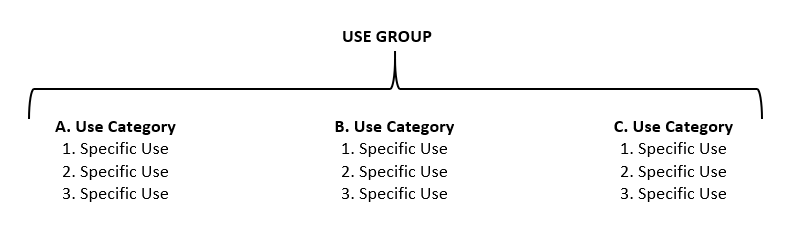
(a) In general. The zoning code classifies principal land uses into use groups, use categories, and specific uses.
(b)
Use groups. Uses are encompassed within six (6) use groups based on the following type of activity:
(1)
Commercial.
(2)
Institutional and Civic.
(3)
Production.
(4)
Public Services and Utilities.
(5)
Residential.
(6)
Transportation, Vehicle Services, and Parking.
(c)
Use categories. Each use group is further divided into more specific use categories. Use categories classify principal uses based on certain common characteristics. Uses within a particular use category are not necessarily allowed in the same zoning districts.
(d)
Specific uses. Within use categories, certain specific uses are listed, particularly where they are identified for more detailed standards that may differ from other uses in the same use category.
Figure 545-1 Example of Format and Hierarchy of Use Groups, Use Categories, and Specific Uses
545.60. - Descriptions and characteristics of use groups and use categories.
This article includes descriptions and the characteristics of each use group and use category. This provides a framework for classifying uses when determining whether they are allowed in a particular zoning district, and which standards are applicable.
545.70. - Use determinations.
When a specific use is not referenced within the use table or within the descriptions and examples provided in this article, the zoning administrator shall make a determination about whether the use fits in a use category or is substantially similar in character and impact to a use regulated herein. If a use is determined to not fit within a use category and is not substantially similar to any other use regulated in the zoning ordinance, the use shall be prohibited. The public may request a written statement of clarification that includes the findings that lead to the zoning administrator's conclusion.
545.80. - Prohibited uses.
The zoning ordinance does not list every prohibited use. As referenced in section 545.20 above, a use is prohibited if it is determined by the zoning administrator to not fit within a use category and is not substantially similar to any other use regulated in the zoning ordinance. However, the following uses represent examples of uses that are either prohibited in all zoning districts or may not be newly established in any zoning district in the city:
(1)
Drive-through facilities.
(2)
Firearms dealers.
(3)
Motels.
(4)
Pet stores and establishments selling dogs, cats, and rabbits sourced from breeders. Rescued animals may be offered for adoption.
(5)
Rooming houses that are not otherwise defined in this ordinance.
(6)
High-impact production and processing uses not expressly identified as a conditionally allowed use in Table 545-1.
(7)
Post-consumer waste processing uses not expressly identified as a conditionally allowed use in Table 545-1.
(8)
Establishments where either a majority of the products available for purchase or a majority of the sales area are dedicated to the sale of animal fur, including clothing and accessory items with animal fur.
545.90. - Overlay districts.
As described in Chapter 535, Overlay Districts, an overlay district may include regulations that are more restrictive or more permissive than otherwise specified in a primary zoning district on the same property.
545.100. - Use table.
Table 545-1, Uses Allowed, identifies the principal uses allowed in the primary zoning districts. The letters, numbers, and symbols listed in the table are described in section 545.20.
Table 545-1 Uses Allowed
(Ord. No. 2024-041, § 1, 10-31-2024; Ord. No. 2025-023, § 30, 5-15-2025)
545.110. - Commercial use group.
(a) Description and characteristics. The commercial use group includes uses that provide a business service or involve the selling, leasing, or renting of merchandise to the general public.
(b)
Use categories. This use group includes the following use categories:
(1)
Bulk Goods and Heavy Equipment Sales.
a.
Description and characteristics. Uses sell bulk goods and sell or rent heavy equipment to the public and to contractors or other retailers. Uses often support construction and landscaping activity.
b.
Examples. Examples of bulk goods and heavy equipment sales include but are not limited to: building material sales, landscaping material sales, sales or rental of heavy equipment.
(2)
Commercial Agriculture.
a.
Description and characteristics. Uses include the sale of supplies related to the production of agriculture to the public, enclosed or open-air production of consumable agriculture, and enclosed or open-air sale of agricultural products.
b.
Examples. Examples of commercial agriculture include but are not limited to: farmer's market, lawn and garden supply store, market garden, and urban farm.
c.
Exceptions. Landscaping material sales (wholesale) is a Bulk Goods and Heavy Equipment Sales use.
(3)
Commercial Recreation and Assembly.
a.
Description and characteristics. Uses are characterized by large gathering spaces, both indoor and outdoor, designed primarily for the purpose of entertainment or recreation.
b.
Examples. Examples of commercial recreation and assembly include but are not limited to: amphitheater, convention center (public), entertainment venue, indoor recreation area, outdoor recreation area, nightclub, reception or meeting hall, regional sports arena, sauna, sports and health facility, and theater (indoor).
c.
Exceptions. Athletic fields and golf courses are classified as recreational facilities uses.
(4)
Food and Beverages.
a.
Description and characteristics. Uses sell food and beverages, either produced on site or pre-packaged, direct to the public for consumption both on- and off-site. May include the sale of alcohol, and the presence of live entertainment.
b.
Examples. Examples of food and beverages include but are not limited to: bakery, bar, catering, cocktail lounge, coffee shop, restaurant, and tavern.
c.
Exceptions.
1.
Off-sale liquor stores are classified as a General Retail Sales and Services use.
2.
Production bakeries and breweries or distilleries with an accessory retail or taproom component are classified as Production and Processing.
(5)
General Retail Sales and Services.
a.
Description and characteristics. Uses include the sale of goods and provision of commercial services. Goods and services may be provided for consumption or use on- or off-site and includes direct interaction between business and customer. Uses are open during regular daytime business hours and beyond.
b.
Examples. Examples of general retail sales and services include but are not limited to: animal boarding, antiques and collectibles store, art gallery, bank or financial institution, barber shop/beauty salon, bookstore, cannabis delivery service (no on-site vehicle fleet), cannabis transporter (no on-site vehicle fleet), cannabis dispensary, clothing and accessories, drug store, dry cleaning, florist, funeral home, grocery store, hardware store, jewelry store, laundry (self-service), liquor store (off-sale), lower-potency hemp edible retailer, massage and bodywork establishment, office supplies sales and service, package delivery service (no on-site vehicle fleet), performing, visual, or martial arts school, pet supply store, pharmacy, post office, secondhand goods store, small engine repair, shoe repair, shopping center, tailor, tattoo and body piercing, tobacco shop, and veterinary clinic.
c.
Exceptions.
1.
Alternative financial establishment, exterminating shop, and pawnshop are High-Impact Commercial uses.
2.
Commercial laundry is a high-impact production and processing use.
3.
Package delivery services that primarily utilize alternatives to commercial vehicles with internal combustion engines, including small vehicles and cargo bicycles, may be considered a General Retail Sales and Services use regardless of whether such vehicles are kept on the site.
4.
Facilities engaged primarily in processing, transferring, and transporting mail or packages, particularly without a service that is open to the public, are classified as Vehicle Fleet-Oriented Services.
(6)
High-Impact Commercial.
a.
Description and characteristics. Uses have a higher potential negative impact on adjacent property than other commercial uses.
b.
Examples. Examples of high-impact commercial include but are not limited to: alternative financial establishment, exterminating shop, and pawnshop.
(7)
Lodging.
a.
Description and characteristics. Uses provide overnight stay accommodations on a non-permanent basis.
b.
Examples. Examples of lodging include but are not limited to: bed and breakfast home, hospitality residence, hotel, hostel and motel.
c.
Exceptions.
1.
Motel is a prohibited use.
2.
Short-term rental units are considered dwelling units and are regulated by Chapter 351, Short-Term Hosting Platforms.
3.
Congregate living uses are residential uses.
(8)
Medical Facilities.
a.
Description and characteristics. Uses include those that provide medical services directly to patients on site or produce goods, run tests, and provide services that support medical practices.
b.
Examples. Examples of medical facilities include but are not limited to: birth center, blood/plasma collection facility, clinic, hospital, laboratory (medical or dental), and medication-assisted treatment site.
c.
Exceptions. A use providing only counseling services is an office use.
(9)
Office.
a.
Description and characteristics. Office uses are characterized by activities that generally focus on business, government, professional, medical, or financial services and may have customers or clients visit the site on a regular basis.
b.
Examples. Examples of office include but are not limited to: contractor's office, and office.
(10)
Sexually Oriented Uses.
a.
Description and characteristics. Uses are distinguished or characterized by an emphasis on matters or conduct depicting, describing or relating to nudity, sexual conduct, sexual excitement or sadomasochism.
b.
Examples. Examples of sexually oriented uses include but are not limited to: adult entertainment center, adults-only bookstore or video store, and adults-only motion picture theater.
c.
Exceptions. Massage and bodywork establishment is a General Retail Sales and Services use.
(Ord. No. 2024-041, § 2, 10-31-2024; Ord. No. 2025-023, § 31, 5-15-2025
545.120. - Institutional and Civic use group.
(a) Description and characteristics. The Institutional and Civic use group includes nonresidential uses of a public, nonprofit, or charitable nature that provide social, educational, cultural, religious and/or recreational services or amenities.
(b)
Use categories. This use group includes the following use categories:
(1)
Community services.
a.
Description and characteristics. Community Services are nonresidential uses of a public, nonprofit, or charitable nature generally providing a local service to people of the community. Generally, they provide the service on the site or have employees at the site on a regular basis. The service is ongoing, not just for special events. Community centers or facilities that have membership provisions are open to the general public to join at any time, (for instance, any senior citizen could join a senior center). The use may also provide special counseling, education, or training of a public, nonprofit, or charitable nature.
b.
Examples. Examples of community services include but are not limited to: botanical gardens, cemeteries, child care centers, community centers, community gardens, community provisions facilities, conservatories, developmental achievement centers, museums, and public libraries.
c.
Exceptions.
1.
Farmer's markets, lawn and garden supply stores, market gardens, and urban farms are commercial agricultural uses.
2.
Sports and health facilities are commercial recreation and assembly uses.
3.
Crematoriums, columbariums, and mausoleums are only allowed accessory to a cemetery.
4.
Private lodges and clubs are social and cultural assembly uses.
5.
Emergency and overnight shelters are residential uses.
6.
Public parks.
7.
Public safety facilities are public safety and welfare uses.
(2)
Educational facilities.
a.
Description and characteristics. This category includes public and private schools offering courses of general or specialized study. Colleges and other institutions of higher learning tend to be in campus-like settings or on multiple blocks. This category also includes non-profit learning centers.
b.
Examples. Examples of educational facilities include but are not limited to: business schools, colleges, educational arts centers, schools with any K-12 grades, universities, and vocational schools.
c.
Exceptions. Performing, visual or martial arts schools are General Retail Sales and Services Uses.
(3)
Parks and public open spaces.
a.
Description and characteristics. This category includes public parks and privately owned spaces that people are allowed public access to as a principal use and do not charge a fee.
b.
Examples. Examples of parks and open spaces include but are not limited to: courtyards, natural areas, plazas or squares, public parks, and sculpture gardens.
c.
Exceptions. Similar uses that charge a fee.
(4)
Recreational facilities.
a.
Description and characteristics. Recreation facilities are uses with outdoor activities occurring in large open areas typically a block or more in size. Recreation facilities are commonly associated with a public park or educational facility but may also include privately owned facilities.
b.
Examples. Examples of recreational facilities include, but are not limited to: athletic fields and golf courses.
c.
Exceptions. Outdoor recreation areas and regional sports arenas are commercial recreation and assembly uses.
(5)
Social and cultural assembly.
a.
Description and characteristics. Uses intended to primarily provide meeting areas for social and cultural groups that are not of a commercial nature.
b.
Examples. Examples of social and cultural assembly include but are not limited to: clubs or lodges, convents, monasteries, religious places of assembly, and religious retreat centers.
c.
Exceptions. Community centers are a community services use.
545.130. - Production use group.
(a) Description and characteristics. The Production use group includes uses related to the production, processing, disposal, and storage of goods and materials.
(b)
Use categories. This use group includes the following use categories:
(1)
Lower-Impact Production and Processing.
a.
Description and characteristics. Lower-impact production and processing uses are uses which produce little or no little or no noise, odor, vibration, glare, or other objectionable influences and which have little to no adverse impact on nearby properties. Lower-impact production and processing uses typically involve the production and processing of finished goods and generally do not include the processing of raw materials or the production of primary materials.
b.
Examples. Production and processing of the following: electronic components and accessories; finished leather products; finished products made from fabrics; furniture and fixtures; food and beverage products; medical and optical goods and technology; office and commercial equipment; packaging and sorting of finished goods; paper and paperboard products; pharmaceuticals, health, and beauty products; signs, including electronic and neon signs; small consumer goods. Art studio; brewery or distillery; film, video, and audio production; limited production and processing; research, development, and testing laboratory; small-scale glass, ceramics, and earthenware production; small-scale grain mill.
c.
Exceptions.
1.
Metalworking, pulp, paper, or paperboard mills, printing and publishing, and production and processing of vegetable oil and vinegar are moderate-impact production and processing uses.
2.
Grain milling other than small scale, hide tanning, and live slaughter are high-impact production and processing uses.
3.
Processes consistent with the description and character of the lower-impact production and processing use category as part of an educational arts center use in compliance with the specific use standards for an educational arts center are an institutional and civic use.
(2)
Moderate-Impact Production and Processing.
a.
Description and characteristics. Moderate-impact production and processing uses include uses which have the potential to produce greater amounts of noise, odor, vibration, glare, or other objectionable influences than lower-impact production and processing uses and which may have some adverse impact on surrounding properties. Moderate-impact production and processing uses may include more intense industrial processes such as metal working and glass working. Moderate-impact production and processing uses may involve the production or processing of finished goods and may include the production and processing of raw materials or production of primary materials.
b.
Examples. Production and processing of the following: electrical equipment such as motors and generators, wiring, and transmission and distribution equipment; fabricated metal products; fabricated plastic and rubber products; glass and glass products, ceramics, and earthenware; gypsum, drywall, and plaster products; latex paints; lumber and wood products, including plywood and other composite wood products; machinery and equipment such as engines and turbines, farm, lawn, and garden equipment, heating, cooling, and refrigeration equipment; metalworking such as stamping, welding, machining, extruding, engraving, grinding, polishing, cleaning, and heat treating; printing and publishing; textiles and fabrics; transportation equipment.
c.
Exceptions.
1.
Production and processing of tires and inner tubes is a high-impact production and processing use.
2.
Metalworking as part of an art studio use in compliance with the specific use standards for an art studio is a lower-impact production and processing use.
3.
Metalworking as part of an educational arts center use in compliance with the specific use standards for an educational arts center is an institutional and civic use.
4.
Metal plating is a high-impact production and processing use.
(3)
High-Impact Production and Processing.
a.
Description and characteristics. High-impact production and processing uses include uses which are likely to have a substantial adverse impact on the environment or on surrounding properties and which require special measures and careful site selection to ensure compatibility with the surrounding area. Some high-impact production and processing uses have the potential for significant adverse impact on human health and are thus not appropriate uses for a developed urban environment. High-impact production and processing uses often include processing of raw materials and production of primary materials.
b.
Examples. Production and processing of the following: asphalt and asphalt-based products such as shingles; battery manufacture and reprocessing; chemicals and chemical products including ammonia, chlorine, household cleaners, detergent, fertilizer, and industrial and agricultural chemicals; oil-based paints, varnishes, lacquers, and enamels; petroleum and coal products; plastics and synthetic resins and fibers; primary metals, including steelworks, rolling and finishing mills, forge, or foundry; sand and gravel; tanned hides and leather; tires and inner tubes. Commercial laundry; crushing and processing of concrete, asphalt, or rock for recycling or disposal; concrete, stone, clay, or title production; grain elevator or mill; metal plating.
c.
Exceptions.
1.
Forge or foundry processes that are part of an art studio use in compliance with the specific use standards for an art studio are a lower-impact production and processing use.
2.
Forge or foundry processes that are part of an educational arts center use in compliance with the specific use standards for an educational arts center are an institutional and civic use.
(4)
Post-Consumer Waste Processing.
a.
Description and characteristics. Post-consumer waste processing uses include uses which are related to the transportation, sorting, processing, reuse, or disposal of waste or recovered post-consumer products or materials.
b.
Examples. Commercial composting facilities, medical waste processing and disposal, recycling centers, recycling facilities, scrap or salvage yards, sediment treatment or disposal, sewage treatment or disposal, waste transfer or disposal facilities
c.
Exceptions.
1.
Municipal waste to energy plants are a principal electric generation use.
2.
The collection of specific small consumer products, primarily intended for resale or reuse on site with little to no intermediate processing required, is a secondhand goods store use.
3.
The collection of specific building materials products or commercial or industrial equipment, primarily intended for resale or reuse on site with little to no intermediate processing required, is a bulk goods and heavy equipment sales use.
4.
Battery reprocessing is a high-impact production and processing use.
(5)
Warehousing and Storage.
a.
Description and characteristics. Warehousing and storage uses include uses which are primarily related to the storage, sorting, packaging, or shipping of goods and materials.
b.
Examples. Cannabis wholesaler, contractor's yards, furniture moving and storage, self-service storage facilities, snow storage sites, storage, warehousing, wholesaling, and distribution.
c.
Exceptions. Motor vehicle storage lots are a vehicle storage use.
(Ord. No. 2024-041, § 3, 10-31-2024; Ord. No. 2025-023, § 32, 5-15-2025)
545.140. - Public Services and Utilities use group.
(a) Description and characteristics. The Public Services and Utilities use group includes public and quasi-public uses that support or directly provide services related to transportation, water, electricity generation and distribution, communication, and public safety.
(b)
Use categories. This use group includes the following use categories:
(1)
Basic Utilities.
a.
Description and characteristics. Public and quasi-public facilities and services that are located in the area where the service is provided.
b.
Examples. Examples of basic utilities include but are not limited to bus turnaround, communication exchange, electric or gas substation, heating or cooling facility, passenger transit station, stormwater retention pond, and water pumping and filtration facility.
c.
Exceptions. Fuel storage is prohibited as a principal use.
(2)
Principal Electricity Generation.
a.
Description and characteristics. A utility use in which power in the form of electricity is produced by wind, solar, or water forces, by conversion of waste, or combustion of raw materials. The production and use of electricity produced from solar energy or other sources of renewable energy as an accessory use is not a power plant use, and the sale of excess energy so produced is not evidence of a power plant use.
b.
Examples. Examples of principal electricity generation uses include but are not limited to electricity generation plant, and municipal waste to energy plant.
c.
Exceptions.
1.
Electricity generation produced by materials combustion, including but not limited to biochar, biomass, coal, natural gas, oil, and waste materials combustion, is prohibited.
2.
Nuclear electricity generation is prohibited.
3.
Rooftop solar installations are an accessory use, regardless of size.
(3)
Public Safety and Welfare.
a.
Description and characteristics. Public and quasi-public facilities that have a broad service area and are focused on maintaining public safety and welfare.
b.
Examples. Examples of public safety and welfare uses include but are not limited to animal shelter, fire station, garage for public vehicles, mounted patrol stable, police station, pretrial detention facility, and street and equipment maintenance facility.
545.150. - Residential use group.
(a) Description and characteristics. The Residential use group includes living quarters where persons reside on a primarily permanent basis, but also includes housing shelters.
(b)
Use categories. This use group includes the following use categories:
(1)
Cluster development.
a.
Description and characteristics. Integrated developments that may contain one (1) or more principal structures planned and developed under unified ownership or control. Cluster developments may contain one (1) or more residential use, including dwellings and congregate living, and nonresidential uses as authorized in the applicable zoning district.
b.
Examples. See the uses described and specified in this section.
c.
Exceptions. Common lot and planned unit developments.
(2)
Congregate living.
a.
Description and characteristics. Uses characterized by residential occupancy by a group of persons who do not constitute a dwelling. These uses may include services such as personal, custodial or home care, meal service, or assistance improving daily living skills. This category also includes uses where residents require supervision or temporary housing.
b.
Examples. Examples of congregate living include but are not limited to: board and care home, nursing home, assisted living, community correctional facilities, dormitory, emergency shelter, fraternity, inebriate housing, intentional community, overnight shelter, residential hospice, single room occupancy housing, sorority, state credentialed care facilities, and supportive housing.
c.
Exceptions. Hotels, hostels, motels, bed and breakfast homes, and hospitality residences are lodging uses.
(3)
Dwellings.
a.
Description and characteristics. Buildings, or portion thereof, containing one (1) or more dwelling units, designed or used exclusively for human habitation where each dwelling unit includes facilities for sleeping, eating and bathing for the exclusive use of a single household.
b.
Examples. Examples of dwellings include but are not limited to: Common lot developments, multiple-family dwellings with four (4) units or more, and single-, two- or three-family dwellings.
c.
Exceptions.
1.
Uses containing rooming units.
2.
Cluster and planned unit developments.
545.160. - Transportation, Vehicle Services, and Parking use group.
(a) Description and characteristics. The Transportation, Vehicle Services, and Parking use group includes the sale, rental, maintenance, storage, and parking of vehicles. It also includes services that rely heavily on fleets of vehicles or trains.
(b)
Use categories. This use group includes the following use categories:
(1)
Automobile Services.
a.
Description and characteristics. Automobile Services provide for the sale, servicing, maintenance, repair, and cleaning of passenger automobiles.
b.
Examples. Examples of automobile services include but are not limited to: automobile rental, car washes, electric vehicle charging hubs, enclosed automobile sales, gas stations existing on the effective date of this ordinance, major automobile repair, minor automobile repair, motorized scooter sales, and neighborhood electric vehicle sales.
c.
Exceptions.
1.
Newly established gas stations are prohibited.
2.
Maintenance and repair of commercial vehicles and industrial transportation equipment are Vehicle Fleet-Oriented Services uses.
3.
Wholesale automobile dealers, where vehicles are not stored on-site, are considered an office use.
4.
Electric vehicle charging hubs will be classified as a principal use only when no other principal use exists on the same zoning lot and the use is intended as a destination specifically for vehicle charging. Principal parking lots that include charging infrastructure are not automatically classified as electric vehicle charging hubs. Electric vehicle charging is an allowed accessory use wherever off-street parking is allowed.
(2)
Industrial Transportation Services.
a.
Description and characteristics. Industrial Transportation Services include the movement and transfer of freight utilizing trains or large-scale trucks, and the storage of fleets of waste collection vehicles.
b.
Examples. Examples of industrial transportation services include but are not limited to: intermodal containerized freight facilities, motor freight terminals, railroad switching yards and freight terminals, railroad rights of way, and waste haulers.
(3)
Principal Parking.
a.
Description and characteristics. Principal parking includes surface parking lots and parking structures that provide parking primarily for passenger automobiles where the parking is not accessory to a principal use. In addition, a parking lot or parking structure that is the sole or primary use on a zoning lot is classified as a principal parking facility regardless of whether it serves as off-site parking for a specific use or uses. When a parking facility exists on a lot with other principal uses and the number of parking spaces exceeds the property's maximum parking standard and/or appears intended to serve a broader geographic area, the zoning administrator may determine that the parking facility is a principal use.
b.
Examples. Principal parking includes but is not limited to: off-site parking lots serving multiple-family residential uses and congregate living uses, off-site parking lots serving institutional and civic uses, principal parking lots, and principal parking structures.
c.
Exceptions. Facilities providing longer-term storage of vehicles, such as motor vehicle storage lots, towing services, and impound lots, are classified as Vehicle Storage uses.
(4)
Vehicle Fleet-Oriented Services.
a.
Description and characteristics. Vehicle Fleet-Oriented Services provide facilities for the dispatching, parking, and/or loading of fleets of commercial vehicles whose primary function is the transportation of goods or people, including facilities where goods are transferred or loaded into commercial vehicles. This use category will include dispatch offices when determined by the zoning administrator that the use is likely to include frequent commercial vehicle traffic or parking. Sales, service, and rental of commercial and recreational vehicles is also included.
b.
Examples. Vehicle Fleet-Oriented Services include but are not limited to: ambulance services; bus garages and maintenance facilities; cannabis delivery service with on-site vehicle fleets; cannabis transporter with on-site vehicle fleets; courier and package delivery services with on-site vehicle fleets; horse and carriage assembly/transfer sites; limousine services; sales, service, and rental of trucks, trailers, boats, and recreational vehicles; and taxicab services.
c.
Exceptions.
1.
Package delivery services primarily dedicated to public pick-up and drop-off will be considered a General Retail Sales and Services use when commercial vehicles are not stored on the site. Package delivery services that primarily utilize alternatives to commercial vehicles with internal combustion engines, including small vehicles and cargo bicycles, may be considered a General Retail Sales and Services use regardless of whether such vehicles are kept on the site.
2.
Public post offices operated by the United States Postal Service are a General Retail Sales and Services use. Facilities engaged primarily in processing, transferring, and transporting mail or packages, particularly without a service that is open to the public, are classified as Vehicle Fleet-Oriented Services.
3.
Warehouses or other facilities where loading and shipment of vehicles is accessory and incidental to the principal use are not classified as Vehicle Fleet-Oriented Services.
(5)
Vehicle Storage.
a.
Description and characteristics. Vehicle Storage uses typically provide parking spaces for vehicles on a longer-term basis than parking facilities. They may be indoors or outdoors and may serve multiple types of vehicles, including commercial vehicles and passenger vehicles. Due to the storage function, individual parking spaces for the stored vehicles are typically not designated and vehicles may be parked in tandem without direct access to a drive aisle. A fee is typically charged to store or to retrieve stored vehicles. Vehicles may or may not be in operable condition.
b.
Examples. Vehicle Storage uses include but are not limited to: motor vehicle storage lots, public impound lots, and towing services.
c.
Exceptions.
1.
Self-service storage uses where less than fifty (50) percent of the total square footage of storage space is accessible for vehicle storage are classified as a Warehousing and Storage use within the Production use group.
2.
Truck trailer storage, where the motorized cab is often not attached, is classified as a Warehousing and Storage use within the Production use group.
(Ord. No. 2024-041, § 4, 10-31-2024; Ord. No. 2025-023, § 33, 5-15-2025)
545.200. - Specific use standards.
Use groups, use categories, and specific uses listed in this article are subject to specific use standards, in addition to all other applicable regulations.
545.210. - Commercial use standards.
(a) Uses within the commercial use group are subject to specific use standards in this section.
(b)
Bulk goods and heavy equipment sales uses. Bulk goods and heavy equipment sales uses shall be subject to the following general standards:
(1)
In the commercial mixed-use districts, storage of building and landscaping materials must be in an enclosed structure.
(2)
In the PR1 District, the portion of the use dedicated to the outdoor storage of materials and equipment and the parking of vehicles exceeding fifteen thousand (15,000) pounds gross vehicle weight shall not exceed ten thousand (10,000) square feet in area.
(c)
Commercial agriculture uses. Commercial agriculture uses shall be subject to the following specific use standards as applicable:
(1)
Farmers' market.
a.
A scaled and dimensioned site plan showing the layout of the entire market area shall be submitted.
b.
All vehicles necessary for the operation of the use shall be located on a dustless all-weather hard surface capable of carrying a wheel load of four thousand (4,000) pounds and shall not remain idling while the use is open.
c.
Canopies shall be securely fastened so as to stay in place during inclement weather. Canopies for temporary farmers' markets shall be removed during days that the farmers' market is not open to the public.
d.
Farmers' markets shall be exempt from the enclosed building requirements of the zoning ordinance.
(2)
Lawn and garden supply store. In the PR1 District, the portion of the use dedicated to the outdoor storage of materials and equipment and the parking of vehicles exceeding fifteen thousand (15,000) pounds gross vehicle weight shall not exceed ten thousand (10,000) square feet in area.
(3)
Market gardens.
a.
In the urban neighborhood and RM1 districts, the following standards shall apply:
1.
Mechanized equipment similar in scale to that designed for household use shall be permitted. Use of larger mechanized farm equipment is generally prohibited; provided, however, that during the initial preparation of the land heavy equipment may be used to prepare the land between 7:00 a.m. and 7:00 p.m.
2.
Accessory retail sales are subject to the use standards for farmstands specified in Article III, Accessory Uses and Structures in this chapter.
3.
No more than two (2) vehicles shall be parked on-site, excluding those parked within an enclosed structure.
4.
Shipment and delivery of products or supplies shall be limited to between 7:00 a.m. and 7:00 p.m. and shall regularly occur only in single rear axle straight trucks or smaller vehicles normally used to serve residential neighborhoods.
5.
Overhead lighting shall be prohibited.
b.
In the CM3, CM4, and downtown zoning districts, market gardens shall be limited to rooftops or indoor operations unless accessory to a principal use located on the same zoning lot.
c.
Any equipment or supplies needed for garden operations shall be enclosed or otherwise screened from the street and any adjacent residential uses.
d.
The use shall not be located in a required interior side yard.
e.
Keeping of animals is prohibited.
f.
Outdoor growing associated with a market garden shall be exempt from the enclosed building requirements of the zoning ordinance.
(4)
Urban farm.
a.
Keeping of animals is prohibited.
b.
Any equipment or supplies needed for farm operations shall be fully enclosed or otherwise effectively screened from the street and any adjacent residential uses.
c.
The use shall not be located in a required interior side yard.
d.
Outdoor growing associated with an urban farm shall be exempt from the enclosed building requirements of the zoning ordinance except that cannabis cultivation shall not be exempted and shall not be conducted in greenhouses, hoop houses, tents, or similar structures.
e.
Light and glare from interior lighting shall be confined to the interior of the structure where indoor growing occurs.
f.
Cannabis cultivation uses shall submit an odor control and air filtration plan. The odor control and air filtration plan shall be implemented prior to the issuance of final building inspection and/or throughout operation of the use, as applicable, as approved and inspected by the Commissioner of Health. Odor control and air filtration measures must comply with Minnesota Statutes, Chapter 342, and rules adopted pursuant to the chapter, and all other applicable regulations.
g.
Cannabis cultivation shall provide adequate security in accordance with Minnesota Statutes, Chapter 342, and rules adopted pursuant to the chapter.
h.
Cannabis cultivation shall comply with the standards governing noise contained in Chapter 389, Noise, of this code and with all other applicable regulations.
(d)
Commercial recreation and assembly uses. Commercial recreation and assembly uses shall be subject to the following general standards and specific use standards as applicable.
(1)
General standards.
a.
Where alcoholic beverages are served, the use shall comply with the requirements of Title 14, Liquor and Beer, of the Minneapolis Code of Ordinances and Chapter 4 of the Minneapolis City Charter.
b.
In the urban neighborhood and residential mixed-use districts, the square footage of unenclosed areas cannot exceed more than half of the allowed square footage for the use in that district.
(2)
Amphitheater.
a.
The amphitheater shall be situated in such a way as to minimize the effects of lighting and noise on surrounding properties.
b.
The use shall be exempt from the enclosed building requirements of this zoning ordinance.
(3)
Indoor recreation area. In the production districts, indoor recreation areas shall be located in buildings existing on the effective date of this ordinance.
(4)
Nightclub. Nightclubs established or expanded after the effective date of this ordinance shall be located at least five hundred (500) feet from an urban neighborhood or residential mixed-use district boundary.
(5)
Outdoor recreation area.
a.
The use shall be screened from any residential use located in an urban neighborhood or residential mixed-use district or any permitted or conditional residential use, as specified in Chapter 550, Article V, Site Plan Review Standards.
b.
In the downtown and CM4 districts, the use shall be limited to rooftop space unless the site is in compliance with minimum height and floor area ratio standards.
(6)
Regional sports arena. The arena and seating areas may be unenclosed, but storage areas shall be enclosed.
(e)
Food and beverages uses. Food and beverages uses shall be subject to the following general standards and specific use standards as applicable:
(1)
General standards.
a.
Where alcoholic beverages are served, the use shall comply with the requirements of Title 14, Liquor and Beer, of the Minneapolis Code of Ordinances and Chapter 4 of the Minneapolis City Charter.
b.
In the residential mixed-use districts, the following standards shall apply:
1.
All food and beverage uses shall be located on the ground floor of a mixed-use building of at least two (2) stories. In the RM1 District, the building shall also contain a residential use.
2.
Drive-through facilities shall be prohibited.
3.
Wholesale and off-premises sales shall be prohibited.
4.
In the RM1 District, the total gross floor area devoted to general retail sales and services and food and beverage uses shall not exceed the gross floor area devoted to the residential use, not including enclosed parking.
(2)
Restaurant. Preparation for off-site consumption must be available for direct customer pickup and shall not exclusively be via delivery services.
(f)
General retail sales and services uses. General retail sales and services uses shall be subject to the following general standards and specific use standards as applicable:
(1)
General standards. In the residential mixed-use districts, the following standards shall apply:
a.
All general retail sales and services shall be located on the ground floor of a mixed-use building. In the RM1 District, the building shall also contain a residential use or uses.
b.
Drive-through facilities shall be prohibited.
c.
Wholesale and off-premises sales shall be prohibited.
d.
In the RM1 District, the total gross floor area devoted to general retail sales and services and food and beverage uses shall not exceed the gross floor area devoted to the residential use, not including enclosed parking.
(2)
Animal boarding.
a.
Outdoor animal runs cannot exceed two thousand (2,000) square feet in area.
b.
Outdoor animal runs shall be fully enclosed with a minimum six (6) foot tall solid fence. The run shall be maintained in a dust free, erosion-controlled manner.
c.
Outdoor animal runs shall be located no less than fifty (50) feet from any adjacent ground floor permitted or conditional residential use.
d.
Dogs shall be supervised at all times while in the animal run and any barking dogs shall be immediately taken into the building.
e.
Outdoor kennels shall be prohibited.
(3)
Cannabis dispensary.
a.
The use shall be located at least three hundred (300) feet from a school, grades K-12.
b.
The use shall be located within a contiguous commercial or industrial area of at least three (3) acres. The minimum acreage required shall be comprised of contiguous zoning districts where a dispensary is a permitted principal use.
c.
The use shall only be allowed as a principal use unless accessory to a cannabis cultivation use or a cannabis manufacturing use.
d.
The use shall not share a common entrance with any use that is not a cannabis business.
e.
The use shall submit an odor control and air filtration plan. The odor control and air filtration plan shall be implemented prior to the issuance of final building inspection and/or throughout operation of the use, as applicable, as approved and inspected by the Commissioner of Health. Odor control and air filtration measures must comply with Minnesota Statutes, Chapter 342, and rules adopted pursuant to the chapter, and all other applicable regulations.
(4)
Dry cleaning. The use shall employ best management practices regarding the venting of odors, gas and fumes. Such vents shall be located a minimum of ten (10) feet above grade and shall be directed away from residential uses.
(5)
Funeral home. Crematories shall be prohibited, except where accessory to a cemetery.
(6)
Liquor store, off-sale. The use shall comply with the requirements of Title 14, Liquor and Beer, of the Minneapolis Code of Ordinances and Chapter 4 of the Minneapolis City Charter.
(7)
Memorial monuments. The use shall be located within three hundred (300) feet of a cemetery and shall not exceed twenty thousand (20,000) square feet in lot area.
(8)
Secondhand goods store. All receipt, sorting and processing of goods shall occur within a completely enclosed building.
(9)
Shopping center.
a.
Only uses allowed in the zoning district in which the shopping center is located shall be allowed in the shopping center.
b.
Uses which require a conditional use permit, site plan review or other land use approval shall comply with all review and approval requirements of this zoning ordinance.
(10)
Tobacco products shop. The use shall comply with the requirements of Title 13, Licenses and Business Regulations, of the Minneapolis Code of Ordinances.
(11)
Veterinary clinic. All activity shall be within a completely enclosed building with soundproofing and odor control. Outdoor kennels shall be prohibited.
(g)
High-impact commercial uses. High-impact commercial uses shall be subject to the following specific use standards as applicable:
(1)
Alternative financial establishment. The use shall be located at least one thousand (1,000) feet from all existing alternative financial establishments and pawnshops.
(2)
Pawnshop.
a.
The use shall be located at least one thousand (1,000) feet from all existing pawnshops, alternative financial establishments and missions.
b.
All receipt, sorting and processing of goods shall occur within a completely enclosed building.
(h)
Lodging uses. Lodging uses shall be subject to the following specific use standards as applicable:
(1)
Bed and breakfast home.
a.
The owner or operator of the bed and breakfast home shall occupy the property as their primary residence and reside in the home when it is in operation.
b.
There shall be no more than eight (8) bedrooms available to bed and breakfast guests.
c.
Separate kitchen facilities shall not be available for guests. Meals shall be prepared and served by the operator and shall be available to registered guests only.
d.
The home shall have a minimum of two thousand (2,000) square feet of habitable residential floor area.
e.
The home shall be licensed in accordance with Chapter 297A, Bed and Breakfast Facilities, of the Minneapolis Code of Ordinances.
f.
Exterior stairways shall be prohibited.
g.
Historically designated structures may apply for a variance from the regulations regarding bed and breakfast homes, as specified in Title 23, Heritage Preservation, of the Minneapolis Code of Ordinances.
(2)
Hospitality residence.
a.
The use shall be located within one-half (½) mile of a hospital.
b.
There shall be no more than fifty (50) rooming units or dwelling units.
c.
On-site services shall be for the residents of the facility only.
d.
The operator shall submit a management plan for the facility and a floor plan showing sleeping areas, emergency exits and bathrooms.
(3)
Hotel or hostel.
a.
The use shall provide customary hotel services such as linen, maid service, and the use and upkeep of furniture.
b.
The use shall include an office and/or lobby that is staffed twenty-four (24) hours per day.
c.
There shall be no more than thirty (30) beds in the RM2, RM3 and CM1 Districts.
(4)
Motel.
a.
The use shall provide customary hotel services such as linen, maid service, and the use and upkeep of furniture.
b.
The use shall include an office and/or lobby that is staffed twenty-four (24) hours per day.
(i)
Medical facilities uses. Medical facilities uses shall be subject to the following specific use standards as applicable:
(1)
Blood/plasma collection facility.
a.
Trash receptacles shall be located at the public entrance(s).
b.
The facility shall include a waiting area and departure lounge of a size large enough to accommodate all donors within the building, but not less than five hundred (500) square feet in area.
c.
The operator shall submit a management plan for the facility and a floor plan showing the waiting area and departure lounge and number of donor beds.
(2)
Hospital. All new hospitals and expansions of existing hospitals shall submit a master development plan that describes proposed physical development for a period of five (5) years and a period from five (5) to ten (10) years and shall include a description of proposed development phases and plans, including development priorities, the probable sequence for proposed development, estimated dates of construction, and anticipated interim use of property waiting to be developed.
(3)
Medication-assisted treatment site.
a.
There shall be no more than sixteen (16) beds.
b.
A medication-assisted treatment site shall be located at least one-fourth (¼) mile from all existing medication-assisted treatment sites.
c.
On-site services shall be for patients of the facility only.
d.
The operator shall submit a management plan for the facility and a floor plan showing sleeping areas, emergency exits and bathrooms.
(j)
Office uses: contractor's offices. On-site storage of building materials, heavy equipment, or vehicles primarily used for the purpose of construction are prohibited for contractor's offices.
(k)
Sexually oriented uses. Sexually oriented uses shall be subject to the following general standards:
(1)
Sexually oriented uses shall be permitted only in the DT1 and DT2 Districts, subject to the provisions of this article, except as otherwise provided in this section. However, no sexually oriented use shall be permitted on any property with its main public entrance on Nicollet Mall, on any property located north/northwest of the centerline of the Burlington Northern Railway right-of-way, nor on any property located east/southeast of the centerline of Fifth Avenue South.
(2)
No sexually oriented use shall be allowed within one thousand (1,000) feet of an urban neighborhood or residential mixed-use district, or within five hundred (500) feet of a child care center established prior to November 1, 1986, a public library, a public educational facility that serves persons aged seventeen (17) or younger, or a school, grades K—12. Distances shall be measured in a straight line from the lot line of properties in an urban neighborhood or residential mixed-use district and from the main public entrances of uses.
(3)
Only one (1) sexually oriented use shall be allowed per block face.
(Ord. No. 2024-041, § 5, 10-31-2024; Ord. No. 2025-023, § 34, 5-15-2025)
545.220. - Institutional and civic use standards.
(a) Uses within the institutional and civic use group are subject to specific use standards in this section.
(b)
Community services uses. Community services uses shall be subject to the following specific use standards as applicable:
(1)
Child care center. In the urban neighborhood districts, the use shall be located in a nonresidential structure existing on the effective date of this ordinance, or nursing home.
(2)
Community garden.
a.
Overhead lighting shall be prohibited.
b.
No more than two (2) vehicles shall be parked on-site, excluding those parked within an enclosed structure.
c.
Accessory retail sales are subject to the use standards for farmstands specified in Article III, Accessory Uses and Structures in this chapter.
d.
The use shall not be located in a required interior side yard.
e.
Keeping of animals is prohibited.
(3)
Community provisions facility.
a.
An appointment or set hours for the acceptance of donated merchandise shall be required.
b.
All receipt, sorting and processing of goods shall occur within a completely enclosed building.
c.
In the urban neighborhood districts, day shelters shall be prohibited unless accessory to a religious place of assembly.
d.
Facilities with day shelters shall also be subject to the following standards:
1.
The use shall be located at least one thousand (1,000) feet from all existing day shelters, alternative financial establishments and pawnshops.
2.
The use shall conspicuously post legible signs at the public entrance(s) advising patrons of the hours of operation of the facility and its meal service, if applicable.
3.
A waiting area for clients shall be provided which shall be available to clients one (1) hour prior to the posted opening of the use and shall include toilet facilities.
(4)
Developmental achievement center. In the urban neighborhood districts, the use shall be located in a nonresidential structure existing on the effective date of this ordinance, or nursing home.
(c)
Educational facilities. Educational facilities uses shall be subject to the following specific use standards as applicable:
(1)
College or university. All new colleges and universities and expansions of existing colleges or universities shall submit a master development plan that describes proposed physical development for a period of five (5) years and a period from five (5) to ten (10) years and shall include a description of proposed development phases and plans, including development priorities, the probable sequence for proposed development, estimated dates of construction, and anticipated interim use of property awaiting to be developed.
(2)
Educational arts center.
a.
In the urban neighborhood and residential mixed-use districts, the use shall be located in a nonresidential structure existing on the effective date of this ordinance.
b.
In the commercial mixed-use and downtown districts, the use may include production and processing activities consistent with the characteristics of the lower-impact production and processing use category, provided the portion of the use dedicated to such activities shall not exceed five thousand (5,000) square feet. Such production and processing activities shall be prohibited in the urban neighborhood and residential mixed-use districts.
c.
Through a conditional use permit in the commercial mixed-use and downtown districts, the use may include metalworking and forging activities, provided the portion of the use dedicated to such activities shall not exceed five thousand (5,000) square feet. Such production and processing activities shall be prohibited in the urban neighborhood and residential mixed-use districts.
d.
Through a conditional use permit in the commercial mixed-use and downtown districts, the use may include foundry activities, provided the portion of the use dedicated to such activities shall not exceed one thousand (1,000) square feet. Such production and processing activities shall be prohibited in the urban neighborhood and residential mixed-use districts.
(3)
School, grades K—12. The use shall include a regular course of study accredited by the State of Minnesota.
(d)
Parks and public open spaces. Parks and public open spaces uses shall be subject to the following general standards:
(1)
Parks and public open spaces that include plazas shall comply with the plaza design standards of Chapter 550, Development Standards.
(2)
Parks and public open spaces as a principal or accessory use shall be exempt from the enclosed building requirements of the zoning ordinance.
(e)
Recreational facilities. Recreational facilities uses shall be subject to the following specific use standards as applicable:
(1)
Athletic field.
a.
The athletic field shall be at least fifty (50) feet from the nearest property line of a residential use located in an urban neighborhood or residential mixed-use district or any permitted or conditional residential use.
b.
The athletic field shall be situated in such a way as to minimize the effects of lighting and noise on surrounding property.
(2)
Golf course. Clubhouses and other structures shall be at least fifty (50) feet from the nearest property line of a residential use located in an urban neighborhood or residential mixed-use district or any permitted or conditional residential use.
(f)
Social and cultural assembly. Social and cultural assembly uses shall be subject to the following specific use standards as applicable:
(1)
Club or lodge. In the residential mixed-use districts, clubs and lodges shall have a minimum of twelve thousand (12,000) square feet of gross floor area.
(2)
Convent, monastery or religious retreat center. In the residential mixed-use districts, the maximum number of persons served shall be thirty-two (32).
545.230. - Production use standards.
(a) Uses within the production and processing use group are subject to specific use standards in this section.
(b)
Lower-impact production and processing uses. Lower-impact production and processing uses shall be subject to the following specific use standards as applicable:
(1)
Art Studio.
a.
An art studio may include the design and fabrication of jewelry, ornamental ceramics, pottery, and visual arts.
b.
In the commercial mixed-use, downtown, and production districts, the use may include production and processing activities consistent with the characteristics of the lower-impact production and processing use category, provided the portion of the use dedicated to such activities shall not exceed five thousand (5,000) square feet. Such production and processing activities shall be prohibited in the urban neighborhood and residential mixed-use districts.
c.
Through a conditional use permit in the commercial mixed-use, downtown, and PR1 districts, or as a permitted use in the PR2 District, the use may include metalworking and forging activities, provided the portion of the use dedicated to such activities shall not exceed five thousand (5,000) square feet. Such production and processing activities shall be prohibited in the urban neighborhood and residential mixed-use districts.
d.
Through a conditional use permit in the production districts, the use may include foundry activities provided the portion of the use dedicated to forge or foundry activities shall be limited to five thousand (5,000) square feet.
(2)
Brewery or distillery.
a.
In the CM1, CM2, and CM3 Districts, the main entrance shall open into a taproom, tasting room, or restaurant component equal to not less than fifteen (15) percent of the floor area of the use.
b.
In the CM4, DT1, and DT2 Districts, the main entrance shall open into a taproom, tasting room, or restaurant component equal to not less than thirty (30) percent of the floor area of the use.
c.
Except in the PR1 and PR2 Districts, the portion of the use dedicated to production, processing, shipping, and warehousing activities shall not exceed five thousand (5,000) square feet of gross floor area.
(3)
Cannabis and lower-potency hemp edible manufacturing.
a.
The use shall submit an odor control and air filtration plan. The odor control and air filtration plan shall be implemented prior to the issuance of final building inspection and/or throughout operation of the use, as applicable, as approved and inspected by the Commissioner of Health. Odor control and air filtration measures must comply with Minnesota Statutes, Chapter 342, and rules adopted pursuant to the chapter, and all other applicable regulations.
b.
The use shall provide adequate security in accordance with Minnesota Statutes, Chapter 342 and rules adopted pursuant to the chapter.
c.
The use shall comply with the standards governing noise contained in Chapter 389, Noise, of the Minneapolis Code of Ordinances and with all other applicable regulations.
d.
In the CM2 and CM3 Districts, the main entrance shall open into a cannabis dispensary or lower-potency hemp edible retailer component equal to not less than fifteen (15) percent of the floor area of the use.
e.
In the CM4, DT1, and DT2 Districts, the main entrance shall open into a cannabis dispensary or lower-potency hemp edible retailer component equal to not less than thirty (30) percent of the floor area of the use.
f.
Except in the PR1 and PR2 Districts, the portion of the use dedicated to production, processing, shipping, and warehousing activities shall not exceed five thousand (5,000) square feet of gross floor area.
(4)
Film, video, and audio production. The use shall be located entirely within a completely enclosed building and shall have sufficient sound attenuation such that the use shall not be audible outside of the building.
(5)
Glass, ceramics, and earthenware production, small scale.
a.
In the PR1 District, the portion of the use dedicated to the production or processing of glass, glassware, ceramic, or earthenware products, including glassblowing and kiln facilities, shall not exceed twenty thousand (20,000) square feet.
b.
In the commercial mixed-use districts, the portion of the use dedicated to the production or processing of glass, glassware, ceramic, or earthenware products, including glassblowing and kiln facilities, shall not exceed five thousand (5,000) square feet.
c.
All kiln facilities and other heating equipment shall be electric or natural gas-fired. Kilns and other heating equipment which are powered by any other energy source, including wood or wood pellet combustion, shall be prohibited.
(6)
Grain mill, small scale. The portion of the use dedicated to production and processing activities shall not exceed five thousand (5,000) square feet.
(7)
Limited production and processing.
a.
Production and processing activities shall be limited to those uses consistent with the description and character of the lower-impact production and processing use category.
b.
The portion of the use dedicated to production, processing, shipping, and warehousing activities shall not exceed five thousand (5,000) square feet.
c.
The main entrance shall open to a retail, dining, or office component equal to not less than fifteen (15) percent of the gross floor area of the use.
(c)
High-impact production and processing uses. High-impact production and processing uses shall be subject to the following general standards and specific use standards as applicable:
(1)
General standards. The use shall be located at least one thousand three hundred and twenty (1,320) feet from any primary zoning district other than the PR2 District or the TR1 District.
(2)
Crushing and processing of concrete, asphalt, or rock for recycling or disposal. As part of the application for any conditional use permit for a new facility for crushing and processing of concrete, asphalt, or rock for recycling or disposal, or for an expansion or intensification of a facility for crushing and processing of concrete, asphalt, or rock for recycling or disposal, the following shall be submitted by the applicant:
a.
A vicinity plan that includes the following:
1.
A description of natural features, including streams, rivers, lakes, wetlands, and major topographical features located within three hundred and fifty (350) feet of the site.
2.
A description of the proposal and how it compares to land uses within three hundred and fifty (350) feet of the site.
3.
A description of any potential environmental hazard due to existing or proposed land uses, including soil, water, and air contamination.
b.
An air quality plan describing stationary and mobile source air emissions, their quantities and composition, and indicating conformance with all applicable air quality regulations, including verification as to whether the proposed use requires permits from the Minnesota Pollution Control Agency.
c.
A dust management plan describing dust emission sources, their quantity and composition, and how dust will be collected, managed, and disposed of, and indicating conformance with all applicable dust emission regulations.
d.
A sound attenuation plan describing sources of sound and indicating conformance with all applicable sound and noise regulations.
e.
A drainage plan for all stormwater management and runoff.
f.
A landscape plan demonstrating compliance with the requirements of Chapter 550, Article V, Site Plan Review Standards.
g.
A traffic plan describing the number of truck trips the proposal will generate and the principal access route to the facility, including a description of the facility's traffic on the surrounding area.
(3)
Concrete, stone, clay, or tile production. As part of the application for any conditional use permit for a new concrete, stone, clay, or tile production use or for an expansion or intensification of an existing concrete, stone, clay, or tile production use, the following shall be submitted by the applicant:
a.
A vicinity plan that includes the following:
1.
A description of natural features, including streams, rivers, lakes, wetlands, and major topographical features located within three hundred and fifty (350) feet of the site.
2.
A description of the proposal and how it compares to land uses within three hundred and fifty (350) feet of the site.
3.
A description of any potential environmental hazard due to existing or proposed land uses, including soil, water, and air contamination.
b.
An air quality plan describing stationary and mobile source air emissions, their quantities and composition, and indicating conformance with all applicable air quality regulations, including verification as to whether the proposed use requires permits from the Minnesota Pollution Control Agency.
c.
A dust management plan describing dust emission sources, their quantity and composition, and how dust will be collected, managed, and disposed of, and indicating conformance with all applicable dust emission regulations.
d.
A sound attenuation plan describing sources of sound and indicating conformance with all applicable sound and noise regulations.
e.
A drainage plan for all stormwater management and runoff.
f.
A landscape plan demonstrating compliance with the requirements of Chapter 550, Article V, Site Plan Review Standards.
g.
A traffic plan describing the number of truck trips the proposal will generate and the principal access route to the facility, including a description of the facility's traffic on the surrounding area.
(d)
Post-consumer waste processing uses. Post-consumer waste processing uses shall be subject to the following specific use standards as applicable:
(1)
Recycling center.
a.
All processing, sorting, and storage of materials shall take place entirely within a completely enclosed building, except that outdoor storage of paper or cardboard in fully enclosed containers or trailers is permitted.
b.
In the PR1 District, the use shall not include the processing of containers for food or beverage products.
(2)
Recycling facility.
a.
The use shall be located at least one thousand three hundred and twenty (1,320) feet from any primary zoning district other than the PR2 District or the TR1 District.
b.
All processing, sorting, and storage of materials shall take place entirely within a completely enclosed building, except that outdoor storage of paper or cardboard in fully enclosed containers or trailers is permitted.
(3)
Waste transfer facility.
a.
The use shall be located at least one thousand three hundred and twenty (1,320) feet from any primary zoning district other than the PR2 District or the TR1 District.
b.
As part of the application for any conditional use permit for a new waste transfer facility or for an expansion or intensification of an existing waste transfer facility, the following shall be submitted by the applicant:
1.
A vicinity plan that includes the following:
i.
A description of natural features, including streams, rivers, lakes, wetlands, and major topographical features located within three hundred and fifty (350) feet of the site.
ii.
A description of the proposal and how it compares to land uses within three hundred and fifty (350) feet of the site.
iii.
A description of any potential environmental hazard due to existing or proposed land uses, including soil, water, and air contamination.
2.
An air quality plan describing stationary and mobile source air emissions, their quantities and composition, and indicating conformance with all applicable air quality regulations, including verification as to whether the proposed use requires permit from the Minnesota Pollution Control Agency.
3.
A dust management plan describing dust emission sources, their quantity and composition, and how dust will be collected, managed, and disposed of, and indicating conformance with all applicable dust emission regulations.
4.
A sound attenuation plan describing sources of sound and indicating conformance with all applicable sound and noise regulations.
5.
A drainage plan for all stormwater management and runoff.
6.
A landscape plan demonstrating compliance with the requirements of Chapter 550, Article V, Site Plan Review Standards.
7.
A traffic plan describing the number of truck trips the proposal will generate and the principal access route to the facility, including a description of the facility's traffic on the surrounding area.
(e)
Warehousing and storage uses. Warehousing and storage uses shall be subject to the following specific use standards as applicable:
(1)
Cannabis wholesaler.
a.
The use shall submit an odor control and air filtration plan. The odor control and air filtration plan shall be implemented prior to the issuance of final building inspection and/or throughout operation of the use, as applicable, as approved and inspected by the Commissioner of Health. Odor control and air filtration measures must comply with Minnesota Statutes, Chapter 342, and rules adopted pursuant to the chapter, and all other applicable regulations.
b.
The use shall provide adequate security in accordance with Minnesota Statutes, Chapter 342, and rules adopted pursuant to the chapter.
(2)
Contractor's yard.
a.
The use shall comply with the landscaping and screening requirements of Chapter 550, Article V, Site Plan Review Standards.
b.
The use shall comply with the surfacing requirements of Chapter 555, Off Street Parking, Loading and Mobility, Article VII, Parking Area Design and Maintenance.
c.
In the PR1 District, the following standards shall apply:
1.
The portion of the use dedicated to the outdoor storage of materials and equipment and the parking of vehicles exceeding fifteen thousand (15,000) pounds gross vehicle weight shall not exceed ten thousand (10,000) square feet in area.
2.
The use shall be located on the same zoning lot as a contractor's office.
(3)
Self-service storage facility. The use shall include an office or retail component which comprises at least twenty-five (25) percent of the building's ground floor street frontage to a minimum depth of twenty (20) feet, or shall be located in a multiple-use building containing a use other than a warehousing and storage use which comprises at least twenty-five (25) percent of the building's ground-floor street frontage to a minimum depth of twenty (20) feet.
(4)
Snow storage site.
a.
The use shall comply with the landscaping and screening requirements of Chapter 550, Article V, Site Plan Review Standards.
b.
The use shall comply with all applicable regulations governing stormwater management, and shall employ on-site best management practices and collection infrastructure, such as catch basins, bioretention facilities, drainage swales or underground storage to minimize off-site stormwater or snowmelt runoff, maximum overland flow and flow distances cover surfaces covered with vegetation, increase on-site filtration, minimize off-site discharges of pollutants, encourage natural filtration function, and prevent negative stormwater impacts to adjacent properties or public right-of-way.
c.
The premises, all adjacent streets, sidewalks and alleys, and all sidewalks and alleys within one hundred (100) feet shall be inspected regularly for the purposes of removing any litter, debris, and/or sediment found thereon.
d.
The use shall comply with all applicable regulations governing erosion and sediment control and shall employ on-site best management practices to minimize soil erosion and off-site sedimentation.
e.
The use shall be exempt from the enclosed building requirements of this zoning ordinance.
(Ord. No. 2024-041, § 6, 10-31-2024; Ord. No. 2025-023, § 35, 5-15-2025)
545.240. - Public services and utilities use standards.
(a) Uses within the public services and utilities use group are subject to specific use standards in this section.
(b)
Basic utilities uses: heating and cooling facilities. In the urban neighborhood and RM1 districts, heating and cooling facilities as a principal use shall be limited to district ground source or air source heat pumps or other technologies that produce little or no noise, odor, vibration, steam, or other off-site, non-visual impacts.
(c)
Principal electricity generation uses. All energy generation plants, except solar farms, shall provide the following with any application to establish, expand, or intensify the use.
(1)
A vicinity plan that includes the following:
a.
A description of natural features, including streams, rivers, lakes, wetlands and major topographical features located within three hundred fifty (350) feet of the site.
b.
A description of the proposal and how it compares to land uses within three hundred fifty (350) feet of the site.
c.
A description of any potential environmental hazard due to existing or proposed land uses, including soil, water and air contamination.
(2)
An air quality plan describing stationary and mobile source air emissions, their quantities and composition, and indicating conformance with all applicable air quality regulations.
(3)
A dust management plan describing dust emission sources, their quantity and composition, and how dust will be collected, managed and disposed of, and indicating conformance with all applicable dust emission regulations.
(4)
A sound attenuation plan describing sources of sound and indicating conformance with all applicable sound and noise regulations.
(5)
A vibration dampening plan describing sources of vibration and indicating conformance with all applicable vibration regulations.
(6)
A drainage plan for stormwater management and runoff.
(7)
A landscape plan showing compliance with the requirements of Chapter 550, Article V, Site Plan Review Standards.
(8)
A traffic plan describing the number of truck trips the proposal will generate and the principal access routes to the facility, including a description of the facility's traffic impact on the surrounding area.
(d)
Public safety and welfare uses: animal shelter. Animal shelters shall be subject to the following:
(1)
Outdoor animal runs cannot exceed two thousand (2,000) square feet in area.
(2)
Outdoor animal runs shall be fully enclosed with a minimum six (6) foot tall solid fence. The run shall be maintained in a dust free, erosion-controlled manner.
(3)
Outdoor animal runs shall be located no less than fifty (50) feet from any adjacent ground floor permitted or conditional residential use.
(4)
Dogs shall be supervised at all times while in the animal run and any barking dogs shall be immediately taken into the building.
(5)
Outdoor kennels shall be prohibited.
545.250. - Residential use standards.
(a) Uses within the residential use group are subject to the general and specific use standards in this section.
(b)
General residential use standards.
(1)
A residential program whose primary purpose is to treat persons who have violated criminal statutes except those relating to sex offenses, or have been adjudicated delinquent on the basis of conduct in violation of criminal statutes except those relating to sex offenses, shall be restricted to the PR2 District and in addition shall be prohibited within three hundred (300) feet of any zoning district other than the PR2 District.
(2)
A residential program whose purpose is to treat persons who have violated criminal statutes relating to sex offenses or have been adjudicated delinquent on the basis of conduct in violation of criminal statutes relating to sex offenses shall be prohibited.
(c)
Cluster development. Cluster developments shall conform to the standards of Chapter 550, Article VIII, Cluster Development Standards.
(d)
Congregate living. Congregate living uses shall be subject to the following specific use standards as applicable:
(1)
Community correctional facility.
a.
The use shall be located at least one-fourth (¼) mile from all existing community correctional facilities.
b.
On-site services shall be for residents of the facility only.
c.
The use shall be located at least three hundred (300) feet from any zoning district other than the PR2 District.
(2)
Dormitory. The use shall be owned by and be located contiguous to or within one-fourth (¼) mile of the educational facility served. For the purposes of the University of Minnesota campus, one-half (½) mile shall be measured from the center of the intersection of 15th Avenue Southeast and University Avenue Southeast.
(3)
Emergency shelter.
a.
The use shall be located at least three hundred fifty (350) feet from all existing emergency shelters and overnight shelters.
b.
As required by Chapter 540, Built Form Overlay Districts, the use shall require not less than seven hundred fifty (750) square feet of lot area per bed in the UN1 District and not less than three hundred twenty-five (325) square feet of lot area per bed in the UN2 and RM1 Districts. The maximum occupancy shall be as approved by conditional use permit in all other districts.
(4)
Fraternity or sorority.
a.
The use shall be located within one-half (½) mile of the educational facility served. For the purposes of the University of Minnesota campus, one-half (½) mile shall be measured from the center of the intersection of 15th Avenue Southeast and University Avenue Southeast.
b.
On-site services shall be for residents or guests of the facility only.
(5)
Inebriate housing.
a.
Inebriate housing shall be located at least one-fourth (¼) mile from all existing inebriate housing and from all of the following uses, except in the DH Downtown Housing Overlay District:
1.
Community correctional facility.
2.
State credentialed care facility serving seven (7) or more persons.
3.
Supportive housing.
4.
Motel.
5.
Overnight shelter.
b.
The maximum number of persons served shall not exceed thirty-two (32), except in the DH Downtown Housing Overlay District.
c.
On-site services shall be for residents of the facility only.
(6)
Intentional community.
a.
The use shall comply with all requirements of Title 12, Housing, of the Minneapolis Code of Ordinances relating to intentional communities.
b.
The use shall comply with all occupancy requirements of Title 5, Building Code, and Title 12, Housing, of the Minneapolis Code of Ordinances.
(7)
Overnight shelter.
a.
The use shall be located at least one thousand (1,000) feet from all existing emergency shelters and overnight shelters.
b.
Except in the DS Downtown Shelter Overlay District, the total number of shelter guests shall not exceed one hundred-fifty (150) persons.
c.
Shelter guests shall be provided with an enclosed waiting area one (1) hour prior to opening each evening, except when the shelter accepts guests by appointment only or is open twenty-four (24) hours per day.
(8)
Residential hospice.
a.
The maximum number of persons served shall not exceed eight (8).
b.
On-site services shall be for residents of the facility only.
(9)
State credentialed care facility.
a.
When serving six (6) or fewer persons, a state credentialed care facility shall be subject to the same regulations for built form, accessory uses and structures, nonconforming uses and structures, off-street parking, loading and mobility, and signs and development standards as a single-family dwelling.
b.
When serving seven (7) or more persons, the use shall be located at least three hundred fifty (350) feet from all existing state credentialed care facilities serving seven (7) or more persons. No spacing is required when the use serves six (6) or fewer persons or for board and care home, nursing homes, or assisted living uses.
c.
In the UN1 and UN2 Districts, state credentialed care facilities serving seventeen (17) or greater persons existing on January 1, 2022, shall not increase the number of persons served, unless the use is an assisted living, board and care, or nursing home facility.
d.
On-site services shall be for residents of the facility only, except where part of a regimen of scheduled post-residential treatment.
(10)
Supportive housing.
a.
Supportive housing shall be located at least one-fourth (¼) mile from all existing supportive housing and from all of the following uses, except in the DH Downtown Housing Overlay District:
1.
Community correctional facility.
2.
State credentialed care facility serving seven (7) or more persons.
3.
Inebriate housing.
4.
Motel.
5.
Overnight shelter.
b.
On-site services shall be for residents of the facility only, except where part of a regimen of scheduled post-residential treatment.
(e)
Dwellings. Dwellings uses shall be subject to the following specific use standards as applicable:
(1)
Common lot development.
a.
Not more than three (3) dwelling units shall be allowed in a common lot development when either of the following applies:
1.
The development is in the UN1 District.
2.
The development is in the UN2 District on a lot less than seven thousand five hundred (7,500) square feet in area.
b.
Maximum floor area requirements shall apply as follows:
1.
Developments with one (1) to three (3) dwelling units in both principal structures shall be subject to a combined maximum floor area ratio of 0.5 in the BFI1 Interior 1 and BFI2 Interior 2 Built Form Overlay Districts.
2.
The maximum floor area ratio requirement for all other developments shall be based on the total number of units proposed and shall be subject to the maximum floor area ratio requirement in Table 540-2 Maximum Floor Area Ratio for the applicable built form overlay district. All other developments may also qualify for premiums to increase maximum floor area ratio as allowed by the built form overlay district.
3.
For developments that are subject to floor area requirements for one (1) to three (3) dwelling units, gross floor area shall be calculated as required by section 540.120, but existing structures shall not qualify for the one-time floor area increase when part of a common lot development. A development may qualify for premiums specific to two- and three-family dwellings when the premium standards are met in at least one building that contains two (2) or three (3) dwellings.
c.
All parcels within the development shall be combined under one tax parcel identification number.
d.
For new construction, the following shall apply:
1.
Developments with four (4) or more dwelling units in at least one of the principal structures shall be subject to the site plan review standards in Chapter 550, Development Standards, not including section 550.790, Site plan review for single-, two-, and three-family dwellings.
2.
Development with one (1) to three (3) dwelling units in both principal structures shall be subject to the standards for single-, two-, and three-family dwellings in section 550.790, Site plan review for single-, two-, and three-family dwellings and shall be subject to the applicable general standards for residential uses in Chapter 550, Development Standards. Each new principal structure shall obtain the minimum number of required site plan review points. Notwithstanding section 550.330(a), the minimum wall area required to be windows where facing a street may be reduced to ten (10) percent when the principal structure is located in the rear forty (40) feet or twenty (20) percent of the lot, whichever is greater, and is located at least forty (40) feet from any adjacent street.
e.
The distance between principal buildings within the common lot development shall be not less than ten (10) feet.
(2)
Multiple-family dwelling, four units or more.
a.
All multiple-family dwellings of four (4) or more units that include at least one (1) dwelling with three (3) or more bedrooms shall provide an outdoor children's play area to serve residents of the development on sites meeting the following criteria:
1.
At least twenty thousand (20,000) square feet of lot area.
2.
Located in the UN2 or UN3 Districts.
3.
Located at least one thousand five hundred (1,500) feet from a public park.
4.
Located outside the UA University Area Overlay District.
b.
All required outdoor children's play areas shall be subject to the following requirements:
1.
An active, outdoor children's play area shall be a minimum of fifty (50) square feet for each unit containing three (3) or more bedrooms, but not less than three hundred (300) square feet of play area to a maximum required area of two thousand (2,000) square feet.
2.
The play area shall be secure, shall be separated from parking and maneuvering areas, and shall be designed to facilitate adult supervision.
3.
The play area shall include play equipment, or natural features suitable for children in both preschool and elementary school. If prefabricated, play equipment shall be installed to manufacturer's specifications.
4.
Areas should be designed for winter use and relate to the built form with consideration given to elements such as providing shelter from wind, utilizing seasonally appropriate materials, maximizing access to sunlight and providing for snow and ice removal.
5.
Play equipment shall not be located in a required yard and not more than twenty-five (25) percent of the required square footage of the play area may be located in a required yard.
(Ord. No. 2025-023, § 36, 5-15-2025)
545.260. - Transportation, vehicle services, and parking use standards.
(a) Uses within the transportation, vehicle services, and parking use group are subject to specific use standards in this section.
(b)
Automobile services uses. Automobile services uses shall be subject to the following general standards and specific use standards as applicable.
(1)
General standards.
a.
The minimum lot area for automobile services uses shall be fourteen thousand (14,000) square feet.
b.
Fuel pumps for the purpose of the retail sale and dispensing of fuel to the general public shall be prohibited.
c.
All vehicles waiting for repair or pick-up shall be stored on the site within an enclosed building or in parking spaces in compliance with Chapter 555, Off-Street Parking, Loading, and Mobility.
d.
All vehicle repairs shall be performed within a completely enclosed building.
e.
All vehicles parked or stored on-site shall display a current license plate with a current license tab. Outside storage of automotive parts or storage of salvaged vehicles shall be prohibited.
f.
Automobile and other motor vehicle sales shall only be allowed as a principal use and shall not be allowed accessory to other automobile services uses.
g.
Vacuum facilities shall be located in an enclosed structure or located not less than fifty (50) feet from any residential use to avoid the impacts of noise.
h.
All parking areas, including vehicle storage areas, shall be surfaced as required in Chapter 555, Off-Street Parking, Loading and Mobility.
i.
Vehicle access doors shall not face a goods and services corridor.
(2)
Automobile repair, major. The use shall employ best management practices regarding the venting of odors, gas, and fumes. Such vents shall be located a minimum of ten (10) feet above grade and shall be directed away from residential uses. All storage tanks shall be equipped with vapor tight fittings to preclude the escape of gas vapors from the fill pipes.
(3)
Automobile sales, enclosed. Automobiles displayed for sale shall be located entirely within an enclosed building.
(4)
Car washes. Water from the car wash shall not drain across any sidewalk or into a public right-of-way.
(5)
Electric vehicle charging hub. Facilities shall maintain a minimum acceptable level of security at all times, while not creating glare or excessive lighting of the site and come into compliance with the lighting standards in Chapter 550, Article XVII, General Performance Standards.
(6)
Gas stations existing on the effective date of this ordinance.
a.
The use shall employ best management practices regarding the venting of odors, gas and fumes. Such vents shall be located a minimum of ten (10) feet above grade and shall be directed away from residential uses. All storage tanks shall be equipped with vapor tight fittings to preclude the escape of gas vapors from the fill pipes.
b.
Service area canopy light fixtures shall be completely recessed within the canopy so that the lenses shall not extend beyond the surface of the canopy.
c.
The total light output used for illuminating service area canopies shall not exceed forty (40) initial bare-lamp lumens per square foot of canopy.
d.
Facilities that provide for unattended, automated dispensing of gasoline or other engine fuel shall provide lighting on site that maintains a minimum acceptable level of security at all times, while not creating glare or excessive lighting of the site and come into compliance with the lighting standards in Chapter 550, Article XVII, General Performance Standards.
(c)
Industrial transportation services. Industrial transportation services uses shall be subject to the following general standards and specific use standards as applicable:
(1)
General standards.
a.
Any loading and unloading activities shall be located at least three hundred (300) feet from any urban neighborhood or residential mixed-use district.
b.
An air quality plan shall be submitted describing stationary and mobile source air emissions, their quantities and composition, and indicating conformance with all applicable air quality regulations.
c.
A dust management plan shall be submitted describing dust emission sources, their quantity and composition, and how dust will be collected, managed and disposed of, and indicating conformance with all applicable dust emission regulations.
d.
A sound attenuation plan shall be submitted describing sources of sound and indicating conformance with all applicable sound and noise regulations.
e.
A vibration dampening plan shall be submitted describing sources of vibration and indicating conformance with all applicable vibration regulations.
(2)
Waste hauler. No waste shall be stored or maintained on-site.
(d)
Principal parking. All principal parking facilities shall serve a use allowed in the zoning district where such parking is located or shall comply with Table 555-5 Location of Off-Site Parking, whichever requirement is more restrictive, provided that uses first allowed in the urban neighborhood and residential mixed-use districts may provide off-street parking in any urban neighborhood, residential mixed-use, commercial mixed-use, or downtown district.
(e)
Vehicle fleet-oriented services. Vehicle fleet-oriented services uses shall be subject to the following general standards and specific use standards as applicable:
(1)
General standards.
a.
The use shall be located at least one hundred (100) feet from an urban neighborhood or residential mixed-use district.
b.
Fleet vehicles stored on-site shall be exempt from the enclosed building requirements of Chapter 550, Development Standards, provided each vehicle is licensed and in operable condition.
(2)
Horse and carriage assembly/transfer sites.
a.
The use shall comply with the requirements of the applicable standards of Title 4, Animal Care and Control, of the Minneapolis Code of Ordinances.
b.
In addition to distance requirements applicable to all vehicle fleet-oriented services uses, the use shall be located at least one hundred (100) feet from a ground floor permitted or conditional residential use or a food or beverages use.
(f)
Vehicle storage. Truck and commercial vehicle parking shall comply with the standards of Chapter 555, Article IX, Truck and Commercial Vehicle Parking.
545.300. - Purpose.
Standards governing accessory uses and structures are established to provide for the orderly development and use of land and to minimize conflicts among land uses by governing the type, size, location, and operational characteristics of accessory uses and structures.
545.310. - Accessory uses and structures in general.
Accessory uses and structures shall comply with the following standards and all other applicable regulations of this zoning ordinance:
(1)
The accessory use or structure shall be incidental to and customarily associated with the principal use or structure served.
(2)
The accessory use or structure shall be subordinate in area, extent, and purpose to the principal use or structure served.
(3)
The accessory use or structure shall contribute to the comfort, convenience, or necessity of the occupants of the principal use or structure served.
(4)
The accessory use or structure shall be located on the same zoning lot as the principal use or structure served, except for accessory off-street parking and loading facilities, subject to the provisions of Chapter 555, Off-Street Parking, Loading, and Mobility, and the applicable requirements of the district in which such facility is located.
(5)
The accessory use or structure shall not be injurious to the use and enjoyment of surrounding properties.
545.320. - Time of construction.
No accessory use or structure shall be constructed or established on any lot prior to the time of construction of the principal structure to which it is accessory. This section shall not be construed to govern the sequencing of a construction project in which both the principal and accessory structures are to be built simultaneously.
545.330. - Hours open to the public.
An accessory use or structure shall be open to the public only during such hours as the principal use is open to the public.
545.340. - Repealed.
Editor's note— Ord. No. 2025-023, § 37, adopted May 15, 2025, repealed § 545.340, which pertained to allowed accessory uses and structures.
545.350. - Maximum height.
(a) In general. The maximum height for all accessory structures shall be limited to the maximum height requirements for principal structures in the built form overlay district in which the accessory structure is located, except as otherwise provided in this zoning ordinance. The maximum height of detached accessory dwelling units shall be governed by Chapter 550, Article IX, Accessory Dwelling Unit Standards.
(b)
Accessory structures located in the urban neighborhood and RM1 districts. A detached accessory structure accessory to a principal use located in an urban neighborhood and RM1 districts shall not exceed thirteen (13) feet. The wall height shall not exceed ten (10) feet at any point from adjacent grade to the exterior intersection of the wall and the roof rafters for hip, gable, gambrel, or flat roofs and for the low eave side for shed roofs. The maximum height may be increased to sixteen (16) feet where the primary exterior materials of the accessory structure match the primary exterior materials of the principal structure and the roof pitch matches the primary roof pitch of the principal structure. The wall height shall not exceed ten (10) feet at any point from adjacent grade to the exterior intersection of the wall and the roof rafters for hip, gable, gambrel, or flat roofs and to the low eave side for shed roofs. The zoning administrator shall conduct the administrative review of all applications to increase the maximum height of accessory structures. All findings and decisions of the zoning administrator shall be final, subject to appeal to the board of adjustment, as specified in Chapter 525, Administration and Procedures.
(c)
All other districts. In all other districts, a detached accessory structure accessory to a single-, two-, and three-family dwelling, or accessory to those residential structures originally designed or intended to have three (3) or fewer units, shall be subject to the same height limitations applicable in subsection (b) above. All other uses shall be governed by subsection (a) above.
545.360. - Maximum floor area.
(a) In general. The floor area of any accessory structure shall be included in the total allowable floor area permitted on the zoning lot except for detached structures accessory to residential uses with three (3) units or less. The maximum floor area of accessory dwelling units shall be governed by Chapter 550, Article IX, Accessory Dwelling Unit Standards.
(b)
Accessory uses and structures located in the urban neighborhood and RM1 districts.
(1)
Single-, two-, and three-family dwellings. The maximum floor area of all detached accessory structures, and any attached accessory use designed or intended to be used for the parking of vehicles, shall not exceed eight hundred (800) square feet or ten (10) percent of the lot area, whichever is greater. Detached accessory structures greater than eight hundred (800) square feet in area shall utilize primary exterior materials that match the primary exterior materials of the principal structure. The zoning administrator shall conduct the administrative review of all applications to increase the maximum floor area of accessory structures. All findings and decisions of the zoning administrator shall be final, subject to appeal to the board of adjustment, as specified in Chapter 525, Administration and Procedures.
(2)
All other uses. The maximum floor area of all detached accessory structures, and any attached accessory use designed or intended to be used for the parking of vehicles shall not exceed eight hundred (800) square feet or ten (10) percent of the lot area, whichever is greater. Parking garages within a building, entirely below grade, or of at least two (2) levels shall not be subject to this limit.
(c)
All other districts. In all other zoning districts, the maximum floor area of all detached accessory structures and any attached accessory use designed or intended to be used for the parking of vehicles, accessory to a structure originally designed or intended as a single-, two-, or three-family dwelling, shall not exceed eight hundred (800) square feet or ten (10) percent of the lot area, whichever is greater.
545.370. - Yard requirements.
The minimum yard requirements for accessory uses and structures shall not be less than those specified for the principal uses to which they are accessory, except as provided Chapter 540, Article IX, Yards, or as otherwise provided in this zoning ordinance.
545.380. - Distance from dwelling.
(a) Detached accessory structures. A detached accessory building shall not be located closer than six (6) feet from the habitable space or attached garage of a residential use.
(b)
Open parking spaces. An open parking space shall not be located closer than three (3) feet from the habitable space or attached garage of a residential use except that no minimum distance shall be required from a detached accessory dwelling unit.
(Ord. No. 2025-023, § 38, 5-15-2025)
545.390. - Location of accessory structures serving residential uses.
Detached parking garages serving residential uses and detached accessory dwelling units shall be located entirely to the rear of the principal residential structure.
545.400. - Prohibited accessory uses.
The sale, lease, trade, or other transfer of firearms or ammunition is prohibited as an accessory use. Firearms dealers existing on or before October 7, 1995, and in all other respects in conformance with the provisions of this ordinance, shall be permitted to continue as nonconforming uses in accordance with the provisions of Article VI, Nonconforming Uses and Structures.
545.410. - Temporary family health care dwellings.
Pursuant to authority granted by Minn. Statutes, the City of Minneapolis opts out of the requirements of Minn. Statutes, Section 462.3593, which defines and regulates temporary family health care dwellings.
545.420. - Allowed accessory uses and structures.
(a) In general. Accessory uses and structures shall be allowed as identified in sections 545.430 through 545.680.
(b)
Public parks. The following individual uses, use categories, and structures shall be allowed accessory to public parks, subject to the specific primary and accessory use standards in this chapter. Additional accessory uses may be permitted as determined by the zoning administrator.
(1)
Amphitheater.
(2)
Botanical garden.
(3)
Child care center.
(4)
Coffee shop.
(5)
Community centers.
(6)
Community garden.
(7)
Community provisions facility.
(8)
Conservatory.
(9)
Farmer's market.
(10)
Indoor recreation area.
(11)
Museum.
(12)
Office.
(13)
Outdoor recreation area.
(14)
Performing or visual arts school.
(15)
Public Safety and Welfare uses except for pretrial detention facilities.
(16)
Reception or meeting hall.
(17)
Recreational facilities.
(18)
Rental of recreational equipment.
(19)
Restaurant.
(20)
Sports and health facility.
(21)
Street and equipment maintenance facility for Park Board operations.
(c)
Additional allowed accessory uses and structures. In addition to the accessory uses and structures listed in sections 545.430 through 545.680, the zoning administrator may allow other accessory uses and structures, provided the zoning administrator determines that the proposed accessory use or structure is substantially similar to an accessory use or structure listed above in the manner provided for in this article, governing determination of substantially similar uses, or the zoning administrator determines that the proposed accessory use or structure meets the standards as specified in section 545.310 above.
545.430. - Accessory uses beginning with A.
Accessory dwelling unit. An accessory dwelling units shall conform to the standards of Chapter 550, Article IX, Accessory Dwelling Unit Standards.
Afterschool programs and tutoring. Afterschool programs and tutoring shall be allowed accessory to a multiple-family dwelling with four (4) or more dwelling units for residents of the building.
Amphitheater. In addition to the zoning districts in which amphitheaters are allowed as a principal use, amphitheaters shall be allowed accessory to public parks, food and beverages uses, institutional and civic uses, and similar uses subject to the following:
a.
The amphitheater shall be situated in such a way as to minimize the effects of lighting and noise on surrounding properties.
b.
The use shall be exempt from the enclosed building requirements of this zoning ordinance.
Animal coops, pens or other structures used to house small animals or fowl, such as a chicken, turkey, duck or pigeon. Animal coops, pens or other structures used to house small animals or fowl, such as a chicken, turkey, duck, or pigeon shall be allowed accessory to a residential use or a K-12 school, subject to the following:
a.
The use shall be located not less than twenty (20) feet from any habitable building on an adjacent property.
b.
The use shall be visually screened from any adjacent residential use.
c.
The use shall be constructed of durable materials and shall be compatible with the principal structure and adjacent residential properties.
d.
The use shall be located entirely to the rear of the principal residential structure when accessory to a residential use.
e.
The use shall comply with the requirements of Chapter 70, Fowl, Pigeons and Other Small Animals, of the Minneapolis Code of Ordinances.
Animal runs. Animal runs used to exercise small animals or fowl, such as a chicken, turkey, duck or pigeon. Animal runs shall be allowed accessory to a residential use or a K-12 school, subject to the following:
a.
The use shall be located not less than twenty (20) feet from any habitable building on an adjacent property.
b.
The use must be fenced or otherwise enclosed to keep the animals confined to the designated area.
c.
The use shall be located entirely to the rear of the principal structure when accessory to a residential use.
d.
The use shall comply with the requirements of Chapter 70, Fowl, Pigeons and Other Small Animals, of the Minneapolis Code of Ordinances.
Antenna. Antennas shall be allowed as an accessory use, subject to the provisions of Chapter 550, Development Standards.
Apiary. An apiary shall be allowed as an accessory use, subject to the following:
a.
The use shall be located not less than twenty (20) feet from any habitable building on an adjacent property.
b.
The use shall comply with the requirements of Title 4, Chapter 74, of the Minneapolis Code of Ordinances.
Aquaponics, aquaculture or hydroponics. Aquaponics, aquaculture or hydroponics shall be allowed accessory to an urban farm or accessory to indoor market gardens located in a commercial mixed-use or downtown zoning district, subject to the following:
a.
The operator shall maintain any required licensure through the Department of Natural Resources and the Department of Agriculture.
b.
The tanks shall not be connected to the sewer system.
Athletic field. Athletic fields, including stadiums and grandstands, shall be allowed accessory to institutional and civic uses, subject to the following:
a.
The athletic field shall be at least fifty (50) feet from the nearest property line of a residential use located in an urban neighborhood or residential mixed-use district or any permitted or conditional residential use.
b.
The athletic field shall be situated in such a way as to minimize the effects of lighting and noise on surrounding property.
Automatic teller machine. Automatic teller machines shall be allowed accessory to nonresidential uses located in districts other than the urban neighborhood and RM1 districts. Such automatic teller machines shall be located within the principal structure served, except when part of a drive-through facility accessory to a bank.
Automobile repair, major and minor. Automobile repair may be allowed accessory to gas stations existing on the effective date of this ordinance, and to automobile sales, subject to the following:
a.
Automobile repair accessory to automobile convenience facilities shall be allowed when located in a district in which such automobile repair is allowed as a principal use that may be established after the effective date of this ordinance.
b.
Automobile repair accessory to automobile sales shall be allowed when located in a district in which such automobile repair is allowed as a principal use that may be established after the effective date of this ordinance.
(Ord. No. 2025-023, § 39, 5-15-2025)
545.450. - Accessory uses beginning with C.
Cafeteria. Cafeterias, dining halls, and similar food services shall be allowed accessory to nonresidential uses when operated primarily for the convenience of the employees, clients, or visitors of the principal use.
Cannabis and lower-potency hemp edible manufacturing. In addition to the zoning districts in which cannabis and lower-potency hemp edible manufacturing is allowed as a principal use, cannabis and lower-potency hemp edible manufacturing shall be allowed as an accessory use to a college or university or vocational or business school where associated with an educational or training program, to a brewery or distillery, to a cannabis dispensary, and to a lower-potency hemp edible retailer, subject to the provisions of Article II, Specific Use Standards, of this chapter, for cannabis and lower-potency hemp edible manufacturing. In the residential mixed-use districts and CM1 district, cannabis and lower-potency hemp edible manufacturing shall be limited to the creation of lower-potency hemp edibles or the creation of hemp-derived consumer products and the manufacture of cannabis products, creation of hemp concentrate, or creation of artificially derived cannabinoids shall be prohibited.
Cannabis delivery. Cannabis delivery shall be allowed accessory to a cannabis business, subject to regulations governing truck and commercial vehicle parking. No on-site vehicle fleets shall be permitted except where the use is located in a district that permits on-site vehicle fleet storage as a principal use.
Cannabis dispensary. Cannabis dispensaries shall be allowed accessory to urban farm uses that cultivate cannabis and to cannabis and lower-potency hemp edible manufacturing, subject to the provisions of Article II, Specific Use Standards, of this chapter. In the production districts, a cannabis dispensary shall not exceed five thousand (5,000) square feet of the floor area of the use.
Cannabis transporter. Cannabis transporters shall be allowed accessory to cannabis businesses, subject to regulations governing truck and commercial vehicle parking. Further, no on-site vehicle fleets shall be permitted except where the use is located in a district that permits on-site vehicle fleet storage as a principal use.
Cannabis wholesaler. Cannabis wholesalers shall be permitted accessory to cannabis cultivation and cannabis and lower-potency hemp edible manufacturing, subject to the provisions of Article II, Specific Use Standards, of this chapter, for cannabis wholesalers.
Car wash. Car washes shall be allowed accessory to automobile repair, automobile sales and rental, and existing gas stations, subject to the applicable specific use regulations and the following:
a.
Accessory car washes shall not be of a self-service type.
Catering. In addition to the zoning districts in which catering is allowed as a principal use, catering shall be allowed accessory to a congregate living use, child care center, food and beverages use, and institutional and civic use, subject to the following:
a.
The use shall have a current institutional food or food manufacturing license in accordance with Title 10, Food Code, of the Minneapolis Code of Ordinances.
b.
No signage for such catering use shall be visible from outside the building.
c.
In urban neighborhood and residential mixed-use districts, parking of commercial vehicles for accessory catering uses shall be limited to operable, single rear axle vehicles of not more than fifteen thousand (15,000) pounds gross vehicle weight. Such vehicles shall be parked in an enclosed structure. These regulations shall apply only to vehicles that are parked regularly at a site and shall not apply to pick-up and delivery activities or to the temporary use of vehicles during construction.
d.
In urban neighborhood districts, shipment and delivery of products, merchandise, or supplies shall regularly occur only in single rear axle straight trucks or smaller vehicles normally used to serve residential neighborhoods.
Cold frames or other structures used to cover food or ornamental crops to protect from cold weather. Cold frames or other structures used to cover food or ornamental crops and provide protection from cold weather shall be allowed as an accessory use subject to the following:
a.
The use shall not exceed four (4) feet in height.
b.
The use shall not be located in a required interior side yard.
Community bulletin board. Community bulletin boards shall be allowed accessory to institutional and civic uses, subject to the following:
a.
A community bulletin board shall not be located in any required yard or within twenty (20) feet of any habitable building on an adjacent property.
b.
Community bulletin boards shall not exceed eight (8) square feet in area and shall not exceed six (6) feet in height.
c.
Illumination is prohibited.
Community garden. In addition to the zoning districts in which community gardens are allowed as a principal use, community gardens shall be allowed as an accessory use subject to the provisions of Article II, Specific Use Standards, of this chapter and the following:
a.
In the urban neighborhood and RM1 districts, community gardens shall not be allowed accessory to a residential use.
Community provisions facility. In addition to the zoning districts in which community provisions facilities are allowed as a principal use, community provisions facilities may be permitted accessory to a community center, development achievement center, or religious place of assembly, subject to the specific use standards in Article II, Specific Use Standards, in this chapter, that apply when established as a principal use.
Community supported agriculture drop-off/pick up. Community supported agriculture drop-off/pick up sites shall be allowed as an accessory use.
Compost container. Compost containers shall be allowed as an accessory use, subject to the following:
a.
The use shall be located not less than twenty (20) feet from any habitable building on an adjacent property.
b.
The use shall comply with the requirements of Chapter 244, Housing Maintenance Code, of the Minneapolis Code of Ordinances and with all applicable rules and statutes as determined by the Minnesota Pollution Control Agency.
Congregate dining. Congregate dining shall be allowed accessory to a residential use with five (5) or more units or any congregate living use, subject to the following:
a.
Congregate dining facilities shall be for residents of the property and their registered guests only.
b.
No signage for such congregate dining facility shall be visible from outside the building.
c.
Separate exterior access to the congregate dining facility shall be prohibited.
Convent, monastery, or religious retreat center. Convents, monasteries, and religious retreat centers shall be allowed accessory to a religious institution place of assembly, provided such use shall be subject to the same requirements for maximum number of persons served as state credentialed care facilities located in the zoning district.
Crematory. Crematories shall be allowed accessory to a cemetery, provided that no crematory shall be located within one thousand (1,000) feet of any exterior property line of the cemetery.
(Ord. No. 2024-041, § 7, 10-31-2024; Ord. No. 2025-023, § 40, 5-15-2025)
545.460. - Accessory uses beginning with D.
Donation collection bin. Donation collection bins shall be allowed in all zoning districts accessory to a commercial use, a religious institution place of assembly, or an educational facility, subject to Title 13, Chapter 282, Donation Collection Bins, of the Minneapolis Code of Ordinances.
545.470. - Accessory uses beginning with E.
Electric vehicle supply equipment. Electric vehicle supply equipment shall be allowed as an accessory use wherever vehicle parking spaces are allowed.
545.480. - Accessory uses beginning with F.
Family or group family day care. Family or group family day care shall be allowed accessory to a residential use, provided play equipment shall not be located in required front, side or rear yards and shall be effectively screened from any adjacent residential use located in an urban neighborhood or residential mixed-use district or from a ground floor permitted or conditional residential use, as specified in Chapter 550, Article V, Site Plan Review Standards. Where the license holder is an employer and the purpose of the program is to provide day care to children of the license holder's employees, such program shall be allowed accessory to a use other than a residential use, provided all other requirements of this section are met.
Farmstand. Farmstands shall be allowed accessory to a community garden, market garden or urban farm, subject to the following:
a.
The farmstand shall only sell products of the farm or garden occupied and cultivated by the same producer within the City of Minneapolis.
b.
The farmstand shall not exceed a duration of seventy-five (75) days in one (1) calendar year.
c.
Sales shall be limited to between 7:00 a.m. and sunset.
d.
Farmstands must be removed from the premises or stored inside a structure when not in operation.
e.
Only one (1) farmstand is permitted per zoning lot.
f.
One (1) sign may be displayed during the growing season but must be removed from the premises or stored inside a structure at other times of the year. The growing season is considered to be the months of April through October.
Fence. Fences shall be allowed as an accessory structure, subject to the provisions of Chapter 550, Development Standards.
Fowl, pigeons and other small animals. Fowl, pigeons and other small animals, such as a chicken, turkey, duck or pigeon, shall be allowed accessory to a permitted or conditional residential use or a K-12 school, subject to the following:
a.
The use shall comply with the requirements of Chapter 70, Fowl, Pigeons and Other Small Animals, of the Minneapolis Code of Ordinances.
b.
Live slaughter shall be prohibited.
Fuel pump. Accessory fuel pumps shall not be utilized for dispensing fuel to the general public and shall be allowed accessory to automobile services, vehicle fleet-oriented services, and industrial transportation services, provided the use shall employ best management practices regarding the venting of odors, gas and fumes. Such vents shall be located a minimum of ten (10) feet above grade and shall be directed away from residential uses. All storage tanks shall be equipped with vaportight fittings to preclude the escape of gas vapors from the fill pipes.
Funeral home. Through the conditional use permit for a cemetery, funeral homes may be allowed as accessory use within a cemetery. Newly constructed funeral homes shall be subject to Chapter 550, Article V, Site Plan Review Standards.
(Ord. No. 2025-023, § 41, 5-15-2025)
545.490. - Accessory uses beginning with G.
Garage, yard or moving sale. Garage, yard and moving sales shall be allowed accessory to a residential use, subject to the following:
a.
Only two (2) such sales shall be allowed per dwelling or congregate living use per year.
b.
Such sales may be conducted for a period of time not to exceed seventy-two (72) consecutive hours.
c.
Items offered for sale shall not have been bought for resale or received on consignment for the purpose of resale.
Gazebo or playhouse. Gazebos, playhouses and other similar structures shall be allowed as an accessory structure.
Greenhouse or conservatory. Greenhouses and conservatories shall be allowed as an accessory use. Greenhouses accessory to community gardens shall be subject to the following standards:
a.
Notwithstanding section 545.360, the total floor area of all accessory structures, including the greenhouse, shall not exceed twenty (20) percent of the lot area. Further, a greenhouse up to one thousand six hundred (1,600) square feet in area may be allowed for community gardens with a lot area of at least ten thousand (10,000) square feet.
b.
The floor area of the greenhouse shall not exceed the outdoor planting area of the community garden.
(Ord. No. 2025-023, § 42, 5-15-2025)
545.500. - Accessory uses beginning with H.
Home occupation. Home occupations shall be allowed accessory to a dwelling or rooming unit, subject to the provisions of Article V, Home Occupations.
Hoop houses or other structures used solely to control the growing environment for food or ornamental crops. Hoop houses or other structures used solely to control the growing environment for food or ornamental crops shall be allowed as an accessory use subject to the applicable district regulations and subject to the following:
a.
In the urban neighborhood and RM1 districts the use must be located in the rear fifty (50) feet of the lot.
b.
The use shall be located not less than twenty (20) feet from any habitable building on an adjacent property.
c.
The use shall not be located in a required interior side yard.
d.
Notwithstanding the provisions of this chapter, hoop houses, cold frames or other structures used solely to control the growing environment for food or ornamental crops that are accessory to a community garden, market garden or urban farm, shall be exempt from the maximum floor area of all accessory structures, provided that the total size of such structures shall not exceed one thousand (1,000) square feet or fifteen (15) percent of the lot area, whichever is greater, and shall not exceed a duration of one hundred eighty (180) days in a calendar year without a building permit.
e.
The use shall comply with all applicable requirements of the Minnesota State Fire Code and Minneapolis Fire Department and obtain any required permits.
f.
Notwithstanding the provisions of section 545.320, the maximum height of a hoop house or other structure used solely to control the growing environment for food or ornamental crops shall not exceed six and one-half (6½) feet accessory to single-, two-, and three-family dwelling and twelve (12) feet accessory to all other uses. The use shall not exceed the maximum height for any accessory structure as specified in section 545.320.
Hospitality residence caretaker's quarters. A separate single-family dwelling for use by the caretaker, manager or other staff member of the facility shall be allowed accessory to a hospitality residence.
Household hazardous waste collection. The collection of household hazardous waste shall be allowed accessory to public safety and welfare and post-consumer waste processing uses. In addition, the collection of household hazardous waste shall be allowed accessory to commercial and production uses where the waste collected aligns with products sold or processed by the principal use, e.g., used motor oil collected accessory to an automobile parts store, light bulbs or latex paint collected accessory to a hardware store.
(Ord. No. 2025-023, § 43, 5-15-2025)
545.510. - Accessory uses beginning with I.
Intentional community cluster developments. Intentional community cluster developments shall be allowed accessory to a religious institution place of assembly. The intentional community cluster development shall obtain a conditional use permit and shall be subject to the applicable standards of Chapter 550, Article VIII, Cluster Development Standards.
(Ord. No. 2025-023, § 44, 5-15-2025)
545.530. - Accessory uses beginning with K.
Kennel. Outdoor kennels shall be allowed accessory to a residential use, subject to the following:
a.
The use shall not exceed two hundred (200) square feet in area.
b.
The use shall be located not less than twenty (20) feet from any habitable building on adjacent property.
c.
The use shall be visually screened from adjacent residential property.
d.
The number of animals allowed on-site shall comply with the requirements of Chapter 64, Dogs and Cats, of the Minneapolis Code of Ordinances.
545.540. - Accessory uses beginning with L.
Lower-potency hemp edible retailer. Lower-potency hemp edible retailers shall be allowed as accessory to a nonresidential use in the zoning districts in which a lower-potency hemp edible retailer is allowed as a principal use and to cannabis and lower-potency hemp edible manufacturing, subject to the provisions of Article II, Specific Use Standards, of this chapter. In the production districts, the lower-potency hemp edible retailer shall not exceed five thousand (5,000) square feet of the floor area of the use.
(Ord. No. 2024-041, § 8, 10-31-2024)
545.550. - Accessory uses beginning with M.
Market garden. In addition to the zoning districts in which market gardens are allowed as a principal use, market gardens shall be allowed as an accessory use subject to the following:
a.
The use shall comply with the applicable provisions of Article II, Specific Use Standards.
b.
In the urban neighborhood and RM1 districts, market gardens shall not be allowed accessory to a residential use.
Medical helistop. Medical helistops shall be allowed accessory to a hospital, provided that non-emergency use of helistops between the hours of 10:00 p.m. and 7:00 a.m. shall be prohibited.
545.570. - Accessory uses beginning with O.
On-site consumption, cannabis. On-site consumption of cannabis shall be allowed accessory to a cannabis dispensary with an on-site consumption endorsement from the State of Minnesota. Such on-site consumption must comply with all regulations under Minn. Statutes, Chapter 342, and rules adopted pursuant to the chapter. Smoking, including smoking for the purpose of the sampling of products, is prohibited within the indoor area of any on-site consumption use established under this chapter.
On-site consumption, lower-potency hemp edible products. On-site consumption of lower-potency hemp edible products shall be allowed accessory to a lower-potency hemp edible retailer. Such on-site consumption must comply with all regulations under Minn. Statutes, Chapter 342, and rules adopted pursuant to the chapter.
Overnight shelter. Overnight shelters shall be allowed accessory to a religious institution place of assembly. In addition to obtaining a conditional use permit, as specified in Chapter 525, Administration and Enforcement, such overnight shelter shall be subject to the following standards:
a.
Shelter guests shall be provided with an enclosed waiting area one (1) hour prior to opening each evening, except when the shelter accepts guests by appointment only or is open twenty-four (24) hours per day.
b.
The number of guests shall not exceed the housing code occupancy requirements.
c.
The operator shall submit a management plan for the facility and a floor plan showing sleeping areas, emergency exits, bathing and restrooms.
d.
The premises, all adjacent streets, sidewalks and alleys, and all sidewalks and alleys within one hundred (100) feet shall be inspected regularly for purposes of removing any litter found thereon.
e.
Accessory overnight shelters existing on December 11, 2015, shall be allowed to remain as a principal, conditional use if the place of assembly to which it is accessory is discontinued. The overnight shelter shall comply with all applicable conditions of the original conditional use permit provided that changes may be allowed by obtaining a new conditional use permit.
(Ord. No. 2024-041, § 9, 10-31-2024)
545.580. - Accessory uses beginning with P.
Parking and loading facility, off-street. Off-street parking and loading facilities, including garages, carports, and parking spaces, shall be allowed as an accessory use, subject to the provisions of Chapter 555, Off-Street Parking, Loading, and Mobility and all other applicable regulations.
Pet exercise run. Outdoor pet exercise runs shall be allowed accessory to a residential use, subject to the following:
a.
The use shall not exceed one thousand (1,000) square feet in area.
b.
The use shall be located not less than twenty (20) feet from any habitable building on adjacent property.
c.
The use shall be visually screened from adjacent residential property.
d.
The number of animals allowed on-site shall comply with the requirements of Chapter 64, Dogs and Cats, of the Minneapolis Code of Ordinances.
e.
Notwithstanding the yard requirements of Chapter 540, Built Form Overlay Districts, a pet exercise run may be allowed in a required interior side or rear yard when adjacent to a public alley.
545.600. - Accessory uses beginning with R.
Reception or meeting hall. A reception or meeting hall may be permitted accessory to a restaurant, hotel, museum, or theater, or any school, public park building, or municipal building that is exempt from the rental hall license requirements of Chapter 266, Rental Halls, provided where alcoholic beverages are served, the use shall comply with the requirements of Title 14, Liquor and Beer, of the Minneapolis Code of Ordinances and Chapter 4 of the Minneapolis City Charter.
Rental of household goods and equipment. Rental of household goods and equipment shall be allowed accessory to nonresidential uses located in districts other than the urban neighborhood and RM1 Districts.
Rectory, parsonage or parish house. Rectories, parsonages and parish houses shall be allowed accessory to a religious institution place of assembly.
545.610. - Accessory uses beginning with S.
Sale of used goods. Used goods received in trade may be sold accessory to the sale of new goods, provided that the sale of such used goods does not require a pawnbroker license or does not constitute a recordable transaction by a secondhand dealer, pursuant to Chapter 321, Secondhand Dealers, of the Minneapolis Code of Ordinances.
Sauna. Saunas for the personal use of residents are allowed accessory to a residential use. Outdoor saunas accessory to nonresidential uses are governed by the exceptions to the enclosed building requirement in Chapter 550, Article IV, General Standards for Nonresidential Uses, and as a temporary use in Article IV of this chapter.
Service area canopies. Service area canopies shall be allowed accessory to a nonresidential use, provided light shall comply with the specific use standards applicable to automobile services uses in Article II of this chapter.
Shed, tool house, or other storage building. Sheds, tool houses and other similar buildings for the storage of supplies shall be allowed as an accessory use.
Sign, on-premises. On-premises signs shall be allowed as an accessory use, subject to the provisions of Chapter 560, Signs.
Solar energy system. Solar energy systems shall be allowed as an accessory use, subject to the applicable zoning district regulations and the regulations contained in Chapter 550, Article XII, Solar Energy Systems.
Swimming pool or other recreational facility. Swimming pools and other recreational facilities shall be allowed as an accessory use.
545.620. - Accessory uses beginning with T.
Telephone, public. Public telephones shall be allowed as an accessory use, provided that in the urban neighborhood and residential mixed-use districts, public telephones shall be located within an enclosed building. For the purposes of this section, a telephone booth shall not be considered a building.
Three and two-tenths (3.2) percent malt beverage, off-sale. Off-sale three and two-tenths (3.2) percent malt beverages shall be allowed accessory to a grocery store or automobile convenience facility located in a zoning district other than an urban neighborhood or residential mixed-use district, provided the use shall comply with all requirements of Title 14, Liquor and Beer, of the Minneapolis Code of Ordinances and Chapter 4 of the Minneapolis City Charter.
545.630. - Accessory uses beginning with U.
Urban Farm. In addition to the zoning districts in which urban farms are allowed as a principal use, cannabis cultivation shall be allowed as an accessory use to a college or university and to a vocational or business school where associated with an educational or training program, or to a cannabis and lower potency hemp edible manufacturing use subject to the provisions of Article II, Specific Use Standards, of this chapter. Cannabis cultivation shall be allowed accessory to a cannabis manufacturing use only in the production districts.
(Ord. No. 2024-041, § 10, 10-31-2024)
545.700. - Purpose.
Temporary use provisions are established to allow for certain uses and structures which have only a seasonal or temporary duration such as community festivals, fresh produce stands, and temporary promotions by permanent businesses.
545.710. - Temporary use permit required.
(a) In general. Any person wishing to establish a temporary use shall obtain a temporary use permit for such use, as specified in Chapter 525, Administration and Procedures.
(b)
Exceptions. No temporary use permit shall be required if the temporary use is required to obtain a business license issued by the City of Minneapolis.
545.720. - Permitted temporary uses and structures.
(a) In general. The following temporary uses and structures shall be permitted in all zoning districts, except as otherwise specified below, provided such temporary use or structure shall comply with the regulations of the zoning district in which it is located and all other applicable regulations of this article. Outdoor temporary uses shall be exempt from the enclosed building requirement.
(1)
Storage of building materials and equipment or temporary buildings. The indoor or outdoor storage of building materials and equipment and temporary buildings for construction purposes may be allowed as a temporary use, provided that such storage or temporary building shall be located on the site under construction and shall not exceed the duration of such construction or one (1) year, whichever is less. The zoning administrator, upon written request, may for good cause shown grant extensions to this time limit.
(2)
Temporary real estate tract office. Temporary real estate tract offices for the purpose of conducting the sale of lots of the tract upon which the tract office is located may be allowed as a temporary use, provided such office shall be located on the tract for a period not to exceed one (1) year. The zoning administrator, upon written request, may for good cause shown grant extensions to this time limit.
(3)
Temporary amusement events. Indoor or outdoor temporary amusement events, including the erection of tents for such event, may be allowed as a temporary use, provided such use shall not exceed a duration of fifteen (15) days in one (1) calendar year. In the urban neighborhood or residential mixed-use districts, such temporary amusement events shall be located on institutional and public uses property only.
(4)
Seasonal outdoor sale of holiday items. The seasonal outdoor sale of holiday items may be allowed as a temporary use. Such temporary use shall not exceed a duration of thirty-five (35) days in one (1) calendar year. In the urban neighborhood and CM1 districts, such seasonal outdoor sale of holiday items shall be located on institutional and public uses property only.
(5)
Farmers' markets, mini-markets and produce and craft markets. Farmers' markets, mini-markets and produce and craft markets may be allowed as a temporary use. Such temporary use shall not exceed a duration of seventy-five (75) days in one (1) calendar year. In the urban neighborhood and CM1 districts, farmers' markets, mini-markets and produce and craft markets shall be located on institutional or public use sites or on zoning lots of not less than twenty thousand (20,000) square feet.
(6)
Promotional activities involving outdoor sales and display. Outdoor sales and display not otherwise allowed, may be allowed as a temporary use, provided such use shall not be located in an urban neighborhood or residential mixed-use district. Such temporary use shall not exceed a duration of fifteen (15) days in one (1) calendar year.
(7)
Searchlights. Searchlights may be allowed in the commercial mixed-use and downtown districts as a temporary use, provided such use shall not exceed a duration of three (3) consecutive days and no more than fifteen (15) days in one (1) calendar year.
(8)
Exhibition or temporary market. Exhibition or temporary markets may be allowed as a temporary use. Such temporary use shall not exceed a duration of one hundred eighty (180) days in one (1) calendar year. In the urban neighborhood and RM1 districts, exhibition or temporary markets shall be located on institutional or public use sites.
(9)
Sauna. In addition to the applicable exceptions to the enclosed building requirement in section 550.420, outdoor saunas shall be allowed accessory to any use for a duration of thirty (30) days in one (1) calendar year.
(10)
Additional temporary uses. In addition to the temporary uses and structures listed above, the zoning administrator may allow other temporary uses and structures, not exceeding fifteen (15) days in one (1) calendar year, provided the zoning administrator determines that the proposed temporary use or structure is substantially similar to a temporary use or structure listed above in the manner provided for in this chapter, governing determination of substantially similar uses.
(Ord. No. 2025-023, § 45, 5-15-2025)
545.800. - Purpose.
Home occupation regulations are established to ensure that employment within residential uses does not adversely affect the livability of the surrounding residents and community, and that a home occupation remains accessory and subordinate to the principal residential use. The regulations recognize that many types of home occupations can be conducted with little or no adverse effect on the surrounding neighborhood.
(Ord. No. 2025-023, § 46, 5-15-2025)
545.810. - Home occupation standards.
Home occupations shall be subject to the following standards, except that licensed family day care and licensed group family day care shall be exempt from the provisions of sections (2), (6), (10), (11), (12) and (14):
(1)
The home occupation shall be an activity which is customarily associated with a residential use.
(2)
Only the residents of the dwelling unit or rooming unit, and not more than one (1) nonresident employee, shall be employed by or engaged in the conduct of the home occupation on the premises. For the purpose of this section, "nonresident employee" shall include an employee, business partner, independent contractor, or other person affiliated with the home occupation who is not a resident of the dwelling unit or rooming unit, but who visits the site as part of the home occupation. Not more than one (1) nonresident employee shall be permitted per dwelling unit or rooming unit, regardless of the number of home occupations.
(3)
Exterior alterations or modifications that change the residential appearance of the residential use, any accessory buildings, or the zoning lot, shall be prohibited.
(4)
Interior alterations or modifications that eliminate the kitchen, living room, all of the bathrooms, or all of the bedrooms of the residential use, shall be prohibited.
(5)
The home occupation shall be conducted only within an enclosed area of the dwelling unit, rooming unit, or accessory structure, except that the growing of food or ornamental crops, to be sold or donated off-site, shall be exempt from this provision. In multiple-family dwellings of four (4) or more units, the zoning administrator may allow the home occupation within a specific area of the principal building designated for such home occupation.
(6)
Outdoor storage or display of materials, goods, supplies, or equipment related to the conduct of a home occupation shall be prohibited, unless associated with the growing of food or ornamental crops to be sold or donated off-site. Any materials associated with the growing of food or ornamental crops shall be located entirely to the rear of the principal structure and shall not be located in a required yard unless stored within a permitted accessory structure.
(7)
Signage shall be restricted to one (1) non-illuminated, flat wall, identification sign not to exceed one (1) square foot in area. On a corner zoning lot, two (2) such signs, one (1) facing each street, shall be allowed.
(8)
No equipment, machinery, or materials other than of a type normally found in or compatible with a residential use shall be allowed.
(9)
No retail sale and delivery of products or merchandise to the customer or client shall occur on the premises except where accessory to any services provided (such as hair care products sold accessory to hair cutting).
(10)
No home occupation shall be visible from any public right-of-way, except for allowed signage, unless associated with the growing of food or ornamental crops to be sold or donated off-site. Plantings visible from any public right-of-way that do not change the residential character or appearance of the principal residential structure, any accessory buildings or the zoning lot shall be permitted.
(11)
The hours open to the public shall be limited to between 8:00 a.m. and 8:00 p.m.
(12)
The home occupation shall not generate excessive customer or client traffic that is detrimental to the residential character of surrounding properties or the neighborhood. For purposes of this provision, more than five (5) customers or clients per day may be determined to be an excessive and detrimental level of traffic. This number shall apply per dwelling unit or rooming unit, regardless of the number of home occupations. The factors to be used for such a determination shall include but not be limited to:
a.
The characteristics of the neighborhood, including land uses, lot sizes and lot widths.
b.
Street type, width, and traffic volumes.
(13)
Shipment and delivery of products, merchandise or supplies shall be limited to between 8:00 a.m. and 8:00 p.m. and shall regularly occur only in single rear axle straight trucks or smaller vehicles normally used to serve residential neighborhoods.
(14)
No sound or noise created by the operation of the home occupation shall be audible beyond the boundaries of the zoning lot.
(15)
Hazardous materials in excess of consumer commodities which are packaged for consumption by individuals for personal care or household use shall be prohibited.
(Ord. No. 2025-023, § 47, 5-15-2025)
545.820. - Prohibited home occupations.
Recognizing that there are some uses which have serious objectionable operational characteristics and thereby adversely affect the surrounding neighborhood, the following shall be prohibited as home occupations:
(1)
Motor vehicle repair, service, or painting, or any repair or servicing of vehicles or equipment with internal combustion engines (such as snowmobiles, lawnmowers, chain saws, and other small engines).
(2)
A use that is designed to serve more than one (1) client on the site at a time.
(3)
The sale, lease, trade or other transfer of firearms or ammunition by a firearms dealer. Firearms dealers existing on or before October 7, 1995, and in all other respects in conformance with the provisions of this ordinance, shall be permitted to continue as nonconforming uses in accordance with the provisions of Article VI, Nonconforming Uses and Structures.
(4)
Sexually oriented uses, as defined in Chapter 565, Definitions.
(5)
Headquarters or dispatch centers where persons come to the site and are dispatched to other locations.
(6)
Uses first allowed in a production district.
(7)
A cannabis business as defined in Chapter 565, Definitions, except that a cannabis event organizer shall be permitted as a home occupation.
(8)
A lower-potency hemp edible business as defined in Chapter 565, Definitions.
(Ord. No. 2024-041, § 11, 10-31-2024)
545.900. - Purpose.
Regulations governing nonconforming uses and structures are established to control the continued existence of legal nonconforming uses and structures by bringing about their gradual elimination, by regulating their enlargement, intensification, expansion, or reconstruction, and by restricting their reestablishment after abandonment or destruction, and to regulate the use of, and construction on, nonconforming lots.
545.910. - General prohibition; authority to continue.
(a) Uses and structures. No structure or use, or part thereof, shall hereafter be erected, constructed, altered, enlarged, relocated, used, or intensified in character or operation except in conformity with the provisions of this zoning ordinance. Legal nonconforming uses and structures shall be allowed to continue so long as they remain otherwise lawful, subject to the provisions of this chapter. Nonconforming uses and structures which were not lawfully in existence on the effective date of this ordinance shall be prohibited.
(b)
Nonconforming lots. No nonconforming lot shall be used, nor any structure erected thereon, except in conformance with section 545.990.
(c)
Interpretation. This chapter imposes a general prohibition on the enlargement, expansion, relocation, or intensification of nonconforming uses and structures, and on the change of any nonconforming use to a use other than one allowed in the district in which the use is located. Nothing in this chapter shall be construed to provide a property owner with any property right or other legal right to compel the city to grant an exception to this general prohibition.
(d)
Change of tenant or ownership. A change of tenancy, ownership or management of any nonconforming use or structure shall be allowed, provided there is no change in the nature or character of such nonconforming use or structure, except as otherwise provided by this chapter.
(e)
Nonconforming signs.
(1)
On-premises signs. Nonconforming on-premises signs may be maintained and repaired, as specified in Chapter 560, Signs, except as prohibited by the regulations governing signs for sexually oriented uses.
(2)
Off-premises advertising signs and billboards. Nonconforming off-premises advertising signs and billboards shall be regulated as specified in Chapter 560, Signs, notwithstanding the provisions of this chapter.
(f)
Legal nonconforming residential uses in urban neighborhood districts. This chapter shall not prevent a legal nonconforming residential use located in a residence district from reducing the number of dwelling or rooming units on the subject property.
545.920. - Establishment of nonconforming rights; certificate of nonconforming use.
(a) Application. Any person having a legal or equitable interest in a nonconforming property may apply for a certificate of nonconforming use by complying with the procedure set forth in Chapter 525, Administration and Procedures. Upon issuance, a certificate of nonconforming use shall be evidence that the use or structure designated therein is a legal nonconforming use or structure at that time.
(b)
Nonconforming structures. Where an application seeks a nonconforming use certificate to establish the legal nonconforming status of a structure only, or a use nonconforming as to parking only, and not to establish the legal nonconforming status of any use, the zoning administrator may issue or deny such certificate upon review of a certified survey, building permits, or other documentation deemed necessary or sufficient by the zoning administrator.
(1)
Single-, two-, and three-family dwellings nonconforming as to yards only.
a.
A single-, two-, or three-family dwelling nonconforming as to front, side, and rear yards only shall have all the rights of a conforming structure, provided the structure is located not closer than three (3) feet from the side and rear lot line, and provided further that the structure shall not be enlarged, altered, or relocated in such a way as to increase its nonconformity. For the purposes of this section, the extension of a single-, two-, or three-family dwelling along the existing setback in the side or rear yard or the addition of a second story or half-story above the existing nonconforming front, side or rear yard setback shall not be considered as increasing its nonconformity, provided the portion of the structure within the required side or rear yard comprises at least sixty (60) percent of the length of the entire structure.
b.
If substantial alteration of a single-, two-, or three-family dwelling results in demolition of the structure, the entire structure shall be subject to the yard requirements applicable to a new structure, except as authorized by section 545.930 related to buildings that are damaged or destroyed.
(2)
All other residential buildings nonconforming as to yards only. A residential building nonconforming as to yards only shall have all the rights of a conforming building, except that said building shall not be enlarged, altered, or relocated in such a way as to increase its nonconformity.
(Ord. No. 2025-023, § 48, 5-15-2025)
545.930. - Loss of nonconforming rights.
(a) Discontinuance.
(1)
In general. If a nonconforming use or structure is discontinued for a continuous period of more than one (1) year, it shall be deemed to be abandoned and may not thereafter be reestablished or resumed. Any subsequent use of the land or structure shall conform to the requirements of the district in which it is located.
(2)
Rebuttal of abandonment. A property owner may rebut the presumption of abandonment only by presenting clear and convincing evidence that discontinuance of the nonconforming use or structure for the specified period was due to circumstances beyond the property owner's control. The property owner shall bear the burden of proof.
(b)
Change to conforming use. When a nonconforming use has been changed to a conforming use, it may not thereafter be reestablished or changed to another nonconforming use. In addition, whenever the degree of nonconformity with the provisions of this ordinance is reduced (e.g., a use nonconforming by three (3) units is reduced to nonconforming by two (2) units or by one (1) unit), the degree of nonconformity shall not thereafter be increased.
(c)
Damage or destruction.
(1)
Legal nonconforming structure containing a conforming use. When a legal nonconforming structure is damaged or destroyed by any cause or means, to the extent that the cost of restoration exceeds one-half (½) of its market value, and no building permit for reconstruction or replacement of nonconforming structure is applied for within one hundred eighty (180) days of date the property is damaged or destroyed, or one (1) year for single-, two-, and three-family dwellings, reconstruction of the nonconforming structure shall be prohibited. A new structure may be built on the parcel, but only in full conformity with the regulations of the district in which it is located. When a building permit to reconstruct or replace the nonconforming structure in its pre-existing conditions and not enlarge, relocate, or expand the nonconforming structure is applied for within one hundred eighty (180) days of the date the property is damaged or destroyed, or one (1) year for single-, two-, and three-family dwellings, such permit shall be approved notwithstanding the cost of the restoration and its relationship to the market value of the structure. Reasonable conditions may be imposed by the zoning administrator to mitigate any newly created impact on adjacent property.
(2)
Legal nonconforming use. When a legal nonconforming use is damaged or destroyed by any cause or means, to the extent that the cost of restoring or reestablishing the nonconforming use, including structural repairs and equipment and fixture replacement, exceeds one-half (½) of its market value, and no building permit for reconstruction or replacement of the nonconforming structure is applied for within one hundred eighty (180) days of date the property is damaged or destroyed, then the nonconforming use shall not be reestablished or resumed. A new structure may be built on the parcel and new uses established, but only in full conformity with the regulations of the district in which it is located. When a building permit to reconstruct or replace the nonconforming use in its pre-existing conditions and not enlarge, relocate or expand the nonconforming use is applied for within one hundred eighty (180) days of the date the property is damaged or destroyed, such permit shall be approved notwithstanding the cost of the restoration and its relationship to the market value of the structure. Reasonable conditions may be imposed by the zoning administrator to mitigate any newly created impact on adjacent property.
545.940. - Expansion or alteration of nonconforming uses and structures.
(a) Legal nonconforming structure containing a conforming use or a structure containing a use nonconforming as to parking only. Where a legal nonconforming structure contains a conforming use, or where a structure contains a use nonconforming as to parking only, such structure may be enlarged, altered or relocated so long as such enlargement, alteration or relocation does not increase its nonconformity. Buildings accessory to a conforming use or accessory to a use nonconforming as to parking only may be added, provided such accessory buildings conform in all respects to the requirements of this zoning ordinance.
(b)
Structure (conforming or nonconforming) containing a legal nonconforming use. Structures containing one (1) or more legal nonconforming uses shall not be moved to a new location on the zoning lot, expanded, enlarged in any way, nor shall such use be intensified, except that the city planning commission may permit the relocation, expansion, enlargement, or intensification of such use or structure or any accessory structure, if it makes the findings specified in Chapter 525, Administration and Procedures. Such relocation, expansion, enlargement, or intensification shall meet all other applicable regulations of this zoning ordinance. This section shall not authorize a use prohibited in the zoning district in which it is located to be expanded beyond the boundaries of its zoning lot.
545.950. - Exceptions to enlargement limitations.
(a) In general. The addition, alteration or enlargement of a deck, open balcony, open porch, accessible ramp, or entrance vestibule to any nonconforming residential use or structure with four (4) or fewer units shall be allowed and exempted from the provisions of section 545.940, provided the following conditions are met:
(1)
The addition, alteration or enlargement of a deck, open balcony, open porch, accessible ramp, or entrance vestibule shall not exceed one hundred (100) square feet for any one (1) or a combination of two (2) or more of said exempted structures.
(2)
The addition, alteration or enlargement shall comply with the yard, height, and all other applicable requirements of the district in which the property is located, unless a variance is granted.
(b)
Detached accessory structures. Detached structures accessory to any nonconforming residential use or structure with four (4) or fewer units shall be allowed and exempted from the provisions of section 545.940 provided all other applicable regulations are met.
545.960. - Equipment replacement.
(a) Equipment replacement. Certain nonconforming production uses may complete equipment replacement as follows:
(1)
Permanent equipment replacement.
a.
A legal nonconforming scrap/salvage yard, metal milling facility, or facility for crushing and processing of concrete, asphalt, or rock, may replace existing equipment included on a certified list of shredding, milling, grinding, baling or packing equipment for the handling of scrap or salvage materials, or a certified list of crushing or grinding equipment for the handling of concrete, asphalt, rock or similar materials, properly submitted to the zoning administrator by August 31, 1992, in accordance with the requirements of the zoning code of 1963. With respect to the permanent replacement of such equipment, such facility may increase by up to ten (10) percent the rated compression capacity, shear force capacity or other appropriate power or capacity measurement approved by the zoning administrator for the piece of equipment being replaced. A piece of equipment shall be allowed only one (1) increase of up to ten (10) percent in any ten (10) year period.
b.
A legal nonconforming production use with an air emission permit may replace or add equipment that will reduce the emission of any regulated pollutant, subject to compliance with all applicable zoning standards and compliance with other local, state, or federal laws.
(2)
Temporary equipment replacement.
a.
In general. Equipment may be temporarily leased and used at such facility during mechanical breakdowns or the overhaul or repair of existing equipment included on the certified list of shredding, milling, grinding, baling or packing equipment, or on the certified list of crushing or grinding equipment, for periods of less than thirty (30) continuous days and not exceeding sixty (60) total days in any one (1) calendar year, subject further to the requirement that the rated compression capacity or other appropriate power or capacity measurement of the temporary equipment shall not exceed by more than ten (10) percent the rated capacity measurement of the equipment temporarily replaced.
b.
Hardship. Upon application to the zoning administrator showing that the operation of this section would create a substantial hardship, the period allowed for temporary leasing and use of equipment at the facility may be extended for the time reasonably required to complete the necessary equipment repair or replacement, not exceeding a total additional period of sixty (60) days.
(3)
Drive-through banking facilities. Any lawfully nonconforming drive-through banking facility may replace teller-served equipment with automatic teller machines, or vice versa, provided the number of drive-through lanes shall not be increased, and subject to all other applicable regulations of this zoning ordinance.
545.970. - Change of use.
A nonconforming use may not be changed to any use other than a use permitted in the district in which the use is located, unless approved by the city planning commission in accordance with the process and findings specified in Chapter 525, Administration and Procedures.
545.980. - Maintenance and repair.
(a) In general. Normal maintenance and repair, including cosmetic changes and replacement, restoration and improvement, may be performed on any nonconforming structure or on any conforming structure containing a nonconforming use, provided however, that no such maintenance or repair shall result in an expansion, relocation, or enlargement of the use or structure or increase the extent of the nonconformity, except as otherwise provided by this chapter.
(b)
Replacement. Following damage or destruction, replacement of a nonconformity shall mean that the structure and site, if reinstated with a nonconformity as allowed under the terms of this chapter, shall be reconstructed to match the pre-existing conditions that preceded damage or destruction. Reasonable conditions may be imposed by the zoning administrator to mitigate any newly created impact on adjacent property. Nonconformities that are completely or substantially reconstructed that include changes to building placement or design shall be subject to section 545.940, Expansion or alteration of nonconforming uses and structures.
(c)
Safety of operation. Except as governed by section 545.960, for the purpose of this section, maintenance and repair shall include the replacement of above ground storage tanks where safety of operation of the installation requires such replacement, and other replacements of, or substitutions for, indoor machinery or equipment not involving structural alterations which will increase the bulk of the building or structure, and replacement of underground tanks, provided any such replacement of an underground tank complies with the provisions of this ordinance and all other applicable regulations.
(d)
Exceptions. The zoning administrator may authorize minor changes in the placement and size of improvements provided such changes decrease the extent of the nonconformity.
545.990. - Nonconforming lots.
(a) General restriction; exception. No building, structure or use shall be erected, constructed or established on a nonconforming lot unless a variance is granted by the board of adjustment, except as otherwise provided in this section. Notwithstanding any other provision to the contrary, in the urban neighborhood and residential mixed-use districts, a single-, two-, or three-family dwelling and a congregate living use serving six (6) or fewer persons shall be permitted on a lot of record existing on the effective date of this ordinance, and in the UN3, residential mixed-use, commercial mixed-use, and downtown zoning districts, a residential building with four (4) or more dwelling units shall be permitted on a lot of record existing on the effective date of this ordinance, provided that the yard dimensions and all other requirements for the district in which the lot is located, not involving lot area or lot width, shall be met.
(b)
Required merger of common ownership lots in the SH Shoreland Overlay District. Notwithstanding the provisions of subdivision (a) and maximum lot area requirements, if in a group of two (2) or more contiguous lots or parcels of land owned or controlled by the same person, any individual lot or parcel is nonconforming as to lot width or lot area and is located within the SH Shoreland Overlay District, such individual lot or parcel shall not be sold or developed as a separate parcel of land, but shall be combined with adjacent lots or parcels under the same ownership or control so that the combination of lots or parcels will equal one (1) or more parcels of land each meeting the full lot width and lot area requirements of this zoning ordinance, and Chapter 598 of the Minneapolis Code of Ordinances, Land Subdivision Regulations.
(c)
Lots nonconforming as to maximum lot area. Notwithstanding the provisions of subdivision (a), a lot that is nonconforming as to the maximum lot area of the zoning district only shall have all of the rights of a conforming lot. Such lots shall not be enlarged except as allowed in Chapter 540, Built Form Overlay Districts, Article VIII, Lot Dimensions.
545.1000. - Compliance with current standards.
All nonconforming uses and all conforming uses in nonconforming structures shall at all times maintain compliance with all general performance standards and with all landscaping, screening, and curbing requirements applicable in the district in which the use is located, or applicable in the most restrictive district in which the use is first allowed, whichever has the greater requirement. Upon determination by the zoning administrator that strict compliance with applicable standards would be practically or economically infeasible, the zoning administrator shall require compliance with such portion of applicable standards as is practically and economically feasible.

