
Minneapolis City Zoning Code
CHAPTER 555
- OFF-STREET PARKING, LOADING, AND MOBILITY
555.10. - Purpose.
Parking, loading, and mobility regulations are established to advance the land use and transportation policies of the city, to enhance the compatibility between parking and loading areas and their surroundings, and to regulate the location of off-street parking and loading spaces and the driveways and aisles that provide access and maneuvering space. The regulations do not mandate a minimum number of automobile parking spaces and recognize that excessive off-street parking for automobiles conflicts with the city's policies related to transportation, land use, urban design, and sustainability.
555.20. - Scope of regulations.
The parking and loading provisions set forth in this chapter shall apply to all land uses, except as otherwise provided in this zoning ordinance.
555.30. - Use of parking and loading facilities.
Parking shall be solely for the parking of passenger automobiles for customers, occupants, employees and guests, and for the parking of vehicles necessary for the operation of the use, subject to district regulations governing the parking of commercial vehicles. Fees may be charged for the use of parking, however such accessory parking shall not be leased, subleased or rented to anyone who is not a customer, occupant, employee or guest, nor shall the parking and loading facilities in any other way be made unavailable for the use served, except as otherwise provided in this zoning ordinance. This section shall not be construed to prevent the sharing of accessory parking between multiple properties, subject to compliance with Article VI, Parking Location Requirements.
555.40. - Intensification of use.
When the intensity of any use is increased through the addition of dwelling units, gross floor area, capacity or other unit of measurement used for determining loading requirements, loading facilities and bicycle parking shall be provided for such intensification as specified in Table 555-9, Specific Off-Street Loading Requirements, and Table 555-2, Bicycle Parking Requirements, as determined by the zoning administrator.
555.50. - Change of use.
Whenever the use of a structure is changed to a new use or divided into two (2) or more uses, loading facilities and bicycle parking shall be provided as required for each use. However, if said structure was erected prior to the effective date of this ordinance, loading facilities and bicycle parking shall be provided in the amount by which the requirements for the new use, or the sum of the requirements for the new uses, exceed those for the former use, as specified in Table 555-9, Specific Off-Street Loading Requirements and Table 555-2, Bicycle Parking Requirements, as determined by the zoning administrator.
555.60. - Inoperable vehicles.
The parking and storage of inoperable vehicles shall be located within an enclosed garage only. Parking of such inoperable vehicles outdoors shall be prohibited.
555.70. - Repair and service.
(a) Repair and service in urban neighborhood and residential mixed-use districts. Minor service and repair of vehicles in a parking area shall be allowed, provided that the vehicle is registered to a resident of the site. Service and repair of vehicles not registered to a resident of the site shall be prohibited, except that emergency service required to start a vehicle shall be permitted.
(b)
Repair and service in commercial mixed-use districts. No motor vehicle repair work or service of any kind shall be permitted in conjunction with any unenclosed parking or loading area in a commercial mixed-use zoning district, except that emergency service required to start a vehicle shall be permitted.
(c)
Repair and service in production districts. No motor vehicle repair work or service of any kind shall be permitted in conjunction with any unenclosed parking or loading area in a production zoning district within three hundred (300) feet of any nonproduction zoning district boundary, except that emergency service required to start a vehicle shall be permitted.
555.100. - Multiple uses.
Where there are two (2) or more separate principal uses on a site, the maximum allowed parking, required bicycle parking, and required loading for the site shall be the sum of the required parking and loading for each use, except as otherwise specified in this chapter. Multiple office uses within the same building shall be considered a single use for the purpose of determining maximum allowed parking, required bicycle parking, and required loading, except for office uses that include an individual principal entrance.
555.110. - Fractional space computations.
Where determination of the number of maximum allowed off-street parking, minimum electric vehicle charging, minimum bicycle parking, or required loading spaces results in a fractional space, any fraction of one-half (½) or less may be disregarded, while a fraction in excess of one-half (½) shall be counted as one (1) parking or loading space.
555.120. - Floor area computations.
Where parking, loading, and bicycle parking standards are determined on the basis of gross floor area, gross floor area shall be determined as the sum of the gross horizontal areas of the several floors of the building, or portion thereof, devoted to such use, including accessory storage areas located within selling or working space such as counters, racks, or closets, and any basement floor area devoted to retailing activities, the production or processing of goods, or offices. Gross floor area for the purpose of measurement for off-street parking and loading spaces shall not include:
(1)
Dwellings.
(2)
Floor area devoted to off-street parking or loading facilities, including aisles, ramps, and maneuvering space.
(3)
Basement floor area other than that devoted to retailing activities or the production or processing of goods, or offices.
555.130. - Unlisted uses.
The zoning administrator shall establish the maximum parking, minimum bicycle parking, and minimum loading required for any use or use category not listed in this chapter. The zoning administrator may consider, but shall not be limited to, the following in establishing requirements for an unlisted use:
(1)
Documentation regarding the actual parking and loading demand for the proposed use.
(2)
Evidence in available planning and technical studies relating to the proposed use.
(3)
Examination of the parking and loading requirements for uses most similar to the proposed use.
555.200. - Specific off-street parking requirements.
(a) In general. The amount of off-street parking for principal uses shall be regulated by this article, except as otherwise required in this zoning ordinance.
(b)
Bicycle parking. Accessory bicycle parking shall be regulated by section 555.230, Bicycle parking requirements, and section 555.240, Bicycle facility requirements.
(c)
Abbreviations. For purposes of Table 555-1, Specific Maximum Off-Street Parking Provisions, Table 555-2, Bicycle Parking Requirements, and Table 555-3, Required Bicycle Facilities, "GFA" shall mean gross floor area, "sq. ft." shall mean square feet, and "CUP" shall mean conditional use permit.
555.210. - Surface parking restrictions.
(a) Surface parking maximum. A zoning lot shall contain a maximum of one hundred (100) vehicle parking spaces in a surface parking lot. The one hundred (100) space limit is also applicable to vehicle trailers, including commercial, farm, recreational, semi-truck, and utility trailers.
(b)
Limit on surface parking street frontage. In the commercial mixed-use and downtown districts, surface parking lots shall be limited to not more than forty (40) feet of street frontage on any zoning lot, excluding any required landscaping and screening. On zoning lots adjacent to multiple streets, the limit shall apply to each individual street frontage.
(Ord. No. 2025-023, § 72, 5-15-2025)
555.220. - Vehicle parking requirements.
(a) In general. Accessory, off-street parking shall be limited for principal uses as specified in Table 555-1, Specific Maximum Off-Street Parking Requirements, except as otherwise specified in this zoning ordinance.
(b)
Tandem spaces. Tandem parking spaces provided for residential uses shall be subject to applicable maximum parking requirements.
Table 555-1 Specific Maximum Off-Street Parking Requirements
(Ord. No. 2025-023, § 74, 5-15-2025; Ord. No. 2025-057, § 16, 12-11-2025)
555.230. - Bicycle parking requirements.
(a) In general. Bicycle parking shall be provided for principal uses as specified in Table 555-2, Bicycle Parking Requirements, except as otherwise specified in this zoning ordinance. The numbers specified in the "Notes" column shall have the following meanings:
(1)
The number one (1) shall mean that not less than fifty (50) percent of the required bicycle parking shall meet the standards for short-term bicycle parking.
(2)
The number two (2) shall mean that not less than fifty (50) percent of the required bicycle parking shall meet the standards for long-term bicycle parking, and not less than five (5) percent of the required bicycle parking shall meet the standards for short-term parking.
(3)
The number three (3) shall mean that not less than ninety (90) percent of the required bicycle parking shall meet the standards for long-term bicycle parking.
(b)
Bicycle parking standards. Each required bicycle parking space must meet the following standards:
(1)
Bicycle parking spaces must be accessible without moving another bicycle and its placement shall not result in a bicycle obstructing a required walkway.
(2)
Bicycle racks shall be installed to the manufacturer's recommended specifications, including the recommended distance from obstructions. Accommodation of varied bicycle sizes and styles, including electric bicycles and cargo bicycles, is encouraged through provision of racks installed with greater clearance from obstructions, walkways, and other bicycle parking spaces.
(3)
Bicycle parking spaces shall include a bicycle rack that permits the locking of the bicycle frame and one (1) wheel to the rack, and that supports the bicycle in a stable position without damage to wheels, frame or components.
(4)
No more than seventy-five (75) percent of required bicycle parking spaces may be provided in wall mounted racks that require the user to lift a bicycle into place.
(5)
Required short-term bicycle parking spaces shall be located in a convenient and visible area within fifty (50) feet of a principal entrance. With the permission of the city engineer, required bicycle parking may be located in the public right-of-way. Public bicycle parking spaces may contribute to compliance with required bicycle parking when located adjacent to the property in question.
(6)
Required long-term bicycle parking spaces shall be located in enclosed and secured or supervised areas providing protection from theft, vandalism and weather and shall be accessible to intended users. Required long-term bicycle parking for residential uses shall not be located within dwelling units or within deck or patio areas accessory to dwelling units. Not less than fifty (50) percent of required long-term spaces shall be accessible without requiring the use of stairs or an elevator. Residential bicycle rooms shall include access to electricity. With permission of the zoning administrator, long-term bicycle parking spaces for nonresidential uses may be located off-site within three hundred (300) feet of the site.
Table 555-2 Bicycle Parking Requirements
(Ord. No. 2025-023, § 74, 5-15-2025)
555.240. - Bicycle facility requirements.
(a) In general. All developments containing two hundred thousand (200,000) square feet or more of new or additional gross floor area shall include bicycle parking spaces, shower facilities and clothing storage areas as provided in Table 555-3, Required Bicycle Facilities. Such facilities shall be for the use of the employees, occupants, and visitors of the building. Not less than ninety (90) percent of the required bicycle parking shall meet the standards for long-term bicycle parking as defined in section 555.230 of this ordinance. Bicycle parking spaces provided in compliance with this section shall count toward any bicycle parking requirement for the uses identified in Table 555-2, Bicycle Parking Requirements.
(b)
Exceptions. This section shall not apply to buildings used primarily as hotels, retail, residential, or warehousing and storage.
Table 555-3 Required Bicycle Facilities
555.300. - Purpose.
The purpose of the electric vehicle charging ordinance is to support the city's transportation policies, encourage use of electric vehicles, and increase equitable access to and distribution of vehicle charging infrastructure throughout the city.
555.310. - Definitions.
As used in this article, the following words shall mean:
Charging level. The standard electrical service and equipment required to meet the charging level standards outlined in this ordinance.
(1)
Level 1 (L1). Electrical service and charging equipment operating on 120v outlets.
(2)
Level 2 (L2). Electrical service and charging equipment operating on 208/240v outlets.
(3)
Direct current fast charger (DCFC). Electrical service and charging equipment operating at greater than two hundred forty (240) volts.
Electric vehicle charging station. Public or private battery charging station equipment with the primary purpose of transferring electric energy to a battery intended to operate an electric vehicle.
Electric vehicle ready space. Parking space with installed wiring in electrical conduit or raceway, and electrical service, where a charging station is not present.
555.320. - Specific electric vehicle charging infrastructure standards.
(a) Incentives. To comply with the standard for the underground parking amenity in Table 550-4, Amenities, the standard for the enclosed parking premium in Table 540-12, and the standard for the enclosed parking premium in Table 540-13, principal uses shall provide electric vehicle charging stations, electric vehicle flexible spaces, and electric vehicle capable spaces for provided parking in the appropriate quantity and at the charging level identified in Table 555-4, Standards for Electric Vehicle Charging Incentives. A property owner, business owner, or property manager may determine whether parking spaces with electric vehicle charging stations are reserved for electric vehicles or are available for use by all vehicles.
(b)
Surface parking. Newly established off-street surface parking areas providing twenty (20) or more spaces and existing off-street surface parking areas that add twenty (20) or more spaces shall supply not less than five (5) percent of newly established parking spaces with electric vehicle charging stations capable of L2 charging or greater. This requirement shall apply to both principal and accessory surface parking areas.
Table 555-4 Standards for Electric Vehicle Charging Incentives
(Ord. No. 2025-023, § 75, 5-15-2025)
555.400. - Required plan approval.
Plans for any use requiring movement of vehicles across public walks, public bicycle facilities, or access through a public alley or street shall be referred to the city engineer for review before any permits are issued. The city engineer shall consider, but not be limited to, the following factors when determining whether to approve the proposed plan:
(1)
In general, the number of curb cuts shall be minimized to prioritize pedestrian, bicycle, and transit user and other traffic safety, and the objectives of this ordinance. Before a new curb cut is authorized, other available access to and from the site and access points needed for the proper functioning of the use shall be considered. Curb cuts shall not be located on a primary frontage unless an alternative access point is impractical. For existing development, the consolidation of curb cuts is encouraged.
(2)
Where a residential use is served by an alley, direct access to the street through a curb cut shall be discouraged. Direct access to the street through a curb cut shall not be allowed where an alley serves a single-, two-, or three-family dwelling.
(3)
The use shall not substantially impede the safe and efficient movement of pedestrian, bicycle, transit, and other traffic.
(4)
The space allocated to the use shall be adequate to keep vehicles clear of sidewalks, alleys, and similar areas.
(5)
The location of driveways relative to other existing uses is such that street traffic shall not be seriously disrupted and no unnecessary hazards shall be established for pedestrians, cyclists, or transit users. In no instance shall a driveway be allowed on a limited access roadway ramp or combined limited access roadway ramp frontage road.
(Ord. No. 2025-023, § 76, 5-15-2025)
555.410. - Specific district regulations for access to parking and loading.
(a) Urban neighborhood and RM1 Districts. No driveway or curb cut in an urban neighborhood district or the RM1 District shall exceed a width of twenty (20) feet, nor be narrower than ten (10) feet, except that driveways accessory to a single-, two-, or three-family dwelling shall not be narrower than eight (8) feet.
(b)
RM2 and RM3 Districts. No driveway or curb cut in the RM2 or RM3 District shall exceed a width of twenty-five (25) feet, nor be narrower than twelve (12) feet.
(c)
All other districts. No driveway or curb cut in a district other than an urban neighborhood or residential mixed-use district shall exceed a width of twenty-five (25) feet except where determined necessary by the city engineer, but not to exceed thirty-five (35) feet, nor be narrower than a width of twelve (12) feet.
555.420. - Valet parking standards.
When provided, valet parking shall meet the following standards:
(1)
The valet service shall provide service to and from the main entrance.
(2)
A passenger loading area, as approved by the city engineer, shall be provided near the main entrance. Availability of this service shall be conspicuously posted inside and outside the establishment near the main entrance.
(3)
The valet shall be properly licensed to operate a motor vehicle.
(4)
The parking area in which the automobiles are parked shall be no farther than eight hundred (800) feet from the main entrance. Parking areas used exclusively for valet parking need not be striped.
555.500. - Parking location.
(a) In general. All parking spaces shall be located on the same zoning lot as the use served, except as otherwise provided in this chapter.
(b)
Off-site parking. In cases where parking facilities are permitted elsewhere than the zoning lot on which the use served is located, such facilities shall be under the same ownership or control as the building or use served. Such ownership or control shall be evidenced either by deed or by long-term lease, the term of such lease to be approved by the zoning administrator, or by special parking assessment certificate, where applicable. Said lease shall be filed and recorded in the Office of the Hennepin County Recorder or Registrar of Titles, and evidence of proper filing shall be submitted to the zoning administrator prior to the issuance of any permits or licenses.
(c)
Location of off-site parking. All off-site parking shall serve a use allowed in the zoning district where such parking is located or shall comply with Table 555-5, Location of Off-Site Parking, whichever requirement is more restrictive, provided that uses first allowed in the UN1 and UN2 Districts may provide off-street parking in any urban neighborhood, residential mixed-use, commercial mixed-use, or downtown district.
Table 555-5 Location of Off-Site Parking
(d)
Off-site parking in urban neighborhood and residential mixed-use districts. Parking that is not allowed in an urban neighborhood or residential mixed-use district shall not be located in such urban neighborhood or residential mixed-use district, except as otherwise provided by the TP Transitional Parking Overlay District, as established in Chapter 535, Overlay Districts.
555.510. - Driveways and parking areas on a zoning lot.
(a) In general. Driveways and parking areas shall conform to the permitted obstructions provisions of Chapter 540, Built Form Overlay Districts, Chapter 545, Article III, Accessory Uses and Structures, and the provisions of this section.
(1)
Driveways.
a.
Front and corner side yards.
1.
Residential uses. Uncovered driveways shall be a permitted obstruction in a required front or corner side yard, provided such driveway leads to a properly located parking area. Passenger automobiles may be parked temporarily on such driveway.
2.
All other uses. Uncovered driveways shall be a permitted obstruction in a required front or corner side yard, provided such driveway is located at least five (5) feet from any property line containing a residential use located in an urban neighborhood or residential mixed-use district or a permitted or conditional residential use. Parking on such driveway shall be prohibited.
b.
Interior side yards.
1.
Residential uses. Uncovered driveways shall be a permitted obstruction in a required interior side yard, provided such driveway leads to a properly located parking area. Passenger automobiles may be parked temporarily on such driveway.
2.
All other uses. Uncovered driveways shall be prohibited in a required interior side yard.
c.
Rear yards.
1.
Residential uses. Uncovered driveways shall be a permitted obstruction in a required rear yard, provided such driveway leads to a properly located parking area. Passenger automobiles may be parked temporarily in such yard space if positioned on a paved driveway leading to a properly located parking area.
2.
All other uses. Uncovered driveways shall be a permitted obstruction in a required rear yard, except where such yard abuts the side lot line of a residential use located in an urban neighborhood or residential mixed-use district or a permitted or conditional residential use.
(2)
Parking areas.
a.
Front and corner side yards. Parking areas shall not be located in a required front or corner side yard.
b.
Interior side yards.
1.
Residential uses. Parking areas shall be a permitted obstruction in a required interior side yard, provided such parking area is located in the rear forty (40) feet or twenty (20) percent of the lot, whichever is greater, subject to the provisions of Chapter 550, Development Standards, and Chapter 545, Article III, Accessory Uses and Structures.
2.
All other uses. Parking areas shall be prohibited in a required interior side yard.
c.
Rear yards.
1.
Residential uses. Parking areas shall be a permitted obstruction in a required rear yard.
2.
All other uses. Parking areas shall be prohibited in a required rear yard.
555.600. - Submission of parking plan.
Any application for a building permit or zoning certificate requiring or including the provision of off-street parking shall include a parking plan. Said plan shall be drawn to scale and fully dimensioned, showing parking facilities to be provided in compliance with this zoning ordinance and all other applicable regulations.
555.610. - Access to parking spaces.
Each off-street parking space shall open directly to an aisle or driveway of such width and design as to provide safe and efficient means of vehicular access to such parking spaces. Parking aisles shall conform to Table 555-6, Minimum Parking Space and Aisle Dimensions, except for the following:
(1)
Where the parking is accessory to single-, two-, or three-family dwellings or a cluster development.
(2)
Tandem parking spaces for residential uses.
(Ord. No. 2025-023, § 77, 5-15-2025)
555.620. - Access to gasoline pump islands.
Each end of a gasoline pump island shall open directly to a parking aisle with a dimension equal to or greater than that required for a ninety (90) degree parking space.
555.630. - Maneuvering area.
(a) In general. All maneuvers associated with parking shall occur in the off-street parking area. Public streets shall not be used to conduct any parking maneuver, including backing out onto the street.
(b)
Exceptions. Maneuvers associated with parking may occur in an alley in the following situations:
(1)
Where the parking area is accessory to a single-, two-, or three-family dwellings, or a cluster development.
(2)
Where the parking area is accessory to all other uses provided the following conditions are met:
a.
No more than three (3) parking spaces utilize the alley for maneuvering.
b.
The parking spaces are located a minimum of seventeen (17) feet from the property line on the opposite side of the alley.
c.
One hundred (100) percent of the parking spaces that use an alley for maneuvering shall comply with the minimum dimensions for standard spaces.
555.640. - Surfacing.
All open off-street parking areas, all driveways leading to such parking areas, and all other areas upon which motor vehicles may be located, shall be surfaced with a dustless all-weather hard surface material capable of carrying a wheel load of four thousand (4,000) pounds. In addition, all driveways in commercial mixed-use, transportation, and production districts leading to areas other than off-street parking areas shall be surfaced with a dustless all-weather hard surface material capable of carrying a wheel load of four thousand (4,000) pounds for a minimum of twenty (20) feet from the curb line. Acceptable surfacing materials shall include asphalt, concrete, brick, cement pavers or similar material installed and maintained per industry standards. Pervious pavement or pervious pavement systems are allowed subject to the provisions of this chapter.
555.650. - Pervious pavement or pervious pavement systems.
(a) In general. Pervious pavement or pervious pavement systems, capable of carrying a wheel load of four thousand (4,000) pounds, including pervious asphalt, pervious concrete, modular pavers designed to funnel water between blocks, lattice or honeycomb shaped concrete grids with turf grass or gravel filled voids to funnel water, plastic geocells with turf grass or gravel, reinforced turf grass or gravel with overlaid or embedded meshes, or similar structured and durable systems are permitted. Gravel, turf, or other materials that are not part of a structured system designed to manage stormwater shall not be considered pervious pavement or a pervious pavement system. Pervious pavement and pervious pavement systems shall meet the following conditions:
(1)
All materials shall be installed per industry standards. Appropriate soils and site conditions shall exist for the pervious pavement or pervious pavement system to function. For parking lots of ten (10) spaces or more documentation that verifies appropriate soils and site conditions shall be provided.
(2)
All materials shall be maintained per industry and city standards. Areas damaged by snow plows or other vehicles shall be promptly repaired. Gravel that has migrated from the pervious pavement systems onto adjacent areas shall be swept and removed regularly.
(3)
Pervious pavement or pervious pavement systems, except for pervious asphalt or pervious concrete, shall not be used for accessible parking spaces or the accessible route from the accessible space to the principal structure or use served.
(4)
Pervious pavement or pervious pavement systems shall be prohibited in areas used for the dispensing of gasoline or other engine fuels or where hazardous liquids could be absorbed into the soil through the pervious pavement or pervious pavement system.
(5)
Pervious pavement or pervious pavement systems, except for pervious asphalt, pervious concrete, or modular pavers shall not be used for drive aisles or driveways.
(6)
Pervious pavement or pervious pavement systems that utilize turf grass shall be limited to overflow parking spaces that are not utilized for required parking and that are not occupied on a daily or regular basis.
(7)
Pervious pavement or pervious pavement systems that utilize gravel with overlaid or embedded mesh or geocells shall be limited to production districts and shall not be used for drive aisles or driveways, except as otherwise allowed by this chapter, and in no case shall be used for drive aisles or driveways less than a minimum of twenty (20) feet from the curbline.
(8)
Pervious pavement or pervious pavement systems used for parking or associated drive aisles or driveways shall count as impervious surface for the purposes of impervious surface coverage in any zoning district that has a maximum impervious surface limit or percentage, except where a pervious pavement system utilizing turf grass is provided for a fire access lane that is independent of a parking lot.
(9)
Pervious pavement or pervious pavement systems shall not count as required landscaping except as allowed by alternative compliance as a part of Chapter 550, Article V, Site Plan Review.
(10)
Pervious pavement or pervious pavement systems shall not allow parking spaces, drives aisles, or driveways to be located anywhere not otherwise permitted by the regulations of this zoning ordinance and the district in which it is located.
(11)
Parking areas shall have the parking spaces marked as required by this chapter except that pervious pavement systems that utilize gravel or turf may use alternative marking to indicate the location of the parking space, including, but not limited to, markings at the end of spaces on the drive aisle or curbing, wheel stops, or concrete or paver strips in lieu of painted lines.
(b)
Off-street parking areas and driveways accessory to single-, two-, and three-family dwellings. Notwithstanding the provisions of subdivision (a), off-street parking areas and driveways accessory to a single-family dwelling may be surfaced with pervious paving systems that utilize gravel installed and maintained per industry standards. Off-street parking areas and driveways accessory to single-, two-, or three-family dwellings may be surfaced with pervious paving systems that utilize turf with plastic geocells or open-celled paving grids installed and maintained per industry standards and designed so that the parking of vehicles does not kill the turf.
(c)
Ribbon driveways. Ribbon driveways that consist of two (2) wheel tracks with a turf median are allowed accessory to single-, two-, and three-family dwellings. Each wheel track shall be surfaced in compliance with the requirements of this chapter and shall be at least three and one-half (3.5) feet in width. The width of the driveway as measured from the outside edges of each wheel track shall not be less than minimum driveway width requirements of this chapter. The median shall not exceed three (3) feet in width.
555.660. - Drainage.
Parking areas of four (4) spaces or larger shall be properly sloped for drainage as approved by the city engineer. On-site retention and filtration of stormwater shall be provided where practical. Water from the parking area shall not drain across a public walkway.
555.670. - Marking of parking spaces.
All parking areas containing four (4) or more parking spaces or containing angled parking shall have the parking spaces and aisles clearly marked on the pavement, using paint or other marking devices approved by the city engineer. Such markings shall conform to the approved parking plan and shall be maintained in a clearly legible condition.
555.680. - Size.
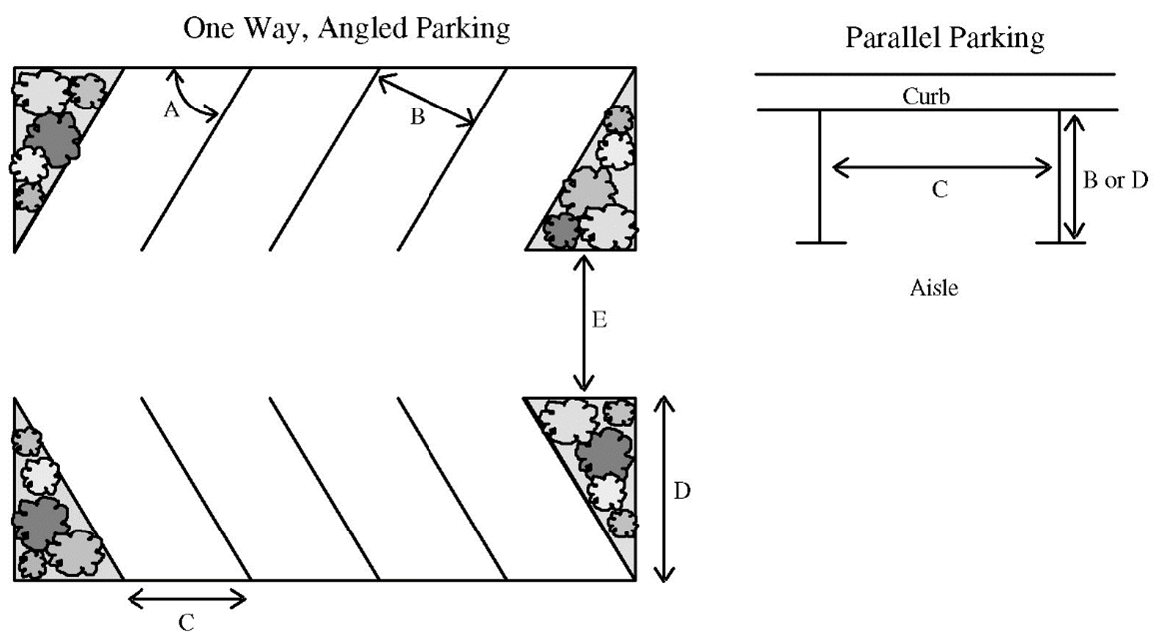
(a) In general. The minimum dimensions for off-street parking spaces are stated in Table 555-6, Minimum Parking Space and Aisle Dimensions, and Figure 555-1, Parking Dimension Diagram, and defined in feet and inches. At least twenty-five (25) percent of the provided parking spaces shall comply with the minimum dimensions for standard spaces. The remaining spaces shall comply with the minimum dimensions for compact spaces. Compact spaces shall be clearly labeled as such. These minimum dimensions are exclusive of access drives or aisles, ramps, or columns.
(b)
Vertical clearance. All required parking spaces shall have a vertical clearance of at least six (6) feet, six (6) inches except where the building code requires greater vertical clearance.
Table 555-6 Minimum Parking Space and Aisle Dimensions
Figure 555-1 Parking Dimension Diagram
555.690. - Lighting.
Any lighting used to illuminate off-street parking areas shall be shielded and arranged in such a way as to comply with the performance standards of Chapter 550, Article XVII, General Performance Standards. A light source that maintains a minimum level of security and provides for transition into covered parking areas shall be provided, as approved by the city engineer, except when accessory to single-, two-, and three-family dwellings and cluster developments.
555.700. - Signs.
Signs accessory to parking areas shall be provided as set forth in Chapter 560, Signs.
555.710. - Landscaping, screening, and curbing.
Parking lots of four (4) spaces or more shall be subject to the landscaping, screening, and curbing requirements as specified in Chapter 550, Article V, Site Plan Review.
555.720. - General maintenance.
Parking areas and driveways shall be kept free of dirt, dust, debris and waste. In winter months, parking areas shall be cleared of snow within a reasonable time.
555.730. - Snow storage.
Pedestrian paths, bicycle parking, driveways, access aisles and landscaping shall not be used for the purpose of snow storage.
555.740. - Stacking spaces.
(a) Number required for drive-through facilities. A car wash or any establishment with a drive-through facility shall provide a minimum number of stacking spaces for each washing line or drive-through station as specified in Table 555-7, Minimum Stacking Spaces. For purposes of Table 555-7, Minimum Stacking Spaces, "ft." shall mean feet.
Table 555-7 Minimum Stacking Spaces
(b)
Dimensions. Each lane of stacking spaces shall be a minimum of eight (8) feet in width and shall be delineated with pavement markings or curbing. Each stacking space shall be a minimum of eighteen (18) feet in length, however, individual spaces within the lane shall not be delineated with pavement markings.
(c)
No conflict of use. Stacking lanes shall not be located within required driveways, internal circulation driveways, loading areas, or parking aisles, and shall not interfere with access to parking and ingress and egress from a public street.
(d)
Pedestrian access to facility. The principal pedestrian access to the entrance of the facility from a public street or sidewalk shall not cross the stacking lane.
555.750. - Accessible parking.
Accessible parking spaces shall be provided as required by the Minnesota State Building Code. All accessible parking spaces shall comply with the minimum stall depth requirements for standard spaces in Table 555-6, Minimum Parking Space and Aisle Dimensions.
555.800. - Planned unit developments.
Vehicle parking, bicycle parking, and loading standards for planned unit developments shall be based on the uses within the planned unit development. Alternatives may be allowed as authorized in Chapter 550, Article VII, Planned Unit Development Standards.
555.810. - Maximum number of vehicles for dwellings and state credentialed care facilities.
The total number of vehicles located on a zoning lot shall not exceed two (2) vehicles per dwelling unit or per state credentialed care facility serving six (6) or fewer persons, excluding those parked within an enclosed structure. For the purposes of this section, accessory dwelling units shall not be considered a dwelling.
(Ord. No. 2025-023, § 78, 5-15-2025)
555.820. - Recreational vehicles in or abutting urban neighborhood or residential mixed-use zoning districts or permitted or conditional residential uses.
Recreational vehicles shall be parked or stored in an enclosed garage unless the following conditions are met:
(1)
The vehicle or item shall not exceed a length of twenty-five (25) feet unless the lot on which it is parked exceeds one hundred twenty-five (125) feet in length. In such instance, the maximum length of said vehicle may be increased one (1) foot for each one (1) foot of lot length over one hundred twenty-five (125) feet. In no case shall the vehicle or item exceed thirty (30) feet.
(2)
The area devoted to parking of such vehicles or items outdoors shall not exceed three hundred (300) square feet, unless only one (1) such vehicle or item is parked on the premises. Such vehicles shall count toward the maximum number of vehicles parked outdoors, as specified in section 555.810 above. For the purposes of this section, a vehicle or item on a trailer shall be considered one (1) vehicle.
(3)
Any such vehicle or item parked outdoors shall be parked on a surface in compliance with section 555.640 in the rear forty (40) feet of the lot.
(4)
Any such vehicle or item shall be located not less than six (6) feet from any habitable building.
(5)
The parking of inoperable vehicles shall be prohibited.
555.830. - High profile vehicles in and abutting urban neighborhood or residential mixed-use districts or permitted or conditional residential uses.
Where an open parking area or driveway is located less than six (6) feet away from a principal residential structure on an adjacent lot, the open, off-street parking of any passenger automobile, with an exterior vertical height of six (6) feet six (6) inches or greater, shall be located not less than six (6) feet from such residential use, and where access to the rear forty (40) feet of the lot exists, shall not be located in the required front yard.
(Ord. No. 2025-023, § 79, 5-15-2025)
555.900. - Standards for truck and commercial vehicle parking.
(a) In general. Commercial vehicles shall be parked or stored only in an authorized off-street location. Such vehicles may include, but shall not be limited to, tow trucks, taxis, buses, limousines, hearses, commercial trucks, food trucks, or vans, police or fire vehicles or other service vehicles. Regulations in this section governing truck and commercial vehicle parking shall apply only to vehicles that are parked regularly at a site and shall not apply to pick-up and delivery activities or to the temporary use of vehicles during construction. Outdoor storage of motorized equipment other than motor vehicles in operable condition shall be prohibited. All outdoor parking of trucks shall be screened from view, as specified in this zoning ordinance.
(b)
Urban neighborhood districts. The following standards shall apply in the urban neighborhood districts:
(1)
Residential uses. Parking of commercial vehicles shall be prohibited.
(2)
Nonresidential uses. Parking of commercial vehicles accessory to permitted or conditional nonresidential uses shall be limited to operable, single rear axle vehicles of not more than fifteen thousand (15,000) pounds gross vehicle weight. Such vehicles shall be parked in an enclosed structure.
(c)
Residential mixed-use districts. The following standards shall apply in the residential mixed-use districts:
(1)
Residential uses. Parking of commercial vehicles shall be prohibited.
(2)
Nonresidential uses. Parking of commercial vehicles accessory to permitted or conditional nonresidential uses shall be limited to operable, single rear axle vehicles of not more than fifteen thousand (15,000) pounds gross vehicle weight. Such vehicles shall be parked in an enclosed structure.
(d)
Commercial mixed-use districts. The following standards shall apply in the commercial mixed-use districts.
(1)
Residential uses. Parking of commercial vehicles shall be prohibited.
(2)
Nonresidential uses. Outdoor parking of trucks and other commercial vehicles shall be limited to operable, single rear axle vehicles of not more than fifteen thousand (15,000) pounds gross vehicle weight.
(e)
Downtown districts. The following standards shall apply in the downtown districts.
(1)
Residential uses. Parking of commercial vehicles shall be prohibited.
(2)
Nonresidential uses. Outdoor parking of trucks and other commercial vehicles shall be limited to operable, single rear axle vehicles of not more than fifteen thousand (15,000) pounds gross vehicle weight when located within three hundred (300) feet of an urban neighborhood or residential mixed-use district boundary.
(3)
Increasing weight. In the downtown districts, gross vehicle weight limitation for trucks and other commercial vehicles parked within three hundred (300) feet of an urban neighborhood or residential mixed-use district boundary may be increased by conditional use permit, as provided in Chapter 525, Administration and Procedures. Preference may be given to applications for conditional use permit approval that limit parking to single rear axle vehicles of not more than thirty-three thousand (33,000) pounds gross vehicle weight and that exclude truck tractors or semitrailers. In addition to the conditional use standards, the city planning commission shall consider but not be limited to the following factors when determining gross vehicle weight limitations:
a.
Number and size of vehicles to be parked.
b.
Proximity of parking area to residential uses.
c.
Screening and landscaping of parking area.
d.
Location of truck routes and amount of truck traffic.
(f)
Production and transportation districts. The following standards shall apply in the production and transportation districts.
(1)
Residential uses. Parking of commercial vehicles shall be prohibited.
(2)
Nonresidential uses, accessory truck and commercial vehicle parking. Within one hundred (100) feet of an urban neighborhood or residential mixed-use district boundary, outdoor parking of trucks and other commercial vehicles as an accessory use shall be limited to operable, single rear axle vehicles of not more than fifteen thousand (15,000) pounds gross vehicle weight.
(3)
Nonresidential uses, principal truck and commercial vehicle parking. Within three hundred (300) feet of an urban neighborhood or residential mixed-use district boundary, outdoor parking of trucks and other commercial vehicles as a principal use shall be limited to operable, single rear axle vehicles of not more than fifteen thousand (15,000) pounds gross vehicle weight.
(4)
Increasing weight. In the production and transportation districts, gross vehicle weight limitation for trucks and other commercial vehicles in this section may be increased by conditional use permit, as provided in Chapter 525, Administration and Procedures. Preference may be given to applications for conditional use permit approval that limit parking to single rear axle vehicles of not more than thirty-three thousand (33,000) pounds gross vehicle weight and that exclude truck tractors or semitrailers. In addition to the conditional use standards, the city planning commission shall consider but not be limited to the following factors when determining gross vehicle weight limitations:
a.
Number and size of vehicles to be parked.
b.
Proximity of parking area to residential uses.
c.
Screening and landscaping of parking area.
d.
Location of truck routes and amount of truck traffic.
(Ord. No. 2025-023, § 80, 5-15-2025)
555.1000. - Specific off-street loading requirements.
(a) In general. Accessory off-street loading shall be provided for principal uses as specified in Table 555-9, Specific Off-Street Loading Requirements, except as otherwise specified in Article XII, Special Loading Provisions for Specific Zoning Districts. Uses not specifically listed in Table 555-9, Specific Off-Street Loading Requirements shall have no minimum loading requirement. All uses listed in Table 555-9, Specific Off-Street Loading Requirements are assigned a rating of low, medium, high, or none. The loading requirement for such rating is based on the size of the use, as specified in Table 555-8, Loading Requirements for Assigned Ratings. When a development includes more than one (1) nonresidential use with a low, medium, or high loading requirement, the square footage of uses within the same rating category shall be added together in order to determine the number of required loading spaces. The loading requirement for planned unit developments shall be as approved by conditional use permit. For purposes of Table 555-8, Loading Requirements for Assigned Ratings and Table 555-9, Specific Off-Street Loading Requirements, "GFA" shall mean gross floor area, "sq. ft." shall mean square feet, and "CUP" shall mean conditional use permit.
(b)
Reducing minimum off-street loading requirements. Requests to reduce minimum off-street loading requirements shall be considered using one (1) of the following two (2) options selected by any person with a legal or equitable interest in the property:
(1)
A variance to reduce the minimum off-street loading requirement, as authorized by Chapter 525, Administration and Procedures.
(2)
A travel demand management plan that includes an analysis that demonstrates an approach to loading that is sufficient, safe, and functional for the proposed use or uses as approved by the planning director and the city engineer.
(c)
Providing small loading spaces in lieu of large loading spaces. Where a use is required to provide one (1) or more large loading spaces, the zoning administrator may allow said use to provide not less than two (2) small loading spaces in lieu of each required large loading space upon considering the following:
(1)
A travel demand management plan is not required for the use.
(2)
The nature of the use.
(3)
Existing site constraints.
Table 555-8 Loading Requirements for Assigned Ratings
555.1010. - Minimum requirement.
Uses for which off-street loading facilities are required in Table 555-9, Specific Off-Street Loading Requirements, but which are located in buildings of less floor area than the minimum prescribed in Table 555-8, Loading Requirements for Assigned Ratings, shall provide adequate shipping and receiving facilities, accessible by motor vehicle off any adjacent alley, service drive, or open space on the same zoning lot where vehicles are allowed.
Table 555-9 Specific Off-Street Loading Requirements
(Ord. No. 2025-023, § 81, 5-15-2025)
555.1100. - Loading location.
(a) In general. All required loading spaces shall be located on the same zoning lot as the use served and shall not be used to satisfy the space requirements for off-street parking, except as otherwise provided by this chapter.
(b)
Access to loading. Each required off-street loading space shall be designed with appropriate means of vehicular access to a street or alley in a manner which will least interfere with traffic movement and as approved by the city engineer. No loading space shall be located within thirty (30) feet of the nearest point of intersection of any two (2) streets.
(c)
Loading areas in required yards. No loading space shall be located in a required yard.
555.1110 - Shared loading facilities.
Central loading facilities may be substituted for loading spaces on the individual zoning lots, provided the following conditions are met:
(1)
Access. Each use served shall have access to the central loading area without crossing streets or alleys at grade.
(2)
Location. No use served shall be located more than five hundred (500) feet removed from the central loading area. Such central loading area shall be located in the same zoning district as the uses served or in a zoning district in which off-site parking for such uses is allowed, pursuant to Table 555-5, Location of Off-Site Parking.
(3)
Agreement. The property owners involved in the joint use of shared loading facilities shall submit a legal agreement approved by the city attorney guaranteeing that the loading facilities shall be maintained so long as the use requiring loading is in existence or unless the required loading is provided elsewhere in accordance with the provisions of this chapter. Such instrument shall be recorded by the property owner with the office of the Hennepin County Recorder or Registrar of Titles. Evidence of such proper recording shall be filed with the zoning office prior to the issuance of any permit or license.
555.1200. - Submission of loading plan.
Any application for a building permit or zoning certificate requiring or including the provision of loading areas shall include a loading plan. Said plan shall be drawn to scale and fully dimensioned, showing any loading facilities to be provided in compliance with this zoning ordinance and all other applicable regulations.
555.1210. - Maneuvering area.
To the extent practical, all maneuvers associated with loading shall occur in the off-street loading area.
555.1220. - Surfacing.
(a) Urban neighborhood and residential mixed-use districts. All open off-street loading spaces shall be surfaced with a dustless all-weather material capable of carrying a wheel load of ten thousand (10,000) pounds.
(b)
All other districts. All open off-street loading spaces shall be surfaced with a dustless all-weather material capable of carrying a wheel load of sixteen thousand (16,000) pounds. Where loading spaces are located in commercial mixed-use or production yard areas such as building material sales yards, scrap/salvage yards, metal milling facilities, contractor's yards, and other similar uses, the driveway leading to such area shall be surfaced with a dustless all-weather material capable of carrying a wheel load of sixteen thousand (16,000) pounds for a minimum of twenty (20) feet from the curb line.
(Ord. No. 2025-023, § 82, 5-15-2025)
555.1230. - Drainage.
Loading area surfaces shall be properly sloped for drainage as approved by the city engineer. On-site retention and filtration of stormwater shall be provided where practical. Water from the loading area shall not drain across a public walkway.
555.1240. - Size.
(a) In general. Required off-street loading spaces shall be at least ten (10) feet in width by at least twenty-five (25) feet in length for small spaces, and at least twelve (12) feet in width by at least fifty (50) feet in length for large spaces, exclusive of aisle and maneuvering space.
(b)
Vertical clearance. All loading areas, except those required for residential uses, shall have a vertical clearance of at least fourteen (14) feet, provided that twelve (12) feet, nine (9) inches of vertical clearance shall be permitted in the portion of the loading area when the truck is entirely within the building and off any ramps.
555.1250. - Lighting.
Any lighting used to illuminate loading areas shall be shielded and arranged in such a way as to comply with the performance standards of Chapter 550, Article XVII, General Performance Standards. A light source that maintains a minimum level of security and provides for transition into covered loading facilities shall be provided, as approved by the city engineer, except when accessory to single-, two-, and three-family dwellings and cluster developments.
(Ord. No. 2025-023, § 83, 5-15-2025)
555.1260. - Landscaping and screening.
Loading areas shall be landscaped and screened as specified in Chapter 550, Article V, Site Plan Review.
555.1270. - General maintenance.
Loading areas shall be kept free of dirt, dust, debris, and waste. In winter months, required loading areas shall be cleared of snow within a reasonable time.
555.1280. - Snow storage.
Pedestrian paths, bicycle parking, driveways, access aisles, and landscaping shall not be used for the purpose of snow storage.
555.1300. - Purpose.
The purpose of the travel demand management ordinance is to support the city's transportation policies and to ensure that larger developments and uses with high-traffic demand have positive impacts on safety, equity, mobility, climate change, greenhouse gas emissions, mode split, and air quality.
555.1310. - Buildings and uses subject to a travel demand management plan.
(a) In general. Buildings and uses subject to a travel demand management plan are listed in Table 555-10, Buildings and Uses Subject to a Travel Demand Management Plan, along with the required minimum number of points required for each building or use. The number of points awarded for each travel demand management strategy is listed in Table 555-11, Travel Demand Management Strategies.
(b)
Travel demand management plan, minor. Minor travel demand management plans shall include a review for compliance with the minimum number of points required by this article.
(c)
Travel demand management plan, major. In addition to review for compliance with the minimum number of points required by this article, a major travel demand management plan shall include a report containing a traffic study prepared consistent with industry standards and certified by a licensed engineer.
(d)
Travel demand management plan, discretionary. The planning director, in consultation with the city engineer, may mandate a travel demand management plan that includes a report containing a traffic study prepared consistent with industry standards and certified by a licensed engineer for the establishment of any use, new building, or building expansion not specified in this chapter when it is determined by the planning director that the proposal presents unique transportation challenges due to the nature of the use or location. The required travel demand management strategies shall be determined based on the findings of the report.
Table 555-10 Buildings and Uses Subject to a Travel Demand Management Plan
(e)
Mixed-use and multiple use development. Mixed-use development is subject to a minor or major travel demand management plan only when either the residential or nonresidential use is subject to such requirement in Table 555-10, Buildings and Uses Subject to a Travel Demand Management Plan, provided that a discretionary travel demand management plan may be required for any building or use. When a development includes more than one (1) use subject to a minor or major travel demand management plan, the minimum required point total shall be based on only the use with the highest requirement rather than the sum of the point total for all applicable buildings or uses.
(f)
Exceptions. A written request may be submitted to the planning director requesting an exemption from the requirement to submit a travel demand management plan. The planning director shall consider, but not be limited to, the nature of the use and the number of vehicle trips the site is expected to generate, and whether a substantial percentage of the building's floor area would be dedicated to warehousing, storage, or other uses that reduce the applicability of travel demand management strategies required by this ordinance. Future conversion of the space to a different use or uses may necessitate the need for a travel demand management plan.
(Ord. No. 2024-033, § 3, 9-19-24)
555.1320. - Application for travel demand management plan.
Any person having a legal or equitable interest in land which requires submission of a travel demand management plan may file an application for approval of such plan on a form approved by the zoning administrator.
555.1330. - Administrative review.
The planning director, in consultation with the city engineer, shall conduct the administrative review of the travel demand management plan. The planning director shall recommend to the zoning administrator any mitigating measures deemed reasonable and necessary, and shall include such recommendation as a condition of the issuance of any building permit, zoning certificate or other approval required by this zoning ordinance or other applicable law. All findings and decisions of the planning director shall be final, subject to appeal to the city planning commission, as specified in Chapter 525, Administration and Procedures.
555.1340. - Content of travel demand management plans.
Any travel demand management plan shall contain at least the following:
(1)
A description of the goals of the travel demand management plan and its relationship to applicable city transportation policies and programs including how the development will contribute to a reduction in greenhouse gas emissions, achieve city mode split goals, reduce use of single-occupancy motor vehicles, and increase walking, bicycling, and transit as primary modes of travel.
(2)
An acknowledgement of a commitment to provide self-reported audits every two (2) years to the planning director and city engineer that confirms ongoing compliance with required strategies until it is deemed that the development is sufficiently meeting city transportation goals. If any points for travel demand management strategies are derived from non-infrastructure solutions, documentation of ongoing programmatic elements must be included in the audit.
555.1350. - Compliance with requirements of travel demand management strategies.
Points shall be awarded for travel demand strategies listed in Table 555-11, Travel Demand Management Strategies. All applicable standards shall be met in order to qualify for the points for each strategy. The required strategies shall be maintained in good order for the life of the structure or use. A list and description of the approved travel demand strategies for a given site shall be posted in a conspicuous common area of the development.
Table 555-11 Travel Demand Management Strategies
(Ord. No. 2025-023, § 84, 5-15-2025)

