
Mount Juliet City Zoning Code
ARTICLE X
- LANDSCAPING AND SCREENING PROVISIONS
Sec. 10-101.- Purposes and intents.
The purposes and intents of this article are to preserve and promote the health, safety and general welfare of the public; to facilitate the creation of a convenient, attractive and harmonious community; to conserve natural resources including air and water; to conserve properties and their values; to preserve the character of an area by preventing the harmful effects of prejudicial uses; and to encourage the appropriate use of land. More specifically, this article is intended to reduce the friction between incompatible uses by requiring a screen or buffer between the uses in order to minimize the harmful impact of noise, dust and other debris, motor vehicle headlight glare or other artificial light intrusion, and other objectionable activities or impacts conducted on or created by an adjoining or nearby use. Additionally, this article is intended to require landscaping of parking lots in order to reduce the harmful effects of wind and air turbulence, heat and noise and the glare of motor vehicle lights; to preserve underground water reservoirs and to permit the return of precipitation to the groundwater strata; to act as a natural drainage system and ameliorate stormwater drainage problems; to reduce the level of carbon dioxide and return pure oxygen to the atmosphere; to prevent soil erosion; to provide shade; and to enhance the blighted appearance of parking lots.
(Ord. of 10-23-2009, § 10-101)
Sec. 10-102. - Emergency and/or disastrous situations.
In the event of emergencies and/or disastrous situations, which may include, but are not limited to, ice and rain storms, tornadoes, floods and similar natural disasters which cause excessive tree and landscape damage throughout the community, the Mayor may suspend these landscaping regulations.
(Ord. of 10-23-2009, § 10-102)
Sec. 10-103. - Applicability.
10-103.1 General[ly]. The provisions of this article shall apply to all new public, private and institutional land development or building construction within the city, except as specified below:
1.
Except as provided in section 10-111, Transitional screening and barriers, no portion of these provisions shall apply to one- and two-family detached dwellings situated on individual lots or parcels of ground.
2.
Any addition to an existing building which is less than ten percent of the gross floor area of the building or 5,000 square feet, whichever is less, shall not be subject to the buffering and screening provisions of section 10-111, but may be subject to the vehicular use areas landscaping as specified in subsection 10-103.2. Repeated expansions of the building over a period of time commencing with the effective date of this ordinance shall be combined in determining whether the threshold has been reached.
3.
The following categories of landscaping are required to be provided as specified within subsections 10-103.2 through 10-103.4.
4.
This article is intended to establish minimum standards to meet the stated purposes and intents as set forth in section 10-101. In anomalous or unusual topographic situations or applications, the Planning Commission may, upon an affirmative finding that the application of these regulations does not meet the purposes and intents of this article, require, permit or allow alternative applications.
10-103.2 Vehicular use area landscaping. The provisions of section 10-109, Vehicular surface area landscaping, shall apply to all developments as indicated below:
1.
New sites. No new site development or building shall hereafter be constructed or vehicular use area created or utilized, unless landscaping as required by the provisions of section 10-109, is provided.
Note. Vehicular use area as used in this ordinance shall mean any ground surface area, except public rights-of-way, used by any type vehicle whether moving or at rest for the purpose of driving, parking, loading, storage or display (automotive sale lots). Also, included are activities of a drive-in nature in connection with banks, restaurants, filling stations and grocery stores.
2.
Existing sites. When the square footage of vehicular use area of an existing site is increased, compliance with the provisions of section 10-109, is required as follows:
a.
Expansion by 25 percent or less. When the vehicular use area is expanded by 25 percent or less, only the expansion area must be brought into compliance with subsection 10-109.3, Interior plantings.
b.
Expansion by more than 25 percent. When the vehicular use area is expanded by more than 25 percent, the entire vehicular use area shall be brought into compliance with subsection 10-109.3, Interior plantings. In addition, the preexisting vehicular use area shall be brought into compliance with the perimeter vehicular use area landscaping requirements of subsection 10-109.2, Street yard vehicular surface plantings.
c.
Repeated expansions. Repeated expansions of the vehicular use area over a period of time commencing with the effective date of this ordinance shall be combined in determining whether the 25 percent threshold has been reached.
3.
Change of use. No use shall be changed to another use for which the zoning ordinance requires additional parking over and above that required for the previous use, unless, vehicular use area landscaping, as required by this article is provided for such additional parking. The provisions of this section shall be effective regardless of whether or not new construction is necessary to meet the parking requirements for the new uses.
10-103.3 Buffering and screening.
1.
Application. No new use of land, nor any change in the type of occupancy, nor any expansion or addition of an existing land use which singly or collectively exceeds ten percent of the gross floor area of the building or 5,000 square feet, whichever is less, or 25 percent of the land surface area of the existing use at the time this section becomes applicable to the property shall occur without first providing a landscaped transitional protective yard which complies with the requirements of section 10-111, Transitional protective yard requirements, of this article. Such transitional protective yard shall be located on the developing property or on a continuous planting easement on the adjacent or adjoining property, which is to be screened. When new nonresidential development is placed adjacent to:
a.
Vacant land zoned for residential use, the new nonresidential development shall provide 100 percent of the required buffer;
b.
Vacant land zoned for nonresidential use, the new residential development shall provide 50 percent of the required buffer;
c.
Existing residential development, the new residential development shall provide 100 percent of the required buffer; and
d.
Vacant land zoned for residential use, the new residential development shall provide 50 percent of the required buffer.
2.
Relationship to plan approval. Following adoption of this article:
a.
No application for a zoning change shall be recommended for approval by the Planning Commission nor approved by the Board of Commissioners, unless such application acknowledges that the provisions set out in section 10-111, Transitional protective yard requirements, will be met.
b.
No master development plan or site plan required by article XIV, subsection 14-103.2 or 14-103.3, respectively, may be approved for any use unless such plan is in compliance with the provisions set out in section 10-111.
c.
The Planning Commission shall not recommend nor shall the Board of Zoning Appeals approve any request for a conditional use permit, unless and until such request demonstrates that the provisions set out in section 10-111 can be met.
10-103.4 Street yards.
1.
Application. No new use of land, nor any change in the type of occupancy, nor any expansion or addition of an existing land use which singly or collectively exceeds ten percent of the gross floor area of the building or 5,000 square feet, whichever is less, or 25 percent of the land surface area of the existing use at the time this section becomes applicable to the property shall occur without first providing street yards in accordance with the requirements of section 10-112, Street yard landscape regulations for both the existing and additional facility as specified in subpart 2 of this section.
2.
Specific requirement. The street yard landscape regulations of section 10-112 shall be met for the entire property, except those portions of the lot used for driveways are exempted from all street yard requirements. This street yard may be arranged in any manner chosen by the owner so long as:
a.
The total square footage of area within the street yard equals five times the length in feet of frontage adjoining the public rights-of-way; and
b.
The minimum dimension of any street yard used to satisfy this requirement is two feet measured perpendicular to the public right-of-way; and
c.
The street yard is contiguous with the rights-of way; and
d.
No portion of the street yard used to meet these requirements is more than 25 feet from the recorded public right-of-way as measured perpendicular to the right-of-way.
(Ord. of 10-23-2009, § 10-103)
Sec. 10-104. - Landscaping procedures.
When an application is made for a permit on any land where the landscaping requirements of this article are applicable, such permit application shall be accompanied by a landscaping plan. All landscape plans shall be prepared by a landscape architect or landscape contractor licensed by the State of Tennessee. Such plan shall contain the information indicated in subsection 10-104.1, or any additional information as required by the Zoning Administrator to enable a determination to be made as to whether the permit application is in compliance with the provisions of this ordinance. When a site plan is required by article XIV of this ordinance, to be approved on land where the provisions of this article are applicable the landscape plan shall accompany such site plan.
10-104.1 Plan content. Landscape plans shall be drawn to scale, including dimensions and distances, and shall clearly delineate:
1.
Location, general type and quality of existing vegetation, including all trees which are five inches or greater in caliper, tree masses composed of trees smaller than five inches in caliper, as well as smaller trees which may be retained to fulfill the requirements of section 10-112, Street yard landscape regulations;
2.
The number, location, species and caliper of existing trees located between the principal building and the public street right-of-way which are to be maintained or preserved for credit as per subsection 10-112.6, along with other existing vegetation proposed to be saved;
3.
Methods and details for protecting existing vegetation during construction;
4.
Schedules with the botanical and common name, size (at the time of planting), quantity and spacing of all proposed landscape material;
5.
Plant lists or schedules showing both the required and proposed quantities of plants;
6.
Plans, shown over a base map which displays existing and proposed topography, indicating the proposed location of plants and the location and description of other landscape improvements, such as earth berms, walls, fences, screens, sculptures, fountains, street furniture, lights, parking and vehicular use areas, including existing and proposed parking spaces, access aisles, driveways, loading and storage areas;
7.
Planting and installation details and notes necessary to ensure conformance with all required standards;
8.
Means for supplying water including irrigation systems, or the location of hydrants or other sources of water supply. A source of water must be available to meet the requirements of this article;
9.
Any other information which the City may require to clarify the applicant's plan and it's ability to meet the stated purposes and intents of this article.
10-104.2 As-built certification. Upon completion of the landscaping required by this ordinance, the designer shall certify that the plan has been followed in the installation. (See subsection 14-103.6, Construction to be in accordance with approved plans.) The designer shall note any areas where the installation deviates from the approved plan and the approvals, secured under the provision of subsection 10-114.4, to allow that deviation. Any and all such approvals of variance shall be obtained prior to issuance of a use and occupancy permit.
10-104.3 Enforcement of landscaping plans. In no event shall a permanent use and occupancy permit be issued, unless and until all elements of landscaping have been installed and such installation has been certified by the City as complete and in accordance with the approved landscape plan. If, at the time application is made for a use and occupancy permit, required nonstructural landscaping (i.e. plant material) is not in place and it can be determined by the City that because of the unavailability of plant material or that requiring completion of the landscaping at the time of such request would jeopardize the health of the plant material or weather conditions prohibit the completion of planting, the developer/owner shall make the following arrangements to secure a temporary use and occupancy permit:
1.
The developer/owner shall produce an agreement in the form of a legally binding contract between the developer and a landscaping installer/contractor specifying the manner and the date by which the landscaping, as shown on approved plans, is to be installed. The maximum period for installation of the required landscaping shall be the lesser of one year or one growing season from the date of application for a temporary use and occupancy permit. The City shall be a third party beneficiary to said contract. This agreement shall be secured by a bond or letter of credit made payable to the City in an amount equal to the estimated cost of the landscaping plus 50 percent. In the event of the failure of the developer to execute this contract and thereby perform the work specified in the plan, the City shall call the bond or letter of credit and fund the contract to have the work accomplished.
2.
The developer shall also agree in writing that he, or his successors or assigns shall provide the required planting as specified in the contract required in [subpart] paragraph 1, above, as a condition for issuance of a permanent use and occupancy permit and that no permanent use and occupancy permit shall be issued unless and until such landscaping is installed. The developer/owner shall also agree that the principal use shall be discontinued should the required planting not be provided as specified in [subpart] paragraph 1, above. Violations of these provisions shall constitute an unauthorized illegal occupancy of the principal use and no further permits of any type shall be approved until the landscaping is installed.
(Ord. of 10-23-2009, § 10-104)
Sec. 10-105. - Definitions.
10-105.1 Application. The following definitions shall apply where within this article. Where words have not been defined, the standard dictionary definition shall prevail.
10-105.2 Terms defined.
Berms and earth mounds [means] earthen barriers which aid in blocking or screening the view similar to a hedge, fence or wall.
Caliper this is a term used to describe the size or cross sectional area of various plants. Caliper is measured in different ways depending on the type and nature of the plant being measured. (See the publication American Standard for Nursery Stock ANSI Z60.1, latest edition, for details of specific application.)
Canopy tree [means] a major shade tree, expected to grow to a mature height of 25 feet or more in Middle Tennessee. (Ex: oaks, maples, ash, sycamore, tulip poplar and similar trees.)
Deciduous trees [means] trees which shed their leaves and remain barren through the winter months.
Display area [means] any portion of a lot used for the exterior display of goods for sale. The term includes exterior display of motor vehicles.
Evergreen trees [means] trees whose branches generally remain covered with thriving leaves/needles throughout the year.
Exterior facing retaining wall [means] any wall which will hold earthen material such as soil, gravel, etc., back from the exterior of a site. The face of the wall faces away from the major structure and/or use of the site.
Freestanding wall or fence [means] any portion of a wall or fence which is constructed to stand above ground; the purpose of which is privacy, visual screening, odor and/or noise retention, etc.
Grass [means] any turf vegetation which is commonly planted and hardy in Middle Tennessee.
Ground cover [means] any low growing plant species which is generally used for coverage within planting beds at the turf level and/or for erosion control on steep slopes. These plant species shall generally be viewed as tolerant of the local climate by landscape professionals within the region.
Interior facing retaining wall [means] any wall which will hold earthen material such as soil, gravel, etc., back from the exterior of a site. The exposed face of the wall faces toward the major structure and/or use of the site.
Shrubs and hedges [means] any plant, deciduous or evergreen, which acts as a visual and physical border, is multi-trunked and/or multi-stemmed, and having a mature height which generally falls within the range of two and 12 feet in planted mature height.
Transitional protective yard [means] an area on the perimeter of a property which is reserved for plantings and/or other barriers which may be required to screen development from abutting properties.
Understory trees [means] trees which are typically between ten and 25 feet in height at maturity in Middle Tennessee plantings and having a particularly notable ornamental or aesthetic quality. (Ex: dogwoods, redbuds, goldenrain trees, Foster hollies, crepe myrtles and Japanese black pines) These plant species shall generally be viewed as tolerant of the local climate by landscape professionals within the region.
Vehicular use area [means] any ground surface area, except public rights-of-way, used by any type of vehicle whether moving or at rest for the purpose of driving, parking, loading, storage or display (automotive sales lots). Also, included are activities of a drive-in nature in connection with banks, restaurants, automobile service stations and grocery stores.
Vines [means] any plant which is generally used in conjunction with walls, fences, trellis-work and/or trees for its climbing nature.
(Ord. of 10-23-2009, § 10-106)
Sec. 10-106. - General provisions.
10-106.1 Vision triangles protected. Landscaping shall not obstruct the view of motorists using any street, private driveway, parking aisle or approach to any street intersection so as to constitute a traffic hazard or a condition dangerous to the public safety upon any such street, driveway, parking aisle or street intersection, or violate the provisions of article IX, subsection 9-106.5, Visibility areas, of this ordinance.
10-106.2 Protection of plantings. All plantings required by the provisions of this article shall be protected and maintained as provided herein.
1.
Whenever any planting areas required by this article are adjacent to parking or vehicular circulation areas, the planting shall be protected from vehicular intrusion or damage from excessive vehicular lubricants or fuels.
2.
All landscaped areas shall be stabilized from soil erosion immediately upon planting and erosion control shall be maintained for the duration of the premises.
3.
The property owner is responsible for maintaining all required plant material in good health. Any dead, unhealthy or missing plants shall be replaced with locally adapted vegetation which conforms to the standards of this ordinance.
10-106.3 Replacement of plantings upon condemned property. Whenever any governmental agency or utility operated by any public or quasi-public agency acquires property by condemnation action and said property complies with the provisions of this article at the time of acquisition, it shall be the responsibility of the condemner to replace, in accordance with the provisions of this ordinance, any landscape materials which were required by this ordinance.
(Ord. of 10-23-2009, § 10-106)
Sec. 10-107. - Alternative methods of compliance.
Although certain material or a particular method of construction is specifically prescribed by this article, it is not intended, especially whenever a stream, natural rock formation or other physiographic condition exists, to prevent the use of materials or methods of construction different from the materials or methods of construction specifically prescribed by this article; provided, any such alternative material or method of construction has been approved in writing or in plan and its use authorized by the body or department authorized to approve the original plan.
The body or department may approve in writing or in plan any such alternate material or method of construction; provided, it is found that the proposed material or method of construction is, for the purpose intended, at least the equivalent of that specifically prescribed by this article in quality, effectiveness, durability, hardiness and performance and that such alternative measure better preserves the existing natural condition. The body or department may require that sufficient evidence or proof be submitted to substantiate any claim that may be made regarding its use.
(Ord. of 10-23-2009, § 10-107)
Sec. 10-108. - Landscape standards and specifications.
10-108.1 Walls and fences.
1.
Materials and construction standards. Walls shall be constructed of natural stone, brick or other weatherproof materials arranged in a linear, serpentine, or other alignment. Fences shall be constructed of wood or other weatherproof, durable materials generally used in the exterior construction of buildings. Fence posts shall be structurally stable based on the material used, and shall have a maximum spacing of eight feet o.c [on center]. If wood is used, the posts shall be four inches by four inches minimum. Posts shall be set in or anchored to crowned concrete footings. The base of the footings shall be at least 24 inches below finished grade. If wood is used for any member, it shall be softwood treated with water-borne preservative to the American Wood Preservers Institute Standard LP-2, for aboveground use or LP-22, for ground contact use, or all heart redwood, or all heart cedar. All cut surfaces of pressure treated lumber shall be waterproofed. If another material is used, it shall be weatherproof. Slats are to be minimum one-half inch in thickness and are to be placed on the outside of the fence, unless the design is two-sided (shadowbox, etc.). All hardware is to be galvanized or otherwise rustproofed. Wood horizontal members shall be installed bark-side up. Chainlink fencing may not be used to meet the requirements of this article. Chainlink fencing may be installed in the required landscape area only if it is in addition to the required continuous planting, hedge, fence, wall or earth mound. In industrial zones, there shall be no maximum height limitation on walls or fences; in all other zones, however, there shall be a six-foot height restriction when such fences are located within side and rear yards. All walls or fences used to meet the requirements of this article shall have a minimum opacity of 80 percent and shall not be used for erection or display of any sign or other advertising device.
2.
Height and landscaping standards. The provisions of this section shall apply to walls constructed to fulfill the requirements of this article.
a.
Freestanding walls. Any freestanding walls (except those directly surrounding trash containers) constructed to stand above ground, the purpose of which is privacy, visual screening, odor and/or noise retention, etc., shall be a minimum of six feet in height.
b.
Interior facing retaining walls. Walls holding earthen material such as soil, gravel, etc., back from the interior of a site shall be unrestricted as to height.
c.
Exterior facing retaining walls. Walls holding earthen material such as soil, gravel, etc., back from the exterior of a site shall be designed and stamp certified as to design and drainage characteristics by a licensed engineer. All walls shall be landscaped as follows:
i.
A minimum of one ornamental tree or large shrub shall be installed for each 150 square feet of terraced area. These trees are to be evenly distributed across the length of the terrace.
ii.
A minimum of three shrubs shall be placed between each two trees.
iii.
A planting of grass or groundcover that is deemed to provide sufficient coverage shall be placed along the entire land surface area at the top of the wall to cover and to stabilize the earth from erosion.
10-108.2 Earth berms. Berms shall have a minimum height of 1½ feet, a minimum crown width of two feet, a side slope no greater than 2:1 and shall be planted and covered with adequate plant material to prevent erosion. A difference in elevation between areas requiring screening does not constitute a berm. Berms which are at slopes greater than 3:1 or greater than three feet in height shall be planted with permanent vegetation which will cover the surface to prevent erosion and which does not require mowing to maintain a neat appearance.
10-108.3 Plants. All plant materials shall be living plants (artificial plants are prohibited) and shall meet the following requirements:
1.
Quality. Plant materials used to meet the provisions of this ordinance shall comply with the standards of the American Standard for Nursery Stock (ANSI Z60.1), American Association of Nurserymen, for size, quality and form and shall have passed any inspections required under state regulations. Bare root trees are prohibited.
2.
Deciduous trees. Deciduous trees shall be species having an average mature crown spread of greater than 15 feet in Middle Tennessee and having trunk(s) which can be maintained with over five feet of clear trunk in areas which have visibility requirements. Trees having an average mature spread of crown less than 15 feet may be substituted by grouping of the same so as to create the equivalent of a 15-foot crown spread. Trees shall be a minimum of eight feet in overall height and at least 1¾ inches in caliper at the time of planting. Trees of species whose roots are known to cause damage to public roadways or other public works shall not be planted closer than 15 feet to such public works, unless the tree root system is completely contained within a barrier for which the minimum interior container dimensions shall be five feet square and five feet deep and for which the construction requirements shall be four inches thick, reinforced concrete.
3.
Evergreen trees. Evergreen trees shall be a minimum of six feet high.
4.
Understory trees. Trees and shrubs which are typically between ten and 25 feet in height at maturity in Middle Tennessee plantings and having a particularly notable ornamental or aesthetic quality. Ex: dogwoods, redbuds, goldenrain trees, Foster hollies, crepe myrtles, Japanese black pines.
5.
Shrubs and hedges. Shrubs and hedges shall be at least two feet in average height with three canes when installed. All plants shall conform to opacity, mature height and other requirements within four years after the date of final approval of each planting or replanting. Privet (ligustrum species) cannot meet the opacity requirements and may not be used to satisfy the requirement of this article. The height of the planting shall be measured from the level of the vehicular use area at the edge closest to the screening.
6.
Vines. Vines shall be at least 12 inches high at planting and shall be trained to grow upon walls or fences.
7.
Grass or ground cover. Grass shall be planted in species normally grown as permanent lawns in Middle Tennessee and may be sodded, plugged, sprigged, or seeded; except in swales or other areas subject to erosion, where solid sod, erosion control, or suitable mulch shall be used. Temporary "nurse-crop" grass seed shall be sown for immediate protection until complete coverage, otherwise, is achieved. Grass sod shall be clean and free of weeds and noxious pests or diseases. Grassed areas shall be planted in such a manner as to provide 100 percent coverage after two full growing seasons.
8.
Existing landscape material. Existing landscape material which to be retained to fulfill landscape requirements shall be shown on the required plan, and any material in satisfactory condition may be used to satisfy these requirements in whole or in part when, in the opinion of the Zoning Administrator such material meets the requirements and achieves the objectives of this article. Existing healthy trees may be substituted for trees required for property or vehicular use area perimeter landscaping, or for interior landscaping by using the following criteria: A six-inch to 12-inch caliper tree surrounded by a minimum of 150 square feet of landscape area may be substituted for two new trees of the required minimum size; a 12-inch to 24-inch caliper tree surrounded by a minimum of 250 square feet of landscape area may be substituted for three new trees of the required minimum size; a 24-inch or greater caliper tree surrounded by a minimum of 300 square feet of landscape area may be substituted for four trees of the required minimum size. The Zoning Administrator shall reinspect the condition of existing vegetation upon completion of construction, at which time the Administrator may require removal of any vegetation deemed by the officer to be damaged beyond repair and the applicant shall replant the area with trees to meet the conditions, otherwise, in force.
9.
Recommended listing of plants to be developed. A listing of plants recommended for use in meeting the various standards and requirements established by this article is to be developed and maintained by the City. Such listing shall also indicate plants with characteristics considered undesirable and not to be utilized in plantings required by this article.
10-108.4 Landscaping in easements. Landscaping may be located in areas reserved for utility or other easements as long as all the landscape requirements can be fully met. Otherwise, landscape buffer plantings shall be provided in addition to, and separate from, any easement. (See subsection 10-111.3, [subpart] paragraph 4.)
10-108.5 Landscaping at driveway and street intersections. To ensure that landscape materials do not constitute a driving hazard, a sight triangle shall be maintained at all street intersections and intersections of driveways with streets.
10-108.6 Joint driveways and common vehicular use areas. Vehicular use area screening shall not be required between a vehicular use area and the adjoining property where a property line divides a driveway used for common access to two or more properties nor when both of the following conditions exist:
1.
The vehicular use areas are for the required parking for the properties or the common use of the properties (as substantiated by a reciprocal parking and access agreement); and
2.
A site development plan for the properties has been approved by the Planning Commission.
(Ord. of 10-23-2009, § 10-108)
Sec. 10-109. - Vehicular surface area landscaping.
10-109.1 Intent, purposes and application. It is the intent of this section to modify and reduce the deleterious visual, environmental and aesthetic effects of vehicular surface areas. The landscape requirements herein have been developed to: filter and reduce the glare of headlight and reflected sunlight from parked automobiles onto the public street rights-of-way; to separate the public from the ill effects of fumes and dust; to visually modify the appearance of parking areas and vehicular surface areas, to encourage the construction of such necessary areas in a manner that more closely follows the existing natural contours of the land; to distribute planting areas around and within the parking areas; to modify the rate of stormwater runoff and increase the capability of groundwater recharge in urban areas; to provide shade, noise attenuation, filtering the air of particulate and gaseous pollutants and other beneficial environmental effects to the microclimate; to prevent the overcrowding of land; and to break the visual blight created by large expanses of vehicular surface areas. These requirements shall apply to all vehicular surface areas, required or otherwise, regardless of the zoning district wherein they are located.
10-109.2 Street yard vehicular surface plantings.
1.
Applicability. All edges of vehicular surface areas within 50 feet of any street right-of-way are required to have a visually modifying screen or barrier between the vehicular surface area and the right-of-way.
2.
Plants and materials. The owner may use natural plants, fences, walls or earthen berms or any combination thereof to meet the requirements of this section so long as all the minimum criteria set forth below are met.
a.
The natural plants, fences, walls, earthen berms or combination thereof, must occupy a minimum of 75 percent of a vertical rectangular plane equal to the peripheral length of the vehicular area in feet, times an average of three feet six inches as measured from the surface edge of the vehicle area. Such rectangular plane shall be exclusive of driveways and sight lines used for automobile ingress and egress. No additional consideration towards meeting the 75 percent average requirement shall be given for any material greater than 84 inches in height.
b.
No more than six continuous lineal feet of vertical plane as measured and viewed perpendicular from the street may be void of any natural plants, berms, closed fences or walls or combinations, thereof.
c.
See subsection 10-108.1, [subpart] subparagraph 1, Materials and construction standards, for standards of construction and appearance. Additional planting materials shall be provided so that no more than two-thirds of the surface area of the fence or wall is visible from the street within three years of erection of the structure. Forty percent of this plant material may be deciduous.
d.
All berms installed shall meet the standards of subsection 10-108.2.
e.
All natural shrubs installed to satisfy the requirements of this section shall be a locally adapted species expected to reach a minimum height of 30 inches within three years of planting. Live vegetation planted on berms may have a lesser mature height provided the combined height of the berm and the plantings after three years are at least 30 inches high. Forty percent of all shrubs may be deciduous.
10-109.3 Interior plantings.
1.
Planting areas. In addition to all other landscape requirements, all vehicular surface areas, temporary or permanent (excluding parking structures) shall provide and maintain landscaped planting areas within the interior of the vehicular surface area. Each planting area shall contain a minimum of 300 square feet in area with minimum dimensions of seven feet and, except for vehicular display areas, shall contain at least one and not more than two locally adapted canopy trees a minimum of 1¾-inch caliper and a minimum height of eight feet.
2.
Trees required. Trees shall be required at a minimum rate of one natural canopy tree for every 2,000 square feet of total vehicular surface area. All vehicular surface areas located within the same block which serve one or more businesses or uses of land or share unified ingress and egress shall be considered as a single vehicular surface area for the purpose of computing the required number of trees, notwithstanding ownership.
3.
Planting area locations. Landscaped planting areas are to be located within or adjacent to the parking area as tree islands, at the end of parking bays, inside seven-foot wide or greater medians between rows of cars, or as part of continuous street or transitional protective yards. The number, size and shape of landscape planting areas shall be at the discretion of the owner; however, tree spacing shall not exceed a maximum of 195 feet or three double-loaded bays of parking, which ever is less. Landscaped planting areas shall be distributed in a manner, which fulfills the purposes of subsection 10-109.1. For vehicular display areas which are not required to have trees, measurements shall be made from the edge of the landscaped planting areas, and no stored vehicle shall be farther than 50 feet from the edge of any landscaped planting area.
4.
Parking reductions permitted. The number of off-street parking spaces required in article IX of this ordinance, may be reduced by the following ratio: The square footage of required interior landscaped planting area divided by 150 but no fraction thereof, provided that no reduction in the number of off-street parking spaces authorized by article IX, in excess of ten percent shall occur without prior approval of the Board of Commissioners which shall first determine if further reductions will cause on-street parking congestion.
5.
Shrubs within planting areas. Any vehicular surface area, including vehicular display areas, shall be provided with landscaped areas containing shrubs. Shrubs shall obtain a minimum size of 30 inches within three years of planting. All shrubs shall be a minimum of 18 inches tall when planted. No more than 40 percent of required shrubs may be deciduous. Shrubs shall be required at the rate of one shrub per 500 square feet of vehicular surface area.
(Ord. of 10-23-2009, § 10-109)
Sec. 10-110. - Loading area, display area and utility service area landscaping requirements.
10-110.1 Application. All loading areas and display areas with minimum dimensions of 15 feet or more, designated short-term storage areas and utility service areas not screened by an intervening building, established after the effective date of [the ordinance from which this article is derived], shall be screened from view from any public street right-of-way for their entire length except for necessary points of access.
10-110.2 Loading areas.
1.
General screening. See subsection 10-108.1, [subpart] subparagraph 1, Materials and construction standards, for construction and appearance criteria. Additional planting materials shall be provided so that no more than two-thirds of the surface area of any closed fence or wall is visible from the street within three years of erection of the structure. The screening may also be accomplished with a natural evergreen plant material which can be expected to reach a height of six feet or greater within three years of planting. Any plant materials used to fulfill these requirements shall be a minimum of three feet in height when planted and there shall be no gap greater than four feet between plant material.
2.
Loading areas in close proximity to residential properties. Loading areas located closer than 50 feet to a property line of land located within a residential zoning district shall be screened from view from the residential property with an earthen berm, closed fence or solid wall which is at least six feet high. (See subsection 10-108.1, [subpart] subparagraph 1, Materials and construction standards, for standards of construction and appearance of fences.) Additional planting materials shall be provided so that no more than two-thirds of the surface area of the closed fence or wall is visible from any adjoining residence within three years of erection of the structure.
10-110.2 Display areas. Screening for display areas may be accomplished by natural plants, closed fences, walls or earthen berms or any combination thereof to meet the requirements of this section so long as all the minimum criteria set forth below are met.
1.
Screening standard. The natural plants, solid fences, walls, earthen berms or combinations thereof, must occupy 75 percent of a vertical rectangular plane equal to the peripheral length of the display area, in feet, times an average of two feet six inches as measured from the surface edge of the display area. Such rectangular plane shall be exclusive of driveways and sight lines used for automobile access. No additional consideration towards meeting the 75 percent average requirement shall be given for any material greater than 66 inches in height. No more than six continuous lineal feet of the vertical plane as measured and viewed perpendicular from the street may be void of any natural plants, berms, closed fences or walls or combination, thereof.
2.
Use of fences and walls. See subsection 10-108.1, [subpart] subparagraph 1, Materials and construction standards, for standards of construction and appearance of fences. Additional planting materials shall be provided so that no more than two-thirds of the surface area of the fence or wall is visible from any adjoining residence within three years of erection of the structure. Forty percent of this plant material may be deciduous.
4.
Use of berms. Any berms installed shall meet the standards set out in subsection 10-108.2.
5.
Size and quality of plant material. All natural shrubs installed to satisfy the requirements of this subsection shall be a locally adapted species expected to reach a minimum height of 24 inches and a minimum spread of 24 inches within three years of planting. All shrubs shall be a minimum of 18 inches tall when planted. Live vegetation planted on berms may have a lesser mature height provided that the combined height of the berm and the plantings after three years are at a height of at least 24 inches. No more than 40 percent of required shrubs may be deciduous.
10-110.3 Utility service areas. Screening for utility service areas may be accomplished by locally adapted plantings, evergreen or deciduous, which are at least 18 inches tall when planted and are expected to reach a height and width equal to or greater than the utility service structures which are required to be screened. Screening for utility service areas in the right-of-way is to be installed by the utility company or the person who installed the service; in all other instances, the property owner shall install the plantings.
10-110.4 Temporary storage areas. Temporary storage of goods outside a building shall occur in such a manner as to screen from adjacent properties as effectively as the building and the vehicular use area. Such goods, whether in storage trailers, temporary structures or simply stacked on the site, shall be placed in a location which has been approved as a part of the site plan, and shall not obstruct required parking, loading spaces, travel ways or fire lanes, nor shall such goods be stored within a required setback.
(Ord. of 10-23-2009, § 10-110)
Sec. 10-111. - Transitional protective yard requirements.
10-111.1 Intent. This section requires transitional protective yards to be provided and maintained when certain land uses are adjacent to or directly across the street from each other to protect the uses from the traffic, noise, glare, trash, activity, vibration, odor, visual disorder and other harmful or noxious effects likely to be emitted by or associated with a more intensive use. Transitional protective yard regulations are also required to prevent adverse community appearance, to protect the character of the area, to conserve the values of buildings and land and to provide adequate light and air. Transitional protective yards of differing depths and widths are required depending upon the combination of uses and the adverse effects which the uses have.
10-111.2 Location and extent of protective yards. Transitional protective yards are measured from the property line of the property to be screened to vehicular surface areas, buildings, the loading, display, storage and service areas. No transitional screening shall be required in street yards provided in accordance with the provisions of section 10-112, Street yard landscape regulations. Transitional protective yards may overlap other yard areas but yard areas used as transitional protective yards must comply with the requirements of this section. Nothing contained in this section shall reduce the minimum requirements of any other yards required by this ordinance. Whenever two or more transitional yards are simultaneously applicable, as for example a property which contains two or more uses, then the more stringent regulation is controlling. If two or more different uses are present on one lot, only those uses which constitute ten percent or more of the gross floor area of the building or land area shall be considered.
10-111.3 Planting materials.
1.
Trees. All deciduous trees which are planted to meet the minimum requirements of this section shall be a minimum height of eight feet in height and 1¾ inches in caliper and shall have an expected mature height of 35 feet or greater, unless subject to an overhead utility line, in which case the mature height may be less. One-half the required trees shall be locally adapted natural evergreen species, a minimum of six feet in height at the time of planting. Two evergreen trees, a minimum of 4½ feet in height at the time of planting, may be substituted for each required evergreen tree. These trees shall be distributed throughout the transitional protective yard in accordance with the approved landscape plan.
2.
Shrubs. Shrubs planted to meet the minimum requirements of this section shall be a minimum of 1½ feet in height when planted and be expected to reach a height of six feet or greater within five years of planting. Shrubs planted on berms may have a lesser mature height provided that the combined height of the plantings and the berm after five years is at least six feet. Shrubs shall be planted in such a way as to form a continuous row, with no shrub being greater than ten feet from another as measured from the property line. Shrubs shall be planted in two or more overlapping rows, and a minimum of 50 percent of the required shrubs shall be locally adapted evergreen species.
3.
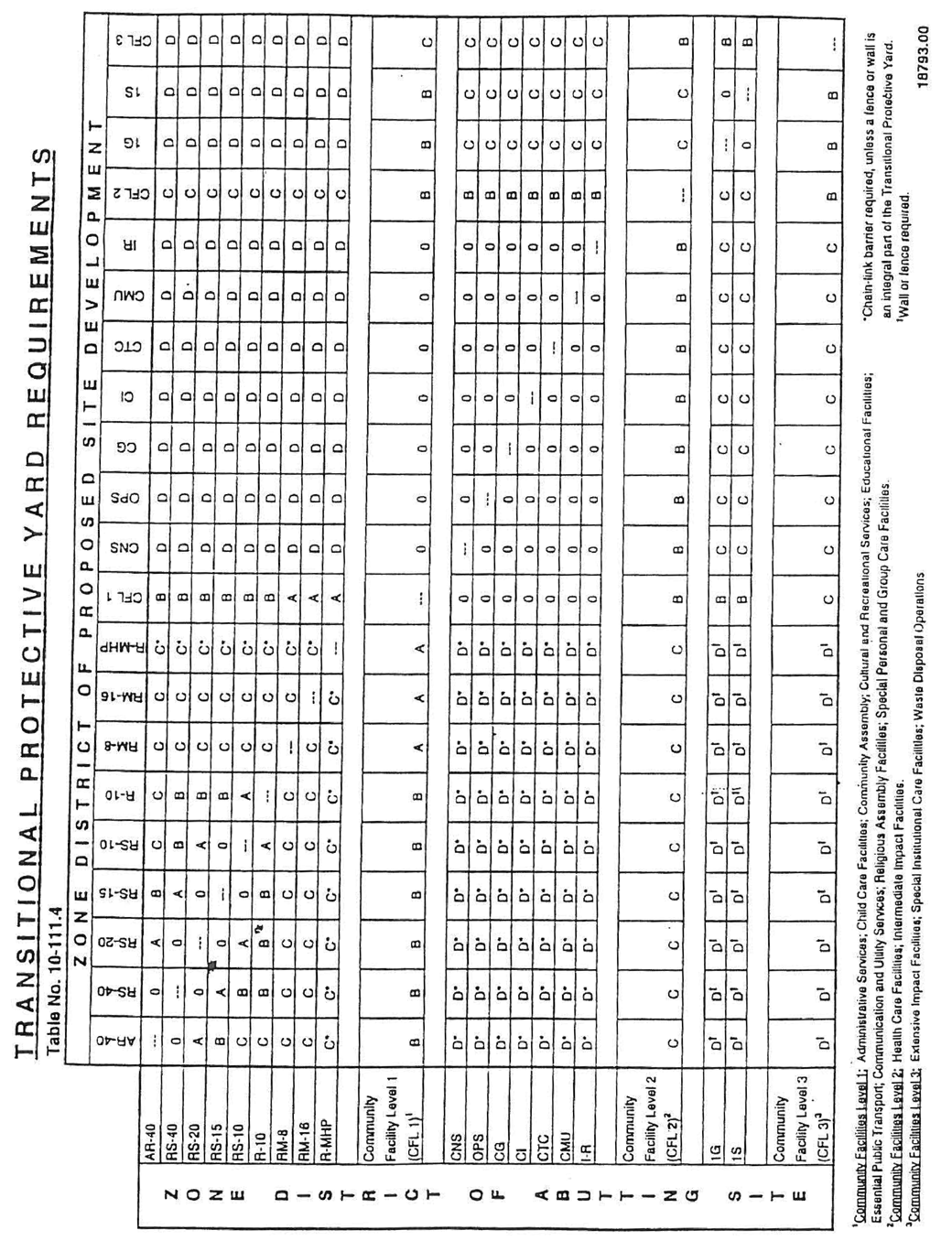
Quantities of material required. In the required transitional protective yard, natural trees and shrubs shall be planted in the quantities shown on the chart entitled, Transitional protective yard requirements of subsection 10-111.4 (below). All required plantings shall be no further than 50 feet from the property line, which is to be screened.
4.
Plantings within easements. With the exception of easements for overhead utility services, vegetative screening shall not be placed within a utility or drainage easement if the easement holder or the City object to such plantings. Vegetative screening shall not be placed within the flowage area of swales or drainage ditches. Should either the easement holder or the City object to vegetative screening in the easement, the required plantings shall be installed in the same number as otherwise required in the portion of the transitional protective yard remaining after exclusion of the easement area. (See subsection 10-108.4.)
5.
Modifications and alternatives. The height and quantity of required planting materials and fencing in areas immediately contiguous to street yards required by section 10-112, may be modified as an alternate method authorized by section 10-107, when such screening will not serve any useful purpose due to the location of uses, vehicles, buildings, structures, storage, loading, display or service areas or when such screening will obstruct traffic visibility.
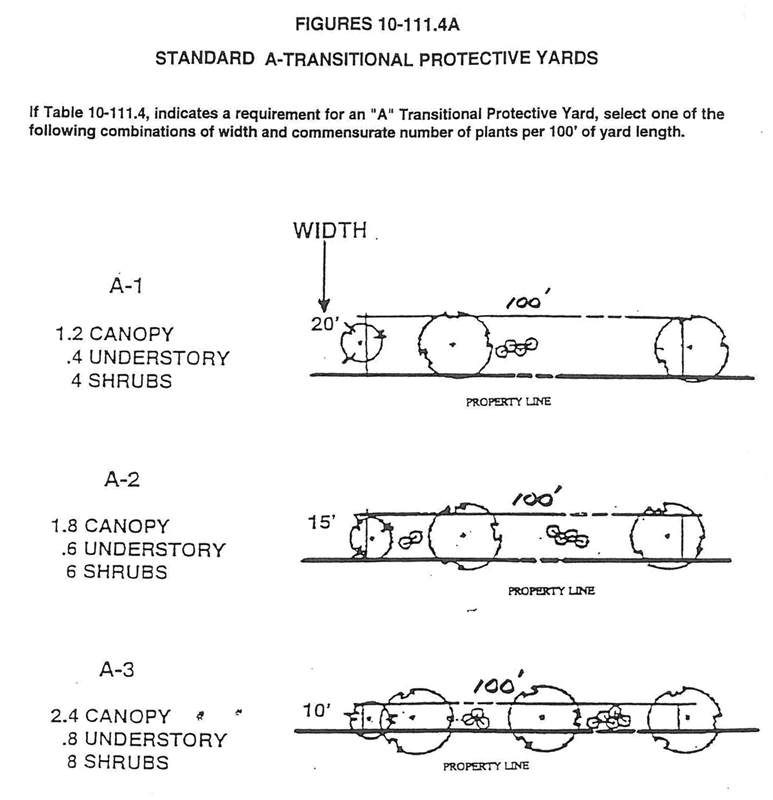
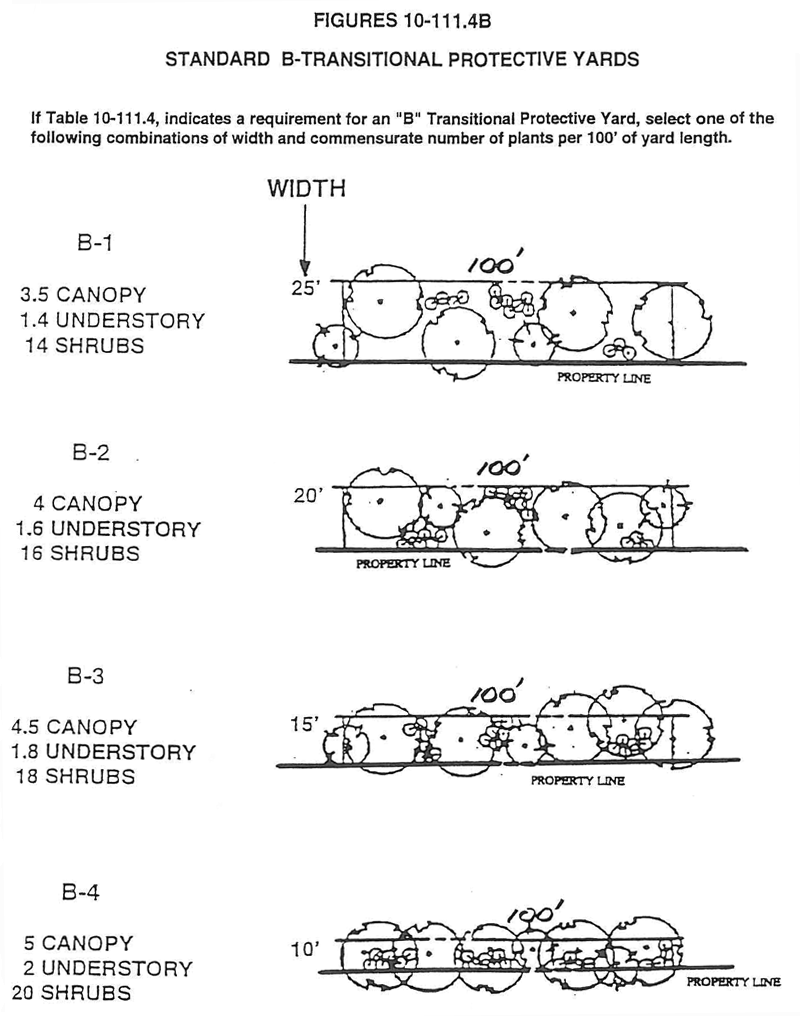
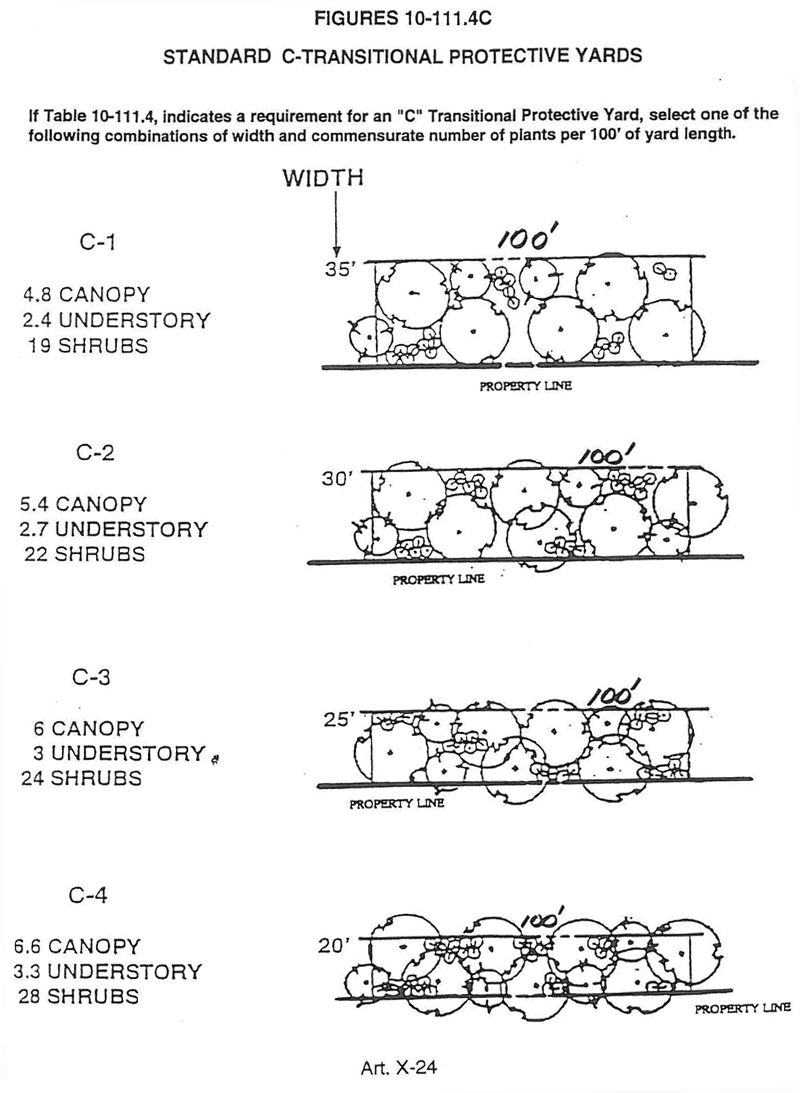
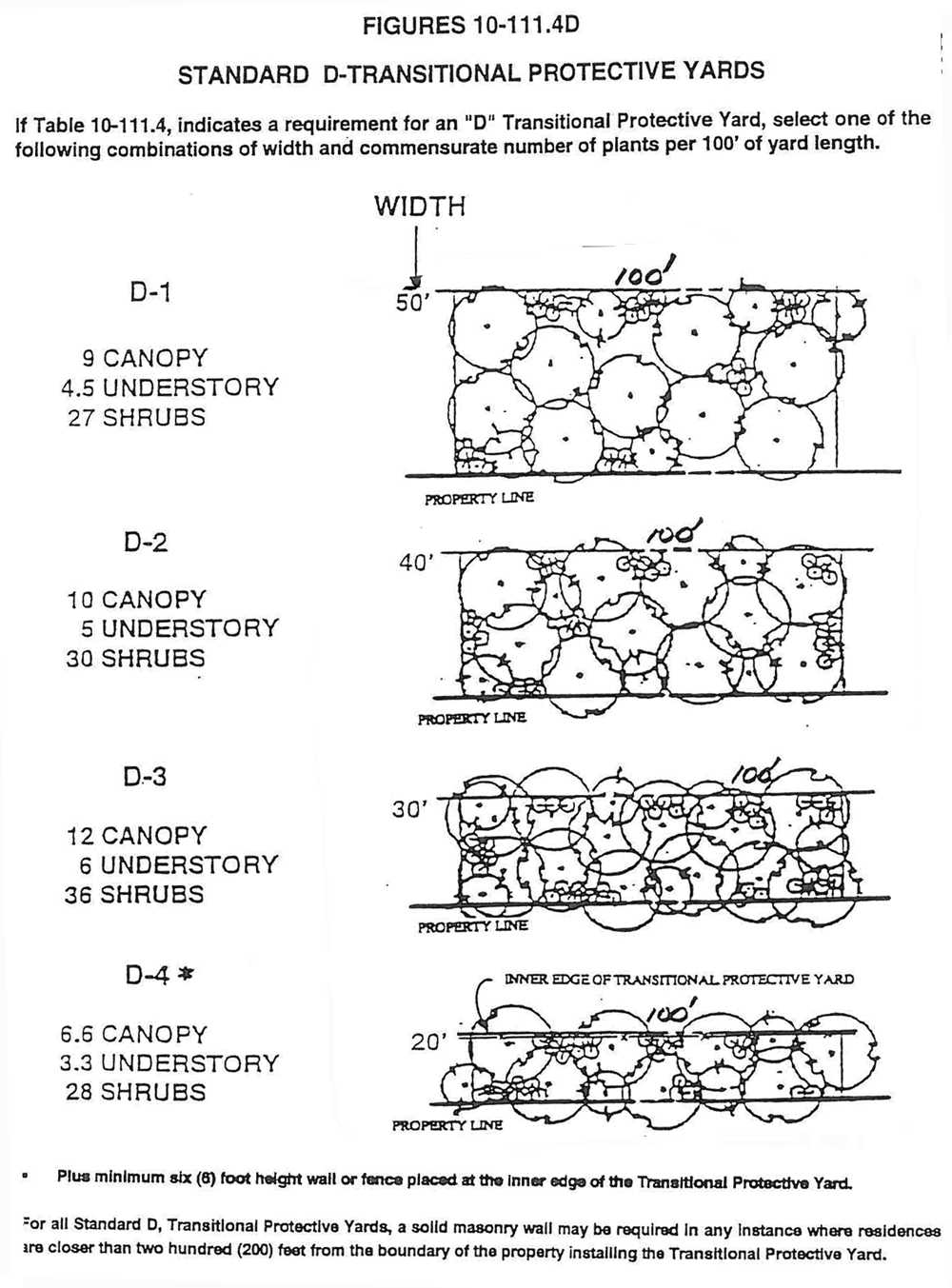
10-111.4 Determination of transitional protective yard requirements. Generally, a transitional protective yard shall be located at the perimeter of the building site along zoning district boundaries, or otherwise coincident with the edge of a specified facility that is to be screened, and shall not be located within in any portion of the public right-of-way. The following procedure shall be followed to determine the standard of transitional protective yard required along a zoning district boundary:
Step A. Determine the zone district for the proposed development site as well as that of the abutting site(s).
Step B. Determine the transitional protective yard standard required for each building site boundary (or portion thereof) by referring to table 10-111.4. Read down the column beneath the zone district of the proposed site development and across the row, which listed the zone district of the abutting site. The letter in the grid square where the column and the row intersect is the required standard for the transitional protective yard.
Step C. Select one width/screening option from the appropriate group among those listed in figures 10-111.4A through 10-111.4D. Any of the listed screening variations shown on the appropriate figure shall satisfy the requirement between the abutting zone districts. (Ex: A-1, A-2, or A-3, may be used to meet the requirements for an A standard, transitional protective yard).
Step D. When calculating required numbers of plant materials, round all fractions to the next whole number.
10-111.5 Existing vegetation.
1.
Credit for existing vegetation. So long as the required level of visual barrier is provided by the resulting transitional protective yard, existing vegetation which meets or exceeds the quantity, spacing and height standards, may be used to satisfy the requirements of subsection 10-111.3. Provided, however, no encroachments shall occur within the greater of either a seven-foot radius or one foot in diameter for each inch of circumference of the existing tree and that the provisions of subsection 10-112.6, are met.
2.
Reduction of required plantings. The amount of required shrubs in a transitional protective yard may be reduced by 50 percent, if in that yard existing trees meeting the space, quantity and specification requirements of subsection 10-111.3, are preserved and protected from encroachment, and the reduced number of shrubs still meets the intent of this ordinance for screening at the level of the groundplane.
3.
Supplemental plantings. Supplemental natural evergreen shrub plantings may be required, however, if it can be reasonably inferred that after five years, the existing vegetation will not continually provide a yearround foliage screen between properties from the natural grade to six feet above grade. Where such supplemental shrub plantings are required, the plantings shall have a minimum height of 1½ feet when installed with an expected height of six feet or greater within five years after planting and shall be planted so that there are no horizontal gaps greater than ten feet between shrubs as measured along the property lines. Where the existing vegetation on site does not meet the established criteria for spacing, quantity and size of plant, then the owner shall be required to plant only those trees and shrubs necessary to meet the established standards for the transitional protective yard required for the specific situation. All plants used for this purpose shall meet the standards set out in subsection 10-111.3.
10-111.6 Fences, walls and earthen berms.
1.
Installation of closed fence or solid wall. A fence or solid wall may be used as the sole means to meet the requirements of this section, only if the ground area required for transition protective yards, other than such yards for uses requiring transitional protective yard standard D, adjoining either property developed residentially or zoned for any residential use, exceeds 20 percent of the lot area.
2.
Height requirements. See [sub]section 10-108.1, [subpart] subparagraph 1, Materials and construction standards, for standards of construction and appearance of fences.
3.
Width of transitional protective yards with closed fences and solid walls. If a fence or wall is erected pursuant to subpart 1 of this section, the width of the transitional protective yard may be reduced to one-half the required width.
4.
Grade changes of six feet or more. Whenever a wall or fence is authorized to be constructed, in lieu of such construction, a natural or manmade grade separation at least six feet in elevation may be substituted; provided that the side slopes of such grade are not greater than 3:1, the developing property is located at an elevation lower than the properties to be screened and the change in grade achieves a similar screening effect as the wall or fence.
5.
Earthen berms. Any earthen berm installed in a transitional protective yard which reduces the width of the transitional yard shall be constructed to meet the standards set out in subsection 10-108.2 and shall be planted in accordance with the provisions of subsection 10-111.3. A steeper slope than that specified in subsection 10-108.2, may be used in exceptional cases when all the following are met:
a.
The steeper slope is sufficiently stabilized;
b.
The screening objectives of subsection 10-111.3, are better achieved; and
c.
Physical constraints of the site prevent the use of a flatter slope.
(Ord. of 10-23-2009, § 10-111)
Sec. 10-112. - Street yard landscape regulations.
10-112.1 Intent. It is the intent of this section to establish a landscape planting area parallel to the recorded public street right-of-way. This area shall contain plantings of trees and other live vegetation to provide a more pleasing view from the ways of travel, to provide continuity of vegetation throughout the City, to reduce the amount of impervious surface and reduce stormwater runoff, to filter air, provide shade and otherwise improve the microclimate and to preserve a remnant of the City's natural vegetative cover.
10-112.2 Applicability. Any use of land, including vehicular surface areas and parking structures, established after the effective date of [the ordinance from which] this article [is derived] shall provide a street yard along any existing or proposed public street right-of-way adjacent to or adjoining the property except those portions of the lot used for driveway construction in accordance with article IX, are exempt from all street yard requirements. The street yard shall be required as follows:
1.
For existing developed lots with unexpired building permits issued prior to the time this article becomes applicable to the property, the required street yard shall be at least five feet wide as measured perpendicular to the public street right-of-way abutting the property.
2.
For existing undeveloped lots platted prior to the application of this article to the property, the required street yard shall be at least five and no more than 25 feet wide measured perpendicular to the public street right-of-way abutting the property. The minimum area of the street yard in square feet, shall be equal to the length of the property line measured along the right-of-way, in linear feet, times ten. Widths in excess of 25 feet in width shall not be calculated in determining the minimum area.
3.
For all new lots developed or otherwise platted and recorded after application of this article to the property the required street yard shall be at least 7½ and no more than 25 feet wide measured perpendicular to the public street right-of-way abutting the property. The minimum area of the street yard, in square feet, shall be equal to the length of the property line measured along the right-of-way, in linear feet, times 15. Widths in excess of 25 feet in width shall not be calculated in determining the minimum area.
4.
For properties which are either acquired by a condemner or which have a change in the type of use which results in a change in the type of occupancy of a building, the applicable required minimum street yard width as determined in [subparts] subsections 1. through 3., above, shall be provided in the same manner as set forth in subsection 10-103.4, except that the multiplier of five contained in subsection 10-103.4, shall be increased to equal the width of the applicable required minimum street yard.
5.
For properties which have expansions or additions made after application of this article, the required minimum street yard widths shall be provided as set forth in subsection 10-103.4.
10-112.3 Alternative street yards. In lieu of the average 15-foot wide street yard area required by subsection 10-112.2, a minimum street yard area equal to 12 times the length of the recorded public right-of-way abutting the property may be substituted as an alternative, provided:
1.
An inventory of all existing trees located within the street yard and sized five caliper inches or greater is shown on the site plan, or landscape plan, when no site plan is required. The inventory shall contain as a minimum the scientific name, caliper and location of all trees identified on the inventory; and
2.
The species of existing trees shown on the inventory should have the characteristics required in subsection 10-112.5; and
3.
The minimum number of existing trees shown on the inventory shall equal the average rate of six caliper inches of trees for each 50-foot linear distance of the street yard measured parallel to the street; and
4.
One or more of the following requirements are met:
a.
All trees shown on the inventory are [to be] preserved. Preservation of existing trees shall be done in accordance with subsection 10-112.6;
b.
Each tree shown on the inventory which is not preserved in accordance with subsection 10-112.6, is replaced with one new tree equal to one-half of the caliper of the unpreserved tree, but the maximum required replacement size need not exceed six inch caliper; or
c.
A continuous area of the street yard equal to at least 20 percent of the street yard area remains unaffected by land disturbing activities, and that located within this undisturbed area are trees at least one inch caliper which sum total of circumference or caliper equals the circumference or caliper of all trees required in that yard.
Note. The required number of caliper inches shall be comprised of one or more trees, provided a total of six caliper inches is provided for each 50 linear feet of frontage and that no tree less than 1¾ inches in caliper shall be credited toward this requirement.
10-112.4 Use of street yards. Street yards required by the provisions of this ordinance shall be landscaped and properly maintained by the owner and shall have live vegetation, groundcover, grass, trees, shrubs, and may unless otherwise prohibited include fences or walls, screening for loading, utility and display areas, and plantings for vehicular surface areas. All fences shall conform to the requirements of this ordinance. No more than 15 percent of this required protective yard shall be covered with an impervious surface which may be used without limitation for walkways, fountains or walls, but not vehicular surface, storage, utility service, display, service or loading areas.
10-112.5 Trees within street yards. Street yards shall contain natural trees, either existing or planted, of at least eight feet in height and 1¾ inches caliper as follows:
1.
No street yard shall contain less than one natural tree.
2.
Each street yard shall contain an average of at least one tree for every 50 linear feet of street yard or fraction thereof, as measured from the corners of the property and shall be located so that at least one tree is within every 100 lineal feet of street yard or fraction thereof. Such street trees shall be planted at least ten feet from any tree on the right-of-way. Along street yards for display areas, the spacing of trees may be one natural tree every 150 lineal feet of the street yard or fraction thereof.
3.
All required trees in the street yard must be a locally adapted species with an expected mature height of 35 feet or greater and an expected crown spread of at least 30 feet or greater unless subject to an overhead power line in which case the mature height may be less.
10-112.6 Preservation of existing trees. Preservation of existing live trees between the principal building and the public street right-of-way can be credited towards the tree planting requirements of this section according to the following ratio: The credit toward the required number of trees shall be a number equal to the value of one-sixth the sum in inches of the caliper(s) of each preserved tree(s) but no fraction thereof. To be included in the computation for credit for existing trees, each preserved tree must be a least 1¾ inches in caliper and be uniformly encircled by a protected ground area. At a minimum, this protected ground area for an existing tree shall be the greater of either a seven-foot radius or one foot in diameter for each inch of circumference of the tree, except those trees in parking lots which are already located inside planting areas with a minimum dimension of seven feet may be used. During construction activities, the protected ground area shall be clearly marked in the field.
No credit will be allowed for any tree proposed to be retained if there is any encroachment within the protected ground area defined by a circle which has as its center the trunk of the tree or if the tree is unhealthy or dead. The replacement of dead or unhealthy trees which are used for credit may be accomplished provided the replacement trees shall be equal to the number of credited trees.
For the purposes of this section an encroachment is defined as any change in the natural grade, construction of impervious surfaces, trenching or excavation, storage of equipment, materials or earth and the temporary or permanent parking or circulation of vehicles or equipment.
(Ord. of 10-23-2009, § 10-112)
Sec. 10-113. - Landscape maintenance.
All landscaping materials shall be installed in a sound, workmanlike manner and according to accepted horticultural procedures. Any landscape material that fails to meet the minimum requirements of this article at the time of installation shall be removed and replaced with acceptable materials. The person in charge of or in control of the property whether as owner, lessee, tenant, occupant, or otherwise, shall be responsible for the continued proper maintenance of all landscaping materials, and shall keep them in a proper, neat and orderly appearance, free from refuse and debris, at all times. All unhealthy or dead plant material shall be replaced within one year, of notification or by the next planting period, whichever comes first; while other defective landscape material shall be replaced or repaired within three months. All fences and/or walls provided in compliance with the requirements of this ordinance shall be maintained in such manner as to preserve them structurally and present an attractive appearance. Failure to replace materials within the time period specified in said notice shall constitute a violation of this ordinance, per subsection 14-108.3.
(Ord. of 10-23-2009, § 10-113)
Sec. 10-114. - Variances.
A.
General[ly]. Where it can be shown that strict compliance with the requirements of these regulations can not be met, due to unavailability of sufficient land, a variance from the provisions of this article may be sought.
B.
Variance procedure. The owner shall submit in writing a request for variance at the time application is made for approval of a site plan. The request shall detail the reasons for such request and shall demonstrate that alternative means of compliance authorized by section 10-107, are unfeasible upon the site in question.
C.
Administrative variances. A variance of up to 15 percent of the land area or requirement for plants may be approved by the Zoning Administrator, provided that the applicant demonstrates that the request for variance complies with all requirements of subpart D (below).
D.
Minimum adjustments only. Any request for variance must be held to the minimum necessary. The Zoning Administrator must find that each of the following conditions apply to the particular circumstances prior to the granting of the variance:
(1)
Practical difficulties or unnecessary hardship. That strict application of the provisions of this ordinance would result in practical difficulties or unnecessary hardship.
(2)
Not detrimental. That granting the application will not be detrimental to the public welfare or injurious to property or improvements in the neighborhood of the premises.
(3)
Maintains intent of ordinance and the development plan. That such variance is within the intent and purpose of this ordinance and will not adversely affect the community objectives of this ordinance.
E.
Variances by the Board of Zoning Appeals. Any request for variance which exceeds the standards for administrative approval may only be approved by an action of the Board of Zoning Appeals in accordance with the provisions of article XIV, section 14-105.
(Ord. of 10-23-2009, § 10-114)
Sec. 10-115. - Technical advisory committee.
There is hereby created a Technical Advisory Committee which shall be comprised of the following members:
The Zoning Administrator
The City Engineer
The Codes Enforcement Officer
The City Planner
The purpose of the Committee is to review landscaping plans presented to meet the requirements of this article and to make such recommendations and reports, as it deems necessary and appropriate.
(Ord. of 10-23-2009, § 10-115)

