
Mount Juliet City Zoning Code
ARTICLE V
- RESIDENTIAL DISTRICT REGULATIONS
Sec. 5-101.- Purposes of residential districts.
5-101.1 General purposes. The residential districts established in this ordinance are designed to promote and protect the health, safety, morals, convenience, order, prosperity and other aspects of the general welfare. These goals include, among others, the following:
1.
To provide sufficient space in appropriate locations for residential developments to adequately meet the housing needs of the present and expected future population of the urban area, with due allowance to the need for a variety of choices in site selection.
2.
To permit improved movement on the public ways and to effectively utilize existing public ways, and, as far as possible, to mitigate the effects of heavy traffic and more particularly all through traffic, in residential areas.
3.
To protect residential areas against flood, fire, explosions, toxic and noxious matter, radiation, and other dangers, and against offensive matter, heat, glare, humidity and other objectionable influences.
4.
To protect residential areas against undue congestion, as far as possible, by regulating the density of population, the intensity of activity, and the bulk of buildings in relation to the surrounding land and to one another.
5.
To require open space in residential areas whenever practicable in order to open up these areas to light and air, to provide open space for rest and recreation, and to break up the monotony of continuous building bulk and thereby to provide a more desirable living environment.
6.
To provide for access of light and air to windows and for privacy, as far as possible, by controls over the height of buildings and structures.
7.
To provide appropriate space for public and private educational, religious, recreational and similar facilities, and public utilities which serve the needs of nearby residents, which generally perform their own activities more effectively in a residential environment, and which do not create objectionable influences, and to coordinate the intensity of residential land use with appropriate community facilities.
8.
To provide a zoning framework conducive to freedom of architectural design in order to encourage development of more attractive and economical building forms.
9.
To provide sufficient space in appropriate locations for agricultural activities.
10.
To promote the most desirable use of land and direction of building development in accordance with a well considered general plan to promote stability of residential development, to protect the character of the district and its peculiar suitability for particular uses, to conserve the value of land and buildings and to protect the community's tax revenues.
5-101.2 District purposes.
1.
AR-40, Agricultural/Residential Districts. These districts are designed to provide for low-density residential development in conjunction with suitable areas for the growing of crops, animal husbandry, dairying, forestry and other similar activities. The intensity of development is expected to range from that which characterizes rural environments to that seen in low-density suburban areas where public sanitary sewer service is least practical. In addition, these districts may include areas and lands not suited by reason of soil, geologic, topographic or other limitations for development. These districts also include community facilities, public utilities, and open uses which serve specifically the residents of these districts, or that are benefited by an open environment without creating objectionable or undesirable influences that are incompatible with a rural environment. It is the express purpose of this ordinance to exclude from these districts all buildings or other structures and uses having commercial characteristics, whether operated for profit or otherwise, except that conditional uses and home occupations specifically provided by these regulations for these districts shall be considered as not having such characteristics if they, otherwise, conform to the provisions of this ordinance.
2.
RS-40, Single-Family Residential Districts. These districts are designed to provide for low-density residential development in areas where public sanitary sewer service is least practical or where large lots and an open appearance is desired. In addition, these districts may include areas and lands not suited by reason of soil, geologic, topographic, or other limitations for development. These districts also include community facilities, public utilities, and open uses which serve specifically the residents of these districts, or that are benefited by an open environment without creating objectionable or undesirable influences that are incompatible with a suburban residential environment. It is the express purpose of this ordinance to exclude from these districts all buildings or other structures and uses having commercial characteristics, whether operated for profit or otherwise, except that conditional uses and home occupations specifically provided by these regulations for these districts shall be considered as not having such characteristics if they, otherwise, conform to the provisions of this ordinance.
3.
RS-30, RS-20 and RS-15, Single-Family Residential Districts. These districts are designed to provide suitable areas for single-family residential development at densities which typically characterize a suburban environment where appropriate urban services and facilities, specifically, including public sewer service, are provided at the time of development. Residential development will consist of single detached dwellings and such other structures as are accessory thereto. These districts also include community facilities, public utilities, and open uses which serve specifically the residents of these districts, or that are benefited by an open residential environment without creating objectionable or undesirable influences upon residential developments. Further, it is the intent of this ordinance that these districts be so located that the expansion of appropriate urban services can be physically and economically facilitated for the orderly expansion and maintenance of urban residential development throughout the planning jurisdiction. It is the express purpose of this ordinance to exclude from these districts all buildings or other structures and uses having commercial characteristics, whether operated for profit or otherwise, except that conditional uses and home occupations specifically provided by these regulations for these districts shall be considered as not having such characteristics if they otherwise conform to the provisions of this ordinance.
4.
RS-10 Single-Family Residential Districts and R-10 One-and Two-Family Residential Districts. These districts are designed to provide suitable areas for single-family and, in the case of the R-10 district, duplex residential development. Residential development will consist of single detached dwelling structures, duplexes and other structures accessory thereto. These districts also include community facilities, public utilities, and open uses which serve specifically the residents of these districts, or that are benefited by an open residential environment without creating objectionable or undesirable influences upon residential developments. Further, it is the intent of this ordinance that these districts be located where appropriate urban services and facilities, specifically, including public sewer service, are provided so that the expansion of appropriate urban services can be physically and economically facilitated throughout the planning jurisdiction. It is the express purpose of this ordinance to exclude from these districts all buildings or other structures and uses having commercial characteristics, whether operated for profit, or otherwise, except that conditional uses and home occupations specifically provided by these regulations for these districts shall be considered as not having such characteristics if they otherwise conform to the provisions of this ordinance.
5.
RM-8, Multifamily Residential Districts. The RM-8 districts are designed to provide suitable areas for multifamily dwellings at densities which are conducive to development of townhouse, and other forms of attached dwellings where sufficient urban facilities are available or where such facilities will be available prior to development. These districts may permit a variety of housing types and forms of property ownership within the same development. In order to permit maximum flexibility in the design solutions and ownership mechanisms available within these districts while maintaining necessary control over the development process, any RM-8 district created after adoption of this ordinance shall not be created as a freestanding district, but shall in all instances be overlain by a PUD, Planned Unit Development District. These districts also permit community facilities, public utilities, and open uses which serve specifically the residents of these districts, or that are benefited by an urban residential environment without creating objectionable or undesirable influences upon residential developments. Further, it is the intent of this ordinance that these districts be located where appropriate urban services and facilities, specifically, including public sewer service, are provided so that expansion of appropriate urban services can be physically and economically facilitated throughout the planning jurisdiction. It is the express purpose of this ordinance to exclude from these districts all buildings or other structures and uses having commercial characteristics, whether operated for profit or otherwise, except that conditional uses and home occupations specifically provided by these regulations for these districts shall be considered as not having such characteristics if they otherwise conform to the provisions of this ordinance.
6.
RM-16, Multifamily Residential Districts. The RM-16 districts are designed to provide suitable areas for multifamily dwellings at high densities where sufficient urban facilities, specifically, including public sewer service, are available or where such facilities will be available prior to or at the time development. These districts may permit a variety of housing types and forms of property ownership within the same development. In order to permit maximum flexibility in the design solutions and ownership mechanisms available within these districts while maintaining necessary control over the development process, any RM-16 district created after adoption of this ordinance shall not be created as a freestanding district, but shall in all instances be overlain by a PUD, Planned Unit Development District. These districts also permit community facilities, public utilities, and open uses which serve specifically the residents of these districts, or that are benefited by an urban residential environment without creating objectionable or undesirable influences upon residential developments. It is the express purpose of this ordinance to exclude from these districts all buildings or other structures and uses having commercial characteristics, whether operated for profit or otherwise, except that conditional uses and home occupations specifically provided by these regulations for these districts shall be considered as not having such characteristics if they, otherwise, conform to the provisions of this ordinance.
7.
R-MHP, Manufactured Home Park Residential Districts. These districts are designed to provide suitable areas for manufactured home parks where sufficient urban facilities, specifically, including public sewer service, are available prior to or at the time of development. Manufactured homes and buildings necessary to support the residential occupancy of these structures are permitted. In order to permit maximum flexibility in the design solutions and ownership mechanisms available within these districts while maintaining necessary control over the development process, any R-MHP district created after adoption of this ordinance shall not be created as a freestanding district, but shall in all instances be overlain by a PUD, Planned Unit Development District. These districts are intended also to permit community facilities and public utility installations which are necessary to service and do service specifically the residents of these districts, or which are benefited by and compatible with a residential environment. It is the express purpose of this ordinance to exclude from these districts all buildings or other structures and uses having commercial characteristics and not planned as an integral part of a total residential development, whether operated for profit or otherwise, except that conditional uses and home occupations specifically provided for in these regulations for these districts shall be considered as not having such characteristics if they otherwise conform to the provisions of this ordinance.
(Ord. No. 2001-34, 10-22-2001; Ord. of 10-23-2009, § 5-101)
5-101.3 Short Term Rentals. The following provisions clarify the operation of short-term rental units, as defined in Tenn. Code Ann. § 13-7-602(8), within the City of Mt. Juliet.
1.
No later than January 1st, 2014, the City adopted an ordinance permitting short term rentals in the RM-16 Zoning District.
2.
Said ordinance permits, as a semi-transient residential establishment in RM-16 zoning, a short-term rental unit where lodging is providing on a daily/weekly/monthly basis, so long as less than 30 percent of the living units located on the same lot are being occupied on less than a monthly basis.
3.
This ordinance complies with Tenn. Code Ann. § 13-7-603 as a prohibition on the use of short-term rental units in the City of Mt. Juliet with the exception found herein for RM-16 zoned lots.
4.
Mt. Juliet adopts the following permit procedure:
a.
A short-term rental unit permit is required prior to the operation of a short term rental unit in the City of Mt. Juliet.
b.
The application for a short-term rental unit permit shall be on a form approved by the Zoning Administrator, who shall make all decisions regarding the issuance of a permit and the application of the City's RM-16 zoning regulation.
c.
The owner/occupant/manager, or any other similar entity, must apply for the permit prior to operating a short-term rental unit.
d.
A short-term rental permit shall not be granted to any property that is not zoned RM-16.
e.
A permit may be granted to properties operated prior to the effective date of this ordinance, as a short-term rental unit in violation of Mt. Juliet's RM-16 zoning regulation, as referenced in sections 5.101.3(1), (2).
i.
The Zoning Administrator shall determine whether a short-term rental unit operated in violation of the City's RM-16 regulations and whether a permit should be issued for the purposes listed in this subsection (e).
ii.
A permit issued under this subsection (e) may be granted for the purpose of appealing, to the City Zoning Appeals, any alleged error in any order, requirement, permit, decision, or refusal made by the Zoning Administrator or any other City official regarding the permissible operation of a property as a short-term rental unit, as required by Tenn. Code Ann. § 13-7-207(1).
A.
A short-term rental unit granted a permit pursuant to this subsection (e) may continue in operation after receiving a permit and filing an appeal with the Board of Zoning Appeals. Such operation must cease after all appellate rights are extinguished.
iii.
Pursuant to Tenn. Code Ann. § 13-7-603(a) and Tenn. Code Ann. § 13-7602(10), no permit will be issued pursuant to this subsection(e) if taxes were not remitted, as required pursuant to Tenn. Code Ann. Title 6, Chapter 5, Part 5, for at least six months within the 12 months preceding the effective date of this ordinance.
f.
Any short-term rental unit that is allowed to operate within the City is subject to all generally applicable rules and regulations. Pursuant to Tenn. Code Ann. § 13-7604, the City will permanently prohibit the use of a property as a short-term rental unit if the unit, while being utilized as a short-term rental unit, is found in violation of generally applicable local law on three separate occasions.
g.
The use of any property in the City as a short-term rental unit without a short-term rental unit permit is not permitted and is subject to the general penalty and enforcement provisions of this Zoning Code.
(Ord. No. 2022-36, 9-12-2022)
Sec. 5-102. - Uses and structures.
5-102.1 General provisions. Principal uses of buildings or other structures and land have been classified and combined into major classes and activity types in article III of this ordinance. The procedure for interpreting the classes and type of activities is provided in article III, section 3-101. Table 5-102A, presents a tabulation of uses and structures which are classified as principal permitted (P), permitted with supplemental provisions (SUP) or conditional (C) uses within the various residential districts. The supplemental design provisions with which (SUP) and (C) uses and activities are required to comply are presented in article III, section 3-104, Supplemental use regulations.
5-102.2 Principal permitted uses (P). Principal permitted uses are permitted as a matter of right within the district indicated, subject to the general requirements established for the district wherein the use is located.
Table 5-102A. Uses And Structures Allowable Within Residential Districts
Key to interpreting use classifications.
P = Use permitted by right within the district.
SUP = Principal use permitted with supplemental provisions.
C = Conditional use subject to approval by the Board of [Zoning] Appeals.
ASP = Accessory use permitted with supplemental provisions.
(1)
This district requires a mandatory PUD overlay.
(2)
See subsection 5-104.1.
(3)
See subsection 5-104.2.
5-102.3 Use permitted with supplemental provisions (SUP). A use permitted with supplemental provisions is an activity, use or structure which is permitted subject to a finding by the Zoning Administrator that the specific standards indicated for the use in question have been met. Only those uses and structures so indicated in table 5-102A, may be allowed within the districts indicated.
5-102.4 Conditional uses (C). A conditional use is an activity, use, or structure which may require large land area, have unique operating, traffic generating or other characteristics that may tend to dominate or adversely affect the area more than do other uses permitted within the same zone district. Because the impacts of these uses cannot be satisfactorily predetermined for every possible location within a zone district, these land uses are permitted only upon approval by the Board of [Zoning] Appeals. Only those uses and structures so indicated in table 5-102A, may be allowed within the districts indicated.
5-102.5 Accessory uses. In addition to the principal activities expressed above, each activity type shall be deemed to include activities customarily associated with and appropriate, incidental and subordinate to the principal activity when such accessory activity is located on the same zone lot as such principal activity and meets the further conditions set forth in article III, section 3-105. Accessory uses designated with the letter (P), in table 5-102A, are permitted as a matter of right and no permit is required to conduct the activity in question. Those accessory uses designated with the letters (ASP) require a permit obtained from the Office of the Zoning Administrator. Permits for accessory uses designated (ASP) shall be issued upon demonstration that the activity in question meets the requirements established for such activity article III, section 3-105. The third classification of accessory uses designated by the letter (C) require approval as a conditional use by the Board of Zoning Appeals. Upon issuance of any permit for a conditional accessory use such use or activity shall be continuously subject to compliance with any operational standard or criteria established by the Board of [Zoning] Appeals.
5-102.6 Temporary uses. The temporary uses and structures specified in article III, section 3-106, as permissible within residential districts, may be permitted for the limited time periods indicated for each such use or activity.
5-102.7 Uses not permitted. Any uses or structures not allowable as permitted uses, conditional uses, temporary uses or accessory uses are prohibited within the various residential districts.
5-102.8 Restriction of buildings permitted on residential zone lots. Only one principal building may be permitted on any zone lot, except as may otherwise be approved as follows:
1.
As part of a complex of dwellings subject to the provisions of subsections 5-104.1 or 5-104.2.
2.
As part of a PUD, Planned Unit Development District as provided in this ordinance.
(Ord. No. 2001-34, 10-22-2001; Ord. No. 2004-34, 8-9-2004; Ord. of 10-23-2009, § 5-102)
Sec. 5-103. - Bulk regulations.
5-103.1 General[ly]. The minimum lot dimensions, maximum lot coverage, maximum density, minimum front, rear, interior and street side yards, maximum building heights and minimum separation between buildings on the same zone lot within any base residential district shall be as indicated in table 5-103a, Bulk regulations for residential districts, and the additional bulk regulations specified in this section. For certain uses, alternative bulk regulations may be specified in this article or other articles of this ordinance. Bulk regulations for PUD, Planned Unit Development Overlay Districts shall be as specified in article VIII, section 8-207, Residential development standards.
5-103.2 Lot dimensions. No lot shall be created and no building permit or zoning approval shall be issued for any lot that does not meet the following minimum dimensional requirements, unless otherwise provided in the development plan of a planned unit development:
1.
Lot area.
a.
Minimum area. Within the various residential districts, the minimum horizontal area of a lot shall not be less than the greater of: that indicated in table 5-103a, Bulk regulations for residential districts, or that required to meet the provisions of article XIII, Environmental and performance standards.
b.
Reduction in lot area prohibited. No lot, even though it may consist of one or more adjacent lots of record, shall be reduced in area so that yards, lot area per dwelling unit, lot width, building area, or other requirements of the zoning ordinance are not maintained. This section shall not apply when a portion of a lot is acquired for a public purpose.
2.
Lot width. The minimum lot width (measured at the building line) shall not be less than indicated in table 5-103a, or otherwise specified in this ordinance.
3.
Lot frontage. All lots shall have a minimum of 50 feet of frontage on a publicly dedicated and maintained street or a permanent access easement as defined and regulated by this ordinance, except that lots located along the terminus of a cul-de-sac shall have a minimum of 35 feet of frontage.
4.
Maximum permitted lot coverage. Within the various residential districts, the maximum zone lot coverage by all buildings, principal and accessory, shall not, except as provided in subsection 5-104.3, exceed the percentage of the total area of the zone lot indicated in table 5-103a.
(Ord. No. 2026-03, § 1, 1-12-2026)
5-103.3 Density regulations.
1.
Basic requirement. The residential density permitted upon any zone lot found within the residential districts is controlled by the greater of the minimum lot size specified or, in the instance of multiple dwelling units permitted on a single lot, the development area required for each dwelling or rooming unit permitted to locate thereon. This is determined by dividing the total area of the zone lot by the development area per dwelling or rooming unit which is presented in table 5-103a.
2.
Adjustment for lot area remainder. In all districts where residential uses are permitted, if an amount of lot area not allocated to a dwelling unit is less than that required for one additional dwelling, the remaining lot area may be used to satisfy lot area requirements if it represents not less than three-fourths of the total required.
5-103.4 Height regulations.
1.
Basic requirements. The maximum permitted height for buildings shall not, except as provided in subpart 2 of this section, exceed that set forth for the various residential districts in table 5-103a.
2.
General exception to height regulations. The height limitation contained in the district regulations does not apply to spires, belfries, cupolas, radio towers, water tanks, ventilators, chimneys or other appurtenances usually required to be placed above the eave height of a building and not intended for human occupancy.
(Ord. No. 2026-03, § 1, 1-12-2026)
5-103.5 Yard regulations.
1.
Application of the lot line equivalent to measurement of yards. The following provisions shall apply in the determination of a lot line equivalent:
a.
A front lot line equivalent is a straight line joining the foremost points of the side lot lines. In the case of rounded property corners at street intersections, the foremost point of a side lot line shall be assumed to be the point at which the side lot line and the front lot line would have met without such rounding.
b.
A rear lot line equivalent is a straight line joining the rearmost points of the side lot lines.
c.
A side lot line equivalent is a straight line joining the ends of the front yard line and the rear yard line on the same side of the zone lot.
In all residential districts, the width or depth of a yard shall be measured perpendicular to lot line equivalents.
2.
Yard diagrams. The yard diagrams as set forth in illustration 2-102.2A can be found on file in the Planning Department, shall be used in clarifying the meaning of the [terms] "line" and "yard" [in the] definitions in this section.
3.
Permitted obstructions in required yards. In all residential districts, the following shall not be considered obstructions when located within a required yard, except that these items shall comply with subpart 4 of this section, Obstructions prohibited at street intersections:
a.
In any yard.
Air conditioning units, provided that no such unit shall extend more than one-half the required width of the yard.
Arbors and trellises.
Awnings or canopies projecting from a building wall over a required yard not more than six feet, and having no supports other than provided by the wall or its integral parts.
Bay windows not projecting more than two feet into the required yard. In no case shall bay windows be located less than five feet from any lot line.
Chimneys projecting not more than three feet into and not exceeding two percent of the area, of the required yard.
Driveways subject to other specific provisions of this ordinance related directly thereto.
Eaves, gutters, or down spouts, projecting into or over required yards not more than 24 inches or 20 percent of the width of such yard, whichever is the lesser distance.
Fire escapes or staircases, the riser of which shall be at least 50 percent open, and whose vertical projection downward onto a required yard does not project more than three feet into, and not exceeding ten percent of the area of the required yard.
Flagpoles having only one structural ground member.
Fountains.
Mailboxes.
Open terraces, including natural plant landscaping.
Sculpture or other similar objects of art.
Street furniture such as, but not limited to, benches, drinking fountains, trash receptacles, ash trays, light standards, or directional signs.
Vehicular parking areas, unless, otherwise, specifically prohibited by applicable sections of this ordinance.
Vents necessary for use of fallout shelters constructed below grade of such yards, but excluding all other parts of such shelters.
Walls, including retaining walls, or fences not exceeding six feet in height measured from finish grade level at any point along the length of, and on any side of, such walls, including retaining walls, or fences, and not roofed or structurally part of a building.
b.
In any rear yard.
1.
In any rear yard, clothes poles, clothes lines and recreational equipment shall be allowed.
2.
In any rear yard, accessory buildings shall be allowed under the following conditions:
c.
In any front or side yard. In any front or side yard, accessory buildings shall only be allowed by conditional use granted by the Board of Zoning Appeals upon a finding that the following requirements have been met:
1.
The building conforms to the principal building in architecture and external building materials; and
2.
The building is not located within any required front or side yard setback; and
3.
The building height shall be the lesser of 20 feet or the height of the principal building.
4.
A plot plan is submitted to the Board of Zoning Appeals that demonstrates compliance with all plot plan requirements for residential construction.
5.
The property:
(i)
Has direct frontage on Old Hickory Lake; or
(ii)
Exceeds five acres, has topographic constraints or other unique physical irregularities that render the rear yard unusable for the location of an accessory building, and is zoned AR-40 or RS-40.
4.
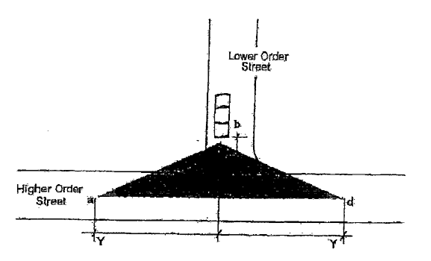
Obstructions prohibited at street intersections. On a corner lot, no fence, wall, hedge, or other planting or structure that will materially obstruct vision between a height of 2½ feet and ten feet above the centerline grades of the intersecting streets shall be erected, placed, or maintained within the triangular area formed by the street lines at such corner lots and a straight line joining such street lines at points which are 35 feet distance from the intersection of the street lines and measured along said street lines. In case of rounded street lines at the intersecting streets, such measurement shall be made from the point of intersection of the tangents of the curve constituting the rounding. (See the [following] illustration 5-103.5A, Vision clearance area:)
Vision Clearance Area
5.
Basic requirements. In all residential districts, the minimum requirement for front, side and rear yards shall be as set forth in table 5-103a.
6.
Special conditions affecting yards.
a.
Front yards to be measured from future street lines. For the purpose of providing adequate space for future widening of streets, required front yards shall be determined by the right-of-way as shown on the latest official major thoroughfare plan.
b.
Rear yard exception for through lots. In all residential districts, no rear yard regulations shall apply to any through lot which extends less than 250 feet in depth from street to street. The depth of such lot shall be considered to be the mean length of its side lot lines. In lieu thereof a front yard shall be required for each street frontage.
c.
Yard requirements for zone lots of unusual shape. In all residential districts, wherever a zone lot is of such unusual shape that the yard provisions of these regulations cannot be specifically applied, the Zoning Administrator may substitute special yard requirements for such lot only to the extent that these regulations are inapplicable and not to exceed the average of the yard requirements on adjacent lots in the district.
d.
Special yard requirements for agricultural activities. Within those residential districts where agricultural activities are permitted there shall be provided a minimum yard from all property lines of not less than 200 feet for all permitted barns and other structures, including feed lots and pens, where animals are maintained.
e.
Special yard requirements for corner lots. The minimum required width of a side yard abutting a street shall be one-half the minimum required front yard depth for the district. Parking within this side yard is prohibited.
f.
Minimum side yard for residential structure with facade parallel to a side lot line. For any residential structure constructed with a front and/or rear building facade parallel to a side lot line, the required side yard shall be not less than one-half the minimum required front yard depth for the district.
g.
Special provisions for front yard setback. Any alteration, addition or construction of a building or structure on a zone lot shall extend no closer to the street which abuts the designated front yard than the average of the distances of the buildings located within 100 feet on each side of the lot whereon the alteration, addition or construction is to occur; provided that no building shall be required to provide a front yard of greater than twice the minimum front yard for the district. The average front yard requirement shall not prohibit alterations or additions to an existing structure which has irregular front walls provided said alteration or addition extends no closer to the street than the existing closest front wall to the street. The Board of [Zoning] Appeals shall have jurisdiction to vary from this strict application upon property where such provision would create an undue hardship.
h.
Special yards and setbacks along district boundaries. Along such portion of the boundary of any Multifamily (R-M) or Manufactured Home [Park] (R-MHP) District, which coincides with a side or rear lot line of a zone lot in any other residential district, the following shall apply:
i.
Residential buffer yards. An open area unobstructed from the ground to the sky shall be provided within the multifamily or R-MHP district, said area being at least 30 feet in width or depth. Such open area shall not be used for accessory off-street parking, or for accessory off-street loading, or for storage or processing of any kind.
ii.
Special front setbacks. Regardless of the front yard provisions established for any multifamily or R-MHP district, no building located on any zone lot adjacent to any other residential district shall extend closer to the street than the average of the distances of the buildings located within 100 feet of the lot; provided that no building shall be required to [be] set back more than twice the minimum front yard applicable within the zoning district wherein it is located.
5-103.6 Separation of buildings on same lot. In all residential districts where more than one principal building is to be located upon a single zone lot, the minimum distance between such buildings shall be the greater of 30 feet or the separation required by adopted building and fire codes.
5-103.7 Special provisions for party walls. Within those districts where semi-detached and attached dwellings are permitted the following shall apply:
1.
The governing building code and fire protection requirements shall apply to all construction details of firewalls.
2.
The firewall shall bisect the line dividing each portion of the building or lot so that one-half of the firewall is held by each of the abutting properties.
3.
If a firewall is destroyed or damaged by fire or other casualty, any owner may restore said wall and if other owners thereafter make use of the wall, they shall contribute to the cost of restoration thereof in proportion to such use without prejudice, however, to the right of any such owner to call for a larger contribution from the others under any rule of law requiring liability for negligent or willful acts and omissions.
4.
Each abutter who may share in the owner ship of any firewall shall have an easement on the property of any other owner(s) for the purpose of reconstruction and protection of remaining unit(s) from the elements.
(Ord. No. 2001-34, 10-22-2001; Ord. of 10-23-2009, § 5-103; Ord. No. 2011-19, § 2, 4-25-2011; Ord. No. 2013-27, § 1, 2-25-2013)
Sec. 5-104. - Supplemental design provisions.
5-104.1 Development standards for multifamily dwellings.
1.
Purpose. The special provisions set forth herein are intended to provide design criteria for multifamily dwellings when such dwellings are located within two or more principal buildings on a zone lot or portion of a zone lot. These provisions shall not apply to developments of multifamily dwellings where such dwellings are individually owned as in the case of condominium or cooperative ownership. All developments involving condominium or cooperative ownership shall be reviewed and approved under the provisions for planned unit developments (See article VIII).
2.
Master site development plan required. It is the express purpose of these provisions to establish design criteria and to provide for implementation of these provisions by Planning Commission review of the master development plan required for all such development by article XIV, subsection 14-103.2. Provided, however, that in any instance where this use is located within a planned unit development this requirement may be fulfilled by submission of the plans required by that section.
3.
Design criteria, general. It is the intent that multifamily dwellings where they are permitted:
a.
May be appropriately intermingled with other types of housing;
b.
Shall not contain more than 12 dwelling units per floor on a single unbroken frontage; and
c.
Shall constitute groupings making efficient economical, comfortable and convenient use of land and open space.
4.
Design criteria, detailed.
a.
Each dwelling unit shall be provided with reasonable visual and acoustical privacy. A fence at least six feet in height shall enclose the boundary of each multifamily development site. A detail of the proposed fence is to be presented with the site development plan. The aesthetic and protective nature of the proposed fence shall be considered an integral element of the overall site design and shall be reviewed as part of the design review process. Where in the judgment of the Planning Commission alternative measures such as landscaping or placing of berms are found to provide equal or superior protection, these measures may be substituted for the fence.
b.
Paved pedestrian walkways shall be provided for convenient and safe access to all living units and recreational facilities from the streets, driveways, parking courts or garages and for convenient circulation and access to all facilities.
c.
The appearance and character of the site shall be preserved and enhanced by retaining and protecting existing trees and other site features to the maximum extent feasible. Prior to any site clearing or development activity the developer shall submit a landscape plan along with the site development plan. Where necessary to provide both internal and external privacy and to screen out objectionable features such as noise or automobile lights, additional new plant material shall be added.
d.
Existing trees, shrubs, evergreens and ground cover shall be retained to the extent that they enhance the project, are effective as a screen planting or are useful in protecting slopes from erosion.
e.
An adequate amenity package for occupants of the apartments shall be provided. The amenity package shall as a minimum include the following:
i.
Exterior sitting areas with a total minimum area of 20 square feet per bedroom, easily accessible by paved walkways to the residents such facilities are designed to serve. Generally, such facility shall be located no more than 750 feet from any residential building it is to serve. All sitting areas shall be equipped, with benches, picnic tables and other passive recreational facilities. All such sites shall be suitably landscaped to enhance their intended function.
ii.
Play lots and/or playgrounds with a total minimum area of 100 square feet per bedroom. These areas shall be provided with playground equipment sufficient to meet the needs of children expected to reside within the complex. Individual pieces of playground equipment shall be specified on the site plan. All recreational equipment provided shall be durable commercial grade equipment which shall meet all Consumer Product Safety Commission safety guidelines as well as the ASTM F1487-93, public use playground standard. The playground shall be served by paved pedestrian walks linking individual buildings to the recreational facility. Additional sitting areas may be substituted for playgrounds on a square foot for square foot basis when the development is planned for occupancy only by elderly adults.
iii.
Club house facilities shall be located within the development. A minimum floor area of 2,000 square feet shall be required for any development. In developments containing 200 or more dwelling units ten square feet of additional floor area shall be provided for each unit thereafter.
iv.
Dumpster enclosures:
1.
Walls used to screen trash dumpsters, refuse collection areas, or recycling containers shall:
a)
Be fully screened from public view;
b)
Be constructed of masonry materials that match the main colors and materials of the associated building they serve;
c)
Include steel opaque gates designed to complement the wall materials used;
d)
Be supplemented with plantings around the perimeter.
2.
Any enclosure intended for screening dumpsters, refuse areas, or recycling containers that contains a compaction unit shall include a floor drain within the containment pad that is tied directly to the sanitary system in accordance with the standard specifications for sanitary sewers;
3.
Any enclosures provided for restaurants or other food service establishments shall provide adequate area for the storage of grease barrels/recycle containers inside of the dumpster enclosure;
4.
Any enclosures provided for restaurants or other food service establishments shall provide a floor drain within the containment pad;
5.
All floor drains located in a dumpster enclosure shall be plumbed to an oil/water separator or grease interceptor. If the drain ultimately is piped to the sanitary sewer system, the enclosure must be covered so that the drain does not receive storm water.
6.
To allow for dumpster gates to remain closed as often as possible, either a pedestrian door or a wall offset for pedestrian access shall be provided.
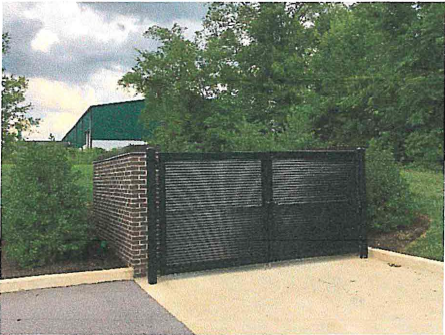 | This image demonstrates how dumpster enclosures can be constructed of high quality materials and provide a completely opaque screen to a height above the dumpsters or recycling containers. |
7.
The Planning Commission may waive any of these design requirements upon showing by the developer/applicant alternative methods of design, if deemed acceptable.
v.
Outdoor decorative trash receptacles. Outdoor trash receptacles shall be required for all multi-family developments, with the exception of those developments that have received site plan approval prior to the enactment of this ordinance.
In addition, outdoor trash receptacles shall comply with the criteria listed, as follows:
a)
Locations.
1)
For multi-family developments, a minimum of one decorative trash receptacle shall be located at each entrance and exit of all amenity centers and/or club houses, a minimum of one within the location of a swimming pool (if proposed), and a minimum of one at all grilling/picnic locations.
2)
The location of all trash receptacles shall not interfere with accessible paths of travel or accessible parking as required by the Americans with Disabilities Act of 1990, as amended or emergency exits.
b)
Design.
All multi-family site plans shall show the proposed design, size, typical elevation and location for each decorative trash receptacle on the plan.
The design of the trash receptacle shall be made of black powdered coated steel, have a minimum capacity of a 36-gallon container and shall be of a strap-type design. (A typical design is shown in illustration 5.1 below for example only).
Illustration 5.1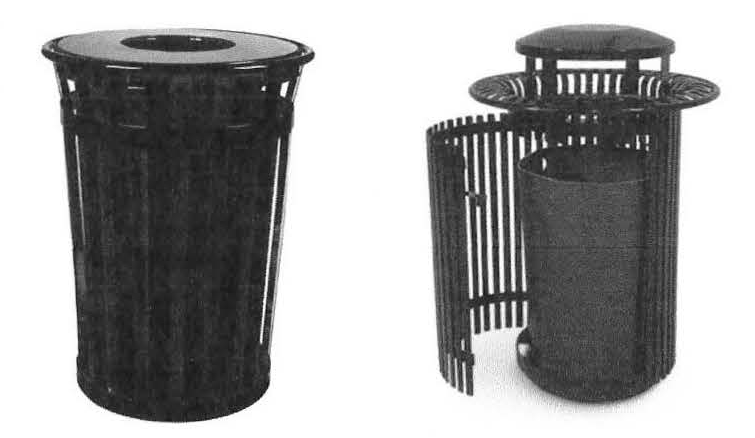
vi.
Streetlights and area lights, lighting the entire development.
f.
All private drives, parking areas or other vehicular ways used for the common access for two or more residences shall be suitably paved and maintained as a condition of approval of the project.
g.
All dwelling units shall be positioned so as to ensure the availability of adequate fire protection. All buildings shall have a fire hydrant located within 150 feet of the furthermost point of each dwelling unit. A minimum flow of 2,500 gallons per minute (gpm) for a one hour duration with a residual pressure of 20 pounds per square inch (psi) shall be available to all dwellings. As an alternative to upgrading water mains to fully meet these flow standards, multifamily dwellings may be provided internal protection in the form of sprinkling systems. In the event such systems are provided, the required fire flow may be reduced by 50 percent from that required without such systems.
h.
Every building utilized for multifamily dwellings shall be accessible to fire apparatus by way of access roadways with all-weather driving surfaces of not less than 20 feet of unobstructed width, with adequate roadway turning radius capable of supporting the imposed loads of fire apparatus and having a minimum vertical clearance of 13 feet six inches. The required width of the access roadway shall not be obstructed in any manner, including the parking of vehicles. "No Parking" signs or other appropriate notice, or approved obstructions inhibiting parking, may be required and if installed shall be maintained. No barriers may be placed within the development which would prevent emergency vehicles from pulling around or between buildings.
5.
Required improvements. The following shall be required:
a.
Internal streets.
i.
In general, internal drives or travelways located within any multifamily development shall be privately constructed and maintained.
ii.
The pavement width and geometric design standards of all internal drives or travelways located within any multifamily development shall be as specified within the subdivision regulations. In any instance where an internal travelway is proposed for dedication as a public street, the pavement design shall meet or exceed that required in the subdivision regulations.
b.
Public street access.
i.
The minimum distance between access points along public street frontage, measured centerline to centerline shall be 200 feet.
ii.
The minimum distance between the centerline of an access point and the nearest curbline or street line of a public street intersection shall be 100 feet.
c.
Storage of waste. All refuse disposal areas shall be maintained in such manner as to meet County and City health requirements and shall be screened from view.
d.
Sanitary sewage requirements. All development projects approved under this section shall be served by public sanitary sewage systems that meet the standards of the Tennessee Department of Environment and Conservation.
e.
Water metering requirements. Each dwelling unit, within any multifamily development, shall have an individual water meter.
f.
Utilities requirement. All cables serving electrical, telephone, television and street lighting shall be placed under ground.
g.
Mail delivery. All multifamily complexes shall develop a plan for mail delivery which meets the criteria developed by the local post office. This plan shall be presented with the master development plan.
6.
Parking space and traffic circulation requirements.
a.
Two off-street parking spaces shall be provided for each dwelling unit.
b.
Off-street parking may be grouped in bays, either adjacent to streets or in the interior of blocks. Such parking areas shall be generally located in close proximity to the dwelling units they are designed to serve. At least one parking space per dwelling unit shall be located so as to provide a maximum walking distance of 200 feet from the nearest entrance of the dwelling unit such space is to serve. Where appropriate, common driveways, parking areas, walks and steps shall be maintained and lighted for night use. Screening of parking and service areas shall be achieved through ample use of trees, shrubs, hedges and screening walls.
c.
Each building shall be physically separated from the highway or street by a curb or planting strip at least eight feet wide against unchanneled motor ingress and egress. The complex shall have not more than two accessways to any highway or street without special approval by the Planning Commission.
7.
Open space requirements. Any common open space provided within a development of multifamily dwellings shall:
a.
Meet the requirements for quality and improvement established in article VIII, subpart [subsection] 8-204.1.
b.
Be protected by covenants as outlined in article VIII, subpart [subsection] 8-204.4, which will ensure the improvement and continued maintenance of all such properties.
c.
Serve as recreational area and open space only.
8.
Permitted density. The density or number of dwelling units permitted within a given area, shall be computed utilizing the development area per dwelling unit for the district wherein the multifamily dwellings are to be located. In any instance where a particular development is located in more than one district, the density shall be separately computed for each district and no density may be transferred between districts.
9.
Yard and building spacing requirements. Within any development approved under the provisions of this section, the following yard requirements shall apply:
a.
For units located entirely within the interior of the site no yards as such are required, however, buildings shall be spaced so that the minimum distance between such buildings shall be the greater of 30 feet or the separation required by adopted building and fire codes.
b.
All buildings located along the periphery of the site shall be set back as provided in article V, subsection 5-103.5, subpart 6.h, Special yards and setbacks along district boundaries.
(Ord. No. 2016-40, § 1, 8-8-2016; Ord. No. 2018-43, § 1, 11-26-18)
5-104.2 Development standards for manufactured home developments.
1.
Purpose. The regulations contained herein are intended to apply to all manufactured home developments as defined by this ordinance. Provided, however, in any instance, where such developments involve subdivision of land and sale of lots or land space for placing of manufactured homes such developments shall be reviewed and approved under the provisions for planned unit developments (see article VIII).
2.
Master site development plan required. It is the express purpose of these provisions to establish design criteria and to provide for implementation of these provisions by Planning Commission review of the master development plan required for all such development by article XIV, subsection 14-103.2. Provided, however, that in any instance where this use is located within a planned unit development this requirement may be fulfilled by submission of the plans required by that section.
3.
Design criteria, general.
a.
No part of a manufactured home development shall be used for nonresidential purposes, except such uses as are required for the direct servicing and well-being of residents and for the management and maintenance of the development.
b.
Nothing contained in this section shall be deemed as prohibiting the sale of a manufactured home or of the site or lot on which such dwelling is located, provided that all provisions of this ordinance pertaining to such use are met.
c.
A fence at least six feet in height shall enclose the boundary of each manufactured home development site. A detail of the proposed fence is to be presented with the site development plan. The aesthetic and protective nature of the proposed fence shall be considered an integral element of the overall site design and shall be reviewed as part of the design review process. Where in the judgment of the Planning Commission alternative measures such as landscaping or placing of berms are found to provide equal or superior protection, these measures may be substituted for the fence.
d.
The appearance and character of the site shall be preserved and enhanced by retaining and protecting existing trees and other site features to the maximum extent feasible. Prior to any site clearing or development activity the developer shall submit a landscape plan along with the site development plan. Where necessary to provide both internal and external privacy and to screen out objectionable features such as noise or automobile lights, additional new plant material shall be added.
e.
Existing trees, shrubs, evergreens and ground cover shall be retained to the extent that they enhance the project, are effective as a screen planting or are useful in protecting slopes from erosion.
4.
Minimum development size and density permitted. No manufactured home development shall be approved which contains less than five acres in area or has less than ten manufactured home spaces.
The maximum density permitted within any manufactured home development shall be as provided in table 5.103A.
5.
Dimensional requirements for parks.
a.
Buffer yards and setbacks meeting the requirements of article V, subsection 5-103.5, subpart 6.h, shall be provided along the periphery of all manufactured home developments in addition to yards required for individual manufactured homes.
b.
Within the interior portions of the manufactured home development, no yards, except as required to meet the spacing standards of subpart 6, Spacing of manufactured homes and site coverage, of this section are required.
c.
No building or structure erected or stationed in a manufactured home park shall have a height greater than two stories or 30 feet.
6.
Spacing of manufactured homes and site coverage.
a.
Manufactured homes shall be so harbored on each space such that there shall be at least a 20-foot clearance between manufactured homes; for manufactured homes parked end-to-end, the end-to-end clearance may be less than 20 feet, but not less than 15 feet. No manufactured home shall be located closer than 20 feet from any building within the park.
b.
There shall be a minimum distance of ten feet between the nearest edge of any manufactured home and an abutting access street.
c.
No manufactured home stand shall occupy an area in excess of 25 percent of the respective lot area. The total area occupied by the manufactured home and its accessory structures shall not exceed 50 percent of the respective lot area.
7.
The manufactured home lot.
a.
The limits of each manufactured home lot shall be marked on the ground by suitable means. Location of lot limits on the ground shall be the same as shown on accepted plans. The minimum area of a manufactured home lot shall be 5,000 square feet or the area required to meet other provisions of this section.
b.
The manufactured home stands shall be improved to provide adequate support for the placement and tie-down of the manufactured home.
c.
Each manufactured home lot shall be provided with an outdoor living and service area. Such area shall be improved as necessary to ensure reasonable privacy and comfort. The minimum outdoor living area shall not be less than 200 square feet of contiguous area.
d.
Tenant storage shall be provided for each manufactured home, either on the individual lot or site of the dwelling or in a centralized storage facility.
e.
Manufactured homes shall be anchored and supported so as to meet or exceed the standards established in Part 4, Manufactured Home Anchoring, of section 68-126, Tennessee Code.
8.
Utilities and other services. The following shall be required:
a.
Internal streets.
i.
In general, internal drives or travelways located within any manufactured home development shall be privately constructed and maintained.
ii.
The pavement width and geometric design standards of all internal drives or travelways located within any manufactured home development shall be as specified within the subdivision regulations. In any instance where an internal travelway is proposed for dedication as a public street, the pavement design shall meet or exceed that required in the subdivision regulations.
b.
Public street access.
i.
The minimum distance between access points along public street frontage, measured centerline to centerline shall be 200 feet.
ii.
The minimum distance between the centerline of an access point and the nearest curbline or street line of a public street intersection shall be 100 feet.
c.
Emergency access. Every manufactured home or building located within a manufactured home development shall be accessible to fire apparatus by way of access roadways with all-weather driving surfaces of not less than 20 feet of unobstructed width, with adequate roadway turning radius capable of supporting the imposed loads of fire apparatus and having a minimum vertical clearance of 13 feet six inches. The required width of the access roadway shall not be obstructed in any manner, including the parking of vehicles. "No Parking" signs or other appropriate notice, or approved obstructions inhibiting parking, may be required and if installed shall be maintained. No barriers may be placed within the development which would prevent emergency vehicles from pulling around or between buildings.
d.
Storage of waste. Centralized refuse disposal facilities shall be provided. All dumping cart/bins shall be opaquely screened by either wood or masonry and landscaped.
e.
Service buildings. Service buildings housing laundry, sanitation or other facilities for use by the occupants shall be permanent structures complying with the applicable codes.
f.
Water requirements. Each manufactured home site shall be provided with a connection to a public water supply on trunk lines not less than six inches in diameter. Each dwelling unit, within any manufactured home development, shall have an individual dwelling unit water meter.
g.
Fire hydrant requirements. Each manufactured home development shall be equipped with fire hydrants capable of providing required fire flow. Hydrants shall be spaced so that the farthest point of any manufactured home, measured by the most directly accessible route, is no more than 400 feet from a hydrant.
h.
Sanitary sewer requirements. Each manufactured home site shall be provided with a connection to a public sanitary sewer line.
i.
Utilities requirement. All cables serving electrical, telephone, television and street lighting shall be placed under ground.
j.
Mail delivery. All manufactured home complexes shall develop a plan for mail delivery which meets the criteria developed by the local post office. This plan shall be presented with the master development plan.
9.
Parking space and traffic circulation requirements.
a.
Two off-street parking spaces shall be provided for each manufactured home.
b.
Off-street parking may be grouped in bays, either adjacent to streets or in the interior of blocks. Such parking areas shall be located in close proximity to the dwelling units they are designed to serve. At least, one parking space per dwelling unit shall be located so as to provide a maximum walking distance of 200 feet from the nearest entrance of the dwelling unit it is to serve. Where appropriate, common driveways, parking areas, walks and steps shall be maintained and lighted for night use. Screening of parking and service areas shall be achieved through ample use of trees, shrubs, hedges and screening walls.
c.
All private drives, parking areas or other vehicular ways used as a common access for two or more residences shall be suitably paved and maintained as a condition approval of the project.
d.
Paved pedestrian walkways shall be provided for convenient and safe access to all living units and recreational facilities from the streets, driveways, parking courts or garages and for convenient circulation and access to all facilities.
10.
Recreation facilities. An adequate amenity package for occupants of the manufactured home development shall be provided. The amenity package shall as a minimum include the following:
a.
Play lots and/or playgrounds with a total minimum area of 200 square feet per manufactured home dwelling. These areas shall be provided with playground equipment sufficient to meet the needs of children expected to reside within the complex. Individual pieces of playground equipment shall be specified on the site plan. All recreational equipment provided shall be durable commercial grade equipment which shall meet all Consumer Product Safety Commission Safety Guidelines, as well as, the ASTM F1487-93, Public Use Playground Standard. The playground shall be served by paved pedestrian walks linking individual dwellings to the recreational facility. Additional sitting areas may be substituted for playgrounds on a square foot for square foot basis when the development is planned for occupancy only by elderly adults.
b.
Clubhouse facilities shall be located within the development. A minimum floor area of 2,000 square feet shall be required for any development. In developments containing 200 or more dwelling units ten square feet of additional floor area shall be provided for each unit thereafter.
c.
All multifamily complexes containing 100 or more dwelling units shall provide swimming pool facilities for the residents.
5-104.3 Variable lot residential development. The purpose of this section is to provide a permissive voluntary alternative procedure to be utilized in placement of buildings and in location of open spaces associated therewith. These provisions are intended to provide for variations in lot size and open space requirements within the residential districts. The density standards established for individual districts are to be maintained on an overall basis and thereby provide desirable and proper open air space, tree cover, recreation areas or scenic vistas; all with the intent of preserving the natural beauty and environmental integrity of the area, while at the same time maintaining the necessary maximum population density limitations of the base zoning districts.
1.
General provisions. The provisions contained within this section are intended to provide a flexible procedure for locating dwellings upon sites. As such, the provisions do not constitute a use but an alternative procedure for the spacing of buildings and the use of open areas surrounding those buildings. It is necessary, however, that the purposes and intent of this ordinance be ensured and that proper light, air and privacy be made available for each dwelling unit. The master site development plan required in subpart 2 of this section, is intended to provide not only an accurate statement of the development scheme proposed for each such development but an enforceable legal instrument whereby the Planning Commission may be ensured that the general purposes, standards, etc., contained in this ordinance are being met.
2.
Master site development plan required.
a.
Contents. A master site development plan containing the information required by the provisions of article XIV, subsection 14-103.2, shall be prepared and submitted to the Planning Commission for review and approval along with a sketch plat as required by the subdivision regulations. In addition to the information required to meet the provisions of subsection 14-103.2, the master development plan shall show:
i.
Topographic features, both existing and proposed, with contours of not more than two-foot intervals where slopes average 12 percent or less and five-foot intervals in areas where slopes are greater than 12 percent.
ii.
Location of any open space that is proposed to be held in common ownership.
iii.
Proposed ground coverage, floor area and heights of all buildings.
iv.
Where any lot or roadway is proposed for location upon any portion of the site where the natural topography exceeds 12 percent such alteration shall be evaluated by a licensed geotechnical engineer and a report of findings and recommendations submitted with the plan of development.
b.
Coordinated review. Upon receipt of a master site development plan and sketch plat containing information as required above, the Planning Commission may:
i.
Concurrently review the site development plan and sketch plat;
ii.
Jointly approve, approve with modification, or disapprove these documents; and
iii.
In the instance of approval, or approval with modification, transfer the site development plan to the Zoning Administrator for enforcement.
c.
Enforcement. Upon approval of a master site development plan, the Zoning Administrator shall note the boundary and extent of such development upon the official zoning map and shall become responsible for enforcement of the plan. Only minimal adjustments involving the placement of any structure will be permitted once a site development plan has been approved. Any other change shall require submission of a proposed amendment to the approved plan.
3.
Development standards. The following standards and requirements shall apply to all developments subject to the provisions of this section:
a.
General standards for development. In the interest of promoting the most appropriate and economical use of the land while assuring that the character of the residential district is maintained, the Planning Commission in its review of a proposed development shall consider the following:
i.
Protection of the character, property values, privacy and other characteristics of the surrounding neighborhood;
ii.
Provision for surface drainage control, sewage disposal and water supply, recreation and traffic control; and
iii.
Preservation and protection of existing trees, ground cover, top soil, streams, rock outcroppings and scenic or historic sites from dangers and damage caused by excessive and poorly planned grading for streets and building sites.
b.
Availability of public utilities. Generally all public utilities, specifically including water and a central sewage collection and treatment system shall be available at the site. Where public sewer is not available, no lot or housing site may be created which has less area than the greater of, 30,000 square feet or that required to meet standards of the County Department of Environment and Conservation. All septic fields for each dwelling unit shall be located within the area of fee simple ownership of said dwelling unit.
c.
Permitted density. The density permitted is intended to be consistent with that allowed within conventional developments offering no common open space. The maximum number of dwelling units permitted shall be computed as follows:
i.
From the gross acreage available within the development shall be subtracted: any portion of the site where the full use of the land is not available to the landowner because of restrictions thereon; specifically including any portion of the site which lies within a floodway district.
ii.
The area remaining after the above adjustments shall be divided by the minimum lot area per family for the applicable dwelling unit type and zone district in which the dwelling unit is located. For developments located in more than one zoning district, the density shall be computed separately for that portion of the development lying within each district. No developmental density may be transferred across zoning district boundaries.
d.
Minimum lot area. Within all developments approved under the provisions of this section the minimum area of lots designated as residential building sites shall be as follows:
i.
Lots served by public sewer. The minimum size of lots served by public sewer shall be as indicated in table 5-104.3a.
ii.
Lots served by on-site sewage disposal systems. The minimum size of lots served by on-site sewage disposal systems shall be the greater of, 30,000 square feet or the area required to meet standards of the County Department of Environment and Conservation.
e.
Lot width and yard requirements. Within any development approved under the provisions of this section the following yard requirements shall apply:
i.
Lots adjacent to conventional residential development. All lots located along the periphery of a development site adjacent to or directly across a street from existing conventional residential lots shall have minimum width, measured at the setback line, equal to 90 percent of the width required by the basic provisions established for the district within which the development is located. Such lots shall contain at least 80 percent of the minimum lot area required by the basic provisions established for the district within which the development is located.
ii.
All other lots. The provisions for spacing of buildings set forth in subpart f (below) shall apply to all buildings and structures approved under the provisions of this section.
f.
Building spacing. The minimum space between any two buildings shall be the greater of that required to meet the minimum distances established in table 5-104.3a, or the separation required by adopted building and fire codes.
g.
Lot coverage. Lot coverage shall not exceed the [following] maximum building envelope standards in table 5-104.3a:
h.
Access to dwellings. Access and circulation shall adequately provide for firefighting, other emergency equipment, service deliveries, furniture moving vans and refuse collection.
i.
Pedestrian circulation. The pedestrian circulation system and its related walkways shall be insulated as completely as possible from the street system in order to provide separation of pedestrian underpasses or overpasses in the vicinity of schools, playgrounds, local shopping areas and other neighborhood uses which generate a considerable amount of pedestrian traffic.
4.
Environmental protection. The following provisions shall apply within all developments approved under the authority of this section:
a.
Tree preservation. All trees six inches or greater in caliper shall be inventoried and a plan for tree protection meeting the requirements of article X, established.
b.
Slope protection. It shall be the general policy of the Planning Commission to discourage alteration of slopes where the natural topography exceeds 15 percent. In particular, toe cuts along the base of such slopes shall be avoided. In any instance where either roads or building sites are proposed upon slopes exceeding 15 percent, any and all alterations shall be evaluated by a licensed geotechnical engineer and the proposed construction activity certified as stable prior to any clearing or excavation.
c.
Siltation and erosion control. A plan of siltation and erosion control shall be approved for all developments subject to the provisions of this section. Such plan shall be instituted at the time construction activity or land alteration is begun and shall remain in effective operation throughout the entire period when land development is taking place.
No portion of any lot proposed as a building site may lie within any area subject to the floodplain protection provisions of this ordinance.
5.
Open space requirements. Common open space provided within any development approved under authority of this section shall:
a.
Meet the requirements for quality and improvement established in article VIII, subpart [subsection] 8-204.1.
b.
Be protected by covenants as outlined in article VIII, subpart [subsection] 8-204.4, which will ensure the improvement and continued maintenance of all such properties.
c.
Serve as recreational area and open space only.
d.
Be transferred to a private maintenance trust at a time and in the manner specified by the Planning Commission as a condition of approval of the project.
5-104.4 Development standards for single-family residential.
1.
The front facade and any other facade shall contain 100 percent brick and/or stone. All percentages are calculated based on the wall surface area and do not include areas used for windows, doors, and fascias. In enforcing this requirement, the Regional Planning Commission may permit any other construction materials allowed under state law. In determining whether to allow such materials, the City may consider whether the material is proposed as an accent, as a portion of a corporate motif, as well as whether the design is in line with general aesthetic goals of the City of Mt. Juliet as set forth herein, and any other factors deemed relevant by the applicant.
2.
Trim, eaves, and soffits may incorporate the use of vinyl, aluminum and other materials approved by the International Residential Code as adopted.
3.
Approved roof materials include: concrete or terra cotta tile, asphalt shingles, and standing seam metal roofing. Shingles shall be fungus resistant.
4.
No tract home or custom home may be built adjacent to or across from a home with the identical elevation. Dwellings constructed next to or across from another dwelling shall include a variety of architectural elements that can include the following: differences in roof lines, the shape, design and size of windows and doors (including garage doors), shutters, materials, colors, and porches. Tract home builders/developments shall provide a minimum of four floor plans with a minimum of three elevations each.
5.
A minimum of 22 feet of driveway depth shall be provided between a garage door and a sidewalk or public path.
6.
No wall or window mounted air conditioning or heating units may be installed or placed in a front or street facing facade (excluding alleys). Such units may be located in a side or rear facade not adjacent to a street.
7.
Covered front porches are recommended for dwellings, and where provided, a minimum depth of six feet and area of 120 [square feet] is recommended.
8.
Rear porches or patios are recommended for dwellings, and where provided, a minimum of 200 square feet is recommended. These areas, whether proposed to be covered or not, shall be planned so as to comply with rear setback requirements
9.
Mechanical equipment shall not be roof-mounted, but may be on the ground, within attic space or other location screened from public view.
10.
All homes shall contain a minimum of a two-car garage. Side, rear or alley-loaded garages are recommended.
a.
Arterials and collectors: When fronting an arterial or collector street, garages and driveways shall be restricted to alleys, side-streets, or other approved combined access drives. In no case shall a garage be street-facing other than to the side street.
b.
Access streets: When fronting an access street, garages and driveways shall be restricted to side-, rear-, or alley-loaded. In no case shall a garage be street-facing other than to the side-street.
c.
Access lanes: Street-facing garages will only be acceptable on access lanes if they incorporate the following features: Ten feet minimum set back from the front of the home including the front porch if applicable and two garage doors separated by a two-foot minimum brick or stone column.
11.
Street-facing garages shall include a double-wide driveway (minimum 18 feet wide). Driveway approaches connecting to side loaded garages may be less than 18 feet wide if proper maneuvering space is provided. The interior width of a two-car garage shall contain a minimum clear space of 20 feet and contain a minimum of 440 square feet. No stairs, water heaters or other fixed items may encroach into this space.
12.
Alley-loaded garages shall be located so that parked vehicles do not encroach into the alley. The garage shall be a minimum of 20 feet from the edge of the alley pavement, or five feet from the edge of the alley pavement with a ten feet by 20 feet parking pad adjacent to the garage.
13.
For narrow lot developments, which are defined as those subdivisions having an average lot width less than or equal to 60 feet; the following shall apply.
a.
Rear loaded garages should be considered to avoid a "snout house" appearance.
b.
Street facing garage facades (excluding the wall frame) shall not exceed 40 percent of the area of the front wall facade of the first floor.
c.
The 40 percent requirement only applies to the doors of the garage and does not apply to the two feet column separating multiple garage doors as mentioned above in item 10.
14.
A plan for the planting and/or the preservation of trees shall be required for all new subdivisions. Said plan shall accompany a request for preliminary plat approval and address the following items. The plan shall be approved by the Regional Planning Commission prior to, or with preliminary plat approval.
a.
A minimum of one tree shall be planted or preserved per lot and may be planted or preserved in the front yard of each lot, within the private or public right-of-way as a street tree, or elsewhere as approved by the Regional Planning Commission.
b.
The City of Mt. Juliet encourages the preservation of existing trees as a means of compliance with the requirements of paragraph "a" above.
c.
The planting species and location for new vegetation shall be selected to avoid conflicts with vehicle and pedestrian movements. More than one species shall be used to avoid adverse impacts from disease or pests.
15.
Except for temporary purposes, motor vehicles shall be parked on paved surfaces. No more than 50 percent of any front yard may be paved or used for motor vehicle parking except that courtyard style garages and associated driveways will not count toward this 50 percent.
16.
Regarding foundations, the finished floor elevation at the front facade shall be located above grade in accordance with the following standards:
a.
For setbacks of ten feet or more, the finished floor elevation of the front facade shall be a minimum of 18 inches above grade; and
b.
For setbacks of less than ten feet, the finished floor elevation of the front facade shall be a minimum of 24 inches above grade.
c.
Exposed foundation walls or piers shall be clad in face brick or stone. Exposed smooth-faced standard concrete block is prohibited.
Nothing in this subsection shall prevent the use of slab foundations, provided:
d.
The outer edge of the slab is clad in the materials required in this subsection;
e.
It extends to the minimum height above grade, except that this provision may be waived for age restricted developments serving a senior adult population of age 55 and over.
17.
Outdoor decorative trash receptacles. Outdoor trash receptacles shall be required for all amenity centers and/or club houses within single family residential developments, with the exception of those developments that have received approval prior to the enactment of this ordinance.
In addition, outdoor trash receptacles shall comply with the criteria listed, as follows:
a.
Locations.
i.
A minimum of one decorative trash receptacle shall be located at each entrance and exit of all amenity centers and/or club houses, a minimum of one within the location of a swimming pool (if proposed), and a minimum of one at all grilling/picnic locations.
ii.
The location of all trash receptacles shall not interfere with accessible paths of travel or accessible parking as required by the Americans with Disabilities Act of 1990, as amended or emergency exits.
b.
Design. All multi-family site plans shall show the proposed design, size, typical elevation and location for each decorative trash receptacle on the plan.
The design of the trash receptacle shall be made of black powdered coated steel, have a minimum capacity of a 36-gallon container and shall be of a strap-type design. (A typical design is shown in illustration 5.2 below for example only).
Illustration 5.2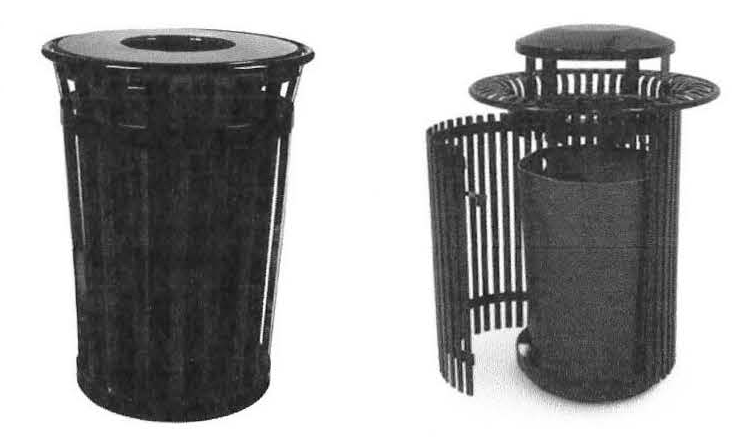
18.
Regarding certain streetscape elements, all traffic poles and traffic sign posts shall be black or dark green in color. All street signs shall be erected with a decorative sign post, a decorative base and a decorative finial that extends beyond the top of the standard sign. All traffic signs shall be of pedestrian-scale ornamental design. Exposed metal poles are strictly prohibited unless entirely enclosed with a brick or stone veneer.
19.
Play lots and/or playgrounds shall be provided per the following, based on the number of homes in the subdivision:
a.
Up to 100 homes: 3,200 square feet.
b.
101 to 200 homes: 6,400 square feet total over two locations (3,200 square feet each).
c.
201 to 400 homes: 9,600 square feet total over two locations (4,800 square feet each).
d.
More than 400 homes: PC to determine.
These areas shall be provided with playground equipment sufficient to meet the needs of children expected to reside within the complex. Individual pieces of playground equipment shall be specified on the site plan. All recreational equipment provided shall be durable commercial grade equipment which shall meet all Consumer Product Safety Commission safety guidelines as well as the ASTM F1487-93, public use playground standard. The playground shall be served by paved pedestrian walks linking individual buildings to the recreational facility. Additional sitting areas may be substituted for playgrounds on a square foot for square foot basis when the development is planned for occupancy only by elderly adults.
20.
Streetlights and area lights, lighting the development, shall be provided per the requirements below:
a.
Decorative poles shall be required and shall be a neutral color: black, gray, dark brown, bronze, dark green or similar.
b.
Decorative fixtures shall be used.
c.
Details of the pole and fixtures shall be provided with final master development plans and preliminary plats.
d.
All poles and fixtures shall be installed per the requirements of the local electric utility providers streetlight manual.
(Ord. No. 2001-34, 10-22-2001; Ord. No. 2003-40, 9-8-2003; Ord. No. 2005-05, 3-14-2005; Ord. No. 2005-35, 12-12-2005; Ord. No. 2006-04, 2-6-2006; Ord. of 10-23-2009, § 5-102; Ord. No. 2015-34, § 1(Att.), 8-24-2015; Ord. No. 2016-40, § 2, 8-8-2016; Ord. No. 2017-43, § 1, 7-10-2017; Ord. No. 2021-42, Exh. A, 10-25-2021; Ord. No. 2025-24, 6-9-2025)

