
Mount Juliet City Zoning Code
ARTICLE II
CONSTRUCTION OF LANGUAGE AND DEFINITIONS
Sec. 2-101.- Rules for construction of language.
In the construction of this ordinance, the rules and definitions contained in this article shall be observed and applied, except when the context clearly indicates otherwise:
A.
The particular shall control the general.
B.
The word "shall" is always mandatory and not discretionary.
C.
The word "may" is permissive.
D.
The word "lot" shall include the words "piece" or "parcel."
E.
The word "structure" includes all other structures, or parts thereof, of every kind regardless of similarity to buildings; and the phrase "used for" shall include the phrases "arranged for," "designed for," "intended for," "maintained for," and "occupied for."
F.
In the case of any difference of meaning or implication between the text of this ordinance and any caption, illustration or table, the text shall control.
G.
The word "permitted" or words "permitted as of right," means permitted without meeting the requirements for a conditional use permit.
H.
The words "permitted with supplemental provisions" mean an activity, use or structure is permitted subject to a finding by the zoning administrator that the specific standards indicated for the use in question have been met.
I.
The words "conditionally permitted" or "permitted by conditional use permit" mean permitted subject to the requirements for a conditional use by special permit pursuant to article XIV, section 14-106, Conditional use permits of this ordinance, and all other applicable provisions.
J.
Words used in the present tense shall include the future, and words used in the singular include the plural and the plural the singular, unless the context clearly indicates the contrary.
K.
Unless the context clearly indicates to the contrary, conjunctions shall be interpreted as follows:
"And" indicates that all connected items, conditions, provisions or events shall apply.
"Or" indicates that the connected items, conditions, provisions, or events shall apply.
"Either . . . or" indicates that the connected items, conditions, provisions, or events shall apply singly but not in combination.
L.
All public officials, bodies, and agencies to which reference is made are those of the City of Mt. Juliet, Tennessee.
(Ord. No. 2009-01, 1-12-2009; Ord. of 10-23-2009, § 2-101)
Sec. 2-102. - General definitions.
2-102.1 Application. Except where definitions are specifically included in various articles and sections, words in the text or tables of this ordinance shall be interpreted in accordance with the provisions set forth in this section. Where words have not been defined, the standard dictionary definition shall prevail.
2-102.2 Terms Defined.
Abutting [means] having a common border with, or being separated from such a common border by a right-of-way or easement.
Accessory [means] an activity or structure that is customarily associated with and is appropriate incidental and subordinate to a principal activity and/or structure and located on the same zone lot, except as provided for under the provisions for accessory off-street parking.
Accessory apartment [means] a temporary accessory dwelling unit located in a one-family residence that is subordinate to the principal one-family dwelling in terms of size and appearance and which apartment does not substantially alter the character and appearance of the residential structure or its conformity with the character of the neighborhood. All accessory apartments are subject to the specific standards set forth in article III, section 3-105.1.
Activity [means] the performance of a function or operation which constitutes the use of land.
Activity-principal. (See Principal activity.)
Actual construction [means] the excavation of a site and/or the placement of building materials in conjunction with the construction of a building or other structure.
Adult entertainment business [means] a commercial enterprise that offers as a substantial portion of its stock in trade sexually oriented material, devices, or paraphernalia or specified sexual activities or any combination or form thereof, whether printed, filmed, recorded or live and which restricts or purports to restrict admission to adults or to any class of adults; or a business establishment advertising and offering for sale and/or rental adult clothing, lingerie, toys, or novelty items; or any tattoo and/or body-piercing establishment. "Adult entertainment business" includes, but is not limited to:
(A)
"Adult book stores" which means any corporation, partnership or business of any kind which has a substantial portion of its stock in trade; books, videos, movies, magazines or other periodicals and which offers, sells or rents for a fee:
(1)
Any sexually oriented material which is available for viewing by patrons on the premises by means of the operation of movie machines, electronic and digital devices, or slide projectors; or
(2)
Any sexually oriented material which has a substantial portion of its contents devoted to the pictorial depiction of sadism, masochism or bestiality; or
(3)
Any sexually oriented material which has as its principal theme the depiction of sexual activity by, or lascivious exhibition of, the uncovered genitals, pubic region or buttocks of children who are or appear to be under 18 years of age;
(B)
"Adult motion picture theaters" which means an enclosed building used for presenting films which are distinguished by an emphasis on matter depicting, describing or relating to specified sexual activities for observation by patrons therein; and
(C)
"Adult shows" or "adult peep shows" which includes all adult shows, exhibitions, performances or presentations which contain acts or depictions of specified sexual activities.
(D)
"Adult stores" offering a substantial portion of their stock in trade, the sale of 'adult' clothing, lingerie, toys, or novelty items with a sexual theme or nature.
(E)
"Tattoo and body piercing establishments" offering skin-penetrating adornment procedures as regulated by the State of Tennessee.
(F)
"Adult club" includes establishments (regardless of whether the establishment identifies itself as a "private club," "adult club," "late night club," etc.) whose purpose is to allow for the viewing and/or engaging in of live sexual acts distinguished by an emphasis on matter depicting, describing or relating to specified sexual activities, including "adult entertainment" as defined in TCA § 7-51-1401.
Alley [means] a public way intended to provide only secondary vehicular access to abutting properties.
Apartment hotel. (See Lodginghouse.)
Attached [means] an enclosure having continuing walls, roof and floor.
Building [means] any structure which:
(A)
Is permanently affixed to the land;
(B)
Has a roof supported by columns or walls;
(C)
Is intended for the shelter or enclosure of goods or persons; and
(D)
Is bounded by either open area or the lot lines of a zone lot.
A building shall not include such structures as billboards, fences, radio or TV towers, or structures not normally accessible for human use, such as gas storage tanks, smoke stacks, grain elevators, exposed industrial equipment (i.e., oil or chemical processing apparatus) or similar structures.
Building, principal. (See Principal building.)
Bulk describes the size of buildings or other structures, and their relationship to each other and to open areas and lot lines, and therefore includes:
(A)
The size (including height and floor area) of buildings or other structures;
(B)
The area of the zoning lot upon which a residential building is located, and the number of dwelling units within such buildings in relation to the area of the zoning lot;
(C)
The location of exterior walls of buildings or other structures in relation to lot lines, other walls of the same building, legally required windows, or other structures; and
(D)
All open areas relating to buildings or other structures and their relationship thereto.
Central sewage collection and treatment system [means] a wastewater collection and/or treatment system owned and operated by a public or quasi-public organization and approved by all appropriate licensing and oversight agencies. This term shall not be construed to include any type of privately owned and operated individual disposal system to include septic or other similar systems.
Child care [means] the provision of supplemental parental care and supervision:
(A)
For a nonrelated child or children;
(B)
On a regular basis;
(C)
For less than 24 hours a day; and
(D)
Under license issued by the Tennessee Department of Human Services.
As used in this ordinance, the term is not intended to include babysitting services of a casual, nonrecurring nature or in a child's own home. Likewise, the term is not intended to include cooperative reciprocative child care by a group of parents, in their domiciles or the keeping of four or less preteenage children, which is an activity regulated as a minor home occupation by this ordinance and requires no licensing by the State of Tennessee.
Commercial complex [means] a commercial complex shall mean:
(A)
Two or more buildings proposed for occupancy by commercial activities constructed or to be constructed upon one zone lot; or
(B)
Two or more principal commercial uses or occupancies located upon one zone lot.
Common open space [means] a parcel or parcels of land and/or an area of water within the site designated, designed and intended for use or enjoyment of the occupants of said development. "Common open space" may contain such complementary structures and improvements as necessary and appropriate for the benefit and enjoyment of the occupants of such development.
Completely enclosed refers to a building or other structure having a roof, and separated on all sides from the adjacent open area or from other buildings or other structures, by exterior walls or party walls, pierced only by windows or entrance and exit doors normally provided for persons, goods or vehicles.
Conditional use [means] a conditional use is a use that would not be appropriate generally or without restriction throughout the zoning district but which, if controlled as to number, area, location, or relation to the neighborhood, would promote the public health, safety, welfare, morals, order, comfort, convenience, appearance, prosperity, or general welfare. Such uses may be permitted in such zoning districts as conditional uses, only when specific provisions for such use is made in this ordinance. For the purposes of administration of this ordinance, conditional uses shall be construed as synonymous with special exceptions, as controlled by section 13-7-206, Tennessee Code.
Curb level [means] the mean of the elevations of the side lot lines extended to the street line.
Curbline [means] the line formed by a curb extending along its roadbed or street bed.
Density [means] the ratio of the number of dwelling units located on a lot to the horizontal area of the lot, expressed in units per acre.
Development [means] any manmade change to improved or unimproved real estate including but not limited to buildings or other structures, mining, dredging, filling, paving, excavating, or drilling operations. Agricultural activities such as plowing or cultivating and gardening activities are not included in this definition of development.
Development area (minimum) [means] the minimum amount of land area required for each dwelling unit located upon a zone lot. The minimum lot size provision shall apply to all lots within the district. However, the minimum development area provision may require a lot larger than the minimum lot size where the intended intensity of use would so require.
Dormitory [means] a facility providing group living quarters for a student body, or other group as an associated use to a college, university, boarding school, orphanage, or other similar use when not located on the same site as the principal associated use. Rooming units are not equipped with kitchen facilities, although one or more dwelling unit may be provided for occupancy by staff. This term is intended to include university dormitories as well as fraternity or sorority houses.
Dwelling [means] a building, or portion thereof, designed or used exclusively for residential occupancy, but not including transient occupancy.
Dwelling unit [means] one or more rooms that are physically arranged, designed, used or intended to create an independent housekeeping establishment for occupancy by one family, and that include lawful cooking space and lawful sanitary facilities reserved for the occupants thereof.
Easement [means] a grant of one or more of the property rights by the owner to, or for use by, the public, a corporation or another person or entity.
Family [means] one of the following:
(A)
An individual, or two or more persons occupying a dwelling unit and living as a single independent, nonprofit housekeeping unit, together with incidental domestic servants and temporary nonpaying guests.
(B)
A group of not more than six unrelated persons living together as a single nonprofit housekeeping unit.
(C)
Four or more persons occupying a dwelling unit and living as a single, nonprofit housekeeping unit, if said occupants are handicapped persons, as defined by Title VIII, of the Civil Rights Act of 1968, as amended by the Fair Housing Amendments Act of 1988. Such unrelated individuals shall have the right to occupy a dwelling unit in the same manner and to the same extent as any family unit as defined herein.
Floods. (See article VIII, section 8-202, for all definitions pertaining to floods and floodplain provisions.)
Funeral homes/funeral parlors means an establishment that is primarily engaged in preparing the dead for burial or interment and conducting funerals (i.e. providing facilities for wakes, arranging transportation for the dead, selling caskets and related merchandise. Other services to include embalming and cremation.
Hazardous occupancy [means] the principal use of a building or structure, or any portion thereof, that involves the manufacture, use or storage of highly combustible, flammable or explosive materials or materials that constitute a high fire hazard and as further defined as a type "H" occupancy in section 407, Standard Building Code.
Home occupation [means] an occupation or business activity which results in a product or service and which: is conducted, in whole or in part, in either the dwelling or an accessory building normally associated with permitted uses; is conducted by at least one family member occupying the residence; and is clearly subordinate to the residential use of the dwelling and premises. Home occupations do not include garage sales, yard sales, Christmas bazaars, or home parties which are held for the purpose of the sale or distribution of goods or services. However, if such sales and/or parties are held more than six times in any calendar year; or operate in excess of 24 cumulative days in a calendar year, such sales and/or parties shall be considered a home occupation.
Incidental alterations [means] modifications to a building or structure that meet the following criteria:
(A)
Changes or replacements in the nonstructural parts of a building or other structure, including but not limited to the following:
(1)
Alteration of interior partitions to improve livability in a nonconforming residential building, provided that no additional dwelling units are created;
(2)
A minor addition to the exterior of a residential building, such as an open porch;
(3)
Alterations of interior non-load-bearing partitions in all other types of buildings or other structures; or
(4)
Replacement of, or minor changes in, capacity of utility pipes, ducts, or conduits.
(B)
Changes or replacements in the structural parts of a building or other structure, limited to the following examples or others of similar character or extent:
(1)
Making windows or doors in exterior walls;
(2)
Replacement of building facades having non-load-bearing capacity; or
(3)
Strengthening the floor load-bearing capacity, in not more than ten percent of the total floor area, to permit the accommodation of specialized machinery or equipment.
Land with minor improvements [means] a tract of land that contains improvements including buildings or other structures having a total assessed valuation of $10,000.00 or less.
Landholder [means] the legal or beneficial owner or owners of all the land proposed to be included in a planned unit development. The holder of an option or contract to purchase, a lessee having a remaining term of not less than 50 years in duration, or other person having an enforceable proprietary interest may be considered a "landholder" for the purpose of this ordinance.
Livestock means cattle, sheep, swine, poultry and other animals or foul, which are being produced primarily for use as food or food products for human consumption or horses.
Lot [means] a tract, plot, or portion of a subdivision or parcel of land intended as a unit for the purpose, whether immediate or future, for transfer of ownership or for building development.
Lot area [means] the horizontal area included within the boundary lines of a lot.
Lot, corner [means] a lot situated at the intersection of two streets.
Lot, interior [means] any lot other than a corner lot.
Lot, through [means] any lot that adjoins two street lines opposite to each other and parallel or within 45 degrees of being parallel to each other. Any portion of a through lot that is not or could not be bounded by two such opposite street lines and two straight lines intersecting such street lines shall be subject to the regulations for an interior lot.
Lot coverage [means] that portion of a zone lot which when viewed directly from above, could be covered by a building or any part of a building.
Lot frontage [means] the front of a lot shall be construed to be the portion nearest the street. For the purposes of determining yard requirements on corner lots and through lots, all sides of a lot adjacent to streets shall be considered frontage, and yards shall be provided as indicated under yards.
Lot line [means] a boundary of a zone lot.
Lot line equivalent [means] a straight line established for the purpose of determining the location and depth or width of a required yard and which either:
(A)
Joins points specified in these regulations; or
(B)
Is an extension of a street line or lot line.
Lot measurements.
(A)
Depth of a lot shall be considered to be the distance between the midpoints of straight lines connecting the foremost points of the side lot lines in the rear.
(B)
Width of a lot shall be considered to be the distance between straight lines connecting front and rear lot lines of each side of the lot, measured across the rear of the required front yard, provided however that width between side lot lines at their foremost points (where they intersect with the street line) shall not be less than 80 percent of the required lot width except in the case of lots on the turning circle of cul-de-sac, where the 80 percent requirements shall not apply.
Lot of record [means] a lot which is part of a subdivision recorded in the Office of the County Recorder, or a lot or parcel described by metes and bounds, the description of which has been so recorded.
Manufactured home. (See Dwelling, manufactured home.)
Manufactured home space [means] a designated area within a manufactured home park for the exclusive use of the occupants of a single home.
Mixed-use development is a kind of urban development, urban design, urban planning and/or a zoning type that blends multiple uses, such as residential, commercial, cultural, institutional, or entertainment, into one space, where those functions are to some degree physically and functionally integrated, and that provides pedestrian connections. Mixed-use development may be applied to a single building, a block or neighborhood, or in zoning policy across an entire city or other administrative unit. These projects may be completed by a private developer, (quasi-) governmental agency, or a combination thereof. A mixed-use development may be a new construction, reuse of an existing building/site or a combination.
Modular home. (See Dwelling, prefabricated.)
Noncomplying [means]:
(A)
Any lot of record which does not contain sufficient lot area to conform to the area requirements for the zoning district in which the lot is located;
(B)
Any lawful building or other structure which does not comply with any one or more of the applicable bulk regulations; or
(C)
Any lawful use other than a nonconforming use, which does not comply with any part or any one or more of the applicable regulations pertaining to:
(a)
Location along a district boundary; or
(b)
Accessory off-street parking and loading either on the effective date of this ordinance or as a result of any subsequent amendment.
Nonconforming sign [means] a lawful sign existing at the effective date of the adoption of this ordinance that does not conform with the provisions of this ordinance.
Nonconforming use [means] a lawful use of a building or other structure other than a sign or of a tract of land which does not conform to any one or more of the applicable use regulations of the district in which it is located, either on the effective date of this ordinance or as a result of any subsequent amendment.
Occupant [means,] for the purposes of this ordinance, an occupant is a single legal entity who holds possession of a property, or portion thereof, and either an owner or a tenant.
Occupancy [means] the principal use of land for the performance of a function or operation by a person, firm, corporation, or association as a single legal entity. For the purposes of this ordinance there shall be only one principal use of land by any one person, firm, corporation, association or legal entity.
Party wall [means] a wall on an interior lot line, used or adopted for joint service between two buildings; such walls shall extend from the foundation to the underside of roof sheathing without openings which would permit the spread of fire from one building to another and shall fully comply with fire and all other provisions and standards established for such walls in the Standard Building Code.
Permanent access easement [means] a perpetual easement guaranteeing right of ingress and egress to and from the premises of a lot owner to a street appurtenant to the land of the owner. Any permanent access easement utilized as the sole means of providing legal access to two or more parcels of land shall be:
(1)
So designed as to ensure continuing adequate ingress and egress for emergency vehicles;
(2)
Ensured adequate continuing maintenance by an owners' association or similar organization; and
(3)
Constructed such that the portion of the permanent access easement intended for ingress and egress complies with the standards of a public street as specified in the subdivision regulations. In any instance where a permanent access easement is located within a PUD district, the design standard shall be as approved in the development plans required therefor.
Person [means] an individual, firm, partnership, corporation, company, association, joint stock association, or body politic, and includes a trustee, receiver, assignee, administrator, executor, guardian, or other representative.
Planned unit development [means] a relatively large, interrelated development adhering to a master development plan and located on a single tract of land, or on two or more tracts of land which may be separated only by a street or other right-of-way.
Prefabricated dwelling. (See Dwelling, prefabricated.)
Principal activity [means] an activity which fulfills a primary function of an establishment, institution, household, or other entity.
Principal building [means] a building which contains the principal activity or use of the zone lot on which the building is situated.
Rear yard [means] a yard extending the full width of the lot between the principal structure and the rear lot line.
Required yard. (See Yard, required.)
Residence [means] a building or part of a building containing one or more dwelling units or rooming units, including one-family or two-family houses, multiple dwellings, boarding or roominghouses, or apartment hotels; However, residences do not include:
(A)
Such transient accommodations as transient hotels, motels, tourist homes, or similar establishments;
(B)
Dormitories, fraternity or sorority houses, monasteries, or convents, or similar establishments containing group living or sleeping accommodations;
(C)
Nurses' residences, sanitariums, nursing homes, convalescent homes, rest homes, or other sleeping or living accommodations in community facility buildings or portions of buildings used for community facilities; or
(D)
In a mixed building, that part of the building used for any nonresidential uses, except uses accessory to residential uses.
Residential [means] pertaining to a residence.
Residential building [means] any building utilized solely for residential activities and their accessory functions.
Right-of-way line [means the] right-of-way line is a line contiguous with a lot line dividing a lot from an abutting street.
Roominghouse. (See Lodginghouse.)
Rooming unit [means] one or more rooms that are arranged, designed, used or intended for occupancy by one or more persons, and that do not include lawful cooking space or lawful sanitary facilities reserved for the occupants thereof.
Setback line [means] a line which establishes the minimum distance the principal building must be setback from the street line.
Sexually oriented material means any book, article, magazine, publication or written matter of any kind, drawing, etching, painting, photograph, motion picture film or sound recording which depicts sexual activity, actual or simulated, involving human beings or animals, or which exhibits uncovered human genitals or pubic region in a lewd or lascivious manner or which exhibits male genitals in a discernibly turgid state if completely uncovered.
Single ownership means a proprietary interest of a landholder as defined herein.
Skin-penetrating body adornment procedure [means]:
(1)
A process that involves piercing or entering the skin or the mucous membrane of an individual for the purpose of inserting pigmented patterns, jewelry or other forms of body decoration.
(2)
"Skin-penetrating body adornment procedure" includes tattooing and body-piercing.
(3)
"Skin-penetrating body adornment procedure" does not include piercing of an ear using a properly disinfected ear piercing gun and single use studs or clutches.
Specified anatomical areas means any of the following:
(A)
Less than completely and opaquely covered human genitals, pubic region, buttocks, anus or female breasts below a point immediately above the top of the areole; or
(B)
Human male genitals in a discernibly turgid state, even if completely and opaquely covered.
Specified sexual activity means activities, services or performances that include the following sexual activities and/or the exhibition of the following anatomical areas:
(A)
Human genitals in a state of sexual stimulation or arousal;
(B)
Acts of human masturbation, sexual intercourse, sodomy cunnilingus, fellatio or any excretory function or the representation thereof;
(C)
Fondling or other erotic touching of human genitals, pubic regions, buttocks or female breasts;
(D)
Flagellation or torture in the context of a sexual relationship;
(E)
Masochism, erotic or sexually oriented torture, beating or the infliction of pain;
(F)
Erotic touching, fondling or other such contact with an animal by a human being; or
(G)
Human excretion, urination, menstruation, vaginal or an irrigation as part of or in connection with any of the activities set forth in [subsections] (A) through (F) above.
Street [means] a publicly maintained right-of-way, other than an alley, which affords a primary means of access to abutting property.
Street line [means] a lot line dividing a lot from an abutting street.
Structure [means] any object constructed or installed by man, including but not limited to buildings, towers, smokestacks, and overhead transmission lines.
Substantial portion [means]:
(1)
At least 15 percent of the stock in the establishment or on display consists of matters or devices depicting, describing or relating to sexual activities; or
(2)
At least 15 percent of the usable floor area is used for the display or storage of matters or devices depicting, describing or relating to sexual activities; or
(3)
At least 15 percent of the establishment's gross retail sales or revenues are derived from the sale, lease or rental of matters or devices depicting, describing or relating to sexual activities.
Tattoo or body piercing establishment means any establishment where a skin-penetrating body adornment procedure is performed.
Use [means] the performance of a function or operation which constitutes the use of land.
Use and occupancy permit [means] a written permit issued by the Zoning Administrator required before occupying or commencing to use any building or other structure or any zone lot.
Vehicular use area [means] any group surface area, except public right-of-way, used by any type vehicle whether moving or at rest for the purpose of driving, parking, loading, storage or display (automotive sale lots). Also included are activities of a drive-in nature in connection with banks, restaurants, filling stations and grocery stores.
Yard [means] an open space on the same lot with a building or building group lying between the front, rear, or side wall of a building and the nearest lot line, unoccupied except for projections and the specific minor uses or structures allowed in such open space under the provisions of this ordinance.
Yard, diagram [means] the yard diagram set forth in illustration 2-102.2A can be found on file in the Planning Department shall be used in clarifying the meaning of the "line" and "yard" definitions of this ordinance.
Yard, front [means] a yard extending along the full length of a front lot line. In the case of a corner lot, a yard at least the full depth required for a front yard in these regulations, and extending along the full length of a street line shall be considered a front yard. At least one such yard shall be designated for each corner lot, at least two such yards shall be designated for each through lot, and each through corner lot.
Yard, required [means] that part of a zone lot extending open and unobstructed from the lowest level to the sky along the entire length of a lot line, and from a lot line equivalent for a depth of width set forth in the applicable regulations. Only such obstructions, projections and specific minor uses or structures allowed in such open space under the provisions of this ordinance may be permitted in any required yard.
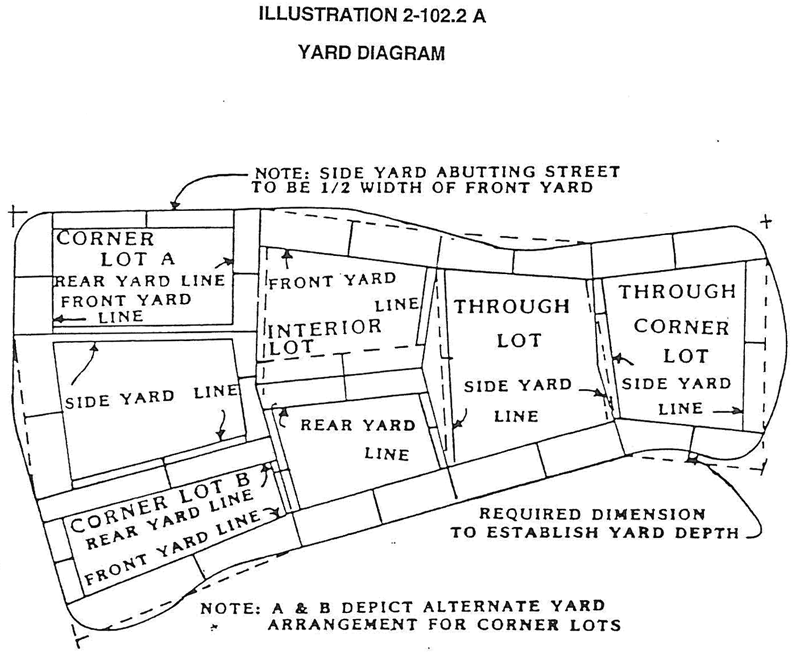
Yard, side [means] a yard extending along a side lot line from the required front yard to the required rear yard. In the case of a corner lot, any yard which abuts a street line and which is not designated a front yard shall be considered a side yard. In the case of a through lot, side yards shall extend between the required front yards, except when such corner lots are required by these regulations specifically to have more than one front yard. A side yard abutting a street shall be at least one-half of the width of the front yard.
Zone or zoning lot [means,] for the purposes of this ordinance, a lot is a parcel of contiguous land which is or may be developed or utilized under one ownership as a unit site for a use or group of uses and which is of at least sufficient size to meet minimum zoning requirements for use, coverage, and area, and to provide such yards and other open spaces as are herein required. Such lot shall have frontage on an improved public street, or on an approved private street, and may consist of:
(A)
A single lot of record;
(B)
A portion of a lot of record;
(C)
A combination of complete lots of record, of complete lots of record and portions of lots of record, or of portions of lots of records;
(D)
A parcel of land described by metes and bounds; provided that in no case of division or combination shall any residual lot or parcel be created which does not meet the requirements of this ordinance.
For the purpose of this definition, the ownership of a zone lot shall be deemed to include a lease of not less than 50 years duration.
Zoning map [means] a map or series of maps and special overlays (the official copy being maintained by the City Recorder) showing districts and special districts that are established under the provisions of and, hereby, being a part of this ordinance.
Zoning permit [means] a general term referring to a permit required to construct, reconstruct, alter or use any building or other structure or any zone lot and including the following specific permits required by this ordinance:
(A)
Building permit.
(B)
Use and occupancy permit.
(Ord. No. 2009-01, 1-12-2009; Ord. of 10-23-2009, § 2-102; Ord. No. 2011-19, § 1, 4-25-2011; Ord. No. 2013-3, § 1, 1-14-2013; Ord. No. 2013-70, § 1, 10-14-2013; Ord. No. 2014-08, § 1, 2-10-2014; Ord. No. 2015-41, § 1, 9-14-2015; Ord. No. 2023-03, 1-9-2023)
Sec. 2-103. - Definition of land use activities.
The definitions within this section are applicable to specific land use activities appearing throughout this ordinance.
2-103.1 Residential activities.
1.
Permanent residential activities.
Dwelling, duplex [means] a building containing not more than two dwelling units located on one zone lot.
Dwelling manufactured home [means] a detached one-family dwelling with all the following characteristics:
(a)
Designed for long-term occupancy, and containing sleeping accommodations, a flush toilet, a tub or shower bath, and kitchen facilities with plumbing and electrical connections provided for attachment to outside systems.
(b)
Constructed as a single self-contained unit and mounted on a single chassis transportable after fabrication on its own wheels or detachable wheels.
(c)
Arriving at the site where it is to be occupied as a dwelling complete, including major appliances and furniture, and ready for occupancy except for minor and incidental unpacking and assembly operations, location of foundation supports, connections to utilities and the like.
Manufactured home dwellings do not include camping trailers, commercial mobile structures, motor homes, recreational vehicles, travel trailers, truck campers or similar units designed to provide temporary living quarters.
Dwelling, multifamily [means] a building containing three or more dwelling units. The term includes cooperative apartments, condominiums, and the like.
Dwelling, prefabricated [means] a single detached dwelling constructed primarily off-site, designed to be transported on a flat-bed truck or trailer. As used in this ordinance the term "prefabricated dwelling" does not include "manufactured homes" constructed as a single self-contained unit and mounted on a single chassis and as further defined in section 68-126-202(4), (6) and (7), of the Tennessee Code. When such a structure meets the above stated definition of a prefabricated dwelling it shall qualify as a "single-family dwelling" as defined below.
Dwelling, single-family [means] a building containing not more than one dwelling unit located upon one zone lot.
2.
Semi-transient residential activities.
Lodginghouse, this is a general term and includes all places of semi-transient residential occupancy (as herein defined). The term lodginghouse is intended to include dormitories, roominghouse[s], boardinghouses, apartment hotels, residential hotels and all similar facilities coming within the general definition of semi-transient residential activities.
Semi-transient residential establishment [means] an establishment where lodging is provided for compensation partly on a weekly or longer basis and partly for a shorter time period, but with less than 30 percent of the living units under the same ownership or management on the same zone lot being occupied on a less than monthly basis; but excluding institutional living arrangements involving the provision of specific kinds of forced residence, such as nursing homes, orphanages, asylums, and prisons.
2-103.2 Community facility activities.
Child care facility [means] a licensed establishment wherein an agency, person or persons regularly provides nonmedical care for a group of five or more children for periods of less than 24 hours a day. Child care facilities as herein defined do not include pre-schools, nursery schools, kindergartens, or other facilities the primary purpose of which is educational, recreational or medical. Child care facilities include the following:
(a)
Family child care home [means] a licensed family dwelling of a person or persons who regularly provides direct care during part of a 24-hour day to five to seven children.
(b)
Group child care home [means] a licensed, child care home or an agency that regularly provides care for eight to 12 children in either a family dwelling of the licensee/care provider or in a premises other than the family dwelling. The number of children being provided care may be increased to 15, if four or more of the children are of school age and if adequate space is available to accommodate the additional children as provided in Tennessee State law and this ordinance.
(c)
Child care center [means] a licensed agency that provides for the care of 13 or more children.
Community assembly [means] an establishment providing meeting, recreational, or other social facilities for a private or nonprofit association, primarily for use by members and guests.
Essential public transport, communication and utility services [means] Public or quasi-public facilities necessary and incidental to the operation of transport, communication and utility services. These facilities operate primarily as distribution networks and do not include production, storage or processing facilities for the product or service being distributed.
Extensive impact facilities this is a diverse grouping of facilities that share the characteristic of potentially exerting high level impact upon surrounding properties. While the nature of the impact varies with the particular use, all the activities included within this grouping must be carefully managed if surrounding activities are to be adequately protected from adverse characteristics associated with the activities included within this grouping.
Health care facilities [means] establishments included within this grouping are principally involved in providing a broad range of health care, treatment and convalescent services to individuals suffering physical or emotional distress. Facilities within this grouping include the following:
(a)
Center for observation and rehabilitation [means] a licensed medical facility wherein services more intensive than those required for room, board, personal services and general nursing care are provided to an in-patient population, but which involves no form of forced residency of the type required within drug and alcohol rehabilitation facilities.
(b)
Hospital [means] an institution that:
(1)
Offers services more intensive than those required for room, board, personal services and general nursing care;
(2)
Offers facilities and beds for use beyond 24 hours by individuals requiring diagnosis, treatment or care for illness, injury, deformity, infirmity, abnormality, disease or pregnancy; and
(3)
Regularly makes available clinical laboratory services, diagnostic services (including X-Ray, C-T Scan, etc.) and treatment facilities for surgery or obstetrical care or other definitive treatment. This activity may include offices for medical or dental personnel, central service facilities such as pharmacies, medical laboratories, and other related uses.
(c)
Medical clinics [means] a public or private nonprofit institution providing a full range of the basic general medical designed to preserve the health, prevent disease and care for the common illnesses and disabilities of the population within a specified geographic area.
Intermediate impact facilities this classification includes a diverse listing of activities which share the characteristic of exerting a significant effect upon surrounding land uses due to their traffic generation characteristics, parking requirements, land requirements or potential nuisances associated with such uses.
Religious facilities [means] any structure or site such as a church, synagogue, chapel, sanctuary or cathedral used for purposes of individual or collective involvement with a religious activity, such as rites, rituals, ceremonies, prayers and discussions.
Special institutional care facilities this is a general term that is intended to include all facilities that involve forced residency, fulltime supervision and care for:
(1)
Individuals legally confined due to violations of law;
(2)
Individuals who are addicted to drugs and/or alcohol; and
(3)
Individuals who are mentally ill, including the criminally dangerous or others who for their own protection or the protection of society must be confined.
Special personal and group care facilities this is a general term that is intended to include residential facilities for the care of elderly or infirm persons who may require special care and/or supervision. The term is intended to include facilities that are principally residential in nature but wherein long term medical or rehabilitative services are provided for the residents. This term is not intended to include facilities for the criminally dangerous or psychotic. Special personal and group care facilities include the following:
(a)
Assisted living facilities for elderly or handicapped persons [means] a residential facility other than a dwelling unit (as defined above) intended for occupancy by unrelated individuals who are handicapped, aged, or disabled and wherein meals are prepared and served in a common dining facility and limited assistance is provided for daily activities.
(b)
Convalescent homes. (See Nursing homes.)
(c)
Family care facilities [means] a licensed facility wherein residential services are provided to eight or fewer unrelated individuals who are handicapped, aged, disabled or otherwise in need of adult supervision in accordance with their individual needs. This grouping does not include facilities providing residential services to delinquent minors, the criminally dangerous, the addicted, and/or mentally ill individuals.
(d)
Group care facilities [means] a licensed facility wherein residential services are provided to nine or more unrelated individuals who are handicapped, aged, disabled or otherwise in need of adult supervision in accordance with their individual needs. This grouping does not include facilities providing residential services to delinquent minors, the criminally dangerous, the addicted, and/or mentally ill individuals.
(e)
Day care facilities for elderly persons [means] a licensed establishment wherein an agency, person or persons regularly provides nonmedical care for a group of unrelated individuals who are handicapped, aged, disabled or otherwise in need of adult supervision in accordance with their individual needs for periods of less than 24 hours a day.
(f)
Nursing homes [means] a general term used to describe a licensed establishment providing bed care and in patient services for individuals needing regular medical attention, but excluding a facility providing surgical or emergency medical services or providing care for mental illness or communicable disease. Retirement or rest homes, and convalescent homes are included within this term.
2-103.3 Commercial activities.
Adult entertainment activities [means] an establishment having as a substantial portion of its stock in trade the provision or sale of products or services defined by this ordinance as "Adult Entertainment." Adult Entertainment activities include, but are not limited to, the following:
(a)
Adult book store [means] an establishment having as a substantial portion of its stock in trade books, videos, movies, magazines, and other periodicals which are distinguished or characterized by their emphasis on matter depicting, describing or relating to specified sexual activities or specified anatomical areas as defined in this article, or an establishment with a segment or section devoted to the display or sale of such material.
(b)
Adult mini-motion picture theater [means] an enclosed building with a capacity for less than 50 persons used for presenting material depicting, describing or relating to specified sexual activities or specified anatomical areas as defined in this article, for observation by patrons therein.
(c)
Adult motion picture theater [means] an enclosed building with a capacity for 50 or more persons used for presenting material depicting, describing or relating to specified sexual activities or specified anatomical areas as defined in this article, for observation by patrons therein.
(d)
Adult store [means] an establishment offering a substantial portion of their stock in trade, as the sale of 'adult' clothing, toys, and novelty items with a sexual theme or nature.
(e)
Tattoo and body piercing [means] establishments offering skin-penetrating adornment procedures as regulated by the State of Tennessee.
Convenience retail sales and services. An establishment not exceeding 5,000 square feet of gross floor area, or as otherwise specified in subsection 3-103.3 subparagraph 6, serving a limited market area and engaged in the retail sale of goods and/or services from the premises of frequently and recurrently needed items for personal consumption or household use.
(Refer to article III, section 3-104.7(5), Provisions applicable to commercial activities convenience retail and services for supplemental conditions for fuel pumps in various zoned districts.)
Entertainment and amusement services—Limited [means] a recreational activity operated as a profit making enterprise, conducted entirely within an enclosed building and serving groups of less than 500 assembled spectators and/or participants.
General business and communications services [means] a commercial activity engaged in providing services to other commercial enterprises.
Payday lenders [means] title loan services and deferred presentment centers, as defined and regulated by Title 45, Chapter 15 and Chapter 17, respectively, of the Tennessee Code Annotated.
Pawnshops [means] those businesses as defined and regulation by Title 45, Chapter 2 of the Tennessee Code Annotated.
Professional services—Medical. This activity classification is intended to include establishments primarily engaged in providing therapeutic, preventative or correctional personal treatment services on an out-patient basis by physicians, dentists, and other medical practitioners, as well as the provision of testing and analysis services. This grouping is limited and does not include the broad ranging services provided at general health care facilities such as hospitals but does include limited outpatient services provided at offices of doctors, dentists outpatient clinics, and other health care providers, whether operated for profit or otherwise.
Restaurant, full-service [means] an establishment where the principal business is the sale of food and beverages in a ready-to-consume state and where the design or principal method of operation consists of one or more of the following:
(a)
A sitdown restaurant where customers, normally provided with an individual menu, are generally served food and beverages in nondisposable containers by a restaurant employee at the same table or counter at which said items are consumed;
(b)
A cafeteria or cafeteria-type operation where foods and beverages generally are served in nondisposable containers and consumed within the restaurant; or
(c)
Small specialty restaurants having floor area exclusively within a shopping center or office park, sharing common parking facilities with other businesses within such centers, and having access to a common interior pedestrian access way.
This activity shall include the on-premise[s] sale, service and consumption of alcoholic beverages as an accessory and secondary use, but excludes any service to a customer in a motor vehicle.
Self-service storage facilities [means] a structure or group of structures for the dead storage of customer's goods and wares where individual stalls or lockers are rented to different tenants for storage and removal of personal effects.
Waste transfer stations. This activity includes a convenience center for collection and mechanical compaction of domestic waste transported in from individual households.
2-103.4 Manufacturing activities.
Brewery [means] the large-scale production of beer and/or malt beverages in quantities exceeding 25,000, however not exceeding 50,000 barrels annually, with one barrel holding 31 gallons, and may include as an accessory use tours, a taproom/tasting room, restaurant, or retail space for the consumption of beer and/or malt beverages made on-site and purchase of brewery related merchandise.
Manufacturing, basic industry [means] an establishment engaged in the basic processing, conversion and manufacturing of materials or products predominantly from extracted or raw materials, or manufacturing processes utilizing flammable or explosive materials. or storage or manufacturing processes that potentially involve hazardous or commonly recognized offensive conditions, other than those classified in the hazardous operations activity type.
Manufacturing, general. This grouping includes all manufacturing operations excepting those classified as basic industry or hazardous operations.
Manufacturing, hazardous operations [means] any establishment engaged in production and/or storage of materials that present serious hazards to human life and health.
Manufacturing, limited [means] an establishment primarily engaged in the on-site production of limited quantities of goods by hand manufacturing that generally involves the use of hand or small power tools, that may include the incidental direct sale of those goods to consumers.
Microbrewery [means] the small-scale production of beer and/or malt beverages in quantities not to exceed 25,000 barrels annually, with one barrel holding 31 gallons, and may include as an accessory use tours, a taproom/tasting room, restaurant or retail space for the consumption of beer and/or malt beverages made on-site and purchase of brewery related merchandise.
2-103.5 Agricultural and extractive activities.
Agriculture, general. This term is intended to include farms (and farm residences) that involve orchards, raising of livestock, dairy cattle, horses or poultry, and truck farming.
Agriculture, intensive. These agricultural uses include operations where animals are tightly confined in buildings or outdoor pens including operation of one or more of the following:
(a)
Dairy farm means any place or premises where one or more cows are kept and from which a part or all of the milk or milk products is provided, sold or offered for sale to milk plant, transfer station or receiving station.
(b)
Egg production house means any place or premises where chickens are kept for production of eggs for resale to processors, wholesalers or retailers.
(c)
Feedlot means a lot, yard, corral or other area in which livestock are confined primarily for the purposes of feeding, growing, raising, or birthing prior to slaughter. Feedlot does not include areas which are used for the raising of crops or other vegetation upon which livestock are allowed to graze or feed.
Agricultural services. This term is intended to encompass a wide variety of service activities that directly support production of crops and animals but are not in and of themselves agricultural activities.
Mining, quarrying and soil extraction. This term is intended to include all operations engaged in the removal by excavation, stripping, dredging or otherwise taking of soil, gravel and sand for off-site use.
Plant and forest nursery. This category includes nurseries with or without retail sales or accessory greenhouses. A minimum of 51 percent of all materials sold by a nursery must be grown on-site. (Nurseries containing a garden center are included within the "Outside material and equipment sales and repair yards" commercial classification.)
2-103.6 Accessory activities.
Accessory apartment [means] an apartment shall be considered an accessory use to any single-family dwelling when such apartment is occupied by a family member and complies with the provisions of article III, subsection 3-105.1.
Bed and breakfast-homestay [means] a minor home occupation that provides one to three rooms for occasional paying guests on an overnight basis for periods not to exceed 14 days with one daily meal being available on the premises. A bed and breakfast homestay is allowable only in a building originally constructed as a single-family residence.
Bed and breakfast inn [means] an operator or owner occupied residence that provides four to 12 rooms for paying guests on an overnight basis for periods not to exceed 14 days with one daily meal being available on the premises. A bed and breakfast inn is allowable only in a building originally constructed as a residence. Bed and breakfast inns are subject to approval by the Tennessee Department of Environment and Conservation in addition to all local requirements.
Country inn [means] a bed and breakfast inn that also has facilities for group and/or special event activities. A country inn is allowable only in a building constructed as a residential dwelling. Country inns are subject to approval by the Tennessee Department of Environment and Conservation, in addition to all local requirements.
(Ord. No. 2003-40, 9-8-2003; Ord. No. 2004-34, 8-9-2004; Ord. No. 2007-22, 5-29-2007; Ord. No. 2009-01, 1-12-2009; Ord. of 10-23-2009, § 2-102; Ord. No. 2010-41, § 1, 8-9-2010; Ord. No. 2013-17, § 1, 2-11-2013; Ord. No. 2013-70, § 2, 10-14-2013; Ord. No. 2014-42, 6-9-2014; Ord. No. 2019-6, § 1, 4-8-2019; Ord. No. 2020-19, § 1, 5-29-2020; Ord. No. 2023-47, 11-13-2023)

