
Mount Juliet City Zoning Code
ARTICLE VII
INDUSTRIAL DISTRICT REGULATIONS
Sec. 7-101.- Purposes of industrial districts.
7-101.1 General purposes. The industrial districts established by this ordinance are designed to promote and protect the health, safety, morals, convenience, order, prosperity and other aspects of the general welfare. These goals include, among others, the following:
1.
To provide sufficient space, in appropriate locations, to meet the needs of the area for all types of distributive, industrial and related activities, with due allowance for the need for choice of suitable sites.
2.
To protect distributive, industrial and related activities, as well as residential and related activities by providing for separation of these uses, and, as far as possible, provide that appropriate space needs for distributive and industrial activities are available by prohibiting the use of such space for residential purposes.
3.
To encourage industrial development which is free from danger of fire, explosions, toxic or noxious matter, radiation, smoke, dust or other particulate matter, and other hazards, and from offensive noise, vibration, odorous matter, heat, humidity, glare, and other objectionable influences, by permitting such development in areas where this ordinance restricts the emission of such nuisances, without regard to the industrial products and processes involved.
4.
To protect adjacent residential and commercial areas, and to protect the labor force in other establishments engaged in less offensive types of industrial and related activities, by restricting those industrial activities which involve danger of fire, explosions, toxic or noxious matter, radiation, smoke, dust, or other particulate matter, and other hazards, or create offensive noise, vibration, heat, humidity, glare, and other objectionable influences, by permitting such development in areas where this ordinance restricts the emission of such nuisances, without regard to the industrial products or processes involved.
5.
To protect industrial activities and related developments against congestion, as far as is possible and appropriate in each area, by limiting the bulk of buildings in relation to the land around them and to one another, and by requiring space off public ways for parking and loading facilities associated with such activities.
6.
To promote the most desirable use of land and direction of building development, to promote stability of industrial and related development, to strengthen the economic base of the area, to protect the character of these districts and their peculiar suitability for particular uses, to conserve the value of land and buildings and to protect the City's tax revenues.
7.
To protect adjacent residential and commercial districts from any negative impacts attributable to sites devoted to industrial activities.
7-101.2 Specific purposes.
1.
I-R, Restrictive Industrial Districts. This class of district is intended to provide space for a wide range of industrial and related uses that conform to a high level of performance criteria and have the least objectionable characteristics. These districts may provide a buffer between other districts and other industrial activities that have more objectionable influences. Except as specified in article III, subsection 3-105.2, subpart 6, Residential occupancy in connection with nonresidential activity, new residential activities are excluded, and community facilities and commercial establishments which provide needed services for industry and are complementary thereto are permitted.
2.
I-G, General Industrial Districts. This class of district is intended to provide space for the types of industrial activities which by reason of volume of raw materials or freight, scale of operation, type of structures required, or other similar characteristics require locations relatively well segregated from nonindustrial uses. Except as specified in article III, subsection 3-105.2, subpart 8, Residential occupancy in connection with nonresidential activity, new residential activities are excluded, and commercial establishments and community facilities which provide needed services for industry and are complementary thereto are permitted.
3.
I-S, Special Industrial Districts. This class of district is intended to provide suitable areas for intense, potentially noxious and/or dangerous industrial operations, including open land operations. It is specifically intended that all newly created districts be so located as to prevent negative impact upon adjoining uses. To this end, these districts are to be protected from encroachment by other activities.
(Ord. of 10-23-2009, § 7-101.2)
Sec. 7-102. - Uses and structures.
7-102.1 General provisions. Principal uses of buildings or other structures and land have been classified and combined into major classes and activity types in article III of this ordinance. The procedure for interpreting the classes and type of activities is provided in article III, section 3-101, table 7-102A, presents a tabulation of uses and structures which are classified as principal permitted (P), permitted with supplemental provisions (SUP) or conditional (C) uses within the various industrial districts. The supplemental design provisions with which (SUP) and (C) uses and activities are required to comply appear in article III, section 3-104, Supplemental use regulations.
7-102.2 Principal permitted uses (P). Principal permitted uses are permitted as a matter of right within the district indicated, subject to the general requirements established for the district wherein the use is located.
7-102.3 Uses permitted with supplemental provisions (SUP). A use permitted with supplemental provisions is an activity, use or structure which is permitted subject to a finding by the Zoning Administrator that the specific standards indicated for the use in question have been met. Only those uses and structures so indicated in table 7-102A, may be allowed within the districts indicated.
7-102.4 Conditional uses (C). A conditional use is an activity, use, or structure which may require large land area, have unique operating, traffic generating or other characteristics that may tend to dominate or adversely affect the area more than do other uses permitted within the same zone district. Because the impacts of these uses cannot be satisfactorily predetermined for every possible location within a zone district, these land uses are permitted only upon approval by the Board of [Zoning] Appeals. Only those uses and structures so indicated in table 7-102A, may be allowed within the districts indicated.
7-102.5 Accessory uses. In addition to the principal activities expressed above, each activity type shall be deemed to include activities customarily associated with, and appropriate, incidental, and subordinate to the principal activity when such accessory activity is located on the same zone lot as such principal activity and meets the further conditions set forth in article III, section 3-105. Permits for accessory uses designated "ASP" shall be issued upon demonstration that the activity in question meets the requirements established for such activity article III, section 3-105. The third classification of accessory uses designated by the letter "C" require[s] approval as a conditional use by the Board of Zoning Appeals. Upon issuance of any permit for a conditional accessory use such use or activity shall be continuously subject to compliance with any operational standard or criteria established by the Board of [Zoning] Appeals.
Note— Key to interpreting use classifications.
P = Use permitted by right within the district.
SUP = Principal use permitted with supplemental provisions.
C = Conditional use (subject to approval by the Board of [Zoning] Appeals).
O = Requires overlay district.
(1)
See subsection 7-104.2, for supplemental design provisions.
(2)
See subsection 7-104.1, for supplemental design provisions.
(3)
See article VIII, section 8-401.
(Ord. No. 2019-6, § 5, 4-8-2019; Ord. No. 2020-19, § 1, 5-29-2020)
7-102.6 Temporary uses. The temporary uses and structures specified in article III, section 3-106, as permissible within industrial districts may be permitted for the limited time periods indicated for each such use or activity.
7-102.7 Uses not permitted. Any uses or structures not allowable as permitted uses, conditional uses, temporary uses or accessory uses are prohibited within the various industrial districts.
(Ord. of 10-23-2009, § 7-102; Ord. No. 2010-37, § 4, 7-12-2010; Ord. No. 2011-01, § 3, 1-10-2011; Ord. No. 2013-70, § 6, 10-14-2013; Ord. No. 2014-24, § 1, 4-14-2014; Ord. No. 2014-31, § 1, 4-14-2014; Ord. No. 2014-42, 6-9-2014; Ord. No. 2015-23, § 1, 6-8-2015)
Sec. 7-103. - Bulk regulations.
7-103.1 General[ly]. Minimum lot dimensions, maximum lot coverage, minimum front, rear, interior and street side yards, maximum building heights and minimum separation between buildings on the same zone lot within any base industrial district shall be as indicated in table 7-103A. Bulk regulations for industrial districts, and the additional bulk regulations specified in this section. For certain uses, alternative bulk regulations may be specified in this section or other sections of this ordinance.
7-103.2 Lot dimensions. No lot shall be created and no building permit or zoning approval shall be issued for any lot that does not meet the following minimum dimensional requirements:
1.
Lot area.
a.
Minimum area. Within the various industrial districts, the minimum horizontal area of a lot shall not be less than that indicated in table 7-103A, Bulk regulations for industrial districts, or as may be otherwise specified in this ordinance.
b.
Reduction in lot area prohibited. No zone lot, even though it may consist of one or more adjacent lots of record, shall be reduced in area so that yards, lot width, building area, or other requirements of the zoning ordinance are not maintained. This section shall not apply when a portion of a lot is acquired for a public purpose.
2.
Lot width. The minimum lot width (measured at the building line) shall not be less than indicated in table 7-103A, or otherwise specified in this ordinance.
(1)
The minimum lot shall be as required to meet other provisions of this article.
(2)
Along the periphery of an industrial site that adjoins commercial or industrial property, side yards ten feet in width, are required. Where an industrial site abuts property classified as residential, the provisions of subsection 7-103.4, subpart 7, shall apply.
(3)
Except along residential district boundaries. (See subsection 7-103.4, subpart 8.)
(4)
See subsection 7-103.4, subpart 8, for special yard provisions within I-S districts.
(5)
See subsection 7-103.4, subpart 9, for special provisions applicable to party walls.
3.
Lot frontage. All lots shall have a minimum of 50 feet of frontage on a publicly dedicated and maintained street or a permanent access easement as defined and regulated by this ordinance, except that lots located along the terminus of a cul-de-sac shall have a minimum of 35 feet of frontage.
4.
Maximum permitted lot coverage. Within the various industrial districts, the maximum zone lot coverage by all buildings (principal and accessory) shall not exceed the percentage of the total area of the zone lot indicated in table 7-103A.
5.
Maximum impermeable surface ratio. Within the various industrial district, the impermeable surface ratio, computed by dividing the impermeable surface area by the total lot area shall not exceed the percentage indicated in table 7-103A.
(Ord. No. 2026-03, § 1, 1-12-2026)
7-103.3 Height regulations.
1.
Basic requirements. The maximum permitted height for buildings shall not, except as provided in subpart 2, below, exceed that set forth for the various industrial districts in table 7-103A.
2.
General exception to height regulations. The height limitation contained herein does not apply to spires, belfries, cupolas, radio towers, water tanks, ventilators, chimneys or other appurtenances usually required to be placed above the roof level and not intended for human occupancy.
7-103.4 Yard regulations.
1.
Permitted obstructions in required yards. In all industrial districts, the following shall not be considered obstructions when located within a required yard, except that all items shall comply with subsection 5-103.5, Obstructions, prohibited at street intersections:
a.
Arbors and trellises.
b.
Awnings or canopies projecting from a building wall over a required yard not more than six feet, and having no supports other than provided by the wall or its integral parts.
c.
Chimneys projecting not more than three feet into, and not exceeding two percent of the area, of the required yard.
d.
Driveways subject to other specific provisions of this ordinance related directly thereto.
e.
Eaves, gutters, or down spouts, projecting into or over required yards not more than 24 inches or 20 percent of the width of such yard, whichever is the lesser distance.
f.
Fire escapes or staircases, the riser area of which shall be at least 50 percent open, and whose vertical projection downward onto a required yard does not exceed 30 percent of the area of such yard.
g.
Flagpoles, having only on structural ground member.
h.
Fountains.
i.
Mailboxes.
j.
Open terraces, including natural plant landscaping.
k.
Retaining walls.
l.
Sculpture or other similar objects of art.
m.
Street furniture such as, but not limited to, benches, drinking fountains, trash receptacles, ash trays, light standards, or directional signs.
n.
Vehicular parking areas, unless otherwise specifically prohibited by applicable sections of this ordinance.
o.
Vents necessary for use of fallout shelter constructed below grade of such yards, but excluding all other parts of such shelters.
p.
Walls or fences not exceeding six feet in height measured from finish grade level at any point along the length of, and on any side of, such walls or fences, and not roofed or structurally part of a building.
2.
Measurement of yard width or depth. In all industrial districts, the width or depth of a required yard shall be measured perpendicular to straight lot lines, or for curved lot lines, in such a way that such yard is bounded by the arc of a curve which is concentric with such curved lot line.
3.
Dimension of yards. In all industrial districts, yards of such dimensions as set forth in table 7-103A, shall be provided.
4.
Uses of required yard areas. The following uses may be made of yard areas, provided such uses are otherwise permissible in this district:
a.
Landscaping. All required yard areas not occupied by driveways or sidewalks shall be devoted to landscaping, as required by article X.
b.
Driveways. Driveways may be located within any required yard; provided, however, that no more than 50 percent of the area of any required yard may be used as a driveway.
c.
Sidewalks.
d.
Parking. Within all industrial districts any yard may be used for off-street parking or loading, except as provided in subpart D.7 [7.a] of this section. However, such areas shall not be used for storage or processing of any kind. No parking shall be permitted within ten feet of the front property line.
5.
Restrictions on outside storage within areas other than required yards.
a.
Outside storage within I-R districts. Within the I-R districts, no stocks, merchandise or material (with the exception of automobiles, tractors and other transportation, excavation or agriculturally related vehicles) may be stored upon any open area situated on any zone lot.
b.
Outside storage within I-G and I-S districts. Within the I-G and I-S districts, outside storage may be permitted only within areas designated for such upon an approved site development plan.
6.
Special yard provisions applying along railroad right-of-way. In all industrial districts, other provisions of this ordinance notwithstanding, along such portion of a rear or side lot line that coincides with a boundary of a railroad right-of-way, no rear or side yard shall be required.
7.
Special provisions applying to required yards and building setbacks along district boundaries coincident with side or rear lot lines of zone lots located in any residential district.
a.
Required yards along district boundaries coincident with side or rear lot lines. Within I-R and I-G, Industrial Districts, along such portion of the boundary of the industrial district which coincides with a side or rear lot line of a zone lot in any residential district, an open area unobstructed from the ground to the sky shall be provided within the industrial district. Within both I-R districts and I-G districts, the width shall be 100 feet, unless supplementary landscaping and buffering plans are approved by the Planning Commission. No portion of this open area shall be used for off-street parking, off-street loading or for storage or processing of any kind. No portion of this open area shall be paved, graveled or used for parking or as an access way of any type.
b.
Special front setback. Regardless of the front yard provisions established for any industrial district, no building located on any zone lot adjacent to any residential district shall extend closer to the street than the average of the distances of the buildings located within 100 feet, of the lot whereon the industrial activity is located; provided that no building shall be required to setback more than twice the minimum front yard applicable within the industrial district.
c.
Screening along residential district boundaries. To assist in preventing the transmission of light and noise from within any industrial district into any abutting residential district, screening shall be required where such district abuts or is contiguous to any residential district, without an intervening street, alley, or other public way. Such screening shall be provided within the industrial district, but not within a public street or alley, along the entire contiguity of said districts. Transitional screening which meets the standards of article X of this ordinance, shall be located in this open area.
8.
Required yards within I-S districts. Due to the potentially noxious activities that may be permitted within I-S districts, special yard provisions are required.
a.
Provisions applicable to zone lots occupied by any activity classified as hazardous manufacturing. In its review of any application for approval of a hazardous manufacturing activity proposed for location within an I-S district, the Board of Commissioners shall establish yards and building separations sufficient to protect the health, safety and economic benefit of persons owning or occupying nearby property. As an absolute minimum such yards shall be as indicated below. Screening shall be provided as established in subpart 7.c of this section (above).
i.
Use adjoins residential property. Along any rear or side lot line which adjoins residential property, whether such property is presently occupied for residential purposes or only zoned for such use, an open area unobstructed from the ground to the sky at least 200 feet wide, shall be provided within the industrial district. Such open area shall not be paved nor used for off-street parking, loading, or storage or processing of any kind.
ii.
Use adjoins commercial or industrial property. Along any lot line that adjoins property, either classified or presently utilized for commercial or industrial purposes, an open area at least 150 feet wide, shall be provided. Such area may be utilized for off-street parking or loading, but shall not be used for storage or processing of any kind.
b.
Zone lots occupied by other than hazardous manufacturing activities. Yards for zone lots located within I-S districts, and occupied by other than hazardous manufacturing activities may be as provided for I-G districts.
9.
Special provisions for party walls. Within I-R and I-G, Industrial Districts, side or rear yard requirements may be waived along the side or rear adjacent to another commercial or industrial zoned lot.
a.
At all points of attachment, adjoining buildings shall be separated from each owner by a four-hour wall constructed in accordance with the Standard Building Code and the National Fire Protection Association.
b.
A common or party wall may bisect the dividing line of two adjacent lots so that one-half of the wall is located on each of the properties, provided that the owners of each property sign a covenant in the form of an easement running with the land granting to the owner of the adjoining property the right to maintain, reconstruct and protect the wall.
c.
In the event of the construction of a building on the lot line, the wall along the lot line if not constructed as a part or common wall between two buildings, shall be constructed as a four-hour wall and meet all requirements of the Standard Building Code and the National Fire Protection Association without regard to any construction that may exist or be proposed on the adjoining property.
d.
All walls constructed within ten feet, of a property line, shall have a four-hour fire rating and shall comply with all requirements of the Standard Building Code.
7-103.5 Obstructions prohibited at street intersections. On a corner lot, no fence, wall, hedge or other planting or structure that will materially obstruct vision between a height of 2½ feet and ten feet above the centerline grades of the intersecting streets shall be erected, placed, or maintained within the triangular area formed by the street lines at such corner lots and a straight line joining such street lines at points which are 35 feet distance from the intersection of the street lines and measured along said street lines. In case of rounded street lines at the intersecting streets, such measurement shall be made from the point of intersection of the tangents of the curve constituting the rounding.
7-103.6 Requirements for fire lanes. Fire lanes with a minimum width of 20 feet shall be located such that the lanes extend from a public street to a point adjacent to the principal entrances of all commercial buildings. Such fire lanes shall be positioned directly adjacent to emergency water facilities designed for fire protection and shall be paved with an all weather surface capable of supporting the imposed loads of fire apparatus. The required fire lanes shall not be obstructed in any manner, including the parking of vehicles. Installation of "No Parking" signs or other appropriate notice or of approved obstructions inhibiting parking may be required and if installed shall be maintained. The owner or his representative of a building that is adjacent to the fire lane shall be responsible for keeping the fire lane free of obstructions.
7-103.7 Requirements for open space. Development of all industrial sites in the City of Mt. Juliet and within the jurisdiction of the Regional Planning Commission shall include construction of all greenway sections that are included in the current and in any future greenway plans for the city. In any development, all parcels of land which touch or lie within the proposed route of a new greenway shall be constructed by the developer. Construction and related expenses for design, acquisition of right-of-way and construction of the greenways will be the responsibility of the developer. All greenway sections will be constructed per current City of Mt. Juliet, TDOT and FHWA standards and specifications, whichever is greater. Examples of said specifications include, but are not limited to, design, materials, thickness and width of greenway, as well as required signage, meeting ADA requirements, etc.
Construction of said greenway sections will be completed by ten percent of development build out and all greenway sections will be dedicated to the City of Mt. Juliet. The developer, property owner or their designated agent may request a waiver or variance from this ten percent requirement should the strict application of the provisions of this ordinance result in practical difficulties or unnecessary hardship. Said waiver, variance or adjustment will not adversely affect the community objectives of the comprehensive plan. All greenways designated by current and any future greenway plans will be dedicated to the City of Mt. Juliet and shall not count toward required open space and amenities.
7-103.8 Requirements for bicycle parking.
A.
Locations.
1.
Bicycle parking shall be located as close as or closer than the nearest car parking space to the building entrance, or other than those spaces for persons with disabilities.
2.
Bicycle parking facilities shall not interfere with accessible paths of travel or accessible parking as required by the Americans with Disabilities Act of 1990, as amended.
3.
A minimum of four feet from the required rack dimension shall be provided for pedestrian clearance when a rack is placed within a sidewalk or pedestrian right-of-way.
4.
Bicycle racks shall be located in highly visible and well lit areas to minimize theft and vandalism.
5.
When automobile parking spaces are provided in a structured parking garage, all required bicycle spaces shall be located inside the garage on the ground level. Alternative layout and design of racks to maximize space may be administratively approved by the Zoning Administrator.
6.
Alternative locations — in the event that compliance may not be feasible because of demonstrable hardship, the Zoning Administrator may approve an alternative location. The Zoning Administrator shall consider the following:
a.
Alternative locations shall be well lit and secure.
b.
All bicycle parking spaces shall be located within a 100-foot diameter of the primary building entrance.
B.
Layout and design.
1.
Bicycle rack design.
a.
All racks shall be of the wave-type design.
b.
Rack structure will require a user supplied locking device.
c.
The racks shall be constructed of durable materials to withstand permanent exposure to the elements, such as powder coated metal or stainless steel.
d.
Racks must be permanently mounted to a concrete or asphalt surface.
e.
Racks shall provide clearance from other objects by using layout dimensions of at least four feet wide by six feet long.
f.
Construction details shall be submitted for review prior to final approval of construction plans.
C.
Bicycle parking requirement.
1.
The number of bicycle parking spaces required shall be based on the required automobile parking spaces and shall be provided in accordance with the following with fractional requirements for bike parking over 0.5 to be rounded up.
2.
A minimum of five bicycle parking spaces shall be provided for all sites with up to 100 required vehicle parking spaces. Two bicycle parking spaces shall be provided for every 150 required vehicle parking spaces thereafter.
3.
Bicycle parking spaces shall be provided for all uses except: Accessory uses; agricultural; lodging; one to four family dwellings; temporary uses; and utilities.
7-103.9 Building design. In all industrial districts, the exterior walls of all buildings shall be of 100 percent brick (clay baked, individually laid) or stone (individually laid). The Board that approves such project may permit any other construction materials allowed under state law. In determining whether to allow such materials, the Board may consider whether the material is proposed as an accent, as a portion of a corporate motif, as well as whether the design is in line with general aesthetic goals of the City of Mt. Juliet as set forth herein, and any other factors deemed relevant by the applicant.
All structures shall be shielded from view from all public streets with a landscaped berm. Accessory buildings and enclosures shall be consistent in design and materials with the building to which they are ancillary. The Planning Commission may waive any of these design requirements upon a showing by the developer that alternative materials will achieve a same or similar design result and be compatible with other buildings and structures in the vicinity which have been approved in accordance with these design provisions.
(Ord. of 10-23-2009, § 7-103; Ord. No. 2014-67, § 1, 10-27-2014; Ord. No. 2015-44, §§ 1, 2, 11-23-2015; Ord. No. 2017-62, § 1, 10-23-2017; Ord. No. 2019-02, § 1, 1-14-2019; Ord. No. 2021-42, Exh. A, 10-25-2021)
7-103.10. Outdoor Decorative Trash Receptacles. Outdoor trash receptacles shall be required for all industrial site plans with the exception of those industrial site plans that have received approval prior to the enactment of this ordinance.
In addition, outdoor trash receptacles shall comply with the criteria listed, as follows:
A.
Locations.
1.
For all industrial uses, a minimum of one decorative trash receptacle shall be located at all public entrances and exits of an industrial use.
2.
A minimum of one decorative trash receptacle shall be located in all designated outdoor employee gathering areas.
3.
The location of all trash receptacles shall not interfere with accessible paths of travel or accessible parking as required by the Americans with Disabilities Act of 1990, as amended or emergency exits.
B.
Design.
All industrial site plans shall show the proposed design, size, typical elevation and location for each decorative trash receptacle on the plan.
The design of the trash receptacle shall be made of black powdered coated steel, have a minimum capacity of a 36-gallon container and shall be of a strap-type design. (A typical design is shown in illustration 7.1 below for example only).
Illustration 7.1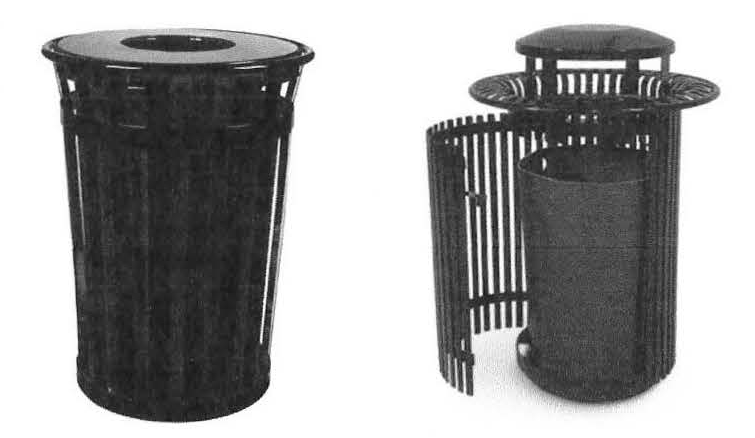
(Ord. No. 2016-40, § 4, 8-8-2016)
7-103.11 Dumpster enclosures:
1.
Walls used to screen trash dumpsters, refuse collection areas, or recycling containers shall:
a)
Be fully screened from public view;
b)
Be constructed of masonry materials that match the main colors and materials of the associated building they serve;
c)
Include steel opaque gates designed to complement the wall materials used;
d)
Be supplemented with plantings around the perimeter.
2.
Any enclosure intended for screening dumpsters, refuse areas, or recycling containers that contains a compaction unit shall include a floor drain within the containment pad that is tied directly to the sanitary system in accordance with the standard specifications for sanitary sewers;
3.
Any enclosures provided for restaurants or other food service establishments shall provide adequate area for the storage of grease barrels/recycle containers inside of the dumpster enclosure;
4.
Any enclosures provided for restaurants or other food service establishments shall provide a floor drain within the containment pad;
5.
All floor drains located in a dumpster enclosure shall be plumbed to an oil/water separator or grease interceptor. If the drain ultimately is piped to the sanitary sewer system, the enclosure must be covered so that the drain does not receive storm water.
6.
To allow for dumpster gates to remain closed as often as possible, either a pedestrian door or a wall offset for pedestrian access shall be provided.
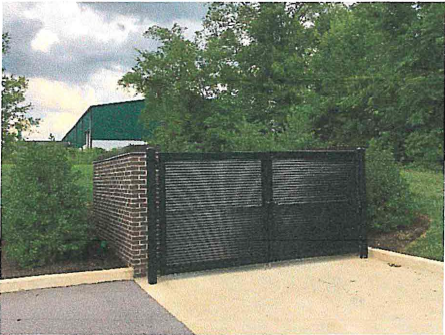 | This image demonstrates how dumpster enclosures can be constructed of high quality materials and provide a completely opaque screen to a height above the dumpsters or recycling containers. |
7.
The Planning Commission may waive any of these design requirements upon showing by the developer/applicant alternative methods of design, if deemed acceptable.
(Ord. No. 2018-43, § 1, 11-26-18)
Editor's note— Ord. No. 2018-43, § 1, adopted November, 26, 2018, set out provisions intended for use as 7-103.10. To preserve the style of this Code, and at the editor's discretion, these provisions have been included as 7-103.11.
7-103.12. Sidewalks.
1.
Sidewalks. Sidewalks shall be required for all industrial site plans, with the exception of those industrial subdivisions that received site plan approval prior to the enactment of this ordinance, and sidewalks shall comply with all criteria as follows:
a.
The design, dimensions, dedications, easements, and reservations for all sidewalks shall conform to all applicable City of Mt. Juliet regulations. Sidewalks constructed within the public rights-of-way shall be installed in accordance with the adopted standards of the City of Mt. Juliet.
b.
Sidewalks are required to be constructed along all streets within or abutting a development and shall connect to sidewalks in adjoining developments.
c.
Sidewalks shall be constructed of concrete and shall be a minimum of six feet in width.
d.
Sidewalks shall maintain minimum thickness of four inches except at driveway areas where the minimum thickness is six inches.
e.
Sidewalks must comply with the City of Mt. Juliet Standard Road Details.
f.
In any case where the reconstruction or construction of a sidewalk or other pedestrian walkway is required, the City of Mt. Juliet may require the contractor to post surety in the form specified in this ordinance, for the construction of the sidewalk or walkway.
g.
The required sidewalk improvements must be installed prior to the issuance of a certificate of occupancy.
(Ord. No. 2019-02, § 2, 1-14-2019)
Editor's note— Ord. No. 2019-02, § 2, adopted January 14, 2019, set out provisions intended for use as 7-103.10. To preserve the style of this Code, and at the editor's discretion, these provisions have been included as 7-103.12.
Sec. 7-104. - Supplemental provisions.
7-104.1 Development standards for I-S, Special Industrial Districts.
1.
Operation and intent. The I-S, Special Industrial District, is intended to provide a mechanism for managing a wide variety of high impact, potentially noxious and/or dangerous, but necessary uses. Certain of the potential uses that may locate within the district have associated with them some special impact or potential hazard related to materials, processes or products which can not be evaluated as to effect on the surrounding area or environment in advance of the use being proposed for a particular location. At the time an application is filed for approval of an I-S district, a review of the location, design configuration and its impact will be conducted. This evaluation shall consider the proposed use, the site development plan required for all such development by article XIV, subsection 14-103.3, and all operational and environmental data required to be submitted. The express goal of this review is to determine appropriate design criteria and environmental safeguards to be applied to such use in order to protect the health and safety of the public at large. The review will formulate a basis for a detailed recommendation to the Board of Commissioners as to conditions under which the proposed use may be permitted to locate within the planning jurisdiction through creation of an I-S, Special Industrial District.
2.
Development plans and review process.
a.
Procedure for submission and review. The process for review and approval of any I-S, Special Industrial District, consists of three progressive elements:
i.
Review and recommendation of a preliminary site development plan containing the information required by article XIV, subsection 14-103.3, and all operational and environmental data required by subpart 2 of this section.
ii.
Consideration by the Board of Commissioners of the requested I-S district, as specified in this section.
iii.
Review and approval of a final site development plan as specified herein.
b.
Operational data required. Sufficient information shall be presented to fully divulge the operational nature, intensity and ultimate extent of the proposed activity. This information shall include, but not be limited to, the following:
i.
The nature of materials to be utilized and processes involved in the proposed operation, to specifically include a detailed listing of types and expected quantities of all materials classified as hazardous by the Federal Department of Environmental Protection or by the Tennessee Department of Environment and Conversation.
ii.
Average number of vehicles entering and leaving the site on a daily basis and the anticipated routes of travel.
iii.
Detailing of types and current status of all federal and state permits required for operation of the proposed facility.
iv.
Detailing of all safety and protective measures to be utilized in connection with the operation as well as an indication of the system proposed for dealing with complaints.
v.
A general indication of the anticipated duration of the proposed use and, details of plans and methodologies proposed for removal of the activity and/or reclamation of the site.
vi.
A listing of the type and quantity of emissions expected to be released from the site.
vii.
Effects of the proposed use on groundwater and air quality.
viii.
Effects on surface water runoff and potential for any contamination of the same.
ix.
A detailed listing of soils and geological conditions found upon the site.
c.
Planning Commission recommendation. The Planning Commission shall consider the preliminary site development plan and forward a detailed recommendation concerning its disposition to the Board of Commissioners. This recommendation may contain suggestions for specific conditions and/or limitations to be applied to the use should the Board of Commissioners approve the zoning request.
d.
Action by Board of Commissioners. After review and recommendation by the Planning Commission, the applicant may proceed to the Board of Commissioners with the proposal. At the meeting of the Board where the proposal is presented, the preliminary site development plan along with the action recommended by the Planning Commission shall be presented for review. The Board of Commissioners may approve or disapprove the proposal, or in an instance where the Planning Commission has recommended approval with conditions or recommendations for alterations, the Board may establish specific conditions within the purview of this ordinance for approval.
Upon action by the Board of Commissioners approving the site development plan and the proposed change in zoning classification, the applicant may proceed to prepare and present to the Planning Commission a final site development plan. In no event shall a building permit be issued for any portion of a development subject to this procedure until a final site development plan has been approved.
In the event that the action by the Board of Commissioners is a conditional approval, such conditions shall be agreed to in writing by the applicant before the zoning approval shall become final. Moreover, such acceptance by the applicant shall cause the activity to be continuously subject to compliance with the conditions set out in the grant of approval (and accepted by the applicant). Any violation of these conditions shall be deemed a violation of this ordinance to be punished as set out in article XIV.
e.
Special information required for final site development plan. Following the action by the Board of Commissioners creating the I-S district, the applicant may proceed to prepare and present for review by the Planning Commission a final site development plan. Such plan shall contain the information specified in article XIV, section 14-103. Additionally, all such plans shall contain the following:
i.
Approved state and federal permits. Copies of all permits required by state and federal law for operation of the facility shall be provided.
ii.
Site restoration or reclamation plan. Depending upon the nature of the proposed use, a site restoration or reclamation plan may be required as a condition of zoning approval. Where such is required, said plan shall accompany the final development plan. Adequate provision, as determined by the City Attorney, shall be made to ensure implementation of said plan regardless of the future financial capabilities of the applicant.
f.
Review of approval action. In the event that any site development plan shall be disapproved, such action shall, upon request by the applicant, be reviewed by the Board of Commissioners. The Board shall consider the report submitted by the Planning Commission and such other information as it may require in order to determine whether such development in its view meets the test of substantial compliance and complies with other standards of review, herein, established. Should the Board of Commissioners uphold the Planning Commission in its action, it shall notify the applicant that final approval of the development plan is denied. Should the Board of Commissioners override the Planning Commission's recommendation to disapprove the plan, it shall notify both the applicant and the Planning Commission of its decision and the action of the Board of Commissioners approving the plan shall become final.
3.
Site location and design.
a.
General location criteria. Any site proposed for classification as an I-S, Special Industrial District shall meet the following criteria:
i.
The proposed site will be located in areas apart from concentrations of residential developments and community facilities where concentrations of people will be present.
ii.
The proposed use will not pollute or deteriorate air quality, surface or subterranean water, or any other natural features.
iii.
The proposed site will not be located in an area that could contaminate the source of an existing public water supply.
iv.
The proposed site will be served by public utilities and services adequate to ensure a safe operation.
v.
The proposed use will not result in transportation of dangerous products or wastes through areas of significant population concentration.
vi.
The proposed site will have direct access from a road classified as an arterial or collector on the major thoroughfare plan.
vii.
The proposed lot shall be sufficient so that no danger occurs to the adjoining uses.
viii.
The proposed site will not be located within a 100-year floodplain or wetland.
b.
General site design criteria.
i.
Provisions shall be made for disposal of surface water falling on or crossing the site at all times, during and after completion of the operations. The operations shall not obstruct the normal flow of any public drain, or abrogate the riparian rights of any other party to a stream or drain.
ii.
The installation of roads, parking areas, buildings, structures and operational facilities and equipment shall be located on the site so that adjoining properties will not be adversely affected.
iii.
The operation shall be conducted at all times so as not to create any violation of environmental and operational performance standards presented in article XII.
iv.
The proposed site shall have a public supply of water available, capable of providing required fire flow to fire hydrants on site.
v.
In any instance where a facility approved within an I-S district involves operation of a sanitary landfill the following will apply:
•
The proposed site will be free of sinkholes, caves, caverns, or other karst features that would present significant potential for surface collapse or significant degradation to local groundwater resources.
•
No excavation or filling shall be made within any portion of the yard areas required by subsection 7-103.4, subpart 8.
•
The depth of excavation and the materials to be used for fill shall not have any adverse effect on the supply, quality or purity of groundwater or wells.
•
A layer of clean earth at least two feet thick, shall be deposited and thoroughly compacted over all fill to bring the surface to the finished surface grade as shown on the topographic plan filed with the application.
4.
Expansion of facilities or changes in operational characteristics. Any approval of an I-S, Special Industrial District, is specifically limited to the uses, facilities and operations presented and approved in the plans provided for by this section. Any expansion of the facilities or change in the materials, services or products shall only be accomplished after approval of a modified site development plan. Such modification may be approved by resolution of the Board of Commissioners.
7-104.2 Development standards for I-R, Restrictive Industrial Districts.
1.
Purpose. The special provisions set forth herein are intended to provide design criteria for all activities proposed for location on a zone lot or portion of a zone within any I-R, Restrictive Industrial District. It is the express purpose of these provisions to establish design criteria and to provide for implementation of these provisions by review of the site plan required by article XIV, subsection 14-103.3. Provided, however, that in any instance where this use is located within a planned unit development this requirement may be fulfilled by submission of the plans required by those sections.
2.
Design criteria, general. It is intended that industrial activities when permitted within this district shall conform to a high level of performance criteria and generally to present the lowest level of objectionable characteristics associated with manufacturing operations. Further, it is intended that buildings located within these districts shall have a high degree of aesthetic appeal. These districts are specifically intended to encourage a mix of manufacturing activity with wholesaling and retailing of equipment, building supplies, etc., within an overall business park atmosphere.
3.
Design criteria, detailed.
a.
All activities to be conducted within enclosed buildings. All activities associated with any use (to specifically include storage) shall be conducted within an enclosed building.
b.
Restriction of dust and odor. No dust, odor, fumes or particulate matter shall be emitted outside the building or introduced into the atmosphere at any point beyond the building.
c.
Restriction of sound and vibration. No sound or vibration shall be emitted which can be detected at the property boundary.
(Ord. of 10-23-2009, § 7-104; Ord. No. 2015-44, § 3, 11-23-2015)

