
Mount Juliet City Zoning Code
ARTICLE XI
SIGN REGULATIONS4
Editor's note— Ord. No. 2016-30, § 1(Exh. A), adopted June 13, 2016, repealed the former art. XI., §§ 11-101—11-110, and enacted a new art. XI as set out herein. The former art. XI pertained to similar subject matter and derived from Ord. No. 2014-21, § 1(Exh. A), adopted March 24, 2014
Sec. 11-101.- Purpose and intent.
It is not the purpose or the intent of these provisions to regulate the message displayed on any sign; nor is it the purpose or intent of the provisions to regulate any building design or any display not defined as a sign, or any sign which cannot be viewed from outside a building. The City's regulations are set forth in an effort to regulate signs by providing an adequate means of expression and to promote the economic viability of the business community, while protecting the City and its citizens from a proliferation of signs of a type, size, location and character that would adversely impact upon the aesthetics of the community and threaten the health, safety and welfare of the community.
a.
Regulate the number, location, size, type, illumination and other physical characteristics of signs within the City in order to promote the public health, safety and welfare.
b.
Maintain, enhance and improve the aesthetic environment of the City by preventing visual clutter that is a threat to traffic safety and is harmful to the appearance of the City.
c.
Improve the visual appearance of the City while providing for effective means of communication consistent with constitutional guarantees.
d.
Provide for fair and consistent enforcement of the sign regulations set forth herein under the regulatory authority of the City.
e.
Encourage the effective use of signs as a means of communication for businesses, organizations and individuals in the City.
f.
Provide for temporary signs in limited circumstances.
g.
Allow a wide variety of sign types in commercial zones, and a more limited variety of signs in other zones, subject to the standards set forth in this article.
h.
Regulate signs in all zoning districts in the City.
i.
Provide a means of way-finding in the community, thereby reducing traffic confusion and congestion and improving pedestrian and traffic safety.
j.
Preserve the City as a community that is attractive to business.
k.
Minimize the possible adverse effects of signs on nearby public and private property while protecting First Amendment free speech rights.
l.
Severability is intended throughout and within the provisions of this article. If any section, sentence, clause, or phrase of this article is held invalid or unconstitutional by a court of competent jurisdiction, then such judgment shall in no way affect or impair the validity of the remaining portions of this article.
(Ord. No. 2016-30, § 1(Exh. A), 6-13-2016)
Sec. 11-102. - General provisions, requirements and terms.
A sign may be erected, placed, established, painted, created or maintained on private property in Mt. Juliet and the Planning Region only in conformance with the standards, procedures, exemptions, and other requirements of this section.
A.
Effect. The effect of this section is to:
1.
Establish a permit system to allow a variety of types of signs in commercial and industrial zones and a limited variety of signs in residential zones, subject to the standards and the permit procedures of this section.
2.
Allow certain signs that are small, unobtrusive, and incidental to the principal use of the respective lots on which they are located, subject to the substantive requirements of this section, but without a requirement for permits.
3.
Provide for temporary signs in limited circumstances.
4.
Regulate signs in all zoning districts in the City.
5.
Prohibit all signs not expressly permitted by this section.
6.
Provide for the enforcement of the provisions of this section.
B.
Permits required.
1.
Applicability. No sign, except those identified in these provisions, as being exempt or not requiring a permit, shall be erected, constructed, altered or relocated without first obtaining a sign permit. All permanent commercial and non-commercial and temporary commercial signs shall be registered on a form provided by the City of Mt. Juliet Planning Department, prior to their construction/erection or change of design. All such signs are required to be reviewed. Signs placed prior to approval and obtaining the appropriate permits, shall be subject to a penalty of 100 percent of the usual permit fee in addition to the required permit fee (i.e. double permit fee).
2.
Authority and execution. The Planning Department shall be responsible for determining compliance with this ordinance. The Planning Department shall be responsible for issuing a sign permit.
3.
Temporary permits. Temporary commercial signs require registration, no fee is required.
4.
Permit issuance. Upon the filing of an application for a permanent sign permit for erection, alteration or relocation of a sign, the Planning Department shall, determine whether the application is complete. If the application in not complete, the Planning Department shall notify the applicant of any deficiencies, and shall take no steps to process the application until the deficiencies are remedied. Once it is determined that the application is complete the Planning Department shall:
a.
Examine the plans and specifications, and location (if required) upon which the proposed sign is to be erected, altered or relocated.
b.
Within seven working days of receiving a complete and correct application, upon notification to the applicant and receipt of the required fees, issue a permit if the sign complies with the requirements of this ordinance, all other ordinances of the City and upon receipt of the required fee. If the work authorized under a sign permit is not completed within one year, after the date of issuance, the permit becomes null and void.
5.
Approval of electrified signs. The application for a sign permit for the erection of a sign in which electrical wiring and connections are to be used, require a separate electrical permit and such application may be filed with the City of Mt. Juliet Building Codes Department upon approval of the sign through the Planning Department.
6.
Approval of ground signs. The application for a sign permit for the erection of a ground/monument sign which is in excess of four feet in height and will require footers, may require a separate building permit application and which may be filed with the City of Mt. Juliet Building Codes Department upon approval of the sign registration through the Planning Department. Approval of the sign registration through the Planning Department does not constitute approval through the Building Codes Department.
7.
Inspection. The Planning Department may inspect, at such times as deemed appropriate, each sign or other advertising structure regulated by this ordinance. The purpose of the inspection is to ascertain whether the structure is secure or insecure, whether in need of repair or removal, or not in conformance with the permit application or otherwise in violation of the provisions of this section. All other inspections, including electrical and building will be performed at the discretion of the Building Codes Department.
8.
Revocation of Permit. All rights and privileges acquired under the provisions of this section are mere licenses revocable at any time by the Planning Department. Upon the termination or revocation of the sign permit, the applicant shall remove the sign or other advertising structure without cost or expense of any kind to the City. In the event of the failure, neglect or refusal on the part of the applicant to do so, the City may proceed to remove the same and charge the expense to the applicant or property owner.
C.
Transitional provisions.
1.
Existing signs. All signs legally erected prior to the effective date of this ordinance are considered legal by this ordinance and may remain in place and in use, subject to certain restriction on time frames (if applicable for temporary signs), modification, replacement and other actions affecting the sign, as set forth in this ordinance.
2.
Existing permits. All holders of permits for signs issued legally prior to the effective date of this ordinance may erect the signs which are the subject of such permits within the times allowed by such permits, and such signs shall then be treated as though they had been erected prior to the effective date of this ordinance. However, such permits may not be extended or amended unless the sign which is the subject of such permit will conform to all of the requirements of this ordinance.
3.
Existing violations. All violations of the sign regulations repealed by this ordinance shall remain violations of this ordinances of the City of Mt. Juliet and all penalties and enforcement remedies set forth hereunder shall be available to the City of Mt. Juliet as though the violation were a violation of this ordinance. However, if the effect of this ordinance is to make a sign that was formerly nonconforming become conforming, then enforcement action shall cease except to the extent of collecting penalties (other than removal of the sign) for violations that occurred prior to the effective date of this ordinance.
D.
Nonconforming signs. The utilization of a nonconforming sign and/or sign structure, as defined herein, may continue subject to the conditions and requirements noted below. When the use of a property changes (including but not limited to the redevelopment of the site or a change in the use of the business, the sign on that property must be brought into compliance with the provision of this article.
1.
With the exception of repairs, maintenance and alterations (allowed pursuant to state law), no alterations to a nonconforming sign/sign structure shall be allowed. Unless otherwise allowed by law, any structural or other substantial improvement to a nonconforming sign (except for printing or refinishing/refacing the surface of the existing sign face or sign structure so as to maintain the appearance) shall be deemed an abandonment of the nonconforming status and shall result in the reclassification of such sign as an illegal sign.
2.
Prior to any new sign being permitted or constructed on any site, all nonconforming signs that do not constitute off-site signs shall be brought into full compliance with the requirements of this ordinance.
Nothing in this ordinance shall prevent the strengthening or restoring to a safe condition of any portion of a sign or structure declared unsafe by a City of Mt. Juliet Building Inspector. Such signs may be improved only to bring the sign in conformance with applicable safety requirements. Any structural changes outside of the context for the safety of the structure will be required to be reviewed and may be required to come into conformity with the current Sign Ordinance regulations.
E.
Violations. Violation of the provisions of this article or failure to comply with any of its requirements shall constitute a misdemeanor and shall be punished as provided by law. Each day such violation exists shall be deemed a separate offense and punishable by a fine of no more than $500.00 per day, as well as any action permitted at law to enjoin or prevent a violation of this article.
City of Mt. Juliet staff may immediately remove temporary commercial signs which are in violation of this article. For Permanent sign violations, please reference, section 11-109, Administration and Enforcement, subsection B for regulatory enforcement.
(Ord. No. 2016-30, § 1(Exh. A), 6-13-2016)
Sec. 11-103. - Design guidelines and standards.
All signs shall be designed, constructed and maintained in accordance with the following standards:
A.
Design review and conformance. Compliance with the following design standards is required for all new permanent signs including replacement signs for which a permit is required as per Appendix, Table A. The Planning Department shall, prior to the issuance of a sign permit as required, review such proposed signs and approve or deny as to conformance with the design standards contained in this ordinance. Denials and waivers, as applicable and in accordance with section 11-109, may be appealed through the Planning Commission.
B.
Design principles. Signs should be designed with consideration to the effect the sign will have upon the character of the surrounding area. Signs can complement or detract from the character of a building. Therefore, particular attention should be given to the way in which the sign will read and whether its design, size, materials, shape, illumination, location, configuration, and character are appropriate to its intended audience or whether a more appropriate sign could better serve its intended purpose and, at the same time, be less visually disruptive.
C.
Design guidelines.
1.
Wall signage should be consistent in size within each development and should be proportional to the building on which each sign is placed. A sign which meets the maximum size limitations may not be appropriate to the scale of the buildings, its architectural features and the character established by the adjacent buildings.
2.
Wall signs should match the architectural character of buildings within the development and area of the building on which the sign is to be placed in terms of style, location, configuration, materials and color.
3.
Wall signs should not obstruct or crowd architectural elements or details such as cornices, pilasters, windows and other features which define the design of the building.
4.
Sign materials must be permanent, durable, low maintenance and of similar quality to the principal structure. Appropriate materials for ground sign background, frame, support and ornamentation includes brick, natural stone (Including panels and limitation stone), wood and EIFS or similar material when use in combination with brick or stone.
5.
Signs consisting of plastic faced channel letters should not be more than two colors. However, this is not to say that logos and other accents combined with letters may not have other colors. Any back lighting should be white in color.
6.
Signs should not be of a material, color or design that attracts attention excessively and disrupts the public environment.
7.
Entire signs may not be in the shape of a product or motif, i.e. soda bottle, burger or boot, however, may contact a shape/element within the sign.
8.
Signs should be primarily for identifying the business and not predominantly for advertising products sold or services rendered.
9.
Ground signs shall be in monument style in nature and design. Ground signs must be placed on a base of at least a minimum base of 12 inches in height flush with the sign and ground. Any sign posts must be concealed within the base and structure of the sign, i.e. with brick columns.
10.
The ground sign base shall be constructed of the same material as the principal building with integrated colors. Where the principal building is not constructed of brick or stone, acceptable base materials shall include, brick, stone, stucco and split face block, or other materials acceptable to the Mt. Juliet Regional Planning Commission.
11.
The ground sign base should be complemented by shrubs, flowers and/or other landscaping. This landscaping should be of a low-growing variety so as not to block the visibility of the sign. This landscaping should also be designed to hide or shield any external light source.
12.
For sites with no principal building, the requirement for a monument design shall not be mandatory. However, the voluntary use of a monument sign shall use base materials as stated in [subsection] 10 above. If a monument sign is not used, supports for the sign shall include two vertical members spaced a width equal to the sign. Exposed metal, including 'painted' metal, shall not be used.
13.
All freestanding signs will need to contact Building Codes to verify any required regulations and permits of the City of Mt Juliet Building Codes Department.
D.
Computations. For commercial/industrial wall sign computation, see section 11-108.C.6.
1.
Computation of sign area of individual signs. The sign area shall be determined by computing the area of the smallest square, rectangle, circle, triangle or combination thereof, that will encompass the extreme limits of the sign face (including any open areas within the sign face), writing, representation, emblem, or other display, together with any material or color forming an integral part of the background of the display or used to differentiate the sign from the backdrop or structure against which it is placed. The sign face describes the entire area of a sign upon, against or through which the sign copy is placed including any background.
2.
Computation of area of two-faced signs. Only one side of a two-faced sign shall be included in the computation of sign area. Where the inside angle of a two-faced sign exceeds 45 degrees, both sign faces shall be counted toward the sign area.
3.
Computation of height. Sign height is measured from the average level of the grade below the sign to the topmost point of the sign structure. Average grade shall be the lower of existing grade prior to construction or newly established grade after construction. Any (berming), filling, or excavating solely for the purpose of locating the sign, shall be computed as part of the sign height.
4.
Lot frontage. Lot frontage is the distance for which a lot adjoins a public street from one lot line intersecting said street to the furthest distant lot line including the distances along not more than two streets for a corner lot or a double frontage lot.
E.
Setbacks (temporary and permanent).
1.
All permanent signs shall be setback at least two feet from a public right-of-way or private roadway or eight feet from the edge of pavement or back of curb, whichever is greater, unless a greater distance is required to remove such sign from the sight distance triangle, or otherwise specified by these provisions. No permanent sign shall be located within a public utility or drainage easement, without written approval from the affected agencies.
2.
All temporary signs shall be located at least ten feet back from the street curb, edge of pavement, stabilized shoulder, or back of sidewalk, whichever is greater, unless a greater distance is required to remove such sign from the sight distance triangle, or otherwise specified by these provisions. No temporary signs, except temporary signs posted on residentially zoned property with a residential use and not impeding visibility along a public thoroughfare, shall be permitted within a public right-of-way.
F.
Spacing. Lots shall generally be limited to one freestanding sign. In order to have additional freestanding signs the following shall be met. A maximum of two freestanding signs shall be allowed for any lot. All permanent freestanding signs on any single lot shall be a minimum of 200 feet from all other signs on the same property, whether on the same or different street frontage, and shall be measured from the closest parts of any two signs unless otherwise provided for by this article. Signs shall be oriented toward the street to which they are adjacent.
G.
Visibility triangle. All entrance signs and freestanding signs located near the corners of an intersection, shall be located outside of the sight distance triangle. Such triangle shall be measured at a distance of 35 feet running parallel along each leg of the road right-of-way connecting them to form a triangular area. This area shall be free of any permanent or temporary signs that may inhibit a clear sight visibility for motorists. Where a private driveway and a right-of-way intersect the distance shall be measured from both sides of the center line of the driveway along the right-of-way/property line to create the visibility triangle.
H.
Sign illumination. Sign illumination shall only be achieved through the following standards:
1.
All electrical service to ground mounted signs shall be placed underground. Electrical service to other signs shall be concealed from public view.
2.
General illumination standards.
a.
Illumination should not interfere or distract from the message conveyed by the sign.
b.
Lighting for signs shall not create a hazardous glare for pedestrians or vehicles either in a public street or on any private premises.
c.
The light source, whether internal to the sign or external, shall be shielded from view. This requirement is not intended to preclude the use of creative exposed lighting.
d.
Illumination should be appropriate for the location, use and character of the neighborhood.
e.
Illumination should seem integrated into the building façade or property/neighborhood character.
f.
Illuminated signs should not be illuminated after 10:00 p.m. or the close of business, whichever is later.
g.
Flashing, blinking, revolving, or rotating lights are not permitted.
h.
All exposed conduit and junction boxes should be concealed from public view.
3.
Internal illumination standards.
a.
Internally illuminated sign cabinets that allow the entire face to illuminate are prohibited.
b.
The sign background or field should be opaque and of a non-reflective material.
4.
External illumination standards.
a.
External lighting fixtures that project light on a sign from above or below are strongly enforced. Light fixtures supported on the front of the building cast light on the sign and a portion of the facade immediately around the sign. The visual impact of this should be considered in lighting selection.
b.
Light fixtures should be simples and unobtrusive in appearance and size.
c.
Light fixtures should be positioned as to not obscure the sign's message and graphics.
d.
Light sources should be shielded and such that the light source is directed aware from passersby. Light sources should be directed against the sign such that is does not shine onto adjacent property or cause glare for motorists and pedestrians. Bare light bulbs should not be exposed.
e.
Awnings with signage included should always be externally illuminated.
5.
Styles of illumination.
a.
Halo-style internal illumination—This form of internal illumination directs light to the wall behind the sign that results in a halo of light around the opaque lettering or logo.

b.
Stencil-cut internal illumination (freestanding sign)—This form restricts the illuminated portions of the sign to the lettering or logo. The remaining face of the sign is opaque. Stencil-cut creates a sign that prevents the background of the sign from being illuminated. Only the logo and name of the brand would illuminate.

c.
Channel-letters internal illumination—This style of sign is comprised of individual letters and symbols, each with its own internal illumination.

d.
Push-through graphics and text—A mix between stencil-cut and channel-letters, where an opaque background like a stencil-cut, but has raised lettering or images that act similarly to channel-letters.

6.
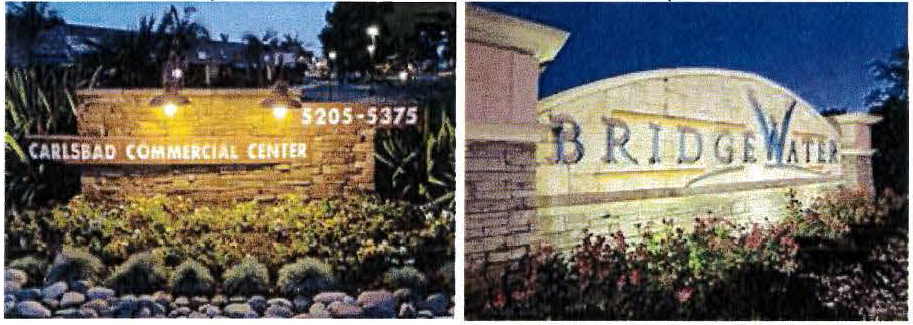
Preferred external illumination standards.
a.
Goose-neck lighting—This form of external illumination consists of lamps that hang over the sign, where the lamps are an attractive architectural component of the building.

b.
Spot or ground external lighting—This is a method of illumination where the source is shielded from public and is not an architectural component of the building or sign.
c.
Direct lighting—Any method of external illumination where a light source is directed at a sign, and is adequately shielded to prevent light pollution on neighboring properties.
I.
Unlawful cutting of trees and shrubs. No person may for the purpose of increasing or enhancing the visibility of any sign, damage, trim, destroy or remove any trees, shrubs or other vegetation located:
1.
Within right-of-way of any public street or road, unless the work is done pursuant to any approved site or grading plan;
2.
On property that is not under the ownership or control of the person doing or responsible for such work, unless the work is done pursuant to the express written authorization of the owner of the property where the trees and/or shrubs are located; or
3.
In any area where such trees or shrubs are required to remain pursuant to an approved site plan, grading plan or plat.
J.
Signs on undeveloped/vacant property. Signs on undeveloped/vacant property may be used for any purpose permitted by this ordinance. For the purposes of this requirement, a property is considered "developed" when it contains a permitted active principal use. Rights-of-way, fee simple land, and/or easements used for utilities, roads, railroads, and similar uses are considered "Undeveloped/Vacant property" and may not contain any type of changeable copy signs.
K.
Municipal information signs.
1.
The City of Mt. Juliet may install within public City rights-of-way municipal information signs. Such signs shall:
a.
Provide directions only to locations within the corporate limits or urban growth boundary of the city;
b.
Conform to the materials and construction standards established by the City;
c.
Conform to standards set by the commission with their number, location and content.
2.
The City of Mt. Juliet may install and/or authorize the placement of signs with non-commercial messages within the public City rights-of-way.
(Ord. No. 2016-30, § 1(Exh. A), 6-13-2016; Ord. No. 2017-29, § 1, 5-8-2017; Ord. No. 2018-28, § 1, 8-13-2018)
Sec. 11-104. - Construction and maintenance.
A.
Code compliance. All signs shall comply with the applicable provisions of the current Building and the Electrical Codes as adopted by ordinance of the City of Mt. Juliet at all times.
B.
Permanent installation required. Except for permitted flags, temporary banners/signs, and window signs conforming in all respects with the requirements of this ordinance, all signs shall be constructed of permanent materials and shall be permanently attached to the ground, a building, or another structure by direct attachment to a rigid wall, frame or structure.
C.
Maintenance. All signs shall be maintained in good structural condition, in compliance with all building and electrical codes, and in conformance with this section, at all times. Specifically:
1.
A sign shall have no more than 20 percent of its surface area covered with disfigured, cracked, ripped/peeling paint, or other material for a period of no more than 30 days.
2.
A sign shall not stand with bent or broken sign facing, with broken supports, with loose appendages or struts, or more than 15 degrees from vertical for a period of no more than 30 successive days.
3.
A sign shall not have weeds, trees, vines, bird nests or other vegetation growing upon it, or obscuring the view of the sign from the street or right-of-way from which it is to be viewed for a period of no more than 30 successive days.
4.
An internally illuminated sign shall be allowed to stand with only partial illumination for a period of no more than 30 successive days.
5.
Damaged and/or deteriorated signs shall be restored within 60 days or removed in accordance with the provisions set forth herein.
(Ord. No. 2016-30, § 1(Exh. A), 6-13-2016)
Sec. 11-105. - Prohibited signs.
All signs not expressly permitted under this section or exempt from regulation hereunder in accordance with the previous section are prohibited. Such signs include, but are not limited to:
A.
Abandoned, dilapidated or obsolete signs: Such signs and all frames, supporting structure, posts and appurtenances shall be removed by the owner of the property, their agent, or person having a beneficial use of the premises upon which said sign is located.
B.
Any commercial sign located in a residential district not otherwise provided for in this article.
C.
Any sign that obstruct free ingress or egress through a required door, window, fire escape or other required exit way.
D.
Any sign which by reason of its location, positions, size, shape, materials or other physical characteristics poses a safety hazard to drivers, pedestrians or residents.
E.
Animated—Other attention-attracting devices except to the extent that they conform fully to the dimensional, design, lighting and other standards applicable to a sign in the same location. Includes signs that emit audible sound, odor, visible matter (smoke, steam), projecting images, search lights, sign spinners/holders/walkers or involve the use of live animals.
F.
Banners, beacons, pennants, and streamers, except for those otherwise provided for in this article or article 3-106.VI, Temporary Event and Use Policy. Banners erected in or over a public right-of-way or streets are specifically prohibited.
G.
Bench signs.
H.
Blade banners, feather flags, swoop flags, teardrop flags, vertical flag, temporary flags and similar devices.
I.
Flashing signs, including flashing signs inside the window visible from the street (public or private).
J.
Inflatable signs including inflated characters, lighter than air devices, and other balloon type devices not otherwise provided for within this article.
K.
Obscene signs—Any signs that exhibits statements, words or pictures of an obscene nature, as defined by the United States Supreme Court.
L.
Off-site signs.
M.
Portable signs—including but not limited to, a-frame, sidewalk, sandwich board.
N.
Projecting signs.
O.
Roof signs, or signs extending beyond the main roofline, provided that signs may be mounted on an architectural feature extending beyond the roofline if such feature is fully enclosed and considered an integral part of the occupied space, such as an atrium or high ceiling.
P.
Signs on natural features such as trees, vegetation and rocks.
Q.
Signs that are painted, pasted or printed on any curbstone, flagstone, pavement, or any portion of any sidewalk or street, except house numbers and traffic control signs.
R.
Signs in the public right-of-way except as follows:
1.
Public signs erected by or on behalf of a governmental body to post legal notices, identify public property, convey public information, and direct or regulate pedestrian or vehicular traffic.
2.
Public transit signs.
3.
Informational signs of a public utility regarding its poles, lines, pipes or other facilities.
4.
Signs appurtenant to a use of public property permitted under a franchise or lease agreement with the City of Mt. Juliet.
5.
Emergency warning signs erected by a governmental agency, a public utility company or a contractor doing authorized or permitted work within the public right-of-way.
S.
Signs which constitute a traffic hazard described as follows: Any sign which by reason of its location, position, size, shape or color may obstruct, impair or otherwise interfere with the view of, or be confused with, any traffic control sign or signal erected by a public authority. To those ends, no sign shall use the words, "slow," "stop," "caution," "yield," "danger," "warning" or "go" in a manner that misleads, confuses or distracts a vehicle driver.
T.
Snipe signs including those utility poles, fences and benches.
U.
Strings of lights.
V.
Suspended signs.
W.
Trash receptacle signs, other than listing the name and contact information for the waste company providing the receptacle.
X.
Vehicle signs—Limited to a sign placed upon a vehicle that either advertises a business that employees or is owned by the owner of the vehicle. Such signage must be painted or wrapped. Vehicle signs cannot be hung, draped or temporarily attached for immediate removal. Specific placement for off-site advertising is not allowed.
Y.
Any other sign not specified herein and which is not a lawful nonconforming sign.
(Ord. No. 2016-30, § 1(Exh. A), 6-13-2016)
Sec. 11-106. - Exempt and exception signs.
A.
Signs exempt from regulation. The following signs shall be exempt from regulation under this section, provided all conditions if noted are followed, and do not require a permit:
1.
Any public, legal or official instrument, notice or warning required by a valid and applicable federal, state or local law, regulation or ordinance.
2.
Traffic control signs such as stop, yield, and similar signs, the faces of which meet Department of Transportation standards and which contain no commercial message of any sort.
3.
Signs internal to a building that are set back more than three feet from a window or door.
4.
Non-commercial flags attached to residential structures in residential zones.
5.
Freestanding flag poles in residential zones.
6.
Scoreboards; athletic/ball field fence signs (cannot exceed the height of the fence).
7.
Decals, numbers, names, addresses, hours and the like attached to doors or windows and all of which occupy a total area of two square feet or less.
8.
Other signs and stamps required by state and federal law, provided they are of the size no greater than the minimum requirements of the law.
9.
Time and temperature signs.
10.
Works of art that do not include a commercial message.
11.
Decorative signs that may be displayed on light poles within a commercial retail or planned unit development, provided such signs do not contain any commercial name, logo or commercial message.
12.
Municipal information signs—The City of Mt. Juliet may install within public City rights-of-way municipal information signs. Such signs shall:
a.
Provide directions only to locations within the corporate limits or urban growth boundary of the city;
b.
Conform to the materials and construction standards established by the City;
c.
Conform to standards set by the Commission with their number, location and content.
d.
The City of Mt. Juliet may install and/or authorize the placement of signs with non-commercial messages within the public City rights-of-way.
B.
Exception signs (temporary).
1.
Non-commercial signs. Temporary non-commercial signs may be displayed on private property with permission of the property owner. There shall be a limit of two temporary, non-commercial signs posted on any lot at any given time. 60 days prior to and five days after any primary or general election, this limit shall be increased to ten temporary non-commercial signs per lot. Temporary non-commercial signs are limited to six square feet per sign face, with a maximum of two sign faces per sign, and a maximum height of four feet. A sign permit is not required for temporary non-commercial signs.
(Ord. No. 2016-30, § 1(Exh. A), 6-13-2016; Ord. No. 2017-01, § 1, 1-9-2017)
Sec. 11-107. - Allowable signs by district.
All signs designated in this section, and Table A shall conform to the standards established herein, In addition to those applicable standards set forth elsewhere herein. See section 11-108 for special conditions as noted in Table A.
A.
All zoning districts. The signs listed below are allowed in all zoning districts, provided that such signs are on private property unless otherwise provided; that such signs are maintained in a manner that does not create a safety hazard; and that the specific restrictions set forth for each type of sign listed below shall apply wherever such a sign is erected, displayed or maintained:
1.
An official sign or notice issued or required to be displayed on private property by any court, public agency or public office, whether permanent or temporary.
2.
A traffic directional, warning or information sign authorized by any public agency, whether permanent or temporary.
3.
A private street or road name sign located at an intersection that does not exceed two square feet per face and does not advertise any commercial name, message or logo.
4.
Signs denoting a property as historic. Such signs shall be authorized by the State of Tennessee or Mt. Juliet Historic Zoning Commission and shall not exceed 16 square feet per sign face nor exceed nine feet in height.
5.
Non-commercial flags/government flags/civic flags, limited to 60 square feet per face, displayed in a non-commercial manner. No flagpole shall exceed 40 feet in height in any zoning district.
6.
Decorative flags (non-commercial). One decorative flag, limited to 24 square feet, whether temporary or permanent, may be displayed on any lot provided that it does not contain any commercial message, logo or symbol. No flag pole shall exceed 40 feet in height.
7.
Building marker. Any permanent building marker shall be limited to four square feet of sign face and composed of materials compatible to the identified building.
8.
All commercial window signage shall comply with the following requirements (see [section] 3-104.7.5.F for retail liquor stores)
a.
Permanent and Temporary window signs shall not exceed 25 percent of the aggregate window or door area, if such door is a see through glass door. A group of windows on a particular building elevation separated by a distinct architectural feature, other than the window frame, shall be considered a separate contiguous window area and the sign area within each contiguous window area shall not exceed 25 percent [CM 1].
b.
Window and door signs shall be located fully within the interior of the building and attached directly to or mounted within 12 inches of the inside of commercial type businesses.
c.
Except otherwise provided within this section, window signage may be painted on the interior of the window with easily removable paint, constructed of paper, cloth or other like material, or internally illuminated provided that the signage is UL-approved, non-animated, does not flash, blink or otherwise contain attention getting features. LED electronic message center window signs are prohibited.
d.
All window signs shall be conformance with all applicable safety and electrical codes.
For all other signs, please see Table (A) for specifications and requirements by sign type and provided that such signs are on private property unless otherwise provided; that such signs are maintained in a manner that does not create a safety hazard; and that the specific restrictions set forth for each type of sign as listed in section 11-108, Special Conditions, or Appendix Table (A) permitted signs.
Sec. 11-108. - Permitted signs.
APPENDIX
Table A—Sign Classifications and Types
All Zoning Districts specifications unless otherwise provided for
Zoning Types
(I) All Industrial
(R) All Residential
(CG) Commercial General
(CI) Commercial Interchange
(CMU) Commercial Mixed Use
(CNS) Convenience Neighborhood Service
(OPS) Office Professional Service
(CTC) Commercial Town Center District
(CRC) Commercial Retail Center
Specifications for permitted signs including Appendix (Table A)
A.
Interstate radius. Signs within the interstate radius must be spaced at intervals no less than 500 feet apart. The edge of the sign face shall be a minimum of 30 feet from any public right-of-way or street.
B.
Permanent sign setbacks. All permanent signs shall be setback at least two feet from a public right-of-way or private roadway or eight feet from the edge of pavement or back of curb, whichever is greater, unless a greater distance is required to remove such sign from the sight distance triangle, or otherwise specified by these provisions. No permanent sign shall be located within a public utility or drainage easement, without written from the affected agencies.
C.
Special conditions by sign type. The following supplemental regulations apply to particular types of signs or to particular signs in particular circumstances. Where appropriate, the tables refer to the conditions set forth in these supplemental regulations by paragraph number within this section. See section 3-104.7 for regulations applicable to retail liquor stores. Changeable copy signs shall not be authorize for retail liquor stores.
1.
Changeable copy.
a.
Electronic changeable copy signs shall only be permitted for schools, churches, and City of Mt. Juliet parks and recreational facilities.
b.
Electronic signs for fuel stations are permitted in convenience neighborhood service and commercial districts for the sole purpose of displaying fuel pricing.
c.
With the exception of gas price signs, changeable copy signs may not be displayed on a building, window, or canopy. All changeable copy signs other than gas price signs shall be freestanding signs. Gas price signs may be mounted on a canopy or freestanding when complying with other requirements of this ordinance.
d.
Electronic signs: the display of the message must be static for a minimum of eight seconds. When copy changes occur, they must change instantaneously with no phasing, scrolling, flashing or any other characteristic which imitates movement.
e.
All electronic messages shall be displayed as illuminated text against a black or non-illuminated background. Black or dark text against an illuminated or bright background is not permitted.
f.
Signs shall be used for the display of text and numbers only and no more than two colors shall be used at one time. The display of graphics, photographs, art, or other images, or the use of text/numbers to create such images shall not be allowed on electronic signs.
g.
The area of the changeable copy portion of the sign shall not exceed 75 percent of the total area of the freestanding sign.
h.
The illumination of an electronic changeable copy sign shall not exceed 0.3-foot candles over ambient lighting conditions, day or night. Measurement shall be as prescribed in the document "Recommended Brightness Levels for On-Premise Electronic Message Centers" published by the International Sign Association. All electronic signs shall be equipped with a sensor device that automatically determines the ambient illumination and each electronic sign shall be programmed to dim in accordance with ambient illumination conditions. Maximum illumination from dusk to dawn shall not exceed 500 nits. A malfunctioning sign shall be programmed to shut down.
i.
No changeable copy sign shall be placed within 100 feet of any residential zoned property measured by a straight line.
j.
A changeable copy sign may not constitute an off-site sign as defined herein. This rule shall not prohibit the display of non-commercial messages on changeable copy signs, including, but not limited to, announcements for nonprofit organizations and the City of Mt. Juliet.
2.
Community facility (churches, schools, service clubs and parks and recreation facilities). Signs for community facilities, shall conform to the following provisions:
a.
Wall signs. Wall signs shall be mounted in a flat fashion, and shall be limited to 1.5 square feet of signage per linear foot of the front facade of the building up to a maximum area of 120 square feet per sign and a maximum of four signs and 480 square feet.
b.
Freestanding signs. A maximum of two freestanding signs shall be located on any community facility site. No more than one non-changeable copy sign and/or one changeable copy sign (manual or electronic) shall be permitted. Both signs shall comply fully with all limitations and specifications contained in this section.
1.
Non-changeable copy sign. Signs shall be a maximum of 24 square feet per sign face, with a maximum of two sign faces, and a maximum sign height of six feet.
2.
Changeable copy sign. (As defined in section 11-110). All signs shall conform to section 11-108.C.1, Requirements for Changeable Copy Signs (Manual and Electronic), and the following:
a.
The maximum height of the sign, including base and frame shall be seven feet.
b.
The maximum size of the sign shall be 32 square feet including the changeable copy and non-changeable copy portions thereof. The changeable copy portion of the sign shall not exceed 75 percent of the total area of the freestanding sign.
c.
Electronic portions of the sign shall only be illuminated from 6:00 a.m. to 10:00 p.m. A sleep mode shall be included in each sign and shall be programmed to comply with the time limitations of this subsection.
d.
No sign shall be placed within 200 feet of an adjacent single-family residence.
e.
Signs may be placed on the same or alternate street frontages so long as a minimum of 300 feet is provided between such signs.
3.
Real estate signs (temporary). One temporary sign advertising the sale, auction, rental or lease of real estate may be displayed on the private property which is for sale, auction, rental or lease.
a.
Residential—The maximum in residential zones is nine square feet in size and four feet in height and may be dual faced. The sign shall be maintained or replaced if damaged, torn, or otherwise defaced.
b.
Commercial/industrial—The maximum in commercial and industrial zones is 20 square feet in size and eight feet in height. The sign shall be maintained or replaced if damaged, torn, or otherwise defaced. Signs advertising the lease or sale of commercial or industrial real property shall only be permitted for 90 days. Upon a showing that the property has not sold or been rented in such 90 day period, and such property remains available on the site wherein the sign is located, the Zoning Administrator is permitted to allow the for sale or rent sign to stand for an additional 90 day period. This process may continue until the real property is sold or leased.
c.
On corner lots and double frontage lots, one such sign may be displayed on each of the two frontages. These two signs shall be separated by at least 100 feet. Properties in excess of three acres may include up to two additional real estate signs, provided such signs are spaced at 500-foot intervals, not located within a public right-of-way and shall not create a visibility hazard.
These signs may remain for as long as the property is for sale, auction, rental or lease and shall be removed within three days of closing of the sale, end of the auction or rental of the premises. Setbacks shall be at least ten feet back from the street curb, edge of pavement or stabilized shoulder, and two feet from the edge of public right-of-way or private roadway, whichever is greater, unless a greater distance is required to remove such sign from the sight distance triangle or otherwise specified within these provisions.
To accommodate an open house, an open house sign may also be placed on the property under the same size and setback requirements specified above. These open house signs shall be allowed on the day of the open house, to be removed by 10:00 a.m. the next day, and on Friday, Saturday and Sunday, regardless of the date of the open house, and removed by 10:00 a.m. on Monday. Such signs are allowed in addition to all other permitted signs.
Temporary residential development signs—One such sign may be erected on-site per street frontage for the purpose of advertising the development of a subdivision or multifamily development (including multi-family developments zoned as CMU). The sign may remain until the sale of all subdivision lots are complete, or the construction of the multi-family development is complete. The sign has a maximum sign face area of 32 square feet per face, maximum of two sign faces and a maximum height of eight feet.
4.
Incidental signs—Commercial tracts other than CNS Zoning.
a.
For all commercial tracts utilizing less than eight acres of land per business/commercial use, incidental signs not exceeding two square feet in area per face. Such signs proclaiming "no trespassing," "no hunting," "no parking," "entrance," "exit," "loading only," "phone," "ATM," "open/closed," "hours of operation," and the like shall be considered incidental to the use of property. There shall be no more than one such incidental sign per 75 spaces provided for customer parking. Enter and exit signs for directing vehicular traffic to/from adjacent roadways shall not be more than three feet in height.
b.
For all commercial tracts utilizing eight acres of land or greater per business/commercial use, incidental signs not exceeding four square feet in area per face and not to exceed six feet in height. Such signs proclaiming "no trespassing," "no hunting," "no parking," "entrance," "exit," "loading only," "phone," "ATM," "open/closed," "hours of operation," and the like shall be considered incidental to the use of property. There shall be no more than one such incidental sign per 75 spaces provided for customer parking, and said sign shall not be visible from public roadways. Enter and exit signs for directing vehicular traffic to/from adjacent roadways shall not be more than three feet in height.
5.
Freestanding signs.
a.
Signs within the interstate radius must be spaced at intervals no less than 500 feet apart. The edge of the sign face shall be a minimum of 30 feet from any public right-of-way or street.
b.
All permanent signs shall be setback at least two feet from a public right-of-way or private roadway or eight feet from the edge of pavement or back of curb, whichever is greater, unless a greater distance is required to remove such sign from the sight distance triangle, or otherwise specified by these provisions. No permanent sign shall be located within a public utility or drainage easement, without written from the affected agencies.
Table B—Freestanding Signs
Commercial Districts Other Than CNS
**In addition to the maximum sign faces per sign as allowed above in Table B, Freestanding signs, the addition of a building/development identification sign face may be allowed, with a maximum of two sign faces, and not to exceed 15 square feet in area.
6.
Wall signs (Commercial/Industrial Districts other than CNS). Wall signs shall be mounted in a flat fashion. For the purposes of this article, painted wall signs, awning and canopy signs shall be calculated as and deducted from the total allowable wall sign area. In no event shall awning or canopy signage exceed 30 square feet. Changeable copy signs shall not be permitted as wall signs. See below for calculations and computations:
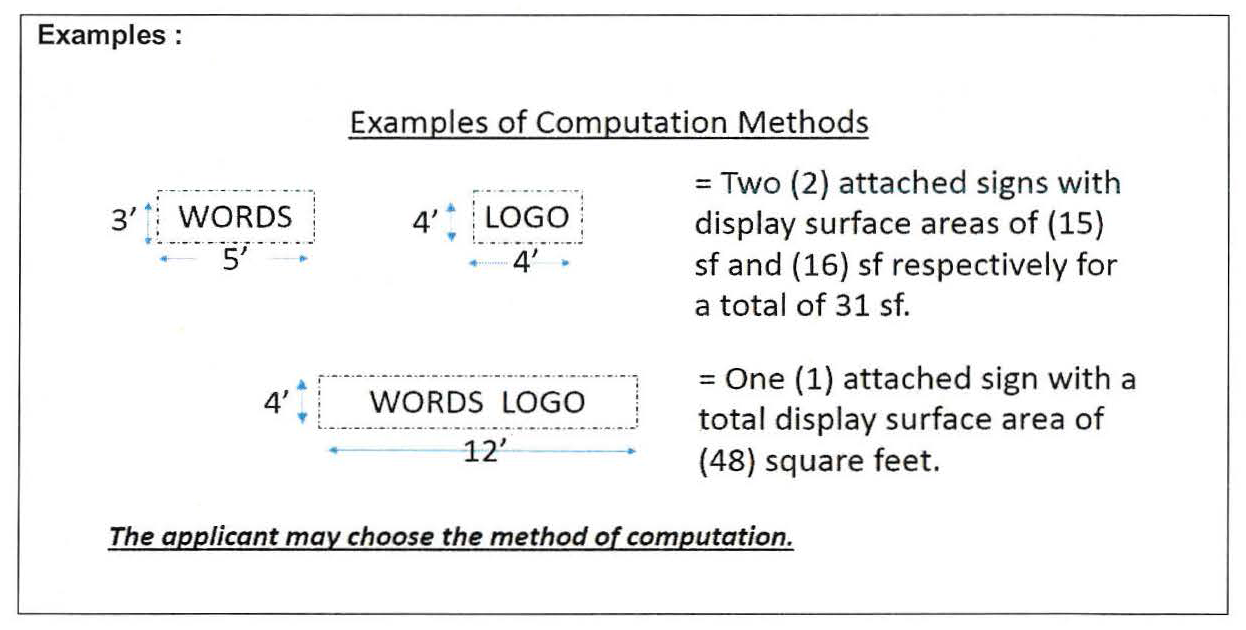
When more than one word, image, logo and/or trademark is attached to one elevation of a building and they are not enclosed by a box or outline, either:
a.
Each word, image, logo and/or trademark may be considered as a separate attached sign, with the display surface are of each such sign being calculated as listed in the example below; or
b.
Two or more of the words, images, logos and/or trademarks may be considered as one attached sign, with the display surface area of the sign being calculated as the area within an proposed rectangular box around the combination of the two or more words, images, logos, and/or trademarks, by calculating the size of multiplying height by width.
1.
Retail or service use/individual principal entrance. The primary entrance to the occupied space shall be considered the front facade.
Specifications. Sign area: 1.5 square feet of signage per linear foot of building elevation for the front facade space for the building, and 2.0 square feet of signage per linear foot of building elevation for the side and/or rear façade space for the building, maximum, provided that no single sign shall exceed 120 square feet, with a total signage limitation of four signs and 480 square feet per business.
2.
Retail or service use/multiple tenants. Each business, of a retail or service nature, sharing a common entrance shall be allowed to have at least one wall sign.
Specifications. Maximum sign face area, 20 square feet per sign face.
7.
Wall signs—Commercial complex.
a.
Signs for tenants with external primary entrances per occupied space, may have a wall sign with a maximum sign face area of 20 square feet, when the building shall include a primary entrance for internal tenants. Internal tenants within the same building sharing a common principal entrance shall not have external wall signs, however, the building shall be allowed a maximum of three wall signs for building identification purposes only.
b.
Specification. External primary entrance wall signs per tenant, maximum of 20 square feet for the sign face. Building identification wall signs, no single sign shall exceed 60 square feet, and shall have a total signage limitation of three signs and 180 square feet.
8.
Permanent residential subdivision signs.
a.
Permanent residential subdivision signs. Such signs shall be located at the primary entrance(s) to a development as identified on a preliminary/final plan approved by the planning department. The signs shall be located on private property and may be within any platted sign and/or landscape easement or within the common open space and approved by the planning department. Such signs shall be maintained by an established property owners' association.
b.
Specifications. One sign per entrance, with a maximum of four entrances per subdivision; maximum sign face area, 24 square feet per sign face, with a maximum of two sign faces; maximum sign height, six feet; setback, ten feet from edge of pavement or the edge of the public right-of-way, whichever is greater, unless more space is necessary to preserve the sight distance triangle. Signs shall provide landscape in the form of trees, shrubs and groundcover along with seasonal color. Walls and landscape shall be maintained by the homeowners association, if one exists. If no homeowners association exists, then the entity/person that erected the sign, or his designee, shall maintain the walls and landscape.
9.
Flag (permanent). The display of permanent horizontal flags shall be subject to the following limitations:
a.
There shall be no more than three flagpoles per principal building on any zone lot. The poles shall be installed in concrete at least three feet deep.
b.
There shall be no more than two flags per pole.
c.
No flag may contain a commercial message except that one of the allowed flags may contain a commercial message in a non-residential zone.
d.
No flagpole shall exceed 35 feet in height. Flagpoles on buildings shall not extend more than 15 feet above the highest point of the building or roof.
e.
The Zoning Administrator shall have the authority to review and approve, if applicable, any increases in the height of a flag pole, based on the zoning and use of the property.
10.
Vehicle signs. Temporary vehicle signs are prohibited as noted in section 11-105, [subsection] X. Permanent vehicle signs shall be painted or vinyl wrapped, and is an ad that advertises a business that employees or is owned by the owner of the vehicle. Permanent vehicle signs cannot be specifically parked or placed for off-site advertising.
11.
Temporary signs.
a.
Unless otherwise provided for within this article or on Table A, temporary signs shall be limited to and not exceed a period of 30 consecutive days in a calendar year. Businesses shall be limited to a maximum of four temporary sign registration permits to be issued within a calendar year.
b.
For a single commercial lot, that has multiple businesses located on the same lot, there shall be no more than three temporary signs allowed on the lot at any time, and each business shall be limited to one sign in accordance with the time frame and sign limitations as set forth above.
(Ord. No. 2016-30, § 1(Exh. A), 6-13-2016; Ord. No. 2018-26, § 1, 7-9-2018)
Sec. 11-109. - Administration and enforcement.
A.
Waivers and variances. The Regional Planning Commission shall have the authority to approve increases in sign area for the following uses and as prescribed in [subsections] 1—4 below:
1.
Wall signs for community facilities.
2.
Wall signs for "big box" buildings in commercial districts other than CNS may be increased a maximum of 50 percent above the allowances in 11-108.C.6, Wall Signs. A "big box" building shall have a front dimension greater than 200 lineal feet and a minimum gross floor area of 75,000 square feet.
3.
Wall signs for industrial buildings in all industrial districts may be increased a maximum of 50 percent above the allowances in 11-106.5(a), provided that the building has a front dimension greater than 300 lineal feet and a minimum gross floor area of 100,000 square feet.
4.
Wall signs for buildings in commercial districts other than CNS, with four stories or more, shall not exceed 175 square feet in size, if approved by the Regional Planning Commission.
5.
In making their decision, the Regional Planning Commission shall approve additional sign area under this section when it has been determined that the requested signage is in proportion and scale to the size of the building façade to which it is to be installed.
B.
Regulatory enforcement. The sign administrator and/or his designees are hereby authorized and directed to enforce all of the provisions of this article. This authority empowers such individuals to perform any necessary inspections, including entering upon private property, and to issue related citations for the enforcement of this article.
1.
Violation notice. The sign administrator or his designee shall order the removal of any sign permanently erected or maintained in violation of this article, providing ten days' written notice to the owner of the premises upon which the offending sign is located to achieve compliance with provisions of this article. If, after ten days, the property owner has failed to achieve compliance with this article, a citation to municipal court shall be issued. However, when good faith efforts to bring a sign into compliance have begun within ten days of notice of violation, the sign administrator may extend the time period for compliance with this article to a period not to exceed 30 days. Temporary commercial signs may be removed immediately upon notice of a violation. Temporary non-commercial signs will receive a 24-hour notice prior to removal.
2.
Impoundment/disposal of signs. The sign administrator, the municipal codes officer and their designees shall have the authority to remove without notice any illegal sign on public property or a public right-of-way, or any illegal sign attached to trees, fences, posts, utility poles or other natural features. Such signs shall be considered litter and shall be subject to disposal.
3.
The sign administrator, the municipal codes officer and their designees shall have the authority and discretion to remove, without prior notice, any sign on public or private property which, due to its physical condition and/or location, constitutes an immediate threat to the safety of citizens or other passersby. Notice shall, however, be provided to the landowner within ten days of removal of a permanent sign on private property.
4.
Each day that a violation of this ordinance remains shall constitute a separate violation of this ordinance for purposes of the court's assessment of fines or penalties.
5.
In addition to other remedies here in under, the City shall have the right to recover from the owner or person placing such a sign the full costs of removal and disposal of such sign.
C.
Conflict. In case of conflict between this ordinance or any part hereof, the City, and any other provision of this Code, the provision that establishes the higher standard shall prevail.
The provisions of this sign ordinance control signage in the City. Any other provisions of the City zoning ordinance which purport to control signage are subordinate to the provisions of this ordinance, unless specifically stated otherwise in this ordinance.
(Ord. No. 2016-30, § 1(Exh. A), 6-13-2016)
Sec. 11-110. - Definitions.
The following definitions shall apply to the interpretation of this article. The definition of the singular form of any defined term also applies to the plural form of the same term.
Abandoned sign means a sign that was lawfully erected on the property in conjunction with a particular use, that use having been subsequently discontinued for a period of 120 days or more, or a lawfully erected temporary sign for which the time period allowed for display of the sign has expired.
A-frame (portable, sidewalk, sandwich board) means a "sandwich-board" style sign that is anchored to a concrete sidewalk outside of the public right-of-way. The term "anchored" means tie-downs, weights or other methods of preventing movement because of winds.
Accessory sign [means] a sign, generally informational or directional, that has a purpose secondary to the use of the lot on which it is located, such as "no parking," "entrance," "loading only," "telephone," or other similar devices.
Address sign [means] the official street address of a building or part thereof.
Animated sign means any sign that uses movement or change of lighting to depict action or create a special effect or scene, or any sign that uses fade in/fade out, marching, rolling, flashing, scrolling, or other special effects created with lights, or other means (LED, LCD and similar technology whether now existing or hereafter created). A sign on which any message changes more frequently than every eight seconds shall be considered an animated sign. Animated attention-attracting devices may or may not convey a message and may include, but are not limited to, the following:
1.
Search lights.
2.
Beacons.
3.
Rope and or string lights.
4.
Neon lights, except as an incidental sign i.e. open/close sign and a marquee for a movie theater.
5.
Sign spinners and/or persons in costumes or any other animated sign design to attract attention.
Awning sign [means] any sign, which is painted, printed, sewed, or otherwise attached to an awning. For purposes of this article, signage on two panels of an awning counts as one sign for purposes of calculating total number of allowable signs.
Balloon [means] any spherical shaped inflatable device (excluding mylar balloons) 14 inches or less in diameter, tethered in a fixed location. Often used for promotional events and grand openings. (*See Inflatable)
Banners, pennants and streamers means any sign of fabric or other flexible material that is mounted to a pole, enclosed in a frame, or otherwise mounted to allow movement caused by wind. Flags shall not be considered as banners under this article.
Beacon. See Animated.
Building identification marker means any sign indicating the name of a building or date and incidental information about its construction, which sign is cut into a masonry surface or made of bronze or other permanent material.
Canopy sign means any sign that is a part of, attached to, or made up of an awning, canopy, or other protective cover over a door, entrance, window or outdoor service area. A marquee is not a canopy.
Changeable copy sign (manual) means a sign or portion thereof with characters, letters, or illustrations that can be changed or rearranged without altering the face or the surface of the sign, and without the aid of lighting or electronic means. All words, text, or other display shown on a sign at one time shall be considered to be one message.
Changeable copy sign (electronic) means a sign or portion thereof with characters, letters, or illustrations that can be changed or rearranged without altering the face or the surface of the sign, with the aid of lighting (LED or otherwise) or electronic means. All words, text, or other display shown on a sign at one time shall be considered to be one message. A sign on which any message changes more than every eight seconds shall be considered an animated sign and not a changeable copy sign for purposes of this ordinance. A sign on which the only copy that changes is an electronic or mechanical indication of time or temperature shall be considered a "time and temperature" portion of a sign and not an electronic changeable copy sign for purposes of this ordinance.
Commercial complex.
1.
Two or more buildings proposed for occupancy by commercial activities constructed or to be constructed upon one zone lot; or
2.
Two or more principal commercial uses or occupancies located upon one zone lot.
Commercial message means any sign wording, logo, mural, or other representation that directly or indirectly names, advertises or calls attention to a business, product, service or other commercial activity.
Community facilities are churches, schools, service clubs and parks and recreation facilities.
Construction sign means a sign conveying information about a building project, such as the name and use of the building being constructed, and the names of architects, engineers, contractors and other persons involved with the construction project.
Decorative artwork {means] exterior works of art, such as statues, murals, and super graphics that do not advertise a product, service, or business; may include vertical banners attached at two ends to a light pole.
Dilapidated sign means any sign that is structurally unsound, has defective parts, or is in need of painting or other maintenance.
Directional sign means a permanent sign erected for or by a public entity for purposes of identification, direction or public safety.
Directory development sign means a sign providing orientation within an office or commercial subdivision, listing such information as on-site businesses and other tenants and their respective activities.
Façade [means] the entire wall of any side of a building, including the wall [CM2] face, parapet, facis, windows, door, canopy and roof on any complete elevation.
Flag means any fabric or bunting containing distinctive colors, patterns or symbols that is used as a symbol of a governmental, commercial, or non-commercial entity.
1.
Commercial flag means any flag which displays a commercial name, message, logo or symbol.
2.
Decorative flag means any flag which displays any holiday or seasonal insignia, design or the like which does not include any commercial name, message, logo or symbol.
3.
Non-commercial/government/civic flag means any flag displaying a name, message, logo or symbol of any governmental, religious, civic or nonprofit agency.
Flashing Sign [means] any illuminated sign whose motion or visual impression primarily changes through electronic means. Said signs include visual simulation of motion characteristic of chasing, running, blinking, oscillating, twinkling, or expanding or contracting light patterns.
Freestanding/ground sign means any sign supported by structures or supports that are anchored in the ground and that are independent of any building or other structure. Freestanding signs include those that are mounted on a pole, pylon, or designed with a monument base.
Front facade means the front elevation of a building that faces the front property line, as recorded on the plat and/or site plan. If a structure is located on a corner parcel, the side which includes the primary entrance shall be considered the front facade. If a structure located on a corner parcel contains a primary entrance on more than one side, the longer side with a primary entrance shall be considered the front facade.
Illegal sign means any sign which is a prohibited sign or does not comply with the requirements established herein, is not a lawful nonconforming sign and is not exempted by law from the requirements established herein.
Illuminated sign (internally) means any sign that transmits light through its face or any part thereof.
Incidental sign means a sign, generally informational, that has a purpose secondary to the use of the lot on which it is located, such as "no parking," "entrance," "exit," "loading only," "no trespassing," "no hunting," "phone," "ATM," "open/closed," "hours of operation," etc.
Inflatable sign [means] any sign that is either expanded to its full dimensions or supported by gases contained within the sign, or sign parts, at a pressure greater than atmospheric pressure. A temporary inflated sign, which may be stationary or mobile that is used to attract attention, which may or may not bear a message. An inflatable stationary sign is anchored in such a fashion that does not allow it to move. An inflatable mobile sign is tethered so that it moves and free floats. For purposes of this definition and ordinance, a simple helium balloon is not considered to be an inflatable sign.
Lot frontage means the distance for which a lot line adjoins a public street from one lot line intersecting said street to the furthest distant lot line including the distances along not more than two streets for a corner lot or a double frontage lot.
Marquee sign means any sign attached to, or made part of, a marquee or other permanent roof-like structure that projects beyond a building face and is not supported from the ground.
Menu board means a structure primarily designed for the display of menu items and prices for the purpose of placing orders for such items in conjunction with a restaurant utilizing drive-through or curbside service.
Monument sign. See freestanding/ground.
Mural [means] painting or other work of art executed directly on a wall. See decorative artwork.
Non-commercial means not naming, advertising, or calling attention to a business or commercial product, service, or activity. However, where the name of a business is merely incidental to the primary purpose of a sign displayed on residential property, such as may be the case with a real estate sign or baby announcement, such sign shall be deemed non-commercial. This exception does not apply to at-home businesses.
Nonconforming sign or sign structure means any existing permanent sign or sign structure which does not conform to the provisions of this article, but was lawfully erected and complied with the sign regulations in effect at the time it was erected.
Off-site sign means any sign that directs attention to a business, commodity, service, use, or entertainment not exclusively related to, located on, or provided by the premises where such sign is located or to which it is affixed.
On-site sign means any sign that directs attention to a business, commodity, service, use, or entertainment that is related to, located on, or provided by the premises where such sign is located or to which it is affixed. In the case of a real estate office, a sign displaying information about properties that are off-premises but which are offered for sale or rent by the business on-premises shall be considered an "on-site" sign.
Painted wall sign means any sign or display painted directly on any exterior surface, exclusive of window or door. See Murals also.
Pennant. See Banners, pennants and balloons.
Permanent sign means any sign that is intended for other than temporary use or a limited period. A permanent sign is generally affixed or attached to the exterior of a building, or to a pole or other structure, by adhesive or mechanical means, or is otherwise characterized by construction materials, a foundation or anchoring indicative of an intent to display the sign for more than a limited period.
Pole sign [means] a freestanding sign supported wholly by one pole placed in the ground.
Political preference sign means any temporary sign erected on private property for the purpose of supporting a political candidate, stating a position regarding a political or ideological issue or similar purpose.
Portable sign means any sign designed or intended to be readily relocated, and not permanently affixed to the ground or to a structure. Portable signs include such signs as; A-frame sign; or any sign attached to or painted on a vehicle or trailer, parked and visible from the public right-of-way for more than four consecutive hours or more than eight total hours between sunrise and sunset. For the purposes of this article, portable signs shall not be considered permanent signs. Real estate signs and other temporary signs which are otherwise provided for in this article shall not be considered portable signs for purposes of this article. As to vehicles, portable sign shall not include a vehicle sign on which an ad is placed that advertises a business that employs or is owned by the owner of the vehicle. Such portable vehicle signs are permitted.
Projecting sign means any sign, other than a wall sign, whose leading edge extends beyond the building or wall to which it is affixed, forming an angle with said building or wall. Typically will extend laterally more than 18 inches from the face of such wall.
Public right-of-way/public way means a strip of ground dedicated for public use, usually for a public street, public infrastructure and/or waterway. For the purposes of this article, such rights-of-way shall be considered to extend a minimum of ten feet from the edge of pavement, or to the dedicated right-of-way boundary, whichever is further.
Real estate sign means a temporary sign erected by the owner, or his agent, advertising the real property upon which the sign is located for rent, lease or sale.
Roofline means the highest horizontal point of the wall visible to the public, excluding any architectural feature which extends above such apparent horizontal roofline if such feature is fully enclosed and considered an integral part of the occupied space, such as an atrium or high ceiling.
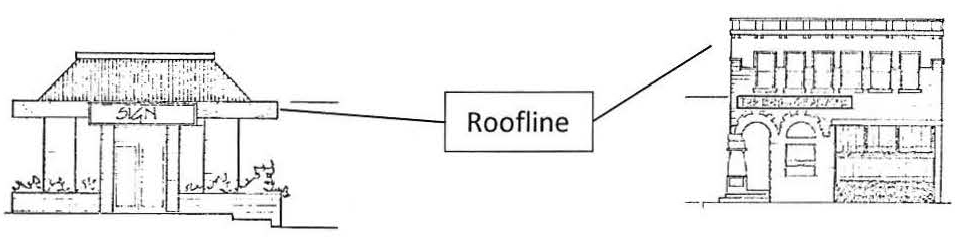
Roof sign means any sign erected wholly or partially above the roofline.
Scoreboard means a structure located within an athletic field, displaying changing scores and related information; provided, however, the scoreboard may also display additional content, including but not limited to the names and logos of any sponsors.
Sidewalk sign means a "sandwich-board" style sign that is anchored to a concrete sidewalk outside of the public right-of-way. The term "anchored" means tie-downs, weights or other methods of preventing movement because of winds.
Sign means any device, fixture, placard or structure that uses color, form, graphic, illumination, symbol or writing to advertise, announce or identify a person or entity, or to communicate information of any kind.
Sign administrator means the person designated by the City Manager as the staff member assigned to oversee the enforcement and interpretation of this article.
Sign area means square foot area enclosed by the perimeter of the sign face. With respect to signs that are composed of individual symbols, letters, figures, illustrations, messages, forms, or panels, sign area shall be considered to include all such components together with their background, surrounding frame, and any cutouts or extensions. The sign area shall not include any supporting structure or bracing.
Sign face means the entire area of a sign upon, against or through which sign copy is placed including any background.
Sign structure means any structure that supports, has supported, or is capable of supporting a sign, including any decorative cover for the sign structure. This definition shall not include a building, fence, wall or earthen berm.
Snipe sign means any sign that is affixed by any means to trees, rocks, utility poles, light poles, fences or other similar structures or objects, where the sign does not qualify as an incidental sign allowed pursuant to section 1-103 herein.
Special events sign [means] any sign advertising special temporary events, such as carnivals, festivals, exhibits, and parades, but not including promotional sales or grand opening signs.
Subdivision means the division of land into smaller tracts for any planned, self-contained residential or office development which, for the purpose of this article, shall initially consist of a minimum of 20 acres or shall create 20 or more individual lots.
Subdivision sign means any sign located at the entrance to a subdivision as defined in this article, for the purpose of identifying the subdivision.
Subdivision temporary development sign means any temporary sign for the purpose of advertising the sale of lots and the development of the subdivision. The names of participating home builders may be included on such signs. For purposes of this article, such signs shall not be classified as the same as a construction sign.
Suspended sign means a sign which is suspended from the underside of a horizontal plane surface and is supported by such surface.
Temporary sign means any sign not permanently mounted, with any message that is intended for temporary use and a limited period of time as specified, as allowed by this article. Temporary signs include but are not limited to political preference signs, construction signs, ideological signs, yard sale signs, help wanted signs and banners which are allowed pursuant to the applicable provisions of this ordinance. If sign display area or structure is permanent but the message displayed is intended to be displayed for a temporary period then such a sign shall not be regarded as a temporary sign. See article 3-106.VI, Signs, for temporary uses and events, for signs such as grand openings, now open, commercial sales events, nonprofit festivals, and other special events.
Time and temperature portion of a sign means a sign on which the only copy that changes is an electronic or mechanical indication of time or temperature.
Two sign faces means any sign with two parallel, or nearly parallel, faces back-to-back and constructed on a single set of supports, with messages visible on either side, or a V-type sign with a common support in the center of the V, where the inside angle of the V does not exceed 45 degrees. The width of a sign cabinet (measurement from face to face) shall be the minimum necessary to contain the working components of the sign.
Vehicle sign [means] flat, one dimensional signs painted or placed magnetically or otherwise attached on the side of vehicles as long as no other structural support is added to the vehicle. Advertising on vehicles for sale at bona fide automobile dealerships are excluded from this definition.
Wall sign means any sign, other than a projecting sign, that is attached parallel to or painted on any wall of any building, awning or canopy and projects from the plane of the wall, canopy or awning less than ten inches. This definition shall not include freestanding walls or multiple sign surfaces. Changeable copy signs shall not be permitted as wall signs.
Window sign means any sign, graphic, or interior design element placed upon the inside or outside of the window pane, or setback less than five feet from the window pane, and used to advertise, announce, or identify a person or entity, or to communicate information of any kind, or to draw visual attention to the business or use, and which is visible from off-site or the public right-of-way. For purposes of this article, window signs may be permanent or temporary and are subject to applicable provisions herein.
(Ord. No. 2016-30, § 1(Exh. A), 6-13-2016)

