COMMERCIAL DISTRICT REGULATIONS
6-101.1 General purposes. The commercial districts established by this ordinance are designed to promote and protect the health, safety, morals, convenience, order, prosperity and other aspects of the general welfare. These goals include, among others, the following:
1.
To provide sufficient space, in appropriate locations in proximity to established residential areas, for local retail and service trades catering specifically to the recurring shopping needs of the occupants of nearby residences.
2.
To protect both retail and service developments and nearby residences against fire, explosions, toxic and noxious matter, radiation and other hazards, and against offensive noise, vibration, smoke, dust and other particulate matter, odorous matter, heat, humidity, glare and other objectionable influences.
3.
To protect both retail and service developments and nearby residences against congestion, by regulating the intensity of retail and service developments consistent with their marketing functions, by restricting those types of establishments which generate heavy traffic, and by providing for off-street parking and loading facilities.
4.
To provide sufficient and appropriate space, and in particular sufficient area, to meet the area's expected future need for modern, planned commercial floor space, including the need for off-street parking space in areas where a large proportion of customers come by automobile, and to encourage the tendency of commercial establishments to concentrate in integrated planned developments, to the mutual advantage of both consumers and merchants.
5.
To provide sufficient space in appropriate locations for commercial districts to satisfy specific functional needs of the area, and in particular the need for medical services, and the needs of the general public traveling along major thoroughfares.
6.
To provide sufficient space in appropriate locations for the mixture of compatible residential and restricted commercial developments where standards for development will provide protection for the environmental essentials of either.
7.
To provide appropriate locations for transitional uses intervening between commercial developments and residential areas, and thereby alleviate the friction inherent between dissimilar activities.
8.
To provide sufficient space in appropriate locations for all types of commercial and miscellaneous service activities.
9.
To provide freedom of architectural design, in order to encourage the development of more attractive, efficient and economic building forms, within appropriate standards which ensure that buildings are in character with their surroundings.
10.
To promote the most desirable use of land and direction of building development in accord with a well considered plan, to promote stability of commercial development, to strengthen the economic base of the area, to protect the character of the districts and their peculiar suitability for particular uses, to conserve the value of land and buildings.
6-101.2 Specific purposes.
1.
CG, Commercial-General Districts. This district is designed to provide for a wide range of commercial uses concerned with retail trade and consumer services; amusement and entertainment establishments; automotive and vehicular service establishments; transient sleeping accommodations; drive-in stores; eating and drinking places, financial institutions; and offices. The uses in this district service a broad market spectrum and, therefore, ease of automotive access is a requirement. However, it is not intended that this district permit uses which generate large volumes of truck traffic. Community facilities and utilities necessary to serve these districts, or necessary for the general community welfare are also permitted. Appropriate open space between commercial and residential areas is required. This classification is intended to recognize an existing undesirable development pattern but not repeat or significantly expand the pattern beyond those areas where such is already established.
2.
CI, Commercial Interchange Districts. This district is designed to provide adequate space at major freeway interchanges for uses which serve the needs of the motoring public. Automobile and other vehicular service establishments, transient sleeping accommodations, and eating and drinking establishments primarily characterize this district. In addition, commercial trade and service uses are permitted if necessary to serve the recurring needs of persons frequenting these districts. Community facilities and utilities necessary to serve these districts, or necessary for the general community welfare are also permitted. Bulk limitations required of uses in these districts, in part, are designed to maximize building in proximate residential districts. Appropriate locations for this district are near major transportation interchanges in clustered development patterns and not patterns of striped commercial development extending in a continuous manner along major traffic arteries.
3.
CMU, Commercial Mixed Use Districts. These districts are designed primarily to provide sufficient space in appropriate locations for establishments and uses engaged in general retail, restaurant, professional offices, commercial services, residential dwellings, and services ancillary thereto. As these districts tend to generate relatively large volumes of vehicular traffic and may have other characteristics detrimental to residential environments, their locations are most suitable on properties with sufficient frontage on arterial streets. Where these districts must necessarily abut existing or proposed residential areas external to the development, efforts to minimize incompatibility shall be made by providing appropriate buffers and through proper site design. In addition, a selection of community facilities and utilities considered necessary to service the principal uses in these districts or necessary for the general community welfare, are permitted. Mixed-use developments may be permitted through the planned unit development process as described in [section] 8-207 of this [Zoning] Ordinance.
4.
CNS, Convenience Neighborhood Service Districts. These districts are intended to provide locations for retail and personal service operations serving a limited market area and engaged in the retail sale of goods and/or services from the site of frequently and recurrently needed items for personal consumption or household use. The permitted establishments are those which provide for regular local shopping and which, therefore, are visited frequently by customers. Community facilities and utilities necessary to serve these districts, or necessary for the general community welfare are also permitted. These districts may occur along and at the intersection of arterial and community collector streets, characteristically are small, and are widely distributed throughout the community for convenient accessibility. It is expressly intended that these districts be limited in gross land area and building bulk so as to maintain compatibility with the surrounding residential environment. The bulk regulations are established to provide for maximum compatibility between the commercial activity in these districts and adjacent residential activity. The establishment of a new district of this nature must be preceded by the development of residential areas capable of supporting the proposed activities.
5.
OPS, Office/Professional Service Districts. These districts are designed to provide for transitional uses between more intensive commercial activities occurring along major traffic arteries and residential areas. The permitted uses are ones which tend to produce relatively low volumes of traffic. In addition to the office activities, certain community facilities are permitted which are compatible with other uses permitted within these districts. The intensity of use and building bulk permitted within these districts is controlled by more restrictive regulation consistent with their intended transitional function.
6.
CTC, Commercial Town Center Districts. This district is designed to provide for a wide range of commercial uses concerned with retail trade and consumer services; amusement and entertainment establishments; eating and drinking places, financial institutions; and offices. The uses in this district service a broad market spectrum and, therefore, ease of automotive access is a requirement. Community facilities and utilities necessary to serve these districts, or necessary for the general community welfare are also permitted. Mixed-use developments may be permitted through the planned unit development process as described in [section] 8-207 of this [Zoning] Ordinance. Appropriate open space between commercial and residential areas is required.
7.
CRC, Commercial Retail Center Districts. These districts are designed to provide for a wide range of commercial uses concerned with retail trade and consumer services; eating and drinking establishments, financial institutions, offices, drive-in stores and general retail. The uses in this district service a broad market spectrum and, therefore, ease of automotive access is a requirement. However, it is not intended that this district permit uses which generate large volumes of truck traffic. Community facilities and utilities necessary to serve these districts, or necessary for the general community welfare, are also permitted. Appropriate open space between commercial and residential area is required. This classification is intended to allow for thoroughfare retail uses not permitted in CTC or OPS districts, while recognizing the existence of nearby or adjacent residential areas.
(Ord. No. 2005-05, 3-14-2005; Ord. of 10-23-2009, § 6-101; Ord. No. 2013-53, § 2, 7-8-2013; Ord. No. 2014-08, § 2, 2-10-2014)
6-102.1 General provisions. Principal uses of buildings or other structures and land have been classified and combined into major classes and activity types in article III of this ordinance. The procedure for interpreting the classes and type of activities is provided in article III, section 3-101, table 6-102A, presents a tabulation of uses and structures which are classified as principal permitted (P), permitted with supplemental provisions (SUP) or conditional (C) uses within the various commercial districts. The supplemental design provisions with which (SUP) and (C) uses and activities are required to comply appear in article III, section 3-104, Supplemental use regulations.
Note— Key to interpreting use classifications.
P = Use permitted by right within the district.
SUP = Principal use permitted with supplemental provisions.
C = Conditional use (subject to approval by the Board of [Zoning] Appeals).
ASP = Accessory use permitted with supplemental provisions.
(1)
See [sub]section 5-104 1 and 6-104 1
(2)
Gasoline sales and convenience markets are not permitted within CTC Districts
(3)
Retail liquor stores shall not be permitted in the CNS and OPS Zoning Districts.
(4)
In CG districts, the following use listings are prohibited: Auto dealers, auto towing services.
(5)
When approved through the PUD or PUD Amendment process in article VIII.
(6)
Within the Town Center Overlay District, Main Street Area, and when approved through the PUD process in article VIII.
(7)
Excluding payday lenders and pawn shops.
(8)
See 6-104.3.
(9)
Grocery stores shall have a minimum of 20,000 square feet in sales floor area.
(10)
Any CMU or CTC mixed use building or mixed use site must meet the requirements for residential development standards set forth in Zoning Code section 8-207, with the exception of CTC Mixed Use sites or buildings fronting N. Mt. Juliet Road with one-half mile of the intersection of East/West Division and Mt. Juliet Road which shall be a minimum of five acres. To the extent any other applicable regulation or any modification through the PUD process imposes additional/conflicting regulations on a PUD applicant, the most strict regulation will apply. Also, subject to Restriction Area, as shown in Exhibit A, as noted in Ordinance 23-[03].
(11)
Only breweries and microbreweries are permitted. In CTC and CMU breweries and microbreweries shall be permitted only through the PUD process in Article VIII.
(12)
Hotels and motels shall include a minimum of 100 guest rooms within the entire building, regardless of branding. For dual-branded hotels, the combined number of guest rooms across all brands must meet or exceed this minimum threshold. Each guest room shall be accessed from an interior corridor and not from an exterior parking lot or entrance. Hotels and motels must have a lobby staffed 24 hours a day, seven days a week, and must offer daily complimentary maid service. Additionally, all hotels and motels are required to provide amenities including a swimming pool and a fitness center.
6-102.2 Principal permitted uses (P). Principal permitted uses are permitted as a matter of right within the district indicated, subject to the general requirements established for the district wherein the use is located.
6-102.3 Uses permitted with supplemental provisions (SUP). A use permitted with conditions is an activity, use or structure which is permitted subject to a finding by the Zoning Administrator that the specific standards indicated for the use in question have been met. Only those uses and structures so indicated in table 6-102A, may be allowed within the districts indicated.
6-102.4 Conditional uses (C). A conditional use is an activity, use, or structure which may require large land area, have unique operating, traffic generating or other characteristics that may tend to dominate or adversely affect the area more than do other uses permitted within the same zone district. Because the impacts of these uses cannot be satisfactorily predetermined for every possible location within a zone district, these land uses are permitted only upon approval by the Board of [Zoning] Appeals. Each conditional use is subject to a finding by the Board of [Zoning] Appeals that the specific standards indicated for the use in question have been met. Only those uses and structures so indicated in table 6-102A, may be allowed within the districts indicated.
6-102.5 Accessory uses. In addition to the principal activities expressed above, each activity type shall be deemed to include activities customarily associated with, and appropriate, incidental, and subordinate to the principal activity when such accessory activity is located on the same zone lot as such principal activity and meets the further conditions set forth in article III, section 3-105. Accessory uses designated with the letter "P" in table 6-102A, are permitted as a matter of right and no permit is required to conduct the activity in question. Those accessory uses designated with the letters "ASP" require a permit obtained from the Office of the Zoning Administrator. Permits for accessory uses designated "ASP" shall be issued upon demonstration that the activity in question meets the requirements established for such activity article III, section 3-105. The third classification of accessory uses designated by the letter "C" require approval as a conditional use by the Board of Zoning Appeals. Upon issuance of any permit for a conditional accessory use such use or activity shall be continuously subject to compliance with any operational standard or criteria established by the Board of [Zoning] Appeals.
6-102.6 Temporary uses. The temporary uses and structures specified in article III, section 3-106, as permissible within residential districts may be permitted for the limited time periods indicated for each such use or activity.
6-102.7 Uses not permitted. Any uses or structures not allowable as permitted uses, conditional uses, temporary uses or accessory uses are prohibited within the various commercial districts.
(Ord. No. 2005-05, 3-14-2005; Ord. of 10-23-2009, § 6-102; Ord. No. 2010-37, § 3, 7-12-2010; Ord. No. 2010-41, § 4, 8-9-2010; Ord. No. 2011-20, § 1, 4-25-2011; Ord. No. 2013-3, § 4, 1-14-2013; Ord. No. 2013-17, § 4, 2-11-2013; Ord. No. 2013-49, § 1, 6-10-2013; Ord. No. 2013-53, § 3, 7-8-2013; Ord. No. 2014-08, § 3, 2-10-2014; Ord. No. 2014-42, 6-9-2014; Ord. No. 2016-5, § 1, 2-8-2016; Ord. No. 2016-24, § 2, 4-25-2016; Ord. No. 2016-36, § 2, 7-11-2016; Ord. No. 2017-03, § 1, 1-9-2017; Ord. No. 2017-66, § 1, 12-11-2017; Ord. No. 2020-41, Exh. A, 9-28-2020; Ord. No. 2021-20, Exh. A, 6-14-2021; Ord. No. 2023-03, 1-9-2023; Ord. No. 2023-29, 7-10-2023; Ord. No. 2023-41, 9-11-2023; Ord. No. 2023-47, 11-13-2023; Ord. No. 2024-48, § 1, 11-25-2024)
6-103.1 General[ly]. The minimum lot dimensions, maximum lot coverage, minimum front, rear, interior and street side yards, maximum building heights and minimum separation between buildings on the same zone lot within any base commercial district shall be as indicated in table 6-103a, Bulk regulations for commercial districts, and the additional bulk regulations specified in this section. For certain uses, alternative bulk regulations may be specified in this section or other sections of this ordinance. Bulk regulations for planned unit development (PUD) overlay districts shall be as specified in article VIII.
6-103.2 Lot dimensions. No lot shall be created and no building permit or zoning approval shall be issued for any lot that does not meet the following minimum dimensional requirements, unless otherwise provided in the preliminary development plan of a planned unit development:
1.
Lot area.
a.
Minimum area. Within the various commercial districts, the minimum horizontal area of a lot shall not be less than that indicated in table 6-103a, Bulk regulations for commercial districts, or as may be otherwise specified in this ordinance.
b.
Reduction in lot area prohibited. No lot, even though it may consist of one or more adjacent lots of record, shall be reduced in area so that yards, lot width, building area, or other requirements of the zoning ordinance are not maintained. This section shall not apply when a portion of a lot is acquired for a public purpose.
2.
Lot width. The minimum lot width (measured at the building line) shall not be less than indicated in table 6-103a, or otherwise specified in this ordinance.
3.
Lot frontage. All lots shall have a minimum of 50 feet of frontage on a publicly dedicated and maintained street or a permanent access easement as defined and regulated by this ordinance, except that lots located along the terminus of a cul-de-sac shall have a minimum of 35 feet of frontage.
4.
Maximum permitted lot coverage. Within the various commercial districts, the maximum zone lot coverage by all buildings (principal and accessory) shall not exceed the percentage of the total area of the zone lot indicated in table 6-103a.
5.
Maximum impermeable surface ratio. Within the various commercial districts, the impermeable surface ratio, computed by dividing the impermeable surface area by the total lot area shall not exceed the percentage indicated in table 6-103a.
6-103.3 Height regulations.
1.
Basic requirements. The maximum permitted height for buildings shall not, except as provided in [subpart] subsection 2, 3 or 4 of this [sub]section exceed the height set forth for the various commercial districts in table 6-103A.
2.
General exception to height regulations. The height limitation contained in the district regulations does not apply to spires, belfries, cupolas, radio towers, water tanks, ventilators, chimneys or other appurtenances usually required to be placed above the roof level and not intended for human occupancy.
3.
Buildings in excess of 35 feet near the interstate. Buildings located within ½-mile of an existing or planned 1-40 interchange, and zoned Commercial Interchange (CI) or Commercial Mixed Use (CMU) may exceed the 35 feet height limit as contained in table 6-103A as follows:
A.
In no case shall any building exceed a height of 70 feet or six stories, whichever is less; and
B.
This height exemption shall be for office, hotel, and multi-family uses only.
4.
Buildings in excess of 35 feet near the Town Center (downtown area). Buildings located within ½-mile of the existing Music City Star rail station, and zoned commercial, may exceed the 35 feet height limit as contained in table 6-103A as follows:
A.
In no case shall any building exceed a height of 50 feet or four stories, whichever is less; and
B.
This height exemption shall be for office, retail, educational, multi-family and transient habitation (hotel) uses only.
(Ord. No. 2017-27, § 1, 5-8-2017; Ord. No. 2020-41, Exh. B, 9-28-2020)
6-103.4 Yard regulations.
1.
Permitted obstructions in required yards. In all commercial districts, the following shall not be considered obstructions when located within a required yard, except that items shall comply with subsection 6-103.5 of this section:
a.
Arbors and trellises.
b.
Awnings or canopies projecting from a building wall over a required yard not more than six feet, and having no supports other than provided by the wall or its integral parts.
c.
Chimneys projecting not more than three feet into, and not exceeding two percent of the area, of the required yard.
d.
Driveways subject to other specific provisions of this ordinance related directly thereto.
e.
Eaves, gutters, or down spouts, projecting into or over required yards not more than 24 inches or 20 percent of the width of such yard, whichever is the lesser distance.
f.
Fire escapes or staircase, the riser area of which shall be at least 50 percent open, and whose vertical projection downward onto a required yard does not exceed 30 percent of the area of such yard.
g.
Flagpoles, having only one structural ground member.
h.
Fountains.
i.
Mailboxes.
j.
Open terraces, including natural plant landscaping.
k.
Retaining walls.
l.
Sculpture or other similar objects of art.
m.
Street furniture such as, but not limited to benches, drinking fountains, trash receptacles, ash trays, light standards or directional signs.
n.
Vents necessary for use of fallout shelters constructed below grade of such yards, but excluding all other parts of such shelters.
o.
Walls or fences not exceeding six feet in height measured from finish grade level at any point along the length of, and on any side of, such walls or fences, and not roofed or structurally part of a building.
2.
Measurement of yard width. In all commercial districts, the width or depth of a yard shall be measured perpendicular to lot lines.
3.
Dimension of yards. Except, as otherwise provided herein, in all commercial districts yards of such dimensions as set forth in table 6-103a, shall be provided for all commercial, manufacturing and community facilities activities.
4.
Accessory off-street parking in required yards. Accessory off-street parking may be permitted within the required yards of commercial districts only to the extent set forth below. Within any area where permitted such parking areas shall be properly maintained and have no obstructions thereon, except as permitted by subpart 1 of this section, and shall not obstruct the visibility triangle as required by subsection 6-103.5.
a.
Accessory off-street parking in required front yards. Within any commercial district, permitted or required accessory off-street parking may be permitted within ten feet of the front lot line.
b.
Accessory off-street parking in side yards. In all commercial districts, accessory off-street parking may be located within five feet of any side lot line, except when such yard is adjacent to a residential district. (See subpart 6 of this section, for special provisions applicable along residential district boundaries).
c.
Accessory off-street parking and loading in rear yards. Except as provided by subpart 6 of this section, in all commercial districts, accessory off-street parking or loading may be located within ten feet of any rear lot line.
5.
Special provisions for through lots. In all commercial districts no rear yard is required for a through lot. In lieu thereof a front yard shall be required for each frontage.
6.
Special provisions applying to required yards and building setbacks along district boundaries coincident with side or rear lot line of zone lot in any residential district. In all commercial districts, along such portion of the boundary of a commercial district which coincides with a lot line of a zone lot in any residential district the following yard provisions shall apply:
a.
Special front setback. Regardless of the front yard provisions established for any commercial district, no building located on any zone lot adjacent to any residential district shall extend closer to the street than the average of the distances of the buildings located within 100 feet of the lot whereon the commercial activity is located; provided that no building shall be required to setback more than twice the minimum front yard applicable within the commercial district.
b.
Special side and rear yards. Along all portions of the boundary of any commercial zone lot where such lot abuts or is contiguous to any residential zone lot without an intervening public street, an open area, unobstructed from the ground to the sky, shall be provided within the commercial district, said area being at least 20 feet in width or depth. Such open area shall not be used for accessory off-street parking, or accessory off-street loading, or for storage or processing of any kind.
7.
Special provisions for party walls. In commercial districts, side or rear yard requirements may be waived along the side or rear adjacent to another commercially zoned lot if the following conditions are met:
a.
At all points of attachment, adjoining buildings shall be separated from each other by a party wall constructed in accordance with the Standard Building Code, fire protection requirements and, otherwise, meeting the requirements of this section.
b.
A party wall may bisect the dividing line of two adjacent lots so that one-half of the party wall is located on each of the properties, provided that the owners of each property sign a covenant granting an easement on the property to the owners of the adjoining property for the purpose of maintaining, reconstructing or protecting the party wall.
c.
In the event of the construction of a building on the lot line, the wall along the lot line, if it is not constructed as a party wall between two buildings, shall be built in such a manner that it will meet all requirements of subpart a of this section, without regard to the wall or building on the adjoining property.
d.
No wall constructed within ten feet of a property line shall have less than a four-hour fire rating and shall have such additional ratings as required by the Standard Building Code and National Fire Protection Association.
6-103.5 Obstructions prohibited at street intersections. On a corner lot, no fence, wall, hedge, or other planting or structure that will materially obstruct vision between a height of 2½ feet and ten feet above the centerline grades of the intersecting streets shall be erected, placed, or maintained within the triangular area formed by the street lines at such corner lots and a straight line joining such street lines at points which are 35 feet distance from the intersection of the street lines and measured along said street lines. In case of rounded street lines at the intersecting streets, such measurement shall be made from the point of intersection of the tangents of the curve constituting the rounding.
6-103.6 Requirements for fire lanes. Fire lanes with a minimum width of 20 feet shall be located such that the lanes extend from a public street to a point adjacent to the principal entrances of all commercial buildings. Such fire lanes shall be positioned directly adjacent to emergency water facilities designed for fire protection and shall be paved with an all weather surface capable of supporting the imposed loads of fire apparatus. The required fire lanes shall not be obstructed in any manner, including the parking of vehicles. Installation of "No Parking" signs or other appropriate notice or of approved obstructions inhibiting parking may be required and if installed shall be maintained. The owner or his representative of a building which is adjacent to the fire lane shall be responsible for keeping the fire lane free of obstructions.
6-103.7 Design standards for commercial structures.
1.
Site design. Elements such as landscaping, site fences, walls and refuse and recycling containers shall be coordinated into a unitary design and shall otherwise comply with all provisions of Article X, Landscaping and screening. All utility service to individual structures shall be underground.
2.
Building design. Building(s) may be required to incorporate similar design elements, and shall be compatible with surrounding buildings with regard to massing, color, scale, proportion of openings, roof types, types of glazed openings, and degree of detail. Color and design elements shall also be compatible with buildings in the vicinity which have been approved in accordance with these design provisions. Color schemes considered to be unpleasant, distasteful or objectionable, as determined by the Planning Commission, will be sufficient reasoning for a negative vote. On corner lots, both sides of the building facing the street are considered the front of the building, and shall include design elements such as windows, doors, texture and wall treatment to provide visual interest and prevent development of a long continuous blank wall. Commercial and institutional buildings which are visible from a public street are required to have a minimum of 100 percent brick and/or stone on the facade(s) facing a public street and 100 percent brick and stone on all other facades. Commercial and institutional buildings which are not visible from a public street are required to have a minimum of 50 percent brick and stone on all facades. The Planning Commission may permit any other construction materials allowed under state law. In determining whether to allow such materials, the Commission may consider whether the material is proposed as an accent, as a portion of a corporate motif, as well as whether the design is in line with general aesthetic goals of the City of Mt. Juliet as set forth herein, and any other factors deemed relevant by the applicant.
Building service areas or loading areas shall not be visible from public streets and shall be located away from private streets and adequately screened. All rooftop-mounted equipment including HVAC equipment shall not be visible from public streets and must be screened by a parapet that is equal to or greater than the height of the equipment. Mechanical equipment on sides of buildings shall not be visible from public streets and must be adequately screened. No wall packs are allowed on any commercial site in the City and all light poles and light fixtures installed on commercial sites shall be finished in a dark grey, dark brown or black color. Hues including metal halide, color-corrected mercury-vapor, color-corrected high-pressure sodium and low-pressure sodium are not allowed for private lighting. All private lighting shall emit light in the range of 4,000K to 5,700K on the Kelvin temperature measurement scale to achieve a cool white color temperature. Private lighting in this section shall refer to lighting intended to illuminate private parking areas and access drives and shall not include lighting that illuminates rights-of-way or public streets. The Planning Commission may waive any of these design requirements upon a showing by the developer that alternative materials will achieve a same or similar design result and be compatible with other buildings and structures in the vicinity which have been approved in accordance with these design provisions. Within a commercial complex, the Planning Commission may waive any of these design requirements upon a showing by the developer that alternative materials will achieve a same or similar design result and be compatible with other buildings and structures in the commercial complex which have been approved after the adoption of these design provisions.
3.
Sidewalks. Sidewalks shall be required for all commercial site plans, including multi-family developments, with the exception of those commercial subdivisions that received site plan approval prior to the enactment of this ordinance, and sidewalks shall comply with all criteria as follows:
a.
The design, dimensions, dedications, easements, and reservations for all sidewalks shall conform to all applicable City of Mt. Juliet regulations. Sidewalks constructed within the public rights-of-way shall be installed in accordance with the adopted standards of the City of Mt. Juliet.
b.
Sidewalks are required to be constructed along all streets within or abutting a development and shall connect to sidewalks in adjoining developments.
c.
Sidewalks shall be constructed of concrete and shall be a minimum of five feet in width on all streets for residential site plans and developments, and five feet in width for non-residential site plans and developments.
d.
Sidewalks shall maintain minimum thickness of four inches except at driveway areas where the minimum thickness is six inches.
e.
Sidewalks must comply with the City of Mt. Juliet Standard Road Details.
f.
In any case where the reconstruction or construction of a sidewalk or other pedestrian walkway is required, the City of Mt. Juliet may require the contractor to post surety in the form specified in this ordinance, for the construction of the sidewalk or walkway.
g.
The required sidewalk improvements must be installed prior to the issuance of a certificate of occupancy.
4.
Greenways. Development of all commercial sites in the City of Mt. Juliet and within the jurisdiction of the Regional Planning Commission shall include construction of all greenway sections that are included in the current and in any future greenway plans for the city. In any development, all parcels of land which touch or lie within the proposed route of a new greenway shall be constructed by the developer. Construction and related expenses for design, acquisition of right-of-way and construction of the greenways will be the responsibility of the developer. All greenway sections will be constructed per current City of Mt. Juliet, TDOT and FHWA standards and specifications, whichever is greater. Examples of said specifications include, but are not limited to, design, materials, thickness and width of greenway, as well as required signage, meeting ADA requirements, etc. Construction of said greenway sections will be completed by ten percent of development build out and all greenway sections will be dedicated to the City of Mt. Juliet. The developer, property owner or their designated agent may request a waiver or variance from this ten percent requirement should the strict application of the provisions of this ordinance result in practical difficulties or unnecessary hardship. Said waiver, variance or adjustment will not adversely affect the community objectives of the comprehensive plan. All greenways designated by current and any future greenway plans will be dedicated to the City of Mt. Juliet and shall not count toward required open space and amenities.
5.
Accommodations for bicycles. Bicycle parking shall be required for all commercial site plans, including multi-family developments, with the exception of those commercial subdivisions that received site plan approval prior to the enactment of this ordinance. In addition, bicycle parking shall comply with the criteria listed as follows:
a.
Locations.
i.
Bicycle parking shall be located as close as or closer than the nearest car parking space to the building entrance, or other than those spaces for persons with disabilities.
ii.
Bicycle parking facilities shall not interfere with accessible paths of travel or accessible parking as required by the Americans with Disabilities Act of 1990, as amended.
iii.
A minimum of four feet from the required rack dimension shall be provided for pedestrian clearance when a rack is placed within a sidewalk or pedestrian right-of-way.
iv.
Bicycle racks shall be located in highly visible and well lit areas to minimize theft and vandalism.
v.
When automobile parking spaces are provided in a structured parking garage, all required bicycle spaces shall be located inside the garage on the ground level. Alternative layout and design of racks to maximize space may be administratively approved by the Zoning Administrator.
vi.
Alternative locations — in the event that compliance may not be feasible because of demonstrable hardship, the Zoning Administrator may approve an alternative location. The Zoning Administrator shall consider the following:
a.
Alternative locations shall be well lit and secure.
b.
All bicycle parking spaces shall be located within a 100-foot diameter of the primary building entrance.
b.
Bicycle rack design.
i.
All racks shall be of the wave-type design.
ii.
Rack structure will require a user supplied locking device.
iii.
The racks shall be constructed of durable materials to withstand permanent exposure to the elements, such as powder coated metal or stainless steel.
iv.
Racks must be permanently mounted to a concrete or asphalt surface.
v.
Racks shall provide clearance from other objects by using layout dimensions of at least four feet wide by six feet long.
vi.
Construction details shall be submitted for review prior to final approval of construction plans.
c.
Bicycle parking requirement.
i.
The number of bicycle parking spaces required shall be based on the required automobile parking spaces and shall be provided in accordance with the following with fractional requirements for bike parking over 0.5 to be rounded up.
ii.
A minimum of five bicycle parking spaces shall be provided for all sites with up to 100 required vehicle parking spaces. Two bicycle parking spaces shall be provided for every 150 required vehicle parking spaces thereafter.
iii.
Bicycle parking spaces shall be provided for all uses except: accessory uses; agricultural; lodging; one to four family dwellings; temporary uses; and utilities.
6.
Outdoor decorative trash receptacles. Outdoor trash receptacles shall be required for all commercial site plans, with the exception of those commercial developments that have received site plan approval prior to the enactment of this ordinance.
In addition, outdoor trash receptacles shall comply with the criteria listed, as follows:
a.
Locations.
i.
For all commercial uses, a minimum of one decorative trash receptacle shall be located at all public entrances and exits of a commercial use.
ii.
The location of all trash receptacles shall not interfere with accessible paths of travel or accessible parking as required by the Americans with Disabilities Act of 1990, as amended or emergency exits.
b.
Design.
All commercial site plans shall show the proposed design, size, typical elevation and location for each decorative trash receptacle on the plan.
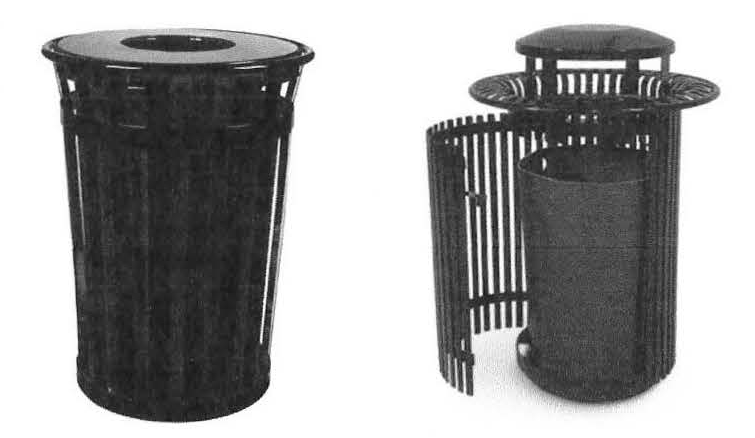
The design of the trash receptacle shall be made of black powdered coated steel, have a minimum capacity of a 36-gallon container and shall be of a strap-type design. (A typical design is shown in illustration 6.1 below for example only).
7.
Dumpster enclosures:
a.
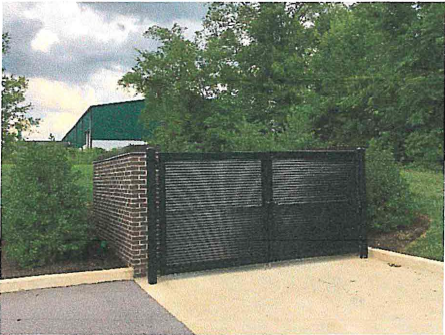
Walls used to screen trash dumpsters, refuse collection areas, or recycling containers shall:
i.
Be fully screened from public view;
ii.
Be constructed of masonry materials that match the main colors and materials of the associated building they serve;
iii.
Include steel opaque gates designed to complement the wall materials used;
iv.
Be supplemented with plantings around the perimeter.
b.
Any enclosure intended for screening dumpsters, refuse areas, or recycling containers that contains a compaction unit shall include a floor drain within the containment pad that is tied directly to the sanitary system in accordance with the standard specifications for sanitary sewers;
c.
Any enclosures provided for restaurants or other food service establishments shall provide adequate area for the storage of grease barrels/recycle containers inside of the dumpster enclosure;
d.
Any enclosures provided for restaurants or other food service establishments shall provide a floor drain within the containment pad;
e.
All floor drains located in a dumpster enclosure shall be plumbed to an oil/water separator or grease interceptor. If the drain ultimately is piped to the sanitary sewer system, the enclosure must be covered so that the drain does not receive storm water.
f.
To allow for dumpster gates to remain closed as often as possible, either a pedestrian door or a wall offset for pedestrian access shall be provided.
g.
The Planning Commission may waive any of these design requirements upon showing by the developer/applicant alternative methods of design, if deemed acceptable.
(Ord. No. 2003-40, 9-8-2003; Ord. No. 2005-05, 3-14-2005; Ord. No. 2005-35, 12-12-2005; Ord. No. 2006-04, 2-6-2006; Ord. of 10-23-2009, § 6-103; Ord. No. 2011-36, § 1, 7-11-2011; Ord. No. 2013-04, § 1, 1-14-2013; Ord. No. 2014-43, § 1, 6-9-2014; Ord. No. 2014-68, § 1, 10-27-2014; Ord. No. 2015-43, §§ 1, 2, 11-23-2015; Ord. No. 2016-13, § 1, 3-28-2016; Ord. No. 2016-40, § 3, 8-8-2016; Ord. No. 2018-43, § 1, 11-26-2018; Ord. No. 2021-42, Exh. A, 10-25-2021)
6-104.1 Mixed-use development standards for density, height, lot size and open space. The provisions of this section apply to any mixed-use development located on any zone lot or portion of a zone lot in any commercial district.
1.
Provisions applicable to mixed-use developments. The provisions appearing below shall apply to all mixed-use developments (buildings and/or sites) where such are permitted within any commercial district.
a.
Maximum bulk permitted. For any mixed-use development the height, density, bulk, lot size and open space provisions applicable to the RM-8/16 district (see article V, table 5-103a) shall apply. Unless modified through the PUD process these provisions and the provisions of [subsection] 5-104.1, Development standards for multi-family dwellings, shall apply.
b.
Calculation of residential density. To determine the residential density permitted within any mixed-use development the following procedure shall be utilized:
i.
The zone lot upon which the development is located will be apportioned as to its nonresidential-residential components as follows:
a)
For a site containing mixed-use buildings the total GFA (gross floor area) will be calculated and the percent commercial/residential determined. The percent residential GFA will then be applied to the total acreage of the site. This acreage will be used to calculate the maximum density. A minimum of 25 percent of the GFA of the entire site shall be commercial for Commercial Mixed Use Developments (CMU) and A minimum of five percent of the GFA of the entire site shall be commercial, for Commercial Town Center (CTC) Developments.
b)
For a mixed-use site a determination will be made as to the area of the property used for commercial/residential activities. The acreage used for residential uses will be used to calculate the maximum density. A minimum of 25 percent of a site shall be used for commercial activities and uses for Commercial Mixed Use (CMU) Developments and for Commercial Town Center (CTC) Developments a minimum of ten percent of a site shall be used for commercial activities and uses.
c)
The residential density approved for any project will be subject to review and approval by the Board of Commissioners based on the quality and characteristics of the project. The Board of Commissioners is under no obligation to approve the maximum allowable density for a project.
ii.
The residential density permitted will then be calculated in a like manner as for any zone lot located within said district.
iii.
In no instance, however, shall the total building bulk permitted be increased beyond that established for the district within which the mixed building(s) is located.
c.
Applicability. The requirement in table 6-102A for a mixed-use building or mixed-use site to be approved through the PUD process contained in article VIII of the Zoning Ordinance shall not authorize such uses without the development being submitted as: 1) part of a new PUD application, or 2) an amendment (per subsection 8.203.11) to an existing PUD. In either case, mixed-use developments shall not be authorized without specific action by the board of commissioners. An existing PUD, although it may contain CMU base zoning, shall not be exempt from this requirement.
6-104.2 Development standards for commercial complexes.
1.
Purpose. The provisions of this section are applicable to all commercial complexes as defined by this ordinance (see article II, section 2-102). The intent of this provision is to ensure coordination of certain critical design elements within commercial complexes by Planning Commission review of the master development plan required for all such development by article XIV, subsection 14-103.3. Provided, however, that in any instance where this use is located within a planned unit development this requirement may be fulfilled by submission of the plans required by that section.
2.
Parking and access control. The parking and access control provisions contained in article IX, subsection 9-102.7, Joint parking facilities, shall apply within all commercial complexes.
3.
Design standards. The following design standards shall apply to all development plans submitted for property located within any commercial complex:
a.
Site drainage shall be designed to incorporate all buildings and structures included with the total development site. In that site drainage may adversely affect other off-site properties, the Planning Commission may require the developer of the commercial complex to post a pre-construction performance bond to ensure the proper completion of drainage improvements.
b.
All commercial complexes shall be subject to the design standards in article VI, [sub]section 6-103.7.
4.
Standards for internal walkways. The following design standards for internal walkways shall apply within all commercial complexes:
a.
Walkways, a minimum of five feet in width, shall be provided from the public sidewalk or right-of-way to the building. At a minimum these walkways shall connect street crossings to the major points of building entry.
b.
Walkways shall be provided along the full length of the building on any side which provides building access to the public or where public parking is available, to provide safe and comfortable pedestrian access to the building.
c.
Internal walkway surfaces shall be designed to be visually attractive and distinguishable from driving surfaces through use of durable, low maintenance materials such as pavers, bricks, or scored concrete to enhance pedestrian safety and comfort.
6-104.3 Special provisions applicable to CNS, Convenience Neighborhood Service and OPS Office/Professional Service Districts.
1.
Purpose. The special provisions set forth herein are intended to provide design criteria for commercial activities proposed for location on a zone lot or portion of a zone lot within Convenience Neighborhood Service (CNS) or Office/Professional Service (OPS) Districts. It is the express purpose of these provisions to establish design criteria and to provide for implementation of these provisions by review of the site plan required by article XIV, subsection 14-103.3. Provided, however, that in any instance where this use is located within a planned unit development this requirement may be fulfilled by submission of the plans required by those sections.
2.
Design criteria, general. It is intended that commercial activities when permitted within these districts generally shall be small, unobstructive and produce negligible off-site impact. To this end, no individual commercial establishment shall be of such size or character as to create the impression of general commercial development. In addition, hours of operation, outdoor display of goods, signage and lighting shall be restricted so as to reduce or eliminate possible negative influences upon the surrounding residential neighborhood.
3.
Design criteria, detailed.
a.
Location. These facilities are intended to meet the very limited function of providing convenience goods and services to the surrounding residents. The locations for these operations are limited to intersections of arterial or major collector streets which are identified on the latest adopted major street plan.
b.
Maximum size of establishments. No individual commercial establishment in CNS districts shall have a gross floor area exceeding 5,000 square feet. There shall be no size limitation for commercial establishments located in OPS districts.
c.
Building design. Buildings must be constructed of masonry and wood and shall be residential in scale and architectural design.
d.
Conduct of operations. All sales, service, or display in connection with commercial establishments shall be within completely enclosed buildings, and there shall be no display, service, or storage outside such buildings. No public address systems or other devices for reproducing or amplifying voices or music shall be mounted outside such buildings or be audible beyond any line of the lot on which the building is situated.
e.
Exterior storage. Exterior storage of goods or materials of any kind is prohibited. Placement of waste disposal facilities is permitted in the rear of the commercial operation only and shall not be located in any front or side yard. Such facilities shall be totally screened using similar exterior materials from which the outside walls of the principal building is constructed and shall be maintained in a clean and orderly manner.
f.
Lighting. During hours of darkness when convenience establishments are in operation, parking areas and pedestrian ways on the premises shall be lighted to an intensity of at least 0.6 footcandle. No such lighting shall be directed in a manner which illuminates adjoining residential premises and no source of incandescent or mercury vapor illumination shall be directly visible from any residential property, or from any street. No neon lights inside or outside structures shall be visible from any residential property, or from any street.
g.
Noise. No noise detectable at the property line may be generated on the site.
h.
Special sign provisions. No signs intended to be read from off the premises shall be permitted in connection with convenience establishments except one sign, not exceeding 16 square feet in area, mounted flat against the side of the building, for each face of the building exposed to a public street. Where more than one convenience establishment is located in the same building, signs in accordance with the above formula may be permitted for each. No such sign shall extend or be mounted above or beyond the wall of the building.
4.
Special parking provisions. Where any commercial use or activity permitted within a CNS or OPS district adjoins any existing residential use, the following special provisions may be utilized, singly or in combination, in order to offset any negative impacts of the parking upon the use and enjoyment of the adjoining residential activity:
a.
Parking shall be restricted or prohibited within front or side yards which adjoin a residential use or activity.
b.
No parking area may be located within any buffer yard required by the provisions of subsection 6-103.4, subpart 6, Special provisions applying to required yards and building setbacks along district boundaries coincident with side or rear lot line of zone lot in any residential district.
c.
Off-site parking may be located on a lot other than the same lot to which the spaces are accessory provided that:
i.
Such spaces are located in a mixed-use or commercial district;
ii.
Such spaces are located to draw a minimum of vehicular traffic to and through streets having predominantly residential frontage;
iii.
Such spaces are located no farther than 400 feet from the nearest boundary of the lot occupied by the activities to which they are accessory;
iv.
Such spaces are in the same ownership as the uses to which they are accessory and necessary instruments are executed to ensure the required number of spaces will remain available throughout the life of such uses; and
v.
Such spaces conform to all applicable district regulations of the district in which they are located.
5.
Special yard requirements. Along such portions of the boundary of any CNS or OPS district where such lot abuts or is contiguous to any residential zone lot, [a] buffer yard, as required by subpart 6 of subsection 6-103.4, shall be required. Such yards may be used only for purposes of screening.
6.
Maximum size of CNS, Convenience Neighborhood Service Districts. Due to limited service nature of the CNS, Convenience Neighborhood Service District and the potential for negative impact upon nearby residential activities no CCNS, Convenience Neighborhood Service District shall be created which exceeds two acres in size.
(Ord. No. 2005-35, 12-12-2005; Ord. of 10-23-2009, § 6-104; Ord. No. 2013-53, § 4, 7-8-2013; Ord. No. 2014-08, § 4, 2-10-2014; Ord. No. 2016-24, § 3, 4-25-2016; Ord. No. 2022-51, 10-24-2022)

COMMERCIAL DISTRICT REGULATIONS
6-101.1 General purposes. The commercial districts established by this ordinance are designed to promote and protect the health, safety, morals, convenience, order, prosperity and other aspects of the general welfare. These goals include, among others, the following:
1.
To provide sufficient space, in appropriate locations in proximity to established residential areas, for local retail and service trades catering specifically to the recurring shopping needs of the occupants of nearby residences.
2.
To protect both retail and service developments and nearby residences against fire, explosions, toxic and noxious matter, radiation and other hazards, and against offensive noise, vibration, smoke, dust and other particulate matter, odorous matter, heat, humidity, glare and other objectionable influences.
3.
To protect both retail and service developments and nearby residences against congestion, by regulating the intensity of retail and service developments consistent with their marketing functions, by restricting those types of establishments which generate heavy traffic, and by providing for off-street parking and loading facilities.
4.
To provide sufficient and appropriate space, and in particular sufficient area, to meet the area's expected future need for modern, planned commercial floor space, including the need for off-street parking space in areas where a large proportion of customers come by automobile, and to encourage the tendency of commercial establishments to concentrate in integrated planned developments, to the mutual advantage of both consumers and merchants.
5.
To provide sufficient space in appropriate locations for commercial districts to satisfy specific functional needs of the area, and in particular the need for medical services, and the needs of the general public traveling along major thoroughfares.
6.
To provide sufficient space in appropriate locations for the mixture of compatible residential and restricted commercial developments where standards for development will provide protection for the environmental essentials of either.
7.
To provide appropriate locations for transitional uses intervening between commercial developments and residential areas, and thereby alleviate the friction inherent between dissimilar activities.
8.
To provide sufficient space in appropriate locations for all types of commercial and miscellaneous service activities.
9.
To provide freedom of architectural design, in order to encourage the development of more attractive, efficient and economic building forms, within appropriate standards which ensure that buildings are in character with their surroundings.
10.
To promote the most desirable use of land and direction of building development in accord with a well considered plan, to promote stability of commercial development, to strengthen the economic base of the area, to protect the character of the districts and their peculiar suitability for particular uses, to conserve the value of land and buildings.
6-101.2 Specific purposes.
1.
CG, Commercial-General Districts. This district is designed to provide for a wide range of commercial uses concerned with retail trade and consumer services; amusement and entertainment establishments; automotive and vehicular service establishments; transient sleeping accommodations; drive-in stores; eating and drinking places, financial institutions; and offices. The uses in this district service a broad market spectrum and, therefore, ease of automotive access is a requirement. However, it is not intended that this district permit uses which generate large volumes of truck traffic. Community facilities and utilities necessary to serve these districts, or necessary for the general community welfare are also permitted. Appropriate open space between commercial and residential areas is required. This classification is intended to recognize an existing undesirable development pattern but not repeat or significantly expand the pattern beyond those areas where such is already established.
2.
CI, Commercial Interchange Districts. This district is designed to provide adequate space at major freeway interchanges for uses which serve the needs of the motoring public. Automobile and other vehicular service establishments, transient sleeping accommodations, and eating and drinking establishments primarily characterize this district. In addition, commercial trade and service uses are permitted if necessary to serve the recurring needs of persons frequenting these districts. Community facilities and utilities necessary to serve these districts, or necessary for the general community welfare are also permitted. Bulk limitations required of uses in these districts, in part, are designed to maximize building in proximate residential districts. Appropriate locations for this district are near major transportation interchanges in clustered development patterns and not patterns of striped commercial development extending in a continuous manner along major traffic arteries.
3.
CMU, Commercial Mixed Use Districts. These districts are designed primarily to provide sufficient space in appropriate locations for establishments and uses engaged in general retail, restaurant, professional offices, commercial services, residential dwellings, and services ancillary thereto. As these districts tend to generate relatively large volumes of vehicular traffic and may have other characteristics detrimental to residential environments, their locations are most suitable on properties with sufficient frontage on arterial streets. Where these districts must necessarily abut existing or proposed residential areas external to the development, efforts to minimize incompatibility shall be made by providing appropriate buffers and through proper site design. In addition, a selection of community facilities and utilities considered necessary to service the principal uses in these districts or necessary for the general community welfare, are permitted. Mixed-use developments may be permitted through the planned unit development process as described in [section] 8-207 of this [Zoning] Ordinance.
4.
CNS, Convenience Neighborhood Service Districts. These districts are intended to provide locations for retail and personal service operations serving a limited market area and engaged in the retail sale of goods and/or services from the site of frequently and recurrently needed items for personal consumption or household use. The permitted establishments are those which provide for regular local shopping and which, therefore, are visited frequently by customers. Community facilities and utilities necessary to serve these districts, or necessary for the general community welfare are also permitted. These districts may occur along and at the intersection of arterial and community collector streets, characteristically are small, and are widely distributed throughout the community for convenient accessibility. It is expressly intended that these districts be limited in gross land area and building bulk so as to maintain compatibility with the surrounding residential environment. The bulk regulations are established to provide for maximum compatibility between the commercial activity in these districts and adjacent residential activity. The establishment of a new district of this nature must be preceded by the development of residential areas capable of supporting the proposed activities.
5.
OPS, Office/Professional Service Districts. These districts are designed to provide for transitional uses between more intensive commercial activities occurring along major traffic arteries and residential areas. The permitted uses are ones which tend to produce relatively low volumes of traffic. In addition to the office activities, certain community facilities are permitted which are compatible with other uses permitted within these districts. The intensity of use and building bulk permitted within these districts is controlled by more restrictive regulation consistent with their intended transitional function.
6.
CTC, Commercial Town Center Districts. This district is designed to provide for a wide range of commercial uses concerned with retail trade and consumer services; amusement and entertainment establishments; eating and drinking places, financial institutions; and offices. The uses in this district service a broad market spectrum and, therefore, ease of automotive access is a requirement. Community facilities and utilities necessary to serve these districts, or necessary for the general community welfare are also permitted. Mixed-use developments may be permitted through the planned unit development process as described in [section] 8-207 of this [Zoning] Ordinance. Appropriate open space between commercial and residential areas is required.
7.
CRC, Commercial Retail Center Districts. These districts are designed to provide for a wide range of commercial uses concerned with retail trade and consumer services; eating and drinking establishments, financial institutions, offices, drive-in stores and general retail. The uses in this district service a broad market spectrum and, therefore, ease of automotive access is a requirement. However, it is not intended that this district permit uses which generate large volumes of truck traffic. Community facilities and utilities necessary to serve these districts, or necessary for the general community welfare, are also permitted. Appropriate open space between commercial and residential area is required. This classification is intended to allow for thoroughfare retail uses not permitted in CTC or OPS districts, while recognizing the existence of nearby or adjacent residential areas.
(Ord. No. 2005-05, 3-14-2005; Ord. of 10-23-2009, § 6-101; Ord. No. 2013-53, § 2, 7-8-2013; Ord. No. 2014-08, § 2, 2-10-2014)
6-102.1 General provisions. Principal uses of buildings or other structures and land have been classified and combined into major classes and activity types in article III of this ordinance. The procedure for interpreting the classes and type of activities is provided in article III, section 3-101, table 6-102A, presents a tabulation of uses and structures which are classified as principal permitted (P), permitted with supplemental provisions (SUP) or conditional (C) uses within the various commercial districts. The supplemental design provisions with which (SUP) and (C) uses and activities are required to comply appear in article III, section 3-104, Supplemental use regulations.
Note— Key to interpreting use classifications.
P = Use permitted by right within the district.
SUP = Principal use permitted with supplemental provisions.
C = Conditional use (subject to approval by the Board of [Zoning] Appeals).
ASP = Accessory use permitted with supplemental provisions.
(1)
See [sub]section 5-104 1 and 6-104 1
(2)
Gasoline sales and convenience markets are not permitted within CTC Districts
(3)
Retail liquor stores shall not be permitted in the CNS and OPS Zoning Districts.
(4)
In CG districts, the following use listings are prohibited: Auto dealers, auto towing services.
(5)
When approved through the PUD or PUD Amendment process in article VIII.
(6)
Within the Town Center Overlay District, Main Street Area, and when approved through the PUD process in article VIII.
(7)
Excluding payday lenders and pawn shops.
(8)
See 6-104.3.
(9)
Grocery stores shall have a minimum of 20,000 square feet in sales floor area.
(10)
Any CMU or CTC mixed use building or mixed use site must meet the requirements for residential development standards set forth in Zoning Code section 8-207, with the exception of CTC Mixed Use sites or buildings fronting N. Mt. Juliet Road with one-half mile of the intersection of East/West Division and Mt. Juliet Road which shall be a minimum of five acres. To the extent any other applicable regulation or any modification through the PUD process imposes additional/conflicting regulations on a PUD applicant, the most strict regulation will apply. Also, subject to Restriction Area, as shown in Exhibit A, as noted in Ordinance 23-[03].
(11)
Only breweries and microbreweries are permitted. In CTC and CMU breweries and microbreweries shall be permitted only through the PUD process in Article VIII.
(12)
Hotels and motels shall include a minimum of 100 guest rooms within the entire building, regardless of branding. For dual-branded hotels, the combined number of guest rooms across all brands must meet or exceed this minimum threshold. Each guest room shall be accessed from an interior corridor and not from an exterior parking lot or entrance. Hotels and motels must have a lobby staffed 24 hours a day, seven days a week, and must offer daily complimentary maid service. Additionally, all hotels and motels are required to provide amenities including a swimming pool and a fitness center.
6-102.2 Principal permitted uses (P). Principal permitted uses are permitted as a matter of right within the district indicated, subject to the general requirements established for the district wherein the use is located.
6-102.3 Uses permitted with supplemental provisions (SUP). A use permitted with conditions is an activity, use or structure which is permitted subject to a finding by the Zoning Administrator that the specific standards indicated for the use in question have been met. Only those uses and structures so indicated in table 6-102A, may be allowed within the districts indicated.
6-102.4 Conditional uses (C). A conditional use is an activity, use, or structure which may require large land area, have unique operating, traffic generating or other characteristics that may tend to dominate or adversely affect the area more than do other uses permitted within the same zone district. Because the impacts of these uses cannot be satisfactorily predetermined for every possible location within a zone district, these land uses are permitted only upon approval by the Board of [Zoning] Appeals. Each conditional use is subject to a finding by the Board of [Zoning] Appeals that the specific standards indicated for the use in question have been met. Only those uses and structures so indicated in table 6-102A, may be allowed within the districts indicated.
6-102.5 Accessory uses. In addition to the principal activities expressed above, each activity type shall be deemed to include activities customarily associated with, and appropriate, incidental, and subordinate to the principal activity when such accessory activity is located on the same zone lot as such principal activity and meets the further conditions set forth in article III, section 3-105. Accessory uses designated with the letter "P" in table 6-102A, are permitted as a matter of right and no permit is required to conduct the activity in question. Those accessory uses designated with the letters "ASP" require a permit obtained from the Office of the Zoning Administrator. Permits for accessory uses designated "ASP" shall be issued upon demonstration that the activity in question meets the requirements established for such activity article III, section 3-105. The third classification of accessory uses designated by the letter "C" require approval as a conditional use by the Board of Zoning Appeals. Upon issuance of any permit for a conditional accessory use such use or activity shall be continuously subject to compliance with any operational standard or criteria established by the Board of [Zoning] Appeals.
6-102.6 Temporary uses. The temporary uses and structures specified in article III, section 3-106, as permissible within residential districts may be permitted for the limited time periods indicated for each such use or activity.
6-102.7 Uses not permitted. Any uses or structures not allowable as permitted uses, conditional uses, temporary uses or accessory uses are prohibited within the various commercial districts.
(Ord. No. 2005-05, 3-14-2005; Ord. of 10-23-2009, § 6-102; Ord. No. 2010-37, § 3, 7-12-2010; Ord. No. 2010-41, § 4, 8-9-2010; Ord. No. 2011-20, § 1, 4-25-2011; Ord. No. 2013-3, § 4, 1-14-2013; Ord. No. 2013-17, § 4, 2-11-2013; Ord. No. 2013-49, § 1, 6-10-2013; Ord. No. 2013-53, § 3, 7-8-2013; Ord. No. 2014-08, § 3, 2-10-2014; Ord. No. 2014-42, 6-9-2014; Ord. No. 2016-5, § 1, 2-8-2016; Ord. No. 2016-24, § 2, 4-25-2016; Ord. No. 2016-36, § 2, 7-11-2016; Ord. No. 2017-03, § 1, 1-9-2017; Ord. No. 2017-66, § 1, 12-11-2017; Ord. No. 2020-41, Exh. A, 9-28-2020; Ord. No. 2021-20, Exh. A, 6-14-2021; Ord. No. 2023-03, 1-9-2023; Ord. No. 2023-29, 7-10-2023; Ord. No. 2023-41, 9-11-2023; Ord. No. 2023-47, 11-13-2023; Ord. No. 2024-48, § 1, 11-25-2024)
6-103.1 General[ly]. The minimum lot dimensions, maximum lot coverage, minimum front, rear, interior and street side yards, maximum building heights and minimum separation between buildings on the same zone lot within any base commercial district shall be as indicated in table 6-103a, Bulk regulations for commercial districts, and the additional bulk regulations specified in this section. For certain uses, alternative bulk regulations may be specified in this section or other sections of this ordinance. Bulk regulations for planned unit development (PUD) overlay districts shall be as specified in article VIII.
6-103.2 Lot dimensions. No lot shall be created and no building permit or zoning approval shall be issued for any lot that does not meet the following minimum dimensional requirements, unless otherwise provided in the preliminary development plan of a planned unit development:
1.
Lot area.
a.
Minimum area. Within the various commercial districts, the minimum horizontal area of a lot shall not be less than that indicated in table 6-103a, Bulk regulations for commercial districts, or as may be otherwise specified in this ordinance.
b.
Reduction in lot area prohibited. No lot, even though it may consist of one or more adjacent lots of record, shall be reduced in area so that yards, lot width, building area, or other requirements of the zoning ordinance are not maintained. This section shall not apply when a portion of a lot is acquired for a public purpose.
2.
Lot width. The minimum lot width (measured at the building line) shall not be less than indicated in table 6-103a, or otherwise specified in this ordinance.
3.
Lot frontage. All lots shall have a minimum of 50 feet of frontage on a publicly dedicated and maintained street or a permanent access easement as defined and regulated by this ordinance, except that lots located along the terminus of a cul-de-sac shall have a minimum of 35 feet of frontage.
4.
Maximum permitted lot coverage. Within the various commercial districts, the maximum zone lot coverage by all buildings (principal and accessory) shall not exceed the percentage of the total area of the zone lot indicated in table 6-103a.
5.
Maximum impermeable surface ratio. Within the various commercial districts, the impermeable surface ratio, computed by dividing the impermeable surface area by the total lot area shall not exceed the percentage indicated in table 6-103a.
6-103.3 Height regulations.
1.
Basic requirements. The maximum permitted height for buildings shall not, except as provided in [subpart] subsection 2, 3 or 4 of this [sub]section exceed the height set forth for the various commercial districts in table 6-103A.
2.
General exception to height regulations. The height limitation contained in the district regulations does not apply to spires, belfries, cupolas, radio towers, water tanks, ventilators, chimneys or other appurtenances usually required to be placed above the roof level and not intended for human occupancy.
3.
Buildings in excess of 35 feet near the interstate. Buildings located within ½-mile of an existing or planned 1-40 interchange, and zoned Commercial Interchange (CI) or Commercial Mixed Use (CMU) may exceed the 35 feet height limit as contained in table 6-103A as follows:
A.
In no case shall any building exceed a height of 70 feet or six stories, whichever is less; and
B.
This height exemption shall be for office, hotel, and multi-family uses only.
4.
Buildings in excess of 35 feet near the Town Center (downtown area). Buildings located within ½-mile of the existing Music City Star rail station, and zoned commercial, may exceed the 35 feet height limit as contained in table 6-103A as follows:
A.
In no case shall any building exceed a height of 50 feet or four stories, whichever is less; and
B.
This height exemption shall be for office, retail, educational, multi-family and transient habitation (hotel) uses only.
(Ord. No. 2017-27, § 1, 5-8-2017; Ord. No. 2020-41, Exh. B, 9-28-2020)
6-103.4 Yard regulations.
1.
Permitted obstructions in required yards. In all commercial districts, the following shall not be considered obstructions when located within a required yard, except that items shall comply with subsection 6-103.5 of this section:
a.
Arbors and trellises.
b.
Awnings or canopies projecting from a building wall over a required yard not more than six feet, and having no supports other than provided by the wall or its integral parts.
c.
Chimneys projecting not more than three feet into, and not exceeding two percent of the area, of the required yard.
d.
Driveways subject to other specific provisions of this ordinance related directly thereto.
e.
Eaves, gutters, or down spouts, projecting into or over required yards not more than 24 inches or 20 percent of the width of such yard, whichever is the lesser distance.
f.
Fire escapes or staircase, the riser area of which shall be at least 50 percent open, and whose vertical projection downward onto a required yard does not exceed 30 percent of the area of such yard.
g.
Flagpoles, having only one structural ground member.
h.
Fountains.
i.
Mailboxes.
j.
Open terraces, including natural plant landscaping.
k.
Retaining walls.
l.
Sculpture or other similar objects of art.
m.
Street furniture such as, but not limited to benches, drinking fountains, trash receptacles, ash trays, light standards or directional signs.
n.
Vents necessary for use of fallout shelters constructed below grade of such yards, but excluding all other parts of such shelters.
o.
Walls or fences not exceeding six feet in height measured from finish grade level at any point along the length of, and on any side of, such walls or fences, and not roofed or structurally part of a building.
2.
Measurement of yard width. In all commercial districts, the width or depth of a yard shall be measured perpendicular to lot lines.
3.
Dimension of yards. Except, as otherwise provided herein, in all commercial districts yards of such dimensions as set forth in table 6-103a, shall be provided for all commercial, manufacturing and community facilities activities.
4.
Accessory off-street parking in required yards. Accessory off-street parking may be permitted within the required yards of commercial districts only to the extent set forth below. Within any area where permitted such parking areas shall be properly maintained and have no obstructions thereon, except as permitted by subpart 1 of this section, and shall not obstruct the visibility triangle as required by subsection 6-103.5.
a.
Accessory off-street parking in required front yards. Within any commercial district, permitted or required accessory off-street parking may be permitted within ten feet of the front lot line.
b.
Accessory off-street parking in side yards. In all commercial districts, accessory off-street parking may be located within five feet of any side lot line, except when such yard is adjacent to a residential district. (See subpart 6 of this section, for special provisions applicable along residential district boundaries).
c.
Accessory off-street parking and loading in rear yards. Except as provided by subpart 6 of this section, in all commercial districts, accessory off-street parking or loading may be located within ten feet of any rear lot line.
5.
Special provisions for through lots. In all commercial districts no rear yard is required for a through lot. In lieu thereof a front yard shall be required for each frontage.
6.
Special provisions applying to required yards and building setbacks along district boundaries coincident with side or rear lot line of zone lot in any residential district. In all commercial districts, along such portion of the boundary of a commercial district which coincides with a lot line of a zone lot in any residential district the following yard provisions shall apply:
a.
Special front setback. Regardless of the front yard provisions established for any commercial district, no building located on any zone lot adjacent to any residential district shall extend closer to the street than the average of the distances of the buildings located within 100 feet of the lot whereon the commercial activity is located; provided that no building shall be required to setback more than twice the minimum front yard applicable within the commercial district.
b.
Special side and rear yards. Along all portions of the boundary of any commercial zone lot where such lot abuts or is contiguous to any residential zone lot without an intervening public street, an open area, unobstructed from the ground to the sky, shall be provided within the commercial district, said area being at least 20 feet in width or depth. Such open area shall not be used for accessory off-street parking, or accessory off-street loading, or for storage or processing of any kind.
7.
Special provisions for party walls. In commercial districts, side or rear yard requirements may be waived along the side or rear adjacent to another commercially zoned lot if the following conditions are met:
a.
At all points of attachment, adjoining buildings shall be separated from each other by a party wall constructed in accordance with the Standard Building Code, fire protection requirements and, otherwise, meeting the requirements of this section.
b.
A party wall may bisect the dividing line of two adjacent lots so that one-half of the party wall is located on each of the properties, provided that the owners of each property sign a covenant granting an easement on the property to the owners of the adjoining property for the purpose of maintaining, reconstructing or protecting the party wall.
c.
In the event of the construction of a building on the lot line, the wall along the lot line, if it is not constructed as a party wall between two buildings, shall be built in such a manner that it will meet all requirements of subpart a of this section, without regard to the wall or building on the adjoining property.
d.
No wall constructed within ten feet of a property line shall have less than a four-hour fire rating and shall have such additional ratings as required by the Standard Building Code and National Fire Protection Association.
6-103.5 Obstructions prohibited at street intersections. On a corner lot, no fence, wall, hedge, or other planting or structure that will materially obstruct vision between a height of 2½ feet and ten feet above the centerline grades of the intersecting streets shall be erected, placed, or maintained within the triangular area formed by the street lines at such corner lots and a straight line joining such street lines at points which are 35 feet distance from the intersection of the street lines and measured along said street lines. In case of rounded street lines at the intersecting streets, such measurement shall be made from the point of intersection of the tangents of the curve constituting the rounding.
6-103.6 Requirements for fire lanes. Fire lanes with a minimum width of 20 feet shall be located such that the lanes extend from a public street to a point adjacent to the principal entrances of all commercial buildings. Such fire lanes shall be positioned directly adjacent to emergency water facilities designed for fire protection and shall be paved with an all weather surface capable of supporting the imposed loads of fire apparatus. The required fire lanes shall not be obstructed in any manner, including the parking of vehicles. Installation of "No Parking" signs or other appropriate notice or of approved obstructions inhibiting parking may be required and if installed shall be maintained. The owner or his representative of a building which is adjacent to the fire lane shall be responsible for keeping the fire lane free of obstructions.
6-103.7 Design standards for commercial structures.
1.
Site design. Elements such as landscaping, site fences, walls and refuse and recycling containers shall be coordinated into a unitary design and shall otherwise comply with all provisions of Article X, Landscaping and screening. All utility service to individual structures shall be underground.
2.
Building design. Building(s) may be required to incorporate similar design elements, and shall be compatible with surrounding buildings with regard to massing, color, scale, proportion of openings, roof types, types of glazed openings, and degree of detail. Color and design elements shall also be compatible with buildings in the vicinity which have been approved in accordance with these design provisions. Color schemes considered to be unpleasant, distasteful or objectionable, as determined by the Planning Commission, will be sufficient reasoning for a negative vote. On corner lots, both sides of the building facing the street are considered the front of the building, and shall include design elements such as windows, doors, texture and wall treatment to provide visual interest and prevent development of a long continuous blank wall. Commercial and institutional buildings which are visible from a public street are required to have a minimum of 100 percent brick and/or stone on the facade(s) facing a public street and 100 percent brick and stone on all other facades. Commercial and institutional buildings which are not visible from a public street are required to have a minimum of 50 percent brick and stone on all facades. The Planning Commission may permit any other construction materials allowed under state law. In determining whether to allow such materials, the Commission may consider whether the material is proposed as an accent, as a portion of a corporate motif, as well as whether the design is in line with general aesthetic goals of the City of Mt. Juliet as set forth herein, and any other factors deemed relevant by the applicant.
Building service areas or loading areas shall not be visible from public streets and shall be located away from private streets and adequately screened. All rooftop-mounted equipment including HVAC equipment shall not be visible from public streets and must be screened by a parapet that is equal to or greater than the height of the equipment. Mechanical equipment on sides of buildings shall not be visible from public streets and must be adequately screened. No wall packs are allowed on any commercial site in the City and all light poles and light fixtures installed on commercial sites shall be finished in a dark grey, dark brown or black color. Hues including metal halide, color-corrected mercury-vapor, color-corrected high-pressure sodium and low-pressure sodium are not allowed for private lighting. All private lighting shall emit light in the range of 4,000K to 5,700K on the Kelvin temperature measurement scale to achieve a cool white color temperature. Private lighting in this section shall refer to lighting intended to illuminate private parking areas and access drives and shall not include lighting that illuminates rights-of-way or public streets. The Planning Commission may waive any of these design requirements upon a showing by the developer that alternative materials will achieve a same or similar design result and be compatible with other buildings and structures in the vicinity which have been approved in accordance with these design provisions. Within a commercial complex, the Planning Commission may waive any of these design requirements upon a showing by the developer that alternative materials will achieve a same or similar design result and be compatible with other buildings and structures in the commercial complex which have been approved after the adoption of these design provisions.
3.
Sidewalks. Sidewalks shall be required for all commercial site plans, including multi-family developments, with the exception of those commercial subdivisions that received site plan approval prior to the enactment of this ordinance, and sidewalks shall comply with all criteria as follows:
a.
The design, dimensions, dedications, easements, and reservations for all sidewalks shall conform to all applicable City of Mt. Juliet regulations. Sidewalks constructed within the public rights-of-way shall be installed in accordance with the adopted standards of the City of Mt. Juliet.
b.
Sidewalks are required to be constructed along all streets within or abutting a development and shall connect to sidewalks in adjoining developments.
c.
Sidewalks shall be constructed of concrete and shall be a minimum of five feet in width on all streets for residential site plans and developments, and five feet in width for non-residential site plans and developments.
d.
Sidewalks shall maintain minimum thickness of four inches except at driveway areas where the minimum thickness is six inches.
e.
Sidewalks must comply with the City of Mt. Juliet Standard Road Details.
f.
In any case where the reconstruction or construction of a sidewalk or other pedestrian walkway is required, the City of Mt. Juliet may require the contractor to post surety in the form specified in this ordinance, for the construction of the sidewalk or walkway.
g.
The required sidewalk improvements must be installed prior to the issuance of a certificate of occupancy.
4.
Greenways. Development of all commercial sites in the City of Mt. Juliet and within the jurisdiction of the Regional Planning Commission shall include construction of all greenway sections that are included in the current and in any future greenway plans for the city. In any development, all parcels of land which touch or lie within the proposed route of a new greenway shall be constructed by the developer. Construction and related expenses for design, acquisition of right-of-way and construction of the greenways will be the responsibility of the developer. All greenway sections will be constructed per current City of Mt. Juliet, TDOT and FHWA standards and specifications, whichever is greater. Examples of said specifications include, but are not limited to, design, materials, thickness and width of greenway, as well as required signage, meeting ADA requirements, etc. Construction of said greenway sections will be completed by ten percent of development build out and all greenway sections will be dedicated to the City of Mt. Juliet. The developer, property owner or their designated agent may request a waiver or variance from this ten percent requirement should the strict application of the provisions of this ordinance result in practical difficulties or unnecessary hardship. Said waiver, variance or adjustment will not adversely affect the community objectives of the comprehensive plan. All greenways designated by current and any future greenway plans will be dedicated to the City of Mt. Juliet and shall not count toward required open space and amenities.
5.
Accommodations for bicycles. Bicycle parking shall be required for all commercial site plans, including multi-family developments, with the exception of those commercial subdivisions that received site plan approval prior to the enactment of this ordinance. In addition, bicycle parking shall comply with the criteria listed as follows:
a.
Locations.
i.
Bicycle parking shall be located as close as or closer than the nearest car parking space to the building entrance, or other than those spaces for persons with disabilities.
ii.
Bicycle parking facilities shall not interfere with accessible paths of travel or accessible parking as required by the Americans with Disabilities Act of 1990, as amended.
iii.
A minimum of four feet from the required rack dimension shall be provided for pedestrian clearance when a rack is placed within a sidewalk or pedestrian right-of-way.
iv.
Bicycle racks shall be located in highly visible and well lit areas to minimize theft and vandalism.
v.
When automobile parking spaces are provided in a structured parking garage, all required bicycle spaces shall be located inside the garage on the ground level. Alternative layout and design of racks to maximize space may be administratively approved by the Zoning Administrator.
vi.
Alternative locations — in the event that compliance may not be feasible because of demonstrable hardship, the Zoning Administrator may approve an alternative location. The Zoning Administrator shall consider the following:
a.
Alternative locations shall be well lit and secure.
b.
All bicycle parking spaces shall be located within a 100-foot diameter of the primary building entrance.
b.
Bicycle rack design.
i.
All racks shall be of the wave-type design.
ii.
Rack structure will require a user supplied locking device.
iii.
The racks shall be constructed of durable materials to withstand permanent exposure to the elements, such as powder coated metal or stainless steel.
iv.
Racks must be permanently mounted to a concrete or asphalt surface.
v.
Racks shall provide clearance from other objects by using layout dimensions of at least four feet wide by six feet long.
vi.
Construction details shall be submitted for review prior to final approval of construction plans.
c.
Bicycle parking requirement.
i.
The number of bicycle parking spaces required shall be based on the required automobile parking spaces and shall be provided in accordance with the following with fractional requirements for bike parking over 0.5 to be rounded up.
ii.
A minimum of five bicycle parking spaces shall be provided for all sites with up to 100 required vehicle parking spaces. Two bicycle parking spaces shall be provided for every 150 required vehicle parking spaces thereafter.
iii.
Bicycle parking spaces shall be provided for all uses except: accessory uses; agricultural; lodging; one to four family dwellings; temporary uses; and utilities.
6.
Outdoor decorative trash receptacles. Outdoor trash receptacles shall be required for all commercial site plans, with the exception of those commercial developments that have received site plan approval prior to the enactment of this ordinance.
In addition, outdoor trash receptacles shall comply with the criteria listed, as follows:
a.
Locations.
i.
For all commercial uses, a minimum of one decorative trash receptacle shall be located at all public entrances and exits of a commercial use.
ii.
The location of all trash receptacles shall not interfere with accessible paths of travel or accessible parking as required by the Americans with Disabilities Act of 1990, as amended or emergency exits.
b.
Design.
All commercial site plans shall show the proposed design, size, typical elevation and location for each decorative trash receptacle on the plan.
The design of the trash receptacle shall be made of black powdered coated steel, have a minimum capacity of a 36-gallon container and shall be of a strap-type design. (A typical design is shown in illustration 6.1 below for example only).
7.
Dumpster enclosures:
a.
Walls used to screen trash dumpsters, refuse collection areas, or recycling containers shall:
i.
Be fully screened from public view;
ii.
Be constructed of masonry materials that match the main colors and materials of the associated building they serve;
iii.
Include steel opaque gates designed to complement the wall materials used;
iv.
Be supplemented with plantings around the perimeter.
b.
Any enclosure intended for screening dumpsters, refuse areas, or recycling containers that contains a compaction unit shall include a floor drain within the containment pad that is tied directly to the sanitary system in accordance with the standard specifications for sanitary sewers;
c.
Any enclosures provided for restaurants or other food service establishments shall provide adequate area for the storage of grease barrels/recycle containers inside of the dumpster enclosure;
d.
Any enclosures provided for restaurants or other food service establishments shall provide a floor drain within the containment pad;
e.
All floor drains located in a dumpster enclosure shall be plumbed to an oil/water separator or grease interceptor. If the drain ultimately is piped to the sanitary sewer system, the enclosure must be covered so that the drain does not receive storm water.
f.
To allow for dumpster gates to remain closed as often as possible, either a pedestrian door or a wall offset for pedestrian access shall be provided.
g.
The Planning Commission may waive any of these design requirements upon showing by the developer/applicant alternative methods of design, if deemed acceptable.
(Ord. No. 2003-40, 9-8-2003; Ord. No. 2005-05, 3-14-2005; Ord. No. 2005-35, 12-12-2005; Ord. No. 2006-04, 2-6-2006; Ord. of 10-23-2009, § 6-103; Ord. No. 2011-36, § 1, 7-11-2011; Ord. No. 2013-04, § 1, 1-14-2013; Ord. No. 2014-43, § 1, 6-9-2014; Ord. No. 2014-68, § 1, 10-27-2014; Ord. No. 2015-43, §§ 1, 2, 11-23-2015; Ord. No. 2016-13, § 1, 3-28-2016; Ord. No. 2016-40, § 3, 8-8-2016; Ord. No. 2018-43, § 1, 11-26-2018; Ord. No. 2021-42, Exh. A, 10-25-2021)
6-104.1 Mixed-use development standards for density, height, lot size and open space. The provisions of this section apply to any mixed-use development located on any zone lot or portion of a zone lot in any commercial district.
1.
Provisions applicable to mixed-use developments. The provisions appearing below shall apply to all mixed-use developments (buildings and/or sites) where such are permitted within any commercial district.
a.
Maximum bulk permitted. For any mixed-use development the height, density, bulk, lot size and open space provisions applicable to the RM-8/16 district (see article V, table 5-103a) shall apply. Unless modified through the PUD process these provisions and the provisions of [subsection] 5-104.1, Development standards for multi-family dwellings, shall apply.
b.
Calculation of residential density. To determine the residential density permitted within any mixed-use development the following procedure shall be utilized:
i.
The zone lot upon which the development is located will be apportioned as to its nonresidential-residential components as follows:
a)
For a site containing mixed-use buildings the total GFA (gross floor area) will be calculated and the percent commercial/residential determined. The percent residential GFA will then be applied to the total acreage of the site. This acreage will be used to calculate the maximum density. A minimum of 25 percent of the GFA of the entire site shall be commercial for Commercial Mixed Use Developments (CMU) and A minimum of five percent of the GFA of the entire site shall be commercial, for Commercial Town Center (CTC) Developments.
b)
For a mixed-use site a determination will be made as to the area of the property used for commercial/residential activities. The acreage used for residential uses will be used to calculate the maximum density. A minimum of 25 percent of a site shall be used for commercial activities and uses for Commercial Mixed Use (CMU) Developments and for Commercial Town Center (CTC) Developments a minimum of ten percent of a site shall be used for commercial activities and uses.
c)
The residential density approved for any project will be subject to review and approval by the Board of Commissioners based on the quality and characteristics of the project. The Board of Commissioners is under no obligation to approve the maximum allowable density for a project.
ii.
The residential density permitted will then be calculated in a like manner as for any zone lot located within said district.
iii.
In no instance, however, shall the total building bulk permitted be increased beyond that established for the district within which the mixed building(s) is located.
c.
Applicability. The requirement in table 6-102A for a mixed-use building or mixed-use site to be approved through the PUD process contained in article VIII of the Zoning Ordinance shall not authorize such uses without the development being submitted as: 1) part of a new PUD application, or 2) an amendment (per subsection 8.203.11) to an existing PUD. In either case, mixed-use developments shall not be authorized without specific action by the board of commissioners. An existing PUD, although it may contain CMU base zoning, shall not be exempt from this requirement.
6-104.2 Development standards for commercial complexes.
1.
Purpose. The provisions of this section are applicable to all commercial complexes as defined by this ordinance (see article II, section 2-102). The intent of this provision is to ensure coordination of certain critical design elements within commercial complexes by Planning Commission review of the master development plan required for all such development by article XIV, subsection 14-103.3. Provided, however, that in any instance where this use is located within a planned unit development this requirement may be fulfilled by submission of the plans required by that section.
2.
Parking and access control. The parking and access control provisions contained in article IX, subsection 9-102.7, Joint parking facilities, shall apply within all commercial complexes.
3.
Design standards. The following design standards shall apply to all development plans submitted for property located within any commercial complex:
a.
Site drainage shall be designed to incorporate all buildings and structures included with the total development site. In that site drainage may adversely affect other off-site properties, the Planning Commission may require the developer of the commercial complex to post a pre-construction performance bond to ensure the proper completion of drainage improvements.
b.
All commercial complexes shall be subject to the design standards in article VI, [sub]section 6-103.7.
4.
Standards for internal walkways. The following design standards for internal walkways shall apply within all commercial complexes:
a.
Walkways, a minimum of five feet in width, shall be provided from the public sidewalk or right-of-way to the building. At a minimum these walkways shall connect street crossings to the major points of building entry.
b.
Walkways shall be provided along the full length of the building on any side which provides building access to the public or where public parking is available, to provide safe and comfortable pedestrian access to the building.
c.
Internal walkway surfaces shall be designed to be visually attractive and distinguishable from driving surfaces through use of durable, low maintenance materials such as pavers, bricks, or scored concrete to enhance pedestrian safety and comfort.
6-104.3 Special provisions applicable to CNS, Convenience Neighborhood Service and OPS Office/Professional Service Districts.
1.
Purpose. The special provisions set forth herein are intended to provide design criteria for commercial activities proposed for location on a zone lot or portion of a zone lot within Convenience Neighborhood Service (CNS) or Office/Professional Service (OPS) Districts. It is the express purpose of these provisions to establish design criteria and to provide for implementation of these provisions by review of the site plan required by article XIV, subsection 14-103.3. Provided, however, that in any instance where this use is located within a planned unit development this requirement may be fulfilled by submission of the plans required by those sections.
2.
Design criteria, general. It is intended that commercial activities when permitted within these districts generally shall be small, unobstructive and produce negligible off-site impact. To this end, no individual commercial establishment shall be of such size or character as to create the impression of general commercial development. In addition, hours of operation, outdoor display of goods, signage and lighting shall be restricted so as to reduce or eliminate possible negative influences upon the surrounding residential neighborhood.
3.
Design criteria, detailed.
a.
Location. These facilities are intended to meet the very limited function of providing convenience goods and services to the surrounding residents. The locations for these operations are limited to intersections of arterial or major collector streets which are identified on the latest adopted major street plan.
b.
Maximum size of establishments. No individual commercial establishment in CNS districts shall have a gross floor area exceeding 5,000 square feet. There shall be no size limitation for commercial establishments located in OPS districts.
c.
Building design. Buildings must be constructed of masonry and wood and shall be residential in scale and architectural design.
d.
Conduct of operations. All sales, service, or display in connection with commercial establishments shall be within completely enclosed buildings, and there shall be no display, service, or storage outside such buildings. No public address systems or other devices for reproducing or amplifying voices or music shall be mounted outside such buildings or be audible beyond any line of the lot on which the building is situated.
e.
Exterior storage. Exterior storage of goods or materials of any kind is prohibited. Placement of waste disposal facilities is permitted in the rear of the commercial operation only and shall not be located in any front or side yard. Such facilities shall be totally screened using similar exterior materials from which the outside walls of the principal building is constructed and shall be maintained in a clean and orderly manner.
f.
Lighting. During hours of darkness when convenience establishments are in operation, parking areas and pedestrian ways on the premises shall be lighted to an intensity of at least 0.6 footcandle. No such lighting shall be directed in a manner which illuminates adjoining residential premises and no source of incandescent or mercury vapor illumination shall be directly visible from any residential property, or from any street. No neon lights inside or outside structures shall be visible from any residential property, or from any street.
g.
Noise. No noise detectable at the property line may be generated on the site.
h.
Special sign provisions. No signs intended to be read from off the premises shall be permitted in connection with convenience establishments except one sign, not exceeding 16 square feet in area, mounted flat against the side of the building, for each face of the building exposed to a public street. Where more than one convenience establishment is located in the same building, signs in accordance with the above formula may be permitted for each. No such sign shall extend or be mounted above or beyond the wall of the building.
4.
Special parking provisions. Where any commercial use or activity permitted within a CNS or OPS district adjoins any existing residential use, the following special provisions may be utilized, singly or in combination, in order to offset any negative impacts of the parking upon the use and enjoyment of the adjoining residential activity:
a.
Parking shall be restricted or prohibited within front or side yards which adjoin a residential use or activity.
b.
No parking area may be located within any buffer yard required by the provisions of subsection 6-103.4, subpart 6, Special provisions applying to required yards and building setbacks along district boundaries coincident with side or rear lot line of zone lot in any residential district.
c.
Off-site parking may be located on a lot other than the same lot to which the spaces are accessory provided that:
i.
Such spaces are located in a mixed-use or commercial district;
ii.
Such spaces are located to draw a minimum of vehicular traffic to and through streets having predominantly residential frontage;
iii.
Such spaces are located no farther than 400 feet from the nearest boundary of the lot occupied by the activities to which they are accessory;
iv.
Such spaces are in the same ownership as the uses to which they are accessory and necessary instruments are executed to ensure the required number of spaces will remain available throughout the life of such uses; and
v.
Such spaces conform to all applicable district regulations of the district in which they are located.
5.
Special yard requirements. Along such portions of the boundary of any CNS or OPS district where such lot abuts or is contiguous to any residential zone lot, [a] buffer yard, as required by subpart 6 of subsection 6-103.4, shall be required. Such yards may be used only for purposes of screening.
6.
Maximum size of CNS, Convenience Neighborhood Service Districts. Due to limited service nature of the CNS, Convenience Neighborhood Service District and the potential for negative impact upon nearby residential activities no CCNS, Convenience Neighborhood Service District shall be created which exceeds two acres in size.
(Ord. No. 2005-35, 12-12-2005; Ord. of 10-23-2009, § 6-104; Ord. No. 2013-53, § 4, 7-8-2013; Ord. No. 2014-08, § 4, 2-10-2014; Ord. No. 2016-24, § 3, 4-25-2016; Ord. No. 2022-51, 10-24-2022)