PARKING, LOADING AND ACCESS REGULATIONS
9-101.1 Purposes. The following regulations on accessory off-street parking spaces are adopted in order to provide needed spaces off the streets for parking in connection with all activities which may be located in the City to reduce traffic congestion resulting from use of the streets as places of storage for automobiles, to protect the character of neighborhoods, to provide for a higher standard of development within the area and thus promote and protect the public health, safety and general welfare.
9-101.2 Applicability.
1.
General[ly]. For every use, activity, or structure permitted by this ordinance and for all buildings or structures erected in accordance therewith, there shall be provided sufficient space for access and off-street standing, parking, circulation, unloading and loading of motor vehicles that may be expected to transport its occupants, whether as patrons, residents, customers, employees, guests, or otherwise, to an establishment, activity, or place of residence at any time under normal conditions for any purpose. When a use is expanded, accessory off-street parking and loading shall be provided in accordance with the regulations herein for the area or capacity of such expansion in combination with the previously existing uses, structure, or activity.
2.
New and complying development. New development occurring after the effective date of this ordinance and development existing on the effective date of this ordinance and complying with the number of off-street parking spaces required by this article shall be subject to the following provisions:
a.
Every use of a building or land hereafter established shall provide the minimum off-street parking and loading spaces as required by this article.
b.
The number of parking and loading spaces required by this article may be reduced when the land use or floor area of a building is changed or reduced to a use or floor area for which fewer parking or loading spaces are required.
c.
When a building is expanded or a land use is changed so as to increase the number of spaces required, the number of such spaces shall be increased.
3.
Existing noncomplying development. Developments with legally noncomplying parking and loading areas shall be subject to the following provisions:
a.
No reduction below requirements. Existing parking and loading spaces shall not be reduced below the minimum required by this article.
b.
Redevelopment not increasing parking requirements. Zoning permits and certifications of zoning compliance may be issued for a change of use or remodeling or structural alterations in developments containing legally noncomplying parking and loading areas, without requiring compliance with this article, provided that such redevelopment does not result in an increase in the number of required parking or loading spaces.
c.
Redevelopment increasing parking requirements. Developments with legally noncomplying parking and loading areas shall be subject to the following provisions:
i.
Minor change. Any building expansion or change of use that results in an increase of 25 percent or less over the number of parking spaces that would be required under this article for the lot prior to the redevelopment activity shall be required to provide only the additional parking or loading spaces in excess of the number that would be required under this article for the previous development. Only the expanded portion of the parking or loading area shall be required to comply with the provisions of this article.
ii.
Major change. Any building expansion or change of use that results in an increase of more than 25 percent over the number of parking spaces that would be required under this article for the lot prior to the redevelopment activity shall be required to bring the entire development on the lot into full compliance with all of the provisions of this article.
(Ord. of 10-23-2009, § 9-101)
9-102.1 Use of residential parking facilities. Facilities accessory to a residential use which are developed in any residential district in accordance with the requirements of this article shall be used solely for parking of passenger automobiles or commercial vehicles of not more than ten tons [of] gross weight owned by occupants of the dwelling structures to which such facilities are accessory, or by guests of such occupants.
9-102.2 Repair, service or sales use of parking facilities. It shall be unlawful to use any required off-street parking or loading facilities for motor vehicle repair work, service, display or sales of any kind, except as expressly permitted elsewhere in this article.
9-102.3 Use of required parking as commercial or public lot. No area designated as a required parking area in connection with any designated building or use shall be operated as a commercial or public parking lot providing parking spaces for the general public or for the occupants, tenants, customers, clients or residents of any other use or activity for a fee or other compensation.
9-102.4 Ingress and egress. All entrances and exits to parking and loading areas from a public right-of-way shall be subject to specific approval of the Planning Commission by approval of a site development plan in accordance with article XIV, subsection 14-103.4. In no event shall parking and loading spaces be provided in a manner requiring the backing out of vehicles into public rights-of-way.
9-102.5 Location of parking or loading space. All required off-street parking or loading spaces shall be provided on the same parcel of land occupied by the use or building to which it is appurtenant. Provided, however, that where there are, in the judgment of the Planning Commission, practical difficulties in satisfying the requirement for parking space and/or if the public safety or convenience would be better served by another location, the Planning Commission may authorize subject to the following conditions an alternative location:
1.
Required accessory off-street parking facilities may be provided elsewhere than on the lot on which the principal use served is located, provided that the property occupied as parking is in the same possession, either by deed, by easement, or by long-term lease which has a term equal to or exceeding the projected life of the facility occupied by the principal use, and further provided that the owner shall be bound by covenants filed on record in the Office of the County Clerk, requiring the owner and his heirs and assigns, as well as subsequent owners, heirs or assigns, to maintain the required number of off-street parking spaces during the existence of such principal use.
2.
Pedestrian access shall be available within a walking distance of not more than 500 feet measured from the nearest point of public access to the building to the nearest part of the accessory parking area.
3.
Such separated parking space shall be usable without causing unreasonable traffic congestion, detriment to any residential neighborhood, or hazard to pedestrians or vehicular traffic.
9-102.6 Phasing of parking facilities within industrial developments. When any manufacturing activity is located within any industrial district, the construction of required parking spaces may be phased as required by occupant loading facilities.
9-102.7 Zoning of accessory parking. All accessory parking facilities, whether provided in fulfillment of or in excess of the requirements of this article, and whether located on the same or on a different lot from the principal use, shall be located on property zoned within the same or a less restrictive zoning district as the principal use served by the parking.
9-102.8 Joint parking facilities. Off-street parking facilities for different buildings, structures or uses, or for mixed uses, may be provided and used collectively or jointly in any zoning district in which separate off-street parking facilities for each constituent use would be permitted, subject to the following provisions:
1.
A legally sufficient written agreement assuring perpetual joint usage of said common parking for the combination of uses or buildings is properly drawn and executed by the parties concerned, approved as to form and execution by the City Attorney, and filed with and made part of the application for a building permit.
2.
Up to 25 percent of the parking spaces required for a theater or other place of evening entertainment, for a church, for multifamily dwelling units, or for a school, may be provided and used jointly by banks, offices, retail stores, repair shops, service establishments, and similar uses not normally open, used, or operated during evening hours, if specifically approved by the Planning Commission and Board of Commissioners; provided, however, that written agreement assuring the retention for such purpose shall be properly drawn and executed by the parties concerned, approved as to form and execution by the City Attorney, filed and made part of the application for a building permit. Such approval may be rescinded by the Board of Commissioners of the City and additional parking shall be obtained by the owners in the event that the Board determines that such joint use is resulting in a public nuisance or otherwise adversely affecting the public health, safety or welfare.
9-102.9 Variance in the required number of parking and loading spaces. The number of parking and loading spaces to be constructed may be less than the number of spaces required herein in the event that the following conditions are met to the satisfaction of the Planning Commission:
1.
Evidence is submitted firmly documenting that the special nature of the use, activity, or building proposed requires less parking area or spaces than required by this ordinance for the same.
2.
The site development plan submitted to and approved by the Planning Commission in accordance with article XIV, subsection 14-103.3, indicates that the location and layout of that portion of the parking requirement deemed unnecessary can and will be constructed accordingly in the event that the Planning Commission determines at any time that all or any portion of this parking is necessary in the interest of the public health, safety and welfare.
3.
In no event shall that portion of the required parking or loading which is so designated, but not constructed as provided herein be counted as open space or other nonpaved area required by other provisions of this ordinance.
(Ord. of 10-23-2009, § 9-102)
9-103.1 Computing parking requirements. The number of parking spaces required for a specific development proposal shall be based on the requirements listed in subsection 9-103.2, Number of parking spaces required, and the following provisions:
1.
Unlisted uses. Upon receiving a development application for a use not specifically listed in this section, the Zoning Administrator shall apply the parking requirements specified for a listed use most similar to the use for which said permit is requested.
2.
Multiple uses. Lots containing more than one use shall provide parking in an amount equal to the total of the requirements for all uses, unless a shared parking arrangement is approved pursuant to subsection 9-102.6, Joint parking facilities.
3.
Fractions. When measurements determining the number of required spaces result in fractions, any fraction less than one-half shall be disregarded and any fraction of one-half or more shall be rounded upward to the next highest full number.
4.
Bench seating. Where seating consisting of benches or pews, the equivalent number of seats shall be determined using the standards of the City's building code.
5.
Floor area. For the purpose of computing parking requirements that are based on the amount of square footage in buildings, calculations shall be on a gross floor area basis, unless otherwise specifically indicated.
9-103.2 Number of parking spaces required. The number of off-street parking spaces shall be provided for the specific unit of measure for the following specified uses within the activity types indicated:
1.
Residential activities.
a.
Permanent activities.
i.
One-family detached, two-family detached dwellings: two spaces per dwelling unit.
ii.
Multifamily dwelling: 1½ spaces for each dwelling unit with one bedroom; two spaces for each dwelling unit with two or more bedrooms.
iii.
Manufactured homes: two spaces per manufactured home.
iv.
Where occupancy is to be primarily by persons over the age of 60: the number of developed spaces may be reduced to one space per dwelling unit. There must be room on the lot to provide 1½ spaces per dwelling unit in the future.
b.
Semi-transient activities.
i.
Boarding[house] or roominghouse, apartment, hotel: one space for each dwelling or rooming unit.
2.
Community facility activities.
3.
Commercial activities.
a.
Uses located on freestanding sites. The provisions of this subsection shall apply to uses which are located on individual lots of record where no parking is shared with any other use or activity.
Note— 1. Due to the extreme variability of parking requirements for certain uses, the requirements for all new structures shall be determined by the Planning Commission as part of the review process of a site development plan based upon pertinent factors with each individual situation. In the case of existing structures the Zoning Administrator shall determine the parking requirements.
4.
Manufacturing activities. One space for each 1,500 square feet of gross floor area or one space for each three employees during the largest shift, whichever is greater.
(Ord. of 10-23-2009, § 9-103; Ord. No. 2017-28, §§ 1, 2, 5-8-2017)
9-104.1 Design objectives. Parking areas shall be designed with careful regard given to orderly arrangement, topography, amenity of view, ease of access and as an integral part of the overall site design. For reasons of use and appearance, it is desirable that parking areas be level or on terraces formed with the slope of the land. Changes in level between such terraces should be formed by retaining walls or landscaped banks. Efforts shall be made to ensure that a parking area does not dominate a site or building. Such efforts may include depressing the level of the parking area, construction of earth berms, dividing large lots into smaller sub-lots and other similar techniques. Wherever possible, the size of parking areas visible from public streets shall be minimized.
9-104.2 Submission of site plan. Any application for a building permit, or for a conditional use permit where no building permit is necessary, that requires five or more accessory off-street parking spaces to be provided on a zone lot, shall be accompanied by a site development plan drawn to scale and fully dimensioned. Said plan shall show the location design and layout of such parking facilities and shall be subject to approval by the Planning Commission. A site plan drawn to meet the requirements of article XIV, subsection 14-103.3, will comply. There shall be included either as a part of the parking area site plan or as a separate plan a landscaping plan for the parking area. Such landscape plan shall show any trees, shrubs, flowers, or ground covers together with; retaining walls or screens; walkways; and traffic barriers. (See article X.)
9-104.3 Design of parking stalls and maneuvering spaces.
1.
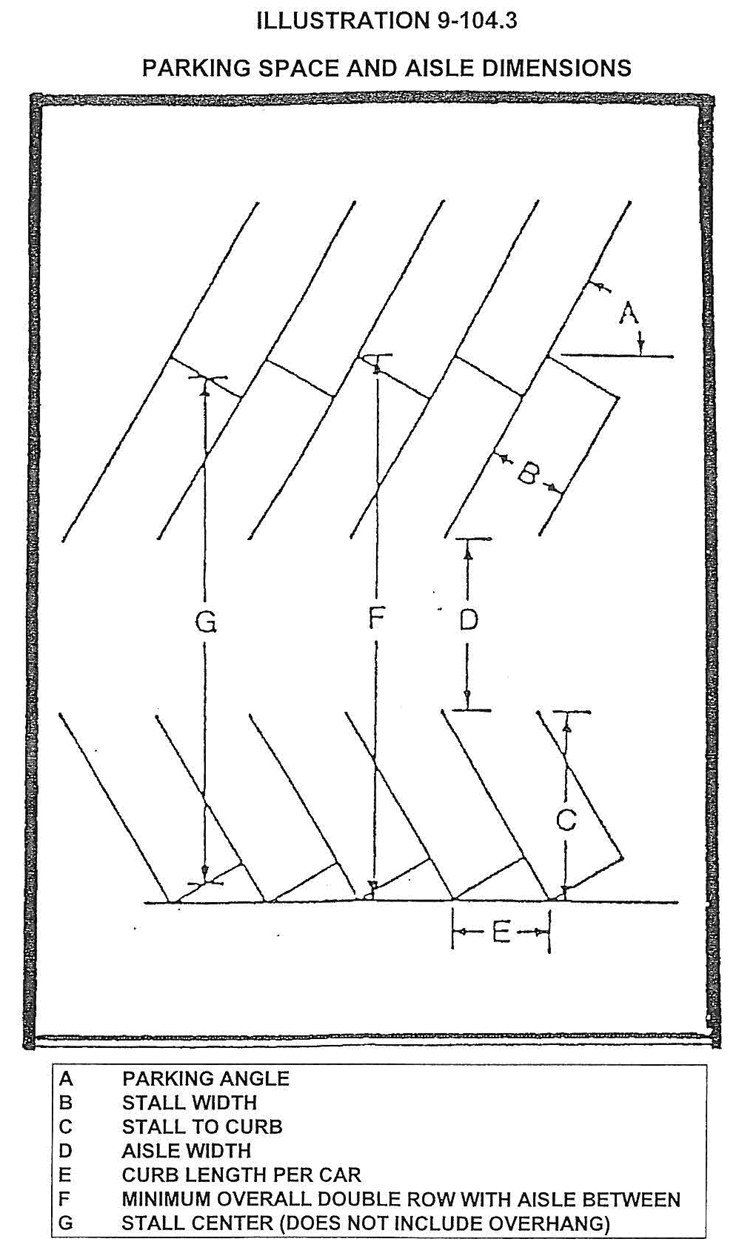
Dimensions of parking spaces. Except as otherwise provided by this subsection, the minimum dimensions of parking stalls and maneuvering spaces shall be as shown in table 9-104.3.
Parking Space and Aisle Dimensions
2.
Parallel parking. Parallel parking spaces shall have a minimum length of 20 feet and a minimum width of eight feet. A minimum width of ten feet shall be required if any structure or obstacle that would impede the opening of a car door is within two feet of the curbside of a parallel parking space.
3.
Residential parking. Parking areas designed solely for a single dwelling unit and not sharing a common parking area shall be a minimum of eight feet wide and 20 feet long. Such parking spaces may be located on a driveway or in an enclosed garage and may be placed end to end, but no portion of any parking space shall be located with the right-of-way of a public street or a public alley.
4.
Layout. All off-street parking spaces, other than those designed solely for a single dwelling unit and not sharing a common parking area, shall comply with the following design requirements:
a.
Each off-street parking spaces shall open directly onto an aisle or driveway that is not a public street or a public alley.
b.
Aisles and driveways shall not be used for parking vehicles.
c.
Parking spaces shall be designed to permit entry and exit without moving any other vehicle.
d.
No parking space shall be located so as to block access by emergency vehicles.
e.
No off-street parking spaces shall be located within the right-of-way of a public street, public alley or required joint access easement.
f.
For parking areas including ten or more spaces, a minimum queuing distance of 20 feet shall be provided along all access drives between the street right-of-way line and the nearest parking space.
5.
Paving standards. All parking spaces and access drives of parking areas with five or more spaces shall be surfaced with asphalt or concrete, or other hard-surfaced dustless materials and shall be constructed to provide for adequate drainage.
6.
Marking. Parking areas containing five or more spaces shall delineate each space by single or double stripes on each side of the space. Except for parallel parking spaces, stall width shall be measured from the centerline of one stripe to the centerline of the other stripe.
7.
Curbs. Curbs shall be provided to prevent any vehicle using a parking area from encroaching on any public right-of-way, required landscaping area or adjacent property.
9-104.4 Handicapped parking. Refer to the latest adopted version of the ICC/ANSI A117.1 and Chapter 11 of the International Building Codes (IBC).
9-104.5 Queuing requirements for drive-through facilities. In addition to meeting the off-street parking requirements of this section, drive-through facilities shall meet the following standards:
1.
Minimum dimensions. Each queue space shall be a minimum of ten feet by 20 feet in size. Unless otherwise indicated, queuing shall be measured from the point of ultimate service to the end of the queuing lane.
2.
Design. Each queue lane shall be clearly defined and designed so as not to conflict or interfere with other traffic using the site. A bypass lane, a minimum of 12 feet wide, shall be provided if a one-way traffic flow is used in the parking lot. The bypass lane shall be clearly designated and distinct from the queuing area.
3.
Number of queue spaces. The minimum number of queue spaces, including the vehicle being serviced, shall be provided as indicated in [following] table 9-104.5:
(Ord. of 10-23-2009, § 9-104; Ord. of ; Ord. No. 2011-70, § 1, 12-12-2011)
9-105.1 Computing loading requirements. The number of loading spaces required for a specific development proposal shall be based on the requirements listed in subsection 9-105.2, Off-street loading space requirements, and the following provisions:
1.
Unlisted uses. Upon receiving a development application for a use not specifically listed in this section, the Zoning Administrator shall apply the loading requirements specified for a listed use most similar to the use for which said permit is requested.
2.
Multiple uses in a building. When a building contains more than one use, and the floor area used for each use is below the minimum for required loading spaces but the aggregate total floor area is greater than the minimum, then off-street loading space shall be provided as if the entire building was used for that use in the building for which the most spaces are required.
3.
Fractions. When measurements determining the number of required additional loading spaces beyond the floor area ranges given in subsection 9-105.2, Off-street loading spaces requirements, result in fractions, any fraction less than one-half shall be disregarded and any fraction of one-half or more shall be rounded upward to the next highest full number.
9-105.2 Off-street loading space requirements. The minimum number of off-street loading spaces to be provided for a building shall be as indicated in table 9-105A.
9-105.3 Loading area design standards.
1.
Size of required berths. The minimum required dimensions of loading spaces, open or enclosed, shall be 12 feet in width by 55 feet in length, with a minimum vertical clearance of 15 feet. Where tractor-trailer units will be using the facility, the minimum length shall be 65 feet.
2.
Paving standards. All open off-street loading spaces shall be surfaced with asphalt or concrete, or other hard-surfaced dustless materials, and shall be constructed to provide for adequate drainage.
3.
Use of loading area. Required off-street loading spaces and associated aisles and maneuvering areas shall be used for vehicle loading only. No sales, storage, display of merchandise (including automobiles), repair work or dismantling shall be permitted in such areas.
4.
Layout. All off-street loading spaces shall comply with the following design requirements:
a.
No off-street loading space shall be located within the right-of-way of a public street. Any loading dock or door shall be set back far enough from the right-of-way so that no portion of the right-of-way is occupied by trucks or other vehicles while loading or unloading.
b.
The location of the loading area shall not interfere with the free circulation of vehicles in the off-street parking area. Where loading areas are directly adjacent to or integrated with an off-street parking lot, the city may require installation of physical barriers or other means of separating loading areas from parking areas and pedestrian traffic.
c.
No loading space shall be located so as to block access by emergency vehicles.
(Ord. of 10-23-2009, § 9-105)
9-106.1 Traffic impact studies. See the Subdivision Regulations for details and requirements regarding traffic study requirements for development or redevelopments.
9-106.2 Protection of residential areas. In order to minimize the destabilizing effects on residential areas, access to commercial and industrial activities shall be designed so as to minimize the intrusion of nonresidential and nonlocal traffic onto local residential streets.
9-106.3 Access control. In order to promote the safety of the motorist and pedestrian and to minimize traffic congestion and conflict by reducing the points of contact, the following access control regulations shall apply (see illustration 9-106A):
Illustration 9-106A
1.
Access from arterial or collector public ways. The city may require:
a.
That corner lots or double frontage lots not derive access from arterial or collector public ways.
b.
That access to residential lots from collectors and minor arterial shall be provided by joint driveways.
c.
That direct access to residential lots from major arterial highways designated in the major thoroughfare plan not be permitted.
2.
Minimum separation between driveways. For each permitted nonresidential driveway, there shall be a corresponding minimum road frontage of:
a.
At least 200 feet along routes designated in the major thoroughfare plan as rural arterial highways and six lane urban arterial highways.
b.
At least 150 feet along routes designated in the major thoroughfare plan as five lane and three lane urban arterial highways.
c.
At least 100 feet along routes designated in the major thoroughfare plan as four lane urban arterial highways and two lane collector highways.
The City will consider requests for modifications to this standard to permit the construction of double driveways, serving the same property from the same street, on a case by case basis. Double driveways shall be allowed only on lots with more than 150 feet of road frontage. In all cases, the separation between double driveways shall be at least 25 feet and shall also be greater than the width of the wider adjoining driveway. The City may require that access to proposed new lots be provided indirectly via cross connections, joint access easements, or local access roads. Nonresidential lots of record as of the date of the enactment of this ordinance shall have direct access to at least one public way.
3.
Minimum clearances. The minimum corner clearance between proposed new driveways and existing or proposed thoroughfares shall be at least 50 feet. In order to ensure adequate storage space for vehicles stopped at a signalized intersection, the City may require that the nearside corner clearance shall be at least 100 feet. Corner clearances shall be as defined in the Rules and Regulations for Constructing Driveways on State Highway Rights-of-Way, adopted by the Tennessee Department of Highways and effective April 3, 1967. Except when access is via a joint driveway, the distance between the frontage property line and the tangent projection of the nearest edge of each driveway, measured along the edge of the public way, shall be at least 15 feet for nonresidential driveways and at least five feet for residential driveways.
4.
Design standards for nonresidential driveways.
a.
For access to thoroughfares where the posted speed limit is 35 mph, or less, all nonresidential driveways shall be constructed with a minimum return radius of 15 feet and a minimum horizontal width of 25 feet.
b.
For access to thoroughfares where the posted speed limit is 40 mph, nonresidential driveways shall be constructed with:
i.
A minimum return radius of 20 feet and a minimum driveway width of 30 feet.
ii.
A minimum return radius of 25 feet and a minimum driveway width of 25 feet.
c.
For access to thoroughfares where the posted speed limit is 45 mph, nonresidential driveways shall be constructed with a right turn deceleration lane and:
i.
A minimum return radius of 25 feet and a minimum driveway width of 40 feet.
ii.
A minimum return radius of 30 feet and a minimum driveway width of 30 feet.
d.
The City will review proposed driveway designs for access to other thoroughfares on a case-by-case basis.
e.
Where required, deceleration lanes shall be designed to provide for sufficient reduction in travel speeds as well as for vehicle storage.
f.
Driveway openings shall be no wider than necessary to ensure conformance with this standard.
g.
All nonresidential driveways shall be permanently paved. Lanes shall be clearly designated and lane uses shall be clearly and permanently marked.
h.
The centerline of every nonresidential two way driveway shall intersect the centerline of the public way at an angle between 75 and 90 degrees.
i.
For other nonresidential driveways, the intersection angle shall be subject to the approval of the City.
5.
Design standards for residential driveways. Where permitted, residential driveways fronting collector and arterial routes designated in the major thoroughfare plan shall be designed so as to avoid requiring vehicles to back onto these highways.
6.
Relationship to state standards. Where the driveway design and location standards listed above are not in conformance with the standards of the Tennessee Department of Transportation, the City may require conformance with whichever standard is more restrictive.
9-106.4 Joint and shared accessways.
1.
Joint use driveways. Wherever feasible, the City may require the establishment of a joint use driveway to serve two or more properties. If a proposed development abuts an existing development that contains an existing joint access driveway, the vehicular circulation of the proposed development shall be designed to connect to the abutting access and circulation areas. If a proposed development abuts existing undeveloped property, the vehicular circulation of the proposed development shall contain a joint access driveway which is designed to connect to the abutting property when such property is developed.
2.
Cross access corridors. The Planning Commission, in conjunction with the City Engineer shall be authorized to designate cross access corridors on properties adjacent to arterial and major collector streets. All developments within the affected area shall be designed so as to provide for mutual coordinated parking, access and circulation systems.
3.
Recording access easements. Whenever joint access driveways or cross access corridors are provided in accordance with the provisions of this section, no development plan shall be approved unless such plan grants an easement for cross access to and from abutting properties. Such designation shall be referenced on all plats of subdivision for any affected property.
4.
Closing of interim driveways. Whenever a permanent joint use driveway and/or a cross access corridor is constructed as required by the provisions of this section, all preceding temporary or interim driveways shall be closed and eliminated. The owner(s) of all properties which involve the use of a permanent joint use driveway and/or a cross access corridor shall enter into a written agreement with the City to be recorded in the public records of the County and running with the land, that existing temporary and/or interim driveways shall be closed and eliminated following construction of both sides of a joint access.
9-106.5 Visibility areas. In order to safely accommodate vehicular movements to and from public streets, the following sight distance and visibility provisions shall be required:
1.
Street intersections. At all points of intersection of public and private streets no fence, wall, hedge or other planting or structure that will obstruct vision at any point above the centerline grades of the intersecting streets shall be erected, placed or maintained within the triangular area formed by the said right-of-way lines and a straight line joining said right-of-way lines at points where they are 35 feet distant from the intersection of the right-of-way lines and measured along said right-of-way lines.
2.
Driveway intersections. In all zone districts, no fence, wall, hedge or other planting or structure that will obstruct vision at any point where any private driveway intersects a public street shall be erected, placed or maintained within 35 feet in all directions measured from all points along the property line across vehicles are intended to pass.
9-106.6 Measurement. For the purposes of this section, distances shall be measured in the following manner:
1.
Distance between driveways. Distances between driveways shall be measured along the right-of-way line from the nearest points of intersection of the driveways with the right-of-way line. In the event that the curb return of a driveway begins outside of the right-of-way, the point of intersection of the extension of the driveway curb or edge shall be used for measurement purposes.
2.
Distance from intersection. The distance from street intersections shall be measured from the nearest intersection of the existing right-of-way lines or extension thereof. For streets designated to be widened at a future time by the adopted major thoroughfare plan, measurement shall be made from the ultimate right-of-way.
3.
Distance from ramps of limited access highways. The distance from ramps for limited access highways shall be measured from the point where the right-of-way for the ramp intersects the right-of-way for the street serving the lot.
(Ord. of 10-23-2009, § 9-106; Ord. No. 2015-4, § 1, 1-12-2015)
PARKING, LOADING AND ACCESS REGULATIONS
9-101.1 Purposes. The following regulations on accessory off-street parking spaces are adopted in order to provide needed spaces off the streets for parking in connection with all activities which may be located in the City to reduce traffic congestion resulting from use of the streets as places of storage for automobiles, to protect the character of neighborhoods, to provide for a higher standard of development within the area and thus promote and protect the public health, safety and general welfare.
9-101.2 Applicability.
1.
General[ly]. For every use, activity, or structure permitted by this ordinance and for all buildings or structures erected in accordance therewith, there shall be provided sufficient space for access and off-street standing, parking, circulation, unloading and loading of motor vehicles that may be expected to transport its occupants, whether as patrons, residents, customers, employees, guests, or otherwise, to an establishment, activity, or place of residence at any time under normal conditions for any purpose. When a use is expanded, accessory off-street parking and loading shall be provided in accordance with the regulations herein for the area or capacity of such expansion in combination with the previously existing uses, structure, or activity.
2.
New and complying development. New development occurring after the effective date of this ordinance and development existing on the effective date of this ordinance and complying with the number of off-street parking spaces required by this article shall be subject to the following provisions:
a.
Every use of a building or land hereafter established shall provide the minimum off-street parking and loading spaces as required by this article.
b.
The number of parking and loading spaces required by this article may be reduced when the land use or floor area of a building is changed or reduced to a use or floor area for which fewer parking or loading spaces are required.
c.
When a building is expanded or a land use is changed so as to increase the number of spaces required, the number of such spaces shall be increased.
3.
Existing noncomplying development. Developments with legally noncomplying parking and loading areas shall be subject to the following provisions:
a.
No reduction below requirements. Existing parking and loading spaces shall not be reduced below the minimum required by this article.
b.
Redevelopment not increasing parking requirements. Zoning permits and certifications of zoning compliance may be issued for a change of use or remodeling or structural alterations in developments containing legally noncomplying parking and loading areas, without requiring compliance with this article, provided that such redevelopment does not result in an increase in the number of required parking or loading spaces.
c.
Redevelopment increasing parking requirements. Developments with legally noncomplying parking and loading areas shall be subject to the following provisions:
i.
Minor change. Any building expansion or change of use that results in an increase of 25 percent or less over the number of parking spaces that would be required under this article for the lot prior to the redevelopment activity shall be required to provide only the additional parking or loading spaces in excess of the number that would be required under this article for the previous development. Only the expanded portion of the parking or loading area shall be required to comply with the provisions of this article.
ii.
Major change. Any building expansion or change of use that results in an increase of more than 25 percent over the number of parking spaces that would be required under this article for the lot prior to the redevelopment activity shall be required to bring the entire development on the lot into full compliance with all of the provisions of this article.
(Ord. of 10-23-2009, § 9-101)
9-102.1 Use of residential parking facilities. Facilities accessory to a residential use which are developed in any residential district in accordance with the requirements of this article shall be used solely for parking of passenger automobiles or commercial vehicles of not more than ten tons [of] gross weight owned by occupants of the dwelling structures to which such facilities are accessory, or by guests of such occupants.
9-102.2 Repair, service or sales use of parking facilities. It shall be unlawful to use any required off-street parking or loading facilities for motor vehicle repair work, service, display or sales of any kind, except as expressly permitted elsewhere in this article.
9-102.3 Use of required parking as commercial or public lot. No area designated as a required parking area in connection with any designated building or use shall be operated as a commercial or public parking lot providing parking spaces for the general public or for the occupants, tenants, customers, clients or residents of any other use or activity for a fee or other compensation.
9-102.4 Ingress and egress. All entrances and exits to parking and loading areas from a public right-of-way shall be subject to specific approval of the Planning Commission by approval of a site development plan in accordance with article XIV, subsection 14-103.4. In no event shall parking and loading spaces be provided in a manner requiring the backing out of vehicles into public rights-of-way.
9-102.5 Location of parking or loading space. All required off-street parking or loading spaces shall be provided on the same parcel of land occupied by the use or building to which it is appurtenant. Provided, however, that where there are, in the judgment of the Planning Commission, practical difficulties in satisfying the requirement for parking space and/or if the public safety or convenience would be better served by another location, the Planning Commission may authorize subject to the following conditions an alternative location:
1.
Required accessory off-street parking facilities may be provided elsewhere than on the lot on which the principal use served is located, provided that the property occupied as parking is in the same possession, either by deed, by easement, or by long-term lease which has a term equal to or exceeding the projected life of the facility occupied by the principal use, and further provided that the owner shall be bound by covenants filed on record in the Office of the County Clerk, requiring the owner and his heirs and assigns, as well as subsequent owners, heirs or assigns, to maintain the required number of off-street parking spaces during the existence of such principal use.
2.
Pedestrian access shall be available within a walking distance of not more than 500 feet measured from the nearest point of public access to the building to the nearest part of the accessory parking area.
3.
Such separated parking space shall be usable without causing unreasonable traffic congestion, detriment to any residential neighborhood, or hazard to pedestrians or vehicular traffic.
9-102.6 Phasing of parking facilities within industrial developments. When any manufacturing activity is located within any industrial district, the construction of required parking spaces may be phased as required by occupant loading facilities.
9-102.7 Zoning of accessory parking. All accessory parking facilities, whether provided in fulfillment of or in excess of the requirements of this article, and whether located on the same or on a different lot from the principal use, shall be located on property zoned within the same or a less restrictive zoning district as the principal use served by the parking.
9-102.8 Joint parking facilities. Off-street parking facilities for different buildings, structures or uses, or for mixed uses, may be provided and used collectively or jointly in any zoning district in which separate off-street parking facilities for each constituent use would be permitted, subject to the following provisions:
1.
A legally sufficient written agreement assuring perpetual joint usage of said common parking for the combination of uses or buildings is properly drawn and executed by the parties concerned, approved as to form and execution by the City Attorney, and filed with and made part of the application for a building permit.
2.
Up to 25 percent of the parking spaces required for a theater or other place of evening entertainment, for a church, for multifamily dwelling units, or for a school, may be provided and used jointly by banks, offices, retail stores, repair shops, service establishments, and similar uses not normally open, used, or operated during evening hours, if specifically approved by the Planning Commission and Board of Commissioners; provided, however, that written agreement assuring the retention for such purpose shall be properly drawn and executed by the parties concerned, approved as to form and execution by the City Attorney, filed and made part of the application for a building permit. Such approval may be rescinded by the Board of Commissioners of the City and additional parking shall be obtained by the owners in the event that the Board determines that such joint use is resulting in a public nuisance or otherwise adversely affecting the public health, safety or welfare.
9-102.9 Variance in the required number of parking and loading spaces. The number of parking and loading spaces to be constructed may be less than the number of spaces required herein in the event that the following conditions are met to the satisfaction of the Planning Commission:
1.
Evidence is submitted firmly documenting that the special nature of the use, activity, or building proposed requires less parking area or spaces than required by this ordinance for the same.
2.
The site development plan submitted to and approved by the Planning Commission in accordance with article XIV, subsection 14-103.3, indicates that the location and layout of that portion of the parking requirement deemed unnecessary can and will be constructed accordingly in the event that the Planning Commission determines at any time that all or any portion of this parking is necessary in the interest of the public health, safety and welfare.
3.
In no event shall that portion of the required parking or loading which is so designated, but not constructed as provided herein be counted as open space or other nonpaved area required by other provisions of this ordinance.
(Ord. of 10-23-2009, § 9-102)
9-103.1 Computing parking requirements. The number of parking spaces required for a specific development proposal shall be based on the requirements listed in subsection 9-103.2, Number of parking spaces required, and the following provisions:
1.
Unlisted uses. Upon receiving a development application for a use not specifically listed in this section, the Zoning Administrator shall apply the parking requirements specified for a listed use most similar to the use for which said permit is requested.
2.
Multiple uses. Lots containing more than one use shall provide parking in an amount equal to the total of the requirements for all uses, unless a shared parking arrangement is approved pursuant to subsection 9-102.6, Joint parking facilities.
3.
Fractions. When measurements determining the number of required spaces result in fractions, any fraction less than one-half shall be disregarded and any fraction of one-half or more shall be rounded upward to the next highest full number.
4.
Bench seating. Where seating consisting of benches or pews, the equivalent number of seats shall be determined using the standards of the City's building code.
5.
Floor area. For the purpose of computing parking requirements that are based on the amount of square footage in buildings, calculations shall be on a gross floor area basis, unless otherwise specifically indicated.
9-103.2 Number of parking spaces required. The number of off-street parking spaces shall be provided for the specific unit of measure for the following specified uses within the activity types indicated:
1.
Residential activities.
a.
Permanent activities.
i.
One-family detached, two-family detached dwellings: two spaces per dwelling unit.
ii.
Multifamily dwelling: 1½ spaces for each dwelling unit with one bedroom; two spaces for each dwelling unit with two or more bedrooms.
iii.
Manufactured homes: two spaces per manufactured home.
iv.
Where occupancy is to be primarily by persons over the age of 60: the number of developed spaces may be reduced to one space per dwelling unit. There must be room on the lot to provide 1½ spaces per dwelling unit in the future.
b.
Semi-transient activities.
i.
Boarding[house] or roominghouse, apartment, hotel: one space for each dwelling or rooming unit.
2.
Community facility activities.
3.
Commercial activities.
a.
Uses located on freestanding sites. The provisions of this subsection shall apply to uses which are located on individual lots of record where no parking is shared with any other use or activity.
Note— 1. Due to the extreme variability of parking requirements for certain uses, the requirements for all new structures shall be determined by the Planning Commission as part of the review process of a site development plan based upon pertinent factors with each individual situation. In the case of existing structures the Zoning Administrator shall determine the parking requirements.
4.
Manufacturing activities. One space for each 1,500 square feet of gross floor area or one space for each three employees during the largest shift, whichever is greater.
(Ord. of 10-23-2009, § 9-103; Ord. No. 2017-28, §§ 1, 2, 5-8-2017)
9-104.1 Design objectives. Parking areas shall be designed with careful regard given to orderly arrangement, topography, amenity of view, ease of access and as an integral part of the overall site design. For reasons of use and appearance, it is desirable that parking areas be level or on terraces formed with the slope of the land. Changes in level between such terraces should be formed by retaining walls or landscaped banks. Efforts shall be made to ensure that a parking area does not dominate a site or building. Such efforts may include depressing the level of the parking area, construction of earth berms, dividing large lots into smaller sub-lots and other similar techniques. Wherever possible, the size of parking areas visible from public streets shall be minimized.
9-104.2 Submission of site plan. Any application for a building permit, or for a conditional use permit where no building permit is necessary, that requires five or more accessory off-street parking spaces to be provided on a zone lot, shall be accompanied by a site development plan drawn to scale and fully dimensioned. Said plan shall show the location design and layout of such parking facilities and shall be subject to approval by the Planning Commission. A site plan drawn to meet the requirements of article XIV, subsection 14-103.3, will comply. There shall be included either as a part of the parking area site plan or as a separate plan a landscaping plan for the parking area. Such landscape plan shall show any trees, shrubs, flowers, or ground covers together with; retaining walls or screens; walkways; and traffic barriers. (See article X.)
9-104.3 Design of parking stalls and maneuvering spaces.
1.
Dimensions of parking spaces. Except as otherwise provided by this subsection, the minimum dimensions of parking stalls and maneuvering spaces shall be as shown in table 9-104.3.
Parking Space and Aisle Dimensions
2.
Parallel parking. Parallel parking spaces shall have a minimum length of 20 feet and a minimum width of eight feet. A minimum width of ten feet shall be required if any structure or obstacle that would impede the opening of a car door is within two feet of the curbside of a parallel parking space.
3.
Residential parking. Parking areas designed solely for a single dwelling unit and not sharing a common parking area shall be a minimum of eight feet wide and 20 feet long. Such parking spaces may be located on a driveway or in an enclosed garage and may be placed end to end, but no portion of any parking space shall be located with the right-of-way of a public street or a public alley.
4.
Layout. All off-street parking spaces, other than those designed solely for a single dwelling unit and not sharing a common parking area, shall comply with the following design requirements:
a.
Each off-street parking spaces shall open directly onto an aisle or driveway that is not a public street or a public alley.
b.
Aisles and driveways shall not be used for parking vehicles.
c.
Parking spaces shall be designed to permit entry and exit without moving any other vehicle.
d.
No parking space shall be located so as to block access by emergency vehicles.
e.
No off-street parking spaces shall be located within the right-of-way of a public street, public alley or required joint access easement.
f.
For parking areas including ten or more spaces, a minimum queuing distance of 20 feet shall be provided along all access drives between the street right-of-way line and the nearest parking space.
5.
Paving standards. All parking spaces and access drives of parking areas with five or more spaces shall be surfaced with asphalt or concrete, or other hard-surfaced dustless materials and shall be constructed to provide for adequate drainage.
6.
Marking. Parking areas containing five or more spaces shall delineate each space by single or double stripes on each side of the space. Except for parallel parking spaces, stall width shall be measured from the centerline of one stripe to the centerline of the other stripe.
7.
Curbs. Curbs shall be provided to prevent any vehicle using a parking area from encroaching on any public right-of-way, required landscaping area or adjacent property.
9-104.4 Handicapped parking. Refer to the latest adopted version of the ICC/ANSI A117.1 and Chapter 11 of the International Building Codes (IBC).
9-104.5 Queuing requirements for drive-through facilities. In addition to meeting the off-street parking requirements of this section, drive-through facilities shall meet the following standards:
1.
Minimum dimensions. Each queue space shall be a minimum of ten feet by 20 feet in size. Unless otherwise indicated, queuing shall be measured from the point of ultimate service to the end of the queuing lane.
2.
Design. Each queue lane shall be clearly defined and designed so as not to conflict or interfere with other traffic using the site. A bypass lane, a minimum of 12 feet wide, shall be provided if a one-way traffic flow is used in the parking lot. The bypass lane shall be clearly designated and distinct from the queuing area.
3.
Number of queue spaces. The minimum number of queue spaces, including the vehicle being serviced, shall be provided as indicated in [following] table 9-104.5:
(Ord. of 10-23-2009, § 9-104; Ord. of ; Ord. No. 2011-70, § 1, 12-12-2011)
9-105.1 Computing loading requirements. The number of loading spaces required for a specific development proposal shall be based on the requirements listed in subsection 9-105.2, Off-street loading space requirements, and the following provisions:
1.
Unlisted uses. Upon receiving a development application for a use not specifically listed in this section, the Zoning Administrator shall apply the loading requirements specified for a listed use most similar to the use for which said permit is requested.
2.
Multiple uses in a building. When a building contains more than one use, and the floor area used for each use is below the minimum for required loading spaces but the aggregate total floor area is greater than the minimum, then off-street loading space shall be provided as if the entire building was used for that use in the building for which the most spaces are required.
3.
Fractions. When measurements determining the number of required additional loading spaces beyond the floor area ranges given in subsection 9-105.2, Off-street loading spaces requirements, result in fractions, any fraction less than one-half shall be disregarded and any fraction of one-half or more shall be rounded upward to the next highest full number.
9-105.2 Off-street loading space requirements. The minimum number of off-street loading spaces to be provided for a building shall be as indicated in table 9-105A.
9-105.3 Loading area design standards.
1.
Size of required berths. The minimum required dimensions of loading spaces, open or enclosed, shall be 12 feet in width by 55 feet in length, with a minimum vertical clearance of 15 feet. Where tractor-trailer units will be using the facility, the minimum length shall be 65 feet.
2.
Paving standards. All open off-street loading spaces shall be surfaced with asphalt or concrete, or other hard-surfaced dustless materials, and shall be constructed to provide for adequate drainage.
3.
Use of loading area. Required off-street loading spaces and associated aisles and maneuvering areas shall be used for vehicle loading only. No sales, storage, display of merchandise (including automobiles), repair work or dismantling shall be permitted in such areas.
4.
Layout. All off-street loading spaces shall comply with the following design requirements:
a.
No off-street loading space shall be located within the right-of-way of a public street. Any loading dock or door shall be set back far enough from the right-of-way so that no portion of the right-of-way is occupied by trucks or other vehicles while loading or unloading.
b.
The location of the loading area shall not interfere with the free circulation of vehicles in the off-street parking area. Where loading areas are directly adjacent to or integrated with an off-street parking lot, the city may require installation of physical barriers or other means of separating loading areas from parking areas and pedestrian traffic.
c.
No loading space shall be located so as to block access by emergency vehicles.
(Ord. of 10-23-2009, § 9-105)
9-106.1 Traffic impact studies. See the Subdivision Regulations for details and requirements regarding traffic study requirements for development or redevelopments.
9-106.2 Protection of residential areas. In order to minimize the destabilizing effects on residential areas, access to commercial and industrial activities shall be designed so as to minimize the intrusion of nonresidential and nonlocal traffic onto local residential streets.
9-106.3 Access control. In order to promote the safety of the motorist and pedestrian and to minimize traffic congestion and conflict by reducing the points of contact, the following access control regulations shall apply (see illustration 9-106A):
Illustration 9-106A
1.
Access from arterial or collector public ways. The city may require:
a.
That corner lots or double frontage lots not derive access from arterial or collector public ways.
b.
That access to residential lots from collectors and minor arterial shall be provided by joint driveways.
c.
That direct access to residential lots from major arterial highways designated in the major thoroughfare plan not be permitted.
2.
Minimum separation between driveways. For each permitted nonresidential driveway, there shall be a corresponding minimum road frontage of:
a.
At least 200 feet along routes designated in the major thoroughfare plan as rural arterial highways and six lane urban arterial highways.
b.
At least 150 feet along routes designated in the major thoroughfare plan as five lane and three lane urban arterial highways.
c.
At least 100 feet along routes designated in the major thoroughfare plan as four lane urban arterial highways and two lane collector highways.
The City will consider requests for modifications to this standard to permit the construction of double driveways, serving the same property from the same street, on a case by case basis. Double driveways shall be allowed only on lots with more than 150 feet of road frontage. In all cases, the separation between double driveways shall be at least 25 feet and shall also be greater than the width of the wider adjoining driveway. The City may require that access to proposed new lots be provided indirectly via cross connections, joint access easements, or local access roads. Nonresidential lots of record as of the date of the enactment of this ordinance shall have direct access to at least one public way.
3.
Minimum clearances. The minimum corner clearance between proposed new driveways and existing or proposed thoroughfares shall be at least 50 feet. In order to ensure adequate storage space for vehicles stopped at a signalized intersection, the City may require that the nearside corner clearance shall be at least 100 feet. Corner clearances shall be as defined in the Rules and Regulations for Constructing Driveways on State Highway Rights-of-Way, adopted by the Tennessee Department of Highways and effective April 3, 1967. Except when access is via a joint driveway, the distance between the frontage property line and the tangent projection of the nearest edge of each driveway, measured along the edge of the public way, shall be at least 15 feet for nonresidential driveways and at least five feet for residential driveways.
4.
Design standards for nonresidential driveways.
a.
For access to thoroughfares where the posted speed limit is 35 mph, or less, all nonresidential driveways shall be constructed with a minimum return radius of 15 feet and a minimum horizontal width of 25 feet.
b.
For access to thoroughfares where the posted speed limit is 40 mph, nonresidential driveways shall be constructed with:
i.
A minimum return radius of 20 feet and a minimum driveway width of 30 feet.
ii.
A minimum return radius of 25 feet and a minimum driveway width of 25 feet.
c.
For access to thoroughfares where the posted speed limit is 45 mph, nonresidential driveways shall be constructed with a right turn deceleration lane and:
i.
A minimum return radius of 25 feet and a minimum driveway width of 40 feet.
ii.
A minimum return radius of 30 feet and a minimum driveway width of 30 feet.
d.
The City will review proposed driveway designs for access to other thoroughfares on a case-by-case basis.
e.
Where required, deceleration lanes shall be designed to provide for sufficient reduction in travel speeds as well as for vehicle storage.
f.
Driveway openings shall be no wider than necessary to ensure conformance with this standard.
g.
All nonresidential driveways shall be permanently paved. Lanes shall be clearly designated and lane uses shall be clearly and permanently marked.
h.
The centerline of every nonresidential two way driveway shall intersect the centerline of the public way at an angle between 75 and 90 degrees.
i.
For other nonresidential driveways, the intersection angle shall be subject to the approval of the City.
5.
Design standards for residential driveways. Where permitted, residential driveways fronting collector and arterial routes designated in the major thoroughfare plan shall be designed so as to avoid requiring vehicles to back onto these highways.
6.
Relationship to state standards. Where the driveway design and location standards listed above are not in conformance with the standards of the Tennessee Department of Transportation, the City may require conformance with whichever standard is more restrictive.
9-106.4 Joint and shared accessways.
1.
Joint use driveways. Wherever feasible, the City may require the establishment of a joint use driveway to serve two or more properties. If a proposed development abuts an existing development that contains an existing joint access driveway, the vehicular circulation of the proposed development shall be designed to connect to the abutting access and circulation areas. If a proposed development abuts existing undeveloped property, the vehicular circulation of the proposed development shall contain a joint access driveway which is designed to connect to the abutting property when such property is developed.
2.
Cross access corridors. The Planning Commission, in conjunction with the City Engineer shall be authorized to designate cross access corridors on properties adjacent to arterial and major collector streets. All developments within the affected area shall be designed so as to provide for mutual coordinated parking, access and circulation systems.
3.
Recording access easements. Whenever joint access driveways or cross access corridors are provided in accordance with the provisions of this section, no development plan shall be approved unless such plan grants an easement for cross access to and from abutting properties. Such designation shall be referenced on all plats of subdivision for any affected property.
4.
Closing of interim driveways. Whenever a permanent joint use driveway and/or a cross access corridor is constructed as required by the provisions of this section, all preceding temporary or interim driveways shall be closed and eliminated. The owner(s) of all properties which involve the use of a permanent joint use driveway and/or a cross access corridor shall enter into a written agreement with the City to be recorded in the public records of the County and running with the land, that existing temporary and/or interim driveways shall be closed and eliminated following construction of both sides of a joint access.
9-106.5 Visibility areas. In order to safely accommodate vehicular movements to and from public streets, the following sight distance and visibility provisions shall be required:
1.
Street intersections. At all points of intersection of public and private streets no fence, wall, hedge or other planting or structure that will obstruct vision at any point above the centerline grades of the intersecting streets shall be erected, placed or maintained within the triangular area formed by the said right-of-way lines and a straight line joining said right-of-way lines at points where they are 35 feet distant from the intersection of the right-of-way lines and measured along said right-of-way lines.
2.
Driveway intersections. In all zone districts, no fence, wall, hedge or other planting or structure that will obstruct vision at any point where any private driveway intersects a public street shall be erected, placed or maintained within 35 feet in all directions measured from all points along the property line across vehicles are intended to pass.
9-106.6 Measurement. For the purposes of this section, distances shall be measured in the following manner:
1.
Distance between driveways. Distances between driveways shall be measured along the right-of-way line from the nearest points of intersection of the driveways with the right-of-way line. In the event that the curb return of a driveway begins outside of the right-of-way, the point of intersection of the extension of the driveway curb or edge shall be used for measurement purposes.
2.
Distance from intersection. The distance from street intersections shall be measured from the nearest intersection of the existing right-of-way lines or extension thereof. For streets designated to be widened at a future time by the adopted major thoroughfare plan, measurement shall be made from the ultimate right-of-way.
3.
Distance from ramps of limited access highways. The distance from ramps for limited access highways shall be measured from the point where the right-of-way for the ramp intersects the right-of-way for the street serving the lot.
(Ord. of 10-23-2009, § 9-106; Ord. No. 2015-4, § 1, 1-12-2015)

