
Nephi City Zoning Code
10.2 Definitions
And General Terms
10.2.1 Word Construction
The words and terms defined in this chapter shall have the meanings indicated. The particular controls the general. The word "shall" is always mandatory and not directory; the word "may" is permissive. Words used in the present tense include the future unless the context clearly indicates the contrary. Words used in the singular number include the plural, and words used in the plural number include the singular unless the context clearly indicates the contrary. Words not included herein but defined in the international building code shall be construed as defined therein.
HISTORY:
Ord. 6-05-07, 6-6-2007; amd. Ord. 09-21-2021-A, 9-21-2021
10.2.2 Definitions
As used in this title:
ACCESSORY USE OR BUILDING: A subordinate use or building customarily incidental to and located upon the same lot occupied by the main use or building. An accessory building shall be deemed to be ten feet (10') to the rear of the main building if the accessory building is located in a rear yard at least ten feet (10') from the main building in every direction.
AFFECTED ENTITY: A county, municipality, independent special service district or school district. Also includes a property owner or property owners' association if they have filed a valid request to receive notice. Such request is valid for a period of one year and can be refiled.
AGRICULTURAL INDUSTRY OR BUSINESS: An industry or business involving agricultural products in manufacturing, packaging, treatment, sales, intensive feeding or storage, including, but not limited to, animal feed yards, fur farms, food packaging or processing plants, commercial poultry or egg production, and similar uses as determined by the planning commission.
AGRIBUSINESS: A commercial business focused on the production, harvesting, processing, storage, distribution, marketing, exporting, or wholesale sales of food and non-food farm commodities to include, but not be limited to, floriculture, trees, fruits, vegetables, fibers, seeds, grains; and other horticultural products; agricultural support products; the manufacture of farm machinery, equipment, and supplies; and retail facilities for the sale of such agricultural products, goods, and services; as well as agritourism activities; not to include, the raising or producing of livestock, cattle, poultry, dairy, agri-chemicals, or slaughter houses.
AGRITOURISM: Any activity carried out on a farm or ranch that allows members of the general public for recreational, entertainment or educational purposes, to view or enjoy rural activities including, but not limited to, farming, ranching, historic, cultural; on-site educational programs; recreational farming programs that may include on-site hospitality services; guided and self-guided tours; bed and breakfast accommodations; petting zoos, farm festivals, corn mazes; harvest-your-own items on-site operations, hayrides, barn parties, horseback riding, fee fishing and camping; or rural-themed reception center. An activity is an agritourism activity whether or not the participant paid to participate in the activity.
ALLEY: A public thoroughfare less than twenty six feet (26') wide.
ALTERATIONS, STRUCTURAL: Any change in the supporting members of a building such as bearing walls, columns, beams or girders.
ANIMALS, FARM: Animals other than household pets that may, where permitted, be kept and maintained for education, family food production or recreation (see section 10-19-15 of this title for supplementary regulations).
ANIMAL HOSPITAL OR VETERINARY OFFICES: An establishment at which more than five (5) dogs, cats or similar household pets at least three (3) months of age are lodged, treated or trained, or at which large animals such as horses are treated.
ANIMAL HOSPITAL OR VETERINARY OFFICES (SMALL): An establishment at which up to five (5) dogs, cats or similar household pets at least three (3) months of age are treated.
ANIMAL WASTE: The excrement and discharge from an animal, or animal carcasses, tissues, or any other substance or material capable of transmitting disease or disease carrying agents.
APARTMENT HOTEL: Any building which contains dwelling units and also satisfies the definition of a "hotel", as defined in this section.
APARTMENT HOUSE: A building which contains four (4) or more dwelling units primarily for rent or lease, or a building which contains an apartment or apartments and also contains other approved uses such as office or retail space.
APARTMENT MOTEL: Any building or group of buildings which contains dwelling units and also satisfies the definition of a "motel", as defined in this section.
APPEAL AUTHORITY: The person, board, commission, agency or other body designated by ordinance to decide an appeal of a decision of a land use application or a variance.
ARCHITECTURAL PROJECTION: Any building or structural projection which is not intended for occupancy and which extends beyond the face of an exterior wall of a structure, but not including signs.
ATHLETIC, TENNIS OR RACQUET CLUB: An establishment providing facilities for physical development, exercise, sports or recreation. Facilities may include exercise equipment, indoor and/or outdoor racquetball or tennis courts, jogging track, swimming pools, ice skating rink, indoor bathing, restaurant or snack bar, and sales of athletic equipment. Facilities may be open to the public for a fee, or available only to persons holding membership.
ATTACHED: One or more buildings that are connected to one another by a shared roof, wall, or structure, regardless of whether portions of the structure are on one building lot, or separate building lots.
AUTO, TRUCK, RECREATIONAL VEHICLE AND EQUIPMENT SALES AND RENTAL: Sales of both new and used motor vehicles and equipment stored and displayed both indoors and on outside lots, but not to include nonserviceable or junk vehicles or equipment.
AUTO WRECKING, SALVAGE YARD: The use of any lot, portion of lot or tract of land for the storage and keeping of salvage, including scrap metals or other scrap material, or for the dismantling or demolition of obsolete automobiles or equipment, machinery, or parts thereof; provided, that this definition shall not be deemed to include such uses which are clearly accessory and incidental to any agricultural use permitted in the zone district.
AUTOMOTIVE REPAIR ESTABLISHMENT: An establishment primarily engaged in the repair or maintenance of motor vehicles, trailers and similar large mechanical equipment. This definition shall include freestanding car washes, automotive mechanics' garages, automotive paint and body shops, and tire businesses. Not included are automotive salvage yards.
AUTOMOTIVE SELF-SERVICE STATION: An establishment for the retail sale of automobile fuels and lubricants, at which the customer provides the service to his own vehicle, and at which no vehicle repair or maintenance service is offered. Such an establishment may offer for sale at retail other convenience items as a clearly secondary activity.
AUTOMOTIVE SERVICE STATION: An establishment whose primary purpose is the retail sale of gasoline or other motor vehicle and related fuel, oil or lubricant. Secondary activities may include minor automotive repair, maintenance or automatic car wash.
BANKING OR FINANCIAL SERVICE: A bank, credit union, savings and loan association, or other establishment with a primary purpose of receiving, lending, exchanging or safeguarding money, or performing financial advisory service. This definition shall include outside drive-up facilities for service to customers in automobiles.
BAR, TAVERN, LOUNGE, CLUB: An establishment intended primarily for the on premises sale and consumption of alcoholic beverages, open either to the public or operated as a nonprofit private club for members only.
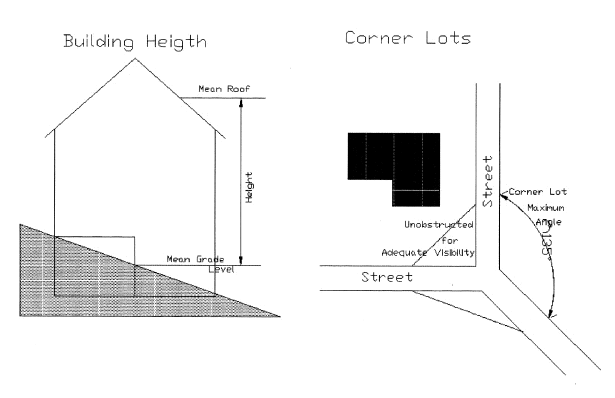
BASEMENT: A story whose floor is more than twelve inches (12") below the average level of the adjoining ground, but where no more than half of its floor to ceiling height is below the average contact level of the adjoining ground, as distinguished from a "cellar", as defined in this section. A basement shall be counted as a story for purposes of height measurement and as a half story for purposes of side yard determination.
BOARDING HOUSE: A building where, for compensation, meals and lodging are provided for at least five (5) but not more than fifteen (15) persons.
BUILDING: Any structure, whether temporary or permanent, having a roof, and used or built for the shelter or enclosure of persons, animals, possessions or property of any kind.
BUILDING HEIGHT: The vertical distance from the average finished grade surface at the building wall to the highest point of the coping of a flat roof or to the deck line of a mansard roof, or the mean height level between eaves and ridge for gable, hip or gambrel roofs.
BUILDING INSPECTOR: See definition of Building Official.
BUILDING, MAIN: A building in which is conducted the principal use of the site on which it is situated.
BUILDING OFFICIAL: The official designated by the Nephi City council as the Nephi City building inspector.
CARPORT: A private garage not completely enclosed by walls or doors. For the purposes of this title, a carport shall be subject to all regulations prescribed for a private garage.
CELLAR: A separate room or space wholly under the surface of the ground, or having more than fifty percent (50%) of its floor to ceiling height under the average level of the adjoining ground.
CEMETERY, COLUMBARIUM, CREMATORY, MAUSOLEUM: Land or buildings used for the cremation, burial or interment of the dead, but not including facilities for embalming.
CHIEF EXECUTIVE OFFICER: The Nephi City mayor.
CHURCH: A building set apart primarily for the purpose of worship in which religious services are held and with which clergy is associated, the main body of which is kept for that use and not put to any other use inconsistent with its primary purpose, and which is tax exempt under the laws of the state of Utah.
CINEMA, INDOOR: An enclosed building used primarily for the presentation of motion pictures.
CINEMA, OUTDOOR: An establishment at which motion pictures are projected onto an outdoor screen for viewing by patrons seated in parked motor vehicles.
CIVIC CLUB, FRATERNAL ORGANIZATION: A building or use, other than a church or school, operated by a nonprofit association or organization for a social, fraternal, political, civic or philanthropic purpose, which may include a meeting hall and cooking and dining facilities for large groups, but shall not provide overnight lodging.
COAL YARD: The storage of coal in quantities in excess of ten (10) tons and/or the retail or wholesale sale of coal.
CONDITIONAL USE: A land use that, because of its unique characteristics or potential impact on the city, surrounding neighbors or adjacent land uses may not be compatible in some areas, or may be compatible only if certain conditions are required that mitigate or eliminate the detrimental impacts.
CONVENIENCE GOODS SALES AND SERVICES: Stores or shops intended for retail sales of convenience goods or performance of convenience services. Goods and services regarded as convenience are those generally needed for daily home consumption and for which locations near residential neighborhoods are considered desirable. This category includes grocery store, drugstore, variety store, personal service, hardware store, dry cleaning pick up, and uses considered similar and compatible.
COURT: An open, unoccupied space, other than a yard, on the same lot with a building or group of buildings and which is bounded on two (2) or more sides by such building or buildings.
COVERAGE: The percent of the total site area covered by structures or impervious paving other than those excepted in this title.
CUL-DE-SAC: A minor street having an open end and being terminated at the other end by a vehicle turnaround.
CULTURAL, CIVIC SERVICES: A building primarily used for the public, nonprofit display of art, historic or cultural artifacts, or other inanimate exhibits, or a building primarily used as a lending library or reading room.
DAIRY: A commercial establishment for the manufacture and retail sale of dairy products.
DATA CENTER - A facility or complex that houses computing and networking equipment, along with storage and management systems, to support the storage, processing, and distribution of digital data and applications. A data center typically features high-performance servers, storage arrays, networking equipment, cooling systems, and power backup solutions to ensure uninterrupted operations. Data centers may include server rooms, or IT operations to monitor, and maintain the computing and networking equipment.
DATA CENTER - ACCESSORY BUILDING(S), STRUCTURES, AND USES: A subordinate, supportive building, structure, or use, customarily incidental to any main use or buildings, located upon the same lot, and only available for employee use that may include, but is not limited to:
- Daycare,
- Cafeteria,
- Medical office;
- Offices;
- Recreation facilities such as a gym, health spa, or workout studio;
- Site improvements;
- Temporary construction yards, and trailers to be removed upon completion of a construction project.
DATA CENTER - BACKUP UTILITY GENERATION: means an on-site, independent power source and system, that automatically activates to provide electricity during a main electric power line outage, ensuring continuous operation of critical IT equipment and infrastructure. The system may consist of generators (including diesel fueled), batter energy storage systems (BESS), automated transfer switches, and UPS (Uninterruptible Power Supply) systems with batteries, or any other type of backup system which can provide immediate, short-term power until the main power grid comes back on line and functional. This ensures data integrity, prevents system crashes, and maintains essential services by bridging the gap between the outage of the primary utility power and the startup of the backup generator.
DATA CENTER - COMPLEX: a specialized, secure, facility or a complex of multiple data center main and accessory and buildings, and their associated site improvements, support structures, and utilities that house the critical IT infrastructure, such as servers, storage systems, and networking equipment, along with essential supporting systems like power, cooling, and security, to store, process, manage, and deliver data and applications for an organization or a cloud service provider. Also, all data center site improvements, support structures, and on-site utilities necessary to support the operations of the data center.
DATA CENTER - MAIN BUILDING(S): are the building facilities that house a vast array of interconnected computing and networking equipment, including servers, storage, and networking gear, along with the essential infrastructure, such as cooling, power, and security systems needed to reliably operate and secure an organization's critical data and applications. It acts as the central hub for an organization's IT operations, supporting the storage, processing, and delivery of data and services.
DATA CENTER - MODULAR: means a facility or group of facilities designed for the housing and operation of computer servers, networking equipment, data storage systems, and related infrastructure, where the primary structures are prefabricated, or modular units that are capable of being transported and assembled on site. Modular data centers shall have a limited:
- Electrical power capacity allowed on the electricity grid circuit as determined by Nephi City Electrical Power Superintendent based on available infrastructure.
- Natural gas capacity allowed on the city natural gas system usage as determined by the Nephi City Natural Gas Superintendent based on available infrastructure.
- Sanitary sewer capacity, and access allowed on the city sanitary sewer system as determined by the Nephi City Sanitary Sewer Superintendent based on available infrastructure, and discharge parameters.
- Culinary water capacity allowed on the city water system usage as determined by the Nephi City Water Superintendent based on available infrastructure. Modular Data Centers shall not employ open-loop evaporative cooling.
DATA CENTER - MODULAR - ACCESSORY USES AND STRUCTURES: are support uses and structures such as are customarily incidental to and used in connection with a modular data center, including but not limited to:
- Battery storage;
- Backup generators;
- Low-water use cooling and ventilation systems, such as closed, updraft mechanical coolers;
- Power generation equipment;
- Security facilities, including remotely-manned systems;
- Transformers;
- Uninterruptible power supply (UPS) systems.
DATA CENTER - SITE IMPROVEMENTS: are the physical buildings, structures, or infrastructure with designed and installed improvement upgrades and enhancements to the real property surrounding a data center as part of a data center complex to enhance capacity, performance, sustainability, and redundancy to meet the needs of artificial intelligence (AI), inference, and cloud availability services, such as massive power, connectivity, security, on-site power generation and storage, backup power, cooling systems, water management, air quality and noise control, and enhancing visual appeal. Some improvements may include, but are not limited to:
- Automatic Transfer Switches (ATS) Systems;
- Backup Utility Generation (BUS);
- Battery energy storage system(s) (BESS) and facilities;
- Chillers/cooling systems;
- Electric power facilities such as, lines, plant, or substation;
- Fencing, security
- Fiber-based broadband infrastructure;
- Generators, including diesel fueled;
- Natural gas facilities such as, lines, plant, power plant, or substation (compressor or regulator);
- Parking areas, lots, or structures for employee and visitor parking, in compliance with Section 11.6.8 of this code;
- Loading areas, lots, or structures for large trucks and equipment in compliance with Section 11.6.8 of this code;
- Maintenance facilities
- Solar energy project
- Uninterruptible power supply (UPS) system
- Utilities, public and private
DAYCARE, EMPLOYER 1 : Group daycare provided by an employer primarily to the children or other dependents of employees, on or adjacent to the premises of the employer.
DAYCARE, FAMILY 2 : The keeping for care and/or instruction, whether or not for compensation, of children in a dwelling if licensed by the state of Utah under one of the following categories. No employees are permitted, except as required by the licensing regulations of the state of Utah.
- Licensed family childcare;
- Licensed family group childcare;
- Residential certificate childcare.
DAYCARE, GROUP 3 : An establishment for the care and/or instruction of children, whether or not for compensation, if licensed by the state of Utah as a childcare center.
DETACHED: A building that is free-standing, separated and disconnected from any other building, roof, wall, or structure, regardless of whether portions of the structure are on one building lot, or separate building lots.
DISABILITY: A physical or mental impairment that substantially limits one or more of a person's major life activities, including a person having a record of such an impairment or being regarded as having such an impairment. "Disability" does not include current illegal use of, or addiction to, any federally controlled substance, as defined in section 102 of the controlled substances act, 21 USC 802.
DISTRICT: A portion of the area of Nephi City, Utah, shown on a zoning map (attached to the ordinance codified herein) and given a zone classification as set forth in this title.
DRIVE AISLE (LANE): An unimpeded circulation route for motorized vehicle traffic through a parking lot, site, or property that allows for entrance and exit to the parking lot, parking stalls, loading docks, drop-off areas, garages, or other locations on the site requiring access, except for drive-through service areas or stacking lanes or aisles for a drive-through facility, which requires a separate driving area.
DRIVE-THROUGH ADJACENT AISLE (LANE): An unimpeded circulation route for motorized vehicle traffic that is parallel and adjacent to a drive through lane with the purpose of providing traffic the ability to enter or exit the adjacent drive through lane at designated locations; clearance for a turning radius route; and direct traffic flow to on site areas such as drive aisle lanes, parking stalls or entry/exit accesses.
DRIVE-THROUGH AISLE (LANE): A circulation route used only, or primarily for vehicular traffic associated with a drive-through facility where customers can receive products or services while remaining in their vehicles.
DRIVE-THROUGH FACILITY: A business that provides products or services, which may be dispensed, or serviced by an attendant or automated machine to customers while they remain in their vehicles, or their vehicles are separately serviced, or products applied or purchased, while customers wait in another designated area.
DRIVE-THROUGH MENU BOARD: A display that presents menu items, promotions, and pricing to customers in their vehicles, or in a designated ordering location.
DRIVE-THROUGH ORDER AREA: An area where products or services may be requested for purchase from a drive-through facility by an attendant or automated machine by customers while they remain in their vehicles, or in a designated ordering location, which may include a menu board.
DRIVE-THROUGH SERVICE AREA: An area where products or services are received from a drive-through facility:
- in uses with service windows, the service area starts at the service window; and
- in uses where the service occurs indoors, the service area is the area within the building where the service occurs; and
- for a vehicular service such as pumping gas, air compressing tires, oil changes, or car cleaning stations, the service area is the area where the vehicles are parked during the service.
DRIVE-THROUGH STACKING AISLE (LANE): A circulation route for motorized vehicle traffic waiting or queuing in line for the purpose of obtaining products or services at a drive-through facility that includes stacked tandem parking spaces that are separated from other vehicular traffic including drive aisles or lanes, pedestrian traffic, and the parking area.
DRY CLEANING ESTABLISHMENT: An establishment employing volatile or explosive substances for the cleaning or dyeing of fabrics. Excluded from this definition are traditional laundries employing water and soaps in the cleaning of fabrics and patron operated dry cleaning machines associated with laundromats.
DWELLING: Any building, or portion thereof, which is designed for use for residential purposes, except hotels, boarding houses, lodging houses and tourist cabins.
DWELLING, APARTMENTS (APARTMENTS): A residential dwelling structure, in single ownership, having more than four dwelling units divided vertically, or horizontally by shared common walls, ceilings, or floors; and including individual entrances, where the entire structure is located upon one building lot that is singly owned; and intended for use as a multi-family dwelling and occupancy.
DWELLING, APARTMENTS (APARTMENTS) ABOVE COMMERCIAL BUSINESS: A combined use dwelling structure, in single ownership, having one or more dwelling units divided vertically by shared common ceilings or floors; and including individual entrances, where the entire structure is located upon one building lot that is singly owned; and intended for use as a multi-family dwelling and occupancy, with:
1. a minimum of eight-hundred (800) square feet per unit; and
2. not exceeding two-thousand, five-hundred (2,500) square feet per unit; and
3. not exceeding fifty (50) percent of the building's total square footage dedicated to residential; and
4. a maximum of eight (8) dwelling units per building; and
5. not exceeding exceeding fifteen-thousand (15,000) square feet in total building size; and
6. a maximum building site footprint of five-thousand (5,000) square feet per building; and
7. meeting all minimum lot or parcel density, frontage, setbacks, and lot size requirements of the zone.
DWELLING, APARTMENTS (APARTMENTS) VERTICAL: A residential dwelling structure, in single ownership, having two or more dwelling units divided vertically by shared common ceilings or floors; and including individual entrances, where the entire structure is located upon one building lot that is singly owned; and intended for use as a multi-family dwelling and occupancy, with:
1. a minimum of eight-hundred (800) square feet per unit; and
2. not exceeding two-thousand, five-hundred (2,500) square feet per unit, and
3. a maximum of six (6) dwelling units per building, and
4. a maximum total building size to not exceed fifteen-thousand (15,000) square feet; and
5. a maximum building site footprint per building of five-thousand (5,000) square feet.
DWELLING, CONDOMINIUMS (CONDOMINIUMS): A residential dwelling structure, in separate ownership, having more than four dwelling units divided vertically or horizontally by shared common walls, ceilings, or floors; and including individual entrances where the entire structure is located upon one building lot where each individual dwelling unit is owned separately, with also an undivided interest in common in the common areas of the property; and intended for use as a multi-family dwelling and occupancy.
DWELLING, CONDOMINIUMS (CONDOMINIUMS) VERTICAL: A residential dwelling structure, in separate ownership, having more than four dwelling units divided vertically by shared common ceilings, or floors; and including individual entrances where the entire structure is located upon one building lot where each individual dwelling unit is owned separately, with also an undivided interest in common in the common areas of the property; and intended for use as a multi-family dwelling and occupancy with:
1. a minimum of eight-hundred (800) square feet per unit, and
2. not exceeding two-thousand, five-hundred (2,500) square feet per unit, and
3. a maximum of six (6) dwelling units per building, and
4. a maximum total building size to not exceed fifteen-thousand (15,000) square feet; and
5. a maximum building site footprint per building is five-thousand (5,000) square feet
DWELLING, DUPLEX (DUPLEX): A residential dwelling structure having two attached dwelling units divided vertically, or horizontally by a single, shared common wall, ceiling, or floor, and including individual entrances, where the entire structure is located upon one building lot that is singly owned; and intended for use as a two-family dwelling and occupancy.
DWELLING, FOUR-FAMILY: A building arranged or designed to be occupied by four (4) families, the structure having only four (4) dwelling units.
DWELLING, FOUR-PLEX (FOUR-PLEX OR QUAD-PLEX): A residential dwelling structure having four attached dwelling units divided vertically, or horizontally by multiple shared common walls, ceilings, or floors, between the four units, and including individual entrances, where the entire structure is located upon one building lot that is singly owned; and intended for the use as a four-family dwelling and occupancy.
DWELLING, INTERNAL ACCESSORY (DWELLING) UNIT “IADU”: means a dwelling unit that:
- is located within a detached, single-family, primary dwelling, that is owner occupied; and
- is located on a lot not less than or equal to 6,000 square feet in size; and
- is located within the footprint of the primary dwelling at the time the IADU is created; and
- is designed in a manner that does not change the appearance of the of the building as a single family dwelling; and
- is not within a mobile home, or
- is not on a lot with a failing septic tank or system; and
- complies with all applicable building, health, and fire codes; and
- complies with all other conditions of this Title 10; and
- is created for the purpose of offering a long-term rental of thirty (30) consecutive days or longer.
DWELLING, MULTIPLE-FAMILY: A building arranged or designed to be occupied by more than four (4) families.
DWELLING, SINGLE-FAMILY: A detached, residential building structure with no shared walls with another residential building structure, designed to be used as a single dwelling unit, and occupied by one family, with the exception of IADUs, located on one lot meeting the minimum zoning setbacks. A single-family dwelling may contain two or more living spaces, kitchens, and bathrooms, but is not an IADU unless all other conditions are met in this Title, and may not be rented or leased for separate occupancy until approved as such.
DWELLING, THREE-FAMILY: A building arranged or designed to be occupied by three (3) families, the structure having only three (3) dwelling units.
DWELLING, TOWN HOME (TOWN HOME): A residential dwelling structure having three, and up to six attached dwelling units divided by two or more vertical, shared, common walls between the units, and including individual entrances, where each separate dwelling unit is located upon three, and up to six building lots that are separately owned; and intended for use as three, four, and multi-family dwelling and occupancy.
DWELLING, TRIPLEX (TRIPLEX, OR THREE-PLEX): A residential dwelling structure having three attached dwelling units divided by two, shared vertical, or horizontal common walls, ceilings, or floors, between the three units, and including individual entrances, where the entire structure is located upon one building lot that is singly owned; and intended for use as a three-family dwelling and occupancy.
DWELLING, TWIN-HOME (TWIN-HOME): A residential dwelling structure having two attached dwelling units divided vertically by a single, shared common wall, and individual entrances, where each dwelling unit is located upon two individual building lots that are separately owned; and intended for use as a two-family dwelling and occupancy.
DWELLING, TWO-FAMILY (DUAL-FAMILY): A building arranged or designed to be occupied by two (2) families, the structure having only two (2) dwelling units.
DWELLING UNIT: A single residential unit providing complete independent living facilities for one or more members of one family, including permanent provisions for living, sleeping, eating, cooking, and sanitation, including at least one separate, private kitchen and bathroom; additional kitchens and bathrooms are allowed and included as part of one dwelling unit if not permanently separated from the rest of the dwelling unit, and not rented, or leased for separate occupancy by a separate family, with the exception of an IADU in a single family dwelling.
ELDERLY PERSON: A person who is sixty (60) years old or older.
ELECTRIC POWER FACILITY: means all conduits, ducts, or other devices, materials, apparatus or property necessary to the generation, transmission, or distribution of electric power and energy.
ELECTRIC POWER LINE(S): means transmission and/or distribution lines of any capacity, wires, conductors, structures, towers, and cables, together with ancillary systems such as, without limitation, switch gear, transformers, and control systems, and all related equipment and fixtures used in the transmission of electric power. Power Lines do not include Electrical Substations.
ELECTRIC POWER PLANT: includes all real estate, fixtures, and personal property owned, controlled, operated, or managed in connection with or to facilitate the production, generation, transmission, delivery, or furnishing of electricity for light, heat, or power, and all conduits, ducts, or other devices, materials, apparatus, or property for containing, holding, or carrying conductors used or to be used for the transmission of electricity for light, heat, or power.
ELECTRIC POWER SUBSTATION: means a facility containing electric supply equipment for the purpose of switching, regulating, transforming, or otherwise modifying the characteristics of electricity, including electrical equipment, such as transformers, circuit breakers, voltage regulating equipment, buses, switches, and other related equipment.
FAMILY: means a group of not more than four (4) unrelated individuals. Unrelated individuals are individuals who are not related by blood, marriage, adoption, guardianship; or other duly authorized custodial relationship.
FENCE: A physical barrier to delineate, contain or designate an area designed for a specific use, such as an enclosure for a dwelling unit, an area of storage, etc.
FENCE, SECURITY: a physical barrier designed to prevent or delay unauthorized access to a property or area, for the purpose of safeguarding personnel, equipment, and assets from theft, damage, and intrusion, and may incorporate walls with anti-climb design features, heavy-duty materials, and sometimes integrated security systems including gates, guard stations, and security cameras. Security fences should generally be no higher than a maximum of twelve (12) feet, but may be allowed to be taller as allowed by the DRC during site plan review.
FIBER-BASED BROADBAND INFRASTRUCTURE: is a network of high-capacity, fiber optic cables that transmit data a light signals, providing the high-speed, low-latency, superior bandwidth, enhanced security, energy efficiency, and reliable connectivity that data centers need to process, store, and distribute massive amounts of information efficiently for demanding application like cloud computing, artificial intelligence, and big data analytics both within the facility and to external users and other data centers, global networks, and the wider internet. Key components can include, but are not limited to: fiber optic cables, multimode fiber, single-mode fiber, transceivers, switches and routers, connectors and patch panels, and dark fiber (unused fiber) that a data center can lease or own.
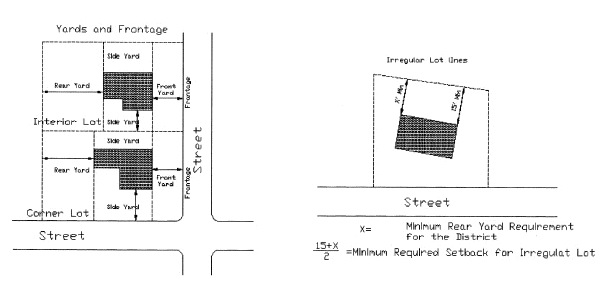
FRONTAGE: The length of the property line of the lot fronting on one side of a street.
GARAGE, COMMERCIAL: A building other than a private garage used for the temporary parking of automobiles with or without a fee.
GARAGE, PRIVATE (INCLUDING CARPORT): A detached accessory building or portion of a main building for the parking or temporary storage of automobiles of the occupants of the premises.
GARDENING, HORTICULTURE: The tilling of the soil, raising of crops, horticulture and gardening.
GENERAL MERCHANDISE SALES AND RELATED SERVICES: Stores, department stores or shops intended for sale of goods or merchandise, but not including convenience goods, liquor, motor vehicles, campers, trailers, farm equipment, lumber, heavy machinery or war surplus goods.
GRADE:
- For buildings adjoining more than one street, the average of the elevations of the sidewalks at the centers of all walls adjoining streets.
- For buildings adjoining one street only, the elevation of the sidewalk at the center of that wall adjoining the street.
- For buildings having no wall adjoining the streets, the average level of the ground (finished surface) adjacent to the exterior walls of the buildings. All walls approximately parallel to and not more than five feet (5') from a street line are to be considered as adjoining a street.
HEALTH DEPARTMENT: The Utah state division of environmental health or local health agency having jurisdiction.
HEALTHCARE CENTER (CONVALESCENT CENTER): A publicly or privately operated facility, other than a hospital, intended for the long term, inpatient care of human illness or infirmity, including the elderly and developmentally disabled, normally employing the services of skilled and licensed practitioners.
HIGHER LEARNING INSTITUTION: a college, university, or similar institution, including a technical or business school, offering postsecondary level academic instruction that leads to an associate or higher degree if the school is empowered by the appropriate State education authority under State law to grant an associate or higher degree. When there is no State law to authorize the granting of a degree, the school may be recognized as an institution of higher learning if it is accredited for degree programs by a recognized accrediting agency. Such term shall also include a hospital offering educational programs at the postsecondary level without regard to whether the hospital grants a postsecondary degree. Such term shall also include an educational institution which is not located in a state, which offers a course leading to a standard college degree, or the equivalent, and which is recognized as such by the secretary of education (or comparable official) of the country or other jurisdiction in which the institution is located.
HOME OCCUPATION: An occupation carried on by the occupant of a dwelling as a secondary use in connection with which there is no display other than that provided in chapter 19 of this title, no stock in trade, no person employed other than members of the family residing on the premises, and no power tools used requiring a motor in excess of one horsepower. (See section 10-19-13 of this title for supplementary regulations.)
HORTICULTURE: The tilling of the soil, raising of crops, horticulture and gardening, but not including the keeping or raising of domestic animals and fowl, except household pets, and not including any agricultural industry or business, such as food packing plants, fur farms, animal hospitals or similar uses.
HOSPITAL: An institution designed for the diagnosis, treatment and care of human illness or infirmity and providing health services, primarily for inpatients, and including as related facilities, laboratories, outpatient departments, training facilities and staff offices, but not including clinics or healthcare centers.
HOTEL: A building designed or occupied as the more or less temporary abiding place of fifteen (15) or more individuals who are, for compensation, lodged, with or without meals.
HOUSEHOLD PETS: Animals or birds ordinarily permitted in the house and kept for company or pleasure, such as dogs, cats and canaries, but not including a sufficient number of dogs to constitute a "kennel", as defined in this section.
INDUSTRIAL (OR RESEARCH) PARK: A tract of land that is subdivided and developed according to a plan for the use of a community of industries and related uses and that is of sufficient size and physical improvement to protect surrounding areas and the general community and to assure a harmonious integration into the neighborhood. Refer to chapter 10 of this title for complete description and regulations.
INDUSTRY, LIGHT: The manufacturing, compounding, processing, assembling, packaging or testing of goods or equipment entirely within an enclosed structure, with no outside storage, serviced by small (3/4 ton) trucks or vans, and imposing a nearly negligible impact upon the surrounding environment by noise, vibration, smoke, dust or pollutants.
INDUSTRY, MEDIUM: The manufacturing, compounding, processing, assembling, packaging or testing of goods or equipment within an enclosed structure, or an open yard that is capable of being screened from neighboring properties, is serviced by trucks or other vehicles, and whose environmental impact is within the industrial performance standards as outlined in this title.
INSTRUCTIONAL ACADEMY: The instruction of students, not in a dwelling, in music, art, crafts, academics, dance or kindergarten preparation, whether or not for compensation.
INSTRUCTIONAL ACADEMY, HOME: The instruction of students, in a dwelling, in music, art, crafts, academics, dance or kindergarten preparation, whether or not for compensation, where no more than sixteen (16) students are present in any one session and where sessions are of less than four (4) hours in duration. Instruction is given by a resident of the dwelling, and no one else is employed.
JUNKYARD: The use of any lot, portion of a lot or tract of land for the storage, keeping or abandonment of junk, including scrap metals or other scrap materials, or for the dismantling, demolition or abandonment of automobiles, other vehicles, or machinery or parts thereof; provided, that this definition shall not be deemed to include such uses which are clearly accessory and incidental in the district.
KENNEL 4 : A place or building used for the keeping of three (3) or more dogs or cats, at least three (3) months of age.
KITCHEN: Any room or area used, intended, or designed to be used for the cooking or preparation of food which contains any two of the following; a sink, a refrigerator, a range, a microwave or any appliance used for food preparation, or a large appliance outlet.
LAND USE APPLICATION: An application required by this title.
LAND USE AUTHORITY: A person, board, commission, agency or other body designated by the legislative body to act upon a land use application.
LAND USE ORDINANCE: A planning, zoning, development or subdivision ordinance of Nephi City, but does not include the general plan.
LAND USE PERMIT: A permit issued by a land use authority.
LAUNDROMAT: An establishment in which patrons wash, dry or dry clean clothing and other fabrics in coin operated, self- service machines.
LAUNDRY: An establishment at which clothing and other fabrics are washed and pressed. Excluded from this definition are dry cleaning establishments and laundromats.
LEGISLATIVE BODY: The Nephi City council.
LIQUOR STORE: A retail sales store authorized by the Utah state alcoholic beverage commission to sell packaged alcoholic beverages for off premises consumption.
LOCAL HEALTH OFFICER: The health officer or department employed by or officially representing Nephi City.
LOCAL JURISDICTION: Nephi City.
LODGING HOUSE: A building where lodging only is provided for compensation to five (5) or more, but not exceeding fifteen (15), persons, in contradistinction to hotels open to transients.
LOT: A parcel of land occupied or to be occupied by a main building or group of buildings (main and accessory), together with such yards, open spaces, lot width and lot area as are required by this title, and having frontage upon a street. More than one dwelling structure may be built on a lot only in cases where the lot is of such size as to provide such required lot area, yards and frontage for each dwelling structure as are required for the first dwelling structure on the lot.
LOT DEPTH: The horizontal distance between the front and rear lot lines measured in the main direction of the side lot line.
LOT LINE: Property lines bounding the lot.
LOT WIDTH: The horizontal distance between the side lot lines, measured at the required front yard setback line or rear yard setback line, whichever is shorter.
LUMBER SALES AND STORAGE: The sale and display of lumber and building supplies, including the outside storage of lumber and related merchandise.
MANAGER'S QUARTERS: A structure detached from buildings used in a business or business complex which contains an office for use of the manager of the business or business complex. This structure may contain living quarters for the manager. Only one such structure shall be allowed for each business or business complex. If any part of a business complex changes ownership, no additional manager's quarters shall be allowed.
MANUFACTURED HOME: A detached, single-family dwelling unit that is transportable in two (2) or more modules, is manufactured or constructed under authority of 42 United States Code section 5401, and which is built on a permanent chassis and designed to be used as a dwelling, shall be attached to a permanent foundation in accordance with plans providing for vertical loads, uplift, and lateral forces and frost protection in compliance with the applicable building code. All appendages, including carports, garages, storage buildings, additions, or alterations shall be built in compliance with the applicable building code. When connected to the required utilities and includes the plumbing, heating, air conditioning and electrical systems contained therein. The unit must bear a U.S. department of housing and urban development (HUD) data plate and must not have been altered in violation of the above code. Excluded from this definition shall be those permanent dwelling structures that are constructed of component parts, that are transported to the building site, which meet structural requirements of the international building code, and which are finished with exterior building material that is typical of permanent residential buildings.
MANUFACTURED HOME (NONCONFORMING):
- A detached, single- family dwelling unit that is transportable, is manufactured or constructed under authority of 42 United States Code section 5401, does not meet the definition of a "manufactured home", as defined in this section, is built on a permanent chassis and designed to be used as a dwelling, with or without a permanent foundation, when connected to the required utilities, and includes the plumbing, heating, air conditioning and electrical systems contained therein. The unit must bear a U.S. department of housing and urban development (HUD) data plate.
- Excluded from this definition shall be those permanent dwelling structures that are constructed of component parts that are transported to the building site and which meet structural requirements of the international building code and which are finished with exterior building material that is typical of permanent residential buildings.
MANUFACTURED HOME SUBDIVISION: A parcel of land, which has been legally subdivided, where owners of manufactured homes may purchase lots and attach said manufactured homes to permanent foundations. The subdivision is developed with all of the improvements and amenities found in a traditional, single-family subdivision as outlined in this title.
MENTAL HEALTH CENTER: A publicly or privately operated facility, intended for the diagnosis and treatment of mental or emotional disorders.
MOBILE HOME:
- A detached dwelling unit designed for long term occupancy and to be transported on its own wheels, or on a flatbed or other trailers or detachable wheels, to a site for occupancy as a complete dwelling unit, except for connections to utilities and other minor work and not affixed with a U.S. department of housing and urban development (HUD) data plate. Removal of such wheels or placing such dwelling on a foundation shall not remove such unit from classification as a mobile home.
- Excluded from this definition shall be those permanent dwelling structures which are constructed of component parts that are transported to the building site, which meet structural requirements of the international building code, and which are finished with exterior building material that is typical of permanent residential buildings.
MOBILE HOME PARK: A residential development in which owners of mobile homes or manufactured housing may rent or lease a lot on which to place their home. Such developments may provide all of the amenities and improvements typical of subdivisions.
MODEL HOME SALES OFFICE: A temporary use in an approved subdivision that includes a sales office only to market homes being built in the subdivision in which it is located. No off site sales are allowed. A plan for parking, signs, etc., must be approved by the zoning administrator prior to establishing any sales office.
MODULAR HOME: A permanent dwelling structure built of prefabricated units which are assembled and erected on the site, and which meets the building codes in effect in Nephi City.
MORTUARY, FUNERAL HOME: An establishment in which the dead are prepared for burial or cremation. The facility may include a chapel for the conduct of funeral services, spaces for informal gatherings and related accessory uses.
MOTEL: A building or group of buildings containing individual sleeping units designed and used primarily for the accommodation of transient automobile travelers and with automobile parking or storage immediately accessible.
NATURAL GAS FACILITY: means a pipe, main, conductor, or other facility or fixture used to carry natural gas.
NATURAL GAS LINE(S): includes both natural gas main and service lines.
NATURAL GAS LINE(S) (MAIN): means a natural gas distribution pipeline that delivers natural gas to another natural gas distribution supply line, or to a natural gas service line, and does not include a Natural Gas Service Line.
NATURAL GAS LINE(S) (SERVICE): means a natural gas pipeline that carries natural gas from a natural gas main to a meter for use by the ultimate consumer.
NATURAL GAS PLANT (OR MANUFACTURED GAS): includes all real estate, fixtures, and personal property owned, controlled, operated, or managed in connection with or to facilitate the production, generation, transmission, delivery, or furnishing of gas, natural or manufactured, for light, heat, or power.
NATURAL GAS POWER PLANT: means a facility designed and used for converting natural gas into electricity, together with all ancillary systems and infrastructure for cooling, emissions controls, and the delivery and storage of natural gas. A Natural Gas Power Plant does not include facilities for the extraction or refinement of natural gas but may include Power Lines.
NATURAL GAS SUBSTATION: means either a compressor station or a regulator station used in the natural gas pipeline network to control the pressure and flow of gas from production wells to consumers. Compressor stations use turbines to boost gas pressure for long-distance transport, while regulator stations, or "city gates", manage gas pressure when the distribution utility receives the gas from the main pipeline.
NATURAL WATERWAYS: Those areas, varying in width, along streams, creeks, springs, gullies or washes which are natural drainage channels, as determined by the building inspector.
NONCOMPLYING STRUCTURE: A structure that:
- Legally existed before its current land use designation; and
- Because of one or more subsequent land use ordinance changes, does not conform to the setback, height restrictions or other regulations, excluding those regulations which govern the use of land.
NONCONFORMING USE: A land use that:
- Legally existed before its current land use designation;
- Has been maintained continuously since the time the land use ordinance governing the land changed; and
- Because of one or more subsequent land use ordinance changes, does not conform to the regulations that now govern the use of land.
OFFICE, BUSINESS OR GOVERNMENT: A place intended for the conduct of administration or services by a business enterprise or unit of government and in which no goods or merchandise are stored, displayed or sold.
OFFICE, PROFESSIONAL: A place intended for the conduct of a recognized learned profession. Such uses include offices or clinics devoted to treatment and care of human illness or injury (medical, dental, chiropractic offices and similar uses). Other professions so defined would include, but not be limited to, accountants, architects, engineers and lawyers. Definition does not allow for inpatient care facilities.
OFFICIAL MAP: A map drawn by Nephi City and recorded in the Juab County recorder's office that:
- Shows actual and proposed rights of way, centerline alignments and setbacks for highways and other transportation facilities;
- Provides a basis for restricting development in designated rights of way or between designated setbacks to allow the government authorities time to purchase or otherwise reserve the land; and
- Has been adopted as a part of the Nephi City general plan.
OPEN SPACE: A planned outdoor landscaped area outside of the required zone setbacks that is designated and installed, or retained and enhanced for use by residents of the property or community for; gatherings, activities, recreation or visual enjoyment, such space can be reserved for; parks, recreation areas, playgrounds, or amenities included to meet the density requirements of a planned unit development; as part of a homeowners association; or as a dedicated area to the City of Nephi by any private or public entity for the city to maintain for the stated purposes above.
OUTDOOR RECREATION, PARK OR PLAYGROUND (PUBLIC OR PRIVATE): An area free of buildings, except for restrooms, dressing rooms, equipment storage and maintenance buildings, and open air pavilions, and used primarily for recreation activities not involving motor vehicles or overnight use.
OWNER OCCUPIED: real property in which the owner or owners live within a residential structure located on the property, and uses all, or a portion of the structure, as their primary residence.
PARKING AREA, PRIVATE: An open area, other than a street, used for the parking of the automobiles of occupants of a dwelling, hotel or apartment hotel.
PARKING LOT, PUBLIC: An open area, other than a private parking area or street, available for public or quasi-public use.
PARKING SPACE, AUTOMOBILE: Space within a building or a private or public parking area, exclusive of driveways, ramps, columns, and office and work areas, for the parking of one automobile.
PERSONAL SERVICES: Establishments primarily involved in providing personal grooming and related services. This definition shall include barbershops, beauty parlors, tailors or message services, but not laundries or dry cleaners.
PET GROOMING: The grooming of small pets such as dogs and cats; provided, that no more than three (3) animals may be on the premises at one time and that no lodging of animals is allowed.
PLANNED RESIDENTIAL DEVELOPMENT: A development.
PLANNED UNIT DEVELOPMENT (PUD): A residential development guided by a total design plan in which one or more of the zoning or subdivision regulations, other than use regulations, may be waived or varied to allow flexibility and creativity in site and building design and location, in accordance with general guidelines as specified in chapter 12 of this title. Units within a PUD may be owned as condominiums or offered for rent.
PLANNING COMMISSION: The Nephi City planning commission.
POWER LINES: (see Electrical Power Lines).
PRIMARY (PRINCIPAL) RESIDENCE: The dwelling or residence where an individual or family maintain a permanent place of living and occupying their time a majority of the calendar year, or over 51% of the time, which may be consecutively or intermittently. Only one location may be considered a primary (principal) residence at a time during a calendar year for any individual.
PUBLIC HEARING: A hearing at which members of the public are provided a reasonable opportunity to comment on the subject of the hearing.
PUBLIC SERVICES: Uses, which may be housed in separate buildings, or which may occupy a space within a building, that are operated by a unit of government to serve public needs such as police (with jail), fire service, ambulance, post office or judicial court, but not including public utility stations or maintenance facilities.
PUBLIC UTILITY STATIONS: A structure or facility used by a public or quasi-public agency to store, distribute, generate or chemically treat water, power, gas, sewage, equipment or other service elements. In any residential zone, public utility stations shall meet the following requirements:
- Each station shall be located on a lot not less than two thousand (2,000) square feet in area.
- Each station shall be located on a lot which has adequate access from a street, alley or easement.
- Each station shall be provided with a yard on each of the four (4) sides of the building, or structure not less than five feet (5') in width; except that for such stations located on lots fronting on a street and abutted by one or more residential lots, the front, side and rear yards should equal those required for a single-family residence in the same district.
- The location of public utility stations in a residential zone shall be subject to approval by the planning commission.
REASONABLE NOTICE: Notice as required by Utah State Code, or if actual legal notice of the hearing or meeting is given.
RECREATIONAL VEHICLE: A vehicular unit, other than a mobile home, primarily designed as a temporary dwelling for travel, recreational and vacation use, which is either self-propelled or is mounted on or pulled by another vehicle, including, but not limited to, a travel trailer, a camping trailer, a truck camper, a motor home, a fifth wheel trailer, and a van.
RECREATIONAL VEHICLE PARK (TRAVEL TRAILER PARK): Any area or tract of land or separately designated section within a mobile home park where lots are rented to one or more owners or users of recreational vehicles for a temporary time not to exceed thirty (30) consecutive days, and not to exceed thirty (30) cumulative days in any ninety (90) day period.
REPAIR SERVICES, SMALL APPLIANCE OR EQUIPMENT: An establishment for the repair of household or other small appliances or equipment and at which no such appliances or their parts are stored out of doors.
RESIDENTIAL STRUCTURE: A building that contains at least one dwelling unit intended for supporting or sheltering residential occupancy.
RESIDENTIAL UNIT: A residential dwelling unit that is occupied in whole or in part for residential use.
RESIDENTIAL FACILITY FOR ELDERLY PERSONS: A residential facility for elderly that is owned by one of the residents or by an immediate family member of one of the residents, or a facility for which the title has been placed in trust for a resident and is occupied on a twenty four (24) hour per day basis by eight (8) or fewer elderly persons in a family type arrangement. A residential facility for elderly persons may not operate as a business 5 .
RESIDENTIAL FACILITY FOR PERSON WITH A DISABILITY: A residential facility in which more than one person with a disability resides; and is licensed or certified by the department of human services under Utah Code Annotated title 62A, chapter 2, licensure of programs and facilities; or is licensed or certified by the department of health under Utah Code Annotated title 26, chapter 21, healthcare facility licensing and inspection act 6 .
RESTAURANT, CAFE, CONFECTIONERY (TRADITIONAL SERVICE): An establishment at which food is prepared and served to customers for consumption on the premises.
RESTAURANT, FAST FOOD, DRIVE-IN: An establishment distinguished from a traditional sit down restaurant in that service is provided from a counter or window for consumption either off or on the premises; on premises consumption normally requires considerably less time than consumption in a traditional restaurant. Service may also be provided to customers in automobiles by use of an outside drive-up window; parking is provided immediately adjacent to the building. This definition includes also specialty food stores such as ice cream parlors or delicatessens, having counter or window service.
SCHOOL, PRIVATE OR QUASI-PUBLIC: A school operated by a private or quasi-public organization or individual, which has a program similar to that provided in any public school in the state of Utah, except that such curriculum may include religious instruction. A private school may be a profit making or nonprofit organization. This definition shall not include commercial schools.
SCHOOL, PUBLIC: An educational facility operated by a school district or other public agency of the state of Utah.
SENIOR CITIZEN CENTER: A building other than a church or school serving the social and recreational needs of the elderly. Such a center may include a meeting hall and cooking and dining facilities for large groups, but shall not provide overnight lodging.
SEXUALLY ORIENTED BUSINESS: A "seminude entertainment business", sexually oriented "outcall services", adult businesses, "seminude dancing bars" and seminude dancing agencies, as defined in title 3, chapter 6 of this code.
SHOPPING CENTER, COMMUNITY: A completely planned and designed commercial development providing for the sale of general merchandise and convenience goods and including a variety store, discount store or supermarket. The center is designed to serve a trading area that extends beyond an immediate neighborhood, but serves a smaller area than a regional center.
SHOPPING CENTER, NEIGHBORHOOD: A planned commercial development providing primarily for the sale of convenience goods and services. The center is designed to serve a residential neighborhood.
SHOPPING CENTER, REGIONAL: A completely planned and designed commercial development providing for the sale of general merchandise, apparel, furniture, home furnishings, and other retail sales and services, in full depth and variety. The center includes at least one full line department store as the principal tenant and often includes two (2) or three (3) major department stores. The center is designed to serve a trading area that draws from beyond Nephi City.
SHORT TERM RENTAL: A residential unit that all or any portion of is rented or offered for rent by the owner of record for fewer than thirty (30) consecutive days to the same person or entity.
SHORT TERM RENTAL OWNER: A person or entity that is the owner of record of a short term rental.
SHORT TERM RENTAL WEBSITE: A website that allows:
A. a person to offer a short-term rental to one or more prospective renters; and
B. facilitates the renting of, and payment for a Short-term Rental.
SIGNS: Every advertising message, announcement, declaration, demonstration, display, illustration, insignia, surface or space erected or maintained in view of the observer thereof for identification, advertisement or promotion of the interest of any person, entity, product or service. The definition of "sign" shall also include the sign structure, support, lighting system and any attachments, ornaments or other features used to draw the attention of observers. This definition does not include any flag, badge or insignia of a government or governmental agency erected for and used to identify said government or governmental agency.
SIGN, ADVERTISING: See definition of Sign, Off Premises.
SIGN, ANIMATED: Any sign which includes action or motion. For purposes of this title, this term does not refer to flashing or changing.
SIGN AREA: The regulated area of a sign, excluding the minimum frame and supports. In computing sign area, refer to section 10-18-6 of this title.
SIGN, COMMUNITY EVENT: Signs for events that are designed to be applicable community-wide and sponsored by a not-for-profit entity.
SIGN, EDUCATIONAL FACILITIES: A sign located in a residential district and upon the grounds of a school (public or charter) that provides instruction to students that leads to the issuance of a high school diploma or equivalent.
SIGN, FLAT: A sign erected parallel to and attached to the outside wall of a building and extending not more than eighteen inches (18") from such wall with messages or copy on the face side only.
SIGN, FLOODLIGHTED: A sign made legible in the absence of daylight by devices which reflect or project light upon it.
SIGN, FREESTANDING (POLE SIGN): A sign supported by a fixed, permanent frame or support in the ground.
SIGN, GROUND (MONUMENT SIGN): "On premises" or identification signs having a maximum height of four feet (4'), incorporated into some form of landscape design scheme or planter box.
SIGN, IDENTIFICATION: A sign displayed to indicate the name or nature of buildings or uses located upon the premises on which the sign is located.
SIGN, ILLUMINATED: A sign which has characters, letters, figures, designs or outlines illuminated by electric lights or luminous tubes as part of the sign proper.
SIGN, INTERIOR: A sign located within a building so as to be visible only from within the building in which the sign is located.
SIGN MAINTENANCE: Signs shall be maintained in a safe, presentable and good condition, including replacing defective parts, repainting, cleaning and other acts required for the care, good appearance and safety of said sign.
SIGN, MOVABLE: Any sign that is not attached to the ground or building and which can be moved or transported by hand.
SIGN, NAMEPLATE: A sign indicating the name and/or occupation of a person or persons residing on the premises or legally occupying the premises, or indicating a home occupation legally existing on the premises.
SIGN, NONCONFORMING: A sign or sign structure, or portion thereof, lawfully existing at the time the ordinance codified herein became effective, which does not conform to all height, area and yard regulations prescribed in the district in which it is located.
SIGN, OFF PREMISES: An identification sign which directs attention to a use or services not related to the premises on which the sign is located.
SIGN, OUTDOOR ADVERTISING (BILLBOARD): A sign which advertises a business, activity, product, service or facility which is not on the premises on which the sign is located.
SIGN, PROJECTING: A sign attached to a building and extending in whole or in part more than eighteen inches (18") beyond any wall of the building.
SIGN, PROPERTY: A temporary sign related to the property on which it is located, advertising contemplated improvements, or announcing the name of the builder, owner, designer or developer of the project, or warning against trespassing.
SIGN, PUBLIC NECESSITY: A sign informing the public of any danger or hazard existing on or adjacent to the premises.
SIGN, REAL ESTATE: A temporary sign related to the property on which it is located and offering such property for sale, rent or lease.
SIGN, ROOF: A sign erected, constructed and maintained upon the roof of any building, and/or supported by the roof of a building, and projecting completely or partially above the highest point of the roof of the building.
SIGN, SERVICE: A sign which is incidental to a use lawfully occupying the property upon which the sign is located and which sign is necessary to provide information to the public, such as direction to parking lots and location of restrooms.
SIGN, SNIPE: A sign for which no permit has been issued and which is attached to a utility pole, sign pole or other outdoor structure.
SIGN, TEMPORARY: Any sign intended to be displayed out of doors for a short period of time. This would include signs advertising for the sale of household items or products produced on the premises.
SIGN, WALL: A sign that is either painted on a wall or its facing, or is painted in such a way that it gives the visual appearance of being painted on a wall or facing by not having a frame or separation from the wall or facing.
SIGN, WINDOW: A sign either attached to a window or door or located within a building so as to be visible through a window or door by people outside of the building.
SOLAR ENERGY PROJECT: means a project that generates electric energy by converting sunlight, whether by solar devices or other conversion technology, for the sale, delivery, transmission, or consumption of the generated energy by more than one end-user or by an end-user other than the owner or operator of the property on which the solar energy system is constructed and operated. A Solar Energy Project may include one or more Battery Energy Storage Systems (BESS), Electric Power Substations, and/or Electric Power Lines.
SKATING RINK: A place, indoors or outdoors, designed and used for roller skating and/or ice skating. Such an establishment may sell food as a secondary activity.
STABLE, PRIVATE: A detached accessory building for the keeping of horses owned by the occupants of the premises and not kept for remuneration, hire or sale.
STABLE, PUBLIC: A stable other than a private stable.
STORY: That portion of a building, other than a cellar, included between the surface of any floor and the surface of the floor or ceiling next above.
STORY, HALF: A story with at least two (2) of its opposite sides situated in a sloping roof, the floor area of which does not exceed two-thirds (2/3) of the floor immediately below it.
STREET: A public thoroughfare which affords principal means of access to abutting property and has a right of way that exceeds twenty six feet (26') in width. The term "street" shall include avenue, drive, circle, road, parkway, boulevard, highway, thoroughfare, or any other similar term.
STREET, ARTERIAL: A street which provides for through traffic movement between areas and across the city, with moderate access to abutting property subject to necessary control of entrances, exits and curb use.
STREET, COLLECTOR: A street which provides for traffic movement between major arterials and local streets, and direct access to abutting property.
STREET, LOCAL: A street which provides for direct access to abutting land and for local traffic movement.
STREET, PRIVATE: A right of way or easement in private ownership, not dedicated or maintained as a public street, which affords the principal means of access to two (2) or more lots.
STRUCTURAL ALTERATIONS: Any change in supporting members of a building, such as bearing walls, columns, beams or girders.
STRUCTURE: Anything constructed or erected, the use of which requires location on the ground or attachment to something having location on the ground. A "building" is included in this definition.
SUBDIVISION:
- Any land that is divided, resubdivided or proposed to be divided into two (2) or more lots, parcels, sites, units, plots or other divisions of land, for the purpose, whether immediate or future, for offer, sale, lease, or development, either on the installment plan or upon any and all other plans, terms and conditions.
- "Subdivision" includes the division or development of land whether by deed, metes and bounds description, devise and testacy, lease, map, plat or other recorded instrument.
SURPLUS, SECONDHAND STORE: An establishment which sells surplus items, used furniture, appliances, clothing and miscellaneous small items. Excluded from this definition are establishments selling used motor vehicles, their parts, and other heavy equipment.
THEATER, CONCERT HALL: A building used primarily for the presentation of live stage productions or performances.
TOURIST COURT: See definition of Motel.
TRAILER, TRAVEL: See definition of Recreational Vehicle.
TRANSPORTATION TERMINAL: A building, or part of a building, which serves as a centralized point of transfer between passenger surface transportation modes, or for the frequent movement of passenger transportation equipment. Not included in this definition are street side bus stops or taxicab stands.
TRAVEL PARK: See definition of Recreational Vehicle Park (Travel Trailer Park).
USE: The activities occurring on a lot or parcel of land for which land or a building is arranged, designed or intended, or for which land or a building is or may be occupied, including all accessory uses.
USE, ACCESSORY: A subordinate use customarily incidental to and located upon the same lot occupied by the main use.
UTILITIES (PUBLIC OR PRIVATE): including, but not limited to:
- Electric power facility
- Electric power line(s), including transmission and distribution lines;
- Electric power plant;
- Electric power substation;
- Natural gas facility;
- Natural gas lines, including main and service lines;
- Natural gas plant, or manufactured gas;
- Natural gas power plant;
- Natural gas substation;
- Sewer (wastewater) system;
- Solar project
- Water (culinary) system;
WASTEWATER SYSTEM: means any sewer, sewage system, sewage treatment facility, lagoon, sewage collection facility and system and related pipelines, and all similar systems, works, and facilities necessary or desirable to collect, hold, cleanse, or purify any sewage or other polluted waters, and related structures and facilities.
WATER SYSTEM (CULINARY): includes all tanks, reservoirs, tunnels, shafts, dams, dikes, head gates, pipes, flumes, canals, valves, hydrants structures, and appliances, and all other real estate, fixtures, and personal property owned, controlled, operated, or managed in connection with or to facilitate the diversion, development, storage, supply, distribution, sale, furnishing, carriage, appointment, apportionment, or measurement of water for power, fire protection, irrigation, reclamation, or manufacturing, or for municipal, domestic, or other beneficial use However, "water system" does not include private irrigation companies engaged in distributing water only to their stockholders.
WHOLESALE, WAREHOUSE, STORAGE: A building in which goods, merchandise or equipment are stored for eventual distribution, or for which storage space is rented.
YARD: An open, unoccupied space on a lot, other than a court, which is unobstructed from the ground upward by buildings or structures, except as otherwise provided in this title.
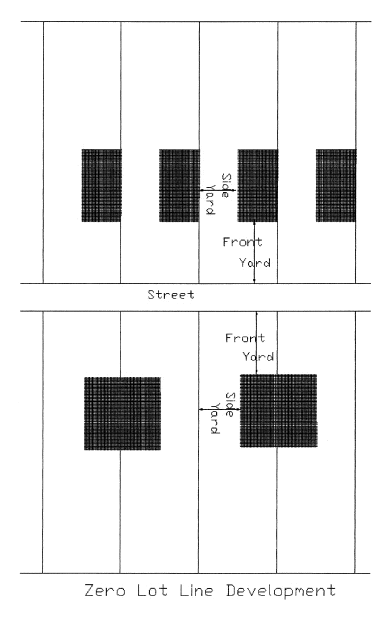
YARD, FRONT: An open, unoccupied space, on the same lot with a building, between the front line of the main building and the property line, and extending for the full width of the lot.
YARD, REAR: A yard extending across the full width of the lot between the most rear main building and the rear lot line. The depth of the required rear yard shall be measured horizontally from the nearest point of the rear lot line. On lots that are not rectangular in shape, the required minimum rear yard may be an average of the distances measured from the rear corners of the main building directly to the rear lot line. The shortest distance used in determining the average shall not be less than fifteen feet (15').
YARD, SIDE: An open, unoccupied space, except as otherwise provided in this title, on the same lot with the building, between the side line of the building and the side lot line, and extending from the front yard to the rear yard; or the shortest distance across said space from the main building to the side lot line.
ZERO LOT LINE DEVELOPMENT TWIN HOMES: Single-family dwellings arranged on two (2) lots sharing a common wall. The required side yard for zero lot line development shall be the total of the two (2) required yards, on each lot, of the district in which they are located.
ZONE: See definition of District.
ZONING MAP: The map adopted as part of this title, that depicts land use zones, overlays and districts.
Notes
1 Not included in the definition of "daycare" and not regulated by the city is the keeping for care of less than 5 children.
2 Not included in the definition of "daycare" and not regulated by the city is the keeping for care of less than 5 children.
3 Not included in the definition of "daycare" and not regulated by the city is the keeping for care of less than 5 children.
4 See also subsection 5-2-4B2 of this code.
5 UCA § 10-9a-501.
6 UCA § 10-9a-502.
HISTORY:
Ord. 6-05-07, 6-6-2007; amd. 2007 Code; Ord. 6-02-09, 6-2-2009; Ord. 2-15-11, 2-23-2011; Ord. 01-21-2020, 1-21-2020; Ord. 03-16-2021-A, 3-16-2021; Ord. 09-21-2021-A, 9-21-2021; Ord. 07-11-2023
10.2.3 Diagrams
HISTORY:
Ord. 6-05-07, 6-6-2007; amd. Ord. 09-21-2021-A, 9-21-2021

