
Niles City Zoning Code
SECTION 10
- OFF-STREET PARKING & LOADING
10.1 - GENERAL REQUIREMENTS
A.
Existing Facilities
As of the effective date of this Ordinance, the following apply:
1.
The existing number of off-street parking and loading spaces may not be reduced below the number required by this Ordinance. If the number of existing spaces is already less than that required, it may not be further reduced.
2.
Existing off-street parking and loading areas that do not conform to the regulations of this Ordinance, but were in conformance with the requirements of this Ordinance at the time the parking or loading facilities were constructed, are permitted to continue as a nonconforming site element.
3.
If a building permit for a structure was issued prior to the effective date of this Ordinance, and if construction has begun within 180 days of the issuance of a permit, the number of off-street parking and loading spaces must be provided in the amount required at the issuance of the building permit. If the amount required by this Ordinance is less than that shown in the plans, only the number required by this Ordinance needs to be constructed.
B.
Change in Use or Increase in Intensity
When the existing use of a structure or land is changed to a new use or increase in intensity through any improvements, parking and loading spaces must be provided as required for the new use or increased demand on parking.
C.
Change in Intensity of Use
When any structure is increased in size through additions, expansions, or any increase in floor area, or if additional dwelling units are created, then additional parking and loading spaces must be provided as required by this Ordinance. When the any structure is decreased in size by the loss of floor area or dwelling units, the number of parking and loading spaces may be reduced so long as the parking requirements of this Ordinance are met for the structure or land as modified.
D.
Provision of Additional Spaces
Nothing in this Ordinance prevents the voluntary establishment of additional off-street parking or loading facilities, provided that all regulations governing the location, design, and construction of such facilities are met.
E.
Provision of Car-Share Facilities
Spaces within parking lots and structures may include designated parking spaces for car-share facilities. A car-share facility is a membership-based car-sharing service that provides automobile rental to members, billable by the hour or day, and is not considered a vehicle rental establishment. Spaces reserved for car-share facilities may count toward minimum parking requirements of this Ordinance in the amount of four spaces or 5% of the total number of spaces, whichever is greater.
F.
Completion of Off-Street Parking and Loading Facilities
All off-street parking and loading facilities must be completed prior to occupancy of the structure or commencement of the use on a lot.
G.
Shared Parking.
Shared parking between 2 or more lots that abut each other may be allowed on a limited basis.
1.
No more than 20% of required parking stalls for any lot or use may be provided with stalls that are provided off-site through a shared-parking arrangement.
2.
Shared parking arrangements are only allowed when created via a document that is recorded against the title of each property that is party to the shared parking arrangement and where Village of Niles approval is required to amend or cancel the shared parking arrangement.
3.
Proposed Shared Parking arrangements shall be reviewed and decisions shall be made using the Site Plan procedure as provided in Section 15.6
(Ord. No. 2017-58, § 2(Exh. 1), 11-28-17)
10.2 - LOCATION OF OFF-STREET PARKING SPACES
A.
Residential Uses
1.
All required parking spaces for residential uses must be located on the same lot as the residential use. In a mixed-use building, all parking for residential dwelling units must be located on the same lot.
2.
Tandem parking is permitted for single-family, two-family and townhouse dwellings, but both spaces must be allotted to the same dwelling unit and located on the same lot as the dwelling.
B.
Non-Residential Uses
1.
All required off-street parking areas for non-residential uses must be located on the same lot as the use served or within 300 feet of the use served.
2.
A non-residential use may provide valet service to a parking facility with no distance restriction.
3.
Parking spaces, parking stalls, and parking facilities located within the Village of Niles may only be used for businesses or uses that are also located within the Village of Niles.
(Ord. No. 2017-58, § 2(Exh. 1), 11-28-17)
10.3 - OFF-STREET PARKING DESIGN STANDARDS
A.
Dimensions
1.
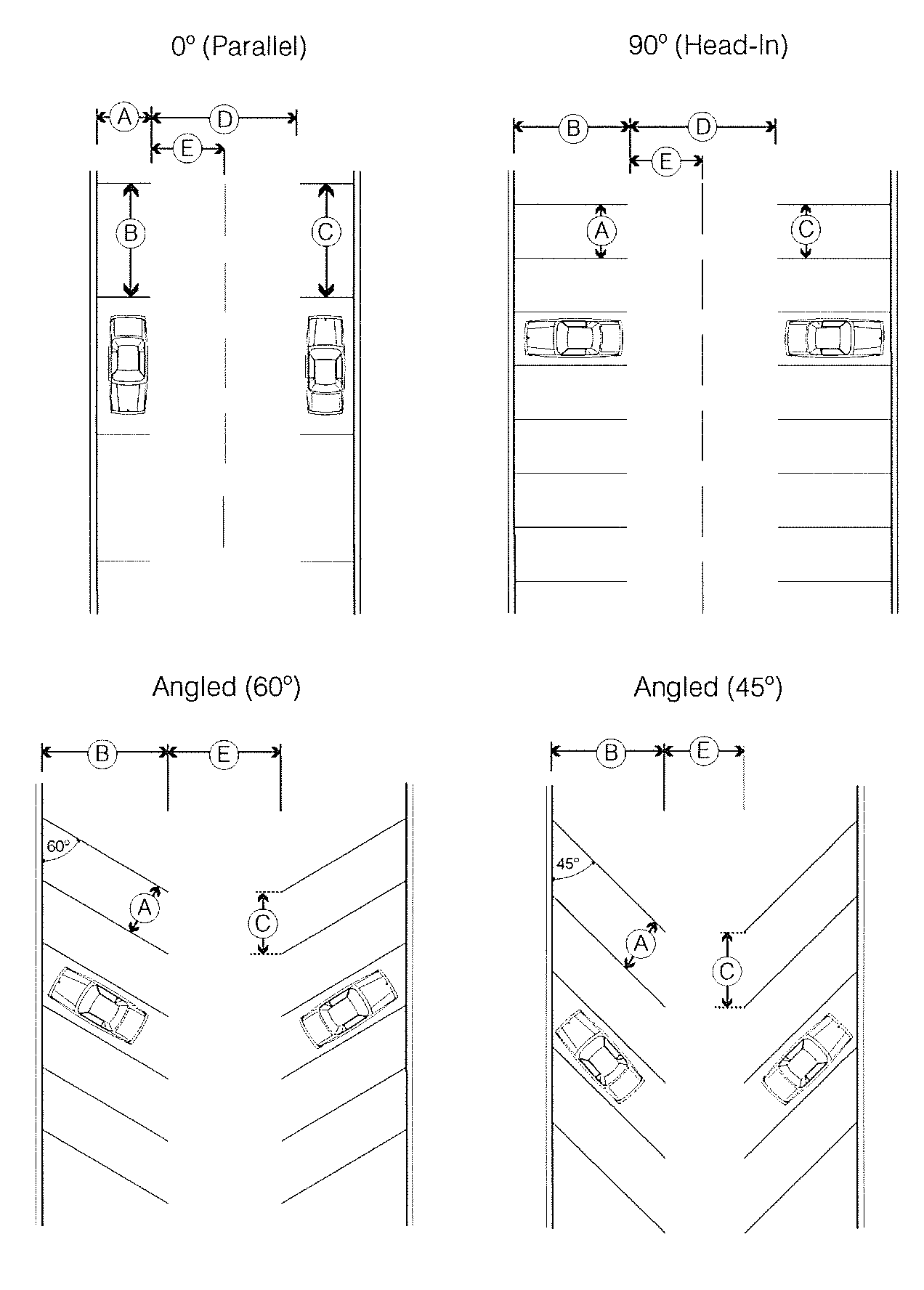
Off-street parking spaces and drive aisles within a parking lot or structure must be designed in accordance with Table 10-1: Off-Street Parking Space Dimensions. Additional parking angles other than those described in Table 10-1 are permitted but a site plan is required to provide evidence of safe and efficient parking configuration and traffic circulation.
2.
Accessible parking spaces must comply with the design standards of the State of Illinois Accessibility Code. Such spaces must be identified by a sign and pavement markings indicating parking for the disabled only. Accessible spaces must be closest to the entrance of the structure, and connected by a paved surface designed to provide safe and easy access.
3.
Motorcycle and scooter parking spaces must measure at least four feet in width by eight feet in length and must be identified or designated through the use of signs or pavement markings.
B.
Residential Passenger Vehicle Parking Pads
Single-family, two-family, and townhouse dwellings are permitted one paved parking pad, subject to the following standards.
1.
Parking pads are prohibited in the front yard and in the required corner side setback.
2.
Parking pads must be located behind the front building line and a minimum of one foot from any lot line.
3.
Parking pads are limited to a maximum of 450 square feet and must be connected to the driveway. The additional paved area used to connect the driveway to the parking area is included in this maximum square footage.
4.
The maximum impervious surface requirement for the lot may not be exceeded to accommodate a parking pad.
C.
Access
1.
All required off-street parking facilities must have vehicular access from a street, driveway, or cross-access connection.
2.
All required off-street parking facilities must have an internal pedestrian circulation system that allows for safe passage between parking areas and any public sidewalk in the adjacent right-of-way and the use it serves. This includes, but is not limited to, interconnected sidewalks, striped walkways, and separated walkways.
3.
All parking facilities must be designed with vehicle egress and ingress points that least interfere with traffic movement. Parking facilities must be designed to allow the driver to proceed forward into traffic, rather than back out and the minimum throat depth required for a parking facility driveway is 50 feet. This provision does not apply to single-family and two-family dwellings.
4.
Single-family and two-family dwelling driveways must meet the following standards:
a.
All driveways must lead to a functional garage or permanent carport. No driveways or paved areas are allowed that do not terminate at a functional garage. If a garage is modified so that the garage doors are removed and the garage no longer functions for vehicle storage, driveways leading to such modified garages must be removed.
b.
The maximum width of a driveway at the front or corner side lot line is 20 feet.
c.
Starting at the garage, the width of the driveway may exceed 20 feet. Such driveways must taper-down to 20 feet at the property line, and the taper cannot exceed a 45 degree angle at any point. At the garage, driveways may be as wide as the garage they lead to, as provided in Section 9.3(H).
d.
Driveways serving single family dwellings may traverse any required yard provided the driveway leads to an approved parking structure.
e.
A driveway in a front yard for a single-family dwelling may be expanded or enlarged beyond the width of the garage but only toward the interior side lot line closest to the driveway and subject to 'b' and 'c' above.
5.
Multi-family and townhouse dwellings and non-residential use driveways must be a minimum of 12 feet and a maximum of 15 feet for one-way drives, and a minimum of 22 feet and a maximum of 30 feet for two-way drives. However, in the industrial districts, driveways may be a maximum of 36 feet in width.
6.
In the industrial districts, driveways may be a maximum of 36 feet in width.
7.
Circular driveways for single family houses shall be allowed provided the following conditions are met:
a.
Circular driveways shall only be allowed on a lot that has a street frontage that is greater than 65 feet. If the lot has more than one street frontage, the circular driveway may only be located on the street frontage that is greater than 65 feet.
D.
Surfacing
1.
All off-street parking lots and parking pads must be improved with a hard surfaced, all-weather dustless material. Pervious paving, subject to approval from the Village Engineer, may also be used. Gravel is prohibited.
2.
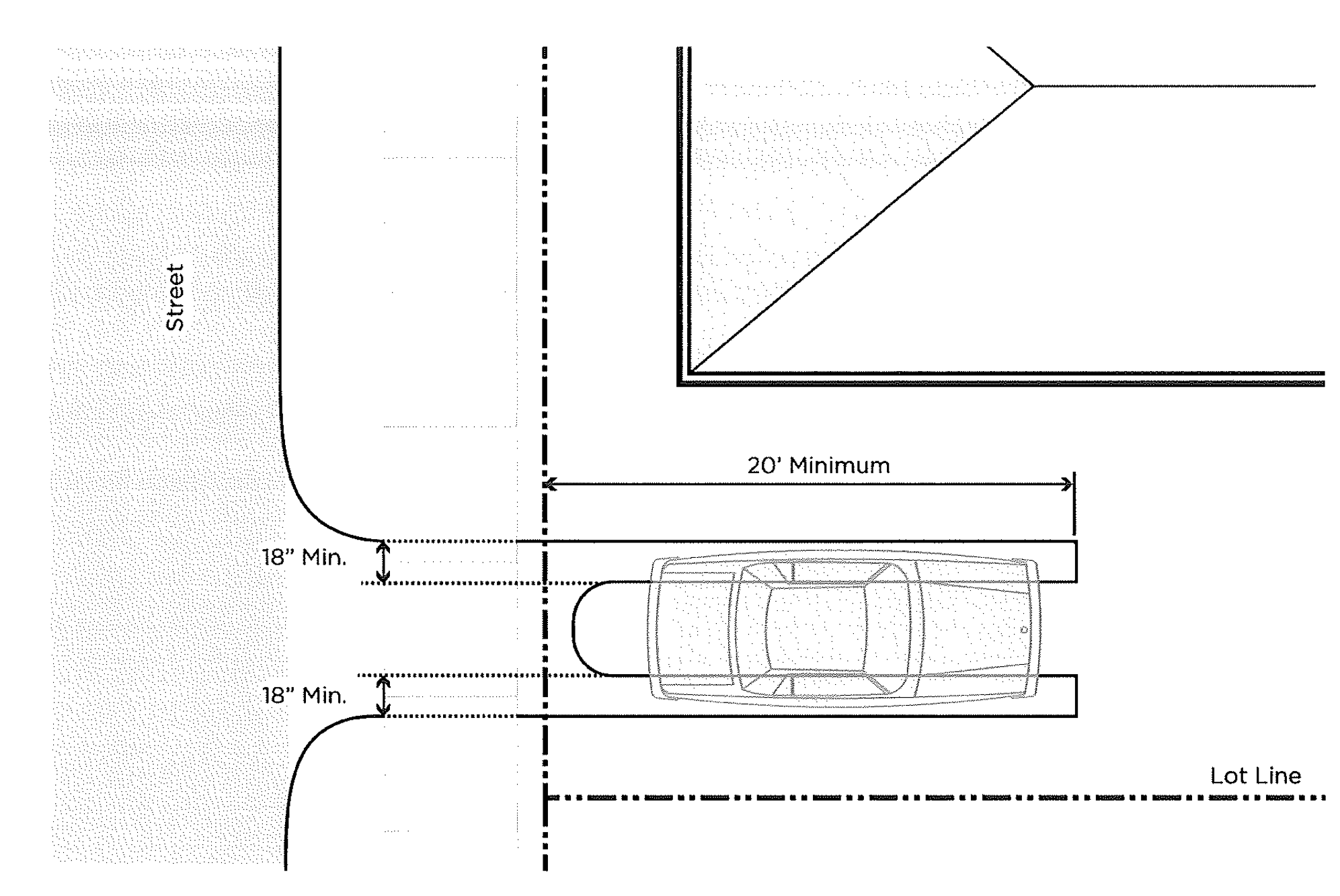
For single-family and two-family dwellings, a driveway may consist of two parallel paved strips, each of which is at least 18 inches in width and 18 feet long. Gravel and wood chips are prohibited as fill material between the strips.
E.
Striping
Off-street parking lots of four or more spaces must delineate parking spaces with paint or other permanent materials, which must be maintained in clearly visible condition.
F.
Wheel Stops and Curbing
Wheel stops or curbing must be installed within parking lots along the perimeter of the lot to prevent vehicles from damaging or encroaching upon any adjacent parking space, sidewalk, landscape, fence, wall, or structure. Such wheel stops or curbing must be constructed of permanent materials, such as concrete, stone, masonry, or steel, a minimum height of four inches above ground level, and permanently affixed to the paved parking area.
G.
Lighting
Parking lot lighting must be in accordance with the exterior lighting standards of Section 9.2.
H.
Landscape and Screening
All parking lots must be landscaped in accordance with the standards of Section 11.
I.
Use of Parking and Loading Spaces
1.
All required parking and loading spaces must be used for vehicle parking and loading. No required space may be used for storage or vehicle repair.
2.
Parking areas uses must be used exclusively for parking purposes and not for storage of vehicles, boats, trailers, campers, or other personal property. No semi-trailers or other vehicles may be parked and used for storage.
J.
Turnaround Space
Dead end parking lots are prohibited. The minimum depth and width of a turnaround space must be nine feet and designated with signs stating "No Parking."
(Ord. No. 2017-58, § 2(Exh. 1), 11-28-17; Ord. No. 2022-38, § 2, 6-28-22)
10.4 - REQUIRED OFF-STREET PARKING SPACES
A.
The minimum number of off-street parking spaces to be provided for a use is delineated in Table 10-2: Off-Street Parking Requirements. Table 10-2 lists parking requirements for the uses listed within the districts. In some cases, uses which are considered part of a generic use category are listed with specified parking requirements. These specific uses are listed only for the purposes of this section and do not indicate whether such uses are permitted or special uses within any district.
B.
Certain uses listed within the districts do not have parking requirements. These uses are not listed in Table 10-2.
C.
The total number of required parking spaces is calculated by the principal use of the lot. When more than one use occupies the same lot, the number of required spaces is the sum of the separate requirements for each use, unless a shared parking arrangement is approved or such use is a multi-tenant retail center, which has a separate requirement. The following standards for computation apply:
1.
Space allocated to any off-street loading space may not be used to satisfy the requirement for any off-street parking space or access aisle, or portion thereof. Conversely, the area allocated to any off-street parking space may not be used to satisfy the replacement for any off-street loading space or portion thereof.
2.
A fraction of less than one-half may be disregarded, and a fraction of one-half or more is counted as one parking space.
3.
In places of assembly in which patrons or spectators occupy benches, pews or similar seating facilities, each 36 inches of such seating facility is counted as one seat for the purpose of determining the requirement for off-street parking facilities. Floor area of a prayer hall is counted as one seat per marked prayer mat space or one seat for every six square feet in the prayer hall if prayer mat spaces are not marked.
D.
Spaces within parking lots and structures may include designated parking spaces for car-share facilities. A car-share facility is a membership-based car-sharing service that provides automobile rental to members, billable by the hour or day; it is not considered a vehicle rental establishment. Spaces reserved for car-share facilities may count toward minimum parking requirements of this Ordinance in the amount of four spaces or 5% of the total number of spaces, whichever is greater.
E.
As of the effective date of this Ordinance, the number of parking spaces currently provided on the lot of an existing non-residential use along Milwaukee Avenue are deemed conforming. Once the existing use in the principal building discontinued, or once the principal building is demolished, the deemed conforming provision is no longer valid. In addition, if the lot area is expanded (e.g., the adjoining lot is purchased), the deemed conforming provision is no longer valid.
F.
Parking for multi-tenant retail centers is required as follows: A multi-tenant retail center is defined as a group of three or more non-residential establishments that are primarily retail establishments, but may include service and recreation and entertainment uses, which is planned, owned, and/or managed as a single property. The two main configurations of multi-tenant retail centers are large shopping centers or malls and retail strip centers.
1.
Multi-tenant retail centers of less than 80,000 square feet:
a.
As of the effective date of this Ordinance, the number of parking spaces currently provided on the lot of an existing multi-tenant retail centers of less than 80,000 square feet are deemed conforming and any use that requires 4 parking stalls or less per each 1,000 s.f. of gross floor area according to Table 10-2 is allowed without parking credits. Special uses must obtain the required special use permit. Any use a) that requires more than 4 parking stalls per each 1,000 s.f. of gross floor area according to Table 10-2 or b) that is designated with an asterisk in Table 10-2 must obtain parking credits according to the procedures in Section 15.10. Once the principal building is demolished, the deemed conforming provision is no longer valid. In addition, if the lot area is expanded (e.g., the adjoining lot is purchased), the deemed conforming provision is no longer valid.
b.
New multi-tenant retail centers of less than 80,000 square feet that provide four spaces per 1,000 square feet of gross floor area shall be deemed conforming and any use that requires 4 parking stalls or less per each 1,000 s.f. of gross floor area according to Table 10-2 is allowed without parking credits. Special uses must obtain the required special use permit. Any use a) that requires more than 4 parking stalls per each 1,000 s.f. of gross floor area according to Table 10-2 or b) that is designated with an asterisk in Table 10-7 must obtain parking credits according to the procedures in Section 15.10.
2.
Multi-tenant retail centers of 80,000 square feet or more:
a.
As of the effective date of this Ordinance, the number of parking spaces currently provided on the lot of an existing multi-tenant retail centers of 80,000 square feet or more are deemed conforming. No uses require parking credits. Once the principal building is demolished, the deemed conforming provision is no longer valid. In addition, if the lot area is expanded (e.g., the adjoining lot is purchased), the deemed conforming provision is no longer valid.
b.
Multi-tenant retail centers built after the adoption of this ordinance with 80,000 square feet or more that provide three spaces per 1,000 square feet of gross floor area shall be deemed conforming. No uses require parking credits.
* Parking Credits per section 15.10 may be required for uses denoted with an asterisk—See 10.4(F)(1)(a) and (b).
(Ord. No. 2019-32, § 2, 10-8-19; Ord. No. 2020-30, § 2(Exh. 1), 9-22-20; Ord. No. 2023-34, § 2, 6-27-23; Ord. No. 2023-56, § 3, 10-24-23)
10.5 - LAND-BANKED PARKING PERMISSION
For retail, service, and/or recreation and entertainment uses over 20,000 s.f. in gross floor area, including multi-tenant retail centers, up to 25% of the required parking spaces of an off-street parking lot may be land-banked during the site plan review process as follows:
A.
Sufficient evidence must be provided by the applicant that supports the reduced parking needs.
B.
The area proposed for land banking of parking spaces must be an area suitable for conversion to parking at a future time.
C.
Landscape of the land-banked area must comply with Section 11. As part of site plan review, additional landscape of the land-banked area may be required.
D.
The land-banked area cannot be used for any other use, such as storage, and cannot be used to fulfill other landscape requirements of this Ordinance.
E.
As part of the site plan review process, the applicant must show the area to be banked on the site plan as "Land-Banked Future Parking."
F.
The Director of Community Development, on the basis of increased parking demand for the use, is authorized to require the conversion of all or part of the land-banked area to off-street parking spaces. Such conversion must be completed within 60 days of notification by the Director of Community Development. Nothing prevents the applicant from converting the land-banked area to parking prior to Village notification.
G.
A Memorandum of Agreement specifying the terms of the land-banked parking shall be recorded against the property with the County Recorder of Deeds.
10.6 - COMMERCIAL AND RECREATIONAL VEHICLES
The location and condition of commercial and recreational vehicles in residential districts is permitted as described in this Section. The following does not apply to commercial vehicles used by and for school activities on school grounds or those conducting business at a location within a residential district, provided that no such vehicle conducting business in a residential district is parked for more than ten consecutive hours and under no circumstances is parked overnight.
A.
For purposes of this Section, commercial and recreational vehicles are defined as follows
1.
Commercial Trailer. Any equipment or trailer, open or closed, which is towed by another commercial vehicle.
2.
Commercial Vehicle. Any vehicle operated for the transportation of persons or property for any commercial or industrial enterprise, for hire or not for hire, but not including a commuter van, defined as a vehicle used in a ridesharing arrangement.
3.
Recreational Trailer. Any open trailer used to haul and store recreational equipment such as boats, snowmobiles, motorcycles, and ATVs, and not used commercially nor owned by a commercial business.
4.
Recreational Vehicle. Every boat, boat trailer, camping trailer, motor home, mini-motor home, travel trailer, truck camper, or van camper used primarily for recreational purposes and not used commercially nor owned by a commercial business.
B.
No more than one commercial and recreational vehicle may be parked on a single-family or two-family lot unless the vehicles can be stored completely within an enclosed garage. No more than one commercial or recreational vehicle per residential unit is permitted on a multiple-family lot unless the vehicles can be stored completely within an enclosed garage.
C.
Commercial and recreational vehicles must be parked in the rear or interior side yard only, except that a commercial vehicle may be permitted in the front or corner side yard if the property is developed in a manner that would physically prohibit parking in the rear or interior side yard. If front or corner side yard storage is required, the commercial vehicle must be parked as near to the front of the garage as possible and cannot extend beyond the front lot line. In all cases, commercial and recreational vehicles must be parked on an approved hard surface of concrete, asphalt, or paving brick. Parking of commercial and recreational vehicles in the rear or interior side yard must meet the following:
1.
Interior side yard parking of commercial and recreational vehicles is permitted provided the vehicle can be parked on an approved surface and is located three feet from the interior side lot line. If the property has a driveway that leads to a detached garage located within the rear yard, a commercial or recreational vehicle may be stored on this driveway only if the parking of the vehicle can comply with the interior side yard parking requirements.
2.
Recreational vehicles may be parked in the rear yard on a pad of concrete, asphalt, or paving brick provided the pad extends to the exterior dimensions of the recreational vehicle and is located a minimum of five feet from the rear lot line, ten feet or 10% of the lot width from the side lot line, whichever is less, and out of any easements.
D.
No commercial vehicle that exceeds any of the following size criteria, or requiring a license plate higher than a "D" plate, may be parked in a residential district unless the vehicle can be placed completely within an enclosed garage:
1.
Seven feet in height for open bed trucks when measured from the ground to the top of the roof, and nine feet in height for enclosed vans when measured from the ground to the top of the roof.
2.
Seven feet in width when measured from the widest point of the vehicle. Mirrors are not included within the seven foot width limitation.
3.
Twenty-two feet in length when measured from the front bumper to back bumper, excluding snowplow blades when permitted.
E.
Storage on the exterior of commercial vehicles that are parked within a residential district must comply with the following restrictions:
1.
Trailers or other attachments are prohibited on the rear of a commercial vehicle when parked in a residential district.
2.
Snowplows are permitted on the front of commercial vehicles during the winter season but must be removed and properly stored by April 15.
3.
No storage of any equipment, storage racks, or materials is permitted on the sides of commercial vehicles.
4.
Storage racks not exceeding 18 inches in height, inclusive of ladders and other equipment, are permitted on commercial vehicles so long as the overall height of the commercial vehicle does not exceed nine feet six inches when measured from the ground to the top of the storage rack, inclusive of equipment stored on said racks.
5.
Equipment, other than permanently attached, and storage of material visible above the top of the trailer and pickup truck bed is prohibited. Storage of landscaping material or other organic debris that exceeds the height of the sides of the trailer or bed of a vehicle is prohibited.
F.
Parking of a commercial vehicle containing a refrigeration unit or other motorized compressor is prohibited within a residential district unless the vehicle is parked within a garage so that the refrigeration unit is not audible outside the garage. This is intended to be applicable to those vehicles that use a refrigeration unit or compressor for the commercial purpose of the vehicle and does not apply to air conditioner units used for the comfort of the driver and passengers.
G.
All commercial trailers or equipment that can be attached to a commercial vehicle stored on a lot in a residential district must, at all times, be parked in a fully enclosed garage. Also, at no time can any equipment stored on a trailer, or equipment which can be attached to a commercial vehicle, that has an engine or compressor be allowed to idle while stored in a residential district. Additionally, any equipment stored on a trailer that does not have rubber tires or treads cannot be loaded or unloaded from the trailer upon any public right-of-way.
H.
No recreational vehicle that exceeds any of the following size criteria may be parked in a residential district unless the vehicle can be placed completely within an enclosed garage:
1.
Thirteen feet in height when measured from the ground to the top of the roof.
2.
Eight feet six inches in width when measured from the widest point of the vehicle. Mirrors are not included within the width limitation.
3.
Thirty-five feet in length when measured from the front bumper or hitch to the back bumper.
4.
Open recreational trailers not stored within a structure must be a maximum of 16 feet long when measured from the hitch to the back bumper or equipment stored on the trailer, whichever is longer, and have no ancillary racks.
I.
No recreational vehicles or trailers may be stored or parked in any residential district unless the following standards are met:
1.
Recreational vehicles and trailers may not be stored in the front yard.
2.
Any recreational vehicle or trailer that is greater than eight feet but less than 13 feet in height may be parked or stored in the rear yard only.
3.
No recreational vehicle or trailer may be connected to gas, water, or sanitary sewer service. Temporary electrical hookup are permitted only to clean and prepare the vehicle or trailer for use.
4.
Parked or stored recreational vehicles and trailers cannot be used for living or sleeping purposes.
5.
Recreational vehicles and trailers cannot be used as accessory structures.
6.
Recreational vehicles or trailers cannot have their wheels removed or be affixed to the ground so as to prevent ready removal of the vehicle.
7.
Recreational vehicles and trailers must be properly licensed.
8.
Recreational equipment stored on a recreational trailer must be screened from public view by means of a fence, a landscape hedge, or covers that are designed and manufactured for covering the equipment or trailer.
10.7 - REQUIRED BICYCLE PARKING
As of the effective date of this Ordinance, new development other than residential development with 3 or fewer dwelling units per building is required to provide bicycle parking.
A.
Design
1.
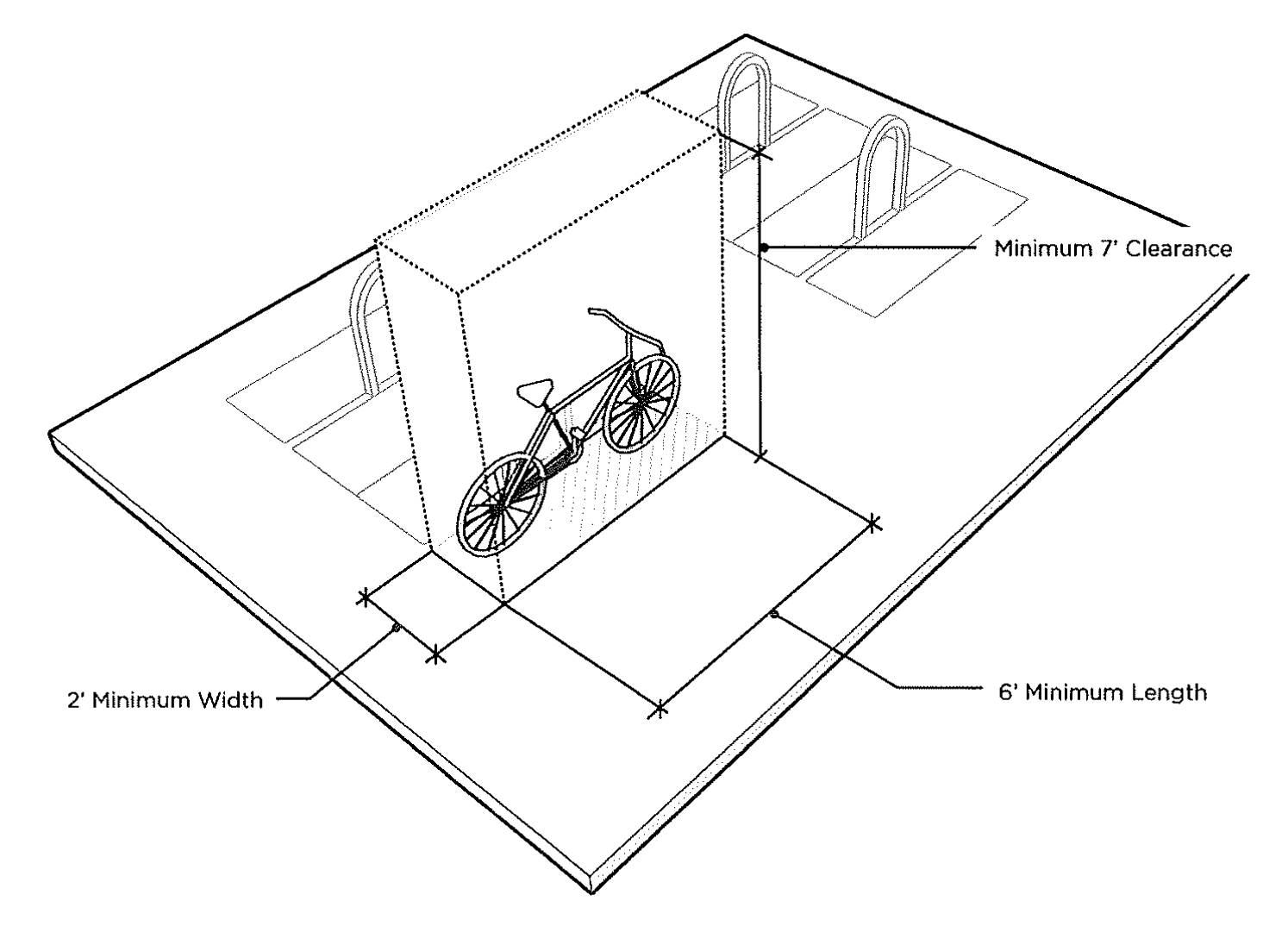
Required bicycle spaces must have a minimum dimension of two feet in width by six feet in length, with a minimum overhead vertical clearance of seven feet. Bicycle spaces are counted by the number of bicycles than can be stored on a rack, meeting these dimensions for a bicycle space.
2.
Bicycle parking facilities must provide racks where the bicycle may be locked by the user or lockable enclosed lockers. Structures that require a user-supplied locking device must be designed to accommodate U-shaped locking devices. All lockers and racks must be securely anchored to the ground or the structure to prevent the racks and lockers from being removed from the location.
3.
If required bicycle parking facilities are not readily visible, signs must be posted indicating their location.
4.
Areas used for required bicycle parking must be paved and drained to be free of mud, dust, and standing water, and must be well-lit.
B.
Location
1.
All required bicycle spaces must be located on the same lot as the use served. However, the Director of Community Development, upon consultation with other Village Departments, may approve the location of bicycle spaces in the public right-of-way.
2.
Required bicycle parking for residential uses may be provided in garages, storage rooms, and other resident-accessible secure areas. Space within dwelling units, including areas such as balconies, are not counted toward satisfying bicycle parking requirements.
C.
Required Number of Bicycle Spaces
Where off-street parking facilities are provided, the number of bicycle parking spaces must be provided as indicated in Table 10-4: Required Bicycle Spaces. In all cases where bicycle parking is required, a minimum of two spaces is required. However, no more than a total of 50 bicycle parking spaces are required to be provided. If the Village and/or property owner determine that inadequate bicycle parking is provided, additional bicycle parking may be provided.
10.8 - REQUIRED OFF-STREET LOADING SPACES
A.
Design
1.
Off-street loading spaces must be located as follows:
a.
All off-street loading spaces must be located on the same lot as the use served.
b.
No off-street loading space may be located in a front or corner side yard or in front of a front building line.
c.
All off-street loading spaces must be located a minimum of 25 feet from the lot line of any residential district, unless completely enclosed by building walls or a uniformly painted solid fence or wall, or any combination thereof, a minimum of six feet in height and a maximum of eight feet in height. In such case, the loading area must be a minimum of 15 feet from such lot line.
2.
All required off-street loading spaces must be at least 12 feet in width and at least 30 feet in length, exclusive of aisle and maneuvering space, and must have a minimum vertical clearance of at least 15 feet.
3.
All off-street loading spaces must be improved with a hard surfaced, all-weather dustless material.
4.
All off-street loading spaces must meet the exterior lighting standards of Section 9.2.
5.
Loading berths must be screened along interior side and rear lot lines with a solid wall or fence, a minimum of six feet and a maximum of seven feet in height.
6.
Central loading facilities may be substituted for loading berths on individual lots subject to the following:
a.
Each lot served must have direct access to the central loading area without crossing streets or alleys at-grade.
b.
No lot served may be more than 500 feet from the central loading area.
B.
Required Number of Off-Street Loading Spaces
Off-street loading spaces must be provided in accordance with Table 10-5: Off-Street Loading Requirements. In the case of multi-tenant buildings or mixed-use developments, required loading spaces are calculated on the basis of each individual tenant (for example, if only one commercial tenant of a multi-tenant building is over 10,000 square feet, only one loading space is required; if all tenants are under ten-thousand 10,000 square feet, no loading is required).
10.9 - TRAFFIC STUDY REQUIREMENT
A.
Proposed new developments or proposed changes of use with significant traffic, as determined by the Director of Community Development, may be required to perform a traffic study. Approval of the proposed development or change in use will require compliance with the findings and recommendations of the traffic study which is approved by the Village of Niles.
(Ord. No. 2017-58, § 2(Exh. 1), 11-28-17)

