
Niles City Zoning Code
SECTION 5
- COMMERCIAL DISTRICTS
5.1 - PURPOSE STATEMENTS
A.
C-1 Corridor Commercial District
The purpose of the C-1 Corridor Commercial Zoning District is to promote development of storefront space and provide for a mix of retail, personal service, and office uses along the commercial corridors within the Village, primarily serving the local community. The C-1 District is intended to accommodate auto-oriented uses while improving the pedestrian environment along the Village's commercial corridors. Mixed-use development is encouraged with residential dwelling units allowed above the ground floor.
B.
C-2 General Commercial District
The purpose of the C-2 General Commercial District is to accommodate regional commercial centers within the Village, including auto-oriented retail centers that serve both residents of the Village and the surrounding communities. The C-2 District provides for large-scale development that generates a sizeable amount of traffic and a significant demand for off-street parking. Mixed-use development is encouraged with residential dwelling units allowed above the ground floor.
C.
C-3 Milwaukee Avenue Form-Based District
The purpose of the C-3 Milwaukee Avenue Form-Based District is to promote a high-quality mixed-use environment along the Milwaukee Avenue corridor within the Village. The C-3 District contains specific standards related to building form, including height and massing, building location, façade transparency, parking, and building design. These standards are intended to improve the image of the corridor, and encourage the development of Milwaukee Avenue as a pedestrian-friendly, walkable mixed-use destination.
D.
C-4 Milwaukee Avenue Mixed-Use District
The purpose of the C-4 Milwaukee Avenue Mixed-Use District is to promote a tailored mix of retail, personal service, office, and residential development along the Milwaukee Avenue Corridor within the Village, complementary in bulk and height to the Milwaukee Avenue Form-Based District. It should maintain a traditional mixed-use character, distinguished by a pedestrian-friendly orientation, building entrances opening to the public sidewalk, and parking, when provided, located to the rear of buildings.
E.
C-5 Urban Village District
The purpose of the C-5 Urban Village District is to promote redevelopment of large regional centers as mixed-use urban villages, rather than as traditional single-purpose shopping centers. The C-5 District provides controls on use mix, siting, and design to encourage a high-quality mixed-use and pedestrian friendly urban village development. Development in the C-5 District requires approval of a planned unit development (Section 12).
(Ord. No. 2022-58, § 2(Exh. 1), 8-23-22)
5.2 - USES
A.
Uses Generally
1.
Section 8 lists permitted and special principal uses and temporary uses for the commercial districts.
2.
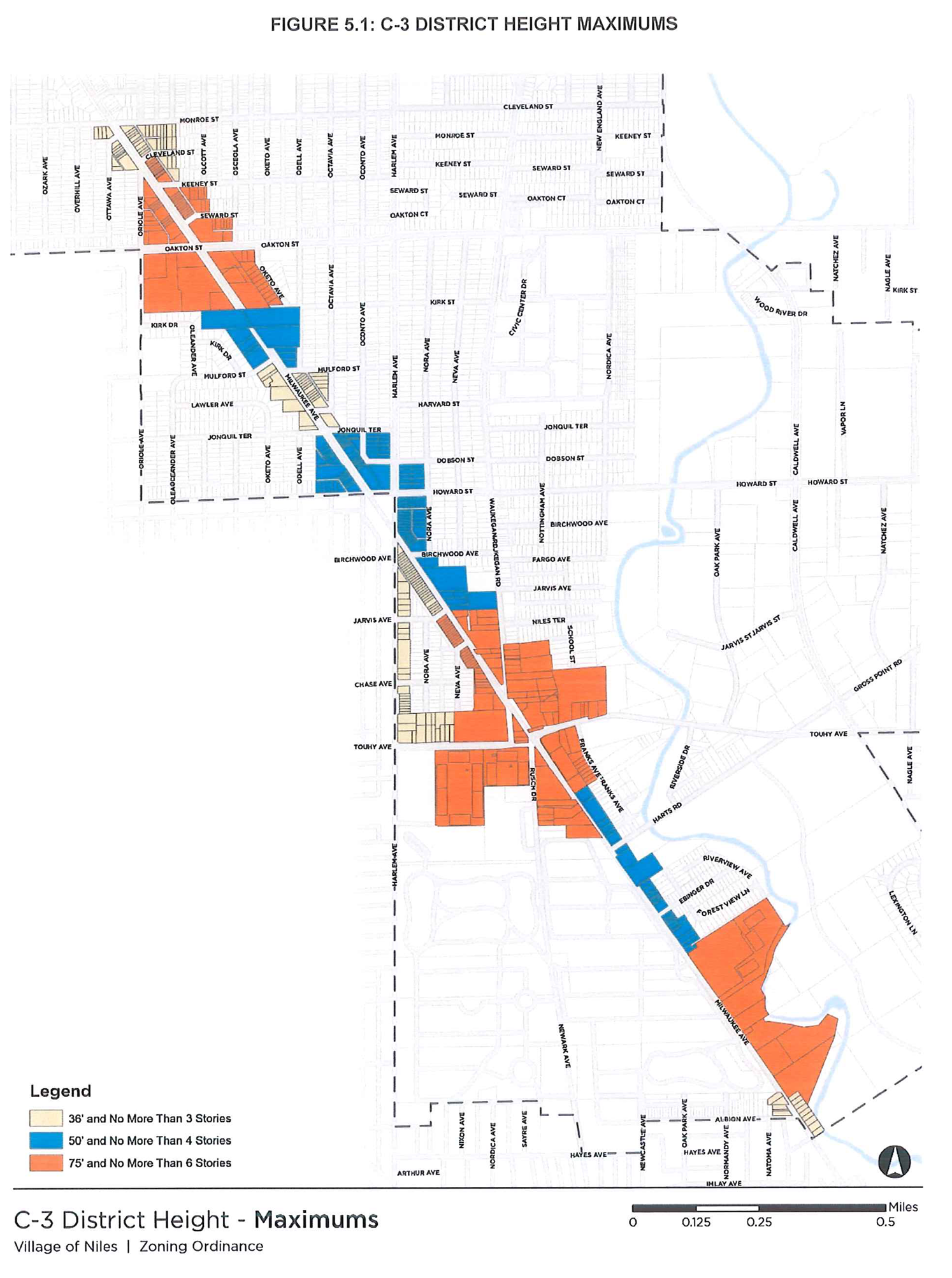
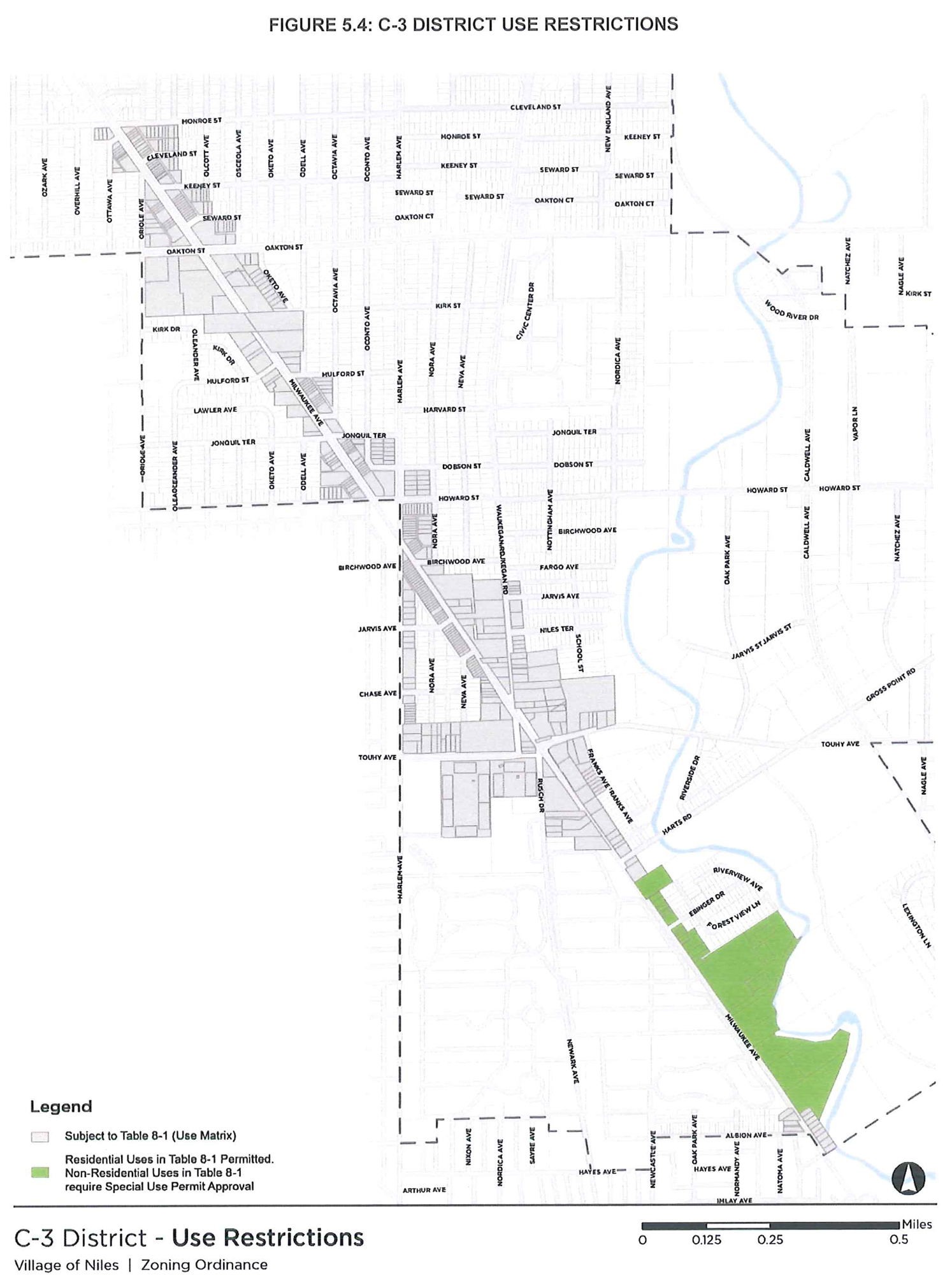
In the C-3 District, uses are restricted per Figure 5.4: C-3 District Use Restrictions. Generally, Table 8-1 lists the uses allowed in the C-3 District unless Figure 5.4 indicates specific additional permissions or restrictions for uses.
3.
Within the C-2, C-3, and C-4 Districts, ground floor uses at corners at intersections with traffic signals are limited to those listed under the "Retail" category in Table 8-1: Use Matrix. This limitation extends for 250 feet along the lot lines along each intersecting street and applies to any ground floor space where 50% or more of the space's frontage is located within this 250 foot measurement.
4.
Residential density limits are controlled by bulk, height, parking, and other zoning regulations.
(Ord. No. 2020-30, § 2(Exh. 1), 9-22-20)
5.3 - DIMENSIONAL STANDARDS
Table 5-1: Commercial Districts Dimensional Standards establishes the dimensional standards for the commercial districts. These regulations apply to all uses within each district unless a different standard is listed for a specific use. Within certain districts, the design standards of Section 5.4 also apply.
1 Minimum district area is measured as contiguous lot area, including lot area separated by a public right-of-way; however, right-of-way cannot be used in any minimum calculation of district area. Contiguous lot area, including lots separated by a public right-of-way, may be added to an existing C-5 District without having to meet the minimum district size.
2 If the dimension of setback from curb exceeds any required build-to zone or build-to line, such dimension controls as a build-to line.
(Ord. No. 2022-58, § 2(Exh. 1), 8-23-22)
5.4 - DESIGN STANDARDS
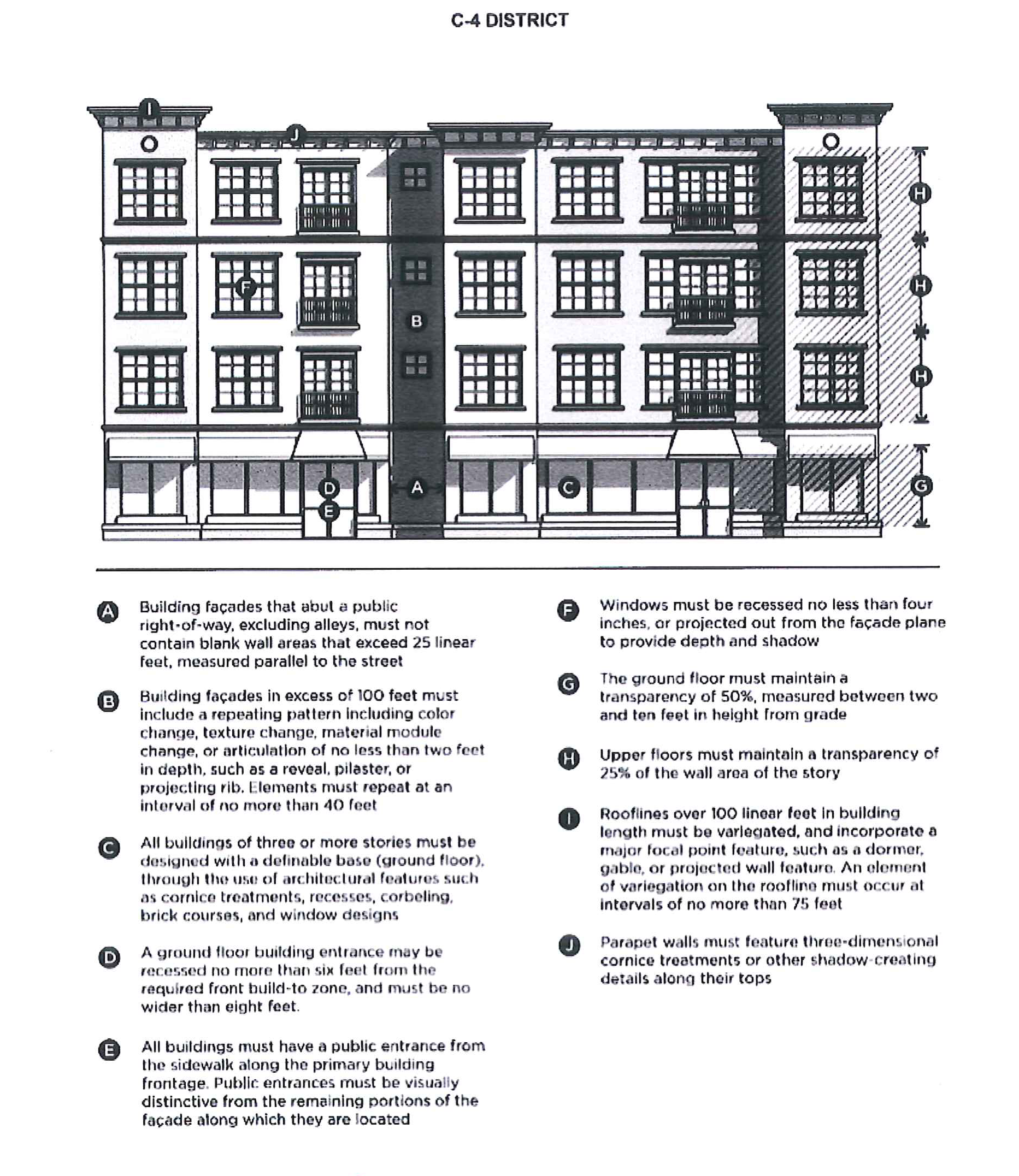
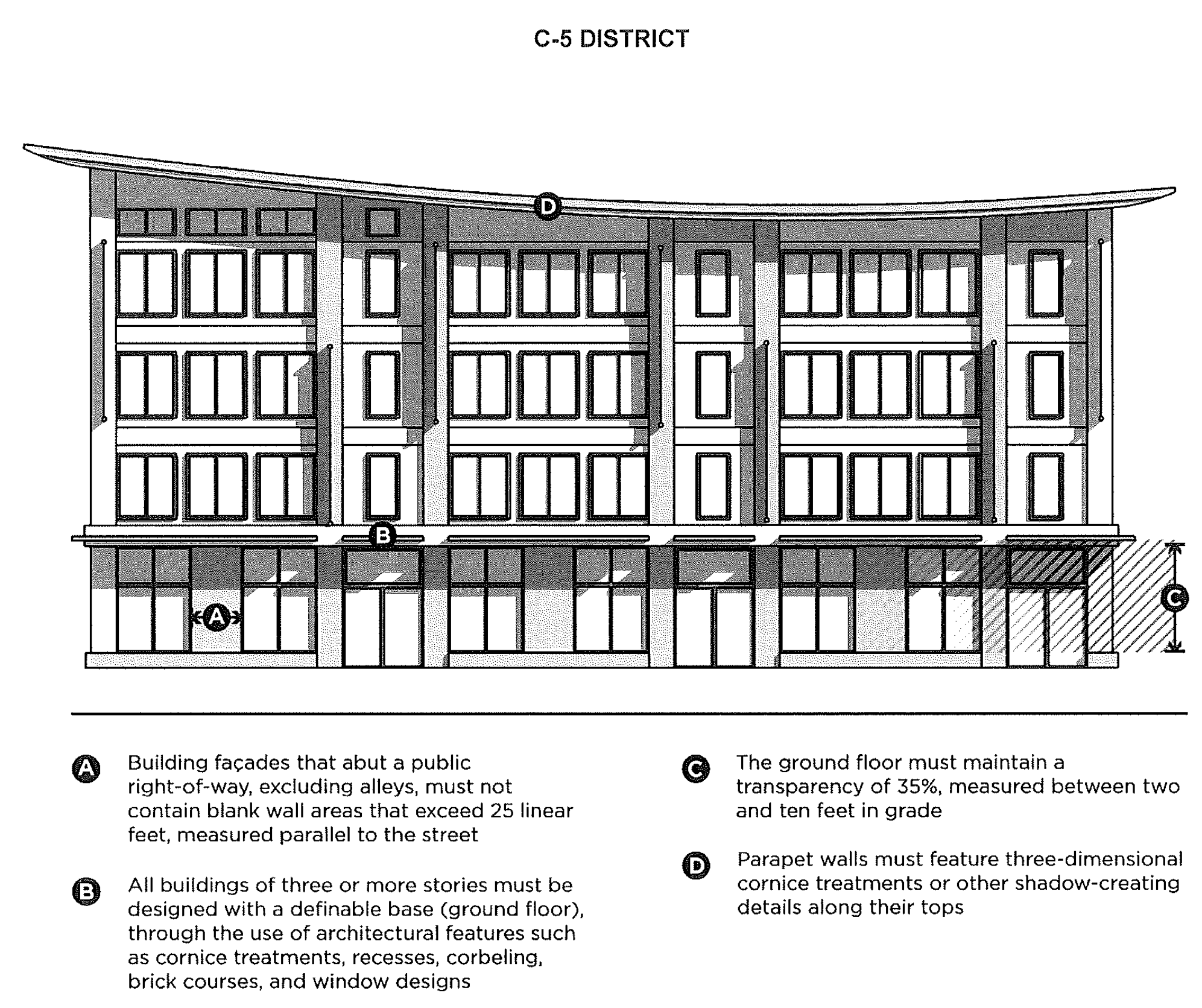
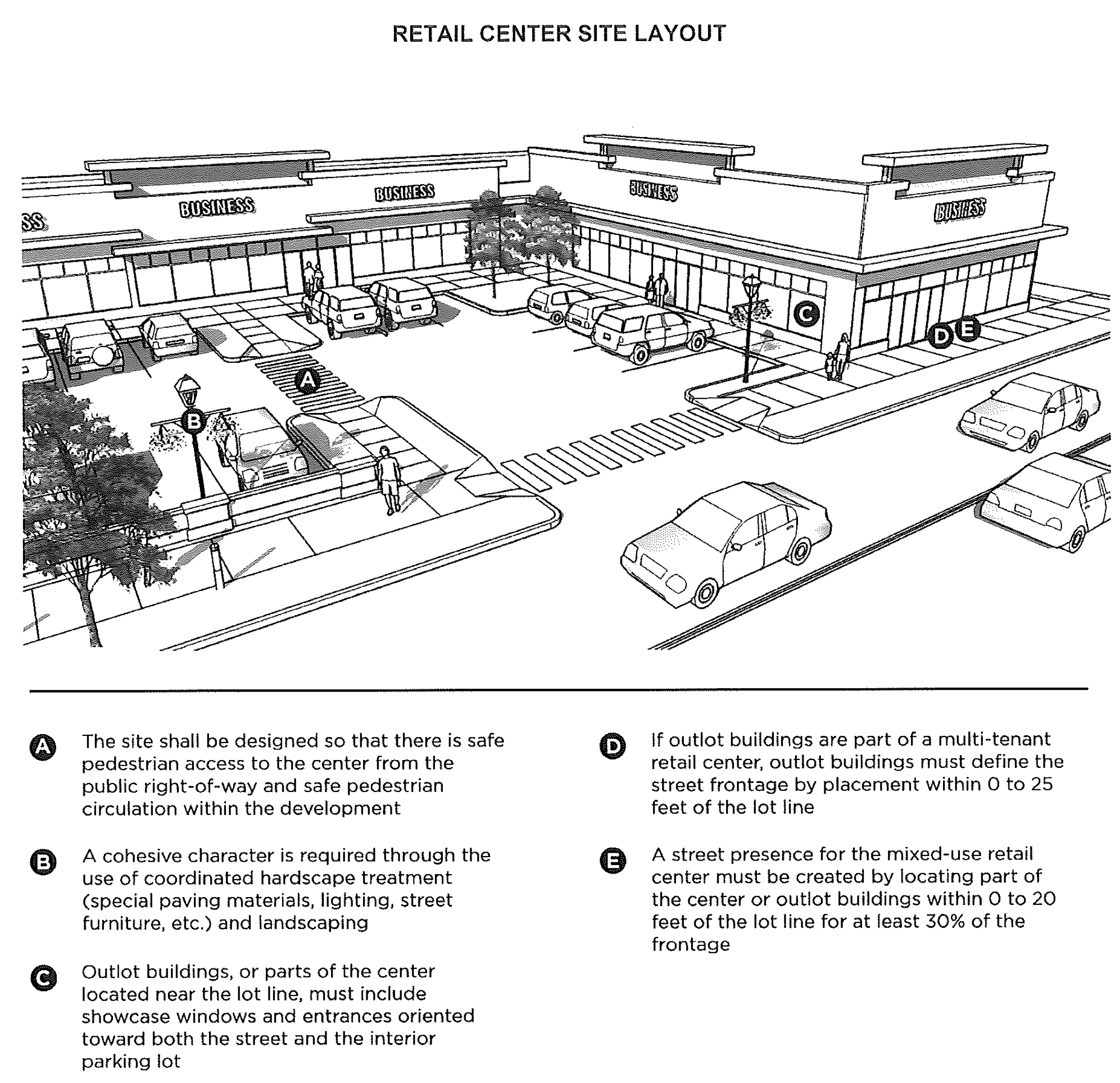
The following design standards apply to new construction, substantial repair or rehabilitation meant to remedy damage or deterioration of the exterior façade of an existing structure, and additions to an existing structure. However, only those standards that relate to the specific repair, rehabilitation, or addition apply. These standards do not apply to interior remodeling. With the exception of the C-3 District, residential dwellings are not subject to these standards but rather to any applicable standards of Section 8 of this Ordinance; multi-family dwellings in the C-3 District are subject to the standards for the C-3 District.
A.
Commercial District Design Standards
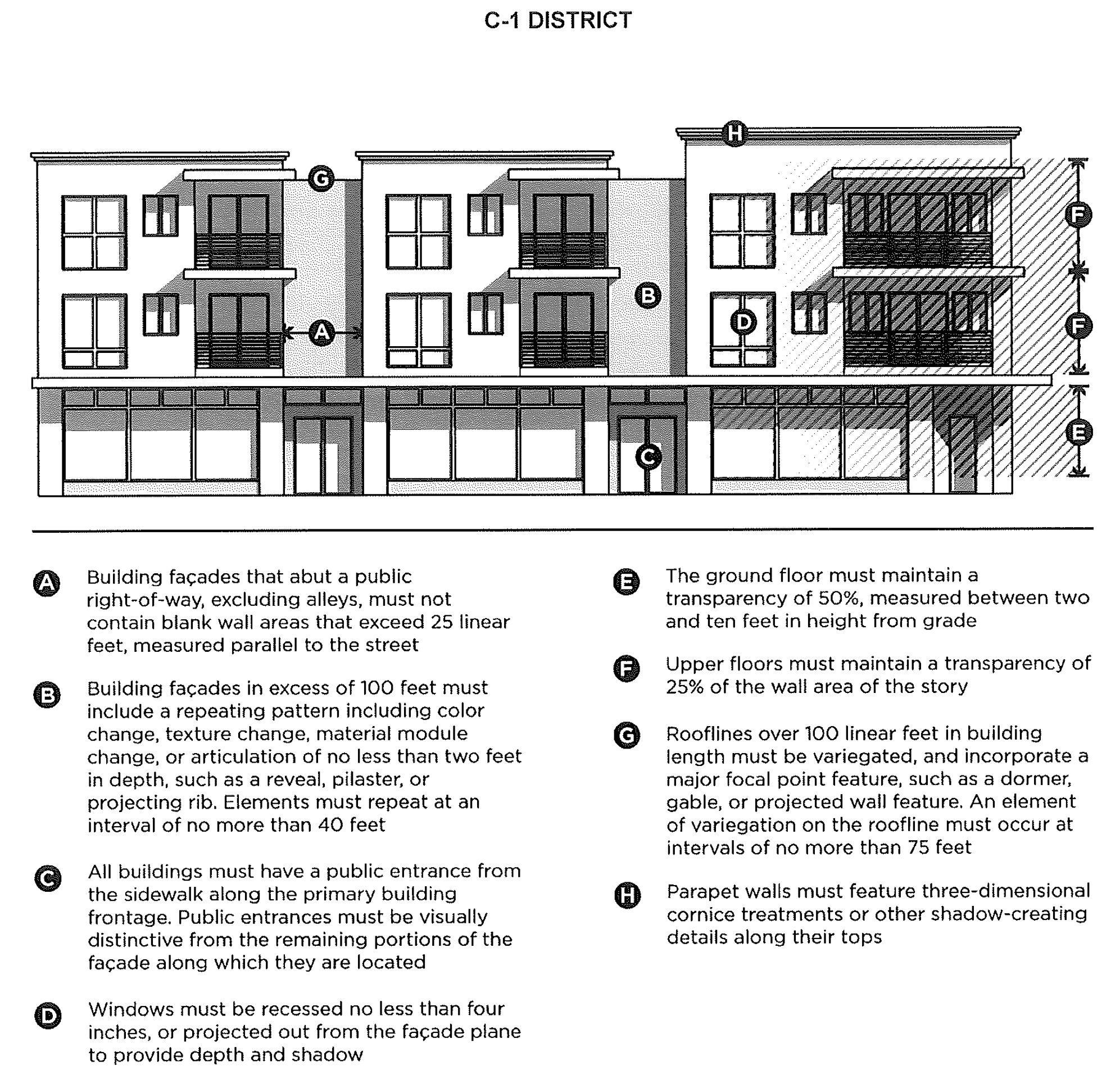
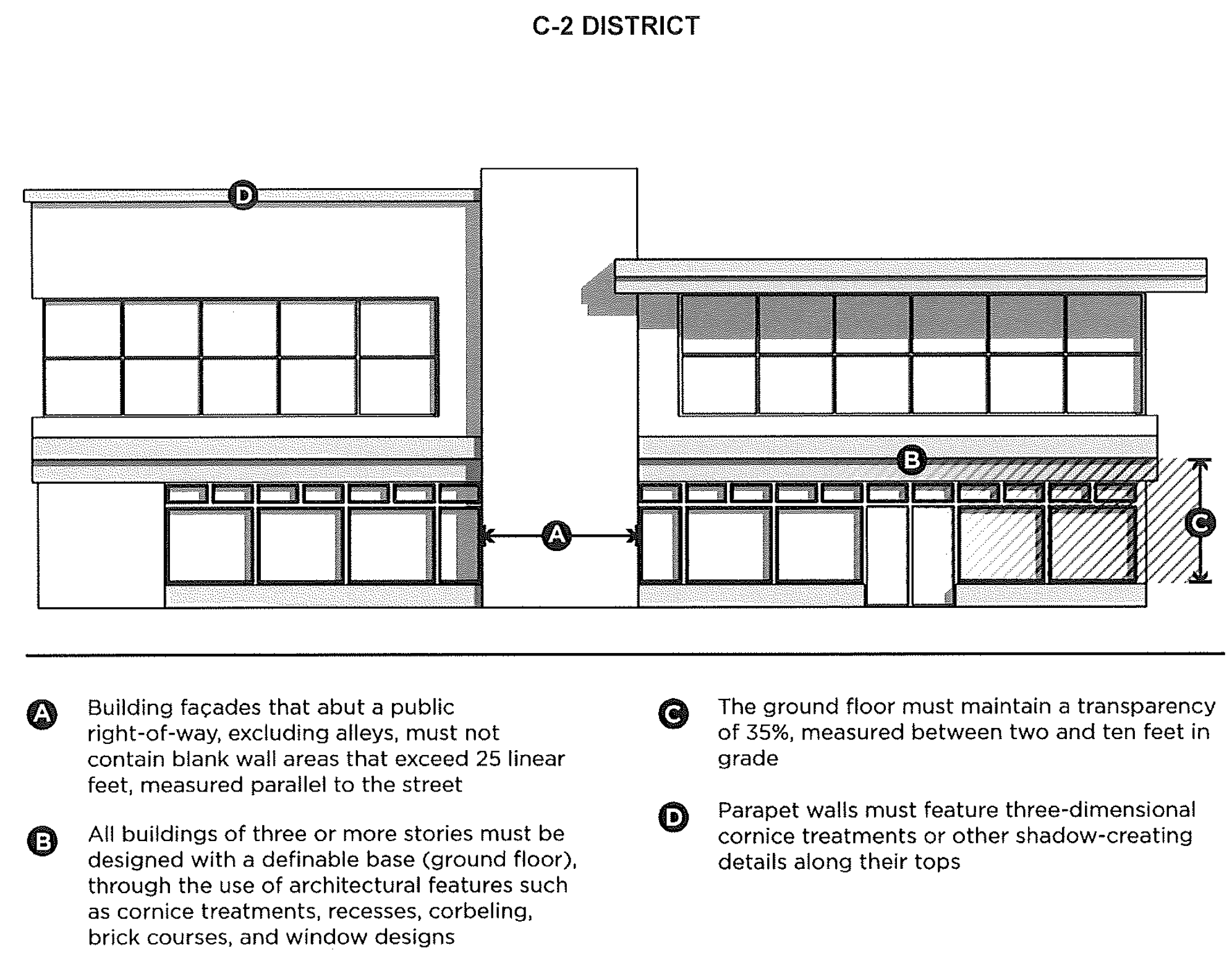
Table 5-2: General Building Design Standards indicates the applicability of general building design standards to the commercial districts. An "X" indicates that the standard is applicable in the district indicated. The absence of an "X" indicates that the standard is not applicable. Standards for the C-3 District are found in item B below.
B.
C-3 District Design Standards
1.
Façade Design
a.
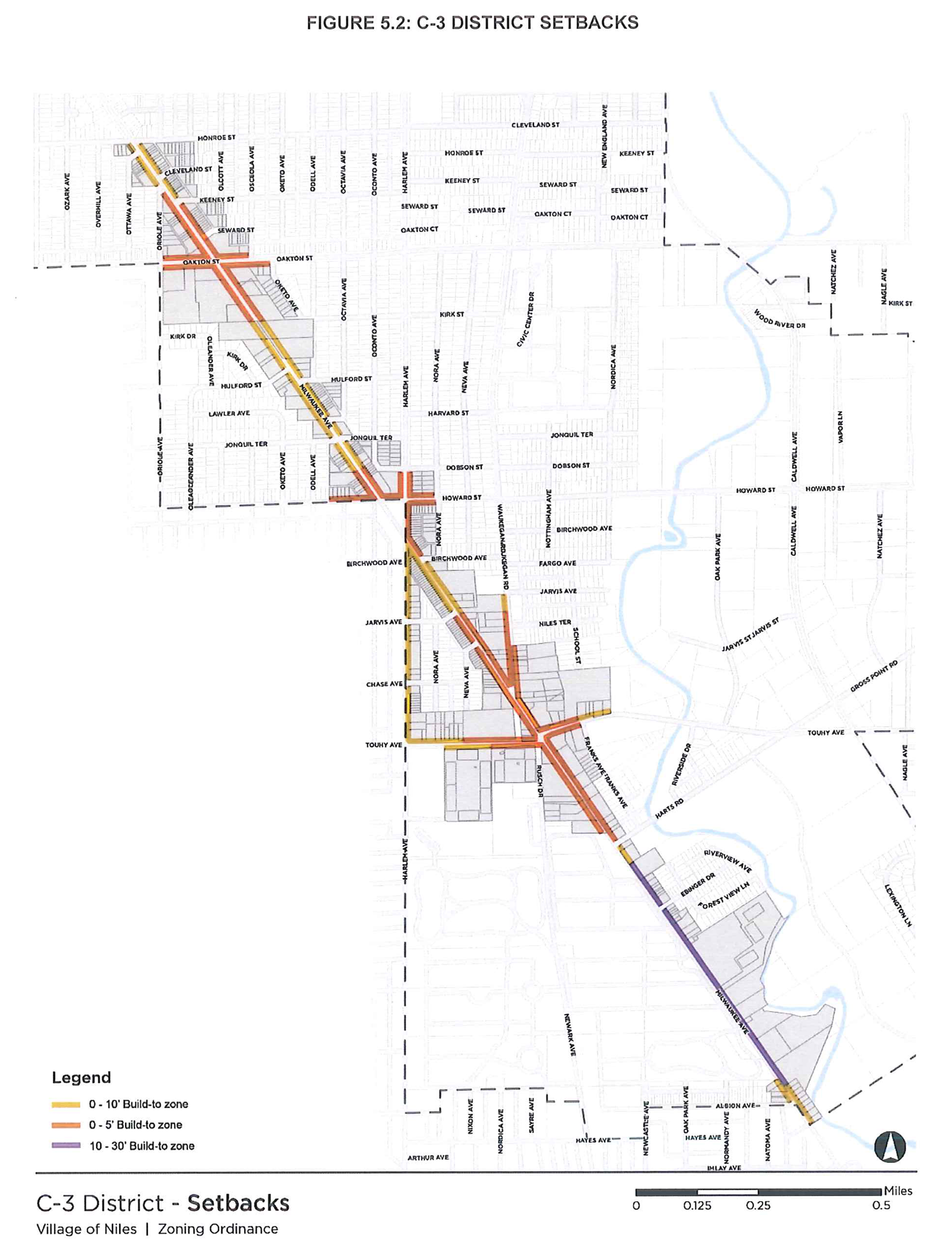
Street abutting building façade s must maintain a build-to percentage as follows:
1.
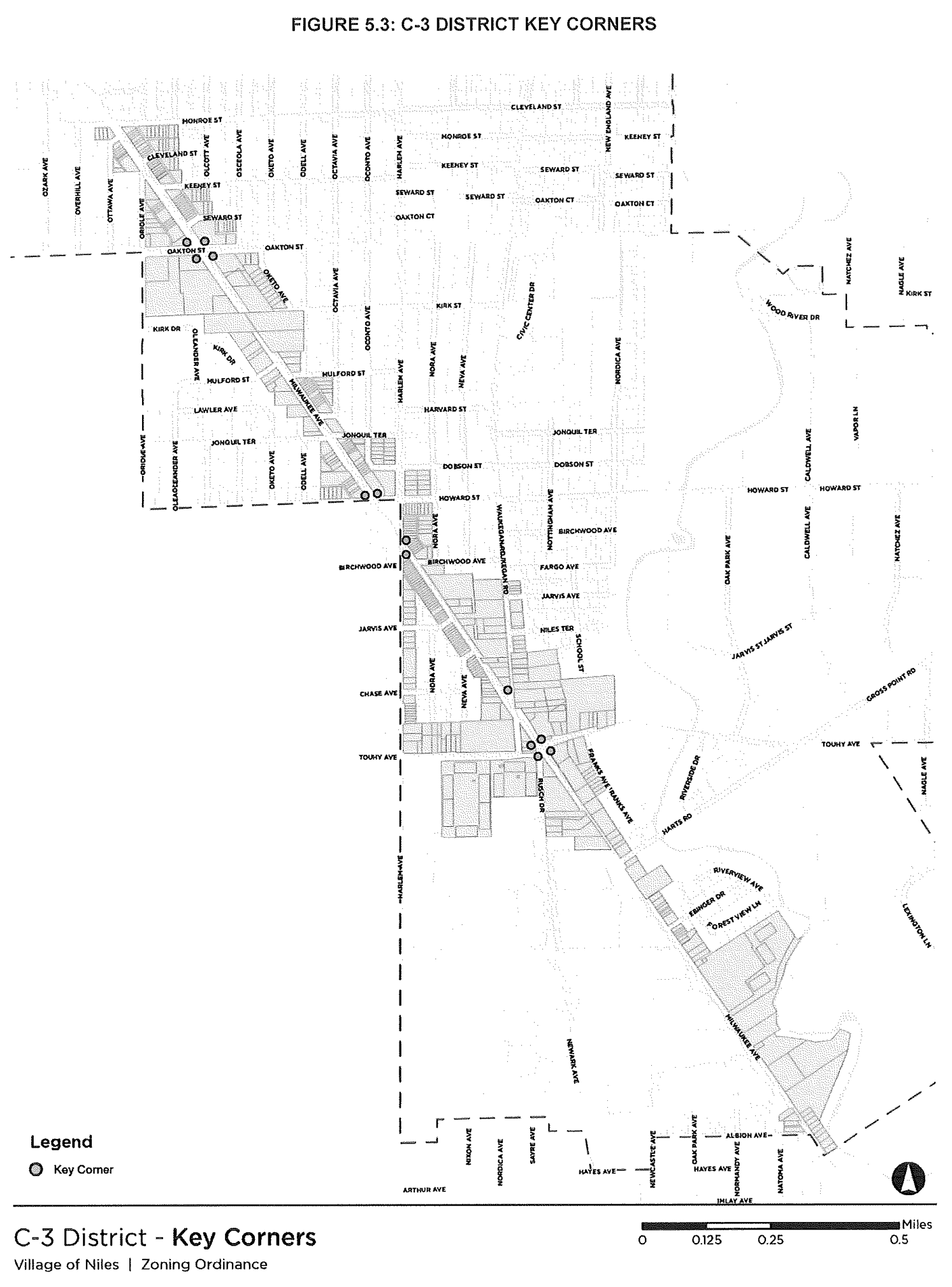
Buildings fronting on Milwaukee Avenue, Oakton Street, Howard Street, and Touhy Avenue must locate 80% of the length of any façade abutting those streets within the required build-to zone. Buildings located at a key corner as designated in Figure 5.4 must locate the first 50 feet from the corner on any façade abutting a street within the required build-to zone.
2.
Buildings fronting on any other street within the C-3 District must locate 60% of the length of any façade abutting a street within the required build-to zone.
3.
Where buildings front on multiple streets, the higher required build-to percentage controls both streets.
b.
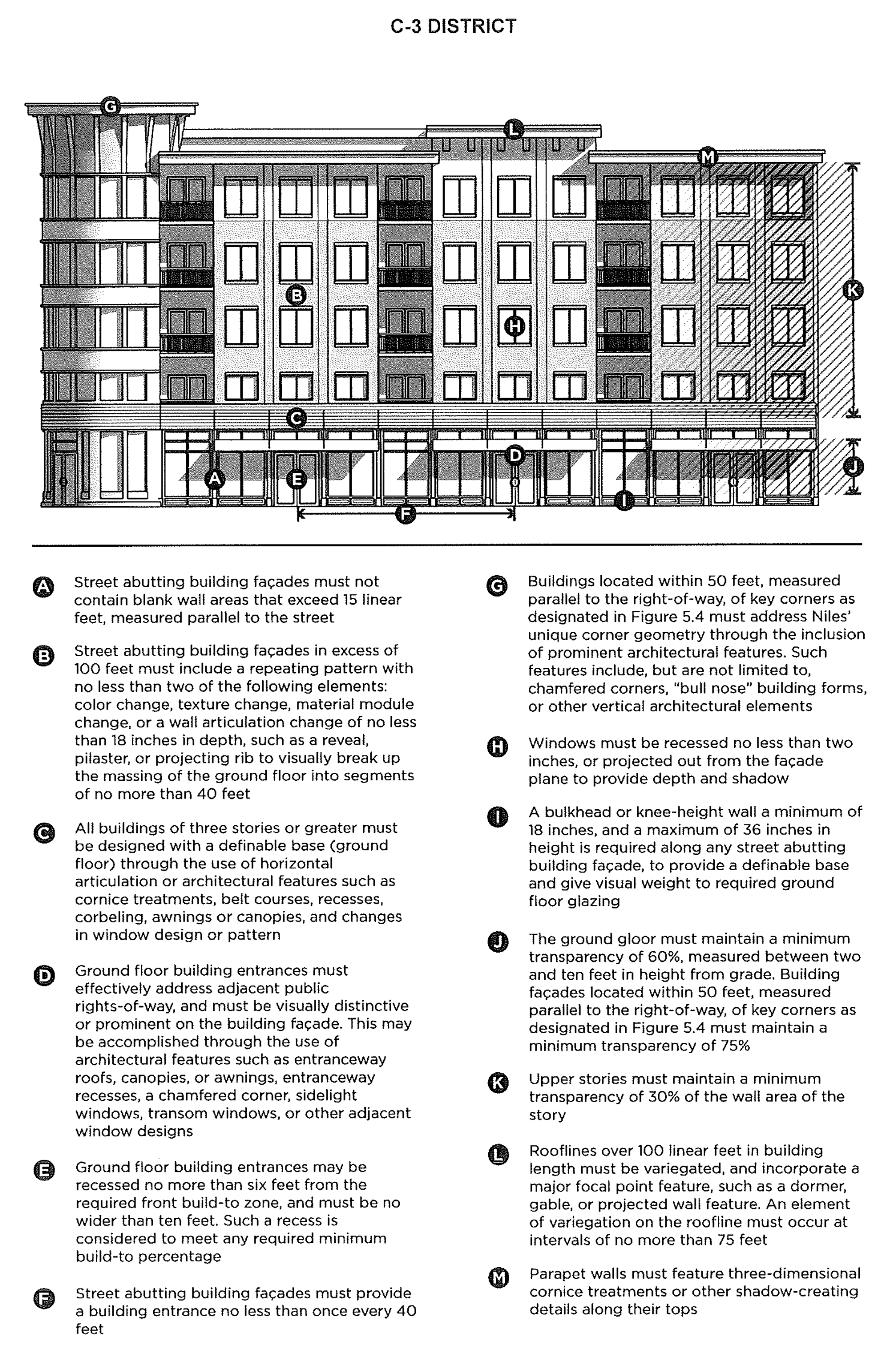
Street abutting building façades must not contain blank wall areas that exceed 15 linear feet, measured parallel to the street.
c.
Street abutting building façades in excess of 100 feet must include a repeating pattern with no less than two of the following elements: color change, texture change, material module change, or a wall articulation change of no less than 18 inches in depth, such as a reveal, pilaster, or projecting rib, to visually break up the massing of the ground floor into segments of no more than 40 feet.
d.
All buildings of three stories or greater must be designed with a definable base (ground floor) through the use of horizontal articulation or architectural features such as cornice treatments, belt courses, recesses, corbeling, awnings or canopies, and changes in window design or pattern.
e.
Ground floor building entrances must address adjacent streets, and must be visually distinctive or prominent on the building façade. This may be accomplished through the use of architectural features such as entranceway roofs, canopies or awnings, entranceway recesses, a chamfered corner, sidelight windows, transom windows, or other adjacent window designs.
f.
Ground floor building entrances may be recessed no more than six feet from the required front build-to zone, and must be no wider than ten feet. Such a recess is considered to meet any required minimum build-to percentage.
g.
Street abutting building façades must provide a building entrance no less than once every 40 feet.
h.
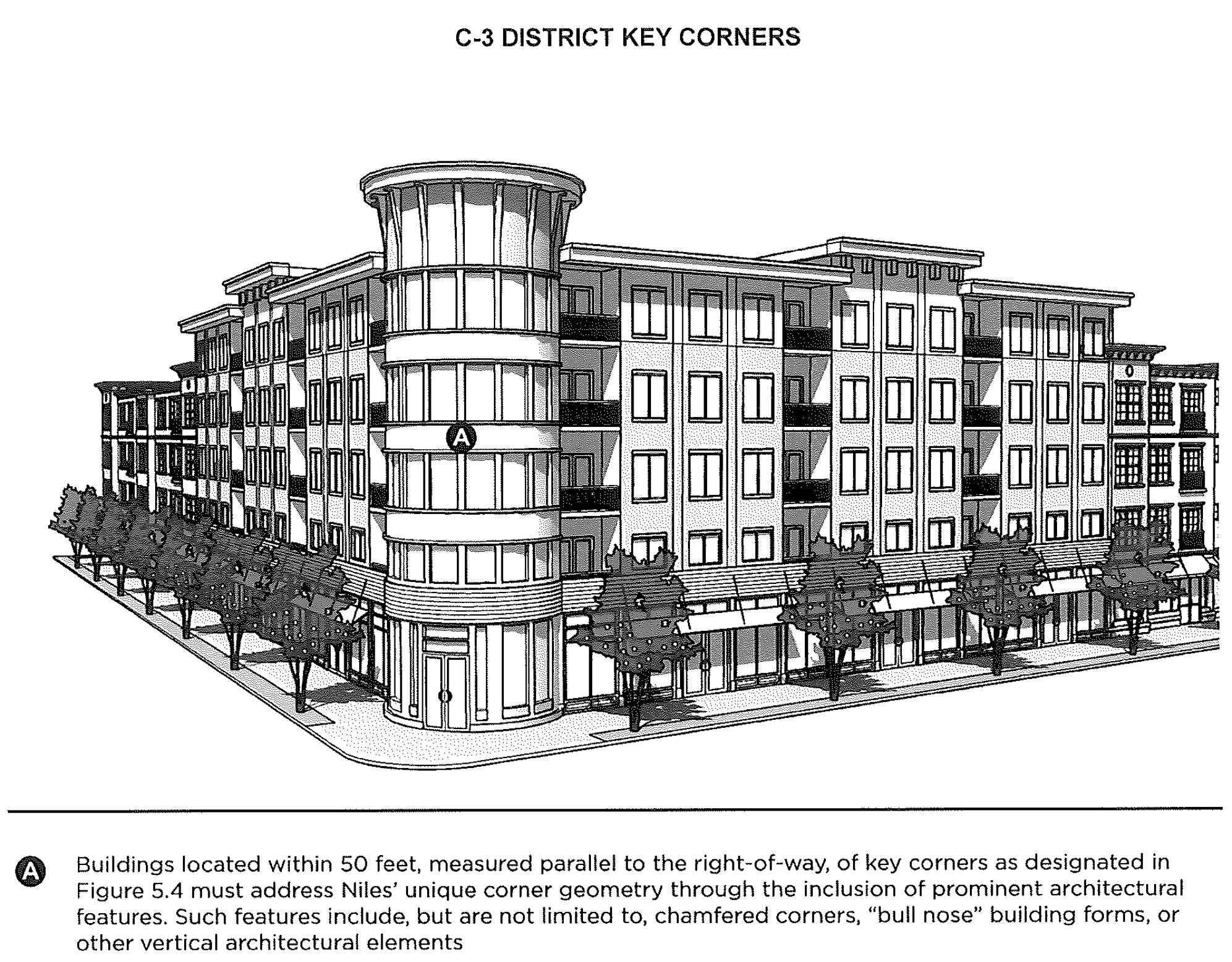
Buildings located within 50 feet of key corners as designated in Figure 5.4, measured parallel to the right-of-way, must address Niles' unique corner geometry through the inclusion of prominent architectural features. Such features include, but are not limited to, chamfered corners, "bull nose" building forms, or other vertical architectural elements.
i.
Vents, air conditioners, and other utility elements, except where such elements are enclosed, camouflaged, screened, obscured, or otherwise not readily apparent to a casual observer, are prohibited as part of a front or corner side façade.
2.
Fenestration Design
a.
Windows must be recessed no less than two inches or projected out from the façade plane to provide depth and shadow.
b.
A bulkhead or knee-height wall a minimum of 18 inches and a maximum of 36 inches in height is required along any street abutting façade to provide a definable base and give visual weight to required ground floor glazing.
c.
The ground floor must maintain a minimum transparency of 60%, measured between two and ten feet in height from grade. Building façades located within 50 feet of key corners as designated in Figure 5.4, measured parallel to the right-of-way, must maintain a minimum transparency of 75% measured between two and ten feet in height from grade.
d.
Upper stories must maintain a minimum transparency of 30% of the wall area of the story.
3.
Roof Design
a.
Rooflines over 100 linear feet in building length must be variegated and incorporate a major focal point feature, such as a dormer, gable, or projected wall feature. An element of variegation on the roofline must occur at intervals of no more than 75 feet.
b.
Parapet walls must feature three-dimensional cornice treatments or other shadow-creating details along their tops.
c.
Green roof, blue roof, and white roof designs are encouraged.
d.
Reflective surfaces that produce glare are prohibited, except for solar panels or white roofs intended to radiate absorbed or non-reflected solar energy and reduce heat transfer to the building.
e.
Mechanical equipment on roofs must be located a minimum of five feet behind the building wall, and must be screened from view from public rights-of-way by the use of parapet walls or enclosures designed to conceal the equipment.
4.
Site Elements
a.
In the C-3 District, parking may be located along the side or to the rear of the building. Parking is prohibited between the front building façade and the front lot line.
b.
In addition to the requirements of Section 11.6, when parking is located adjacent to a building, a continuation of the street wall must be created through the use of a solid masonry wall designed to complement the building or combination of landscape and an open decorative fence as follows:
1.
A solid masonry wall must be between three and four feet in height. An open, decorative feature may be included in the design of such a wall, and may extend up to a maximum height of five feet. A masonry wall must employ the same quality materials required of the primary building.
2.
An open decorative fence must be between four and six feet in height, and must be constructed of high-quality durable material such as wrought iron.
5.
Site Design
a.
Buildings or structures that are part of a multi-building complex should achieve unity of character and design through the use of architectural features, building style, texture, color, materials, form, scale and proportion, and site design elements such as courtyards, plazas, landscape, and walkways.
b.
Developments should provide pedestrian links to adjacent commercial uses and neighborhoods, where appropriate, to provide integrated, safe pedestrian access between the site and commercial or residential uses outside the development.
C.
Building Material Restrictions
In all commercial districts, the following building materials are prohibited on any façade facing a public right-of-way, excluding alleys, or any façade that abuts a residential district. However, such materials may be used as decorative or detail elements for up to 25% of the façade, or as part of the exterior construction that is not used as a surface finish material.
1.
Plain concrete block
2.
Corrugated metal
3.
Aluminum, steel or other metal sidings
4.
Exposed aggregate (rough finish) concrete wall panels
5.
Exterior insulating finish systems (EIFS)
6.
T-111 composite plywood siding
7.
Plastic
8.
Vinyl
(Ord. No. 2022-58, § 2(Exh. 1), 8-23-22)
5.5 - GENERAL STANDARDS OF APPLICABILITY
A.
Site Development Standards
See Section 9 for additional on-site development standards and requirements, such as exterior lighting, accessory structures and uses, and permitted encroachments.
B.
Off-Street Parking and Loading
See Section 10 for off-street parking and loading standards and requirements.
C.
Landscape
See Section 11 for landscape, buffering and screening standards and requirements.
D.
Signs
See Chapter 78 of the Village Code for sign standards.

