
Niles City Zoning Code
SECTION 11
- LANDSCAPE
11.1 - INTENT
A.
Landscape improvements must serve to integrate the development into the site, with particular sensitivity to natural topography, watercourses, and existing significant native vegetation. Preservation of existing plant material and landforms shall be taken into account, particularly where mature or significant trees or native plant communities are a part of the site. This is of particular importance in cases where specimen trees, groves, or tree lines, or tree-lined watercourses are present.
B.
Landscape improvements must serve to enhance the appearance of the site, especially as viewed from adjacent public rights-of-way. Effective year-round screening must be provided to lessen the visual prominence of parking lots, service yards, loading docks, public utility structures, or unsightly appurtenances. Landscape must also serve to minimize the harmful or nuisance effects resulting from noise, heat, glare, and accumulation of dust, and to provide shade, air purification, oxygen regeneration, groundwater recharge, storm water run-off management, and other environmental benefits. Innovative landscape design proposals are highly encouraged, including the use of green technology regarding storm water management and the use of native plant materials.
C.
Preservation of existing trees as recommended by the Village Forester is encouraged. Where existing trees are to be protected, site development must comply with the applicable Village requirements as found in Section 106-38.
11.2 - LANDSCAPE PLAN
A.
Landscape Plan Required
A landscape plan is required as part of a site plan review application for townhouse, multi-family, non-residential, or mixed-use development, and any planned unit development. The landscape plan must be approved prior to the issuance of a building permit.
B.
Content of Landscape Plan
1.
North arrow and graphic scale, the location and dimensions of all existing and proposed structures, property lines, easements, parking lots and drives, rights-of-way, refuse disposal and recycling areas, pedestrian and bicycle paths, fences, mechanical equipment, overhead utility wires, underground utilities, retention/detention facilities, and other drainage facilities, such as drainage swales.
2.
The location, quantity, size, name, and condition, both botanical and common, of all existing plant materials on-site, indicating plant material to be retained and to be removed.
3.
The location, quantity, size, and name, both botanical and common, of all proposed plant material.
4.
The existing and proposed grading of the site indicating contours at one foot intervals. Any proposed berming, earthwork, or storm water management basins must also be indicated using one foot contour intervals.
5.
Elevations of all proposed fences, stairs, and retaining walls.
6.
Any other details as determined necessary by the Director of Community Development.
C.
Minor Changes to Approved Landscape Plans
Minor changes to the landscape plan that do not result in a reduction in the net amount of plant material as specified on the approved landscape plan may be approved by the Director of Community Development. Changes to the amount of plant materials of an approved landscape plan are not considered a minor change. Major changes must be approved by the body granting approval of the landscape plan initially.
11.3 - ENFORCEMENT OF LANDSCAPE PLAN
A.
No certificate of occupancy will be issued until all the requirements of this Section and the landscape plan have been fulfilled. Failure to implement the landscape plan, or to maintain the lot in conformance with the landscape plan, may result in the application of fines and penalties, as established in this Ordinance. All landscape is subject to periodic inspection.
B.
If weather prohibits the installation of landscape at the time a certificate of occupancy is applied for, a temporary certificate of occupancy may be issued for a six month period with provision of a security bond or security for 115% of the estimated amount, including installation.
11.4 - SELECTION, INSTALLATION AND MAINTENANCE
A.
Selection
All plant materials must be of good quality and meet American Horticulture Industry Association (AmericanHort) or its ANSI accredited successor's standards for minimum acceptable form, quality and size for species selected, and capable to withstand the seasonal temperature variations of northeastern Illinois, as well as the individual site microclimate. The use of species native or naturalized to northeastern Illinois is encouraged. Size and density of plant material, both at the time of planting and at maturity, are additional criteria that must be considered when selecting plant material. Where appropriate, the use of drought and salt tolerant plant material is preferred.
B.
Installation
All landscape materials must be installed in accordance with current nursery industry standards, and must be properly supported to ensure survival. Support devices such as guy wires or stakes must not interfere with pedestrian or vehicular movement. All plant materials must be free of disease and installed so that soil of sufficient volume, composition, and nutrient balance are available to sustain healthy growth. Installation of plant materials during the appropriate growing season is encouraged.
C.
Maintenance
1.
Landscape materials depicted on approved landscape plans are considered a required site element in the same manner as structures, required parking, lighting, and other improvements. As such, the owner of record or the business or homeowner's association is responsible for the maintenance, repair, and replacement of all landscape materials, fences, steps, retaining walls, and similar landscape elements.
2.
All landscape materials must be maintained in good condition, present a healthy, neat, and orderly appearance, and be kept free of refuse and debris. Any dead, unhealthy, or missing plants must be replaced within 60 days of notification, unless an extension is approved.
11.5 - LANDSCAPE DESIGN STANDARDS
A.
Minimum Planting Sizes
1.
Shade trees must have a minimum trunk size of two and one-half inches in caliper at planting.
2.
Evergreens trees must have a minimum height of four feet at planting.
3.
Single stem ornamental trees must have a minimum trunk size of two and one-half inches in caliper at planting. Multiple stem ornamental trees must have a minimum height of eight feet at planting.
4.
Large shrubs must have minimum height of three feet at installation. Small shrubs must have a minimum height of 18 inches at installation. Large shrubs are those that reach five or more feet in height at maturity. Small shrubs are those that may grow up to four feet in height if left unmaintained, but are generally maintained at heights of eighteen 18 to 30 inches.
B.
Energy Conservation
Plant material placement should be designed to provide passive benefits, and reduce the energy consumption needs of the development:
1.
Deciduous trees should be placed on the south and west sides of buildings to provide shade from the summer sun.
2.
Evergreens and other plant materials should be concentrated on the north and west sides of buildings to dissipate the effect of winter winds.
C.
Species Diversity
Diversity among required plant material is required for visual interest and to reduce the risk of losing a large population of plants due to disease. Table 11-1: Plant Diversity Requirements indicates the percentage of diversity required based on the total quantity of species being used. For example, if a development requires 45 shade trees, no more than 18 trees (40%) can be of one species, and there must be a minimum of five different species within the 45 trees. When the calculation of plant diversity requirements results in a fraction, the fraction is rounded up.
D.
Berming
Earthen berms and existing topographic features should be incorporated into the landscape treatment of a site where there is sufficient space and, in particular, when berms and existing topographic features can be combined with plant material to facilitate effective screening. Minimum unretained berm side slopes must be maintained at no steeper than a 4:1 slope ratio to prevent erosion and be properly and safely maintained, unless a steeper slope is allowed by the Director of Community Development. Retained slopes may be implemented with the appropriate terracing necessary to reduce the need for safety railing.
11.6 - PARKING LOT PERIMETER LANDSCAPE YARD
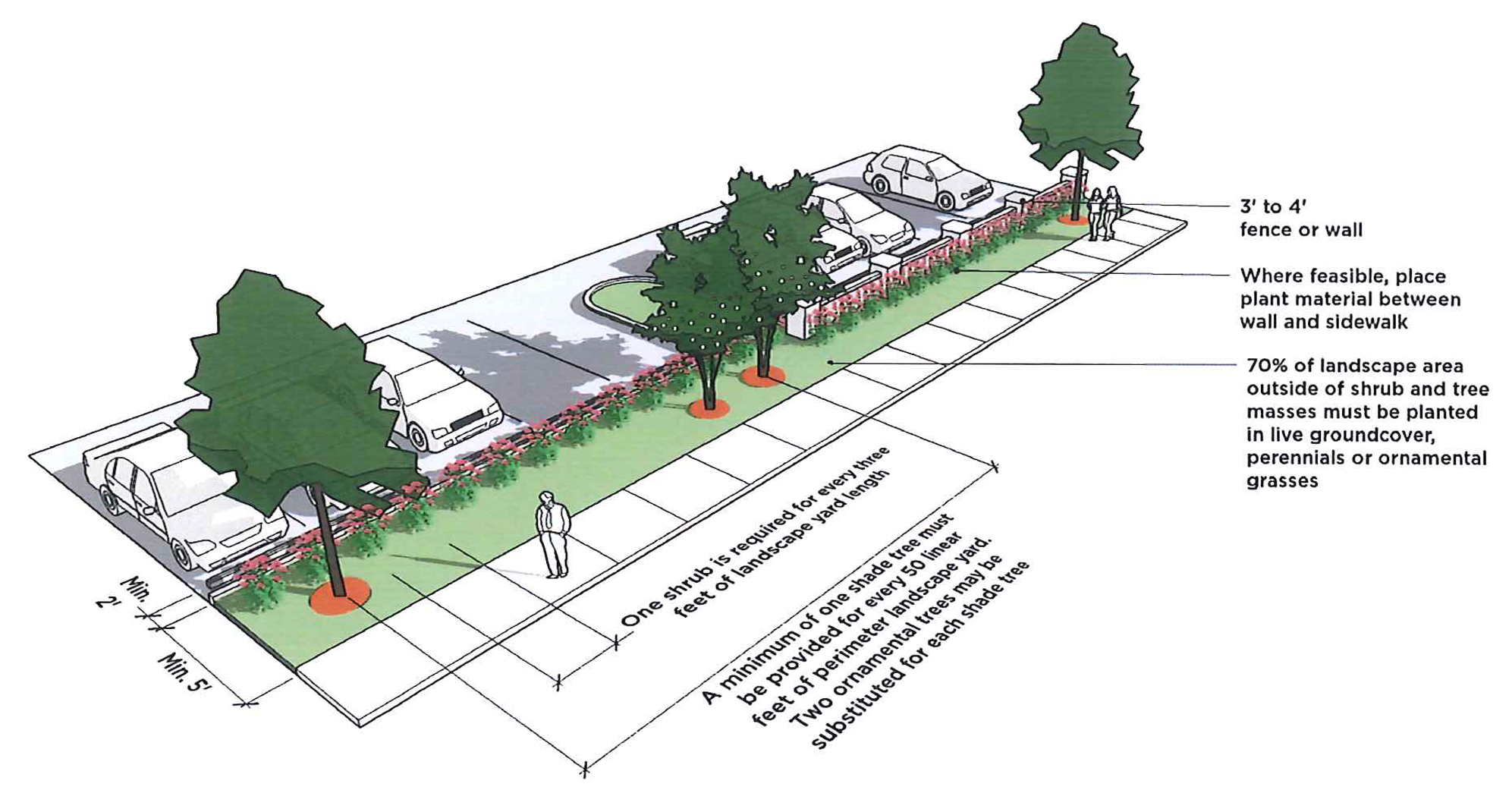
A perimeter landscape yard is required for all parking lots that abut a public right-of-way, excluding alleys, and must be established along the edge of the parking lot to screen the parking lot. The landscape treatment must run the full length of the parking lot perimeter along the right-of-way and must be located between the lot line and the edge of the parking lot. The landscaped area must be improved as follows:
A.
The perimeter parking lot landscape area must be at least five feet in width. There must be a minimum linear distance of two feet between any wheels stops or curbs to accommodate vehicle bumper overhang, which is not included in the minimum five foot calculation.
B.
One shrub, measuring a minimum of 18 inches at planting and reaching a minimum of three feet at maturity, must be planted for every three feet of landscape yard length, spaced linearly, which may be excepted for the planting of a shade tree. Alternatively, a mix of shrubs, perennials, native grasses, and other planting types that provide screening of a minimum of three feet in height may be used.
C.
A minimum of one shade tree must be provided for each 50 linear feet of perimeter landscape yard. Two ornamental trees may be substituted for each shade tree.
D.
70% of the landscape area outside of shrub and tree masses must be planted in live groundcover, perennials, or ornamental grasses.
E.
Alternatively, and with the approval of the Director of Community Development, a low pedestrian wall or decorative fence a minimum of three feet to a maximum of four feet in height may be used instead of shrubs and shade trees. Where feasible, plant materials shall be installed between the sidewalk and the low pedestrian wall or decorative fence to provide a softening effect on the wall or fence.
(Ord. No. 2017-58, § 2(Exh. 1), 11-28-17)
11.7 - INTERIOR PARKING LOT LANDSCAPE
All parking lots consisting of 15 or more spaces require interior parking lot landscape as described in this section.
A.
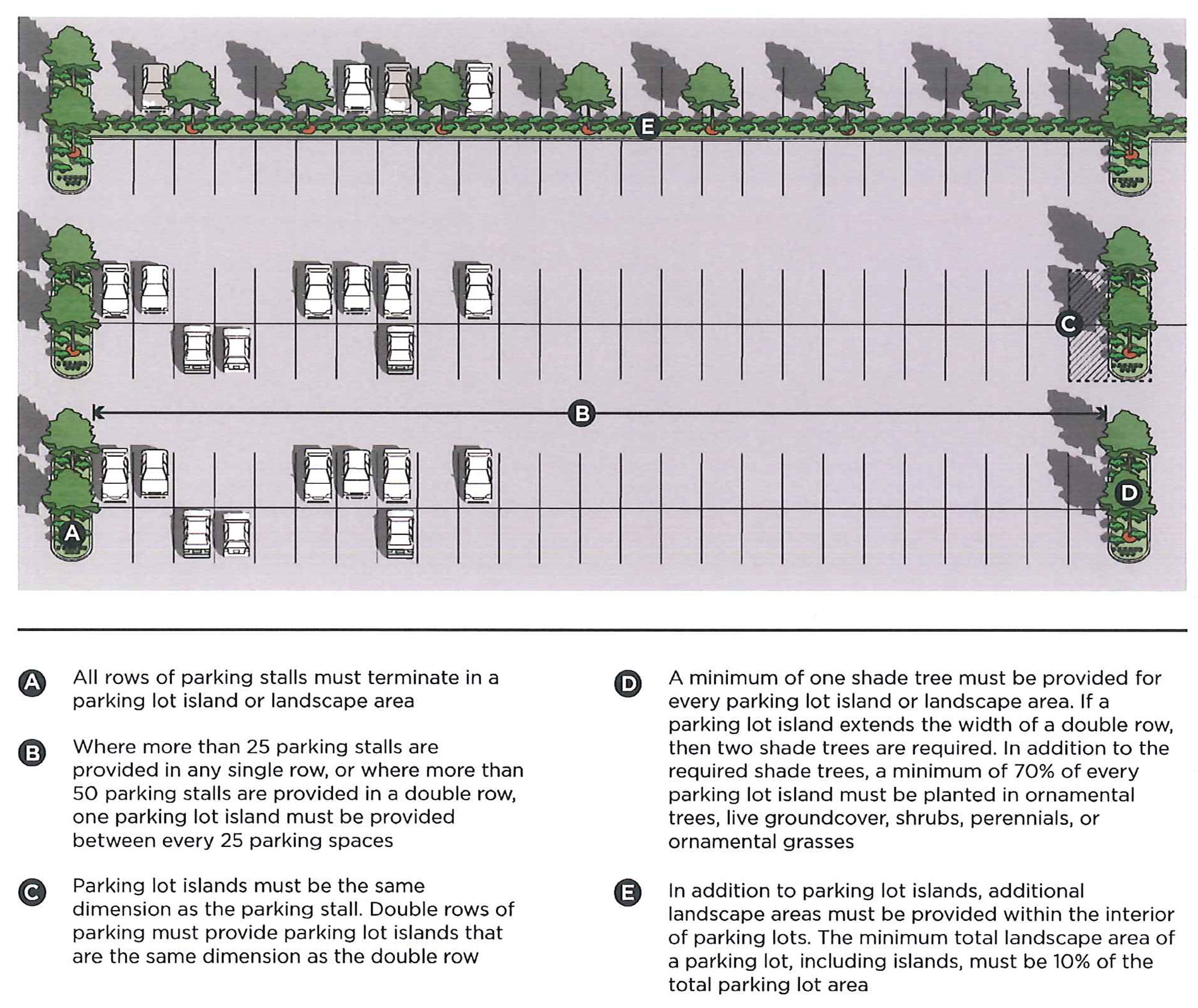
All rows of parking stalls must terminate in a parking lot island or landscape area.
B.
Where more than 25 parking stalls are provided in any single row, or where more than 50 parking stalls are provided in a double row, one parking lot island must be provided between every 25 parking spaces. As part of the landscape plan approval, parking lot island locations may be varied based on specific site requirements or design scheme, but the total number of islands must be no less than the amount required of one island for every 25 single row or 50 double row spaces.
C.
Parking lot islands must be the same dimension as the parking stall. Double rows of parking must provide parking lot islands that are the same dimension as the double row.
D.
A minimum of one shade tree must be provided for every parking lot island or landscape area. If a parking lot island extends the width of a double row, then two shade trees are required. In addition to the required shade trees, a minimum of 70% of every parking lot island must be planted in ornamental trees, live groundcover, shrubs, perennials, or ornamental grasses.
E.
The use of storm water management techniques, such as rain gardens and bio-swales, is encouraged in landscape areas. Parking lot islands and landscape areas are encouraged to be designed to accommodate storm water infiltration. The Director of Community Development may reduce the requirements of item C above if it is demonstrated that such a reduction is necessary to accommodate storm water management techniques.
F.
In addition to parking lot islands, additional landscape areas must be provided within the interior of parking lots. The minimum total landscape area of a parking lot, including parking lot islands, must be 10% of the total parking lot area. Parking lot perimeter landscape is excluded from the calculation of total parking lot area.
11.8 - SITE LANDSCAPE
Except for landscaping standards for parking lot interiors as provided for in Section 11.7, the following site landscape standards apply to townhouse, multi-family dwelling and non-residential uses.
A.
Areas of the site not covered by structures or pavement must be planted with live landscaping.
B.
Decorative stone, brick, or pavement may be used for edging planting beds but may not cover more than 20% of the landscaped area.
C.
A landscaped area must be located around the foundation perimeter of all buildings when visible from a public street. Such landscaping may be composed of a combination of shrubs, roses, ground cover, ornamental grasses, perennials, vines and annual flowers. Planted pots and/or planter boxes may be used to satisfy this requirement in tight and/or paved areas. This does not apply to structures that are sited 10 feet or less from the lot line, or where sidewalks, driveways, truck docks, and loading and service areas provide access to the building or where fire department connections are necessary.
D.
Shade trees should be located on the south side of buildings wherever feasible to block summer sun.
E.
Plantings shall be designed so as to provide massing of natural colors and shapes to offset the mass of the building and to provide visual relief from the straight lines of building architecture, parking lots, and other man-made features. The overuse of hybridized colored plantings (e.g., bright yellow & purple foliage) should be avoided.
F.
Service yards and exterior work areas must be screened from view from adjacent residential and commercial districts and the public right-of-way.
11.9 - BUFFER YARDS
This section establishes standards for the dimension and required landscape for buffer yards between land uses and/or zoning districts within the rear or interior side yard. Nothing in this section prevents the applicant's voluntary installation of buffer yards where they are not required.
A.
As of the effective date of this Ordinance, buffer yards are required for new construction [2] along interior side and rear yards in the following cases:
1.
Where an R-3 or R-4 District abuts a R-1, R-2, or R-2-35 District. This does not apply to single-family and two-family dwellings located within an R-3 or R-4 District.
2.
Where a non-residential use is located within a residential district. This does not apply to parks.
3.
Where a non-residential district abuts a residential district. This does not apply to parks.
B. Buffer yards may be located within required yards, but must be reserved for the planting of material and installation of screening as required by this section. No parking, driveways, sidewalks, accessory structures, or other impervious surfaces are permitted within the buffer yard area.
C. The required design of buffer yards is as follows:
1.
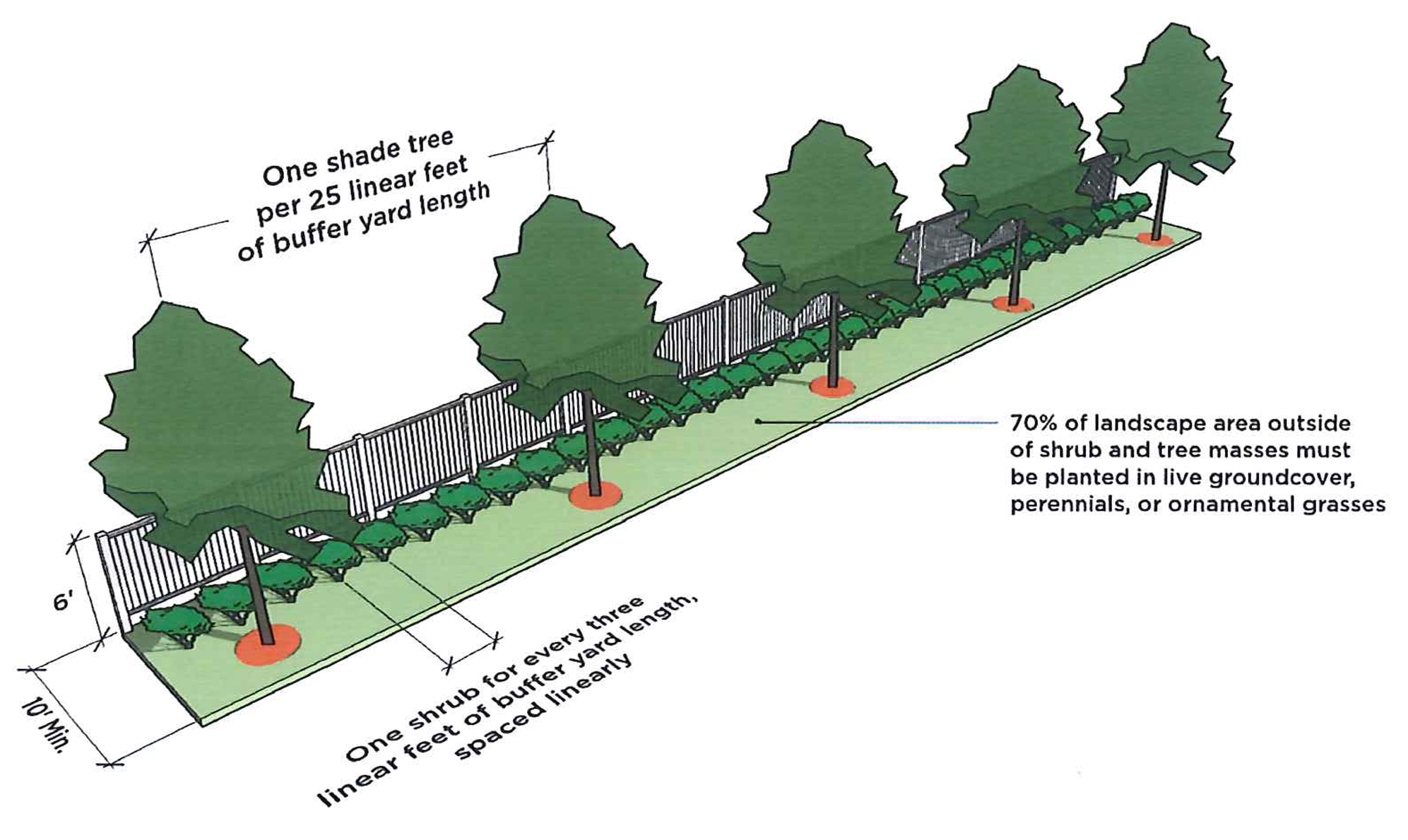
A buffer yard must be a minimum of 10 feet in width. This requirement may be reduced or eliminated for smaller parcels by the Director of Community Development if it is demonstrated that a 10 foot wide buffer yard presents a hardship.
2.
One shade tree must be planted for every 25 linear feet of buffer yard length. As part of the landscape plan approval, trees may be spaced at various intervals based on specific site requirements, but the total number of trees planted must be no less than one per 25 linear feet of buffer yard length.
3.
Existing trees that are preserved may count toward the buffer yard tree requirement. This credit is a 1:1 ratio (one existing tree for one proposed tree) regardless of the size of the existing tree.
4.
Unless otherwise specifically required by the use standards of this Ordinance, a solid fence or wall of six feet in height must be erected along 100% of the buffer yard length.
5.
One shrub, measuring a minimum of 18 inches in height at planting and reaching a minimum of three feet in height at maturity, must be planted for every three linear feet of buffer yard length, spaced linearly.
6.
70% of the landscape area outside of shrub and tree masses must be planted in live groundcover, perennials, or ornamental grasses.
Note— For example, new commercial construction next to an existing residential district must provide the buffer yard. Conversely, new residential construction next to an existing commercial district is not required to provide a buffer yard and is not considered nonconforming.
11.10 - STORMWATER MANAGEMENT BASIN LANDSCAPING
Storm water management basins must be designed as an integral part of the overall site plan, and should provide required storm water storage as well as desirable environmental functions and an aesthetically pleasing environment.
A.
Storm water management basins should be designed as follows:
1.
In permanently wet retention basins, emergent plantings must be incorporated to soften the shoreline, increase water quality, and provide wildlife habitat. The shoreline zone, consisting of an area from the normal water level to the top of the slope, around the entire perimeter, must be planted with suitable cover vegetation such as native grasses, sedges, forbs, or turf.
a.
Maintained turf areas may be used within the shoreline zone to allow vehicle access for maintenance including, but not limited to, dredging equipment. Maintained turf must not constitute more than 30% of the area of the shoreline zone.
2.
In dry-bottom or occasionally inundated detention basins, all areas of the basin, including the floor, side slopes, berms, impoundment structures, or other earth structures must be planted with turf grass or other cover vegetation specifically suited for storm water basins. Turf grass areas must be sodded or hydro-seeded to minimize erosion during the establishment period, and once established, should be maintained at a height of not more than six inches. Wildflowers, meadow plantings, and nonaggressive grasses suitable to the intermittently wet conditions of the detention basin are encouraged as alternatives to turf grass, provided that they provide continuous cover to all areas of the basin, and do not interfere in the safe and efficient function of the basin.
3.
Storm water management basins are required to provide a buffer zone, extending 20 feet from the top of slope, around the entire perimeter of the basin. This area serves to buffer adjacent uses and to provide a transition to a development's overall landscape theme. Required plantings in the buffer zone may be grouped together or spaced as necessary to provide an aesthetically appealing transition to the surrounding landscape. Plantings in the buffer zone are required as follows:
a.
A minimum of one deciduous tree is required for each 2,500 square feet of total buffer area.
b.
A minimum of one evergreen tree is required for each 3,000 square feet of total buffer area.
c.
A combination of deciduous and evergreen shrubs are required, at a minimum rate of one shrub for each 400 square feet of total buffer area.
d.
The remainder of the buffer area must be planted with live groundcover, perennials, or ornamental grasses.
e.
In the case that any of the above calculations result in a fraction, it must be rounded up to the nearest whole number.
4.
Basins must incorporate curvilinear features to blend with and complement the natural surrounding topography. The use of sharp geometric shapes must be avoided.
5.
Where appropriate, dry bottom or occasionally inundated storm water management basins should be designed to serve a secondary purpose for recreation, open space, or other types of uses that will not be adversely affected by occasional or intermittent flooding.
6.
Amenities, such as bike paths, sidewalks, gazebos, benches, and other such items are encouraged around storm water management basins.
7.
All storm water management basins that can be expected to flood to a depth of three feet must have warning signs posted on all sides.
B.
Maintenance should be considered at the time of designing a stormwater management basin. To make maintenance easier and less costly, designs should include the following features where applicable:
1.
A discharge drain made of concrete or other durable materials other than corrugated metal.
2.
A discharge drain located in the embankment with easy access for repair and debris removal.
3.
Shoreline protection measures to prevent erosion from any potential wave action.
4.
Facilities to allow the water level to be lowered by gravity flow for cleaning purposes and shoreline maintenance.
5.
Plant selections that consider the climate and other events likely to contribute to erosion, based on an evaluation of the risks, costs, and benefits involved.
6.
Protection of natural vegetation wherever possible in areas immediately adjacent to natural watercourses.
C.
A maintenance bond will be held by the Village's Department of Community Development for a two year period following initial approval of the landscape plan. This must be equivalent to 25% of the vegetation and installation cost related to any storm water management basin, and will be collected to ensure sufficient establishment of the plants. The project sponsor must provide a written cost estimate or actual contract amount as a basis for the bond amount.
D.
A management plan for storm water management basins must be provided to the Village at the time of site plan review. Any homeowner association covenants and restrictions or master deed must include language for detention basin maintenance per the approved plan. The Village may require establishment of a special service area for maintenance of the stormwater management basin.
11.11 - STREET TREE REQUIREMENTS
A.
For any project classified as new construction, Village street tree requirements as provided in Section 106 shall be met.
(Ord. No. 2017-58, § 2(Exh. 1), 11-28-17)

