
Niles City Zoning Code
SECTION 8
- USES
8.1 - GENERAL USE PERMISSIONS
A.
No structure or land may be used or occupied except in conformity with the regulations for the zoning district in which it is located.
B.
All uses must comply with any applicable federal and state requirements and any regulations of the Village Code.
C.
Noncompliance with any of the use standards of this Section and any conditions imposed as a part of the approval of a special use or other zoning approval is considered a violation of this Ordinance and subject to enforcement provisions.
D.
A non-residential lot may contain more than one principal use, so long as each principal use is allowed in the district. Each principal use must be approved separately, even if the uses function as a whole development. For example, a gas station may have a car wash or a minor vehicle repair if a car wash or a minor vehicle repair use is allowed in the district. In some cases, the principal use standards and/or definition may identify ancillary uses that are an integral part of the principal use's operation. When identified as an ancillary use, the ancillary use does not require separate approval, but must comply with any standards applicable to such use.
E.
Any use not listed within Table 8-1: Use Matrix of Section 8.2 is prohibited.
8.2 - USE MATRIX
A.
Table 8-1: Use Matrix identifies the principal and temporary uses allowed within each zoning district. P indicates that the use is permitted in the district. S indicates that the use is a special use in the district and requires special use permit approval. If a cell is blank, the use is not allowed in the district. In the case of temporary uses, a P indicates the temporary use is allowed in the district and the standards may indicate that it requires temporary use permit approval in accordance with the standards of Section 8.4.
B.
Within the C-2, C-3, and C-4 Districts, ground floor uses at corners at intersections with traffic signals are limited to those listed under the "Retail" category in Table 8-1: Use Matrix. This limitation extends for 250 feet along the lot lines along each intersecting street and applies to any ground floor space where 50% or more of the space's frontage is located within this 250 foot measurement.
(Ord. No. 2017-58, § 2(Exh. 1), 11-28-17; Ord. No. 2018-29, § 2(Exh. 1), 6-26-18; Ord. No. 2019-32, § 2, 10-8-19; Ord. No. 2020-30, § 2(Exh. 1), 9-22-20; Ord. No. 2021-34, § 2(Exh. 1), 6-22-21; Ord. No. 2022-50, § 2, 7-26-22; Ord. No. 2022-52, § 2, 7-26-22; Ord. No. 2022-58, § 2(Exh. 1), 8-23-22; Ord. No. 2022-74, § 2, 11-15-22; Ord. No. 2023-34, § 2, 6-27-23; Ord. No. 2023-56, § 3, 10-24-23; Ord. No. 2023-66, § 2, 11-14-23)
8.3 - PRINCIPAL USE STANDARDS
Where applicable, principal uses are required to comply with all use standards of this section, whether a permitted or special use, in addition to all other regulations of this Ordinance.
A.
Adult Use
1.
All adult uses require a business license per Section 22.541 of the Village Code.
2.
All adult uses must be located a minimum of 2,000 feet from any residential use, place of worship, educational facility, park/playground, or cultural facility.
3.
An adult use must be located a minimum of 2,000 feet from any other adult use.
4.
No adult use may be maintained or operated in any manner that causes, creates, or allows public viewing of any adult material, or any entertainment depicting, describing, or relating to specified sexual activities or specified anatomical areas, from any public or private right-of-way or any property.
B.
Community Residence
1.
A community residence must be the only principal use within a building.
2.
Community residences must meet all applicable federal, state, and local requirements including, but not limited to, licensing, health, safety, and building code requirements.
3.
The facility must retain a residential character, which is compatible with the surrounding residential neighborhood.
4.
The facility must not be located within 1,500 feet of another community residence, either small or large.
C.
Currency Exchange or Payday/Title Loan Establishment
No currency exchange or payday/title loan establishment may be located within one mile of another currency exchange or payday/title loan establishment.
D.
Day Care Home
1.
Day care homes must meet any applicable federal, state, and local requirements including, but not limited to, licensing, health, safety, and building code requirements.
2.
The facility must retain a residential character that is compatible with surrounding residential neighborhoods.
3.
One sign is permitted and must be wall or window mounted, and no more than six square feet in area.
E.
Day Care Center
Day care centers must meet all applicable federal, state, and local requirements including, but not limited to, licensing, health, safety, and building code requirements.
F.
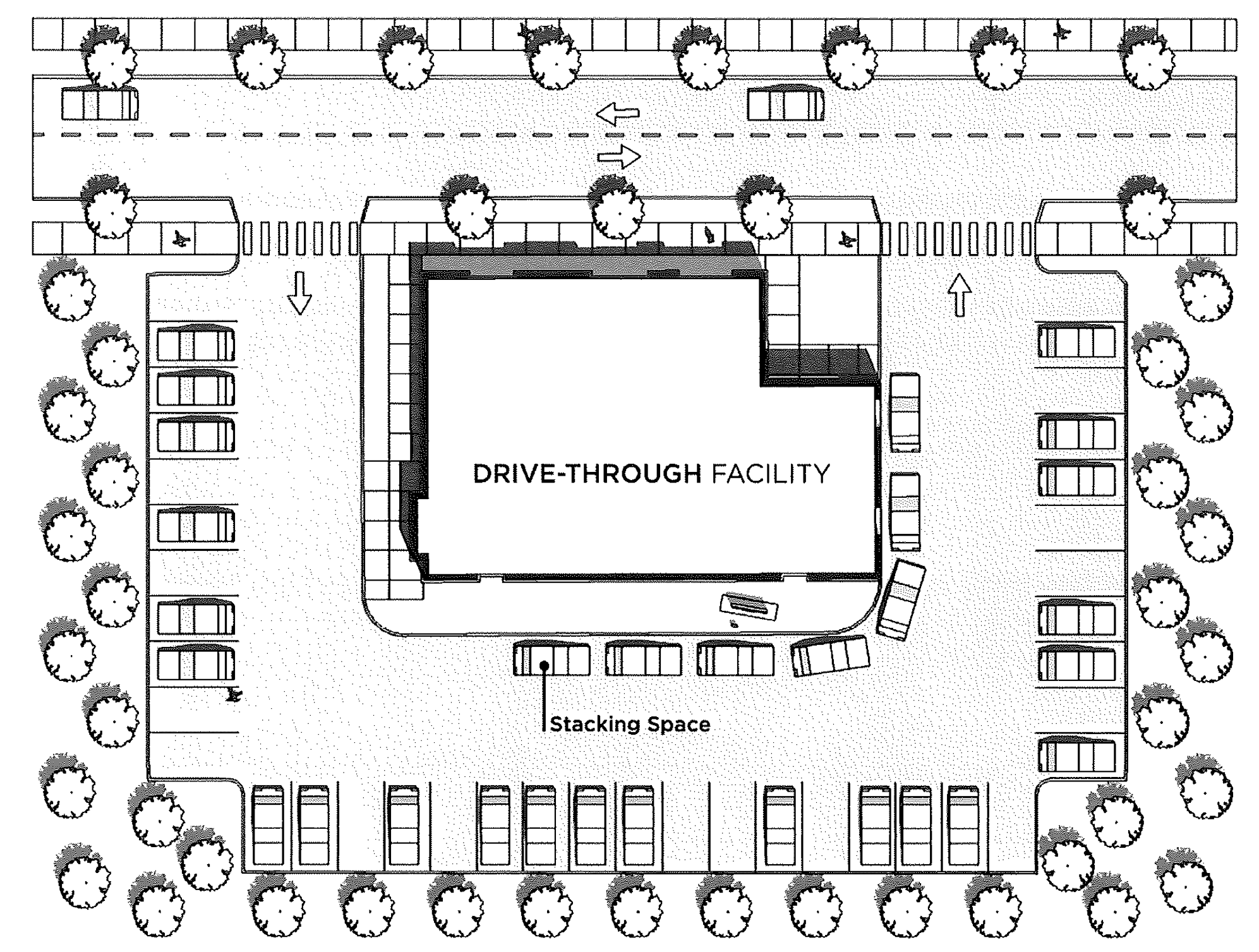
Drive-Through Facility
1.
All drive-through facilities must provide a minimum of six stacking spaces per lane or bay, unless additional or lesser stacking spaces are specifically required by this Ordinance. The Village may require more than this minimum number of spaces as part of special use approval and/or site plan review.
2.
All drive-through lanes must be designed to ensure that they do not adversely affect the safety and efficiency of traffic circulation on the lot and on adjoining streets.
3.
Additional screening may be required as part of special use approval and/or site plan review to minimize the impact of exterior site lighting, headlight glare, menu boards, and intercom sound.
G.
Dwelling - Single-Family and Two-Family
1.
No single-family or two-family dwelling may be constructed or undergo major renovation that would be the same or a similar design as any dwelling located on any first, second, or third lot adjacent to either side of the lot or any lot directly across the street.
2.
Any frontloading attached garage with a full second floor above must have an additional roof line that runs at least as wide as the garage door(s) with a minimum projection of one foot.
H.
Firearms Sales and Firearm Training Centers
Firearms Sales and Firearms training Centers are only allowed indoors. No firearms sales and/or firearm training centers may be located within 1,000 feet of any educational facility. See 8.5 for definition of 'educational facility'.
I.
Gas Station
1.
All gas station driveways must be located and designed to ensure that they will not adversely affect traffic circulation on adjoining streets.
2.
Gas stations may include an ancillary retail establishment.
3.
The volume on any outdoor audio component must be maintained at a level so as not to be audible on adjoining properties.
J.
Heavy Commercial - Rental and Service, or Retail
1.
Outdoor storage areas must be located to the rear or side of the structure where possible. No outdoor storage is permitted in required setbacks.
2.
All heavy commercial uses must be screened along interior side and rear lot lines with a solid wall or fence of six feet in height.
K.
Medical Cannabis Dispensing Organization
1.
In accordance with state law, as amended, Medical Cannabis Dispensing Organizations must comply with the required spacing and location requirements. Any subsequent amendment to state law that is more restrictive than this standard will control.
The Village of Niles adopts all operating standards and established and amended from time to time by the State of Illinois ("Operating Standards"). Each Medical Cannabis Dispensing Organization is bound by such Operating Standards.
a.
A licensed Medical Cannabis Dispensing Organization may not be located within 1,000 feet of a pre-existing educational facility - primary or secondary and/or day care center.
b.
A licensed Medical Cannabis Dispensing Organization may not be located within 500 feet of any place of worship, or park/playground.
c.
Only within the C-E Overlay District a licensed Medical Cannabis Dispensing Organization may not be located within 5,000 feet of another licensed Medical Cannabis Dispensary Organization, except where co-location of a use is authorized by the Act.
d.
A licensed Medical Cannabis Dispensing Organization may not be located within a residential dwelling or within a residential district.
2.
The following components of the Medical Cannabis Dispensing Organization shall be provided to the Director of Community Development and approved by the appropriate Village Departments prior to the issuance of a Certificate of Occupancy:
a.
Proposed structure in which the facility will be located, including co-tenancy (if in a multi-tenant building), total square footage, and building code compliance.
b.
Security installations/security plan approved by the Chief of Police, or his designee.
c.
An operation plan must be submitted, which includes the days and hours of operation, a delivery plan, a sign plan, and a site plan that describes access points and internal site circulation, exterior lighting, and parking capacity.
L.
Medical Cannabis Cultivation Center
1.
In accordance with state law, as amended, Medical Cannabis Cultivation Center must comply with the required facility design and spacing requirements. Any subsequent amendment to state law that is more restrictive than this standard will control. The Village of Niles adopts all operating standards and established and amended from time to time by the State of Illinois ("Operating Standards"). Each Medical Cannabis Cultivation Organization is bound by such Operating Standards.
a.
A licensed Medical Cannabis Cultivation Center must be located within an enclosed, locked facility, defined as a room, greenhouse, building, or other enclosed area equipped with locks or other security devices that permit access only by a cultivation center's agents or a dispensing organization's agent working for the registered cultivation center or the registered dispensing organization to cultivate, store, and distribute cannabis for registered qualifying patients.
b.
A licensed Medical Cannabis Cultivation Center may not be located within 1,500 feet of a pre-existing educational facility - primary or secondary, day care center, day care home, a residential district, place of worship, or park/playground.
2.
The following components of a Medical Cannabis Cultivation Center shall be provided to the Director of Community Development and approved by the appropriate Village Departments prior to the issuance of a Certificate of Occupancy:
a.
Proposed structure in which the facility will be located, including co-tenancy (if in a multi-tenant building), total square footage, and building code compliance.
b.
Security installations/security plan approved by the Chief of Police, or his designee.
c.
An operation plan must be submitted, which includes the days and hours of operation, a delivery plan, a sign plan, and a site plan that describes access points and internal site circulation, exterior lighting, and parking capacity.
M.
Outdoor Display (Retail)
1.
Retail establishments located on lots a minimum of a 20,000 square feet are permitted permanent outdoor display areas.
2.
Permanent outdoor display areas must be located within a maximum of 25 feet of any building wall. Outdoor display areas must be located 10 feet from any lot line.
N.
Outdoor Sales (Retail)
1.
Retail establishments located on lots a minimum of a 20,000 square feet are permitted permanent outdoor sales areas.
2.
Permanent outdoor sales areas are not permitted in required setbacks.
3.
A walk aisle a minimum of four feet in width must be maintained at all times throughout the sales area.
4.
A permanent safety barrier must be erected to maintain a separation between the outdoor sales areas and any parking and drive-aisles.
O.
Outdoor Seating
1.
Outdoor seating must maintain a minimum five foot clearance for all walkways.
2.
All outdoor furnishings must be able to be easily removed during winter months and/or if required by the Village. All outdoor furnishings must be designed to withstand a wind pressure of not less than 30 pounds per square foot.
3.
Outdoor seating may be open between the hours of 6:00 AM and 11:00 PM.
4.
Any outdoor seating in the right-of-way requires special use approval and is subject to the following specific regulations, in addition to the other regulations of this section.
a.
Outdoor seating in the right-of-way requires the applicant to enter into a lease of the right-of-way, a hold harmless agreement, and to provide evidence of general liability insurance and dramshop insurance, including naming the Village as an insured and insuring the Village against any liability. Minimum coverage must be $1,000,000.00 for general liability insurance and $300,000.00 for dramshop insurance and no less than an "A" rating by the most recent "AM Best Insurance Rating Guide."
b.
All maintenance and upkeep of a right-of-way associated with the operation of the outdoor seating in the public right-of-way is the responsibility of the property owner (upkeep includes the replacement of damaged public property, i.e., brick pavers).
P.
Outdoor Storage
1
An outdoor storage yard must be completely enclosed along all lot lines by a solid fence or wall six feet in height. Fences or walls along the front or corner side lot line must be set back a minimum of 10 feet. Within the setback, one shrub a minimum of three feet in height must be planted linearly every three feet on-center along such fence or wall.
2.
Storage of any kind is prohibited within any required setback.
3.
Storage of any kind is prohibited outside the fence or wall. No items stored within 25 feet of the fence or wall may exceed the height of the fence or wall.
Q.
Parking Structure and Parking Lot
All parking structures and parking lots are subject to the parking design standards of Section 10. In addition, parking structures and parking lots as principal uses are subject to the following standards.
1.
Parking Structure
a.
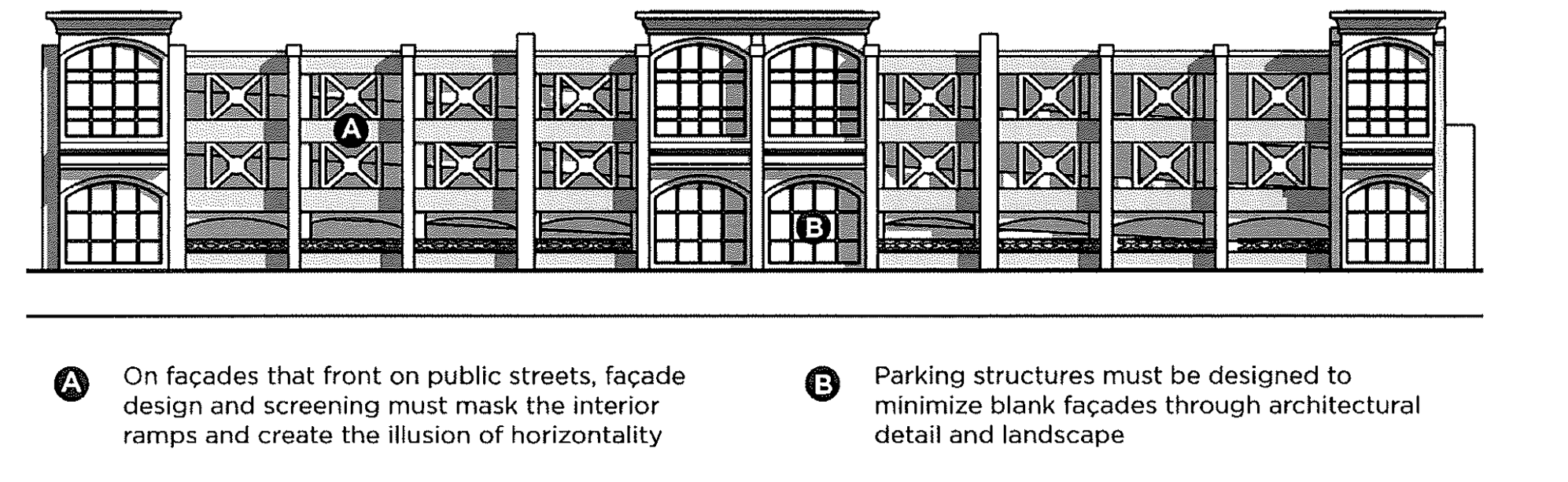
On façades that front on public streets, façade design and screening must mask the interior ramps and create the illusion of horizontality.
b.
Parking structures must be designed to minimize blank façades through architectural detail and landscape.
c.
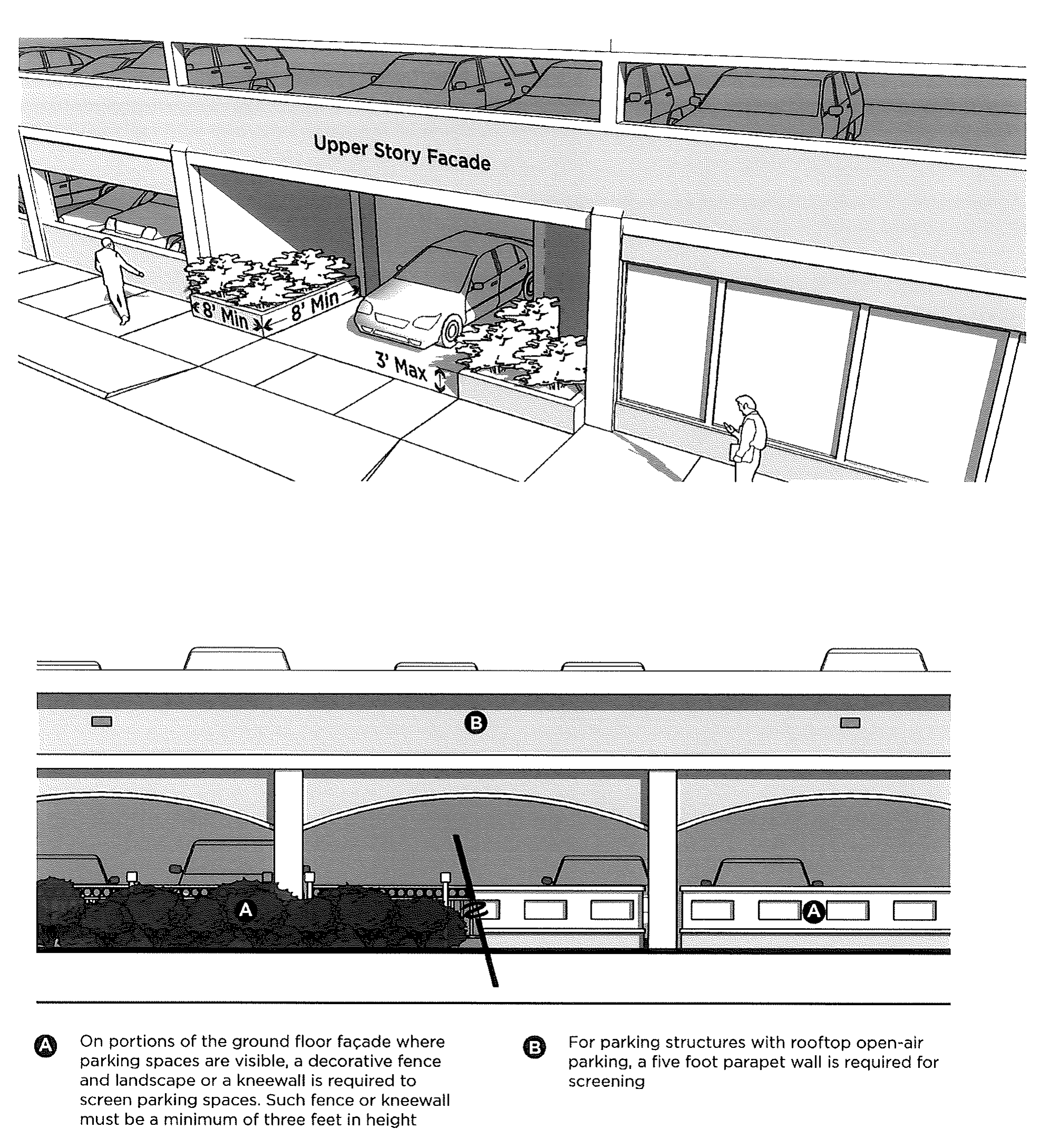
On portions of the ground floor façade where parking spaces are visible, a decorative fence and landscape or a kneewall is required to screen parking spaces. Such fence or kneewall must be a minimum of three feet in height.
d.
For parking structures with rooftop open-air parking, a five foot parapet wall is required for screening.
e.
A vehicular clear sight zone must be included at vehicular exit areas as follows:
i.
The façade of vehicular exit areas must be set back from any pedestrian walkway along that façade a minimum of eight feet for the portion of the façade that includes the vehicle exit area and eight feet on each side of the exit opening.
ii.
A sight triangle is defined by drawing a line from the edge of the vehicular exit area to a point on the property line abutting the pedestrian walkway eight feet to the side of the exit lane. In the sight triangle, groundcover, landscape, or decorative wall must be used to act as a buffer between the exit aisle and the pedestrian walkway. Landscape or a decorative wall must not exceed three feet in height in order to maintain driver sightlines to the pedestrian walkway.
iii.
The upper story façade(s) of the parking structure may overhang the vehicular clear sight zone.
2.
Parking Lot
a.
A parking lot must be used solely for the temporary parking of motor vehicles and cannot be used as an off-street loading area. No sale, display, repair, or service, except emergency service, of any kind is permitted in any parking lot. This does not include permitted temporary uses.
b.
Parking lots must be screened and landscaped in accordance with the requirements of Section 11.
R.
Pet Services: Overnight Boarding
All overnight boarding facilities must be located indoors. Animals may be allowed outside until no later than 11:00 p.m. except for toileting.
S.
Reception Facility
1.
A general admission fee or any other monetary donations (payment at the door to the general public) for entrance is prohibited, with the exception of fundraisers or events for bona fide non-profit organizations, places of worship, educational facilities, or similar.
2.
Outdoor seating areas are permitted for the use of guests. If a reception facility conducts main activities outdoors, special use approval is required for any permanent outdoor component of the facility.
T.
Residential Care Facility
1.
Residential care facilities must meet any applicable federal, state, and local requirements including, but not limited to, licensing, health, safety, and building code requirements.
2.
When located in a residential district, the facility must retain a residential character, which is compatible with the surrounding residential neighborhood. When located in a non-residential district, the structure must be designed with a lobby entrance along the primary frontage.
3.
Residential care facilities that are only residential in use must meet applicable standards for multi-family dwellings in that district. Mixed-use residential care facilities, where commercial uses are located on the ground floor, must meet the design standards of the district.
U.
Vehicle Operation Facility
All repair and service operations must be performed within a fully enclosed building.
V.
Vehicle Rental, and Vehicle, Marine, and Recreational Vehicle Sales
1.
Vehicle rental and vehicle sales establishments may have ancillary vehicle repair facilities. All repair and service operations must be performed within a fully enclosed building, with the exception of any fueling facilities. Fueling facilities must be located to the rear of the lot.
2.
Vehicle rental and vehicle sales establishments with outdoor vehicle display are subject to the following:
a.
Within commercial districts, a minimum lot area of three acres is required. Within industrial districts there is no minimum lot area. Vehicle rental and vehicle sales establishments with outdoor vehicle display are prohibited along Milwaukee Avenue.
b.
Any outdoor display of vehicles must be screened along front and corner side yards. The screening must consist of shrubs a minimum of three feet in height, spaced linearly and planted every three feet on center, and/or a low pedestrian wall a minimum of three feet to a maximum of four feet in height along the perimeter of such outdoor display areas.
W.
Vehicle Repair - Minor and Major
1.
Vehicle repair/service establishments may not store the same vehicles outdoors on the site for longer than three days. Only vehicles that have been or are being serviced may be stored outdoors.
2.
All repair and service operations must be performed within a fully enclosed building. All equipment and parts must be stored indoors.
3.
Vehicle repair establishments that abut a residential district must be screened along interior side and rear lot lines with a solid wall or fence six feet in height.
4.
No partially dismantled, wrecked, or unlicensed vehicle may be stored outdoors on the premises. This standard does not apply to vehicles under repair. Vehicles may not be on-site for more than 3 days.
5.
The sale of used or new automobiles is prohibited.
6.
No motor vehicles may be stored and no repair work may be conducted in the public right-of-way.
X.
Wind Energy System
1.
The design of the wind energy system must conform to applicable industry standards as such standards exist as of the date construction is commenced. The facility owner or operator must submit certificates of design compliance obtained by the equipment manufacturers from official certifying organizations.
2.
All wind turbines must be newly manufactured as of the date of installation. Experimental/prototype wind turbines may be approved only as a special use.
3.
All wind energy systems must be equipped with a redundant braking system. This includes both aerodynamic over-speed controls (including variable pitch, tip, and other similar systems) and mechanical brakes. Mechanical brakes must be operated in a fail-safe mode. Stall regulation is not considered a sufficient braking system for over speed protection.
4.
All electrical components of the wind energy system must conform to applicable federal, state, and local codes, and applicable international standards.
5.
An engineer's certificate must be completed by a structural engineer, licensed in the State of Illinois, certifying that the tower and foundation of the wind turbines are compatible with, and are appropriate for, the particular model of wind turbine used, and that the specific soils at the site can support the wind turbine.
6.
Wind turbines must comply with the following design standards:
a.
Wind turbines must be a non-obtrusive and non-reflective color. The facility owner or operator must maintain the paint on wind turbines at all times in good repair.
b.
Wind turbines must not display advertising, except for reasonable identification of the turbine manufacturer, or the facility owner and operator.
c.
Within the wind energy system, wind turbines must be of a generally consistent size, design, and color, of similar height and rotor diameter, and rotate in the same direction.
d.
Wind turbines must not be artificially lit, except to the extent required by the Federal Aviation Administration or other applicable regulatory authorities.
e.
On-site transmission and power lines between wind turbines must, to the maximum extent practicable, be placed underground, reach the property line, and be located and constructed in such a way as to minimize disruption to the property's primary purpose as well as to facilitate the interconnection of other commercial wind power generating facilities.
f.
Non-essential appurtenances are prohibited to be affixed to any wind turbine, including, but not limited to, cellular or radio antennae or banners or signs.
g.
A clearly visible warning sign advising persons of the presence of high voltage levels must be placed at the base of all pad-mounted transformers and substations.
7.
The applicant must commission and submit at the time of permit application a wildlife assessment (impact study), conducted by a qualified wildlife expert indicating possible risks to local wildlife, habitat, and migratory birds. Additionally, the applicant's wildlife expert must also develop a mitigation plan, if applicable, that addresses/mitigates any risk to wildlife, migratory birds, and affiliated habitat. All wind turbines at time of application must be located out of bird and bat migration pathways/corridors where wind turbine construction would pose a substantial risk.
8.
Wind turbines must not be climbable up to a height of at least 15 feet above ground surface. All access doors to wind turbines and electrical equipment must be locked or fenced, as appropriate, to prevent entry by non-authorized persons.
9.
All wind turbines must be set back from the nearest property line a distance of not less than the required setback for that zoning district or the turbine height, whichever is greater. The setback distance is measured from the property line to the nearest point on the outside edge of a tower. Operation and maintenance building(s) and substations must be located in accordance with zoning district yard requirements. All wind farm structures, except for wind turbines, must comply with the regulations of the zoning district.
10.
The facility owner or operator must comply with all applicable codes and ordinances regulating sound generation. In the event that any sound levels from a wind turbine are found to be in excess of permissible levels, the facility owner or operator must take necessary measures to bring sound levels down to a level acceptable.
11.
A wind turbine's shadow flicker must not fall on any window of an existing structure or within the buildable area of an adjacent lot, as defined by setback requirements.
12.
The facility owner and operator must, at their sole expense, complete decommissioning of the wind energy system, or individual wind turbines, within one year after the end of the useful life of the wind energy system or individual wind turbines. The wind energy system or turbine will be deemed to be at the end of its useful life if it is abandoned for a period of time in excess of 180 days. Decommissioning includes removal of wind turbines, structures, roads, and foundations to a depth of 48 inches, and any other element constructed by facility owner or operator for the purpose of maintaining or operating the wind energy system.
Y.
Wireless Telecommunications
1.
Purpose
The following standards for wireless telecommunications antennas, facilities, and towers are intended to:
a.
Ensure public health, safety, and welfare.
b.
Ensure access to reliable wireless telecommunications services throughout the Village.
c.
Encourage the location of antennas and towers on Village-owned property.
d.
Encourage the use of existing towers and other structures for the co-location of wireless telecommunications antenna.
e.
Encourage the location of towers, to the extent possible, in areas where the adverse impact on the Village will be minimal.
f.
Encourage the location of small cell and Distributed Antenna Systems (DAS) in buildings and in densely populated areas as an alternative to use of towers and other macrocell structures.
2.
Application Requirements
In addition to the requirements for a special use, all applications to erect, construct, or modify any part of a wireless telecommunications antenna, facility, or tower must include the following items, unless waived by the body approving the application:
a.
A site plan showing:
i.
The location, size, screening, and design of all structures, including fences.
ii.
The location and size of all outdoor equipment.
iii.
Elevations showing antenna height.
iv.
If the site plan is for a new wireless telecommunications tower, indication of the fall zone as a shaded circle.
b.
A maintenance plan and any applicable maintenance agreement designed to ensure long-term, continuous maintenance, including maintenance of landscape, keeping the area free from debris and litter, and immediate removal of any graffiti. The plan may include a copy of the conditions addressing maintenance, debris, litter, and graffiti stated in the lease agreement between the wireless carrier or tower owner, and the owner of the property where the wireless facility is located.
c.
A disclosure of what is proposed.
d.
The reason or purpose for the placement, construction, or modification in the proposed location with specific reference to the provider's coverage, capacity, and/or quality needs, goals, and objectives.
e.
For projects on Village-owned property, the service area of the proposed wireless telecommunications antenna, facility, or tower.
f.
If the proposal is for a new telecommunications tower, then a map showing co-location opportunities within the City and within areas surrounding the borders of the Village must be provided and justification for why co-location is not feasible in order to demonstrate the need for a new tower.
g.
Certification by a licensed and registered professional engineer or architect regarding the manner in which the proposed structure will pass or fail. The certification may be utilized, along with other criteria such as applicable regulations for the district in question, in determining if additional setback should be required for the structure and other facilities.
h.
Statements requiring compliance with local building codes, safety standards, all applicable local and state laws, and all local, state, and federal regulations. If such laws or regulations are changed, then the wireless facility provider shall have six (6) months from the effective date of such revised laws or standards to come into compliance unless a more restrictive compliance schedule is mandated by the controlling state or federal agency.
i.
A statement requiring that the provider shall make its best efforts to avoid interference of its frequencies with Village public safety, public works, and administrative radio frequencies.
j.
Completion of FCC forms indicating exemption from or compliance with federal regulations regarding radio frequency warning signage and safety zones.
k.
A statement or analysis by a licensed professional engineer attesting to the structural integrity of a tower, pole, or other structure proposed to accommodate a proposed wireless facility.
l.
Any wireless facility provider shall maintain its facility in compliance with the standards contained in the current applicable local, county, or state building codes and the applicable standards for telecommunications towers that are published by the American National Standards Institute (ANSI), Telecommunications Industry Association (TIA) and the Electronics Industry Association (EIA), as amended from time to time. If, upon inspection, the Village concludes that an antenna, antenna structure, or telecommunications tower fails to comply with such codes or standards, and constitutes a danger to persons or property, then upon notice being provided to the provider of the antenna, antenna structure, or telecommunications tower, the provider shall have thirty (30) days, or other agreed-upon timetable, to bring such antenna, antenna structure, or telecommunications tower into compliance with the applicable codes or standards.
3.
Site Priority
To minimize the adverse visual impact of wireless telecommunications towers, antennas, and facilities are allowed as special uses in the following order of priority for location. If lower priority locations are requested, the applicant may be required to provide engineering data certified by the appropriate licensed professionals, or other information the Village deems necessary, that the use of a higher priority location is not technically or otherwise feasible, and that the requested location is a matter of engineering necessity.
a.
First priority sites are the M, OR, and P-1 Districts. In addition, any stealth design of antennas is a first priority site.
b.
Second priority sites are the C-2, C-4, C-5, and ENT-MU Districts.
c.
Third priority sites are any areas not cited as a first or second priority.
4.
Setbacks
All wireless telecommunications towers and facilities must be set back from all property lines in accordance with the minimum setback requirements in the zoning district.
5.
Height
The maximum height of a wireless telecommunications tower is that of the maximum height permitted in the zoning district. If a taller height is needed to function satisfactorily, such additional height may be allowed as part of the special use approval. For wireless facilities proposed to be constructed on Village-owned property, the special use application for approval of a wireless telecommunications tower must demonstrate the minimum height needed for the tower to function.
6.
Lighting and Marking
Wireless telecommunications antennas, towers, and facilities must not be lit or marked unless required by the Federal Communications Commission (FCC) or the Federal Aviation Administration (FAA).
7.
Specific Standards for Wireless Telecommunications Antennas
Wireless telecommunications antennas are a special use in all districts, unless they are stealth design in which case they are considered a permitted use and subject only to site plan review. Stealth design for wireless antennas is encouraged and is considered a permitted use in all districts, subject to site plan review and approval. All applications for wireless telecommunications antennas must include all information required by this section. In addition to the standards of this section for wireless telecommunications antennas, stealth design must comply with the following regulations:
a.
To qualify as a stealth design, wireless telecommunications antennas must be enclosed, camouflaged, screened, obscured, or otherwise not readily apparent to a casual observer.
b.
Wireless telecommunication antennas mounted on rooftops or penthouses must be mounted at least 35 feet above grade, as measured from grade to the base of the antenna, and must be mounted on the sides of the rooftop or penthouse and painted to match the color of the structure to qualify as stealth design. Wireless telecommunication antennas mounted lower than 35 feet are not considered stealth design and require special use approval.
c.
Antennas must be located on or in structures already permitted within zoning districts, which may include, but are not limited to, water towers, clock towers, streetlights, rooftops, penthouses, parapet walls, and steeples, and must be designed to blend in with the structure. Antennas may not be located on or in structures that have been designated by the Village to be architecturally or historically significant.
d.
No antenna may increase the overall height of any structure, except a lattice tower or monopole tower, on which it is mounted by more than ten feet. If an antenna exceeds such additional height on a structure that is not a monopole tower or lattice tower, it is not considered stealth design and shall require special use approval. Extensions proposed for a monopole tower or lattice tower for the purpose of accommodating an additional antenna array or a lightning rod shall not be considered a stealth design.
e.
Any proposed project that defeats the concealment elements of the support structure per 47 CFR § 1.6100 (b)(7)(v) will require special use approval.
f.
Antennas and cabling extending from wireless communications antennas shall be painted to match the tower, building, or other structure where the antenna array is located.
8.
Specific Standards for Wireless Telecommunications Facilities
a.
Any buildings, cabinets, or shelters may house only equipment and supplies for operation of the wireless telecommunication tower. Any equipment not used in direct support of such operation must not be stored on the site. The facility must be un-staffed. Buildings, cabinets, or shelters located on Village-owned property shall not receive final Village approval until a lease between the Village and the wireless service provider has been approved and executed by the Village.
b.
Signs for the wireless telecommunications facility are limited to ownership and contact information, FCC antenna registration number (if required), radio frequency safety notice and warning signage required by FCC regulations, and any other information required by federal government regulation. Other than the display of the name of the wireless carrier or tower owner, commercial advertising is prohibited.
c.
A wireless telecommunications facility building or related structure shall, to the extent possible, use materials, colors, screening, and landscaping that will blend them into natural settings and surrounding buildings.
d.
All sites on which antennas, antenna structures, and telecommunications towers are located must have a passable roadway access.
e.
The structures upon any site which contains an antenna, antenna structure, or telecommunications tower shall be surrounded by a screen or fence. The requirements for fencing or screening in the zoning district in which the proposed antenna, antenna structure, or telecommunications tower is to be located shall apply.
f.
No antenna, antenna structure, or telecommunications tower shall be located in an area which has been designated as a wetland by either the Village of Niles, Cook County, the Illinois Department of Natural Resources, the U.S. Department of the Interior, or the U.S. Army Corps of Engineers, and any and all governmental bodies and agencies having jurisdiction.
9.
Specific Standards for Wireless Telecommunications Towers
a.
The ability for other telecommunications providers to co-locate on a tower is required. Wireless telecommunications towers must be designed to accommodate other telecommunications providers. The area surrounding a tower must be of a sufficient size to accommodate accompanying wireless telecommunications facilities for other telecommunications providers.
b.
Unless otherwise required by the Federal Communications Commission, the Federal Aviation Administration or the Village, towers must have a white, galvanized silver, or grey finish.
c.
Towers must be able to withstand wind and ice forces in accordance with standards established under American National Standards Institute/Telecommunications Industry Association/Electronics Industry Association (ANSI/TIA/EIA) Section 222-G standard, or its successor, and the 2009 International Building Code (IBC-2018), or its successor. Antenna mounts must be able to withstand wind and ice forces in accordance with standards established under ANSI/TIA/EIA Section 222-H standard or its successor. Wireless facilities mounted on utility poles as defined by the Illinois Small Wireless Facilities Deployment Act, 50 ILCS 840/10, must be able to withstand wind and ice forces in accordance with National Electrical Safety Code (NESC) and ANSI 250-B, 250-C and 250-D Codes, and their standards or their successor.
10.
Abandonment
Any wireless telecommunications tower or facility that is not operated for a period of 180 consecutive days is considered abandoned. The owner must immediately remove the tower or facility and all aboveground equipment and related debris at its own cost. The Village may ensure and enforce removal by means of its existing regulatory authority.
Z.
Adult-Use Cannabis:
1.
Purpose and Applicability: It is the intent and purpose of this Section to provide regulations regarding the cultivation, processing and dispensing of adult-use cannabis occurring within the corporate limits of the Village of Niles. Such facilities shall comply with all regulations provided in the Cannabis Regulation and Tax Act (P.A. 101-0027) (Act), as it may be amended from time-to-time, and regulations promulgated thereunder, and the regulations provided below. In the event that the Act is amended, the more restrictive of the state or local regulations shall apply. The Village of Niles adopts all operating standards and established and amended from time to time by the State of Illinois ("Operating Standards"). Each Adult-Use Cannabis Dispensing Organization; Adult-Use Cannabis Cultivation Center; Adult-Use Cannabis Infuser Organization; Adult-Use Cannabis Processing Organization; Adult-Use Cannabis Transporting Organization Operating Standards.
2.
Adult-Use Cannabis Facility Components: The following components of the Adult-Use Cannabis Facility must be provided to the Director of Community Development and approved by the appropriate Village Departments prior to the issuance of a Certificate of Occupancy:
a.
Proposed structure in which the facility will be located, including co-tenancy (if in a multi-tenant building), total square footage, and building code compliance.
b.
Security installations/security plan approved by the Chief of Police, or his designee.
c.
An operation plan must be submitted, which includes the days and hours of operation, a delivery plan, a sign plan, and a site plan that describes access points and internal site circulation, exterior lighting, and parking capacity.
d.
Compliance with all requirements provided in Section 8.3(Z)(4) Adult-Use Cannabis Craft Grower; Section 8.3(Z)(5) Adult-Use Cannabis Dispensing Organization; Section 8.3(Z)(6) Adult-Use Cannabis Cultivation Center; Section 8.3(Z)(7) Adult-Use Cannabis Infuser Organization; Section 8.3(Z)(8) Adult-Use Cannabis Processing Organization; Section 8.3(Z)(9) Adult-Use Cannabis Transporting Organization; as applicable.
e.
Compliance with all requirements of the State Cannabis Regulation and Tax Act.
3.
Adult-Use Cannabis Craft Grower: In those zoning districts in which an Adult-Use Cannabis Craft Grower may be located, the proposed facility must comply with the following:
a.
Facility may not be located within 200 feet of a pre-existing educational facility - primary or secondary and/or day care center.
b.
Facility may not be located within 200 feet of any place of worship, or park/playground.
c.
Facility may not be located within 5,000 feet of another Adult-Use Cannabis Craft Grower, Adult-Use Cannabis Dispensing Organization or Medical Cannabis Dispensing Organization, except where co-location of a use is authorized by the Act.
1.
Only one licensed Adult-Use Cannabis Craft Grower may be located in each C-E Overlay District.
d.
Facility may not be located within a residential dwelling or within a residential district.
e.
Facility may only be allowed within the C-E Cannabis Establishment Overlay District.
f.
Facility may not conduct any sales or distribution of cannabis other than as authorized by the Act.
g.
Petitioner shall file an affidavit (provided by the Village) with the Village affirming compliance with the Village of Niles' regulations regarding Adult-Use Cannabis Facility Components, Adult-Use Cannabis Craft Growers, and all other requirements of the Act.
4.
Adult-Use Cannabis Dispensing Organization: In those zoning districts in which an Adult-Use Cannabis Dispensing Organization may be located, the proposed facility must comply with the following:
a.
Facility may not be located within 200 feet of a pre-existing educational facility - primary or secondary and/or day care center.
b.
Facility may not be located within 200 feet of any place of worship, or park/playground.
c.
Facility may not be located within 5,000 feet of another Adult-Use Cannabis Craft Grower, Adult-Use Cannabis Dispensing Organization or Medical Cannabis Dispensing Organization, except where co-location of a use is authorized by the Act.
1.
Only one licensed Adult-Use Dispensing Organization may be located in each C-E Overlay District.
d.
Facility may not be located within a residential dwelling or within a residential district.
e.
Facility may only be allowed within the C-E Cannabis Establishment Overlay District.
f.
At least 75% of the floor area of any tenant space occupied by a dispensing organization shall be devoted to the activities of the dispensing organization as authorized by the Act, and no dispensing organization shall also sell food for consumption on the premises.
g.
Facility may not conduct any sales or distribution of cannabis other than as authorized by the Act.
h.
Petitioner shall file an affidavit (provided by the Village) with the Village affirming compliance with the Village of Niles' regulations regarding Adult-Use Cannabis Facility Components, Adult-Use Cannabis Dispensing Organizations, and all other requirements of the Act.
5.
Adult-Use Cannabis Cultivation Center: In those zoning districts in which an Adult-Use Cannabis Cultivation Center may be located, the proposed facility must comply with the following:
a.
Facility may not be located within 1,500 feet of a pre-existing educational facility - primary or secondary, day care center, day care home, a residential district, place of worship or park/playground.
b.
Facility may not conduct any sales or distribution of cannabis other than as authorized by the Act.
c.
Petitioner shall file an affidavit (provided by the Village) with the Village affirming compliance with the Village of Niles' regulations regarding Adult-Use Facility Components, Adult-Use Cannabis Cultivation Centers, and all other requirements of the Act.
6.
Adult-Use Cannabis Infuser Organization: In those zoning districts in which an Adult-Use Cannabis Infuser Organization may be located, the proposed facility must comply with the following:
a.
Facility may not be located within 1,500 feet of a pre-existing educational facility - primary or secondary, day care center, day care home, a residential district, place of worship or park/playground.
b.
At least 75% of the floor area of any tenant space occupied by an infusing organization shall be devoted to the activities of the infusing organization as authorized by the Act. Facility may not conduct any sales or distribution of cannabis other than as authorized by the Act.
c.
Petitioner shall file an affidavit (provided by the Village) with the Village affirming compliance with the Village of Niles' regulations regarding Adult-Use Cannabis Facility Components, Adult-Use Cannabis Infuser Organizations, and all other requirements of the Act.
7.
Adult-Use Cannabis Processing Organization: In those zoning districts in which an Adult-Use Cannabis Processing Organization may be located, the proposed facility must comply with the following:
a.
Facility may not be located within 1,500 feet of a pre-existing educational facility - primary or secondary, day care center, day care home, a residential district, place of worship or park/playground.
b.
At least 75% of the floor area of any tenant space occupied by a processing organization shall be devoted to the activities of the processing organization as authorized by the Act. Facility may not conduct any sales or distribution of cannabis other than as authorized by the Act.
c.
Petitioner shall file an affidavit (provided by the Village) with the Village affirming compliance with the Village of Niles' regulations regarding Adult-Use Cannabis Facility Components, Adult-Use Cannabis Processing Organizations, and all other requirements of the Act.
8.
Adult-Use Cannabis Transporting Organization: In those zoning districts in which an Adult-Use Transporting Organization may be located, the proposed facility must comply with the following:
a.
Facility may not be located within 1,500 feet of a pre-existing educational facility - primary or secondary, day care center, day care home, a residential district, place of worship or park/playground.
b.
The transporting organization shall be the sole use of the tenant space in which it is located. Facility may not conduct any sales or distribution of cannabis other than as authorized by the Act.
c.
Petitioner shall file an affidavit (provided by the Village) with the Village affirming compliance with the Village of Niles' regulations regarding Adult-Use Cannabis Facility Components, Adult-Use Cannabis Transporting Organizations, and all other requirements of the Act.
9.
Additional Requirements: Petitioner shall install building enhancements, such as security cameras, lighting or other improvements to ensure the safety of employees and customers of the adult-use cannabis business establishments, as well as its environs.
10.
Co-Location of Cannabis Business Establishments. The Village may approve the co-location of an Adult-Use Cannabis Dispensing Organization with an Adult-Use Cannabis Craft Grower Center or an Adult-Use Cannabis Infuser Organization, or both, in an area properly zoned for said uses, subject to the provisions of the Act and the criteria within the Village of Niles Code of Ordinances. In a co-location, the floor space requirements of Section 5(d) and 7(b) shall not apply, but the co-located establishments shall be the sole use of the tenant space.
(Ord. No. 2019-32, § 2, 10-8-19; Ord. No. 2022-38, § 2, 6-28-22; Ord. No. 2022-41, § 2, 6-28-22; Ord. No. 2023-34, § 2, 6-27-23; Ord. No. 2023-56, § 3, 10-24-23)
8.4 - TEMPORARY USE STANDARDS
Temporary uses are required to comply with the use standards of this section, in addition to all other regulations of this Ordinance. These regulations are for temporary uses located on private property. Temporary uses on public property and/or properties controlled by separate taxing bodies are exempt from these standards. Unless otherwise indicated, all temporary uses require a temporary use permit.
A.
Farmers Market
1.
The timeframe of a farmers market, including number of days per week and overall duration of the event, will be determined and approved as part of the temporary use permit.
2.
A management plan is required as part of the temporary use permit application that demonstrates the following:
a.
The on-site presence of a manager during hours of operation who directs the operations of vendors participating in the market.
b.
An established set of operating rules addressing the governance structure of the market, hours of operation, and maintenance when open to the public.
c.
A general site plan of vendor stalls, visitor facilities, such as any seating areas and restrooms, and all ingress and egress points to the site.
d.
Provision for recycling and waste removal.
e.
The days and hours of internal operation, including vendor set-up and take-down times.
B.
Garage/Yard Sale
1.
A garage/yard sale is allowed as accessory to a residential use and does not require a temporary use permit. A garage/yard sale must be incidental to the use of the property for residential purposes and must be conducted entirely on the lot.
2.
All goods offered for sale must be the property of the resident of the dwelling or for multiple neighbors where the garage/yard sale takes place.
C.
Real Estate Sales Office/Model Unit
1.
A real estate sales office/model unit(s) is allowed in any approved residential development. Multiple model units are allowed.
2.
The temporary use permit is valid for one year but may be renewed.
3.
The real estate sales office/model unit(s) must be removed and closed within 30 days after the sale of the last unit of the development.
4.
All activities conducted within real estate sales office/model unit(s) must be directly related to the construction and sale of properties within the particular development. Use as a general office of operation of any firm is prohibited.
D.
Temporary Contractor's Office
1.
A temporary contractor's office is allowed incidental to a construction project.
2.
The temporary use permit is valid for the duration of the building permit, including any extensions.
3.
The temporary contractor's office must be removed within 30 days of completion of the construction project.
E.
Temporary Mobile Food Sales
1.
The timeframe of a temporary mobile food sales use, including number of days per week and overall duration of the event, will be determined and approved as part of the temporary use permit.
2.
The temporary use permit will be evaluated on the basis of the adequacy of the parcel size, parking provisions, traffic access, and the absence of undue adverse impact, including noise, on other properties.
3.
All mobile food establishments must be properly licensed by the health department.
4.
If the mobile food establishment operator is not the owner of the site where the truck or trailer will be located, written permission from the property owner must be submitted as part of the temporary use permit application.
5.
Sale of alcohol is prohibited.
6.
During business hours, the permit holder must provide a trash receptacle for customer use and must keep the area clear of litter and debris at all times.
7.
Outdoor seating may be provided on the site, but no seating may be permanently installed.
8.
A permanent water or wastewater connection is prohibited.
9.
Electrical service may be provided only by temporary service or other connection provided by an electric utility, or an on-board generator.
10.
Drive-through service is prohibited.
11.
A mobile food establishment is limited to signs attached to the exterior of the truck or trailer that must be mounted flat against the truck or trailer with a maximum projection of six inches, and one A-frame sign.
F.
Temporary Outdoor Entertainment
1.
A management plan is required as part of the temporary use permit application that demonstrates the following:
a.
The on-site presence of a manager during the event.
b.
A general site plan of performance areas, visitor facilities, such as any seating areas and restrooms, and all ingress and egress points to the site.
c.
Provision for recycling and waste removal.
d.
The days and hours of operation, including set-up and take-down times.
e.
A description of crowd control and security measures.
2.
Any temporary structures must be removed within three days of conclusion of the event.
3.
Temporary outdoor entertainment events are limited to three events per calendar year on the same lot and a maximum duration of four days per event, with a minimum of 15 days between events, with the following exceptions:
a.
A temporary use permit for a carnival or circus is valid for a period of three events per calendar year on the same lot no more than 15 days in duration, with a minimum of 30 days between events.
G.
Temporary Outdoor Sales/Promotion
1.
A management plan is required as part of the temporary use permit application that demonstrates the following:
a.
The on-site presence of a manager during hours of operation who directs the operations of all participating vendors.
b.
An established set of operating rules addressing the governance structure of the sales event, hours of operation, and maintenance.
c.
A general site plan of vendor stalls, visitor facilities, such as any seating areas and restrooms, and all ingress and egress points to the site.
d.
Provision for recycling and waste removal.
e.
The days and hours of operation, including vendor set-up and take-down times.
2.
Any temporary structures must be removed within three days of conclusion of the event.
3.
Temporary outdoor sales/promotion events are limited to three events per calendar year and a maximum duration of seven days per event, with a minimum of 30 days between events, with the following exceptions:
a.
A temporary use permit for a seasonal sale for Christmas trees or pumpkin sales are limited to three events per calendar year and a maximum duration of 45 days. There is no minimum time between events.
4.
No furniture or household items, such as rugs or towels, may be sold as part of a temporary outdoor sales/promotion event.
5.
Temporary outdoor sales/promotion events are not permitted for the sale of athletic memorabilia related to sports teams and/or sporting events.
H.
Temporary Outdoor Storage Container
1.
Residential Uses
a.
Temporary storage containers are permitted on any residential lot when used for loading or unloading. Containers are permitted on site for a period not to exceed 10 days with no temporary use permit. If a longer time period is required, a temporary use permit is required.
b.
Temporary storage containers may not be used for permanent storage. They may not serve as a substitute for permanent storage needs on the site on which they are located. Containers may not be permanently attached to the ground, serviced with permanent utilities, or stacked on the site.
2.
Non-Residential Uses
Temporary storage containers for non-residential uses require a temporary use permit. Specific time limits and conditions of approval will be determined as part of permit approval.
8.5 - USE DEFINITIONS
All uses found within Table 8-1 are defined in this section. Certain uses are defined to be inclusive of many uses. When a use meets a specific definition, it is regulated as such and is not regulated as part of a more inclusive use category.
Adult Use. Adult uses are defined as follows:
A.
General Definitions
1.
Adult Use. A business that sells or disseminates explicit sexual material, and/or at which access to the public display of explicit sexual material is restricted to persons 18 years of age or older.
2.
Sexually-Oriented Activities. The following definitions describe the sexually-oriented activities contained within the general definitions for the above adult uses:
a.
Sexually Oriented Devices. Any artificial or simulated specified anatomical area or other device or paraphernalia that is designed in whole or part for specified sexual activities.
b.
Specified Anatomical Area. Less than completely and opaquely covered genitals, pubic region, buttock, and female breast below a point immediately above the top of the areola, or human male genitals in a discernible turgid state, even if completely and opaquely covered.
c.
Specified Sexual Activities. Any activity that includes human genitals in a state of sexual stimulation or arousal; acts of human masturbation, sexual intercourse, or sodomy; or fondling or erotic touching of human genitals, pubic regions, buttocks, or female breasts, even if completely or opaquely covered.
B.
Adult Use: Retail
1.
Adult Bookstore/Retail. A business which offers for sale or rent any of the following: publications, books, magazines, periodicals, photographs, films, motion pictures, video cassettes, DVD, or other video reproductions, or other visual representations that depict or describe specified sexual activities or specified anatomical areas, or instruments, devices, or paraphernalia that are designed for use in connection with specified sexual activities.
C.
Adult Use: Entertainment
1.
Adult Arcade. A business where, for any form of consideration, one or more still or motion picture projectors, slide projectors or similar machines are used to show films, motion pictures, video cassettes, DVD, slides, computer generated graphics, or other photographic reproductions which are characterized by an emphasis upon the depiction or description of specified sexual activities or specified anatomical areas.
2.
Adult Cabaret. A business that features dancers, go-go dancers, exotic dancers or similar entertainers, or live entertainment, in which persons regularly appear in a state of nudity, or where live performances are characterized by the exposure of specified anatomical areas or by specified sexual activities. Adult cabaret establishments specifically exclude minors, or minors are specifically prohibited by statute or ordinance, regardless of whether any such business is licensed to sell alcoholic beverages.
3.
Adult Motion Picture Theater. A business used for presenting motion pictures that are distinguished or characterized by an emphasis on matter depicting, describing, or relating to specified sexual activities or specified anatomical areas for observation by patrons.
D.
Adult Use: Service
1.
Adult Hotel/Motel. A hotel or motel or similar business establishment that rents, leases or lets any room for less than a six hour period, or rents, leases or lets any single room more than twice in a 24 hour period.
Adult-Use Cannabis Business Establishment. An adult-use cannabis cultivation center, craft grower, processing organization, infuser organization, dispensing organization or transporting organization.
Adult-Use Cannabis Craft Grower. A facility operated by an organization or business that is licensed by the Illinois Department of Agriculture to cultivate, dry, cure and package cannabis and perform other necessary activities to make cannabis available for sale at a dispensing organization or use at a processing organization, per the Cannabis Regulation and Tax Act, (P.A. 101-0027), as it may be amended from time-to-time, and regulations promulgated thereunder.
Adult-Use Cannabis Cultivation Center. A facility operated by an organization or business that is licensed by the Illinois Department of Agriculture to cultivate, process, transport and perform necessary activities to provide cannabis and cannabis-infused products to licensed cannabis business establishments, per the Cannabis Regulation and Tax Act, (P.A. 101-0027), as it may be amended from time-to-time, and regulations promulgated thereunder.
Adult-Use Cannabis Dispensing Organization. A facility operated by an organization or business that is licensed by the Illinois Department of Financial and Professional Regulation to acquire cannabis from licensed cannabis business establishments for the purpose of selling or dispensing cannabis, cannabis-infused products, cannabis seeds, paraphernalia or related supplies to purchasers or to qualified registered medical cannabis patients and caregivers, per the Cannabis Regulation and Tax Act, (P.A. 101-0027), as it may be amended from time-to-time, and regulations promulgated thereunder. No on-site consumption is allowed.
Adult-Use Cannabis Infuser Organization or Infuser. A facility operated by an organization or business that is licensed by the Illinois Department of Agriculture to directly incorporate cannabis or cannabis concentrate into a product formulation to produce a cannabis-infused product, per the Cannabis Regulation and Tax Act, (P.A. 101-0027), as it may be amended from time-to-time, and regulations promulgated thereunder.
Adult-Use Cannabis Processing Organization or Processor. A facility operated by an organization or business that is licensed by the Illinois Department of Agriculture to either extract constituent chemicals or compounds to produce cannabis concentrate or incorporate cannabis or cannabis concentrate into a product formulation to produce a cannabis product, per the Cannabis Regulation and Tax Act, (P.A. 101-0027), as it may be amended from time-to-time, and regulations promulgated thereunder.
Adult-Use Cannabis Transporting Organization or Transporter. An organization or business that is licensed by the Illinois Department of Agriculture to transport cannabis on behalf of a cannabis business establishment or a community college licensed under the Community College Cannabis Vocational Training Pilot Program, per the Cannabis Regulation and Tax Act, (P.A. 101-0027), as it may be amended from time-to-time, and regulations promulgated thereunder.
Amusement Facility - Indoor. A facility for spectator and participatory uses conducted within an enclosed building, such as movie theaters, sports arenas, bowling alleys, tumbling centers, skating centers, roller rinks, swimming pools and pool halls. Indoor amusement facilities do not include live performance venues. An indoor amusement facility may include concession stands.
Amusement Facility - Outdoor. A facility for spectator and participatory uses conducted outdoors or within partially enclosed structures, such as stadiums, fairgrounds, batting cages, miniature golf courses, swimming pools and amusement parks. An outdoor amusement facility may include concession stands.
Animal and Pet Adoption. An facility that houses and provides care for homeless, lost, or abandoned dogs, cats, and/or other animals until such animals are reclaimed by their owner, placed in a new home, or placed with another organization for adoption.
Animal and Pet Sales. A business that sells dogs, cats, and/or other animals.
Art Gallery. A business engaged in the sale, loan, and/or display of paintings, sculpture, photographs, video art, or other works of art. Art gallery does not include a cultural facility, such as a library or museum, which may also display paintings, sculpture, photographs, video art, or other works.
Arts Studio. A business where a type of art or activity is taught, studied, or practiced, such as dance, martial arts, photography, music, painting, gymnastics, pilates, or yoga, or where facilities are available for use by others for the production of a type of art, such as a recording studio. An arts studio also includes private exercise studios that are only open for private sessions with trainers and/or classes.
Bar. An establishment where the principal business is the sale of alcoholic beverages for consumption on the premises. Snack foods or other prepared food may be available for consumption on the premises as an ancillary use. Live entertainment may be provided as an ancillary use to a bar.
Body Modification Establishment. A business that offers non-cosmetic tattooing services, body piercing, and/or non-medical body modification. Body modification establishment does not include an establishment that offers only ear piercing as an ancillary service.
Car Wash. A business for the washing and cleaning of passenger vehicles, recreational vehicles, and other light duty equipment, whether automatic, by hand, or self-service.
Catering Establishment. A business that prepares food for delivery an off-site location.
Cemetery. Land and structures reserved for the interring of human remains. A cemetery includes land and structures reserved for the exclusive interring of animal remains. Cemeteries may include structures for performing religious ceremonies related to the entombment of the deceased, mortuaries, crematoriums, the sales of items related to the internment of remains, and related accessory structures, such as sheds for the storage of maintenance equipment.
Community Garden. A garden for growing vegetables and flowers and which is managed by an individual or an organization for use by members of the public.
Community Residence. A group care facility in a residential dwelling for: 1) care of persons in need of personal services or assistance essential for activities of daily living; 2) care of persons in transition or in need of supervision; or 3) the protection of the individual. Group homes include facilities for drug and alcohol rehabilitation, excluding active users. Group home does not include facilities for adults or minors who have been institutionalized for criminal conduct and require a group setting to facilitate transition into society
A.
Community Residence - Small. A community residence providing living accommodations for no more than eight residents, including live-in staff. Visiting staff who do not reside within the community residence are not counted for purposes of establishing the number of residents. Must be more than 1,000 feet away from any other Community Residence—either 'Small' or 'Large'.
B.
Community Residence - Large. A community residence providing living accommodations for more than eight residents, including live-in staff. Visiting staff who do not reside within the community residence are not counted for purposes of establishing the number of residents. Must be more than 1,300 feet away from any other Community Residence—either 'Small' or 'Large'.
Community/Recreation Center. A facility used as a place of meeting, recreation, or social activity, and not operated for profit, which is open to the public.
Contractor and Construction Office. Offices for businesses in the conduct of any building trade or building craft, together with land and/or structures used for the storage of equipment, vehicles, machinery, or building materials related to and used by the building trade or craft. A contractor office with no equipment or material storage is considered an office.
Cosmetic Tattoo. A business that offers medically-necessary cosmetic tattoo services.
Cultural Facility. A facility open to the public that provides access to cultural exhibits and activities including, but not limited to, museums, cultural centers, non-commercial galleries, historical societies, and libraries. A cultural facility may include ancillary uses such as retail sales and restaurants.
Currency Exchange. An establishment that exchanges common currencies, sells money orders, or cashiers checks, transmits wire money transfers, and cashes checks as its principal business activity. Currency exchange does not include financial institutions or payday loan establishments.
Day Care Center. A licensed facility where care, protection, and supervision is provided for children or well, ambulatory, or semi-ambulatory (non-bedridden) adults for less than 24 hours per day.
Day Care Home. A licensed facility operated in a dwelling where a permanent occupant of the dwelling provides for the care, protection, and supervision for children or well, ambulatory, or semi-ambulatory (non-bedridden) adults for less than 24 hours per day. Children include the permanent occupant's natural, foster, or adopted children.
Drive-Through Facility. A portion of a principal use, such as a retail, restaurant, or service business, where business is transacted directly with customers via a service window that allows customers to remain in their vehicle. The drive-in element of drive-in restaurants is considered a drive-through facility.
Dwelling, Above the Ground Floor. Dwelling units within multi-story buildings located above non-residential uses on the ground floor or located behind non-residential uses on the ground floor. In the case of dwelling units located behind non-residential uses on the ground floor, non-residential uses must be located along the primary street frontage though a portion of the ground floor may be used as an entryway and/or lobby for the residential units.
Dwelling - Multi-Family. A structure containing three or more attached dwelling units used for residential occupancy.
Dwelling - Single-Family. A structure containing only one dwelling unit.
Dwelling - Townhouse. A structure consisting of three or more dwelling units, the interior of which is configured in a manner such that the dwelling units are stacked horizontally or vertically, separated by a party wall, ceiling, or floor. Townhouse refers to the design of a structure and does not reflect the type of ownership of the individual units. A townhouse dwelling does not include a multi-family dwelling. A horizontal townhouse is typically designed with no other dwelling, or portion of other dwelling, directly above or below, where each unit has a separate exterior entrance and direct ground level access to the outdoors. These units are connected to other dwelling units by a party wall with no opening. A vertical townhouse is designed as a stacked flat and is typically designed with dwelling units stacked vertically, with primary access to said dwelling units via a common exterior entrance. These units are connected to other dwellings by a ceiling or floor.
Dwelling - Two-Family. A structure containing two dwelling units, each with a separate entrance.
Educational Facility - College/University. A facility for post-secondary higher learning that grants associate or bachelor degrees. The institution may also have research facilities and/or professional schools that grant master and doctoral degrees. College/university educational facilities may include ancillary uses such as dormitories, cafeterias, restaurants, retail sales, and similar uses.
Educational Facility - Primary/Secondary. A public, private, or parochial facility that offers instruction at the elementary, junior high, and/or high school levels.
Educational Facility - Vocational. A facility that offers instruction in technical, trade, fine and performing arts, sports, and recreation, industrial, clerical, computer, managerial, automotive, repair (electrical, plumbing, carpentry, etc.), or commercial skills, or a business conducted as a commercial enterprise, such as a driving school or school for general educational development. A vocational educational facility also applies to privately operated schools that do not offer a complete educational curriculum.
Employment Agency. A business that provides employment services for temporary employment of semi-skilled and unskilled workers, and typically operates as a labor pool where workers gather on-site for job placement.
Farmers Market. A temporary use of structures and/or land for the sale of a variety of fresh fruits and vegetables, and other locally produced farm and food products directly to consumers from two or more famers or vendors, including those vendors that have taken such items on consignment.
Financial Institution. A bank, savings and loan, credit union, loan, or mortgage office.
Firearms Training Center. A facility that includes a firing range with targets for rifle or handgun practice, and may offer training and lessons.
Firearm Sales. Any establishment or entity that engages in the sale or purchase of any firearm or firearm ammunition, as defined in the Firearm Owners Identification Card Act, 430 ILCS 65/1.1.
Funeral Home. An establishment that prepares the dead for burial display and for rituals before burial or cremation, including chapels for the display of the deceased and the conducting of rituals before burial or cremation. This definition of funeral home includes crematoriums and body disposal services.
Garage, storage. A building or premises used for housing only of motor vehicles pursuant to previous arrangements and not by transients; and where no equipment or parts are sold and vehicles are not rebuilt, serviced, repaired, hired, or sold.
Garage/Yard Sale. A temporary use where used household and personal articles are sold held on the seller's own premises or for multiple neighbors when sponsored by a homeowner, neighborhood, or similar association.
Gas Station. A business where fuels for vehicles are stored and dispersed from fixed equipment into the fuel tanks of motor vehicles. This also includes solar and/or electric charging stations for vehicles.
Golf Course. A tract of land design with at least nine holes for playing a game of golf and improved with tees, greens, fairways, and hazards. A golf course may include a clubhouse, restrooms, and shelters as ancillary uses. A driving range may be designed as a standalone facility or included as part of a golf course, which is defined as a tract of land equipped with distance markers, clubs, balls, and tees for practicing the hitting of golf balls, and may include a snack-bar and pro-shop.
Government Office. Offices owned, operated, or occupied by a governmental agency to provide a governmental service to the public. Government offices do not include public safety or public works facilities.
Greenhouse/Nursery - Retail. A business where flowers, shrubbery, vegetables, trees, and other horticultural and floricultural products are grown and sold, and may include the sales of gardening and landscape supplies, and products such as hardware, garden tools and utensils, and paving stone and bricks.
Heavy Commercial - Rental and Service. Rental and/or service establishments that may have permanent outdoor service areas, storage areas, and/or partially enclosed structures, such as heavy equipment or vehicle rental and service.
Heavy Commercial - Retail. Retail establishments that have permanent outdoor service areas, storage areas, and/or partially enclosed structures including, but not limited to, large-scale home improvement centers, industrial supply stores, lumberyards, and heavy equipment or vehicle rental and/or sales.
Helipad. An area of land or portion of a structure used for the landing and take-off of helicopters with no facilities for service or permanent basing of such aircraft.
Heliport. A designated landing area for discharging or picking up passengers or goods by helicopter or similar vertical lift aircraft, and includes terminal facilities for passengers, goods, aircraft servicing, or storage.
Hospital. Facilities for primary health services and medical or surgical care to people, primarily in-patients, and including as an integral part of the institution, related facilities such as laboratories, outpatient facilities, or educational facilities. Hospital includes, but is not limited to, sanitariums and any other medical facility where intensive medical treatment, including in-patient residential care, is provided.
Hotel/Motel. A facility that provides sleeping accommodations for a fee and customary lodging services. Related ancillary uses include, but are not be limited to, conference and meeting rooms, restaurants and bars, and recreational facilities for the use of guests. Bed and breakfasts and short-term residential rentals are considered a hotel/motel.
Industrial - Limited. Industrial activities that are contained entirely within a building, and any noise, odor, smoke, heat, glare, and vibration resulting from the activity are confined entirely within the building. A limited industrial use may also include a showroom and ancillary sales of products related to the items manufactured or stored on-site.
Industrial - General. Industrial activities that may produce noise, vibrations, illumination, or particulate that is perceptible to adjacent land users but is not offensive or obnoxious, and typically have ancillary outdoor storage, such as the manufacturing of products from processed or unprocessed raw materials, including processing, fabrication, assembly, treatment, and packaging, and incidental storage, sales, and distribution of such products.
Industrial Design. A business where the form, usability, physical ergonomics, marketing, brand development, and sales of various products are researched and developed. An industrial design establishment may create prototypes of products, but may not manufacture products for direct sale and distribution from the premises.
Live Performance Venue. A facility for the presentation of live entertainment, including musical acts, disc jockeys (DJs), theatrical plays, stand-up comedy, and similar performances. A live performance venue is generally only open to the public when a live performance is scheduled. A live performance venue may include classroom space utilized during hours it is not open to the public for a performance. A live performance venue may include concession stands, which may only operate when it is open to the public for a performance.
Massage Services Establishment. An establishment that provides the services of massage and body manipulation, including exercises, heat and light treatments of the body, and all forms of physiotherapy. Massage services establishment does not include facilities operated by a licensed medical practitioner, chiropractor, or professional physical therapist, which are considered medical clinics. This definition does not include an athletic club, beauty salon, spa, or similar establishment where massage is offered as an ancillary service.
Medical Cannabis Cultivation Center. A facility operated by an organization or business that is registered by the Illinois Department of Agriculture to perform necessary activities to provide only registered medical cannabis dispensing organizations with usable medical cannabis.
Medical Cannabis Dispensing Organization. A facility operated by an organization or business that is registered by the Illinois Department of Financial and Professional Regulation to acquire medical cannabis from a registered cultivation center for the purpose of dispensing cannabis, paraphernalia, or related supplies and educational materials to registered qualifying patients.
Medical/Dental Clinic. A facility operated by one or more physicians, dentists, chiropractors, psychiatrists, physiotherapists, or other licensed practitioners of the healing arts for the examination and treatment of persons solely on an outpatient basis. Medical clinics also include alternative medicine clinics, such as acupuncture and holistic therapies, and physical therapy offices for physical rehabilitation excluding massage service establishments.
Micro-Brewery/Micro-Distillery. A business that specializes in the limited production and on-site sale of certain alcoholic products including beer, wine, or alcoholic spirits, and which may offer indoor or outdoor areas for on-site consumption of the products produced on-site. Micro-Brewery/Micro-Distilllery also include small-scale preparation, processing, or packaging of products made on-site where all such preparation, processing, or packaging is completely enclosed and there are no outside impacts or outside storage.
Off-Track Betting Parlor. An establishment that accepts wagers on horse and dog races away from a racetrack.
Office. A use that engages in the processing, manipulation or application of business information or professional expertise. Such an office may or may not offer services to the public. An office is not materially involved in fabricating, assembling, or warehousing of physical products for the retail or wholesale market, nor engaged in the repair of products or retail services, though the creation of prototypes is permitted. An office does not include financial institution, government office, or industrial design.
Open Space. A non-commercial facility designed to serve the recreation needs of the community. Open space includes parks and playgrounds, such as ballfields, football fields, soccer fields, basketball courts, tennis courts, dog parks, and skateboard parks, as well as passive recreation areas that allow for activities such as hiking, running trails, and picnicking. Open space may include park district field houses, which may have indoor recreation facilities.
Outdoor Display (Retail). A lot or a portion of a lot used for permanent outdoor display of goods offered for sale.
Outdoor Sales (Retail). A lot or a portion of a lot used for permanent outdoor sales.
Outdoor Seating. A seating area that is located outdoors and contiguous to a restaurant, bar, or similar use, typically in addition to an indoor seating area.
Outdoor Storage. A lot used for permanent storage of material, including the storage of equipment, vehicles, machinery, or building materials in the conduct of any building trade or building craft.
Parking Lot. An open, hard-surfaced area, other than a street or public way, used for the storage of operable vehicles, whether for compensation or at no charge.
Parking Structure. A structure of one or more levels or floors used for the parking or storage of operable vehicles, whether for compensation or at no charge.
Passenger Terminal. A facility for handling, receiving, and transferring passenger traffic, including, but not limited to, buses and trains.
Payday/Title Loan Establishment. An establishment providing loans to individuals in exchange for receiving personal checks or titles to the borrowers' motor vehicles as collateral.
Personal Service Establishment. A business that provides frequent or recurrent needed services of a personal nature. Typical uses include, but are not limited to, beauty shops, barbershops, tanning salons, electronics repair shops, nail salons, laundromats, health clubs, dry cleaners, and tailors.
Pet Services.Grooming. An establishment that offers pet grooming services.
Pet Services.Day Boarding. An establishment where animals are boarded during the day for a fee, with no overnight boarding services.
Pet Services.Overnight Boarding. An establishment where animals are boarded overnight for a fee, and may also include day boarding services.
Pet Supplies.Retail. An establishment that offers pet supplies for sale.
Place of Worship. A building, together with accessory structures and uses, where persons regularly assemble for religious purposes and related social events, and may include group housing for persons under religious vows or orders. Places of worship may also include ancillary day care facilities and/or classrooms for weekly religious instruction.
Precious Metals Dealer. An establishment that buys personal jewelry or other items made of gold or other precious metals primarily for refining. This does not include a retail establishment that primarily offers jewelry for sale where less than 10% of income is derived from the purchase of personal jewelry from customers.
Public Safety Facility. A facility operated by and for the use of public safety agencies, such as the fire department and police departments, including the dispatch, storage, and maintenance of police and fire vehicles.
Public Works Facility. A facility operated by the municipal public works department to provide village services, including dispatch, storage and maintenance of municipal vehicles.
Radio/TV Studio. A facility engaged in broadcasting and information relay services for radio and television signals. A broadcasting facility may or may not include antennas to broadcast the signal.
Real Estate Project Sales Office/Model Unit. A residential unit temporarily used for display purposes as an example of dwelling units available for sale or rental in a residential development and/or sales or rental offices for dwellings within the development.
Reception Facility. A facility that provides hosting and rental services of a banquet hall or similar for private events including, but not limited to, wedding receptions, holiday parties, and fundraisers, with food and beverages that are prepared and served on-site or by a caterer to invited guests during intermittent dates and hours of operation. Live entertainment may be provided as an ancillary use as part of an event. A reception facility is not operated as a restaurant with regular hours of operation.
Repair and Service—Indoor. The repair or servicing of non-vehicular items and products, including but not limited to televisions, watches, clocks, vacuums, appliances, office machines, upholstery, and similar items and for which there are no negative impacts for adjacent properties such as noise, smoke, vibration, odors, etc. Excludes small engine repair and service.
Research and Development (R&D). A facility where research and development is conducted in industries that include, but are not limited to, biotechnology, pharmaceuticals, medical instrumentation or supplies, communication, and information technology, electronics and instrumentation, and computer hardware and software. Research and development does not involve the manufacture, fabrication, processing, or sale of products.
Residential Care Facility. A group care facility licensed by the state for 24 hour medical or non-medical care of persons in need of personal services, supervision, or assistance essential for sustaining the activities of daily living, or for the protection of the individual. A residential care facility includes nursing homes, assisted living, hospice, and continuum of care facilities.
Restaurant, indoor. An establishment where food and drinks are provided to the public, primarily for on-premises consumption by patrons seated indoors. Limited outdoor patio areas and limited carry out services are also allowed. If the establishment also serves alcoholic beverages, a full menu of food and drinks must also be prepared on premises. Live entertainment may be provided as an ancillary use to a restaurant.
Restaurant, carry-out. A restaurant that sells prepared foods and no more than 10 seats are provided for consumption on the premises, either inside or outside the building.
Restaurant, drive-in. A restaurant where food and drinks are sold to customers in a ready-to-eat state and where the customer consumes, or is permitted to consume, such food and drink in an automobile parked upon the premises or at other facilities which are provided for use of the customer for the purpose of consumption and which are located outside the building.
Retail Establishment. A commercial enterprise that provides physical goods, products or merchandise directly to the consumer, where such goods are typically available for immediate purchase and removal from the premises by the purchaser. Retail establishment does not include any business that lends money on the deposit or pledge of physically delivered personal property, and who may also purchase such property on the condition of selling it back again at a stipulated price, or any business that buys personal property, such as gold, jewelry, or artwork. Retail establishment does include consignment shops and antique shops.
Salvage Yard. A lot where vehicles or other machinery are collected, accumulated, or stored, and broken up, where parts may be saved and processed for resale. This includes any land where two or more wrecked, junked, burned, salvaged, disassembled, or inoperative motor vehicles are collected, accumulated, or stored not within a completely enclosed structure.
Self-Storage Facility. A facility for the storage of personal property where individual renters control and access individual storage spaces. Ancillary retail sales of related items, such as moving supplies, and offices may also be included.
Small Engine Repair and Service. The repair or servicing of non-vehicular items and products with small engines, including but not limited to lawn mowers, chainsaws, and snow blowers. Small engine repair and service shall be considered a permitted accessory use at locations that sell lawn mowers, chainsaws, and snow blowers.
Smoking Establishment. An establishment that allows the smoking of tobacco products when permitted by local and state laws, such as cigar bars and hookah lounges, and may also sell tobacco products and smoking instruments. Includes businesses who primarily sell tobacco products and tobacco smoking accessories.
Social Club/Lodge. A facility operated by an organization or association for a common purpose, such as, but not limited to, a meeting hall for a fraternal or social organization or a union hall, but not including clubs organized primarily for-profit or to render a service which is customarily carried on as a business.
Solar Farm. A facility that consists of a cluster or group of photovoltaic cells and generators used for the production of electric power. A solar farm is a principal use of the lot, but may be combined with other principal uses on the same lot.
Specialty Food Service. A business that specializes in the sale of certain food products, such as a delicatessen, bakery, meat market, catering business, or fishmonger, and may offer areas for accessory retail sales or restaurants that serve the products processed on-site. Specialty food service also includes small-scale preparation, processing, or packaging of food products where all processing is completely enclosed and there are no outside impacts or outside storage.
Temporary Contractor's Office. A temporary, portable or modular structure utilized as a watchman's quarters, construction office, equipment shed, or sales center during the construction of a new development.
Temporary Mobile Food Sales. A vehicle-mounted food establishment, where food preparation, service, and sales is housed in a truck or a trailer, typically called a food truck.
Temporary Outdoor Entertainment. A temporary live entertainment event, such as the performance of live music, within an outdoor space. Temporary outdoor entertainment event includes fireworks shows, animal shows, carnivals/circuses, and others.
Temporary Outdoor Sales/Promotion. Temporary uses, which may include temporary structures, where goods are sold, such as arts and crafts fairs, flea markets, rummage sales, and holiday sales, such as Christmas tree lots and pumpkin sales lots. This temporary use category does not include outdoor sales related to a retail establishment where such goods are part of the establishment's regular items offered for purchase.
Temporary Outdoor Storage Container. Temporary self-storage containers delivered to a residence or business owner to store belongings, and then picked up and returned to a warehouse until called for.
Utilities. Facilities and equipment that produces and/or transmits basic services, such as electricity, gas, sewer, cable, or water, including large-scale developments such as electric or gas generation plants, electrical substations, high voltage transmission lines, and water towers and tanks. Utilities do not include public works facilities. Wind energy systems and solar farms are not considered utilities.
Vehicle Parts Sales. An establishment that offers vehicle parts and supplies for sale.
Vehicle Operations Facility. A facility for the dispatch, storage, and maintenance of emergency medical care vehicles, taxicabs, school buses, and livery vehicles. Motor vehicle operations facility does not include a public works or public safety facility, where vehicles for fire, police or other municipal departments are dispatched, stored and/or maintained.
Vehicle Rental. An establishment that rents automobiles and vans, including incidental parking and servicing of rental vehicles. A motor vehicle rental establishment may maintain an inventory of the vehicles for sale or lease either on-site or at a nearby location, and may provide on-site facilities for the repair and service of the vehicles sold or leased by the dealership.
Vehicle Repair - Minor. A business the provides services in minor repairs to motor vehicles, motorcycles, all-terrain vehicles (ATV) vehicles, including repair or replacement of cooling, electrical, fuel and exhaust systems, brake adjustments, replacement tires, realigning and repairs, wheel servicing, alignment and balancing, repair and replacement of shock absorbers, and replacement or adjustment of mufflers and tail pipes, hoses, belts, light bulbs, fuses, windshield wipers/wiper blades, grease retainers, wheel bearings, and the like. Minor vehicle repair does not include small engine repair.
Vehicle Repair - Major. A business that provides services in engine rebuilding, major reconditioning of worn or damaged motor vehicles, motorcycles, all-terrain vehicles (ATV), recreational vehicles and trailers, towing and collision service, including body, frame or fender straightening or repair, and painting of motor vehicles, and may include minor auto repair services.
Vehicle, Marine, and Recreational Vehicle Sales. An establishment that sells or leases automobiles, boats and marine equipment, and recreational vehicles. A dealership may maintain an inventory of the vehicles for sale or lease either on-site or at a nearby location, and may provide on-site facilities for the repair and service of the vehicles sold or leased by the dealership.
Veterinarian. A facility that provides medical care for domestic animals, where animals may be boarded during their convalescence.
Video Gaming Café. An establishment in which gambling devices are allowed.
Warehouse. An enclosed facility for the storage and distribution of manufactured products, supplies, and/or equipment.
Wholesale Establishment. A business where goods are sold to either retailers, or to industrial, commercial, institutional, or other professional business users, or to other wholesalers and related subordinated services.
Wind Energy System. A facility that consists of a cluster or group of wind turbines and generators used for the production of electric power. A wind energy system is a principal use of the lot, but may be combined with other principal uses on the same lot.
Wireless Telecommunications. Towers, antennas, and facilities used to transmit and receive radio-frequency signals, microwave signals, or other signals that facilitate wireless telecommunications. The following definitions describe the wireless telecommunications infrastructure described within the general definition for wireless telecommunications:
A.
Antenna. A specific device, the surface of which is used to transmit and/or receive radio-frequency signals, microwave signals, or other signals transmitted to or from other antennas. This does not include satellite dish antennae.
B.
Facility. An un-staffed structure used to house and protect the equipment necessary for processing telecommunications signals, which may include air conditioning equipment and emergency generators.
C.
Tower. A structure designed and constructed to support one or more wireless telecommunications antennae and including all appurtenant devices attached to it.
(Ord. No. 2017-58, § 2(Exh. 1), 11-28-17; Ord. No. 2019-32, § 2, 10-8-19; Ord. No. 2020-30, § 2(Exh. 1), 9-22-20; Ord. No. 2021-56, § 2(Exh. 1), 10-26-21; Ord. No. 2023-34, § 2, 6-27-23; Ord. No. 2023-56, § 3, 10-24-23)

