
North Ogden City Zoning Code
11-13
PLANNED UNIT DEVELOPMENT PUD AND ATTACHED DWELLING UNITS
11-13-1: PURPOSE AND INTENT
- The purpose of the Planned Unit Development (PUD) and Attached Dwelling Units is to encourage better utilization of land, to develop a sense of community and to ensure compatibility with the surrounding neighborhoods. This is accomplished by allowing flexibility in the placement and design of buildings and infrastructure not ordinarily allowed in conventional zoning regulations. It allows flexibility in development standards for creative design and yet provides specific requirements to ensure surrounding properties and natural features are protected.
- A PUD or Attached Dwelling Unit is a residential development planned as a whole, single complex. It incorporates a definite development theme which includes the elements of usable open space, diversity of lot design, residential use and amenities, a well-planned circulation system, and attractive entrances as part of the design. The incorporation of one or two (2) of these elements into a development does not make a PUD or Attached Dwelling Unit. The combination of all of these elements is necessary for the development of a PUD and Attached Dwelling Unit.
- Flexibility in lot sizes may be granted, as provided herein, but only when the reduction and/or more creative configuration of the lots results in better use of the land, the creation of usable common activity areas and improved aesthetics. These benefits should reasonably promise to enhance the enjoyment of life within the PUD or Attached Dwelling Unit to a degree that would not otherwise be achievable without the lot size concessions.
11-13-2: PLANNED UNIT DEVELOPMENTS AND ATTACHED DWELLING UNITS
- There are two types of development options in this chapter; Planned Unit Developments and Attached Dwelling Units. The development types are segregated by the size of the development parcel.
- Planned Unit Developments (PUD). The minimum size for a Planned Unit Development is five acres and larger.
- Attached Dwelling Units. There are two (2) types of Attached Dwelling Units, small lot and neighborhood. Because of the different character and impact of these two (2) types of developments, some development standards may be different. The ownership may be in either single ownership or units sold according to the condominium requirements. The types of Attached Dwelling Units are distinguished by their size.
- Small Lot Attached Dwelling Units. Small lot Attached Dwelling Units consist of a development on a small parcel of land which is less than two acres in total area and characterized by lots with a size generally less than 5,000 square feet.
- Neighborhood Attached Dwelling Units. Neighborhood Attached Dwelling Units consist of a development on property which is between two and five (5) acres in total area and characterized by units sharing walls.
11-13-3: USE REGULATIONS
- Uses in all PUDs and Attached Dwelling Units shall be limited to the permitted and conditional uses of the zoning district where the PUD or Attached Dwelling Unit is located with the following exceptions.
- Attached Dwelling Units may be allowed in the R-1 and R-2 zones to provide a variety of housing options provided all other requirements of this Title are met.
- Accessory uses to the PUD which are located in a common main building may be permitted. Accessory uses shall be limited to personal services and recreational facilities so long as adequate parking is provided.
11-13-4: AREA REQUIREMENTS
- Minimum Lot Area and Unit Type. The minimum lot area required per unit for PUDs and Attached Dwelling Units shall be based on the following square footage requirements and may in some cases supersede the densities allowed in the underlying zone. In addition to these minimum lot area requirements, the development shall also meet the minimum design standards and the approval process of this Title. The densities may be increased within PUDs as per CCNO 11-13-5(c). Building types by zone are also specified in this table.
Zone Minimum Square Footage Per Unit Type R-1 As per the existing zone requirements R-2 4,000 square feet per small lot, single-family dwelling.
8,000 square feet per duplex.R-3 4,000 square feet per small lot, single-family dwelling.
8,000 square feet per duplex.
3,000 square feet overall density for attached units where a lot is defined.
Attached condominium type dwelling units shall meet the 3,000 square foot minimum for the overall site but shall have a minimum footprint of 900 square feet.
Maximum Density is 12 units per acreR-4 4,000 square feet per small lot, single-family dwelling.
8,000 square feet per duplex.
2,000 square feet for attached units where a lot is defined.
Attached condominium type dwellings shall meet the 2,000 square foot minimums for the overall site but shall have a minimum footprint of 800 square feet.
Maximum Density is 15 units per acre
11-13-5: DENSITY DETERMINATION
- Developable Acreage. Density in PUDs or Attached Dwelling Units shall be determined by using the developable acreage of the entire proposed development. Developable acreage is land under twenty percent (20%) slope which is capable of being improved with landscaping, recreational facilities, buildings, or parking. Unmitigated natural hazard areas and wetland areas shall be "undevelopable" land. Land devoted to street usage (the right of way for public streets and the area from back of curb to back of curb for private streets) shall not be considered developable acreage and must be subtracted out of the total acreage used to determine density.
- Density in PUDs or Attached Dwelling Units. The number of dwellings in a PUD or Attached Dwelling Unit shall be determined by dividing the net developable square footage of the PUD or Attached Dwelling Unit by the square footage required for each residential lot by the zone in which the PUD or Attached Dwelling Unit is located. If the number of lots ends in a fractional amount, fractional amounts are to be disregarded.
- Density Bonuses. Once the density is calculated through A and B above, a 20% increase in density can be achieved through corresponding lot size decreases or footprints, if:
- A sensitive land is defined, preserved (via an HOA or a conservation easement dedicated to the City), and buffered with at least a peripheral buffer of 50’. Such areas shall provide neighborhood access and include trails.
- In the case of disturbed lands, such as abandoned gravel pits, reclamation with native plants, protection of steep slopes, terracing for steep slopes over 50’ in height, setbacks from such areas of 50’ or more.
- Creation of a Public Park. If the City determines that a public park would have value at the particular location, and through a development agreement, certain improvements are installed.
- Improved Streetscapes. Improved landscaping through evident intensification, wider sidewalks, trail connections, composite/brick/finished masonry products for walls that together provide an enhanced perimeter appearance.
- Architecture. Provide buildings that incorporate 50% brick or stone, do not use vinyl or aluminum except for soffits and fascia and incorporate a varied façade on all 4 sides of the buildings.
- Sustainability. Include 220-volt outlets in all garages, solar panels on roofs, and insulation exceeding standard code requirements by 20% for roofs and walls.
11-13-6: DEVELOPMENT REQUIREMENTS
- All proposed PUD and Attached Dwelling Unit developments shall comply with all minimum development requirements as provided in this section.
- Design Theme. Each PUD and Attached Dwelling Unit project shall establish a design theme through a project narrative that includes a project overview, existing land use, building elevations, relationship to adjoining properties, and overall concept design.
- Building Setbacks.
- The minimum setback for all buildings (excluding fences) and parking on the periphery of the development shall be equal to the front setback of the underlying zone at those locations where the development abuts a street and thirty foot (30') at those locations where development abuts other parcels of land.
- Notwithstanding the above provision, if the development has subdivided single-family lots, which abut other parcels of land, the specific zone regulations shall apply for rear yard setbacks and accessory uses of the subdivided lots. The required setback area shall be landscaped. Front setbacks may be reduced by the Planning Commission if the project can demonstrate an upgraded design to include:
- The building fronts face the street.
- The building fronts have the main entrance features oriented toward the street, e.g., the front door, walkway to the sidewalk, porch (60 sq. ft. minimum), windows, shutters, etc.
- The park strip and front yard shall have a landscape theme.
- The project is pedestrian friendly. In addition to the normal sidewalk design a walking trail system is included that has public access through a public access easement. The trail system and sidewalks may include pedestrian lights.
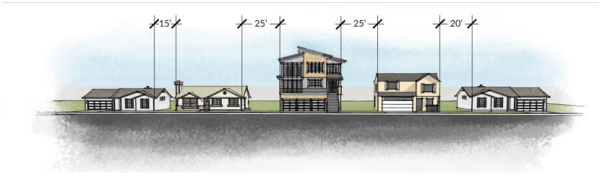
- Distance Between Buildings. The minimum distance between main buildings in the development shall be fifteen feet (15') for single-story buildings, twenty feet (20') for two-story buildings, twenty-five feet (25') for two and one-half (2 1/2) story buildings. If the lower building is next to a taller building, then the larger separation distance will apply.
- Building Height. The height of the buildings shall be limited to the maximum height allowed in the respective zoning district of the project, however, heights may be varied by using an average height for a building or group of buildings, as long as that maximum height of the zone is not exceeded by more than ten feet. All utilities shall be placed underground, except power transmission lines capable of carrying forty-six (46) kV or greater.
- Building Orientation. The front of the units developed on the periphery of the project shall front onto the public streets. When units abut two (2) parallel streets, the fronts of the units shall face the public street bordering the PUD or Attached Dwelling Unit development. Units, which are on corners, may front either street. The Planning Commission may waive this provision due to unusual topographic features or unusual conditions, provided that such a waiver does not negatively impact the continuity of the existing streetscape.
- Building Materials. Acceptable building materials are brick, stone, Hardie board composites, and or stucco or other material approved by the Planning Commission; Aluminum or vinyl siding are only allowed on the soffit and fascia. The surrounding existing uses will be considered by the Planning Commission when approving other building materials to be used.
- Open Space and Landscaping.
- Developments shall be designed to preserve and incorporate the natural features of the land into the development. Natural features include drainage swales, rock outcroppings, streams and concentrated native stands of large shrubs or trees.
- Developed common activity area for single-family and attached dwelling units shall be provided as follows.
- Developments with attached dwelling units shall provide developed common activity area at a ratio of one square foot of developed common activity area per one square foot of floor area of living space. Each phase of development shall provide its proportionate required open green space needed for that phase. At a minimum, developed common activity area shall include either a playground with play equipment or pathways with benches and tables through a natural planted landscaped area. Common activity areas shall be configured to provide appropriate, accessible, and usable spaces. Spaces that are too small, too steep, too narrow, etc., or otherwise configured in a way that the space provides questionable utility for homeowners in the PUD, shall not be credited toward the developer's open space requirement.
- Subdivided, single-family lots shall provide developed common activity area at a ratio of 15% of the overall site, if such single family lots are smaller than 10,000 square feet. At a minimum, developed common activity area shall include either a playground with play equipment or pathways with benches and tables through a natural or planted landscaped area.
- Developments shall be designed to incorporate existing large trees, clusters of trees or clusters of large shrubs. The Planning Commission shall review the appropriateness of removal of portions of these types of vegetation if proposed in the development plan. The Planning Commission may approve removal of some, or all vegetation based on a determination of the benefits of the existing plant material and the efforts made to save and incorporate the existing plant material into the design of the project versus the problems the plant materials may create for the project in terms of:
- General construction techniques;
- The impact removal will have to the character of the area;
- The topography of the site; or
- Harmful conditions the vegetation may create.
- Since one of the purposes of an Attached Dwelling Unit and a PUD is to protect natural features, the Planning Commission may deny approval of an Attached Dwelling Unit if it is determined there has been removal of trees or shrubs prior to submittal or intensified landscaping shall be required. It is prohibited for such properties to remove existing vegetation, prior to final approval of the application.
- The majority of new plant material used for landscaping is to be drought tolerant plants. The landscaping design shall locate plant materials in similar water usage demand zones to ensure proper irrigation coverage and reduce wasteful watering.
- Drip irrigation systems are designed and installed to irrigate all shrub and tree areas as needed.
- Areas which are to be screened are to be screened with an opaque wood, wood composite, vinyl, or masonry fence. Landscaping should be designed to soften the appearance of the fence. Landscaping may be vines, shrubs, or trees.
- Street trees shall be placed along all interior roads at a maximum spacing distance of forty feet (40') between each tree, depending on tree type. Such trees shall be located in the park strip or if no park strip is proposed, three feet from the street side property line, consistent with any approved streetscape plan.
- The development shall have an approved landscape plan that provides a unified landscaping design of trees, shrubs, and theme lighting. Natural features, ponds, streams, fountains, waterfalls, sculptures, and other design elements which create interest and visual unity and displays creativity in providing usable open space for the residents of the development are encouraged.
- Landscaping. All landscaping shall meet the standards set forth in CCNO 11-20.
- Fencing. All proposed fencing shall meet the standards set forth in CCNO 11-9M-15.
- All dumpsters shall be stored in screened enclosures, including gates, which are architecturally compatible in style and materials with the architecture of the development. Dumpsters shall be located so they are not in the required setback areas, not visible from the public street and do not restrict vehicular parking or circulation.
- Stormwater. Stormwater detention facilities shall be designed to meet North Ogden City Public Works standards.
- Parking Regulations.
- Parking lot layout, number of required spaces, landscaping and screening shall conform to CCNO 11-19.
- If a group recreational vehicle (RV) parking area is provided for the development, said parking area shall not be located within twenty feet (20’) of the perimeter of the PUD or Attached Dwelling Unit development and shall be completely screened per CCNO 11-20-6.
- A minimum six foot (6') landscaped area, excluding sidewalk, is to be provided between the unit and any parking or access lanes.
- Street Design. PUDs and Attached Dwelling Units shall be designed to generally comply with the circulation recommendations of the transportation element of the general plan, the design needs of the surrounding area, and the project. Projects which are located on or next to a collector or arterial street shall be designed and developed so the public street continues through the project in a logical, safe design. Projects which are located at the end of stubbed local public streets may be required to extend the street through the development based on the proposed circulation needs of the area as determined by the Planning Commission. The Planning Commission, upon recommendation of the City Engineer, shall determine if the street should be extended as a through street or as a cul-de-sac during the preliminary approval. Local streets which are internal to the development and do not provide access through the project may be designed as either public or private streets provided, they meet the following criteria.
- Public Street Requirements.
- Right of Way Width. Public streets shall meet the appropriate right of way widths as required by Public Works Standards.
- Neighborhood Local Streets. Projects may develop neighborhood local streets with lesser widths in consultation with the City Engineer as part of a PUD, provided the street meets one of the following criteria.
- The road is a cul-de-sac which does not exceed 600 hundred feet in length or fifteen (15) dwelling units, whichever is less.
- The roadway is internal to the development, intersects at each end with a roadway which has a right of way of sixty feet (60') or larger, does not provide for access through the development, and is less than seven hundred feet (700') in length or is intersected by a standard width right of way.
- Unusual Cross Sections. In cases where unusual topography or other exceptional conditions exist which would make the installation of required public street cross sections impractical to develop, variations from the standards may be considered. The Planning Commission shall consider the reasons for the request, the impact to the existing land, the development, and the ability of the city to deliver services with the unusual cross section before any variation from the standard is approved.
- Public Sidewalk. Five-foot (5”) sidewalks are generally required to be installed in the public right of way may be varied in location, but at all times there shall be at least a four and one-half foot (4 1/2') wide landscape strip of land between the curb and sidewalk. The applicant may request that a public sidewalk be located independent of the public street right of way due to topography or other design considerations, provided the design has reasonable access from one end of the development to the other, allowing the public to pass through the neighborhood in a logical manner, and is within the common area of the development. A public easement for such a walkway shall be required. Because such sidewalk is established independent of the street right of way, the sidewalk shall be maintained by a homeowners' association.
- All street frontages shall be designed consistent with approved streetscape design standards. If a streetscape plan has not been established, then a streetscape design shall be presented for approval by the Planning Commission.
- Private Street Requirements.
- Private streets must meet all public street standards.
- All private roads shall be placed in a separate tract of land from the other common areas of the PUD or Attached Dwelling Unit.
- All private roadway tracts shall be the same width as the public rights of way.
- Private streets will be approved only in PUDs or Attached Dwelling Units which:
- Establish a homeowners' or property owners' association.
- Explicitly provide that the homeowners' association will assume responsibility for the maintenance of all private streets.
- Obtain approval from the Planning Commission of an assessment fee analysis demonstrating a reasonable financial plan to provide for future street maintenance or replacement and other common features within the development.
- Public Street Requirements.
- Public Trails. Development of public trails as an alternative form of travel serves important community interests of improving air quality, increasing opportunity for recreation and improved health, reducing motor vehicle congestion, and preserving scarce energy resources. Development within any new subdivision of a segment of a trail system designated in the city's general plan or trails master plan shall be a required feature of new subdivision infrastructure.
- Trails shall be developed according to standards established by the city and shall be of sufficient width and design to safely accommodate two-way bicycle and pedestrian traffic into, out of and within the development.
- Voluntary dedication of area within a development, in excess of the minimum required to meet the alternative travel needs of the development itself, may be accepted by the city for use as part of a public trail system. Any additional area so dedicated shall be counted as part of the open space requirement of the PUD. Furthermore, the Planning Commission, may allow a reduction in the overall open space requirement of the PUD in exchange for voluntary dedication of excess trail right of way or off-site trail extension/connections by a developer where it is in the best interest of the City.
- The Planning Commission may also include excess area dedicated to public trail right of way as part of the calculation of any setback requirement, if the quality, and function in the trails plan, is a priority.
- After final approval and completion/acceptance of public trail infrastructure by the city, the city shall become responsible for trail maintenance.
11-13-7: SUBMISSION AND REVIEW PROCESS
- See CCNO 11-2-11, 11-2-12, and 11-2-13 for subdivision application procedures.
- Preliminary Development Plan Review Process. The Planning Commission, subject to the requirements of this chapter, may approve, deny if the development does not meet City standards, or approve with conditions, the preliminary development plan for the proposed PUD or Attached Dwelling Unit. During the preliminary review process, notice shall be given to the public of the PUD or Attached Dwelling Unit proposal in accordance with City Notice requirements. In reviewing the site plan for the proposed PUD or Attached Dwelling Unit, the Planning Commission shall determine if the PUD or Attached Dwelling Unit meets the minimum requirements of this title.
- Site Plan or Final Subdivision Plat Submission. The final plans, including all modifications from the preliminary site plan or subdivision approval, based on the conceptual sketch and preliminary plans, shall be processed by the planning staff and include information as identified on the PUD Attached Dwelling Units application form.
11-13-8: APPLICABILITY OF SUBDIVISION ORDINANCE
- A PUD or Attached Dwelling Units shall comply with the provisions of CCNO 11-23, as identified on the PUD Attached Dwelling Units application form.
- The procedures for preliminary and final plan approval required under the subdivision ordinance shall be fulfilled upon approval of the preliminary development plan and final development plan in this chapter.
- A PUD or Attached Dwelling Unit for which all of the real property is intended to be maintained as one lot, held in single ownership, shall require the filing of a plat and site plan as a single lot subdivision as part of the final development plan approval process, in order to provide for the dedication of public property, and the elimination of existing lot lines.
11-13-9: AMENDMENTS
- The applicant/owner and any assigns or successors in interest, is required to develop only in accordance with the proposals outlined in the plan. Any materially different concept, use, building arrangement, etc., will not be approved nor will building permits be issued by the city until such plan is amended by the Planning Commission. Minor changes to an approved site plan may be approved by the Planning Director or designees that are consistent with the intent of the original approval, so long as such changes do not constitute more than 5% of the original project area. Any changes shall be approved only if the modifications include improved or equivalent quality of materials or design. Any proposed changes that exceed 5% of the project area or that are deemed materially significant by the Planning Director shall require an amendment to the site plan and approval by the Planning Commission.
11-13-10: TIME LIMITATIONS
- Final Development Plan. A final development plan shall be submitted for approval within twelve (12) months of the issuance of the preliminary approval for the PUD or Attached Dwelling Unit. Failure to submit a final development plan within the specified time period shall result in the automatic revocation of the application, and the preliminary plan shall be null and void. However, a one-time extension of twelve (12) months may be granted by the Planning Director for a showing of good cause, defined as financial, material or labor issues, if such request is made prior to the expiration of the final development plan.
- Recording Subdivision Plat. If the PUD or Attached Dwelling Unit is a multi-lot subdivision, a final subdivision plat shall be recorded prior to the time any construction permits are issued. A final plat must be recorded within twelve (12) months after approval of the final development plan. Failure to record the subdivision plat within the specified time period shall result in the final development plan becoming null and void.
- Site Plan Revocation. Any property for which a site plan has been revoked or a plan determined to be null and void for failure to comply with the above time limitations shall thereafter be subject to the zoning and subdivision ordinances otherwise applicable to said property.
11-13-11: CONSTRUCTION PARAMETERS
- Financial Sureties. Prior to the recording of a PUD or Attached Dwelling Unit subdivision plat and prior to the issuance of any building permit on property covered by a PUD or Attached Dwelling Units final development plan, an escrow account acceptable to the city, sufficient in amount to cover the cost of all infrastructure, as outlined in the subdivision ordinance.
- Infrastructure. All street improvements, sidewalks, curbs and gutters, water lines, sewer lines, trail connections, and all other such surface and underground improvements shall be completed prior to occupancy.
- Amenities and Landscaping. Notwithstanding the provision above, all amenities shall be completed prior to occupancy unless inclement weather prevents their completion, in which case one extension of six (6) months for amenities and landscaping may be granted by the Planning Director if the applicant can show good cause such as material shortages, labor shortages, and/or financing issues. If not completed at the end of the six (6) month period, the city will review the progress and may proceed to limit further certificates of occupancy.
- Property Ownership. Plans submitted for preliminary and final site plan review may be filed jointly by multiple owners provided all owners have signed the proposed plans. The applicant shall submit a title report demonstrating compliance with this section. The area proposed for a PUD or Attached Dwelling Unit be in single ownership or corporate ownership prior to recording of the final plat or in order to provide for full supervision and control of said development, and to ensure conformance with the provisions of this chapter.
- Phasing. If the sequence of construction of various portions of the final development plan is to occur in stages, then the open space or recreational facilities shall be developed in proportion to the number of dwelling units intended to be developed during any given stage of construction. A phasing plan, including size and order of phases, shall be approved by the Planning Commission. Such phasing plans shall have the written approval of all property owners. In addition, the approved phasing shall be submitted to the city recorder for recordation with the county recorder's office as a covenant to run with the land.
11-13-12: FAILURE TO COMPLY; CERTIFICATE OF OCCUPANCY
- In case of the failure or neglect to comply with any and all of the provisions of this chapter, and the conditions and stipulations herein established, and as specifically made applicable to a PUD or Attached Dwelling Unit, the Building Official shall not authorize occupancy of any structure. Such failure or neglect shall be cause for termination of the approval of the project. Such failure or neglect to comply with the requirements and to maintain the buildings and premises in accordance with the conditions of approval thereafter shall also be deemed to be a violation of this section and Title.
11-13-13: ISSUANCE OF BUILDING PERMITS
- The Building Official shall not issue a permit for any proposed building, structure, or use within the project unless such building, structure or use is in accordance with the approved plan and any conditions imposed in conjunction with its approval.

