
North Ogden City Zoning Code
11-21
SIGN REGULATIONS
11-21-1: PURPOSE AND INTENT
- These sign regulations are intended to encourage attractive, effective, and adequate signs for businesses and services, while promoting the general welfare of the community by creating safer street frontages through the use of controlled signs.
- It is the city's policy to regulate signs in a manner that is consistent with the free speech protections and provisions of the United States Constitution and of the Constitution of the State of Utah by enacting regulations which do not restrict speech on the basis of its content, viewpoint or message; and do not favor one form of speech over another.
- Permit Required; Exception. Sign permits, issued by the building department in coordination with the Community Development Department, are required for placement of all signs, except those signs authorized in CCNO 11-21-6A1 and CCNO 11-21-8, and windows signs. The fee for sign permits shall be established by resolution of the city council.
- Unlawful Without Permit; Appeal. It shall be unlawful to erect, install and/or modify any sign that requires a sign permit within the city without first applying for and obtaining a sign permit. "Modify", as it is used herein, shall mean any change in or to an existing sign, its face, electrical components, design and/or supporting structures. Appeals of any decision by the Community Development and/or building department concerning sign permits shall be directed to the administrative law judge or city council. IBC code issues are appealed to the Board established in that Code.
11-21-2: SIGN AREA AND HEIGHT
- Sign Area. Sign area shall be measured as follows.
- Sign copy mounted or painted on a background panel or area distinctively painted, textured, or constructed. Sign area is the area within the outside dimensions of the background panel or surface.
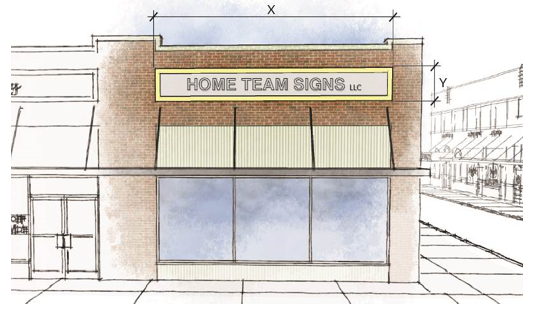
- Sign copy consisting of individual letters and/or graphics affixed to a wall or portion of a building which has not been painted, textured, or otherwise altered to provide a distinctive background for the sign copy.
- Sign area is the area within the smallest rectangle that will enclose the sign copy.
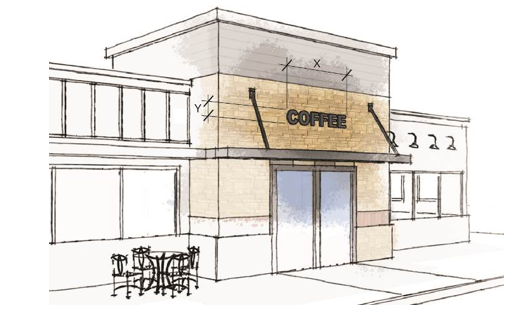
- Sign copy mounted or painted on an internally illuminated sign or internally illuminated element of a building. The entire internally illuminated surface or architectural element, which contains sign copy, will be counted as sign area.
- Number of Sign Faces.
- One. Area of the single face only.
- Two. If the interior angle between the two (2) sign faces is forty-five degrees (45°) or less, the sign area is the area of the larger of the two (2) sign faces. If the angle exceeds forty-five degrees (45°), the sign area is the sum of the areas of the two (2) faces.
- Three or More. The sign area is the sum of areas of the three (3) or more faces.
- Three Dimensional, Sculptural or Other Nonplanar Signs. Sign area will be the sum of the areas of the vertical faces of the smallest polyhedron that will encompass the sign structure.
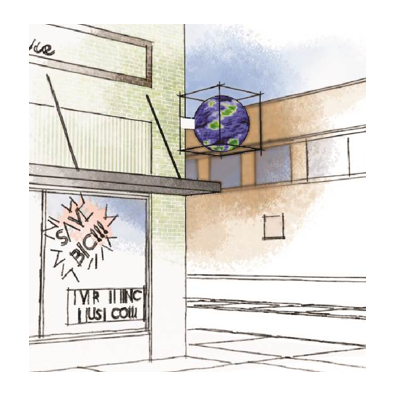
- The sum of the areas of the signs on a single lot or parcel shall not exceed the sign area allowed for the use in the zone in which it is located.
- The sign area is the area of the smallest rectangle which can enclose the sign. Any monuments or other supporting structures are not calculated in the sign area calculation. Any post or monument must be a neutral color in order to not be a part of the rectangular calculation.
- Sign copy mounted or painted on a background panel or area distinctively painted, textured, or constructed. Sign area is the area within the outside dimensions of the background panel or surface.
- Sign Height. Sign height is defined as follows.
- Freestanding Sign. Sign height is the distance from highest historic elevation of the ground surface directly below the sign to the tallest point of the sign measured vertically from the top of the sign, including all elements of the sign. In the commercial zones where a three-foot (3') high berm is required when site parking is adjacent to the public street, the height shall be measured from the height of the three foot (3') berm beneath the sign location. When the ground elevation of the sign is below public street level, the crown of the nearest public street shall become the lowest point to measure the height of the sign.
LEVEL GRADE APPLICATION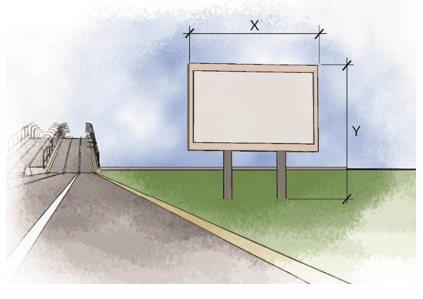 DOWNHILL GRADE APPLICATION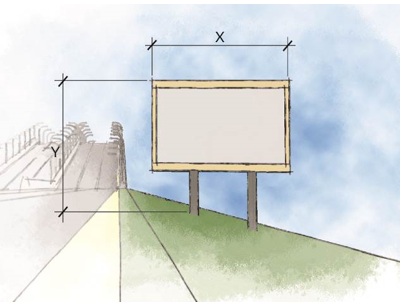
UPHILL GRADE APPLICATION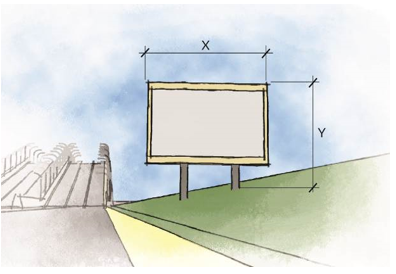
- Wall or Fascia Mounted Signs. Sign height is the distance from the top of the sign structure to the top of the curb nearest the sign or to the crown of the adjacent roadway if no curb exists, or grade of the building where significant grade separations from the road exists.
- Projection of Parapet Sign. No parapet sign may project more than five feet (5') above the roofline but must remain below the top line of the parapet.
- Freestanding Sign. Sign height is the distance from highest historic elevation of the ground surface directly below the sign to the tallest point of the sign measured vertically from the top of the sign, including all elements of the sign. In the commercial zones where a three-foot (3') high berm is required when site parking is adjacent to the public street, the height shall be measured from the height of the three foot (3') berm beneath the sign location. When the ground elevation of the sign is below public street level, the crown of the nearest public street shall become the lowest point to measure the height of the sign.
11-21-3: GENERAL PROVISIONS
- Prohibited Signs. Signs not specifically authorized herein are prohibited, including, but not limited to the following.
- Off premises commercial signs, except as permitted in CCNO 11-21-7, Temporary Signs
- Commercial signs mounted, attached or painted on trailers, boats or motor vehicles parked continuously for more than twenty-four (24) hours, on the premises of a business which sign advertises a product or service available on the premises
- Roof signs, or signs that project above the highest point of the roofline, parapet, or fascia of the building
- Any sign emitting sound, except for menu boards
- Any sign with intermittent or flashing illumination
- Any sign with animation or motion, including electronic reader boards
- Legal Nonconforming Signs. Signs which have been legally erected in the city prior to the adoption of this chapter, and which do not comply with the terms of this chapter may be repaired and maintained; provided, that there may be no extension or expansion of the sign. Whenever any person or entity operating a business with a legal nonconforming sign or signs sells the business, changes the business, or changes the name of the business, the nonconforming sign or signs may be replaced or altered to reflect the new business; provided, that there may be no expansion or extension of the signs. If a nonconforming sign is abandoned for a period of twelve (12) months or more, use of the sign shall be deemed to be abandoned and the sign, together with any supporting structures, poles and other related equipment, shall be removed. In the event of any conflict between this section and any other sign provision, this section shall control. A commercial sign attached to, or associated with, a business operated in a particular building shall be deemed to be abandoned if the business ceases its operation in the building.
- Location Restrictions. With the exception of directional signs owned by the city or another governmental agency, no sign shall be erected or placed within any center median or any public sidewalk or bicycle path. The city employees may remove any sign located in these areas.
- Window Signs. "Window signs and laminated films", shall not exceed twenty five percent (25%) of the total area of the windows through which they are visible.
- Enforcement. The Community Development Department and the Building Inspection Department shall be responsible for the enforcement and the administration of this chapter. The building inspection department shall inspect each sign for which a permit has been issued and shall require the proper maintenance of all signs subject to the provisions of this chapter.
- State License Required. It is unlawful for any person, partnership or corporation to erect or maintain, or to engage in the business of erecting or maintaining any "sign", as herein defined, except those signs authorized by subsection A of this section, CCNO 11-21-6A1 and CCNO 11-21-8, until such person, partnership or corporation shall have obtained a license from the state authorizing the person, partnership or corporation to be a sign installation contractor. Application for permits to erect signs will be accepted and permits granted only to such persons, partnerships, or corporations as are licensed by the state to perform such sign contracting.
- Vertical Clearance. There shall be a minimum vertical clearance of ten feet (10') between the ground or sidewalk and any part of a projecting sign, projecting more than eight inches (8") from a wall.
- Lighting of Signs. Signs may be illuminated by indirect lighting, floodlights, or luminous tubes only. No lighting shall be installed in any way which will permit direct rays of such light to penetrate onto any adjoining property used for residential purposes, or in any manner constituting a nuisance. All such lighting shall be directed downward and shielded.
- Location of Signs. No light or sign, or other advertising structure as regulated by this title shall be erected at the intersection of any street in such a manner as to obstruct free and clear vision, or at any location where, by reason of the position, shape or color, it may interfere with, obstruct the view of, or be confused with any authorized traffic sign, signal or device, or one which makes use of any other word, phrase, symbol or character in such manner as to interfere with, mislead or confuse traffic. No part of any sign shall be permitted to extend across any property line.
- Sign Not to Constitute a Traffic Hazard. No sign or other structure in excess of two feet (2') in height, as measured from the top of the curb or edge of the hard road surface, shall be placed on any corner lot within the Typical Sight Triangle as referenced in the City’s Public Works Standards, in such a manner as to obstruct free and clear vision to automobile drivers.
- Maintenance of Signs. Signs regulated by this chapter shall be maintained in good visual appearance and structural condition at all times.
- If a sign does not conform with the requirements of this chapter or if the construction, design, manner of use, or method of anchoring or supporting any sign makes such sign unsafe, the building inspector shall proceed in any manner he deems necessary to cause the removal of the sign or the rebuilding of the sign to conform with the requirements of this chapter, or to remedy the defects herein. All signs must meet the requirements of the international building code and safety regulations of the city.
- The city, its building inspector and its other agents shall not be liable for negligence or failure of the owner, or the person responsible for maintaining any sign, to keep such sign in good condition or be responsible for any damage caused by defective conditions. Good condition means a sign and/or the sign pole that does not show evidence of rust, broken panels, missing lettering, dents, peeling paint, and other signs of neglect.
- Any person occupying a building or portion of a building, who owns or maintains a sign in connection therewith shall, upon discontinuing the business advertised, cause the sign or the portion of the sign devoted to that business, to be removed within 30 days. Any person who owns and maintains a sign which is maintained for the benefit of another person who occupies a building or part of a building whereon the sign is located shall cause the sign or the portion of the sign devoted to that business to be removed within 30 days if the person for whom the sign is maintained vacates the premises.
- Failure of the owner of the sign or of the person responsible for maintaining same to remove the sign within thirty (30) days after notice from the building inspector shall be considered as a violation of this chapter and shall subject the owner of the sign and the owner of the property to the penalties herein.
- Obscene Messages. No sign shall be erected or maintained, or be permitted to remain publicly displayed, which contains obscene material per Utah State Code.
- Pasting, and Gluing of Temporary Signs. Signs shall be permanently attached onto any wall, parapet, fascia, vehicle, sign pole, plant, or structure.
- Materials. Permanent signs may only be constructed of one or more of the following materials: stucco, metal, at least one-fourth inch (1/4") thick plastic; rock/stone, or wood that is at least three-eighths of an inch (3/8") thick. No paper or cloth sign shall be allowed.
- Refusal of Owner to Remove Dangerous Signs; Removal by Building Inspector. Where immediate action is deemed necessary to protect limb, life, or property and where the owner of a sign or the owner of the property on which the sign is erected fails to remove such sign pursuant to notice from the building inspector within a specified time fixed in such notice, the building inspector may proceed in any manner deemed necessary to cause the immediate removal of such sign. The building inspector shall certify a statement of the expenses incurred in such removal to the city treasurer, who in turn shall assess and charge the same against the real estate upon which the sign was erected. If the assessment is not paid within ninety (90) days, the city may then file suit to recover the cost, including attorney fees.
- Sign Not to Cover Windows, Doors or Similar Openings. No sign shall cover more than twenty five percent (25%) of a window, doorway or other opening providing light, ventilation or exit facilities.
- Interior Signs Exempt. Interior signs which are not visible from outside the building in which they are installed are exempt from the provisions of this chapter. Interior signs shall meet all the provisions of the international building code and shall be safely installed. Interior signs shall be placed in accordance with any instructions of the fire marshal or fire chief. No sign shall be installed on any exit door.
- Signs on Private Property. It shall be unlawful for any person to fasten, attach, paint or place any "sign", as defined in this chapter, upon any private wall, window, door, gate or fence, or upon other personal property, without the consent of the owner, lessee or someone authorized to act on behalf of such owner or lessee.
- Sign on Public Property. Except as authorized in CCNO 11-21-7, it shall be unlawful for any person to fasten, attach, paint or place any sign, handbill, poster, advertisement or notice of any kind or sort, whether commercial or noncommercial, or to cause the same to be done in or upon any public curb, lamp post, telephone pole, electric light, power pole, hydrant, bridge, tree, easement, right of way, sidewalk, street, building or other property of the city. No sign shall be erected or project over such public properties.
- Sign Over Public Right of Way (ROW) Prohibited. It shall be unlawful to erect and/or maintain any sign over any ROW, except as herein expressly provided.
- Signs, Zones Permitted, and Controls. It is unlawful for any person to erect or otherwise install a sign having an area or height greater than allowed in this chapter. It is unlawful for any person to erect or otherwise install a sign located on a site or in a zone in violation of the regulations specified in the chapter.
- Compliance with State Highway Sign Regulations. Before any sign permit is issued for signs on a highway controlled or funded by the state or federal government, the applicant shall show proof that the sign has been approved by the controlling agency. This proof must be submitted to the city with the application for a sign permit. The city will not consider sign permit applications until the proof of approval is submitted.
- All permitted electronic message display signs shall be equipped with a sensor which uses photocell technology to automatically determine the amount of ambient light and to adjust the brightness of the electronic message display sign according to the amount of ambient light. This sensor must be functional and in operation at all times that the electronic message display sign is operating. If incandescent lighting is used, lamp size may not exceed fifty-four (54) watts of incandescent lighting for daytime usage and nighttime wattage shall be reduced to thirty (30) watts maximum, automatically, by means of the required sensor. Electronic sign lighting shall be directed downward at an angle that reduces dark sky lighting, measured as 80 degrees or less from a line perpendicular to the sign face.
- An electronic message display sign may not flash or otherwise scintillate, except to transition from the displayed message to a different message using the permitted effects listed in subsection (1).
- The following effects for electronic message display signs are permitted when transitioning from the displayed message to a different message. Dissolve with 0 – 1 second between messages; fade with 0 – 1 second between messages; instantaneous transitions between messages; animation; scrolling (vertical movement of message); and travel (horizontal movement of message).
- The following frame effects are prohibited when transitioning from the displayed message to a different message. Flashing or blinking transitions; blank white transitions; and any frame effect not listed in subsection (1).
- Any message on the electronic message display sign must remain lighted and stationary for at least two (2) seconds.
- Electronic message display signs which are located in a commercial or manufacturing zone, and are within two hundred feet (200') of a residential zone, excluding the R-4 zone, may not operate between the hours of ten o'clock (10:00) P.M. and six o'clock (6:00) A.M.
- Electronic message display signs located in a residential zone, excluding the R-4 zone, may not operate between the hours of nine o' clock (9:00) P.M. and six o' clock (6:00) A.M.
- Electronic message display signs are not allowed off premises.
- Electronic message display signs may not be leased in whole or part for any use which is not the primary use on the property where the sign is located.
- The sign shall not cause glare or be intensely lighted at dark so that it creates a nuisance or hazard to vehicle traffic, pedestrians, or neighboring residential properties.
11-21-4: COMPREHENSIVE SIGN PLAN
- Purpose and Intent. A comprehensive sign plan for a proposed or existing development for multi-tenant shopping centers may be approved by the Planning Director or his or her designee as part of the site plan process. The intent of this section is to provide for flexible sign criteria that promote superior design through architectural integration of the site, buildings and signs. Examples of signs permitted under this section are street name signs and directional signs.
- Content of Plan. A comprehensive sign plan shall include the location, size, height, type of illumination, landscaping, time of placement and/or illumination, and orientation, of all proposed signs for the development, either permanent or temporary.
- Parameters for Flexibility. Flexibility in sign regulations shall be in accordance with the following parameters.
- Subdivisions in Residential Zoning Districts.
- Permanent subdivision signs may be permitted up to a maximum area of thirty (30) square feet and a maximum height up to six feet (6').
- At a minimum, such signs shall be located in a landscaped area of at least four (4) square feet per each one square foot of sign area.
- Only one sign per entrance of the subdivision is allowed.
- The type of illumination shall be shielded and downward directed for external illumination. Internal illumination is limited to lettering lighting such as pan channel lighting.
- There shall be no flexibility in traffic control signage. All traffic control signs shall be in compliance with the standards established in the manual of uniform traffic control devices. This restriction shall apply to private streets as well as public streets.
- No flashing, moving or sound emitting signs shall be permitted.
- Shopping Centers, Building Complexes, Subdivisions in Nonresidential Zoning Districts.
- A permanent freestanding sign for a shopping center, building complex or subdivision signs may be permitted up to a maximum area of sixty (60) square feet and a maximum height up to twenty feet (20').
- At a minimum, such signs shall be located in a landscaped area of at least four (4) square feet per each one square foot of sign area.
- The number of signs permitted shall be limited to two (2) signs per acre of the subdivision.
- The type of illumination shall be downward directed and shielded.
- There shall be no flexibility in traffic control signage. All traffic control signs shall be in compliance with the standards established in the manual of uniform traffic control devices. This restriction shall apply to private streets as well as public streets.
- In addition to the permitted business signs, one electronic message sign low profile sign, whether as a reader board, changeable copy area or electronic message center, in conjunction with a regular shopping center sign, is permitted. No such device shall exceed fifty percent (50%) of the total sign copy area of the sign.
- Minimum Acreage Requirements to Utilize the Provisions of this Section. The proposed overall development must be at least forty (40) acres if it is a residential development and at least ten (10) acres if it is a nonresidential development. If the overall development is a mixture of residential and nonresidential development, the overall development must be at least forty (40) acres.
- Subdivisions in Residential Zoning Districts.
11-21-5: SIGNS FOR RESIDENTIAL USES
- One- And Two-Family Dwellings.
- Permanent Noncommercial Signs. One noncommercial sign, not exceeding one square foot in area, except for political and ideological signs, which shall be governed by CCNO 11-22-12.
- Temporary Signs. Temporary signs in accordance with CCNO 11-21-7.
- Permanent Commercial Signs. Residential uses shall not be permitted to have permanent commercial signs.
- Multi-Family Dwellings.
- Temporary Signs. Temporary signs in accordance with CCNO 11-21-7.
- Apartments and Condominium Complexes. Signs for apartments and condominium complexes and similar uses in the multi-family districts as follows:
- A freestanding sign, not exceeding fifteen (15) square feet in area. Such sign shall not exceed five feet (5') in width or three feet (3') in height. Such sign must be located at least five feet (5') from any property line; or
- A wall mounted sign, not exceeding twelve (12) square feet in area. Height of such sign shall not exceed ten feet (10').
- Subdivision Signs. Permanent subdivision signs for recorded subdivisions, ten (10) or more acres in size, in accordance with the following parameters:
- Maximum area of each such sign shall be twenty-four (24) square feet with a maximum height of five feet (5').
- Such signs to be monument type, i.e., individually mounted letters on a freestanding wall.
- Such signs shall be located in a landscaped area of at least four (4) square feet per each one square foot of sign area.
- There may be one sign for a single development project of at least ten (10) acres, but less than fifty (50) acres in size. For purposes of this subsection, a development or project shall be deemed to be a single development project, even though it is developed in multiple subdivisions or phases, if:
- The entire project is designed for development by a single developer; and
- The entire project is developed under the same name.
- There may be two (2) signs for a single development project of at least fifty (50) acres in size. For purposes of this subsection, a development or project shall be deemed to be a single development project, even though it is developed in multiple subdivisions or phases, if:
- The entire project shall be designed for development by a single developer; and
- The entire project is developed under the same name.
11-21-6: SIGNS PERMITTED FOR NONRESIDENTIAL USES IN SPECIFIC DISTRICTS
- HP-3, HP-2, HP-1, RE-20, R-1-12.5, R-1-10, R-1-8, R-1-8(A), R-1-8(AG), R-2, R-3, R-4, and RCC Zoning Districts.
- All signs permitted in CCNO 11-21-6A of this chapter.
- Signs with a total maximum sign area not exceeding twenty-four (24) square feet. Such signs may be wall mounted with a maximum height of ten feet (10') and/or such signs may be freestanding according to the following:
- One freestanding sign shall be permitted with a maximum height of five feet (5').
- A landscaped area shall be provided, on site at the street frontage at the base of the freestanding sign, with said landscaped area to have a minimum area of four (4) square feet for each one square foot of sign area.
- Electronic message display signs shall be allowed only by building permit, except as provided for in subsection (1).
- Sign area for electronic message display signs shall be calculated by the same standards as illuminated signs in CCNO 11-21-5, with any portion of the electronic message display sign which is able to emit light considered as the illuminated surface. The number of sign faces contributing to total sign area shall be determined by the same standard as used in CCNO 11-21-5) for other signs.
- In addition to the twenty-four (24) square feet of signs permitted in subsection A.2 of this section, each tenant may be allowed three (3) square feet of non-illuminated sign area, located on the wall adjacent to the entry of the tenant's business.
- In addition to the above, a sign with a maximum area of six (6) square feet and a maximum height of six feet (6') may be permitted behind the required front yard setback.
- CN, CC-DT, CC-ST Zoning Districts.
- Signs shall be in accordance with the following regulations.
- Excluding the area allowed for a freestanding sign, the total aggregate area of all commercial signs pertaining to one or more businesses in any single building or suite shall not exceed forty percent (40%), excluding the windows and doors, of the front wall plane of the building or suite or two hundred (200) square feet, whichever is less, unless the portion of the building or suite adjacent to its lot's street-property line measures more than two hundred (200) linear feet. In that case, the aggregate area of all such signs on the premises may be increased in area to the rate of one square foot of sign area for each linear foot of building or suite frontage in excess of two hundred (200) linear feet. For buildings or suites on a corner lot, only the frontage on the building which contains the main entrance shall be measured to compute the aggregate sign area.
- Freestanding commercial signs shall not be counted as a portion of the total aggregate sign area of the premises and shall be restricted to the following:
- One freestanding commercial sign for each street upon which the lot has frontage.
- Such signs shall have a maximum area of sixteen (16) square feet.
- Such signs shall have a maximum height of five feet (5').
- Such signs shall not be closer than thirty feet (30') to any residential district.
- A landscaped area shall be provided, on site at the street frontage at the base of the freestanding sign, with said landscaped area to have a minimum area of four (4) square feet for each square foot of sign area.
- The minimum setback from the street property lines shall be ten feet (10').
- Noncommercial signs shall be in accordance with the following regulations.
- The total aggregate area of all noncommercial signs pertaining to one or more businesses in any single building or suite shall not exceed ten (10) square feet, unless the portion of the building or suite adjacent to its lot's street-property line measures more than thirty-six (36) linear feet. In that case, the aggregate area of all such signs on the premises may be increased in area to the rate of one square foot of sign area for each linear foot of building or suite frontage in excess of thirty-six (36) linear feet, provided the total aggregate area for businesses housed in a single building or suite shall not exceed forty (40) square feet. For buildings or suites on a corner lot, only the frontage on the building or suite which contains the main entrance shall be measured to compute the aggregate sign area.
- Freestanding noncommercial signs shall be counted as a portion of the total noncommercial aggregate sign area of the premises and shall be restricted to the following:
- One freestanding noncommercial sign for each public street access.
- Such signs shall have a maximum sign copy area of four (4) square feet.
- Such signs shall have a maximum height of the entire sign structure of three feet (3').
- Signs shall be in accordance with the following regulations.
- CN, CC-DT, CC-ST, and MP-1 Zoning Districts.
- Commercial Signs. Commercial signs shall be in accordance with the following regulations:
- Total Area of Commercial Signs. The total aggregate area of all commercial signs pertaining to one or more businesses in any single building or suite shall not exceed forty percent (40%) of the front wall plane of the building or suite or two hundred (200) square feet, whichever is less, unless the portion of the building or suite adjacent to its lot's street-property line measures more than two hundred (200) linear feet. In that case, the aggregate area of all such signs on the premises may be increased in area to the rate of one square foot of sign area for each linear foot of building or suite frontage in excess of two hundred (200) linear feet.
Exception- When a building has three or more sides which are adjacent to parking lots, access lanes, or alleys, the total area of wall signage may be increased 25% for a total square footage of two hundred fifty (250) square feet, provided that the total aggregate area of all commercial signs pertaining to one or more businesses in any single building or suite does not exceed forty percent (40%) of the front wall plane of the building or suite, and no building face has no more than two hundred (200) square feet of signage. For the purposes of this provision, when sidewalks, landscape areas, or similar landscape elements are immediately between the building and the parking lots, access lanes, or alleys, the building shall be considered adjacent to the parking lots, access lanes, or alleys. - Freestanding Commercial Signs. Freestanding commercial signs shall not be counted as a portion of the total aggregate sign area of the premises and shall be restricted to the following.
- Number of Signs Permitted. One freestanding commercial sign for each street upon which the lot has frontage.
- Maximum Unchangeable Area. Such signs shall have a maximum unchangeable area (decorative borders of the sign copy) of seventy-five (75) square feet.
- Proximity to Residential District. Such signs shall not be closer than thirty feet (30') to any residential district.
- Minimum Setback. The minimum setback shall be 5’ from the public ROW.
- Additional Area Allowed for Changeable Copy. In addition to the seventy-five (75) square feet permitted for business signs, thirty (30) square feet will be allowed for a changeable copy area incorporated with the regular sign. No such device shall exceed fifty percent (50%) of the total sign copy area of the sign.
- Permitted Signs.
- Monument/low profile Sign.
- Monument/low profile signs shall have a maximum height of ten feet (10'). For existing signs, an additional 2 feet in height may be added for a decorative feature, e.g., a roof that does not include any additional sign lettering.
- Monument/low profile base shall be no less than one-half (1/2) the width of the widest portion of the sign. The monument base shall not be greater than one and one-half (1 1/2) times the width of the portion of the sign containing verbiage.
- Such signs shall be incorporated into some form of landscape design scheme or planter box with an open area from the ground to the bottom edge of the sign with dual support.
- Pole or Monolith Sign.
- Pole sign shall have a double pole support cladded in the manner provided in the sign design standards.
- A pole sign shall have a maximum height of twenty feet (20') and a maximum width of six feet (6’).
- No more than 50% of the overall height of the sign shall be used for the sign copy.
- Monument/low profile Sign.
- Sign Design Standards. The following design standards are mandatory:
- Sign Cabinets. Sign cabinets shall be integrated into a uniform sign, rather than added to a pole in an ad hoc manner.
- Wood Signs. Wood signs are not permitted for permanent signs.
- Cladding. All poles supporting signs shall be cladded as a means to improve the appearance of the sign by:
- Proportionately increasing the base of the structure that anchors the sign to the ground; and
- Providing a material on the support structure that complements the building architecture.
- Cladding shall primarily be metal with textures to simulate the adjacent building materials, stucco, brick, or rock, duplicating materials which are used on the main building. Manmade products may be used if the material replicates the appearance of a natural material.
- Cladding is not required, if in the opinion of the Planning Commission, the sign contains unique elements that result in creative flair or defines a product or service with unique design, and the cladding would detract from the creativity of the design.
- Landscaping. Landscaping shall be provided at the base of the sign at a ratio of four (4) square feet for every one foot (1') of sign width, with fifty percent (50%) of the landscaped area containing live decorative plant material.
- Theme and Plan. Where feasible, signs shall be incorporated into a landscape theme and be part of an overall design plan for the property.
- Freestanding Sign for Shopping Center or Multi-Tenant Complex on Site of Less Than Ten Acres.
- Maximum Size of Total Sign Copy Area.
- Twenty-six (26) square feet of sign copy area for the first two (2) potential tenants in the shopping center or multi-tenant complex.
- Thirteen (13) additional square feet for each additional potential tenant over the first two (2) potential tenants in the shopping center or multi-tenant complex, up to one hundred four (104) square feet of total sign copy area.
- Maximum Copy Area Utilization.
- Specified. The maximum copy area that can be utilized at any time is limited to a maximum of thirteen (13) square feet per actual tenant operating in the shopping center or multi-tenant complex.
- Maximum Height of Total Sign Structure. Twenty feet (20').
- Maximum Width of Copy Area. Eight feet (8').
- Vertical Clearance. There shall be at least four feet (4') of vertical clear space (excluding the sign poles) measured from the top of the required three foot (3') high landscaped berm and the bottom of the sign copy area. Except for the support poles, no sign structure is permitted in the bottom seven feet (7') of the sign area.
- Minimum Landscaping. Four square feet for every square foot of total sign area shall surround the sign structure on the shopping center property. Landscaping in the right of way cannot be attributed to the landscape area calculations to fulfill this requirement.
- Location. The entire sign structure, including overhangs, shall be entirely on the shopping center property and setback at least 5’ from the public ROW. No portion of the sign shall be in the public right of way. The sign shall be at least twenty feet (20') from the interior side property line and at least fifty feet (50') from the street side property line.
- Number Below Minimum; Removal. If the number of actual tenants and potential tenant spaces in the shopping center or multi-tenant building complex falls below the minimum number of tenant spaces to qualify for a shopping center or multi-tenant building, the sign authorized in this section must be removed or modified to meet the correct standards.
- In addition to the permitted business signs, one electronic message sign, whether as a reader board, changeable copy area or electronic message center, as part of a listed permitted sign, is permitted. No such device shall exceed fifty percent (50%) of the total sign copy area of the sign.
- Maximum Size of Total Sign Copy Area.
- Freestanding Signs for Shopping Center or Multi-Tenant Complex on Site of More Than Ten Acres.
- MAXIMUM SIZE OF TOTAL SIGN COPY AREA.
- Maximum copy area 200 square feet.
- Tenant sign area to be determined by shopping center or multi-tenant management. However, no tenant to exceed 25 square feet of sign area on shopping center sign.
- 1 reader board per sign, not to exceed 32 square feet.
- SIGN STRUCTURE.
- Maximum height of entire 26 feet.
- Maximum copy area width 12 feet.
- Signs per street frontage 1.
- Minimum landscaping 4 square feet for each square foot of sign copy area. The landscaped area shall surround the base of the proposed sign on the shopping center or multi-tenant property. Landscaping in the street right of way cannot be used to calculate required landscaping area.
- Minimum setbacks 26 feet from an interior side yard and 50 feet from an intersection of 2 streets (corner). The sign shall be entirely on the commercial site's property and not overhang onto any public right of way.
- 10 feet from front yard property line or sideline abutting a public street for any part of the sign structure, which touches the surface of the ground.
- Clear area. 4 feet from top of a 3-foot-high berm.
- MAXIMUM SIZE OF TOTAL SIGN COPY AREA.
- Total Area of Commercial Signs. The total aggregate area of all commercial signs pertaining to one or more businesses in any single building or suite shall not exceed forty percent (40%) of the front wall plane of the building or suite or two hundred (200) square feet, whichever is less, unless the portion of the building or suite adjacent to its lot's street-property line measures more than two hundred (200) linear feet. In that case, the aggregate area of all such signs on the premises may be increased in area to the rate of one square foot of sign area for each linear foot of building or suite frontage in excess of two hundred (200) linear feet.
- Noncommercial Signs. Noncommercial signs shall be in accordance with the following regulations.
- The total aggregate area of all noncommercial signs pertaining to one or more businesses in any single building shall not exceed ten (10) square feet, unless the portion of the building or suite adjacent to its lot's street-property line measures more than forty (40) lineal feet. In that case, the aggregate area of all such signs on the premises may be increased in area to the rate of one square foot of sign area for each lineal foot of building frontage in excess of forty (40) lineal feet, provided the total aggregate area for businesses housed in single building or suite shall not exceed (40) square feet. For buildings on a corner lot, only the frontage on the building which contains the main entrance shall be measured to compute the aggregate sign area.
- Freestanding Noncommercial Signs. Freestanding noncommercial signs shall be counted as a portion of the total noncommercial aggregate sign area of the premises and shall be restricted to the following.
- One freestanding noncommercial sign for each public street access.
- Such signs shall have a maximum sign copy area of four (4) square feet.
- Such signs shall have a maximum height of the entire sign structure of three feet (3').
- Drive-Through and Drive-in Restaurant Menu Signs.
- In addition to the signs allowed in subsections C.1 and C.2 of this section, drive-through and drive-in restaurants may have two (2) freestanding menu board signs located at least thirty feet (30') from the front and street side property line which conform to the following standards:
- Number of signs.
- Menu Signs. Each commercial site shall be allowed a maximum of two (2) menu signs. If two (2) ordering lanes are used, one (1) per lane is allowed. Two (2) menu signs may be used in the same lane, if only one (1) ordering lane is used.
- Pre-sale Signs. One (1) additional sign, with a maximum square footage of twelve (12) square feet, that is used to illustrate, describe, and promote selected product offerings to customers on site, known as a pre-sale sign, shall be allowed.
- Height. Seven and one-half feet (7.5’) is the maximum permitted height for menu signs. The maximum permitted height for pre-sale signs is six feet (6’).
- Area. Forty-five (45) square feet is the maximum permitted area per sign.
- Awnings and Accessory Items. Awnings are allowed but must be approved as part of a building permit. The colors used for the awning must be consistent with the color scheme used on the building. Up to one (1) separate microphone stand is allowed per menu board sign.
- Location. In addition to the above-listed thirty-foot (30’) distance requirement from a public right-of-way, menu signs, pre-sale signs, and accessory items must be fifty feet (50’) from a residential zone. Distance requirements shall apply to all accessory items related to menu signs, in addition to the menu signs themselves.
- If located on the side of the building facing a public right-of-way, menu signs shall not be located between the access lane used for ordering and the public right-of-way; the sign must be between the access lane used for ordering and the building, or elsewhere.
- Orientation. Signs shall be oriented a minimum of 30 degrees away from parallel to Washington Boulevard when located between a building and Washington Boulevard, or closer to the public right-of-way than the building face closest to Washington Boulevard.
- Digital menu signs are permitted.
- Number of signs.
- In addition to the signs allowed in subsections C.1 and C.2 of this section, drive-through and drive-in restaurants may have two (2) freestanding menu board signs located at least thirty feet (30') from the front and street side property line which conform to the following standards:
- Commercial Signs. Commercial signs shall be in accordance with the following regulations:
11-21-7: TEMPORARY SIGNS
- Purpose and Intent. Temporary signs shall be permitted by application to the Planning Department in accordance with standards set forth below, unless specified otherwise in this ordinance:
- Setback Standards for Temporary Signs.
- Temporary signs must be located completely on private property, except as otherwise exempted in the community sign provisions.
- Signs shall not be located in the public ROW.
- On streets with no sidewalks and where it is not clear where the property line is located, signs must be placed ten feet behind the curb or pavement and not hang into the street.
- At intersections, they must be placed to not obstruct free and clear vision CCNO 11-21-3 I and shall not constitute a traffic hazard within the site distance triangle and provide a clear view of intersecting streets CCNO 11-21-3 J.
- Additional Standards.
- Off premise temporary signs are not allowed.
- Temporary signs that are permitted that are placed on private property must have the permission of the property owner 11-21-3R.
- Except as otherwise permitted in this title, no such sign or portion of the sign may be located in or project into a public right of way or an adjoining property 11-21-3I and 11-21-3T.
- Political and Campaign Signs.
Table 1Table 2Sign Type Display Period Removal Required 5 Days After Sign Permit Required Campaign signs 30 days prior to primary
45 days prior to special and general electionCompletion of the election No Political signs No limit No limit No Table 3Campaign and Political Signs Permitted in Residential Zones Maximum Area per Sign Face Maximum Height of Freestanding Sign (Includes support structure) Number of Signs Permitted per Sign Type Campaign Sign 6 square feet 4.5 feet No limit Political Sign 6 square feet 4.5 feet One per street frontage Campaign and Political Signs Permitted RE-20, Commercial, and Manufacturing Zones Maximum Area per Sign Face Maximum Height of Freestanding Sign (Includes support structure) Number of Signs Permitted per Sign Type Campaign Sign 32 square feet 4.5 feet No limit Political Sign 32 square feet 4.5 feet One per street frontage - Sale, Lease or Rent Signs. Shall conform to the following regulations and are exempted from the total aggregate sign area. Such signs shall be located out of the public ROW.
- Nonresidential Zoning Districts. The signs shall be non-illuminated and shall not exceed sixteen (16) square feet in aggregate area and eight feet (8') in height.
- Residential Zoning Districts. Non-illuminated and not exceeding four and one-half (4 1/2) square feet in total aggregate area and five feet (5') in maximum height.
- Future Development Signs. Signs are allowed if located outside of the public ROW, in accordance with the following.
- Sign Area. The cumulative maximum sign area for the entire site or project shall not exceed sixty-four (64) square feet.
- Illumination. Such signs shall not be illuminated.
- Double Faced. Such signs may be double faced. If the interior angle between the two (2) sign faces is forty-five degrees (45°) or less, the sign area is the area of the larger of the two (2) sign faces. If the angle exceeds forty-five degrees (45°), the sign area is the sum of the areas of the two (2) faces.
- Freestanding Sign. One freestanding sign is permitted for each street on which the development has frontage.
- Maximum Height. Maximum height shall not exceed eight feet (8') for all such signs.
- Term Permitted. Such signs may be installed and maintained for a period not to exceed twelve (12) months. If a building or construction permit is not obtained at the end of the twelve (12) months, such signs must be removed. If a building or construction permit is issued within twelve (12) months of the placement of the signs, the sign may remain during construction, but must be removed upon issuance of the first certificate of occupancy.
- Permit Required. A sign permit must be obtained before a future development sign is located on the site.
- Banners, Pennants and Displays for Promotional or Special Events.
- Freestanding banners, vertical banners, pennants, and other displays shall be allowed in nonresidential zones for a maximum of three (3) weeks at a time or less; whatever the time period, the banners, pennants and other displays must be removed for the same period of time (days) that they were put out. If the display was up for two (2) weeks, it must be removed for the same period of time. Any use of banners, pennants or other displays may only be for a total period of twelve (12) weeks in any calendar year. Signs, banners, pennants, and displays shall be limited to:
- One four foot by eight foot (4' x 8') banner for each street on which the business has frontage.
- Banners, pennants and displays for a promotional event shall be located on the business premises only.
- Balloons shall be tethered so as not to exceed thirty-five feet (35') and shall not occupy any required parking space.
- Balloons and signs shall not be designed to depict any product not legally available to all residents of the city.
- During the promotional event, the total sign area, including permanent signs, shall not exceed two hundred percent (200%) of the permitted sign area.
- Maximum height for vertical banners is twenty feet (20') and no more than two (2) vertical banners per commercial lot are permitted.
- Freestanding banners, pennants and other displays shall be allowed in residential zones for a maximum of one week at a time or less; whatever the time period, the banners, pennants and other displays must be removed for the same period of time (days) that they were put out. If the display was up for one week, it must be removed for the same period of time. Any use of banners, pennants or other displays may only be for a total period of two (2) weeks in any calendar year. Signs, banners, pennants and displays in residential zones shall be limited to:
- One two foot by six foot (2' x 6') banner and one freestanding sign not exceeding four and one-half (4 1/2) square feet in total copy area nor five feet (5') in height.
- Banners and signs advertising an event shall be located on the residential premises only.
- Freestanding banners, vertical banners, pennants, and other displays shall be allowed in nonresidential zones for a maximum of three (3) weeks at a time or less; whatever the time period, the banners, pennants and other displays must be removed for the same period of time (days) that they were put out. If the display was up for two (2) weeks, it must be removed for the same period of time. Any use of banners, pennants or other displays may only be for a total period of twelve (12) weeks in any calendar year. Signs, banners, pennants, and displays shall be limited to:
- Construction Site Signs. A sign may be placed on a construction site out of the public ROW within the following parameters.
- Number. There shall be only one sign per lot.
- Size. Such a sign shall not exceed eight (8) square feet.
- Height. A construction site sign shall not exceed five feet (5') in height.
- Location. Such a sign must be located on the construction site.
- Illumination. A contractor sign shall not be illuminated.
- Time. A contractor sign may be placed only during the period of time when a building permit is valid and must be removed no later than the final inspection.
- Community Signs. Community signs are permitted in all zones with a permit issued by the Planning Department. A community sign plan and visual representations of all types of signs and their proposed locations shall be submitted to the community development department. These submittals shall be reviewed by the community development staff for compliance with these requirements. Additional review, if necessary, may include, but not be limited to, the City Engineer, police department and public works.
- No sign shall be permitted which is unsafe for vehicular or pedestrian traffic, is inappropriate with respect to location, size, or is in a deteriorated condition. Such sign:
- Shall be made of durable, weather resistant material.
- Shall use logos or symbols instead of copy, especially where copy would cause distraction to vehicular traffic.
- Shall not exceed thirty-two (32) square feet.
- Shall not exceed six feet (6') in height.
- Any such sign may not be attached to another temporary sign or permanent traffic or business sign.
- Any such sign for any single purpose or event shall not be displayed for more than twenty-one (21) days prior to the event and two (2) days after the event.
- Commercial logos, limited to sponsors of the event, may appear on signage for community events.
- No sign shall be permitted which is unsafe for vehicular or pedestrian traffic, is inappropriate with respect to location, size, or is in a deteriorated condition. Such sign:
- A-Frame Signs. An A-frame sign may be no larger than twelve (12) square feet in area for each visible side and stand no taller than five feet (5'). It shall be secured in a temporary manner to the ground or include weighted bottom edges to decrease potential movement in the wind. The sign must be movable by hand and have no electrical or battery-operated lights. It may be placed anywhere on the business site at ground level and not in the public right of way. The placement shall not interfere with the visual needs of vehicular or pedestrian traffic and if determined to interfere with the clear view of a driveway or street intersection, it shall be immediately moved when requested to do so by the North Ogden City police department or code enforcement staff. The sign must be made of durable, weather resistant materials and have an anchor system to the ground to resist wind pressure. The sign shall be kept in good condition and shall be removed, repaired, or replaced at the request of the North Ogden code enforcement staff.
11-21-8: FLAGS AND FLAGPOLES
- Height. No flagpole may be higher than the maximum building height limitation permitted in the zoning district where the flagpole is located.
- Location. No flagpole shall be located closer to a property line than its reclining length.
- Exceptions. Except as otherwise provided in CCNO 11-22-11F, a maximum of one nongovernmental flag is permitted per property under following parameters.
- Any flag flown in conjunction with the U.S. and/or state of Utah flag must be flown beneath them and must not exceed them in size.
- The maximum size of any nongovernmental flag shall not exceed fifteen (15) square feet. No one dimension to exceed six feet (6') in any direction.
- Governmental flags and model home flags which comply with the provisions of CCNO 11-22-11F shall not be considered signs and will not be included in the calculation of total aggregate sign area. All other signs shall be included in the calculation of total aggregate sign area.
11-21-9: ON SITE SUBDIVISION ADVERTISING SIGNS
- Permit. A building permit is required to place signs advertising a subdivision in a residential zone.
- Size. No sign shall exceed thirty-two (32) square feet in size.
- Height. No sign shall exceed five feet (5') in height.
- Time Limit. On site subdivision advertising signs may be permitted until the last house or lot in the subdivision is sold.
11-21-10: MODEL HOME ADVERTISING SIGNS
- Through the land use permit process required for model homes, the following parameters for signs must be followed.
- Number. One sign per model home.
- Size. No sign shall exceed twenty-four (24) square feet.
- Height. No sign shall exceed five feet (5') in height.
- Illumination. Model home signs shall not be illuminated.
- Model Home Flags. A model home may use flags in addition to the United States of America flag and the State of Utah flag, in the following manner.
- Number. No more than two (2) flags on the lot of the first model home and one flag on each additional lot with a model home located upon it, up to a total of four (4) lots of model homes and five (5) flags.
- Size. Model home flags shall not exceed eight (8) square feet in size.
- Height. Flagpoles shall not exceed twenty-five feet (25') in height.
- Illumination. Model home flags shall not be illuminated.

