
North Ogden City Zoning Code
11-7
DEFINITIONS
For the purposes of this Title, certain terms and words are defined and are used in this Title in that defined context. Any words in this Title not defined in this chapter shall be as defined in "Webster's Collegiate Dictionary."
A
ABUTTING: The condition of two (2) adjoining properties having a common property line or boundary, including cases where two (2) or more lots adjoin only a corner or corners.
ACCESS OR ACCESSWAY: The place, means or way by which pedestrians and vehicles shall have safe, adequate and usable ingress and egress to a property or use as required by this Title.
ACCESSORY BUILDING, LARGE: A building which is six hundred (600) square feet or larger located on a lot with an existing principal or main use. The building's use may be for any accessory use allowed in the particular zone in which the lot is located. Allowed uses include: detached garage, personal storage, lawn care equipment, etc. If the large accessory building meets the definition of a garage, no home occupation may be allowed in the building.
ACCESSORY DWELLING UNIT: A subordinate dwelling, which has its own kitchen, living/sleeping area, and sanitation facilities which is: 1) within or attached to a single-family residential building, or 2) within a detached accessory structure associated with a single-family dwelling.
ACCESSORY BUILDING OR USE: A subordinate use or building customarily incidental to and located upon the same lot occupied by the principal or main use or building.
ACRE: An area of land containing forty three thousand five hundred sixty (43,560) square feet.
ADJACENT: Having a common endpoint or border.
ADMINISTRATIVE DECISION: Any final order, requirement, decision, determination or interpretation made by a Land Use Authority in the administration or the enforcement of this Title.
ADVERSELY AFFECTED PARTY: A person other than a land use applicant who: (a) owns real property adjoining the property that is the subject of a land use application or land use decision; or (b) will suffer a damage different in kind than, or an injury distinct from, that of the general community as a result of the land use decision.
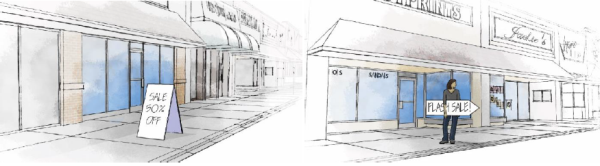
A-FRAME SIGNS: A portable commercial sign used on a daily basis during the time when the business is open to advertise daily special food plates in the case of restaurants, cafes or cafeterias as well as daily merchandise on sale at other businesses.
AGENT OR OWNER: Any person who is legally authorized to act for the property owner.
AGRICULTURE: The tilling of the soil, the raising of crops, horticulture and gardening. "Agriculture" does not include any agricultural industry or business, such as fruit packing plants, fur farms, animal hospitals or similar uses.
ALLEY: A public or private right of way, less than twenty six feet (26') wide, affording a secondary means of access to abutting property and not intended for general traffic circulation.
ALTERNATIVE TOWER STRUCTURE: Clock towers, bell steeples, light poles and similar alterative design mounting structures that camouflage or conceal the presence of antennas or towers.
AMBULATORY PERSON: Any individual, including one who uses a cane or other ambulatory support, who is physically and mentally capable, under emergency conditions, of finding a way to safety without assistance.
AMENDMENT: In reference to this Title, a change in the wording or substance of this Title, or an addition or deletion or a change in the zone district boundaries or classifications of the zoning map.
ANIMAL HOSPITAL: Facilities for the care, treatment and boarding of animals, including facilities within the term "veterinary clinic".
ANTENNA: Any exterior transmitting or receiving device mounted on a tower, building or structure and used in communications that radiates or captures electromagnetic waves, digital signals, analog signals, radio frequencies (excluding radar signals), wireless telecommunications signals or other communication signals.
ANTIQUE: A product or other item of personal property that is sold or exchanged because of value derived, in whole or in part, because of its age, and not simply because the same is not a new product.
APIARY: Any place where one (1) or more colonies of bees are located.
APIARY EQUIPMENT: Hives, supers, frames, veils, gloves, or other equipment used to handle or manipulate bees, honey, wax or hives.
APPLICANT: The owner of land proposed to be subdivided or such owner’s duly authorized agent. Any agent must have written authorization from the owner.
APPEAL AUTHORITY: The person, board, commission, agency, or other body designated by ordinance to decide an appeal of a decision of a land use application or a variance.
APPEAL: An action which permits anyone to arrange for a hearing before an individual or a group other than the individual or group from whose decision the appellant seeks redress, or a first request for action, depending on context. CCNO 11-6-6 addresses the appeal procedures available under this Title to adversely affected parties.
AUTOMOTIVE WRECKING: See definition of Junkyard.
B
BACKHAUL NETWORK: The lines that connect a provider's towers/cell sites to one or more cellular telephone switching offices, and/or long-distance providers, or the public switched telephone network.
BAR OR COCKTAIL LOUNGE: An establishment whose primary business is the serving of alcoholic beverages to the public for consumption on the premises.
BARN: (See also building, agricultural.) A large accessory building used exclusively for the storage of grain, hay, and other farm products, or the sheltering of livestock or farm equipment.
BASEMENT: A story partly underground and having more than one-half (1/2) of its height below ground.
BED AND BREAKFAST ESTABLISHMENT: A dwelling in which the occupants of the dwelling provide, for compensation, seven (7) or less days' lodging and meals for guests, occupying not more than two (2) guestrooms, located within the same dwelling.
BEE: The common honey bee, Apis mellifera, at any state of development, but not including the African honeybee, Apis mellifera scutellata species, or any hybrid thereof.
BEEKEEPER: A person who owns or has charge of one (1) or more colonies of bees.
BEEKEEPING: To hold a colony of bees in a hive for the purpose of pollination, honey production, study or similar purpose, including the extraction of honey for personal and household use, and limited sale, if legal according to the requirements of state law, and less than the amount required for a business license.
BLOCK: A tract of land bounded by streets, or by a combination of streets and public parks, cemeteries or boundary lines of municipalities.
BUILDING: Any structure having a roof supported by columns or walls, for the housing or enclosure of persons, animals or chattel.
BUILDING, ACCESSORY: A detached subordinate building clearly incidental to and located upon the same lot occupied by the main building.
BUILDING AREA: The total area, taken on a horizontal plane at the mean grade level, of the principal buildings and all accessory buildings and structures, exclusive of uncovered porches, terraces and steps. Decks over two and one-half feet (2 1/2') from the ground, and covered porches, are included in the building area.
BUILDING, AGRICULTURAL: A structure on agricultural land designed, constructed, and used to house farm implements, livestock, or agricultural produce or products used by the owner, lessee, or sub-lessee or their immediate families, their employees, and persons engaged in the pick up or delivery of agricultural produce or products grown or raised on the premises. The term “agricultural building” shall not include dwellings.
BUILDING, ATTACHED: A building which has at least part of a wall in common with another building, or which is connected to another building by a roof.
BUILDING, DETACHED: A building which is separated from another building or buildings on the same lot.
BUILDING FOOTPRINT: The area of the primary structure measured from the outside walls (excluding any overhanging portions) which includes indoor uses, such as attached garage, carport, utility room, laundry, etc. (including covered patios and breezeways), which are an integral part of the roof structure of the structure.
BUILDING, HEIGHT OF: The vertical distance measured from the natural grade level to the highest point of the structure directly above the natural grade when such structure is not located in a platted subdivision. If the structure is located in a platted subdivision, the building height shall be the vertical distance measured from the finished grade as shown on the subdivision grading plans or finished grade as shown on the individual lot's grading plans (whichever is lower), to the highest point of the structure directly above the finished grade. In the event that terrain problems prevent an accurate determination of height, the Planning Director shall rule as to height.
The height of a building on a flat lot is measured from the highest finished grade at the building foundation to the highest point of the roof, which can be no higher than thirty-five feet (35’). The definition of a "flat lot" is no more than three feet (3') of difference from the lowest point of the top back of curb to the highest point of the top back of curb on the building lot.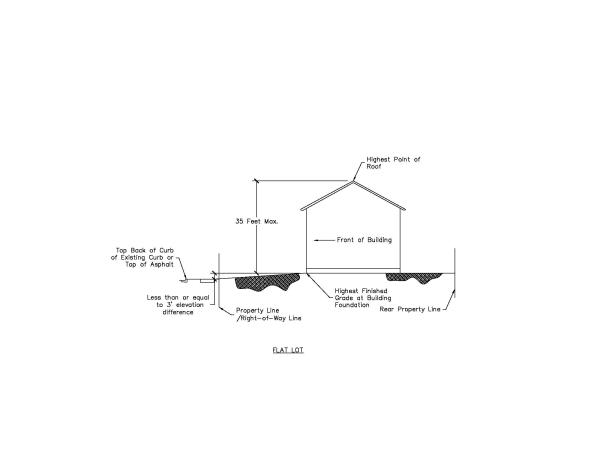
The height of a building on a downhill lot is measured from the highest finished grade at the building foundation to the highest point of the roof, which can be no higher than thirty-five feet (35’). Also, the height of a building from the lowest grade of the foundation to the highest point of the roof can be no higher than fifty five feet (55’).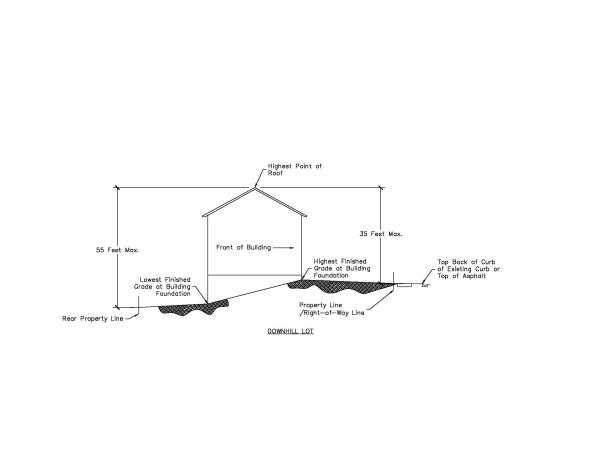
The height of a building on an uphill lot is measured from the lowest finished grade of the building foundation to the highest point of the roof, which can be no higher than thirty-five feet (35’). Also, the height of the building from the top back of curb at the center of the lot to the highest point of the roof can be no higher than forty feet (40’)..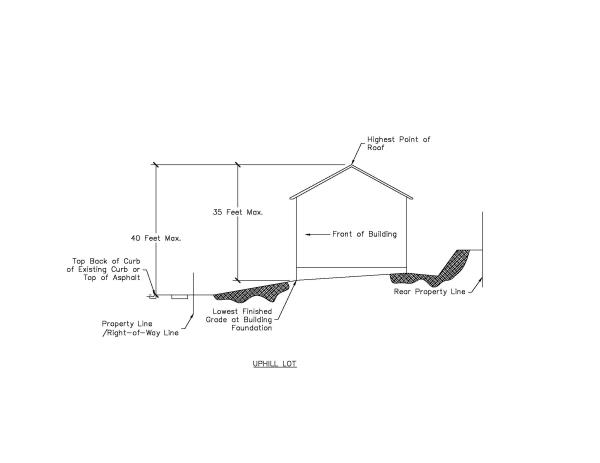
BUILDING PERMIT: A permit required for erection, construction, modification, addition to or moving of any building, structure or use in the incorporated area of the North Ogden City, as more fully defined in the international building code adopted by the City Council.
BUILDING, PRINCIPAL: A building, or buildings, in which is conducted the principal use of the lot on which it is situated. In any residential district, any dwelling shall be deemed to be the main building of the lot on which the same is situated.
BUILDING, PUBLIC: A building owned and operated, or owned and intended to be operated by a public agency of the United States of America or the state of Utah, or any of its subdivisions, or the City.
BUILDING SETBACK: The minimum distance as prescribed by this Title between any property line and the closest point of the foundation or any supporting post or pillar of any building or structure related thereto. (See definitions of Yard; Yard, Front; Yard, Rear Corner; Yard, Rear Interior; Yard, Side Corner; and Yard, Side Interior.)
C
CANNABIS CULTIVATION FACILITY: A person that possesses cannabis; grows or intends to grow cannabis; and sells or intends to sell cannabis to a cannabis cultivation facility, a cannabis processing facility, or a medical cannabis research licensee.
CANNABIS PHARMACY: A business, licensed by the State of Utah, to distribute cannabis products by prescription for medical purposes.
CANNABIS PROCESSING FACILITY: A person that acquires or intends to acquire cannabis from a cannabis production establishment; possesses cannabis with the intent to manufacture a cannabis product; manufactures or intends to manufacture a cannabis product from unprocessed cannabis or a cannabis extract; and sells or intends to sell a cannabis product to a medical cannabis pharmacy or a medical cannabis research licensee.
CANNABIS PRODUCTION ESTABLISHMENT: A cannabis cultivation facility, a cannabis processing facility, or an independent cannabis testing laboratory.
CAMPAIGN SIGN: The term “campaign sign” means a temporary sign soliciting support for a person running for public office or a sign supporting, defending or objecting to an issue or proposal being placed before the public.
CAMPGROUND: Any lot, parcel or tract of land used, designed, maintained and intended for rent of plots or sites to accommodate temporary camping by the traveling public, with or without sanitary facilities and water, and whether or not a charge is made for the use of the site and the facilities of the campground.
CAPITAL IMPROVEMENTS PROGRAM: A proposed schedule of all future projects listed in order of construction priority, together with cost estimates and the anticipated means of financing each project. All major projects requiring the expenditure of public funds, over and above the annual City operating expenses, for the purchase, construction or replacement of the physical assets for the community are included.
CARPORT: A roof supported by pillars or cantilevers, which shelters a car or other vehicle. May either extend from a structure (usually a house) or be constructed separately (often to accommodate several cars).
CEMETERY: Land used or intended to be used for the burial of the dead, and dedicated for such purposes, including columbaria, crematoriums, mausoleums and mortuaries, when operated in conjunction with and within the boundaries of such premises.
CHARTER SCHOOL: (i) an operating charter school; (ii) a charter school applicant that has its application approved by a charter school authorizer in accordance with UCA Title 53G, Chapter 5, Part 3, Charter School Authorization; or (iii) an entity that is working on behalf of a charter school or approved charter applicant to develop or construct a charter school building. "Charter school" does not include a therapeutic school.
CHURCH: A permanently located building commonly used for religious worship, fully enclosed with walls, but including windows and doors, and having a structurally solid and sound roof.
CITY: A political subdivision of the state of Utah and is referred to herein as “North Ogden City” or “the City.”
CITY COUNCIL OR COUNCIL: The Mayor and Council of North Ogden City.
CLASSROOM: An area of space located within a commercial or residential structure or other structure accessory thereto, excluding nurseries and daycare use, which is utilized in bringing two (2) or more persons together for the purpose of instruction, supervision, care, recreation or other such uses. The number of classroom occupants is governed by the minimum egress and access requirements pertaining to classrooms as set forth in the adopted edition of the international building code.
CLEARING: The removal and disposal of all obstructions, such as fences, walls, foundations, buildings and existing structures, and accumulations of rubbish of whatever nature. Also, the substantial removal of trees, shrubs, cacti, and other indigenous vegetation, but not including grass and weeds considered to be a potential fire hazard.
CLINIC: A place for the provision of group medical services, not involving overnight housing of patients.
CLUBHOUSE: A building, located on a golf course with nine (9) or more holes, that contains one or more of the following facilities: pro shop for the retailing of clothing and golf accessories; the golf course's own cart rental and maintenance facility (does not include golf cart sales and the maintenance of golf carts not rented by the golf course); restaurant with or without alcoholic beverage service; and the golf course's administrative office.
CLUSTER HOUSING: Houses built close together with little yard space and a large common area, rather than each house having a large separate yard.
COLONY: Bees in any hive including queens, workers, or drones.
COMMISSION: The North Ogden City Planning Commission.
COLLOCATION: The reasonable sharing of tower space by more than one user or provider of a wireless telecommunications service.
COMMON OPEN SPACE: Open space usable by all the people within a certain development; provided, that such area is commonly owned by all the property owners in that development.
COMMUNITY CORRECTIONS FACILITY: A facility which provides lodging and meals and, primarily, counseling, treatment and rehabilitation to adjudicated delinquents, parolees and individuals in prerelease (transitional) or diversionary programs from correctional institutions.
COMMUNITY SIGN: A temporary sign erected within the City owned or controlled right of way solely for the purpose of advertising or announcing a special community wide event or activity conducted or cosponsored by the City. A special community wide event or activity is one which occurs not more than twice in a twelve (12) month period and seeks to attract donations or participants throughout the City.
COMPLETE APPLICATION: When the applicant provides a land use application in a form that complies with the requirements of this Title and applicable ordinances and pays all applicable fees.
CONDITIONAL USE: A permitted land use that, because of its unique characteristics or potential impact on the municipality, surrounding neighbors, or adjacent land uses, may be compatible only if certain conditions are required that substantially mitigate the reasonably anticipated detrimental effects.
CONDOMINIUM: Real estate, portions of which are designated for separate ownership and the remainder of which is designated for common ownership solely by the owners of the separate portions. Real estate is not a condominium unless a declaration is recorded submitting the real estate to the terms of the Utah condominium act and the undivided interests in the common elements are vested in the unit owners.
CONTIGUOUS: Sharing a common border, touching along a boundary or point.
CONSTRUCTION SITE: A site on which a construction permit or building permit has been issued by North Ogden City.
CONVALESCENT HOME: See definition of Nursing Home.
CORRAL: A fenced space less than one acre in area, or less than one hundred feet (100') in width, used for the confinement of animals.
COTTAGE FOOD PRODUCTION: A home kitchen designed and intended for use by the residents of a dwelling, where a resident produces non-potentially hazardous foods such as baked goods, jams, jellies, or similar items for sale under cottage food regulations. This use does not require commercial-grade equipment and must comply with applicable state food safety and labeling requirements.
COUNTY: Weber County, Utah.
CULINARY WATER AUTHORITY: The department, agency, or public entity with responsibility to review and approve the feasibility of the culinary water system and sources for the subject property.
D
DAIRY: A commercial establishment for the manufacture or processing of dairy products.
DAYCARE CENTER: Any building or structure, other than an occupied residence, furnishing care, supervision and guidance for three (3) or more children unaccompanied by parent or guardian for periods of less than twenty-four (24) hours per day.
DENSITY: The average number of families, persons or housing units per unit of land; usually density is expressed "per acre". Thus, the density of a development of three hundred (300) units occupying forty (40) acres is seven and one-half (7.5) units per acre.
DEVELOPER: Any person who undertakes to develop land, including subdividers.
DEVELOPMENT: The improvement of any tract, lot, or parcel of land by construction thereon.
DEVELOPMENT ACTIVITY: Any construction or expansion of building, structure or use, any change in use of building or structure, or any change in the use of land that creates additional demand and need for public facilities. Development activity will include residential and commercial users who are not currently connected to any of the City’s public facilities systems but will be located within the City service area.
DEVELOPMENT APPROVAL: Any written authorization from the City that authorizes the commencement of development activity.
DEVELOPED COMMON ACTIVITY AREA: Open green space which is designed to provide activity areas for use by all residents such as playgrounds, recreational courts, picnic pavilions and gazebos. Title to developed common activity area shall be held in common or in private ownership, provided that all residents of the PUD shall be granted access to the developed common activity area.
DISABILITY: a physical or mental impairment that substantially limits one or more of a person’s major life activities, including a person having a record of such an impairment or being regarded as having such an impairment. “Disability” does not include current illegal use of, or addiction to, any federally controlled substance, as defined in Section 102 of the Controlled Substances Act, 21 USC 802.
DISTURBANCE: Clearing, grubbing, excavation and/or filling.
DRIVE-IN RESTAURANT: Any establishment primarily where food or beverages are dispensed and are primarily consumed in the patron's vehicle.
DRIVE-IN THEATER: An open-air theater where the performance is viewed by all, or part, of the audience from motor vehicles.
DRIVEWAY, PRIMARY: An improved point of access which connects a public right-of-way to a parking lot, or garage.
DRIVEWAY SECONDARY: An improved point of access connecting to a site which may not have direct access to a public right-of-way.
DWELLING: A building or portion thereof designed for residential use which is constructed in compliance with the City's adopted building, plumbing, electrical and health codes and regulations. The term "dwelling" includes manufactured and modular homes when the requirements of CCNO 11-15 are met.
DWELLING, ATTACHED: Two (2) or more dwelling units connected by at least one wall or floor of common construction.
DWELLING, FOUR-FAMILY: A dwelling arranged or designed to be occupied by four (4) families for residential purposes, the structure having only four (4) dwelling units.
DWELLING, MULTIPLE-FAMILY: A dwelling located in a building containing more than one dwelling.
DWELLING, SINGLE-FAMILY: A detached dwelling arranged or designed to be occupied by one family for residential purposes, the structure having only one dwelling unit.
DWELLING, THREE-FAMILY: A dwelling arranged or designed to be occupied by three (3) families for residential purposes, the structure having only three (3) dwelling units.
DWELLING, TWIN HOME: A structure containing an attached two-car garage or carport for each unit, with two (2) dwelling units that are legally subdivided into separate housing units and divided by a common wall. Such structure must be located on two (2) lots that have the common property line on the common division wall.
DWELLING, TWO-FAMILY OR DUPLEX: A dwelling arranged or designed to be occupied by two (2) families, the structure having only two (2) dwelling units.
DWELLING UNIT. A structure for human habitation which shall not include a mobile living unit such as a motor home or trailer coach, or a hotel, dormitory, hospital, rooming house or tent. A single unit providing complete independent living facilities for one or more persons, including permanent kitchen and sanitation facilities, and provisions for living, sleeping, and eating.
E
EASEMENT: A specified area on a lot or parcel of land reserved or used for the location of and/or access to, utilities, drainage or other physical access purposes, or for preservation of undisturbed terrain for the benefit of the general public. An easement also includes private rights of way that one property owner grants to another party to use the grantor's property for the grantee's purposes, such as, but not limited to, access to the grantee's property.
ELDERLY: A person who is sixty-five (65) years of age or older.
ELECTRONIC MESSAGE DISPLAY SIGN: A sign, which uses changing patterns of lights to display public information and/or commercial messages. These signs include displays using incandescent lamps, LEDs, or LCDs.
ENTERTAINMENT USES: Businesses that provide entertainment opportunities to the surrounding community such as motion picture theaters, live theater, musical performance venues, art galleries, commercial recreation, dance halls, amusement businesses, etc.
ERECT: To build, to build upon, to add to, to alter, to construct, to reconstruct, to move upon, or to undertake any other physical operations on the land, which is required for a building or structure.
EXCAVATION: The removal of earthen material, resulting in a lowering of the grade at the location.
EXISTING STRUCTURE: Light poles, power poles, chimneys, billboards and other similar structures which are placed within the City at the time of adoption of this chapter, except existing buildings.
F
FAA: The Federal Aviation Administration.
FACADE: All exterior walls of a building or structure.
FAMILY: An individual, or two (2) or more persons related by blood or marriage, or a group of persons not related by blood or marriage, living together as a single housekeeping group in a dwelling unit.
FARM: An area of not less than two (2) contiguous acres which is used for the commercial production of farm crops, such as vegetables, fruit trees, cotton, grain and other crops, and their storage on the area, as well as the raising thereon of "domesticated animals", defined as horses, cows, sheep, goats, rabbits and fowl (i.e., chickens, pheasants, turkeys, ducks, geese and pigeons). The term "farm" includes the operating of such an area for one or more of the above uses, including dairy farms, with the necessary accessory uses for treating or storing the produce; provided, that the operation of any such accessory use is secondary to that of the farm activities; and provided further, that the farm activities do not include commercial feeding of offal to swine or other animals.
FARM ANIMALS: The general list of animals raised for food or recreational purposes such as cows, horses, pigs, chickens, goats, sheep, etc.
FASCIA SIGN: A sign which is permanently affixed to the horizontal member or surface at the edge of a projecting roof.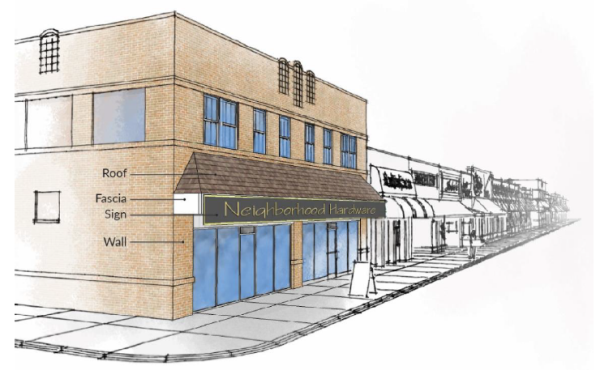
FCC: The federal communications commission.
FENCE: A tangible barrier or obstruction of any material, or a line of obstacles interposed along a line between two (2) portions of land above the surface of the ground on each side thereof, with the purpose, intent, or having the effect of preventing passage or view across the fence line. This definition includes hedges and walls when used for these purposes.
FILLING: The dumping or depositing of earthen material resulting in the raising of the grade at that location.
FINAL PLAT: The final drawing of the subdivision and dedication prepared for filing for record with the county recorder and in compliance with all the requirements set forth in this Title and adopted pursuant thereto.
FIRE AUTHORITY: The department, agency, or public entity with responsibility to review and approve the feasibility of fire protection and suppression services for the subject property.
FLOOR AREA: The gross square footage of a building. When considering minimum off street parking area, floor area may also include the open land needed for service to the public as customers, patrons, clients or patients, including area occupied by fixtures and equipment used for display or sale of merchandise.
FLYWAY BARRIER: A solid fence or hedge used in beekeeping, at least six feet (6') in height extending ten feet (10') from the hive in each direction. It is used to force bees to fly at least six feet (6') above ground over neighboring property lines.
FREESTANDING SIGN: A sign which has its own supporting structure independent of any building or structure.
FRONTAGE: All the property fronting on one side of the street between intersecting or intercepting streets, or between a street and a right of way, waterway, end of dead-end street, or political subdivision boundary, measured along the street lines. An intercepting street shall determine only the boundary of the frontage on the side of the street it intercepts.
FUTURE DEVELOPMENT SIGNS: Signs announcing the proposed development of property in nonresidential zoning districts only prior to issuance of a building permit for the purpose of displaying the name of the project, contractors, architect and any additional information pertaining to the site on which the signs are located.
G
GARAGE, CARPORT: See definition of Carport.
GARAGE, PRIVATE: An accessory building designed or used for the storage of automobiles owned and used by the occupants of the building to which it is accessory; provided, that on a lot occupied by a multiple dwelling, the private garage may be designed and used for the storage of two (2) times as many automobiles as there are dwelling units in the multiple dwelling. A garage shall be considered part of a dwelling if the garage and dwelling have a roof or wall in common. A private garage may not be used for storage of any truck which has a gross vehicle weight rating of more than twelve thousand (12,000) pounds as specified in the vehicle's registration under the motor vehicle laws.
GARAGE, PUBLIC: A building or portion thereof, other than a private garage, designed or used for servicing, repairing, equipping, hiring, selling or storing motor driven vehicles.
GARAGE SALE: A sale held by up to four (4) separate owners or occupants of property in a residential zone held at one of the properties to sell used property which the owners or occupants formerly used at their properties.
GENERAL PLAN: A document that a municipality adopts that sets forth general guidelines for proposed future development of the land within the municipality, as set forth in Utah Code §§ 10-9-301 and 10-9-302. "General Plan" includes what is also commonly referred to as "master plan".
GOLF COURSE: A course on which golf is played.
GRADE: For buildings adjoining one street only, the elevation of the sidewalk at the center of that walk adjoining the street.
For buildings adjoining more than one street, the average of the elevations of the sidewalk at the center point of the building walls that adjoin the streets.
For buildings having no walk adjoining the street, the average level of the ground (finished surface) adjacent to the exterior walls of the building. All walks approximately parallel to, and not more than five feet (5') from, a property line is to be considered as adjoining a street.
GRADE, FINISHED: Final elevation of the ground surface conforming to the approved grading plans.
GRADE, NATURAL: Elevation of the natural or undisturbed ground surface prior to any grading operation. If "natural grade" can no longer be determined, then the grade elevation existing on March 17, 1999, as shown on the City's topographical maps of that date, shall be used in lieu thereof. If a parcel of land is not shown on the March 17, 1999, topographical maps, "natural grade" shall be as shown on a topographical map that has been both prepared after March 17, 1999 and that is acceptable to the City Engineer.
GRADING: The process of changing gradients of land by contouring, smoothing or otherwise shaping land areas by excavating or filling, or a combination thereof.
GROSS ACREAGE: The total amount of acreage in a subdivision or PUD.
GROUP HOME: A home where a small number of unrelated people in need of care, support, or supervision can live together and is licensed by the State of Utah as such.
GRUBBING: The elimination of roots from the ground by digging or pulling.
GUEST: Any transient person who rents or occupies a room or structure for sleeping purposes.
GUEST HOUSE: Living or sleeping quarters within an accessory building for the sole use of occupants of the premises, guests of such occupants or persons employed on the premises. Such quarters shall not be rented and/or otherwise used for income producing purposes.
GUEST RANCH: A building or group of buildings containing two (2) or more guest rooms, other than a boarding house, hotel or motel, and including outdoor recreational facilities such as, but not limited to, horseback riding, swimming, tennis courts, shuffleboard courts, barbecue and picnic facilities, and dining facilities intended for the use primarily by guests of the guest ranch, but not including bars and restaurants which cater primarily to customers other than guests of the guest ranch.
GUEST ROOM: A room designed for occupancy by one or more guests for sleeping purposes, but having no cooking facilities.
H
HAZARDOUS MATERIALS: Any substance characterized as flammable solids, corrosive liquids, radioactive materials, oxidizing materials, highly toxic materials, poisonous gases, reactive materials, unstable materials, hypergolic materials and pyrophoric materials, and any substance or mixture of substances which is an irritant, a strong sensitizer or which generates pressure through exposure to heat, decomposition or other means.
HEIGHT: When referring to a tower or other structure, the vertical distance measured from the natural grade level to the highest point of the structure directly above the natural grade when such structure is not located in a platted subdivision. If the structure is located in a platted subdivision, the height shall be the vertical distance measured from the finished grade as shown on the subdivision grading plans or finished grade as shown on the individual lot's grading plans (whichever is lower), to the highest point of the structure directly above the finished grade. In the event that terrain problems prevent an accurate determination of height, the Planning Director shall rule as to height, and appeal from that decision shall be to the Appeal Authority.
HIVE: A structure designed to contain one colony of honeybees. A frame hive, box hive, box, barrel, log, gum skep, or other artificial or natural receptacle which may be used to house bees.
HOME DAYCARE CENTER: A residential facility in which care for nonresidents is provided for periods of less than twenty-four (24) hours per day.
HOME OCCUPATION: An income producing use of residential property, which is incidental, secondary, and accessory to the primary use of the dwelling for living purposes, and compatible to the residential uses permitted by the zone within which the property lies.
HOSPITAL: A place for the treatment or care of human ailments, where overnight lodging for patients is provided, other than nursing homes.
HOTEL: A building designed for or occupied as the temporary abiding place for individuals who, for compensation are lodged, with or without meals, and in which no provision is made for cooking in any individual room or suite.
HOUSEHOLD PETS: Animals which are usually kept as pets and which are kept in residential areas solely for personal pleasure. "Household pets" shall not include swine of any kind, cattle, goats, fowl or dangerous animals. Animals which are usually kept as household pets are domesticated animals if they are kept for profit and bred on the premises. "Household pets" include:
- Dogs;
- Cats;
- Fish;
- Gerbils;
- Guinea pigs;
- Hamsters;
- Rabbits;
- Nonpoisonous lizards less than one foot (1') long, no more than two (2);
- Nonpoisonous snakes less than three feet (3') long;
- Turtles less than one foot (1') long;
- Parrots;
- Parakeets; and
- Budgerigars.
I
IDENTICAL PLANS: Building plans submitted to a municipality that: (a) are clearly marked as "identical plans"; (b) are substantially identical to building plans that were previously submitted to and reviewed and approved by the municipality; and (c) describe a building that: (i) is located on land zoned the same as the land on which the building described in the previously approved plans is located; (ii) is subject to the same geological and meteorological conditions and the same law as the building described in the previously approved plans; (iii) has a floor plan identical to the building plan previously submitted to and reviewed and approved by the municipality; and (iv) does not require any additional engineering or analysis.
ILLUMINATED SIGN: A sign which is lighted, either externally or internally.
IMPACT FEE: A payment of money imposed upon development activity as a condition of development approval. “Impact fee” includes development impact fees, but does not include a tax, special assessment, hookup fee, building permit fee, fee for project improvements, or other reasonable permit or application fees. Title 11, Chapter 36a of the Impact Fees Act.
IMPACT FEE ANALYSIS or “IFA”: The written analysis required by Title 11, Chapter 36a of the Impact Fees Act.
IMPACT FEE FACILITIES PLAN: The plan required by Title 11, Chapter 36a-301 of the Impact Fees Act.
IMPROVEMENT COMPLETION ASSURANCE: A surety bond, letter of credit, financial institution bond, cash, assignment of rights, lien, or other equivalent security required by a municipality to guaranty the proper completion of landscaping or an infrastructure improvement required as a condition precedent to: (a) recording a subdivision plat; or (b) development of a commercial, industrial, mixed use, or multifamily project.
IMPROVEMENT WARRANTY: An applicant's unconditional warranty that the applicant's installed and accepted landscaping or infrastructure improvement: (a) complies with the municipality's written standards for design, materials, and workmanship; and (b) will not fail in any material respect, as a result of poor workmanship or materials, within the improvement warranty period.
IMPROVEMENT WARRANTY PERIOD: A period: (a) no later than one year after a municipality's acceptance of required landscaping; or (b) no later than one year after a municipality's acceptance of required infrastructure, unless the municipality: (i) determines for good cause that a one-year period would be inadequate to protect the public health, safety, and welfare; and (ii) has substantial evidence, on record: (A) of prior poor performance by the applicant; or (B) that the area upon which the infrastructure will be constructed contains suspect soil and the municipality has not otherwise required the applicant to mitigate the suspect soil.
INFRASTRUCTURE IMPROVEMENT: Permanent infrastructure that is essential for the public health and safety or that: (a) is required for human occupation; and (b) an applicant must install: (i) in accordance with published installation and inspection specifications for public improvements; and (ii) whether the improvement is public or private, as a condition of: (A) recording a subdivision plat; (B) obtaining a building permit; or (C) development of a commercial, industrial, mixed use, condominium, or multifamily project.
INDIVIDUAL: Any private individual, tenant, lessee, owner or any commercial entity, including, but not limited to, companies, partnerships, joint ventures or corporations.
J
JUNK: Any old or scrap metal, rope, rags, batteries, paper, trash, wood, glass, plastic and/or rubber debris, waste or junked, dismantled or wrecked automobiles, or parts thereof, iron, steel, and other old or scrap ferrous or nonferrous material.
JUNKYARD: The use of any lot, portion of a lot, or tract of land for the storage, keeping or abandonment of junk, including scrap metals or other scrap material, or for the dismantling, demolition or abandonment of automobiles or other vehicles, or machinery or parts thereof; provided, that this definition shall not be deemed to include such uses which are clearly accessory and incidental to any agricultural use permitted in the zone.
K
KENNEL: Any premises where dogs are either bred or boarded, and/or trained. Having one litter up to three (3) months of age is not considered to be a kennel. See CCNO 6-1, Animal Control for more information.
KITCHEN: Any room in a building or dwelling unit which is used or intended to be used for cooking or the preparation of food.
L
LAND USE APPLICANT: A property owner, or the property owner's designee, who submits a land use application regarding the property owner's land.
LAND USE APPLICATION: (a) An application that is (i) required by a municipality; and (ii) submitted by a land use applicant to obtain a land use decision; and (b) does not mean an application to enact, amend, or repeal a land use regulation.
LAND USE AUTHORITY: (a) A person, board, commission, agency, or body, including the local legislative body, designated by the local legislative body to act upon a land use application; or (b) if the local legislative body has not designated a person, board, commission, agency, or body, the local legislative body.
LAND USE DECISION: An administrative decision of a land use authority or appeal authority regarding: (a) a land use permit; (b) a land use application; or (c) the enforcement of a land use regulation, land use permit, or development agreement.
LAND USE PERMIT: A permit issued by a land use authority.
LAND USE REGULATION: A legislative decision enacted by ordinance, law, code, map, resolution, specification, fee, or rule that governs the use or development of land; (a) includes the adoption or amendment of a zoning map or the text of the zoning code; and (b) does not include: (i) a land use decision of the legislative body acting as the land use authority, even if the decision is expressed in a resolution or ordinance; or (ii) a temporary revision to an engineering specification that does not materially: (A) increase a land use applicant's cost of development compared to the existing specification; or (B) impact a land use applicant's use of land.
LANDSCAPING: An area which has been improved through the harmonious combination and introduction of trees, shrubs and ground cover, and which may contain natural topping material such as boulders, rock, stone, granite or other approved material. The area shall be void of any asphaltic or concrete pavement, except for pedestrian walkways.
LAUNDRY, SELF-SERVICE: A building within which clothes washing and drying machines, and clothes dry cleaning machines, either coin operated or attendant operated, are provided on a rental basis for use by individuals for doing their own laundry or dry cleaning. "Self-service laundry" does not include outdoor drying facilities.
LEGISLATIVE BODY: The North Ogden City Council.
LIVING SPACE: The habitable portions of a residence including bedrooms, living rooms, bathrooms and kitchens and excluding crawl spaces, unfinished basements and garages.
LOADING AND UNLOADING SPACES: A permanently maintained space on the same lot as the principal building accessible to a street or alley and not less than ten feet (10') in width, twenty feet (20') in length, and fourteen feet (14') in height.
LOT: A single piece of property located in a recorded subdivision, having frontage on a publicly dedicated and accepted street or an approved private road, which is described and denoted as such.
LOT AREA: The total horizontal area within the lot lines of a lot.
LOT, CORNER: A lot which has an interior angle of one hundred thirty-five degrees (135°) or less at the intersection of two (2) street lines. A lot abutting upon a curved street is considered a corner lot if the tangents to the curve at the points of intersection of the side lot lines intersect at an interior angle of one hundred thirty-five degrees (135°) or less.
LOT COVERAGE: That portion of a lot or parcel which is occupied by any building or other covered structure, excepting paved areas, walks and swimming pools.
LOT DEPTH: The horizontal length of a straight line connecting the midpoints of the front and rear lot lines.
LOT, FLAG: A flag or L-shaped lot consisting of a staff portion contiguous with the flag portion, the staff portion having frontage less than the required frontage on a dedicated street.
LOT FRONTAGE: The horizontal length of the front lot line.
LOT, INTERIOR: A lot, other than a corner lot or flag lot, meeting the requirements of the zone in which it is located.
LOT IMPROVEMENT: Any building, structure, place, work of art, or other object, or improvement of the land on which they are situated constituting a physical betterment of real property or any part of such betterment. Certain lot improvements shall be properly bonded or escrowed as provided in these regulations.
LOT, RESTRICTED (R LOT): A lot having an average slope of twenty percent (20%) or more which contains a building area of at least two thousand five hundred (2,500) square feet and/or a lot which contains or is susceptible to special events or conditions, including, but not limited to, flooding, wetlands, improper drainage, steep slopes, rock formations, adverse earth formations or topography, fault lines, water table, and snow, mud, and debris slides. Such lot shall be subject to and regulated and developed in accordance with the restricted lot development ordinance, the North Ogden City zoning ordinance, and the North Ogden City subdivision ordinance. All R lots shall be clearly identified on the recorded plat.
LOT LINE: The line bounding a lot.
LOT LINE, ADJUSTMENT: A relocation of a lot line boundary between adjoining lots or parcels, whether or not the lots are located in the same subdivision, in accordance with Utah State Code Section 10-9a-608, with the consent of the owners of record.
LOT LINE, FRONT: In the case of an interior lot, a line separating the lot from the street right of way. In the case of a corner lot, the shorter of the two (2) lot lines adjoining a street right of way.
LOT LINE, REAR: A lot line which is opposite and most distant from the front lot line. In the case of a lot having five (5) or more sides, the rear lot line shall be any lot line, other than the front lot line, which intersects a side or a street side lot line at any angle less than one hundred thirty-five degrees (135°). An Exception shall apply in the case where one of the connected property lines, having an angle of less than 135 degrees, is twenty (20) feet or less, these property lines are considered a side yard lot line.
LOT LINE, SIDE: Those lot lines other than a street side lot line that connects the front and rear lot lines.
LOT LINE, STREET SIDE: That lot line or lines on a corner lot adjoining a street right of way that connects the front lot line to a rear lot line.
LOT, THROUGH: A lot which has street right of way frontage on two (2) non adjoining sides.
LOT WIDTH: For rectangular lots, lots having side lot lines not parallel, and lots on the outside of the curve of a street, the distance between side lot lines shall be measured at the required minimum front yard line on a line parallel to the street or street chord; and for lots on the inside of the curve of a street, the distance between side lot lines shall be measured thirty feet (30') behind the required minimum front yard line on a line parallel to the street or street chord.
M
MANSARD AND PARAPET SIGNS: A sign permanently affixed to a wall or surface not more than twenty degrees (20°) from vertical at the upper edge of a building and running parallel with the mansard roofline or parapet upon which the sign is attached.
MANUFACTURED HOME: A structure, intended for residential use, transportable in one or more sections, including the plumbing, heating, air conditioning and electrical systems contained in such structure. The term "manufactured home" includes mobile homes, modular homes and travel trailers.
MANUFACTURING: The fabricating or assembling of materials into finished or partially finished products by hand or by the use of machinery.
MANUFACTURING, LIGHT: The assembly or production of goods conducted entirely within enclosed buildings, utilizing hand tools, small power tools, or 3D printing equipment. Operations must not produce significant noise which exceeds city noise ordinance, vibration, emissions, or other adverse impacts on surrounding properties or uses. Limited on-site storage of raw materials and finished or semi-finished products is permitted, provided all storage is fully enclosed. Direct-to-consumer retail sales must be offered either on-site or online.
MASSAGE ESTABLISHMENT: Any establishment where any person, firm, association or corporation engages in or carries on or permits to be engaged in or carried on any "massage activities", defined as any method of pressure on, friction against, or stroking, kneading, rubbing, tapping, pounding, vibrating, or stimulating of external soft parts of the body with the hands or with the aid of any mechanical apparatus or electrical apparatus or appliance. All massage therapists performing work outlined above must be trained and licensed in accordance with Utah State Code Title 58, Chapter 47B, and meet requirements outlined in NOC 11-10A-2.
MINIMUM VEGETATIVE AREA: The minimum area required to be vegetated to comply with the open space requirements of the City.
MOBILE HOME: A manufactured home:
- Which is built prior to June 15, 1976, in compliance with the federal home construction and safety act of 1974; and
- Which:
- In traveling mode is more than eight feet (8') wide and forty feet (40') in length; or
- When erected, containing four hundred (400) or more square feet of living space; and
- Which is not a modular home.
MODERATE INCOME HOUSING: Housing occupied or reserved for occupancy by households with a gross household income equal to or less than 80% of the median gross income for households of the same size in the county in which the City is located. MODULAR HOME: A manufactured home:
- Which is built on or after June 15, 1976, in compliance with the federal home construction and safety standards act of 1974; and
- Which:
- In traveling mode is more than eight feet (8') wide and forty feet (40') in length; or
- When erected contains four hundred (400) or more square feet of living space; and
- Which has been attached to a permanent foundation in accordance with the applicable building codes adopted by the City, including meeting all applicable standards for:
- Vertical loads;
- Uplift;
- Lateral forces; and
- Frost protection; and
- Where all of the home's appendages, including carports, garages, storage buildings, additions and alterations comply with the applicable building codes.
MOTEL: Any building or group of buildings containing sleeping rooms, with or without fixed cooking facilities, designed for temporary use by automobile tourists or transients, with a garage attached or parking space conveniently located to each unit, including auto courts, tourist courts or motor lodges.
MONUMENT SIGN: Monument sign is a freestanding sign whose sign face extends to the ground or to a base.
MULTI-TENANT COMPLEX OR SHOPPING CENTER UNDER TEN ACRES: A building or a complex of buildings on a single site, less than ten (10) acres, having uniform management and at least six (6) potential tenants with exclusive access and independent operation.
N
NATIVE VEGETATION: Indigenous plant materials of northern Utah.
NATURAL: The condition of the land, vegetation, rocks and other surface features which have not been physically disturbed, changed or added to by any action of man or machine.
NATURAL OPEN SPACE: Areas of any parcel of land that includes hillsides, sagebrush, or natural vegetation that is left undeveloped and dedicated, designated, or reserved as Open Space.
NATURAL TRAIL: An unimproved, or semi-improved backcountry trail that connects natural areas and mountain recreation areas.
NATURAL WATERWAYS: Those areas, varying in width along streams, creeks, gullies, springs or washes which are natural drainage channels as determined by the City Engineer, and within which areas no buildings shall be constructed.
NET ACREAGE: The total amount of acreage in a PUD or Group Dwelling development excluding rights of way or roads and "undevelopable land" such as unmitigated natural hazard areas, wetland areas and floodplains.
NONCOMMERCIAL SIGN: A sign which expresses, conveys or advocates a noncommercial message.
NONCONFORMING SIGN OR SIGN STRUCTURE: A sign or sign structure or portion thereof lawfully existing at the time the ordinance codified in this chapter became effective, which does not conform to all height, area, and yard regulations prescribed in the zone in which it is located.
NONCOMPLYING STRUCTURE: A structure that legally existed before its current land use designation; and because of one or more subsequent land use ordinance changes, does not conform to the setback, height restrictions, or other regulations, excluding those regulations, which govern the use of land.
NONCONFORMING USE: A use of land that legally existed before its current zoning designation that has been maintained continuously since the time the zoning regulation governing the land changed, and because of subsequent zoning changes, does not conform with the zoning regulations that now govern the land.
NUISANCE: Anything, condition or use of property which endangers life or health, gives offense to the senses and/or obstructs the reasonable and comfortable use of other property.
NURSING HOME: A structure operated as a lodging house in which nursing, dietary and other personal services are rendered to convalescents, not including persons suffering from contagious diseases, and in which surgery is not performed and primary treatment, such as customarily is given in hospitals and sanitariums, is not provided. A convalescent home shall be deemed a nursing home.
NURSERY: A commercial operation for the growth and sale of plants, storage of equipment for landscaping and the wholesale or retail sale of commercial gardening supplies.
O
OFF STREET PARKING AND LOADING FACILITIES: A site or a portion of a site devoted to the off-street parking of motor vehicles, including parking spaces, aisles and access driveways.
OFFICE: A room or rooms and accessory facilities for the managing or conducting of a business.
OFFICIAL MAP: A map drawn by municipal authorities and recorded in a county recorder's office that shows actual and proposed rights-of-way, centerline alignments, and setbacks for highways and other transportation facilities; provides a basis for restricting development in designated rights-of-way or between designated setbacks to allow the government authorities time to purchase or otherwise reserve the land; and has been adopted as an element of the municipality's general plan.
OFF-SITE: Outside the boundaries of a specific parcel of land being developed or considered for development.
ON-SITE: Within a parcel of land owned by a private citizen or by a private legal entity.
OPEN SPACE: Any parcel or area of land or water unimproved or improved only with landscaping, site furnishings, playground equipment, trails, trailheads, walking paths, plazas, or other improvements typically associated with outdoor recreation and set aside, dedicated, designated, or reserved for the public or private use and enjoyment of owners and occupants of land adjoining or neighboring such open space. Open Space also includes Natural Open Space.
OPEN GREEN SPACE: A planned open area suitable for relaxation, recreation or landscaping which may be held in common or private ownership, provided that all residents of the development shall have a right to enter and use the open space. It should be unoccupied and unobstructed by buildings and hard surfaces such as asphalt or concrete, except that such open green spaces may include walkways, patios, recreational activity areas, picnic pavilions, gazebos and water features so long as such surfaces do not exceed fifteen percent (15%) of the required open green space.
OUTDOOR STORAGE: The location of any goods, wares, merchandise, commodities, junk, debris, or any other item outside of a completely enclosed building for a continuous period longer than twenty-four (24) hours.
Owner-Occupied Residential Property: Real property that is occupied by
its owner as the owner’s primary residence.
P
PARCEL: Any real property that is not a lot created by and shown on a subdivision plat recorded in the office of the county recorder.
PARK: A public or private parcel of land designed to function as and be used for passive or active recreation or natural open space.
PARKING AREA: An area designed and constructed and used exclusively for the parking, storage and maneuvering of vehicles. Such area shall conform to CCNO 11-17.
PARKING SPACE: A permanently surfaced area, enclosed or unenclosed, of not less than nine feet (9') in width, and nineteen feet (19') in depth, together with a driveway connecting the parking space with a street and permitting ingress and egress of the automobile. (See CCNO 11-17.)
PERIPHERY: A one-hundred-foot (100') depth around the perimeter of the project measured inward from the property line.
PERSON, DISABLED: A person who has a disability (now defined).
PLAN FOR MODERATE INCOME HOUSING: A written document adopted by the legislative body that includes: (a) an estimate of the existing supply of moderate income housing located within the City; (b) an estimate of the need for moderate income housing in the City for the next five years; (c) a survey of total residential land use; (d) an evaluation of how existing land uses and zones affect opportunities for moderate income housing; and (e) a description of the City’s program to encourage an adequate supply of moderate income housing.
PLANNED UNIT DEVELOPMENT: A development on a site of five (5) or more acres in size, containing one-family, two-family, three-family, four-family or multiple-family dwellings, or combination thereof, together with such recreational areas, open spaces and other facilities as permitted in the zone in which the development is located and meeting the requirements of CCNO 11-11.
PLANNING COMMISSION: The North Ogden City Planning Commission.
PLANNING DIRECTOR: The official charged with the responsibility of managing the processes and duties defined in this ordinance and the official's designee.
PLAT: A map, plan or depiction of a subdivision showing thereon the division of a tract or parcel of land into lots, blocks, streets and alleys or other divisions and dedications.
PLAT, FINAL: A proposed subdivision drawn accurately to scale and which has all measurements, data, certificates and dedications thereon which are required for approval and acceptance by the proper agencies and for recording in the office of the county recorder.
PORTABLE SIGN: A commercial sign which is not permanently affixed to a structure or permanently ground mounted, including A-frame signs.
PORTABLE STORAGE CONTAINER: A movable weather resistant container fabricated for the purpose of transporting freight or goods on a truck, railroad or ship, including cargo containers, shipping containers, storage units or other portable structures, which are placed on private property and used for storage of items, including, but not limited to, clothing, equipment, goods, household or office fixtures or furnishings, materials and merchandise. This definition shall not include accessory buildings or a building approved for construction. Portable storage containers shall be subject to the regulations set forth in CCNO 11-9M-9.
PREEXISTING TOWERS AND PREEXISTING ANTENNAS: Any tower or antenna for which a building permit has been properly issued prior to the effective date hereof, including permitted towers or antennas that have not yet been constructed, so long as such approval is current and not expired.
PROFESSIONAL OFFICE: Any building, structure, or portion thereof, used or intended to be used as an office for a lawyer, architect, engineer, surveyor, planner, optometrist, accountant, doctor, dentist or other similar professions.
PROPORTIONATE SHARE: An amount that is roughly proportionate and reasonably related to the service demands and needs of a development activity.
PUBLIC BUILDING: Facilities for conducting public business occupied by various public agencies. This includes all federal, state, county, and city offices and buildings. These facilities may include accessory food service and retail sales.
PUBLIC HEARING: A hearing held to receive public testimony or comment as required by law or at the direction of the Planning Commission or City Council.
PUBLIC MEETING: A meeting that is required to be open to the public under Title 52, Chapter 4 of the Open and Public Meetings Act.
PUBLIC USE: A use owned and/or operated exclusively by a public body, or quasi-public body, having the purpose of serving the public health, safety, or general welfare, and including uses such as public schools, parks, playgrounds, and other recreational facilities, administrative and service facilities, and public utilities.
PUBLIC UTILITY: Private or public facilities for distribution of various services, such as water, power, gas, communication, etc., to the public.
Q
QUASI-PUBLIC USE: a use operated by a private nonprofit, religious, recreational, charitable, or philanthropic institution, such use having the purpose primarily of serving the general public, such as a church, private university, or similar use.
R
RECREATION FACILITIES: Includes buildings, structures or areas built or developed for purposes of entertaining, exercising or observing various activities participated in either actively or passively by individuals or organized groups.
RECREATIONAL VEHICLE: A vehicular unit other than a mobile home, primarily designed as a temporary dwelling for travel, recreational or vacation use, which is either self-propelled or pulled by another vehicle. "Recreational vehicle" includes a travel trailer, a camping trailer, a motor home, a fifth wheel trailer, a van, a boat, a boat trailer, a snowmobile, a snowmobile trailer, a jet ski or wave runner, and a trailer carrying a jet ski or wave runner, a horse trailer and a utility trailer.
RECREATIONAL VEHICLE PARK: Facilities for the temporary storage, parking and maneuvering of recreational vehicles (motor homes, travel trailers, campers, etc.), which are occupied as temporary residences within the park, with adequate roads and stall sites, including sanitary and water facilities. Site locations are typically provided on a day-to-day basis. Does not constitute a mobile home park and may not allow mobile homes.
RESIDENTIAL FACILITY FOR DISABLED PERSONS: a dwelling in which more than one person with a disability resides and which is licensed or certified by the Department of Human Services under Title 62A, Chapter 2 of the Utah Code Annotated 1953, Licensure of Programs and Facilities, or is licensed or certified by the Department of Health under Title 26, Chapter 21 of the Utah Code Annotated 1953, Health Care Facility Licensing and Inspection Act.
RESTAURANT: An establishment whose primary business is the serving of food to the public.
RESTAURANT, DRIVE-IN: A restaurant that serves food that is prepared on site and is delivered by carhop service for consumption in its parking lot, at outdoor tables on its property or off the restaurant's premises. The restaurant may also have drive-through food service to serve food that is prepared on site.
RESTRICTED LOTS (R-LOTS): An "R lot" is a lot having an average slope of between ten percent (10%) and twenty percent (20%), which contains a building area of at least two thousand five hundred (2,500) square feet having a slope of less than twenty percent (20%) and which contains or is susceptible to special events or conditions, including, but not limited to, flooding, natural drainage channels, wetlands, improper drainage, steep slopes, rock formations, adverse earth formations or topography, fault lines, water table, and snow, mud and debris slides. All R lots shall be clearly identified on the recorded plat and on a recordable instrument in form acceptable to the city. The instrument shall be recorded in the county recorder's office at the time the final plat is recorded in order to provide notice to potential lot purchasers of the existence of limitations imposed upon R lot development.
RESUBDIVISION: A change in the map of an approved or recorded subdivision plat if such change affects any street layout on or area reserved thereon for public use, any lot line, or any map or plan legally recorded prior to the adoption of any regulations controlling subdivisions.
RETAIL STORE: A commercial business for selling goods, services, wares or merchandise directly to the consumers, but not including a professional office.
RETAINING WALL: A wall or terraced combination of walls used to retain earth, but not directly supporting the wall of a building, including stacked rock and imbedded boulder walls.
REVEGETATION: The replacement of indigenous living plant materials on areas where the natural vegetation has been removed. The areas include disturbed natural areas and manmade cut and fill slopes.
RIGHT OF WAY (ROW): Includes any public or private right of way and includes any area required for public use pursuant to any official plan.
ROADSIDE VEGETABLE OR FRUIT STAND: A seasonal, temporary or semi-temporary structure that may be located on or off the farm for the sale of product produced on said farm.
ROOF SIGN: A sign affixed on, above or over the roof of a building so that it projects above the roofline. The top of a parapet wall shall be considered the roofline. The highest point of a mansard roof shall be considered the roofline. Where a parapet wall is combined with a mansard roof, the roofline shall be the top of the parapet.
S
SALE, LEASE OR RENT SIGNS: Signs advertising the sale, leasing or renting of a building, dwelling, suite, property or other forms of real estate.
SANITARY SEWER AUTHORITY: The department, agency, or public entity with responsibility to review and approve the feasibility of sanitary sewer services or onsite wastewater systems.
SATELLITE DISH ANTENNA: A device incorporating a reflective surface that is solid, open mesh, or bar configured and is in the shape of a shallow dish, cone, horn or cornucopia. Such device shall be used to transmit and/or receive radio or electromagnetic waves between terrestrially and/or orbitally based stations. This definition is meant to include, but not be limited to, what are commonly referred to as satellite earth stations, television reception only (TVROs), and satellite microwave antennas.
SCHOOL, ELEMENTARY, JUNIOR HIGH, HIGH SCHOOL, COLLEGE OR JUNIOR COLLEGE: Institutions conducting regular academic instruction at kindergarten, elementary, secondary, and post high school levels. Such institutions shall offer general academic instructions equivalent to the standards prescribed by the state board of education or the state board of regents.
SCHOOL, PRESCHOOL: A school or the use of a site or a portion of a site for an organized program devoted to the education of five (5) or more children younger than elementary school age, other than those residents on the site.
SCHOOL, PRIVATE OR PAROCHIAL: An institution conducting regular academic instruction at kindergarten, elementary, secondary, and post-secondary levels operated by a nongovernmental organization.
SCHOOL, TRADE: Facilities offering instruction in the technical, commercial or trade skills, such as real estate schools, business colleges, electronic schools, automotive and aircraft technicians, technical certification schools and similar commercial establishments.
SCREENING:
- Either:
- A strip at least five feet (5') wide, densely planted (or having equivalent natural growth) with shrubs or trees at least four feet (4') high at the time of planting, of a type that will form a year-round dense screen at least six feet (6') in height; or
- An opaque wall or barrier or uniformly painted fence at least six feet (6') high.
SENIOR CARE FACILITY: A commercial facilities for the care of persons over 65 years of age. SERVICE STATION: An occupancy engaged in the retail sales of gasoline, oil, tires, batteries, and new accessories and which provides for the servicing of motor vehicles and operations incidental thereto, including, automobile washing, waxing and polishing, tire changing and repairing, but not including recapping. May also include battery service, radiator cleaning, flushing and repair, installation of minor accessories, lubrication of motor vehicles, rental of utility trailers, testing, adjustment and replacement of motor parts and accessories. SETBACK: The minimum distance that any portion of a building, accessory building, sign or sign structure shall be from any street right-of-way line and yard line coterminous with a street.
SEXUALLY ORIENTED BUSINESS: A sexually oriented businesses is a business that includes the following:
- ADULT BOOKSTORE: An establishment:
- Having a portion of its stock in trade, videos, film, books, magazines and other periodicals or publications depicting, describing or relating to "specified sexual activities" or which are characterized by their emphasis on matter depicting, describing or relating to "specified anatomical areas"; or
- Having as a substantial portion of its stock in trade, books, magazines and other periodicals, and which excludes all minors from the premises, or a section thereof.
- ADULT LIVE ENTERTAINMENT ESTABLISHMENT: An establishment which features topless female or bottomless dancers of both sexes, go-go dancers, exotic dancers, strippers or similar entertainers.
- ADULT THEATER: An enclosed building or open-air drive-in theater:
- Regularly used for presenting any film or plate negative, film or plate positive, film or tape designed to be projected on a screen for exhibition or films, glass slides or transparencies, either in negative or positive form, designed for exhibition by projection on a screen depicting, describing or relating to "specified sexual activities" or characterized by an emphasis on matter depicting, describing or relating to "specified anatomical areas"; or
- Used for presenting any film or plate negative, film or plate positive, film or tape designed to be projected on a screen for exhibition, or films, glass slides or transparencies, either in negative or positive form, designed for exhibition by projection on a screen and which regularly excludes minors.
- SPECIFIED ANATOMICAL AREAS:
- Less than completely and opaquely covered: 1) human genitals, pubic region; 2) buttock; and 3) breast below a point immediately above the top of the areola; and
- Human male genitals in a discernible turgid state, even if completely and opaquely covered.
- SPECIFIED SEXUAL ACTIVITIES:
- Human genitals in a state of sexual stimulation or arousal.
- Acts of human masturbation, sexual intercourse, sodomy, or other sexual or erotic contact of one or more “specified anatomical areas” with another body.
- Fondling or other erotic touching of human genitals, pubic region, buttocks or breasts.
SHOPPING CENTER: A group of retail stores or professional offices planned and designed for the site on which it is built, functioning as a unit, with off street parking, landscaped areas and pedestrian malls or plazas provided on the property as an integral part of the unit.
SHORT TERM RENTAL: A residential unit or any portion of a residential unit that the owner of record or the lessee of the residential unit offers for occupancy for fewer than 30 consecutive days.
SIGN: Any device providing identification, advertising or directional information for a business, service, product, person, organization, place or building. Included in this definition of signs are graphic devices such as logos and attention attracting items such as banners or logo sculptures, and trademarked color band fascia.
STABLE, COMMERCIAL: A structure including, but not limited to, a corral or paddock for the keeping of horses for remuneration, hire or sale.
STABLE, PRIVATE: A detached accessory building for the keeping of horses owned by the occupants of the premises, and not kept for remuneration, hire or sale.
STABLE, PUBLIC: A stable other than a private or commercial stable.
STORE: An establishment where manufactured goods, food stuffs or readymade items can be purchased.
STORY: The space within a building included between the surface of any floor and the surface of the ceiling next above.
STORY, HALF: A story with at least two (2) of its sides situated in a sloping roof, with the floor area of which does not exceed two-thirds (2/3) of the floor immediately below it.
STREET: The entire area within a public right of way, established by:
- Deed or conveyance;
- Dedication to the public (and accepted by proper public authority) by the owners thereof;
- Dedication to the public by continuous use as a public thoroughfare for a period of ten (10) years; or
- Dedication to the public by the federal city site act of 1867 or similar law, statute or ordinance, which affords the principal means of access to abutting property.
STREET, ARTERIAL: A street, existing or proposed, which serves or is intended to serve as a major trafficway, and is designated on the master street plan as a controlled access highway, major street, parkway or other equivalent term to identify those streets comprising the basic structure of the street plan.
STREET, COLLECTOR: A street, existing or proposed, of considerable continuity, which is the main means of access to the major street system.
STREET, CUL-DE-SAC: A single dead-end street terminating with a permanent turnaround bulb that meets the North Ogden City public works standards.
STREET LINE: The boundary line between street right of way and abutting property.
STREET, MINOR: A street, existing or proposed, which is supplementary to a collector street and of limited continuity which serves or is intended to serve the local needs of a neighborhood.
STREET, PRIVATE: A tract of land, dedicated to and accepted by a homeowners' or property owners' association for maintenance, which provides the principal vehicular and pedestrian access to properties within a planned residential unit development or condominium development.
STRUCTURAL ALTERATIONS: Any change in supporting members of a building or structure, such as bearing walls, columns, beams or girders.
STRUCTURE: Anything constructed or erected which requires a fixed location on the ground, including a building or mobile home, but not including a fence or wall used as a fence.
SUBDIVIDER: Any person who undertakes to create a subdivision.
SUBDIVISION: Any land that is divided, re-subdivided or proposed to be subdivided into two or more lots, parcels, sites, units, plots, or other division of land for the immediate or future offer of sale, sale, lease, or development either on the installment plan or upon any and all other plans, terms and conditions. Subdivision includes the division or development of land whether by deed, metes and bounds description, devise and testacy, lease, map, plat, or other recorded instrument; and divisions of land for all residential and nonresidential uses, including land used or to be used for commercial, agricultural, and industrial purposes. "Subdivision" does not include:
- A bona fide division or partition of agricultural land for the purpose of joining one of the resulting separate parcels to a contiguous parcel of unsubdivided agricultural land, if neither the resulting combined parcel nor the parcel remaining from the division or partition violates an applicable land use ordinance.
- An agreement recorded with the county recorder's office between owners of adjoining unsubdivided properties adjusting the mutual boundary by a boundary line agreement in accordance with UCA 57-1-45.
SWALE: A low flat depression to drain off excess water.
SWIMMING POOL: Any permanent structure, containing or intended to contain water eighteen inches (18") or more in depth and/or eight feet (8') or more in width at any point.
T
TEMPORARY SIGN: Any exterior sign, banner, pennant, valance or advertising display constructed of paper, cloth, canvas, light fabric, cardboard, wallboard or other light materials including metal real estate signs, with or without light frames, intended to be displayed for a short period of time. Examples of temporary signs include: a grand opening banner, public event banner, political sign, real estate sign, and special event sign.
TEMPORARY VEHICLE STORAGE FACILITY: Any land or building used for the temporary storage of abandoned, wrecked or legally impounded automobiles, boats, recreational vehicles, or other vehicles regardless of running condition. Such a facility is not a facility where dismantling of any vehicle, the storage of any vehicle parts, the retailing or wholesaling of any vehicle or vehicle parts may take place.
TENANT: Primary occupant (i.e., owner, lessee or renter) who has the operation or temporary possession of space in a commercial building, or rents or leases from a landlord.
TOWER: Any structure that is designed and constructed primarily for the purpose of supporting one or more antennas for telephone, radio and similar communication purposes, including self-supporting lattice towers, guyed towers or monopole towers. The term includes radio and television transmission towers, microwave towers, common carrier towers, cellular telephone towers, alternative tower structures and the like. The term also includes the structure and any support thereto.
TRAIL HEADS: The point at which a trail begins.
TRAVEL TRAILER: Any trailer is a manufactured home which is not a mobile home or a modular home.
TREATMENT CENTER: Facilities providing lodging and meals, and primarily treatment, training or education as a part of an alcoholism or drug addiction program.
TWIN HOME: A twin home is a dwelling structure arranged and designed to be occupied by two (2) families, the structure having only two (2) dwelling units. Each dwelling unit to be built on its own lot, the two (2) lots together having a common zero lot line.
U
USABLE OPEN SPACE: Open space which can be enjoyed by people outside of structures. This could include landscaped plazas, grass and trees, fountains, sitting areas, etc., and is meant to provide an open garden atmosphere. Usable open space does not include parking areas, vacant or undeveloped lots or any other space which does not contribute to the quality of the environment or cannot be used for recreation.
USE: The purpose for which a site or structure is arranged, designed, intended, constructed, moved, erected, altered or enlarged, or for which either a site or structure is or may be occupied and maintained.
USE, PERMITTED: A use which is listed as a "permitted use" in any given zoning district. Such use shall be allowed to be established within that zoning district, subject to the specific requirements of this Title.
USE, PROHIBITED: Any use not specifically permitted or permitted by a conditional use.
UTILITY SERVICES: Service to the public of water, sewer, gas, electricity, telephone and cable television. The foregoing shall be deemed to include attendant facilities and appurtenances to the above uses, including, without limitation, stations along pipelines, and substations along electric transmission lines; but not including public utility treatment and generating plants or offices.
V
VARIANCE: See CCNO 11-6.
W
WALL: Any device forming a physical barrier which is so constructed that fifty percent (50%) or more of the vertical surface is closed preventing the passage of light, air and vision through said surface.
WALL MOUNTED SIGN: A sign which is fastened to any vertical portion of a building.
WINDOW SIGN: Any poster, cut out letters, painted text or graphics, or other text or visual presentation affixed to, or placed within twelve inches (12") behind a window pane, which can be read from the exterior of a building.
WAREHOUSE: A building or buildings used for the storage of goods.
WETLANDS: Generally, those areas that are inundated or saturated by surface or ground water at a frequency and duration sufficient to support, and that under normal circumstances do support, a prevalence of vegetation typically adapted for life in saturated soil conditions. When in conflict, federal definitions and standards shall prevail.
WHOLESALE: The sale of goods or materials for the purpose of resale.
WINDOW SIGN: A sign that is mounted for display on a window and intended to be viewed from the outside.
Y
YARD: A space on a lot, other than a court, unoccupied and unobstructed from the ground upward, by buildings, structures, semi permanently parked trailers, or other vehicles, except as otherwise provided herein.
YARD, FRONT: An open, unoccupied space on the same lot with a building, between the front line of the main building and the front lot line, and extending across the full width of the lot.
YARD, REAR CORNER: An open, unoccupied space on the same lot with a building, between the rear line of the main building and the rear lot line, and extending from the side property line abutting an interior lot to the corner side yard.
YARD, REAR INTERIOR: An open, unoccupied space on the same lot with a building, between the rear line of the main building and the rear lot line, and extending the full width of the lot. The depth of the rear yard is the minimum distance between the nearest part of the rear lot line and the nearest part of the rear line of the main building.
YARD, REQUIRED: The minimum open space as specified by the regulations of this Title for front, rear, side and street side, as distinguished from any yard area in excess of the minimum required. See definition of Building Area.
YARD, SIDE CORNER: An open unoccupied space on the same lot with a building, between the side line of the building facing the street, exclusive of steps, and the side lot line abutting a street and extending from the front lot line to the rear lot line. The width of the side yard in any given location shall be the shortest distance between the nearest part of the side lot line abutting the street and the nearest part of the side line of the building facing the street.
YARD, SIDE INTERIOR: An open, unoccupied space on the same lot with a building, between the side line of the building, exclusive of steps, and the side lot line abutting an interior lot and extending from the front yard to the rear yard. The width of the side yard shall be the minimum distance between the nearest part of the side lot line and the nearest part of the side line of the building.
Z
ZONE: A district classification established by this Title, which limits or permits various and specific uses.
ZONING DISTRICT: An area in which the same zoning designation listed in the North Ogden City Code apply, and throughout which the same regulations apply.
ZONING MAP: The zoning map or maps of North Ogden City, Utah, adopted as part of a land use ordinance, that depicts land use zones, overlays, or districts.

