
North Ogden City Zoning Code
11-19
PARKING AND LOADING; AND TRAFFIC AND ACCESSS STANDARDS
11-19-1: PURPOSE AND INTENT
- The purpose of this chapter is to regulate parking and loading spaces, vehicle traffic and access in order to provide orderly and adequate development of these needed amenities and, in so doing, promote the safety and well-being of the citizens of the city. Consequently, there shall be provided at the time of the erection of any main building or at the time any main building is enlarged or increased, minimum off street parking space with adequate provisions for ingress and egress by standard sized automobiles.
11-19-2: GENERAL REGULATIONS
- Parking Space Size.
- Regular Parking Space. A regular parking space shall mean an area of not less than one hundred seventy-one (171) square feet, with a minimum width of nine feet (9'), and minimum depth of nineteen feet (19'), which is specifically designated for, and used for, the parking of an automobile or light truck, exclusive of all driveways and accessways.
- Parking Space for Vehicles Carrying People with Disabilities. A parking space for vehicles carrying persons with disabilities shall mean an area of not less than two hundred nine (209) square feet, with a minimum width of eleven feet (11'), and minimum depth of nineteen feet (19'). In addition to the parking stall, there shall be a five foot (5') wide access aisle adjacent to and on the right side of each parking space. The space shall be specifically designated and used for the parking of an automobile, passenger van or light truck, exclusive of all driveways and accessways, that is designated as a vehicle permitted to park in such a parking space.
- Permits. An applicant for site plan review or a building permit must submit plans showing the off-street parking required by this chapter. These plans must show locations, arrangement, and dimensions of the off-street parking, turning spaces, drives, aisles and ingress and egress, and must be approved by the building inspector. Whenever a permit has been issued in compliance with the requirements of this chapter, subsequent use of the structure, or use of the land is conditioned upon the unqualified availability of off-street parking as shown in the approved plans.
- Alterations, Additions and Expansion of a Business.
- A new use, addition or alteration of a building shall not be approved if it would create or increase a deficit in the amount or type of off-street parking.
- It is unlawful to reduce the amount of existing parking below the minimum amount or type of parking spaces required by this section without first supplying other spaces as are required.
- If a building or business is destroyed, and if it is allowed to be reconstructed subject to the provisions of CCNO 11-5, it shall be required to provide only the number of parking spaces which existed prior to the destruction.
- If a business expands, it shall, in addition to the parking spaces in existence prior to such expansion, be required to provide only the number and type of additional parking spaces necessitated by the expansion.
- Parking Garage. All garage or other space allocated for the parking of vehicles within buildings, basements or on roofs of buildings, shall be considered part of the off-street parking facilities and may be included as such in computing the parking area requirements.
- Access. All off street parking shall have access from a public street or alley.
- Ingress, Egress, Internal Traffic Circulation. Off street parking and loading facilities and pedestrian ways shall be designed so as to promote safety and convenience and so that traffic visibility is not obstructed.
11-19-3: DESIGN AND LOCATION OF PARKING SPACES
- Single-Family Residences, Mobile Homes and Multiple-Family Residences of Four or Less Dwelling Units Per Building.
- Location/Required off street parking shall be located on the same lot or parcel as the use it is intended to serve.
- Surfacing.
- A minimum of the first twenty feet (20’) from the public right-of-way of all primary driveways used to access the required parking stalls under CCNO 11-19-4 for any residential unit shall be surfaced with asphaltic concrete, pavement bricks, cement concrete, permeable pavers, or other material approved by the City Engineer which complies with air quality and SWPPP standards.
- Secondary driveways to Single-Family Residences may be constructed using rocks, road base, grasscrete or other natural or manmade materials provided the area is kept weed free and complies with air quality and SWPPP standards.
- Off-street parking stalls located in the side yard or rear yard setbacks of a structure may be constructed using rocks, road base, or other natural or manmade materials provided the area is kept weed free and complies with air quality and SWPPP standards.
- Multi-family units and Accessory Dwelling units are required to utilize asphaltic concrete, pavement bricks, or cement concrete, or other materials approved by the City Engineer for all parking stalls and driveways. Agricultural Uses. For properties which are zoned RE-20 or R-1-8 AG the primary and secondary access ways to agricultural uses may remain unpaved, but property owners are responsible for all road cleaning required because of debris tracked onto the roadway from vehicular access.
- Driveways. Primary driveways shall be not less than ten feet (10') wide for one-way traffic, and not less than twenty feet (20') wide for two-way traffic.
- Parking shall meet the following standards.
- The dwelling unit has the minimum number of required off street parking spaces as stipulated by CCNO 11-17-3.
- The parking area is at least eight feet (8') wide, and in the case of corner lots, a maximum of twelve feet (12') wide in the side yard area and is of sufficient length to accommodate the vehicle with no portion of the vehicle extending more than ten feet (10') forward of the front face of the dwelling. In the case of a corner lot, no vehicle shall be parked in the Typical Sight Triangle as referenced in the City’s Public Works Standards.
- The appurtenant driveway to the slab must be tapered to use the existing driveway approach or a new approach must be installed for the new driveway access.
- Any slab constructed must remain open and unobstructed to the sky, or appropriate building permit be obtained to comply with all setbacks and other requirements of this code.
- All storm water runoff from hard surfaces must be directed so as to prevent drainage onto adjacent properties.
- Garages. When residential garages are used to meet the minimum off street parking requirements, an unobstructed parking stall from the floor to the height of the garage door with the following interior dimensions must be met.
- Single Car Garage. Twelve-foot (12') width by a twenty-foot (20') depth.
- Double Car Garage. Twenty-two-foot (22') width with a twenty-foot (20') depth.
- Garages larger than a double car garage must provide at least the parking space dimensions of a double car garage for each dwelling unit the garage is serving.
- All Uses Except as Provided Above.
- Location. Required off street parking shall be located within three hundred feet (300') of the building or use it is intended to serve, the distance being measured along the street line from the nearest point of the building or use to the nearest point of the parking lot. Whenever the use of a separate lot or parcel is proposed for fulfillment of minimum parking requirements, the owner shall submit as a part of his application satisfactory assurance that the separate lot or parcel is permanently committed to parking use by enforceable legal measure.
- Off Street Parking. Off street parking spaces shall be situated in a manner which will not result in automobiles backing onto a public street.
- Surfacing. All off street parking areas, access ways and driveways shall be improved with concrete, pavement bricks or asphaltic concrete. The surfacing of the parking area shall be designed and graded so that there will be total retention or drainage into a drainage system approved by the City Engineer. Catch basins and drains shall be provided to collect surface drainage of all paved areas at a minimum rate of one inch (1") an hour rainfall. Surface drainage is not allowable across pedestrian walkways or sidewalks.
- Curbing. A six inch (6") wide by six inch (6") high curb or bumper guard shall be installed along all edges of the parking and maneuvering area, excluding necessary points of ingress and egress, and shall be so located that no part of a vehicle shall extend over or beyond any property line or sidewalk. The building inspector may determine the location of additional bumper guards or curbs to protect adjacent property owners or persons using a sidewalk.
- Design. All areas of the parking lot, with the exception of necessary points of ingress and egress and drive aisles, shall be no closer than fourteen feet from top back or curb, or property line, whichever is greater. Parking stalls shall be twenty feet (20') from the front property line, along property lines that are adjacent to Washington Boulevard, or other streets noted as collectors or arterials in the North Ogden City general plan. In other areas, the location of parking stalls shall be at least 14’ behind top back of curb of the street, or 16.5’ from edge of the asphalt (if no curb is installed currently, nor is required to be installed as part of site plan approval or subdivision of the property), 4’ behind the sidewalk (if present), and all of the parking lot must be on private property, including all of the parking lot curb. The area between the back of the street curb and the parking lot shall be landscaped and maintained with trees, shrubs, ground cover, undisturbed natural growth, pedestrian walkways, or plazas.
- Access. Access to off street parking areas from a public street shall be from a two-way driveway with a minimum width of twenty feet (20') and a maximum width of twenty-five feet (25'), or two (2) one-way driveways each with a minimum width of twelve feet (12') and a maximum width of fifteen feet (15'). No access driveway shall be located closer than twenty feet (20') from a street intersection or other access driveway, nor any closer than ten feet (10') from any property line.
- Maximum Yard Area to be Used for Parking and Vehicle Access Lanes. For all uses permitted in the RE-20 and single-family residential zoning districts, none of the front yard area and side yard required by the respective zones shall be used to meet the minimum off street parking requirements, but overflow parking is permitted in the front and side yard areas if the standards of subsection A.4 of this section are met.
- Accessible Parking Spaces. Accessible parking spaces shall include a five foot (5') wide access aisle adjacent to each parking space. The parking space and access aisle shall not have a slope greater than two percent (2%) in any direction. The access aisle shall be connected to an accessible route to the appropriate accessible entrance of a building or facility. The parking access aisle shall either blend with the accessible route or have a curb ramp complying with Americans with disabilities act (ADA) regulations. Such a curb ramp opening must be located within the access aisle boundaries, not within the parking space boundaries. The required dimensions of the access aisle cannot be restricted by planters, curbs, or wheel stops. Signs designating parking spaces for disabled persons shall be located in front of each parking space and shall be mounted four feet (4') above the ground, in addition to blue wheelchair logo being painted on the parking space itself.
- Screening. Whenever a parking lot or a driveway to a parking lot is established adjacent to a residential zoning district, a solid masonry or solid material fence eight feet (8') in height shall be required in addition to landscape and buffer The buffer yard requirement of ten (10’) feet shall be landscaped with a weed control mat and rock mulch coupled with medium to large deciduous trees planted at 30’ or longer intervals, depending on the tree type, and include a drip irrigation system. (Subject also to the fence height regulations established in CCNO 11-9L-7 and 11-10B-5). Planning Commission has the authority to reduce this requirement based on site conditions such as grade differences, and adjacent uses.
- Lighting. Parking lot lights used during hours of darkness shall not exceed five (5) foot-candles. Lighting shall be indirect, downward directed, hooded, and arranged so that the source of light is not directly visible from any street or adjoining property. Light standards shall be a maximum of twenty feet (20') in height above grade.
- Dimensions. Arrangements of parking spaces within the parking lot and driveway widths shall conform with the following requirements. Parking layout dimension (in feet) for nine feet by nineteen foot (9' x 19') stalls at various angles.
Dimension (in feet) On Diagram Angle 45º 60º 75º 90º Stall width A 12.7 10.4 9.3 9.0 Stall length B 28.5 24.3 21.5 19.0 Stall depth C 20.0 21.0 20.5 19.0 Bumper overhang, (typical) D 2.0 2.3 2.5 2.5 Cross aisle, one-way E 14.0 14.0 14.0 14.0 Cross aisle, two-way F 24.0 24.0 24.0 24.0 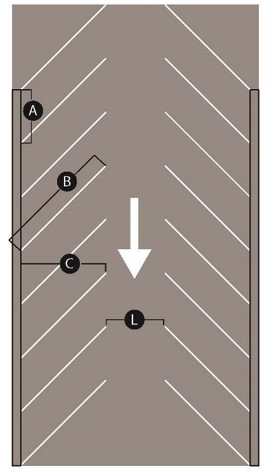
- Accessible Parking Spaces. One accessible parking shall be required for any development having twenty-five (25) or more parking spaces. Thereafter, not less than two percent (2%) of the parking spaces within a development shall be built and maintained as accessible parking spaces.
- Turnaround Bay. There shall be a turnaround bay, at least nine and one-half feet (9 1/2') deep and thirteen feet (13') wide, with eighteen-foot (18') radii located at the end of each dead end row of parking stalls.
- Undeveloped Lots and Parcels. No parking shall occur on undeveloped lots or parcels.
11-19-4: SCHEDULE OF REQUIRED OFF STREET SPACES
- Off Street Parking Spaces. Off street parking spaces shall be provided for each specified use in accordance with the schedule below.
- In calculating the total number of required parking spaces, "usable area", as used herein, shall mean the area capable of being devoted to the specified use (does not include such spaces as kitchens, restrooms, hallways, etc.), and the term "seat" shall also include each thirty inches (30") of bench seating when individual seats are not provided.
- Mixed Use Developments. In the event of mixed-use developments, the total requirement for off street parking spaces is the sum of the requirements of the various uses computed separately.
- Fractional Amount. In calculating the total number of required off street parking spaces, fractional amounts are to be disregarded.
- Unlisted Uses. Minimum parking requirements for a specific use not listed in this section shall be determined by the Planning Director with appeal to the Planning Commission.
- All required parking stalls must be non-tandem, except that visitor parking stalls may be tandem with the following standards.
- Both the required parking stalls and visitor tandem parking stalls must be for the same dwelling unit.
- Tandem visitor parking is only allowed behind a fully enclosed parking stall.
- All tandem parking pads shall meet the following size requirement, i.e., 10 feet wide by 20 feet in depth.
- Tandem visiting parking may only be used to satisfy up to one half of a project’s visitor parking requirement.
- Schedule.
1. Residential Use a. One- or two-family residence 2 per dwelling unit b. Multiple dwellings with more than 2 units 2 per dwelling unit, plus 1 visitor parking space for every 2 dwelling units, or fraction thereof. Independent living units – 1 per unit c. Rooming houses, fraternities, sororities, resident clubs, lodges 1 per sleeping room or 1 per bed, whichever is greater 2. Civic Use:
All Civic Uses11-19-4 schedule of required off street parking spaces shall be used for business offices.
a. For parks the National Recreation and Parks Association guidelines will be consulted for the number of required stalls. The Planning Commission shall approve the number of onsite and offsite stalls after evaluation of the park uses and needs.
b. When the civic use does not require permanent parking or when the use is intermittently used, the Planning Commission may take into account on street spaces and not require any off street spaces or adjust the number of required parking stalls.3. Commercial Sales and Service: a. Restaurants, bars, cocktail lounges 1 per 40 square feet of usable floor area b. Drive-in food or drink places with on-site consumption 1 per 40 square feet of usable floor area c. Mortuaries, funeral homes 1 space for each 75 square feet of gross floor area of public assembly area d. Self-service laundries and dry cleaners 1 per 2 machines e. Open air businesses 1 per 500 square feet of sales area for first 2,000 square feet, plus 1 per additional 2,000 square feet f. Auto sales lots 1 per each 300 square feet of office area and covered parking area, plus 2 for the first 10,000 square feet or portion thereof of land area and 1 for each additional 10,000 feet, or portion thereof of land area, plus 2 per service bay g. Gas service stations 1 per each 375 square feet of building h. Car wash 1 per employee, plus reserve spaces equal to 4 times the wash capacity i. Motor vehicle and machinery sales, auto repair shops 1 per 200 square feet of floor area j. Planned shopping centers under unified control Requirements for all uses elsewhere specified herein. All unspecified uses shall have at least 1 parking stall for every 200 square feet of gross building area for the first 25,000 square feet of gross building area in the center; then 1 parking stall for every 250 square feet of gross building area for gross building area over 25,000 square feet in the center k. Barbershops, beauty shops 2 per service chair l. Furniture and appliance stores, household equipment 1 per 800 square feet floor area m. Supermarkets, drugstores 1 per 250 square feet of gross leasable space n. Hotels, motels 1 1/2 per guest room or suite o. Bus depots 1 per 150 square feet of waiting room space p. Skating rinks, dance halls, dance studios 1 per 3 persons of maximum capacity permitted by fire regulations q. Bowling alleys 6 per bowling lane r. Billiard parlors 1 per billiard table s. Gymnasiums, health studios 1 per 350 square feet of usable floor area t. Private golf clubs, athletic, swimming and tennis clubs 1 per every 5 memberships u. Auditoriums, gymnasiums, and similar places of public assembly 1 per every 4-person occupancy capacity v. Theaters 1 per every 6-person occupancy capacity 4. Offices and Clinic Uses: a. Offices, banks, savings, and loan agencies 1 per 250 square feet of gross floor area b. Medical and dental offices 3 per examination room or dental chair c. Nursing homes, convalescent homes, and homes for the aged 1 per 4 beds 5. Schools and Institutions: a. Elementary and intermediate schools 2 per classroom b. High schools 6 per classroom and other teaching stations c. Junior colleges, colleges, universities 3 per classroom and other teaching stations d. Trade schools, business college 1 per 150 square feet of gross floor area e. Hospitals 1 per bed f. Churches, community centers, libraries, assembly halls, public meetings 1 space per each 75 square feet of meeting area 6. Manufacturing and Industrial Uses: a. Manufacturing 2 per every 3 employees b. Telemarketing, data processing centers 1 per 50 square feet of building area c. Other industrial uses 1 per 300 square feet d. Warehousing or wholesaling 1 per 800 square feet e. Ministorage 1 per 35 spaces, plus 1 for the manager
11-19-5: BUSINESS REQUIRING AUTOMOBILE ACCESS
- Service stations, roadside stands, public parking lots, storage sheds and all other businesses requiring motor vehicle access shall meet the following requirements:
- Access. Access to the station or other structure or parking lot shall be as per Public Works standards.
- Gasoline Pumps. Gasoline pumps shall be set back at least twenty feet (20') from any property line bordering a street; provided, that a pump island parallel to an adjoining street may be located not less than fifteen feet (15') from the property line bordering said street.
11-19-6: VEHICULAR TRAFFIC TO COMMERCIAL OR MANUFACTURING ZONES
- Land, other than public streets, located within a residential zone shall not be used as a regular means of vehicular passage to and from property in commercial or manufacturing zones.
11-19-7: OFF STREET LOADING SPACES
- Location. Off street loading spaces shall not be permitted in any required front yard, nor in any required side yard, except in a nonresidential district where a side yard abuts an alley. An off-street loading space may occupy all or any part of a required rear yard and may be partially or entirely enclosed within a building. All loading areas abutting residential zoning districts shall be screened from the residential zoning districts.
- Size. Every required off street loading space shall have a minimum width of twelve feet (12'), a minimum length of forty-five feet (45') and a minimum height of fourteen feet (14'), exclusive of access aisles and maneuvering space.
- Screening. Screen of off-site loading spaces shall follow the requirements of parking lots in CCNO 11-19-9, A, 3.
11-19-8: ALLEY ABUTMENT
- Where a building or use in a nonresidential district abuts an alley, such alley may be used as maneuvering space for loading and unloading spaces. No alley abutting any residential district may be so used.
11-19-9: PARKING LOT LANDSCAPING
- Amount Required.
- Interior Parking Lot Landscaping. A landscape island shall be installed every ten (10) parking spaces with a minimum width of nine (9) feet. Each island shall contain at least one deciduous shade tree with shrubs and groundcover to include at least 50% live material.
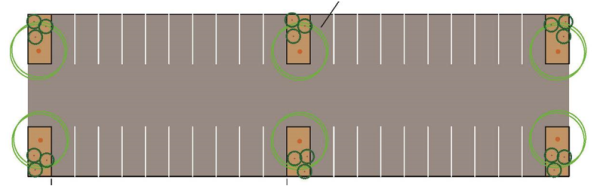
- Perimeter Parking Lot Landscaping. The perimeter of all parking areas shall contain deciduous shade trees planted at an average spacing of forty (40) feet on center as well as, shrubs, ground cover, pedestrian walkways, and plazas.
- Screening. All parking lots shall screen vehicle headlights with a berm or landscaping running along all street frontages. The screen is intended to create a more walkable streetscape and shall be located in the landscaped area between the sidewalk and parking lot pavement. The berms shall not be steeper than one foot (1') vertical for each three (3) horizontal feet of landscaped area and shall be a minimum height of two feet (2’) and a maximum of three feet (3'). The height shall be measured from the top of the street curb. Off street parking areas serving single-family dwellings, two-family dwellings and churches are excluded from this regulation.
- Interior Parking Lot Landscaping. A landscape island shall be installed every ten (10) parking spaces with a minimum width of nine (9) feet. Each island shall contain at least one deciduous shade tree with shrubs and groundcover to include at least 50% live material.
- Location. The landscaping should be located in protected areas, such as along walkways, in center islands, at the ends of bays or between parking stalls. All landscaping in parking areas and on the street, frontage shall be placed so that it will not obstruct sight distance.
- Plant Type. A mixture of hardy flowering and deciduous trees shall be planted. The area between trees shall be mulched, planted with shrubs, or ground cover, or covered with paving material. Any area that will be under the overhang of vehicles shall be mulched or covered with paving materials.

