
North Ogden City Zoning Code
11-9
RESIDENTIAL AND CIVIC ZONES
2025-05
2024-02
2022-24 Amended
2026-08
2022-16 Amended
2024-08
2025-09
2024-04
2022-22 Amended
2022-28
2022-08 Amended
11-9A-1: PURPOSE AND INTENT
- The purpose of the RE-20 zone classification is to provide a regulated area for large lot, single-family residential and agricultural uses.
11-9A-2: PERMITTED USES
The following uses shall be permitted:
- Accessory buildings and uses customarily incidental to any permitted use. See CCNO 11-9M-8.
- Accessory dwelling unit as a second residence. See CCNO 11-9M-9.
- Agriculture, subject to County Health regulations and CCNO 5-3, Sound Regulations to include nurseries and greenhouses, provided the sale of goods is limited to materials produced on the premises, and there is no retail shop operated in connection therewith. Roadside vegetable and fruits stands are permitted.
- Animals or fowl.
- On one acre or more, up to five (5) acres, animals and fowl will be limited to four (4) horses, cows, sheep or goats, or combination thereof, per acre. Up to five (5) rabbits per acre shall be permitted.
- On more than five (5) acres, an aggregate of a total of two (2) units of group A, B or C, or a combination thereof, may be kept per acre.
- Group A: Four (4) horses or cows, or combination thereof. (Equestrian stables exempt)
- Group B: Four (4) sheep or goats.
- Group C: Five (5) rabbits, or thirty (30) chickens, or thirty (30) pheasants, or ten (10) turkeys, or ten (10) ducks, or five (5) geese, or ten (10) pigeons.
- The keeping of swine of any species, including pigs, is not permitted within North Ogden City Limits.
- Shade must be provided.
- Clean, fresh water and fresh feed must be readily available.
- Attached dwelling units. See CCNO 11-13.
- Barn upon a lot with a minimum of one (1) acre. Barns are not subject to the accessory building design standards found in CCNO 11-9M-8.
- Cemeteries.
- Church, synagogue or similar permanent building used for religious worship.
- Daycare. See CCNO 11-9M-13.
- Educational institution, which has a curricula substantially the same as customarily offered in the public school system for kindergarten through twelfth grade.
- Golf course, except miniature golf course.
- Home occupations. See CCNO 11-14.
- Libraries.
- Model homes, master planned village sales and information centers, and temporary sales trailers. See CCNO 11-9M-15.
- Planned Unit Development. See CCNO 11-12.
- Private equestrian training stable facilities on a minimum of five (5) acres of land and at a density of not more than ten (10) horses per acre.
- Public buildings, public park recreation grounds and associated buildings.
- Public utility substation. See CCNO 11-9M-18.
- Preschools. See CCNO 11-9M-13.
- Single-family dwelling.
- Temporary building for use incidental to construction work. Such building shall be removed upon completion or abandonment of the construction work.
11-9A-3: SITE DEVELOPMENT STANDARDS
(Measurements in feet or square feet)
A. Minimum lot area: (sq. feet) | |
1. Interior or corner lot | 20,000 |
2. Interior or corner lot with animals | 43,560 square feet/ 1 acre |
B. Minimum lot width measured 30 feet back from the front property line | |
1. Interior lot | 100’ |
2. Corner lot | 120’ |
C. Minimum yard setbacks (Movable building, i.e., without in ground foundation, may be placed over easements without restrictions, coordinate with utility companies to determine restrictions for placement of any permanent structures) | |
1. Front | 30’ |
2. Side | |
a. Dwelling | 10’ |
b. Total combination width not less than | 24’ |
c. Exception: Where there is an attached garage with the required number of parking spaces, both side yards may be | 10’ |
3. Side facing street on corner lot | 20’ |
4. Rear | 50’ |
5. Keeping of Animals or Fowl |
|
a. Animals or fowl may be maintained on a lot, there shall be provided a minimum spacing of | 20’ from the existing dwelling |
b. From a dwelling on an adjacent lot | 75’ |
c. Any barn, stable, coop or pen shall not be constructed closer to a street than: | 100’ |
(1). Exception: An enclosure or pasture may be adjacent to a public street if larger than: | 1 Acre |
(2). Exception: All utility easements must be maintained in an open state |
|
D. Total lot coverage |
|
1. Minimum vegetative area | 50% |
E. Building height |
|
1. Minimum | 10’ |
2. Maximum | 35’ |
F. Accessory building regulations (see also CCNO 11-9M-8) |
|
1. Accessory building height | |
2. Accessory building setback |
|
a. Accessory building/large accessory building | |
(1). Corner lot (street side) | 20’ |
(2). Required setback in feet (with permitted increases in building height beyond 10’) |
|
(A) Buildings that meet the design standards requirements in 11-9M-8: a building up to 10’ tall may be 3’ from the property line. Beginning at 5’ from the property line, an increase in building height beyond 10’ is permitted at a 1:1 ratio up to a maximum building height of 25’. Rooflines may exist within the vertical envelope created by the 1:1 ratio of building height and setback. |
|
3. Minimum separation required between primary building and accessory building | At least 6’ |
4. Maximum rear yard coverage by accessory building | 25% |
a. On lots less than an acre, the minimum rear yard area calculation is based upon the minimum lot width times the rear yard setback and not the actual rear yard dimensions |
|
5. Building Design and Materials - See CCNO 11-9M-8 |
11-9A-4: SIGN REGULATIONS
- The height, size and location of signs shall be in accordance with the regulations set forth in CCNO 11-21.
11-9B-1: PURPOSE AND INTENT
- The purpose of the R-1-12.5, R-1-10, R-1-8, R-1-8(A) and R-1-8(AG) zoning classification is to provide regulated areas for single-family residential use at three (3) different low-density levels.
11-9B-2: PERMITTED USES
The following uses shall be permitted:
- Accessory buildings and uses customarily incidental to any permitted use.
- Accessory Dwelling Unit. See CCNO 11-9M-9.
- Agriculture. Subject to County Health regulations and CCNO 5-3, Sound Regulations.
- Animals or fowl permitted in the R-1-8(AG) zoning districts only:
- On lots one acre or more, up to five (5) acres in size, animals and fowl will be limited to four (4) horses, cows, sheep or goats, or combination thereof per acre.
- On lots more than five (5) acres in size, an aggregate of a total of two (2) units of group A, B or C, or a combination thereof, may be kept per acre.
- Group A: Four (4) horses or cows, or combination thereof.
- Group B: Four (4) sheep or goats.
- Group C: Five (5) rabbits, or thirty (30) chickens, or thirty (30) pheasants, or ten (10) turkeys, or ten (10) ducks, or five (5) geese, or ten (10) pigeons.
- Group A: Four (4) horses or cows, or combination thereof.
- The keeping of swine of any species, including pigs, is not permitted within the corporate limits of the City.
- Attached dwelling units. See CCNO 11-13.
- Church, synagogue or similar permanent building used for regular religious worship.
- Daycare. See CCNO 11-9M-13.
- Home occupations. See CCNO 11-14.
- Household pets.
- Libraries.
- Planned Unit Development. See CCNO 11-13.
- Preschools. See CCNO 11-9M-13.
- Public buildings, public parks, recreation grounds and associated buildings.
- Public schools, private educational institutions having a curriculum similar to that ordinarily given in public schools, private parks, playgrounds and recreation areas that meet the requirements of CCNO 11-9M-17 and the following requirements:
- All facilities, equipment and buildings shall be set back not less than twenty feet (20') from any property line and shall be located not less than fifty feet (50') from any main building on an adjoining lot and from any area upon which any such main building may be constructed upon said adjoining lot if no such main building is in existence.
- The minimum size of the lot or site used for such recreational or other purposes shall be one acre.
- Any lights used to illuminate the premises shall be installed in such a manner that the source of light shall not be visible from outside the premises, and the source of light shall be suitably screened to avoid annoying illumination of lands outside said premises.
- Single-family dwellings.
- Temporary buildings, structures and uses incidental to construction work. Such building shall be removed upon completion or abandonment of the construction work.
11-9B-3: CONDITIONAL USES
- The following uses are permitted only when authorized by a conditional use permit as provided in CCNO 11-2-7:
- Private Park, playground or recreation area not open to the general public and to which no admission charge is made and not including privately owned commercial amusement business.
- Public utility substation in accordance with the standards stated in CCNO 11-10-14.
11-9B-4: SITE DEVELOPMENT STANDARDS
(Measurements in feet or square feet)
| R-1-12.5 | R-1-10 | R-1-8 | R-1-8(A) | R-1-8(AG) | |
| A. Minimum lot area (sq. ft.): | |||||
| 1. Interior lot | 12,500 | 10,000 | 8,000 | 8,000 | 8,000 |
| 2. Corner lot | 13,500 | 11,000 | 9,000 | 8,000 | 9,000 |
| B. Minimum lot width measured 30 feet back from the front property line | 100' | 90' | 80' | 80' | 80' |
| C. Minimum yard setbacks: Written permission must be secured from all utility companies to place a non-movable structure, i.e. a structure with a permanent in-ground foundation, over the easements. | |||||
| 1. Front | 30’ | 30’ | 30’ | 30’ | 30’ |
| 2. Side: | |||||
| a. Dwelling-interior | 10' | 10' | 8' | 4' | 8' |
| b. Total combination width not less than | 24' | 24' | 18' | 12' | 18' |
| c. Exception: Where there is an attached garage with the required number of parking spaces, both side yards may be | 10' | 10' | 8' | 4' | 8' |
| 3. Side facing street on corner lot | 20' | 20' | 20' | 20' | 20' |
| 4. Rear: | 20’ | 20’ | 20’ | 20’ | 20’ |
| D. Total lot coverage: | |||||
| 1. Primary/main Building footprint | 35% | 35% | 35% | 35% | 35% |
| 2. Minimum vegetative area | 50% | 50% | 50% | 50% | 50% |
| E. Building height (in feet): | |||||
| 1. Minimum | 10’ | 10’ | 10’ | 10’ | 10’ |
| 2. Maximum | 35’ | 35’ | 35’ | 35’ | 35’ |
| F. Accessory building regulations | |||||
| 1. Accessory building height | |||||
| 2. Accessory building setback | |||||
| a. Accessory/Large building | |||||
(1) Setback minimum in feet (if building height is 10’ or less) | 3’ | 3’ | 3’ | 3’ | 3’ |
| (2) Buildings that meet the design standards requirements in 11-9M-8: a building up to 10’ tall may be 3’ from the property line. Beginning at 5’ from the property line, an increase in building height beyond 10’ is permitted at a 1:1 ratio up to a maximum building height of 25’. Rooflines may exist within the vertical envelope created by the 1:1 ratio of building height and setback. | |||||
| 3. Corner lot setback (street side) | 20' | 20' | 20' | 20' | 20' |
| 4. Minimum separation required between main building and accessory buildings | At least 6' | ||||
| 5. Maximum rear yard coverage by accessory building | 25% | ||||
| 6. Maximum number of large accessory buildings per lot | 1 | ||||
| 7. Building Design and Materials – See 11-9M-8 | |||||
11-9B-5: SIGN REGULATIONS
- The height, size and location of signs shall be in accordance with the regulations set forth in CCNO 11-21.
11-9C-1: PURPOSE AND INTENT
- The purpose of the Residential Zone R-1-5 zone classification is to provide a regulated area for single-family residential uses in a small lot configuration to provide flexibility for infill, redevelopment, and/or other similar projects in a planned residential unit development. Property designated in the General Plan as low to medium density may be rezoned to this designation with a maximum density of six (6) dwelling units per acre as averaged across the developable acreage. Property designated in the General Plan as low to medium density may be rezoned to this designation with a maximum density of ten (10) dwelling units per acre as averaged across the developable acreage.
11-9C-2: ZONE CHANGE CRITERIA
- A concept plan is required to be submitted with the zone change application per CCNO 11-4-4.
11-9C-3: PERMITTED USES
- The following uses shall be permitted:
- Attached dwelling units. See CCNO 11-13.
- Church, synagogue or similar permanent building used for regular religious worship.
- Home occupations. See CCNO 11-14.
- Household pets.
- Planned Unit Development. See CCNO 11-13.
- Public buildings, public or private parks, recreation grounds and associated buildings. See CCNO 11-9M-17.
- Single-family dwellings.
- Temporary buildings, structures and uses incidental to construction work. Such building shall be removed upon completion or abandonment of the construction work.
11-9C-4: SITE DEVELOPMENT STANDARDS
(Measurements in feet or square feet)
A. Minimum zone area | 5 Acres in low density General Plan areas 1 Acre in medium density General Plan areas |
B. General Plan Low Density Areas | Maximum Density 6 dwelling units per acre |
C. General Plan Medium Density Areas | Maximum Density 10 dwelling units per acre |
D. Minimum lot area: (square feet) | |
1. Interior with single-family dwelling | 4,600 square feet low density area 4,000 square feet medium density area |
2. Corner with single-family dwelling | 5,600 square feet low density area 5,000 square feet medium density area |
E. Minimum lot width measured 30 feet back from the front property line | 55’ |
F. Minimum yard setback (in feet) |
|
1. Front (see 11-9C-6 below) | 20’ |
2. Interior side | 7’ |
3. Street side. All utility easements must be maintained in an open state | 20' Exception: The street side setback can be reduced to 10 feet along all streets which do not extend beyond the depth of the lot for which the exemption shall apply |
4. Rear | 20’ Exception: The rear yard setback for the main use/dwelling may be reduced by 10% provided that the combined distance between the neighboring structures remains 40 feet or greater |
G. Building height |
|
1. Minimum one story | 12’ |
2. Maximum one and a half story | 27’ |
H. Maximum lot coverage: |
|
1. Primary/main Building footprint | 45% |
2. Minimum vegetative area | 40% |
11-9C-5: SIGN REGULATIONS
- The height, size and locations of signs shall be in accordance with the regulations set forth in CCNO 11-21.
11-9C-6 DESIGN STANDARDS
- All residential development shall include the following design features:
- Front yard setbacks may be reduced to 15’ if rear loaded garages are utilized for units facing a street.
11-9D-1: PURPOSE AND INTENT
- The purpose of the R-2 zone is to provide residential areas that will accommodate the development of dwelling types from single-family through two-family dwelling units, with their associated necessary public services and activities. It is also to provide an orderly transition from less intensive, lower density uses to medium density uses.
11-9D-2: PERMITTED USES
- The following uses shall be permitted:
- Accessory buildings and uses customarily incidental to any permitted use. See CCNO 11-9L-9.
- Attached dwelling units. See CCNO 11-13.
- Church, synagogue or similar permanent building used for regular religious worship.
- Daycare. See CCNO 11-9M-13.
- Educational institutions, public schools, private parks, playgrounds, and recreational areas that meet the requirements of CCNO 11-9M-17.
- Golf course, except miniature golf.
- Home occupations. See CCNO 11-14.
- Household pets. Includes an allowance for 6 female chickens in a coop and pen. See CCNO 11-9M-10.
- Model homes, master planned village sales and information centers, and temporary sales trailers in accordance with CCNO 11-9M-17 and approved during the subdivision process.
- Planned Unit Development. See CCNO 11-13.
- Public buildings, public parks, recreation grounds and associated buildings. See CCNO 11-9M-18 and 11-26-12 .
- Public utility substation in accordance with the standards stated in CCNO 11-9M-19.
- Preschools. See CCNO 11-9M-13.
- Single-family dwellings.
- Temporary buildings, structures and uses incidental to construction work. Such building shall be removed upon completion or abandonment of the construction work.
- Two-family dwellings and twin homes.
11-9D-3: SITE DEVELOPMENT STANDARDS
(Measurements in feet or square feet)
| A. Minimum lot area | |
| 1. Interior with single-family dwelling | 8,000 square feet |
| 2. Interior with two-family dwelling or other main building, includes twin homes | 12,000 square feet total, 6000 per unit |
| 3. Corner with single-family dwelling | 9,000 square feet |
| 4. Corner with two-family dwelling or main building with other than dwelling | 12,000 square feet total, 6000 per unit |
| B. Minimum lot widths measured 30 feet back from the front property line | |
| 1. For a single-family dwelling at a distance thirty feet (30') back from the front property line | 80' |
| 2. For a two-family dwelling at a distance thirty feet (30') back from the front property line | 90' |
| C. Minimum yard setback | |
| 1. Front | 30' |
| 2. Side | |
| a. Dwelling | 8' |
| (1). Minimum length of the total of the two (2) side yards | 18' |
| (2). For interior lots where there is an attached garage with the required number of parking spaces, each side yard may be eight feet (8') | |
| b. Other main buildings (each side) | 20' |
| c. Twin home | 18' |
| 3. Side facing street on corner lot | 20' |
| 4. All utility easements must be maintained in an open state, unless written permission is secured from all utility companies to place a structure over the easements | |
| 5. Rear | |
| a. Main building | 20' |
| b. Minimum spacing between main and accessory buildings | 6' |
| 6. Building height | |
| a. Minimum | 10' |
| b. Maximum | 35' |
| D. Total lot coverage: | |
| 1. Maximum rear yard coverage for accessory building or group of accessory buildings | 25% |
| 2. Maximum lot coverage for building or group of buildings with the accessory buildings | 35% |
| E. Accessory building regulations (see also CCNO 11-9-M-9) | |
| 1. Accessory building height | |
| 2. Accessory building setback | |
| a. Accessory building | |
| (1) Corner lot (street side) | 20' |
| (2) Required setback in feet (with permitted increases in building height beyond | |
| (A) Buildings that meet the design standards requirements in 11-9M-8: a building up to 10’ tall may be 3’ from the property line. Beginning at 5’ from the property line, an increase in building height beyond 10’ is permitted at a 1:1 ratio up to a maximum building height of 25’. Rooflines may exist within the vertical envelope created by the 1:1 ratio of building height and setback. | |
| 3. Minimum separation required between primary building and between all accessory buildings | At least 6' |
Amended by Ord. 2022-24 Amended on 12/13/2022
Amended by Ord. 2024-02 Amends Accessory Building Standards on 1/23/2024
11-9D-4 DESIGN STANDARDS
- All residential development shall include the following design features:
- Front yard setbacks may be reduced to 15’ if rear loaded garages are utilized for units facing a street.
11-9D-5: SIGN REGULATIONS
- The height, size and location of signs shall be in accordance with the regulations set forth in CCNO 11-21.
11-9D-6: SITE PLAN APPROVAL
- For all permitted uses other than single-family dwellings and agricultural uses, a site plan shall be required in accordance with CCNO 11-2-9.
11-9E-1: PURPOSE AND INTENT
- The purpose of the R-3 zone is to provide higher density residential areas with associated necessary public services and activities. It is also to provide an orderly transition from less intensive, lower density uses to medium density uses.
11-9E-2: PERMITTED USES
- The following uses shall be permitted:
- Attached dwelling units. See CCNO 11-13.
- Church, synagogue or similar permanent building used for regular religious worship.
- Daycare. See CCNO 11-9M-13.
- Golf course, except miniature golf.
- Home occupations. See CCNO 11-14.
- Household pets.
- Model homes, master planned village sales and information centers, and temporary sales trailers in accordance with CCNO 11-9M-16.
- Planned Unit Development. See CCNO 11-13.
- Preschools. See CCNO 11-9M-13.
- Public buildings, public libraries, public museums (nonprofit), public schools, public educational institutions having a curriculum similar to that ordinarily given in public schools; private parks, playgrounds and public recreation grounds, and associated buildings. See CCNO 11-9M-17.
- Public utility substation. See CCNO 11-9M-19.
- Single-family dwellings.
- Temporary buildings, structures and uses incidental to construction work. Such building shall be removed upon completion or abandonment of the construction work.
- Two-family dwellings and twin homes.
11-9E-3: SITE DEVELOPMENT STANDARDS
(Measurements in feet or square feet)
| A. Minimum lot area | |
| 1. Interior with single-family dwelling | 8,000 square feet |
| 2. Corner with single-family dwelling | 9,000 square feet |
| 3. Interior and corner - multi-family dwelling | 10,000 square feet |
| 4. Interior - nonresidential building | 8,500 square feet |
| 5. Corner - nonresidential building | 9,500 square feet |
| B. Minimum lot width measured 30 feet back from the front property line | 80' |
| C. Minimum Yard Setback: | |
| 1. Front | 30' |
| 2. Side | |
| a. Single-family dwelling | 8’ Exception: The total of two side yards shall not be less than 17’ |
| b. Other main buildings (each side) | 20' |
| c. All utility easements must be maintained in an open state | |
| 3. Side facing street on corner lot | 20' |
| 4. Rear (main building) | 20' |
| D. Building Height | |
| 1. Minimum | 10' |
| 2. Maximum | 35' |
| E. Total lot coverage: | |
| 1. No accessory building or group of accessory buildings shall cover more of the rear yard than twenty five percent (25%) | |
| 2. No building or group of buildings with the accessory buildings shall cover more of the total lot area than fifty percent (50%) | |
| F. Accessory building regulations (see also CCNO 11-9M-8) | |
| 1. Accessory building height | |
| 2. Accessory building setbacks | |
| a. Accessory building | |
| (1) Corner lot (street side) | 20' |
| (2) Required setback | |
| (A) Buildings that meet the design standards requirements in 11-9M-8: a building up to 10’ tall may be 3’ from the property line. Beginning at 5’ from the property line, an increase in building height beyond 10’ is permitted at a 1:1 ratio up to a maximum building height of 25’. Rooflines may exist within the vertical envelope created by the 1:1 ratio of building height and setback | |
| 3. Minimum separation required between primary building and between all accessory buildings | At least 6' |
Amended by Ord. 2022-24 Amended on 12/13/2022
Amended by Ord. 2024-02 Amends Accessory Building Standards on 1/23/2024
11-9E-4 DESIGN STANDARDS
- All residential development shall include the following design features:
- Front yard setbacks may be reduced to 15’ if rear loaded garages are utilized for units facing a street.
11-9E-5: SIGN REGULATIONS
- The height, size and location of signs shall be in accordance with the regulations set forth in CCNO 11-21.
11-9E-6: SITE PLAN APPROVAL
- For all permitted uses other than single-family dwellings and two-family dwellings, a site plan shall be required in accordance with CCNO 11-2-9.
11-9F-1: PURPOSE AND INTENT
- The purpose of the R-4 zone is to provide higher density residential areas with associated necessary public services and activities. It is also to provide an orderly transition from less intensive, lower density uses to more intensive, higher density uses.
11-9F-2: PERMITTED USES
The following uses shall be permitted:
- Accessory buildings and uses customarily incidental to any permitted use.
- Attached dwelling units. See CCNO 11-13.
- Church, synagogue or similar permanent building used for regular religious worship.
- Daycare. See CCNO 11-9M-13
- Golf course, except miniature golf.
- Home occupations. See CCNO 11-14.
- Household pets.
- Model homes, master planned village sales and information centers and temporary sales trailers in accordance with CCNO 11-9M-16.
- Multi-family dwellings.
- Planned Unit Development. See CCNO 11-13.
- Preschools. See CCNO 11-9M-13.
- Private Park, playground or recreation area, but not including privately owned commercial amusement business. See CCNO 11-9M-17.
- Public schools, private educational institutions having a curriculum similar to that ordinarily given in public schools. See CCNO 11-9M-18.
- Public utility substation in accordance with standards stated in CCNO 11-9M-19.
- Single-family dwelling.
- Temporary building for use incidental to construction work. Such building shall be removed upon completion or abandonment of the construction work.
- Two-family dwelling and twin homes.
- Residential care facility.
11-9F-3: SITE DEVELOPMENT STANDARDS
(Measurements in feet and square feet)
| A. Minimum lot area | |
| 1. Interior with single-family dwelling | 8,000 square feet |
| 2. Corner with single-family dwelling | 9,000 square feet |
| 3. Interior and corner - two-family dwelling | 8,000 square feet |
| 4. Interior with nonresidential main building | 8,500 square feet |
| 5. Corner with nonresidential main building | 9,500 square feet |
| 6. Residential care facility, in addition to minimum, for each patient | 500 square feet |
| B. Minimum lot width measured 30 feet back from the front property line | 80' |
| C. Minimum Yard Setback: | |
| 1. Front | 30' If located on Washington Blvd. or 2700 North, the front yard setback is 20’ with no parking allowed in the front yard. |
| 2. Side | |
| a. Single-family dwelling | 8’ Exception: The total of two side yards shall not be less than 17’ Exception: On interior lots where there is an attached garage with the required number of parking spaces, each side yard may be 8' |
| b. Other main buildings (each side) | 20' |
| c. All utility easements must be maintained in an open state | |
| d. Twin homes | 16' |
| e. Side facing street on corner lot | 20' |
| 3. Rear (main building) | 20' |
| D. Building Height | |
| 1. Minimum | 10' |
| 2. Maximum | 35' |
| E. Accessory building regulations (see also CCNO 11-9M-9) | |
| 1. Accessory building height | |
| 2. Accessory building setback | |
| a. Accessory building | |
| (1) Corner lot (street side) | 20' |
| (2) Required setback in feet (with permitted increases in building height beyond 10') | |
| b. Buildings that meet the design standards requirements in 11-9M-8: a building up to 10’ tall may be 3’ from the property line. Beginning at 5’ from the property line, an increase in building height beyond 10’ is permitted at a 1:1 ratio up to a maximum building height of 25’. Rooflines may exist within the vertical envelope created by the 1:1 ratio of building height and setback | |
| 3. Minimum separation required between primary building and between all accessory buildings | At least 6' |
Amended by Ord. 2022-24 Amended on 12/13/2022
Amended by Ord. 2024-02 Amends Accessory Building Standards on 1/23/2024
11-9F-4 DESIGN STANDARDS
- All residential development shall include the following design features:
- Front yard setbacks may be reduced to 15’ if rear loaded garages are utilized for units facing a street.
- Non-residential uses shall use brick, stone, or Hardie plank (cementitious material) for the entire front façade and extend that material to at least 10’ on the sides with a wainscot required to continue around the building utilizing the from façade materials.
11-9F-5: SIGN REGULATIONS
- The height, size and location of signs shall be in accordance with the regulations set forth in CCNO 11-21.
11-9F-6: SITE PLAN APPROVAL
- For any permitted or conditional uses other than single-family dwellings and agricultural uses, a site plan shall be required in accordance with CCNO 11-2-9.
11-9G-1: PURPOSE AND INTENT
- The purpose of the Roylance Farms phase II Planned Unit Development zone classification is to provide a regulated area for single-family residential uses in a Planned Unit Development.
11-9G-2: PERMITTED USES
- The following uses shall be permitted:
- Attached dwelling units. See CCNO 11-13.
- Church, synagogue or similar permanent building used for regular religious worship.
- Home daycare center. See CCNO 11-9M-13.
- Home occupations. See CCNO 11-14.
- Home preschool. See CCNO 11-9M-13.
- Household pets.
- Single-family dwellings.
- Temporary buildings, structures and uses incidental to construction work. Such building shall be removed upon completion or abandonment of the construction work.
- Accessory buildings and uses customarily incidental to any permitted use. (See 11NOCC 11-9M-8 for accessory building standards.)
11-9G-3: SITE DEVELOPMENT STANDARDS
(Measurements in feet and square feet)
| A. Minimum lot area (square feet) | 2,232 |
| B. Minimum lot width (measured 20 feet back from the front property line) | 37' |
| C. Minimum yard setback (in feet) | |
| 1. Front | 20' |
| 2. Interior side | 7' |
| 3. Street side | 20' |
| 4. Rear | 20' |
| 5. All utility easements must be maintained in an open state | |
| D. Building height (in feet) | |
| 1. Minimum one story | 10' |
| 2. Maximum one story | 20' |
11-9G-4: SIGN REGULATIONS
- The height, size and location of signs shall be in accordance with the regulations set forth in CCNO 11-21.
11-9H-1: PURPOSE AND INTENT
- The purpose of the Quail Ponds Planned Unit Development zone classification is to provide a regulated area for single-family residential uses in a Planned Unit Development.
11-9H-2: PERMITTED USES
- The following uses shall be permitted:
- Attached dwelling units. See CCNO 11-13.
- Church, synagogue or similar permanent building used for regular religious worship.
- Home occupations. See CCNO 11-14.
- Household pets.
- Planned Unit Development. See CCNO 11-13.
- Public buildings, public or private parks, recreation grounds, and associated buildings. See CCNO 11-9M-17, 11-9M-18, 11-9M-19, and 11-26-12.
- Single-family dwellings.
- Temporary buildings, structures and uses incidental to construction work. Such building shall be removed upon completion or abandonment of the construction work.
- Accessory buildings and uses customarily incidental to any permitted use. See CCNO 11-9M-8.
11-9H-3: SITE DEVELOPMENT STANDARDS
(Measurements in feet and square feet)
| A. Minimum lot area | 4,290 square feet |
| B. Minimum lot width | Measured 30 feet back from the front property line |
| C. Minimum yard setback | |
| 1. Front | 18' |
| 2. Interior side | 5' |
| 3. Street side | 15' |
| 4. All utility easements must be maintained in an open state | |
| 5. Rear | On the lots numbered on the July 31, 1998 preliminary plat: 10’ on lots 1 through 28 and lots 46 through 63; 20’ on lots 29 through 45 |
| D. Building height | |
| 1. Minimum one story | 10' |
| 2. Maximum one and a half story | 27' |
| E. Maximum lot coverage percentage | |
| 1. Under roof | 45% |
11-9H-4: SIGN REGULATIONS
- The height, size and location of permitted signs shall be in accordance with the regulations set forth in CCNO 11-21.
11-9I-1: PURPOSE AND INTENT
- The purpose of the Cold Creek Planned Unit Development zone classification is to provide a regulated area for single-family and multi-family residential uses in a Planned Unit Development.
11-9I-2: PERMITTED USES
- The following uses shall be permitted:
- Home occupations. See CCNO 11-14.
- Household pets.
- Multi-family dwellings.
- Single-family dwellings.
- Temporary buildings incidental to construction work.
- Accessory buildings and uses customarily incidental to any permitted use. See CCNO 11-9M-8.
11-9I-3: SITE DEVELOPMENT STANDARDS
(Measurements in feet and square feet)
| A. Minimum lot area | |
| 1. Interior with single-family dwelling | 5,565 square feet |
| 2. Corner with single-family dwelling | 6,825 square feet |
| B. Minimum single-family lot width | 53' |
| C. Minimum yard setback single-family | |
| 1. Front | 20' |
| 2. Interior side | 15’ between one-story buildings 20’ between two-story buildings |
| 3. Street side | 20' |
| 4. Rear | 20' |
| D. Minimum yard setback multi-family | |
| 1. Front | 6' |
| 2. Interior side | 15’ between one-story buildings 20’ between two-story buildings |
| 3. Street side | 20' |
| 4. Rear | 20' |
| E. Minimum street width | 30’ from back of curb to back of curb |
| F. Building height | |
| 1. Minimum one story | 10' |
| 2. Maximum two story | 30' |
11-9I-4: SIGN REGULATIONS
- The height, size and locations of signs shall be in accordance with the regulations set forth in CCNO 11-21.
11-9J-1: PURPOSE AND INTENT
- The purpose of this zone is to provide a residential area that encourages the preservation of single-family dwellings in the historical area of North Ogden City, but also will accommodate the development of residential dwellings with their associated necessary public services and activities, which fits the character of the existing City Center. It is also to provide an orderly transition from less intensive, lower density uses to more intensive, higher density uses.
11-9J-2: PERMITTED USES
- The following uses shall be permitted:
- Accessory buildings and uses customarily incidental to any permitted use. See CCNO 11-9M-8.
- Accessory Dwelling Unit. See CCNO 11-9M-9.
- Attached dwelling units. See CCNO 11-13.
- Cemeteries with customary incidental buildings.
- Daycare. See CCNO 11-9M-13.
- Educational institutions, public schools, private parks, playgrounds, and recreational areas that meet the requirements of CCNO 11-9M-17.
- Golf course, except miniature golf.
- Home occupations. See CCNO 11-14.
- Household pets.
- Model homes, master planned village sales and information centers, and temporary sales trailers in accordance with CCNO 11-9M-16.
- Places of worship.
- Planned Unit Development. See CCNO 11-13.
- Preschools. See CCNO 11-9M-13.
- Private park, playground, or recreation area but not including privately owned commercial amusement business. See CCNO 11-9M-17.
- Public buildings, public park, recreation grounds, and associated buildings. See CCNO 11-9M-18 and 11-26-12.
- Public utility substation. See CCNO 11-9M-19.
- Single-family dwellings.
- Temporary buildings, structures, and uses incidental to construction work. Such building shall be removed upon completion or abandonment of the construction work.
11-9J-3: SITE DEVELOPMENT STANDARDS
(Measurements in feet and square feet)
| A. Minimum lot area | |
| 1. Interior with single-family dwelling | 8,000 square feet |
| 2. Corner with single-family dwelling | 9,000 square feet |
| B. Minimum lot widths | |
| 1. For a single-family dwelling at a distance 30 feet back from the front property line | 80' |
| C. Minimum yard setback | |
| 1. Front | 30' |
| 2. Side: | |
| a. Single-family dwelling: | 8' |
| i. Exception: The total of the 2 side yards shall not be less than | 18' |
| ii. Exception: On interior lots where there is an attached garage with the required number of parking spaces, each side yard may be | 8' |
| b. Other main buildings (each side) | 20' |
| 3. Side facing street on corner lot | 20' |
| 4. All utility easements must be maintained in an open state, unless written permission is secured from all utility companies to place a structure over the easements | |
| 5. Rear: | |
| a. Main building | 20' |
| 6. Building height | |
| a. Minimum | 10' |
| b. Maximum | 35' |
| 7. No building or group of buildings with accessory buildings shall cover more of the total lot area than | 35% |
| D. Minimum vegetative open space lot | 50% |
| E. Accessory building regulations (see also CCNO 11-9M-8) | |
| 1. Rear and side setback | |
| a. Accessory building/large accessory building: | |
| (1) Required setback in feet (with permitted increases in building height beyond 10’) | |
| (2) Buildings that meet the design standards requirements in 11-9M-8: a building up to 10’ tall may be 3’ from the property line. Beginning at 5’ from the property line, an increase in building height beyond 10’ is permitted at a 1:1 ratio up to a maximum building height of 25’. Rooflines may exist within the vertical envelope created by the 1:1 ratio of building height and setback | |
| 2. There shall be provided a minimum spacing between main and accessory buildings of at least | 6' |
| 3. No accessory building or group of accessory buildings shall cover more of the rear yard than | 25% |
11-9J-4: DESIGN STANDARDS
- All residential development in a PUD shall include at least four of the following design features as stipulated in a Development Agreement:
- Front yard setbacks shall not be the same for more than two adjacent lots in the case of single-family dwellings, twin homes, or duplexes - 3' variance may encroach into the front yard. For group dwellings the groups shall offset from each other by at least a 3’ front yard setback.
- Front yard setbacks may be reduced to 15’ if rear loaded garages are utilized for units facing a street.
- Front porches are required with at least 60 square feet.
- Garages shall be recessed from the front façade by at least 5’ and shall not encompass more than 50% or the front façade. If garages are rear loaded the front setback may be reduced to 15’, garages can be flus with the facade, but setback variance is still required.
- Front facades shall include a wainscot of brick or stone that extends at least 5’ along the sides of the units. This requirement does not preclude all brick or stone facades. Groups of attached dwellings shall vary the front facades to distinguish between units.
- Pitched roofs are required with shingles that simulate the depth of wood shakes or tile. Minimum pitch of 4:12.
- Non-residential uses shall use brick, stone, or Hardie plank (cementitious material) for the entire front façade and extend that material to at least 10’ on the sides with a wainscot required to continue around the building utilizing the from façade materials.
11-9J-5: SIGN REGULATIONS
- The height, size, and locations of signs shall be in accordance with the regulations set forth in CCNO 11-21.
11-9J-6: SITE PLAN APPROVAL
- For any permitted or conditional uses other than single-family dwellings, a site plan shall be required in accordance with CCNO 11-2-9.
11-9K-1: PURPOSE AND INTENT
- The purpose of the Master Planned Community Zone is to provide opportunities for creative and unique developments within North Ogden City. This ordinance includes guidelines for creating neighborhood-oriented village projects that may include a mix of residential, commercial, recreational and/or public uses.
An integral part of this Zone is a multistep review process to assure compatibility of proposed land uses with existing, and proposed adjacent neighborhoods, as well as the vision of the General Plan. The desired goal is to move toward vibrant, sustainable, and walkable neighborhood centers, with integrated streets.
Proposed plans for development shall follow or exceed design standards found within this ordinance. Specific plans shall be a reflection of a required development agreement.
11-9K-2: MASTER PLANNED COMMUNITY REZONE REQUIRED
- Not all properties will be eligible for the Master Planned Community zone designation. Each proposed parcel shall be evaluated on its own merits and a rezone is required. All of the following criteria shall be used to assess the suitability of the parcel to be considered for the Master Planned Community zone:
- The proposed parcel shall encompass a minimum of 5 acres; however, projects on smaller parcels may be considered if they fulfill the objectives of the City.
- The proposed parcel shall be located within or adjacent to the North Ogden Downtown, Southtown, between those nodes along Washington Boulevard, or to the west of Downtown, where more diverse and intense uses are anticipated in the General Plan.
- The primary use shall be residential.
- At least 5% of the total square footage of all buildings in the entire proposal shall be devoted to a secondary use, such as residential mixed with commercial uses or office uses. Greater mixes are encouraged.
- Proposals shall demonstrate an excellence in architecture, site design, and walkability, as described in the standards of this ordinance.
- Proposers shall be willing to enter into a development agreement that runs with the land.
- Proposals shall demonstrate how the potential project will address the specific goals and values found in the North Ogden General Plan and within the Downtown chapter.
- The entire parcel shall be reflected in a specific site plan meeting requirements of 11-9K-3.
11-9K-3: DEVELOPMENT STANDARDS
- Development Standards. The following standards apply specifically to development in the Master Planned Community zone (MPC) and shall supersede any other standards found elsewhere in this Code. These standards are guidelines that should be reinforced through the required development agreement. Significant deviations from these standards are possible, but only if coupled with a development agreement.
- Building Placement and Massing.
- Setbacks. Building facades should comprise at least 65% of the frontage facing Washington Blvd. and 50% of all other public street edges. Building facades must be located 0-10 feet from the public right-of-way (typically inside edge of sidewalk) on major streets. Minor streets may include increased setbacks with a minimum of 15’. Awnings, balconies, and architectural features may project beyond building facades, but not over the sidewalk, as approved by the Planning Commission. Street side setback variations are encouraged when an activity related to pedestrian use is maintained, i.e. special landscaping, outside seating for a restaurant, patios, recessed plazas, courtyards, and trellises are encouraged.
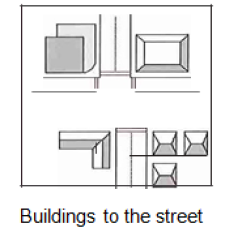
- Zero lot line side setbacks with attached structures, in compliance with the International Building Code are anticipated except for necessary rear lot driveway access, pedestrian access, open space, transitions to other uses and landscape areas. Rear setbacks should be of sufficient depth to allow proper parking and landscaped areas to the rear of the buildings, coupled with appropriate transitions to adjacent uses. Rear yards and the rear of buildings shall not directly abut streets. If the rear of building is approved adjacent to a street, pedestrian access and street-oriented building treatment must be adequately addressed.
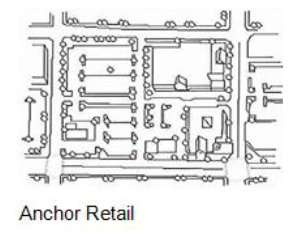
- Building Orientation. The entrances of all retail, civic, residential, institutional uses, and office buildings shall always front onto major streets, with the exception of center block residences (which still must front pedestrian ways) and anchor stores greater than 30,000 square feet in size. On minor streets this requirement is suggested but may be waived with an appropriately landscaped buffer yard adjacent to the minor street. Secondary entries may be required at the rear of street-facing buildings. Where possible, 'like land uses' shall face 'like land uses' or open space, i.e. retail across the street from retail, townhomes from townhomes, etc. Loading docks and service areas shall be screened from streets and adjacent properties through architectural design and landscaping. Anchor store entrances must front onto the street, and be connected to adjacent streets via landscaped, publicly accessible walkways. Access from parking areas may be via mid-block passageways or "paseos," to the street.
- Setbacks. Building facades should comprise at least 65% of the frontage facing Washington Blvd. and 50% of all other public street edges. Building facades must be located 0-10 feet from the public right-of-way (typically inside edge of sidewalk) on major streets. Minor streets may include increased setbacks with a minimum of 15’. Awnings, balconies, and architectural features may project beyond building facades, but not over the sidewalk, as approved by the Planning Commission. Street side setback variations are encouraged when an activity related to pedestrian use is maintained, i.e. special landscaping, outside seating for a restaurant, patios, recessed plazas, courtyards, and trellises are encouraged.
- Building Height. Buildings shall have a minimum and maximum height as indicated on the table by building type, with height to be measured in accordance with the City's adopted ordinances and standards.The Planning Director may approve a height over three stories if the design includes suitable “step-back” architecture and other architectural features which encourage a “village” feel on the street level. Step-backs shall create usable spaces for residents.
Land Use Commercial, Office & Vertical Mixed Use or residential flats Condos, Town-homes, single purpose apartments Single-family, duplexes, twin homes, & 4 unit buildings Civic Uses & other stand-alone uses Minimum Building Height Two stories or 24’ Two stories or 24’ One story or 14’ One story or 14’ Maximum Building Height Four stories or 45’ Three stories or 36’ Two stories or 24’ Three stories or 36’ - Land Use Impact and Buffering. Landscape buffers are strongly preferred over fences and walls where a separation is desirable. A visually open look should be encouraged between compatible uses. Visual screening which creates 'outdoor rooms' is often more important than a physical separation and the Planning Commission, shall evaluate such areas. Fences or walls, if determined to be necessary or desirable, must be reviewed for their effectiveness in protecting private space while not creating isolated uses or dead space void of natural surveillance. Approved fences or walls shall be compatible in color, texture, and design in relationship to building materials. In order to mitigate any negative impacts, the Planning Director, after due consideration, may modify building setbacks and heights to create better separation, and/or require additional architectural and/or landscape elements, as needed to mitigate anticipated detrimental impacts between uses. Transitions between buildings in the MPC and other zones shall be setback 20’ for buildings up to 24’ in height (measured to the peak of the roof) and then additional height shall be allowed with an additional foot of setback equal to one additional foot of height.
- Architectural Design and Materials. The treatment of building mass, façade variation, materials and exterior appurtenances shall create an aesthetically pleasing building and site that is in character with the proportions of other surrounding buildings, and yet provides diversity in design. A mix of materials is required. Requirements applicable to all buildings are stated below:
- All sides of buildings shall receive substantial design consideration, with an emphasis on areas visible to pedestrians, vehicular traffic, and neighbors. Repetitive design for any project over 5 buildings is not acceptable. Within projects, sub-neighborhoods created by design shall be incorporated in the overall scheme, with a general intent of significant building façade changes every 5 to 10 buildings or as approved in the site plan. A mix of materials is required.
- Screening. All building equipment and service areas, including on grade and roof mechanical equipment, utility meters, and transformers that are readily visible from the public right of way, shall be screened from public view. These elements shall be sited to minimize their visibility and impact, especially from major streets, or they may be enclosed as to appear to be an integral part of the architectural design of the building. Dumpsters (shall not be located closer than 20’ from any property line), and other necessary equipment shall be located or screened so as not to be visible from streets, pedestrian areas, and adjacent. Screening elements shall be aesthetically incorporated into the design of the site whether located on the ground or on a structure.
- Basic building materials shall include, but are not necessarily limited to, architecturally treated pre-cast concrete, brick, stone, granite, ceramic tile, cement/fiber board, architectural metals, and/or glass. All residential uses shall have substantial brick and/or masonry exteriors. Limited amounts of stucco, vinyl siding and metal may be considered as accent materials, if the quality of the design merits such consideration. The use of exposed concrete (architectural concrete excepted), or vinyl for storefront facades is not permitted. All buildings within the development shall incorporate some common architectural theme and/or architectural elements, creating a unifying development.
- No more than four colors shall be used per development excluding the roof. Earth tone colors are encouraged to help buildings blend into the environment; however, color may vary if approved by the land use authority as being compatible with surrounding developments. Approved tinted glass surfaces shall be considered as one of the colors allowed and shall conform to the color requirements included herein.
- Buildings shall be designed to relate to grade conditions with a minimum of grading and exposed foundation walls, creating easy pedestrian access from sidewalks, parking areas, etc. Commercial buildings shall be designed with ground floor architectural distinction/separation in order to enhance street activity and walkability. All buildings shall have expansive windows, balconies, bay and/or box windows, terraces, or other design features which are oriented to the street, or other people spaces. Windows shall make up at least 50% of street-facing facades on the first story of commercial developments. Window shapes and sizes shall be so designed to be compatible from building to building. Substantially tinted windows and windows with reflective film or glass are not permitted at street level; however, windows with a minimum of tinting to meet low-e and other energy efficiency standards are highly encouraged. Building facades shall provide at least one operable building entrance per elevation that faces a public street.
- Maximum Length. The maximum length of any blank wall uninterrupted by windows, doors, art or architectural detailing at the first-floor level shall be fifteen feet (15').
- Plans shall include any existing buildings that will be incorporated into the project and any modifications to such buildings.
- Signage. Proper design and placement of signs and their lighting is critical. All developments shall have a sign theme which promotes use compatibility. Permitted permanent signs within the MPC Zone shall be, directional signs, or signs located on the building, such as wall signs, projecting wall signs, and window signs.
- In addition, a monument sign is allowed with the following limitations: the sign shall have as the prominent feature the name of the development. Font styles shall be consistent. Monument signs shall be constructed with materials similar to that of the main building. Monument signs may not obstruct the clear of view of any intersection or driveway.
Only A-frame signs and painted murals on the inside of a storefront window are allowed as temporary signs. - Open Space. Significant usable open space equal to 20% of the project shall be provided within the MPC development, depending upon the size, scale, and nature of the development. Usable open space means spaces that serve a recreation function and not leftover non-usable pieces such as landscaped islands in parking lots. Such spaces should be appropriately sized for the development and should include at least one usable space with a minimum dimension of 50’ by 100’.
- Approved open space may include but is not limited to: commons, pocket parks, plazas, courtyards, landscape features, water fountains and features, greenbelts, and trail connections.
- A 'Village Green” or other commons area, may be required adjacent to mass transit connections or other significant activity.
- Building materials used within open space areas shall be related to the materials of adjacent buildings and shall be a non-skid finish.
- Design shall be designed to provide safe pedestrian use, including landscaping, seating areas, WIFI, and lighting as appropriate. Fruit tree, community gardens, and water themes are encouraged.
- Areas of environmental concern or interest may be required to be preserved or enhanced, i.e., water drainages, connections to trail systems, and water features. Unless otherwise specified through the development agreement with the City, all open space areas shall be maintained by the property owners or homeowner associations.
- Landscaping. Landscaping guidelines are established to improve and maintain site qualities. Landscaping, in general, shall conform CCNO 11-19 and the following principles:
- Landscape and streetscape plans are required to be submitted with any building, structure or other improvements meeting the standards of this ordinance and as specified in the Public Works Standards. All such plans shall promote water–wise landscaping designs and include xeriscape, where appropriate.
- Street trees are required along major streets unless this requirement is specifically waived by the City in exchange for other types of street landscaping, such as, flowering pots, shrubbery, rain gardens, etc. When available, the City’s Street Tree Plan should be consulted.
- Future development areas or land area not occupied by buildings, structures, hard surfacing, vehicular driveways or pedestrian walkways shall be kept in a weed-free condition or landscaped.
- Where possible, a 50/50 mix of deciduous and evergreen trees and shrubs shall be used for on-site landscaping.
- Outdoor Lighting. Lighting, in general, shall conform CCNO 11-11-6 and the following principles:
- The lighting of streets, pedestrian areas, parking lots, and open space is required.
- Exterior wall mounted floodlights are expressly prohibited.
- Indirect lighting, bollard lighting, and landscape lighting is encouraged.
- Lighting of a building and site identification signs are permitted as allowed elsewhere in this Code.
- Lighting along Washington Blvd., the Downtown and Southtown, and 2700 N. shall be an approved fixture as selected by the City.
- Lighting shall be evaluated as to how adequately it meets its intended purpose. Design and location of standards and fixtures shall be specified on the site development drawings and a lighting plan provided. Intensities shall be controlled so that 'safety' lighting is provided while neighboring areas are protected from glare or excessive direct light.
- Streets and Pedestrian Ways.
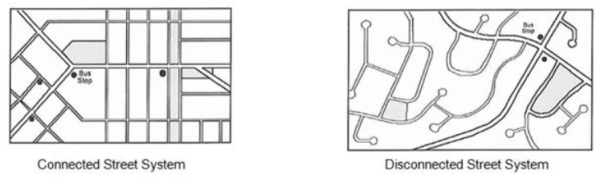
- Streets. All accesses within a MPC shall have connectivity with existing and future street patterns. A grid street pattern or modified grid pattern is required where possible. Cul-de-sac streets shall not be approved unless it can be demonstrated that no other practical way exists to make connectivity. In order to uphold and enhance traditional neighborhood development principles, private streets are discouraged and gated communities are prohibited.
- Widths. Street widths shall be per Public Works Standards. In general, streets shall be designed to meet the level of travel and service, while incorporating principles of traffic calming and pedestrian compatibility, i.e., tree lined streets with pedestrian ways and linkages, decreasing the need for pavement width by spreading traffic through a grid or modified street hierarchy system.
- Sidewalks and Walkways. The design of pedestrian ways may include a solitary meandering pathway or trail, a 'pedestrian street' and the many possible designs in-between. Walkways and connections to trail systems shall be incorporated into the project. Choice of appropriate pedestrian access shall be made based upon the scale and type of mixed-use project being proposed and by the way uses are intermingled. A ten-foot cross-section (five-foot park strip, five-foot sidewalk) is a minimum standard, while sidewalks widths of 10’ are required for properties that front on Washington Blvd. and/or 2700 N. All public streets shall have walkways for pedestrians.
- Pavers, borders, colored/textured concrete and other sidewalk design materials with compatible colors shall be used as needed in order break up expanses of hard-surfacing and to encourage pedestrian interest and activity. In vertical mixed-use areas, wider sidewalks are required in order to enhance street and land use connectivity. Portions of the park strip may be paved or crushed rock, to accommodate street furniture, leaving tree wells for street trees. Corner plazas are required with a triangular area having at least 20’ dimension parallel to the streets emanating from the intersection of ROW lines. Street furniture, including but not limited to benches, trash receptacles, artwork, drinking fountains, bike racks, etc. may be required depending upon the nature of approved uses. Street furniture requirements shall include an overall design theme for compatibility.
- Crosswalks. Extensive use of crosswalks shall be incorporated within the project. Crosswalks shall be so configured to be a design feature of the development, i.e., heavy painted lines in patterns, pavers, edges, and other methods of emphasizing pedestrian use. Bulb-outs and other pedestrian design shall be used to shorten walking distances across open pavement. Planted medians shall be used in appropriate areas to encourage walking and to act as a 'refuge' for crossing pedestrians.
- Street widths. The widths of streets shall be established as per Public Works Standards.
- Streets. All accesses within a MPC shall have connectivity with existing and future street patterns. A grid street pattern or modified grid pattern is required where possible. Cul-de-sac streets shall not be approved unless it can be demonstrated that no other practical way exists to make connectivity. In order to uphold and enhance traditional neighborhood development principles, private streets are discouraged and gated communities are prohibited.
- Other Forms of Transportation. All forms of transportation shall be considered within and without the MPC with the intent to improve convenience and reduce automobile trips. All forms of transportation should be encouraged, including, walking, bus, bicycle, and pedestrian. Access connections shall be required where deemed essential to provide circulation or access to churches, schools, playgrounds, shopping centers, transportation, and other community facilities.
Conveniently located short term bicycle racks shall be required in every development along the street frontage with the ratio of one rack that accommodates at least 2 bikes per business with up to 25 employees and one rack that accommodates at least 4 bikes for businesses with over 25 employees. Long term bike rack/storage is required for residential developments with a ratio of one rack that accommodates at least 5 bikes for every 50 units.
Appropriate bus turnouts, shelters, and stops shall be coordinated and planned as part of the development review process. Based upon land use and the level of demand, bicycle parking shall be provided in appropriate locations, i.e., visible from store fronts and entrances to office buildings and residential structures. - Parking Areas. Parking areas shall be considered as structures since they present a three-dimensional appearance when occupied. All parking areas shall meet the requirements of CCNO 11-19 as well as the following:
- Parking Location. Location of parking shall be determined not only from its visual relationship to the building and site, but also as it relates to safe convenient pedestrian and vehicular circulation patterns. Where possible, Parking lots shall be broken up and planned as 'outdoor rooms'.
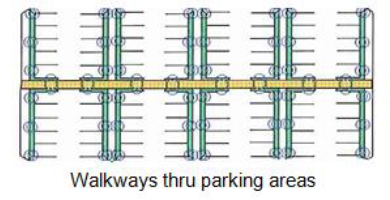
- Large Parking lots. When approved, larger parking lots shall be broken up with substantial tree and ground cover broken up into 'rooms' of no more than 300 parking stalls thru the use of connecting walkways.
- Where practical, parking lots shall incorporate LID techniques, by providing retention through the use of internal islands for storm water retention.
- Unless otherwise approved by the Planning Director, parking lots are prohibited adjacent to any street and/or between a building and the street. Parking shall be located to the rear of the building or to the side. Parking lots located to the side of a building shall incorporate adequate screening, such as short walls and hedge type landscaping between the lot and the public sidewalk.
- Underground parking, deck or terrace parking, and parking garages are encouraged. Parking structures with first level parking immediately adjacent to the frontage of a street are prohibited. Parking structures shall be designed around natural light with 'safety' lighting added as needed.
- Landscaping, within and without, may be required to enhance compatibility and safety.
- Developments may be approved with less than required parking if evidence can be shown that the nature of the land use proposed will not need the number of stalls as recommended in the City's parking ordinance, as may be approved by the land use authority.
- Developments may also be 'under parked' if justified with a walkable design that demonstrates such, and/or where local multi-modal transit systems exist or are immediately planned, which would help reduce the number of needed parking stalls and/or automobile trips.
- Shared parking arrangements may be required in order to reduce necessary parking areas and to encourage pedestrian activity. A parking study may be required during the pre-application process if determined by the Planning Director that some flexibility may be warranted, paid for by the developer and managed by the City to consider a reduction in the City parking standards.
- Where possible, on-street parking shall be provided adjacent to developments, and a pro-rated share of such, may be used to satisfy overall parking requirements. Parallel or angle parking may be approved based upon the overall design and width of the street, as recommended by the City Engineer and approved by the land use authority. UDOT coordination and approvals may be required.
- Visitor parking shall be carefully considered using the standard of 1 visitor parking space for every unit. Tandem parking may be considered for up to 50% of this requirement.
- RV storage lots and stalls occupied by RVs shall not be allowed.
- Parking Location. Location of parking shall be determined not only from its visual relationship to the building and site, but also as it relates to safe convenient pedestrian and vehicular circulation patterns. Where possible, Parking lots shall be broken up and planned as 'outdoor rooms'.
- Environmental. Building, landscape, and solar design should be adjusted, where possible, to be compatible with the local climate. Such design should include, but may not be limited to, window placement, building recesses, overhangs, trellises, awnings, porches, and landscape placement, planned in such a way to enhance livability and reduce energy costs.
- The use of lighter colored building materials (i.e., roof tops), fences/walls, and extensive deciduous and evergreen tree cover shall be incorporated into developments in order to reduce the urban heat island effect.
- Where possible, streets, driveways, parking lots, etc., should use concrete or other materials which absorb less sunlight.
- Interior and perimeter parking lot landscaping shall be provided at the ratio of at least one tree per six parking stalls.
- Where practical, drought resistant ground covers, shrubs, and trees shall be incorporated into the landscape to reduce water usage and storm runoff. Extensive areas of grass or other high water use plants without a public purpose are discouraged.
- Include 220-volt outlets in all garages, solar panels on roofs, and insulation exceeding standard code requirements by 20% for roofs and walls.
- Requirements Unique to Residential Uses. The following shall apply to residential uses:
- Multi-family residential use shall comprise a variety of types of housing, fulfilling housing needs with a wide assortment of housing choices.
- The following standards shall be required for multi-family residential:
- Properly designed off-street surface parking hidden from streets, parking terraces, or underground parking. Attached or detached garage units associated with multi-family development should be rear loaded. Where only front-loaded garages are possible, they shall be subservient and setback 5 feet from the front façade and at least 20’ from the front property line.
- Flat roofs with a parapet and pitched roofs with a 4/12 pitch or greater, unless otherwise approved by the Land Use Authority.
- Extensive windows facing streets, alleys and pedestrian connections.
- Covered porch entrances.
- Entry sidewalks that connect directly to public sidewalks.
- Livable balconies of 50 square feet or larger with a minimum of 5’ in depth.
- Material variety.
- Building relief.
- The following standards for multi-family residential are required:
- Multi-level structures
- Dormers and/or shutters, and other window treatments such as bay or box type windows
- Enhanced corner treatments on major streets including towers and larger corner setbacks for plazas
- Street side balconies/decks
- Streets which de-emphasize the need and speed of automobiles
- Other pedestrian oriented design
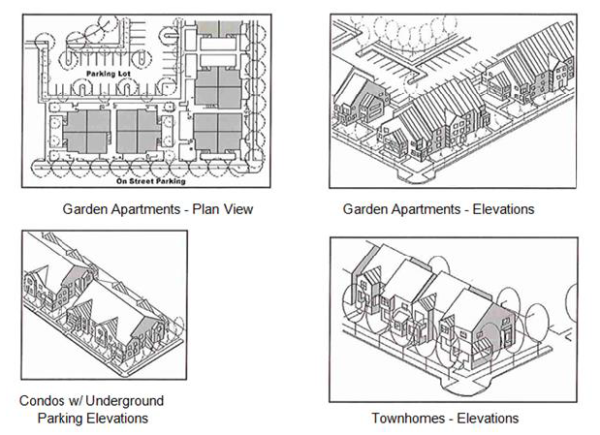
- The following standards shall be required for multi-family residential:
- Small lot Single family residential uses, if approved, shall be carefully designed using the following design principles. Front setbacks shall range between fifteen (15) and twenty (20) feet typically measured from the inside edge of sidewalk to the porch. Front loaded garages shall be subservient to the dwelling and shall not have a setback less than twenty feet. The following standards shall be required for single family residential:
- Subservient garages, i.e., back loaded detached with alley access, front loaded detached, attached but setback from the front line of the home by at least five feet (and 20’ from the public ROW), side entry attached, or a combination of the above
- Roofs with a 4/12 pitch or greater
- Covered open front porches comprising at least 50% of the front elevation (not including the garage), in no case being no less than fifteen feet (15’) in width and six feet (6’) in depth
- Entry sidewalks that connect directly to public sidewalks
- Lamp posts and/or entry door lighting with downward directed illumination
- The following standards for small lot single family residential are required:
- Two-story dwellings
- House dormers and/or shutters, and other window treatments
- Street side balconies/decks
- Wrap-around porches, particularly on corner lots
- Rear loaded garages
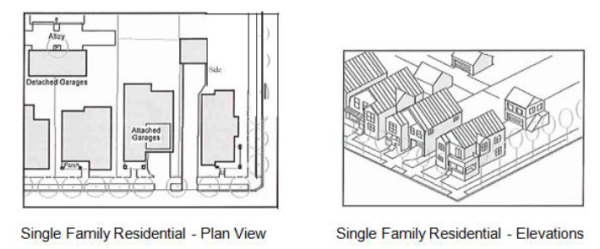
- Service Areas. Loading and refuse collection areas shall be screened from public view. These areas are not permitted between buildings and streets unless they can be adequately screened thru landscaping and architectural design. Streets shall not be used as maneuvering areas for commercial loading, unloading, or refuse collection. Building and improvements upon lots shall be designed to properly accommodate loading, unloading and refuse collection. Screen walls and enclosures shall be constructed with materials compatible with the structures they serve. Loading and refuse collection areas shall be properly maintained in a debris-free condition. Dumpsters shall not be located within 20’ of any property line.
- Multi-family residential use shall comprise a variety of types of housing, fulfilling housing needs with a wide assortment of housing choices.
- Density. It is anticipated that a Master Planned Community will fall in the medium to high density categories as established in the General Plan. Currently (2015) those densities are 6 to 18 units per acre for medium density and 18 to 40 units per acre for high density.
11-9K-4: LAND USES
- Land uses shall be established through the development agreement. The general categories of uses include: retail, service, office, and residential uses but all uses shall be enumerated in the development agreement.
11-9K-5: ZONE DESIGNATION ON THE OFFICIAL ZONING MAP OF NORTH OGDEN
- All Master Planned Community zoning shall be designated MPC with a suffix that refers to the actual development. As an example, if a project is approved and built with the name “Coldwater Springs”, it would be designated on the Zoning Map as MPC-CS.
11-9K-6: MODIFICATIONS OF THE APPROVED PLANS
- After adoption of the MPC, there may be a need for deviations from the approved plans to address building code revisions, unknown existing conditions, material availability, and other unforeseeable issues. The City Planner, the City Engineer, and their designees may approve changes that are consistent with the intent of the original approval, so long as such changes do not constitute more than 5% of the original project area. Any changes shall be approved only if the modifications include improved or equivalent quality of materials or design. Any proposed changes that exceed 5% of the project area or that are deemed materially significant by the City Planner or City Engineer shall require an amendment to the MPC per the approval process set forth in this ordinance. Planning Commission shall hold a hearing and may make a determination in favor of, against, or require a modification to the proposal. Any significant change shall require that the Development Agreement be updated with the City Council, in a public hearing process.
11-9K-7: MASTER PLANNED COMMUNITY ZONE CONFLICTS WITH OTHER REQUIREMENTS IN THE CITY CODE
- When the requirements of this chapter are found to be in conflict with other provisions of the City Code, the standards, requirements, and processes of this chapter shall take precedence, especially where a development agreement has been approved.
11-9L-1: PURPOSE AND INTENT
The civic zone is specifically intended to regulate civic uses within the City. This zone identifies the standards for public land and structures that are developed and set aside for the use and benefit of the public.
11-9L-2: PERMITTED USES
- The following uses shall be permitted:
- Accessory building and use customarily incidental to any permitted use. See CCNO 11-9M-8.
- Cemetery.
- Civic Buildings.
- Civic Complexes.
- Public Buildings, Public Parks, public recreation grounds, and associated buildings. See CCNO 11-9M-18.
- Public Utility substation or water storage reservoir developed by a public agency. See CCNO 11-9M-19.
11-9L-3: SITE DEVELOPMENT STANDARDS
The following standards reflect minimums; however, the variety of civic uses have unique circumstances and needs. The Planning Commission may approve alternative standards based upon unique circumstances while taking into account the need for appropriate buffering with adjacent properties.
| A. Minimum Lot Area | No Minimum lot area. |
| B. Minimum Lot Width | No Minimum lot width, however, frontage access on a public street is required |
| C. Minimum Yard Setbacks for Structures | |
| 1. Front | 20' |
| 2. Side | 10' |
| 3. Rear | 20' |
| D. Building Height | |
| 1. Minimum | One-story |
| 2. Maximum | Two and one-half (2 1/2) stories or thirty-five feet (35') or as approved by the Planning Commission |
| E. Open Space | |
| 1. Civic Building | 20% |
| 2. Public Parks | 50% |
11-9L-4: SITE PLAN APPROVAL
For any permitted uses a site plan shall be required in accordance with CCNO 11-2-9. Uses for each site plan will be identified.
11-9L-5: AMENDMENTS
- Minor Changes. All development shall conform to the final plan. Minor changes in the location, siting or character of buildings and structures may be authorized by the Planning Director if the change is consistent with the intent of the original approval, so long as such changes do not constitute more than 5% of the original project area. Any changes shall be approved only if the modifications include improve or equivalent quality of materials or design Any changes that exceed 5% of the project area or are deemed materially significant by the Planning Director shall require an amendment to the site plan. Examples of a minor change are the relocation of a use on the site.
- Changes to any of the following shall require a modified site plan review and approval by the Planning Commission.
- A change in the use or character of the development.
- A change in character of approved open space.
- A reduction of required off street parking.
11-9L-6: SIGN REGULATIONS
A comprehensive sign plan shall be submitted and approved for each civic facility.
A comprehensive sign plan shall include the location size, height, type of illumination, landscaping, time of placement and/or illumination, and orientation, of all proposed signs for the civic use, either permanent or temporary.
The comprehensive sign plan shall be approved by the Planning Commission as part of the site plan approval.
11-9L-7: FENCE REGULATIONS
Uses within the Civic zone are subject to 11-9M-15.
A fencing plan shall be included with the site plan and approved by the Planning Commission.
11-9L-8: EXTERIOR LIGHTING
Uses within the Civic zone are subject to 11-11-6 (Exterior Lighting).
11-9L-9: TRASH ENCLOSURES
Uses within the Civic zone are subject to CCNO 11-11-10 (Trash Enclosures). Civic uses may use standard pickup service in lieu of a trash enclosure.
11-9L-10: PARKING
Uses within the Civic zone are subject to CCNO 11-19. The number of required parking stalls shall be approved by the Planning Commission as part of the site plan review approval process.
11-9M-1: APPLICABILITY
- The regulations included herein, qualify or supplement, as the case may be, the zone regulations contained within the Residential Zone Districts.
11-9M-2: ADDITIONAL PRINCIPAL BUILDING REGULATIONS
- Every principal building shall be located and maintained on a lot and every lot shall have required frontage on a street, except where a parcel of land was in separate ownership prior to December 31, 2000, and except as otherwise permitted in this Title.
11-9M-3: ADDITIONAL YARD REGULATIONS
- Open or lattice enclosed fire escapes, fireproof outside stairways, regular unwalled porches, terraces, bay windows, chimneys, balconies, and balconies opening upon fire escapes , may project five feet (5') into a required front yard, ten feet (10') into a required rear yard, and three feet (3') into a required side yard; and the ordinary projections of chimneys and flues are permitted.
11-9M-4: ADDITIONAL HEIGHT REGULATIONS
- Chimneys in residential zoning districts may be two feet (2') above the roofline of the residential structure, even if the roofline is at the maximum building height.
11-9M-5: ZERO SIDE YARD PROVISIONS
- Purpose and Intent. The purpose of this section is to allow the Planning Commission to grant one zero side yard per lot in the subdivision as per the following conditions:
- When the remaining one side yard is equal to the combined total of the required two (2) side yards of the zone in which it is located.
- No window or other similar opening shall be installed in the building or any accessory building along the side having a zero-side yard.
- No zero-side yard will be permitted on the lot side bordering a nonresidential zone, or on the lot side bordering on a residential lot not utilizing zero side yard provisions.
- The use of the zero-side yard provision is contingent upon development of, or commitment to development of, a zero-side yard on adjacent lots.
- The approved location of each dwelling and accessory buildings utilizing the zero-side yard concept must be designated on each lot on the approved final subdivision plat.
- In the case of existing subdivisions, the zero-side yard concept may be utilized upon compliance with the above provisions and upon issuance of a conditional use permit approved by the Planning Commission and City Council.
- All building permits will be issued in strict accordance with the building site restrictions as shown on the approved subdivision final plat. Any changes in the location of buildings from the location shown on the approved final plat must be approved by the City Council and an amended final plat shall be recorded with the county recorder showing the approved changes.
11-9M-6: SETBACKS ON LOTS 10% OR GREATER SLOPE
- Purpose and Intent. The purpose of this section is to provide setback relief for lots with an overall slope greater than fifteen percent.
- Residential lots with an overall slope greater than ten percent may have the front setback reduced from 30 feet to 20 feet. Slopes shall be measured from the highest elevation on either the front or rear lot line to the lowest elevation on the lot.
11-9M-7: SPECIAL PROVISIONS FOR SIDE YARD REDUCTION
- Purpose and Intent. To provide residential single-family dwelling units built prior to 1980, not having adequate parking as required by current ordinance, or for single-family dwellings built prior to 1980, that do have adequate parking as required by ordinance, to request a reduced side yard, for the purpose of adding additional garage space.
- For single-family dwelling units that do not have adequate parking as required by current ordinance, a reduced side yard of not less than six feet (6') and/or a reduced garage width of not less than eighteen feet (18') for the purpose of adding a garage or carport provided, that:
- The side yard reduction must be on the garage or carport side of the dwelling and no living space will be allowed in connection with the addition.
- The combined total of the side yards of the dwelling requesting the change is not less than eighteen feet (18') in zones RE-20, R-1-12.5, R-1-10; and twelve feet (12') in zones R-1-8, R-1-8(A), R-1-8(AG), R-2, R-3 and R-4
- Residential single-family dwellings built prior to 1980 that do have adequate parking as required by the current ordinance that applies to the zone in which they are located, may have a reduced setback of eight feet (8’), for additional garage space, if provisions 1 and 2, immediately above are met.
11-9M-8: ACCESSORY BUILDINGS
- Purpose and Intent. To allow for the construction of accessory buildings and ensure that accessory buildings are designed and built to minimize their impacts on neighboring properties.
- Location and Size.
- No detached accessory building, other than trellises, shall be allowed between the front of the main residential building and the street.
- A garage or carport attached to the main residential building is allowed between the front of the main residential building and the street if the front and side yard setback requirements for the zone are maintained and the garage or carport is integrated into the design of the residential building, with a similar residential exterior wall treatment, roof slope, and roofing material as the main building to which it is attached.
- A detached garage or carport may be located in the side yard so long as it meets the side and front yard setbacks, is a minimum of six feet from the main building, is integrated into the design of the residential building, and has similar residential exterior wall treatment and roofing material as the main building.
- Accessory buildings regardless of size may be located in an interior side yard or rear yard provided they meet the required setbacks of the zone.
- On a corner lot, an attached or detached accessory building (with or without a roof) that is open on at least three (3) sides may extend into the side yard setback facing a street up to the minimum side yard setback for an interior lot in its respective zone. Such structures are limited to covered or uncovered decks, patios, gazebos, pergolas, and trellises.
- Height. The building shall not exceed the maximum height allowed per the development standards of each zone district.
- Design and Materials. The following standards shall apply to the design and materials of accessory buildings:
- All accessory buildings larger than two hundred (200) square feet must be integrated into the design of the residential building with similar residential exterior wall color.
- Roofing materials including metal roofs shall have a similar color as the main building.
- An eave proportionate to the main building is required with a minimum of twelve (12) inches. Aluminum fascia soffits are allowed.
- Accessory buildings fronting onto a street must have a window(s) that occupies a minimum of five percent (5%) of the façade of the building or have a person door or garage door with windows.
- Reuse of a metal structure originally designed for or used for other purposes, such as shipping or cargo containers, is not allowed unless the exterior of the metal structure is made to be integrated into the design of the main residential building, with a similar residential exterior wall treatment and roofing material as the main building.
- All accessory buildings shall have a buffer of either a fence or landscaping or a combination of the two.
- All accessory buildings larger than two hundred (200) square feet must be integrated into the design of the residential building with similar residential exterior wall color.
- Prohibited Use. Accessory buildings shall not be used as living quarters. Accessory dwelling units are not considered accessory buildings.
Standards for Accessory Buildings PRUD Zones CCNO 11-7C (Legacy Planned Residential Unit Zone), CCNO 11-7D (Roylance Farms Planned Residential Unit Zone), CCNO 11-7E (Quail Ponds Planned Residential Unit Zone), and CCNO 11-7I (Cold Creek Village Planning Residential Unit Development Zone):PRUD Accessory Building Site Development Standards A. Accessory building regulations (see also CCNO 11-9M-9) 1. Accessory building height 2. Accessory building setback a. Accessory building
(1) Corner lot (street side)
20' (2) Required setback in feet (with permitted increases in building height beyond 10')
b. Buildings that meet the design standards requirements in 11-9M-8: a building up to 10’ tall may be 3’ from the property line. Beginning at 5’ from the property line, an increase in building height beyond 10’ is permitted at a 1:1 ratio up to a maximum building height of 25’. Rooflines may exist within the vertical envelope created by the 1:1 ratio of building height and setback
3. Minimum separation required between primary building and between all accessory buildings At least 6' 4. Maximum rear yard coverage by all accessory buildings 25%
11-9M-9: ACCESSORY DWELLING UNITS
- Purpose and Intent. The purpose and intent of this section is to recognize the residential character of North Ogden City and to provide for supplementary living accommodations in the community. These provisions are intended to provide for affordable housing with reasonable limitations to minimize the impact on neighboring properties and neighborhoods, and to promote the health, safety, and welfare of the property owners and residents of accessory dwelling units (ADUs).
- Owner Occupied. No ADU shall be created, established, or occupied in a single-family dwelling unless the owner of the property occupies either a portion of the primary dwelling or a detached accessory unit on the same single-family lot. For the purpose of this section, the term "owner occupied" shall be defined as full time residency within the home by the bona fide property owner(s) as shown on the Weber County tax assessment rolls.
- Owner Occupant. An owner occupant shall be considered:
- An individual who:
- Possesses, as shown by a recorded deed, fifty (50) percent or more ownership in a dwelling unit; and
- Occupies the dwelling unit with a bona fide intent to make it his or her primary residence; or
- An individual who:
- Is a trustor of a family trust which possesses fee Title ownership to the dwelling unit which was created for estate planning purposes by one (1) or more trustors of the trust; and
- Occupies the dwelling unit owned by the family trust with a bona fide intent to make it his or her primary residence. Each living trustor of the trust shall so occupy the dwelling unit except for a trustor who temporarily resides elsewhere due to a disability or infirmity. In such event, the dwelling unit shall nevertheless be the domicile of the trustor during the trustor's temporary absence.
- A person who because of a temporary work, military, or non-profit related assignment which is less than 36 months is relocated outside of the City but maintains the property associated with the ADU as their legal residence as evidenced by providing proof annually of the temporary assignment and one of the following: the current years income taxes (with financial information redacted), driver’s license, vehicle registrations, or voting registration.
- An individual who:
- Owner Occupant. An owner occupant shall be considered:
- Dwelling Unit Occupancy. The occupants of an accessory dwelling unit shall be limited by one of the following family categories:
- Temporary guests. A "temporary guest" is defined as a person who stays with a family for a period of less than thirty (30) days within any rolling one year period and does not utilize the dwelling as a legal address for any purpose.
- Zones. An ADU which meets ordinance requirements is a permitted use in a single-family dwelling unit or in a detached accessory unit within the RE-20, R-1-8, R-1-8(AG), R-1-10, R-1-12.5 and RCC zones. No accessory dwelling unit may be allowed in any multi-family dwelling.
- Number of ADUs. A maximum of one ADU shall be allowed in each owner occupied single-family dwelling, or in a detached ADU associated with a single-family dwelling.
- Address. The principal dwelling unit and the ADU shall have the same address number, but shall refer to the ADU as unit B. Addresses must be located in a visible location on the street frontage side of the home.
- Separate Living Areas. An ADU must provide living areas for eating, sleeping and sanitation facilities separate from the principal dwelling unit.
- Fire, Building, and Health Codes. An ADU shall comply with all building construction and fire codes in effect at the time the ADU is constructed, created or subsequently remodeled, including the obtaining of required building and other permits.
- Utility Meters. A single-family dwelling with an ADU shall have one (1) but no more than two (2) meters for each water, gas, and electricity utility service, and each meter shall be in the property owner’s name. Impact fees are required when adding a detached ADU.
- Not Intended For Sale. ADUs shall not be sold separately from the primary dwelling unit.
- ADU Registration / Business License. Any person owning an existing ADU that has not previously been permitted by the City, or any person constructing or causing the construction of a residence that has an ADU, or any person remodeling or causing the remodeling of a residence for an ADU, shall register the accessory dwelling unit with the Planning department. If the ADU is a rental unit a business license is required. This shall be in addition to a building permit for the work to be performed. In order to meet the requirements of the registration, the applicant shall:
- Submit a fee as identified in the Consolidated Fee Schedule with a completed registration form including a site plan that shows property lines and dimensions, the location of existing buildings and building entrances, proposed buildings or additions, dimensions from buildings or additions to property lines, the location of parking stalls, and utility meters.
- Include detailed floor plans with labels on rooms indicating uses or proposed uses.
- Pay building permit fees, if applicable, for the construction of a new dwelling, or the remodeling of an existing dwelling, in accordance with the established fees and charges.
- Make all corrections identified as necessary to comply with building code requirements, as identified by the chief building official or his designee, and provide photos of the life safety items required by building code, including carbon monoxide detectors, smoke detectors, and earthquake strapping on water heaters.
- Existing non-conforming duplexes which were legally established prior to the elimination of duplexes from the underlying zone shall continue to operate as a duplex even if an Owner Occupant maintains one of the units as their primary residence, provided the Owner Occupant continues to treat the property as a duplex.
- The Owner Occupant establishes the intent to maintain the duplex use by:
- Obtaining the necessary rental license annually; and
- Paying the required utility billing charges for two dwelling units; and
- Paying all other necessary licensing procedures which may be imposed in the future on all landlords throughout the City.
- Failure to maintain the license and pay all necessary utility and other fees for a period of one year or more shall be interpreted as the intent to abandon the duplex use in favor of the conforming ADU use whether or not the unit is occupied.
- Registering the duplex as an ADU for a period of one year or more shall be interpreted as the intent to abandon the duplex use.
- The Owner Occupant establishes the intent to maintain the duplex use by:
- Failure to Complete Registration. If the property owner does not complete the registration as outlined above, the ADU shall not be considered legal or approved. Failure to complete the registration of an existing ADU within two (2) years of the passing of this section may result in a fine of five hundred dollars ($500.00) which may result in a lien on the property. After the fine is assessed, the building official or his designee shall determine an appropriate deadline for compliance. An additional fine may be assessed for each deadline that is not met.
- Home Occupation Businesses. Home occupation businesses which may be approved in an ADU shall be restricted to a home office use which creates no customer traffic. No home occupation business shall be established within an accessory dwelling unit without the express written permission of the property owner.
- Development Standards.
- The total area of the ADU shall be fifty percent (50%) or less of the living space of the primary residence for an attached ADU. The total area of the ADU shall be forty percent (40%) or less of the living space of the primary residence for a detached ADU.
- ADUs shall not be located in a front or corner lot side yard and shall meet the same setbacks as required for the primary residence in the zone.
- Appearance. The architectural design, color pallet, and materials for an ADU shall be similar to the primary dwelling unit.
- ADUs and the primary dwelling must be on the same parcel and may not be subdivided.
- The height of an attached ADU may be equal to the main building maximum height. A detached ADU may have a maximum height of twenty-five (25) feet.
- Location. Accessory dwelling units may be allowed as long as the zoning requirements for properties in a single-family neighborhood are met. The ADU shall not be within the building front, rear, or side yard setbacks for the zoning district in which the dwelling lot is located. In addition, the following standards apply:
- All accessory dwelling units are allowed over the garage, provided the parking within the garage is not converted; or
- Attached accessory dwelling units are allowed:
- Inside the primary residential dwelling through an internal conversion of the housing unit as an addition or in the basement.
- By an addition to the house, containing an internal connection between dwelling units provided that the addition will not alter the single-family character of the building.
- Detached accessory dwelling units are allowed:
- Over a detached garage.
- Only in the rear yard.
- On lots having a minimum area of 20,000 square feet.
- Shall have a minimum separation from the primary dwelling of 15 feet.
- Subject to Site Development Standards in 11-9.
- Building Entrances. An accessory dwelling unit shall have a separate entrance located on any side or rear of the single-family home or at the front of the home if it is below grade and maintains the characteristics of a single-family home. The purpose of this requirement is to preserve the single-family residential appearance of the building.
- Parking. A single-family dwelling with an ADU shall provide at least three (3) off street parking spaces. In no case shall the number of off-street parking spaces be less than the number of vehicles being maintained on the premises. This shall include covered parking, garages and tandem parking in driveways. Tandem parking within a driveway is allowed to meet the parking requirement. No parking spaces may be located within the front or side yard setbacks adjacent to a street, except for within an approved driveway. The minimum width of parking areas and driveways shall be paved with concrete, asphalt, masonry, or concrete pavers. No ADU may be allowed on any lot that cannot satisfy the parking requirements.
- Converting Existing Dwelling Unit. An existing single-family dwelling unit, lawfully prior to the date of application for an accessory dwelling unit, may be converted to an accessory dwelling unit. The lot must meet the standards outlined in CCNO 11-9M-9 and is exempt only from the following standards: CCNO 11-9M-9 (N)1, 11-9M-9 (N)2, 11-9M-9 (N)3, 11-9M-9 (N)5, 11-9M-9 (N) 6.c(2), 11-9M-9 (N)7.
11-9M-10: ANIMALS AND FOWL
- Purpose and Intent. These provisions are intended to allow for animals and fowl on residential properties with minimal impact on neighboring properties and neighborhoods.
- Barns, Pens or Corrals. No barn, pen, or corral shall be maintained closer than fifty feet (50') from any dwelling and not closer than seventy-five feet (75') from a dwelling on any adjacent lot. Any barn, stable, pen, or corral shall be kept, constructed, or maintained not less than one hundred feet (100') from a public street. A fenced pasture of one acre or more will be permitted to abut adjoining property lines and the property line adjacent to the public street, except as otherwise permitted in subsection E of this section.
- Kenneling Of Dogs. The pen or run in which the dog or dogs are kept shall not be built closer than one foot (1') to the property lines, but in no case shall it encroach upon existing utility easements. The pen or run shall be designed so as not to permit runoff onto adjoining property.
- Keeping Of Backyard Chickens in Residential Zones:
Zone Less Than 0.49 Acre (No Rooster) 0.5 Acre To 0.99 Acre (No Rooster) 1 Acre To 4.99 Acres Over 5 Acres RE-20 10 hens 15 hens 15 chickens per acre 30 chickens per acre R-1-12.5 10 hens 15 hens 15 chickens per acre R-1-10 10 hens 15 hens 15 chickens per acre R-1-8 10 hens 15 hens 15 chickens per acre R-1-8(A) 10 hens 15 hens 15 chickens per acre R-1-8(AG) 10 hens 15 hens 15 chickens per acre 30 chickens per acre HP-1 10 hens 15 hens 15 chickens per acre HP-2 10 hens 15 hens 15 chickens per acre HP-3 10 hens 15 hens 15 chickens per acre RCC 10 hens 15 hens 15 chickens per acre - Additional requirements:
- Coops will be treated the same as accessory buildings (See 11-9M-8); however, coops must be maintained not closer than twenty-five feet (25’) from any dwelling on any adjacent lot.
- Feed must be stored in a rodent proof container.
- Clean water shall be made available to the chickens at all times.
- Chickens must be housed in a covered, ventilated, and predator resistant coop.
- The coop must be located in the rear yard.
- The chickens must be contained within the owner's property lines.
- If the chickens have access to an outdoor run, the coop must have at least two (2) square feet per chicken.
- If chickens stay in the coop at all times, the coop must have at least six (6) square feet per chicken.
- The coop and enclosed area must be kept clean and sanitary to prevent any insect breeding, vermin attraction, nuisance, or offensive odor past the property line.
- Dead birds and discarded or rotting eggs shall be removed as soon as possible but no longer than twenty-four (24) hours and shall be properly disposed of.
- Coops must not be constructed from scrap or dilapidated materials and must be finished with all-weather exterior materials.
- Additional requirements:
11-9M-11: ATHLETIC COURT
- Purpose and Intent. The purpose of this section is to permit residents to install an athletic court for recreational purposes.
- Permits. Athletic courts shall require a land use permit and building permit, and in addition to the impervious surface/landscaping requirements found elsewhere in this code, shall be subject to the following requirements:
- Athletic courts shall be considered an accessory structure and shall be subject to CCNO 11-9M-8 and CCNO 11-9M-9.
- Setbacks. An athletic court shall be constructed in the side or rear yard only with a 5-foot setback if the athletic court has a fence height higher than 6 feet. The setback to be measured from the property line to the fence fabric. Construction upon any utility easement will be done at the property owner’s risk.
- Fencing. Fencing around the athletic court may be up to twelve feet (12') in height. Fencing enclosures shall not be considered as part of standard property line fencing. Fencing materials for athletic courts shall consist of open mesh fabric or vinyl coated or color coated chain link without slats. Fencing for athletic courts that are less than six feet (6’) in height may be placed along a rear property line or side property line within the rear yard.
- Lighting. All athletic court lighting shall be subject to CCNO 11-11-6, must be shielded, directed downward, and shall not spill on to an adjacent property. The applicant shall provide evidence indicating that their light product and lighting plan will not cause light or light pollution from the athletic court light(s) to extend beyond their property line. Lights and light poles including the light base and any supporting structures shall not be in excess of twenty feet (20’) in height. Light operating hours shall be restricted to 7am - 10pm.
- Grading and Drainage. All athletic courts areas shall be designed and constructed so that storm water runoff shall be contained on the owner’s property and cannot discharge onto any adjacent property.
11-9M-12 BEEKEEPING
- Purpose and Intent. The purpose and intent of this section is to permit residents in all single family residential and R-2 zones to keep bees.
- Development Standards. An apiary, consisting of not more than five (5) hives or an equivalent capacity, may be maintained in a rear yard (or side yard) of any residential lot or parcel. On a residential lot or parcel which is one-half (0.5) acre or larger, the number of hives located on the lot may be increased to ten (10) hives.
- Additional requirements.
- A person shall not locate or allow a hive on property owned or occupied by another person without first obtaining written permission from the owner or occupant.
- Each beekeeper shall be registered with the Utah Department of Agriculture and Food as provided in the Utah Bee Inspection Act set forth in Utah Code 4-11, as amended.
- Hives shall be placed at least three feet (3') from any property line and six inches (6") above the ground, as measured from the ground to the lowest portion of the hive.
- Hives shall be operated and maintained as provided in the Utah Bee Inspection Act.
- Each hive shall be conspicuously marked with the owner's name, address, telephone number, and state registration number.
- A hive shall be placed on property so the general flight pattern of bees is in a direction that will deter bee contact with humans and domesticated animals. If any portion of a hives located between three feet (3') and fifteen feet (15') from any property line that does not have a six foot (6') solid fence, a flyway barrier shall be established and maintained around the hive except as needed to allow access.
- On all lots, if the apiary is located in an area that borders a public walk, street or public area, the area shall be separated from the public walk or street by a six foot (6') so lid fence or wall that extends at least ten feet (10') from the hive in each direction.
- Each beekeeper shall ensure that a convenient source of water is available to the colony continuously. The water shall be in a location that minimizes any nuisance created by bees seeking water on neighboring property.
- Each bee keeper shall comply with all State laws and regulations pertaining to beekeeping.
- Harvesting. Honey may be extracted from the hives for personal use and limited sales. Processing and packaging for sale is prohibited per the CCNO 11-14.
- In the event of a conflict between any regulation set forth in this chapter and bee management regulations adopted by the State of Utah and/or the Weber County Health Department, the most restrictive regulations shall apply.
- Additional requirements.
11-9M-13: IN-HOME DAYCARES AND PRESCHOOLS
- Purpose and Intent. The purpose and intent of this section is to permit residents in specific residential zones to conduct in-home daycares and preschools in a manner that will retain the character of the home in a residential setting while not significantly impacting the residential character of the neighborhood.
- In-home Daycares and preschools are allowed in specific residential zones as a permitted use that requires a site plan per CCNO 11-2-9.
- Development Standards of all Daycares. It shall be unlawful to conduct or pursue an in-home daycare or preschool within the corporate limits of the City, unless each of the following conditions are observed:
- In-home daycares in the operator's residence shall not exceed sixteen (16) people.
- Preschools in the operator's residence shall not exceed a total of fourteen (14) children per day.
- Residents of Premises. Only persons who are bona fide residents of the premises shall operate the daycare or preschool; if the daycare or preschool has more than 8 people or children then one additional person not residing in the dwelling may be employed in the daycare if they have been certified by the state and not a minor.
- Total Floor Area. The daycare or preschool shall not occupy more than 50% of the ground floor area of the residence.
- Minimum Interior Floor Area. A minimum floor area of thirty-five (35) square feet per child shall be provided.
- Signs and Advertising. No sign or advertising shall be displayed on the premises.
- Parking and Drop Off. Off street parking shall be provided to satisfy the requirements of CCNO 11-18. No additional parking required. The safe drop off of children is the responsibility of the daycare operator and shall be illustrated in the site plan application.
- Play Areas. A minimum outdoor play area of forty (40) square feet per child shall be provided in the rear yard. All outdoor play areas shall be within a fenced area and shall be limited to use by the children in the daycare in normal operating hours. Fence height shall be in accordance with CCNO 11-9M-15.
- Conformance with Laws. There shall be complete conformity with fire, building, plumbing, electrical and health codes; and to all state and city ordinances and other laws, covenants, restrictions or regulations pertaining to the premises upon which the daycare is conducted. State Law Applicable: The regulations and licensing of daycare centers shall be in accordance with Utah Code 26-39, as amended, or as hereafter amended.
- Licensing and Regulation. Appropriate city and state licenses shall be acquired.
- An annual inspection for continued compliance will be required for business license renewal of all in-home daycare and preschool facilities.
- A criminal background check is required for any adult who resides at a dwelling used for an in-home daycare or preschool business.
- No person who has been convicted of a sexually oriented crime may operate, be employed by, or reside at a dwelling that is used for an in-home daycare or preschool business.
11-9M-14: FAMILY SWIMMING POOL
- Purpose and Intent. In single-family residential zones, family swimming pools shall be permitted in the rear yard of a dwelling, and on corner lots, in the side yard, as an accessory use. The purpose of this section is to ensure the following requirements are met:
- Location. The location of a family swimming pool and accessory machinery shall be located thirty-five (35) feet or more from any dwelling on an adjoining lot and ten (10) feet or more from any interior property line. Pools, accessory machinery, and decking located in a corner side yard may not be located farther forward in the lot than a line which is parallel to the required front setback, extending from the required front setback for a main dwelling to the side property line. Additionally, no swimming pool, decking or accessory machinery in a corner side yard shall be permitted in the area that is farther forward on a lot than the front corner of the main dwelling that is closest to the pool.
- Fencing and Lighting. An outside family swimming pool shall be completely enclosed by a fence structurally adequate to resist wind load conforming to the international building code (IBC), and not less than six (6) feet in height with a self-latching gate with the latch on the pool facing side of the gate. Any lights used to illuminate said pool or its accessories shall be shielded, directed downward, and shall not spill on to an adjacent property and preserve the visibility of the night sky.
11-9M-15: RESIDENTIAL FENCE REGULATIONS
- Purpose and Intent. The purpose of this section is to provide standards for location and size of fencing for all residential applications.
- Front, Side and Rear Yards. Except as otherwise stated in subsections, D, E, and F of this section, no fence, hedge or other similar structure shall be erected in any required front yard of a lot to a height in excess of three and one-half feet (3 1/2'); nor shall any fence or other similar structure be erected in any side or rear yard to a height in excess of six feet (6'), or as stated in other provisions in this Title. Fence posts or similar structure may exceed the maximum fence height. Hedges shall not exceed seven feet (7') in height in the side and rear yard. Hedge provisions in this Code Section apply only to hedges used in place of a fence or acting as a fence as defined in (CCNO 11-7 Definitions).
- Corner Lots. No fence, hedge or other similar structure shall be erected to a height in excess of six feet (6') in the rear or side yard of a corner lot. Hedge provisions in this Code Section apply only to hedges used in place of a fence or acting as a fence as defined in (CCNO 11-7 Definitions). All such fencing, shall maintain appropriate sight lines on the corner of the intersecting streets, as per D 1.
- Fences located in a side yard or portion of a rear yard of a corner lot which adjoins a street or public right-of-way, may be solid in appearance, or may preserve a degree of visibility between slats or similar elements, and may be located either on the property line or on a line located twelve feet (12') behind the edge of the asphalt in the street; whichever of these locations is farther away from the edge of the asphalt. The fence may also be located at a distance farther behind the edge of the asphalt than the distance determined from among the two listed above to be the farthest from the edge of the asphalt. (While not required, a three-foot (3') distance behind the sidewalk is recommended, if a sidewalk is present, in order to provide an increase in space for snow storage, safety, practical usability of the entire width of the sidewalk by pedestrians, and aesthetic value.) Along the rear boundary of the corner lot, the fence may be located on the rear property line. A fence located in a side yard or portion of a rear yard of a corner lot which adjoins a street a public right-of-way, shall have the following additional limitations and requirements.
- Any fence erected in a side yard of a corner lot, that encroaches into the Typical Sight Triangle as referenced in the City’s Public Works Standards required for visibility on a corner lot, as specified in subsection (C) of this section, shall not exceed three and one-half feet (3 1/2’) tall, shall be at least 75% transparent, and shall not be chain link.
- On any corner lot where a driveway on an adjoining lot is located less than ten feet (10’) from the rear property line of the corner lot, any fence constructed in a side yard or portion of a rear yard of that corner lot, which adjoins a street or public right of way, after the date of adoption of this ordinance, shall preserve a clear view through a triangular area on a portion of the rear yard of the corner lot (in addition and separate from the Typical Sight Triangle as referenced in the City’s Public Works Standards), wherein no fence, hedge, similar structure, or other obstruction to view shall be allowed. This triangular area shall be determined by measuring a line ten feet (10’) in length, starting at the point where the rear property line of the corner lot intersects the public right-of-way or the line twelve feet (12’) behind the edge of the asphalt (whichever has been determined to be farther behind the edge of asphalt), along the rear property line of the corner lot, and then measuring another line ten feet (10’) in length, also starting at the same point as the first line mentioned immediately above, along the public right-of-way, or the line twelve feet (12’) behind the edge of the asphalt (whichever has been determined to be farther behind the edge of asphalt), towards the front of the corner lot, and then connecting the farthest points of the two ten foot (10’) lines with a straight line.
- Any lot which is adjacent to the rear yard of a corner lot and which does not have a driveway, approach, or access way within ten feet (10’) of the rear property line of the corner lot, shall not (upon the construction of a home, a new or expanded garage, or at any other time) after the date of adoption of this ordinance, be allowed to have a new driveway, approach, or access way constructed on it which is less than ten feet (10’) from the rear property line of a corner lot which adjoins the two lots, for the first ten feet (10’) behind the line mentioned above whereon a fence on a corner lot, in a side yard or portion of a rear yard which adjoins a street or public right-of-way, may be located, as described earlier in this subsection. Further, a clear view shall be maintained through this same ten-foot (10’) by ten foot (10’) area, as well as the area directly between this ten foot (10’) by ten foot (10’) area and the edge of the asphalt, wherein no fence, hedge, similar structure, or other obstruction to view shall be allowed.
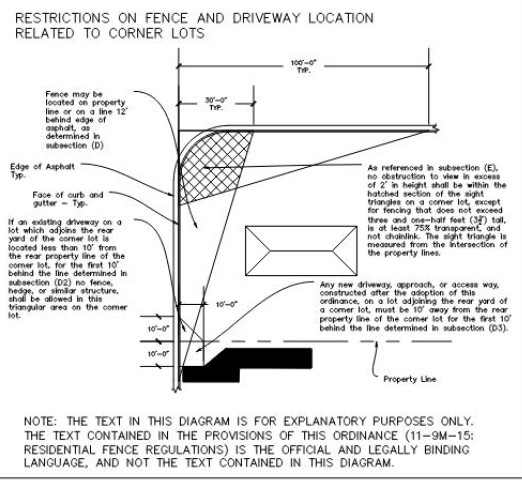
- Obstruction to View. In all zones, no obstruction to view in excess of two feet (2') in height as measured from the top of the curb or edge of the hard street surface, shall be placed on any corner lot within the Typical Sight Triangle as referenced in the City’s Public Works Standards or at any other location which would obstruct the vision of street and regulatory signs or oncoming vehicles by automobile drivers, except a reasonable number of trees pruned high enough to permit an unobstructed view of street and regulatory signs or oncoming vehicles by automobile drivers, or fencing that does not exceed three and one-half feet (3 1/2’) tall, is at least 75% transparent, and not chain link.
- Fence Height and Fence Transparency on Retaining Walls.
- All retaining walls and grading for the area surrounding the location of those retaining walls must comply with CCNO 11-22.
- Fence Height. a. Fences constructed on the high side of a retaining wall, within three feet (3’) (measured horizontally) of the top back of the retaining wall, shall have a maximum height of six feet (6’), measured from the vertical elevation of the top back of the retaining wall, and a required minimum height of three and one-half feet (3.5’) measured from the finished grade on which the fence is constructed, when the retaining wall is two and one-half feet (2.5’) tall or taller. The fence height is measured to the top of the picket, baluster, mesh, or top rail, or the highest typical fence element (not including posts or post caps). Fence posts, including the post cap, may extend up to eight inches (8”) above the maximum fence height. When a public right-of-way or trail is on the high side of a retaining wall which is two and one-half feet (2.5’) or taller, and the public right of way or trail is within five feet (5’) of that retaining wall, and a fence is installed between the retaining wall and the public right-of-way or trail, a minimum fence height of three and one-half feet (3.5’) is required.
- Fence Transparency. Fences constructed on the high side of a retaining wall, within three feet (3’) (measured horizontally) of the top back of the retaining wall, shall comply with the following standards for fence transparency.
- Retaining Wall Height shall be determined using the same standard used in CCNO 11-22 I.
- The height of the retaining wall shall determine the minimum fence transparency, according to the following table.
Existing or Proposed Retaining Wall Height Minimum Fence Transparency 0' - 5' 0% Greater than 5', up to 8' 50% Greater than 8% 80% - The above listed transparency requirements shall not apply if the applicant is the owner of the property on the low side of the retaining wall, and both the fence and the exposed surface of the retaining wall are on the same parcel as the low side of the retaining wall.
- The above listed transparency requirements shall not apply where a fence is built on the high side of a retaining wall and a public right-of-way or trail is directly adjacent to the property where the fence is built.
- Obstruction to view and sight triangle requirements shall apply to retaining walls and all fences built upon retaining walls.
- Fence Support Structure (other than retaining wall).
- The fence support structure average height measurement shall not exceed 12 inches in height and shall not exceed 20 inches in any single location.
- Security Fencing. Public utility substations and institutional uses, e.g., churches, government buildings, or schools, may be enclosed by security fencing not less than six feet (6') in height and no more than eight feet (8') in height, which shall be constructed of cement block, masonry, precast masonry, and/or wrought iron and may be equipped with an appropriate anti climbing device. Chain link may only be used as approved by the Planning Commission for security.
- The Planning Director may vary the fence height for nonconforming commercial sites in residential zones if it determines the proposed fence design, materials, and location will not create a safety hazard due to obstructed vision of approaching vehicles or pedestrians and will:
- Not isolate the surrounding neighborhoods;
- Be consistent with the theme of the development; and
- Provide an effective screen to adjacent properties.
- Chain link, vinyl, cement block, masonry, and wrought iron are acceptable materials.
- If the fence is a solid screen wall it shall have at least a ninety five percent (95%) screen value.
- The owner of the nonconforming commercial property shall construct, maintain, and keep the fence in good repair.
11-9M-16: MODEL HOMES, MASTER PLANNED VILLAGE SALES AND INFORMATION CENTERS, AND TEMPORARY SALES TRAILERS
- Purpose and Intent. Model homes may be permitted in a residential area by a land use permit if not part of subdivision application. In the review for a model home, the Planning Director, shall consider lighting, landscaping, hours of operation, signage, parking, duration and neighborhood impact.
- As a minimum, the following standards shall apply:
- In no case shall a model home be open before seven o'clock (7:00) A.M. or after nine o'clock (9:00) P.M.
- The model home shall be for the purpose of initial marketing of houses within the subdivision where the model home is located. A model home may not be used as an office for the marketing of property in the subdivision that was previously sold, or the marketing of property outside of the subdivision.
- Space shall be provided for parking for each person stationed on site, plus two additional (2) spaces. Parking for model homes may be located on an adjacent lot owned by the owner of the model home and can be comprised of a temporary surface material such as gravel.
11-9M-17: PRIVATE PARK, PLAYGROUND OR RECREATION AREA
- Purpose and Intent. The purpose of this section is to ensure that private parks, playgrounds or recreation areas, with or without a swimming pool, in residential zones, meet the following requirements:
- Sanitary Facilities. Adequate restrooms and sanitary facilities shall be provided and kept available for use by members, their families and guests, and shall be maintained in proper working order and in a clean and sanitary condition and in full compliance with the reasonable standards, rules and regulations established by the county health department.
- Hours of Operation. Operation or use of the recreational or other facilities shall be prohibited outside the hours of 7am - 10pm.
- Setback. All facilities, equipment and buildings shall be set back not less than twenty feet (20') from any property line and shall be located not less than fifty feet (50') from any main building on an adjoining lot and from any area upon which any such main building may be constructed upon said adjoining lot, if no such main building is in existence.
- Lot Size. The minimum size of the lot or site used for such recreational or other purposes shall be one acre.
- Lighting. Any lights used to illuminate the premises shall be shielded, directed downward, and shall not spill on to an adjacent property.
11-9M-18 PUBLIC SERVICE FACILITIES
- Purpose and Intent. The purpose and intent of this section is to provide regulations for public service facilities within residential zone districts.
- A permitted use and building permit shall be required by all public service companies in order to establish or substantially expand utility buildings, structures or appurtenances thereto, in any residential zoning district. Extension of public service lines in public or private rights of way is exempt from these requirements.
11-9M-19: PUBLIC UTILITY SUBSTATION
- Purpose and Intent. The purpose of this section is to ensure that public utility substations in civic and residential zones meet the following requirements:
- Lot Area. Each public utility substation in a residential and civic zone shall be located on a lot not less than two thousand (2,000) square feet in area.
- Yards. Each public utility substation in a residential or civic zone shall be provided with a yard on each of the four (4) sides of the building or utility not less than five feet (5') in width.
- Street Access. Each public utility substation in a residential or civic zone shall be located on a lot which has access from a street, alley, or easement.
- Location to be approved. The location of a public utility substation in a residential or civic zone shall be subject to site plan approval in accordance with CCNO 11-2-9.
- Landscaping. A landscape plan will demonstrate appropriate buffering from adjoining uses.
- Fencing. The site plan will indicate opaque fencing as required by the Planning Commission.
- Parking. Permanent parking will not be required unless there is an onsite employee assigned to the substation.
11-9M-20: STORAGE OF RECREATIONAL VEHICLES AND TRAILERS
- Purpose and Intent. The purpose and intent of this section is to state regulations for storage of recreational vehicles and trailers in residential zones.
- Storage Permitted. Motor homes, travel trailers, camping trailers, other trailers, boats or utility trailers, shall only be stored, parked or located in any residential zoning district in the following ways:
- Such vehicles must be noncommercial if located in any residential zoning district.
- Such vehicles, including trailer tongue and hitches, must be located no closer to the front property line than ten feet (10') in front of the front wall plane of the house and entirely on the owner's property.
- No such vehicle may be located on a residentially zoned lot or parcel of land that does not have a residential structure. In planned residential unit development projects, approved screened storage yards may be allowed; however, occupancy of any vehicle in the storage yard is prohibited.
- In multi-family developments and planned residential unit development projects, recreational vehicles shall only be parked in approved screened storage yards; however, occupancy of any vehicle in the storage yard is prohibited.
- All motor homes, travel trailers, camping trailers, other trailers, and boats stored in residential zoning districts shall be stored on a concrete or asphaltic concrete pad for which a building permit was obtained.
- Storage Permitted. Motor homes, travel trailers, camping trailers, other trailers, boats or utility trailers, shall only be stored, parked or located in any residential zoning district in the following ways:
11-9M-21: SHORT TERM RENTAL REGULATIONS
- Purpose and Intent. The purpose of this section is to provide regulations for short term rentals.
- Location.
- Short term rentals are only permitted
- within all owner-occupied residential structures, or
- those managed by an owner or management company who can respond within 1 hour at any time.
- Short term rentals are permitted within owner-occupied accessory dwelling units, both attached and detached.
- Short term rentals are only permitted
- Parking. Short term rentals shall provide one parking space per bedroom being rented.
- Property Contact.
- Short term rental owners shall provide a phone number and contact information for an owner or property manager who can be reached by phone 24 hours a day 7 days per week
- Short term rental owners shall provide a phone number and contact information for an owner, property manager, or representative who can be physically at the house within one hour of a call. If the owner or property manager is not responsive within three contact attempts, then a Civil Citation will be issued by the North Ogden Police Department.
- License: Short term rentals shall obtain a Rental Business License.
- Inspection.
- Short term rentals shall be inspected by the Fire Department prior to initial approval of the Business License and shall be inspected annually at the time of business license renewal thereafter.
- Inspection shall include:
- Compliance with Building, Fire, and Health Codes.
- Smoke Detectors shall be installed in each bedroom.
- Ground fault circuit interrupter (GFCI) outlets required in locations set by Building Code.
- Ingress and egress doors and windows shall meet Building Code at the time of application.
- Hand or Guard Rails shall be required in locations set by Building Code.
- Occupancy: Maximum occupancy for a short term rental shall be no more than 12 persons.
- Penalty: Any violation shall result in a revocation of the permit along with a minimum fine of $500 of the first offense and $1,000 for second offense.
11-9N-1: PURPOSE AND INTENT
The purpose of the Century Farms zone classification is to provide a regulated area for single-family residential uses.
11-9N-2: PERMITTED USES
The following uses shall be permitted: Church, synagogue or similar permanent building used for regular religious worship. Home occupations. Household pets. Public buildings, public or private parks, recreation grounds, and associated buildings. Residential facility for disabled persons in accordance with CCNO 11-11-11. Single-family dwellings. Temporary buildings, structures and uses incidental to construction work. Such building shall be removed upon completion or abandonment of the construction work.
11-9N-3: SITE DEVELOPMENT STANDARDS
A. Minimum lot area (square feet) | 4,000 |
B. Minimum lot width (square feet) | 40 |
C. Minimum yard setback ( in feet) | |
1. Front | 20 (18 feet if the house proceeds the garage) |
2. Interior Side | 5 |
3. Street side | 15 (On lots numbered 14 and 34 the street side yard setback is 12 feet) |
4. All utility easements must be maintained in an open state | |
| 5. Rear | 15 |
| D. Building Height (in feet) | |
| 1. Minimum one story | 10 |
| 2. Maximum two story | 28 |
| E. Maximum lot coverage percentage: | |
| 1. Under roof | 45% |
| 2. Minimum vegetative area | 40% |
11-9N-4: SIGN REGULATIONS
The height, size and location of permitted signs shall be in accordance with the regulations set forth in CCNO 11-21.
11-9N-5: CITY PARK
The Shaw Century Farm Plat will be governed by a Development Agreement specifying open space requirements and financial donations for the development of the City park.

