
Omaha City Zoning Code
ARTICLE XIII
LANDSCAPING AND SCREENING7
Cross reference— Location and spacing of trees and vegetation, § 37-72 et seq.; sight obstructions by trees and vegetation, § 37-91 et seq.
Sec. 55-711.- Purpose of article.
The landscaping and screening provisions are included to improve the physical appearance of the community; to improve the environmental performance of new development by contributing to the abatement of heat, glare and noise, and by promoting natural percolation of storm water and improvement of air quality; to buffer potentially incompatible land uses from one another; and to conserve the value of property and neighborhoods within the city.
(Code 1980, § 55-711)
Sec. 55-712. - Applicability of article.
The provisions of this article shall apply to all new development on each lot, site or common development upon application for a building permit, except for the following:
(a)
Reconstruction or replacement of a lawfully existing use or structure following casualty loss.
(b)
Remodeling, rehabilitation or improvements to existing uses or structures which do not substantially change the location of structures or the location and design of parking facilities or other site improvements.
(c)
Additions or enlargements of existing uses or structures, except surface parking, which increase floor area or impervious coverage by less than 20 percent. Where such additions or enlargements are 20 percent or greater, these provisions shall apply only to that portion of the lot, site or common development where the new development occurs.
(Code 1980, § 55-712)
Sec. 55-713. - Conflicting provisions.
Any conflict between this article and another section of this chapter shall be resolved in favor of the more restrictive provision.
(Code 1980, § 55-713)
Sec. 55-714. - Definitions.
The following definitions shall be used for terms contained within this article:
(a)
Bufferyard: A landscaped area provided to separate and partially obstruct the view of two adjacent land uses or properties from one another.
(b)
Landscaped area: That area within the boundaries of a given lot consisting primarily of plant material, including but not limited to grass, trees, shrubs, flowers, vines, groundcover, and other organic plant materials; or grass paver masonry units installed such that the appearance of the area is primarily landscaped. Inorganic materials such as brick, stone or aggregate may be used within landscaped areas, provided that such material comprises no more than 35 percent of the area of the required landscaped area. Flat concrete or asphalt, other than walkways five feet or less in width, may not be used within a required landscaped area.
(c)
Minimum equivalent street landscaping: The minimum landscaped area which must be provided in a street yard, expressed as a percent of the total area contained within that street yard.
(d)
Minimum depth: The minimum depth of required landscape area extending from each street property line into the required street yard.
(e)
Street yard:
(1)
The area of a lot or parcel which lies between any street property line and the fronting walls of any building or buildings on the parcel. The street yard shall follow all irregularities or indentations in the front wall of the building, excluding minor projections or indentations such as steps or unenclosed porches. For the purposes of defining the street yard area, the front wall shall be extended from the outermost corners of the building, parallel with the fronting street, until intersecting the side property line.
(2)
On lots or parcels with multiple buildings, the street yard area shall be defined by all building front walls having direct, visual frontage onto the street. Any space between buildings equal to 15 percent of the length of such frontage, but in no case more than 100 feet, shall be considered an extension of the continuous building front wall for the purpose of delineating the street yard.
(Code 1980, § 55-714; Ord. No. 44374, § 1, 8-26-25)
Cross reference— Definitions and rules of construction generally, § 1-2; zoning definitions, § 55-11 et seq.
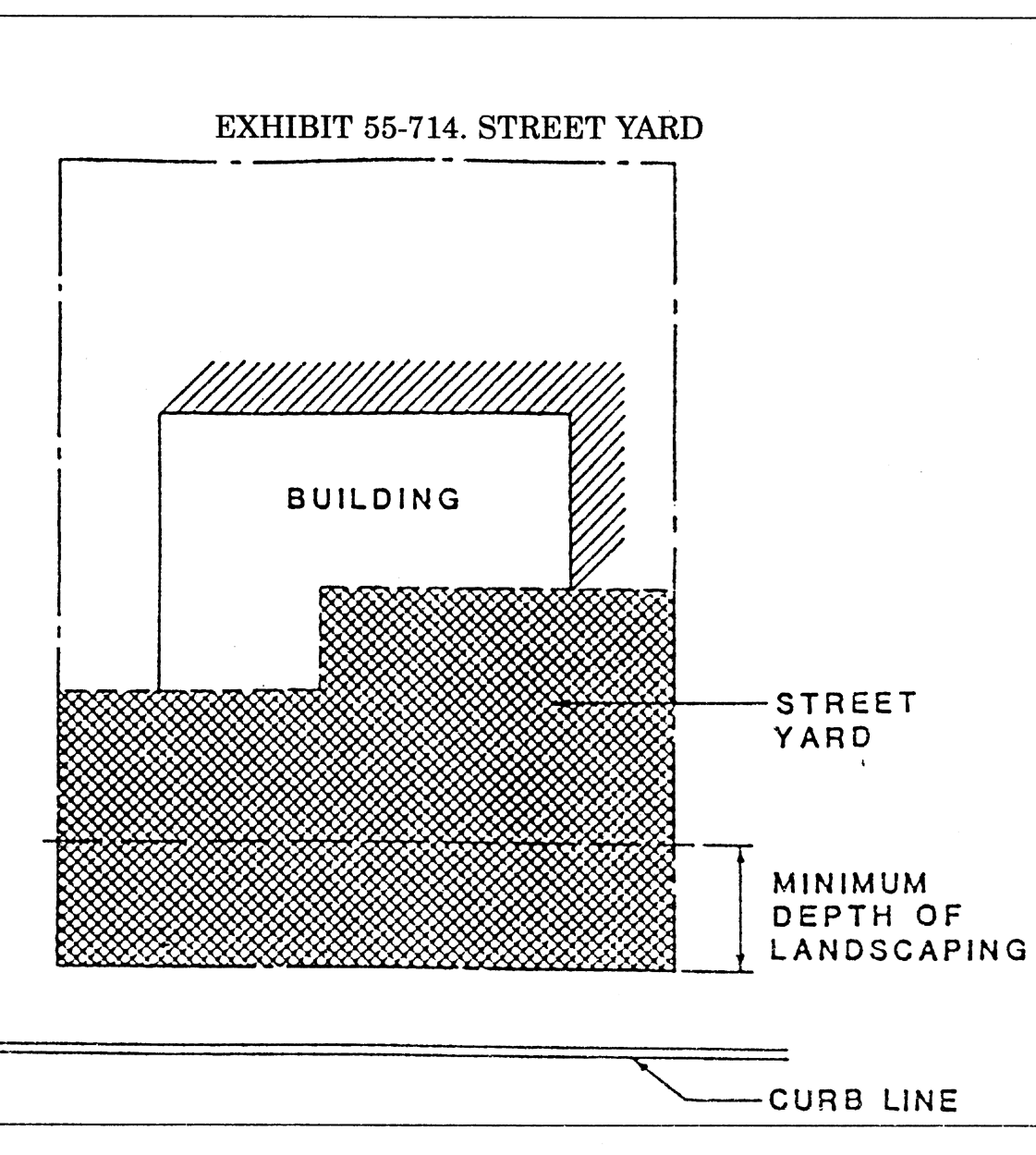
Exhibit 55-714—Street Yard
Sec. 55-715. - Street yard landscaping.
Landscaping shall be provided adjacent to each street property line and within street yards as set forth in Table 55-715. (See the drawings on the page following the table.)
(a)
Credit for landscaped right-of-way (R-O-W): On properties located in an R6 or more intensive zoning district, a maximum of one-half of the area of any landscaped street R-O-W more than 35 feet back from the center line of such street and planted and maintained by the adjacent property owner, may be credited toward the fulfillment of the landscaping requirements for the adjacent street yard, subject to the following conditions:
(1)
Such landscaped R-O-W must be visually contiguous to the street yard, and must be landscaped and maintained as part of the adjacent property.
(2)
The maximum area that may be credited toward fulfillment of the street yard landscaping requirement in the R-O-W shall be 20 feet multiplied by the applicable street frontage.
(3)
A minimum of one tree must be planted and maintained for each 500 square feet of landscaped R-O-W credited toward satisfaction of the street yard landscaping requirement. Trees required under this schedule may be located elsewhere within the street yard. Each tree planting plan for street R-O-W shall be reviewed and approved by the public works director and the city forester, or their designees. In no event shall any such tree be planted closer than 12 feet from the final proposed curb line.
(4)
The minimum depth requirement for street yard landscaping must be fulfilled.
(5)
The credit set forth herein shall not cause the required landscaped area within the first 100 feet of street yard depth to be reduced to less than the minimum equivalent street landscaping for the applicable zoning district.
(6)
Reduction of any landscaped right-of-way developed pursuant to this section by reason of eventual public use shall not be considered to create a nonconformance with the requirements of this article.
(b)
Lots with multiple frontage: When a lot contains more than one street frontage, the area of al street yards and the proposed street yard landscaped areas may be combined for the purpose of determining compliance with this schedule.
(c)
Shallow lots: On any lot within a CC Community Commercial, GC General Commercial, or GI General Industrial District, with a perpendicular dimension of 150 feet or less measured from the street property line, the following exceptions to the minimum depth provisions of this section shall apply:
(1)
The required minimum depth may be reduced to ten percent of the depth of the street yard. Such minimum depth shall not be less than five feet, except as provided by section 55-715(c)(2).
(2)
The landscaped area required by the minimum depth provisions may alternately be provided in grouped landscaping areas extending back from the street property line, subject to approval by the planning director.
(d)
Irregular residential lots: For irregular lots within residential districts, the width of the street yard shall be defined by lines drawn perpendicular from the intersection of the front building line with the side property line of the lot.
TABLE 55-715
STREET YARD LANDSCAPING
SCHEDULE A
This schedule establishes required street yard landscaping in the CC and GC districts. It shall not overrule any more restrictive landscaping requirements set forth elsewhere in this chapter.
STREET YARD LANDSCAPING
Example
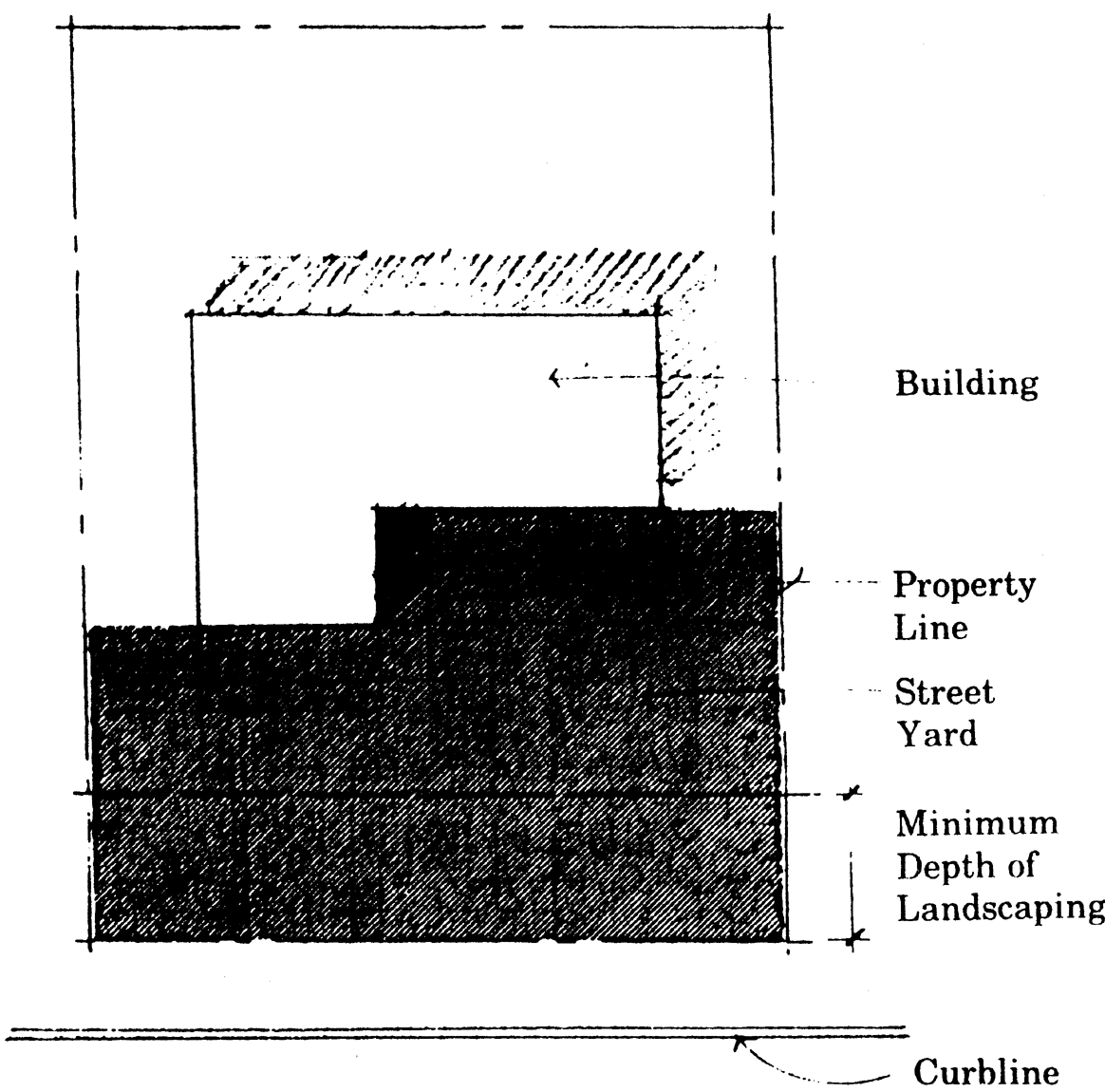
Figure 55-715
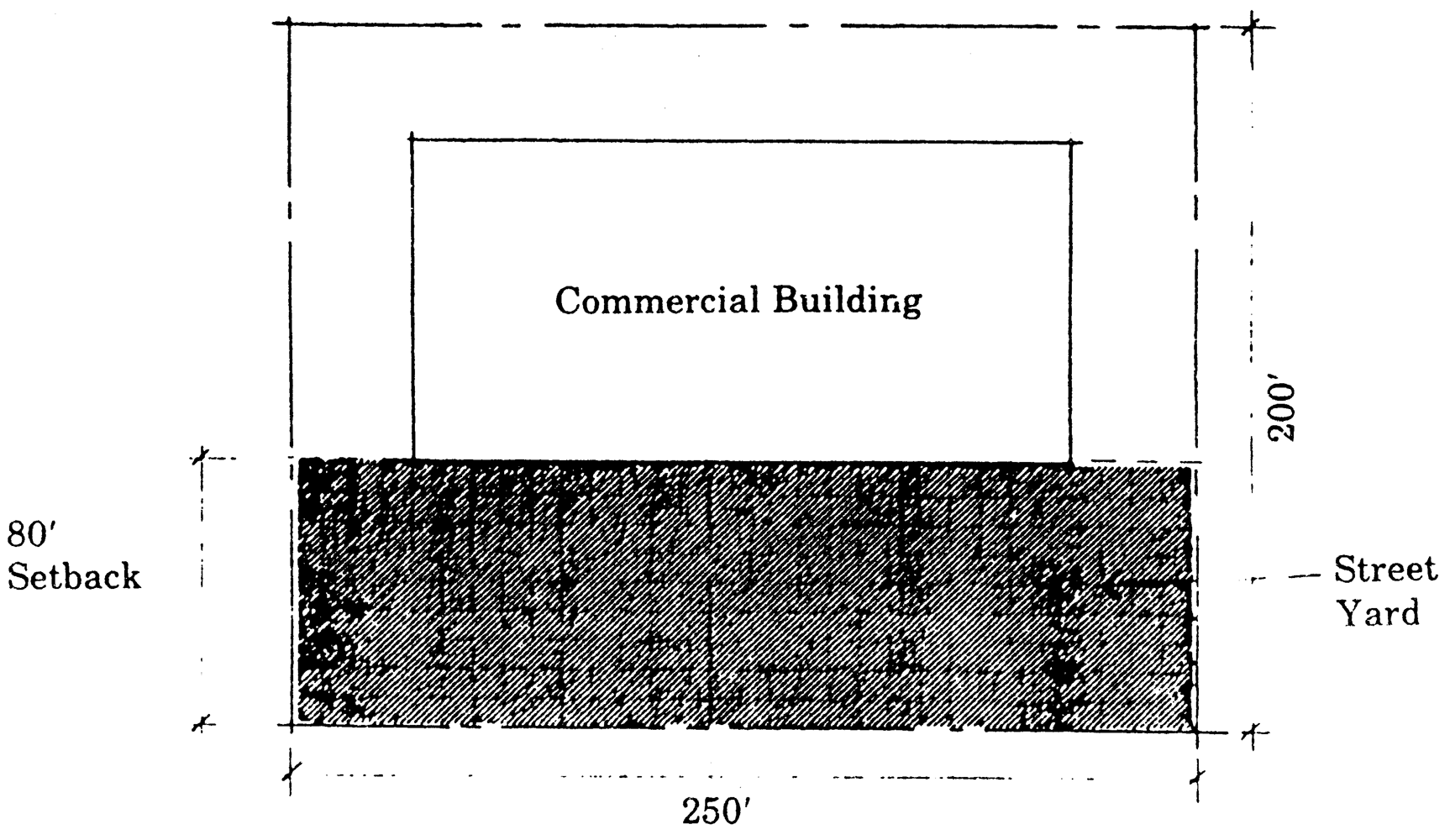
A developer wants to build a commercial building on a 250-foot by 200-foot site, as shown. The site is zoned CC. What are the street landscaping requirements?
Commercial Building
Solution
The size of the street yard is 80 feet by 250 feet, or 20,000 square feet. In the CC district, 20 percent of this area must be landscaped. Thus 4,000 square feet of the street yard must be landscaped.
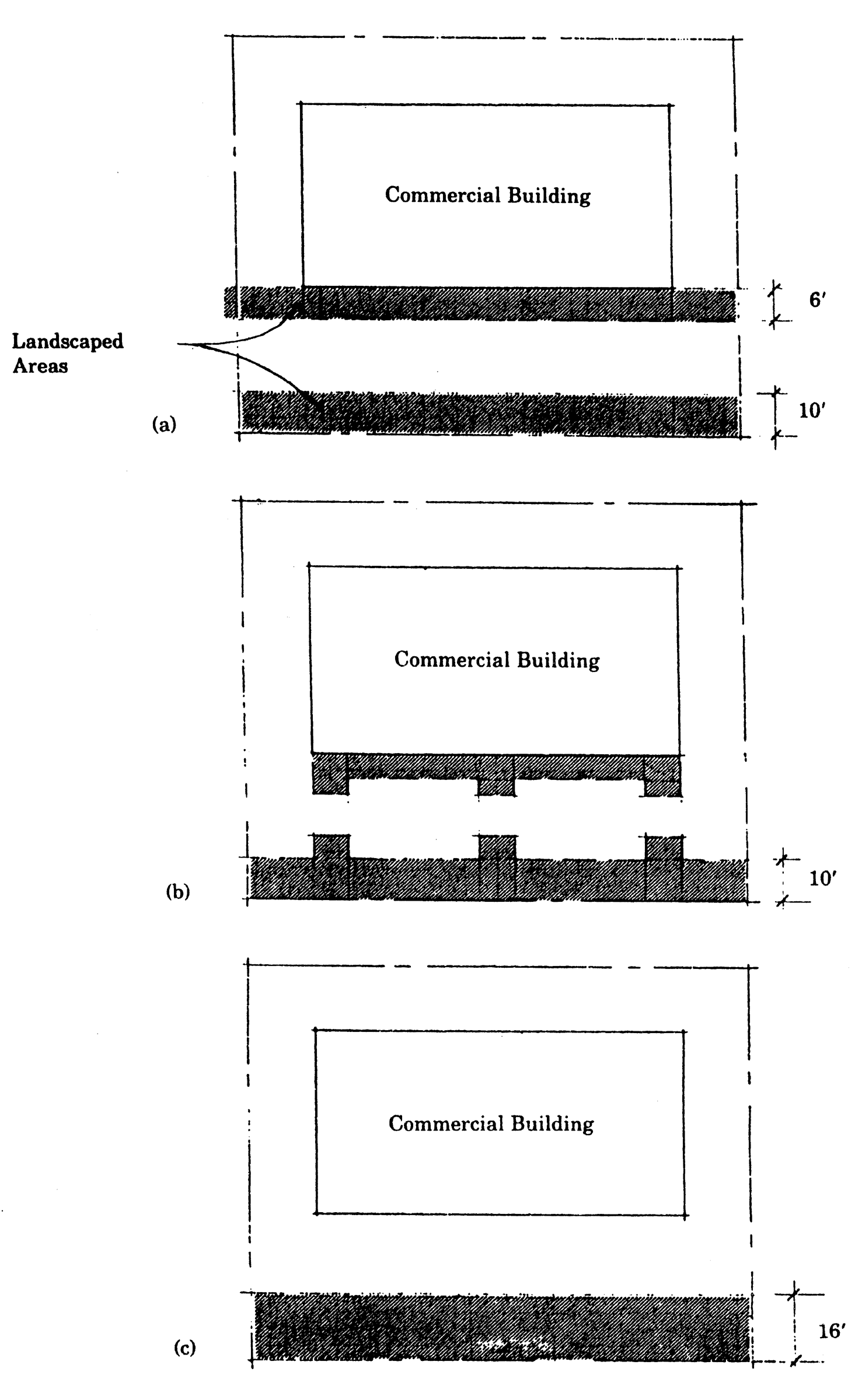
The minimum depth of the street landscaping from the front property line is ten feet. This accounts for 250 feet by ten feet or 2,500 square feet of the required street yard landscaping.
Therefore, an additional 1,500 square feet of landscaping is required. Diagrams (a), (b), and (c) give examples of how the street landscaping requirements could be satisfied.
Landscaped Areas
Example 2
A developer wants to build a commercial building on an 800-foot wide by 400-foot deep
site as shown below. The site is zoned CC community commercial. What are the street
landscaping requirements?
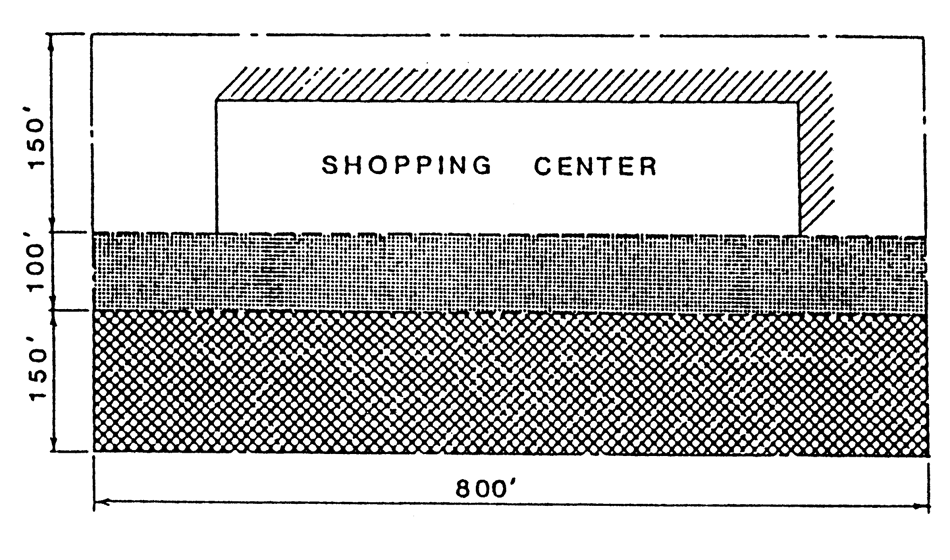
Example 2—Shopping Center
Solution
The size of the entire street yard is 250 feet by 800 feet, or 200,000 square feet. In the CC district, the total amount of required street landscaping is equal to the sum of 20 percent of the first 150 feet of street yard measured from the property line, ten percent of the next 150 feet, and five percent of any additional depth. In this example, the required landscaping is calculated as follows:
First 150 feet: 150 × 800 × 0.20 = 24,000 sq. ft.
Next 100 feet: 100 × 800 × 0.10 = 8,000 sq. ft.
Total 32,000 sq. ft.
A minimum of 20 percent of the first 150 feet of the street yard, or 24,000 square feet must be landscaped. However, some of the required landscaping within the second 100 feet may be transferred to the front of the lot, provided that not less than five percent of this second area is landscaped. Thus, the developer could choose to transfer up to 4,000 square feet of landscaping from the second part of the street yard to the front 150 feet.
The minimum depth of the street landscaping from the front property line is ten feet. This minimum accounts for 800 × 10, or 8,000 square feet of the required landscaping in the front 150 feet of the street yard. An additional 16,000 square feet must be provided within this area.
In certain situations, landscaping that is planted and maintained within the public right-of-way may help fulfill these street landscaping requirements. (Refer to section 55-715, Schedule A, for the use of this credit.)
(Code 1980, § 55-715; Ord. No. 37810, § 26, 8-14-07; Ord. No. 38677, § 7, 3-16-10; Ord. No. 40041, § 4, 7-15-14)
_____
Sec. 55-716. - Bufferyards.
These provisions apply when a use is established in a more intensive zoning district ("district A") which is adjacent to a less intensive zoning district ("district B"). The owner, developer or operator of the use within district A shall install and maintain a landscaped bufferyard on his/her lot, site or common development, as set forth in this section. Bufferyard requirements apply only to those districts indicated in table 55-716.
(a)
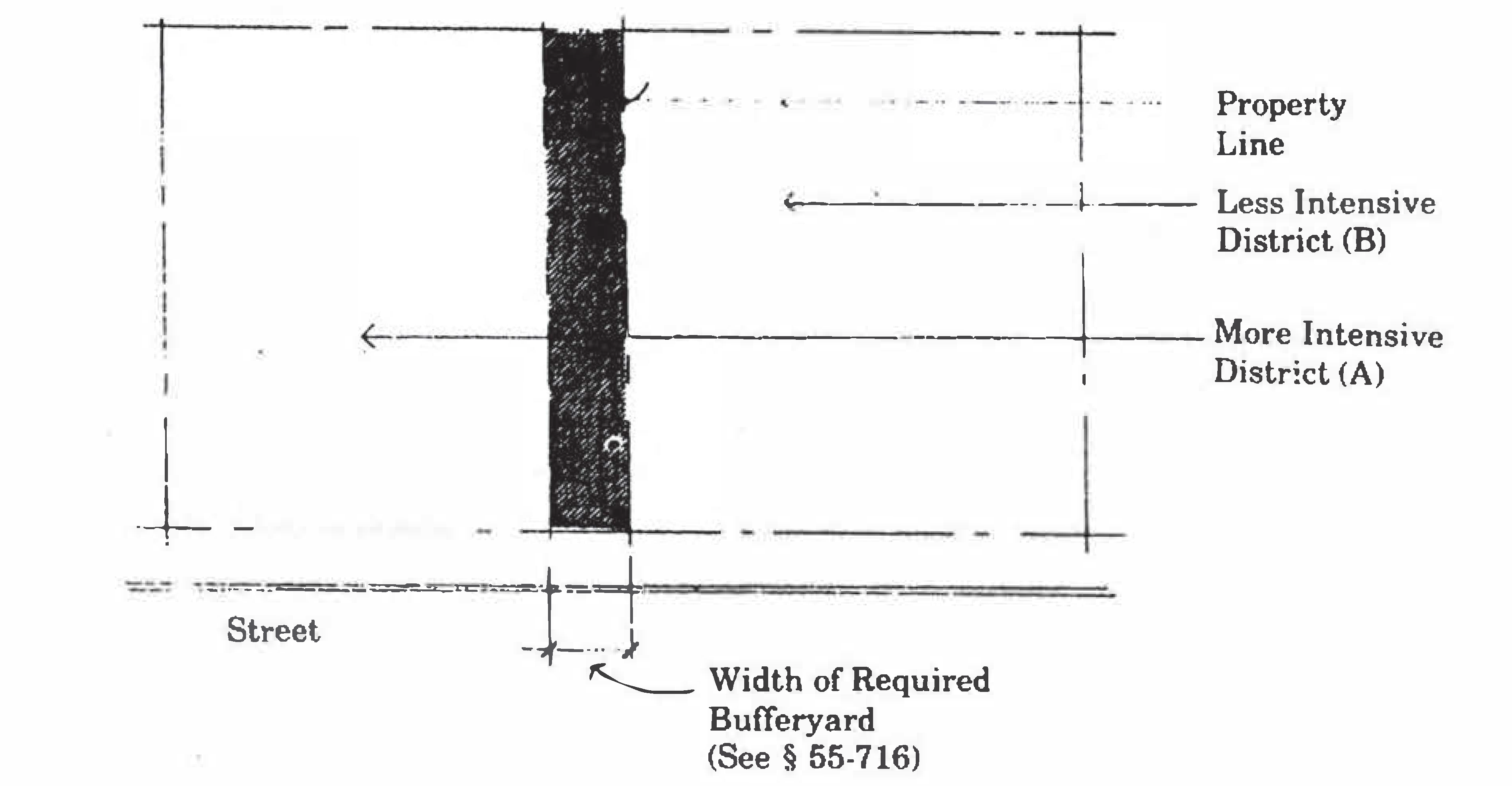
Districts with common lot lines. When the use in the more intensive zoning district has a common lot line with a less intensive zoning district, the required bufferyard is set forth in table 55-716. (See exhibit 55-716(a).)
(b)
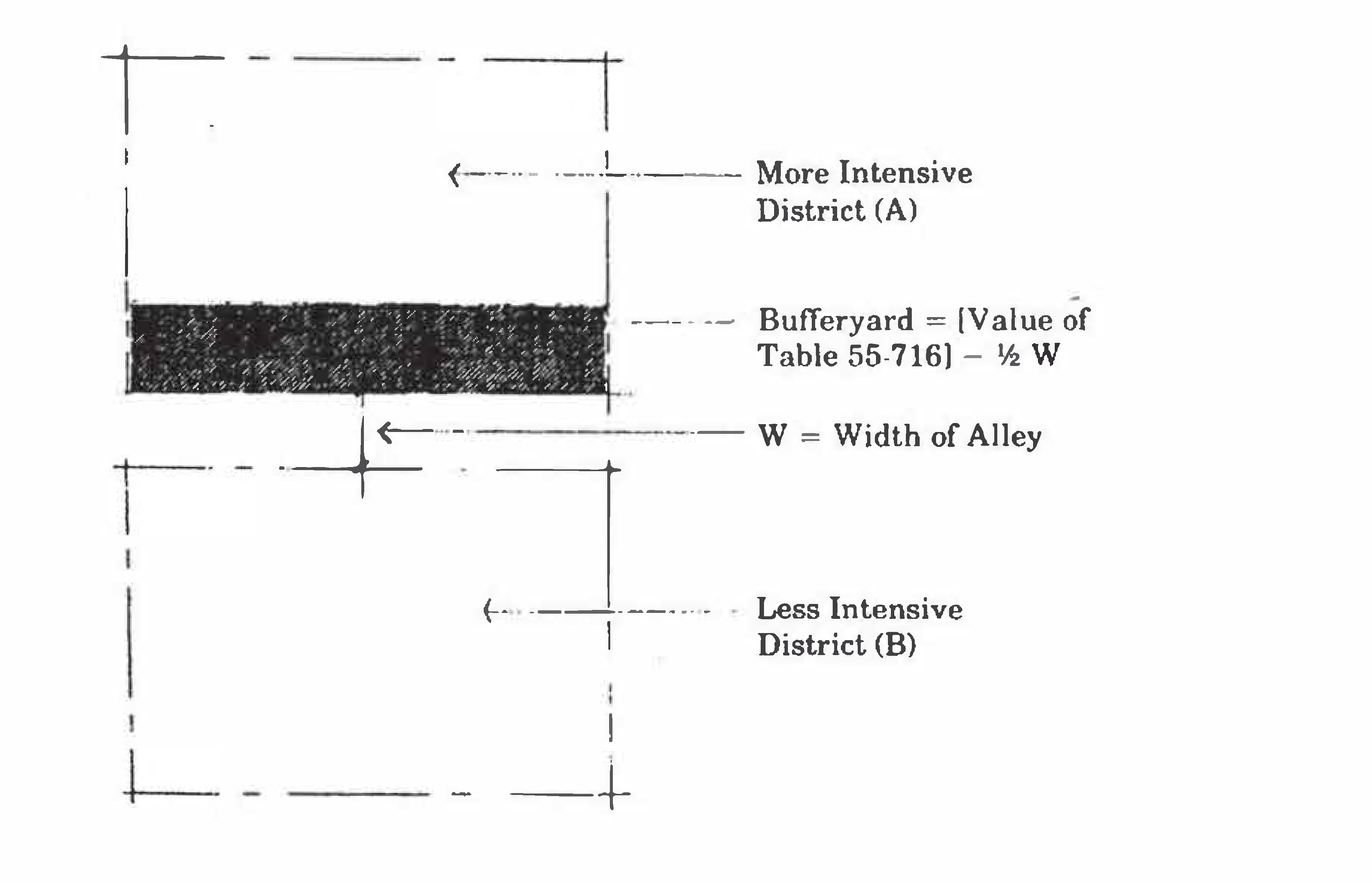
Districts with intervening alleys. When an alley separates adjacent districts requiring a bufferyard, one-half the width of the alley shall be credited toward meeting the required bufferyard. (See exhibit 55-716(b).)
(c)
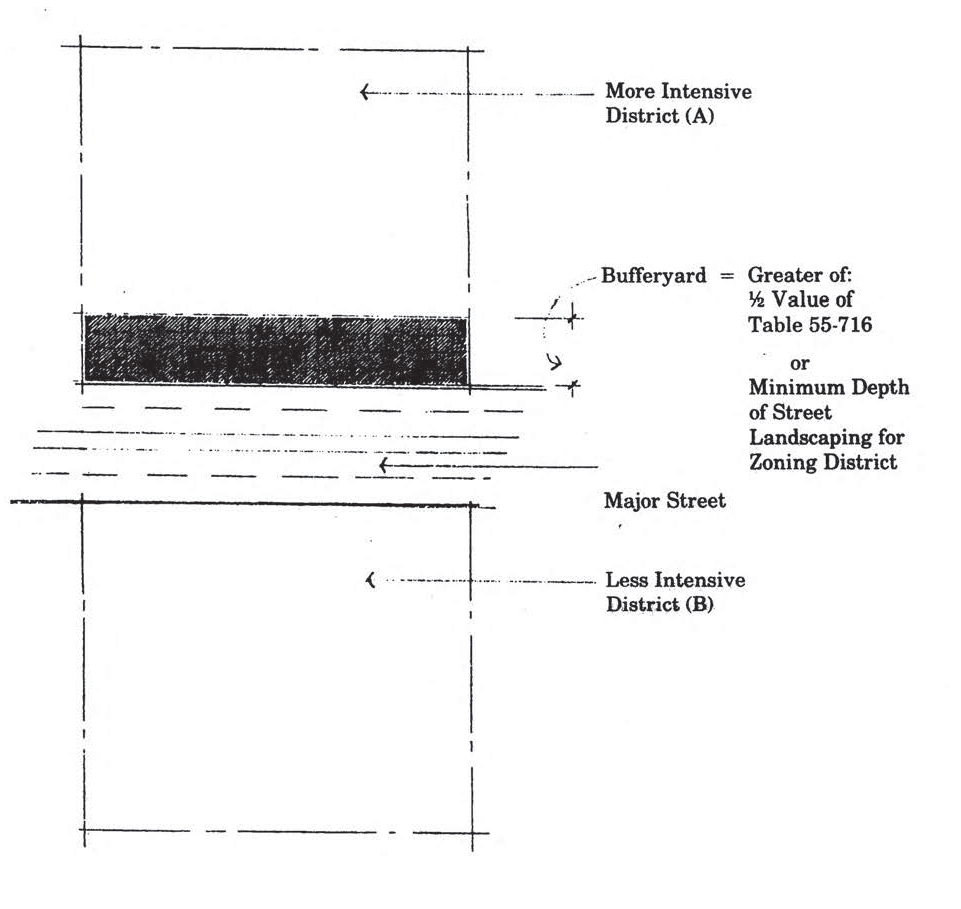
Districts with intervening major street. When a collector or arterial street separates adjacent districts requiring a bufferyard, the required bufferyard shall be the greater of one-half the required bufferyard set forth by table 55-716 or the minimum depth of front yard landscaping provided by table 55-715. (See exhibit 55-716(c).)
(d)
Districts with intervening local street. When a local street separates adjacent districts requiring a bufferyard, the required bufferyard shall be the greater of the required bufferyard set forth in table 55-716 or the minimum depth of front yard landscaping provided by table 55-715. (See exhibit 55-716(d).)
(e)
Railroad right-of-way. Any lot or site which is adjacent to an active railroad right-of-way shall be exempt from any bufferyard requirement along the common property line with such right-of-way.
(f)
Exception. On any lot platted before March 4, 1987, which requires provision of a bufferyard and has a dimension perpendicular to such bufferyard of less than 150 feet, such bufferyard may be reduced to no less than ten percent of the applicable dimension. The screening standards set forth in section 55-717 shall apply to any lot using this bufferyard reduction provision.
_____
TABLE 55-716. BUFFERYARD REQUIREMENTS
(In Feet)
* Screening provisions, section 55-717, may apply to these conditions.
SCHEDULE B
(Code 1980, § 55-716)
FIGURE 55-716. BUFFERYARD REQUIREMENTS
(a)
Common Lot Lines.
(b)
Intervening Alleys
(c)
Intervening Major Streets.
(d)
Intervening Local Street.
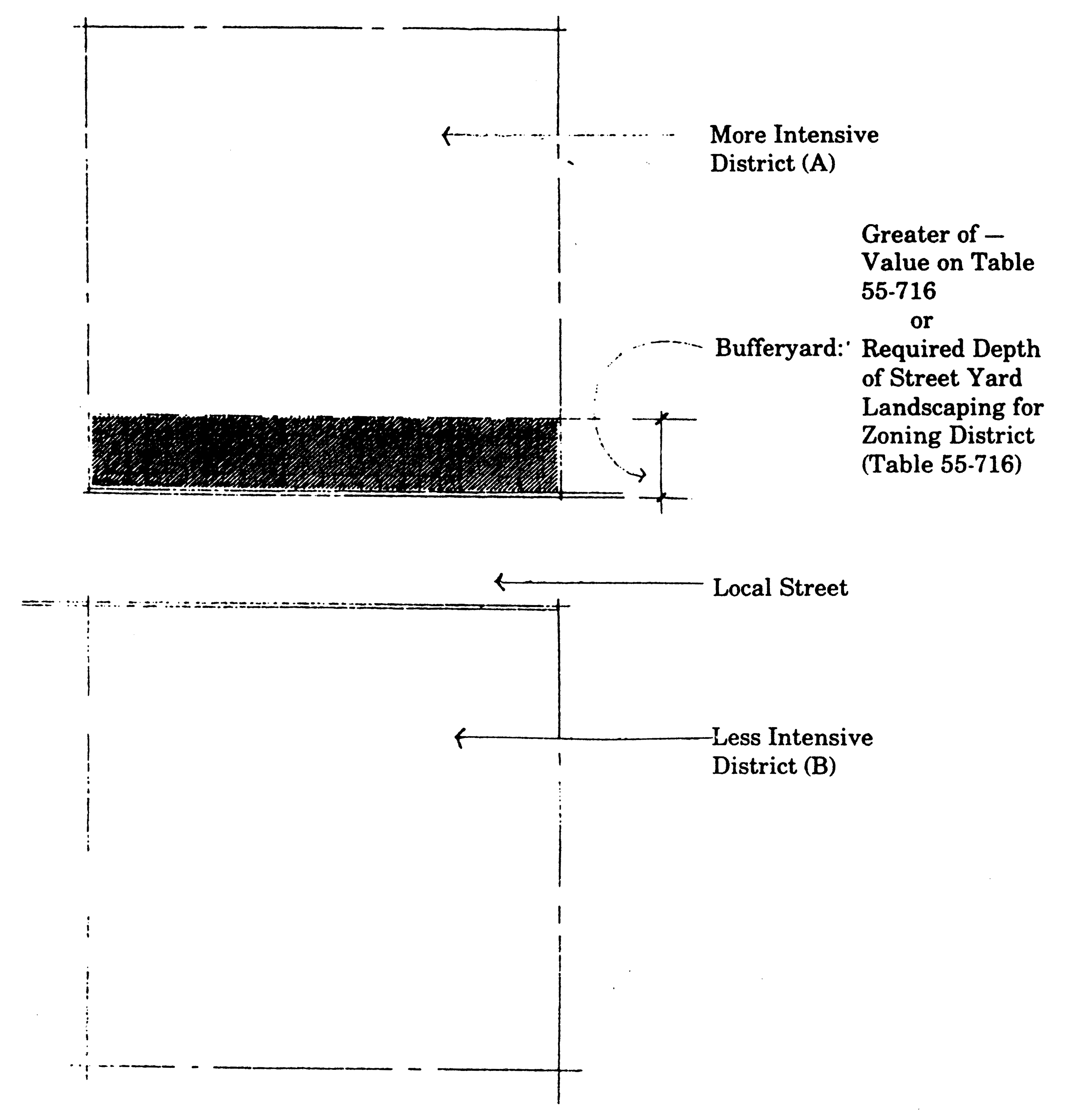
Intervening Local Street
Sec. 55-717. - Screening.
(a)
Screening is required between adjacent zoning districts as indicated in Table 55-716 when one of the following conditions in the more intensive zoning district is directly visible from and faces toward the boundary of the less intensive zoning district:
(1)
The rear elevation of buildings.
(2)
Outdoor storage areas, unless otherwise screened.
(3)
Loading docks, refuse collection points, and other service areas.
(4)
Major machinery or areas housing a manufacturing process.
(5)
Truck and/or trailer parking.
(6)
Sources of glare, noise or other environmental effects.
(7)
Parking facilities (including drive-through lanes). Screening is not required if separated by a public right-of-way greater than 20 feet.
(b)
A six-foot opaque barrier shall be provided which visually screens the potentially offensive uses listed in section 55-717(a) from less intensive districts as follows:
(1)
A solid wood and/or masonry fence or wall at least six feet in height, of a design approved by the planning director.
(2)
A hedge-like screen or a random or informal screen of evergreen or approved deciduous plant material, capable of providing a substantially opaque barrier and attaining a minimum height of six feet within three years of planting.
(3)
A landscaped earth berm with a maximum slope of three to one, rising no less than six feet above the existing grade of the lot line separating the zoning districts.
(4)
Any combination of these methods that achieves a cumulative six-foot high screen.
(c)
A solid wood and/or masonry fence or wall of any height, as a method of screening as referred to in section 55-717(b), must be located at the interior boundary of the required bufferyard.
(d)
Screening shall not adversely affect surface water drainage.
(Code 1980, § 55-717; Ord. No. 37976, § 1, 1-29-08; Ord. No. 44374, § 1, 8-26-25)
Sec. 55-718. - Applicability of article; tree planting; maintenance.
The landscaping and screening provisions of this article apply to all development within the city and its extraterritorial jurisdiction, except as otherwise provided by this chapter. These provisions shall be applied for each individual lot when an application for a building permit on such lot is made.
(a)
Common development. A common development that includes more than one lot or site shall be treated as one lot or site for the purposes of satisfying the requirements of this section.
(b)
Previously approved site plans. Any site plan or landscaping plan approved by the planning board or the city council prior to the effective date of this chapter [March 4, 1987] shall remain enforceable and in force.
(c)
Tree planting.
(1)
Urban Design (UD) districts:
a.
Follow the planting guidelines outlined in sections 55-924 and 55-928 with regard to right-of-way and parking facilities.
b.
If buildings are set back further than ten feet from the property line, trees will still be required as outlined below.
(2)
In any landscaped area required by the minimum depth requirements pursuant to section 55-715, the bufferyard provisions pursuant to section 55-716, and the parking lot landscaping requirements pursuant to subsection 55-740(f)(4) and (5), one tree shall be planted and maintained for each 500 square feet of such landscaped area with the following exceptions:
a.
Single-family (detached) residential and agricultural uses.
b.
Parking lot perimeter landscape areas and bufferyards less than six feet.
c.
If utilities, easements or other conflicts exist within a required landscape area, the planning director may approve an alternative planting plan subsequent to documentation being provided that details the conflict and the plan having the same number of trees as would otherwise be required located as close as is feasible to the required landscaped area.
(3)
Tree species shall be approved consistent with lists on file with the planning department. Minimum requirements for the trees at the time of planting are as follows:
a.
Overstory trees - minimum two inch B&B (balled and burlapped) or seven gallon grow-bag (or equivalent caliper).
b.
Understory trees - minimum 1.5 inch B&B (balled and burlapped) or seven gallon grow-bag tree (or equivalent caliper).
c.
Evergreen trees - minimum five feet in height.
d.
Trees grown in plastic nursery pots are not allowed.
(d)
Bonus provision. Preservation of each healthy existing tree of an approved species that is at least 4.5 inches caliper shall count as two trees toward fulfillment of the tree requirements of subsection (c) subject to the following conditions:
(1)
Species must be on the approved list on file with the planning department.
(2)
All trees to be preserved and removed must be shown on a demolition or removal plan.
(3)
If grading, either cut or fill, is taking place within the dripline of the tree, it cannot be counted as being preserved unless specific mitigation strategies are provided by a licensed arborist and detailed on the plans.
(4)
The tree(s) to be preserved must be fenced off at the dripline of the tree during the construction process. This distance may be reduced in certain circumstances but the exact extent of the fencing must be shown on the approved plan set.
(e)
Maintenance of required landscaping. Upon installation or preservation of required landscape materials, appropriate measures shall be taken to ensure their continued health and maintenance. Required materials that do not remain healthy or die shall be replaced consistent with this article.
(Code 1980, § 55-718; Ord. No. 43542, § 1, 10-2-23; Ord. No. 44374, § 1, 8-26-25)
Sec. 55-719. - Performance bond.
(a)
If, at the time of an application for a certificate of occupancy, any required landscaping is unable to be installed due to climatic conditions, the developer or owner of a site must submit surety (by bond, letter of credit or other security approved in writing by the city attorney) satisfactory to the city in the amount of the value of a bona fide contract to install such landscaping. Such a contract must be reviewed and approved by the permits and inspections division. Landscaping bonds will only be issued from November 15th through April 15th unless otherwise approved by the planning director.
(b)
The developer or owner shall grant the city permission to enter upon the land to install required landscaping if this has not been done within 12 months of the effective date of the certificate of occupancy.
(c)
The city shall release any bond or other arrangement immediately when the permits and inspections division verifies that required landscaping has been installed.
(d)
These provisions shall not apply to single-family, duplex or two-family residential uses except when a specific landscaping plan has been approved by the planning board and/or the city council.
(Code 1980, § 55-719; Ord. No. 42341, § 8, 10-27-20)
Sec. 55-720. - Obstruction of view.
Landscaping installed in any landscaped area shall not obstruct the view from or to any driveway approach, street, alley or driveway intersection, or pedestrian or bicycle intersection, indicated on the approved construction plans, and shall be consistent with the visibility requirements outlined in the City of Omaha's Standards for Urban Landscaping, on file with the planning director.
(Code 1980, § 55-720)
Cross reference— Sight obstructions by trees and vegetation, § 37-91 et seq.
Sec. 55-721. - Parking lot landscaping.
Any landscaping installed within parking lots to satisfy the requirements of section 55-740(f) shall count toward meeting the requirements of this section.
(Code 1980, § 55-721)
Sec. 55-722. - Rezoning of adjacent property.
A development may continue to comply with the bufferyard and screening requirements in effect at the time of issuance of its initial building permit, regardless of whether an adjacent lot, site or common development is rezoned to a less intensive district which requires additional bufferyards or screening.
(Code 1980, § 55-722)

