
Omaha City Zoning Code
ARTICLE XVIII
SIGN AND STREET GRAPHICS REGULATIONS10
Cross reference— Advertising, ch. 3; private use of public property, § 34-141 et seq.; signs and awnings, ch. 51.
Sec. 55-821. - Purpose.
This article shall be known as the sign and street graphics regulations. These regulations provide standards for communicating information in the environment of the city and its jurisdiction. The regulations recognize the need to protect public health, safety and welfare; to maintain the attractive appearance of the community; and to provide for adequate business identification, advertising and communication. The regulations are intended to:
(a)
Ensure that the informational needs of sign users are met in a way that is compatible with the surrounding urban environment.
(b)
Improve the legibility and efficiency of individual signs and graphics.
(c)
Provide for the design, location and maintenance of signs and graphics in a manner that does not endanger public safety.
(d)
Provide flexibility for sign and graphics users to communicate effectively within certain standards.
(e)
Recognize the special characteristics of specific areas and the impact of graphics on urban environmental design.
(Code 1980, § 55-821)
Sec. 55-822. - Definitions.
The following definitions shall be used for terms contained in this chapter that are not otherwise defined in this Code or in this chapter.
(a)
Advertising sign: A sign which directs attention to business, profession, commodity or service, that is offered, sold or manufactured on property or premises other than that upon which the sign is located, including incidental off-premises directional copy.
(b)
Advertising sign location: The portion of a site directly below any structure, equipment or accessory associated with an advertising sign. An advertising sign location shall be considered established upon issuance of a valid sign permit.
(c)
Abandoned sign:
(1)
An on-premises sign, including sign face and supporting structure, which refers to a discontinued business, profession, commodity, service, or other activity or use formerly occupying the site.
(2)
An off-premises sign structure which contains no sign copy on all sign faces for a continuous period of six months.
(d)
Architectural sign band: A wall sign which is an integral part of and projects no more than eight inches beyond the facade of a building and which has the following additional characteristics:
(1)
The width of the sign is no greater than 2.5 percent of its length.
(2)
The total area of copy, as defined by the sum of the area of rectangles enclosing the extreme limits of each individual copy entry, does not exceed 50 percent of the total surface area of the sign.
(e)
Attached sign: A sign which is structurally connected to a building and/or depends upon that building for support.
(f)
Auxiliary design elements: Terms which describe secondary characteristics of a sign, including its method of illumination and other features within the bounds of its basic shape.
(g)
Awning sign: A sign or graphic printed directly upon awning material.
(h)
Banner: A flexible substrate of fabric, plastic, paper, or other light pliable material on which copy or graphics may be displayed. A banner is one type of temporary sign. This can include pennants, panels or other similar signs.
(i)
Basic design elements: Terms which describe primary visual and structural characteristics of a sign, including its method of support and general appearance.
(j)
Bulletin board: A sign which permits the posting of announcements regarding religious, civic, philanthropic or neighborhood organizations.
(k)
Business center: A building containing more than one business, or any group of buildings in close proximity to one another, sharing parking, ownership and access.
(l)
Business center identification sign: A sign which identifies a business center by name, address or symbol.
(m)
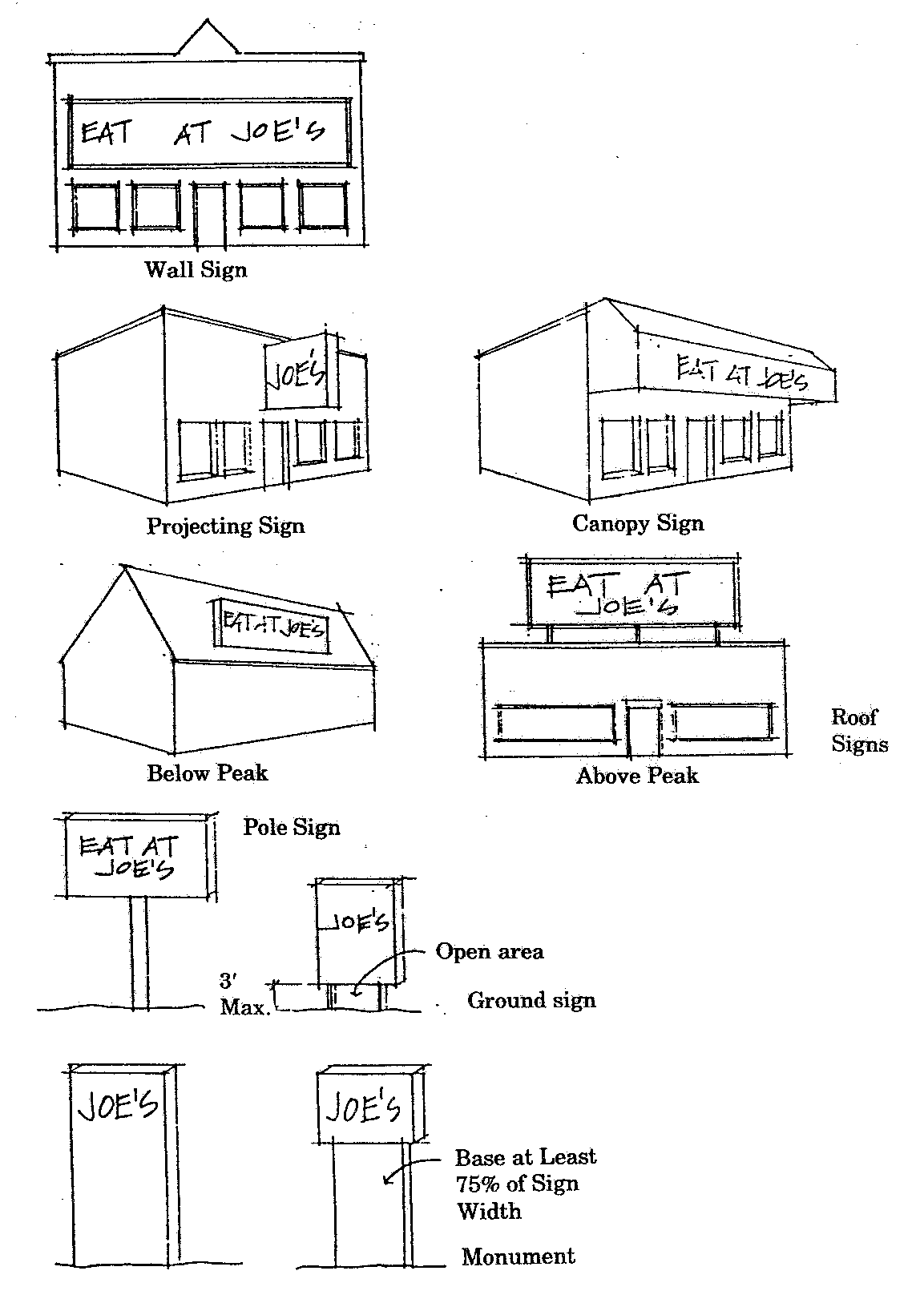
Canopy sign: A sign which is attached or made an integral part of a canopy.
(n)
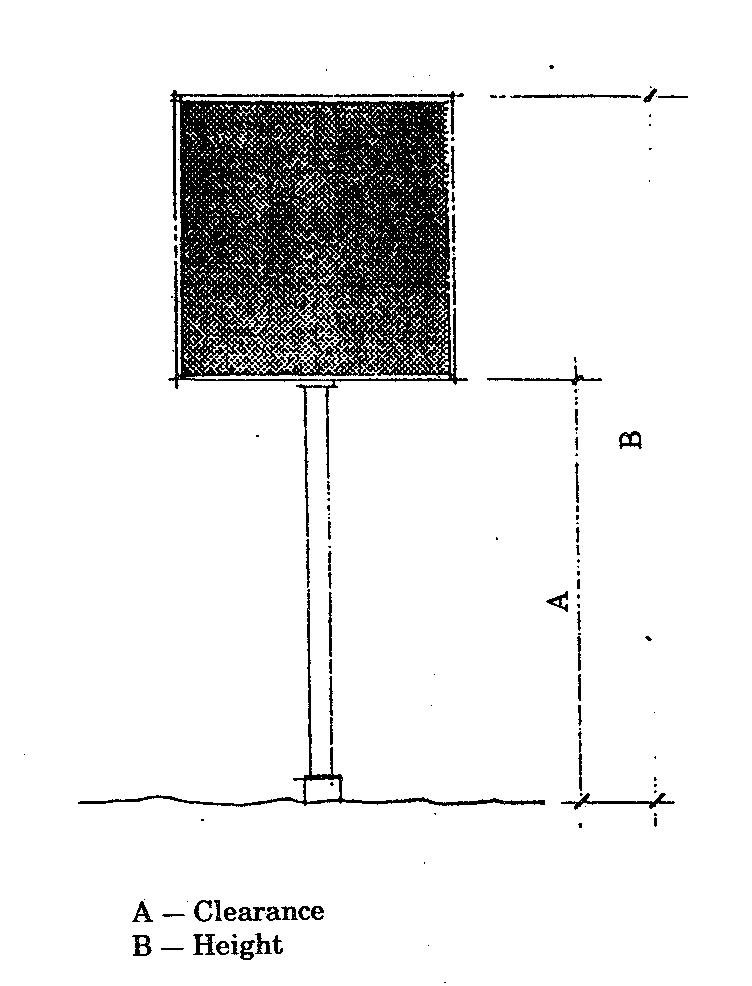
Clearance: The distance from the bottom of a sign face elevated above grade and the grade below.
(o)
Detached sign: A sign which is self-supporting and structurally independent from any building.
(p)
Directional sign: A sign which serves only to designate the location or direction of any area or place.
(q)
Double-faced sign: A sign consisting of no more than two parallel faces supported by a single structure.
(r)
Electronic information sign: Any sign intended primarily to provide information of general community interest, including time, temperature, date, atmospheric conditions, news, traffic control, or commercial messages pertaining to the use on the premises, by means of an electronic display.
(s)
Federal aid primary road system: A system of major arterial streets and highways displayed on the Federal Aid Urban System (F.A.U.S.) map on file with the planning director.
(t)
Frontage: The length of a property line of any one premises abutting and parallel to a public street, private way or court.
(u)
Ground sign: A detached on-premises sign built on a freestanding frame, mast or pole(s) with a clearance no greater than three feet.
(v)
Illumination: Lighting sources installed for the primary purpose of lighting a specific sign or group of signs.
(1)
Bare bulb illumination: Illumination or emphasis of signs using unshielded bulbs.
(2)
Direct flood illumination: Illumination of signs through floodlights whose luminous surface is visible to the normally located observer.
(3)
Flame: Use of open flame or torches as a light source.
(4)
Flashing illumination: use of an intermittent light source, including the illusion of intermittence through animation or other external light sources. Electronic information signs are excluded from this definition, except for the flashing mode of these signs.
(5)
Indirect illumination: Use of a light source whose luminous surface is not visible to the normally located observer.
(6)
Internal illumination: Use of a light source concealed or contained within the sign, and visible by shining through a translucent surface.
(7)
Neon or gas tube: Use of a light source supplied by a neon or other gas tube, bent to form letters, symbols and other shapes.
(w)
Major architectural feature: A significant element or detail of the facade of a building designated as a local landmark and/or listed on the National Register of Historic Places. Examples include ornate cornices, columns, column capitals, bas-reliefs, gargoyles or sculptures, or balconies and balustrades.
(x)
Monument sign: An on-premises freestanding sign with the appearance of a solid base. The width of such base shall be at least 75 percent of the width of the sign.
(y)
Moving sign: A sign which conveys its message through rotating, changing, or animated elements.
(z)
Nonconforming sign: A sign that was legally erected prior to the adoption of this chapter (January 27, 1987), but which violates the regulations of this chapter.
(aa)
Off-premises sign: A sign which directs attention to a business, profession, commodity or service offered on property other than on which the sign is located.
(bb)
On-premises sign: A sign which directs attention to a business, profession, commodity or service offered on the property on which the sign is located.
(cc)
Owner identification sign: An on-premises sign which pertains only to the use of a premises and which contains information about the owner or operator of that use, the type of business being conducted or the principal brand name of a commodity sold on the premises, and other information relative to the conduct of the use.
(dd)
Pole sign: An on-premises sign built on a freestanding frame, mast or pole(s) with a clearance greater than three feet, and where the support encompasses less than 75 percent of the width of the sign.
(ee)
Political sign: A sign installed for a limited period of time which displays information pertaining to an upcoming governmental subdivision, city, county, state or federal election.
(ff)
Portable sign: Any sign which by design or construction is intended to be easily and readily relocated to a particular site but is not permanently affixed to the ground, a building or other structure. Portable signs shall include, but are not limited to, signs mounted upon a trailer, bench, wheeled carrier, or other motorized or non-motorized mobile structure with or without wheels.
(gg)
Premises: A tract of one or more lots or sites which are contiguous and under common ownership or control.
(hh)
Projecting sign: A sign other than a wall sign that is attached to and projects from a building face.
(ii)
Real estate sign: A temporary sign which is used exclusively to announce that the property upon which it is located is for sale, for lease, has been sold or leased.
(jj)
Roof sign: Any sign or part of sign erected upon, against or directly above a roof or on top of or above the parapet or cornice of a building.
(1)
Below-peak roof sign: A roof sign positioned between an eave line and the peak or highest point on a roof, substantially parallel to the face of a building.
(2)
Above-peak roof sign: A roof sign positioned above the peak of a roof or above a parapet or cornice.
(kk)
Sign: A symbolic visual device fixed upon a building, vehicle, structure or parcel of land which is intended to convey information about a product, business, activity, place, person, institution, candidate or political idea.
(ll)
Signable wall area (SWA): A percentage of the surface area of a street, private way or court facade that defines the maximum area of any wall sign or combination of wall signs permitted on that facade.
(mm)
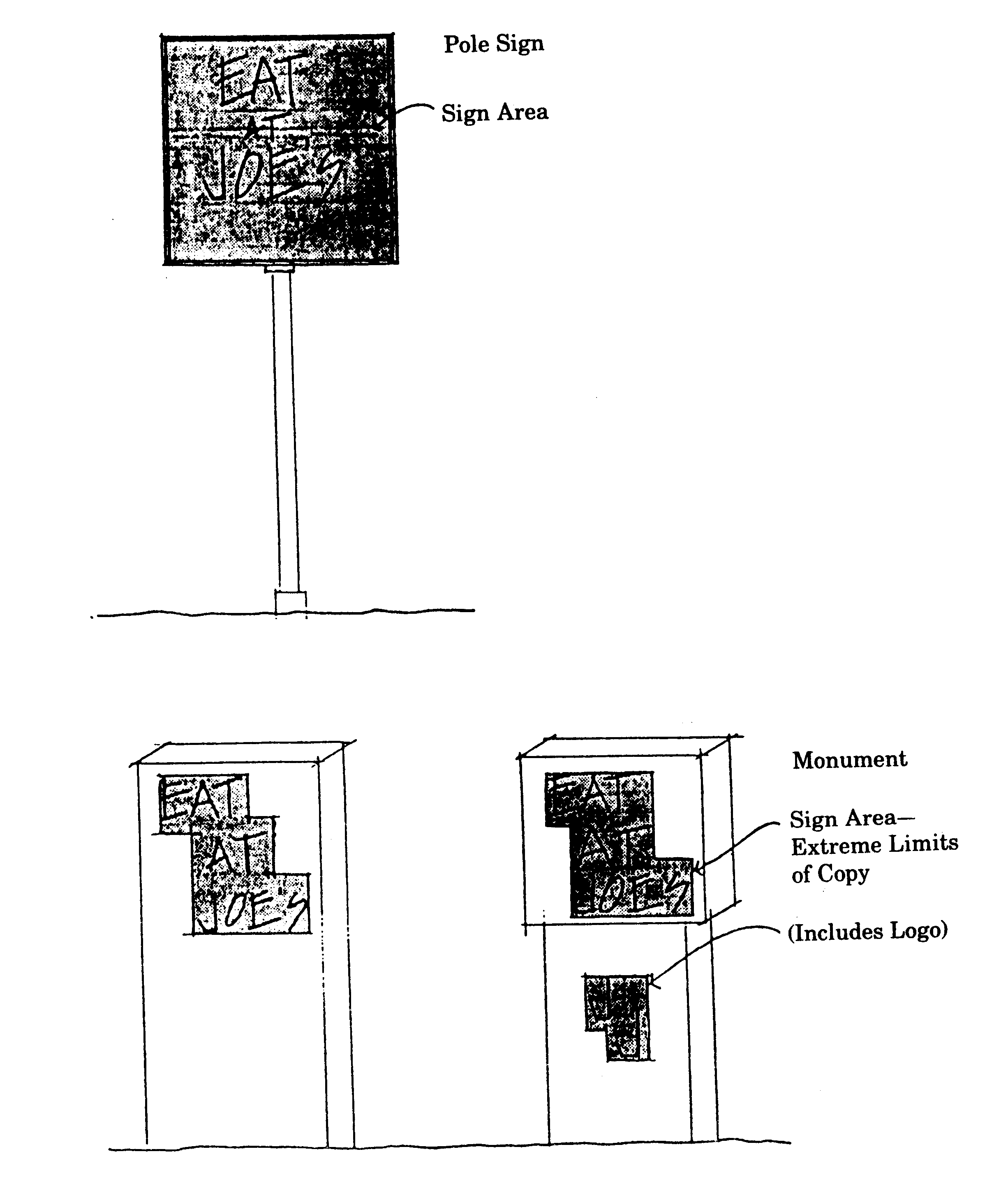
Sign area: The entire area within the largest single continuous perimeter enclosing the extreme limits of a sign face, but not passing through or between any element of the sign. "Sign area" does not include any structure for support or service of the sign, or architectural elements of the building.
(nn)
Sign type: A functional description of the use of an individual sign. Includes owner identification, advertising, directional, electronic message and temporary.
(oo)
Street facade: Any separate external face of a building, including parapet walls and omitted wall lines, oriented to and facing a public street, private way or court. Separate faces oriented in the same direction or within 45 degrees of one another are considered part of the same street facade.
(pp)
Temporary signs: A sign intended to display either commercial or noncommercial messages of a transitory or temporary nature including, but not limited to, placards, banners, posters, pennants, valances or other outdoor advertising displays not intended to be permanently displayed. Any sign not permanently embedded in the ground or not permanently affixed to a building or sign structure that is permanently embedded in the ground are considered temporary signs.
(qq)
Total permitted sign area: The maximum permitted combined area of all on-premises signs allowed on a specific property.
(rr)
Triangular sign: A sign consisting of three faces, at least two of which are separated by no more than 30 degrees, supported by a single structure.
(ss)
Wall sign: A sign attached to and parallel with the side of a building. Such a sign mounted to or a part of a screen for mechanical equipment shall be considered a wall sign if its area does not exceed 40 percent of the area of the screen wall to which it is affixed.
(tt)
Window sign: A sign painted on or installed inside a window for the purpose of viewing from outside the premises.
(uu)
Yard sign: A sign with a metal or wood frame or post designed to be driven into the ground. This type of sign is typically smaller than five square feet and intended to be temporary in nature.
(Code 1980, § 55-822; Ord. No. 33027, § 1, 7-27-93; Ord. No. 38397, § 1, 4-14-09; Ord. No. 38676, § 4, 3-16-10)
Cross reference— Definitions and rules of construction generally, § 1-2.
FIGURE 55-822. DEFINITION OF TERMS
Sec. 55-823. - General regulations; prohibited signs; exempt signs.
(a)
Compliance with applicable regulations. Each sign or part of a sign erected within the zoning jurisdiction of the city must comply with the provisions of this chapter and of chapter 51 of this Code.
(b)
Conflicting provisions. This chapter is not meant to repeal or interfere with enforcement of other sections of this Code. In cases of conflicts with Code sections, state regulations or federal regulations, the more restrictive regulations shall apply.
(c)
Prohibited signs. The following signs are prohibited in all zoning districts:
(1)
Signs painted on or attached to rocks, trees or other natural objects.
(2)
Signs or sign structures which resemble or conflict with traffic-control signs or devices, which mislead or confuse persons traveling on public streets, or which create a traffic hazard.
(3)
Signs on public property, unless specifically authorized by the appropriate public agency.
(4)
Signs which create a safety hazard by obstructing the clear view of pedestrians or vehicles, or which obscure official signs or signals.
(5)
Portable signs.
(6)
On-premises abandoned signs.
a.
The face of abandoned on-premises signs must be removed within 30 days of date of abandonment and replaced with a blank face.
b.
The abandoned on-premises sign must be removed within 12 months of the date of abandonment.
(d)
Exempt signs. The following signs are permitted in any zoning district and are exempt from other provisions of this chapter:
(1)
Bulletin boards for religious assembly or school uses, provided that they have a maximum sign area of 20 square feet and are not located in a required sign setback.
(2)
On-premises real estate signs, with a maximum sign area often square feet in DR through R5 districts, and 32 square feet in any other district, provided that only one such sign may be permitted along any street frontage, except that such signs for single-family detached, single-family attached, two-family, and duplex residential use types shall in no case exceed ten square feet. In the case of real estate signs announcing that property has been sold, the sign shall cease being an exempt sign ten days after the closing on the sale. In the case of real estate signs announcing that all or a portion of a property has been leased, the sign shall cease being an exempt sign ten days after the tenant(s) take possession of all of the property offered for lease.
(3)
Official signs authorized by a government or governmental subdivision which give traffic, directional or warning information.
(4)
Historic or commemorative plaques, and building names and cornerstones carved into a masonry surface.
(5)
Seasonal decorations for display on private or public property.
(6)
On-premises construction signs, with sign areas less than or equal to 16 square feet in DR through R5 districts, and 32 square feet in any other district, provided that only one such sign may be permitted along any street frontage. Construction signs may identify the owner, contractor, architect and engineers, and financing agents of the construction project. Such construction signs in DR through R5 districts may be erected with sign areas up to 32 square feet, provided that they refer to a subdivision containing at least 12 housing units, and that they remain for a period not to exceed one year.
(7)
Political signs, provided they are installed no more than two months prior to the election to which they pertain and are removed within seven days after the election to which they refer.
(8)
Temporary signs for special community events, provided that they have a maximum area of 32 square feet. Such temporary signs may remain for no more than 30 days during any six-month period.
(9)
Murals, defined as works of graphic art painted or applied to building walls which contain no advertising or identification messages.
(10)
Street numbers.
(11)
Advertising signs at bus stops designated by Metro Area Transit. Signs mounted on benches may not exceed 15 square feet. Signs may be placed in bus shelters in a manner approved by the city council, and shall not exceed four feet by six feet (24 square feet).
(12)
Signs which are not visible from a public right-of-way, private way, or court or from a property other than that on which the sign is installed.
(e)
Placement in bufferyards. No sign other than on-premises directional signs permitted under subsection 55-828(e) shall be placed within any bufferyard required by section 55-716, "Bufferyards," except bufferyards adjacent to intervening major streets.
(f)
Vision clearance area. Except as provided below, no sign may project into or be placed within a vision clearance area defined by a triangle with legs of 20 feet from the point at which the curbs or edges of two intersecting streets, private ways or courts or an intersecting street, private way, or court and driveway meet.
(1)
Where otherwise permitted, signs with a minimum clearance often feet to grade may project into a vision clearance area.
(2)
Where otherwise permitted, signs with a maximum height of three feet to grade may be placed in a vision clearance area; provided that such signs do not block or inhibit visibility from any street or driveway onto an intersecting street or driveway, and provided that such signs are no greater than three feet above the grade of any intersecting street, drive or sidewalk.
(g)
Neighborhood identification signs. Ground or monument signs for the purpose of identifying neighborhoods or residential developments are permitted in any zoning district, subject to the following conditions:
(1)
Such signs do not exceed five feet in height or 25 square feet in sign area.
(2)
Signs are placed at an entrance to the neighborhood or development.
(3)
A maximum of two signs may be placed at each entrance.
(4)
The location of each sign must comply with the regulations for vision clearance areas and must be approved by the planning and public works directors.
(h)
Penalties.
(1)
It shall be unlawful for the owner of a property to allow any violation of this article to occur on such property. The owner shall be the party responsible for ensuring compliance with these regulations and shall be held responsible in the event of any violation upon the said property. Any violation of this article may be criminally prosecuted to the fullest extent allowed by state law and this Code.
(2)
In the event that the city notifies a property owner of a violation of this article occurring on the said property, the city may re-inspect the property to determine if the violation has been remedied. The owner shall pay the city an inspection fee of $50.00 for each such re-inspection required as a result of the violation. Assessment of this fee may be appealed to the zoning board of appeals by filing an application for such appeal with the planning department within ten days of assessment of the fee.
(i)
Urban agriculture uses. Reference subsection 55-762(c)(11) for signage requirements for urban agriculture uses.
(Code 1980, § 55-823; Ord. No. 33027, § 2, 7-27-93; Ord. No. 38397, § 2, 4-14-09; Ord. No. 39119, § 1, 9-20-11; Ord. No. 43400, § 1, 5-2-23)
Sec. 55-824. - Basic design elements for on-premises signs.
(a)
Wall signs and graphics. Wall signs and graphics are subject to the following general regulations:
(1)
A wall sign shall not extend more than 30 inches from the wall to which it is attached.
(2)
A wall sign must be parallel to the wall to which it is attached.
(3)
Wall signs may not cover in whole or in part any wall opening or major architectural feature of the building.
(4)
A wall sign may not extend beyond the corner of the wall to which it is attached; except, where attached to another wall sign, it may extend to provide for the attachment.
(5)
A wall sign may not extend beyond its building's roof line.
(6)
A wall sign attached to a building on its front property line may encroach upon the public right-of-way by no more than 18 inches. Such a wall sign shall provide a minimum clearance of eight feet six inches.
(7)
For the purpose of calculating permitted sign areas pursuant to this chapter, signs painted on the walls of buildings shall be considered wall signs.
(8)
Where permitted, canopy signs are counted as wall signs when calculating total permitted sign area.
(b)
Projecting signs and graphics. Projecting signs and graphics are subject to the following general regulations:
(1)
The maximum projection of any projecting sign shall be as follows:
a.
Six feet six inches over public sidewalks less than 12 feet wide;
b.
Eight feet over public sidewalks 12 feet wide or more, or over private property.
(2)
A projecting sign may be no closer than two feet to the vertical plane of the inside curbline.
(3)
Each projecting sign must maintain at least the following vertical clearances:
a.
Eight feet six inches over sidewalks; except that a canopy may reduce its vertical clearance to seven feet six inches;
b.
Fourteen feet over parking lots;
c.
Sixteen feet six inches over alleys or driveways.
(4)
No projecting sign extending three feet or more from a property line may be located within 25 feet of any other projecting sign extending three feet or more from a property line.
(5)
Projecting signs must minimize visible support structure and may not expose guy wires, cables, turnbuckles, angle iron, or other similar external support structure.
(c)
Pole signs. Pole signs, where permitted, are subject to the following general regulations:
(1)
Pole signs may be used on premises if the front wall of the building or structure which the sign serves is set back at least 25 feet from the right-of-way line of the street, private way, or court to which the sign is oriented.
(2)
Each pole sign must maintain at least the following vertical clearances:
a.
Eight feet six inches over sidewalks;
b.
Fourteen feet over parking lots;
c.
Sixteen feet six inches over alleys or driveways.
(3)
Permitted pole signs may revolve at a rate not to exceed six revolutions per minute.
(d)
Ground and monument signs. Ground and monument signs are subject to the following general regulations:
(1)
Ground and monument signs may be used on premises if the front wall of the building or structure which the sign serves is set back at least 15 feet from the right-of-way line of the street, private way, or court to which the sign is oriented.
(e)
Roof signs. Roof signs are subject to the following general regulations:
(1)
Where permitted, below-peak roof signs may be used interchangeably with wall signs.
(2)
Below-peak roof signs may not exceed the permitted height for pole signs.
(3)
A below-peak roof sign must be mounted parallel to the wall of the building that it faces.
(4)
Where permitted by the specific regulations, the maximum permitted sign area for a wall sign may be transferred to an above-peak roof sign. Such a sign may not exceed the height limit for the zoning district in which it is located.
(f)
Window signs. Window signs may not occupy more than 40 percent of the total area of the window in which they are displayed. Up to 25 percent of this area may be permanent window signs. Permanent window signs are not counted against the total permitted sign area for each premises.
(Code 1980, § 55-824)
Sec. 55-825. - Auxiliary design elements.
(a)
Illumination. Lighting, when installed, must be positioned in such a manner that light is not directed onto an adjoining property or onto a public street or highway.
(b)
Marquees and marquee signs. Signs placed on, attached to, or constructed on a marquee are subject to the maximum projection and clearance regulations of projecting signs.
(c)
Temporary signs.
(1)
Temporary signs may be utilized in those zoning districts specified in this chapter.
(2)
Signs temporarily displayed that direct attention to a business, profession, commodity or service that is offered, sold or manufactured on property or premises shall be permitted with the following limitations:
a.
A sign permit shall be required for the display of all temporary signs.
b.
Temporary sign permit fees are $2.00 per day for 32 square feet or any fraction thereof, with a $60.00 minimum fee. A six-month permit may be obtained for $300.00.
c.
Temporary signs can be no larger than 32 square feet.
d.
A maximum of one temporary sign is permitted for any single lot, or one per business in a common development.
e.
Location: All temporary signs must be attached to the face of a building or to the structure of another sign. A sign may be constructed, pursuant to proper permit, strictly for the purpose of displaying temporary signs. When temporary signs are placed on opposite sides of a legal sign structure they may be counted as a single sign. Banners or posters on the inside of windows are subject to section 55-824(f). Temporary signs are not allowed to be attached to a pole or poles away from a building (this includes 'feather' banners).
f.
Such signs shall not be placed in public right-of-way.
g.
Height: A banner sign attached to a building cannot exceed the height of the building. Banners on another sign face must meet the standards for that type of sign.
(d)
Yard signs.
(1)
Yard signs no larger than five square feet may be utilized as ancillary to a valid temporary sign permit with the following limitations:
a.
No more than two yard signs per business, one per street frontage.
b.
Yard signs must be separated by a minimum of 100 feet.
c.
Yard signs are subject to all applicable sign setback requirements.
(e)
Maintenance.
(1)
All temporary signs and yard signs shall be kept in good repair at all times.
(f)
Clocks. For the purposes of this chapter, clocks are not considered a moving sign.
(Code 1980, § 55-825; Ord. No. 38397, § 3, 4-14-09; Ord. No. 39119, § 2, 9-20-11)
Sec. 55-826. - Basic design elements for off-premises signs.
(a)
Advertising signs.
(1)
Number of signs per location. No more than one advertising sign may be erected at any one advertising sign location. Such advertising sign may have no greater than two sign faces, provided that:
a.
The sign faces are oriented in opposite directions; and
b.
The maximum perpendicular distance between parallel sign faces is five feet; or
c.
Nonparallel sign faces must be connected at one point and must have an angle of separation no greater than 30 degrees.
(2)
Setback. No portion of any advertising sign, or any advertising sign location, shall encroach into any required front yard, rear yard, side yard or street side yard setback.
(3)
Spacing. Unless otherwise provided, no advertising sign location shall be located nearer than 700 feet to any other advertising sign location, measured from their nearest points.
(4)
Separation from surrounding uses. Advertising signs shall be located in conformance with the following separation requirements:
a.
The perpendicular distance from any part of a sign face to the property line of any property in any agricultural or residential zoning district must be at least 150 feet;
b.
The advertising sign location must be at least 150 feet from the property line of any property occupied by one of the following use types at the time of installation of the sign:
College and university
Cultural services
Park and recreation services
Primary educational facilities
Public assembly
Religious assembly
Secondary educational facilities
c.
The minimum distance between a sign location and any agricultural or residential zoning district shall be 50 feet.
(5)
Traffic-control conflicts. No advertising sign shall resemble an official marker erected by a governmental agency, and advertising signs shall not obstruct any traffic signal or sign from clear view.
(6)
Illumination. Advertising signs may be illuminated by indirect and internal lighting only, subject to the following conditions:
a.
Signs may not contain or be illuminated by flashing lights.
b.
Signs may include an electronic information sign.
c.
Lighting shall be shielded to direct light away from streets and surrounding property and shall not cause glare or impair vision.
d.
Neon or incandescent illumination which is integral to the design of the sign face shall be permitted on such sign face, provided that this illumination does not cause glare or impair vision.
e.
Notwithstanding this subsection (6), electronic off-premises advertising signs shall be permitted, but only to the extent allowed by other sections of this Code, including but not limited to sections 55-850 through 55-858.
(7)
Motion. Advertising signs shall not revolve or rotate. Slow and continuous motion or rotation within a portion of the sign face comprising less than 38 percent of the area of such sign shall be permitted.
(8)
Roof-mounted signs. Advertising signs shall not be installed upon the roof of any building. Advertising signs, along with associated structures, equipment, and accessories, may overhang a building, provided that such installation complies with all provisions of this chapter and this Code.
(9)
Cap and replace.
a.
Outdoor advertising companies are limited to their current number of sign locations, faces and square footage as of the effective date of Ordinance No. 38320. The total number and square footage allowed for each company shall be reduced by the number and square footage of signs removed due to an electronic off-premise advertising sign replacement requirement.
b.
For every non-electronic off-premises advertising sign erected, at least an equal amount of square footage of sign area shall be removed.
c.
Any signs and/or structures removed pursuant to this cap and replace requirement will be at the advertising company's sole cost and expense and without compensation by the city.
d.
Signs to be removed must be taken down prior to the erection of the new off-premises advertising sign, including any structure associated with such sign if no other sign faces remain on said sign.
e.
Permits for removed structures or faces, including those removed prior to the effective date of the ordinance, shall no longer be valid and may not be renewed for the same location or otherwise counted or credited for any purpose.
f.
Banking of removed signs. Any sign that is removed after the effective date of the ordinance that is not a part of a takedown requirement for the erection of either an electronic off-premises sign or a static off-premises sign shall be considered banked and may be used toward future takedown requirements.
(10)
Abandoned signs. In addition to all other applicable regulations, advertising sign structures which contain no sign copy on all faces for a continuous period of six months shall be considered an abandoned sign and shall be removed. This removal shall take place within ten days of the date of the abandonment.
(b)
Off-premises directional signs. Off-premises directional signs, where permitted, are subject to the following standards:
(1)
Each sign must conform to the specific regulations for signs and graphics within its zoning district.
(2)
No sign may exceed 50 square feet in area.
(3)
Off-premises directional sign area is counted toward the maximum permitted sign area for the premises upon which the sign is located.
(4)
The sign may contain only the name of the principal use and directions to the location of that use. Symbols should be used to the maximum possible degree.
(5)
An off-premises directional sign shall not be considered an advertising sign for the purpose of determining spacing required by subsection (a)(3) of this section.
(Code 1980, § 55-826; Ord. No. 35828, § 1, 1-29-02; Ord. No. 38115, § 1, 6-3-08; Ord. No. 38308, § 1, 12-9-08; Ord. No. 38320, § 1, 12-23-08)
Sec. 55-827. - Specific regulations by zoning district.
Sections 55-828 through 55-847 set forth regulations and design standards for signs and graphics for each zoning district.
(Code 1980, § 55-827)
Sec. 55-828. - Measurement of regulators.
(a)
Total permitted sign area. Total permitted sign area for premises is set forth as a numerical limit or as a function of the frontage of the premises on a street or private way. For properties with frontage on more than one street or private way, the total frontage shall be calculated as the longest frontage plus one-half the length of all additional frontages. Common developments which are constructed in phases may use the frontage of an individual premises or the total frontage of the common development for calculating total permitted sign area. However, in no case shall the total sign budget for the common development be exceeded.
(b)
Sign area. Sign area includes the entire area within the perimeter enclosing the extreme limits of the sign, excluding any structure essential for support or service of the sign, or architectural elements of the building. The area of double-faced signs is calculated on the largest face only. The area of a triangular sign is calculated by counting the sides separated by 30 degrees or less on their largest face only, plus the total area of the third side. For other signs with more than one section or module, the area of each section is calculated separately and totaled. The sign area for ground signs, monument signs and architectural sign bands is calculated as the area enclosing the extreme limits of the copy only. In the case of individual letters mounted to a wall, only the total area of the letters themselves is included within the sign area.
(c)
Height. The height of a sign is measured from the average grade level below the sign to the topmost point of the sign or sign structure.
(d)
Setback. The setback of a sign is measured from the property line to the supporting frame mast, pole or base of the sign.
(e)
On-premises directional signs. One on-premises directional sign is permitted at each entrance to or exit from a multifamily residential, civic, commercial, office, industrial, transportation or parking use, subject to the following conditions. Such directional signs are not considered in calculating compliance with the regulations of this section.
(1)
Directional signs do not exceed four square feet in face area per side.
(2)
Directional signs do not exceed four feet in height.
(Code 1980, § 55-828)
FIGURE 55-828. SIGN AREA CALCULATIONS
Sec. 55-829. - Specific regulations for AG and DR districts.
(a)
Permitted sign types. Sign types are permitted as set forth in Table 55-829(1).
TABLE 55-829(1). AG, DR: PERMITTED SIGN TYPES
(b)
Basic design regulations. Regulations for basic design elements in the AG and DR districts are set forth in Table 55-829(2).
TABLE 55-829(2). BASIC DESIGN REGULATIONS IN AG AND DR DISTRICTS
(c)
Auxiliary design elements. Auxiliary design elements are permitted as set forth in Table 55-829(3).
TABLE 55-829(3). AG, DR: AUXILIARY DESIGN ELEMENTS
(Code 1980, § 55-829; Ord. No. 43542, § 1, 10-2-23)
Sec. 55-830. - Specific regulations for MH, R1, R2, R3, R4 and R5 districts.
(a)
Permitted sign types. Sign types are permitted as set forth in Table 55-830(1).
TABLE 55-830(1). MH, R1, R2, R3, R4, R5: PERMITTED SIGN TYPES
(b)
Basic design regulations. Regulations for basic design elements in the MH, R1, R2, R3, R4 and R5 districts are set forth in Table 55-830(2).
TABLE 55-830(2). BASIC DESIGN REGULATIONS IN MH, R1, R2, R3, R4, R5 DISTRICTS
(c)
Auxiliary design elements. Auxiliary design elements are permitted as set forth in Table 55-830(3).
TABLE 55-830(3). MH, R1, R2, R3, R4, R5: AUXILIARY DESIGN ELEMENTS
(d)
Mobile home parks. Each mobile home park shall be permitted no more than one ground or monument sign identifying the name of the park. Such signs are subject to the regulations for individual detached signs for civic use types within the MH district.
(Code 1980, § 55-830)
Sec. 55-831. - Specific regulations for R6 district.
(a)
Permitted sign types. Sign types are permitted as set forth in table 55-831(1).
TABLE 55-831(1). R6: PERMITTED SIGN TYPES
(b)
Basic design regulations. Regulations for basic design elements in the R6 district are set forth in table 55-831(2).
TABLE 55-831(2). BASIC DESIGN REGULATIONS IN R6 DISTRICT
(c)
Auxiliary design elements. Auxiliary design elements are permitted as set forth in table 55-831(3).
TABLE 55-831(3). R6: AUXILIARY DESIGN ELEMENTS
(Code 1980, § 55-831)
Sec. 55-832. - Specific regulations for R7 and R8 districts.
(a)
Permitted sign types. Sign types are permitted as set forth in table 55-832(1).
TABLE 55-832(1). R7, R8: PERMITTED SIGN TYPES
(b)
Basic design regulations. Regulations for basic design elements in the R7 and R8 districts are set forth in table 55-832(2).
TABLE 55-832(2). BASIC DESIGN REGULATIONS IN R7 AND R8 DISTRICTS
(c)
Auxiliary design elements. Auxiliary design elements are permitted as set forth in table 55-832(3).
TABLE 55-832(3). R7 AND R8: AUXILIARY DESIGN ELEMENTS
(Code 1980, § 55-832)
Sec. 55-833. - Specific regulations for LO district.
(a)
Permitted sign types. Sign types are permitted as set forth in table 55-833(1).
TABLE 55-833(1). LO: PERMITTED SIGN TYPES
(b)
Basic design regulations. Regulations for basic design elements in the LO district are set forth in table 55-833(2).
TABLE 55-833(2). BASIC DESIGN REGULATIONS IN LO DISTRICT
(1) 150 square feet for business center identification sign.
(c)
Auxiliary design elements. Auxiliary design elements are permitted as set forth in table 55-833(3).
TABLE 55-833(3) LO: AUXILIARY DESIGN ELEMENTS
(d)
Business centers. Within its total permitted sign area, each premises used for a business center may have one or more detached center identification signs, subject to the following conditions:
(1)
The maximum area for any center identification sign shall be 150 square feet.
(2)
The maximum height for any center identification sign shall be 30 feet.
(3)
No center identification sign shall be within 200 feet of any other center identification sign on the same side of the street or within 100 feet of any detached sign on the same or adjacent premises.
(4)
Each sign shall be subject to all other regulations for detached signs or graphics set forth in this chapter.
(Code 1980, § 55-833; Ord. No. 40220, § 1, 1-13-15)
Sec. 55-834. - Specific regulations for GO district.
(a)
Permitted sign types. Sign types are permitted as set forth in table 55-834(1).
TABLE 55-834(1). GO: PERMITTED SIGN TYPES
(b)
Basic design regulations. Regulations for basic design elements in the GO district are set forth in table 55-834(2).
TABLE 55-834(2). BASIC DESIGN REGULATIONS IN GO DISTRICT
(1) 150 square feet for business center identification sign.
(c)
Auxiliary design elements. Auxiliary design elements are permitted as set forth in table 55-834(3).
TABLE 55-834(3). GO: AUXILIARY DESIGN ELEMENTS
(d)
Business centers. Within its total permitted area, each premises used for a business center may have one or more detached center identification signs, subject to the following conditions:
(1)
The maximum area for any center identification sign shall be 150 square feet.
(2)
The maximum height for any center identification sign shall be 30 feet.
(3)
No center identification sign shall be within 200 feet of any other center identification sign on the same side of the street, or within 100 feet of any detached sign on the same or adjacent premises.
(4)
Each sign shall be subject to all other regulations for detached signs or graphics set forth in this chapter.
(Code 1980, § 55-834)
Sec. 55-835. - Specific regulations for LC district.
(a)
Permitted sign types. Sign types are permitted as set forth in table 55-835(1).
TABLE 55-835(1). LC: PERMITTED SIGN TYPES
(b)
Basic design regulations. Regulations for basic design elements in the LC district are set forth in table 55-835(2). Below-peak roof signs, where permitted, shall have a maximum height of 25 feet.
TABLE 55-835(2). BASIC DESIGN REGULATIONS IN LC DISTRICT
(1) 150 square feet for business center identification sign.
(c)
Auxiliary design elements. Auxiliary design elements are permitted as set forth in table 55-835(3).
TABLE 55-835(3). LC: AUXILIARY DESIGN ELEMENTS
(d)
Business centers. Within its total permitted sign area, each premises used for a business center may have one or more detached center identification signs, subject to the following conditions:
(1)
The maximum area for any center identification sign shall be 150 square feet.
(2)
The maximum height for any center identification sign shall be 30 feet.
(3)
No center identification sign shall be within 200 feet of any other center identification sign on the same side of the street or within 100 feet of any other detached sign on the same or adjacent premises.
(4)
Each sign shall be subject to all other regulations for detached signs or graphics set forth in this chapter.
(Code 1980, § 55-835; Ord. No. 40220, § 2, 1-13-15)
Sec. 55-836. - Specific regulations for CC district.
(a)
Permitted sign types. Sign types are permitted as set forth in table 55-836(1).
TABLE 55-836(1). CC: PERMITTED SIGN TYPES
Note 1: Permitted as provided by section 55-826(b).
(b)
Basic design regulations. Regulations for basic design elements in the CC district are set forth in table 55-836(2).
(1)
No more than one pole sign shall be permitted along any one street frontage of the premises, except as provided below.
(2)
A maximum of two pole signs may be permitted along any one street frontage of the premises, provided that the frontage is at least 200 feet and the pole signs are at least 100 feet apart.
TABLE 55-836(2). BASIC DESIGN REGULATIONS IN CC DISTRICT
(1) 300 square feet maximum for business center identification.
(c)
Auxiliary design elements. Auxiliary design elements are permitted as set forth in table 55-836(3). Flashing signs, where permitted, may not be located on premises adjacent to residentially zoned property.
TABLE 55-836(3). CC: AUXILIARY DESIGN ELEMENTS
(d)
Business centers. Within its total permitted sign area, each premises used for a business center may have one or more detached center identification signs, subject to the following conditions:
(1)
The maximum area for any center identification sign shall be 300 square feet.
(2)
The maximum height for any center identification sign shall be 30 feet.
(3)
No center identification sign shall be within 300 feet of any other center identification sign or within 100 feet of any other detached sign on the same or adjacent premises.
(4)
Each sign shall be subject to all other regulations for detached signs or graphics set forth in this chapter.
(Code 1980, § 55-836; Ord. No. 40220, § 3, 1-13-15)
Sec. 55-837. - Specific regulations for NBD district.
(a)
Permitted sign types. Sign types are permitted as set forth in table 55-837(1).
TABLE 55-837(1). NBD: PERMITTED SIGN TYPES
(b)
Basic design regulations. Regulations for basic design elements in the NBD district are set forth in table 55-837(2).
TABLE 55-837(2). BASIC DESIGN REGULATIONS IN NBD DISTRICT
(c)
Auxiliary design elements. Auxiliary design elements are permitted as set forth in table 55-837(3). Flashing signs, where permitted, may not be located on premises adjacent to residentially zoned property.
TABLE 55-837(3). NBD: AUXILIARY DESIGN ELEMENTS
(Code 1980, § 55-837)
Sec. 55-838. - Specific regulations for GC district.
(a)
Permitted sign types. Sign types are permitted as set forth in table 55-838(1).
TABLE 55-838(1) GC: PERMITTED SIGN TYPES
Note 1: Permitted as provided by section 55-826(a).
Note 2: Permitted as provided by section 55-826(b).
(b)
Basic design regulations. Regulations for basic design elements in the GC district are set forth in table 55-838(2). No more than one pole sign shall be permitted along any one street frontage of the premises unless the frontage is at least 200 feet and the pole signs are at least 100 feet apart.
TABLE 55-838(2). BASIC DESIGN REGULATIONS IN GC DISTRICT
(1) 300 square feet maximum for business center identification sign.
(c)
Auxiliary design elements. Auxiliary design elements are permitted as set forth in table 55-838(3). Flashing signs, where permitted, may not be located on premises adjacent to residentially zoned property.
TABLE 55-838(3). GC: AUXILIARY DESIGN ELEMENTS
(d)
Advertising signs. Off-premises advertising signs are permitted in the GC district, subject to the following conditions:
(1)
The maximum area of any sign is 300 square feet when located within 150 feet of any agricultural or residential zoning district.
(2)
The maximum area of any sign is 672 square feet when located more than 150 feet from any agricultural or residential zoning district.
(3)
An additional ten percent of the sign area is permitted for extensions beyond the sign face.
(4)
The maximum height for any sign shall be 55 feet, with an additional five feet permitted for extensions beyond the sign face.
(e)
Business centers. Within its total permitted sign area, each premises used for a business center may have one or more detached center identification signs, subject to the following conditions:
(1)
The maximum area for any center identification sign shall be 300 square feet.
(2)
The maximum height for any center identification sign shall be 35 feet.
(3)
No business center identification sign shall be within 300 feet of any other center identification sign or within 100 feet of any other detached sign on the same or adjacent premises.
(4)
Each sign shall be subject to all other regulations for detached signs or graphics set forth in this chapter.
(Code 1980, § 55-838; Ord. No. 40220, § 4, 1-13-15)
Sec. 55-839. - Specific regulations for CBD district.
(a)
Permitted sign types. Sign types are permitted as set forth in table 55-839(1).
TABLE 55-839(1). CBD: PERMITTED SIGN TYPES
Note 1: Permitted as provided by section 55-826(b).
(b)
Basic design regulations. Regulations for the basic design elements in the CBD district are set forth in table 55-839(2). Below-peak roof signs shall have a maximum height of 25 feet.
TABLE 55-839(2). BASIC DESIGN REGULATIONS IN CBD DISTRICT
(c)
Auxiliary design elements. Auxiliary design elements are permitted as set forth in table 55-839(3). Flashing signs, where permitted, may not be located on premises adjacent to residentially zoned property.
TABLE 55-839(3). CBD: AUXILIARY DESIGN ELEMENTS
(Code 1980, § 55-839)
Sec. 55-840. - Specific regulations for DS district.
(a)
Permitted sign types. Sign types are permitted as set forth in table 55-840(1).
TABLE 55-840(1). DS: PERMITTED SIGN TYPES
Note 1: Permitted as provided by section 55-826(a).
Note 2: Permitted as provided by section 55-826(b).
(b)
Basic design regulations. Regulations for basic design elements in the DS district are set forth in table 55-840(2). Below-peak roof signs shall have a maximum height of 35 feet.
TABLE 55-840(2). BASIC DESIGN REGULATIONS IN DS DISTRICT
(1) 300 square feet for business center identification sign.
(c)
Auxiliary design elements. Auxiliary design elements are permitted as set forth in table 55-840(3). Flashing signs, where permitted, may not be located on premises adjacent to residentially zoned property.
TABLE 55-840(3). DS: AUXILIARY DESIGN ELEMENTS
(d)
Advertising signs. Off-premises advertising signs are permitted in the DS district, subject to the following conditions:
(1)
The maximum area of any sign is 300 square feet when located within 150 feet of any agricultural or residential zoning district.
(2)
The maximum area of any sign is 672 square feet when located more than 150 feet from any agricultural or residential zoning district.
(3)
An additional ten percent of the sign area is permitted for extensions beyond the sign face.
(4)
The maximum height for any sign shall be 55 feet, with an additional five feet permitted for extensions beyond the sign face.
(e)
Business centers. Within its total permitted sign area, each premises used for a business center may have one or more detached business center identification signs, subject to the following conditions:
(1)
The maximum area for any center identification sign shall be 300 feet.
(2)
The maximum height for any center identification sign shall be 50 feet.
(3)
No center identification sign shall be within 300 feet of any other center identification sign or within 100 feet of any other detached sign on the same or adjacent premises.
(4)
Each sign shall be subject to all other regulations for detached signs or graphics set forth in this chapter.
(Code 1980, § 55-840)
Sec. 55-841. - Specific regulations for CH district.
(a)
Permitted sign types. Sign types are permitted as set forth in table 55-841(1).
TABLE 55-841(1). CH: PERMITTED SIGN TYPES
Note 1: Permitted as provided by section 55-826(a).
Note 2: Permitted as provided by section 55-826(b).
(b)
Basic design regulations. Regulations for basic design elements in the CH district are set forth in table 55-841(2). No more than one pole sign shall be allowed along any one street frontage of the premises unless such frontage is at least 200 feet and the pole signs are at least 100 feet apart.
TABLE 55-841(2). BASIC DESIGN REGULATIONS IN CH DISTRICT
(1) 300 square feet maximum for business center identification sign.
(c)
Auxiliary design elements. Auxiliary design elements are permitted as set forth in table 55-841(3). Flashing signs, where permitted, may not be located on premises adjacent to residentially zoned property.
TABLE 55-841(3). CH: AUXILIARY DESIGN ELEMENTS
(d)
Advertising signs. Off-premises advertising signs are permitted in the CH district, subject to the following conditions:
(1)
The maximum area of any sign is 300 square feet when located within 150 feet of any agricultural or residential zoning district.
(2)
The maximum area of any sign is 672 square feet when located more than 150 feet from any agricultural or residential zoning district.
(3)
An additional ten percent of the sign area is permitted for extensions beyond the sign face.
(4)
The maximum height for any sign shall be 55 feet, with an additional five feet permitted for extensions beyond the sign face.
(e)
Business centers. Within its total permitted sign area, each premises used for a business center may have one or more detached center identification signs, subject to the following conditions:
(1)
The maximum area for any center identification sign shall be 300 feet.
(2)
The maximum height for any center identification sign shall be 50 feet.
(3)
No center identification sign shall be within 300 feet of any other center identification sign or within 100 feet of any other detached sign on the same or adjacent premises.
(4)
Each sign shall be subject to all other regulations for detached signs or graphics set forth in this chapter.
(Code 1980, § 55-841)
Sec. 55-842. - Specific regulations for LI district.
(a)
Permitted sign types. Sign types are permitted as set forth in table 55-842(1).
TABLE 55-842(1). LI: PERMITTED SIGN TYPES
Note 1: Permitted as provided by section 55-826(b).
(b)
Basic design regulations. Regulations for basic design elements in the LI districts are set forth in table 55-842(2).
(1)
No more than one pole sign shall be permitted along any one street frontage of the premises, except as provided below.
(2)
A maximum of two pole signs may be permitted along any one street frontage of the premises, provided that the frontage is at least 200 feet and the pole signs are at least 100 feet apart.
TABLE 55-842(2). BASIC DESIGN REGULATIONS IN LI DISTRICT
(1) 300 square feet maximum for business center identification sign.
(c)
Auxiliary design elements. Auxiliary design elements are permitted as set forth in table 55-842(3).
TABLE 55-842(3). LI: AUXILIARY DESIGN ELEMENTS
(d)
Business centers. Within its total permitted sign area, each premises used for a business center may have one or more detached center identification signs, subject to the following conditions:
(1)
The maximum area for any center identification sign shall be 300 feet.
(2)
The maximum height for any center identification sign shall be 30 feet.
(3)
No center identification sign shall be within 300 feet of any other center identification sign or within 100 feet of any other detached sign on the same or adjacent premises.
(4)
Each sign shall be subject to all other regulations for detached signs or graphics set forth in this chapter.
(Code 1980, § 55-842; Ord. No. 40220, § 5, 1-13-15)
Sec. 55-843. - Specific regulations for GI and HI districts.
(a)
Permitted sign types. Sign types are permitted as set forth in table 55-843(1).
TABLE 55-843(1) GI, HI: PERMITTED SIGN TYPES
Note 1: Permitted as provided by section 55-826(a).
Note 2: Permitted as provided by section 55-826(b).
(b)
Basic design regulations. Regulations for basic design elements in the GI and HI districts are set forth in table 55-843(2).
TABLE 55-843(2). BASIC DESIGN REGULATIONS IN GI AND HI DISTRICTS
(c)
Auxiliary design elements. Auxiliary design elements are permitted as set forth in table 55-843(3).
TABLE 55-843(3). GI, HI: AUXILIARY DESIGN ELEMENTS
(d)
Advertising signs. Off-premises advertising signs are permitted in the GI and HI districts, subject to the following conditions:
(1)
The maximum area of any sign is 300 square feet when located within 150 feet of any agricultural or residential zoning district.
(2)
The maximum area of any sign is 672 square feet when located more than 150 feet from any agricultural or residential zoning district.
(3)
An additional ten percent of the sign area is permitted for extensions beyond the sign face.
(4)
The maximum height for any sign shall be 55 feet, with an additional five feet permitted for extensions beyond the sign face.
(e)
Business centers. Within its total permitted sign area, each premises used for a business center may have one or more detached business center identification signs, subject to the following conditions:
(1)
The maximum area for any center identification sign shall be 300 feet.
(2)
The maximum height for any center identification sign shall be 50 feet.
(3)
No center identification sign shall be within 300 feet of any other center identification sign or within 100 feet of any other detached sign on the same or adjacent premises.
(4)
Each sign shall be subject to all other regulations for detached signs or graphics set forth in this chapter.
(Code 1980, § 55-843)
Sec. 55-844. - Regulations for other districts; conditional and special permit uses.
(a)
Overlay districts.
(1)
All uses in any overlay district shall comply with the minimum specific sign regulations of the basic underlying zoning district.
(2)
Each development plan submitted for approval may include specific sign regulations more restrictive than those of the underlying district. The planning department will issue sign permits based upon these more restrictive regulations.
(b)
Conditional uses and special permit uses. In approving a conditional or special permit use within a zoning district, the planning board and/or the city council may impose regulations for signs and graphics that are more restrictive than those for the zoning district.
(c)
MU districts. Sign regulations for each development within an MU mixed use district shall be established for each approved special use permit, pursuant to section 55-884, or approved development plan. No sign may be located in any MU district prior to approval of such special use permit or development plan.
(d)
AV districts. Sign regulations for each development within an AV aviation district shall be established by a comprehensive sign plan approved by the planning director.
(Code 1980, § 55-844)
Sec. 55-845. - Areas of special graphic control.
(a)
Purpose. Areas exist within the city which have special land use, traffic circulation or urban design characteristics requiring sign regulations that differ from those provided by this chapter. This section is intended to provide for such areas. The creation of a special graphic control area may be initiated by the mayor, planning board or city council.
(b)
Designation.
(1)
The city council, with the recommendation of the planning board, may establish, by ordinance, areas of special graphic control. Within areas of special graphic control, the city council may adopt special sign and graphic regulations which are either more or less restrictive than those provided by this chapter.
(2)
The ordinance creating an area of special graphic control must include, at the least, the following components:
a.
A map describing the limits of the proposed area of special graphic control.
b.
A statement describing the purpose and objectives of the ordinance and the proposed area's special land use, traffic and/or urban design characteristics.
c.
The specific sign and graphic regulations that apply to the area of special graphic control.
(Code 1980, § 55-845)
Sec. 55-846. - Repair, modification or substitution of nonconforming signs.
(a)
Except as provided by subsection (b) of this section, any nonconforming sign which presently is or becomes structurally damaged or deteriorated, or is altered by more than 50 percent of its replacement cost, shall be either removed or altered so as to comply with this chapter.
(b)
For business centers preexisting on March 4, 1987, which do not conform to the total permitted sign area provisions of this article, individual signs may be replaced, modified or substituted prior to March 4, 2002. Each such sign shall conform to the applicable regulations for individual signs and shall be installed so as to reduce the total nonconformance.
(Code 1980, § 55-846)
Sec. 55-847. - Discontinuance of nonconforming signs.
Within any zoning district, all on-premises signage must comply fully with the provisions of this chapter, unless otherwise provided, by March 4, 2002.
(Code 1980, § 55-847)
Sec. 55-850. - Purpose and scope.
(a)
Purpose. It is the intent of this division of regulations to allow electronic off-premises advertising signs, but only subject to regulations to minimize and mitigate any harm to the visual quality and vehicular traffic safety of the city. The purpose of this division of regulations is to balance the allowance of such electronic off-premises advertising signs against the city's substantial governmental interests in protecting and promoting visual quality and vehicular traffic safety.
(b)
Scope. The regulations contained herein are no more extensive than necessary to serve the substantial governmental interests identified in this division. It is not the intent of this division to regulate the content of signs, but only their location, operating characteristics, spacing, number, support, distance from right of way, illumination, or other non-content based restrictions stated or implied in this division. It is not the intent of this division to foreclose important and distinct media of expression for political, religious, or personal messages, on any sign permitted to be erected by this division. These regulations shall not be construed as limiting the message content of any sign.
(Ord. No. 38320, § 3, 12-23-08)
Sec. 55-851. - Definitions.
For the purposes of this chapter, the following terms shall be defined as follows:
Electronic off-premises sign: Any off-premises advertising sign which by electronic means provides for a changing, moving or otherwise animated message. Such a sign may include information of general community interest and any type of commercial messages but shall not be considered an electronic information sign. Digital and LED type billboards are examples of an electronic off-premises sign.
An electronic off-premises sign contains only one image being shown at a time. It may consist of a back-to-back sign with a static sign face on the opposite side. Back-to-back electronic off-premises signs shall be permitted; however, back-to-back electronic off-premises signs shall be counted as two signs for the purposes of removal requirements. No electronic off-premises sign shall be allowed to have two or more separate faces side by side.
(Ord. No. 38320, § 3, 12-23-08)
Sec. 55-852. - Permitted.
Electronic off-premises signs are permitted only in the current zoning districts which allow off-premises advertising: GC general commercial, DS downtown services, CH highway commercial services, GI general industrial and HI heavy industrial. All electronic off-premises signs shall comply with the regulations in this division, and in this code.
(Ord. No. 38320, § 3, 12-23-08)
Sec. 55-853. - Spacing and setbacks.
(a)
Spacing. All electronic off-premises signs must be separated by a minimum of 5,000 feet measured by lineal distance along both sides of the street for signs facing in the same general direction and must be a minimum of 700 feet from any other standard off-premises sign. In addition, all electronic off-premises signs with faces viewable from a single point, without regard to the direction they face, must be a minimum of 5,000 feet apart. Signs facing different directions, and not visible simultaneously, shall not be subject to this 5,000 foot spacing rule.
(b)
Residential setback. An electronic off-premises sign must meet the following setbacks from any residential district.
(1)
The setback of an electronic off-premises sign shall be at least 150 feet (perpendicular from the sign face) from a residential district (if the sign is no brighter than existing lighted off-premises advertising signs), with a parallel setback from residential district of at least 50 feet.
(2)
The setback of an electronic off-premises sign shall be at least 250 feet (perpendicular from the sign face) from a residential district (if the brightness of the sign exceeds the brightness of existing lighted off-premises advertising signs), with a parallel setback from residential district of at least 50 feet.
(c)
Other setbacks. Electronic off-premises signs are prohibited within 400 feet of a planned or existing gateway, designated historic district, civic place district (as shown in the master plan), public park or recreation facility, or major public cultural or entertainment facility. Electronic off-premises signs will also not be allowed within 100 feet from the roadway at the intersection of major streets.
(Ord. No. 38320, § 3, 12-23-08)
Sec. 55-854. - Performance standards.
Electronic off-premises signs shall comply with the following performance standards.
(a)
Brightness.
(1)
The maximum brightness of the sign shall not exceed a luminance of 5,200 NITS (candelas per square meter) during daylight hours, or 0.3 foot-candles over ambient lighting, whichever is less. The maximum brightness of the sign shall not exceed a luminance of 500 NITS during the period from dusk to dawn, or 0.3 foot-candles over ambient lighting, whichever is less.
(2)
The sign shall have an automatic dimmer control or ambient light monitors to produce an illumination change from a higher illumination level to a lower one for the period of time from dusk to dawn (or any other applicable conditions based on ambient light).
(3)
There shall be a minimal brightness differential from an image with a white or light-colored background/content to one with a black or darker background/content (and vice versa). Screen transitions should not appear to flash due to brightness differential.
(b)
Image restriction.
(1)
Any image or message displayed on the sign must have a minimum duration time of ten seconds.
(2)
Each image shown must be static and not contain any type of motion, animation, scrolling of text, or sequential displays designed to appear as such.
(c)
Transition time.
(1)
The transition from one image to another shall appear instantaneous.
(2)
The use of specialized transitions or other special effects during transition is prohibited.
(3)
The sign shall have a default mechanism that will stop the sign in one fixed position should a malfunction occur.
(d)
Noise restriction. The sign shall not contain any type of audio speakers or sound broadcast devices. The operating equipment for the electronic off-premises sign must comply with the current noise regulations contained in section 55-804.
(e)
Size and height. The size and height requirements of the electronic off-premises sign must comply with the current regulations as indicated in each applicable zoning district.
(Ord. No. 38320, § 3, 12-23-08)
Sec. 55-855. - Replacement ratios.
(a)
Number of signs allowed. No outdoor advertising company may have more than eight percent of its total aggregate conforming sign locations with electronic off-premises signs (in other words, number of conforming sign locations (not faces) multiplied by 0.08). The total conforming figure will be calculated as of the effective date of the ordinance from which this division is derived.
(b)
Geographic categories. The installation of any electronic off-premises sign shall have a direct correlation to the location in which existing signs must be removed. Installation (and therefore removal of existing signs) will occur within one of the following three categories: 1) along an interstate corridor, or in an existing or planned ACI corridor; 2) in an industrial zoned area; and 3) all other permissible zoning districts. Signs taken down pursuant to this section must be located in the same category as the new electronic off-premises sign that is erected in exchange. Signs taken down pursuant to these requirements may not be replaced.
(c)
Most restrictive standard. The replacement ratio for an electronic off-premises sign will be calculated using the most restrictive applicable standard, except in the case of a conditional use permit granted by the planning board as set forth below.
(d)
Industrial districts. In order to erect one electronic off-premises sign in an allowed industrial zoning district, at least three existing signs, which total at least three times the square footage of the electronic off-premises sign being installed, must be removed, which may include a sign being replaced.
(e)
Other permissible zoning districts. In order to erect one electronic off-premises sign in one of the aforesaid "other permissible zoning districts," at least four existing signs, which total at least four times the square footage of the electronic off-premises sign being installed, must be removed, which may include a sign being replaced.
(f)
ACI district or Interstate corridors. In order to erect one electronic off-premises sign in a planned or existing ACI (area of civic importance) district or interstate corridor, at least five existing signs, which total at least five times the square footage of the electronic off-premises sign being installed, must be removed, which may include a sign being replaced, as determined by the planning director.
(g)
Removal of structures. A single face may not be removed from a two-sided structure unless only one face is required to be removed. When three faces are required removed, at least one structure must also be removed. When four or five faces are required to be removed, a minimum of two structures must be removed.
(h)
Takedown plan. As an alternate to the takedown ratios described above, a specific takedown plan may be approved via conditional use permit, upon review and recommendation by the planning director. Such a plan must describe which faces will be removed and where electronic off-premises signs will be erected. The plan must meet the intent of the language in this code section by providing for greater takedowns in more sensitive districts and locations. Areas considered particularly sensitive are those within 400 feet of CP districts, gateways, historic areas, and others with similar characteristics. In no case shall a takedown ratio be less than three to one.
(Ord. No. 38320, § 3, 12-23-08)
Sec. 55-856. - Fees.
The initial application for an electronic off-premises sign will require payment of a permit fee of $1,500.00. Each electronic off-premises sign permit will require payment of an annual renewal fee of $500.00.
(Ord. No. 38320, § 3, 12-23-08)
Sec. 55-857. - Miscellaneous regulations.
(a)
Public projects. If an electronic off-premises sign is removed as part of a public project, the company that owns the sign will be allowed to relocate it to a comparable location without the requirement for removal of any additional signs. City removal and relocation costs shall only amount to those required to physically relocate said sign.
(b)
New federal or state guidelines. If new guidelines governing electronic off-premises signs are promulgated by the Federal Highway Administration or other federal agency, or if electronic off-premises sign guidelines are adopted by the Nebraska Department of Roads, and such new guidelines are more restrictive than those contained in this code, all electronic off-premises signs shall comply with the new guidelines without compensation from the city.
(c)
Hazards. An advertising company can be ordered to either modify the operation of or remove an electronic off-premises sign if it can be shown by the city traffic engineer that the sign poses a public safety or traffic hazard.
(d)
Electronic information signs. Electronic information signs are not allowed as a part of any electronic off-premises sign. Static off-premises advertising signs with a digital portion smaller than 35 square feet are not considered electronic off-premises signs.
(e)
Support structure. Electronic off-premises signs must be supported by a single pole and cannot be attached to buildings or other structures.
(f)
Applications. An outdoor advertising company, including any subsidiaries, related entities or persons, cannot submit more than one application for an electronic off-premises sign per day.
(g)
Existing signs. The five electronic off-premises signs existing as of the effective date of the ordinance from which this division is derived shall comply with all provisions of this division and this Code, including applicable fees. All required takedowns for such signs shall be completed within 90 days of the effective date of the ordinance.
(h)
Violations. The city shall provide written notice and 30 days to cure any violation of the electronic off-premises sign regulations. Thereafter, if such violation is not cured the penalty for violating the electronic off-premises sign regulations shall be revocation of the permit and removal of the sign.
(Ord. No. 38320, § 3, 12-23-08)
Sec. 55-858. - Severability.
If any provision, clause, sentence, or paragraph of this division or the application thereof to any person or circumstances shall be held invalid, that invalidity shall not affect the other provisions of this division which can be given effect without the invalid provision or application, and to this end the provisions of this division are declared to be severable.
(Ord. No. 38320, § 3, 12-23-08)

