
Omaha City Zoning Code
ARTICLE XIV
OFF-STREET PARKING AND LOADING REGULATIONS8
Cross reference— Private use of public property, § 34-141 et seq.
Sec. 55-731.- Purpose.
This article shall be known as the off-street parking and loading regulations. These regulations require off-street parking and loading facilities in proportion to the need created by each use. The regulations further establish standards for the functional design of such facilities. These regulations are intended to provide for accommodation of vehicles and bicycles in a functionally and aesthetically satisfactory manner, to reduce congestion on city streets, and to minimize external effects on adjacent land uses.
(Code 1980, § 55-731; Ord. No. 42341, § 9, 10-27-20)
Sec. 55-732. - General off-street parking regulations.
(a)
Terminology. Unless "bicycles" or "bicycle" are specifically noted, all references to "parking spaces", "parking stalls", "parking facilities" or "off-street parking" in this article refer to parking that is intended for use by motorized vehicles and not by bicycles. All provisions of this article that are applicable to bicycle parking include the term "bicycle" or "bicycles."
(b)
Applicability. Off-street vehicle and bicycle parking shall be provided for any new building constructed, for new uses or conversions of existing conforming buildings, or for enlargements of existing structures.
(1)
For new uses, conversions or enlargements of existing conforming buildings, off-street parking in compliance with these regulations shall be provided for the entire facility before issuance of a certificate of occupancy by the planning department.
(2)
For enlargements of existing structures or uses which do not conform to these regulations, required parking must equal the sum of those spaces furnished by the use prior to the enlargement and the number of spaces required by these regulations for any additional use area.
(c)
Reduction in off-street parking facilities. No existing facility used for off-street vehicle or bicycle parking on the effective date of this chapter [March 4, 1987] shall be reduced in capacity to less than the minimum required number of spaces, or altered in design or function to less than the minimum standards prescribed by this section. A reduction of spaces may be permitted by the planning director if an additional off-street parking area compensating for the reduction and conforming to these regulations is substituted.
(d)
Multiple uses on site. For sites with more than one use, the vehicle and bicycle parking requirement shall be the sum of spaces required for each use, except as adjusted pursuant to section 55-736.
(e)
Application of design standards. All parking facilities constructed or substantially reconstructed after the effective date of this chapter [March 4, 1987] shall comply with section 55-740, "Off-street parking design standards."
(f)
Maintenance and use of off-street parking facilities. All required off-street vehicle or bicycle parking facilities shall be maintained for the duration of the use requiring such facilities. Such facilities are to be used solely for the temporary parking of personal vehicles or bicycles. Personal vehicles include passenger cars, vans, pickup trucks, recreational vehicles, trailers under 20 feet in length, and boats. Off-street parking facilities may not be used for the sale, display or storage of merchandise, or for the storage and repair of vehicles or equipment.
(Code 1980, § 55-732; Ord. No. 38797, § 1, 8-24-10; Ord. No. 42341, § 9, 10-27-20)
Sec. 55-733. - District exemptions.
Any use within the CBD central business district or NBD neighborhood business district is exempt from the off-street parking requirements provided by section 55-734. Any use within a TOD transit oriented development district shall provide off-street parking in accordance with section 55-576. Any off-street parking facility constructed in these districts after the effective date of this chapter [March 4, 1987] must comply with the design standards set forth in section 55-740. Bicycle parking requirements provided by section 55-745 only apply within the following zoning districts: MU mixed use district, and all TOD transit oriented development districts.
(Code 1980, § 55-733; Ord. No. 42341, § 9, 10-27-20)
Sec. 55-734. - Schedule of off-street parking requirements.
Parking facilities for each use shall be provided in accord with the minimum requirements set forth in Table 55-734.
(1)
When a computation of required parking results in a fraction of 0.5 or greater, the requirement should be rounded up to the next whole number.
(2)
Unless otherwise indicated, parking requirements are based on gross floor areas. Gross floor areas for the purpose of this computation do not include enclosed areas devoted to off-street parking or loading.
(3)
When parking requirements are computed on the basis of capacity, capacity shall be determined by the building code applicable in the city at the time the use is established.
TABLE 55-734. OFF-STREET PARKING REQUIREMENTS
(Requirements Based on Gross Floor Area Unless Otherwise Noted)
SCHEDULE A
This schedule sets forth minimum off-street parking requirements for uses with elements having different functions or operating characteristics.
SCHEDULE B
Specific requirements shall be determined by the directors of planning and public works. Requirements shall be based on requirements for similar uses, location of proposed use, expected demand and traffic generated by the proposed use, and appropriate traffic engineering and planning criteria and information. Determination of requirements may be appealed to the zoning board of appeals.
SCHEDULE C
When all three components of assisted living as described in subsections 55-43(h)(1), (2), [and] (3) are combined into a common project, the parking requirements may be adjusted if the development meets facility location standards with sidewalk access to basic facilities. To qualify for a parking adjustment the independent and semi-dependent housing developments must score a minimum 17 points, and a dependent living development must score a minimum of 15 points from the facility location standards shown in Exhibit 55-734.
EXHIBIT 55-734
FACILITY LOCATION STANDARDS
(Code 1980, § 55-734; Ord. No. 33809, § 1, 2-6-96; Ord. No. 34178, § 11, 5-6-97; Ord. No. 35607, § 1, 6-12-01; Ord. No. 38198, § 29, 7-29-08; Ord. No. 38861, § 4, 11-2-10; Ord. No. 39371, § 6, 6-26-12; Ord. No. 42341, § 9, 10-27-20; Ord. No. 43400, § 1, 5-2-23)
_____
Sec. 55-735. - Parking facility location.
(a)
Residential parking. Off-street parking for single-family, duplex, two-family residential uses and mobile home subdivisions shall be located on the same lot or site as the use generating the requirement. Off-street parking for other residential uses may be located on the same lot or site as the use generating the requirement or on an adjacent lot or site in the same or a more intensive zoning district.
(1)
Off-street parking areas for multifamily or large group living uses shall not be located within a required front or street side yard.
(2)
Parking areas for multifamily or large group living uses shall be at least six feet from any main building.
(b)
Nonresidential parking. Off-street parking for nonresidential uses shall be on the same lot or site as the use generating the requirement or within 300 feet of that use if zoned for such parking, measured from the nearest property line to the nearest point of the off-street parking facility. Off-street parking for nonresidential uses in residential zoning districts shall not be located within a required front or street side yard.
(Code 1980, § 55-735; Ord. No. 38198, § 30, 7-29-08; Ord. No. 42341, § 9, 10-27-20)
Sec. 55-736. - Adjustment for mixed use developments.
(a)
Different uses within a mixed use development may have complementary parking demands. This can result in a parking requirement that is less than the sum of required parking for each use considered separately. This provision is designed to prevent excessive requirements for off-street parking in mixed use developments.
(b)
The planning board may authorize an adjustment in the total parking requirement for separate uses located on the same site or for separate uses located on adjoining sites and served by a common parking facility.
(c)
An application for such an adjustment must include a site plan showing location of parking and extent of various uses, the requested reduction in the parking requirement, and a transportation engineering report addressing the criteria established in paragraph (e) below.
(d)
All parking spaces subject to the mixed use adjustment must be located in a common, contiguous facility, nearly equally accessible and usable to all uses which it serves.
(e)
The planning board shall consider at least the following criteria in determining approval of a mixed use adjustment:
(1)
The characteristics and time of operation of each use, and differences in projected peak parking demand.
(2)
Potential reduction in total expected vehicle movements afforded by multiple uses of the parking facilities.
(3)
Functional design of the development and its parking facilities.
(4)
Recommendations of the planning director and the public works director.
(f)
The planning board may require such guarantees which it considers necessary to assure the continued availability, maintenance and operation of the parking facility.
(Code 1980, § 55-736; Ord. No. 42341, § 9, 10-27-20)
Sec. 55-737. - Compact car parking.
(a)
Each parking facility may provide a maximum of 50 percent of its spaces for compact cars.
(b)
Dimensions for compact spaces are set forth in section 55-740, "Off-street parking design standards."
(c)
Compact spaces shall be appropriately identified by markings, and be located in a manner affording the same convenience as standard stalls.
(Code 1980, § 55-737; Ord. No. 42341, § 9, 10-27-20; Ord. No. 43728, § 1, 3-5-24)
Sec. 55-738. - Handicapped parking.
(a)
Off-street parking facilities shall provide parking spaces specifically designed, located, signed and reserved for vehicles licensed for use by the handicapped, according to Table 55-738.
TABLE 55-738. HANDICAPPED PARKING REQUIREMENTS
(b)
Design criteria and dimensions for handicapped spaces are set forth in section 55-740, "Off-street parking design standards."
(c)
Off-street parking facilities for single-family, duplex, two-family and townhouse residential uses located on the same lot or site shall be exempt from handicapped parking requirements.
(Code 1980, § 55-738; Ord. No. 42341, § 9, 10-27-20)
Sec. 55-739. - Bonus provisions.
(a)
Bicycle parking bonus.
(1)
A use may substitute bicycle parking for a maximum of five percent of its minimum off-street parking requirement.
(2)
For the purpose of calculating a permitted substitution, one completely enclosed and secure bicycle locker is the equivalent of one vehicle parking space; four spaces in a bicycle rack are the equivalent of one vehicle parking space; one bicycle repair or service station that is accessible to residents, tenants, employees, or members of the public and includes an air pump and tools to complete simple repairs is the equivalent of one vehicle parking space.
(3)
Bicycle parking facilities shall meet the standards defined by subsection 55-745(a) to be counted as a permitted substitution.
(b)
Bike-share service bonus.
(1)
The number of required vehicle parking spaces is reduced by two spaces for uses that provide a space for a city-approved bike-share program facility with a minimum of five bicycle docks in a location approved by the planning director and, if in the adjacent public right-of-way, also by the public works director.
(c)
Public transportation access bonus.
(1)
The off-street parking requirement for a use may be reduced by five percent if an entrance of the building having such use is within one-fourth mile of a transit stop designated by Metro Area Transit and by ten percent if an entrance of a building having such use is within 300 feet of a transit stop designated by Metro Area Transit.
(2)
This public transit access bonus provision shall apply only if there is a reasonably direct and accessible pedestrian route provided between the building entrance for the use in question and the adjacent street that is nearest to where the transit stop is located.
(3)
This public transit access bonus provision shall not apply in any TOD transit oriented development districts.
(Code 1980, § 55-739; Ord. No. 42341, § 9, 10-27-20)
Sec. 55-740. - Off-street parking design standards.
(a)
Standards. This section establishes minimum standards for the design, construction and maintenance of off-street parking areas.
(b)
Dimensions.
(1)
Standard parking stalls must comply with minimum dimensions specified in Table 55-740(1) and Figure 55-740 (following this section). The standard size parking stall shall be at least nine feet wide and 18 feet long.
TABLE 55-740(1). STANDARD PARKING
LAYOUT DIMENSIONS
(2)
Compact parking stalls as required by section 55-737 shall be eight feet in width and 16 feet in depth. These stalls shall comply with minimum dimensions specified in Table 55-740(2) and Figure 55-740.
TABLE 55-740(2). COMPACT PARKING LAYOUT DIMENSIONS
(c)
Vehicle overhang. Where parking stalls lie adjacent to landscaped areas, the paved depth of the stalls may be decreased by two feet to provide for a vehicular overhang area. The vehicular overhang area may not encroach into a required landscaped area or public sidewalk.
(d)
Design requirements for parking reserved for the handicapped.
(1)
Accessible parking spaces for individual vehicles shall have a minimum width of eight feet plus an adjacent access aisle.
(2)
Parking access aisles shall be part of an accessible route to the building or facility entrance and adjoin each handicapped space. Two accessible parking spaces may share a common access aisle. Parked vehicle overhangs shall not reduce the clear width of an accessible route. Standard access aisles must be five feet wide. Parking spaces and access aisles shall be level with surface slopes not exceeding 1:50 (two percent) in all directions.
(3)
One in every eight accessible spaces, but not less than one shall be served by an access aisle eight feet wide minimum and shall be designated "van accessible" as required below. All such spaces may be grouped on one level of a parking structure.
(4)
A minimum vertical clearance of 98 inches must be provided at each parking space and along at least one vehicle access route from site entrance(s) and exit(s).
(5)
Accessible parking spaces serving a particular building shall be located on the shortest accessible route of travel from adjacent parking to an accessible entrance. In parking facilities that do not serve a particular building, accessible parking shall be located on the shortest accessible route of travel to an accessible pedestrian entrance of the parking facility. In buildings with multiple accessible entrances with adjacent parking, accessible parking spaces shall be dispersed and located closest to the accessible entrances.
(6)
Access routes from parking spaces to entrance or elevator must be barrier-free and not require users to walk or wheel behind parked cars. Any intervening curb on this route must include a curb cut for handicapped access that is not less than three feet wide with a gradient of not more than one foot in 12 feet.
(7)
Accessible parking spaces shall be designed as reserved by a sign showing the symbol of accessibility. Van accessible spaces shall have an additional sign "van accessible" mounted below the symbol of accessibility. Such signs shall be located so they cannot be obscured by a vehicle parked in the space.
(e)
Paving and drainage.
(1)
Off-street parking facilities shall be surfaced and maintained with asphalt, concrete, brick or other permanent hard surfacing material sufficient to prevent mud, dust or loose material. Surfaces which are pervious, but still provide a hard surface, are acceptable.
(2)
Off-street parking facilities shall provide a storm drainage system approved by the public works director. The system shall prevent the free flow of water onto adjacent properties or public rights-of-way.
a.
An interior storm drainage system, connected to the city storm sewer system if reasonably available, is required for all parking facilities one acre or larger in size per drainage area. This requirement may be waived by the public works director.
b.
Facilities under one acre may utilize surface drainage and may cross sidewalks at driveways or through flumes under sidewalks.
(3)
A paved, hard surfaced driveway shall be installed and maintained, providing a connection between (a) any parking facility, garage, carport, or other structure capable of storing a personal vehicle, and (b) a curb cut along the adjoining street.
(f)
Landscape requirements. Interior and perimeter landscaping shall be provided for all parking facilities, other than parking structures, to buffer the facility from surrounding properties and rights-of-way; reduce the environmental effects of large, hard-surfaced area; and improve the retention and absorption of storm water runoff. Parking facilities with an area of less than 4,000 square feet shall be exempt from interior landscaping provisions; parking facilities with an area of less than 2,000 square feet shall be exempt from both interior and perimeter landscaping provisions.
(1)
All landscaping shall comply with the provisions set forth in article XIII, "Landscaping and Screening" (section 55-711 et seq.). For properties within Urban Design districts, reference section 55-928 for interior and perimeter parking lot landscaping requirements.
(2)
Perimeter landscaping shall include the continuous landscaped area(s) which constitute the physical edge that surrounds the parking facility, and may include or be part of any side, front or rear buffer yard.
(3)
Interior landscaped area shall include that landscaped area within the outmost limits of the parking facility, not including side, front or rear buffer yards; or perimeter landscaping.
(4)
Each unenclosed parking facility shall provide minimum perimeter landscaping of at least five feet along each side property line, and ten feet along street property lines. Perimeter landscaping shall be increased to a ten-foot minimum width where adjacent to residential districts.
(5)
Each unenclosed parking facility shall provide interior landscaping equal to no less than five percent of the total paved area of the parking facility. All landscaped areas used for tree planting pursuant to section 55-718 must be no less than eight feet in any one direction and a minimum of 150 square feet. Properties within the DS downtown service district, GI general industrial district, or HI heavy industrial district shall be exempt from this requirement.
(6)
Interior landscaping shall constitute credit toward the satisfaction of overall landscaping requirements set forth in section 55-715.
(7)
All landscaping shall be protected with concrete curbs or barriers with equal performance and shall be continuously maintained free of weeds, debris and litter.
(g)
Screening requirements. Any parking facility which abuts property in a residential district shall provide a fence, wall or landscape screen not less than four feet in height for the length of the common boundary. A grade change, terrace or other design feature which effectively blocks the sight line of headlights into the residential property may satisfy this requirement, subject to the approval of the planning director.
(h)
Entrances and exits.
(1)
Adequate access to each parking facility must be provided by means of clearly defined and limited driveways in conformance with design standards established by the public works department and on file with the city clerk. Entrances and exits should be located so as to direct nonresidential traffic away from residential areas.
(2)
Access to a parking facility shall be restricted as follows:
a.
Access to a more intensive residential district shall not be across a less intensive residential district.
b.
Access to office, commercial or industrial districts shall not be across a residential district, except where this access is provided within an approved planned unit development.
(3)
Parking facilities other than driveways for single-family, duplexes, two-family or townhouse residential uses must permit vehicles to enter the street in a forward position.
(i)
Lighting. Exterior lighting shall comply with the requirements of chapter 44 of this Code.
(j)
Safety features.
(1)
Parking facilities shall use curbs, protective bumpers, wheel stops or other devices to prevent encroachment on public rights-of-way or adjoining private property and to protect landscaping.
(2)
Parking facility design shall provide visibility of and between pedestrians and vehicles when circulating within or entering or leaving the facility.
(3)
Vehicular circulation patterns shall be designed in accord with accepted principles of traffic engineering and safety.
(4)
Parking facility design, lighting, landscaping and other features shall provide ready visibility into the facility from adjacent public sidewalks and shall not create blind or hidden areas.
(k)
Maintenance. All parking facilities shall be maintained to assure the continued usefulness and compatibility of the facility. Acceptable maintenance includes keeping the facility free of refuse, debris and litter; maintaining paving surfaces in sound condition; and providing proper care of landscaped areas.
(l)
Adjustments. For uses subject to conditional or special permit approval, the planning board or the city council may adjust the minimum requirements of this section in order to provide design, use ability, attractiveness or protection to adjoining uses in a manner equal to or greater than the specific requirements of this section.
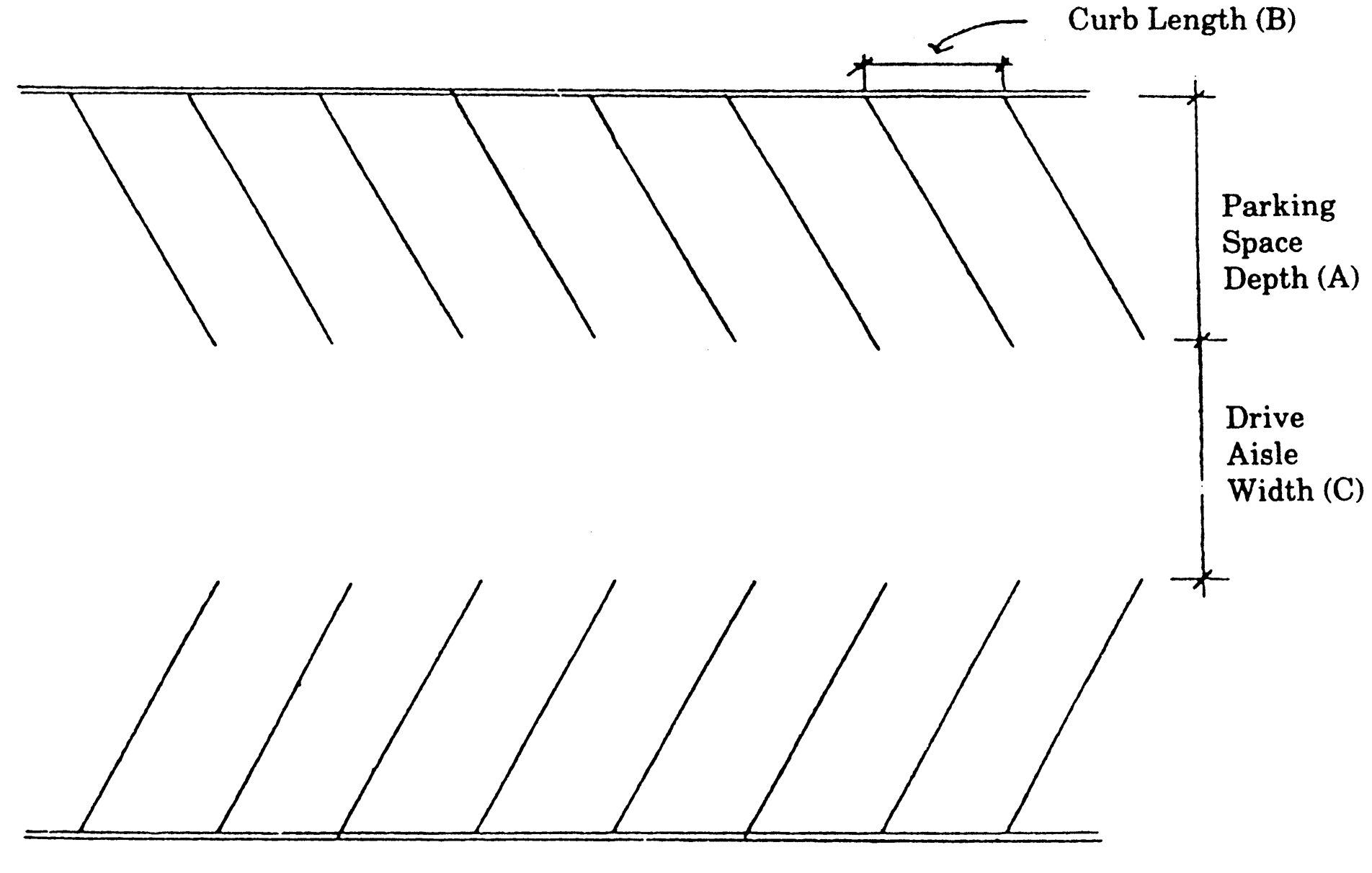
Figure 55-740. Off-street Parking Design Standards
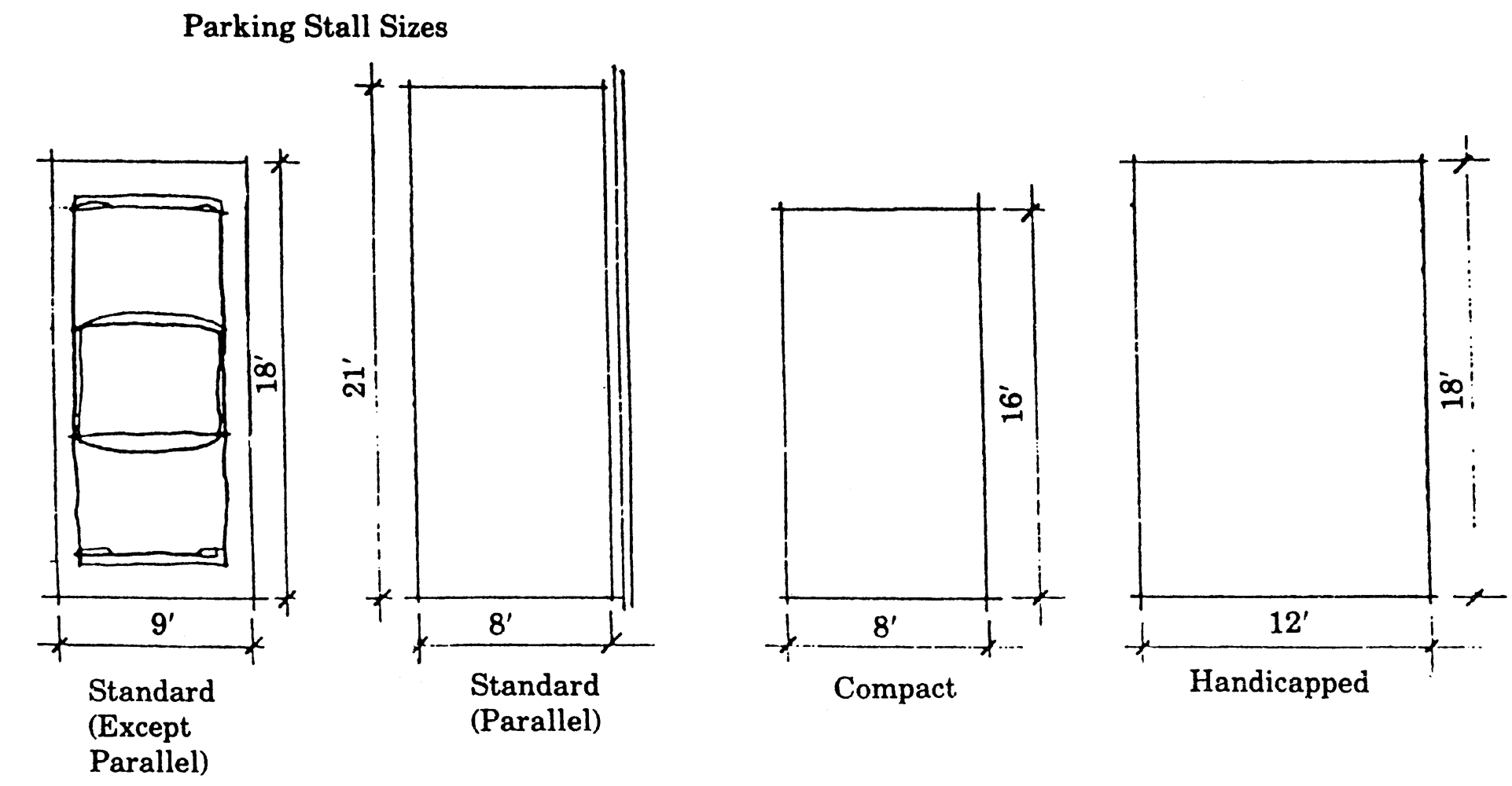
Parking Stall Sizes
(Code 1980, § 55-740; Ord. No. 33109, § 1, 11-23-93; Ord. No. 36203, § 3, 3-25-03; Ord. No. 37289, § 1, 2-14-06; Ord. No. 38725, § 1, 5-11-10; Ord. No. 39640, § 1, 9-25-12; Ord. No. 39652, § 1, 4-23-13; Ord. No. 42341, § 9, 10-27-20; Ord. No. 44374, § 1, 8-26-25)
Sec. 55-741. - Off-street loading requirements.
(a)
Applicability. Any use which involves the receipt or distribution of freight, merchandise, supplies, vehicles or equipment as part of its typical operation shall provide and maintain adequate space for off-street loading and circulation. Loading areas shall be designed to avoid undue interference with public use of streets and sidewalks.
(b)
Schedule of off-street loading requirements. Loading spaces for each use requiring them shall be provided in accord with the minimum requirements set forth in Table 55-741.
TABLE 55-741. OFF-STREET LOADING REQUIREMENTS
(c)
Dimensions and design standards.
(1)
Each off-street loading space shall be at least ten by 50 feet, with a vertical clearance of at least 14 feet.
(2)
Paving surfaces of off-street loading spaces shall be permanent, durable and dustless.
(3)
Off-street loading spaces may not be located in any required yard adjacent to a residential district.
(4)
Off-street loading spaces are subject to the buffering requirements of this section and section 55-716.
(5)
Circulation area and access to loading spaces must allow maneuvering into or out of the space to occur outside of any public street.
(Code 1980, § 55-741; Ord. No. 42341, § 9, 10-27-20)
Sec. 55-742. - Parking of personal vehicles on residential lot.
(a)
Applicability. This section permits the parking of personal vehicles on a single lot in a residential district subject to specific conditions. Personal vehicles include passenger cars, vans, pickup trucks, recreational vehicles, trailers under 20 feet in length, or boats.
(b)
Location of parking.
(1)
Parking is permitted within any enclosed structure when the structure otherwise conforms to the requirements of its specific zoning district.
(2)
Parking is permitted outside of an enclosed structure in the side yard behind the line of the required front yard setback or in the rear provided the space is on a paved, hard-surfaced driveway or paved pad adjacent to the driveway.
(3)
Parking is permitted outside of an enclosed structure within the required front yard setback, subject to the following conditions:
a.
The parking space is provided on a paved, hard-surfaced driveway or paved pad adjacent to the driveway.
b.
Space is unavailable in the side yard behind the required front yard setback or in the rear yard, or there is no reasonable access to the side or rear yards. A corner lot is normally considered to have reasonable access to the rear yard. A fence does not prevent reasonable access. Grade changes or substantial vegetation or landscape features can be considered to prevent reasonable access.
c.
Enclosed parking in conformance with the requirements of the district is impossible.
d.
The vehicle is parked perpendicular to the front curb.
e.
The vehicle must not encroach on public right-of-way.
(c)
Recreational vehicles, trailers and boats. Parking and storage of recreational vehicles, trailers and boats is subject to the following additional conditions:
(1)
The vehicle shall be maintained in a clean, well-kept state.
(2)
If the vehicle is equipped with liquefied petroleum gas containers, the containers must meet the standards of the Interstate Commerce Commission, the United States Department of Transportation, or the American Society of Mechanical Engineers, as such standards existed on September 23, 1975. Any valves must be closed at all times that the vehicle is not in preparation for immediate use. Immediate corrective action must be taken to repair any leaks in containers.
(3)
The vehicle may be used only by nonpaying guests at a residential district for a maximum of three consecutive days or 14 days during any calendar year. Cooking is prohibited at all times.
(4)
The vehicle may not be permanently connected to utility lines.
(5)
The vehicle may not be used for storage of goods, materials or equipment other than those items which are part of the unit or essential to its immediate use.
(6)
The length of the vehicle shall not exceed 20 feet, if the vehicle is parked or stored in the required front yard or street side yard.
(d)
Exceptions. Temporary parking of personal vehicles on a driveway within a front yard setback is permitted for loading and unloading purposes. Such temporary parking shall not exceed 24 hours during an individual week.
(Code 1980, § 55-742; Ord. No. 38475, § 1, 7-28-09; Ord. No. 42341, § 9, 10-27-20)
Sec. 55-743. - Construction permit for parking facilities.
(a)
Required. Prior to the start of construction of any off-street parking facility, the property owner must obtain an off-street parking permit from the permits and inspections division of the planning department. The building official shall issue a certificate of occupancy, in accordance with chapter 43 of this Code, within 12 months after completion of construction, if the completed facility complies with the approved plan, as provided by this section.
(b)
Plan review and approval; appeals.
(1)
Prior to issuance of an off-street parking permit for a parking facility of ten or more stalls, a plan must be approved by the directors of the planning and public works departments, or their designees.
(2)
Application for a permit shall include the following plans and specifications prepared by a registered architect, landscape architect or engineer, demonstrating compliance with the off-street parking and loading regulations. These plans and specifications shall include, but not be limited to:
a.
The location of parking stalls, lighting, drive aisles, circulation ways and access points to the facility.
b.
A landscape plan, indicating location, size and species of proposed landscaping.
c.
A grading plan, showing existing and proposed grades at two-foot intervals.
d.
The location and direction of drainage for stormwater runoff.
e.
Indication of all structures or uses to be served by the facility.
f.
Construction details necessary to demonstrate compliance with this chapter.
(3)
Plans shall be reviewed for compliance with the standards and policies of this article and any other applicable ordinance or regulation.
(4)
Permits shall be issued by the building official following approval of plans and specifications and in accord with those plans.
(5)
Denial of an application for a permit to build an off-street parking facility may be appealed to the zoning board of appeals.
(c)
Performance bond for installation of landscaping.
(1)
If, at the time of an application for a certificate of occupancy, any required landscaping has not been installed, the developer or owner of a site must make fiscal arrangements (by bond, certificate of deposit, or letter or credit) satisfactory to the city in the amount of $2.00 per square foot of required landscaping not in place.
(2)
The developer or owner shall grant the city permission to enter upon the land to install required landscaping if this has not been done within 12 months of the effective date of the certificate of occupancy.
(3)
The city shall release any bond or other arrangement immediately when the permits and inspections division verifies that required landscaping has been installed.
(Code 1980, § 55-743; Ord. No. 42341, § 9, 10-27-20)
Sec. 55-744. - Construction permit for courts and private ways.
(a)
Required. Prior to the start of construction of any court or private way, the property owner must obtain a court and private way permit from the permits and inspections division of the planning department.
(b)
Plan review and approval; appeals.
(1)
Prior to issuance of a permit for a court or private way, a plan showing the same must be approved by the directors of the planning and public works departments, and the fire chief, or their designees.
(2)
Application for a permit shall include the following plans and specifications prepared by a architect, landscape architect or engineer acceptable to the public works department, demonstrating compliance with applicable regulations, guidelines, and code sections of the city. These plans and specifications shall include, but not be limited to:
a.
The location, dimensions, and depth of the court or private way, and all driveways or other access points connecting thereto.
b.
A grading plan, showing existing and proposed grades at two-foot intervals.
c.
Indication of all structures or uses to be served by the court or private way.
d.
Such other details deemed necessary by the city to demonstrate compliance with applicable regulations, guidelines, and code sections.
(3)
Plans shall be reviewed for compliance with the applicable sections of this code and any other applicable regulations or guidelines of the city.
(4)
Permits shall be issued by the building official following approval of plans and specifications and in accord with those plans.
(5)
Denial of an application for a permit to build a court or private way may be appealed to the zoning board of appeals.
(Ord. No. 37570, § 1, 12-12-06; Ord. No. 42341, § 9, 10-27-20)
Editor's note— Section 4 of Ord. No. 37570 provided for an effective date of January 1, 2007.
Sec. 55-745. - Bicycle parking requirements.
(a)
Standards. Bicycle parking may be short-term or long-term bicycle parking in accordance with the following standards.
(1)
Short-term bicycle parking is intended to serve the needs of people, such as customers, clients, and students, parking their bicycles for short time periods and shall:
a.
Be provided in the form of securely anchored bicycle racks of any of the following standard designs: U-racks, staple racks, circle racks, post-and-ring racks, or any other bicycle rack design approved by the planning director, which provides two points of contact with the bicycle frame and allows for both the bicycle frame and one wheel to be locked to the rack using a standard U-lock;
b.
Be located within 75 feet of the building entrance it serves or in a location approved by the planning director; and
c.
Be of solid construction, resistant to rust, corrosion, hammers, and saws.
(2)
Long-term bicycle parking is intended to meet the needs of people, such as residents and employees, parking bicycles for longer time periods, and shall:
a.
Be a bicycle storage room, bicycle lockers, or any other secure, indoor or covered outdoor area specifically intended for bicycle parking;
b.
Be in an area that can be accessed without requiring users to carry bicycles up or down stairs; and
c.
Contain bike racks, bike lockers, or other bicycle parking and storage solutions that do not require the user to lift the entire bicycle, including both wheels, completely off the ground.
(3)
Both short-term and long-term bicycle parking shall be accessible to intended users without requiring the user to move another bicycle and without obstructing a required walkway.
(4)
Both short-term and long-term bicycle parking shall be installed according to the manufacturer's specifications, including minimum recommended distance from other structures and minimum spacing between adjacent bicycle racks.
(5)
With the permission of the city engineer, required short-term bicycle parking may be located in the public right-of-way. Public bicycle parking spaces may contribute to compliance with required bicycle parking when located on the same block face and within 75 feet of a principal building entrance for the use in question.
(b)
Schedule of bicycle parking requirements. Bicycle parking for each use shall be provided in accordance with the minimum requirements set forth in Table 55-745.
(1)
One U-rack, staple rack, circle rack, post-and-ring rack, or other bicycle rack that can accommodate one bicycle on each side of the rack counts as two bicycle parking spaces.
(2)
Uses not listed in Table 55-745 are not required to provide bicycle parking.
(3)
Uses within all zoning districts are exempt from bicycle parking requirements provided in Table 55-745 except for within the following zoning districts: MU mixed use district, and all TOD transit oriented development districts.
(4)
Any non-residential uses having 1,000 square feet or less of gross floor area shall be exempt from minimum bicycle parking requirements.
(5)
When a computation of required parking results in a fraction of 0.5 or greater, the requirement should be rounded up to the next whole number.
(6)
Unless otherwise indicated, parking requirements are based on gross floor area. Gross floor areas for the purpose of this computation do not include enclosed areas devoted to off-street vehicle or bicycle parking or loading.
(7)
When parking requirements are computed on the basis of capacity, capacity shall be determined by the building code applicable in the city at the time the use is established.
TABLE 55-745. BICYCLE PARKING REQUIREMENTS
(Ord. No. 42341, § 9, 10-27-20)
Secs. 55-746—55-760. - Reserved.
_____

