
Park City City Zoning Code
15-2.11 Single
Family SF District
15-2.11-1 Purpose
The purpose of the Single Family SF District is to:
- maintain existing predominately Single Family detached residential neighborhoods,
- allow for Single Family Development Compatible with existing Developments,
- maintain the character of mountain resort neighborhoods with Compatible residential design; and
- require Streetscape design that minimizes impacts on existing residents and reduces architectural impacts of the automobile.
Adopted by Ord. 00-51 on 9/21/2000
15-2.11-2 Uses
Uses in the SF District are limited to the following:
- ALLOWED USES.
- Single Family Dwelling
- Duplex Dwelling1
- Secondary Living Quarters2
- Accessory Apartment3
- Nightly Rental4
- Home Occupation
- Child Care, In-Home Babysitting5
- Child Care, Family Group5
- Accessory Building and Use
- Conservation Activity
- Agriculture
- Parking Area or Structure with four (4) or fewer spaces
- Internal Accessory Dwelling Unit10
- Single Family Dwelling
- CONDITIONAL USES.
- Guest House6
- Group Care Facility
- Child Care Center5
- Public and Quasi-Public Institution, Church, and School
- Essential Municipal Public Utility Use, Facility, Service, and Structure
- Telecommunication Antenna7
- Satellite Dish, greater than thirty-nine inches (39") diameter8
- Raising, grazing of horses
- Bed and Breakfast Inn
- Parking Area or Structure with five (5) or more spaces9
- Temporary Improvements9
- Outdoor Event9
- Recreation Facility, Public or Private11
- Fences greater than six feet (6') in height from Final Grade9
- Guest House6
- PROHIBITED USES. Any Use not listed above as an Allowed or Conditional Use is a prohibited Use.
1Permitted only on Lots designated for Duplexes on the official Subdivision Plat.
2Detached Guest Houses and detached Secondary Living Quarters are not allowed as a Conditional or Allowed Use within Holiday Ranchettes Subdivision.
3Requires an Administrative Permit. See Section 15-4-7, Accessory Apartments. Accessory Apartments in detached Structures are not allowed within Holiday Ranchettes Subdivision.
4Allowed only within Prospector Village Subdivision. Commercial Uses are not allowed within Nightly Rental units.
5See Section 15-4-9 Child Care and Child Care Facilities. Family Group Child Care and Child Care Center Uses require an Administrative Conditional Use permit.
6Detached Guest Houses and detached Secondary Living Quarters are not allowed as a Conditional or Allowed Use within Holiday Ranchettes Subdivision.
7See Section 15-4-14, Telecommunication Facilities
8See Section 15-4-13, Placement of Satellite Receiving Antennas
9Requires an Administrative Conditional Use permit.
10See Section 15-4-7.1, Internal Accessory Dwelling Units.
11See Section 15-4-22, Outdoor Pickleball Courts in Residential Areas.
Adopted by Ord. 00-51 on 9/21/2000
Amended by Ord. 06-76 on 11/9/2006
Amended by Ord. 2020-45 on 10/1/2020
Amended by Ord. 2021-38 on 9/23/2021
Amended by Ord. 2021-51 on 12/16/2021
Amended by Ord. 2022-08 on 4/28/2022
Amended by Ord. 2025-11 on 6/5/2025
15-2.11-3 Lot And Site Requirements
Except as may otherwise be provided in this Code, no Building Permit shall be issued for a Lot unless such Lot has Frontage on a Street shown as a private or Public Street on the Streets Master Plan, or on a private easement connecting the Lot to a Street shown on the Streets Master Plan. All Development must comply with the following:
- DENSITY. The maximum Density for Subdivisions is three (3) units per acre. Subdivisions must Cluster Development to maximize common Transferred Development Right (TDR) Open Space.
- FRONT SETBACK.
- In Thaynes Canyon Subdivision 1 and 2 and Prospector Village Subdivision, the minimum Front Setback for Main Buildings is twenty feet (20') and minimum Front Setback for Garages is ten feet (10').
- In Prospector Park Subdivisions 1, 2, and 3, the minimum Front Setback is 20 feet (20'), including Garages.
- In all other subdivisions, the minimum Front Setback is twenty feet (20'). New Front-Facing Garages for Single Family and Duplex Dwellings must maintain a minimum of twenty five feet (25') from Front Lot Line.
- In Thaynes Canyon Subdivision 1 and 2 and Prospector Village Subdivision, the minimum Front Setback for Main Buildings is twenty feet (20') and minimum Front Setback for Garages is ten feet (10').
- FRONT SETBACK EXCEPTIONS.
- The Planning Commission may designate specific Single Family Lots on which the Front Setback is ten feet (10') for the Main Building and fifteen feet (15') for a new Front Facing Garage or garage element, including any habitable space above the garage. This exception may be granted to:
- solve Access problems with relatively steep Grades,
- preserve Significant Vegetation,
- eliminate or minimize cut and fill Areas,
- promote Clustered Development, and
- preserve Open Space.
Lots to which this exception applies must be so designated on the Subdivision Plat at the time the plat is approved.
- solve Access problems with relatively steep Grades,
- The Front Setback must be open and free of any Structure except:
- Fences, walls, and retaining walls not more than four feet (4') in height, or as permitted in Section 15-4-2. On Corner Lots, Fences more than three feet (3') in height are prohibited within twenty-five feet (25') of the intersection at back of curb.
- Uncovered steps leading to the Main Building provided the steps are not more than four feet (4') in height from Final Grade, not including any required handrail, and do not cause any danger or hazard to traffic by obstructing the view of a Street or intersection.
- Decks, porches, and Bay Windows, not more than ten feet (10') wide, projecting not more than five feet (5') into the Front Setback.
- Roof overhangs, eaves, and cornices projecting not more than three feet (3') into the Front Setback.
- Sidewalks, patios, and pathways.
- Driveways leading to a garage or Parking Area. No portion of a Front Yard, except for approved driveways and patios, allowed Parking Areas, and sidewalks may be Hard-Surfaced or graveled.
- Circular driveways meeting all requirements stated in Section 15-3-4.
- Fences, walls, and retaining walls not more than four feet (4') in height, or as permitted in Section 15-4-2. On Corner Lots, Fences more than three feet (3') in height are prohibited within twenty-five feet (25') of the intersection at back of curb.
- The Planning Commission may designate specific Single Family Lots on which the Front Setback is ten feet (10') for the Main Building and fifteen feet (15') for a new Front Facing Garage or garage element, including any habitable space above the garage. This exception may be granted to:
- REAR SETBACK.
- In Thaynes Canyon Subdivision 1 and 2 and Prospector Village Subdivision, the minimum Rear Setback is 10 feet (10').
- In Prospector Park Subdivisions 1, 2, and 3 the minimum Rear Setback is ten feet (10').
- In all other subdivisions, the minimum Rear Setback is fifteen feet (15').
- In Thaynes Canyon Subdivision 1 and 2 and Prospector Village Subdivision, the minimum Rear Setback is 10 feet (10').
- REAR SETBACK EXCEPTIONS. The Rear Setback must be open and free of any Structure except:
- Bay Windows not more than ten feet (10') wide projecting not more than two feet (2') into the Rear Setback.
- Chimneys not more than five feet (5') wide projecting not more than two feet (2') into the Rear Setback.
- Window wells and light wells projecting not more than four feet (4') into the Rear Setback.
- Roof overhangs and eaves projecting not more than three feet (3') into the Rear Setback.
- Window sills, belt courses, cornices, trim, and other ornamental features projecting not more than six inches (6") beyond the window or main Structure to which it is attached.
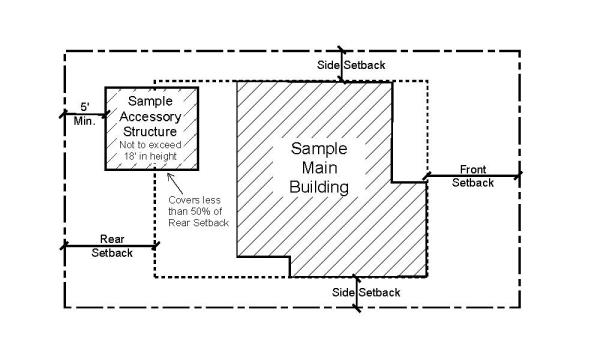
- Detached Accessory Buildings not more than eighteen feet (18') in height and maintaining a minimum Rear Setback of five feet (5'). Such Structure must not cover over fifty percent (50%) of the Rear Setback. See the following illustration:
- Hard-Surfaced Parking Areas subject to the same location requirements as detached Accessory Buildings.
- Screened mechanical equipment, hot tubs, and similar Structures located at least five feet (5') from the Rear Lot Line.
- Fences, walls, and retaining walls not more than six feet (6') in height, or as permitted in Section 15-4-2. Retaining walls may have multiple steps, however, each exposed face cannot exceed six feet (6') in height and the horizontal distance between the walls, front face to rear face, must be at least three feet (3') and planted with approved vegetation. The Planning Director may approve minor deviations to the height and stepping requirements based on Site specific review.1
- Patios, decks, pathways, steps, or similar Structures not more than thirty inches (30") above Final Grade, provided it is located at least five feet (5') from the Rear Lot Line.
- Bay Windows not more than ten feet (10') wide projecting not more than two feet (2') into the Rear Setback.
- SIDE SETBACK.
- In Thaynes Canyon Subdivision 1 and 2 and Prospector Village Subdivision, the minimum Side Setback is five feet (5'). On Corner Lots the minimum Side Setback abutting a Street is ten feet (10').
- In Prospector Park Subdivisions 1, 2, and 3 the minimum Side Setback is ten feet (10'). On corner Lots the Side setback that faces the street must not be less than fifteen feet (15').
- In all other subdivisions, the minimum Side Setback is twelve feet (12').
- A Side Setback between connected Structures is not required where Structures are designed with a common wall on a Property Line, each Structure is located on an individual Lot, the Lots are burdened with a party wall agreement in a form approved by the City Attorney and Chief Building Official, all applicable Building and Fire Code requirements are met, and the Use is an Allowed or Conditional Use in the Zoning District.
- Exterior Side Setbacks shall be based on the required minimum Side Setback for each Lot; however the Planning Commission may consider increasing exterior Side Setbacks during Conditional Use Permit review to mitigate potential impacts on adjacent Property. Side Setbacks exceptions continue to apply.
- Exterior Side Setbacks shall be based on the required minimum Side Setback for each Lot; however the Planning Commission may consider increasing exterior Side Setbacks during Conditional Use Permit review to mitigate potential impacts on adjacent Property. Side Setbacks exceptions continue to apply.
- In Thaynes Canyon Subdivision 1 and 2 and Prospector Village Subdivision, the minimum Side Setback is five feet (5'). On Corner Lots the minimum Side Setback abutting a Street is ten feet (10').
- SIDE SETBACK EXCEPTIONS. The Side Setback must be open and free of any Structure except:
- Bay Windows not more than ten feet (10') wide projecting not more than two feet (2') into the Side Setback.
- Chimneys not more than five feet (5') wide projecting not more than two feet (2') into the Side Setback.
- Window wells and light wells projecting not more than four feet (4') into the Side Setback.
- Roof overhangs and eaves projecting not more than three feet (3') into the Side Setback.
- Window sills, belt courses, cornices, trim, and other ornamental features projecting not more than six inches (6") beyond the window or main Structure to which it is attached.
- Patios, decks, pathways, steps, and similar Structures not more than thirty inches (30") in height above Final Grade, provided there is at least one foot (1') Setback to the Side Lot Line.
- Fences, walls, and retaining walls not more than six feet (6') in height, or as permitted in Sections 15-4-2. Retaining walls may have multiple steps, however, each exposed face cannot exceed six feet (6') in height and the horizontal distance between the walls, front face to rear face, must be at least three feet (3') and planted with approved vegetation. The Planning Director may approve minor deviations to the height and stepping requirements based on Site specific review.2
- Driveways leading to an approved garage or Parking Area maintaining a three foot (3') landscaped Setback to the Side Lot Line. A paved turn out Area, to aid in backing a vehicle out of a garage or Parking Area, is allowed but may not be used for parking, and must maintain a one foot (1’) landscaped Setback to the Side Lot Line.
- Detached Accessory Buildings not more than eighteen feet (18') in height, located a minimum of five feet (5') behind the front facade of the Main Building, and maintaining a minimum Side Setback of five feet (5').
- Screened mechanical equipment, hot tubs, and similar Structures located a minimum of five feet (5') from the Side Lot Line.
- Bay Windows not more than ten feet (10') wide projecting not more than two feet (2') into the Side Setback.
1Fences and walls greater than six feet (6') in height require an administrative Conditional Use permit.
2Fences or Walls greater than six feet (6') in height requires an administrative Conditional Use permit.
Adopted by Ord. 00-51 on 9/21/2000
Amended by Ord. 06-76 on 11/9/2006
Amended by Ord. 2016-44 on 9/15/2016
Amended by Ord. 2017-29 on 6/15/2017
Amended by Ord. 2018-43 on 7/19/2018
Amended by Ord. 2019-37 on 7/11/2019
15-2.11-4 Building Height
No Structure shall be erected to a height greater than twenty-eight feet (28') from Existing Grade. This is the Zone Height. Accessory Structures in the SF District shall not exceed a maximum height of eighteen feet (18').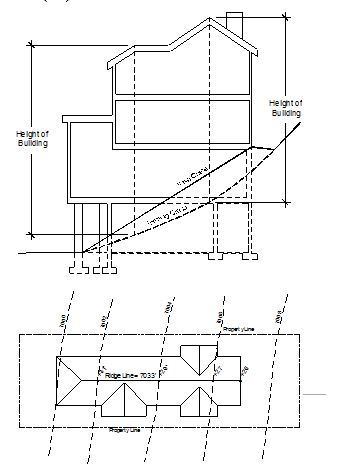
- BUILDING HEIGHT EXCEPTIONS. The following height exceptions apply:
- A gable, hip, Barrel, or similar pitched roof may extend up to five feet (5') above the Zone Height, if the roof pitch is 4:12 or greater.
- Antennas, chimneys, flues, vents, and similar Structures, may extend up to five feet (5') above the highest point of the Building to comply with International Building Code (IBC) requirements.
- Water towers, mechanical equipment, and associated Screening, when enclosed or Screened, may extend up to five feet (5') above the height of the Building.
- Church spires, bell towers, and like architectural features subject to the Architectural Guidelines, LMC Chapter 15-5, may extend up to fifty percent (50%) above the Zone Height, but may not contain Habitable Space above the Zone Height. Such exception requires approval by the Planning Director.
- An Elevator Penthouse may extend up to eight feet (8') above the Zone Height.
- A gable, hip, Barrel, or similar pitched roof may extend up to five feet (5') above the Zone Height, if the roof pitch is 4:12 or greater.
Adopted by Ord. 00-51 on 9/21/2000
Amended by Ord. 05-65 on 10/27/2005
Amended by Ord. 06-76 on 11/9/2006
Amended by Ord. 07-25 on 4/19/2007
Amended by Ord. 2016-44 on 9/15/2016
15-2.11-5 Architectural Review
Prior to issuance of a Building Permit for any Conditional or Allowed Use, the Planning Department must review the proposed plans for compliance with Architectural Review, Chapter 15-5.
Adopted by Ord. 00-51 on 9/21/2000
Amended by Ord. 06-76 on 11/9/2006
Amended by Ord. 2022-16 on 5/26/2022
15-2.11-6 Maximum House Size And Setbacks On Combined Lots
As part of a Master Planned Development, or a subdivision, the Planning Commission may designate maximum house sizes to ensure Compatibility. An Owner may combine Lots with designated maximum house sizes and achieve approximately 150% of the maximum house size attributed to a particular Lot. The Owner must request an increase in maximum house size prior to or concurrent with, the Lot combination plat. The request must be made on forms provided by the Planning Department for review by the Planning Director for compliance with the following:
- HOUSE SIZE. The maximum house size may not exceed 150 percent (150%) of the house size allowed on each single Lot when those maximums are combined and averaged. The following formula must be used to calculate the maximum house size (MHS):
MHS =((hsLot1 + hsLot 2...hsLotn) ÷n)x 1.50
*where n is the number of Lots being combined, and hsLot1, hsLot2, hsLotn are the allowed house sizes in square feet, for the individual Lots in the Lot combination.
For example: if two (2) Lots , one with a 4000 square foot maximum house and one with a 3000 square foot maximum, are combined the maximum house size would be 5250 square feet. The average of the two Lots is 3500 square feet. 3500 x 150% = 5250 square feet, i.e. ((4000 + 3000)÷2) x 1.5 = 5250 sq. ft.
In Subdivisions where maximum house size is not specified, the house size on combined Lots must be determined by the Planning Director based upon neighborhood Compatibility, Lot size, visibility from Public Streets, and visual analysis. - SETBACKS. The allowed minimum Setbacks (MSB) for the proposed house size (PHS) on combined Lots must increase in proportion to the percentage of increase in the house size (%IHS) over the average maximum house size (AMHS) for the Lots being combined, according to the following formulas:
%IHS=((PHS-AMHS)÷AMHS) x 100
MSB=Zone Setback +(Zone Setback x %IHS)
For example: Using the previous example, where two Lots, one with a 4,000 sq. ft. maximum house size and one with a 3,000 sq. ft. maximum, are combined yielding a proposed house size (PHS) of 5,250 sq. ft., the percent increase in house size (%IHS) is fifty percent (50%).
%IHS=((5,250-3,500)÷3,500) x 100 = 50%
If the increased house size (%IHS) is fifty percent (50%) greater than the average maximum house size (AMHS) on any of the Lots being combined, the allowed minimum Setbacks (AMSB) must be fifty percent (50%) greater than the standard Setbacks of the zone.
For example: If the zone Setback for Side Yards is twelve feet (12') and the percent increase in house size is fifty percent (50%) then the minimum Setback for the combined Lot is eighteen feet (18'), as follows:
MSB = 12' + (12'X50%) = 18'
Therefore: Minimum Setback (Side) = 12' + (12'X50%) = 18' if zone Setback is 12'.Lots with unusual configurations, topography, Access, or Significant Vegetation may have the Setbacks shifted upon approval of the Planning Director but in no case may they be less than the required Setbacks. - EASEMENT VACATIONS. If an easement must be vacated to allow construction on a combined Lot, the Applicant must show evidence that the easement can be vacated or relocated without affecting service to the adjacent Lots. The easement relocation agreement must be recorded and/or shown on the plat amendment for the Lot combination.
- PLAT AMENDMENT. The Lots must be legally combined through plat amendment or administrative approval as provided in LMC Chapter 15-7, Subdivisions.
Adopted by Ord. 00-51 on 9/21/2000
Amended by Ord. 06-76 on 11/9/2006
15-2.11-7 Criteria For Bed And Breakfast Inns
A Bed and Breakfast Inn is a Conditional Use. No Conditional Use permit may be issued unless the following criteria are met:
- If the Use is in a Historic Structure, the Applicant will make every attempt to rehabilitate the Historic portion of the Structure.
- The Structure has at least two (2) rentable rooms. The maximum number of rooms will be determined by the Applicant's ability to mitigate neighborhood impacts.
- In a Historic Structure, the size and configuration of the rooms are Compatible with the Historic character of the Building and neighborhood.
- The rooms are available for Nightly Rental only.
- An Owner/manager is living on-Site, or in Historic Structures there must be twenty-four (24) hour on-Site management and check-in.
- Food service is for the benefit of overnight guests only.
- No Kitchen is permitted within rental room(s).
- Parking on-Site is required at a rate of one (1) space per rentable room.
- The use complies with Section 15-1-10, Conditional Use review.
Adopted by Ord. 00-51 on 9/21/2000
15-2.11-8 Outdoor Events And Music
Outdoor events and music require an Administrative Conditional Use permit. The use must also comply with Section 15-1-10, Conditional Use Review. The Applicant must submit a Site plan and written description of the event, addressing the following:
- Notification of adjacent Property Owners.
- No violation of the City Noise Ordinance, Title 6.
- Impacts on adjacent Residential Uses.
- Proposed plans for music, lighting, Structures, electrical, signs, etc.
- Parking demand and impacts on neighboring Properties.
- Duration and hours of operation.
- Impacts on emergency Access and circulation.
Adopted by Ord. 00-51 on 9/21/2000
15-2.11-9 Criteria For Raising And Grazing Of Horses
The raising and grazing of horses may be approved as a Conditional Use by the Planning Commission. In making a determination whether raising and grazing of horses is appropriate, the Planning Commission shall consider the following criteria:
- Any barn must be located a minimum of seventy-five feet (75') from the nearest neighboring Dwelling Unit.
- There shall be a maximum of two (2) horses per acre.
- Terrain and Slope of the Property must be suitable for horses.
- The Applicant must submit an Animal Management Plan outlining the following:
- waste removal/odors;
- drainage and runoff;
- bedding materials;
- flies; and
- feed/hay.
- waste removal/odors;
Adopted by Ord. 00-51 on 9/21/2000
15-2.11-10 Vegetation Protection
The Property Owner must protect Significant Vegetation during any Development activity. Significant Vegetation includes large trees six inches (6") in diameter or greater measured four and one-half feet (4½') above the ground, groves of smaller trees, or clumps of oak and maple covering an Area fifty square feet (50 sq. ft.) or more measured at the drip line.
Development plans must show all Significant Vegetation within twenty feet (20') of a proposed Development. The Property Owner must demonstrate the health and viability of all large trees through a certified arborist. The Planning Director shall determine the Limits of Disturbance and may require mitigation for loss of Significant Vegetation consistent with Landscape Criteria in Sections 15-3-3 and 15-5-5(N), and Title 14.
Adopted by Ord. 00-51 on 9/21/2000
Amended by Ord. 06-76 on 11/9/2006
Amended by Ord. 2022-16 on 5/26/2022
15-2.11-11 Signs
Signs are allowed in the SF District as provided in the Park City Sign Code, Title 12.
Adopted by Ord. 00-51 on 9/21/2000
15-2.11-12 Related Provisions
- Fences and Walls. Section 15-4-2.
- Accessory Apartments. Section 15-4-7.
- Satellite Receiving Antenna. Section 15-4-13.
- Telecommunication Facility. Section 15-4-14.
- Parking. Chapter 15-3.
- Landscaping. Title 14; Sections 15-3-3 and 15-5-5(N).
- Lighting. Sections 15-3-3 and 15-5-5(J).
- Historic Preservation. Chapters 15-11 and 15-13.
- Park City Sign Code. Title 12
- Architectural Review. Chapter 15-5.
- Snow Storage. Section 15-3-3.
- Parking Ratio Requirements. Section 15-3-6.
Adopted by Ord. 00-51 on 9/21/2000
Amended by Ord. 2022-16 on 5/26/2022

