
Park City City Zoning Code
15-2.22 Public
Use Transition PUT District
15-2.22-1 Purpose
The purpose of the Public Use Transition (PUT) District is to:
- preserve the cultural heritage of the City’s original Business, governmental, and residential center;
- allow the Use of land for recreational and institutional purposes with limited commercial support to enhance and foster the economic and cultural vitality of the City;
- facilitate the continuation of the visual character, scale, and Streetscape of the original Park City town core;
- encourage the preservation of Historic Structures within the district;
- encourage pedestrian-oriented, pedestrian-scale Development;
- minimize the impacts of new Development on parking constraints of Old Town;
- minimize visual impacts of automobiles and parking on Historic Buildings and Streetscapes;
- support Development on Swede Alley which maintains existing parking and service/delivery operations while providing Areas for public plazas and spaces;
- allow for community input on Development design within the District through the public Conditional Use permit review process; and
- provide a transition between the HCB and the HR-1 Districts for the purpose of providing municipal Uses and public gathering and activity Areas.
Adopted by Ord. 05-12 on 3/3/2005
15-2.22-2 Uses
Uses in the Public Use Transition District are limited to the following:
- ALLOWED USES.
- Municipal/Institutional Accessory Building and Use 600 sf or less
- Conservation Activity
- Parking Lot, Public or Private with four (4) or fewer spaces
- Public Utility or Essential Services
- Public Assembly Uses
- Outdoor Events
- Food Truck Location5
- Enclosed Mobile Business Location6
- Municipal/Institutional Accessory Building and Use 600 sf or less
- CONDITIONAL USES.
- Public and Quasi-Public Institution, Church, School, Post Office
- Entertainment Facility, Outdoor
- Essential Municipal Public Utility Use, Facility, or Service Structure
- Parking Area or Structure for five (5) or more cars
- Liquor Store
- Commercial Retail and Service, Minor
- Outdoor Recreation Equipment
- Outdoor Grills/Beverage Service Stations
- Restaurant, Outdoor Dining1
- Restaurant, Café or Deli
- Accessory Building or Use greater than 600 sf
- Telecommunication Antenna2
- Satellite Dish, greater than thirty-nine inches (39”) in diameter3
- Temporary Improvement/Outdoor Use
- Salt Lake City 2002 Winter Olympic Legacy Displays4
- Passenger Tramways, ski towers, and ski lift facilities.
- Public and Quasi-Public Institution, Church, School, Post Office
- PROHIBITED USES. Any Use not listed above as an Allowed or Conditional Use is a prohibited Use.
1Required Administrative Conditional Use permit.
2See Section 15-4-14, Telecommunication Facilities.
3See Section 15-4-13, Placement of Satellite Receiving Antennas.
4Olympic Legacy Displays limited to those specific Structures approved under the SLOC/Park City Municipal Corporation Olympic Services Agreement and/or Olympic Master Festival License and placed in an Area other than the original location set forth in the services agreement and/or Master Festival License.
5The Planning Director or their designee shall, upon finding a Food Truck Location in compliance with Municipal Code Section 4-5-6, issue the property owner a Food Truck Location administrative approval letter.
6See Section 15-4-24, Mobile Businesses.
Adopted by Ord. 05-12 on 3/3/2005
Amended by Ord. 2018-55 on 10/23/2018
Amended by Ord. 2020-45 on 10/1/2020
Amended by Ord. 2025-11 on 6/5/2025
15-2.22-3 Lot And Size Requirements
Except as may otherwise be provided in this Code, no Building Permit will be issued for a Lot unless such Lot has the Area, width, and depth as required, and Frontage on a Street shown as a private or Public Street on the Streets Master Plan, or on private easement connecting the Lot to a Street shown on the Streets Master Plan. All Development must comply with the following:
- LOT SIZE. There is no minimum Lot size in the PUT District.
- FRONT, REAR AND SIDE SETBACKS. There are no minimum required Front, Rear, or Side Setback dimensions in the PUT District; however, where new construction abuts a residential zone, the new construction shall meet the required minimum Setback of the abutting zone.
- CLEAR VIEW OF INTERSECTION. No visual obstruction in excess of two feet (2’) in height above Road Grade shall be placed on any Corner Lot within the Site Distance Triangle. A reasonable number of trees may be allowed, if pruned high enough to permit automobile drivers an unobstructed view. This provision must not require changes in the Natural Grade on the Site.
Adopted by Ord. 05-12 on 3/3/2005
Amended by Ord. 2018-43 on 7/19/2018
15-2.22-4 Maximum Building Height
- The maximum Building volume for each Lot is defined by a plane that rises vertically at the Front Lot Line to a height of thirty feet (30’) measured above the average Natural Grade and then proceeds at a forty-five degree (45°) angle toward the rear of the Property until it intersects with a point forty-five feet (45’) above the Natural Grade and connects with the rear portion of the bulk plane. The maximum Building Height shall be forty-five feet (45’) as measured from Existing Grade.
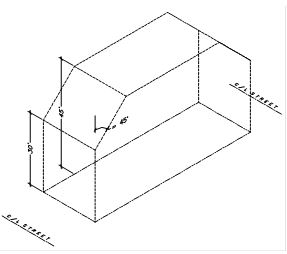
- MAXIMUM BUILDING VOLUME AND BUILDING HEIGHT EXCEPTIONS. The following height exceptions apply:
- Gable, hip, Barrel, and similar pitched roofs may extend up to five feet (5’) above the Zone Height, if the roof pitch is 4:12 or greater.
- Antennas, chimneys, flues, vents, and similar Structures may extend up to five feet (5’) above the highest point of the Building to comply with International Building Code (IBC) requirements.
- Water towers, mechanical equipment, and associated Screening, when enclosed or Screened, may extend up to five feet (5’) above the height of the Building.
- Church spires, bell towers, and like architectural features may extend up to fifty percent (50%) above the Zone Height, but may not contain Habitable Space above the Zone Height. Such exceptions require approval by the Planning and Building Departments.
- Elevator Penthouses may extend up to eight feet (8’) above the Zone Height.
- Salt Lake City 2002 Winter Olympic Games Olympic Legacy Displays, including Olympic way-finding towers, are permitted to a height of sixty-five feet (65’).
- Gable, hip, Barrel, and similar pitched roofs may extend up to five feet (5’) above the Zone Height, if the roof pitch is 4:12 or greater.
Adopted by Ord. 05-12 on 3/3/2005
Amended by Ord. 06-76 on 11/9/2006
Amended by Ord. 07-25 on 4/19/2007
Amended by Ord. 2016-44 on 9/15/2016
15-2.22-5 Architectural Review
- REVIEW. Prior to issuance of a Building Permit for any Conditional or Allowed Use, the Planning Department must review the proposed plans for compliance with the Architectural Review standards, Chapter 15-5. Restorations, rehabilitations, adaptive reuses, and additions to Historic Structures within the PUT shall be reviewed by the Planning Department for compliance with the Design Guidelines for Historic Districts and Historic Sites.
- NOTICE TO ADJACENT PROPERTY OWNERS. When the Planning Department determines that proposed Development plans comply with all LMC and/or Design Guidelines for Historic Districts and Historic Sites, the staff shall post the Property and provide written notice to Owners immediately adjacent to the Property, directly abutting the Property and across Public Streets and/or Rights-of-Way.
The notice shall state that the Planning Department staff has made a preliminary determination finding that the proposed plans comply with the LMC and/or Design Guidelines for Historic Districts and Historic Sites.
Adopted by Ord. 05-12 on 3/3/2005
Amended by Ord. 2022-16 on 5/26/2022
15-2.22-6 Parking Regulations
Off-Street parking shall be provided per the LMC parking standards set forth in Chapter 15-3. The parking must be on-Site or paid by fee in lieu of on-Site parking set by Resolution equal to the parking obligation multiplied by the per space parking fee/in-lieu fee.
Adopted by Ord. 05-12 on 3/3/2005
15-2.22-7 Mechanical Service
All exterior mechanical equipment must be Screened to minimize noise infiltration to adjoining Properties and to mitigate visual impacts on nearby Properties, including those Properties located above the roof tops of Structures in the HCB District, and general public view.
All mechanical equipment must be shown on the plans prepared for Conditional Use Permit and/or architectural review.
Adopted by Ord. 05-12 on 3/3/2005
Amended by Ord. 2016-44 on 9/15/2016
15-2.22-8 Access, Service And Delivery
All Structures must provide a means of storing refuse generated by the Structure’s occupants. All refuse storage facilities must be shown on the plans prepared for Conditional Use Permit and/or architectural review. Refuse storage must be Screened, enclosed, and properly ventilated. The refuse storage must be on-Site and accessible from a Public Street. Public trash receptacles set in the Right-of-Way by the City for Use by the public are exempt from this regulation.
The loading and unloading of goods must take place entirely on the Site. Loading areas must be Screened from general public view. All loading areas shall be shown on the plans prepared for Conditional Use Permit and/or architectural review.
Adopted by Ord. 05-12 on 3/3/2005
Amended by Ord. 2016-44 on 9/15/2016
15-2.22-9 Goods And Uses To Be Within Enclosed Building
- OUTDOOR DISPLAY OF GOODS PROHIBITED. Unless expressly allowed as an Allowed or Conditional Use, all goods including food, beverage and cigarette vending machines must be within a completely enclosed Structure. New construction of enclosures for the storage of goods shall not have windows and/or other fenestration, which exceeds a wall-to-window ratio of thirty percent (30%). This section does not preclude temporary sales in conjunction with a Master Festival License, sidewalk sale, or seasonal plant sale. See Section 15-2.6-1(B)(3) for outdoor display of bicycles, kayaks, and canoes.
- OUTDOOR USES PROHIBITED/ EXCEPTIONS. The following outdoor Uses may be allowed by the City upon the issuance of an Administrative Permit. The Applicant must submit the required Application, pay all applicable fees, and provide all required materials and plans. Appeals of departmental actions are heard by the Planning Commission.
- OUTDOOR DINING. Outdoor dining is subject to the following criteria:
- The proposed seating Area is located on private Property or leased public Property and does not diminish parking or landscaping.
- The proposed seating Area does not impede pedestrian circulation.
- The proposed seating Area does not impede emergency Access or circulation.
- The proposed furniture is Compatible with the Streetscape.
- No music or noise is in excess of the City Noise Ordinance, Title 6.
- No Use after 10:00 p.m.
- No net increases in the Restaurant’s seating capacity without adequate mitigation of the increased parking demand.
- The proposed seating Area is located on private Property or leased public Property and does not diminish parking or landscaping.
- OUTDOOR GRILLS/BEVERAGE SERVICE STATIONS. Outdoor grills and/or beverage service stations are subject to the following criteria:
- The Use is on private Property or leased public Property, and does not diminish parking or landscaping.
- The Use is only for the sale of food or beverages in a form suited for immediate consumption.
- The Use is Compatible with the neighborhood.
- The proposed service station does not impede pedestrian circulation.
- The proposed service station does not impede emergency Access or circulation.
- Design of the service station is Compatible with the adjacent Buildings and Streetscape.
- No violation of the City Noise Ordinance, Title 6.
- Compliance with the City Sign Code, Title 12.
- The Use is on private Property or leased public Property, and does not diminish parking or landscaping.
- OUTDOOR EVENTS AND MUSIC. Outdoor events and music require an Administrative Use permit. The Use must also comply with Section 15-1-10, Conditional Use review. The Applicant must submit a Site plan and written description of the event, addressing the following:
- Notification of adjacent Property Owners.
- No violation of the City Noise Ordinance, Title 6.
- Impacts on adjacent Residential Uses.
- Proposed plans for music, lighting, Structures, electrical signs, etc.
- Parking demand and impacts on neighboring Properties.
- Duration and hours of operation.
- Impacts on emergency Access and circulation.
- Notification of adjacent Property Owners.
- DISPLAY OF MERCHANDISE. Display of outdoor merchandise is subject to the following criteria:
- The display is immediately available for purchase at the Business displaying the item.
- The merchandise is displayed on private Property directly in front of or appurtenant to the Business which displays it, so long as the private Area is in an alcove, recess, patio, or similar location that provides a physical separation from the public sidewalk. No item of merchandise may be displayed on publicly owned Property including any sidewalk or prescriptive Right-of-Way regardless if the Property Line extends into the public sidewalk. An item of merchandise may be displayed on commonly owned Property; however, written permission for the display of the merchandise must be obtained from the Owner’s association.
- The display is prohibited from being permanently affixed to any Building. Temporary fixtures may not be affixed to any Historic Building in a manner that compromises the Historic integrity or Façade Easement of the Building as determined by the Planning Director.
- The display does not diminish parking or landscaping.
- The Use does not violate the Summit County Health Code, the Fire Code, or International Building Code. The display does not impede pedestrian circulation, sidewalks, emergency Access, or circulation. At minimum, forty-four inches (44”) of clear and unobstructed Access to all fire hydrants, egress and Access points must be maintained. Merchandise may not be placed so as to block visibility of or Access to any adjacent Property.
- The merchandise must be removed if it becomes a hazard due to wind or weather conditions, or if it is in a state of disrepair, as determined by either the Planning Director or Building Official.
- The display is immediately available for purchase at the Business displaying the item.
- OUTDOOR DINING. Outdoor dining is subject to the following criteria:
Adopted by Ord. 05-12 on 3/3/2005
Amended by Ord. 05-49 on 8/4/2005
15-2.22-10 Vegetation Protection
The Property Owner must protect Significant Vegetation during any Development activity. Significant Vegetation includes large trees six inches (6”) in diameter or greater measured four and one-half feet (4½’) above the ground, groves of small trees, or clumps of oak and maple covering an Area fifty square feet (50 sq. ft.) or more measured at the drip line.
Development plans must show all Significant Vegetation within twenty feet (20’) of a proposed Development. The Property Owner must demonstrate the health and viability of all large trees through a certified arborist. The Planning, Building, and Engineering Departments shall determine the Limits of Disturbance and may require mitigation for loss of Significant Vegetation consistent with Landscape Criteria in LMC Chapter 15-3-3 and 15-5-5(N), and Title 14.
Adopted by Ord. 05-12 on 3/3/2005
Amended by Ord. 2022-16 on 5/26/2022
15-2.22-11 Signs
Signs are allowed in the PUT District as provided in the Park City Sign Code, Title 12.
Adopted by Ord. 05-12 on 3/3/2005
15-2.22-12 Related Provisions
- Fences and Walls. Section 15-4-2.
- Accessory Apartments. Section 15-4-7.
- Satellite Receiving Antenna. Section 15-4-13.
- Telecommunication Facility. Section 15-4-14.
- Parking. Chapter 15-3.
- Landscaping. Title 14; Sections 15-3-3 and 15-5-5(N).
- Lighting. Sections 15-3-3 and 15-5-5(J).
- Park City Sign Code. Title 12.
- Architectural Review. Chapter 15-5.
- Snow Storage. Section 15-3-3.
- Parking Ratio Requirements. Section 15-3-6.
Adopted by Ord. 05-12 on 3/3/2005
Amended by Ord. 2022-16 on 5/26/2022

