
Park City City Zoning Code
15-2.1 Historic
Residential-Low Density HRL District
15-2.1-1 Purpose
The purpose of the Historic Residential Low-Density (HRL) District is to:
- reduce density that is accessible only by substandard Streets so these Streets are not impacted beyond their reasonable carrying capacity,
- provide an Area of lower density Residential Use within the old portion of Park City,
- preserve the character of Historic residential Development in Park City,
- encourage the preservation of Historic Buildings and/or Structures,
- encourage construction of Historically Compatible Structures that contribute to the character and scale of the Historic District, and maintain existing residential neighborhoods.
- establish Development review criteria for new Development on Steep Slopes which mitigate impacts to mass and scale and the environment, and
- define Development parameters that are consistent with the General Plan policies for the Historic core.
Adopted by Ord. 00-15 on 3/2/2000
Amended by Ord. 09-14 on 4/9/2009
Amended by Ord. 2020-42 on 9/17/2020
15-2.1-2 Uses
- Uses in the HRL District are limited to the following:
- ALLOWED USES.
- Single Family Dwelling
- Home Occupation
- Child Care, In-Home Babysitting
- Child Care, Family Group1
- Accessory Building and Use
- Conservation Activity
- Agriculture
- Residential Parking Area or Structure with four (4) or fewer spaces
- Internal Accessory Dwelling Unit9
- Accessory Apartment3
- Single Family Dwelling
- CONDITIONAL USES.
- Nightly Rentals2
- Lockout Unit
- Child Care Center1
- Essential Municipal and Public Utility Use, Facility, Service and Structure
- Telecommunication Antenna4
- Satellite dish greater than thirty-nine inches (39") in diameter5
- Residential Parking Area or Structure five (5) or more spaces
- Temporary Improvement6
- Passenger Tramway Station and Ski Base Facility7
- Ski Tow Rope, Ski Lift, Ski Run, and Ski Bridge6
- Recreation Facility, Private10
- Fences greater than six feet (6') in height from Final Grade5,8
- Temporary Structures, excluding yurts.11
- Nightly Rentals2
- PROHIBITED USES. Any Use not listed above as an Allowed or Conditional Use is a prohibited Use.
1See Section 15-4-9, Child Care and Child Care Facilities. Family Group Child Care and Child Care Center Uses require an Administrative Conditional Use permit.
2The HRL Zoning District is divided into three sub-neighborhoods: the western sub-neighborhood along Sampson Avenue, Ridge Avenue, and King Road; the McHenry Avenue Sub-neighborhood; and the Lower Rossi Hill sub-neighborhood along Deer Valley Loop and Rossi Hill Drive. No more than twelve (12) Conditional Use Permits shall be allowed in the western sub-neighborhood. Nightly Rentals are prohibited in the McHenry Avenue sub-neighborhood. Nightly Rentals in the Lower Rossi Hill sub-neighborhood require a Conditional Use Permit. For Nightly Rentals in the western sub-neighborhood, in addition to the Conditional Use Permit criteria in LMC § 15-1-10(E), the Planning Commission shall consider whether or not the proposed Nightly Rental mitigates the impacts of and addresses the following items: (a) all rental agreements for Nightly Rental shall include language that limits the vehicles allowed to the number of on-site Parking Spaces; (b) all rental agreements shall include language indicating that all-wheel drive vehicles are required during the winter season; (c) all rental agreements shall provide Nightly Renters with information regarding walkable access to skiing, to Park City's Historic Main Street, to Old Town, and to Park City's free transit service; and (d) property management contact information shall be displayed in a prominent location inside the Nightly Rental. For Nightly Rentals in the Lower Rossi Hill sub-neighborhood, in addition to the Conditional Use Permit criteria in LMC § 15-1-10(E), the Planning Commission shall consider whether or not the proposed Nightly Rental mitigates the impacts of and addresses the following items: (a) all rental agreements for Nightly Rental shall include language that limits the vehicles allowed to the number of on-site parking spaces; and (b) property management contact information shall be displayed in a prominent location inside the Nightly Rental.
3Requires an Administrative Permit. See Section 15-4-7, Accessory Apartments.
4See Section 15-4-14, Telecommunications Facilities.
5See Section 15-4-13, Placement of Satellite Receiving Antennas.
6Subject to Administrative or Administrative Conditional Use permit, see LMC Chapter 15-4.
7See Section 15-4-18, Passenger Tramways and Ski-Base Facilities.
8See Section 15-4-2, Fences and Retaining Walls.
9See Section 15-4-7.1, Internal Accessory Dwelling Units. Single-Family Dwellings designated Significant or Landmark Historic Sites on the Park City Historic Sites Inventory are subject to an Administrative Conditional Use Permit.
10See Section 15-4-22, Outdoor Pickleball Courts in Residential Areas.
11Requires an Administrative Permit. See Section 15-13-10, Standards for Temporary Structures in Historic Districts.
Adopted by Ord. 00-15 on 3/2/2000
Amended by Ord. 06-56 on 7/27/2006
Amended by Ord. 09-10 on 3/5/2009
Amended by Ord. 15-35 on 10/12/2015
Amended by Ord. 15-44 on 11/5/2015
Amended by Ord. 2020-37 on 7/30/2020
Amended by Ord. 2020-42 on 9/17/2020
Amended by Ord. 2021-06 on 2/4/2021
Amended by Ord. 2021-38 on 9/23/2021
Amended by Ord. 2021-51 on 12/16/2021
Amended by Ord. 2022-08 on 4/28/2022
Amended by Ord. 2024-11 on 5/23/2024
Amended by Ord. 2025-11 on 6/5/2025
15-2.1-3 Lot And Site Requirements
Except as may otherwise be provided in this Code, no Building Permit shall be issued for a Lot unless such Lot has the Area, width, and depth as required, and Frontage on a Street shown as a private or Public Street on the Streets Master Plan, or on a private easement connecting the Lot to a Street shown on the Streets Master Plan.
All Development activity must comply with the following minimum Lot and Site requirements:
- LOT SIZE. The minimum Lot Area is 3,750 square feet. The maximum Lot Area for a Single-Family Dwelling is 5,625 square feet.
- LOT WIDTH (HRL DISTRICT). The minimum width of a Lot is thirty-five feet (35'), measured fifteen feet (15') back from the Front Lot Line. In the case of unusual Lot configurations, Lot width measurements shall be determined by the Planning Director
- BUILDING ENVELOPE (HRL DISTRICT). The Building Pad, Building Footprint, and height restrictions define the maximum Building Envelope in which all Development must occur, with exceptions as allowed by Section 15-2.1-3(D).
- BUILDING PAD (HRL DISTRICT). The Building Pad is the Lot Area minus required Front, Rear and Side Setback Areas.
- The Building Footprint must be within the Building Pad. The remainder of the Building Pad must be open and free of any other Structure except:
- Porches or decks, with or without roofs;
- At Grade patios;
- Upper level decks, with or without roofs;
- Bay Windows;
- Chimneys;
- Sidewalks, pathways, and steps;
- Screened hot tubs; and
- Landscaping.
- Porches or decks, with or without roofs;
- Exceptions to the Building Pad Area, excluding Bay Windows, are not included in the Building Footprint calculations, and are subject to Planning Department approval based on a determination that the proposed exceptions result in a design that:
- provides increased architectural interest consistent with the Design Guidelines for Historic Districts and Historic Sites;
- maintains the intent of this section to provide horizontal and vertical Building articulation.
- provides increased architectural interest consistent with the Design Guidelines for Historic Districts and Historic Sites;
- The Building Footprint must be within the Building Pad. The remainder of the Building Pad must be open and free of any other Structure except:
- BUILDING FOOTPRINT (HRL DISTRICT). The maximum Building Footprint of any Structure shall be located on a Lot, or combination of Lots, not exceeding 18,750 square feet in Lot Area, shall be calculated according to the following formula for Building Footprint. The maximum Building Footprint for any Structure located on a Lot or combination of Lots, exceeding 18,750 square feet in Lot Area, shall be 4,500 square feet; with an exemption allowance of 400 square feet per dwelling unit for garage floor area. A Conditional Use Permit is required for all Structures with a proposed footprint of greater than 3,500 square feet.
Accessory Buildings listed on the Park City Historic Sites Inventory that are not expanded, enlarged or incorporated into the Main Building, shall not count in the total Building Footprint of the Lot.
MAXIMUM FP = (A/2) x 0.9A/1875
Where FP = maximum Building Footprint and A = Lot Area.
Example: 3,750 sq. ft. Lot: (3,750/2) x 0.9(3750/1875) = 1,875 x 0.81 = 1,519 sq. ft.
- FRONT AND REAR SETBACKS. Front and Rear Setbacks are as follows:
TABLE 15-2.1aLot Depth Minimum Front/Rear Setback Total of Setback Up to 75 ft., inclusive 10 ft. each 20 ft. From 75 ft. to 100 ft. 12 ft./13 ft. (or vice versa) 25 ft. Over 100 ft. 15 ft. each 30 ft. - FRONT SETBACK EXCEPTIONS. The Front Setback must be open and free of any Structure except:
- Fences, walls, and retaining walls not more than four feet (4') in height, or as permitted in Section 15-4-2 Fences and Retaining Walls. On Corner Lots, Fences more than three feet (3') in height are prohibited within twenty-five feet (25') of the intersection, at back of curb.
- Uncovered steps leading to the Main Building, provided the steps are not more than four feet (4') in height from Final Grade, not including any required handrail, and do not cause any danger or hazard to traffic by obstructing the view of the Street or intersection.

- Decks, porches, or Bay Windows not more than ten feet (10') wide and projecting not more than three feet (3') into the Front Setback.
- Roof overhangs, eaves, or cornices projecting not more than three feet (3') into the Front Setback.
- Sidewalks and pathways.
- Driveways leading to either a garage or an approved Parking Area. No portion of a Front Yard, except for driveways, allowed Parking Areas and sidewalks, may be Hard-Surfaced or graveled.
- Fences, walls, and retaining walls not more than four feet (4') in height, or as permitted in Section 15-4-2 Fences and Retaining Walls. On Corner Lots, Fences more than three feet (3') in height are prohibited within twenty-five feet (25') of the intersection, at back of curb.
- REAR SETBACK EXCEPTIONS. The Rear Setback must be open and free of any Structure except:
- Bay Windows not more than ten feet (10') wide and projecting not more than two feet (2') into the Rear Setback.
- Chimneys not more than five feet (5') wide and projecting not more than two feet (2') into the Rear Setback.
- Window wells not exceeding the minimum International Residential Code (IRC) or International Building Code (IBC) requirements for egress may extend not more than four feet (4') into the Rear Setback. Should egress requirements be met within the building pad, no Rear Setback exception is permitted.
- Roof overhangs or eaves projecting not more than two feet (2') into the Rear Setback.
- Window sills, belt courses, cornices, trim, exterior siding, or other ornamental features projecting not more than six inches (6") beyond the main Structure to which they are attached.
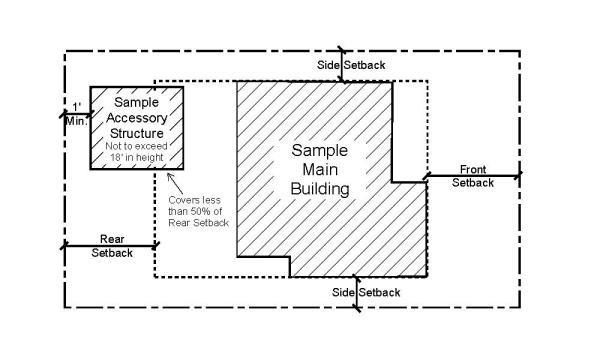
- Detached Accessory Buildings not more than eighteen feet (18') in height, and including any free-standing Solar Energy Systems, located a minimum of five feet (5') behind the front facade of the Main Building, and maintaining a minimum Rear Setback of one foot (1'). Such Structure must not cover over fifty percent (50%) of the Rear Setback. See the following illustration:
- A Hard-Surfaced Parking Area subject to the same location requirements as a Detached Accessory Building.
- Mechanical equipment (which must be screened), hot tubs, or similar Structures located at least three feet (3') from the Rear Lot Line.
- Fences, walls, and retaining walls as permitted in Section 15-4-2 Fences and Retaining Walls.
- Patios, decks, pathways, steps, or similar Structures not more than thirty inches (30") above Final Grade, not including any required handrail, and located at least one foot (1') from the Rear Lot Line.
- Pathways or Steps connecting to a City staircase or pathway.
- One (1) Shared Driveway leading to either a garage or an approved Parking Area. See Section 15-2.1-7 Parking Regulations for additional requirements.
- Bay Windows not more than ten feet (10') wide and projecting not more than two feet (2') into the Rear Setback.
- SIDE SETBACKS. Side Setbacks are as follows:
TABLE 15-2.1b* for existing 25' wide lots, Use HR-1 standards.Lot Width (ft.) up to: Minimum Side Setback Total of Setback 37.5* 3 ft. each side 6 ft. 50.0 5 ft. each side 10 ft. 62.5 5 ft. minimum 14 ft. 75.0 5 ft. minimum 18 ft. 87.5 10 ft. minimum 24 ft. 100.0 10 ft. minimum 24 ft. Greater than 100.0 10 ft. minimum 30 ft.
On Corner Lots, the minimum Side Setback that faces a side Street or a platted Right-of-Way is five feet (5'). A three foot (3') Side Setback along the platted Right-of-Way may be approved by the City Engineer when the Lot Width is less than 37.5 feet; no Side Setback exceptions shall be utilized and the sight triangle shall be maintained when the Setback is three feet (3') along the Right-of-Way. - SIDE SETBACK EXCEPTIONS. The Side Setback must be open and free of any Structure except:
- Bay Windows not more than ten feet (10') wide and projecting not more than two feet (2') into the Side Setback.
- Chimneys not more than five feet (5') wide and projecting not more than two feet (2') into the Side Setback.
- Window wells not exceeding the minimum International Residential Code (IRC) or International Building Code (IBC) requirements for egress may extend not more than four feet (4') into the Side Setback. Only permitted on Lots with a minimum required Side Setback of five feet (5') or greater. Should egress requirements be met within the building pad, this Side Setback exception is not permitted.
- Roof overhangs or eaves projecting not more than two feet (2') into the Side Setback on Lots with a minimum required Side Setback of five feet (5') or greater. A one foot (1’) eave overhang is permitted on Lots with a Side Setback less than five feet (5’).
- Window sills, belt courses, trim, exterior siding, cornices, or other ornamental features projecting not more than six inches (6") beyond the main Structure to which they are attached.
- Patios, decks, pathways, steps, or similar Structures not more than thirty inches (30") in height from Final Grade, not including any required handrail.
- Fences, walls or retaining walls, as permitted in Section 15-4-2 Fences and Retaining Walls.
- One (1) private or Shared Driveway leading to a garage or an approved Parking Area. See Section 15-2.1-7 Parking Regulations for additional requirements.
- Pathways or steps connecting to a City staircase or pathway.
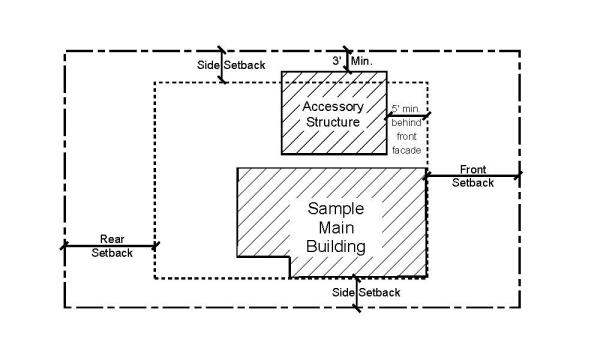
- Detached Accessory Buildings, not more than eighteen feet (18') in height, and including any free-standing Solar Energy Systems, located a minimum of five feet (5') behind the front Facade of the Main Building, maintaining a minimum Side Setback of three feet (3'). See the following illustration:
- Mechanical equipment (which must be screened), hot tubs, or similar Structures, located at least three feet (3’) from the Side Lot Line.
- Bay Windows not more than ten feet (10') wide and projecting not more than two feet (2') into the Side Setback.
- SNOW RELEASE. Site plans and Building designs must resolve snow release issues to the satisfaction of the Chief Building Official.
- CLEAR VIEW OF INTERSECTION. No visual obstruction in excess of two feet (2') in height above road Grade shall be placed on any Corner Lot within the Site Distance Triangle. A reasonable number of trees may be allowed, if pruned high enough to permit automobile drivers an unobstructed view. This provision must not require changes in the Natural Grade on the Site.
Adopted by Ord. 00-15 on 3/2/2000
Amended by Ord. 06-56 on 7/27/2006
Amended by Ord. 15-35 on 10/12/2015
Amended by Ord. 2018-27 on 5/31/2018
Amended by Ord. 2018-43 on 7/19/2018
Amended by Ord. 2020-42 on 9/17/2020
Amended by Ord. 2022-16 on 5/26/2022
Amended by Ord. 2023-50 on 10/26/2023
15-2.1-4 Existing Historic Buildings And/or Structures
Significant and Landmark Historic Sites that exceed the maximum Lot Area, and Historic Buildings and/or Structures that do not comply with Building Footprint, Building Height, Building Setbacks, Off-Street parking, and driveway location standards are valid Non-Complying Structures. Additions must comply with Building Setbacks, Building Footprint, driveway location standards and Building Height. Additions to Historic Buildings and/or Structures are exempt from Off-Street parking requirements provided the addition does not create a Lockout Unit or Accessory Apartment. All Conditional Uses proposed on the Site, excluding Development on a Steep Slope, shall comply with parking requirements of Chapter 15-3.
- EXCEPTION. In order to achieve new construction consistent with the Design Guidelines for Historic Districts and Historic Sites, the Planning Commission may grant an exception to the Building Setback and driveway location standards for additions to Historic Buildings and/or Structures, including detached Garages:
- Upon approval of a Conditional Use permit, and
- When the scale of the addition and/or driveway is Compatible with the Historic Building and/or Structure, and
- When the addition complies with all other provisions of this Chapter, and
- When the addition complies with the adopted Building and Fire Codes, and
- When the addition complies with the Design Guidelines for Historic Districts and Historic Sites.
- Upon approval of a Conditional Use permit, and
Adopted by Ord. 00-15 on 3/2/2000
Amended by Ord. 2016-44 on 9/15/2016
Amended by Ord. 2020-42 on 9/17/2020
Amended by Ord. 2022-16 on 5/26/2022
Amended by Ord. 2023-50 on 10/26/2023
15-2.1-5 Building Height
No Structure shall be erected to a height greater than twenty-seven feet (27') from Existing Grade. This is the Zone Height. Final Grade must be within four vertical feet (4’) of Existing Grade, except for the placement of approved window wells, emergency egress, and a garage entrance. The following height requirement must be met:
- A Structure shall have a maximum height of thirty five feet (35’) measured from the lowest floor plane to the point of the highest wall top plate that supports the ceiling joists or roof rafters.
- A ten foot (10’) minimum horizontal step in the downhill façade is required unless the First Story is located completely under the finish grade on all sides of the Structure. The horizontal step shall take place at a maximum height of twenty three feet (23’) from where the Building Footprint meets the lowest point of existing Grade. Architectural features, that provide articulation to the upper story façade setback, may encroach into the minimum ten foot (10’) setback but shall be limited to no more than twenty five percent (25%) of the width of the building encroaching no more than four feet (4’) into the setback, subject to compliance with the Design Guidelines for Historic Sites and Historic Districts.
- ROOF PITCH. The roof pitch of a Structure’s Contributing Roof Form shall be between seven: twelve (7:12) and twelve: twelve (12:12) and shall occupy a minimum horizontal distance of 20 feet measured from the primary façade to the rear of the building, as viewed from the primary public right-of-way. Secondary Roof Forms may be below the required 7:12 roof pitch and located on the primary façade (such as porches, bay window roofs, etc).
- Secondary Roof Forms may be Rooftop Decks so long as they are not more than 23 feet in height above Finished Grade. This height includes any railings, parapets, stairs, and similar constructions on the Roof Deck.
- The height of railings, parapets, stairs, and similar constructions on a Green Roof or Flat Roof are included in the calculation of Building Height. Decks, hot tubs, outdoor cooking areas, and seating areas are not permitted on Green Roofs. Green Roofs must be vegetated.
- A Structure containing a flat roof shall have a maximum height of thirty-five feet (35’) measured from the lowest floor plan to the highest wall top plate that supports the ceiling joists or roof rafters. The height of the Green Roof, including the parapets or similar features shall not exceed twenty four inches (24”) above the highest top plate mentioned above. Any required railings for a Green Roof shall comply with Building Height.

- Accessory Structures may be below the required seven: twelve (7:12) roof pitch.
- Secondary Roof Forms may be Rooftop Decks so long as they are not more than 23 feet in height above Finished Grade. This height includes any railings, parapets, stairs, and similar constructions on the Roof Deck.
- BUILDING HEIGHT EXCEPTIONS. The following height exceptions apply:
- Antennas, chimneys, flues, vents, or similar Structures, may extend up to five feet (5') above the highest point of the Building to comply with International Building Code (IBC) requirements.
- Water towers, mechanical equipment, and Solar Energy Systems, when Screened or enclosed, may extend up to five feet (5') above the height of the Building. See Section 15-5-5.
- ELEVATOR ACCESS. The Planning Director may allow additional height to allow for an elevator compliant with American Disability Act (ADA) standards. The Applicant must verify the following:
- The proposed height exception is only for the Area of the elevator. No increase in square footage of the Building is being achieved.
- The proposed option is the only feasible option for the elevator on the Site.
- The proposed elevator and floor plans comply with the American Disability Act (ADA) standards.
- The proposed height exception is only for the Area of the elevator. No increase in square footage of the Building is being achieved.
- GARAGE ON DOWNHILL LOT. The Planning Commission may allow additional Building Height (see entire Section 15-2.1-5) on a downhill Lot to accommodate a single car wide garage in a Tandem Parking configuration; to accommodate circulation, such as stairs and/or an ADA elevator; and to accommodate a reasonably sized front entry area and front porch that provide a Compatible streetscape design. The depth of the garage may not exceed the minimum depth for internal Parking Space(s) as dimensioned within this Code, Chapter 15-3. The additional Building Height may not exceed thirty-five feet (35’) from Existing Grade.
- Antennas, chimneys, flues, vents, or similar Structures, may extend up to five feet (5') above the highest point of the Building to comply with International Building Code (IBC) requirements.
Adopted by Ord. 00-15 on 3/2/2000
Amended by Ord. 06-56 on 7/27/2006
Amended by Ord. 09-10 on 3/5/2009
Amended by Ord. 09-14 on 4/9/2009
Amended by Ord. 09-40 on 11/5/2009
Amended by Ord. 13-48 on 11/21/2013
Amended by Ord. 2016-44 on 9/15/2016
Amended by Ord. 2017-59 on 11/9/2017
Amended by Ord. 2018-27 on 5/31/2018
Amended by Ord. 2020-42 on 9/17/2020
15-2.1-6 Development On Steep Slopes
Development on Steep Slopes must be environmentally sensitive to hillside Areas, carefully planned to mitigate adverse effects on neighboring land and Improvements, and consistent with the Design Regulations for Historic Districts and Historic Sites Chapter 15-13 and Architectural Review Chapter 15-5.
For the purpose of measuring Slope, the measurement shall include a minimum horizontal distance of fifteen feet (15') measured perpendicular to the contour lines on the certified topographic survey. The measurement shall quantify the steepest Slope within the Building Footprint and any Access driveway.
- Steep Slope Determination.
- A Steep Slope Conditional Use permit is required for construction of any Structure with a Building Footprint in excess of two hundred square feet (200 sq. ft.) if said Building Footprint is located on or projecting over an existing Slope of thirty percent (30%) or greater.
- A Steep Slope Conditional Use permit is required for construction of any addition to an existing Structure, when the Building Footprint of the addition is in excess of two hundred square feet (200 sq. ft.), if the Building Footprint of the addition is located on or projecting over an existing Slope of thirty percent (30%) or greater.
- A Steep Slope Conditional Use permit is required for any Access driveway located on or projecting over an existing Slope of (30%) or greater.
- Any disturbance that creates a change from Existing Grade or elevation greater than four feet, cuts into the Steep Slope, or requires retaining walls to construct the Structure (including patio, hot tub, pool, landscaping/grading).
- A Steep Slope Conditional Use permit is required for construction of any Structure with a Building Footprint in excess of two hundred square feet (200 sq. ft.) if said Building Footprint is located on or projecting over an existing Slope of thirty percent (30%) or greater.
- Steep Slope Review.
To fully evaluate the Criteria below, the Applicant shall provide the following information:
- GEOTECHNICAL ANALYSIS. For Structures that create a change from Existing Grade or elevation greater than four feet, cut into the Steep Slope, or require retaining walls to construct the Structure, a geotechnical report is required. The Applicant shall provide the Planning Department with a geotechnical report prepared by a licensed geotechnical engineer, engineering geologist, or other qualified professional. The report must include information such as soils characteristics and preliminary structural recommendations intended to inform the design and mitigation of soils conditions, slope limitations, and/or ground water. The Engineering or Building Department may request additional information in the form of a geotechnical survey if additional information is deemed necessary.
- SLOPE/TOPOGRAPHIC MAP. Certified boundary survey depicting contours at an interval of two feet (2’) or less that identifies Very Steep Slopes (40% or greater) within fifty feet (50’) of the Property boundary and highlights areas of high geologic hazard, areas subject to land sliding, and all Steep Slopes for areas with a rise of at least twenty-five feet (25’) vertically and a run of at least fifty feet (50’) horizontally in the following categories:
- Greater than fifteen percent (15%), but less than or equal to thirty percent (30%) (shown in yellow)
- Greater than thirty percent (30%) but less than or equal to forty percent (40%) (shown in orange)
- Very Steep Slopes, greater than forty percent (40%) (shown in red)
- Conditional Use Permit Criteria.
The Planning Commission may review Steep Slope Conditional Use permit Applications as Consent Calendar items. Steep Slope Conditional Use permit Applications shall be subject to the following criteria:- LOCATION OF DEVELOPMENT. Development is located and designed to reduce visual and environmental impacts of the Structure.
- VISUAL ANALYSIS. To determine potential impacts of the proposed Access, and Building mass and design and to identify the potential for Screening, Slope stabilization, erosion mitigation, vegetation protection, and other design opportunities, a visual analysis of the project from key Vantage Points is required. The Applicant must provide the Planning Department with:
- Four panoramic views of existing property showing the site from the perimeter of the property from 90-degree compass intervals (camera facing toward site). Four panoramic views showing the neighborhood taken from the perimeter of the property at 90-degree compass intervals (camera facing away from site). One aerial photograph placing the subject in a neighborhood context.
- Streetscape elevation – including 100 feet on either side of the property along the project side of the street to indicate accurate height, width, and building or all proposed work in relation to existing surrounding and adjacent buildings, drawn at minimum 1/8 inch scale. If access to properties is limited, a photographic streetscape is allowed.
- A 3D massing model illustrating the proposed project from designated Vantage Points (see Planning Staff to review and establish Vantage Points for the Application).
- A rendering that superimposes the proposed project on a photo of the site and streetscape.
- ACCESS. Access points and driveways must be designed to minimize Grading of the natural topography and to reduce overall Building scale. Shared Driveways and Parking Areas, and side Access to garages are strongly encouraged, where feasible.
- TERRACING. The proposed plans shall include detailed information, including height from Existing Grade, width, and length of all proposed retaining walls. The Applicant shall terrace retaining walls to return to Natural Grade. A Building Permit, including drawings stamped by a licensed engineer, is required for any retaining wall or combination retaining wall with a total or combined height greater than four feet (4’) in height. A combination retaining wall is defined as any series of retaining walls in which the horizontal separation between subsequent walls is closer than 1.5:1 compared to the height of the individual walls. If the height of any retaining walls is proposed to be modified by more than twelve inches in height, width, length, or location, the Applicant shall file a modification application with the Planning Department and return to the Planning Commission for review and Final Action. Additionally, modifications of pervious material to impervious material or changes to excavation depths require a modification application and Planning Commission review and Final Action.
- BUILDING LOCATION. Buildings, Access, and infrastructure must be located to minimize cut and fill that would alter the perceived natural topography of the Site. The Site design and Building Footprint must coordinate with adjacent Properties to maximize opportunities for open Areas and preservation of natural vegetation, to minimize driveway and Parking Areas, and to provide variation of the Front Yard.
- BUILDING FORM AND SCALE. Where Building masses orient against the Lot’s existing contours, the Structures must be stepped with the Grade and broken into a series of individual smaller components that are Compatible with the District. Low profile Buildings that orient with existing contours are strongly encouraged. The garage must be subordinate in design to the main Building. In order to decrease the perceived bulk of the Main Building, the Planning Commission may require a garage separate from the main Structure or no garage.
- SETBACKS. The Planning Commission may require an increase in one or more Setbacks to minimize the creation of a “wall effect” along the Street front and/or the Rear Lot Line. The Setback variation will be a function of the Site constraints, proposed Building scale, and Setbacks on adjacent Structures.
- DWELLING VOLUME. The maximum volume of any Structure is a function of the Lot size, Building Height, Setbacks, and provisions set forth in this Chapter. The Planning Commission may further limit the volume of a proposed Structure to minimize its visual mass and/or to mitigate differences in scale between a proposed Structure and existing Structures.
- BUILDING HEIGHT (STEEP SLOPE). The Zone Height in the HRL District is twenty-seven feet (27') and is restricted as stated above in Section 15-2.1-5. The Planning Commission may require a reduction in Building Height for all, or portions, of a proposed Structure to minimize its visual mass and/or to mitigate differences in scale between a proposed Structure and the Historic character of the neighborhood's existing residential Structures.
- LOCATION OF DEVELOPMENT. Development is located and designed to reduce visual and environmental impacts of the Structure.
Adopted by Ord. 00-15 on 3/2/2000
Amended by Ord. 06-56 on 7/27/2006
Amended by Ord. 09-10 on 3/5/2009
Amended by Ord. 09-14 on 4/9/2009
Amended by Ord. 15-35 on 10/12/2015
Amended by Ord. 2016-44 on 9/15/2016
Amended by Ord. 2019-07 on 1/29/2019
Amended by Ord. 2020-42 on 9/17/2020
Amended by Ord. 2023-49 on 10/26/2023
Amended by Ord. 2025-11 on 6/5/2025
15-2.1-7 Parking Regulations
- Tandem Parking is allowed in the Historic District.
- One (1) Shared Driveway is allowed along shared Side or Rear Lot Lines to provide Access to Parking in the rear of the Main Building or below Grade if both Properties are deed restricted to allow for the perpetual Use of the shared drive.
- Common Parking Structures are allowed as a Conditional Use where it facilitates:
- the Development of individual Buildings that more closely conform to the scale of Historic Buildings and/or Structures in the District; and/or
- the reduction, mitigation or elimination of garage doors at the Street edge.
- the Development of individual Buildings that more closely conform to the scale of Historic Buildings and/or Structures in the District; and/or
- A common Parking Structure may occupy below Grade Side Yards between participating Developments if the Structure maintains all Setbacks above Grade. Common Parking Structures requiring a Conditional Use Permit are subject to a Conditional Use review, Section 15-1-10.
- Driveways between Structures are allowed in order to eliminate garage doors facing the Street, to remove cars from on-Street parking, and to reduce paved Areas, provided the driveway leads to an approved garage or approved Parking Area.
- Turning radii are subject to review by the City Engineer as to function and design.
- See Chapter 15-3 Off Street Parking for additional parking requirements.
Adopted by Ord. 00-15 on 3/2/2000
Amended by Ord. 06-56 on 7/27/2006
Amended by Ord. 09-10 on 3/5/2009
Amended by Ord. 2020-42 on 9/17/2020
15-2.1-8 Architectural Review
Prior to issuance of a Building Permit for any Conditional or Allowed Use, the Planning Department shall review the proposed plans for compliance with the Architectural Review Chapter 15-5, Historic Preservation Chapter 15-11, and the Design Guidelines for Historic Districts and Historic Sites Chapter 15-13.
Adopted by Ord. 00-15 on 3/2/2000
Amended by Ord. 06-56 on 7/27/2006
Amended by Ord. 09-23 on 7/9/2009
Amended by Ord. 15-53 on 12/17/2015
Amended by Ord. 2020-42 on 9/17/2020
Amended by Ord. 2022-16 on 5/26/2022
15-2.1-9 Vegetation Protection
The Property Owner must protect Significant Vegetation during any Development activity. Significant Vegetation includes large trees six inches (6") in diameter or greater measured four and one-half feet (4½') above the ground, groves of smaller trees, or clumps of oak and maple covering an Area fifty square feet (50 sq. ft.) or more measured at the drip line.
Development plans must show all Significant Vegetation within twenty feet (20') of a proposed Development. The Property Owner must demonstrate the health and viability of all large trees through a certified arborist. The Planning Director shall determine the Limits of Disturbance and may require mitigation for loss of Significant Vegetation consistent with Landscape Criteria in Sections 15-3-3 and 15-5-5(N), and Title 14.
Adopted by Ord. 00-15 on 3/2/2000
Amended by Ord. 06-56 on 7/27/2006
Amended by Ord. 2020-42 on 9/17/2020
Amended by Ord. 2022-16 on 5/26/2022
15-2.1-10 Signs
Signs are allowed in the HRL District as provided in the Park City Sign Code, Title 12.
Adopted by Ord. 00-15 on 3/2/2000
15-2.1-11 Related Provisions
- Fences and Retaining Walls. Section 15-4-2.
- Accessory Apartments. Section 15-4-7.
- Placement of Satellite Receiving Antennas. Section 15-4-13.
- Telecommunication Facilities. Section 15-4-14.
- Off-Street Parking. Chapter 15-3.
- Landscaping. Title 14; Sections 15-3-3 and 15-5-5(N).
- Lighting. Sections 15-3-3 and 15-5-5(J).
- Historic Preservation. Chapters 15-11 and 15-13.
- Park City Sign Code. Title 12.
- Architectural Review. Chapter 15-5.
- Snow Storage. Section 15-3-3
- Parking Ratio Requirements. Section 15-3-6.
Adopted by Ord. 00-15 on 3/2/2000
Amended by Ord. 2020-42 on 9/17/2020
Amended by Ord. 2022-16 on 5/26/2022

