
Park City City Zoning Code
15-2.16 Recreation
Commercial RC District
15-2.16-1 Purpose
The purpose of the Recreation Commercial RC District is to:
- allow for the Development of hotel and convention accommodations in close proximity to major recreation facilities,
- allow for resort-related transient housing with appropriate supporting commercial and service activities,
- encourage the clustering of Development to preserve Open Space, minimize Site disturbance and impacts of Development, and minimize the cost of construction and municipal services,
- limit new Development on visible hillsides and sensitive view Areas,
- provide opportunities for variation in architectural design and housing types,
- promote pedestrian connections within Developments and to adjacent Areas,
- minimize architectural impacts of the automobile,
- promote the Development of Buildings with designs that reflect traditional Park City architectural patterns, character, and Site designs,
- promote Park City’s mountain and Historic character by designing projects that relate to the mining and Historic architectural heritage of the City, and
- promote the preservation and rehabilitation of Historic Buildings.
Adopted by Ord. 00-51 on 9/21/2000
15-2.16-2 Uses
Uses in the RC District are limited to the following:
- ALLOWED USES.
- Single Family Dwelling
- Duplex Dwelling
- Triplex Dwelling
- Secondary Living Quarters
- Lockout Unit1
- Accessory Apartment2
- Nightly Rental3
- Home Occupation
- Child Care, In-Home Babysitting4
- Child Care, Family Group4
- Child Care Center4
- Accessory Building and Use
- Conservation Activity
- Agriculture
- Bed and Breakfast Inn
- Boarding House, Hostel
- Hotel, Minor
- Parking Area or Structure with four (4) or fewer spaces
- Salt Lake City 2002 Winter Olympic Games Olympic Legacy Displays5
- Food Truck Location12
- Enclosed Mobile Business Location14
- Public Transit Amenity Area, limited to streets currently served by Park City Transit, identified in the Short-Range Transit Plan for future service, or as approved by the Transportation Director
- Single Family Dwelling
- CONDITIONAL USES.
- Multi-Unit Dwelling
- Group Care Facility
- Public and Quasi-Public institution, church, and school
- Essential municipal and public utility Use, facility, service, and Structure
- Telecommunications Antenna6
- Satellite dish Antenna, greater than thirty-nine inches (39") in diameter7
- Raising, grazing of horses
- Cemetery
- Hotel, Major
- Timeshare Project and Conversion
- Timeshare Sales Office
- Private Residence Club Project and Conversion9
- Office, General8
- Office, Moderate8
- Office and clinic, Medical8
- Financial institution without drive-up window8
- Minor Retail and Service Commercial8
- Retail and Service Commercial, Personal Improvement8
- Transportation Service8
- Neighborhood Market, without gasoline sales8
- Café or Deli8
- Restaurant, General8
- Restaurant, outdoor dining8,9
- Bar8
- Hospital, Limited Care Facility8
- Parking Area or Structure with five (5) or more spaces
- Temporary Improvement9
- Passenger Tramway station and ski base facility10
- Ski tow rope, ski lift, ski run, and ski bridge10
- Outdoor Events and Uses9
- Recreation Facility, Public and Private8, 13
- Recreation Facility, Commercial8
- Entertainment Facility, Indoor8
- Commercial Riding Stable(s), riding academy8
- Heliport8
- Amenities Club
- Club, Private Residence Off-Site11
- Multi-Unit Dwelling
- PROHIBITED USES. Any Use not listed above as an Allowed or Conditional Use is a prohibited Use.
1Nightly Rental of Lockout Units requires a Conditional Use permit.
2Requires an Administrative Permit. See Section 15-4-7, Accessory Apartments.
3Nightly Rentals do not include the Use of dwellings for Commercial Uses.
4See Section 15-4-9, Child Care And Child Care Facilities. Family Group Child Care and Child Care Center Uses require an Administrative permit.
5Olympic Legacy Displays limited to those specific Structures approved under the SLOC/Park City Municipal Corporation Olympic Services Agreement and/or Olympic Master Festival License and placed on the original Property set forth in the services agreement and/or Master Festival License. Requires an Administrative Permit.
6See Section 15-4-14, Telecommunication Facilities.
7See Section 15-4-13, Placement Of Satellite Receiving Antennas.
8As support Use to primary Development or Use, subject to provisions of LMC Chapter 15-6, Master Planned Developments.
9Requires an Administrative or Administrative Conditional Use permit, see Chapter 15-4.
10As part of an approved Ski Area Master Plan.
11Requires an Administrative Conditional Use permit. Is permitted only in approved existing Commercial spaces or Developments that have ten (10) or more units with approved Support Commercial space. A Parking Plan shall be submitted to determine site specific parking requirements.
12The Planning Director or their designee shall, upon finding a Food Truck Location in compliance with Municipal Code Section 4-5-6, issue the property owner a Food Truck Location administrative approval letter.
13See Section 15-4-22, Outdoor Pickleball Courts in Residential Areas.
14See Section 15-4-24, Mobile Businesses.
Adopted by Ord. 00-51 on 9/21/2000
Amended by Ord. 02-38 on 9/12/2002
Amended by Ord. 04-39 on 3/18/2004
Amended by Ord. 06-76 on 11/9/2006
Amended by Ord. 09-10 on 3/5/2009
Amended by Ord. 11-05 on 1/27/2011
Amended by Ord. 15-35 on 10/12/2015
Amended by Ord. 2018-23 on 5/17/2018
Amended by Ord. 2018-55 on 10/23/2018
Amended by Ord. 2020-36 on 7/30/2020
Amended by Ord. 2020-45 on 10/1/2020
Amended by Ord. 2021-51 on 12/16/2021
Amended by Ord. 2022-08 on 4/28/2022
Amended by Ord. 2022-21 on 10/27/2022
Amended by Ord. 2023-16 on 4/27/2023
Amended by Ord. 2025-11 on 6/5/2025
Amended by Ord. 2026-03 on 2/3/2026
15-2.16-3 Lot And Site Requirements
Except as may otherwise be provided in this Code, no Building Permit shall be issued for a Lot unless such Lot has Frontage on a Street shown as a private or Public Street on the Streets Master Plan, or on a private easement connecting the Lot to a Street shown on the Streets Master Plan. All Development must comply with the following:
- SINGLE FAMILY AND DUPLEX DWELLINGS. For Single Family and Duplex Dwellings see Section 15-2.16-5.
- DEVELOPMENT FLOOR AREA RATIO. For all Development, except Single Family and Duplex Dwellings, the maximum Floor Area Ratio is one (1.0), not including underground Parking Structures.
- FRONT SETBACK. The minimum Front Setback is twenty feet (20'). See Section 15-2.16-5 for Front Setback requirements for Single Family and Duplex Dwellings.
- FRONT SETBACK EXCEPTIONS. The Front Setback must be open and free of any Structure except:
- Fences, walls, and retaining walls not more than four feet (4') in height, or as permitted in Section 15-4-2. On Corner Lots, Fences more than three feet (3') in height are prohibited within twenty-five feet (25') of the intersection at back of curb.
- Uncovered steps leading to the Main Building, provided the steps are not more than four feet (4') in height from Final Grade, not including any required handrail, and do not cause any danger or hazard to traffic by obstructing the view of a Street or intersection.
- Decks, porches, and Bay Windows not more than ten feet (10') wide, projecting not more than five feet (5') into the Front Yard.
- Roof overhangs, eaves and cornices projecting not more than three feet (3') into the Front Yard.
- Sidewalks, patios, and pathways.
- Driveways leading to a garage or Parking Area. No portion of a Front Yard except for approved driveways, allowed Parking Areas, and sidewalks may be Hard-Surfaced or graveled.
- Circular driveways meeting all requirements stated in Section 15-3-4 herein.
- Public Transit Amenity Area, limited to streets currently served by Park City Transit, identified in the Short-Range Transit Plan for future service, or as approved by the Transportation Director.
- Fences, walls, and retaining walls not more than four feet (4') in height, or as permitted in Section 15-4-2. On Corner Lots, Fences more than three feet (3') in height are prohibited within twenty-five feet (25') of the intersection at back of curb.
- REAR SETBACK. The minimum Rear Setback is ten feet (10'). See Section 15-2.16-5 for Rear Setback requirements for Single Family and Duplex Dwellings.
- REAR SETBACK EXCEPTIONS. The Rear Setback must be open and free of any Structure except:
- Bay Windows not more than ten feet (10') wide projecting not more than two feet (2') into the Rear Setback.
- Chimneys not more than five feet (5') wide projecting not more than two feet (2') into the Rear Setback.
- Window wells and light wells projecting not more than four feet (4') into the Rear Setback.
- Roof overhangs and eaves projecting not more than three feet (3') into the Rear Setback.
- Window sills, belt courses, cornices, trim, exterior siding, and other ornamental features projecting not more than six inches (6") beyond the window or main Structure to which it is attached.
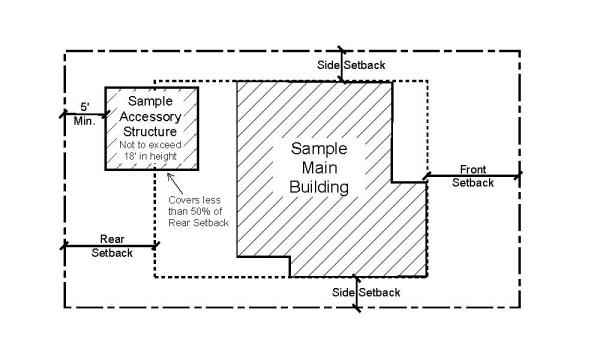
- Detached Accessory Buildings not more than eighteen feet (18') in height and maintaining a minimum Rear Setback of five feet (5'). Such Structures must not cover more than fifty percent (50%) of the Rear Setback. See the following illustration:
- Hard-Surfaced Parking Areas subject to the same location requirements as a detached Accessory Building.
- Mechanical equipment (which must be screened), hot tubs, or similar Structures located at least three feet (3') from the Rear Lot Line.
- Fences, walls, and retaining walls not more than six feet (6') in height, or as permitted in Section 15-4-2. Retaining walls may have multiple steps, however, each exposed face cannot exceed six feet (6') in height and the horizontal distance between the walls, front face to rear face, must be at least three feet (3') and planted with approved vegetation. The Planning Director may approve minor deviations to the height and stepping requirements based on Site specific review.
- Patios, decks, pathways, steps, and similar Structures not more than thirty inches (30") above Final Grade.
- Bay Windows not more than ten feet (10') wide projecting not more than two feet (2') into the Rear Setback.
- SIDE SETBACK.
- The minimum Side Setback is ten feet (10'). See Section 15-2.16-5 for Side Setback requirements for Single Family and Duplex Dwellings.
- A Side Setback between connected Structures is not required where Structures are designed with a common wall on a Property Line and the Lots are burdened with a party wall agreement in a form approved by the City Attorney and Chief Building Official.
- The minimum Side Setback is ten feet (10'). See Section 15-2.16-5 for Side Setback requirements for Single Family and Duplex Dwellings.
- SIDE SETBACK EXCEPTIONS. The Side Setback must be open and free of any Structure except:
- Bay Windows not more than ten feet (10') wide, projecting not more than two feet (2') into the Side Setback.
- Chimneys not more than five feet (5') wide projecting not more than two feet (2') into the Side Setback.
- Window wells and light wells projecting not more than four feet (4') into the Side Setback.
- Roof overhangs and eaves projecting not more than three feet (3') into the Side Setback.
- Window sills, belt courses, cornices, trim, and other ornamental features projecting not more than six inches (6") beyond the window or main Structure to which it is attached.
- Patios, decks, pathways, steps, and similar Structures not more than thirty inches (30") in height above Final Grade.
- Fences, walls, and retaining walls not more than six feet (6') in height, or as permitted in Section 15-4-2. Retaining walls may have multiple steps, however, each exposed face cannot exceed six feet (6') in height and the horizontal distance between the walls, front face to rear face, must be at least three feet (3') and planted with approved vegetation. The Planning Director may approve minor deviations to the height and stepping requirements based on Site specific review.
- Driveways leading to a garage or Parking Area maintaining a three foot (3') landscaped Setback to the Side Lot Line.
- Detached Accessory Buildings not more than eighteen feet (18') in height, located a minimum of five feet (5') behind the front facade of the Main Building and maintaining a minimum Side Setback of five feet (5').
- Mechanical equipment (which must be screened), hot tubs, or similar Structures located at least three feet (3’) from the Side Lot line.
- Bay Windows not more than ten feet (10') wide, projecting not more than two feet (2') into the Side Setback.
- SNOW RELEASE. Site plans and Building design must resolve snow release issues to the satisfaction of the Chief Building Official.
- OPEN SPACE. On any Lot greater than 25,000 sq. ft. in Area, at least sixty percent (60%) of the Lot must be devoted to Open Space if the Lot is not developed as Master Planned Development. If the Lot is developed as a Master Planned Development then the Open Space requirements of Section 15-6-5.(D) shall apply.
Adopted by Ord. 00-51 on 9/21/2000
Amended by Ord. 06-76 on 11/9/2006
Amended by Ord. 09-10 on 3/5/2009
Amended by Ord. 12-37 on 12/20/2012
Amended by Ord. 15-35 on 10/12/2015
Amended by Ord. 2018-43 on 7/19/2018
Amended by Ord. 2026-03 on 2/3/2026
15-2.16-4 Building Height
No Structure shall be erected to a height greater than thirty-five feet (35') from Existing Grade. This is the Zone Height. See Section 15-2.16-5 Building Height for Single Family Dwellings and Duplexes.
- MAXIMUM BUILDING VOLUME AND BUILDING HEIGHT EXCEPTIONS. The following height exceptions apply:
- Gable, hip, and similar pitched roofs may extend up to five feet (5') above the Zone Height, if the roof pitch is 4:12 or greater.
- Antennas, chimneys, flues, vents, and similar Structures may extend up to five feet (5') above the highest point of the Building to comply with International Building Code (IBC) requirements.
- Water towers, mechanical equipment, and associated Screening, when enclosed or Screened may extend up to five feet (5') above the height of the Building.
- Church spires, bell towers, and like architectural features, subject to LMC Chapter 15-5 Architectural Guidelines, may extend up to fifty percent (50%) above the Zone Height, but may not contain Habitable Space above the Zone Height. Such exception requires approval by the Planning Director.
- Elevator Penthouses may extend up to eight feet (8') above the Zone Height.
- Ski Lifts and Tramway towers may extend above the Zone Height subject to a visual analysis and administrative approval by the Planning Commission.
- Salt Lake City 2002 Winter Olympic Games Olympic Legacy Displays, including Olympic way-finding towers, are permitted to a height of sixty-five feet (65').
- Gable, hip, and similar pitched roofs may extend up to five feet (5') above the Zone Height, if the roof pitch is 4:12 or greater.
Adopted by Ord. 00-51 on 9/21/2000
Amended by Ord. 02-38 on 9/12/2002
Amended by Ord. 06-76 on 11/9/2006
Amended by Ord. 07-25 on 4/19/2007
15-2.16-5 Special Requirements For Single Family And Duplex Dwellings
Except as may otherwise be provided in this Code, no Building Permit shall be issued for a Lot unless such Lot has Area, width, and depth as required, and Frontage on a Street shown as a private or Public Street on the Streets Master Plan, or on a private easement connecting the Lot to a Street shown on the Streets Master Plan.
The following minimum Lot and Site requirements apply to Single Family and Duplex Dwellings in the RC District:
- LOT SIZE. The minimum Lot Area is 1,875 square feet for a Single Family Dwelling and the maximum Lot Area is 3,750 square feet. The minimum Lot Area for a Duplex. is 3,750 square feet and the maximum Lot Area is 7,500 square feet. The minimum width of a Lot is twenty five feet (25'); measured fifteen feet (15') back from the Front Lot Line. In the case of unusual Lot configurations, Lot Width measurements shall be determined by the Planning Director.
- BUILDING ENVELOPE - RC DISTRICT. The Building Pad, Building Footprint and height restrictions define the maximum Building Envelope within which all Development must occur, with exceptions as allowed by Section 2-16-5(C).
- BUILDING PAD - RC DISTRICT. The Building Pad is the Lot Area minus required Front, Rear and Side Setback Areas.
- The Building Footprint must be within the Building Pad. The remainder of the Building Pad must be open and free of any other Structure except:
- Porches or decks, with or without roofs;
- At Grade patios;
- Upper level decks, with or without roofs;
- Bay Windows;
- Chimneys;
- Sidewalks, pathways, and steps;
- Screened hot tubs; and
- Landscaping.
- Porches or decks, with or without roofs;
- Exceptions to the Building Pad Area, excluding Bay Windows, are not included in the Building Footprint calculations, and are subject to Planning Director approval based on a determination that the proposed exceptions result in a design that:
- provides increased architectural interest consistent with the Design Guidelines for Historic Districts and Sites; and
- maintains the intent of this section to provide horizontal and vertical Building articulation.
- provides increased architectural interest consistent with the Design Guidelines for Historic Districts and Sites; and
- The Building Footprint must be within the Building Pad. The remainder of the Building Pad must be open and free of any other Structure except:
- BUILDING FOOTPRINT – RC DISTRICT. The maximum Building Footprint of any Single Family or Duplex Structure located on a Lot, or combination of Lots, not exceeding 18,750 square feet in Lot Area, shall be calculated according to the following formula for Building Footprint, illustrated in Table 15-2.16.
Accessory Buildings listed on the Park City Historic Structures Inventory that are not expanded, enlarged or incorporated into the Main Building, shall not count in the total Building Footprint of the Lot.
The maximum Building Footprint for any Structure located on a Lot or combination of Lots, exceeding 18,750 square feet in Lot Area, shall be 4,500 square feet; with an exemption allowance of 400 square feet, per Dwelling Unit, for garage floor area. A Conditional Use permit is required for all Structures with a proposed footprint of greater than 3,500 square feet.
MAXIMUM FP = (A/2) x 0.9A/1875
Where FP= maximum Building Footprint and A= Lot Area.
Example: 3,750 sq. ft. lot: (3,750/2) x 0.9 (3750/1875) = 1,875 x 0.81= 1,519 sq. ft.
See the following Table 15-2.16 below for a schedule equivalent of this formula.
TABLE 15-2.16*For Lots > 75’ in depth use Footprint formula and Table 15-2.16a for Front and Rear Setbacks.Lot Depth </=ft.* Lot Width, ft. Up to: Side Setbacks Min. Total, ft. Lot Area Sq. ft. Bldg. Pad Sq. ft. Max. Bldg. Footprint 75 ft. 25.0 3 ft. 6 ft. 1,875 1,045 844 75 ft. 37.5 3 ft. 6 ft. 2,813 1,733 1,201 75 ft. 50.0 5 ft. 10 ft. 3,750 2,200 1,519 75 ft. 62.5 5 ft. 14 ft. 4,688 2,668 1,801 75 ft. 75.0 5 ft. 18 ft. 5,625 3,135 2,050 75 ft. 87.5 10 ft. 24 ft. 6,563 3,493 2,270 75 ft. 100.0 10 ft. 24 ft. 7,500 4,180 2,460 75 ft. Greater than 100.0 10 ft. 30 ft. Greater than 75 ft. Per Setbacks and Lot Area Per formula 
- FRONT AND REAR SETBACK. Front and Rear Setbacks are as follows:
Table 15-2.16aLot Depth Min. Front/Rear Setback Total of Setbacks Up to 75 ft., inclusive 10 ft. 20 ft. From 75 ft. to 100 ft. 12 ft. 25 ft. Over 100 ft. 15 ft. 30 ft. - FRONT SETBACK EXCEPTIONS. The Front Setback must be open and free of any Structure except:
- Fences or walls not more than four feet (4') in height, or as permitted in Section 15-4-2. Fences and Walls. On Corner Lots, Fences more than three feet (3') in height are prohibited within twenty-five feet (25') of the intersection at back of curb.
- Uncovered steps leading to the Main Building; provided the steps are not more than four feet (4') in height from Final Grade, not including any required handrail, and do not cause any danger or hazard to traffic by obstructing the view of the Street or intersection.
- Decks, porches, and Bay Windows not more than ten feet (10') wide, projecting not more than three feet (3') into the Front Setback.
- Roof overhangs, eaves, and cornices projecting not more than three feet (3') into the Front Setback.
- Sidewalks, patios, and pathways.
- A driveway leading to a garage or Parking Area. No portion of a Front Yard, except for patios, driveways, allowed Parking Areas and sidewalks may be Hard-Surfaced or graveled.
- Fences or walls not more than four feet (4') in height, or as permitted in Section 15-4-2. Fences and Walls. On Corner Lots, Fences more than three feet (3') in height are prohibited within twenty-five feet (25') of the intersection at back of curb.
- REAR SETBACK EXCEPTIONS. The Rear Setback must be open and free of any Structure except:
- Bay Windows not more than ten feet (10') wide, projecting not more than two feet (2') into the Rear Setback.
- Chimneys not more than five feet (5') wide projecting not more than two feet (2') into the Rear Setback.
- Window wells and light wells projecting not more than four feet (4') into the Rear Setback.
- Roof overhangs and eaves projecting not more than two feet (2') into the Rear Setback.
- Window sills, belt courses, cornices, trim, exterior siding, and other ornamental features projecting not more than six inches (6”) beyond the window or main Structure to which it is attached.
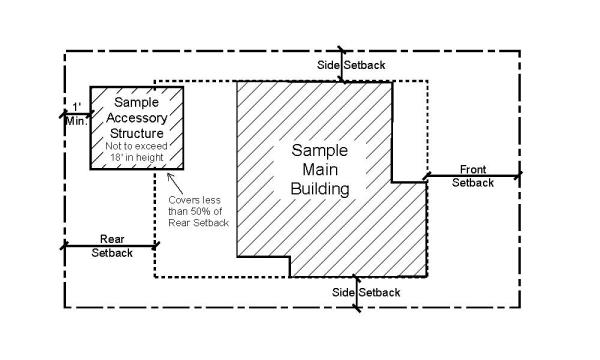
- Detached Accessory Buildings not more than eighteen feet (18’) in height, located a minimum of five feet (5’) behind the front façade of the Main Building, and maintaining a minimum Rear Setback of one foot (1’). Such Structures may not cover more than fifty percent (50%) of the Rear Setback. See the following illustration:
- Hard-Surfaced Parking Areas subject to the same location requirements as a detached Accessory Building.
- Mechanical equipment (which must be screened), hot tubs, or similar Structures located at least three feet (3') from the Rear Lot Line.
- Fences and walls as permitted in Section 15-4-2, Fences and Walls.
- Patios, decks, pathways, steps, and similar Structures not more than thirty inches (30") above Final Grade.
- Pathways and steps connecting to a City staircase or pathway.
- Bay Windows not more than ten feet (10') wide, projecting not more than two feet (2') into the Rear Setback.
- SIDE SETBACKS.
- The minimum Side Setback is three feet (3'), but increases for Lots greater than thirty-seven and one-half feet (37.5') in Width, as per Table 15-2.16 above.
- Site plans and Building designs must resolve snow release issues to the satisfaction of the Chief Building Official.
- On Corner Lots, the minimum Side Setback that faces a side Street or platted Right-of-Way is five feet (5').
- A Side Setback between connected Structures is not required where Structures are designed with a common wall on a Property Line, each Structure is located on an individual Lot, the Lots are burdened with a party wall agreement in a form approved by the City Attorney and Chief Building Official, all applicable Building and Fire Code requirements are met, and the Use is an Allowed or Conditional Use in the Zoning District.
- Exterior Side Setbacks shall be based on the required minimum Side Setback for each Lot; however the Planning Commission may consider increasing exterior Side Setbacks during Conditional Use Permit review to mitigate potential impacts on adjacent Property. Side Setback exceptions continue to apply.
- Building Footprint shall be based on the total lot Area of the underlying Lots. The Planning Commission may consider decreasing Building Footprint during Conditional Use Permit review to mitigate potential impacts on adjacent Property.
- Exterior Side Setbacks shall be based on the required minimum Side Setback for each Lot; however the Planning Commission may consider increasing exterior Side Setbacks during Conditional Use Permit review to mitigate potential impacts on adjacent Property. Side Setback exceptions continue to apply.
- The minimum Side Setback is three feet (3'), but increases for Lots greater than thirty-seven and one-half feet (37.5') in Width, as per Table 15-2.16 above.
- SIDE SETBACK EXCEPTIONS. The Side Setback must be open and free of any Structure except:
- Bay Windows not more than ten feet (10') wide projecting not more than two feet (2') into the Side Setback.1
- Chimneys not more than five Feet (5’) wide projecting not more than two feet (2’) into the Side Setback.1
- Window wells and light wells Projecting not more than four feet (4’) into the Side Setback.1
- Roof overhangs and eaves projecting not more than two feet (2’) into the Side Setback. A one foot (1’) roof or eave overhang is permitted on Lots with a Side Setback of less than five feet (5’).1
- Window sills, belt courses, trim, cornices, exterior siding, and other ornamental features projecting not more than six inches (6") beyond the window or main Structure to which it is attached.
- Patios, decks, pathways, steps, or similar Structures not more than thirty inches (30") in height from Final Grade.
- Fences and walls as permitted in Section 15-4-2.
- Driveways leading to a garage or approved Parking Area.
- Pathways and steps connecting to a City staircase or pathway.
- A detached Accessory Building, not more than eighteen feet (18') in height, located a minimum of five feet (5') behind the front facade of the Main Building, and maintaining a minimum Side Setback of three feet (3'). See the following illustration:

- Mechanical equipment (which must be screened), hot tubs, or similar Structures located a minimum of three feet (3') from the Side Lot Line.
- Bay Windows not more than ten feet (10') wide projecting not more than two feet (2') into the Side Setback.1
- SNOW RELEASE. Site plans and Building designs must resolve snow release issues to the satisfaction of the Chief Building Official.
- CLEAR VIEW OF INTERSECTION. No visual obstruction in excess of two feet (2') in height above Road Grade shall be placed on any Corner Lot within the Site Distance Triangle. A reasonable number of trees may be allowed, if pruned high enough to permit automobile drivers an unobstructed view. This provision must not require changes in the Natural Grade on the Site.
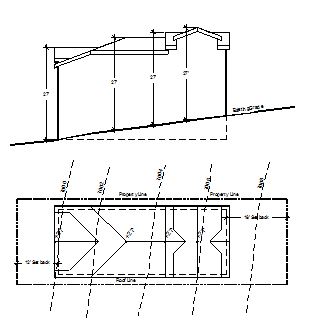
- BUILDING HEIGHT. No Single Family or Duplex Dwelling Structure shall be erected to a height greater than twenty-seven feet (27'). This is the Zone Height for Single Family and Duplex Dwellings. Final Grade must be within four vertical feet (4’) of Existing Grade around the periphery of the Structure, except for the placement of approved window wells, emergency egress, and a garage entrance. The following height requirements must be met:
- A Structure shall have a maximum height of thirty five feet (35’) measured from the lowest finish floor plane to the point of the highest wall top plate that supports the ceiling joists or roof rafters.
- A ten foot (10’) minimum horizontal step in the downhill façade is required unless the First Story is located completely under the finished Grade on all sides of the Structure. The horizontal step shall take place at a maximum height of twenty three feet (23’) from where Building Footprint meets the lowest point of existing Grade. Architectural features, that provide articulation to the upper story façade Setback, may encroach into the minimum ten foot (10’) Setback but shall be limited to no more than twenty five percent (25%) of the width of the building encroaching no more than four feet (4’) into the Setback, subject to compliance with the Design Guidelines for Historic Sites and Historic Districts.
- Roof Pitch. The primary roof pitch must be between seven:twelve (7:12) and twelve:twelve (12:12). A Green Roof may be below the required 7:12 roof pitch as part of the primary roof design. In addition, a roof that is not part of the primary roof design may be below the required 7:12 roof pitch.
- A structure containing a flat roof shall have a maximum height of thirty five feet (35’) measured from the lowest floor plane to the highest wall top plate that supports the ceiling joists or roof rafters. The height of the Green Roof, including the parapets, railings, or similar features shall not exceed twenty four inches (24”) above the highest top plate mentioned above.
- A structure containing a flat roof shall have a maximum height of thirty five feet (35’) measured from the lowest floor plane to the highest wall top plate that supports the ceiling joists or roof rafters. The height of the Green Roof, including the parapets, railings, or similar features shall not exceed twenty four inches (24”) above the highest top plate mentioned above.
- A Structure shall have a maximum height of thirty five feet (35’) measured from the lowest finish floor plane to the point of the highest wall top plate that supports the ceiling joists or roof rafters.
- BUILDING HEIGHT EXCEPTIONS. The following height exceptions apply:
- Antennas, chimneys, flues, vents, and similar Structures, may extend up to five feet (5') above the highest point of the Building to comply with International Building Code (IBC) requirements.
- Water towers, mechanical equipment, and associated Screening, when Screened or enclosed, may extend up to five feet (5') above the height of the Building.
- Elevator access. The Planning Director may allow additional height to allow for an elevator compliant with the American Disability Acts standards. The Applicant must verify the following:
- The proposed height exception is only for the Area of the elevator. No increase in square footage is being achieved.
- The proposed option is the only feasible option for the elevator on the site.
- The proposed elevator and floor plans comply with the American Disability Act (ADA) standards.
- The proposed height exception is only for the Area of the elevator. No increase in square footage is being achieved.
- Garage on Downhill Lot. The Planning Commission may allow additional Building Height (see entire Section 15-2.16-5 (L) on a downhill Lot to accommodate a single car wide garage in a Tandem Parking configuration; to accommodate circulation, such as stairs and/or an ADA elevator; and to accommodate a reasonably sized front entry area and front porch that provide a Compatible streetscape design. The depth of the garage may not exceed the minimum depth for internal Parking Space(s) as dimensioned within this Code, Section 15-3. The additional Building Height may not exceed thirty-five feet (35’) from Existing Grade.
- Antennas, chimneys, flues, vents, and similar Structures, may extend up to five feet (5') above the highest point of the Building to comply with International Building Code (IBC) requirements.
1Applies only to Lots with a minimum Side Setback of five feet (5’) or greater.
Adopted by Ord. 00-51 on 9/21/2000
Amended by Ord. 06-76 on 11/9/2006
Amended by Ord. 09-10 on 3/5/2009
Amended by Ord. 11-05 on 1/27/2011
Amended by Ord. 13-48 on 11/21/2013
Amended by Ord. 15-35 on 10/12/2015
Amended by Ord. 2016-44 on 9/15/2016
Amended by Ord. 2018-43 on 7/19/2018
Amended by Ord. 2024-10 on 5/23/2024
15-2.16-6 Existing Historic Structures
Historic Structures that do not comply with Building Footprint, Building Height, Building Setbacks, Off-Street parking, and driveway location standards are valid Non-Complying Structures. Additions to Historic Structures are exempt from Off-Street parking requirements provided the addition does not create a Lockout Unit or an Accessory Apartment. Additions must comply with Building Setbacks, Building Footprint, driveway location standards and Building Height. All Conditional Uses shall comply with parking requirements of Section 15-3 of this Code.
- EXCEPTION. In order to achieve new construction consistent with the Design Guidelines for Historic Districts and Sites, the Planning Commission may grant an exception to the Building Setbacks and driveway location standards for additions to Historic Buildings upon:
- Upon approval of a Conditional Use Permit, and
- When the scale of the addition and/or driveway is Compatible with the Historic Structure, and
- When the addition complies with all other provisions of this Chapter, and
- When the addition complies with the adopted Building and Fire Codes, and
- When the addition complies with the Design Guidelines for Historic Districts and Sites.
- Upon approval of a Conditional Use Permit, and
Adopted by Ord. 00-51 on 9/21/2000
Amended by Ord. 06-76 on 11/9/2006
Amended by Ord. 11-05 on 1/27/2011
Amended by Ord. 2016-44 on 9/15/2016
15-2.16-7 Architectural Review
- ALL DEVELOPMENT. Prior to the issuance of Building Permits for any Conditional or Allowed Use, the Planning Department shall review the proposed plans for compliance with Architectural Review, Chapter 15-5.
Adopted by Ord. 00-51 on 9/21/2000
Amended by Ord. 06-76 on 11/9/2006
Amended by Ord. 09-10 on 3/5/2009
Amended by Ord. 11-05 on 1/27/2011
Amended by Ord. 2022-16 on 5/26/2022
15-2.16-8 Parking Regulations
- Tandem Parking is allowed for Single Family and Duplex Dwellings in the RC District.
- Common driveways are allowed along shared Side Yard Property Lines to provide Access to parking in the rear of the Main Building or below Grade if both Properties are deed restricted to allow for the perpetual Use of such a shared drive.
- Common Parking Structures are allowed as a Conditional Use where it facilitates:
- the Development of individual Buildings that more closely conform to the scale of Historic Structures in the district; and
- the reduction, mitigation or elimination of garage doors at the Street edge.
- the Development of individual Buildings that more closely conform to the scale of Historic Structures in the district; and
- A Parking Structure may occupy below Grade Side and Rear Setbacks if the Structure maintains all Setbacks above Grade. Common Parking Structures requiring a Conditional Use permit are subject to a Conditional Use review, Chapter 15-1-10.
- Driveways between Structures are allowed in order to eliminate garage doors facing the Street, to remove cars from on-Street parking, and to reduce paved Areas, provided the driveway leads to an approved garage or Parking Area. Driveway widths are regulated in Section 15-3.
- Turning radii are subject to review by the City Engineer as to function and design.
- See Section 15-3 Off Street Parking for additional parking requirements.
Adopted by Ord. 00-51 on 9/21/2000
Amended by Ord. 06-76 on 11/9/2006
Amended by Ord. 09-10 on 3/5/2009
Amended by Ord. 11-05 on 1/27/2011
Amended by Ord. 2018-43 on 7/19/2018
15-2.16-9 Mechanical Service
All exterior mechanical equipment must be Screened to minimize noise infiltration to adjoining Properties and to mitigate visual impacts on nearby Properties and general public view. All mechanical equipment must be shown on the plans prepared for Conditional Use Permit and architectural review.
All Structure must provide a means of storing refuse generated by the Structure's occupants. All refuse storage facilities must be shown on the plans prepared for Conditional Use Permit and architectural review. Refuse storage must be Screened, enclosed, and properly ventilated.
The loading and unloading of goods must take place entirely on the Site. Loading areas must be Screened from general public view. All loading areas shall be shown on the plans prepared for Conditional Use Permit and architectural review.
Adopted by Ord. 2016-44 on 9/15/2016
15-2.16-10 Goods And Uses To Be Within Enclosed Building
- OUTDOOR DISPLAY OF GOODS PROHIBITED. Unless expressly allowed as an Allowed or Conditional Use, or allowed with an Administrative Permit, all goods including food, beverage and cigarette vending machines must be within a completely enclosed Structure. New construction of enclosures for the storage of goods shall not have windows and/or other fenestration that exceeds a wall-to-window ratio of thirty percent (30%). This section does not preclude temporary sales in conjunction with a Master Festival License, sidewalk sale, or seasonal plant sale. See Section 15-2.16-9(B)(3) for outdoor display of bicycles, kayaks, and canoes.
- OUTDOOR USES PROHIBITED/EXCEPTIONS. The following outdoor Uses may be allowed by the Planning Department upon the issuance of an Administrative Conditional Use permit or an Administrative Permit as described herein. The Applicant must submit the required Application, pay all applicable fees, and provide all required materials and plans. Appeals of Departmental actions are heard by the Planning Commission.
- OUTDOOR DINING. Outdoor dining requires an Administrative Conditional Use permit and is subject to the following criteria:
- The proposed seating Area is located on private Property or leased public Property and does not diminish parking or landscaping.
- The proposed seating Area does not impede pedestrian circulation.
- The proposed seating Area does not impede emergency Access or circulation.
- The proposed furniture is Compatible with the Streetscape.
- No music or noise in excess of the City Noise Ordinance.
- No Use after 10:00 p.m.
- Review of the restaurant’s seating capacity to determine appropriate mitigation measures in the event of increased parking demand.
- The proposed seating Area is located on private Property or leased public Property and does not diminish parking or landscaping.
- OUTDOOR GRILLS/BEVERAGE SERVICE STATIONS. Outdoor grills and/or beverage service stations require an Administrative Permit and are subject to the following criteria:
- The Use is on private Property or leased public Property, and does not diminish parking or landscaping.
- The Use is only for the sale of food or beverages in a form suited for immediate consumption.
- The Use is Compatible with the neighborhood.
- The proposed service station does not impede pedestrian circulation.
- The proposed service station does not impede emergency Access or circulation.
- Design of the service station is Compatible with the adjacent Buildings and Streetscape.
- No violation of the City Noise Ordinance.
- Compliance with the City Sign Code, Title 12.
- The Use is on private Property or leased public Property, and does not diminish parking or landscaping.
- OUTDOOR STORAGE AND DISPLAY OF BICYCLES, KAYAKS, MOTORIZED SCOOTERS, AND CANOES. Outdoor storage and display of bicycles, kayaks, motorized scooters, and canoes requires an Administrative Permit and is subject to the following criteria:
- The Area of the proposed bicycle, kayak, motorized scooters, and canoe storage or display is on private Property and not in Areas of required parking or landscaped planting beds.
- Bicycles, kayaks, and canoes may be hung on Buildings if sufficient Site Area is not available, provided the display does not impact or alter the architectural integrity or character of the Structure.
- No more than a total of fifteen (15) pieces of equipment may be displayed.
- Outdoor display is only allowed during Business hours.
- Additional outdoor bicycle storage Areas may be considered for rental bicycles or motorized scooters, provided there are no or only minimal impacts on landscaped Areas, parking spaces, and pedestrian and emergency circulation.
- The Area of the proposed bicycle, kayak, motorized scooters, and canoe storage or display is on private Property and not in Areas of required parking or landscaped planting beds.
- OUTDOOR EVENTS AND MUSIC. Outdoor events and music require an Administrative Conditional Use permit. The Use must also comply with Section 15-1-10, Conditional Use Review. An Applicant must submit a Site plan and written description of the event, addressing the following:
- Notification of adjacent Property Owners.
- No violation of the City’s Noise Ordinance.
- Impacts on adjacent Residential Uses.
- Proposed plans for music, lighting, Structures, electrical signs, etc.
- Parking demand and impacts on neighboring Properties.
- Duration and hours of operation.
- Impacts on emergency Access and circulation.
- Notification of adjacent Property Owners.
- DISPLAY OF MERCHANDISE. Display of outdoor merchandise requires an Administrative Permit and is subject to the following criteria:
- The display is immediately available for purchase at the Business displaying the item.
- The merchandise is displayed on private Property directly in front of or appurtenant to the Business which displays it, so long as the private Area is in an alcove, recess, patio, or similar location that provides a physical separation from the public sidewalk. No item of merchandise may be displayed on publicly owned Property including any sidewalk or prescriptive Right-of-Way regardless if the Property Line extends into the public sidewalk. An item of merchandise may be displayed on commonly owned Property; however, written permission for the display of the merchandise must be obtained from the Owner’s association.
- The display is prohibited from being permanently affixed to any Building. Temporary fixtures may not be affixed to any Historic Building in a manner that compromises the Historic integrity or Façade Easement of the Building as determined by the Planning Director.
- The display does not diminish parking or landscaping.
- The Use does not violate the Summit County Health Code, the Fire Code, or International Building Code. The display does not impede pedestrian circulation, sidewalks, emergency Access, or circulation. At minimum, forty-four inches (44”) of clear and unobstructed Access to all fire hydrants, egress and Access points must be maintained. Merchandise may not be placed so as to block visibility of or Access to any adjacent Property.
- The merchandise must be removed if it becomes a hazard due to wind or weather conditions, or if it is in a state of disrepair, as determined by either the Planning Director or Building Official.
- The display is immediately available for purchase at the Business displaying the item.
- OUTDOOR DINING. Outdoor dining requires an Administrative Conditional Use permit and is subject to the following criteria:
Adopted by Ord. 00-51 on 9/21/2000
Amended by Ord. 05-49 on 8/4/2005
Amended by Ord. 06-76 on 11/9/2006
Amended by Ord. 09-10 on 3/5/2009
Renumbered by Ord. 2016-44 on 9/15/2016
15-2.16-11 Criteria For Bed And Breakfast Inns
A Bed and Breakfast Inn is an Allowed Use subject to an Administrative Conditional Use permit. No permit may be issued unless the following criteria are met:
- If the Use is in a Historic Structure, the Applicant will make every attempt to rehabilitate the Historic portion of the Structure to its original condition.
- The Structure has at least two (2) rentable rooms. The maximum number of rooms will be determined by the Applicant's ability to mitigate neighborhood impacts.
- In Historic Structures, the size and configuration of the rooms are Compatible with the Historic character of the Building and neighborhood.
- The rooms are available for Nightly Rental only.
- An Owner/manager is living on-Site, or in Historic Structures there must be twenty-four (24) hour on-Site management and check-in.
- Food service is for the benefit of overnight guests only.
- No Kitchen is permitted within rental room(s).
- Parking on-Site is required at a rate of one (1) space per rentable room. The Planning Director may waive the parking requirement for Historic Structures if the Applicant proves that:
- no on-Site parking is possible without compromising the Historic Structure or Site, including removal of existing Significant Vegetation, and all alternatives for proximate parking have been explored and exhausted; and
- the Structure is not economically feasible to restore or maintain without the adaptive Use.
- no on-Site parking is possible without compromising the Historic Structure or Site, including removal of existing Significant Vegetation, and all alternatives for proximate parking have been explored and exhausted; and
- The Use complies with Section 15-1-10, Conditional Use review.
Adopted by Ord. 00-51 on 9/21/2000
Amended by Ord. 06-76 on 11/9/2006
Renumbered by Ord. 2016-44 on 9/15/2016
15-2.16-12 Criteria For Raising And Grazing Of Horses
The raising and grazing of horses may be approved as a Conditional Use by the Planning Commission. In making a determination whether raising and grazing of horses is appropriate, the Planning Commission shall consider the following criteria:
- Any barn must be located a minimum of seventy-five feet (75') from the nearest neighboring Dwelling Unit.
- There shall be a maximum of two (2) horses per acre.
- Terrain and Slope of the Property must be suitable for horses.
- The Applicant must submit an Animal Management Plan outlining the following:
- waste removal/odors;
- drainage and runoff;
- bedding materials;
- flies; and
- feed/hay.
- waste removal/odors;
Adopted by Ord. 00-51 on 9/21/2000
Renumbered by Ord. 2016-44 on 9/15/2016
15-2.16-13 Vegetation Protection
The Property Owner must protect Significant Vegetation during any Development activity. Significant vegetation includes large trees six inches (6") in diameter or greater measured four and one-half feet (4.5') above the ground, groves of smaller trees, or clumps of oak and maple covering an Area fifty square feet (50 sq. ft.) or more measured at the drip line.
Development plans must show all Significant Vegetation within twenty feet (20') of a proposed Development. The Property Owner must demonstrate the health and viability of all large trees through a certified arborist. The Planning Director shall determine the Limits of Disturbance and may require mitigation for loss of Significant Vegetation consistent with Landscape Criteria in Sections 15-3-3 and 15-5-5(N), and Title 14.
Adopted by Ord. 00-51 on 9/21/2000
Amended by Ord. 06-76 on 11/9/2006
Renumbered by Ord. 2016-44 on 9/15/2016
Amended by Ord. 2022-16 on 5/26/2022
15-2.16-14 Signs
Signs are allowed in the RC District as provided in the Park City Sign Code, Title 12.
Adopted by Ord. 00-51 on 9/21/2000
Renumbered by Ord. 2016-44 on 9/15/2016
15-2.16-15 Related Provisions
- Fences and Walls. Section 15-4-2.
- Accessory Apartments. Section 15-4.
- Satellite Receiving Antenna. Section 15-4-13.
- Telecommunication Facility. Section 15-4-14.
- Parking. Chapter 15-3.
- Landscaping. Title 14; LMC Chapter 15-3-3(D)
- Lighting. Sections 15-3-3 and 15-5-5(J).
- Historic Preservation. Chapters 15-11 and 15-13.
- Park City Sign Code. Title 12.
- Architectural Review. Chapter 15-5.
- Snow Storage. Section 15-3-3.
- Parking Ratio Requirements. Section 15-3-6.
Adopted by Ord. 00-51 on 9/21/2000
Renumbered by Ord. 2016-44 on 9/15/2016
Amended by Ord. 2022-16 on 5/26/2022

