
Perryville City Zoning Code
CHAPTER 17
36 - EXCEPTIONS AND MODIFICATIONS
Sections:
17.36.010 - Scope.
The regulations set forth in this chapter qualify or supplement, as the case may be, the district regulations appearing elsewhere in this chapter.
(Ord. No. 6822, § 1 (Exh. 1), 12-2-25)
17.36.020 - General area exceptions and modifications.
A.
Minimum lot area and lot width requirements shall not apply to existing lots of record as of the effective date of this chapter.
B.
No basement or cellar shall be occupied for residential purposes until the remainder of the building has been substantially completed.
C.
Where a lot or tract is used for farming, commercial, or industrial purposes, more than one main building may be located upon the lot or tract, but only when such buildings conform to all open space requirements around the lot for the district in which the lot or tract is located.
D.
In the event that a lot is to be occupied by a group of two or more related buildings to be used for multiple-dwelling, institutional, motel, or hotel purposes, there may be more than one main building on the lot; provided, however, that the open spaces between buildings that are parallel, or within forty-five (45) degrees of being parallel, shall have a minimum dimension of twenty (20) feet for one-story buildings, thirty (30) feet for two-story buildings, and forty (40) feet for three- or four-story buildings.
E.
Where an open space is more than fifty (50) percent surrounded by a building, the minimum width of the open space shall be at least twenty (20) feet for one-story buildings, thirty (30) feet for two-story buildings, and forty (40) feet for three- and four-story buildings.
F.
Every part of a required yard shall be open to the sky, unobstructed by any structure, except for the projection of sills, belt courses, cornices, and ornaments and features which are not to exceed twelve (12) inches. The twelve (12) inch limitation shall apply to commercial and industrial property only.
(Ord. No. 6822, § 1 (Exh. 1), 12-2-25)
17.36.030 - Front yard exceptions and modifications.
A.
Double Frontage. Where lots have double frontage, the required front yard shall be provided on both streets.
B.
Projections. An open, unenclosed porch, balcony, or paved terrace may project into a front yard for a distance not exceeding ten feet. An enclosed vestibule containing not more than forty (40) square feet may project into a front yard for a distance not to exceed four feet.
C.
The front yards heretofore established shall be adjusted in the following cases:
1.
Where forty (40) percent or more of the frontage on the same side of a street between two intersecting streets is developed, or may hereafter be developed, with two or more buildings that have (with a variation of five feet or less) a front yard greater in depth than herein required, new buildings shall not be erected closer to the street than the front yard so established by the existing building nearest the street line.
2.
Where forty (40) percent or more of the frontage on the same side of a street between two intersecting streets is developed, or may hereafter be developed, with two or more buildings that have a front yard of less depth than herein required, then:
a.
Where a building is to be erected on a parcel of land that is within one hundred (100) feet of existing buildings on both sides, the minimum front yard shall be a line drawn between the two closest front corners of the adjacent buildings on each side; or
b.
Where a building is to be erected on a parcel of land that is within one hundred (100) feet of an existing building on one side only, such building may be erected as close to the street as the existing adjacent building.
(Ord. No. 6822, § 1 (Exh. 1), 12-2-25)
17.36.040 - Side yard exceptions and modifications.
A.
The required side yard on the street side of a corner lot shall be the same as the required front yard on such street; except that the building width shall not be reduced to less than thirty-two (32) feet, and no accessory building shall project beyond the required front yard on either street.
B.
For the purpose of the side yard regulations, a two-family dwelling or a multiple-family dwelling shall be considered as one building occupying one lot.
C.
No side yards are required where dwelling units are erected above commercial or industrial structures.
D.
Terraces, uncovered porches, platforms, or ornamental features which do not extend more than three feet above the floor level of the ground story may project into a required yard, provided these projections be distant at least two feet from the adjacent side lot line.
E.
Whenever a lot of record as of the effective date of the ordinance codified in this chapter has a width less than that required for the district in which it is located, the side yards may be reduced to a width of not less than ten percent of the width of the lot, but in no instance shall it be less than five feet.
F.
Open or lattice-enclosed fire escapes, required by law, projecting into a side yard may not exceed five feet and the ordinary projection on chimneys and pilasters shall be permitted by the building inspector when placed so as not to obstruct light and ventilation.
(Ord. No. 6822, § 1 (Exh. 1), 12-2-25)
17.36.050 - Rear yard exceptions and modifications.
A.
Open-lattice, enclosed fire escapes, fireproof outside stairways and balconies opening upon fire towers, and the ordinary projections of chimneys and flues into a rear yard for a distance of not more than five feet may be permitted by the building inspector when placed so as not to obstruct light and ventilation.
(Ord. No. 6822, § 1 (Exh. 1), 12-2-25)
17.36.060 - Height exceptions and modifications.
A.
Public, semipublic, or public service buildings, hospitals, institutions, or schools, when permitted in a district, may be erected to a height not exceeding sixty (60) feet, if the building is set back from each yard line at least one foot for every two feet of additional building height above the height limit otherwise provided in the district in which the building is located.
B.
Chimneys, cooling towers, elevator bulkheads, fire towers, monuments, stacks, stage towers or scenery lofts, tanks, water towers, ornamental towers, spires, wireless towers, grain elevators, or necessary mechanical appurtenances are exempt from the height regulations contained herein.
(Ord. No. 6822, § 1 (Exh. 1), 12-2-25)
17.36.070 - Flag lots.
A.
Flag Lots, When Permitted. In the case of flag lots, the property may be developable as per the regulations of the underlying zoning district of the lot, despite the lot's insufficient frontage and width at the front lot line, when the following requirements are met:
1.
Any structures constructed on the property shall meet the required yard area setbacks from the lot lines.
2.
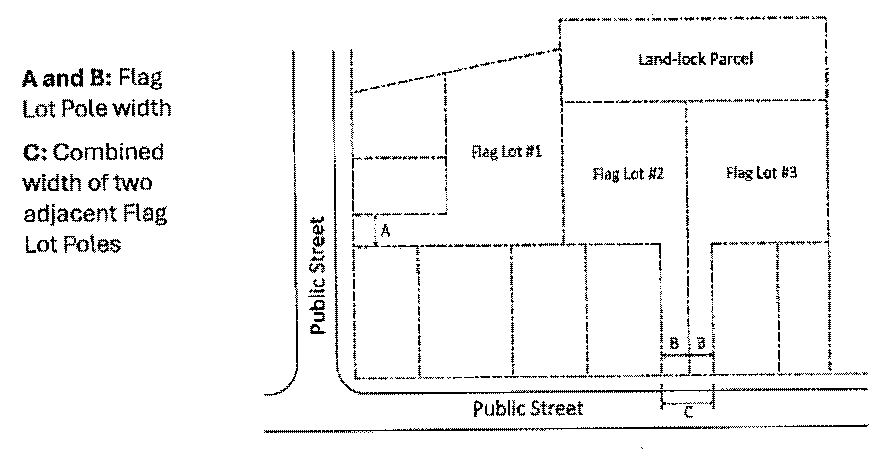
The flag lot pole shall have a minimum width of twenty (20) feet at the street frontage and be improved as approved by the board of aldermen who shall take into account the ability of emergency equipment to access the property.
B.
Flag Lot Poles. A flag lot pole shall only be used for egress from and ingress to the property it is part of, except as permitted below:
1.
Any property that requires the use of a flag lot pole, or any part of a flag lot pole, to access a public roadway shall have an access easement, which runs with the land, recorded in the county land records.
2.
Where two adjacent flag lot poles exist, the width of both flag lot poles may be used to meet the minimum width requirements above. In such cases, an access easement which runs with the land shall be recorded in the county land records.
3.
No more than four properties may utilize the same flag lot pole for access to a public roadway.
(Ord. No. 6822, § 1 (Exh. 1), 12-2-25)

