
Perryville City Zoning Code
CHAPTER 17
48 - ADMINISTRATION AND ENFORCEMENT
Sections:
17.48.010 - General provisions for zoning applications, procedures, and actions.
A.
Legislative and Quasi-Judicial Regulation of Land Use. The city shall regulate land use as provided by statute and appointment of a planning and zoning commission, in accordance with this code.
B.
Zoning Administrator. It shall be the duty of the person designated by the board of aldermen as the zoning administrator to administer and enforce the regulations contained in this title.
C.
Application of Regulations. No structure or land shall hereafter be used or occupied, and no structure or part thereof shall hereafter be erected, constructed, reconstructed, moved, or structurally altered except in conformity with these title, and without first having applied in writing to the city for a building permit to do so and a building permit having been granted therefor in accordance with Chapter 15.08.
D.
Application Forms. Applications required under this code shall be submitted to the zoning administrator. The zoning administrator is authorized to modify the application forms and submittal requirements as deemed necessary in the zoning administrator's discretion.
E.
Fees. Applications shall be accompanied by a non-refundable fee established by the board of aldermen. Any application that does not include the required fee shall be returned to the applicant as incomplete. Fees shall not be required with applications initiated by the staff, planning and zoning commission, or board of aldermen. Zoning applications are required as provided in Appendix A: Zoning Fee Schedule.
F.
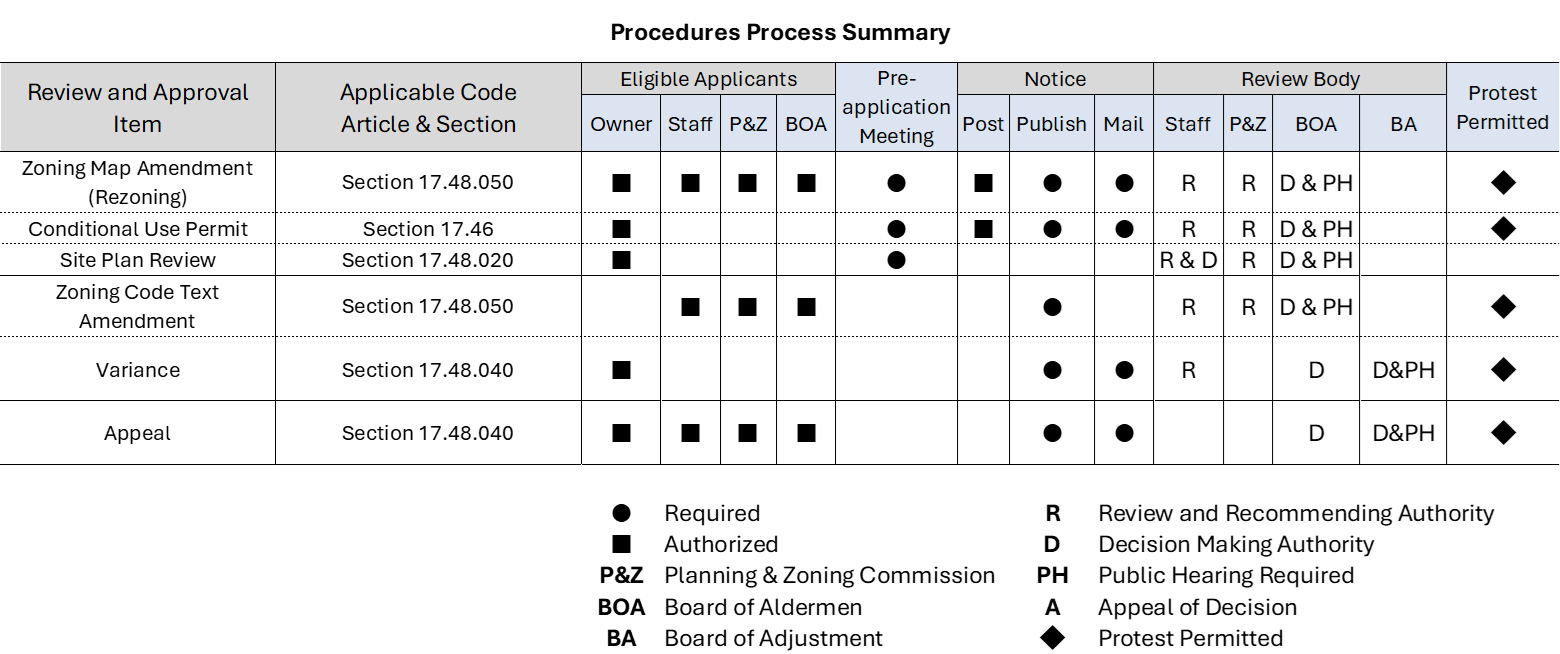
Eligible Applicants. The table in Section 17.48.010H. identifies applicants eligible for each application under this code, which includes the following:
1.
Owner. The recorded owner of property impacted by the application, or that owner's authorized agent. In the case of an application requiring a public hearing, and for the purposes of the right to appeal or protest, all those receiving mailed notice shall be considered owners impacted by the application.
2.
Planning and Zoning Commission. The planning and zoning commission, acting on its own initiative according to its bylaws and rules of procedure.
3.
Board of Aldermen. The board of aldermen acting on its own initiative according to its by laws and rules of procedure.
4.
Zoning Administrator. The zoning administrator acting on his/her own initiative according to the authorities assigned to the role of zoning administrator.
G.
Procedures Process Summary. The table below provides a summary of review and approval requirements related to zoning applications, procedures, and actions described in this chapter.
H.
Application Processing Cycle. The zoning administrator shall establish a more specific processing cycle for each type of application, which includes:
1.
Dates of regular meetings of review bodies and decision makers during which complete applications will be reviewed that comply with all legal requirements for notice and public meeting deadlines.
2.
Deadlines for receipt of a complete application for consideration at a particular meeting.
3.
The scheduling of staff reviews, agency reviews, and staff reports on complete applications; and
4.
The steps and benchmarks in the application process (including required notice requirements, public meetings, public hearings, decision meetings and review by other bodies).
I.
Pre-application Meeting. Pre-application meetings may be requested for any application and shall be required as indicated by the table provided in subsection H of this section. Where required, the applicant shall confer with the zoning enforcement officer, and other city officials designated by the zoning enforcement officer. The purpose of the pre-application meeting is to discuss the general nature of the proposal, including:
1.
Classification of the application.
2.
Procedure and submittal requirements for the application.
3.
Criteria for processing and decisions on the application.
4.
Notification requirements, timing, and other procedural pre-requisites, or whether any special community outreach may be important.
5.
Planning and infrastructure impacts, including the need for any additional technical studies or outside agency coordination and review.
6.
The relationship to the master plan, and whether any specific plans, policies or other design, development or economic development initiatives impact the application.
7.
Zoning requirements for the property in question and adjacent property.
8.
Opportunities to improve any preliminary design concepts and better relate project benefits or mitigate impacts to other public or private investments in the area.
A required pre-application meeting may be waived at the zoning enforcement officer's discretion and upon the applicant's request for any application that is routine in nature and where the above topics can be addressed by general correspondence.
J.
Staff Review. Upon receipt of an application, the zoning administrator shall take the following steps:
1.
Notification of Incomplete Application. If the zoning administrator determines that an application is incomplete within, the zoning administrator shall notify the applicant of the specific ways in which the application is deficient within fifteen (15) days of submittal, and no further processing of the application shall occur until the deficiencies are corrected. If the application is not completed within thirty (30) days of the notice, the incomplete application is deemed rejected.
2.
Scheduling. The zoning administrator shall schedule complete applications for further review according to these regulations.
a.
Applications that require a public hearing shall be scheduled for initial review within sixty (60) days of a determination of a complete application.
b.
Applications that do not require a hearing, but an official public meeting shall be scheduled for review within thirty (30) days of a determination of a complete application or the recommendation from another required review body.
c.
In the event that the next regular meeting of the review body is beyond these time periods, or the required notice cannot be given within these time periods, the application shall be scheduled for the closest available meeting.
3.
Staff Report. The zoning administrator shall prepare a staff report in light of the appropriate policies, plans and regulations. The zoning administrator shall provide a copy of the report to the review body and to the applicant before the scheduled meeting.
K.
Notice. Notice shall be provided for each application as indicated by the table in Section 17.48.010(H), which shall provide the time, place and general nature and location of the application required notice shall be based on the following requirements:
1.
Published. Where published notice is required, at least fifteen (15) days, but not more than thirty (30) days prior to the public review notice shall be published in a newspaper in general circulation in the city.
2.
Posted. Where posted notice is required, the city shall post notice on property that is the subject of the application within public view at least fifteen (15) days before the scheduled review.
3.
Mailed. Where mailed notice is required, the applicant shall provide names and addresses of all owners of record within one hundred eighty-five (185) feet, excluding existing rights-of-way, of the boundaries of the property. At the expense of the applicant, the zoning enforcement officer shall mail notice of the time, place and nature of the hearing by certified mail at least fifteen (15) days prior to the public review. When mailed notices have been properly addressed and deposited in the mail, failure of a party to receive such notice shall not invalidate any subsequent action.
L.
Public Hearings. Where a public hearing is required by the table in Section 17.48.010H., the following procedures apply:
1.
The hearing shall be conducted, and a record of the proceedings shall be preserved, as the specific review body may prescribe by rule.
2.
Any interested person or party may appear and be heard in person, by an agent, or by an attorney.
3.
The review body may request a report on the application from any government official or agency, or any other person, firm or corporation with information pertinent to the application. A copy of any requested report shall be made available to the applicant and interested parties and shall be available for review in the office of the zoning administrator.
4.
A public hearing for which proper notice was given may be continued to a later date without again complying with the notice requirements of this chapter provided that the continuance is set for a specific date, time and location announced at the original public hearing.
(Ord. No. 6822, § 1 (Exh. 1), 12-2-25)
17.48.020 - Site plan review.
A.
Purpose. The purpose of a site plan review is to ensure that the design and layout of certain developments permitted will constitute suitable development and will not result in a detriment to the neighborhood or the environment.
B.
Site Plan, When Required. A site plan for the use or development of property must be approved by the city prior to any of the following events:
1.
All proposals for the construction or enlargement of condominium units.
2.
The grading of any site for development, unless so authorized by the city, or the issuance of any building permit for the construction of any principal structure other than a single-family detached structure.
3.
A change in the principal or accessory use of a property that results in additional parking or other site requirements not reflected on any existing approved site plan as determined by the city.
4.
The redevelopment or expansion of a principal structure that enlarges the size of the original structure by more than five hundred (500) square feet.
5.
Any planned development district, unless otherwise authorized by the city.
6.
As otherwise required in the city's ordinances in Title 17, Zoning.
7.
Exceptions: A site plan shall not be required in any one of the following situations:
a.
When, in the opinion of the city, the proposed development, issuance of required permits, or change in the principal use of property will have no detrimental impact on adjoining property; or the proposed development will conform in every respect to a site plan previously approved for the same property;
b.
The applicant demonstrates that the proposed improvements on the property clearly comply with all regulations of the city without review of the plan by the planning and zoning commission, in which case the applicant may proceed with the submittal of civil construction plans and/or all other permitting documents necessary for approval by the city.
c.
The construction of a single-family residential detached dwelling, including associated garages.
d.
Construction of a commercial structure or addition not exceeding five hundred (500) square feet.
C.
Applications. All applications for site plan review shall be made and processed in the same manner as provided for zoning amendments in Section 17.48.050. An applicant for site plan review shall file a copy of an application form and a site plan with the city. The application fee for site plan review shall be one hundred dollars ($100.00).
D.
Submission Requirements. The site plan shall include and be accompanied by the following items and information:
1.
Unless this requirement is waived by the zoning administrator, the site plan shall be prepared by a registered professional engineer or architect.
2.
The site plan shall be of a scale not to be greater than one inch equals fifty (50) feet nor less than one inch equals two hundred (200) feet, and of such accuracy that the commission can readily interpret the plan, and shall include more than one drawing where required for clarity.
3.
It shall show the scale, north arrow, boundary dimensions, existing and proposed zoning district boundaries, and existing uses for the subject properties and adjacent properties adjacent to the site's perimeter.
4.
Name and address of the owner of record, developer, and seal of the engineer, architect, land surveyor or landscape architect.
5.
Name and address of all owners of record of abutting parcels.
6.
The property shall be identified by lot lines and location, including dimensions, angles, and size, correlated with the legal description of said property. All existing lot lines, easements, and rights-of-way shall be shown.
7.
Locations and dimensions of all setbacks, including distances between all buildings, between buildings and property lines and between all parking areas and property lines.
8.
The location and use of all existing and proposed structures within the development.
9.
Include all dimensions of height and floor area and show all exterior entrances and all anticipated future additions and alterations.
10.
All existing and proposed topography and finished grade elevations, parking spaces, driveway openings, driveways, service areas, facilities for sewage, refuse and other waste disposal and for surface water drainage, natural features, and landscape features, such as fences, walls, screening, earth berms, planting areas, walks and lighting, both existing and proposed. The relation of the above features to adjacent ways and properties.
11.
The site plan shall also show all contiguous land owned by the applicant or by the owner of the property which is the subject of the application.
12.
Location, dimension, and area of any parcel or property thereof proposed to be set aside for open space, park, playground use or other public/private recreational purposes.
13.
The location, height, size, materials, and design of all proposed signage.
14.
Architectural elevations. Architectural elevations of all proposed buildings and structures, identifying all materials proposed.
15.
Landscape plan. A landscape plan shall be provided.
16.
The applicant shall submit such material as may be required regarding the projected traffic flow patterns into and upon the site for both vehicles and pedestrians, and an estimate of the projected number of motor vehicle trips to and from the site for an average day.
17.
For phased developments, depict the various limits and timing of each proposed phase.
18.
Required site plan elements may be waived at the discretion of the zoning administrator.
(Ord. No. 6822, § 1 (Exh. 1), 12-2-25)
17.48.030 - Enforcement.
A.
It is the duty of the person designated by the mayor as zoning administrator to administer and enforce the regulations contained in this title.
B.
It is unlawful to commence or proceed with the erection, construction, reconstruction, conversion, alteration, enlargement, extension, raising or moving of any building or structure, or of any portion thereof, without first having applied in writing to the building official for a building permit to do so, and until a building permit has been granted therefor.
(Ord. No. 6822, § 1 (Exh. 1), 12-2-25)
17.48.040 - Zoning board of adjustment.
A.
A Board of Adjustment is Created. The word "Board" when used in this section, shall be construed to mean the board of adjustment, rather than the board of aldermen.
B.
Composition, Appointments, and Term of Office. The board shall consist of five members, who shall be residents of the city, appointed by the mayor and approved by the board of aldermen, each to be appointed for a term of five years; excepting that, when the board shall first be created, one member shall be appointed for a term of five years, one for a term of four years, one for a term of three years, one for a term of two years, and one for a term of one year. Three alternate members may be appointed to serve in the absence or disqualification of the regular members. All members and alternates shall be removable for cause by the mayor and board of aldermen upon written charges and after a public hearing. Vacancies shall be filled for the unexpired term only of any member whose term becomes vacant. The board shall elect its own chairperson and vice chairperson who shall serve for one year.
C.
Rules and Procedures. The board of adjustment shall adopt rules for the conduct of its business, and keep a public record of all findings, decisions, and minutes of its meetings. Meetings of the board shall be held at the call of the chairperson and at such other times as the board may determine, and all meetings shall be open to the public.
D.
Quorum. A majority of the members of the board of adjustment shall constitute a quorum. Upon the written approval of the mayor, up to two members of the board of adjustment may attend the meeting via video teleconference or other electronic means.
E.
Powers and Duties. The board of adjustment shall have the following powers and duties:
1.
Appeals. To hear and decide appeals, where it is alleged that there is an error in any order, requirement, decisions, or determination made by the zoning administrator in the enforcement of this chapter, and may affirm or reverse, in whole or part, the decision of the zoning administrator.
2.
Variances. To hear requests for variances from the literal provisions of the zoning ordinance in instances where strict enforcement of the zoning ordinance would cause undue hardship, due to circumstances unique to the individual property under consideration, and grant such variances only when it is demonstrated that such action will be in keeping with the spirit and intent of the provisions of the zoning ordinance. The board of adjustment shall not permit, as a variance, any use in a district that is not permitted under this title. The board of adjustment may impose conditions in the granting of a variance to ensure compliance and to protect adjacent property.
3.
Other Authority.
a.
To hear and decide all matters referred to it or upon which it is required to pass under the provisions of this title.
b.
To hold public hearings on and decide the following exceptions to or variations of this chapter:
(1)
To permit the extension of a district where the boundary line thereof divides a lot held in a single ownership at the time of the adoption of this title,
(2)
Interpret the provisions of this title in such a way as to carry out the intent and purpose of the plan, as shown upon the zoning district map, where the street layout on the ground varies from the street layout as shown on this map,
(3)
Permit reconstruction of a nonconforming building otherwise prohibited by Section 17.38.170,
(4)
Vary the yard regulations where there is an exceptional or unusual physical condition of a lot, not generally prevalent in the neighborhood, which condition, when related to the yard regulations of this chapter, would prevent a reasonable or sensible arrangement of buildings on the lot,
(5)
Vary the parking regulations, where it is conclusively shown that the specific use of a building would make unnecessary the parking spaces otherwise required by this title, or where it can be conclusively shown that adequate off-street parking to serve a particular use has been provided by or is controlled by the municipality.
F.
Appeals. An appeal may be taken to the board of adjustment by any person, group, or organization, public or private, affected by a decision of the zoning administrator.
1.
Timing. Such an appeal shall be taken within thirty (30) days of a decision by the zoning administrator by filing with the zoning administrator a notice of appeal specifying the grounds thereof.
2.
Transmittal of Application. The zoning administrator shall forthwith transmit to the board all papers constituting the record upon which the action appealed from was taken.
3.
Proceedings. An appeal stays all proceedings in furtherance of the action appealed from, unless the zoning administrator certifies to the board of adjustment, after the notice of appeal shall have been filed with him, that, by reason of facts stated in the certificate, a stay would, in his opinion, cause imminent peril to life or property. In such case, proceedings shall not be stayed otherwise than by a restraining order which may be granted by the board of adjustment or by a court of record on application or notice to the zoning administrator and on due cause shown.
4.
Criteria for Considering Appeals. In considering all appeals to the provisions of this title, the board shall, before making any finding in a specific case, first determine that:
a.
The proposed change will not constitute a change in the zoning district map.
b.
Will not impair an adequate supply of light and air to adjacent property.
c.
Will not increase congestion in public streets.
d.
Will not increase the danger of fire.
e.
Will not materially diminish or impair established property values within the surrounding area.
f.
Will not any other respect impair the public health, safety, comfort, morals, and welfare of the city.
G.
Variances. A variance may be sought by filing a written application and payment of applicable fee to the city.
1.
Applications. Applications for variances shall specify the specific provision or provisions to be varied, the extent of the variation, and the basis therefore and including such requirements as are set forth in the Perryville Zoning Regulations or as otherwise established by the city.
2.
General. The board may grant a variance only if it is in harmony with the general purpose and intent of the Perryville Zoning Regulations and in accordance with general or specific rules adopted hereto and only in cases where there are practical difficulties or particular hardship in the way of carrying out the strict letter of any regulation of the Perryville Zoning Regulations relating to the use, construction, alteration of buildings, or structures or the use of land, but in no other case. No variance may be granted to any condition or term of a conditional use permit or planned development district zoning procedure. The board may impose such conditions, safeguards and restrictions upon the premises, benefited by the variance as may be necessary to reduce or minimize any potentially injurious effect of such variance upon other property in the neighborhood, and to carry out the general purpose and intent of these regulations.
3.
Criteria for Considering Variances. A request for a variance may be granted, upon a finding and determination on the record of the hearing officer that the requirements of the Perryville Zoning Regulations are met and that all of the following conditions are satisfied and present or upon such conditions as may the hearing officer establishes as will meet such conditions:
a.
The variance requested arises from such condition which is unique to the property in question and which is not ordinarily found in the same zone or district, and is not created by an action or actions of the property owner or applicant.
b.
The granting of the permit for the variance will not adversely affect the rights of adjacent property owners represented in the application.
c.
The strict application of the provisions of the zoning regulations of which the variance is requested will constitute unnecessary hardship upon the property owner represented in the application.
d.
The variance desired will not adversely affect the public health, safety, morals, order, convenience, prosperity, or general welfare.
e.
The granting of the variance desired will not be opposed to the general spirit and intent of the zoning regulations.
H.
Procedures.
1.
Application and Fee Required. A notice of appeal or variance may be sought by filing a written application and payment of applicable of forty dollars ($40.00) to the city.
2.
Notice of Hearing and Hearing Procedure. Any meeting at which an appeal or variance is to be heard shall be a public meeting with public notice of such meeting and business to be carried or published in a newspaper of general circulation in the city at least one time, seven days prior to the meeting, as well as due notice to the parties in interest. Upon the hearing, any party may appear in person or by agent or attorney. The chairperson, or in his/her absence, the acting chairperson, may administer oaths and compel the attendance of witnesses.
3.
Decision. In exercising the powers established within this section, the board of adjustment may:
a.
Reverse or affirm an appeal wholly or partly.
b.
Grant or deny a variance wholly or partly.
c.
Modify, the order, requirement, decision, or determination appealed from and may make such order, requirement, decision, or determination as ought to be made and to that end shall have all the powers of the zoning administrator.
4.
Findings of Fact. Every appeals or variance decision by the board shall be accompanied by a written findings of fact, specifying the reason for granting or denying the variation. The decision of the board shall be acted upon and completed by the applicant within two years of the board's decision, and any decision not acted upon and completed within two years of the board's decision shall be null and void. The decision of the board shall be made a part of any building permit in which the variation is allowed. The concurring vote of four members of the board shall be necessary to reverse any order, requirement, decision, or determination of the zoning administrator, or to decide in favor of the applicant on any matter upon which it is required to pass under this chapter or to effect any variation in this title. Every rule, regulation, decision, or determination of the board shall immediately be filed with the zoning administrator and city clerk and shall be a public record.
I.
Board of Aldermen Power of Administrative Review.
1.
Immediately following the filing of the written decision of the board on any appeal or variance under the Perryville Zoning Regulations, the zoning administrator shall file a report with the board of aldermen and city administrator concerning such action. Within thirty (30) days after the board's decision, the board of aldermen, upon majority vote, may exercise the power of administrative review of any board decision on an application for an appeal or variance.
2.
Upon adoption of the motion to exercise the power of administrative review, the board of aldermen may act on the matter directly, or first refer the matter to the board for further review and advisement. Before acting on the variance or appeal, the board of aldermen may set the matter before the board for hearing to accept additional evidence. The board of aldermen will give written notice of any such additional hearing to the applicant and all other persons who appeared and spoke at the public hearing before the board. In addition, the board of aldermen may, in its discretion, notify and allow to be heard at the additional hearing any other person who the board of aldermen believes may be aggrieved by any decision or action concerning the application.
3.
Following its final review, the board of aldermen may affirm, reverse, or modify, in whole or in part, the determination of the board. An affirmative majority vote of the board of aldermen shall be required to overturn or modify a decision by the board. The decision of the board of aldermen shall be made within thirty (30) days of the initial board vote, unless extended for specified cause by a majority vote of the board of aldermen, or the board's decision shall become final. In making any decision, the board of aldermen may adopt and rely on the record of the board.
4.
Unless the board of aldermen exercises its power of administrative review, the decision of the board of adjustments shall become effective after thirty-one (31) days following its decision.
J.
Grievances. Any person or persons jointly or severally aggrieved by any decision of the board of adjustment, or any officer, department, board, or bureau of the municipality, may present to the circuit clerk of Perry County a petition, duly verified, setting forth that such decision is illegal, in whole or in part, specifying the grounds of the illegality. Such petition shall be presented to the court within thirty (30) days after the filing of the decision in the office of the board of adjustment. Upon presentation of such petition, the court may allow a writ of certiorari directed to the board of adjustment to review such decision of the board of adjustment and shall prescribe therein the time within which a return thereto must be made and served upon the relator's attorney, which shall not be less than ten days and may be extended by the court. The allowance of the writ shall not stay proceedings upon the decision appealed from, but the court may, on application, on notice to the board and on due cause shown, grant a restraining order. The board of adjustment shall not be required to return the original papers acted upon by it, but it shall be sufficient to return certified or sworn copies thereof, or of such portions thereof as may be called for by such writ. The return shall concisely set forth such other facts as may be pertinent and materials to show the grounds of the decision appealed from and shall be verified. If, upon the hearing, it shall appear to the court that testimony is necessary for the proper disposition of the matter, it may take additional evidence, or appoint a referee to take such evidence as it may direct, and report the same to the court with his findings of fact and conclusions of law, which shall constitute a part of the proceedings upon which a determination of the court shall be made. The court may reverse or affirm, wholly or partly, or may modify the decision brought up for review. Costs shall not be allowed against the board, unless it shall appear to the court that it acted with gross negligence, or in bad faith or with malice in making the decision appealed from.
K.
Employees not to Serve on Zoning Board of Adjustment. No person who is a non-elected full-time or part-time employee of the city shall be appointed to or serve on the zoning board of adjustment.
(Ord. No. 6822, § 1 (Exh. 1), 12-2-25)
17.48.050 - Amendments.
A.
General. The board of aldermen may, by ordinance on its own motion or on application, amend, supplement, change, modify, or repeal the boundaries or zoning designation of districts established in this chapter, under the procedures provided in this chapter and following referral thereof to the planning and zoning commission in accordance with this section.
B.
Powers and Duties. The board of aldermen may, by ordinance on its own motion or application, amend, supplement, change, modify, or repeal the regulations or restrictions of districts established in this chapter, following the referral thereof to the planning and zoning commission, as provided in subsection E of this section.
C.
Application and Fee Required. Applications for district changes shall be filed in writing with the city clerk who shall place the application before the board of aldermen after determining that it is in proper form as provided in this chapter. All applications, except those proposed by the board of aldermen or the city planning and zoning commission, shall be accompanied by a non-refundable fee of one hundred dollars ($100.00). A copy of the application shall remain on file with the city clerk for public inspection until final action thereon.
D.
Submission Requirements. The board of aldermen or the city planning and zoning commission may provide forms for applications and may require applicants to provide plans, plats, technical studies, and other documents or other information it may determine to be of value in acting upon the application. The board and planning commission may request the opinions and recommendations of other city boards and officers upon applications.
E.
Referral to Planning and Zoning Commission. Upon receipt of an application in proper form, the board of aldermen shall refer it to the planning and zoning commission. The planning and zoning commission shall return the application to the board of aldermen with its recommendations relating thereto, and showing the number of votes for and against its action, and may include a summary of the reasons expressed for and in opposition thereto. The board of aldermen may set a date by which the recommendation shall be returned, no less than twenty (20) days from the date of such setting, and the board of aldermen may proceed without receipt of such recommendations in the absence of receipt by such date. The board of aldermen may, by resolution, delegate the duty of such receipt and referral to the city administrator or similar official.
F.
Review and Action by Planning and Zoning Commission. Upon review an application, the planning and zoning commission shall make a recommendation to:
1.
Approve the application; or
2.
Approve the application with conditions or modifications; or
3.
Deny the application; or
4.
Continue the application to allow further analysis. The continued application shall not be more than sixty (60) days from the original review without consent of the applicant. No application shall be continued more than once by each review body without consent of the applicant.
G.
Review and Action by Board of Aldermen.
1.
Public Hearing Required. No amendment, supplement, or change of the regulations or restrictions or boundaries of districts shall become effective until after the board of aldermen has held a public hearing in relation thereto, at which parties in interest and citizens shall have an opportunity to be heard.
2.
Notice of Public Hearing. At least fifteen (15) days' notice of the time and place of such hearing shall be published in a newspaper of general circulation in the city. The board of aldermen may provide for the posting of notices of the hearing on the tract and for other means of notifying the public or interested persons of the proceedings.
3.
Determination.
a.
Recommendation to Approve. If the city planning and zoning commission recommends approval of an application in whole or in part, the board of aldermen shall set a public hearing to review and take action on an application, as provided in this chapter. The board of aldermen shall make a determination to:
(1)
Approve the application; or
(2)
Approve the application with conditions or modifications; or
(3)
Deny the application; or
(4)
Continue the application to allow further analysis. The continued application shall not be more than sixty (60) days from the original review without consent of the applicant. No application shall be continued more than once by each review body without consent of the applicant.
b.
Recommendation to Deny. If the planning and zoning commission recommends rejection of an application in full, the board of aldermen may set a public hearing, as provided in this section, upon its own motion; or the board of aldermen may, by motion, file such recommendation of rejection; and the application shall thereupon be deemed rejected, unless, within ten days from such filing, the applicant files a written request with the city clerk for a public hearing under this section or makes an oral request therefor at a regular or special meeting of the board of aldermen, whereupon the board of aldermen shall set such a public hearing.
4.
If the board of aldermen fails to approve an application in whole or in part within thirty-five (35) days after the public hearing, such application shall be deemed to have been rejected in full, unless the board of aldermen shall have expressly extended such time period prior to the expiration thereof.
H.
Successive Applications. In the event that the board of aldermen takes final action to deny an application, the same or a similar application shall not be refiled for one year from the advertised review date. The zoning administrator, upon petition by the applicant, may permit a refiling of the application no sooner than one hundred eighty (180) days after the scheduled review date when it is determined that significant physical, economic, or land use changes have taken place within the immediate vicinity, or a significant zoning ordinance text amendment has been adopted. There shall be no time limitation on a substantially different application.
I.
Protest. In case of an adverse report by the city planning and zoning commission, or if a protest against such proposed amendment, supplement, change, modification, or repeal shall be presented in writing to the city clerk, duly signed and acknowledged by the owners of thirty (30) percent or more, either of the areas of land (exclusive of streets and alleys) included within such proposed change, or within an area determined by lines drawn parallel to and one hundred eighty-five (185) feet distant from the boundaries of the district proposed to be changed, such amendment, supplement, change, modification, or repeal shall not become effective except by the favorable vote of two-thirds of all the members of the board of aldermen.
J.
In its action upon an application for change in district boundaries, the board of aldermen may grant a change to a district which is intermediate in restrictiveness between the existing district and the requested district. However, no change in district of this nature shall be granted until the parties in interest have been notified by either public notice or certified mail that such permit or change is contemplated.
(Ord. No. 6822, § 1 (Exh. 1), 12-2-25)
17.48.060 - Violations and penalty.
A.
In case any building or structure is erected, constructed, reconstructed, altered, converted, or maintained, or any building, structure, or land is used in violation of Sections 89.010 to 89.140, RSMo., or of any ordinance or other regulation made under authority conferred hereby, the proper local authorities of the municipality, in addition to other remedies, may institute any appropriate action or proceedings to prevent such unlawful erection, construction, reconstruction, alteration, conversion, maintenance, or use, to restrain, correct, or abate such violation, to prevent the occupancy of such building, structure, or land, or to prevent any illegal act, conduct, business, or use in or about such premises. Such regulations shall be enforced by an officer empowered to cause any building, structure, place, or premises to be inspected and examined and to order in writing the remedying of any condition found to exist therein or thereat in violation of any provision of the regulations made under authority of Sections 89.010 to 89.140, RSMo.
B.
The owner or agent of a building or premises in or upon which a violation of any provision of this title has been committed or shall exist; or the lessee or tenant of an entire building or entire premises in or upon which a violation has been committed or shall exist; or the agent, architect, building contractor or any other person who commits, takes part or assists in any violation, or who maintains a building or premises in or upon which such violation shall exist, shall be guilty of a misdemeanor, punishable by a fine of not less than ten dollars ($10.00) and not more than one hundred dollars ($100.00) for each and every day that such violation continues; but if the offense is willful, on conviction thereof, the punishment shall be a fine of not less than one hundred dollars ($100.00) nor more than two hundred and fifty dollars ($250.00) for each and every day that such violation shall continue, or by imprisonment for ten days for each and every day such violation shall continue, or by both such fine and imprisonment, in the discretion of the court.
C.
Any such person, having been served with an order to remove any such violation, failing to comply with the order within ten days after such notice, or continuing to violate any provision of the regulations made under authority of this title in the respect named in such order, shall be subject to a civil penalty of two hundred fifty dollars ($250.00).
D.
In addition to the above procedure, the city attorney is also authorized to institute any appropriate action or proceeding to prevent violations of the zoning code, to restrain, correct, or abate such violations, to prevent the occupancy of buildings, structures, or lands, or to prevent any illegal act, conduct, business, or use in or about such premises. An appropriate action or proceeding shall include, but shall not be limited to, injunctive relief and any other appropriate action at law or in equity, and may, among other things seek the reimbursement of reasonable attorney fees and other costs of the action.
E.
The remedies herein shall be cumulative and not exclusive.
(Ord. No. 6822, § 1 (Exh. 1), 12-2-25)

