
Pinellas Park City Zoning Code
SECTION 18
1502.- DEFINITIONS
Sec. 18-1502.1.- INTERPRETATION OF WORDS.
(A)
All words used in the present tense include the future tense.
(B)
All words in the plural number include the singular number, and all words in the singular number include the plural number.
(C)
The use of any gender shall include all genders unless the natural construction of the wording indicates otherwise.
(D)
The word "Building" includes the word "Structure."
(E)
The word "Shall" or "Must" is mandatory and not directory.
(F)
The word "May" is permissive.
(G)
The word "Day" shall mean calendar day unless otherwise indicated.
(H)
The word "Year" shall mean a calendar year, unless a fiscal year is indicated.
(I)
The terms "Land Use" and "Use of Land" shall be deemed also to include building use and use of building.
(J)
The word "Used" shall be deemed also to include "Designed, Intended, or Arranged to be used."
(K)
The word "Person" shall be deemed also to include "Individual," "Corporation," "Partnership," "Association", "company", organization, or other entity.
(L)
The word "State" means the State of Florida and its authorized agents.
(M)
The word "County" means Pinellas County, Florida, and its authorized agents.
(N)
The word "Include" or "Includes", or "Such As", when used in the context of a list or an example, is illustrative and not intended as an exhaustive listing, unless the context clearly indicates the contrary.
(O)
Delegation of authority. Any reference to a City administrative official shall be construed as authorizing said official to designate, delegate, and authorize one (1) or more subordinates to perform the given function.
(P)
Unless specifically defined below or in the specific provision in which they appear, words or phrases used in this Article shall be interpreted so as to give them the meaning they have in common usage, and to give this Article its most reasonable application, considering the intent and meaning of the City Council in promulgating the provision, and the protection of the public health, safety, and welfare.
(Ord. No. 3748, § 3, 10-28-2010)
Sec. 18-1502.2. - DEFINITIONS.
For purposes of this Article, the definitions contained in this Section shall be observed and applied as listed immediately below.
(A)
Words or terms beginning with the letters "A" through "E":
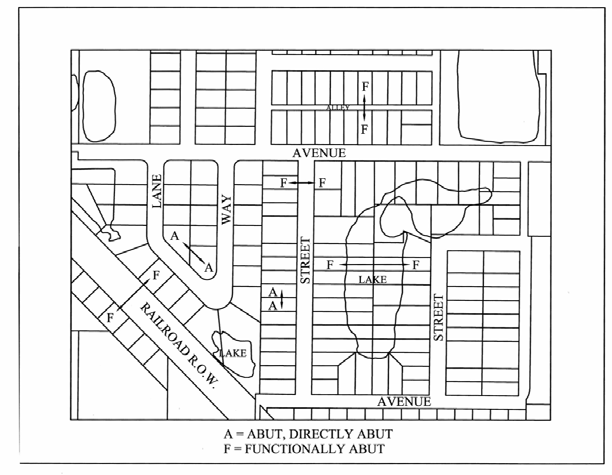
ABUT. To physically touch or border upon; or to share a common property line; includes contiguous and adjacent.
ABUT, FUNCTIONALLY. Having portions of lot lines in common or separated only by a right-of-way, street, alley, or water body and located within two hundred (200) feet of each other.
FIGURE 18-1502-1. ABUTTING AND FUNCTIONALLY ABUTTING LOTS
ACCESS. The legal, safe, and adequate physical means of ingress and egress to and from a public or private street right-of-way for motor vehicles and/or pedestrians, as the context dictates.
ACCESS DRIVE. A paved area designed and intended to transport motor vehicles from a street right-of-way or alley to and from a lot.
ACCESS AISLE. The primary means of off-street vehicle circulation used by motor vehicles to access off-street parking and loading spaces, and connecting such spaces and other vehicular use areas, with other access aisles and access drives.
ACCESSORY DWELLING UNIT. A self-contained dwelling unit with a separate entrance located on a lot of record with a single-family detached dwelling, which may be attached or detached from the single-family home.
ACCESSORY USE, BUILDING. A use, building, or part thereof, which is customarily incidental and clearly subordinate—both in function, dimensions, and area—to the principal use or building on the same lot. This shall not apply to accessory structures in the "F" Farm District or 'RE" Residential Estate District where barns are typically larger than the house.
ACCESSORY USE, BUILDING. A use, building, or part thereof, which is customarily incidental and clearly subordinate—both in function, dimensions, and area—to the principal use or building on the same lot. This shall not apply to accessory structures in the "F" Farm District or 'RE" Residential Estate District where barns are typically larger than the house.
ACRE. Forty-three thousand five hundred and sixty (43,560) square feet of land or water area.
ACRE, GROSS. One (1) acre of land including any internal right-of-way and including a proportionate share of any abutting public right-of-way.
ACRE, NET. One (1) acre of privately-owned land exclusive of any: public or private right-of-way or submerged land.
ACTIVITY CENTER. A Countywide Plan Map category under the Special Designations major classification which includes those areas of the county that are now developed or appropriate to be developed for the purpose of encouraging concentrations of employment, housing, cultural, or business development consistent with the Countywide Plan and the special area plan approved therefore. This category will be identified on the Countywide Plan Map as an overlay superimposed over the otherwise applicable category as Activity Center.
ACTIVITY CENTER, REGIONAL. A designation or overlay district providing for more intense uses of land situate to major transportation corridors that is achieved through application to the Tampa Bay Regional Planning Council consistent with the adopted Strategic Regional Policy Plan.
ADULT FAMILY CARE HOMES AND CENTERS. Types of day care providing services to adults.
1.
Type I. Family-type living arrangement, in a private home, under which a person who owns or rents the home provides room, board, and personal care, on a twenty-four (24) hour basis, for no more than five (5) disabled adults or frail elders who are not relatives. Private homes that are licensed by the Florida Agency for Health Care Administration pursuant to F.S. pt. II, ch. 429, under which such private homes are defined as Adult Family Care Homes. This term shall also be known as an Adult Family Care Home, as defined in F.S. pt. II, ch. 429, as may be amended from time to time.
2.
Type II. An establishment located on the same premises as an educational institution and/or a place of worship, whether operated for profit or not, in which is provided through ownership or management, for a part of a day, basic services to three (3) or more persons who are eighteen (18) years of age or older, who are not related to the owner or operator by blood or marriage, and who require such services. This term shall not be construed to include any center under the jurisdiction of the State Board of Education or to include any nonpublic educational institution except in regard to disabled adults. Such centers for adults shall be licensed by the Florida Agency of Health Care Administration under F.S. pt. III, Ch. 429, as may be amended from time to time, as Adult Day Care Centers.
3.
Type III. An establishment located within a public, commercial, industrial, or mixed-use zoning district, whether operated for profit or not, in which is provided through ownership or management, for a part of a day, basic services to three (3) or more persons who are eighteen (18) years of age or older, who are not related to the owner or operator by blood or marriage, and who require such services. This term shall not be construed to include any center under the jurisdiction of the State Board of Education or to include any non-public educational institution except in regard to disabled adults. Such centers for adults shall be licensed by the Florida Agency of Health Care Administration under F.S. pt. III, Ch. 429, as may be amended from time to time, as Adult Day Care Centers.
ADULT ENTERTAINMENT ESTABLISHMENTS. The following shall constitute adult entertainment establishments:
1.
LIVE ADULT ENTERTAINMENT ESTABLISHMENT. Any premises on which is offered to members of the public, or any person, entertainment distinguished or characterized by an emphasis on specified anatomical areas, or specified sexual conduct, of live human male or female performers. Such entertainment shall be designed for commercial purposes, whereby specified anatomical areas or specified sexual conduct shall be exhibited for a consideration, and such entertainment shall not include performances whose sexual aspect is presented only as an element of an expression of social or political ideas.
(a)
Specified Anatomical Areas, defined.
Less than completely and opaquely covered:
(1)
Human genitals or pubic region;
(2)
Buttock;
(3)
Female breast below a point immediately above the top of the areola.
(4)
Human male genitals in a discernibly turgid state, even if completely and opaquely covered.
(b)
Specified Sexual Conduct, defined.
(1)
Human genitals in a state of sexual stimulation or arousal.
(2)
Acts of human masturbation, sexual intercourse or sodomy, whether actual or simulated.
2.
ADULT BOOKSTORES. An establishment having a substantial or significant portion of its stock in trade, books, magazines, films, newspapers, photographs, paintings, drawings, or other publications or graphic media, which are distinguished or characterized by their emphasis on matters depicting, describing, or relating to specified anatomical areas or specified sexual conduct or an establishment with a segment or section devoted to the sale or display of such material.
3.
ADULT THEATRES. Any premises used primarily for presenting films, slides or other materials distinguished or characterized by an emphasis on matter depicting, describing or relating to specified sexual conduct, or specified anatomical areas or for observation by patrons of the theater.
AFFORDABLE HOUSING. As defined by the U.S. Department of Housing and Urban Development: In general, housing for which the occupant(s) is/are paying no more than thirty (30) percent of his or her income for gross housing costs, including utilities. The various housing assistance programs of Federal, State agencies or private sector housing finance institutions may employ variations of this general, rule of thumb definition for the administration of their housing programs. (Note: "affordable housing" is an expression of the financial ability of a person or family to pay for rental or ownership housing and generally includes debt service (interest), insurance and utility costs.)
AGRICULTURAL USE. Cultivation of ground, the harvesting of crops, and the rearing and management of farm or livestock animals, excluding swine; also including tillage, husbandry, farming, horticultural establishments, fish hatcheries, aviaries, and soil storage, but not including excavation or mining. Also includes those uses which are normally accessory to the conduct of an agricultural activity. Crop production, including plant nurseries; raising livestock (excluding swine), including horse stables and equestrian uses, dog kennels and animal boarding; veterinary clinics; and associated uses as permitted.
AIRPORT (AIRCRAFT LANDING FIELD). Any public or privately owned or operated ground facility designed to accommodate landing and take-off operations of aircraft. This term shall include heliports.
ALCOHOLIC BEVERAGES. Distilled spirits and all beverages greater than one-half (½) of one (1) percent alcohol by volume.
ALLEY. An improved or unimproved public or private right-of-way generally not exceeding twenty (20) feet in width, reserved or functioning as a secondary means of vehicular access to one (1) or more properties, usually via the rear yard, and not intended for general traffic circulation. An alley is not considered a street.
ALTERATION. Any physical change to a building or land including, but not limited to access, size, floor area, height, elevation and grade, projections, rearrangement or moving of parts. When used in reference to a site plan or permit application, the term shall mean any revision that proposes such a physical change to a building or land. When used in any other context, the term shall have its common meaning.
ANCILLARY NONRESIDENTIAL USE. Off-street parking, drainage retention areas and open space buffer areas for adjacent, contiguous, nonresidential uses.
ANIMALS, DOMESTIC. Household animals that are customarily kept for personal use or enjoyment, which are not exhibited to the public, nor raised for commercial purposes, and do not require separate living quarters (ex: a barn, paddock or other enclosure or outdoor accommodation). Domestic animals shall include domestic dogs, domestic cats, white mice, hamsters, birds, and similar animals, raised for the personal enjoyment of the household where kept.
ANIMALS, FARM OR LIVESTOCK. Animals commonly associated with farm use, or raised for commercial profit, including, but not limited to, hoofed mammals such as cattle, sheep, goats, horses, and similar animals (except swine); and fowl/birds, including but not limited to, chickens, ducks, turkey, geese or exotic birds. Large scale chicken operations intended to serve more than a local market are not permitted.
ANTENNA. The arrangement of wires or metal rods used in the sending and receiving of electromagnetic waves. For the purposes of this Article antennas shall be deemed to be structures.
ANTENNA, DISH. A spherical or parabolic antenna designed to receive or transmit signals to and from satellites, or to receive or transmit fixed wireless signals other than via satellite. A fixed wireless signal is any commercial non-broadcast communication signal transmitted via wireless technology to and/or from a fixed customer location, such as to provide fixed-location telephone service or high-speed internet.
ANTENNA HEIGHT. The overall vertical length of the antenna and support structure above grade, or if such system is located on a building, then the overall vertical length includes the height of the building upon which the structure is mounted.
ANTENNA, MICROWAVE. An antenna capable of receiving and or transmitting microwave signals. Does not apply to satellite dishes. (For purposes of this Article, microwave antennas shall be deemed to be a structure).
ANTENNA SUPPORT STRUCTURE. Any structure, mast, pole, tripod, or tower utilized for the purpose of supporting an antenna or antennas for the purpose of transmission or reception of electromagnetic waves including but not limited to federally licensed amateur radio or citizens band radio operators.
ANTENNA, WIRELESS COMMUNICATION. An antenna designed for cellular and personal communication services.
ARCHITECT. A person who is lawfully registered and licensed to practice architecture within and by the State of Florida.
ARCHITECT, LANDSCAPE. A person who is lawfully registered and licensed to practice landscape architecture within and by the State of Florida.
AREA. (See Acre, Gross or Acre, Net)
ART GALLERY. An establishment specializing in and which its primary purpose is the display of art works for public viewing or sale. Accessory and incidental to the principal use of display or sale may be art studios, classrooms for art instruction or education, art restoration or storage, sale of art books, films, and supplies or other activities commonly associated with art galleries.
ART STUDIO. A room or rooms within a structure dedicated to the production of creative arts for exhibition or sale to the general public. Art studios may include art gallery, art restoration, or retail sale of artist supplies and paraphernalia. Art studios may be permitted in combination with live/work units.
AT-GRADE FACILITY. A Communications Facility (as defined in Section 14-203(10), Code of Ordinances) the structure of which is affixed to the ground at-grade with a portion of the structure extending vertically above grade. At-Grade Facilities may also, but not necessarily, extend vertically below grade. Utility Poles and ground-mounted equipment installed as part of a Small Cell Wireless Facility shall not be considered At-Grade Facilities.
AUTOMOBILE. Any self-propelled vehicle specifically designed for passenger transportation primarily used as a conveyance on a street or roadway, and having a gross vehicle weight of no more than eight thousand (8,000) pounds, as well as "Trucks, Light" as defined in this Section. For the purposes of administering this Land Development Code, motorcycles shall also be considered automobiles.
AUTOMOBILE DEALER—NEW CARS. The use of land and/or buildings primarily for the display and retail sale and/or long-term leasing of new automobiles. Long-term leasing shall mean the leasing of new vehicles for time periods of at least one (1) year. Includes minor and major automotive repair facilities for automobiles as an accessory use.
AUTOMOBILE DEALER—USED CARS. The use of land and/or buildings primarily for the display and retail sale of used and pre-owned automobiles. This term includes automotive repair facility (minor) as an accessory use.
AUTOMOBILE RENTAL. The use of land and/or buildings for the rental and/or short-term leasing and customer pickup and return of automobiles, light trucks, and utility trailers. Short-term leasing shall mean the leasing of vehicles for time periods less than one (1) year. This term includes automotive repair facility (minor) as an accessory use but does not include Automobile Dealer, new or used cars.
AUTOMOTIVE REPAIR (MAJOR). Repair of automotive vehicles or parts thereof, or body work, frame work, rebuilding, or reconditioning, including the removal of the head, crankcase or entire engine, painting, steam cleaning, transmission rebuilding and repair, welding, or other characteristics to an extent greater than "Automotive Repair" (Minor).
AUTOMOTIVE REPAIR (MINOR). The retail dispensing and installation of gasoline, oil, grease, coolants, and automotive accessory items such as, but not limited to, fan belts, batteries and tires, and automotive repair services such as, but not limited to, the following, where some disassembly is permitted provided there is not manufacturing, remanufacturing, or machine work performed:
(A)
Installation of automobile accessories;
(B)
Tire servicing and repair, but no recapping and regrooving;
(C)
Replacement of mufflers and tail pipes, batteries, water hoses, fan belts, brake fluid, light bulbs, fuses, floor mats, seat covers, windshield wipers and blades, grease retainers, wheel bearing, mirrors, and the like;
(D)
Changing or flushing of oil, transmission, brake or cooling fluids;
(E)
Radiator cleaning, and flushing;
(F)
Washing, polishing, and sale of washing and polishing materials;
(G)
Greasing and lubrication;
(H)
Providing and repairing fuel pumps, water pumps, and lines;
(I)
Servicing, repair, and re-building of carburetors;
(J)
Adjusting and repairing brakes (including the turning of brake drums and rotors);
(K)
Motor adjustments not involving removal of the head or crankcase or racing the motor;
(L)
Warranty maintenance and safety inspections; and/or
(M)
Repair and installation of automotive upholstery.
Uses permitted as "Automotive Repair" (Minor) do not include major mechanical and body work, straightening of body parts, painting, welding, or other work involving glare, fumes, smoke, or odors.
BALCONY. An elevated platform that projects from the wall of a building and has a railing or similar protective feature along the projecting portion of its perimeter.
BARRIER. A functionally opaque, continuous screen consisting of plant materials, and/or fences or walls.
BARS. See "TAVERNS AND LOUNGES."
BAY WINDOW. A window projecting outwards from a wall of a building and maintaining a minimum of one and one-half (1½) feet between the bottom of the projection and the finished floor elevation.
BED AND BREAKFAST. A house, or portion thereof, which may provide short-term lodging and meals to transient guests. It is not intended that these be apartment units, rooming or boardinghouses, or other mid-to long-term rental units. Short-term lodging shall mean lodging for fewer than thirty (30) consecutive days in accordance with state law. These facilities shall be licensed as required by the State of Florida.
BELOW-GRADE FACILITY. A Below-Grade Facility means a Communications Facility, including manholes or access points that are entirely contained below-grade within the Public Rights-of-way. A Below-Grade Facility is a type of Wireline Facility.
BERM. A linear or curvilinear mound of soil used for screening or stormwater retention purposes, which is planted with trees, shrubs, and/or ground cover to prevent erosion and/or enhance the effectiveness of the screening.
BLIGHTED STRUCTURE: A structure exhibiting objectively determinable signs of deterioration sufficient to constitute a threat to human health, safety, and public welfare.
BOARD OF ADJUSTMENT. An official board of the City of Pinellas Park, the functions and duties of which are described in Section 18-1537.
BOTTLE CLUB. A commercial establishment operated for a profit wherein patrons consume alcoholic beverages which are brought onto the premises and not sold or supplied to the patrons by the establishment. Licensee may not hold any other alcoholic beverage license for the premises while licensed as a bottle club. Purchases of alcoholic beverages for resale are not permitted.
BREWERY. An establishment which produces more than fifteen thousand (15,000) barrels (four hundred sixty-five thousand (465,000) US gallons/seventeen thousand six hundred two and sixteen hundredths (17,602.16) hectoliters) of beer per year. A regional (small) brewery typically has an annual beer production of between fifteen thousand (15,000) and six million (6,000,000) barrels. A large brewery typically has an annual beer production of more than six million (6,000,000) barrels. A brewery may include a taproom as an accessory use, and may host food trucks.
BREWPUB. An establishment that is primarily a restaurant, but which includes the brewing of beer as an accessory use. A brewpub produces only enough beer for consumption on the premises or for retail carryout sale in containers commonly referred to as growlers.
BROWNFIELD: Abandoned, idled, and underused industrial and commercial facilities where expansion and redevelopment is burdened by real or potential environmental contamination.
BUFFER STRIP. A strip of land that is established and reserved for landscaping, which is intended to buffer and screen one area from another.
BUILDABLE AREA. The portion of a lot upon which structures may be placed in accordance with the regulations of this Article, and specifically excluding required yards notwithstanding allowable encroachments, any conservation or preservation areas, submerged lands, easements or rights-of-way, and land required to meet pervious area or open space requirements.
BUILDING. Any structure having a roof supported by columns or walls and intended for the shelter, housing, or enclosure of any individual, animal, process, equipment, goods, or materials of any kind or nature.
BUILDING CODE. The Florida Building Code, inclusive of any Pinellas County Amendments, as may be amended from time to time. Generally, a set of building construction requirements developed and administered by national and local bodies to ensure that buildings meet certain minimum standards for structural integrity, safety, design, and durability.
BUILDING, COMPLETELY ENCLOSED. A structure with a roof and having the entire area under the roof totally enclosed by opaque walls with wall openings customary to commercial/industrial buildings. It shall be the intent of this term to provide indoor locations for certain uses which may be noisy, odiferous, noxious, aesthetically displeasing, or which may have similarly undesirable effects on nearby properties. By requiring such indoor locations, these undesirable effects can be reduced, mitigated, and buffered to such a degree so as to provide neighboring properties with reasonable protection from such potentially undesirable effects.
BUILDING MATERIAL AND HOME IMPROVEMENT ESTABLISHMENT. A supplier of various household goods, appliances, tools, hardware, landscape materials and supplies, and materials used in the construction and maintenance of buildings. This land use is differentiated from the use "Hardware Store" in that Hardware Stores are smaller and do not have a significant stock of building materials, appliances, and landscape materials.
BUILDING OR STRUCTURE HEIGHT. (See height, building or structure.)
BUILDING OFFICIAL. The Director of the Building Development Division or designee.
BUILDING PERMIT. An official permit issued by the Building Official, pursuant to the Florida Building Code, for the construction, repair, alteration, or addition of a structure, any portion thereof, and/or site improvements. This term shall include engineering permits pertaining to on-site improvements such as, but not limited to, clearing, paving, grading, and drainage activity that are outside the scope of the Florida Building Code.
BULK STORAGE. The storage of materials or substances in large quantities, for resale to distributors, wholesalers or retailers on a regional scale, including but not limited to, chemicals, petroleum products, grains, or other materials.
BUS SHELTER. A small, roofed structure, usually having three (3) walls, located near a street and designed primarily for the protection and convenience of bus passengers.
BUS TERMINAL. Any area or building where a principal use bus stops to load and unload passengers, cargo, or luggage on a regular basis, together with accessory uses such as, but not limited to, the sale of tickets, newsstand, and retail sale of food.
BUSINESS SERVICES. Provision of professional support services to other businesses (i.e., printing, reproduction, computer assistance, office machine repair, and similar operations).
CARPORT. A roofed accessory structure, open on one (1) or more sides, intended or used for the parking and storage of automobiles or other vehicles.
CENTERLINE. The line midway between rights-of-way lines, or the line surveyed, designated, and platted as the centerline of a right-of-way.
CERTIFICATE OF APPROVAL. An administrative authorization that a petition has fulfilled the requirements of the Land Development Code relative to appropriate project approval(s).
CERTIFICATE OF OCCUPANCY. A form signed by the Building Official certifying that the building or structure and related on-site improvements, if applicable, and the use of said building or structure complies with all applicable requirements of this Article, the Building Code, and all other applicable laws and regulations enforced by the City.
CHILD CARE. The care, protection, and supervision of a child under thirteen (13) years of age, away from his or her home for a period of up to twenty-four (24) hours a day with prolonged child care certification on a regular basis, with or without compensation. Child care supplements parental care, health supervision, and safety, and may include enrichment and/or education for the child, in accordance with his or her needs. For the purpose of licensure, child care does not include occasional or sporadic care. Child care as it pertains to children's centers and family child care homes does not include statutorily exempt programs.
CHILD CARE HOMES AND CENTERS. Types of day care providing services to children.
1.
Type I. An occupied dwelling unit in which the resident caregiver is responsible for children away from their own homes, who are not related to such caregiver(s) by blood, marriage, or adoption, for the purpose of providing family care for such children. Such dwellings shall be as licensed by the Pinellas County License Board for Children's Centers and Family Day Care Homes, which shall determine the maximum capacity of children, ages of children, and length of time of care. This type shall also be known as a Family Child Care Home or a Large Family Child Care Home, as defined in F.S ch. 402, as may be amended from time to time.
2.
Type II. An establishment located on the same premises as an educational institution and/or a place of worship that is deemed to be child care per F.S ch. 402, as may be amended from time to time, shall be licensed by the Pinellas County License Board for Children's Centers and Family Day Care Homes, which shall determine the maximum capacity of children, ages of children, and length of time of care. This type shall also be known as a Child Care Facility, as defined in F.S ch. 402, as may be amended from time to time.
3.
Type III. An establishment located within a public, commercial, industrial, or mixed use zoning district that is deemed to be Child Care per F.S Ch. 402, as amended from time to time, shall be licensed by the Pinellas County License Board for Children's Centers and Family Day Care Homes, which shall determine the maximum capacity of children, ages of children, and length of time of care. This type shall also be known as a Child Care Facility, as defined in F.S ch.402, as may be amended from time to time.
CITY. The City of Pinellas Park.
CITY ATTORNEY. The City Attorney of the City of Pinellas Park or designee.
CITY COUNCIL. The body of elected officials of the City of Pinellas Park as established by the City Charter.
CITY ENGINEER. The City Engineer of the City of Pinellas Park or designee.
CITY MANAGER. The Chief Administrative Officer of the City of Pinellas Park or designee.
CLINIC, MEDICAL. A facility wherein professional services concerning personal health of humans are administered by medical doctors, chiropractors, osteopaths, optometrists, dentists, physician assistants, nurse practitioners or other such medical professional which may lawfully practice in the state, provided that persons treated are not lodged therein overnight.
CLINIC, VETERINARY. A facility rendering medical and surgical treatment to domestic animals primarily on an outpatient basis but having overnight accommodations in an enclosed building for no more than ten (10) convalescing animals.
CLUBS AND LODGES. Buildings and other facilities owned or operated for a social, educational, or recreational purpose, including auxiliaries, but not primarily for profit or to render a service which is customarily conducted as a business.
CLUSTERING. A development pattern in which individual lots, uses, or buildings are grouped together rather than spread evenly throughout a development project area, and where the remaining portion of the development project area is maintained as common open space, thus converting a project's gross density into one (1) or more localized areas of potentially much higher net density. Clustering is intended to result in one (1) or more areas of contiguous common open space that is larger and more than identifiable than would result from traditional suburban development. This is typically achieved by reducing lot sizes and removing a portion of what would have been private open space (yards) from within individual lots and centralizing it, or by subdividing the entire development project area into individual lots but restricting the location of buildings, improvements and uses within individual lots, and reserving the remainder of the lots for common usage or preservation by easement or restrictive covenant.
COLLEGES, UNIVERSITIES, SEMINARIES, AND OTHER INSTITUTIONS OF HIGHER EDUCATION. An educational institution offering advanced instruction in any academic field beyond the secondary level. Does not include trade schools or business colleges.
COMMERCIAL USE. An activity carried out for monetary gain.
COMMERCIAL RECREATION USE. A private or quasi-public recreation facility designed for participant or spectator sports for a charge, including, but not limited to, marina, miniature golf, bowling alleys, movie theaters, dog race track, horse race track, jai-alai fronton, stock car race track, or sports stadium.
COMMUNICATION TOWER. A tower structure, whether placed on foundations, on another structure, or otherwise which is designed for use for radio, television, microwave, cellular, personal communication services, radar or any other similar communication purpose, and shall include any accessory equipment or building therefor. Communication Tower includes ground-mounted communication towers, either monopole (free-standing), guyed (anchored with guy wires) or lattice (self-supporting towers with three (3) or more sides of open-framed supports), and includes, but is not limited to, utility poles as the term is defined in Section 14-203(24), Code of Ordinances. Communication Tower shall not include amateur radio towers or antennas if licensed by the Federal Communications Commission. Communication tower shall not include satellite antennas or antennas as allowed by Section 18-1530.7, "Dish-Type Antennas."
COMMUNITY ASSOCIATION. A property owners' association organized to own, operate, maintain, and/or repair common facilities or areas.
COMMUNITY FACILITY. A building or structure owned and/or operated by a governmental agency to provide a governmental service to the public.
COMMUNITY REDEVELOPMENT AGENCY. An official board of the City of Pinellas Park, having the powers and responsibilities as enumerated and described in F.S. pt. III, ch. 163.
COMMUNITY RESIDENTIAL HOME. See, "State of Florida Licensed Facilities" defined herein.
COMPREHENSIVE PLAN. The City of Pinellas Park Comprehensive Plan adopted by the City Council, pursuant to Chapter 163, Part II F.S. The plan establishes the goals, objectives, and policies for the future growth and development of the City.
CONCEPT PLAN. See, "Site Plan, Preliminary."
CONDITIONAL USE. A use which because of its characteristics is not appropriate generally or without restriction throughout a particular zoning district, but would be if controlled as to number, area, location, relation to the neighborhood, or other characteristics. See Section 18-1531, "Conditional Uses."
CONDOMINIUM. A form of ownership in which the separate owners of the individual units jointly own the development's common areas and facilities.
CONSTRUCTION. The placing of substantial construction materials in permanent position, fastened in a permanent manner; except that, where demolition, excavation, or removal of an existing structure has been substantially begun preparatory to new construction, such excavation, demolition, or removal shall be deemed to be construction, provided that work shall be continually carried on until the completion of the new construction involved.
CONVENIENCE STORE. A building used primarily for the retail sale of packaged and pre-prepared foods, beverages, beer, wine, tobacco products, household products, and sundry items. As distinguished from a supermarket and larger retailers, the convenience store carries limited lines and quantities of food and sundries intended to meet minimal and most basic daily and stop-gap needs of nearby or passing consumers, and generally does not carry fresh meats, vegetables, and other perishable items. In many, the sale of self-service gasoline is included. The sale of alcoholic beverages for off-premises consumption is permissible provided that the sale of alcoholic beverages occupies less than twenty-five (25) percent of the floor area of the use. Should the sale of alcoholic beverages occupy twenty-five (25) percent of the floor area of the use or greater, then the use shall be considered a package store.
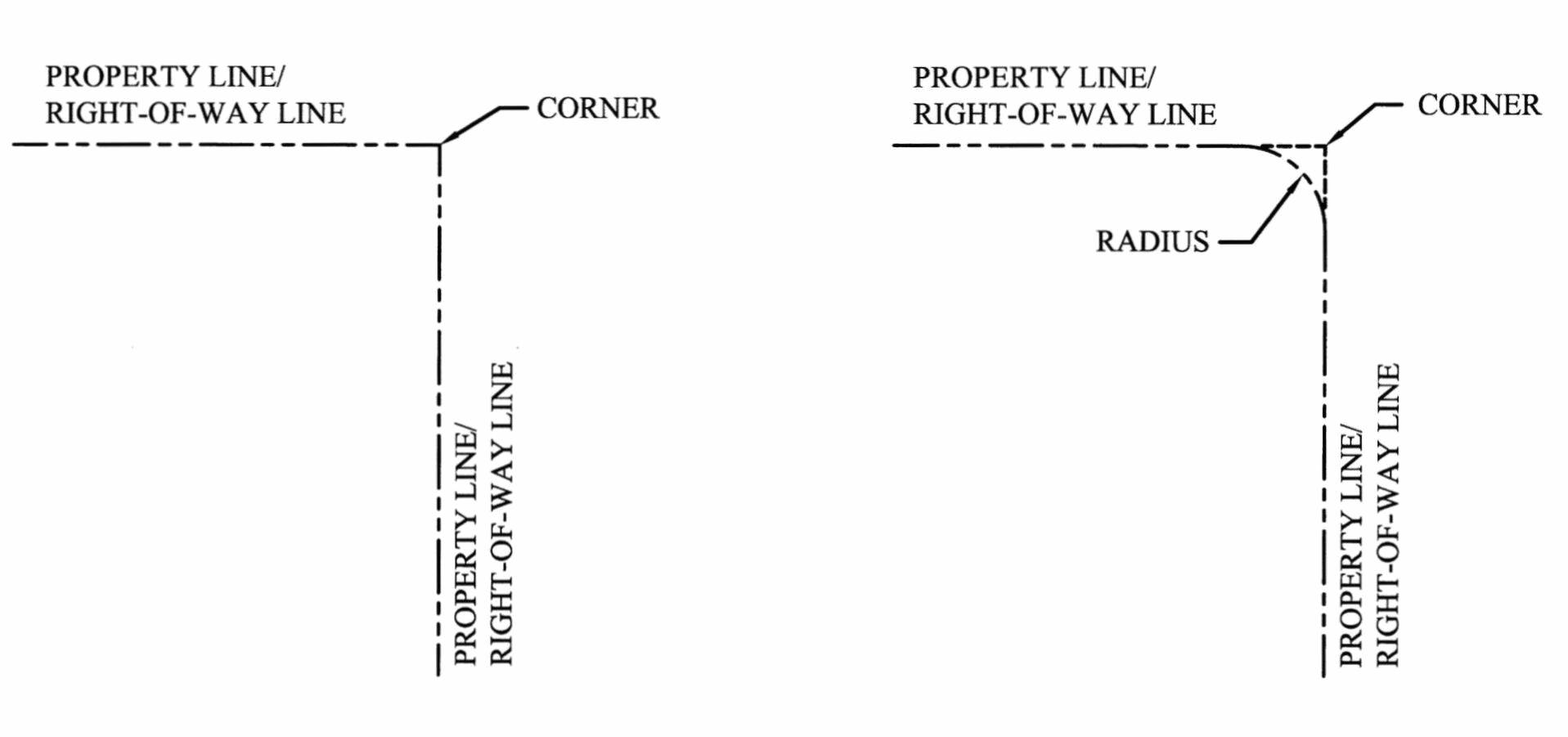
CORNER. The intersection of two (2) property/right-of-way lines. Where a radius exists, the point of intersection of the extended property/right-of-way lines shall be used. The following graphics illustrate this definition:
FIGURE 18-1502-2 CORNER LOTS
DANCE HALLS. See "TAVERNS AND LOUNGES."
DAY CARE CENTER. Includes Child Care Centers and Adult Day Care Centers as defined above.
DECK. An unenclosed platform or slab with or without a roof.
DENSITY. A measure, within a given area, of the number of dwelling units per gross or net acre. For the purposes of determining development rights on a parcel of land, density shall be expressed per net acre.
DEVELOPMENT or DEVELOP. The carrying out of any building activity, the making of any material change in the use or appearance of any structure or land, or the dividing of land into two (2) or more lots.
1.
The following activities or uses shall be taken for the purposes of this Article to involve "development" as defined in this Section:
(a)
A reconstruction, alteration of the size, or material change in the external appearance of a structure or land.
(b)
A change in the intensity of use of land, such as an increase or decrease in the number of dwelling units in a structure or on land or a material change in the number of businesses, manufacturing establishments, offices, or dwelling units in a structure or on land.
(c)
Alteration of a shore or bank of a seacoast, river, stream, lake, pond, or canal, including any "coastal construction" as defined in F.S. § 161.021.
(d)
Deposit of refuse, solid or liquid waste, or fill on a lot.
2.
The following operations or uses shall not be taken for the purpose of this Article to involve "Development" as defined in this Section:
(a)
Work by a highway or road agency or railroad company for the maintenance or improvement of a road or railroad track, if the work is carried out on land within the boundaries of the right-of-way.
(b)
Work by any utility and other persons engaged in the distribution or transmission of gas or water, for the purpose of inspecting, repairing, renewing, or constructing on established rights-of-way any sewers, mains, pipes, cables, utility tunnels, power lines, communication lines, towers, poles, tracks, or the like.
(c)
Work for the maintenance, renewal, improvement, or alteration of any structure, if the work affects only the interior or the color of the structure of the decoration of the exterior of the structure.
(d)
The use of any structure or land devoted to dwelling uses for any purpose customarily incidental to enjoyment of the dwelling.
(e)
The use of any land for the purpose of growing plants, crops, trees, and other agricultural or forestry products; raising livestock; or for other agricultural purposes.
(f)
A change in use of land or structure from a use within a class specified in an ordinance or rule to another use in the same class.
(g)
A change in the ownership or form of ownership of any land or building.
(h)
The creation or termination of rights of access, riparian rights, easements, covenants concerning development of land, or other rights in land.
3.
"Development" as designated herein includes all other development customarily associated with it unless otherwise specified. When appropriate to the context, "Development", refers to the act of developing or to the result of development. Reference to any specific operation is not intended to mean that the operation or activity, when part of other operations or activities is not development. Reference to particular operations is not intended to limit the generality of Subsection (A) above.
DEVELOPMENT ORDER. Any order granting, denying, or granting with conditions an application for a development permit.
DEVELOPMENT PERMIT. Includes any building permit, site plan approval, conditional use, issuance of new or changed occupational licenses, or any other official action of local government having the effect of permitting the development of land. Tree removal permits and clearing and grubbing permits are not to be considered development permits.
DISABLED ADULT. Any person between eighteen (18) and fifty-nine (59) years of age, inclusive, who is a resident of the state and who has one (1) or more permanent physical or mental limitations that restrict the person's ability to perform the normal activities of daily living.
DISTRICT. See "Zoning District."
DOCK. Any structure constructed on piling over open water or supported by flotation on the water used for fishing, boat dockage, sitting or similar noncommercial activities for the exclusive use of the resident of the contiguous upland property.
DORMITORY. A building used as group living quarters for a student body or religious order as an accessory use for a college, university, boarding school, orphanage, convent, monastery, or other similar institutional use. Fraternity and sorority houses shall be included within this term.
DRIVE-IN/DRIVE-THRU BUSINESS: ALL TYPES NOT OTHERWISE LISTED. An establishment which by design, physical facilities, service, or by parking procedures, encourages and permits customers to receive services or obtain goods while remaining in their motor vehicles. This term shall not include financial institutions, drive-thru; restaurants, drive-in/drive-thru; and, theatre, drive-in.
DRIVEWAY. A paved surface which provides vehicular access between a street right-of-way or alley and off-street vehicular use areas.
DUMPSTERS. Dumpsters shall mean containers for the central storage of garbage, trash or refuse, usually of two (2) to eight (8) cubic yards, but shall include open-top roll-off boxes and compactor roll-off boxes. For purposes of this Article, this term shall include the container(s) itself, the pad it rests upon, and its enclosure or screening.
DWELLING. A building or portion thereof containing one (1) or more dwelling units. The term does not include commercial, lodging, fraternal or institutional uses such as hotels, motels, rooming and boarding houses, dormitories, fraternity and sorority houses, and nursing homes, nor does it include recreational vehicles.
DWELLING, DUPLEX. A dwelling, which is entirely surrounded by open space or yards on the same lot or abutting lots, containing only two (2) dwelling units, each of which is totally separated from the other, by a common solid wall or a solid common ceiling/floor.
DWELLING, EFFICIENCY. A dwelling unit consisting of not more than one (1) habitable room together with kitchen or kitchenette and sanitary facilities.
DWELLING, MANUFACTURED HOME. A structure fabricated on or after June 15, 1976, in an off-site manufacturing facility with each section bearing a seal certifying that it is built in compliance with the federal Manufactured Home Construction and Safety Standards Act. When permanently attached to a permanent foundation in compliance with the building Code, a manufactured home shall be considered a conventional dwelling.
DWELLING, MOBILE HOME. A structure fabricated prior to June 15, 1976, in an off-site manufacturing facility, transportable in one (1) or more sections, which structure is eight (8) body feet or more in width and which is built on an integral chassis and designed to be used as a dwelling when connected to the required utilities, and includes the plumbing, heating, air conditioning, and electrical systems contained therein. (F.S. § 320.01, as amended)
DWELLING, MODULAR HOME. A structure built from one (1) or more sections that are assembled off-site, delivered to the development site, and are subject to state building code requirements. For purposes of this article, modular homes or industrialized buildings are considered to be the same as site-built structures.
DWELLING, MULTI-FAMILY. A dwelling containing three (3) or more separate dwelling units upon one (1) lot.
DWELLING, SINGLE-FAMILY ATTACHED. A one-family dwelling attached by common vertical walls to another such dwelling in a group of at least three (3) where the dwelling units in such group are also located on abutting individual lots, such as townhouses.
DWELLING, SINGLE-FAMILY DETACHED. A principal building comprised of a single dwelling unit situated on its own lot and surrounded by open space or yards such that it is not attached to any other dwelling by any means. This term shall include manufactured home dwellings.
DWELLING UNIT. One (1) or more rooms used as independent living quarters for one (1) family only, containing sleeping, kitchen or kitchen facilities, and bathroom facilities, and functionally separated from any other dwelling units which may be in the same building or premises.
DWELLING UNIT, SECURITY GUARD OR CARETAKER. A dwelling unit provided on site for the owner, a security guard or caretaker to provide security when the business is closed. For the purpose of development, the gross square footage of the dwelling shall be counted in calculating floor area ratio and maximum lot coverage.
EASEMENT. A right given by the owner of land or property to another party for specific, limited use or restriction of that land or property, the title to which shall remain in the name of the property owner, subject to the right of use designated in the instrument by which the easement is conveyed.
EDUCATIONAL INSTITUTIONS. (ELEMENTARY, MIDDLE, AND SENIOR). A private or other nonprofit institution conducting regular academic instruction at kindergarten, elementary, middle, and/or secondary levels, operated by a nongovernmental organization.
EMPLOYMENT OFFICES, TEMPORARY LABOR. A business office or operation at which prospective employees gather for the purpose of seeking day labor or other short term temporary construction or industrial labor positions, or similar positions of employment, including daily work/daily pay positions.
EQUESTRIAN USE. Any commercial use involving horses, including the boarding, grooming, or training of horses not owned by the residents of the parcel, or the provision of riding lessons or other services involving the use of horses for compensation. The keeping of one (1) or more horses for use by the parcel's residents is not considered an equestrian use except for purposes of Section 18-1530.23(A)1.(e) of this Article.
EXTENDED STAY HOTEL. (Also, all-suite hotel/aparthotel) A temporary lodging facility offering longer lengths of stay than temporary lodging facilities but generally less than one (1) year. Requires the same components as temporary lodging facilities such as lobby, central check-in desk etc.
(B)
Words or terms beginning with the letters "F" through "K":
FABRICATION AND ASSEMBLY. The construction, typically from standardized parts, of a distinct object differing from the individual components.
FAMILY. One (1) or more persons occupying a single dwelling unit as a single housekeeping unit, provided that unless all members are related by law, blood, adoption, legal guardianship, or marriage, or are disabled as defined by federal law, no such family shall contain over four (4) persons, exclusive of domestic servants employed on the premises.
FAMILY CHILD CARE HOME. An occupied residence in which child care is regularly provided for children from at least two (2) unrelated households with or without compensation. A family child care home may provide care for children under thirteen (13) years of age when on the premises of the family child care home or on a field trip. The maximum number of children in a family child care home shall be as follows:
a)
A maximum of six (6) children, if no more than three (3) are under eighteen (18) months of age.
b)
A maximum of six (6) preschool aged children, if no more than three (3) are under eighteen (18) months of age, and all are older than twelve (12) months of age.
c)
A maximum of ten (10) children total (at least two (2) of the ten (10) children need to be Household Children.) Of the ten (10) total children, no more than five (5) are pre-school age, and of those five (5), no more than three (3) are under eighteen (18) months of age, and of those three (3), no more than two (2) are under twelve (12) months of age.
FENCE. A barrier constructed of component wood, metal, mesh, or plastic parts, which can, if necessary, be disassembled and moved. Fences utilizing masonry columns with the aforementioned components footings shall be considered "structural fences", which shall not be considered capable of disassembly.
FENCE OR WALL, SOLID. An opaque fence or wall constructed of masonry, wood, plastic vinyl, or similar material, but excluding chain link fences of any type, whether or not slatted.
FINANCIAL INSTITUTION. An establishment such as, but not limited to, banks and trust companies, savings and loan institutions, credit unions, investment companies, currency exchanges, brokers, and dealers of securities and commodities, or security and commodity exchanges. This term shall not include "Financial Institution, Drive-Thru."
FINANCIAL INSTITUTION, DRIVE-THRU. A "Financial Institution", as defined hereinabove, which provides drive-thru facilities of one (1) or more lanes that permit customers to receive services while remaining in their motor vehicles.
FITNESS CLASSES. A facility offering class-based fitness programs with a limited number of participants that are instructor-led. These facilities are not considered "Schools of Non-Academic Curriculum."
FLOOR AREA, GROSS. The sum of the gross horizontal areas of the several floors of a building, measured from the exterior faces of exterior walls, or from the centerline of a wall separating two (2) buildings, but not including interior parking spaces or loading spaces for automobiles.
FLOOR AREA, LIVEABLE OR NET. The sum of the net usable areas of the interior floors of a building measured from the interior faces of the exterior walls, excluding elevator shafts, stairwells at each floor, mechanical equipment space, attic space having headroom under seven (7) feet ten (10) inches, roofed or enclosed porches, open roof areas, parking areas, garages, enclosed loading areas, carports, open or screened porches, breezeways, and storage areas not directly accessible from within the subject building(s).
FLOOR AREA RATIO. A measurement of the intensity of building development on a site. A floor area ratio (FAR) is the relationship between the gross floor area on a site and the net land area. The FAR is calculated by adding the gross floor areas of all buildings on the site and dividing by the net land area. For the purposes of these regulations, the gross floor area of parking garages shall not be included in the calculation when it is accessory to a principal use on the same lot or parcel as the principal use.
FRAIL ELDER. A functionally impaired elderly person who is sixty (60) years of age or older and who has physical or mental limitations that restrict the person's ability to perform the normal activities of daily living and that impede the person's capacity to live independently.
GARAGE, PRIVATE. An accessory building or portion of a principal building used for the accessory parking and storage of automobiles by the occupants of the principal building.
GARAGE, PARKING. An accessory building or portion of a principal building of two (2) or more levels, used for the parking and storage of automobiles.
GARAGE, PUBLIC PARKING. A building of two (2) or more stories in height that has a primary use of providing parking for automobiles, excluding dead storage, to the general public.
GRADE. Unless otherwise specified, all use of the term "Grade" shall mean "Finished Grade."
GRADE, EXISTING OR ORIGINAL. The elevation of the ground surface prior to excavation, filling or grading.
GRADE, FINISHED. The final elevation of the ground surface after the completion of earthwork, including excavation, filling and grading. Relative to existing or proposed improvements upon the ground surface, the term refers to the finished grade upon which the improvement is, or will be, located, unless otherwise specified.
GROSS LAND AREA. Gross land area for the purpose of computing density/intensity shall be that total land area within the property boundaries of the subject parcel, and specifically exclusive of any submerged land or public road right-of-way.
GROSS LEASABLE AREA (GLA). The total gross floor area within buildings which is occupied exclusively by individual tenants and upon which the tenants pay rent.
GUEST HOUSE. An accessory building to a detached single-family dwelling that (a) occupies not more than one-twentieth (1/20) of the area of the lot on which it is situated; and, (b) is used exclusively for housing members of the family occupying the principal dwelling or their nonpaying guests; and, (c) complies with the property development regulations for the district in which it is located; and, (d) is not sold or rented separate from the single-family detached dwelling lot upon which situated.
HAZARDOUS WASTE. Shall have the same meaning as found in Title 40, Part 261 of the Code of Federal Regulations (CFR), as may be amended from time to time.
HEALTH CLUBS. An indoor facility offering memberships that primarily focuses on individual fitness or training. It typically provides exercise classes, fitness equipment, a weight room, and/or spa. These facilities may include ancillary facilities, such as a swimming pool, whirlpool, sauna, limited retail and snack bar, and basketball, tennis, pickleball, racquetball, or handball courts.
HEIGHT, BUILDING, OR STRUCTURE. The vertical distance of a building or structure measured from the lowest finished grade at the property line—excluding swales and ditches—to the highest point of the roof, and for non-roofed structures, to the highest point of the structure, unless otherwise provided for specific structure types or situations.
HELIPORT. Any public or privately owned or operated area, either at ground level or elevated on a structure, designed to accommodate the operation of helicopter(s).
HISTORIC RESOURCES. All areas, districts, or sites containing properties listed on the Florida Master Site File, the National Register of Historic Places, or designated by a local government as historically, architecturally, or archaeologically significant.
HOME HEALTH CARE SERVICE AGENCIES. A public or private organization operated for profit or not, which furnishes by special arrangement or on a visiting basis in a place of residence used as an individual home, health, and medical services or supplies. Such agencies are considered to be commercial uses and are required to be licensed by the State of Florida as "Home Health Agencies."
HOME OCCUPATION. Any activity carried out for profit or gain by a resident conducted as an accessory use in the resident's dwelling unit or accessory structure.
HOMELESS SHELTER AND RESOURCE CENTER. A not for profit establishment that provides an array of services and support to homeless individuals and/or families including, but not limited to, temporary shelter/housing, feeding/nutrition, transportation, employment assistance, health screening, and/or referrals to other public or private resources that provide or arrange assistance to homeless persons. Any person or entity that organizes to offer any, some or all of the above listed services shall be deemed a homeless shelter and resource center, subject to all requirements of this section.
HOSPITAL. A facility licensed under F.S. ch. 395, as may be amended from time to time, as a hospital.
HOTELS AND MOTELS. A building or portion thereof, or a group of buildings, which provide(s) ten (10) or more individual rooms or suites of rooms, each having a private bathroom and accessible from a common hallway, for transient occupancy by the general public for compensation on a daily, overnight basis, together with on-premise automobile parking spaces, on-premise facilities for reservations, daily cleaning service, and on-site management at all times, whether such establishment is designated as a hotel, motel, motor inn, motor lodge, or otherwise. Hotels may include accessory uses such as a restaurant and lounge, meeting rooms, fitness center, spa, entertainment, and recreational facilities. (Also, see Temporary Lodging Use) The terms hotel or motel shall not include "Rooming and/or Boarding House."
HOUSEHOLD CHILDREN. Children who are related by blood, marriage, or legal adoption to, or who are the legal wards of, the family child care home operator, the large family child care home operator, or an adult household member who permanently or temporarily resides in the home. Supervision of the operator's household children shall be left to the discretion of the operator unless those children receive subsidized child care through the School Readiness Program pursuant to s. 411.0101 to be in the home.
IMPERVIOUS SURFACE. A surface that has been compacted or covered with a layer of material so that it is highly resistant to, or prevents, or significantly impedes, infiltration by stormwater. It includes roofed areas and surfaces such as compacted sand, shell, lime rock, or clay, as well as conventionally surfaced streets, sidewalks, parking lots, and other similar surfaces.
IMPERVIOUS SURFACE RATIO (ISR). A mathematical expression of the intensity of hard surfaced development on a development site or lot. The ratio is the relationship between the total impervious surface area of a site and the net land area calculated by dividing the impervious area, in square feet, by the total net land area in square feet.
INCOMPATIBLE USE. A use that is inconsistent with the established and/or planned character of an area, and does not, or cannot, exist with adjacent existing and/or planned uses without causing a detrimental impact to the use, enjoyment, or value of neighboring properties resulting from the nature and/or intensity of its development and use characteristics.
INDUSTRIAL BY-PRODUCT. See "Hazardous Waste."
INDUSTRIAL PARK. Land that is planned, developed and operated as an integrated facility for at least ten (10) individual industries, or one (1) with fewer industries but consisting of a building with fifteen thousand (15,000) square feet or more under one (1) roof or within connected walls.
INSTITUTION. A facility operated by a public or private nonprofit entity to provide services of a nonprofit nature.
INTENSITY. A measure of the physical magnitude of a development and/or the operational magnitude of a land use activity, which may be expressed in terms such as, but not limited to, density, floor area ratio, bulk, height, lot coverage, hours of operation, demand for public infrastructure and services, traffic generation, environmental impact, and other externalities.
JUNK. Material which is either worn out, scrapped, partially dismantled, non-operative, unuseable or discarded, such as but not limited to automobiles or parts thereof, building materials, machinery, metal, waste paper, rags, glassware, tinware, vehicles, boats or parts thereof.
JUNK YARD. See "salvage yard."
KENNEL. Land and/or improvements used for raising, breeding, boarding, and/or grooming more than five (5) adult domestic animals such as dogs or cats, but excluding customary farm animals or exotic species such as snakes.
(C)
Words or terms beginning with the letters "L" through "O":
LABORATORIES, MEDICAL, AND DENTAL. Any establishment engaged in the testing and analysis of material for medical or dental services or for the patient on prescription of a health practitioner. This shall also include the creation, fitting and fixing of dentures, crowns, and other dental materials.
LAND USE PLAN. The Future Land Use Element of the Comprehensive Plan which establishes the goals, policies, objectives, and Land Use Plan Map within the City of Pinellas Park.
LANDSCAPE SERVICE ESTABLISHMENTS. Any premises where the principal use involves the performance off the premises of horticultural services such as cemetery upkeep, landscape maintenance, landscape and tree planting, and similar operations on a given premises normally on a contract basis, or for a fee or charge.
LANDSCAPED AREA. Open space upon which is established and maintained as a combination of lawns, groundcover, trees, shrubs, hedges, other vegetation, and water bodies.
LARGE FAMILY CHILD CARE HOME. A home that is licensed under Section 402.3131, F.S. A large family child care home means an occupied residence in which child care is regularly provided with or without compensation for children from at least two (2) unrelated households and which has at least two (2) full-time child care personnel on the premises during the hours of operation. One (1) of the two (2) full-time child care personnel must be the operator or the operator's substitute. A large family child care home must meet all State of Florida and Pinellas County requirements for licensing. A large family child care home shall be allowed to provide care for one (1) of the following groups of children, which shall include household preschool-aged children whether present or not, and household school aged children under thirteen (13) years of age when on the premises of the large family child care home or on a field trip. The maximum number of children in a family child care home shall be as follows:
a)
A maximum of eight (8) children from birth to twenty-four (24) months of age.
b)
A maximum of twelve (12) children, with no more than four (4) children under twenty-four (24) months of age.
LEGAL ACCESS. A dedicated or recorded road, land, place, alley, or easement, excluding utility or drainage easements, affording perpetual ingress and egress from a subject property to a public thoroughfare, and not less than twenty (20) feet in width.
LIGHT PRINTING ESTABLISHMENTS. Any premises where the principal use is printing, reproduction, or publishing, not involving linotype or large-scale type-setting operations on the premises. This term shall include blueprinting services and photograph developing and processing shops.
LIVE/WORK UNIT. A structure or portion of a structure that combines a commercial or manufacturing activity with a residential living space for the owner of the commercial or manufacturing business, or the owner's employee, and that person's household.
LODGE. See "Clubs and Lodges."
LOT. One (1) or more abutting lots of record under unified ownership, to be used or developed as a single unit.
LOT AREA. The total net horizontal area included within the lot lines, expressed in acres or square feet, unless otherwise stated.
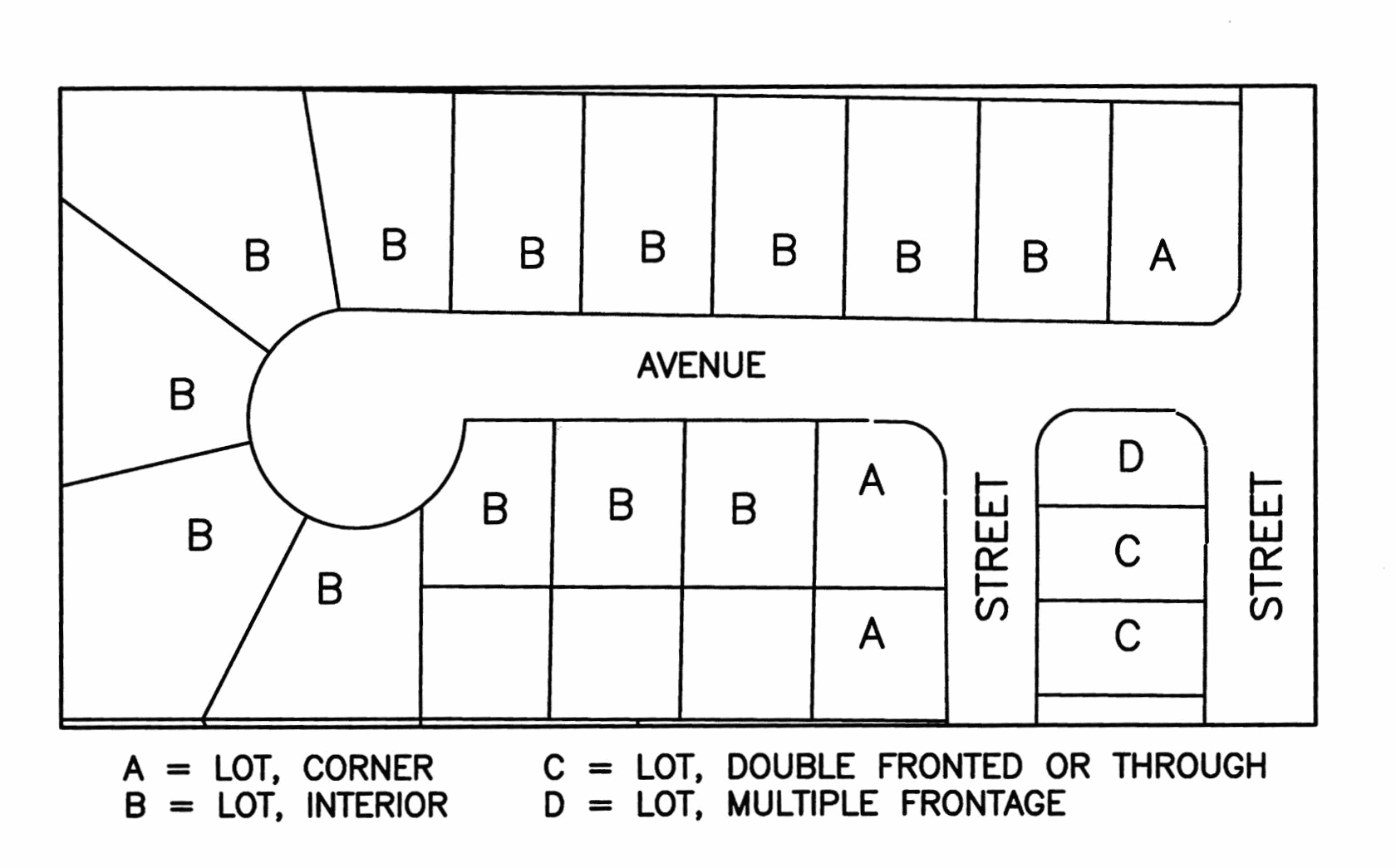
LOT, CORNER. A lot bounded on two (2) adjacent sides by public or private street rights-of-way at their intersection, with an angle of intersection of less than one hundred thirty-five (135) degrees. See Figure 18-1502-4, Lot "A."
LOT COVERAGE. That portion of the lot that is covered by buildings, structures, and other impervious surfaces. As a ratio, it is the relationship between the total impervious surface area on a site and the net acreage of the lot, calculated by dividing the square footage of the area of all impervious surfaces on the site by the square footage of the net land area. An impervious surface ratio (ISR) is the relationship between the total impervious surface area on a site and the gross land area. The ISR is calculated by dividing the square footage of the area of all impervious surfaces on the site by the square footage of the gross land area, less the area of water bodies below the mean high water line.
LOT DEPTH. The mean horizontal distance between the front and rear lot lines. Where there is no rear lot line (ex: corner lots), the lot line most closely opposite and parallel to the front lot line shall be utilized.
LOT, DOUBLE FRONTAGE. A lot, other than a corner lot, with frontage on two (2) streets that are parallel to or within forty-five (45) degrees of being parallel to each other. Same as a "through lot." See Figure 18-1502-4, Lot "C."
LOT FRONTAGE, FRONTAGE, or STREET FRONTAGE. The distance along which a lot line is coterminous with a street.
LOT, INTERIOR. A lot with frontage on only one (1) street.
LOT LINE. The lines delineating the property boundaries of a lot. (Same as "Property Line.")
LOT LINE, FRONT. The lot line extended between the side lot lines across the street frontage of the lot. For the purpose of determining the front lot line on a corner lot, the front lot line shall be the lot line with the lesser dimension. In cases where the nature and development of surrounding properties, or means of ingress and access to the lot are such that the narrow part of the lot is clearly not the functional front lot line, or where both street frontages are the same dimension, the Zoning Director shall make a determination of the front lot line based on these existing conditions.
LOT LINE, INTERIOR. A lot line which does not abut a public or private street right-of-way. See Figure 18-1502-4, Lot "B."
LOT LINE, REAR. The lot line which is generally most distant from and most closely parallel to the front property line.
LOT LINE, SIDE. Any lot line which is neither the front nor the rear lot line.
LOT, MULTIPLE FRONTAGE. A lot which abuts three (3) or more public or private street rights-of-way. See Figure 18-1502-4, Lot "D."
LOW IMPACT OFFICE. An office use, typically of a non-profit or neighborhood service nature as determined by the City Manager, requiring less than two thousand (2,000) square feet of office space with limited client visitation and proximate to commercial corridors on parcels of land greater than one-half (½) acre but less than one (1) acre of land area.
LOW INCOME. As related to the meaning of Affordable Housing when required by this Article, gross family or individual income as expressed as a percentage of the areawide median income (AMI). Extremely Low Income is less than or equal to thirty (30) percent of AMI; Very Low Income is thirty-one (31) percent to fifty (50) percent of AMI; Low Income is fifty-one (51) percent to eighty (80) percent of AMI and Moderate Income is eighty-one (81) percent to one hundred twenty (120) percent of AMI. Depending upon various housing assistance programs, income is as defined in the Code of Federal Regulations (24 CFR 5.609); annual income as reported under the Census Long Form for the most recent decennial census; or adjusted gross income as defined for purposes of reporting under Internal Revenue Service (IRS) Form 1040 series for individual federal income tax purposes.
LOT OF RECORD. A unit of land that is under identical ownership throughout, that is established and described as a distinct unit on a plat, deed, or other instrument as provided by law, which is validly recorded in the Office of the Clerk of the Circuit Court of Pinellas County, and which has not been further subdivided.
LOT WIDTH. The horizontal distance between side lot lines, as measured at the required front setback line.
MANUFACTURING. An establishment engaged in the mechanical or chemical transformation of materials or substances into new products including the assembling of component parts, the manufacturing of products, and the blending of materials, such as lubricating oils, plastics, resins, or liquors.
MASTER DEVELOPMENT PLAN. The proposal for the development of a planned unit development satisfying all applicable requirements of this Article, including, but not limited to, the requirements for a "Preliminary Site Plan" and those for a "Final Site Plan" as stipulated in this Article.
MEDICAL MARIJUANA DISPENSARY. An establishment/business licensed to dispense Medical Marijuana pursuant to applicable law and rules and that is engaged in the retail sale of Cannabis products and derivatives. Medical Marijuana shall have the same meaning as provided in Section 381.986(1)(f) F.S.
MEDICAL MARIJUANA TREATMENT CENTER (MMTC). An entity that acquires, cultivates, possesses, processes (including development of related products such as food, tinctures, aerosols, oils, or ointments), transfers, sells, distributes, dispenses, or administers marijuana, products containing marijuana, related supplies, or educational materials to qualifying patients or their caregivers and is registered by the Department of Health.
MICROBREWERY. An establishment that is primarily a brewery, which produces no more than fifteen thousand (15,000) barrels (four hundred sixty-five thousand (465,000) US gallons/seventeen thousand six hundred two and sixteen hundredths (17,602.16) hectoliters) of beer per year, and includes a lounge, restaurant, taproom or tavern as an accessory use and may host food trucks. Microbreweries sell to the general public by one (1) or more of the following methods: the traditional three-tier system (brewer to wholesaler to retailer to consumer); the two-tier system (brewer acting as wholesaler to retailer to consumer); and, directly to the consumer for consumption on the premises or for retail carryout sale. For the purposes of this Code a micro-distillery or micro-winery shall constitute a microbrewery.
MICRO-DISTILLERY. An establishment that is primarily a distillery, which produces no more than seventy-five thousand (75,000) US gallons of distilled spirits per year, and includes a lounge, restaurant, tasting room or tavern as an accessory use and may host food trucks. For the purposes of this Code, a micro-distillery shall constitute a microbrewery.
MICRO-WINERY. A facility that uses grapes from outside sources instead of its own vineyard to produce wine in quantities not to exceed two thousand (2,000) barrels per year, and includes a lounge, restaurant, tasting room or tavern as an accessory use and may host food trucks. For the purposes of this Code, a micro-winery shall constitute a microbrewery.
MINI-WAREHOUSE. Any building used exclusively for leasing storage space for household goods, business, or personal property.
MIXED-USE. Residential and nonresidential uses sharing the same lot or building, and sharing legal street access and other infrastructure.
MIXED USE BUILDING. A building incorporating residential and nonresidential uses.
MIXED USE DEVELOPMENT. A single development project under unified control incorporating residential and nonresidential uses.
MOBILE FOOD TRUCK. A vehicle which is used to vend food and beverage products and is classified as one (1) of the following:
1.
CLASS I—MOBILE KITCHENS. These vehicles may cook, prepare and assemble food items on or in the unit and serve a full menu. These vehicles may also vend the products permitted for Class II Mobile Food Trucks.
2.
CLASS II—CANTEEN TRUCKS. These vehicles vend pre-cooked foods, pre-packaged foods, pre-packaged drinks and incidental sales of pre-packaged frozen dairy or frozen water-based food products, fruits and vegetables. No preparation or assembly of food or beverage may take place on or in the vehicle; however, the heating of pre-cooked food is permitted.
MOBILE FOOD VENDOR. A person who prepares, dispenses or otherwise sells food from a mobile food truck.
MODEL HOME. Any residential building used for demonstration or sales purposes during the construction phase of a residential development, which structure is open to the public for inspection, and not occupied as a dwelling unit.
MOTOR FREIGHT TERMINAL. A building or area wherein trucks, including tractor or trailer units, are parked, stored, or serviced, including the transfer, loading or unloading of goods. A terminal may include facilities for the temporary storage of loads prior to transshipment.
MOTOR VEHICLE REPAIR. See "Automotive Repair" facility (minor and major) defined herein.
MULTI-FAMILY DEVELOPMENT. Development of three (3) or more dwelling units on the same lot, including three (3) single-family attached dwelling units or two (2) or more duplexes.
NIGHTCLUBS. See "TAVERNS AND LOUNGES."
NONCONFORMING BUILDING OR STRUCTURE. A building or structure, inclusive of accessory uses and improvements, the size, number, dimension or location of which was lawful prior to the adoption, revision or amendment of this Article, but which fails, by reason of such adoption, revision, or amendment, to conform to the present requirements of this Article.
NONCONFORMING LOT. A lot of record that was lawful prior to the adoption, revision or amendment of this Article, but which fails, by reason of such adoption, revision, or amendment, to conform to the present requirements of this Article for lot area, width, depth, and/or frontage.
NONCONFORMING USE. A use or activity which was lawful prior to the adoption, revision or amendment of this Article, but which fails, by reason of such adoption, revision, or amendment, to conform to the present requirements of this Article.
NUISANCE. Any activity, use, or condition that:
(A)
Has an adverse impact upon the use, enjoyment, or value of neighboring properties;
(B)
Endangers the public health, safety, or welfare; or
(C)
Is clearly offensive to human senses beyond the property boundaries of the site.
OFFENDER HALFWAY HOUSE. See, "State of Florida Licensed Facilities" defined herein.
OFFICE. A room, studio, suite, group of rooms, or building used for conducting the affairs of a business, profession, service, industry, or government, including professional offices; professional services; clinics; travel agencies; sales or manufacturer's representatives; professional, civic, social, fraternal, political, or religious organizations; labor unions; employment agencies; real estate brokers; and similar uses. Light assembly (i.e. the fitting together of manufactured parts into a complete machine or unit of a machine) is permitted; however, assembly line (i.e. an arrangement of machines, equipment, and workers in which work passes from operation to operation in direct line until the product is assembled) or general manufacturing procedures are specifically excluded. This term shall not include veterinary clinics, employment offices, temporary labor, or personal services.
OFFICE, PROFESSIONAL. An office for the conduct of "Professional Services" as defined herein, and specifically excluding offices for sales, telemarketing and call centers, corporate customer service, product technical assistance, contractors, shipping, retail, administrative offices, and similar activities.
OFFICE, SHOWROOM. A facility which combines offices with space devoted to either the display of samples of merchandise distributed by such business or the exhibition of such merchandise for sale on the premises. Light assembly (i.e. the fitting together of manufactured parts into a complete machine or unit of a machine) is permitted; however, assembly line (i.e. an arrangement of machines, equipment, and workers in which work passes from operation to operation in direct line until the product is assembled) or general manufacturing procedures are specifically excluded.
OFF-STREET LOADING. See "Loading Space, Off-Street."
OFF-STREET PARKING. See "Parking Space, Off-Street."
OFFICIAL ZONING MAP. An official map depicting the boundaries and identification of the zoning districts established and amended, from time to time by City Council through the provisions of law and this Article, and made a part of this Article by reference.
OPEN SPACE. An area of land not occupied by any building, impervious surface, or retention area which can be used by residents for active or passive recreation. Such areas shall be in excess of those required in the minimum zoning requirements for required yards, lot size, and shall be at least two hundred (200) square feet in size.
OPEN SPACE, USABLE. Open space located on a lot devoted exclusively to active or passive recreation for those persons residing thereon.
OUTDOOR CAFE. A restaurant, which may include Drive-in/Drive-thru facilities, containing seating in an outdoor, non-enclosed area. It is characterized by tables and chairs for the consumption of food and drink, may be shaded by awnings, canopies or umbrellas, but not having cooking or storage in the outdoor, non-enclosed area. Indoor seating may also be provided.
OUTDOOR DINING AREA. Any outdoor area that is part of a public food service establishment where chairs, benches, tables, or other accommodations are provided for customers of the public food service establishment.
OUTDOOR STORAGE. Items other than vehicles, construction equipment, or other similar equipment, stored for a period of time exceeding twenty-four (24) hours in an unoccupied space open to the sky or otherwise not fully enclosed. For vehicles or equipment stored for the purpose of salvage see "SALVAGE YARDS AND JUNK YARDS" and for storage of various types of vehicles see "OUTDOOR STORAGE OF VEHICLES, CONSTRUCTION EQUIPMENT, AND OTHER SIMILAR EQUIPMENT."
OUTDOOR STORAGE OF VEHICLES, CONSTRUCTION EQUIPMENT, AND OTHER SIMILAR EQUIPMENT. Any property used for the outdoor storage of vehicles, construction equipment, and any other similar types of equipment for a period of time exceeding twenty-four (24) hours, in an unoccupied space open to the sky or otherwise not fully enclosed. For vehicles or equipment stored for the purpose of salvage see "SALVAGE YARDS AND JUNK YARDS."
(D)
Words or terms beginning with the letters "P" through "S":
PACKAGE STORE. Any place of business that sells or dispenses alcoholic beverages for off-premises consumption and derives fifty (50) percent or more of its gross revenue from the sale or dispensing of alcoholic beverages.
PARKING LOT. A paved area, open to the sky, used for parking more than two (2) vehicles.
PARKING SPACE. A designated space for the temporary daily or overnight parking of an operable motor vehicle, particularly an automobile.
PARKING SPACE, ACCESSIBLE. A parking space that is accessible to persons with disabilities; is reserved for disabled persons issued a disabled parking permit or license plate as provided under F.S. ch. 316 or 320, as may be amended from time to time, and meets all of the signage, dimensional, location, vertical clearance, and other requirements and specifications of Florida Building Code, Section 11-4, "Accessible Elements and Spaces: Scope and Technical Requirements", as may be amended from time to time.
PARKING SPACE, OFF-STREET. A parking space provided within the property boundaries of a lot.
PARKING GARAGE. (See Garage, Parking.)
PEDESTRIAN. An individual who travels on foot.
PEDESTRIAN ACCESS. A way or means of pedestrian ingress and egress to a property or portion thereof meeting the minimum requirements of this Article.
PERMITTED USE. A use which may be established by right in a particular zoning district, provided that it conforms to all of the requirements and regulations of that district.
PERSONAL SERVICES. Establishments where the principal use is engaged in the repair, care of, maintenance, or customizing of personal properties that are worn or carried about the person or are a physical component of the person. Personal Services shall include, but need not be limited to, barber shops, beauty shops, coin-operated laundries, dry cleaning, and other garment servicing establishments, tailors, dressmaking shops, shoe cleaning or repair establishments, and other similar places of business. This term shall not include clinics, dry cleaning and laundry plants containing more than three thousand, five hundred (3,500) square feet of gross floor area, or adult entertainment establishments.
PLACE OF WORSHIP. A place of assembly for the conduct of religious services or activities and accessory uses, including but not limited to, churches, temples, mosques, convents, and monasteries.
PLANNED UNIT DEVELOPMENT. A contiguous area, that is planned and developed as a single entity under the provisions of the Planned Unit Development District.
PLANNING AND ZONING COMMISSION. An official advisory body of the City of Pinellas Park, the functions and powers of which are described in Article 15 of the Land Development Code.
PLANT NURSERY, RETAIL. A premises for the retail sale of trees, shrubs, or plants in small quantities, not in bulk, to the general public, and may include the accessory sale of garden or landscape accessories, such as mulch, fertilizer, stepping stones, soil, tools, landscape timbers, and other similar garden or landscape materials. This term shall include greenhouses and wholesale plant nurseries that include such retail sales.
PLANT NURSERY, WHOLESALE. A premises where the principal use is the growing of trees, shrubs, or plants for transplanting, for use as stocks for budding and grafting, and accessory wholesaling. This term shall include greenhouses, hydroponic farms, and general horticulture otherwise meeting the terms of this definition, but shall not include retail plant nurseries. This term shall also include Landscape Service Establishments.
PREAPPLICATION CONFERENCE. An informal meeting between an applicant for site plan approval and appropriate City staff members to:
1.
Acquaint the applicant with relevant Codes, Ordinances, and procedures.
2.
Suggest improvements to the proposed preliminary site plan design or other application.
3.
Discuss possible public improvements and other plans which may have impact upon the proposed development.
4.
Offer the applicant a preliminary opinion of compliance or non-compliance based on relevant Codes and Ordinances and upon information supplied to attendant staff.
PREMISES. A lot, or portion thereof.
PRINCIPAL STRUCTURE or PRINCIPAL BUILDING. A structure or building within which the principal use of the lot is located. There may be more than one (1) principal building on a lot if permitted by the applicable district regulations.
PRINCIPAL USE. The dominant purpose for which a land or water area, building or structure is used. There may be more than one (1) principal use on a lot if permitted by the applicable zoning district regulations.
PROFESSIONAL OFFICE. (See "Office, Professional.")
PROFESSIONAL SERVICES. A service in which attainment of knowledge in some formal discipline of science or learning, and distinguished from an exclusively manual skill, is used by its application to the affairs of others either by advising, guiding, treating, teaching, or otherwise serving their interest, health, welfare, or finances, including but not limited to, medicine, dentistry, law, engineering, architecture, insurance, finance, music, and art.
PUBLIC AGENCY. Any government, governmental agency, board, commission, authority, or body, or any other legally constituted governmental subdivision or special district.
PUBLIC EDUCATIONAL FACILITIES. This term shall include the following public schools: elementary schools, middle schools, high schools, special education facilities, alternative education facilities, and area vocational/technical schools.
PUBLIC FOOD SERVICE ESTABLISHMENT. Subject to exemptions provided in F.S. § 509.013, any building, vehicle, place, or structure, or any room or division in a building, vehicle, place, or structure where food is prepared, served, or sold for immediate consumption on or in the vicinity of the premises; called for or taken out by customers; or prepared prior to being delivered to another location for consumption. The term includes a culinary education program, as defined in F.S. § 381.0072(2), which offers, prepares, serves, or sells food to the general public, regardless of whether it is inspected by another state agency for compliance with sanitation standards. "Public Food Service Establishment," includes a restaurant, tavern/lounge, brewery, microbrewery, micro-winery, or micro-distillery as defined in this section.
PUBLIC USE. The use of any land or water area, structure, or building by any public agency for a public service or purpose.
RECORDED. Refers to the recordation of a legal instrument in the Office of the Clerk of the Circuit Court of Pinellas County, Florida, and made part of the Pinellas County Public Records.
RECREATION, COMMERCIAL. A recreation facility operated as a business and open to the public for a fee.
RECREATION/OPEN SPACE. Privately or publicly owned land that is now used, or appropriate to be used, for recreational or open space purposes, i.e. public/private open space, public/private park, golf course or similar use, public/private recreation facility, or community gardens.
RECREATIONAL VEHICLE. A vehicle-type unit primarily designed as temporary living quarters for recreational camping or travel use, but not for use as a permanent dwelling, which either have their own motive power or are mounted on or drawn by another vehicle.
RECYCLING FACILITY. A facility in which the primary activity involves processes designed to collect, separate and process for re-use any solid waste or materials that would become solid waste.
REDEVELOPMENT TRUST FUND. An account set up with funds to be used by the Community Redevelopment Agency to finance or refinance any Community Redevelopment it undertakes pursuant to the approved Community Redevelopment Plan.
REPAIR SERVICES. Establishments where the principal use is the repair and general service of common home appliances, such as musical instruments, sewing machines, televisions, radios, bicycles, washing machines, dryers, vacuum cleaners, power tools, electric razors, refrigerators, and lawn mowers and lawn equipment, or any premises where the principal use is taxidermy, gunsmithing, or similar uses, or interior decorating to include re-upholstering and the making of draperies, slipcovers, and other similar articles. This term shall include accessory retail sales of parts, used appliances, and light machinery. This term shall not include "Automotive Repair Facilities (minor)" and furniture and cabinet making establishments.
RESEARCH AND DEVELOPMENT. The act of carrying out an investigation or experimentation in the natural, physical, or social sciences aimed at the discovery and interpretation of facts, revision of accepted theories or laws in the light of new facts or practical application of such new or revised theories or laws; provided that no manufacturing or production is entailed except as an integral part of the testing activities associated directly with the Research and Development process. (This definition does not apply to those Research and Development activities carried on solely as a secondary use to a principal business).
RESIDENTIAL CARE FACILITY. See, "State of Florida Licensed Facilities" defined herein.
RESIDENTIAL EQUIVALENT USE. A residential-like accommodation other than a dwelling unit, including bed and breakfast, group home, congregate care, nursing home and comparable assisted living facilities. No such use shall be required or eligible to employ the residential equivalent standards for density/intensity for any household that qualifies as a dwelling unit. This use shall not include any type of use authorized by F.S. ch. 419, Community Residential Homes, which is entitled to be treated as a dwelling unit.
RESTAURANT. Any establishment which provides food or drink for consumption by patrons primarily on the premises (i.e.: seating provided), including the subordinate sale of alcoholic beverages for consumption on premises. The term shall include outdoor cafes but shall not be deemed to include facilities with prepared food service within grocery stores and delicatessens, or a "Restaurant, Drive-in/Drive-thru" or a "Tavern or Lounge."
RESTAURANT, DRIVE-IN/DRIVE-THRU. A restaurant, as defined hereinabove, which includes a pick-up or drive-thru window, or where food or drink are consumed by patrons while remaining in their vehicles in designated off-street parking or holding areas, but not including the sale of alcoholic beverages for on- or off-premises consumption.
RETAIL SALES. A building, property, or activity the principle use or purpose of which is the sale or lease of goods, products, materials, or services directly to the consumer, including the sale of alcoholic beverages for off-premises consumption provided that the sale of alcoholic beverages is subordinate to the principal use and display of alcoholic beverages occupies less than twenty-five (25) percent of the floor area of the use.
REZONING. The legal process by which changes are made to the boundary or boundaries of a zoning district(s) or where one (1) zoning classification is substituted for another.
RIGHT-OF-WAY, PRIVATE. A street, way, or alley, permanently reserved by an easement, reservation, or other legal encumbrance, for the passage of vehicles and which is not a component of the state, county, or city-owned and maintained thoroughfare system.
RIGHT-OF-WAY, PUBLIC. A street, way, or alley permanently reserved by dedication or as provided by law to a governmental or quasi-governmental entity, for the passage of vehicles, drainage of stormwater, transmission of electrical power, or for the location of other public infrastructure, or public use as provided by law.
RIGHT-OF-WAY, ULTIMATE. The planned width of a given street or other right-of-way according to the Comprehensive Plan, and from which all required setbacks and yards are measured, otherwise described as the street line that would result from dedication of right-of-way or granting of an access easement based upon the total public or private right-of-way prescribed for any given street by these regulations or the Comprehensive Plan. Means the same as "Street Line."
ROOMING AND BOARDING HOUSE. A building used for the lodging, of three (3) to fifteen (15) people for compensation, with or without meals or group cooking facilities. This term shall include any lodging establishment that is not a "Hotel" as defined herein. Such use does not entail the provision of "Personal Services" as defined herein.
RURAL EVENT VENUES. Facilities used for weddings, banquets, and similar events in areas characterized by low-density development, large lots, and a presence or history of agricultural and/or equestrian activities. This term shall not include uses associated with legitimate agritourism activities on properties classified as agricultural land under Florida Statute § 193.461.
SALVAGE YARDS AND JUNK YARDS. Any property used for the outdoor storage and/or sale of junk, or useable parts extracted from junk, including but not limited to, used mechanical, electrical, hydraulic, and similar equipment, metallic pieces and other salvageable materials, and portions of used trucks, vehicles, construction equipment, and any other similar types of equipment.
SCHOOL BUS. All motor vehicles, with a seating capacity of twenty-four (24) or more persons, which are regularly used for the transportation of pupils to or from "Day Care Center, Type II or III" or similar type day care facility, "Educational Institutions (elementary, middle and senior)", "Public Educational Facilities", or "Places of Worship", or to and from related activities.
SCHOOLS OF NON-ACADEMIC CURRICULUM. An educational facility which primarily offers instruction in dance, martial arts, diving, gymnastics, crafts, and other similar activities. This term does not include "Educational Institutions (elementary, middle, and senior)" or "Trade Schools."
SCHOOLS, TRADE. A school that offers preponderant instruction in the technical, commercial, or trade skills and meets state requirements for such a facility, such as real estate schools, business colleges, electronics schools, automotive and aircraft technicians schools, and similar establishments. This term does not include "Educational Institutions (elementary, middle, and senior)" or "Schools of Non-Academic Curriculum."
SECURITY GUARD/CARETAKER DWELLING UNIT. (See "Dwelling Unit, Security Guard or Caretaker.)
SEMI-PUBLIC USE OR ACTIVITY. A use of land or building that serves the general public in a manner similar to a governmentally owned and operated use, but is not owned or operated by a governmental agency. Examples include, but are not limited to, privately owned bus terminals, railroad stations, theatres, and museums.
SERVICE BAY. A portion of an enclosed building, unless otherwise provided, capable of accommodating one (1) motor vehicle, within which repair or maintenance work takes place.
SETBACK. The shortest distance separation between the street line, front, side, or rear lot lines, and nearest point of any building or structure.
SETBACK AREA. The area between the buildable area and the property line or street line. This area is also referred to as the "required yard."
SETBACK LINE. The line or vertical plane representing the setback distance and yard depth, also described as the inner edge of any required yard. The Setback Line demarcates the vertical plane that separates a required yard from the "Buildable Area" of the lot, within which principal structures may be erected. The "Required Setback Line" is the line representing the minimum required setback distance/yard depth.
FIGURE 18-1502-5 INTERIOR LOT SETBACK AREAS AND LINES
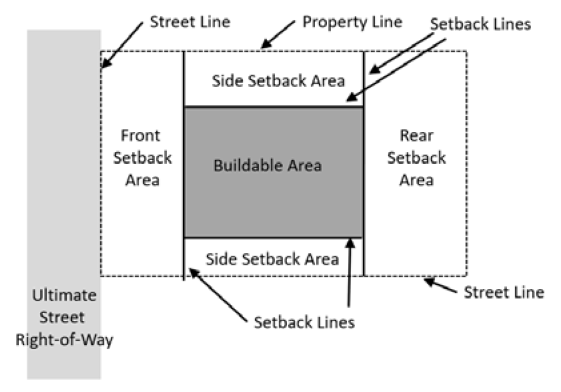
FIGURE 18-1502-6 CORNER LOT SETBACK AREAS AND LINES
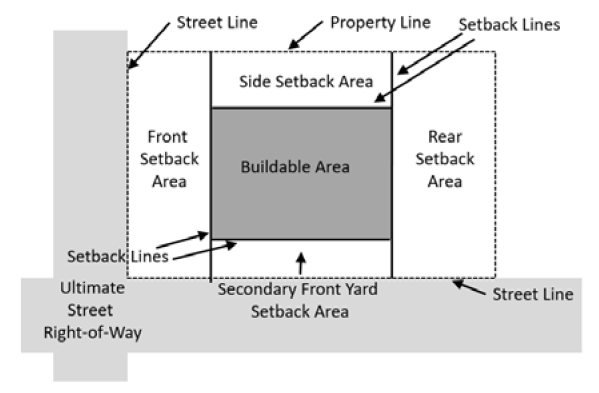
SETBACK, REQUIRED. The minimum required distance separation between the street line, side, or rear lot lines, and the nearest point of any building or structure, subject to any limited encroachments authorized in Section 18-1503.9, "Permitted Obstructions in Required Yards." Required Setbacks for principal and accessory buildings may be different within a given zoning district. A minimum setback requirement creates a minimum yard requirement, and conversely, a minimum yard depth requirement has the same effect as requiring a minimum setback. Required setback adaptations for various lot configurations are explained in Section 18-1503.7, "Yard Determinations."
SHELTER HOME. See, "State of Florida Licensed Facilities" defined herein.
SHOPPING CENTER. A group of ten (10) or more individual commercial establishments and fifty thousand (50,000) or more square feet of gross floor area planned, constructed, or managed as a total entity with customer and employee parking provided on-site, and provision for goods delivery separated from customer access.
SIDEWALK. An area intended primarily for pedestrians to walk or stand, and typically located within either a public or private street right-of-way.
SIGNS, OFF-PREMISES. See definition in Article 6 of the Land Development Code.
SITE PLAN. A graphic and informational representation of the specific site design solution for a development phase or entirety, meeting the specific requirements of Chapter 18, Land Development Code and other established City policies, codes or regulations.
SITE PLAN, PRELIMINARY. A Site Plan designed at such detail to permit the analysis of, and show the arrangement of, land uses, buildings, and other improvements on a site in relation to each other, existing site conditions, and surrounding property.
SITE PLAN, FINAL. A Site Plan to show the specific arrangement of buildings and other improvements on a site in relation to each other, existing site conditions and surrounding property, together with specific information on the nature and intensity of land use, primarily for a determination of compliance with the specific use, dimensional, and other regulations of Chapter 18, Land Development Code, other established City policies, codes or regulations, and the terms of any prior conditional approval of the project.
STABLES, BOARDING. A facility where the owner or lessee, for a fee or other form of compensation, boards (which can include keeping, feeding, grooming, exercising, and/or similar activities) and trains horses which are boarded at the facility, and/or permits the public to rent horses for riding pleasure or for riding instruction.
STATE OF FLORIDA LICENSED FACILITIES. For purposes of this Article, the following terms and definitions shall apply to facilities licensed by the State of Florida.
The following terms shall apply only to the definitions of State Licensed Facilities:
1.
COMMUNITY RESIDENTIAL HOME. A "Dwelling" licensed by the State of Florida to serve persons with disabilities as defined by Federal Law, as well as clients of the Florida Department of Elderly Affairs, the Florida Agency for Persons with Disabilities, the Florida Department of Juvenile Justice, the Florida Department of Children and Family Services, or the Agency for Health Care Administration, where clients are not a danger to themselves or others, do not suffer from "Acute Mental Crisis", and are not actively using drugs or exhibiting drug or alcohol dependency. A Community Residential Home provides a living environment for unrelated residents who operate as the functional equivalent of a "Family", including such supervision and care by supportive staff as may be necessary to meet the physical, emotional, and social needs of the residents. This term includes foster homes, and Adult Family Care Homes and is exclusive of all other State of Florida Licensed Facilities defined herein. The establishment of community residential homes shall be as propounded in F.S. ch. 419, as it may be amended from time to time. A Planned Residential Community means a planned unit development of a minimum of eight (8) acres and has amenities that are designed to serve residents with a developmental disability as defined in F.S. § 393.063 but that shall provide housing options for other individuals. The community shall provide choices with regard to housing arrangements, support providers, and activities. The residents' freedom of movement within and outside the community may not be restricted. For the purposes of this paragraph, the City approval must be based on criteria that include, but are not limited to, compliance with appropriate land use, zoning, and building codes. A planned residential community may contain two (2) or more community residential homes that are contiguous to each other and the City may not impose proximity limitations between homes within a planned residential community if such limitations are based solely on the types of residents anticipated to be living in the community. A planned residential community may not be located within a ten-mile radius of any other planned residential community.
2.
DOMESTIC VIOLENCE CENTER. A facility certified by the Department of Children and Family Services as a center to receive and house persons who are victims of domestic violence pursuant to F.S. § 39.905.
3.
OFFENDER HALFWAY HOUSE. A residential facility licensed by the State of Florida for the constant supervision of criminal offenders as part of a probation or court-ordered requirement.
4.
RESIDENTIAL CARE FACILITY. A residential facility licensed by the State of Florida to provide any combination of nursing care, injury or illness rehabilitation, personal services, community re-entry training, aids for independent living, or counseling, but not medical services, to persons with disabilities as defined by Federal Law, as well as clients of the Florida Department of Elderly Affairs, the Florida Agency for Persons with Disabilities, the Florida Department of Children and Family Services, or the Agency for Health Care Administration, which clients are not of danger to themselves or others, are not suffering from "Acute Mental Crisis", and are not actively using drugs or exhibiting drug or alcohol dependency. Examples include facilities typically referred to as nursing homes, convalescent homes, and assisted living facilities. This term does not include hospitals licensed under F.S. ch. 395, as may be amended from time to time, or any federally operated hospital facility.
5.
SHELTER HOME. A residential facility licensed by the State of Florida, to provide temporary, short-term care and twenty-four-hour supervision to no more than five (5) clients of the Florida Department of Children and Family Services, which are not of danger to themselves or others, are not suffering from "Acute Mental Crisis", and are not actively using drugs or exhibiting drug or alcohol dependency.
6.
RESIDENTIAL TREATMENT FACILITY. A State-supported and licensed facility providing a comprehensive treatment program for mentally ill individuals in a community based setting.
STORAGE, BULK. The storage of liquids, gasses, or materials in above or below ground storage tanks or containers, in large quantities consistent with wholesale distribution or mass consumption. Within a Residential zoning district, bulk storage shall mean storage of liquids, gasses, or materials in quantities that exceed those customarily necessary for household consumption on a regular basis (ex: emergency fuel supply needed to operate a generator during power outages).
STORY. That part of a building between the surface of a floor and the ceiling immediately above.
STREET. A public or private "Right-of-Way" which affords a primary means of vehicular and pedestrian access to abutting properties, whether designated as a street, road, avenue, boulevard, lane, collector, arterial, thoroughfare, highway, throughway, or however otherwise designated, except that driveways and alleys are not considered streets.
STREET, ARTERIAL. A route providing service which is relatively continuous and of relatively high traffic volume, long average trip length, generally higher operating speed, and high mobility importance.
STREET, COLLECTOR. A "Street" as identified by the Comprehensive Plan, designed to serve the City's internal traffic needs and to distribute traffic to the arterial street system. Collector streets accommodate short-to-moderate trip lengths, moderate traffic volumes, and moderate speed limits (35—45 mph), to provide access to abutting property under controlled conditions.
STREET, EXPRESSWAY. A limited access highway as identified by the Comprehensive Plan, designed to serve regional traffic needs.
STREET FRONTAGE. See "Lot Frontage" defined herein.
STREET LINE. The outer boundary line of the ultimate right-of-way of a public or private street.
STREET, LOCAL. A "Street" as identified by the Comprehensive Plan, designed primarily to provide access to abutting properties. Local streets carry slow moving traffic at low volumes.
STRUCTURE. Anything constructed or erected with a fixed location on the ground, or attached to something having a fixed location on the ground, including but not limited to, buildings, towers, storage tanks, walls, air-conditioning units, pool pumps, heat pumps, antennas, billboards, etc; but not including cement slabs or decks at ground level or less than six (6) inches above finished grade.
STRUCTURED PARKING. See "Garage, Parking", defined herein.
SUBDIVISION. The division of a lot of record into two (2) or more lots of record.
SUBMERGED LAND. The area situated below the mean high water line of a standing body of water, including ocean, estuary, lake, pond, river or stream. For the purpose of this definition, drainage detention areas created as a function of development that are recorded on an approved final site plan or other authorized development order action, and wetlands, shall not be considered submerged land, and thus may be included in the computation of net land area for the purpose of determining permitted density/intensity.
SUBSTANTIAL CHANGE/DEVIATION. Any change to a site plan which creates a reasonable likelihood of adverse impact to any developed portion of the site or to adjacent properties.
SWIMMING POOL. A water-filled enclosure, permanently constructed or portable, designed for human use, and designed, maintained, or used for swimming and bathing, having a minimum depth of eighteen (18) inches either above surface or below the level of the surrounding land. This term shall include spas.
(E)
Words or terms beginning with the letters "T" through "Z":
TAPROOM. A room that is ancillary to the production of beer at a brewery, microbrewery or brewpub where the public can purchase and/or consume alcoholic beverages.
TASTING ROOM. A room that is ancillary to the production of spirits at a micro-distillery where the public can purchase and/or consume the spirits.
TAVERNS AND LOUNGES. Any establishment (including bars, dance halls, and nightclubs) used primarily for the sale or dispensing of alcoholic beverages for consumption on-premises. This use may include retail and restaurants as an accessory use, and may host food trucks.
TEMPORARY USES. Any use which is not designed or intended to be permanent in nature, and unless otherwise specified in this Article, is not permitted for a period exceeding ninety (90) days. The duration of temporary uses may be extended by lawful agreement in situations deemed advisable by the City Manager.
TOWER, RADIO, TELEVISION, OR MICROWAVE. See definition of "Antenna" herein.
TRUCK/TRAILER RENTAL ESTABLISHMENT. An establishment offering, through lease or rental agreement, the use of trucks or trailers to the general public. This term does not include the rental of light trucks.
TRUCKS, HEAVY. All trucks other than those defined as "Light Trucks."
TRUCKS, LIGHT. Any vehicle designed, used or maintained for the transportation of property with a maximum length of twenty-one (21) feet and a maximum gross vehicle weight (GVW) of eight thousand (8,000) lbs., including pickups, vans and panels.
UNIFIED CONTROL. Having fee simple title or other legally binding control for the purposes of development, over an area of land, which gives full authority to the holder of such "unified control" to legally bind all such lands to development orders of the City.
UNITY OF TITLE. A recorded document stipulating that a "Lot" or lots shall be held under single ownership, shall not be eligible for further subdivision and shall not be transferred, conveyed, sold or divided in any unit other than in its entirety.
USE. The purpose for which land, water, or a building is designed, arranged, or intended to be occupied or utilized, or for which it is occupied or maintained. See definitions herein for specific types of uses.
VARIANCE. Relief from certain requirements of this Article, where such variance will not be contrary to the public interest, and where owing to conditions particular to the property and not the result of the actions of the applicant, a literal enforcement of those requirements would result in unnecessary and undue hardship. Variances do not apply and shall not be granted for the establishment or expansion of a use not specifically allowed in the applicable zoning district.
VEHICLE, COMMERCIAL. A vehicle used or maintained for the transportation of persons for hire, compensation, or profit, or designed, used, or maintained primarily for the transportation of property (i.e. materials), and specifically includes step-up vans, heavy trucks, trailers, semi-trailers, truck-tractors, tractor-trailers, combinations as defined in F.S. ch. 320, as may be amended from time to time, moving vans, trucks, delivery trucks, box trucks, dump trucks, service vehicles, tow trucks, utility trucks, flatbed trucks, wreckers, buses, cranes, draglines, earthmovers, bulldozers, backhoes, trenchers, or similar vehicles. The term also includes school buses (when located within a residential zoning district where the principal uses of the property is residential), a recreational vehicle converted from a commercial vehicle and any vehicles used as a platform for a derrick, hoist, cranes, compressor tank(s), ladder racks, or similar equipment or as a means of transporting or storing a commercial vehicle.
The following vehicles are specifically excluded from this definition and shall not be deemed commercial vehicles: unaltered automobiles and unaltered station wagons, passenger vans, and panel vans including those with racks, pickup trucks, including those with toppers, campers and racks, taxicabs (with or without "vehicle signage") and limos where the vehicle employed as such is a passenger car or passenger van, subject to the restrictions provided in Subsection. 18-1530.15(A)1.(b)(1), and utility trucks or flatbed trucks of a gross vehicle registered weight or no more than one (1) ton, subject to the restrictions provided in Subsection 18-1530.15(A)1.(b)(2).
VEHICULAR USE AREA. All land used for the circulation, parking, storage, loading and unloading, or display of any and all types of vehicles, boats, or heavy construction equipment whether self-propelled or not, and all land upon which vehicles traverse as a function of the use of a site, except that driveways and parking spaces serving single-family and duplex dwellings are excluded from this definition. A driveway extension providing vehicular access to private parking areas, loading areas or outdoor storage areas and does not abut other impervious or paved areas shall not be included in the calculation of vehicular use area for determining the required area of interior green to be provided pursuant to Section 18-1533 Landscaping Regulations.
VISIBILITY TRIANGLE. A triangular-shaped portion of land established at the intersection of two (2) or more rights-of-way, or an intersection of a right-of-way with a driveway or alley which is kept free of visual impairment to allow full view of vehicular, pedestrian and bicycle traffic.
WALKWAY. An area intended primarily for pedestrians to walk or stand and located on private property.
WAREHOUSE. A building used primarily for the storage of goods and materials; A terminating point where goods are transferred from a truck to a storage area or to other trucks, or transported by other forms of locomotion. Accessory office use not exceeding more than twenty-five (25) percent of gross floor area is included in the definition. Office use that exceeds twenty-five (25) percent shall be considered a principal use (and is calculated separately for parking requirements).
WHOLESALING. Establishments or places of business primarily engaged in: (1) selling goods, merchandise, and commodities in gross or bulk, primarily for purposes of resale; (2) selling such merchandise to retailers, industrial, commercial, institutional, or professional business users, or to other wholesalers; or (3) acting as agents or brokers and buying merchandise for, or selling to, such individuals or companies.
WIRELINE FACILITY. An aerial facility used to provide communications services or a below-grade facility. The term includes wireline backhaul facilities associated with a wireless facility and coaxial or fiber-optic cable that is between wireless structures or utility poles or that is otherwise not immediately adjacent to or directly associated with a particular antenna of a wireless facility.
YARD. The area between a building and the property line. See Section 18-1503.7, "Yard Determinations."
YARD, FRONT. The area extending from a building and lines projecting from outside corners of a building to the side property lines and the property line abutting the street right-of-way in front of the building. A courtyard is not considered part of the front yard if a wall or walls enclose the portion of the courtyard facing the street with the exception of an entryway that is no greater than one-third (⅓) the width of the courtyard.
YARD, SECONDARY FRONT. The area between the side of a building, the front yard, rear yard, and side street.
YARD, REAR. The area extending from a building and lines projecting from outside corners of a building to the side property lines and the property line to the rear of a building.
YARD, SIDE. The area between the side of a building, the front yard, rear yard, and the side property line.
FIGURE 18-1502-8 INTERIOR LOT YARDS
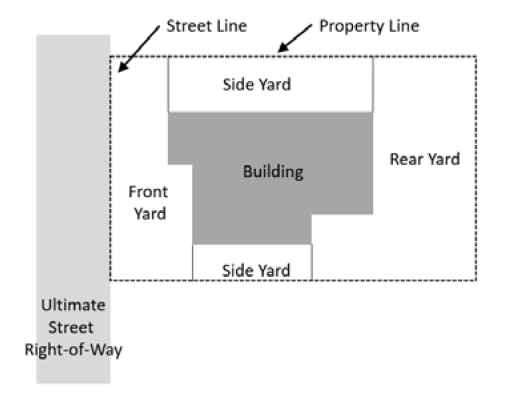
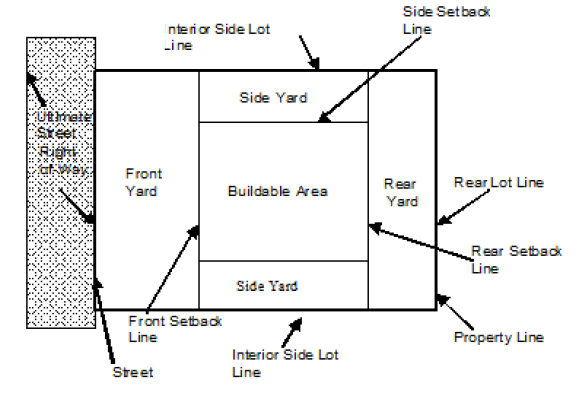
FIGURE 18-1502-9 CORNER LOT YARDS
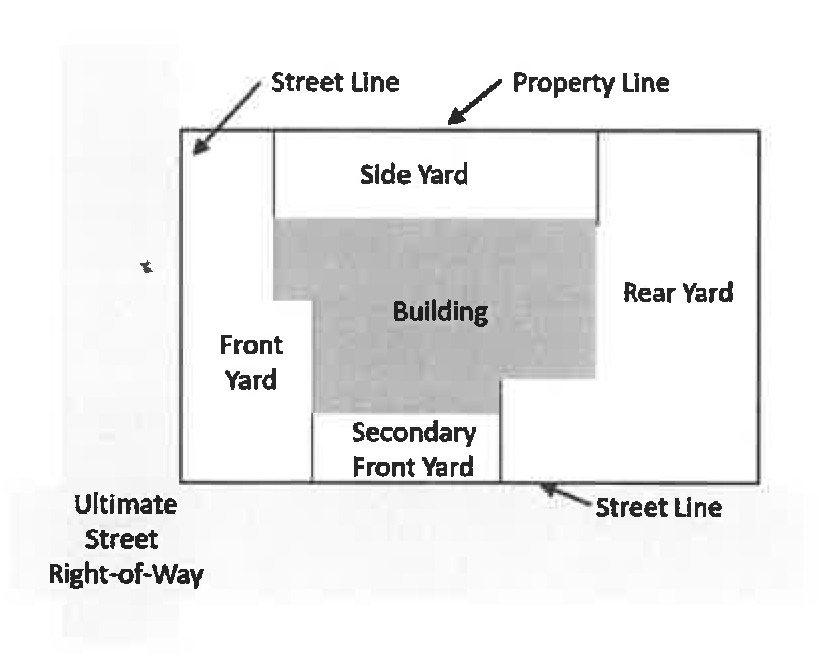
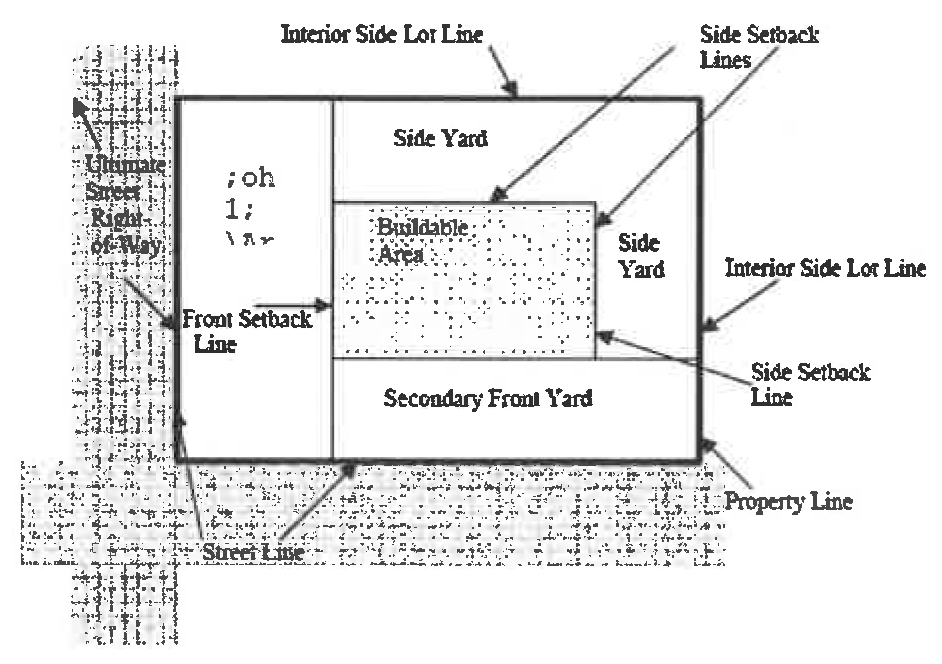
ZERO-LOT-LINE DEVELOPMENT. A development approach in which a building is sited on one (1) or more lot lines.
ZONING DIRECTOR. The Planning and Development Services Director or other designee of the City Manager who shall be responsible to administer and enforce this Article unless otherwise provided.
ZONING DISTRICT. Any of the several classifications of permitted land use promulgated herein, within which the applicable regulations of this Article apply and within which said regulations are uniform, and as may be applied geographically within the City through the Official Zoning Map.
ZONING DISTRICT, COMMERCIAL. "CN" Commercial Neighborhood, "GO" General Office, "B1" General Commercial, and "CH" Heavy Commercial districts, and any portion of a "PUD" Planned Unit Development District designated for uses permitted in the commercial zoning districts.
ZONING DISTRICT, DUPLEX. "R-4" Duplex Residential District.
ZONING DISTRICT, INDUSTRIAL. "M-1" Light Industrial and "IH" Heavy Industrial districts, and any portion of a "PUD" Planned Unit Development District designated for uses permitted in the industrial zoning districts.
ZONING DISTRICT, MIXED USE. "R-6" Multi-Family Residential/Commercial, "ROR" Residential/Office/Retail, "MXD" Mixed Use, and "TC" Town Center districts, and any portion of a "PUD" Planned Unit Development District designated for mixed use.
ZONING DISTRICT, MANUFACTURED HOME. "T-1" Manufactured Home Subdivision and "T-2" Manufactured Home Park districts.
ZONING DISTRICT, MULTI-FAMILY. "R-5" Multi-Family Residential and "R-6" Multi-Family Residential/Commercial districts, and any portion of a "PUD" Planned Unit Development District designated for multiple-family dwellings.
ZONING DISTRICT, NONRESIDENTIAL. "CN" Commercial Neighborhood, "GO" General Office, "B-1" General Commercial, "CH" Heavy Commercial, "M-1" Light Industrial, and "IH" Heavy Industrial districts, and any portion of a "PUD" Planned Unit Development District designated for uses permitted in nonresidential zoning districts.
ZONING DISTRICT, PLANNED UNIT DEVELOPMENT. "PUD" Planned Unit Development District. See also definition of "Planned Unit Development."
ZONING DISTRICT, PUBLIC/SEMI-PUBLIC. "P" Public, "OS" Open Space, and "PRES" Preservation districts.
ZONING DISTRICT, RESIDENTIAL. "F" Farm, "RE" Single-family Residential Estate, "RR" Rural Residential, "R-1" Single-family Residential, "R-2" Single-family Residential, "R-3" Single-family Residential, "R-4" Duplex Residential, "R-5" Multi-Family Residential, "R-6" Multi-Family Residential/Commercial, "T-1" Manufactured Home Subdivision, and "T-2" Manufactured Home Park districts, and any residential-only portion of a "PUD" Planned Unit Development District.
ZONING DISTRICT, SINGLE-FAMILY. "F" Farm, "RE" Single-family Residential Estate, "RR" Rural Residential, "R-1" Single-family Residential, "R-2" Single-family Residential, and "R-3" Single-family Residential districts, and any portion of a "PUD" Planned Unit Development District restricted to single-family residential use.
(Ord. No. 3748, § 3, 10-28-2010; Ord. No. 3863, § 1, 10-10-2013; Ord. No. 3928, § 1, 1-22-2015; Ord. No. 3990, § 1, 9-8-2016; Ord. No. 3987, § 1, 7-14-2016; Ord. No. 4030, § 1, 8-10-2017; Ord. No. 4042, § 1, 10-26-2017; Ord. No. 4050, § 1, 1-25-2018; Ord. No. 4079, § 1(Att. A)5., 3-14-2019; Ord. No. 4093, § 3, 11-26-2019; Ord. No. 4106, § 2, 3-12-2020; Ord. No. 4107, § 7, 3-12-2020; Ord. No. 4198, § 3, 6-22-2023; Ord. No. 4199, § 1, 6-22-2023; Ord. No. 4205, § 1, 7-27-2023; Ord. No. 4234, § 1, 1-11-2024; Ord. No. 4255, § 1, 6-27-2024; Ord. No. 4280, § 1, 1-9-2025; Ord. No. 2025-13, § 1, 3-27-2025Ord. No. 2025-30, § 1, 10-23-2025)

