
Pinellas Park City Zoning Code
SECTION 18
1532.- OFF-STREET PARKING AND LOADING REGULATIONS
Sec. 18-1532.1.- PURPOSE, INTENT AND APPLICABILITY.
(A)
PURPOSE. It is necessary to establish minimum requirements for facilities and space for the off-street parking of vehicles and loading and unloading of goods in the City, in order to promote the safety of pedestrians and motorists, the orderly movement of people, vehicles and goods, and maintaining the public ways, recognizing that different land uses have varying requirements for off-street parking.
(B)
INTENT. All use of land shall provide off-street parking in accordance with the standards and requirements of this Section.
(C)
APPLICABILITY. No development permit shall be issued that causes any of the following situations unless the use or for which the permit is being sought complies with these off-street parking and loading regulations:
1.
New Use. Whenever a new use is established.
2.
Expansion of a Building or Structure. Whenever an existing building or structure is enlarged.
3.
Expansion or Change of Use. Whenever the use of an existing building, structure or site is expanded or changed so that it will increase the number of required spaces.
(D)
EXEMPTIONS. The Zoning Director may adjust or waive the requirement for additional parking in the following circumstances:
1.
If the expansion or change of use of an existing development increases the demand for spaces and the applicant demonstrates the adequacy of existing parking to meet existing and projected demands, the Zoning Director may waive the requirement for additional parking.
2.
If the expansion or change increases parking demands by not more than the greater of five (5) spaces or ten (10) percent, the Zoning Director may waive the requirement for additional parking. This provision may be used only once for any given site.
3.
If the existing parking is non-conforming, yet accommodates existing demands, the Zoning Director may adjust the increased parking requirement based on the demand created by the expansion of the building or use.
(Ord. No. 3748, § 3, 10-28-2010; Ord. No. 4079, § 1(Att. A)113., 3-14-2019)
Sec. 18-1532.2. - GENERAL REGULATIONS.
The following shall apply to the development of all off-street parking within the City of Pinellas Park:
(A)
All parking lot development shall be designed in accordance with Section 18-1532.6 and the City's engineering specifications on file with the Engineering Services Department. The number, dimensions and marking of handicapped accessible parking spaces shall be designed in accordance with Florida Building Code requirements.
(B)
This Section establishes the minimum required number of off-street parking and loading spaces for each of the listed land uses. Actual parking and loading demand tends to vary for any one given use from site to site, sometimes significantly. The intent of the minimum standards established in this Section is to accommodate typical weekly peak parking demand for a given use, which may occur on a weekday, weekend, morning, afternoon or evening, depending upon the characteristics of the particular use. Given the variation in parking demand among identical land uses in different locations, Section 18-1532.5 provides for an applicant to submit data supporting alternate parking, loading or stacking requirements, and authorizes the City to approve same. This same process is available for uses that are not listed, but that are similar to a listed use.
(C)
When a developed property complies with the minimum off-street parking requirements hereunder, but consistently lacks sufficient parking to accommodate actual demand for same, any application for expansion of the use, or for site modification, shall be evaluated as if the existing supply of off-street parking spaces is inadequate and does not conform to the requirements of this Section. The actual parking requirement, in such cases, shall be based upon the demonstrated demand during typical weekly peak parking periods unless the applicant proposes mitigation acceptable to the City.
(D)
The Zoning Director may require an applicant to perform a study or provide professionally acceptable data demonstrating that the minimum standards set forth in this Section for number of parking, loading, and/or stacking spaces is adequate for the proposed use, when the Zoning Director determines that the characteristics of a proposed use may require additional spaces.
(E)
For those uses not specifically assigned minimum parking requirements herein, off-street parking shall be provided on the basis of the parking requirements of comparable uses, in the judgment of the Zoning Director. The Zoning Director may also require a study or documentation pursuant to paragraph (D), above, for a use that is not specifically listed in this Section, when in the judgment of the Zoning Director, the parking, stacking and/or loading characteristics of the proposed use are not substantially similar to a listed use.
(F)
Where parking requirements are linked to the seating capacity of certain occupancies (i.e., auditoriums, stadiums, churches, lodge rooms, etc.) the seating capacities for such occupancies shall, in the absence of fixed-seating, be computed based upon the maximum occupancy of persons allowed under the Florida Building Code, as may be amended from time to time, for the purpose of determining the required number of off-street parking spaces.
(G)
Fixed bench seating shall be calculated as one (1) seat per each twenty-four (24) linear inches, excluding any fractions thereof.
(H)
The parking required herein is in addition to space for storage of trucks or other vehicles used in connection with a business, commercial or industrial use.
(I)
Where fractional spaces result from a required parking calculation the result shall be rounded up, such that the parking, stacking or loading spaces required shall be construed to be the next highest whole number. For example, if a parking calculation requires 1.99 spaces, this number shall be rounded up to two (2) spaces.
(J)
Designated parking spaces and associated vehicular use areas shall be used for vehicular parking only. No sales, rental, storage, repair, servicing of vehicles, equipment or materials, dismantling, or other activities shall be conducted or located in such areas.
(K)
All parking spaces required herein shall be located on the same lot with the building or use served, except as provided under Section 18-1532.4, "Shared and Off-Site Parking".
(L)
Parking areas shall be located so as to minimize conflicting movements between vehicles maneuvering in parking aisles and those vehicles traveling into, out of, or through the site.
(Ord. No. 3748, § 3, 10-28-2010)
Sec. 18-1532.3. - NONCONFORMING PARKING FACILITIES.
Whenever vehicular use areas (VUAs), including required off-street parking or loading facilities, are nonconforming as to any requirements of this Section, the nonconformities may continue subject to the following conditions.
(A)
SUBSTANDARD VUA SURFACE. As a result of a change or expansion of use, when an existing VUA is unpaved or otherwise has a substandard surface, and such VUA is: 1) increased in size by at least fifty (50) percent; or 2) the number of required parking spaces is increased by at least twenty-five (25) percent, both the new portion and remaining substandard portion shall be improved to the paving and marking standards required herein.
(B)
NONCONFORMING PARKING OR LOADING FACILITIES.
1.
When a new use is established, and the required parking is at a higher ratio than the ratio of the use it replaces, parking must be provided based on the new use and current Code requirements.
2.
Should a building be expanded for an existing use within the building, and the overall existing parking supply for the building or complex does not meet the current requirement, parking must be provided for the expanded use at the current requirement for the new addition. However, parking provided for the existing building area, although nonconforming, does not have to be brought up to current requirements, unless the existing parking surface is substandard, and the percentage thresholds of (A) above have been reached.
3.
Should State or Federal Disability Accessibility Codes require additional or upgraded disabled-accessible parking spaces, the existing nonconforming parking lot may be upgraded to meet said Code, without penalty to the property owner, even if one (1) or more existing parking spaces are being removed to provide for disabled-accessible spaces.
(Ord. No. 3748, § 3, 10-28-2010)
Sec. 18-1532.4. - SHARED AND OFF-SITE PARKING.
(A)
OFF-SITE PARKING. Required parking for certain nonresidential uses may be provided off-site, within a distance not to exceed four hundred (400) feet measured as the shortest distance between the two (2) properties, along the most direct route of sidewalk access between the properties, provided that:
1.
The two (2) properties are completely connected by sidewalks and are not separated by a collector or arterial roadway; and
2.
Appropriate directional signage is provided to advise patrons of the off-site parking and to reserve the off-site parking for the building or use it serves; and
3.
The use is characterized by relatively infrequent utilization of its full parking facilities and/or a low turnover of parking spaces, such as a theatre, auditorium, arena, auction house, place of worship (excluding parking for day care, administrative offices and elementary school), faculty and student parking for colleges and universities, and employee parking for uses such as hospitals, government buildings, office buildings, banks and other places of substantial employment, or uses with similar parking characteristics.
4.
Within the CRA boundaries, a mixed-use development, or a neighborhood that the Zoning Director finds to be functionally pedestrian-oriented and mixed-use, the Zoning Director may extend the off-site parking distance in this paragraph to eight hundred (800) feet, if:
(a)
There is a continuous system of sidewalks or other pedestrian facilities connecting the off-site parking with the non-residential use;
(b)
The remote parking does not require pedestrians to cross an arterial street;
(c)
Required parking for disabled individuals is provided on-site;
(d)
Required parking for residences is provided on-site or on an abutting parcel; and
(e)
The owners of the property where the parking and the proposed development are located enter into an agreement reserving the required parking spaces for exclusive use by the subject development or joint use (pursuant to paragraph (B) of this section). Exclusive and joint parking agreements shall not be revocable without approval of the Zoning Director. As an alternative to this requirement, the Zoning Director may approve the use of public parking areas upon determining that the areas have sufficient surplus parking to serve the proposed development.
(B)
JOINT PARKING FACILITIES.
1.
The required off-street parking may be collectively provided by two (2) or more uses, however, the number of parking spaces shall not be less than the sum of the requirements for the several individual uses if computed separately, except as provided below.
2.
Where it can be shown to the satisfaction of the Zoning Director that the peak hours of use for two (2) or more establishments on the same lot will not coincide, or a parking demand study certified by a registered engineer determines on the basis of current peak usage that an existing use that is to be the subject of a shared parking agreement has surplus parking spaces, the sum of the parking requirements for said establishments may be reduced; however, said reduction shall not exceed twenty-five (25) percent of the total number of required off-street parking spaces.
(C)
ADMINISTRATION AND ENFORCEMENT.
1.
It shall be the responsibility of the developer to provide the documentation necessary to determine whether the provisions of this section are applicable.
2.
In any case, where the required parking spaces are not located on the same lot with the building or use served, or where such spaces are collectively or jointly provided and used, a written agreement thereby assuring their retention for such purposes shall be recorded and shall be filed with the application for a building permit. A covenant running with the lands shall be recorded noting that the properties have a shared parking arrangement or offsetting peak hour parking arrangement.
3.
If it is found that the peak hours of operation for establishments utilizing shared parking have become the same or overlap, then all required parking shall be provided if, in the opinion of the Zoning Director, a lack of parking is expressed by "spillover" whereby the lack of parking on site impacts adjacent or other nearby uses.
(Ord. No. 3748, § 3, 10-28-2010; Ord. No. 4079, § 1(Att. A)114., 3-14-2019)
Sec. 18-1532.5. - ALTERNATIVE STANDARDS.
(A)
The City may approve a parking, loading and/or stacking space needs analysis justifying an alternative parking, loading or stacking generation rate(s) provided by a petitioner for development approval or change of use, if:
1.
Such alternate rate or requirement is the result of unique operating characteristics of the proposed use or mix of uses;
2.
If there are distinctions between the demand generated by the proposed use(s) and the standard(s) set forth herein for the most similar use(s) contained in this Section;
3.
Or, where the petitioner produces recent, professionally acceptable data and analysis demonstrating that an alternate generation rate(s) is more appropriate for a class of use than that contained in this Section.
(B)
A parking, loading and/or stacking space needs analysis shall include one (1) or more of the following, as applicable, to support the needs analysis:
1.
Estimates of parking, loading and/or stacking space needs based on recommendations in studies such as those from the Urban Land Institute, Institute of Traffic Engineers, or industry standards based on data collected from geographic areas and uses or combinations of uses that are similar to the proposed uses(s). The analysis shall document the source of the data used to develop particular recommendations.
2.
Actual parking, loading and/or stacking space counts for a similar development indicating that the full complement of spaces is not required. Such counts shall be taken during peak demand parking and drive-thru hours.
3.
An analysis of the extent to which other options exist that would lessen on-site parking requirements.
4.
An operational procedure indicating that the full complement of spaces is not required and a guarantee of continuity of such operational procedure.
(C)
The needs analysis shall include a statement of remedies in the event the City makes a future determination that the full complement of spaces is required. In the event that the City makes a future determination that insufficient spaces exist, the property owner shall be notified by certified mail that a remedy shall be implemented within sixty (60) days, as may be extended by the City Manager for just cause. A determination of insufficiency shall be made using one (1) or more of the following methods: monitoring of the parking, loading or stacking as applicable; parking, loading or stacking in the rights-of-way caused by insufficient off-street facilities; or, verified complaints of parking, stacking or loading on neighboring properties in connection with the property in question.
(D)
The City, when reviewing such data, should consider the future adaptability of the site, given the reduced parking, loading or stacking spaces, for the same use with more typical operational characteristics, as well as other land uses.
(E)
The petitioner shall execute an agreement with the City, setting forth the terms of the alternative generation standard, which may require recalculation based upon changes to the business operation, and/or other terms and conditions the City deems necessary to ensure the alternative calculation will remain appropriate.
(F)
In order for any development to qualify for an alternative standard, the development must comply with all applicable architectural and urban design guidelines, and shall provide an additional twenty (20) percent landscaping material on site.
(Ord. No. 3748, § 3, 10-28-2010)
Sec. 18-1532.6. - SPECIFICATIONS AND STANDARDS FOR PARKING LOT DEVELOPMENT.
(A)
CIRCULATION.
1.
Off-street parking areas shall be designed to ensure safe and efficient traffic circulation, with consideration given to the surrounding street plan, traffic volumes, proposed street improvements, vehicular street capacities, and pedestrian movements and safety. The parking facilities shall be of sufficient size and configuration to allow necessary functions for loading, unloading and parking maneuvers to be carried out on private property, and completely off the street right-of-way, unless otherwise specifically permitted.
2.
Parking facility design shall provide for a clearly defined vehicular circulation system, which allows free movement within the proposed site while discouraging excessive speed, and allows efficient and orderly circulation that minimizes congestion.
3.
Pedestrian and vehicular circulation systems shall be adequately separated for pedestrian safety.
4.
All off-street parking areas, with the exception of those required for attached or detached single-family homes, shall be designed so that no vehicle is required to back directly into a public street right-of-way (exclusive of alleys) to obtain egress, and so that no vehicle shall be required to use a public street right-of-way (exclusive of alleys) for direct movement into or out of individual parking spaces. The establishment of new back-out parking for single-family homes is prohibited along collector and arterial roadways. Furthermore, no required parking spaces may be located directly in front of vehicular access openings to buildings; all such access bays must remain accessible.
5.
Lighting shall be consistent with the latest recommendations of the Illuminating Engineering Society (IES) document RP-20-98, Lighting for Parking Facilities, as may be amended from time to time.
(B)
SURFACE. All off-street parking and access ways shall be paved with pervious or impervious surfaces as approved by the City Engineer and marked in accordance with the standard specifications of the City of Pinellas Park, except as provided below.
1.
Pervious material may be substituted where approved by the City Engineer based on sound engineering and traffic principles and consistency with an approved drainage plan.
2.
Where it can be shown that the use of all spaces of a parking lot or portion thereof is equal to or less than an average of six (6) vehicular parking events (i.e., one (1) vehicle parking in and leaving a space) per space per week, such parking areas need not be paved to City Standards and may utilize an unpaved surface for parking and circulation, provided the surface is stabilized to professionally accepted standards. Such parking areas shall be clearly delineated with wheel stops, border chain, shrubs or other suitable materials to clearly show the general parking scheme intended. In addition, that portion of the access to the lot lying within City right-of-way shall be paved and improved to City Standards as required by the City Engineer.
(C)
PARKING SPACE DIMENSIONS. Unless otherwise specified herein, each off-street parking space shall have a minimum net area of one-hundred sixty-two (162) square feet, and minimum dimensions of nine (9) feet by eighteen (18) feet exclusive of access drives or aisles that provide access thereto, without requiring another automobile to be moved or otherwise requiring access over or through any other parking space, except as provided herein for valet parking and/or funeral homes/chapels.
1.
A driveway, as well as a carport, that meets the dimensional requirements of this provision, may be counted as off-street parking spaces for single-family homes, regardless of the need to move one (1) automobile in order to afford ingress and egress for another automobile.
2.
A garage or carport, and a driveway servicing a garage or carport, that meets the dimensional requirements of this provision, may be counted as off-street parking spaces for attached single-family homes, duplex and townhome units to which the garage or carport is attached, regardless of the need to move one (1) automobile in order to afford ingress and egress for another automobile, subject to Subsection (A)4., above. If a homeowner subsequently encumbers garage or carport space in a manner that eliminates its functional use as a parking space, then that space shall be replaced in another acceptable manner and location within a timeframe to be determined by the Zoning Director.
3.
No parking space shall be designed or constructed so as to encroach on any sidewalk, pedestrian way or required landscape area. The use of wheelstops and or grass strips two (2) feet in width between the curb and pedestrian way shall be installed where conflicts arise. Such a two (2) feet wide grass strip shall not qualify as interior green (VUA landscape) as described in Section 18-1533, Landscaping.
4.
A standard off-street parallel parking space shall measure nine (9) feet by twenty-three (23) feet.
5.
The width of a parking space shall be increased by two (2) feet where adjacent to fences, walls or curbs above six (6) inches in height.
(D)
PARKING LOT ACCESS AISLES.
1.
Dimensions. Ingress/egress aisles to a parking lot with ten (10) or more spaces shall be properly marked and designated and shall have the following width dimensions, provided that the Florida Fire Prevention Code requires at least one (1) means of ingress into a site at a minimum of twenty (20) feet (where feasible the required width can be assumed from an adjacent aisle) in width:
2.
Two-way directional movement requires a minimum aisle of twenty-four (24) feet regardless of parking angle.
3.
If a parking aisle requires access for emergency vehicles, garbage trucks or trucks moving to or from a loading area, that parking aisle shall be at least twenty-four (24) feet wide.
4.
Parking stalls abutting the same continuous parking aisle shall have the same angle and orientation. Parking aisles less than twenty-four (24) feet wide and aisles abutting parking stalls with angles of less than ninety (90) degrees, shall be one-way only. Parking stall angles and parking aisle direction of flow may change only when the parking aisle is interrupted by a circulation drive, structure, or landscape median or similar feature.
5.
All required parking stalls shall have direct and unobstructed access from a parking aisle.
6.
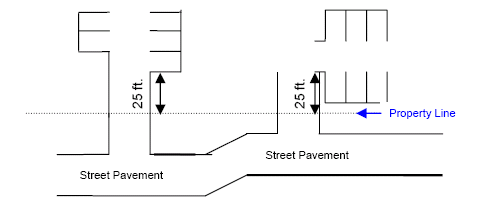
When a row of parking stalls is immediately adjacent to a right-of-way, a minimum stacking area of twenty-five (25) feet is required between the property line and the entrance to the first stall. See Figure 18-1532-1, below.
FIGURE 18-1532-1 MINIMUM STACKING AREA ADJACENT TO RIGHT-OF-WAY
7.
When a gate is installed along a right-of-way, the following minimum setbacks are required:
a.
Along a City road, there shall be a minimum twenty-five (25) foot setback from the property line.
b.
When a gate is proposed to be installed along any Pinellas County roadway, Pinellas County approval and a Pinellas County utilization permit are required.
c.
When a gate is proposed to be installed along any Florida Department of Transportation (FDOT) roadway, FDOT approval and an FDOT permit are required.
8.
Dead-end parking aisles are prohibited, except where a double-loaded dead-end aisle serves fewer than twenty-one (21) parking spaces and a turnaround area is provided that will accommodate a three (3) point turnaround, or where the number of parking spaces in the double-loaded dead-end aisle is ten (10) or fewer (AASHTO "P" Design Vehicle).
(E)
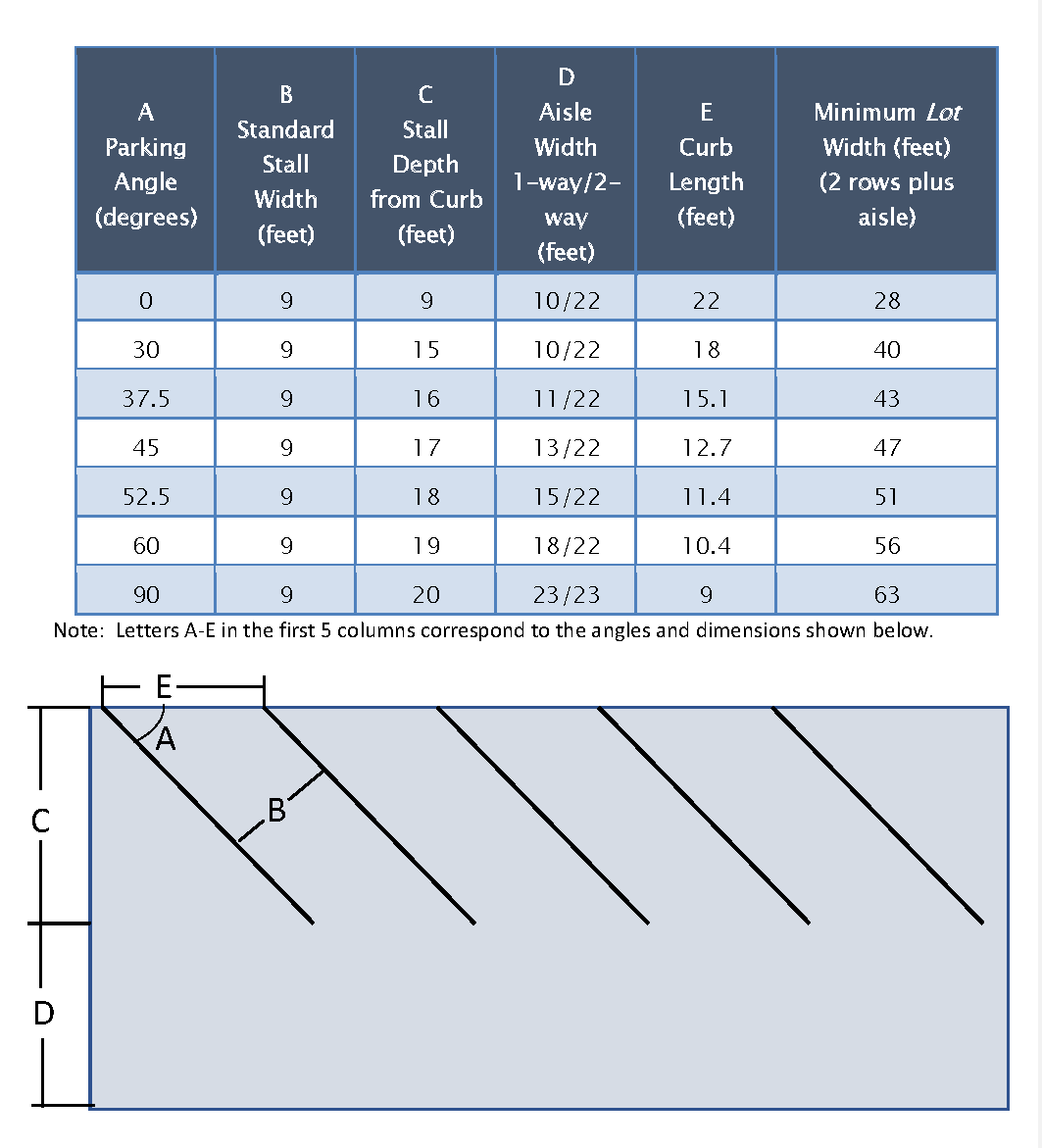
ADDITIONAL CONSIDERATIONS FOR ANGLED PARKING SCHEMES. The following dimensions shall be utilized for the development of angled (less than ninety (90) degrees) spaces. Other layout arrangements (herringbone, hybrids) may be approved provided they meet common industry standards.
(F)
SIGNAGE AND MARKINGS. Traffic control signs and delineation and other pavement markings shall be used as necessary to ensure safe and efficient traffic operation of parking areas. All parking spaces shall be delineated by painted lines, curbs, and/or other means to indicate individual spaces. Please reference the MUTCD (Manual of Uniform Traffic Control Devices) for guidance.
1.
Emergency vehicle access requirements. When necessary for adequate accessibility for fire protection purposes, emergency access for fire rescue apparatus, equipment and operations shall conform to the requirements of the Florida Fire Prevention Code.
(G)
ATTENDANT PARKING. In the case of buildings wherein the owner supplies and maintains the services of attendants to receive, park and deliver the automobile of occupants, tenants, customers and visitors, with or without charge, the required minimum width of each parking space shall be eight and one-half (8½) feet. All spaces need not be directly accessible provided for any parking space to be accessible, no more than two (2) spaces may be crossed into when parking a motor vehicle. Such reductions in parking space width and change in accessibility shall be authorized under the following conditions:
1.
Permission for such attendant parking shall be evidenced by the recordation of an attendant off-street parking agreement, showing the required attendant parking spaces to be maintained, which restriction shall be deemed a covenant running with the land.
2.
After completed construction based upon approved plans and specifications providing for such attendant parking, areas designated for attendant parking shall not be used without providing the service of attendants.
(H)
LIGHTING. Lighting shall be provided and maintained in accordance with Section 18-1503.15, "Illumination".
(I)
VISIBILITY TRIANGLE. At no time shall a vehicular parking space be located within the visibility triangle as defined in Section 18-1503.11, 'General Provisions."
(Ord. No. 3748, § 3, 10-28-2010; Ord. No. 4079, § 1(Att. A)115., 3-14-2019; Ord. No. 4218, § 1, 10-26-2023)
Sec. 18-1532.7. - VEHICULAR STACKING SPACES AND DRIVE-THRU LANES.
(A)
A vehicular stacking space is a space measuring twenty (20) feet in length and at least ten (10) feet in width located within a VUA. Stacking spaces shall be specifically reserved and demarcated through curbing or pavement markings, as well as one-way entrance signage, as one (1) or more separate and distinct lane(s), for the temporary stopping of a vehicle awaiting service as provided in this section, and shall not be designed or used for, nor interfere with, any other purpose including, but not limited to, site circulation, parking, and loading.
(B)
A separate and distinct on-site escape lane, ten (10) feet wide, shall be provided to allow motorists to bypass drive-thru service lane(s).
(C)
All inbound spaces are measured rearward from the front of the first stopping point at a service position, and all outbound spaces are measured forward from the front of last stopping point at a service position.
(D)
Each stacking space shall be clearly defined on the site plan.
(E)
In order to minimize traffic congestion, a minimum queuing lane of eighty (80) feet shall be provided between the street line at the principal point of entrance and the last drive-thru service window. Access and queuing plans shall be approved by the Traffic Division Director.
(Ord. No. 3748, § 3, 10-28-2010)
Sec. 18-1532.8. - PARKING GARAGES.
Parking facilities on more than one (1) level shall be designed in accordance with the standards set forth in this article for grade-level parking facilities, insofar as they are applicable. Parking garages shall be considered an accessory use to the principal use it serves unless the garage is used for area-wide public parking. Construction of parking garage facilities may be phased, when such phasing is approved by the City.
(A)
The City shall consider the following issues when reviewing an application for development approval which includes a parking garage, utilizing the standards and principles set forth in this Section:
1.
Vehicular and pedestrian orientation and circulation;
2.
Safety and convenience of ingress and egress;
3.
Effectiveness of landscaping proposed for the structure at reducing the perception of bulk, enhancing the facade, screening the view of parked cars and internal views of the structure; and tying in with other landscape materials used on site to the extent applicable;
4.
Effectiveness of landscaping, screening and buffering from adjacent single-family and duplex residential zoning districts and uses;
5.
Lighting;
6.
Appearance and architectural treatments to minimize visual impacts, including the use of false facades, liner buildings, or opaque or substantially opaque screening along the perimeter of such structures to conceal parked vehicles from public view.
7.
Compatibility with adjacent structures, including mass and bulk of structure.
(Ord. No. 3748, § 3, 10-28-2010)
Sec. 18-1532.9. - MINIMUM OFF-STREET PARKING SPACE REQUIREMENTS.
All parking standards based upon floor area (ex: one (1) space per xxx SF of GFA) shall be calculated including fractions thereof. For example, a requirement for one (1) per 200 SF of GFA shall mean, one space per 200 SF of GFA, or fraction thereof.
(A)
RESIDENTIAL.
1.
SINGLE-FAMILY DWELLINGS. All single-family detached dwellings which are permitted for construction after November 13, 1986 shall be required to provide two (2) off-street parking spaces for each dwelling unit. Such off-street parking spaces shall adhere to the following:
(a)
Be paved with either asphalt, concrete or other suitable material as may be approved by the City Engineer, based upon sound engineering practices.
(b)
Notwithstanding the provisions of Section 18-504(A), where a single-family detached dwelling has a driveway to an arterial or collector street, an on-site vehicular turn around area or circular drive shall be required.
2.
DUPLEX AND SINGLE-FAMILY ATTACHED DWELLINGS. Two (2) per dwelling unit.
3.
MULTI-FAMILY DWELLINGS.
a.
Efficiency units: One (1) per dwelling unit.
b.
Studio and one-bedroom units: One and one-half (1.5) per dwelling unit.
c.
Two- or three-bedroom units: Two (2) per dwelling unit.
d.
Four- or more bedroom units: Three (3) per dwelling unit.
4.
RESIDENTIAL PUD. For purposes of this Section, all residential units within a Residential Planned Unit Development, the Master Plan for which was approved by City Council prior to November 13, 1986, shall be deemed to have been permitted for construction prior to November 13, 1986.
5.
MANUFACTURED HOMES. Two (2) per dwelling unit.
6.
MANUFACTURED HOME PARKS. One and one-half (1.5) per dwelling unit. Off-street parking may be provided in common parking areas or on individual home lots.
(B)
COMMERCIAL/BUSINESS USES.
1.
Repair Services: One (1) per four hundred (400) SF of GFA.
2.
Data Processing and Call Centers: One (1) per two hundred (200) SF of GFA.
3.
Office, Medical: one (1) per two hundred fifty (250) SF of GFA.
4.
Office, General:
(a)
Less than or equal to twenty-five thousand (25,000) SF of GFA: One (1) per three hundred (300) SF of GFA.
(b)
Greater than twenty-five thousand (25,000) to one hundred thousand (100,000) SF of GFA: One (1) per three hundred twenty-five (325) SF of GFA.
(c)
Greater than one hundred thousand (100,000) up to five hundred thousand (500,000) SF of GFA: One (1) per three hundred fifty (350) SF of GFA.
(d)
Above five hundred thousand (500,000) SF of GFA: One (1) per three hundred seventy-five (375) SF of GFA.
5.
Personal Services (unless otherwise required for specific uses, below): One (1) per three hundred (300) SF of GFA.
(a)
Dry Cleaner: Two (2), plus one (1) per four hundred (400) SF of GFA above one thousand (1,000) SF of GFA.
(b)
Beauty Salons, Hairstylists, Nail Salons: The higher of one (1) per three hundred (300) SF of GFA, or two (2) per haircutting/nail/manicure/pedicure/massage therapy or spa-type station.
6.
Freestanding Retail Sales: One (1) per three hundred (300) SF of GFA.
7.
Grocery Store (free standing): One (1) per three hundred (300) SF of GFA.
8.
Convenience Store: One (1) per two hundred (200) SF of GFA, provided that when combined with motor fuel pumps, the requirement shall be one (1) per two hundred fifty (250) SF of GFA.
9.
Shopping Centers.
(a)
For shopping centers under fifty thousand (50,000) SF of GFA, the freestanding retail standard applies. Restaurant, entertainment and other uses with higher parking requirements than shopping centers shall be calculated separately unless parking is provided at one (1) per two hundred fifty (250) SF of GFA.
(b)
For shopping centers between fifty thousand (50,000) and four hundred thousand (400,000) SF of GFA: One (1) per two hundred fifty (250) SF of GFA for the first fifty thousand (50,000) SF of GFA then one (1) per two hundred twenty-five (225) SF of GFA up to two hundred thousand (200,000) GFA and one (1) per two hundred fifty (250) SF up to four hundred thousand (400,000) GFA inclusive of all uses except movie theatre which shall be calculated separately.
(c)
Greater than four hundred thousand (400,000) SF of GFA: The above calculations then one (1) per three hundred fifty (350) SF of GFA above four hundred thousand (400,000) GFA inclusive of all allowable uses except movie theatre, will shall be calculated separately.
10.
Adult Entertainment Establishments: One (1) per fifty (50) SF of GFA.
11.
Sale and Rental of Automobiles, Manufactured Homes, Boats, Recreational Vehicles, and other Vehicles: One (1) per five hundred (500) SF of enclosed sales/rental GFA, plus two (2) per service bay. Customer parking for open sales/rental area shall require one (1) off-street parking space for each two thousand (2,000) square feet of outdoor sales and/or rental area.
12.
Automobile Service Station or Repair Facility: Two and one-half (2.5) per service bay, in addition to required parking for other principal uses such as retail.
13.
Automotive Fuel Pumps/Sales (standalone): One (1) space per pump.
14.
Taverns and Lounges: One (1) per two hundred fifty (250) SF of GFA.
15.
Car Wash, Self-Service: One (1) stacking space per bay.
16.
Car Wash, Full-Service (principal use): One (1) per employee on the largest shift, or three (3) per wash bay and detailing station, whichever results in a greater parking requirement.
17.
Carpet, Flooring and Furniture Sales: One (1) per seven hundred fifty (750) SF of GFA, or five (5) spaces, whichever is greater.
18.
Medical Clinic: See "Office, Medical".
19.
Veterinarian, Animal Hospital: Three (3) per veterinarian on staff, but not less than one (1) per three hundred (300) SF of GFA.
20.
Kennel (not part of an animal hospital or veterinarian office): One (1) per six hundred (600) SF of GFA.
21.
Financial Institutions: One (1) per two hundred (200) SF of GFA.
22.
Funeral Chapel, Funeral Homes, Mortuaries, Crematoriums: One (1) per three (3) seats of each chapel, plus one (1) per three hundred (300) SF of GFA of office/administrative area.
23.
Health Clubs: One (1) per two hundred (200) SF of GFA.
24.
Hotels, Motels: One (1) per guest room or suite plus (1) per three (3) seats for any restaurant, lounge and/or convention center that is part of the hotel or motel.
25.
Indoor Recreation Facilities.
(a)
Bowling alley: Four (4) per lane plus 1:100 SF of net floor area for game rooms plus 1:3 seats for ancillary food or drink service areas.
(b)
Skating rink/pool hall: 1:3 persons based upon assembly capacity as determined by the Florida Building Code.
26.
Outdoor Recreation Facilities: 1:3 patrons.
27.
Launderettes: One per two (2) washing machines.
28.
Home Improvement Establishments: One (1) per three hundred (300) SF of enclosed GFA, plus one (1) per thousand (1,000) SF of unenclosed retail GFA.
29.
Plant Nurseries, Garden Centers: One (1) per three hundred (300) SF of enclosed retail sales GFA, plus one (1) per thousand (1,000) SF of unenclosed retail GFA or five (5) spaces; whichever results in a greater parking requirement.
30.
Restaurants and Cafeterias: One (1) per three (3) seats or one (1) per hundred (100) SF of GFA, whichever results in a greater parking requirement.
31.
Restaurant, Drive-Thru: One (1) per three (3) seats, or one (1) per hundred (100) SF of GFA; whichever results in a greater parking requirement.
32.
Service Establishments (i.e. carpet cleaning, maid service, delivery service): One (1) per three hundred (300) SF of GFA plus one (1) per business (service, delivery etc.) vehicle stored on the lot.
33.
Studios for Dance, Photography, Music, Etc.: One (1) per two hundred (200) SF of gross instruction area.
34.
Taxi, Limousine Service: One (1) per employee on the largest working shift, plus one (1) per vehicle used in connection with the business; or, one (1) per three hundred (300) SF of GFA; whichever results in a greater parking requirement.
35.
Breweries: One (1) per two hundred fifty (250) SF of GFA used as a taproom, plus one (1) per one thousand (1,000) SF of all other GFA.
36.
Brewpubs: One (1) per two hundred fifty (250) SF of GFA.
37.
Microbreweries: One (1) per two hundred fifty (250) SF of GFA used as a lounge, restaurant, taproom or tavern, plus one (1) per one thousand (1,000) SF of all other GFA.
38.
Package Sales: One (1) per two hundred fifty (250) SF of GFA.
39.
Rural Event Venues: One (1) per three (3) seats. Maximum venue capacity shall be used to determine overall seat count.
40.
Fitness Classes: One (1) per two hundred (200) SF of GFA or by approval of the Planning and Development Services Director.
(C)
PUBLIC/SEMI-PUBLIC USES.
1.
Trade or Vocational Institutions: One (1) space per three (3) students (design capacity) plus one (1) per two (2) employees, plus one (1) per three hundred (300) SF of any office or clerical area.
2.
Day Care Center or Facility (Adult or Child), Public and Private: One (1) space per employee plus one (1) space per three hundred (300) square feet GFA, OR one (1) space per ten (10) children, whichever results in a greater parking requirement.
3.
Government Offices and Service Facilities: One (1) per two hundred (200) SF of GFA, plus one (1) per four (4) seats in any public assembly room or facility, plus one (1) per government vehicle normally parked or stored at that facility.
4.
Hospitals: Seven and one-half (7.5) per patient bed, or one (1) per employee (all shifts), whichever results in a greater number of required spaces.
5.
Library, Museum: One (1) per two hundred (200) SF of GFA.
6.
Schools.
(a)
Elementary, Junior or Middle: Two (2) per classroom plus one (1) per five (5) seats in any assembly area.
(b)
Senior: Five (5) per classroom and study area and one (1) per five (5) seats in any assembly area.
(c)
College, Junior College: One (1) space per five hundred (500) square feet of academic space plus one (1) per two (2) employees plus one (1) per three (3) seats in any auditorium, gymnasium or assembly area.
7.
Place of Worship: One (1) per three (3) seats of congregational seating area.
8.
Private Civic Fraternal Club or Lodge: One (1) per two hundred (200) SF of GFA, or one (1) per three (3) seats of the aggregate of the seating capacity for all rooms, including meeting rooms, lounges, restaurants, etc. as determined by the Florida Fire Prevention Code; whichever results in a greater parking requirement. If the private or civic fraternal club or lodge has a swimming pool, there shall be one (1) additional space per fifty (50) SF of pool area surface.
9.
Residential Care Facilities: Four-tenths (0.4) per assisted living apartment unit and one (1) per bed in non-assisted living units, or one (1) per hundred (100) SF of GFA (excluding assisted living apartments), whichever results in a greater parking requirement.
10.
Special Needs Treatment Facility: One (1) per bed or one (1) per hundred (100) SF of GFA, whichever results in a greater parking requirement.
11.
Theatres, Stadiums, Auditoriums, and Performing Arts Centers: One (1) per three (3) seats, plus one per two (2) employees on the largest shift, plus ten (10) spaces.
(D)
INDUSTRIAL AND MANUFACTURING USES.
1.
Manufacturing: One (1) per seven hundred fifty (750) SF of GFA.
2.
Mini-Warehousing: One (1) per fifty (50) storage units plus two (2) for the Manager's Office, if office is provided.
3.
Outdoor Storage. One (1) per ten thousand (10,000) SF of Storage and one (1) per three hundred (300) SF of accessory Office space.
4.
Warehousing: One (1) per seven hundred fifty (750) SF of GFA.
5.
Wholesale: One (1) per two hundred (200) SF of office and accessory retail sales GFA and one (1) per thousand (1,000) SF of merchandise storage GFA.
6.
Industrial Parks: (Containing a minimum of ten (10) acres).
(a)
One (1) per five hundred (500) SF of GFA.
(b)
The Zoning Director may require a different rate based upon the proposed or expected mix of uses.
(E)
MIXED-USE (SEE SHARED PARKING).
(F)
OTHER.
1.
Utilities, Telecommunication Towers: One (1) per telecommunication tower or other utility installation.
(Ord. No. 3748, § 3, 10-28-2010; Ord. No. 4079, § 1(Att. A)116., 3-14-2019; Ord. No. 4106, §§ 20, 21, 3-12-2020; Ord. No. 4107, § 10, 3-12-2020; Ord. No. 4205, § 24, 7-27-2023; Ord. No. 4255, § 6, 6-27-2024; Ord. No. 4280, § 11, 1-9-2025; Ord. No. 2025-13, § 5, 3-27-2025)
Sec. 18-1532.10. - OFF-STREET LOADING SPACE REQUIREMENTS.
(A)
OFF-STREET LOADING REQUIRED. Except as otherwise provided in this Section, when any building that is erected, structurally altered to the extent of increasing the floor area by fifty (50) percent or more, or converted in use, accessory off-street loading spaces shall be provided where required in accordance with Subsection (B) below.
(B)
Any commercial or industrial building, including retail, restaurant, wholesale, warehouse, repair, general service, manufacturing, industrial or other use, but excluding office use, having ten thousand (10,000) SF of GFA or greater, and requiring the receipt and distribution by vehicles of materials and merchandise, shall have at least one (1) permanently maintained off-street parking/loading space for the first ten thousand (10,000) SF of GFA and one (1) additional permanently maintained parking/loading space for each additional twenty thousand (20,000) SF of GFA.
(C)
Uses that require specialized loading areas for the purpose of discharging and accepting passengers shall demonstrate the adequacy of the loading and unloading spaces designated for this purpose, including but not limited to, hospital emergency rooms (ambulances) and schools (school buses).
(D)
The City may waive the requirement for a loading zone if the developer/owner submits approvable plans and stipulates in a form acceptable to the City Attorney, that no portion of such building in excess of ten thousand (10,000) SF of GFA shall at any time be used for any single business activity.
(E)
To insure conformance with this provision, the City Building Official shall file a copy of said document under the license address file of the subject building and not issue any new licenses or business tax receipts for any business in excess of ten thousand (10,000) SF of GFA at said address unless provisions for adequate off-street loading space have been secured.
(F)
DIMENSIONS. Each off-street parking/loading space shall have a minimum length of twenty-five (25) feet which shall be increased to and fifty-five (55) feet when required to accommodate tractor-trailers; minimum width of, twelve (12) feet; and minimum vertical clearance of fourteen (14) feet.
(G)
DESIGN. Off-street loading spaces shall be located so as not to hinder the movement of vehicles and pedestrians over a sidewalk, street or alley.
(H)
Any commercial or industrial building with less than ten thousand (10,000) SF of GFA shall provide sufficient receiving space on the property, as determined through site plan review, so as not to hinder the movement of vehicles and pedestrians over a sidewalk, street, or alley.
(I)
Off-street loading facilities in areas zoned M-1 or IH shall not be located directly across the street from any residential district.
(Ord. No. 3748, § 3, 10-28-2010)

