
Pinellas Park City Zoning Code
SECTION 18
1503.- GENERAL PROVISIONS
Sec. 18-1503.1.- PURPOSE.
This Section contains provisions that apply to all zoning districts, buildings and uses. Regulations that apply to particular uses (ex: seasonal sales, outdoor storage, animal waste storage and disposal), structures (ex: antennas, dumpsters, accessory structures, portable storage units) or zoning districts, are found in Section 18-1530, "Accessory Use And Supplementary District Regulations."
(Ord. No. 3748, § 3, 10-28-2010)
Sec. 18-1503.2. - PERMITS REQUIRED.
(A)
No building or other structure, nor any improvement that creates or expands an impervious surface, shall be erected, moved, added to, or structurally altered without a City permit therefore.
(B)
No City permit shall be issued except in conformity with the provisions of this Article.
(C)
No clearing, grubbing, grading, excavation, paving, or filling of land or water shall occur unless a City permit has been issued therefore.
(Ord. No. 3748, § 3, 10-28-2010)
Sec. 18-1503.3. - CONFORMITY WITH APPROVED PLANS REQUIRED.
All lots shall be developed, maintained, and used, when applicable to the development approval, in accordance with the approved site plan, building permit plans and any other City-approved plans.
(Ord. No. 3748, § 3, 10-28-2010; Ord. No. 4079, § 1(Att. A)6., 3-14-2019)
Sec. 18-1503.4. - LOTS, YARDS AND OPEN SPACE, GENERALLY.
No lot area or dimension shall be reduced or diminished so that the lot, yards, open spaces or other dimensional requirement shall be smaller than prescribed by this Article, nor shall the density of population, impervious area, building coverage or bulk be increased in any manner, except in conformity with the regulations established herein. No space which has been counted or calculated as part of a lot, yard or other open space required by this Article for any building may be counted or calculated to satisfy or comply with a lot, yard or other open space requirement of, or for, any other building.
(Ord. No. 3748, § 3, 10-28-2010)
Sec. 18-1503.5. - DIVISION OF LOTS/UNITY OF TITLE DOCUMENTS.
(A)
No lot improved with a building or buildings shall hereafter be divided into two (2) or more lots, and no portion of any lot shall be divided or sold separately from the entirety of the lot, unless all lots and improvements thereon, following any division or sale, shall conform with all the regulations of the zoning district in which the property is located.
(B)
The City may require owners of developed lots comprising: 1) more than one (1) lot of record; or 2) one (1) lot of record large enough to be subdivided in compliance with minimum required lot area and dimensions of this Article, to execute a "Lot Line Adjustment" or "Unity of Title" document pursuant to Section 18-101.5 of the Land Development Code, which shall be recorded through the City Clerk's Office. This shall be required when the City Manager determines it to be necessary in order to ensure that the lot(s) shall not subsequently be subdivided, transferred, conveyed or sold in any manner that creates or exacerbates a violation of the provisions of this Article.
(C)
The recorded document required above shall stipulate that a lot or lots shall be held under single ownership, shall not be eligible for further subdivision and shall not be transferred, conveyed, sold or divided in any unit other than in its entirety. If a lot or lots are controlled by a Unity of Title, the City Manager may release the Unity of Title for justified cause. In any case where a waiver or variance, other than an administrative exception, of any provision of Chapter 18 would be necessary prior to release of the Unity of Title, then City Council shall approve or deny the release of the recorded Unity of Title. Lot(s) that are controlled by a Unity of Title document may be subdivided if the Unity of title is released and all requirements of this Article are met.
(Ord. No. 3748, § 3, 10-28-2010; Ord. No. 4079, § 1(Att. A)7., 3-14-2019)
Sec. 18-1503.6. - USES TO BE CONDUCTED WITHIN ENCLOSED BUILDINGS.
All uses shall be conducted entirely within a completely enclosed building unless the City Manager determines that the use is customarily conducted outdoors. Customary outdoor uses include, but are not limited to, farming, produce stands, outdoor cafes, drive-thru functions, outdoor recreation, cemeteries, salvage yards, vehicle parking and storage, automobile dealer displays, stadiums, fuel oil storage and distribution, car washes, retail sale of automotive fuel, public utility infrastructure, certain special outdoor events such as carnivals, shows and promotions, and drive-in theaters.
(Ord. No. 3748, § 3, 10-28-2010; Ord. No. 4079, § 1(Att. A)8., 3-14-2019)
Sec. 18-1503.7. - YARD DETERMINATIONS.
(A)
CORNER LOTS. A front yard shall be maintained on one (1) street frontage, and a secondary front yard on the intersecting street frontage. All other boundaries shall be considered side yards. Where the provisions of Section 18-1504.4 "Nonconforming Lots" apply, certain lots may qualify for lesser setbacks as provided for in district regulations.
(B)
DOUBLE FRONTAGE LOT (THROUGH LOT). For commercial, industrial, mixed-use, public and multi-family zoning districts, a front yard shall be maintained on both frontages as provided in the district regulations. For single-family residential zoning districts, in keeping with the prevailing development pattern, a front yard shall be maintained on one (1) street frontage, and a rear yard on the second street frontage (opposite of what has been determined to be the front yard).
(C)
MULTIPLE FRONTAGE LOTS. For commercial, industrial, mixed-use, public and multi-family zoning districts, a front yard shall be maintained on all frontages as provided in district regulations. For single-family residential zoning, in keeping with the prevailing development pattern, a front yard shall be maintained on one (1) street frontage, a secondary front yard on the intersecting street frontage, and a rear yard on the third street frontage (opposite of what has been determined to be the front yard).
(D)
LOTS ABUTTING WATER BODIES. Where a drainage canal, detention pond, or other similar water body is located in a right-of-way, and the right-of-way is not used for public access, the required setback from the property line abutting that right-of-way shall be the interior side yard setback as provided in district regulations, or a minimum setback of ten (10) feet, whichever is greater.
(E)
ADMINISTRATIVE DETERMINATION. In cases where the determination is unclear because of orientation or other lot or structural attribute, the Zoning Director shall determine the required yards.
(Ord. No. 3748, § 3, 10-28-2010)
Sec. 18-1503.8. - MEASUREMENTS OF YARD SETBACKS ON LOTS ADJACENT TO RIGHTS-OF-WAY OF INSUFFICIENT WIDTH.
(A)
In any case where a proposed or existing lot abuts a planned or existing right-of-way which does not yet have the full dedicated right-of-way width as presented in Article 1, Subdivision Code, the Comprehensive Plan, a City Thoroughfare Plan, or as required by another governmental agency having jurisdiction over the right-of-way, the yard setbacks for such properties for all improvements, including but not limited to buildings, structures, signs, landscaping, drainage ponds, and buffers, shall be measured from the ultimate right-of-way lines. This requirement shall not apply to developed parcels on existing local streets where the Future Traffic Circulation Plan does not indicate a change of functional classification to a higher classification that also requires a greater right-of-way width and the requirements of Section 18-105.5(A), (C) and (D) do not apply.
(B)
An applicant may request a waiver of a City right-of-way width requirement by making written application for a waiver to the Zoning Director. The Zoning Director shall then prepare a report, advertise the request consistent with procedures enumerated at Section 18-1534 Public Notice Requirements and schedule a public hearing before City Council. The City Council shall grant or deny the application based on the following factors:
1.
The impact that the applicant's proposal would have on the existing and proposed right-of-way in the area;
2.
The location of the applicant's property;
3.
Traffic patterns in the area;
4.
The character and age of the neighborhood; and
5.
Any other factor that is relevant and material to the waiver request.
In granting such waivers, the City Council shall find that such waiver will not be contrary to the public interest and may prescribe appropriate conditions and safeguards. A violation of such conditions and safeguards shall be deemed a violation of this Article. If the waiver is denied, the City Council may authorize modifications to lot development standards to mitigate lost development potential resulting from additional setback requirements.
(Ord. No. 3748, § 3, 10-28-2010; Ord. No. 4079, § 1(Att. A)9., 3-14-2019)
Sec. 18-1503.9. - PERMITTED OBSTRUCTIONS IN REQUIRED SETBACKS.
Obstructions shall be permitted in any required setback as specified below; however, in no case shall any obstruction interfere with the visibility triangle as defined in Section 18-1502.2, "Definitions", or be located within a public or private right-of-way. See also, Section 18-1530.4, "Swimming Pools."
(A)
ALL SETBACKS. Permitted obstructions shall be limited to a maximum projection from a building of three (3) feet into any required yard, unless otherwise stated below.
1.
Arbors and trellises may project over a required yard to within five (5) feet of the property line.
2.
Awnings and canopies.
3.
Chimneys attached to a dwelling.
4.
Flag poles and garden ornaments.
5.
Steps or concrete walkways, which are necessary to provide access to the first floor of a building, or for access to a lot from a street or alley.
6.
Overhanging eaves or cornices (may project into an easement).
7.
Driveways, decks, patios, walkways or other impervious surfaces less than six (6) inches above finished grade and open to the sky may project to within five (5) feet of the property line.
8.
Handicap ramps, including vertical guard rails, meeting the requirements of the Florida Building Code, may project over the required yard.
9.
Recreational and children's playground equipment, excluding skateboard ramps, may occupy a required yard.
10.
Paved vehicular connections, up to twenty (20) feet in width, between commercial or industrial properties may cross property lines for the movement of people or goods from one structure to another without the necessity of a setback variance. In planning such connections, applicants shall demonstrate that drainage plans remain viable for the subject properties and that impervious surface ratios remain within regulatory limits. As part of the engineering permit required to construct such connection, applicants shall also submit to the Zoning Director revised final site plans for all connected properties reflecting resultant increases of impervious surface and any other controlling site data quantity. Said connection shall not be considered vehicular use area for determining landscape requirements under Section 18-1533.17 of this Land Development Code.
11.
Shared driveways approved in accordance with Article 5 of the Land Development Code may encroach on side setback lines.
(B)
FRONT SETBACKS. Permitted obstructions shall be limited to a maximum projection from a building of three (3) feet into any required front setback, unless otherwise stated below.
1.
One-story bay windows.
2.
Second story balconies may project from a building not more than five (5) feet over the required yard.
3.
Decks more than six (6) inches above grade and open to the sky may extend not more than five (5) feet over the required yard.
(C)
SIDE SETBACKS. Permitted obstructions shall be limited to a projection of three (3) feet into any required side setback, unless otherwise stated below.
1.
Second or higher story balconies.
2.
Sidewalks and walkways may be located within one (1) foot of a property line.
(D)
REAR SETBACKS AND SECONDARY FRONT SETBACKS. Permitted obstructions shall be limited to a maximum projection from a building of three (3) feet into any required rear or secondary front setback, unless otherwise stated below.
1.
Second or higher story balconies may project not more than five (5) feet over the required setback.
2.
One-story bay windows.
3.
Decks more than six (6) inches above grade and open to the sky may project not more than five (5) feet over the required setback.
4.
Airconditioners, heat pumps, pool pumps and similar equipment including supporting slabs may project not more than four (4) feet over the required rear setback.
(Ord. No. 3748, § 3, 10-28-2010; Ord. No. 3865, § 1, 10-10-2013; Ord. No. 4079, § 1(Att. A)10., 3-14-2019; Ord. No. 4107, § 8, 3-12-2020)
Sec. 18-1503.10. - RESERVED.
Editor's note— Ord. No. 4079, § 1(Att. A)11., adopted March 14, 2019, moved the provisions formerly set out in this section to subsection 18-1504.3(G)4. The historical notation remains with the renumbered provisions.
Sec. 18-1503.11. - VISIBILITY TRIANGLE.
(A)
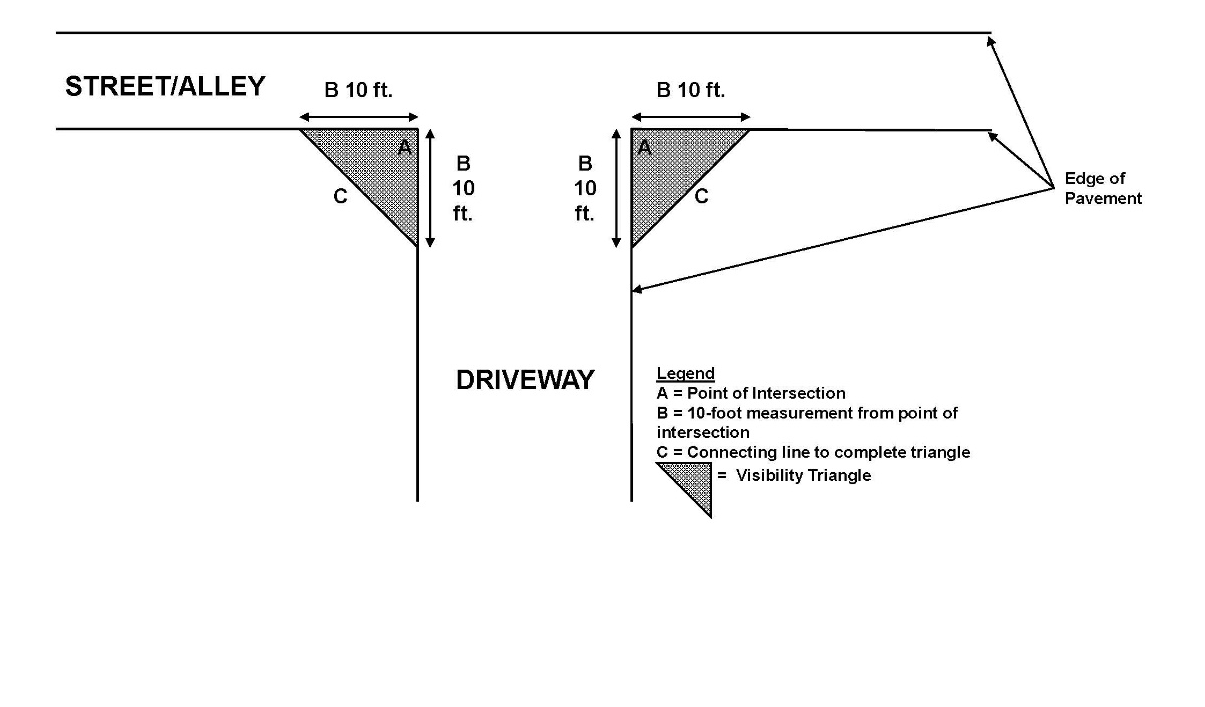
PURPOSE AND INTENT. The objective of these requirements is to provide sufficient view corridors for safe interaction of vehicles, pedestrians and cyclists at intersections. Visibility triangles are to be measured from the edge of pavement for driveways and the edge of pavement of alleys and streets. The sight visibility areas apply to all potential visual obstructions, such as but not limited to, landscaping, signs, utilities, traffic signal controller cabinets, structures, walls and fences, etc. The following regulations shall apply to all zoning districts.
(B)
VISIBILITY TRIANGLE MEASUREMENTS.
1.
DRIVEWAY INTERSECTING STREET OR ALLEY. The triangle is formed on both sides of a driveway by the intersection of a driveway with a private or public street or alley with a length of ten (10) feet along the driveway, a length of ten (10) feet along the edge of pavement of the private or public street or alley and the third side being a line connecting the ends of the other two (2) lines.
2.
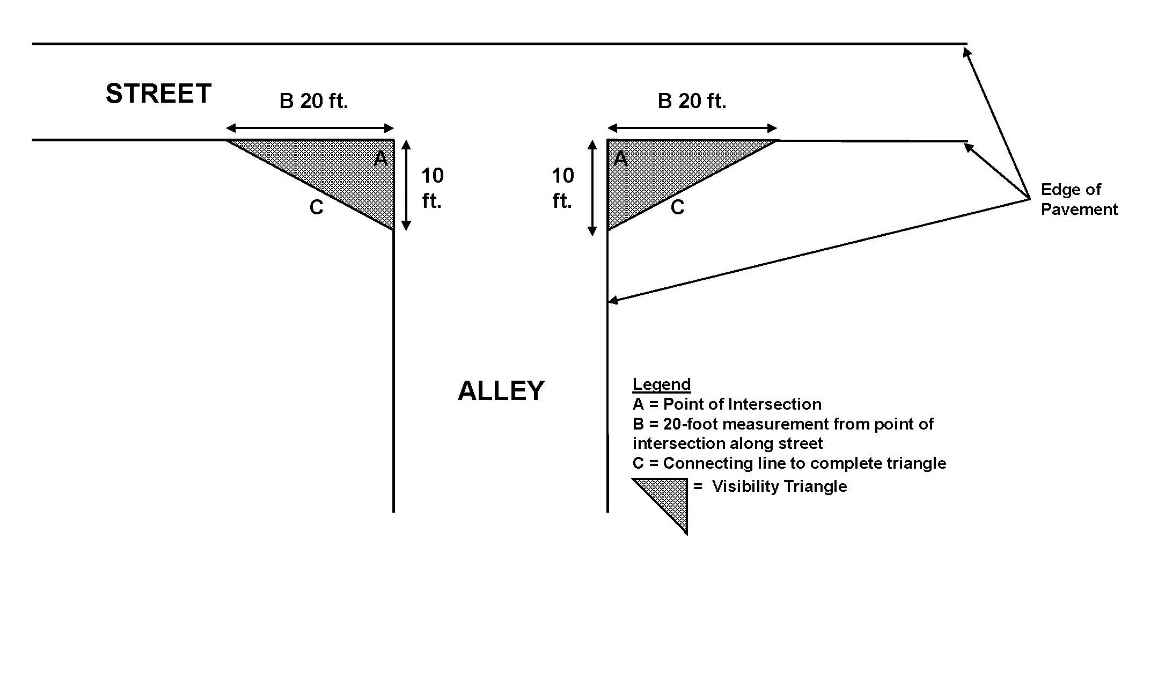
ALLEY INTERSECTING STREET. The triangle is formed by the intersection of a private or public alley and a private or public street with a length of ten (10) feet along the edge of pavement of the alley, a length of twenty (20) feet along the edge of pavement of the street, and the third side being a line connecting the ends of the other two (2) lines.
3.
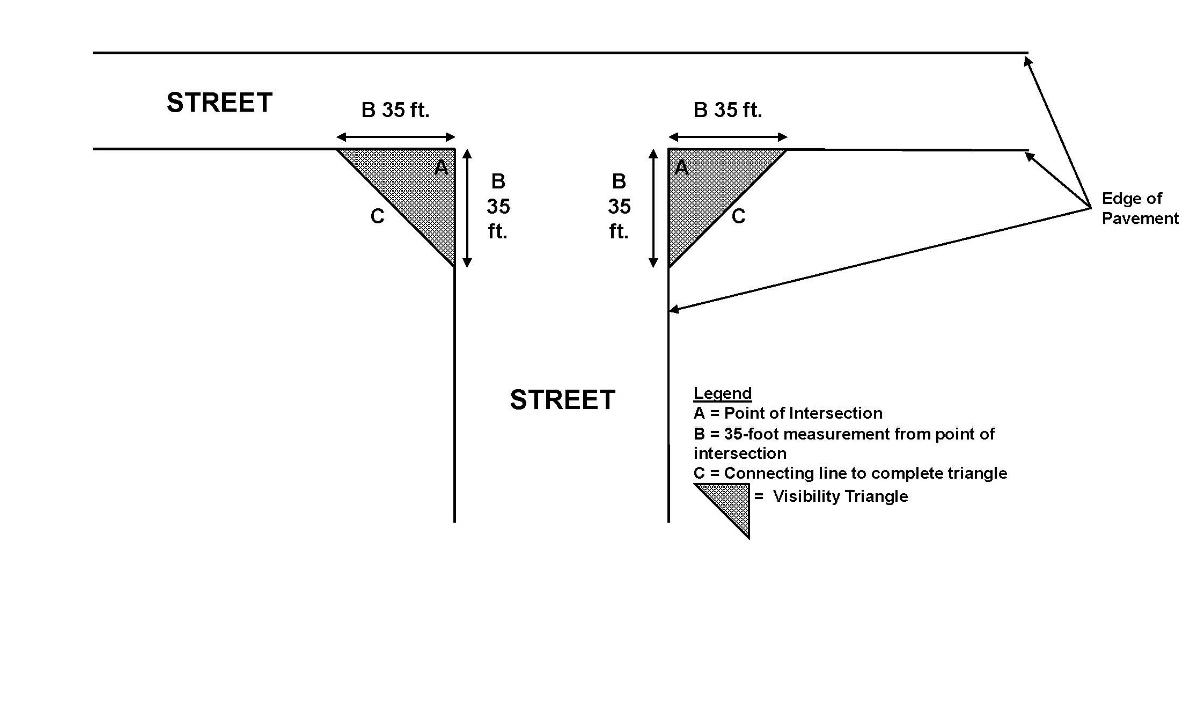
INTERSECTING RIGHTS-OF-WAY. The triangle is formed by the intersection of two (2) or more private or public rights-of-way with two (2) sides of the triangular area being thirty-five (35) feet in length along the edge of pavement of the street, measured from their point of intersection, and the third side being a line connecting the ends of the other two (2) lines.
4.
RIGHTS-OF-WAY IN COUNTY OR STATE JURISDICTION. Visibility Triangle measurements at the intersection of a right-of-way, accessway, or driveway and a right-of-way under County or State jurisdiction are subject to the visibility requirements of those authorities.
5.
PRIVATE RIGHTS-OF-WAY IN SUBDIVISIONS SUBJECT TO HOMEOWNERS' ASSOCIATION (HOA) OR PROPERTY OWNERS' ASSOCIATION (POA) RESTRICTIONS. Visibility Triangle measurements at the intersection of a private right-of-way, accessway, or driveway and a private right-of-way under HOA or POA jurisdiction are also subject to the visibility requirements of those authorities.
6.
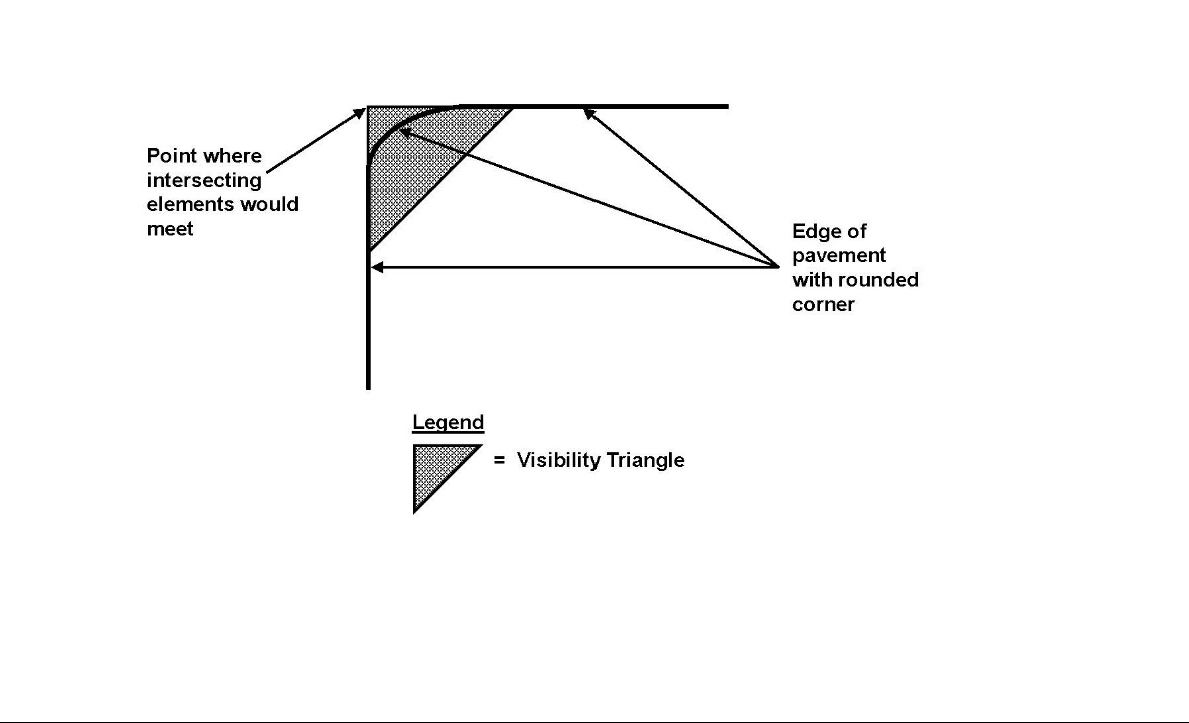
In the case of rounded corners and driveway flares, the point at which the intersecting elements would meet without such rounding or flares shall be used in order to perform the above visibility triangle measurements.
(C)
INTERSECTIONS. Unobstructed cross-visibility at a level between two (2) feet and eight (8) feet in height above the crown of the lowest adjacent right-of-way shall be maintained within the visibility triangle. Trees or palms having canopy limbs, foliage and fronds shall be maintained in such a manner that cross visibility is provided.
(D)
EXCEPTIONS. The Planning and Development Services Director may adjust or waive the requirements for visibility triangles on a case-by-case basis. The review shall take into consideration the following criteria:
1.
Right-of-way characteristics such as the pavement width, width of the right-of-way, curvature of the street, one-way directional traffic, presence of on-street parking spaces, amount of traffic, speed limit and other similar elements;
2.
Neighborhood characteristics such as locations of schools, parks and other public facilities;
3.
Elevation difference between the street and adjacent lots;
4.
Life safety concerns;
5.
Exceptions to reduce the measurement at an intersection shall only be considered when the intersection is controlled by a four-way stop or electronic traffic signal; and
6.
Exceptions will not be considered for driveways linked to streets functionally classified as an arterial or collector.
(Ord. No. 3748, § 3, 10-28-2010; Ord. No. 4093, §§ 5, 6, 11-26-2019; Ord. No. 2025-06, § 1, 2-27-2025)
Sec. 18-1503.12. - TRANSFER OF DEVELOPMENT RIGHTS.
(A)
PURPOSE. It is the purpose of this Section to establish a procedure and guidelines by which the Community Redevelopment Agency may authorize the transfer of development rights consistent with the public health, safety and welfare within the Community Redevelopment District (CRD) Land Use Plan Map category.
(B)
APPLICABILITY. This Section shall apply only to properties within the Community Redevelopment District (CRD) Land Use Plan Map category which are to be developed utilizing a transfer of development right. The "Transfer of Development Rights" shall only apply to density, residential equivalency, floor area ratio and maximum lot coverage. The total development rights of parcels shall be limited to expressions of density or intensity available to the area of the parcel consistent with the Community Redevelopment Plan. The use of property developed with transferable development rights shall be controlled by the underlying zoning district, Comprehensive Plan and/or Special Area Plan applicable to the parcel. The merit of any proposed "Transfer of Development Rights" as provided in this Section shall be decided by the Community Redevelopment Agency.
(C)
ELIGIBILITY. Owners of real property located within the Community Redevelopment District.
1.
Owners of undeveloped real property located within the community redevelopment district shall be eligible to apply for the "Transfer of Development Rights" from such property (sending parcel) to other property located within the community redevelopment district (receiving parcel). There shall be no transfer of development rights from existing developed properties irrespective of whether or not that property has been developed to the maximum density/intensity permitted. Existing, developed lots shall be presumed to have exhausted all unit development rights and shall not claim additional unit rights on the basis of the density or intensity assignment relative to the Official Land Use Map classification. This shall not preclude the right of that owner to expand an existing home's living area, expand a business or to add accessory uses consistent with the Land Development Code.
2.
Density/intensity of receiving parcels may exceed by no more than twenty-five (25) percent the density/intensity assigned or achievable by the Community Redevelopment Plan.
3.
The density/intensity of the transferring (sending) parcel shall thereafter be limited to the remnant use if all development rights are transferred. Prior to transferring any density/intensity, the Zoning Division shall quantify the total and/or remaining development rights associated with the sending parcel.
(D)
PROCEDURE. Any proposed transfer of development rights, as identified in Subsection (B) above, shall be processed as follows:
1.
Only the Community Redevelopment Agency may authorize the transfer of development rights consistent with the guidelines of this Section.
2.
A request for a transfer of development rights shall be submitted to the Zoning Division on a form provided by the City with such information as may be determined by the Zoning Director to be necessary to evaluate the request and a review and advertising fee. A request shall not be considered until public notice has been given of the public hearings by the Planning and Zoning Commission and Community Redevelopment Agency. The provisions of Section 18-1534, Public Notice Requirements" shall apply. The Community Redevelopment Agency, after review by the Planning and Zoning Commission, may approve, approve with conditions, or deny the transfer consistent with the review guidelines of this Section.
3.
Any action by the Community Redevelopment Agency to approve the requested transfer shall be so noted on the approved site plan and building permit, as applicable, together with any conditions.
4.
Any property owner(s) who has had such transfer authorized by the Community Redevelopment Agency shall record a covenant or other appropriate legal instrument, as devised by the County, with the Clerk of the Circuit Court so as to constitute a public record setting forth the details and the conditions of any "Transfer of Development Rights." The instrument shall stipulate any remaining development right for the sending parcel as determined by the Zoning Division. Prior to recording, the completed instrument shall be reviewed by the Zoning Director for consistency with this section. Upon written notification from the Director that the instrument meets the requirements of this section, the applicant shall record the instrument and direct the Clerk of Court to transmit four (4) certified copies thereof to the Director for distribution to the file, City Clerk and Building Official. Additionally, a record copy shall be transmitted to the Pinellas Planning Council for acceptance and filing.
(E)
GUIDELINES FOR REVIEW. In reviewing any request for transfer of development rights, the Community Redevelopment Agency shall be guided by the following criteria:
1.
The unique limitations and conditions characterizing and affecting the property from which and to which the development rights are proposed to be transferred. Such unique limitations and conditions may include, but are not limited to, characteristics of the property such as: Lot size, location, configuration and access; physical characteristics such as topography, soils, vegetative cover, environmental sensitivity, wildlife habitat and water bodies; and regulatory measures and restraints as they relate to the characteristics of the property and its ability to be used in a reasonable manner.
2.
The ramifications to the receiving site as a result of the transfer relative to open space, building bulk, height and setbacks, as well as related site improvements, such as parking, recreation and service areas. The Community Redevelopment Agency shall evaluate and make findings of fact as to the extent of any variances and/or waivers from any applicable standard that is necessitated by such transfer, the acceptability or unacceptability of such variance and/or waiver as it relates to the site plan in question and the reasons therefore.
3.
The public interest and benefit, if any, as such interest and benefit may be affected by the proposed transfer. Such public interest and benefit may include, but is not limited to: preservation or enhancement of significant environmental features, floodplain management, open space, recreational opportunities, community appearance, aesthetics, views, traffic flow or control; beneficial relationship to adjoining uses, specific target neighborhood or redevelopment objectives, resource and energy conservation; and requirements for public services and utilities.
4.
The Community Redevelopment Agency shall not approve any transfer of development rights where a finding has been made by the Agency that such transfer would be detrimental to the public interest based on safety, economic, environmental, recreational or community appearance considerations, and the Community Redevelopment Agency shall not approve any transfer of development rights to a property which would establish a use that is not consistent with the applicable zoning district or Land Use Plan Map category or adopted special area plan (Community Redevelopment Plan).
(Ord. No. 3748, § 3, 10-28-2010)
Sec. 18-1503.13. - EXCLUSION FROM HEIGHT LIMITS.
(A)
Rooftop projections such as, but not limited to, penthouses containing mechanical equipment, parapet walls not to exceed five (5) feet in height to conceal mechanical equipment or to add architectural features to a façade, spires, steeples, domes and other decorative projections, tanks, chimneys, stacks, and flagpoles may exceed the stated height limit for a given zoning district, provided that such projections shall not exceed thirty (30) percent of the total roof area of the building or structure and that no such projection shall exceed the stated height limit by more than twenty-five (25) percent or thirty (30) feet, whichever is less.
(B)
Antennas may exceed the stated height limit as provided in the antenna and telecommunication tower provisions of Section 18-1530.7, Section 1530.8 and Section 18-1530.9.
(Ord. No. 3748, § 3, 10-28-2010; Ord. No. 4079, § 1(Att. A)12., 3-14-2019)
Sec. 18-1503.14. - MECHANICAL EQUIPMENT.
(A)
Nonresidential Zoning Districts. All mechanical equipment other than accessory equipment for residential uses, and all refrigeration units, shall be placed in a location as far as possible from any abutting and functionally abutting residential zoning district so that noise and exhaust is kept away from any abutting or functionally abutting residential zoning district. If structurally buffered with a solid masonry wall, such equipment may be placed on the sides of the building. However, mechanical equipment must meet the required setbacks.
(B)
Residential Zoning Districts. Mechanical equipment or appurtenances, such as air conditioning compressors; pumps and fans; pool pumps and filtration systems; propane or other fuel tanks; generators or other electrical power generating devices; when attached to a dwelling or other accessory structure on a residential lot are regarded as structures and are required to meet structure setback requirements for the zoning district in which they are located. The City recognizes that nuisances related to noise and aesthetics can be abated through architectural design, placement, visual screening, acoustical enclosure or other methods that, when properly designed and executed, can ameliorate and/or eliminate nuisance impacts to adjacent properties and the street. In furtherance of this concept, when a property and/or structure can demonstrate that any one of the following site conditions can be met when attaching noise producing or other mechanical equipment as listed above, a variance to setbacks for mechanical equipment will not be required:
1.
Twenty (20) feet or greater distance between structures and equipment is screened with a six (6) solid fence or wall with hedge plants on the outside face of the screen.
2.
At least ten (10) feet distance between residences and no wall openings (windows/doors) exist on the adjacent residence unless the opening is into a garage.
3.
Fifteen (15) feet distance between residences and one (1) non-garage wall opening on the adjacent residence that is at least twenty (20) feet away from the equipment pad as measured along the side yard property line and screened by a six (6) feet high solid fence buffered with hedge plants on the outside face of the screen.
4.
Ten (10) feet between residences and motorized equipment (pump/compressor) is enclosed with an acoustical enclosure certified by an acoustical engineer to reduce sound as measured one (1) foot inside the adjacent residence's side yard to a minimum of fifty-five (55) decibels.
Furthermore, screening should be established at a minimum of eighteen (18) inches or manufacturer's recommendation away from motorized equipment to insure proper function of the equipment. Residents are encouraged to inspect their systems regularly to insure that housing screws are properly tightened to reduce rattle and that fans are adequately lubricated. A well maintained system helps to not only extend the functional life of a system, it helps to reduce noises that can negatively impact neighbors and your own indoor and outdoor living spaces as well.
All quiescent mechanical equipment such as, but not limited to, propane or other fuel tanks, pool filtration systems, solar panels or other equipment, that does not generate noise, when visually screened from abutting residential properties and streets with vegetation, fences or walls to the satisfaction of the Zoning Director, shall not require a setback variance. If vegetative screening is used then the vegetation must be kept alive and in good condition. If the screen is allowed to deteriorate to a condition that allows view from abutting lots or the street, or the screen itself becomes a visually blighting appurtenance, the property owner will be subject to the issuance of a compliance citation requiring reestablishment of the screen or be directed through the variance process.
(Ord. No. 3748, § 3, 10-28-2010)
Sec. 18-1503.15. - ILLUMINATION.
All outdoor lighting shall be designed and situated so as to maximize containment of the emitted illumination on the subject lot. No spill-over lighting shall be directed onto any abutting lot. The provisions of this paragraph shall be achieved, insofar as possible, through the use of cut-off fixtures so that the line of illumination does not intrude onto an abutting lot. Further, no outdoor lighting shall be directed at angles that interfere with driver vision on adjacent roadways.
(Ord. No. 3748, § 3, 10-28-2010)
Sec. 18-1503.16. - DETERMINING ALLOWABLE DENSITY FOR CERTAIN LAND USES THAT PROVIDE FOR OVERNIGHT ACCOMMODATIONS.
Allowable density for land uses such as, but not limited to, hospitals, nursing homes, congregate living facilities, personal care homes, bed and breakfast establishments and similar uses shall be based upon an equivalent residential unit (ERU) of 3.0 beds per dwelling unit allowed by the particular zoning district in which such use is proposed. Density/intensity for hotels/motels shall be determined consistently with applicable zoning district regulations and Future Land Use Classification.
(Ord. No. 3748, § 3, 10-28-2010)
Sec. 18-1503.17. - ALTERNATIVE STANDARDS FOR THE DEVELOPMENT OF HOTELS AND MOTELS.
Higher densities (units per acre of land) for temporary lodging facilities can be achieved by following the guidelines, standards and review processes established in the Countywide Plan Rules, Pinellas County Ordinance 2007-50 modified herein as follows:
(A)
Eligible Areas for Establishment. Hotels/Motels may be established at densities determined by the Future Land Use Category of the site as follows:
1 Subject to Master Development Plan requirements as contained in Section 2.3.3.6.1 of the Countywide Rules. See Zoning Director for packet of information.
(Ord. No. 3748, § 3, 10-28-2010)
Sec. 18-1503.18. - DEVELOPMENT AGREEMENTS.
(A)
PURPOSE. It is the intent of this Article to encourage a strong commitment to sound comprehensive and capital facilities planning, to ensure the provision of adequate public facilities for development concurrent with the impacts of development, to encourage the efficient use of resources, and to reduce the economic cost of development, and to provide necessary assurances to both the City and developers that development can be completed according to plans in a specified timeframe.
(B)
AUTHORITY. This Article sets forth the procedural requirements that the City shall consider and implement in order to enter into development agreements. Specific authority for adoption of this Article is based upon F.S. §§ 163.3220—163.3243. In general, the provisions of this Article comply with and are authorized by the provisions set forth in the local government development agreement act, and the definitions of F.S. § 163.3221 shall apply to development agreements entered into by the City.
(C)
APPLICATIONS.
1.
Applications for development agreements shall be submitted to the City Manager on forms supplied by the City accompanied by any fees or charges as may be imposed by the City Council for filing and processing. In addition to the required information enumerated in Subsection (D) below, the City may require an applicant to submit other information as is reasonably necessary to fully consider the application.
2.
Only a qualified applicant may file an application to enter into a development agreement. A qualified applicant is a person who has legal or equitable interest in the real property which is the subject of the development agreement. The application shall state the ownership interests of any joint ventures, partnerships or corporations and reveal all principals or directors and officers, as appropriate. Such statements shall be certified by a title company or an attorney-at-law licensed to practice in the State of Florida.
3.
The City Council shall have the authority to approve, in conjunction with a development agreement, conditions, stipulations and alternative standards that will apply to any other development permit or approval that property may be required to obtain. Such conditions, stipulations, or alternative standards may take the place of standards set forth in the land development code so long as the alternative standards applied is consistent with and implements the requirements of the Comprehensive Plan. Such alternative standards may be approved in a development agreement regardless of whether compliances with the strict terms of the land development code would impose a hardship.
4.
A landowner may request the City to enter a development agreement where the development will require the dedication of property or the construction of public facilities to meet concurrency requirements, where the landowner or developer wishes to phase a project, qualify for density bonuses, seeks application of alternative standards to those found in the land development code, or wishes to vest development rights for the project.
(D)
REQUIREMENTS OF A DEVELOPMENT AGREEMENT.
1.
A development agreement shall, at a minimum, include the following:
(a)
A legal description of the land subject to the agreement and the names of its legal and equitable owners;
(b)
The duration of the agreement;
(c)
The uses permitted on the land, including dwelling unit densities, building intensities and height;
(d)
A description of public facilities that will service the development, including who shall provide such facilities; the date of any new facilities, if needed, that will be constructed; and a schedule to assure public facilities are available concurrent with the impacts of the development;
(e)
A description of any reservation or dedication of land for public purposes;
(f)
A description of all local development permits approved or needed to be approved for the development of the land;
(g)
A finding that the development permitted or proposed is consistent with the local government's comprehensive plan and land development regulations;
(h)
A description of any conditions, terms restrictions, or other requirements determined to be necessary by the local government for the public health, safety and welfare of its citizens;
(i)
A statement indicating that the failure of the agreement to address a particular permit, condition, term, or restriction shall not relieve the developer of the necessity of complying with the law governing the said permitting requirement, condition, term or restriction;
(j)
The land use designation of the property under the Future Land Use Element of the Pinellas Park Comprehensive Plan;
(k)
The current zoning of the property; and
(l)
Provisions stating that the agreement's specified improvements required to serve development that has occurred pursuant to the development agreement shall be binding on all successors to the agreement, even if such improvements have not been provided during the life of the agreement. Expiration of the agreement shall not relieve the successors to the development agreement of the responsibility to provide specified improvements on which the owners of property subject to the agreement have reasonable reliance.
2.
A development agreement may include:
(a)
Design criteria for multifamily, commercial or office uses, including but not limited to transitions in density and intensity, screening and buffering, architectural theme and building finish, consistent roof lines, controlled access, building orientation, building mass, building scale, building height, building setbacks, parking requirements, street design, and other site planning techniques;
(b)
Approval of waivers, variances or alternative standards to specific land development code requirements as they relate to: drainage, parking, landscaping, access management, visibility, site/lot/parcel coverage, impervious surface ratio, floor area ratio, density, commercial corridor architectural standards, signage, setbacks, or height, subject only to consistency with the comprehensive plan and consistency with the countywide rules; and
(c)
Establish enforcement procedures and requirements which may be in addition to the code enforcement provisions of the land development code, and which may include the recording of restrictive covenants in favor of the City.
3.
A development agreement may provide that the entire development, any phase thereof, or capital project be commenced or completed within a specific period of time.
4.
The term of a development agreement shall not exceed ten (10) years or such time as the act may provide and is approved by the City Council. A development agreement may only be extended by mutual consent of the City Council and the developer, subject to public hearings as required by this Section.
(E)
NOTICES AND HEARINGS.
(1)
Before entering into, amending, or revoking a development agreement, the City Council shall conduct two (2) Public Hearings on the application. The day, time, and place of the second Public Hearing shall be announced at the first Public Hearing. At the conclusion of the second Public Hearing, the City Council shall approve, approve with modifications, or deny the application for a development agreement.
(a)
Notice of intent to consider a development agreement shall be advertised no less than seven (7) days before each Public Hearing in a newspaper of general circulation and readership in Pinellas Park. Notice of intent to consider a development agreement shall also be mailed fifteen (15) days before the first Public Hearing to all affected property owners of record. For the purposes of this section "affected property owners" shall mean owners of property within three hundred (300) feet of the property subject to a development agreement as evidenced by the record of the Pinellas County Property Appraiser.
(b)
Payment of application fees, submission of applications, engineering plans, surveys, or any other expenditure shall not vest any rights to complete development or to obtain any requested zoning or land use classification amendments.
(F)
RECORDATION. Development agreements shall be recorded in the public records of Pinellas County within fourteen (14) days following approval by City Council. A certified copy shall be submitted to the Department of Community Affairs within fourteen (14) days after the agreement is recorded. If the agreement is amended, cancelled, modified, extended or revoked, the Clerk shall have notice of such action recorded in the public records and such recorded notice shall be submitted to the Department of Community Affairs. The burdens of the development agreement shall be binding upon and the benefits of the agreement shall inure to all successors in interest to the parties to the agreement.
(G)
PERIODIC REVIEW.
1.
The City shall review projects or land subject to a development agreement at least once every twelve (12) months to determine if there has been demonstrated good faith compliance with the terms of the development agreement.
2.
If the City finds, on the basis of substantial competent evidence, that there has been a failure to comply with the terms of the development agreement, the City Council shall set the matter for public hearing.
3.
If the City subsequently finds that there has been a failure to comply with the terms of the agreement, the agreement may be revoked or modified by the City Council.
(H)
LAWS AND POLICIES GOVERNING A DEVELOPMENT AGREEMENT.
1.
The City of Pinellas Park laws and policies governing land development at the time of the execution of the development agreement shall govern the development of the land for the duration of the agreement.
2.
The City may apply subsequently adopted laws and policies to a development that is subject to a development agreement only if the local government has held a Public Hearing and determined:
(a)
They are not in conflict with the laws and policies governing the development agreement and do not prevent development of the land use, intensities, or densities existing in the development agreement.
(b)
They are essential to the public health, safety and welfare and expressly state that they shall apply to development that is subject to a development agreement.
(c)
They are specifically anticipated and provided for in the development agreement.
(d)
The City demonstrates that substantial changes have occurred in pertinent conditions existing at the time of approval of the development agreement.
(e)
The development agreement is based on substantially inaccurate information supplied by the developer.
3.
This Section does not abrogate any rights that may vest pursuant to common law.
(I)
ENFORCEMENT. Any aggrieved or adversely affected party as defined in F.S. § 163.3215(2), or the State Land Planning Agency may file an action for injunctive relief in the Circuit Court of the Sixth Judicial Circuit in and for the City of Pinellas Park, to enforce the terms of a development agreement or to challenge compliance of the agreement with the provision of F.S. § 163.3220.
(J)
AMENDMENT, MODIFICATION, EXTENSION, REVOCATION AND CANCELLATION OF AGREEMENTS.
1.
Development agreements may be amended or cancelled by mutual consent of the parties to the agreement or by their successors in interest upon proper notice and hearing as set forth in this section.
2.
If state or federal laws are enacted after the execution of a development agreement that are applicable to and preclude the parties' compliance with the terms or conditions of a development agreement, then such agreement shall be modified or revoked as is necessary to comply with the relevant state or federal laws upon proper notice and hearing set forth in this section.
(K)
LEGAL STATUS OF DEVELOPMENT AGREEMENTS.
1.
The burdens of a development agreement shall be binding upon, and the benefits of the agreement shall apply to, all successors in interest to the parties to the agreement
2.
The City's laws and policies governing the development of land in effect at the time of execution of a development agreement, including, but not limited to, all other ordinances comprising the land development code under F.S. § 163.3202, as amended, shall govern the development of all land specified in the development agreement for its stated duration.
3.
The City may only apply subsequently adopted laws and policies to then existing development agreements if, after a duly noticed public hearing, the City Council:
(a)
Determines that such laws and policies are specifically anticipated and provided for in a development agreement;
(b)
Determines that such laws and policies are not in conflict with the prior laws and policies governing existing development agreements; and do not prevent development of the land uses, intensities, or densities set forth in existing development agreements;
(c)
Determines that such laws and policies are essential to the public health, safety or welfare, and expressly state that they shall apply to existing development agreements;
(d)
Determines and demonstrates that substantial changes have occurred in pertinent conditions existing at the time of approval of existing development agreements; or
(e)
Determines that certain development agreements were based upon substantially inaccurate information supplied by the owner/developer.
4.
The provisions set forth in paragraphs 2. and 3. of this section do not abrogate any development rights that may vest pursuant to common law.
(Ord. No. 3748, § 3, 10-28-2010; Ord. No. 4079, § 1(Att. A)13., 3-14-2019; Ord. No. 4209, § 2, 8-8-2023)

