
Plymouth City Zoning Code
SECTION 21105
GENERAL BUILDING AND PERFORMANCE STANDARDS
21105.01.- Purpose.
The purpose of this section of the Zoning Ordinance is to establish general development performance standards. These standards are intended and designed to assure compatibility of uses; to prevent urban blight, deterioration and decay; and to enhance the health, safety and general welfare of the residents of the community.
21105.02. - Dwelling Unit Restriction.
Subd. 1.
No model home, garage, tent, accessory building, vehicle, or recreational camping vehicle shall at any time be used as living quarters, temporarily or permanently, except as may be approved in emergency cases by the Zoning Administrator as an administrative permit.
Subd. 2.
Tents, play houses or similar structures may only be used for play or recreational purposes.
Subd. 3.
Basements and cellars may be used as living quarters or rooms as a portion of the principal residential dwelling.
Subd. 4.
Where renting of rooms to boarders is allowed as an accessory use in a zoning district, such arrangement shall not be allowed to create a separate or accessory dwelling unit except where allowed under Section 21190.04. Except where allowed under Section 21190.04, such boarders or renters shall have full access to, and use of, common living spaces, with no separate entrance or kitchen. Such boarders or renters shall not occupy an accessory structure.
(Amended by Ord. No. 2010-01, 02/23/10; Ord. No. 2012-05, 02/28/12; Ord. No. 2015-15, 05/26/15; Ord. No. 2024-09, § 35, 3/26/2024)
21105.03. - Platted and Unplatted Property.
Subd. 1.
Any person desiring to improve property shall submit to the Building Official a survey of said premises and information on the location and dimension of existing and proposed buildings, location of easements within the property, encroachments, and any other information which may be necessary to evaluate conformance with City ordinances.
Subd. 2.
All buildings shall be so placed so that they will not obstruct future streets which may be constructed by the City and be in conformity with existing streets, adopted plans, and according to the system and standards employed by the City.
Subd. 3.
Substandard lots of record shall be governed by Section 21100 of this Chapter.
Subd. 4.
Except as may be authorized under Section 21190.04 of this Chapter, no more than one principal building and no more than one dwelling unit shall be located on a single family residential lot, unless authorized by interim use permit to allow the temporary occupancy of an existing dwelling during construction of a new dwelling. Except by conditional use permit, no more than one principal building shall be located on a multiple family residential lot or non-residential lot. The words "principal building" shall be given their common, ordinary meaning as defined in Section 21005 of this Chapter.
Subd. 5.
On a through lot, both street lines shall be front lot lines for applying the yard setback regulations of this Chapter. In addition, no home on a through lot or corner lot in any residential zone shall maintain direct access to any arterial street designated as such by the Comprehensive Plan.
Subd. 6.
When a development is proposed which is to be located on two or more parcels, and such parcels are required to meet the minimum district area or frontage requirement and/or are required to accommodate the use, the parcels shall be combined prior to the issuing of a building permit.
Subd. 7.
In the case of properties which abut street easements, applicable setbacks shall be determined by the Zoning Administrator and related to roadway classification as identified in the Plymouth Comprehensive Plan.
Subd. 8.
Outlots are deemed unbuildable and no building permit shall be issued for such properties, except that permits for fences and retaining walls may be issued on outlots, and except that City and regional public park structures may be placed on outlots pursuant to any applicable building permits.
Subd. 9.
Except as otherwise allowed by property subdivision, each lot shall have frontage (consistent with the minimum lot width specified by the district) and access directly onto an abutting, improved and City-accepted public street. An existing lot of record (vacant or for redevelopment) that does not have frontage and access directly onto an abutting, improved and City accepted public street shall require approval of a conditional use permit prior to issuance of any building permits.
(Amended by Ord. No. 99-5, 01/19/99; Ord. No. 2002-02, 01/22/02; Ord. No. 2002-32, 11/26/02; Ord. No. 2004-17, 08/24/04; Ord. No. 2007-05, 01/23/07; Ord. No. 2009-07, 05/12/09; Ord. No. 2015-15, 05/26/15; Ord. No. 2020-11, § 7, 10/13/2020)
21105.04. - Reserved.
Editor's note— Ord. No. 2026-01, § 3, adopted February 10, 2026, repealed § 21105.04, which pertained to grading and drainage.
21105.05. - Traffic Sight Visibility.
Fencing, walls, trees, shrubs, vegetation, and other structures or obstructions shall not be placed upon, or extend into, any yard areas or rights-of-way as follows:
Subd. 1.
Visibility Triangles—Driveways for Single- and Two-Family Uses.
(a)
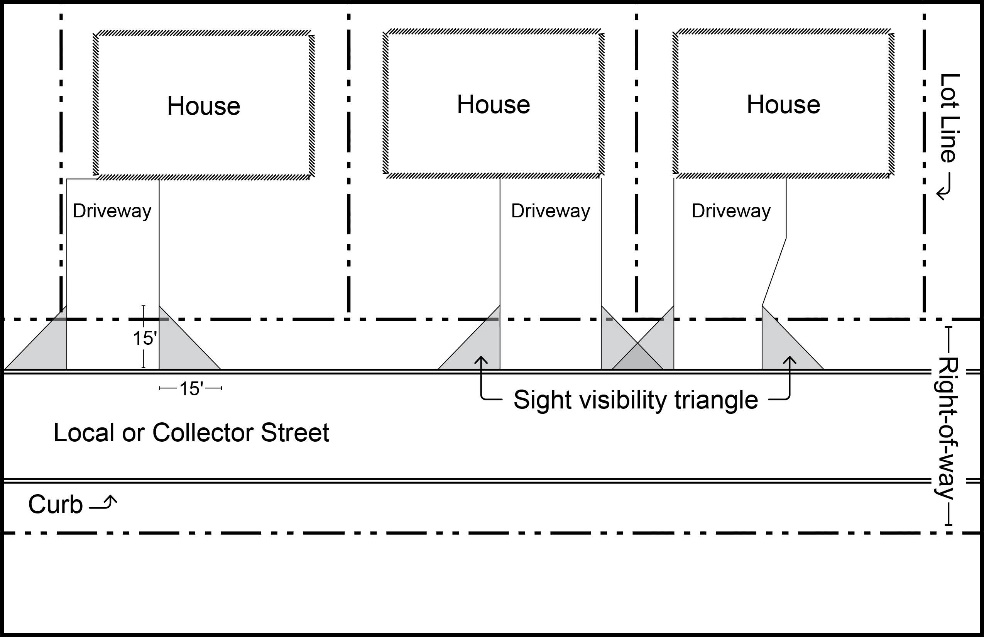
Visibility from driveways to a local or collector street, as identified on Figure 6-1 of the Comprehensive Plan, shall be unobstructed between a height of three and one-half feet and eight feet above grade (as measured along the driveway elevation), within triangular areas described as beginning at the point where driveway edges meet the street curb (or street pavement in the absence of a curb), thence 15 feet along the driveway edge, thence diagonally to a point 15 feet from the point of beginning along the street curb (or edge of street pavement in the absence of a curb). The owner of the property where any fence, wall, tree, shrubbery, vegetation, or other feature is proposed shall keep such obstructions out of the visibility triangles for their driveway and out of the visibility triangle for driveways on directly-abutting properties. The exception to the regulations in this subsection shall be where there is a mailbox and/or plantings within the visibility triangle that do not result in obstructions totaling more than three feet in width. Nothing in this subsection authorizes the use of public right-of-way for installation of fencing, walls, or plantings. The regulations contained in this Section shall not apply to conditions that legally existed prior to the effective date of this Chapter unless the City determines that such conditions constitute a traffic safety hazard.
(b)
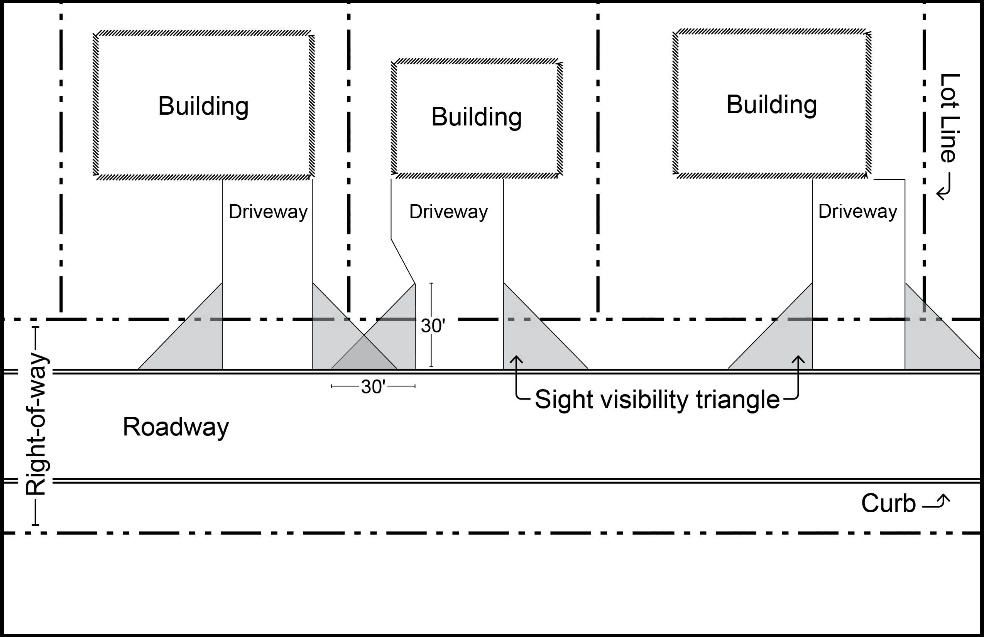
Visibility from driveways to an arterial roadway, as identified on Figure 6-1 of the Comprehensive Plan, shall be unobstructed between a height of three and one-half feet and eight feet above grade (as measured along the driveway elevation), within triangular areas described as beginning at the point where driveway edges meet the street curb (or street pavement in the absence of a curb), thence 30 feet along the driveway edge, thence diagonally to a point 30 feet from the point of beginning along the street curb (or edge of street pavement in the absence of a curb). The owner of the property where any fence, wall, tree, shrubbery, vegetation, or other feature is proposed shall keep such obstructions out of the visibility triangles for their driveway and out of the visibility triangle for driveways on directly-abutting properties. The exception to the regulations in this subsection shall be where there is a mailbox, plantings, or other features within the visibility triangle that do not result in obstructions totaling more than three feet in width. Nothing in this subsection authorizes the use of public right-of-way for installation of fencing, walls, or plantings. The regulations contained in this Section shall not apply to conditions that legally existed prior to the effective date of this Chapter unless the City, or the County or State transportation department, determines that such conditions constitute a traffic safety hazard.
Subd. 2.
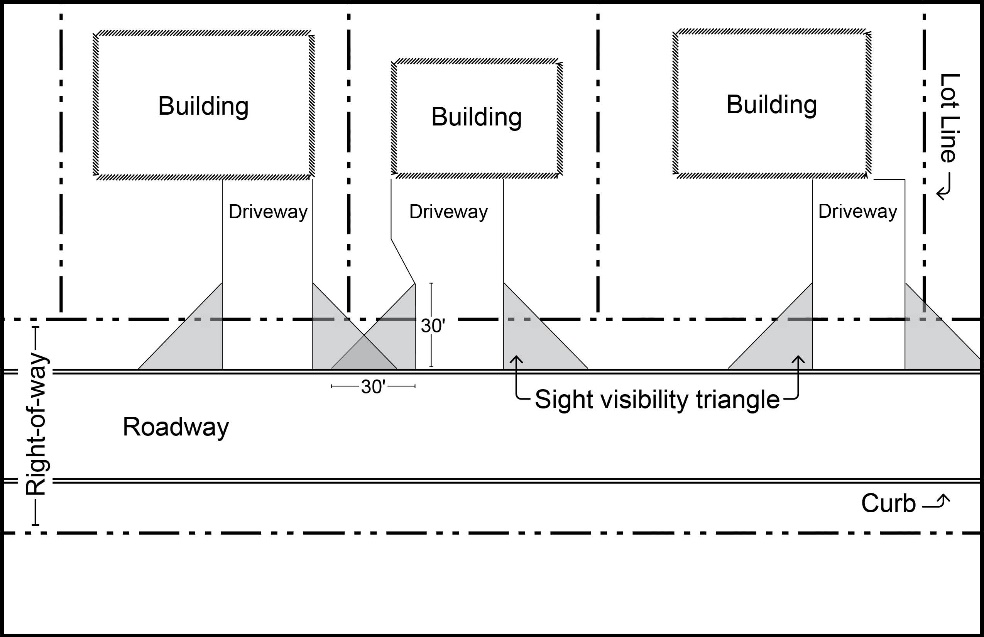
Visibility Triangles—Driveways for Uses Other Than Single- or Two-Family Use. Visibility from driveways to any street/roadway shall be unobstructed between a height of three and one-half feet and eight feet above grade (as measured along the driveway elevation), within triangular areas described as beginning at the point where driveway edges meet the street/roadway curb (or road bed including any shoulder in the absence of a curb), thence 30 feet along the driveway edge, thence diagonally to a point 30 feet from the point of beginning along the street/roadway curb (or edge of road bed including any shoulder in the absence of a curb). The owner of the property where any fence, wall, tree, shrubbery, vegetation, or other feature is proposed shall keep such obstructions out of the visibility triangles for their driveway and out of the visibility triangle for driveways on directly-abutting properties. The exception to the regulations in this subsection shall be where there is a mailbox, plantings, and/or other features within the visibility triangle that do not result in obstructions totaling more than three feet in width. Nothing in this subsection authorizes the use of public right-of-way for installation of fencing, walls, plantings, or other features. The regulations contained in this Section shall not apply to conditions that legally existed prior to the effective date of this Chapter unless the City, or the County or State transportation department, determines that such conditions constitute a traffic safety hazard.
Subd. 3.
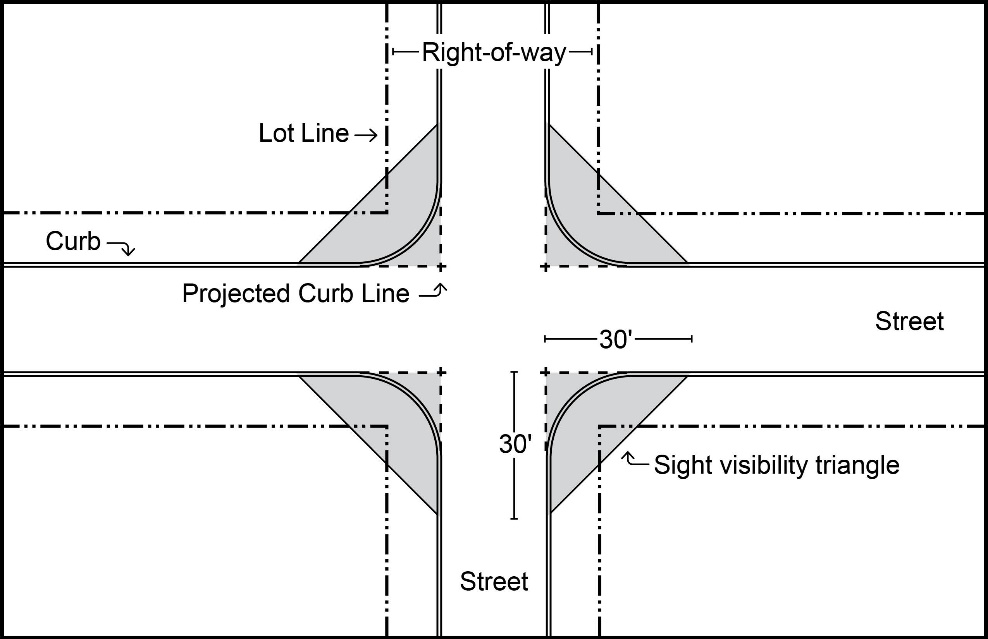
Visibility Triangle—Street/Roadway Intersections. Except for a governmental agency for the purposes of screening or noise attenuation, visibility at corner lots where two or more streets/roadways intersect shall be unobstructed between a height of three and one-half feet and eight feet above grade (as measured along the elevation of the lowest abutting segment of street/roadway), within a triangular area described as beginning at a point where the projected curb lines (or projected road bed lines including any shoulder in the absence of curbing) intersect, thence 30 feet along one street/roadway, thence diagonally to a point 30 feet from the point of beginning along the other street/roadway. The exception to the regulations in this subsection shall be where there are plantings and/or other features within the visibility triangle that do not result in obstructions totaling more than three feet in width. Nothing in this subsection authorizes the use of public right-of-way for installation of fencing, walls, plantings, or other features. The regulations contained in this Section shall not apply to conditions that legally existed prior to the effective date of this Chapter unless the City, or the County or State transportation department, determines that such conditions constitute a traffic safety hazard.
(Amended by Ord. No. 2002-32, 11/26/02; Ord. No. 2020-11, § 8, 10/13/2020; Ord. No. 2021-04, § 2, 2/23/2021)
21105.06. - Exterior Lighting.
Exterior lighting shall comply with the following standards:
Subd. 1.
Purpose and Scope. The purpose of this Section is to establish exterior lighting requirements that will 1) permit reasonable uses of lighting for night-time safety, utility, security, productivity, enjoyment and commerce, 2) minimize glare, obtrusive light and artificial sky glow by limiting outdoor lighting that is misdirected, excessive or unnecessary, 3) conserve energy and resources to the greatest extent possible and 4) help protect the natural environment from the damaging effects of night lighting from man-made sources.
Subd. 2.
Use of Lighting Zones.
(a)
Using Table 1 as a guide, the City Council shall determine and maintain Lighting Zones within the boundaries of the City.
(b)
The lighting zones established by this Ordinance are hereby set forth on the Plymouth, Minnesota Lighting Zone Map; and said map is hereby made a part of this Ordinance; said map shall be known as the "Plymouth, Minnesota Lighting Zone Map". Said map and all notations, references, and data shown thereon are hereby incorporated by reference into this Ordinance and shall be as much a part of it as if all were fully described herein. It shall be the responsibility of the Zoning Administrator to maintain said map, and amendments thereto shall be recorded on said Lighting Zone Map within 30 days after official adoption of amendments. The official Lighting Zone Map shall be kept on file in the City Hall. The Lighting Zone of a parcel or project shall determine the limitations for lighting as specified in this Section.
(c)
Amendments to the Lighting Zones shall be processed according to the procedures established in Section 21010 of this Chapter.
Subd. 3.
Applicability.
(a)
All outdoor lighting fixtures (luminaires) in Lighting Zone 2, and all outdoor lighting fixtures on non-residential properties in Lighting Zones 0 and 1 shall be installed in conformance with the provisions of this Section and Section 21155 (Sign Regulations) as applicable as well as the latest rules, codes and regulations, including but not limited to OSHA, National Fire Codes of Fire Protection Association (NFPA), Minnesota State Building Code, and National Electrical Code. In addition, all luminaires shall be installed under appropriate permit and inspection.
(b)
Lighting on single- and two-family homes, manor homes, and townhouses is subject only to the regulations as outlined in Subd. 6 and in Subd. 7 (c) of this subsection.
(c)
Lighting in the public right-of-way is not regulated by this Section. However, it is recommended that all such lighting conform to the regulations in this Section.
Subd. 4.
General Performance Standards:
(a)
Luminaire shielding and installation requirements. Luminaires within 300 feet of a residential property line shall be equipped with side shielding (house side shielding), except that luminaires mounted at a height of 12 feet or lower shall be exempt from this requirement provided they meet IESNA U0 rating.
(b)
Height Limits.
(1)
Pole mounted lighting. Lighting mounted onto poles or any structures intended primarily for mounting of lighting shall not exceed a mounting height of 40 percent of the horizontal distance of the light pole from the property line, nor a maximum height according to Table 2, whichever is lower. Height includes the base and the pole heights.
* By conditional use permit only.
(2)
Exceptions for pole heights.
a.
Mounting heights greater than 40 percent of the horizontal distance to the property line but no greater than permitted by Table 2 may be used provided that the luminaire has a B0 rating if ideally oriented or a G0 rating if not ideally oriented.
b.
Lights specifically for driveways, and then only at the intersection of the road providing access to the site, may be mounted at any distance relative to the property line, but may not exceed the mounting height listed in Table 2.
c.
Landscape lighting may be installed in a tree.
(3)
Lights mounted to buildings or structures. Lighting mounted onto buildings or other structures shall not exceed a mounting height greater than the height of the building or structure at the place where the lighting is attached, nor higher than 40 percent of the horizontal distance of the light from the property line, whichever is less.
(4)
Exceptions for building mounted lights.
a.
Lighting for facades may be mounted at any height equal to or less than the total height of the structure being illuminated regardless of horizontal distance to property line.
b.
For buildings less than 40 feet to the property line, including canopies or overhangs onto a sidewalk or public right-of-way, luminaires may be mounted to the vertical façade or underside of canopies at 16 feet or less.
c.
The top exterior deck of parking garages shall be treated as normal pole mounted lighting rather than as lights mounted to buildings. The lights on the outside edges of such a deck must be side shielded to the property line.
(c)
Lighting Quality.
(1)
All permanently installed lighting for high density residential developments and all non-residential lighting shall have a minimum color-rendering index (CRI) of 70.
(2)
All permanently installed lighting for high density residential developments and all non-residential lighting shall have a correlated color temperature (CCT) of no greater than 4100 Kelvin.
(d)
Lighting quantity and luminaire distribution.
(1)
Total site lumen limit: The total installed initial luminaire lumens of all outdoor lighting shall not exceed the total site lumen limit. The total site lumen limit shall be determined using either the Parking Space Method (Table 3) or the Hardscape Area Method (Table 4). Only one method shall be used per application, and for sites with existing lighting, existing lighting shall be included in the calculation of total initial installed luminaire lumens. The total installed initial luminaire lumens is calculated as the sum of the initial luminaire lumens for all luminaires.
* By conditional use permit only.
* By conditional use permit only.
1 When lighting intersections of site drives and public streets or roads, a total of 600 square feet for each intersection may be added to the actual site hardscape area to provide for intersection lighting.
(2)
Limits to off-site impacts: All luminaires shall be rated and installed according to Tables 5, 6 and 7. A luminaire may be used if it is rated for the lighting zone of the site or lower in number for all B, U and G ratings. Luminaires equipped with adjustable mounting devices permitting alteration of luminaire aiming in the field shall not be permitted.
* By conditional use permit only.
1 For property lines that abut public walkways, bikeways, plazas, and parking lots, the property line may be considered to be five feet beyond the actual property line for purpose of determining compliance with this table. For property lines that abut public roadways and public transit corridors, the property line may be considered to be the centerline of the public roadway or public corridor for the purpose of determining compliance with this table. NOTE: This adjustment is relative to Tables 5 and 7 only, and shall not be used to increase the Hardscape Area of the site.
* By conditional use permit only.
* By conditional use permit only.
(3)
Shielding for parking lot lighting: All parking lot lighting shall have a U0 rating, except that ornamental parking lot lighting shall meet the requirements of Tables 5, 6 and 7 without the need for external field-added modifications.
(e)
Required lighting controls. Lighting systems for non-residential properties shall be extinguished or reduced in lighting by at least 50 percent beginning at curfew and continuing until dawn or start of business, whichever is sooner. The reduction shall be determined as an overall average for a site. When possible, the lighting system should be turned off entirely.
(1)
Curfew. Curfew shall be as follows:
LZ0, the later of 8:00 p.m. or close of business
LZ1, the later of 8:00 p.m. or close of business
LZ2, the later of 10:00 p.m. or close of business
LZ3, the later of midnight or close of business (by conditional use permit only)
(2)
Low voltage landscape lighting shall be completely extinguished at the Curfew time stated above or one hour after the site is closed, whichever is sooner.
(3)
Exceptions to curfew:
a.
When there is only one (conforming) luminaire for the site.
b.
Code required lighting for steps, stairs, walkways, and building entrances.
c.
When in the opinion of the City Council, reduced lighting levels at a given location will cause unacceptable increased risk and design levels must be maintained.
(f)
Prohibited lighting.
(1)
Mercury vapor lamps.
(2)
Luminaires mounted to aim light only toward a property line.
(3)
Luminaires mounted in a way so as to cause confusion or hazard to traffic or to conflict with traffic control signs or lights.
(g)
Following installation of any lighting on a site, the engineer or lighting professional who prepared the lighting plan shall certify in writing that the location, type, mounting height, initial luminaire lumens, and photometric data including BUG ratings all comply with the approved lighting plan.
(h)
Any new lighting installed after the effective date of this ordinance shall be in compliance with the requirements of this Section. Any lighting in existence before the effective date of this ordinance that does not comply with the requirements shall be considered legally non-conforming. However, if a property owner proposes to replace 50 percent or more of the existing exterior luminaires or standards in any one year period, the luminaires or standards must be replaced in conformance with this Chapter.
(Amended by Ord. No. 2015-15, 05/26/15; Ord. No. 2016-11, 04/26/16; Ord. No. 2019-01, 02/12/19; Ord. No. 2020-11, § 9, 10/13/2020)
Subd. 5.
Light Trespass Limitations. The illuminance levels provided in Table 8 shall be used for enforcement should concerns of obtrusive lighting or questions of compliance arise. This provision shall apply to all exterior lighting, and to interior lighting if the light source is visible off-site. The illuminance values provided in Table 8 shall be measured at the lot line unless said lot line abuts a public street, in which case the illuminance values shall be measured at the centerline of such public street.
Subd. 6.
Exempt Lighting. The following luminaires and lighting systems are exempt from the provisions of this Section.
(a)
Lighting required and regulated by the Federal Aviation Administration or other federal or state agency.
(b)
Situations where fire, police, rescue or repair personnel need light for temporary emergencies or road repair work.
(c)
Temporary seasonal lighting provided that individual lamps are less than ten watts and 70 lumens.
(d)
Temporary lighting for theatrical, television and performance areas.
(e)
Soffit or wall-mounted luminaires with less than 375 initial luminaire lumens and permanently attached to dwellings (including multi-family residence but excluding hotels or motels) at a height not to exceed 20 feet above the adjacent grade.
(f)
Lighting in swimming pools and other water features governed by Article 680 of the National Electrical Code.
(g)
Code required exit signs.
(h)
Code required lighting for stairs and ramps.
(i)
Interior lighting, except as addressed by Section 21105.06, Subd. 5 of this Section.
Subd. 7.
Special Purpose Lighting.
(a)
High intensity lighting. The following lighting systems are prohibited from being installed except by administrative permit.
(1)
Aerial lasers.
(2)
Skytrackers.
(3)
Motion detection security lighting, except that such lighting for single- and two-family homes shall be permitted and shall be exempt from the requirement for an administrative permit.
(b)
Other special lighting.
(1)
Lighting systems not complying with the technical requirements of this Section but consistent with its intent may be installed for the following applications upon issuance of a conditional use permit. Each request for a conditional use permit shall be evaluated based upon the standards and criteria set forth in Section 21015.02, Subd. 5 of this Chapter.
(i)
Outdoor athletic fields and recreation areas.
(ii)
Construction lighting.
(iii)
National and State flag lighting with spotlights greater than 3,400 lumens in LZ2 and LZ3 and greater than 2,000 lumens in LZ0 and LZ1.
(iv)
Floodlighting of buildings over two stories high.
(v)
Public monuments, public buildings, and religious institutions.
(vi)
Ornamental lighting in LZ0 and LZ1.
(2)
To obtain a conditional use permit, applicants shall demonstrate that the proposed lighting installation:
(a)
Is not within LZ0 or LZ1, except for ornamental lighting and necessary construction lighting.
(b)
Utilizes fully shielded luminaires and, if required, side shielded and internally shielded luminaires that are installed in a fashion that maintains the shielding characteristics unless certified in writing by a registered engineer or by a certified lighting professional that such shielding is impractical. Where fully shielded fixtures cannot be utilized, acceptable luminaires shall include only those that are installed with maximum aiming angles of 65 degrees above nadir. Said aiming angle shall be measured from nadir as defined by an independent testing agency using Type B photometry as defined by the IES.
(c)
Has received every reasonable effort to mitigate light trespass and light pollution, supported by a signed statement from a registered engineer or by a certified lighting professional describing the mitigation measures.
(d)
Complies with all the technical requirements of this Section after curfew, with the following exception: No illumination of athletic fields shall be permitted after 11:00 p.m., except to conclude a scheduled event that was in progress before 11:00 p.m. and circumstances prevented concluding before 11:00 p.m.
(c)
Lighting for single and two family homes, manor homes, and townhouses.
(1)
Lighting systems for single family homes in all Lighting Zones shall be in compliance with the Pre-Curfew Light Trespass Limitations at the lot line provided in Table 8 above. Lighting systems for two family homes, manor homes, and townhouses in all Lighting Zones may consider the Pre-Curfew Light Trespass Limitations at the subdivision boundary instead of the lot line.
(2)
Motion activated lighting systems for single family homes in all Lighting Zones shall not be activated by movement beyond the lot line, and motion activated lighting systems for two family homes, manor homes, and townhouses in all Lighting Zones shall not be activated by movement beyond the subdivision boundary.
(3)
Lighting systems for single family homes, two family homes, manor homes, and townhouses in all Lighting Zones that provide lighting, or are intended to provide lighting, for recreational purposes (i.e., sport courts, hockey rinks, or other similar features) shall direct lighting downward and inward from the perimeter lot boundaries, shall not exceed 15 feet in height, and shall be turned off between 10:00 p.m. and 7:00 a.m.
(Amended by Ord. No. 2013-27, 10/22/13; Ord. No. 2022-10, § 6, 8/16/2022)
21105.07. - Smoke.
The emission of smoke by any use shall be in compliance with and regulated by the State of Minnesota Pollution Control Standards, Minnesota Regulation APC 7017.
21105.08. - Dust and Other Particulate Matter.
The emission of dust, fly ash or other particulate matter by any use shall be in compliance with and regulated by the State of Minnesota Pollution Control Standards, Minnesota Regulation APC 7011.
21105.09. - Air Pollution.
The emission of air pollution, including potentially hazardous emissions, by any use shall be in compliance with and regulated by Minnesota Statutes 116, as may be amended.
21105.10. - Noise.
Noises emanating from any use shall be in compliance with and regulated by 2025 of the City Code.
(Amended by Ord. No. 2000-06, 02/29/00)
21105.11. - Outside Storage/Display.
Subd. 1.
General Provisions that apply to All Zoning Districts.
(a)
Passenger automobiles and trucks not currently licensed by the State, or which are incapable of movement under their own power due to mechanical deficiency, which are parked or stored outside for a period in excess of ninety-six (96) hours, and all materials stored outside in violation of the City Ordinances are considered refuse or junk and shall be disposed of pursuant to City regulations.
(b)
Any accumulation of refuse not stored in containers which comply with City Code, or any accumulation of refuse including car parts is hereby declared to be a nuisance and may be abated by order of the Zoning Administrator, as provided by Minnesota Statutes and Section 2010 of the City Code. The cost of abatement shall be recovered in accordance with the applicable provisions of Section 2010 of the City Code.
(c)
Outside storage, including but not limited to equipment storage and the parking of vehicles, shall be prohibited as a principal use of property.
(Amended by Ord. No. 2001-06, 02/13/01; Ord. No. 2002-02, 01/22/02; Ord. No. 2006-04, 02/07/06)
(d)
Except for temporary construction trailers and mobile services operated by public service agencies (e.g., bookmobile, bloodmobiles) as allowed by the City, and trailers parked in a designated and improved loading area, no vehicle may be used for office, business, industrial manufacturing, testing, or storage of items used with or in a business, commercial or industrial enterprise, unless otherwise approved by the Zoning Administrator.
(e)
The City Council may order the owner of any property to cease or modify outside storage uses including existing uses, provided it is found that such use constitutes a threat to the public health, safety, convenience, or general welfare.
(f)
Outside storage shall be prohibited within wetlands and areas designated as wetland buffers.
Subd. 2.
Residential Zoning Districts.
(a)
All personal property shall be stored within a building or fully screened so as not to be visible from adjoining properties and public streets, except for the following:
(1)
Basketball hoop, provided it is set back at least six feet from any lot line.
(2)
Stacked firewood for the burning supply of the property resident may be located in a side, rear, or equivalent yard, provided it is not located in a wetland or wetland buffer.
(3)
Construction and landscaping materials or equipment, if these are used or intended for use on the premises within a period of three months, unless there is an active building permit issued for improvements on the property, or as otherwise approved by the Zoning Administrator.
(4)
Agricultural equipment and materials in FRD zoned areas, if these are used or intended for use on the premises within a period of 12 months.
(5)
Off-street parking of licensed passenger automobiles and personal vehicles of less than twelve thousand (12,000) pounds gross vehicle weight rating (GVWR) on an established driveway or parking area that is surfaced in compliance with Section 21135.07, Subd. 1 of this Chapter.
(6)
Off-street parking of not more than one commercial vehicle of less than 12,000 pounds gross vehicle weight rating (GVWR) and of not more than one fully enclosed commercial trailer with a bed length of 14 feet or less on an established driveway or parking area that is surfaced in compliance with Section 21135.07, Subd. 1 of this Chapter.
(7)
Off-street parking of one commercial vehicle with no restriction on the gross vehicle weight rating (GVWR) and of one commercial trailer (enclosed or unenclosed) with no restriction on bed length may temporarily occur for a time period not to exceed one hour per day unless being used in conjunction with a temporary service including, but not limited to, a construction or remodeling project benefiting the premises, provided they are parked on an established driveway or parking area that is surfaced in compliance with Section 21135.07, Subd. 1 of this Chapter.
(8)
Recreational equipment.
(9)
Recreational vehicles and recreational camping vehicles that are registered to the occupant, provided they are stored in a side or rear yard, or in a designated driveway or parking area that is surfaced in compliance with Section 21135.07, Subd. 1 of this Chapter.
(10)
One non-vehicular ice-fishing house may be located in a rear or equivalent rear yard, provided it is set back at least six feet from any lot line.
(Amended by Ord. No. 2000-06, 02/29/00; Ord. No. 2002-02, 01/22/02; Ord. No. 2007-05, 01/23/07; Ord. No. 2013-11, 04/23/13)
Subd. 3.
Commercial, Public/Institutional and Industrial Zoning Districts.
(a)
Outside Storage/Display. Exterior storage and display shall be governed by the respective zoning district in which such use is located.
(b)
Additional Standards. All exterior storage shall be located in the rear or side yard, shall be screened with materials of 90 percent or more opacity, and shall screen views from adjoining properties and public streets except for the following:
(Amended by Ord. No. 99-5, 01/19/99; Ord. No. 2005-01, 01/11/05)
(1)
Merchandise being displayed for sale in accordance with zoning district requirements.
(2)
Materials and equipment currently being used for construction on the premises.
(c)
Parking of Commercial Vehicles and Commercial Trailers. Up to three commercial vehicles or commercial trailers (or a combination thereof totaling three) with a gross vehicle weight rating (GVWR) of 12,000 pounds or less may be parked on a lot within any yard area without screening, provided they relate to the principal use. Commercial vehicles or commercial trailers exceeding three with a gross vehicle weight rating (GVWR) of 12,000 pounds or less may be parked on a lot provided they relate to the principal use and are not parked within a front yard area unless the yard qualifies as an equivalent side or rear yard. Additionally, such parking shall be screened in compliance with Section 21130 of this Chapter if the yard where the parking would occur abuts, or is readily visible from, residential land use. Commercial vehicles or commercial trailers with a gross vehicle weight rating (GVWR) of over 12,000 pounds may be parked on a lot provided they relate to the principal use, are not parked within a front yard area unless the yard qualifies as an equivalent side or rear yard, and are screened in compliance with Section 21130 of this Chapter.
(Amended by Ord. No. 2010-01, 02/23/10; Ord. No. 2013-11, 04/23/13)
21105.12. - Sewage Disposal.
Individual sewage disposal systems shall be installed and operated in compliance with the applicable provisions of Chapter VII, Section 710 of the City Code.
21105.13. - Bulk Storage (Liquid).
All uses associated with the bulk storage of all gasoline, liquid fertilizer, chemical, flammable and similar liquids shall comply with requirements of and have appropriate permits indicating compliance with the Minnesota State Fire Code and Minnesota Department of Agriculture regulations.
21105.14. - Radiation Emission.
All activities that emit radioactivity shall comply with the minimum requirements of the Minnesota Pollution Control Agency.
21105.15. - Electrical Emission.
All activities which create electrical emissions shall comply with the minimum requirements of the Federal Communications Commission.
21105.16. - Common Open Space and Amenities.
Subd. 1.
Common private open spaces or amenities may be allowed as part of a PUD or property subdivision, or by conditional use permit subject to the provisions of this Chapter.
Subd. 2.
Operating and Maintenance Requirements for Common Open Space and Amenities. Whenever common public open space or amenities are provided, provisions shall be made to assure the continued operation and maintenance of such open space or amenities to a predetermined reasonable standard. Common private open space and amenities may be placed under the ownership of one or more of the following, as approved by the City Council:
(a)
Landlord control, where only use by tenants is anticipated.
(b)
Property owners association, provided all of the following conditions are met:
(1)
Prior to the use, occupancy, sale or the execution of contracts for sale of individual buildings, units, lots, parcels, tracts or common areas, a declaration of covenants, conditions and restrictions or an equivalent document or a document such as specified by Minnesota Statutes 515, Article 2 and a set of floor plans such as specified by Minnesota Statutes 515, Article 2-110 shall be filed with the City of Plymouth. Said filing with the City is to be made prior to the filings of said declaration or document or floor plans with the recording officers of the County.
(2)
The declaration of covenants, conditions and restrictions or equivalent document shall specify that deeds, leases or documents of conveyance affecting buildings, units, lots, parcels, or tracts shall subject said properties to the terms of said declaration.
(3)
The declaration of covenants, conditions and restrictions shall provide that an owner's association or corporation shall be formed and that all owners shall be members of said association or corporation which shall maintain all properties and common areas in good repair and which shall assess individual property owners proportionate shares of joint or common costs. This declaration shall be subject to the review and approval of the City Attorney. The intent of this requirement is to protect the property values of the individual owner through establishing adequate private control.
(4)
The declaration shall additionally, amongst other things, provide that in the event the association or corporation fails to maintain properties in accordance with the applicable rules and regulations of the City of Plymouth or fails to pay taxes or assessments on properties as they become due and in the event the said City of Plymouth incurs any expenses in enforcing its rules and regulations, which said expenses are not immediately reimbursed by the association or corporation, then the City of Plymouth shall have the right to assess each property its prorata share of said expenses. Such assessments, together with interest thereon and costs of collection, shall be a lien on each property against which each such assessment is made.
(5)
Membership must be mandatory for each owner, and any successive buyer.
(6)
The open space restrictions must be permanent and not for a limited period of years, unless specifically approved by the City.
(Amended by Ord. No. 2000-06, 02/29/00)

