
Plymouth City Zoning Code
SECTION 21130
FENCING/SCREENING/LANDSCAPING
21130.01.- Fence/Wall Regulations.
Subd. 1.
Permit Required. Except as otherwise provided herein, no person shall erect, alter or relocate any fence or wall within the City without first having been issued a permit therefor.
Subd. 2.
Permit Fee.
(a)
Agricultural, Single-Family, and Two-Family Uses: There is no charge for a fence/wall permit, except that a building permit and related building permit fee pursuant to Section 1015 of the City Code shall be required for proposed fences that would exceed seven feet in height and for proposed walls that would exceed four feet in height. In cases where a building permit is required for such fencing or wall(s), a separate fence/wall permit is not required.
(b)
All Other Land Uses (excludes agricultural, single-family, and two-family uses): The appropriate site plan review fee pursuant to Subd. 3 (b) in this subsection shall be required. Additionally, a separate building permit and related building permit fee pursuant to Section 1015 of the City Code shall be required if the proposed fencing would exceed seven feet in height or if the proposed wall(s) would exceed four feet in height.
Subd. 3.
Application Procedures.
(a)
Agricultural, Single-Family, and Two-Family Uses: Requests for fencing or walls shall require a "no-fee" fence/wall permit and related application, or shall require a building permit and related application if required by this Section due to the height. Applications shall be submitted on forms provided by the City. The exception is that a "no-fee" wall/fence permit is not required for such developer-installed features within new subdivisions if authorized on the approved plat drawings. In such cases, a building permit would still be required for any fencing over seven feet high and for any walls over four feet high. All applications shall include a site plan drawn to scale showing the location of the house, any accessory structures or other improvements, all public easements, and any required wetland buffers on the lot, together with the location of the fencing or wall to be erected, altered or relocated.
(b)
All Other Land Uses (excludes agricultural, single-family, and two-family uses): Requests for fencing or walls shall be processed as part of, and in accordance with the procedures established for review of a site plan or site plan amendment, as stipulated in Section 21045 of this Chapter. If a separate building permit is also required by this Section due to the height, the building permit application shall be submitted on forms provided by the City.
Subd. 4.
General Provisions. Except as otherwise provided herein, all fences and walls within the City shall be subject to the following general provisions:
(a)
No fences or walls shall be placed on or extend into public rights-of-way.
(b)
Hedges and other plantings shall not require a permit. Such features are not subject to the provisions of this Section, but are subject to the provisions of Section 21105.05 of this Chapter relating to traffic sight visibility, and to the applicable provisions of Section 21130.03, Subd. 2 (e) (1) of this Chapter.
(c)
Fence Materials, Design, and Color.
(1)
Fences shall not be constructed from chicken wire, welded wire, plastic deer fence netting or similar products, snow fence, branches, or materials originally intended for other purposes, unless upon the showing of a high degree of architectural quality achieved through the use of such materials, prior approval is granted by the Zoning Administrator.
(2)
That side of any fence or wall considered to be its "face" (i.e., the finished side showing no structural supports) shall face abutting property or street right-of-way.
(3)
Chain link fences shall include a top rail, and the barbed ends shall be toward the ground.
(4)
Except for agricultural uses in the FRD District, fences shall not be supported using metal T- or U-posts or similar products.
(5)
Fences shall be the same color on each side, unless upon the showing of a high degree of architectural design and appearance achieved through the use of different color on each side, prior approval is granted by the Zoning Administrator. Except for white, bright colors (e.g., neon or fluorescent) shall not be permitted, except for allowable temporary fencing.
(d)
Both sides of any fence or wall shall be maintained in a condition of reasonable repair and appearance by its owner and shall not be allowed to become and remain in a condition of disrepair or danger, or constitute a nuisance, public or private.
(e)
No physical damage of any kind shall occur to abutting property during installation unless it is allowed under agreement with the adjacent property owner.
(f)
A certificate of survey may be required by the Building Official for all fences (except hedges and plantings) or walls to be constructed on or within six feet from the property line, unless corner property stakes are in place and marked and a survey is filed with the City.
(g)
Retaining walls shall not be placed within any drainage or ponding easement unless also reviewed and approved by the City Engineer.
(h)
Fencing shall not be placed within any utility easement that includes major utility service such as publicly-maintained water main or sewer pipes unless reviewed and approved by the City Engineer. Additionally, any new fencing to be installed on or after January 1, 2025, shall not be placed within a pond access easement unless reviewed and approved by the City Engineer.
(i)
A fence with a minimum height of three and one-half feet shall be required on the top of any retaining wall that exceeds four feet in height, and on the top of any tiered retaining wall that requires a building permit. The Zoning Administrator may grant exceptions to this provision if the retaining wall does not pose a public safety concern.
(j)
No fences or walls shall be placed within a wetland or required wetland buffer, nor shall they cross over a required rain garden/filtration basin/infiltration basin or extend below the ordinary high water level of a lake, stream, or water quality/detention pond.
(k)
Fencing that is two feet high or lower and that directly surrounds a garden shall be exempt from the provisions of this Section, provided it is set back a minimum of six feet from lot lines.
Subd. 5.
Specific Fence Standards. Except as otherwise provided herein, fences may be allowed subject to the following specific standards:
(a)
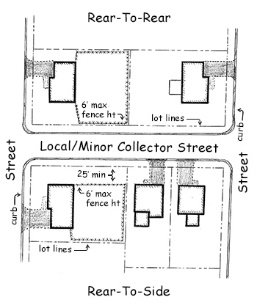
Fences constructed of materials with an opacity of up to 100 percent and not exceeding 6.5 feet in height (measured from the adjoining grade at the bottom to the top of support posts/post caps), provided that the actual fence panels/boards do not exceed 6 feet, may be located at or behind the minimum front setback lines, as required for the principal structure on the lot. The exception is, on corner lots where the rear wall of the principal building (wall opposite the wall where the property is addressed) faces the rear wall of an abutting principal building, such fences may be located within the required front yard area that lies between the side wall of the principal building and the abutting side street, from the rear wall of the principal building to the rear lot line. Said fence may also be located within a required front yard area that qualifies as an equivalent rear or side yard as defined by this Chapter.
(b)
Except as provided in (a) above, fences constructed of materials with an opacity of 50 percent or more and not exceeding 3.5 feet in height (measured from the adjoining grade at the bottom to the top of support posts/post caps), provided that the actual fence panels/boards do not exceed 3 feet, may be located within a required front yard area. Fences constructed of materials with an opacity of under 50 percent (e.g., wrought iron, chain link, split rail) and not exceeding 4.5 feet in height (includes ground clearance at the bottom and support posts/post caps at the top), provided that the actual fence panels/boards do not exceed 4 feet, may be located within a required front yard area.
(c)
Fences not exceeding 6.5 feet in height (measured from the adjoining grade at the bottom to the top of support posts/post caps), provided that the actual fence panels/boards do not exceed 6 feet, may be permitted in front yard areas of homeowner-association owned and maintained amenity lots in order to enclose and secure a swimming pool area, provided that:
(1)
Such fencing shall be set back a minimum of three feet from front lot lines.
(2)
Such front yard fencing shall be constructed of decorative materials with an opacity of under 50 percent (e.g., wrought iron).
(d)
Fences not exceeding 6.5 feet in height (measured from the adjoining grade at the bottom to the top of support posts/post caps), provided that the actual fence panels/boards do not exceed 6 feet, for uses other than one and two family dwellings, may be permitted in front of the front building line as established by the primary structure on the lot, when required for screening of adjacent property. In such cases, the required front setback for the fence shall be the same as for the use which it is intended to buffer.
(e)
No fence or wall shall be located within a traffic sight visibility triangle for a driveway or street intersection unless it complies with the sight clearance regulations set forth in Section 21105.05 of this Chapter.
(f)
There is no height restriction on plantings, except that any plantings located within or near a traffic sight visibility triangle shall comply with the sight clearance regulations set forth in Section 21105.05 of this Chapter.
(g)
Should the rear lot line of a lot in a residential district be common with the side lot line of an abutting lot, that portion of the rear lot line equal to the required front yard setback of the abutting lot shall be fenced in accordance with the provisions of Section 21130.01, Subd. 5.b.
(h)
Fences not exceeding 10 feet in height may be permitted without a conditional use permit to enclose tennis or other recreational courts, provided that:
(1)
All other requirements of this Chapter are met.
(2)
Such fences shall be constructed of materials with an opacity of under 50 percent (e.g., wrought iron, chain link).
(3)
Such fences may be located within: i) a rear or side yard provided they are set back at least 6 feet from any lot line; or ii) a front yard which qualifies as an equivalent rear or side yard (as defined by this Chapter) provided they are set back from such front lot line a distance equal to, or greater than, the minimum front setback specified for the principal building on the lot, and are set back at least 6 feet from other lot lines.
(4)
Such fences over 7 feet in height shall require a building permit.
(i)
Fences not exceeding 10 feet in height may be permitted without a conditional use permit to: 1) provide required screening of outside storage yards or loading areas in the industrial districts; or 2) provide screening of electrical substation enclosures in the P-I district, provided that:
(1)
All other requirements of this Chapter are met.
(2)
Such fences over 7 feet in height shall require a building permit.
(j)
Fences which include a security gate at a point where access is provided to the property and principal building may be approved if necessary and appropriate as part of the site plan review.
(k)
Temporary fencing not exceeding 6 feet in height may be installed to secure the perimeter of a construction site, upon issuance of an administrative permit pursuant to Section 21025 of this Chapter, provided any such fencing is removed upon completion of the construction project.
Subd. 6.
Fences Allowed by Conditional Use Permit and Interim Use Permit. In accordance with requirements set forth in Section 21015 or 21020 of this Chapter as applicable, the following special fencing arrangements may be approved as a conditional use permit or interim use permit by the City:
(a)
Fences allowed by conditional use permit are as follows:
(1)
Fences exceeding six and one-half feet in height (includes ground clearance at the bottom and support posts/post caps at the top), provided that:
a.
The fence is in a location where fences up to six and one-half feet are permitted.
b.
The fence not exceed eight feet in height.
c.
The fence shall not be located within the minimum building setback, as required for principal structures, from the ordinary high water level of lakes and streams.
(b)
Fences allowed by interim use permit are as follows:
(1)
Barbed wire and electrically charged fences. Agricultural uses located in the FRD District and essential service structures in all Districts shall, however, be exempt from the interim use permit requirements.
(2)
Razor wire fences.
(c)
Standards for evaluating fences allowed by conditional use permits or interim use permits shall include, but not be limited to, the following:
(1)
The fence placement, height or design does not create a safety hazard with regard to, from or on a public street or roadway.
(2)
The fence placement, height or design does not create a safety problem or negatively affect adjoining properties or use.
Subd. 7.
Non-Conforming Fences. It is the intent of this Chapter to allow the continuation of such non-conforming fences until they are discontinued as provided herein. However, it is not the intent of this Chapter to encourage the survival of non-conforming fences and such fences that are declared to be incompatible with permitted fences within the City. Such fences shall be regulated by the following provision:
(a)
An existing fence not allowed by this Chapter in the district within which it is located, except when required by law or ordinance, shall not be enlarged, extended, reconstructed, or structurally altered unless such fence is changed to comply with the requirements of this Chapter. Maintenance of a non-conforming fence will be allowed when this includes necessary repair and incidental alterations which do not expand or intensify the non-conforming fence.
(Amended by Ord. No. 99-5, 01/19/99; Ord. No. 2000-06, 02/29/00; Ord. No. 2001-06, 02/13/01; Ord. No. 2002-02, 01/22/02; Ord. No. 2004-02, 01/13/04; Ord. No. 2005-01, 01/11/05; Ord. No. 2009-07, 05/12/09; Ord. No. 2010-01, 02/23/10; Ord. No. 2011-22, 07/26/11; Ord. No. 2014-12, 02/25/14; Ord. No. 2019-01, 02/12/19; Ord. No. 2020-11, § 12, 10/13/2020; Ord. No. 2021-04, §§ 3, 4, 2/23/2021; Ord. No. 2022-10, §§ 7, 8, 8/16/2022; Ord. No. 2025-02, §§ 13—17, 3/25/2025)
21130.02. - General Landscaping and Maintenance.
All exposed ground areas within the lot that are not devoted to off-street parking, drives, sidewalks, patios, or other such improvements shall have or shall be covered with topsoil with an average depth of at least four inches and landscaped with grass, shrubs, trees, or other ornamental landscape materials on the date of building occupancy or within one year after the building permit is issued, whichever occurs first. All exposed ground areas within the street boulevard abutting the lot that are not devoted to driveways, sidewalks, or trails shall have or shall be covered with topsoil with an average depth of at least four inches and landscaped with grass on the date of building occupancy or within one year after the building permit is issued, whichever occurs first. The Zoning Administrator may alter the schedules in the case of demonstrated hardship due to sources beyond the control of the permittee or property owner (including weather conditions, reasonably unforeseen material, equipment or labor shortages; continuing presence of large construction equipment actively involved in the project) upon request of the permittee or property owner. In the event the time period defined above falls between November 1 and May 30, the permittee or property owner shall have until the upcoming July 1 to complete the landscaping. All landscaped areas shall be kept neat, clean and uncluttered, and where landscaping is required as part of City approvals, any plant material which is diseased or dies shall be replaced with like kind of the original size. No landscaped area shall be used for the parking of vehicles or for the storage or display of materials, supplies or merchandise, unless otherwise authorized by this Chapter. Fences and/or plantings placed upon utility easements are subject to removal by the City or utility company if required for maintenance or improvement of the utility. In such case, costs for removal and replacement shall be the responsibility of the property owner. Trees on utility easements containing overhead wires shall not exceed 15 feet in height, and such trees shall be the property owner's responsibility to maintain. Grass, weed, and vegetation elimination employing solarization, occultation, or similar methods shall cease after 6 weeks, and vegetation re-established via sodding or seeding. Erosion control measures may be required until new vegetation has been established.
(Amended by Ord. No. 2004-02, 01/13/04; Ord. No. 2008-24, 10/14/08; Ord. No. 2013-11, 04/23/13; Ord. No. 2014-12, 02/25/14; Ord. No. 2022-10, § 9, 8/16/2022; Ord. No. 2026-01, § 10, 2/10/2026)
21130.03. - Required Fencing, Screening and Landscaping.
Subd. 1.
Fencing and Screening.
(a)
Multiple Family Uses.
(1)
Where any townhouse, manor home, manufactured home park or apartment dwelling structure abuts property zoned for less dense residential use, the higher density residential use shall provide screening along all off-street parking or formal outdoor recreational activity areas to mitigate possible adverse impacts. Housing of similar types and densities shall not be subject to special screening requirements for formal outdoor recreational activity areas.
(2)
Along boundaries where parking or formal outdoor recreational activity areas exist, all the fencing and screening specifically required by this Chapter shall be subject to Section 21105.05 and shall consist of either a fence or a green belt planting strip as provided for below.
a.
A green belt planting strip shall consist of evergreen trees and/or deciduous trees and plants and shall be of sufficient width and density to provide an effective visual buffer. This planting strip shall be designed to provide complete visual screening to a minimum height of six feet. Alternatively, earth mounding or berms may be used to achieve all or a portion of the required buffer. The screening plan including type of plantings and berming shall require the approval of the City, as part of the site plan review pursuant to Section 21045 of this Chapter.
b.
A required screening fence shall be constructed of masonry, brick, wood or metal. Such fence shall provide a solid screening effect of six feet in height. The design and materials used in constructing a required screening fence shall be subject to the approval of the City as part of the site plan review pursuant to Section 21045 of this Chapter. Fences in excess of height limitations established in Section 21130.01 shall be subject to approval pursuant to required procedures. The City Council may also require plantings of shrubs or trees in association with required fencing.
(b)
Non-Residential Uses.
(1)
Where any non-residential use (i.e., structure, parking or storage) abuts property zoned for residential use, the non-residential use shall provide screening along its boundary with the residential property. Screening shall also be provided where a non-residential use is across the street from a residential zone, but not on that side of a non-residential use considered to be the front (as determined by the Zoning Administrator). All the fencing and screening specifically required by this Chapter shall be subject to Section 21105.05 and shall consist of either a fence or a green belt strip as provided for in Section 21130.03, Subd. 1.a.2.a and Subd. 1.a.2.b.
Subd. 2.
Landscaping—Public, Semi-Public, Institutional, Single Family, Two Family, Multiple Family, Manufactured Home Park, Commercial, and Industrial Uses. Prior to approval of a building permit, all above referenced uses shall be subject to mandatory landscape plan and specification requirements. Except for single- and two-family development, said landscape plan shall be developed with an emphasis upon the boundary or perimeter of the proposed site at points adjoining other property and the immediate perimeter of the structure. All landscaping incorporated in said plan shall conform to the following standards and criteria:
(a)
Landscape Design Elements. Elements of landscape design may include:
(1)
Existing topographical and vegetative features.
(2)
Berming.
(3)
Plantings, including the required minimum number of overstory trees, understory trees, shrubs, flowers, and ground cover materials.
(b)
Types and Species of New Trees.
(1)
All tree species shall be indigenous to the appropriate hardiness zone and physical characteristics of the site, as specified by the City Forester.
(2)
To the extent possible, native drought-resistant trees shall be planted.
(3)
All types and species of overstory and understory deciduous and coniferous trees and their cultivars shall be consistent with the City of Plymouth's Landscape Tree List, as provided by the City Forester.
(4)
The complement of trees fulfilling the requirements of this Section shall be not less than 25 percent deciduous and not less than 25 percent coniferous.
(c)
Number of Trees. The minimum number of new trees on any given site shall be as follows:
(1)
Residential Uses. Single-family and two-family dwellings shall require two trees (may be new trees or preserved pre-existing trees) within the front yard, at least one of which must be an overstory tree. Townhouse dwellings, manor home dwellings, and manufactured home parks shall require a minimum of two new overstory trees per dwelling unit. Apartment developments shall require trees as follows:
a.
Developments with 50 or fewer dwelling units shall require a minimum of two new overstory trees per dwelling unit.
b.
Developments with more than 50 dwelling units shall require a minimum of 1.5 new overstory trees per dwelling unit.
c.
Developments within the RMF-5 district shall require 0.75 new overstory trees per dwelling unit.
d.
If the planting provision results in overcrowding, as determined by the City, the developer may plant fewer trees on the site, provided a cash fee in accordance with Section 530 of the City Code is deposited in the Community Planting Fund to make up the difference between the trees required by this provision and the trees actually planted on the site.
(2)
Mixed Land Uses. Mixed Land Uses shall require trees as follows:
a.
The residential portion(s) of the mixed-use development shall require 0.75 new overstory trees per dwelling unit.
b.
The non-residential portion(s) of the mixed-use development shall follow the requirements specified in Items (3) and (4) below of this subsection, as applicable.
c.
If the planting provision results in overcrowding, as determined by the City, the developer may plant fewer trees on the site, provided a cash fee in accordance with Section 530 of the City Code is deposited in the Community Planting Fund to make up the difference between the trees required by this provision and the trees actually planted on the site.
(3)
Non-Residential Uses. New Development. New non-residential developments or uses shall require at a minimum the greater of:
a.
One new overstory tree per 50 lineal feet of site perimeter; or
b.
One new overstory tree per 1,000 square feet of gross building floor area. If the floor area ratio (FAR) for the site would be 0.5 or greater, the developer may plant fewer trees on the site than required by this provision to prevent overcrowding, provided a cash fee in accordance with Section 530 of the City Code is deposited in the Community Planting Fund to make up the difference between the trees required by this provision and the trees actually planted on the site.
(4)
Non-Residential Uses. Expansion to Existing Development. Expansion of existing non-residential developments or uses shall require at a minimum one new overstory tree per 1,000 square feet of expanded gross floor area.
(5)
Overstory Trees/Equivalency. Up to 50 percent of the required number of overstory trees on a site may be substituted with an equivalent number of understory trees or shrubs. In such case, three understory trees or ten shrubs shall be equivalent to one overstory tree.
(d)
Planting Size.
(1)
Required trees shall be of the following minimum planting size:
a.
Deciduous Trees. Two and one-half inches in diameter as measured from six inches above the ground.
b.
Coniferous Trees. Six feet in height.
(2)
A minimum of 15 percent of the required minimum number of trees for multi-residential developments shall be long-lived deciduous trees, 3.5 inches in diameter as measured six inches off the ground.
(3)
Evergreen shrubs used for screening purposes including those used in conjunction with berming shall be a minimum of 36 inches in height.
(e)
Spacing.
(1)
Plant material centers shall not be located closer than three feet from the fence line or property line, and any plantings located within or near a traffic sight visibility triangle shall comply with the sight clearance regulations set forth in Section 21105.05 of this Chapter.
(2)
Where plant materials are planted in two or more rows, plantings shall be staggered in rows unless otherwise approved by the Zoning Administrator.
(3)
The spacing of trees shall be appropriate to the type of tree species provided. Where massing of plants or screening is intended, large deciduous shrubs shall not be planted more than four feet on center, and/or evergreen shrubs shall not be planted more than three feet on center, unless otherwise approved by the City Forester.
(f)
Sodding and Ground Cover. For single- and two-family developments, all yard areas not otherwise improved shall be sodded. For other developments, all areas not otherwise improved in accordance with an approved site plan shall be sodded. Exceptions to this requirement are as follows:
(1)
Seeding may be provided in lieu of sod in any of the following cases:
a.
Where the seed is applied to future building expansion areas, as shown on an approved site plan.
b.
Where the seed is applied adjacent to natural areas or wetlands, or where seed is applied within or to create natural preserves as regulated by Section 811 of the City Code.
c.
Where the seed is applied to low maintenance areas alongside principal arterial roadways, as defined by the Comprehensive Plan.
d.
Where the Zoning Administrator determines that certain site characteristics (e.g., steep slopes or retained areas) would make it difficult to establish or maintain sod for specific portions of a site.
(2)
Undisturbed areas containing existing viable natural vegetation which can be maintained free of foreign and noxious plant materials.
(3)
Areas designated as open space or future expansion areas properly planted and maintained with prairie grass.
(4)
Use of mulch materials such as bark and wood chips in support of shrubs and foundation plantings.
(5)
For single-family residential properties, portions of rear yards which lie beyond 25 feet of the lot's principal building may be seeded, except in cases where the rear yard abuts a public street. Where a rear yard abuts a public street, that portion of the rear yard within 25 feet of the lot line shall be sodded. Proper erosion control measures shall be implemented and maintained until vegetation is established.
(g)
Slopes and Berms.
(1)
Final slope grades steeper than the ratio of 3:1 shall not be permitted without special approval treatment such as ground cover, terracing or retaining walls.
(2)
Berming used to provide required effective screening of parking lots and other open areas shall have a maximum slope ratio of 3:1.
(h)
Planting Method. All trees shall be planted in a method, and pursuant to specifications, as prescribed by the City Forester.
(i)
Landscape Guarantee. All required plantings (includes trees and sod) shall be guaranteed for one full year from the time planting has been completed. All plants shall be alive and in satisfactory growth at the end of the guarantee period or be replaced.
(Amended by Ord. No. 99-5, 01/19/99; Ord. No. 2002-02, 01/22/02; Ord. No. 2002-32, 11/26/02; Ord. No. 2008-09, 03/25/08; Ord. No. 2009-07, 05/12/09; Ord. No. 2011-08, 04/12/11; Ord. No. 2013-11, 04/23/13; Ord. No. 2021-04, § 5, 2/23/2021; Ord. No. 2026-01, § 11, 2/10/2026)
21130.04. - Tree Preservation.
A tree preservation plan shall be submitted in conjunction with any proposal that includes a subdivision application, in accordance with Chapter V of the City Code.
(Amended by Ord. No. 2002-02, 01/22/02; Ord. No. 2004-02, 01/13/04)
21130.05. - Screening of Mechanical Equipment.
All rooftop and ground mounted mechanical equipment of non-residential buildings shall comply with the following standards:
Subd. 1.
All rooftop and ground mounted mechanical equipment shall be buffered so as to mitigate noise in compliance with Section 21105.10 of this Chapter.
Subd. 2.
All rooftop and ground mounted mechanical equipment shall be designed (including exterior color) and located so to be aesthetically harmonious and compatible with the building. Screening of the equipment may be required where the design, color, and location of the equipment are found to not effectively buffer noise or provide aesthetic harmony and compatibility as observed by a six-foot tall individual standing at ground level on the adjacent property or public right-of-way. Screening shall be constructed of durable materials which are aesthetically compatible with the structure and which may be an integral part of the structure. Applicable requirements for access to the equipment shall be observed in the design and construction of the screening.
Subd. 3.
Rooftop mechanical equipment less than three feet in height shall be exempt from the screening requirements of Section 21130.05, Subd. 2. of this Chapter.
(Amended by Ord. No. 99-5, 01/19/99; Ord. No. 2009-07, 05/12/09; Ord. No. 2013-11, 04/23/13; Ord. No. 2024-22, § 10, 9/24/2024; Ord. No. 2026-01, § 12, 2/10/2026)

