
Port Orange City Zoning Code
CHAPTER 11
UTILITIES1
Code of Ordinances reference—Utilities, ch. 74.
Section 1: - Purpose and intent.
The following requirements and regulations are intended to provide potable water (water), sanitary sewer, reclaimed water, and solid waste facilities necessary to: (1) meet the level of service requirements of the comprehensive plan; (2) provide adequate service capacities for individual projects; [and] (3) meet the requirements of other related codes and standards adopted by the city or required by regional, state, and federal agencies.
(Ord. No. 1995-43, § 53, 12-19-95)
Section 2: - In general.
(a)
Connection to Port Orange utility systems. Unless specifically allowed otherwise herein, all water, sanitary sewer, and reclaimed water improvements shall be designed to connect to the city's central utility systems.
(b)
Adoption of Standard Construction [Utility] Details. All utility construction shall comply with Standard Utility Details as adopted by resolution by the city council. Any deviation from the adopted standards shall be clearly noted in plans and specifications as such, and specifically approved by the city. If inadvertent deviations in plans are not so noted, the adopted standards shall apply.
(Ord. No. 1995-43, § 54, 12-19-95)
Section 3: - Water service.
(a)
Minimum service requirements. All development shall provide new facilities, or expand existing facilities, to provide minimum service as follows:
(1)
Required subdivision improvements shall include off-site and on-site water mains as necessary to provide adequate water service for domestic use and fire protection to each lot created. Minimum water main size installed shall be per table 11-1, Minimum Main Size, Flow Rate, and Hydrant Spacing by Land Use. Water service taps shall be installed for each lot, with a minimum one-inch tap for single residential service, and a minimum one-inch tap for a double residential service. Common facility or area services shall be sized based on the anticipated highest water demand of allowed land uses.
(2)
Site development plans shall show construction of water mains extending off site and on site, as necessary, to provide adequate water service for domestic use and fire protection for the proposed buildings and uses. Minimum water main size installed shall be per table 11-1, Minimum Main Size, Flow Rate, and Hydrant Spacing by Land Use. Water service tap(s) shall be installed if not already available, based on the highest anticipated domestic water demand of allowable land uses and fire sprinkler flow demand of the proposed building and use.
(3)
Use of private wells for potable water supply shall only be permitted for existing lots of record where there is no city water main, accessible by right-of-way or easement, within 100 feet of the nearest lot boundary, and as further described in article II, chapter 74, Code of Ordinances. A letter certifying the lack of available city water service must be obtained from the public utilities department, for use in obtaining a potable drinking well permit from the Volusia County Health Department. This county well permit shall be presented to the building official prior to issuance of a building permit.
(4)
All connections to the city's potable water system shall be in compliance with the cross connection control program set forth in article VIII, chapter 74, Code of Ordinances.
(b)
Water distribution system design. The layout of water distribution systems shall comply with the following design criteria, and the adopted standard utility details of the city.
(1)
Minimum size. When designing water mains to meet the criteria in subsection (a), main size shall be sized so that any new main is fed by an existing main of equal or larger size.
(2)
Extension of lines to property boundaries. Water mains shall be designed to "stub out" to the property boundaries of the subdivision or site development to help serve adjacent properties, as provided in chapters 5 and 6 of this code. This shall include mains in all right-of-way stubs, across the entire frontage of the proposed development on existing roads without existing mains, and to the proposed development's property boundary via easement when there is insufficient access to provide a looped system to adjacent unserved properties. The developer shall provide additional water service to all unserved properties that are outside of the new subdivision and adjacent to the new water mains. Developers may request city cost participation for installation of these services under the terms contained in section 6 of this chapter.
(3)
Valves. Valves shall be placed at a maximum spacing of 1,000 feet along all water mains, and at all intersections of water mains. The number of valves installed at an intersection shall be a minimum of two at a three-leg intersection, and three at a four-leg intersection. Valves shall be bolted to the intersection fitting.
(4)
Looping. Except as provided below, all water mains shall be looped to provide for adequate pressures and system redundancy. Water mains shall be designed so that in the event that water supply is interrupted on one end of the loop, the flow of water to the loop shall not be entirely eliminated. In order to meet the requirement for such system looping, the points of new connection to the existing distribution system shall be as far apart as possible and no closer than 500 feet along the existing water line(s). The placement of points of connection to the existing distribution system as described above may require insertion of a new valve into the existing water supply main between the loop points of new connection.
(5)
Provisions for nonlooped water mains. In recognition of the fact that looped water mains are sometimes unnecessary or impractical, the following applications are permitted:
(a)
In single-family residential locations or at development sites having an existing water main located on the opposite side of an arterial road from a required fire hydrant, dead-end water mains supplied by a looped water main of equal or larger size may be extended up to 250 feet for required six-inch water mains, and up to 500 feet for required eight-inch and larger water mains.
(b)
Temporary dead-end lines may be permitted in those areas where there is no ability to loop lines within the criteria of this code until adjoining properties are developed. Such dead-end lines shall only be allowed when served by mains of eight-inch diameter or greater, and where clearly designed to extend to adjoining properties in the future.
(c)
Dead-end mains exceeding the length allowed in subsection 5(a) above may be allowed where the main is increased in size by at least two inches in diameter, and it can be demonstrated both by hydraulic computation and actual water flow testing after construction that the design pressures can still meet the requirements of this code.
(6)
Pressure requirements. All system design and fire flow calculations shall maintain a 20 pounds per square inch residual pressure in the system, during maximum demand on the system. Calculations prepared and submitted for review to the city by a Florida duly licensed professional engineer shall be based on existing system flows and pressure at or near the proposed point of connection. Flow testing shall be required upon construction completion to verify that all flow requirements have been met.
(c)
Fire hydrants. Fire hydrants shall not be installed on any water main of less than six inches inside diameter. On water mains larger that six inches, the last 20 feet of a pipe lateral closest to and serving a single fire hydrant may be reduced to six inches to enable the control valve to be sized to six inches.
(1)
Placement and spacing. Except as provided herein, fire hydrants shall be installed at all street intersections and at intervals between street intersections not to exceed the distances listed in table 11-1, Minimum Main Size, Flow Rate, and Hydrant Spacing by Land Use. However, where there is an existing fire hydrant meeting the applicable sections of this code located within 100 feet of and physically accessible to an intersection, an additional fire hydrant shall not be required.
(2)
Sprinkler or standpipe systems. Where a sprinkler or standpipe system is provided, a fire hydrant shall be located at least 50 feet away from the structure but not more than 75 feet away from the fire department's connection for the system.
(3)
On-site hydrants. When buildings or dwellings are proposed off of a road or other drive so as to cause hose lays from the nearest hydrant in excess of the permitted distances listed in table 11-1, the developer shall provide a sufficient number of hydrants on-site meeting all the requirements of this chapter.
(4)
Hose lay measurement. Hose lay measurement shall be the distance from a hydrant, along a road, street, drive, or other traveled way designed to accommodate fire equipment, to the attack location approved by the fire chief or his designee. Maximum hose lay distance is not allowed to be measured across any street other than a residential street (50-foot to 60-foot right-of-way) to meet the minimum requirements of this section.
(5)
Hydrant specification and installation. All fire hydrants shall be of the breakaway design, meeting the model and manufacturer specifications of the standard utility details, as specifically approved by the fire and public utilities departments and listed therein. Hydrants shall be installed as depicted in the standard construction details.
(6)
Access and visibility. Hydrants shall not be located closer than four feet or more than 30 feet from the edge of a street, drive, or other accessway. No fence, tree, post, shrub, or other object which could block the hydrant from normal view as seen from the nearest roadway, or obstruct the hydrant's use shall be permitted. Unless otherwise approved by the fire chief or his designee, the four-and-one-half-inch large volume connection shall face the nearest roadway. No hydrant shall be installed where pedestrian or vehicular traffic would interfere with the use of the hydrant.
(7)
Ownership and maintenance. All fire hydrants located on public rights-of-way or designed to serve multiple ownerships, as determined by hose lay distances provided in table 11-1, shall be conveyed by approved instrument to the city including utility easements for such hydrants and water supply lines. Upon the city's acceptance of the improvements and the instrument of conveyance of ownership, the city shall be responsible for the maintenance of these hydrants. All hydrants not dedicated to the city shall be maintained at the owner's expense per the current Fee Resolution.
(Ord. No. 1995-43, § 55, 12-19-95; Ord. No. 1999-6, § 20, 2-23-99; Ord. No. 2008-40, § 1, 12-9-08; Ord. No. 2010-9, § 1, 5-4-10)
Code of Ordinances references—Water service, § 74-31 et seq.; cross connection control, § 74-241 et seq.
[THIS SPACE INTENTIONALLY LEFT BLANK]
TABLE 11-1. MINIMUM MAIN SIZE, FLOW RATE
AND HYDRANT SPACING BY LAND USE
NOTE: Specific guidelines for design and construction of fire systems shall follow the Florida Fire Prevention Code, NFPA1, the latest revised edition.
* Interior separations or fire walls shall not be used to reduce the minimum water supply requirements of this section without the explicit written consent of the fire chief or his designee.
Note: This table is a guide for the development of new sites and subdivisions, and does not guarantee fire flow adequacy outside of one- and two-family dwelling subdivisions. In those portions of the city where existing water mains cannot meet the above requirements, other building-specific measures can be used to reduce fire flow. See chapter 8 of the LDC for additional information or the latest adopted version of the Florida Fire Prevention Code, NFPA1.
Section 4: - Sanitary sewer service.
(a)
Minimum service requirements. All development shall provide new facilities, or expand existing facilities, to provide minimum service as follows:
(1)
Subdivisions shall construct sanitary sewers necessary to provide adequate service to each lot created. The minimum diameter for sanitary sewer mains shall be eight inches inside diameter. Minimum sewer main slopes for both design and construction shall be as set forth in table 11-2, as follows:
TABLE 11-2
An individual four-inch minimum sewer service lateral shall be supplied for each single-family unit. Services for commercial and industrial lots shall be sized based on the anticipated highest sewer demand of allowed land uses, but in no case less than six inches in diameter. All services shall be installed at an adequate depth so as to serve the entire buildable area of the subject lot, allowing for minimum slopes specified in the standard construction details and this code.
(2)
Site development plans shall show construction of sanitary sewers extending to the site and on-site, as necessary to provide adequate sewer service for the proposed buildings and uses. The minimum diameter for sanitary sewer mains shall be eight inches inside diameter. Minimum sewer main slopes shall be as set forth in table 11-3 as follows:
TABLE 11-3
An individual four-inch minimum sewer service lateral shall be supplied for each single-family unit. Duplex units shall require two individual four-inch services or one combined six-inch service when appropriate. Services for multifamily buildings shall be six-inch for up to eight units, and eight-inch for nine or more units. Services for commercial and industrial buildings shall be sized based on the anticipated highest sewer demand of allowed land uses, but in no case less than six inches in diameter, and shall include grease interceptors or pre-treatment systems as required by this code, the standard construction details, or the city's industrial pretreatment program. All services shall be installed at an adequate depth so as to serve the planned building sites, allowing for minimum slopes specified in the Standard Construction Details, this code, and the most current adopted version of the Florida Building Code.
(3)
The use of on-site disposal systems (septic tanks) shall only be permitted as follows:
(a)
For single-family homes on lots of one acre or more, with soils that are defined as suitable for septic tank use by the soil conservation service, and where central sewer service is not available for extension.
(b)
For temporary, isolated use in areas scheduled for future central sewer construction.
(c)
For infill on existing single-family lots of record where there is no city sewer main, accessible by right-of-way or easement, within 100 feet of the nearest lot boundary, and as further defined in article III, chapter 20, Code of Ordinances.
(b)
Sewer collection system design. The layout of sewage collection systems shall comply with the following design criteria, and the adopted standard construction details of the city.
(1)
Sanitary sewer mains. Mains shall be sized based on the maximum upstream flow anticipated from the uses designated by the city's adopted future land use map, with a minimum size of eight inches. Minimum slope shall be as noted in subsection (a) of this section, and maximum slope shall be five percent. Sanitary sewer mains shall be installed wherever possible under paved areas, preferably within public rights-of-way, with mid-block and rear yard locations not allowed unless extraordinary physical conditions exist that meet public utilities department approval.
(2)
Extension of sewer mains to property boundaries. Mains shall be extended to the property boundaries of the proposed development to serve adjoining properties, as governed by chapters 5 and 6 of this code. Such extensions shall be within street stubs or along existing street frontages, but may be required in easements between lots or across open space areas. Where mains are installed within 100 feet of an existing unserved building lot, the sewer mains necessary for service to the unserved building lot shall be installed. The developer may request city cost participation for the installation of these sewer mains, in accordance with section 6 of this chapter.
(3)
Manholes. Manholes shall be located at all changes in pipe slope and direction, at the end of all sewer main stubs with service laterals connected, and at intervals no greater than 350 feet. Manholes shall be located near street or easement centerlines, where applicable. Manholes shall be placed such that interconnecting sewer mains remain at least eight feet inside easement boundaries and at least ten feet inside right-of-way lines. Where extraordinary conditions exist, the city manager or his designee may approve deviations consistent with acceptable engineering practices and the purposes of this chapter. Manholes receiving discharge from force mains or other forms of turbulent flows or as determined necessary by the city manager or his designee shall have fiberglass liners installed.
(4)
Public lift stations. All efforts should be made to serve developments from existing lift stations. Any new public lift station that is physically necessary to serve the development shall be located and designed so as to allow for the largest possible service area, at a property boundary for the development. Lift stations shall be public if they are designed and positioned to serve more than one parcel of land. Public lift stations shall be located in a minimum 30-foot by 30-foot easement dedicated to the city, and adjacent to a public right-of-way. Lift stations shall be constructed with fiberglass-lined wet wells with equipment, accessories, controls and telemetry in accordance with the standard construction details. Site work shall include a vehicular access drive as specified in the standard construction details. The final location and configuration of all lift station sites shall be approved by the city manager or his designee based on the requirements of this code, and the Port Orange Master Plan.
(5)
Private lift stations. Private lift stations shall be permitted only when the development consists of a single parcel to be served and there is no greater public need for service to a larger area adjacent to the development. The permitted lift station shall be located on private property, shall meet all requirements of applicable public health laws and regulations, and shall be maintained and operated by the private property owner whose property is served by the private lift stations. The city shall not accept ownership and maintenance of any existing private lift station which does not comply with the standard construction details.
(6)
Sewer force mains. Public lift stations shall transport sewage to the treatment plant through force mains of a minimum diameter of six inches. Force mains shall not discharge into gravity mains, except those interceptor mains specifically designed for that function. All manholes receiving sewage flow from a force main connection shall be fiberglass lined in accordance with the standard construction details. Force main sizing and routing shall be approved by the city manager or his designee based on the requirements of this code and the sanitary sewer subelement of the Port Orange Comprehensive Plan.
(Ord. No. 1995-43, § 56, 12-19-95; Ord. No. 2008-40, § 1, 12-9-08)
Code of Ordinances reference—Sewer system and sewage disposal, § 74-61 et seq.
Section 5: - Reclaimed water service.
(a)
[Service availability.] Reclaimed water service availability shall be established by the city manager or his designee, subject to restrictions relating to environmental or operational conditions. Reclaimed water service may only be considered to be "available" to properties when the following criteria have been met:
(1)
The property is currently within the city limits of Port Orange, or is owned by the city;
(2)
The property is currently receiving or is part of a submittal for plan review to receive sewage treatment from the city; and
(3)
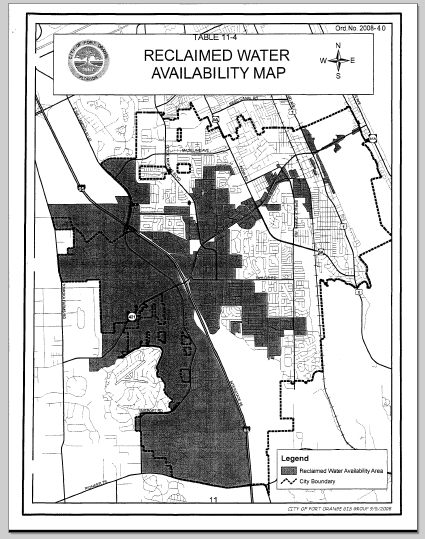
The property is currently within the city's reclaimed water availability map area as set forth in Table 11-4 as follows:
(b)
Minimum service requirements. All developments requesting that service be provided and determined to have reclaimed water "available" by the city manager or his designee shall provide new facilities or expand existing facilities as follows:
(1)
Subdivisions shall construct reclaimed water mains to provide irrigation and other nonpotable service to all lots based on the projected amount of property to be irrigated, as well as other potential nonpotable use. All subdivisions over five acres shall be required to be interruptible customers and have a backup source of irrigation water. Reclaimed water service taps shall be installed for each lot, with a minimum service tap size of one-inch diameter. Actual service tap size and potential sharing of service lines shall be reviewed and approved as specified and approved by city council resolution.
(2)
When reclaimed water service is determined to be "available" site development plans shall construct the required irrigation systems connected to reclaimed water mains. All site developments over five acres shall be interruptible customers and have a back up source of irrigation water. Where reclaimed water service has been projected to be available in the future per the city's reclaimed water availability map, irrigation systems shall be configured for ultimate connection to reclaimed water mains by locating pumps or future reclaimed water system connections adjacent to the right-of-way or other planned reclaimed water main location as directed by the city manager or his designee.
(3)
Proposed subdivisions and site developments of five acres or less located within the reclaimed water service area map may voluntarily request to be an interruptible reclaimed water customer or request to be a standard reclaimed water customer with no back up source of irrigation water.
(c)
Reclaimed water system design. The layout of reclaimed water distribution systems shall comply with the following design criteria, and the adopted reclaimed water policies and regulations and standard construction details of the city.
(1)
In general. Design and installation practices, materials, and methods shall conform with requirements for potable water systems, except where specifically modified by policies or details adopted for the reclaimed water system with the exception that backflow prevention devices are not required at the point of service.
(2)
Main size. Mains shall be sized based on the anticipated demand for reclaimed water use based on land use, soil characteristics, and potential nonirrigation use. Minimum main size shall be six inches in diameter and as identified in the city's current master utility plan.
(3)
Extension of lines to property boundaries. Reclaimed water mains shall be designed to "stub out" to the property boundaries for the proposed development to serve adjacent properties. This shall include mains in all right-of-way stubs, across the entire property frontage on existing roads without existing mains, and to the property boundary via easement when no other access is available to undeveloped and unserved properties as identified in the city's master utility plan and its reclaimed water availability area map.
(Ord. No. 1993-58, 1-18-94; Ord. No. 1995-43, §§ 57, 58, 12-19-95; Ord. No. 2008-40, § 1, 12-9-08)
Code of Ordinances reference—Reclaimed water, § 74-181 et seq.
Section 6: - City cost participation in infrastructure improvements.
The city may participate at the sole discretion of the Port Orange City Council in the cost of constructing certain upsized improvements as provided in this section and as identified in the city's master utility plan. For purposes herein, "upsized improvements" shall not include those improvements required under sections 3(b)(2), 4(b)(2), or 5(b)(1) and (2) of this chapter, unless the improvements required therein necessitate additional pipe size or depth.
(a)
Amount and form of cost participation. The amount of city's cost participation that may be considered shall be limited to the amounts described in subsection (c) of this section. The cost participation shall be in the form of cash reimbursement, impact fee credits, or a combination of the two, at the sole discretion of the city council.
(b)
Procedure. The following conditions shall be met prior to receipt by the developer of the cash reimbursement or impact fee credits as described in subsection (a) of this section:
(1)
Review of utility and drainage concept design. Before undertaking the construction of upsized improvements, the developer shall submit to the appropriate department a utility and drainage concept design showing all improvements required under this chapter and complying with any additional requirements of this chapter.
(2)
Verification/support of construction costs. The developer shall verify or support the amounts submitted to the city for cost participation by obtaining and submitting to the city either of the following:
(a)
At least three signed and dated bids for the construction work entailed in constructing the upsized improvements from reputable contractors, qualified and capable of performing the work; or
(b)
If the developer enters into a negotiated contract for the construction work that includes the upsized improvements, a copy of the initial and final contract prices and a cost estimate prepared, signed, and sealed by the engineer of record; and
(c)
The developer's submittal shall itemize the costs for the various upsized improvements in such a manner that a calculation of the amount of the city's cost participation may readily be made.
(3)
Review and recommendation. The appropriate department shall review the verification/support of construction costs submitted by the developer to ensure that the submission complies with all requirements of paragraph (1) of this subsection. The appropriate department shall forward a written recommendation to the city council as to the appropriate sum to be paid under the cost participation program and a request to encumber cost participation funds.
(4)
Award by city council. Upon receipt of the appropriate department's recommendation and any other appropriate information, the city council shall determine the amount and form of cost participation based on the applicable provisions of this chapter. Any cost participation request for city funds must be submitted for consideration prior to or concurrently with the final development plan or development order approval by the city. In order to be eligible to receive reimbursement via a city cost participation purchase order, the applicant shall be required to complete the construction of the city improvement including providing as-built drawings per city standards and any necessary easement documents. In addition, the final pay request must be received by the city within one year following city council approval of the initial funding request. Any development order extension on the project shall not automatically provide any additional time on the city cost participation request.
(5)
[Special considerations.] Should conditions arise that the applicant believes warrants special consideration for late reimbursement or a time extension for construction completion, then the applicant shall be required to submit another separate city cost participation request to the city manager or his designee stating the reason for the consideration of the time extension.
(6)
[Disbursement of funds.] Disbursement of the funds shall be subject to final inspection of the related improvements, receipt of as-built drawings per city standards, receipt of all necessary related easement and release of lien documents and acceptance of the related improvements.
(c)
Costs subject to reimbursement by city. The following types of construction costs shall be subject to cost participation in the following amounts, in accordance with the provisions of this section. For purposes herein, "construction cost" shall include a proportionate share of the city's costs for activities such as design, engineering or surveying work made in preparation of the construction work involved however, administrative or indirect costs such as attorneys' fees or the developer's own administration of the construction contract under which the upsized improvements are to be constructed shall not be included or considered.
(1)
Water mains—Oversizing of water mains. The city shall only pay for the upsizing of a water main if the required water main is greater than eight inches in diameter. Where the city requires a water main to be sized over eight inches in diameter, but the minimum service levels required by this code can be satisfied for the development using a water main of eight inches in diameter or less, upon approval of the city council, the city shall pay the amount of the difference in construction costs between the eight inch diameter line and the larger diameter required by the city.
(2)
Sewage collection facilities.
(a)
Oversizing of sewer mains. Where the city requires a sewer main to be sized over eight inches in diameter, but the minimum service levels required by this code can be satisfied for the development using a sewer main of eight inches in diameter, upon approval of the city council, the city shall pay for the amount of the difference in construction costs between an eight-inch-diameter line and the diameter required by the city.
(b)
Additional cut depth. Where the city requires depth on sewer mains, manholes, or lift stations in excess of the depth required to serve the development (including all phases), upon approval of the city council, the city shall pay for the additional construction costs associated with the increased depth.
(c)
Additional lift station capacity. Where the city requires additional wet well diameter or mechanical pumping equipment of greater capacity than that necessary to serve the project, upon approval of the city council, the city shall pay for the difference in construction costs between the facilities necessary to provide service to the development and those required to be installed by the city.
(d)
Oversizing of force mains. Where the city requires a sewer force main to be sized over six inches in diameter, but the minimum service levels required by this code can be satisfied for the development using a sewer force main of six inches in diameter, upon approval of the city council, the city shall pay for the difference in construction costs between a six-inch diameter line and the diameter required by the city.
(3)
Reclaimed water mains—Oversizing of reclaimed water mains. The city shall only pay for upsizing a reclaimed water main if the reclaimed main is required to be greater than six inches. Where the city requires a reclaimed water main to be sized over six inches in diameter, but the minimum service levels required by this code can be satisfied for the development using a reclaimed water main of six inches in diameter or less, upon approval of the city council the city shall pay for the difference in construction costs between the six inch diameter line and the larger diameter required by the city.
(4)
Drainage facilities. The city shall not pay for any drainage facility required for the development. This includes culverts and bridges for roads, driveways, and sidewalks which cross existing or proposed swales, ditches or canals. The city shall not pay for the construction of drainage facilities designed to accommodate the normal existing or natural flows from off-site watersheds. Where the city requires drainage facilities to be increased in capacity to alleviate existing development related drainage problems and flows not normally anticipated under stormwater management requirements, upon approval of the city council, the city shall participate in the costs of constructing the increase in capacity above the normally anticipated flows.
(5)
Other infrastructure improvements. The city shall pay for its proportionate share of all other infrastructure improvements as approved by the city council for upsizing greater than the minimum service levels.
(Ord. No. 1991-20, 8-27-91; Ord. No. 1993-58, 1-18-94; Ord. No. 1995-43, § 59, 12-19-95; Ord. No. 1999-6, § 21, 2-23-99; Ord. No. 2008-40, § 1, 12-9-08)
Section 7: - Solid waste collection service.
(a)
Minimum service requirements. All townhouse, multifamily, commercial, and industrial development shall provide facilities for service as follows:
(1)
Townhouse and multifamily projects shall provide one standard dumpster pad and enclosed collection point for every 20 residential units or a trash compactor sufficient in size to serve the entire development.
(a)
All individual dumpster pads must be located within a reasonable walking distance from the units they serve. Distances shall be measured from a dwelling unit's entryway, stairway, or elevator servicing the unit to the dumpster pad.
(b)
Trash compactor(s) are to be located where it is most convenient for residents. A separate drive that serves as a dropoff area for the trash compactor shall be constructed.
(c)
Townhouse and multifamily projects with less than 20 residential units are exempt from these requirements.
(2)
Commercial developments shall provide one standard dumpster pad for every 7,500 square feet of retail space and every 10,000 square feet of office space.
(3)
Industrial developments shall provide one standard dumpster pad for every 10,000 square feet of office or manufacturing space, and one standard dumpster pad for every 30,000 square feet of warehouse space.
(4)
Institutional buildings shall meet the requirements or combination of requirements that reflect the specific use or uses of the building.
(5)
These requirements are minimums based on twice a week service. If the number of dumpsters does not meet the regular needs of the development, the city may require the construction of additional facilities, or increased rates for more frequent service.
(b)
Solid waste facility design. The layout and design of dumpsters and other solid waste facilities shall comply with the following criteria, and the adopted Standard Paving and Drainage Details of the city.
(1)
Accessibility. Dumpster pad locations shall be designed to accommodate front loading trucks. No dumpster shall be located so as to require the truck to back up a distance of more than 100 feet. Multiple locations shall be oriented to allow the shortest route to service the group of dumpsters. All drives that provide access to dumpsters must be able to accommodate a 35-foot inside turning radius totally within the paved area. Dumpster pad locations should generally be angled at 45 degrees or less from access drives except when located at intersections allowing 90-degree access.
(2)
Clearance. Fences, walls, landscaping and other improvements shall be located so as to provide clearance as shown in the Standard [Utility] Details, including vertical clearance from power lines, light standards, and trees.
(3)
Enclosure. Each dumpster location shall be surrounded by an enclosure as depicted in the Standard [Utility] Details. Enclosures should remain open on the service side, except in high visibility locations where gates may be approved. The enclosure shall be constructed using colors, materials, and architectural treatments consistent with the structure it serves. Alternative materials and colors may be approved in those situations where the enclosure is physically or visually separated from the primary structure, or where the primary building materials do not lend themselves to the enclosure application.
(Ord. No. 2011-27, § 6, 10-25-11)
Code of Ordinances reference—Solid waste, ch. 56.
Section 8: - Electric, telephone, and television cable installation.
The following regulations shall apply to the installation, maintenance and replacement of all electric, telephone, television cable and similar utilities within the city. The general policy of the city is to require underground installation of such utilities to the greatest extent feasible, to assure public safety, foster tree preservation, and protect the general aesthetic character of the city.
(a)
Installation requirements. Except as provided below, all utility lines and services, with the exception of temporary construction lines, shall be installed underground at the owner's, developer's, or builder's expense. This shall specifically apply to all cables, conduits, or wires forming part of an electrical distribution system, including service lines to individual properties necessary to serve new development, or existing development where new or upgraded service is being installed. Underground installation shall not be required for:
(1)
Electric transmission lines. Those lines that transmit electricity between generating stations and substations.
(2)
Electric feeder lines. Those lines that transmit electricity between substations and individual subdivisions and projects. The installation of new feeder lines will be coordinated between the city and utility company.
(3)
Appurtenances such as transformers, pedestal-mounted terminal boxes and meter cabinets, when placed on a level concrete slab and located so as to minimize noise effects on surrounding properties.
(4)
Lines serving interim land uses, such as agricultural use of land designated for future urban development.
(5)
Replacement of existing overhead service lines, where no other site improvements are required due to expansion or change of use.
(6)
Replacement of lines on existing poles.
(7)
Service to individual residential lots in developed areas of the city presently served by overhead utility lines.
(b)
Waiver of underground installation requirement. Underground installation that would be required above may be waived as part of final site plan or subdivision approval, when established and extraordinary physical conditions and distances, service demands, or other site planning requirements result in economic impact or other circumstances that justify relief from this requirement. Such waiver is conditioned on the following:
(1)
The proposed overhead route does not contain trees of over 12 inches in diameter.
(2)
The proposed overhead route is not within and parallel to an existing or future required buffer between differing land uses, and does not conflict with required tree preservation or landscape installations.
(3)
The proposed overhead route is designed so as to minimize its visibility from off-site public areas on-site.
(4)
Overhead routes along arterial or collector roads shall be discouraged. However, if such a route is required, poles shall be located so as to accommodate necessary street lighting.
(5)
Due to the unique characteristics of electric power distribution, waivers for overhead power shall not automatically allow the installation of other utility lines. Parallel requests for such waivers shall be considered separately.
(6)
The cost differential between underground installation shall not be considered as the sole reason for installation.
(c)
Approval of overhead line and service routes. Waivers may be requested as part of the application for final subdivision or site plan approval, or building permit. The following information shall be submitted as part of the application:
(1)
A letter requesting the waiver, providing written justification for the granting of a waiver, including documentation from utility companies, contractors, or engineers to verify cost estimates or service demands.
(2)
A map or engineering drawing showing the route of the proposed lines, and existing or proposed easements covering the route.
(3)
A survey or drawing showing trees that must be removed or substantially pruned to allow the proposed construction.
(4)
Drawings showing the relationship of the proposed line to existing and proposed lots, buildings, landscaping, streets and other improvements. This may be reflected in typical details where appropriate.
(5)
A drawing showing the construction detail of proposed lines and poles, including dimensions and materials.

