
Port Orange City Zoning Code
CHAPTER 12
ROADS AND VEHICULAR USE AREAS1
Code of Ordinances references—Streets, sidewalks and other public places, ch. 58; sidewalk, garage and yard sales, § 18-76 et seq.
Section 1: - Purpose and intent.
To ensure effective, efficient and safe design of vehicular use facilities, the following chapter specifies criteria for all development as stated herein. This chapter is intended to serve the following purposes:
(a)
Maintain functional roadway capacity and travel speeds by requiring traffic analyses for new development to determine the need for transportation improvements;
(b)
Promote safe and well-designed traffic patterns and enhance functional roadway capacity by maintaining standards for access control;
(c)
Provide adequate parking and loading spaces for specific uses within the city;
(d)
Establish standards for bicycle parking for specific uses within the city;
(e)
Establish positive design standards for the layout and construction of vehicular use areas which promote safe and logical traffic patterns;
(f)
Provide required stacking area for drive-through facilities;
(g)
Provide for construction of sidewalks and bikeways to maintain safe bicycle and pedestrian movements, and to encourage use of alternative transportation;
(h)
Establish ultimate right-of-way widths for roadways within the city network; and
(i)
Establish special setbacks for properties which front on roadways which are to be improved in the future, thus providing ultimate required landscape buffers and setbacks.
Section 2: - General provisions.
(a)
Traffic analysis required. New development proposed within the city shall be required to provide a traffic analysis in accordance with the requirements established for concurrency review in chapter 4 of this code.
(b)
Transportation improvements required.
(1)
Turning lanes.
(a)
Left turn lanes. A left turn lane with a minimum of 200 feet of storage and 100 feet of transition shall be provided at each access point with an average daily trip end [volume] of 1,000 vehicles or more, and/or an average peak hour inbound left turn volume of 25 vehicles or more. Increased storage and transition lengths may be required by the city to provide for all deceleration outside the through lane.
(b)
Right turn deceleration lanes. A right turn deceleration lane with a minimum of 150 feet of storage and 100 feet of transition shall be required at each access point when the speed limit equals or exceeds 35 miles per hour and if the development will generate 100 or more right turn movements during the peak hour. Increased storage and transition lengths may be required by the city to provide for all deceleration outside the through lane.
(2)
Intersection improvements. At any intersection which abuts the development, the following improvements shall be provided:
(a)
A right turn shall be provided if the speed limit of the street equals or exceeds 35 miles per hour and if the development will generate 100 or more right turns during the peak hour.
(b)
A left turn shall be provided if the speed limit of the street equals or exceeds 35 miles per hour and if the development will generate 25 or more left turns during the peak hour.
(3)
Access drive. The design of access drives shall be in accordance with the following provisions:
(a)
Minor driveway entrance. This driveway type shall be provided for a maximum daily trip end volume of 500 vehicles and/or a maximum average peak hour volume of 50 vehicles. The minimum distance from the street right-of-way line at any ingress or egress minor driveway to the outer edge of any interior service drive or parking space with direct access to such driveway shall be 25 feet, measured perpendicular from the street. The city may require a turn lane of twelve 12 feet in width, with minimum 150 feet of storage and 100 feet of transition, unless a traffic engineering study acceptable to the city demonstrates that the absence of such a lane will not adversely impact traffic conditions.
(b)
Intermediate driveway entrance. This driveway type shall be provided for a maximum average daily trip end volume of 1,500 vehicles and/or a maximum average peak hour volume of 150 vehicles. The minimum distance from the street right-of-way line at any ingress or egress intermediate driveway to the outer edge of any interior service drive or parking space with direct access to such driveway shall be 50 feet, measured perpendicular from the street. A minimum turn lane 12 feet wide, with minimum 150 feet of storage and 100 feet of transition shall be provided, unless a traffic engineering study acceptable to the city demonstrates that the absence of such a lane will not adversely impact traffic conditions.
(c)
Major driveway entrance. This driveway type shall be provided for a maximum average daily trip end volume of 5,000 vehicles and/or maximum average peak hour volume of 500 vehicles. The minimum distance from the street right-of-way line at any ingress or egress major driveway to the outer edge of any interior service drive or parking space with direct access to such driveway shall be 100 feet, measured perpendicular from the street. A minimum turn lane 12 feet wide, with minimum 200 feet of storage and 100 feet of transition shall be provided, unless a traffic engineering study acceptable to the city demonstrates that the absence of such a lane will not adversely impact traffic conditions.
(d)
Major driveway signalized. Any major drive requiring a traffic signal shall conform to those warrants specified in the Manual of Uniform Traffic Control Devices (MUTCD) in addition to the following minimum requirements:
(1)
The installation of any traffic signal shall be subject to the approval of the appropriate jurisdiction responsible for the roadway upon which the signal is to be installed.
(2)
A continuous right turn lane shall be provided at all driveway locations where posted speeds are 35 miles per hour or greater and the total driveway volume of the development meets or exceeds 20 percent of the one-way directional flow on the street from which the driveway is provided access.
(4)
Traffic control signs. Traffic control signs shall be provided on-site and off-site in accordance with the Manual of Uniform Traffic Control Devices (MUTCD).
(5)
Pavement markings. Pavement markings shall be provided in accordance with the Manual of Uniform Traffic Control Devices (MUTCD).
(6)
Bus stops. New commercial developments exceeding 50,000 square feet in gross floor area and all new residential developments of more than 200 dwelling units shall provide on-site space for bus stops if located on an existing or proposed bus route. Such bus stops shall be separate and adjacent to travel lanes.
(c)
Classification of streets. For purposes of this code, streets shall be classified as they are identified for future functional classification in the comprehensive plan. The city council may, by subsequent resolution(s), designate, identify, and/or classify certain streets or roads as being arterial, major collector, minor collector or local.
(Ord. No. 2011-27, § 7, 10-25-11)
Section 3: - Access control.
(a)
In general. The following regulations are designed to promote the safety of vehicular and pedestrian traffic, minimize traffic congestion, promote roadside aesthetics and enhance the functional capacity of roads and highways in the City of Port Orange. These regulations shall be in addition to those imposed by the Florida Department of Transportation and the County of Volusia on roads under their jurisdiction[s].
Where recorded cross-access easements exist, all properties with cross-access shall be considered as one parcel under the provisions of this section. Further, where two or more of these regulations conflict, the more stringent requirement shall apply.
(b)
Number of entrances. All parcels shall be allowed one access point, consisting of one two-way driveway or a pair of one-way driveways, except for those properties restricted by subdivision plats or otherwise stated herein. The minimum frontage to allow two access points shall be as follows:
*Undesirable uses on roads of this classification and generally not permitted.
**Driveway classifications are defined in chapter 2, section 2, "Driveways."
A third access point may be allowed for properties with at least two times the frontage cited above.
(c)
Distance between access points and intersections. Access points upstream from intersections of higher or similar classification to the accessed road should be located as far as feasible from the intersection to provide for stacking and protection of left turn movements. Minimum distance from the intersecting right-of-way line to nearest edge of driveway shall be as follows:
*Undesirable uses on roads of this classification and generally not permitted.
(d)
Distance between two-way access points on one parcel. The minimum distance between two two-way access point centerlines on one parcel shall be as follows:
* Undesirable uses on roads of this classification and generally not permitted.
(e)
Distance between access point and property line. The minimum distance between the nearest edge of an access drive and any property line without a cross-access easement shall be as follows:
* Undesirable uses on roads of this classification and generally not permitted.
(f)
Width and radii of access drives. Width of two-way driveway access and radii shall be within the dimensions specified below. Actual width and radii shall be based on a) classification of the roadway, b) number of entrances to the parcel, and c) expected traffic demand, including truck usage.
Where one-way turning motions are dictated, reverse radii with a 2.5-foot radius bullnose shall be provided.
(g)
Single-family and duplex drives.
(1)
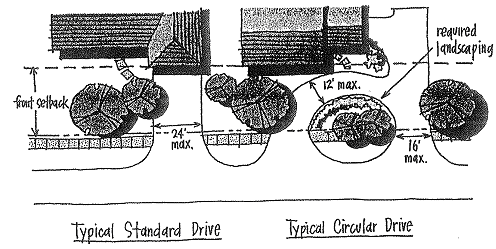
Dimensions. The following dimensions shall apply to drives within the front yard setback of all single-family and duplex dwellings.
* Driveways in excess of the maximum width may be approved by the administrative official when such driveway width is proportional to the size of the residence, the number of garage parking spaces, and the size of the lot.
** Maximum width shall only be permitted for the portion of the circular drive that diverges to create a standard drive.
Figure 12:1 Residential Driveway Dimensions
(2)
Maximum coverage. Driveway and parking coverage within the front yard area shall not exceed 40 percent. Both pervious and impervious surfaces shall be considered in calculating whether the foregoing standard has been exceeded.
(3)
Visual screening. Any parking or driveway area located within the building setback which is in excess of the above-stated maximum width or not perpendicular to the right-of-way shall be sufficiently screened to mitigate its visual impact and to achieve the intent of this chapter. The property owner shall provide a mitigation proposal to be reviewed by the administrative official. This requirement shall not apply to second drives for corner lots.
(4)
Front yard coverage. Driveway and parking coverage within the front yard shall be limited to the area of the front yard that is directly in front of the garage or in the side yard. Further extension of or expansion to the existing driveway and parking coverage shall not increase the driveway or parking coverage toward the center of the front yard, unless such extension or expansion is for the purpose of constructing a circular drive.
(h)
Limited use service drives. The provisions of this chapter shall not generally apply to limited use service drives. Dimensions regarding this type of drive shall be determined based on the specific traffic safety considerations of the location and proposed use of the drive.
(i)
Dunlawton corridor provisions. Development within the Dunlawton corridor shall be designed in compliance with the roadway maps of the Dunlawton corridor plan, an appendix to the future land use element of the comprehensive plan, and address the following requirements:
(1)
Cross-access easements, where indicated and/or deemed necessary, shall be required to allow for multiple ownership parcels to utilize the limited access points planned.
(2)
Access shall only be permitted at points proposed in the plan. The temporary and ultimate full or limited access function of these access points shall be in accordance with the plan.
(3)
Shared or frontage road access shall be provided in accordance with the plan.
(j)
Corner sites. Corner sites shall have sole access from the street with the lower functional classification, unless otherwise determined by the city.
(k)
Through lots. Through lots which abut any street upon which single-family lots are located shall be prohibited from gaining access to such street, unless no other means of access is available.
(l)
Existing curb cuts. New development and renovation/rehabilitation of existing sites shall be required to remove all abandoned existing curb cuts adjacent to the site. Such removal shall include repair of the curb, sidewalk and landscaped area as necessary.
(m)
Variances. Where the department concurs that unique traffic engineering considerations exist on a specific site, variances from this chapter may be authorized through the development plan approval process, or at the time of building permit application for one-family and two-family residences. However, if the department objects to a proposed variance from this chapter, a formal variance shall be requested in accordance with provisions for such in this code.
(Ord. No. 1993-58, 1-18-94; Ord. No. 1995-43, § 60, 12-19-95; Ord. No. 1996-33, §§ 6, 7, 11-19-96; Ord. No. 2011-27, § 7, 10-25-11)
Section 4: - Parking.
(a)
General provisions.
(1)
Off-street parking required. Off-street parking facilities shall be provided for all development within the city pursuant to the requirements of this code. The facilities shall be maintained as long as the use exists that the facilities were designed to serve.
(2)
Computation.
(a)
Number of spaces. When the number of off-street spaces required by this code results in a fractional space, the fraction of one-half or less may be disregarded, and a fraction in excess of one-half shall be counted as one parking space.
(b)
Places of public assembly.
(1)
Benches. In stadiums, sports arenas, churches and other places of assembly in which those in attendance occupy benches, pews or other similar seating facilities, each 18 inches of the seating facilities shall be counted as one seat.
(2)
Fixed seats and assembly areas. In cases where a place of assembly has both fixed seats and open assembly area, requirements shall be computed separately for each type and added together.
(3)
Square feet. Unless otherwise stated herein, square feet shall be defined as gross floor area. Gross floor area shall be the sum of the gross horizontal area of all floors of a building measured from the exterior faces of the exterior walls.
(3)
Maintenance. All off-street parking, loading and vehicular use areas shall be maintained in accordance with commercial property maintenance standards, Code of Ordinances.
(b)
Required off-street parking spaces.
(1)
Minimum requirements. The matrix below specifies the required minimum number of off-street motor vehicle and bicycle parking spaces, the percentage of motor vehicle spaces that must be allotted for compact vehicles, and in the notes, any special requirements that may apply.
(2)
Uses not listed. The number of parking spaces required for uses not specifically listed in the matrix shall be determined by the city based upon information provided by the applicant. Applicable information shall include requirements for similar uses and appropriate traffic engineering and planning data, and shall establish a minimum number of parking spaces based upon the principles of this code.
(3)
Multiple uses. Where a combination of uses is proposed for development, parking shall be provided for each of the uses as prescribed by the matrix, unless reduction is granted pursuant to [subsection] (d)(3) of this section.
(4)
Ratio of full size to compact spaces. The ratio of full size to compact spaces shall be maintained for the total number of parking spaces provided. Developers may increase this ratio thus increasing the number of full size spaces, however, in no case shall the ratio of compact spaces be permitted to exceed that as specified for each use.
(5)
Motorcycle parking spaces. In development sites requiring more than 20 automobile parking spaces, five percent of the required automobile parking spaces may be converted to motorcycle parking.
(6)
Matrix.
(c)
Special parking spaces.
(1)
Parking for handicapped persons. Any parking area to be used by the general public shall provide suitable, marked parking spaces for handicapped persons. The number, design, and location of these spaces shall be consistent with the requirements of the applicable Florida Statutes, or succeeding provisions.
Parking spaces required for the handicapped may be counted as parking spaces in determining compliance with this chapter. All spaces for the handicapped shall be paved.
(2)
Bicycle parking.
(a)
Bicycle racks or other acceptable bicycle parking devices shall:
(1)
Be designed to allow each bicycle to be supported by its frame.
(2)
Be designed to allow the frame and wheels of each bicycle to be secured against theft.
(3)
Be designed to avoid damage to the bicycles.
(4)
Be anchored to resist removal and solidly constructed to resist damage by rust, corrosion, and vandalism.
(5)
Accommodate a range of bicycle shapes and sizes and to facilitate easy locking without interfering with adjacent bicycles.
(6)
Be located to prevent damage to bicycles by cars.
(7)
Be consistent with the surroundings in color and design and be incorporated wherever possible into building or street furniture design.
(8)
Be located in convenient, highly-visible, active, well-lighted areas.
(9)
Be located so as not to interfere with pedestrian movements.
(10)
Be located as near the principal entrance of the building as practicable.
(11)
Provide safe access from the spaces to the right-of-way or bikeway.
(d)
Adjustments to requirements.
(1)
Vehicle parking deferral.
(a)
To avoid requiring more parking spaces than actually needed to serve a development, the city may defer the provision of some portion of the off-street parking spaces required by this code if previous experience within the city for such a use or information supplied by the developer suggests that the required number of parking spaces may not be necessary. In such a case, the developer shall provide a deferred parking plan in accordance with [subsection] (b) below.
(b)
A deferred parking plan:
(1)
Shall be designed to contain sufficient space to meet the full parking requirements of this code, shall illustrate the layout for the full number of parking spaces, and shall designate which are to be deferred.
(2)
Shall not assign deferred spaces to areas required for landscaping, transition zones, setbacks, or areas that would otherwise be unsuitable for parking spaces because of the physical characteristics of the land or other requirements of this code.
(3)
Shall include a landscaping plan for the deferred parking area.
(4)
Shall include a written agreement with the city that, one year from the date of issuance of the certificate of occupancy, the deferred spaces will be converted to parking spaces that conform to this code at the developer's expense should the city determine from experience that the additional parking spaces are needed.
(5)
Shall include a written agreement that the developer shall incur the expense of a traffic study to be undertaken by a registered transportation engineer to determine the advisability of providing the full parking requirement should the city determine from experience that the additional parking spaces are needed.
(c)
When authorized by the city upon a preliminary finding that the parking is inadequate, but not sooner than one year after the date of issuance of the certificate of occupancy for the development, the city shall request a study to determine the need of providing the full parking requirement to satisfy the proven demand for parking as discussed in [subsection] (b)(5) above.
(d)
Based upon the study and the recommendations of the transportation engineer and the director of community development, the city shall determine if the deferred spaces shall be converted to operable parking spaces by the developer or retained as deferred parking area.
(e)
The developer may at any time request that the city approve a revised development plan to allow converting the deferred spaces to operable parking spaces.
(2)
Bicycle parking deferral. The city may authorize deferral of required bicycle parking spaces when the nature of the use, information supplied by the developer or previous experience for similar uses in the city suggests that the bicycle parking is not necessary. The developer shall note on the development plan the number and location of spaces to be deferred, and an obligation to provide the bicycle parking when its need has been determined by the city. Deferred bicycle parking spaces shall comply with requirements of this code at the time of installation.
(3)
Reduction for mixed or joint use of parking spaces. The city may authorize a reduction in the total number of required parking spaces for two or more uses jointly providing off-street parking when their respective hours of need of maximum parking do not normally overlap. Reduction of parking requirements because of joint use may be approved if the following conditions are met:
(a)
The developer submits sufficient data to demonstrate that hours of maximum demand for parking at the respective uses do not normally overlap.
(b)
The developer submits a legal agreement approved by the city attorney guaranteeing the joint use of the off-street parking spaces as long as the uses requiring parking are in existence or until the required parking is provided elsewhere in accordance with the provisions of this code.
(c)
The structures and facilities provided for one or both of the uses are specialized to the degree that no change in use resulting in greater parking demand could take place without expensive reconstruction necessitating a development permit and development plan review.
(d)
If the properties are under separate ownership and control, a written easement and agreement shall be recorded at the applicant's expense, specifying the conditions of such joint use. This agreement shall be approved by the city attorney.
(4)
Reduction to achieve compliance with other code requirements for existing developments. The city may authorize a reduction in the total number of required parking spaces for existing developments when such reduction is proposed in conjunction with renovation, redevelopment or reuse of the site as part of the development plan approval process. In reviewing the reduction, the city shall consider the extent of the reduction, the degree to which the site is brought into compliance with current code requirements as a result of the reduction, the historical parking utilization of the subject property, the impact such reduction may have on adjoining properties and parking facilities, and any other concern which may be deemed significant by the administrative official.
(Ord. No. 1993-58, 1-18-94; Ord. No. 1995-43, §§ 61, 62, 12-19-95; Ord. No. 1999-6, § 22, 2-23-99; Ord. No. 2000-53, § 3, 2-20-01; Ord. No. 2004-11, § 2, 6-15-04; Ord. No. 2011-27, § 7, 10-25-11; Ord. No. 2011-32, § 2, 12-13-11; Ord. No. 2011-39, § 2, 1-3-12; Ord. No. 2015-34, § 2, 10-6-15; Ord. No. 2015-39, § 1, 12-8-15; Ord. No. 2017-16, § 2, 5-16-17; Ord. No. 2017-17, § 1, 5-16-17; Ord. No. 2020-7, § 2, 6-16-20)
Code of Ordinances reference—Stopping, standing and parking, § 70-31 et seq.
Section 5: - Loading.
(a)
In general. Spaces to accommodate off-street loading of business vehicles shall be provided as required below.
(b)
Required loading spaces.
Code of Ordinances reference—Stopping, standing and parking, § 70-31 et seq.
Section 6: - Design standards for off-street parking and loading areas.
(a)
Location.
(1)
Except as provided herein, all required off-street parking spaces and the use they are intended to serve shall be located on the same parcel.
(2)
The city may approve a special exception for off-site parking facilities as part of the parking required by this code if:
(a)
The location of the off-site parking spaces will adequately serve the use for which it is intended. The following factors shall be considered:
(1)
Proximity of the off-site spaces to the use that they will serve.
(2)
Ease of pedestrian access to the off-site parking spaces.
(3)
Whether off-site parking spaces are compatible with the use intended to be served, e.g., off-site parking is not ordinarily compatible with high turnover uses such as retail.
(b)
The location of off-site parking spaces will not create unreasonable:
(1)
Hazards to pedestrians.
(2)
Hazards to vehicular traffic.
(3)
Traffic congestion.
(4)
Interference with access to other parking spaces in the vicinity.
(5)
Detriment to any nearby use.
(c)
The developer supplies a written agreement or attaches off-site parking by deed to the parcel to which such parking is designed to serve, approved in form by the city attorney, assuring the continued availability of the off-site parking facilities for the use they are intended to serve.
(3)
All parking spaces required by this code for residential uses should be located no further than the following distances from the units they serve:
Resident parking: 200 feet.
Visitor parking: 250 feet.
Distances shall be measured from a dwelling unit's entry to the parking space. Where a stairway or elevator provides access to dwelling units, the stairway or elevator shall be considered to be the entrance to the dwelling unit. For purposes of measuring these distances, each required parking space shall be assigned to a specific unit on the development plan, whether or not the developer will actually assign spaces for the exclusive use of the specific unit.
(b)
Size.
(1)
Parking spaces.
(a)
A standard parking space shall be ten feet wide and 20 feet long.
(b)
Compact parking spaces shall be 8½ feet wide and 17 feet long.
(c)
Parallel parking spaces shall be a minimum of ten feet wide and 22 feet long.
(d)
A tandem parking space is a parking space that abuts a second parking space in such a manner that vehicular access to the second space can be made only through the abutting (tandem) space. Tandem parking spaces shall be a minimum of ten feet wide and 20 feet long, and may only be used for residential uses in accordance with requirements of this chapter.
(e)
Standard motorcycle parking space shall be a minimum of four feet wide and ten feet long. Motorcycle spaces shall be constructed of concrete or other acceptable hard surfaces other than asphalt.
(f)
Spaces for handicapped parking shall be the size specified by the applicable Florida Statutes.
(2)
Loading spaces. The standard off-street loading space shall be 12 feet wide, 25 feet long, provide vertical clearance of 15 feet, and provide adequate area for maneuvering, ingress and egress. The city may require the length of one or more of the loading spaces to be increased up to 55 feet if full-length tractor-trailers are anticipated to be accommodated. Developers may install spaces that are larger than the standard, but the number of spaces shall not be reduced on that account.
(c)
Layout.
(1)
General requirements.
(a)
Pedestrian and bicyclist circulation facilities, roadways, driveways, and off-street parking and loading areas shall be designed to be safe and convenient.
(b)
Parking and loading areas, aisles, pedestrian walks, bikeways, landscaping, and open space shall be designed as integral parts of an overall development plan and shall be properly related to existing and proposed buildings.
(c)
Buildings, parking and loading areas, landscaping and open spaces shall be designed so that pedestrians moving from parking areas to buildings and between buildings are not unreasonably exposed to vehicular traffic.
(d)
Each off-street parking space shall open directly onto an aisle or driveway that, except for single-family and two-family residences, is not a public street.
(e)
Aisles and driveways shall not be used for parking vehicles, except that the driveway of a single-family or two-family residence or townhouse with an attached garage shall be counted as a parking space for the dwelling unit, or as a number of parking spaces as determined by the city based on the size and accessibility of the driveway.
(f)
The design shall be based on a definite and logical system of drive lanes to serve the parking and loading spaces. A physical separation or barrier, such as vertical curbs, may be required to separate parking spaces from travel lanes.
(g)
Parking spaces for all uses, except single-family and two-family residences and townhouse units with attached garages, shall be designed to permit entry and exit without moving any other motor vehicles.
(h)
No parking space shall be located so as to block access by emergency vehicles.
(i)
Compact spaces shall be distributed evenly throughout the parking area to the greatest extent possible.
(j)
No designated off-street parking or loading space or drive shall be located within ten feet of any multifamily structure or within three feet of any other building or structure which such vehicular facility is intended to serve.
(k)
Dead-end aisles with adjoining parking spaces shall have an extension of the aisle a minimum of five feet beyond the last space to provide for vehicular maneuvering.
(2)
Dimensions. The following table and illustration prescribe the required minimum dimensions of all parking spaces.
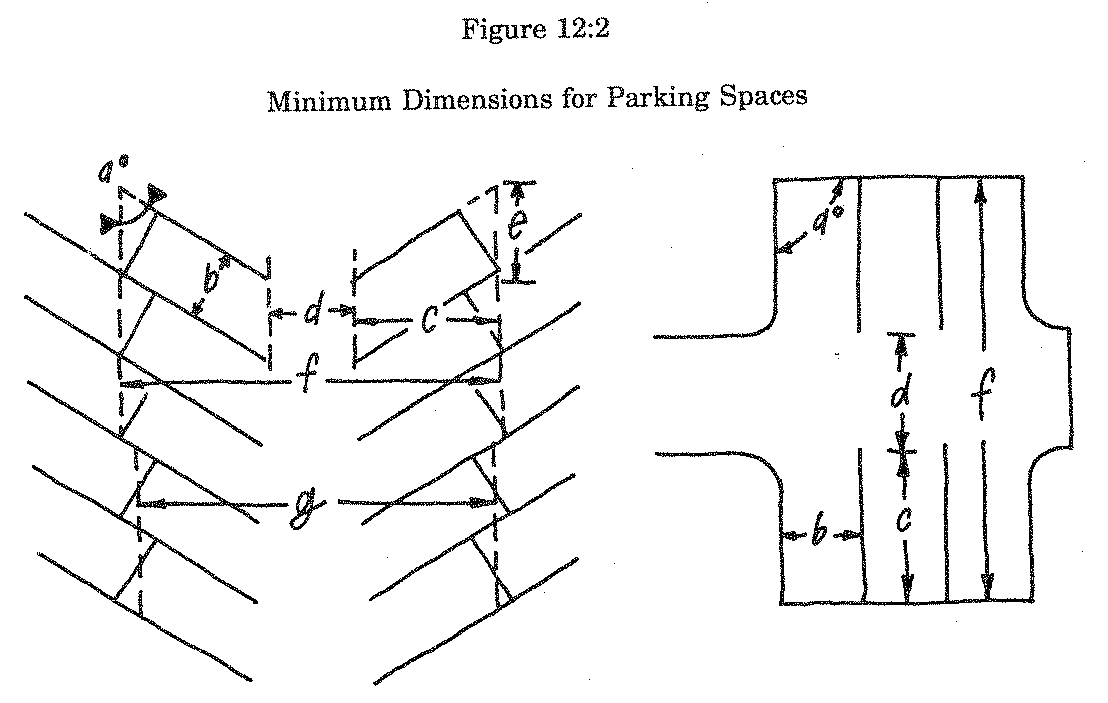
TABLE FOR PARKING LOT DIMENSIONS
Reductions in required width and length may be permitted under the following conditions. Such reductions shall be utilized to reduce pavement area, preserve significant trees or vegetation or increase landscaped areas. The unpaved area resulting from such reductions shall not be credited towards required vehicular use landscaping or be included within required buffers.
(a)
Reduced width. An unlimited number of spaces may be approved to be reduced to nine feet wide to increase internal landscaped area above the minimums specified by this code, and to preserve existing specimen trees.
(b)
Reduced length. Designers are encouraged to reduce paved areas by reducing the length of standard parking spaces to 18 feet of pavement with two feet of grassed overhang area. Continuous curbing or wheel stops shall be used at the end of the 18-foot dimension.
(d)
Grass parking. Designers are encouraged to provide grassed overflow parking areas where the number of spaces desired is greater than the code minimums. Additionally, those uses that anticipate less parking demand than the code minimum requires may utilize grassed overflow parking areas for up to 25 percent of the requirement for general office, commercial, and industrial uses, and up to 50 percent for recreational or institutional uses with weekly or less frequent peak demand. The provision for grassed parking to satisfy minimum parking requirements shall comply with the following conditions:
(1)
Grassed parking shall be shown on the development plan. Stormwater, landscaping, buffer, setback and other applicable provisions of this code shall be complied with as though the area was being paved.
(2)
No grassed parking area shall be established within any required open space or landscape area, and no such area shall be credited towards required buffers and landscaping.
(3)
Spaces shall be delineated in some manner, such as use of railroad ties or wheel stops.
(4)
Grass may be substituted with cypress mulch, bark, gravel or other similar material, provided such material is a minimum of two inches deep, placed upon a porous weed barrier and effectively contained within a border of concrete, railroad ties, or other rigid material.
(5)
If grassed parking areas utilized to satisfy the minimum number of parking spaces are regularly used so as to become rutted, uneven, unable to drain properly, unsightly or unmaintained, the city may require that the area be paved as specified in this chapter.
(e)
Access to loading spaces.
(1)
Each required loading space shall be accessible to a street, service drive, or alley in a manner that will not interfere with the movement of vehicles passing the loading space.
(2)
No loading space shall be located so that a vehicle must back onto a public street or extend into any street right-of-way while being loaded or unloaded.
(f)
Surfacing.
(1)
In general. All parking and loading spaces, access drives, aisles, and other means of vehicular access required under this code shall be graded and paved in accordance with the specifications described in Standard Paving and Drainage Details of the City of Port Orange, except as otherwise permitted herein.
(2)
Alternative surfaces.
(a)
The city may allow specified parking spaces or areas to be surfaced with paver blocks, aggregate concrete, or other semi-impervious material in order to reduce adverse impacts to existing vegetation and trees shown to be preserved on a development plan.
(b)
The city may allow grass parking in accordance with provisions of section 6(d) above.
(c)
The city may allow alternative surfaces such as brick, decorative block or other material for decorative purposes, provided such materials are determined to be an acceptable substitute by the department.
(3)
Ridgewood development district. For properties in the Ridgewood development district south of Fleming Avenue, the city may allow the use of alternative surfaces such as recycled concrete, aggregate concrete, paver blocks, or other semi-pervious material. If an alternative surface is used, a header curb or similar material/method shall be constructed around the perimeter of the parking lot and internal landscape islands. Driveway aprons within the right-of-way and the required ten-foot right-of-way buffer, and handicapped parking spaces shall not be constructed of alternative surfaces.
(g)
Curbing, wheel stops and speed bumps.
(1)
Curbing, wheel stops, or barriers to protect sidewalks, walls, fences, or landscaped areas, and to prevent parking or loading where not permitted, shall be provided in accordance with this code except for parking areas for single-family or two-family dwellings.
(2)
Wheel stops shall be installed at least 30 inches from an adjacent sidewalk, fence, wall or hedge. The stops shall be of the standard concrete curb, or other appurtenance or design feature that keeps a vehicle from obstructing a sidewalk or making contact with a wall, hedge or fence. A sidewalk adjacent to a building may be used for vehicle overhang if the sidewalk is not less than seven feet wide.
(3)
Speed bumps or other devices which create a hazardous break in the level surface of a roadway or drive shall not be permitted within the city.
(h)
Marking.
(1)
Designated parking and loading spaces shall be marked on the surface of the parking space with paint or permanent marking materials in accordance with the Manual of Uniform Traffic Control Devices (MUTCD), and maintained in a clear and visible condition.
(2)
Compact spaces. Labeled wheel stops or pavement markings shall be used to distinguish compact car spaces from full size car spaces.
(3)
All motorcycle parking shall be clearly identified through signage or pavement marking as reserved for motorcycles only.
(i)
Directional arrows. In parking facilities containing 20 spaces or more, all aisles, approach lanes, and maneuvering areas shall be clearly marked with directional arrows and lines to expedite traffic movement in accordance with the Manual of Uniform Traffic Control Devices (MUTCD).
(j)
Signs. The city may require a developer to install signs in addition to directional arrows and consistent with the sign regulations in this code and the Manual of Uniform Traffic Control Devices (MUTCD) to ensure the safe and efficient flow of vehicles, both on-site and off-site as warranted.
(k)
Landscaping. All off-street parking and loading areas shall be landscaped in accordance with the landscaping and tree protection regulations in this code.
(l)
Lighting. Parking lots of 20 spaces or more that are to be used after dark shall be lighted. The lighting shall not shine directly upon any adjacent residence or street, and shall not produce excessive glare.
(m)
Shopping cart corrals. To help protect landscape islands and other landscaped areas from becoming shopping cart corrals, such cart corrals shall be required for any site development which proposes the use of shopping carts and requires more than 100 parking spaces. Cart corrals shall be incorporated into the design of the parking layout and permanently affixed to the parking surface. Parking spaces utilized for cart corrals shall not be counted toward the required number of off-street parking spaces.
(Ord. No. 1993-58, 1-18-94; Ord. No. 1995-43, § 63, 12-19-95; Ord. No. 1999-6, § 23, 2-23-99; Ord. No. 2011-27, § 7, 10-25-11; Ord. No. 2013-5, § 2, 5-21-2013)
Code of Ordinances reference—Stopping, standing and parking, § 70-31 et seq.
Section 7: - Required stacking area for drive-through facilities.
All commercial and office uses utilizing drive-through facilities shall provide vehicle stacking area based on the following criteria:
(a)
Size of space. Stacking area shall be designed based on a ten-foot by 22-foot space per required vehicle.
(b)
Design of stacking area. The stacking area required below shall be designed so as to operate independently of other required parking and circulation areas. The required number of vehicle spaces shall include the vehicle being served.
(c)
Required stacking area.
Section 8: - Pedestrian/bicycle access.
(a)
In general. All new development shall be required to provide for pedestrian/bicycle access in accordance with this section. Such access shall be coordinated with general vehicular traffic and directed to provide safe access to bicycle parking areas, main entrances and other appropriate focal points.
(b)
Bikeways.
(1)
Location. All new development shall construct the following when required by the city:
(a)
Bikeways shown for construction in the comprehensive plan which are in rights-of-way adjacent to new development. Bikeways shall be constructed on the side of the right-of-way designated by the city, regardless of which side new development is proposed.
(b)
Bikeways on both sides of Dunlawton Avenue and Taylor Road in accordance with the Dunlawton corridor plan.
(c)
Bikeways on both sides of any right-of-way which exceeds 150 feet in width.
(d)
Bikeway connectors between bicycle parking areas, main entrances or other areas and the bikeway within the right-of-way when the required number of bicycle parking spaces exceeds five. Such connectors shall be a minimum of five feet in width and shall be designed separate from general vehicular traffic.
(e)
Bikeways required as a specific contingency of any subdivision, site or planned development approval.
(2)
Specifications. The minimum specifications for bikeways shall be in accordance with the Standard Paving and Drainage Details of the City of Port Orange.
(c)
Sidewalks.
(1)
Location. All new development shall construct the following when required by the city:
(a)
Sidewalks which would logically extend and connect to an existing sidewalk.
(b)
Sidewalks to connect new development with existing or proposed sidewalks or bikeways within the right-of-way when the total required number of parking spaces for the development exceeds 35.
(c)
Complete internal sidewalk systems within multifamily developments which connect buildings, parking areas and common facilities.
(d)
Sidewalks which separate parking areas from buildings, and provide safe pedestrian access from parking areas to buildings.
(e)
Sidewalks required as part of any subdivision, site or planned development approval.
(f)
Sidewalks in adjacent rights-of-way.
(2)
Specifications. The minimum specifications for sidewalks shall be in accordance with the Standard Paving and Drainage Details of the City of Port Orange.
(d)
Design of bikeways and sidewalks.
(1)
Bikeways should be designed to take advantage of natural areas and provide for a visually pleasurable route by meandering around and through natural undisturbed areas, landscape buffers and man-made landscape features. The minimum radius of any curve in the layout of a bikeway shall be 25 feet.
(2)
Bikeways should be designed to meander in and out of the right-of-way in order to de-emphasize the hard edge of the right-of-way line.
(e)
Walklights. All development within the Dunlawton Corridor shall be required to install high-level walklights adjacent to bikeways and sidewalks as shown in the Dunlawton Corridor plan. Such walklights shall be ten to 12 feet in height, placed three feet from the edge of the bikeway or sidewalk, spaced 100 feet on center, and be of the general shoe box style with light fixtures directed down toward the bikeway or sidewalk. Other style fixtures may be considered by the city when such fixtures are determined to be integral to a desired theme or recognized architectural style, and consistent with the intent of the corridor plan.
(Ord. No. 1992-29, 11-3-92)
Code of Ordinances reference—Duty of property owner regarding construction and maintenance of sidewalks, § 58-3.
Section 9: - Roadways.
(a)
In general. The following section describes the city program for ensuring an effective, efficient and attractive roadway network. All new development shall be required to comply with these regulations as applicable in order to promote the purposes and determinations stated herein.
(b)
Right-of-way. The city has determined the ultimate and future right-of-way for all streets comprising the roadway network. The following list provides ultimate right-of-way widths by link for roadways which are existing or planned.
TABLE 12-1. ULTIMATE RIGHT-OF-WAY WIDTHS
(c)
Reserved.
(d)
Expansion of existing structures along existing roadways. Expansion of existing structures on properties fronting on roadways identified in [subsection] (c) above shall comply with special setback requirements contained therein for the applicable thoroughfare buffer zone.
(Ord. No. 1995-43, §§ 64, 65, 12-19-95)

