
Port Orange City Zoning Code
CHAPTER 14
ARCHITECTURAL DESIGN
Section 1: - Purpose and intent.
To ensure quality development and to maintain and enhance an attractive physical environment within the city, the following chapter requires compliance with architectural design criteria for all development as stated herein. Pertinent to an attractive physical environment for the public is the design of the site, use of colors and materials, signage, building orientation, architectural style and compatibility with surrounding structures.
This chapter is intended to promote imagination, innovation and variety by focusing on design principles and encouraging creative solutions which serve the following purposes.
(a)
Create a sense of permanence and place by promoting development which emulates enduring character through use of quality design and building materials;
(b)
Promote variety and diversity in architectural design;
(c)
Carefully balance the natural environment with man-made systems which preserve, protect and conserve the natural environment;
(d)
Sustain the comfort, health, tranquility and contentment of residents and attract new residents by reason of a desirable suburban environment;
(e)
Minimize incompatible surroundings and visual blight which prevent orderly community development and reduce community property values;
(f)
Encourage and promote development which features amenities and excellence in the form of variations of siting, types of structures and adaption to and conservation of native vegetation and other environmental design features;
(g)
Foster civic pride and community spirit by maximizing the positive impact of development;
(h)
Inspire creative approaches to the use of land and related physical development;
(i)
Encourage the realization and conservation of a desirable and aesthetic suburban environment through simple and cost-effective design elements; and
(j)
Foster the development of a positive visual character for the city by promoting a high degree of compatibility between land uses and maintaining a standard for quality development.
Section 2: - In general.
(a)
Application to development. The architectural design of all structures shall comply with the requirements of this chapter, except as otherwise provided in this subsection. Architectural elevations of all facades of all structures to be constructed within the city shall be a required exhibit for development plan approval. Such exhibit shall include colors, materials, building dimensions, location of service areas and mechanical equipment, screening devices, site furnishings, lighting fixtures, notes indicating compliance with section 4 of this chapter, and any other information as determined necessary to ensure consistency with the intent of this chapter by the administrative official. Single-family and two-family dwellings and their appurtenant accessory structures shall be exempt from the provisions of this chapter unless located within the Port Orange Town Center.
(b)
City approval required. Final approval of all architectural designs shall be determined by the city as part of the development plan approval process. Such approval shall include, but not be limited to, roof design, materials, colors, orientation, and signage.
(c)
Approval for change of exterior design required. Any exterior change of any nonresidential structure or multifamily structure in a planned unit development or conventional zoning district shall require review and approval by the city. Such changes shall include, but not be limited to, colors, materials, roof finishes and signage. The purpose of such approval shall be to ensure that any exterior change is consistent with the intent and requirements of this chapter. Routine maintenance and replacement of materials which does not affect the approved exterior design shall be exempt from this subsection.
(d)
Recognized architectural style. A recognized architectural style shall be one which is recognized by design professionals as having a basis in classical, historical or academic architectural design philosophies. The use of features deemed by this chapter to be "integral features of a recognized architectural style" shall have a rational and aesthetic relationship to the elevation of a structure, and be harmonious with the pattern, proportions and materials of surrounding structures. The following shall not be considered recognized architectural styles:
(1)
Highway architecture as commonly described by architectural historians.
(2)
Corporate signature or commercial phototype architecture, unless such is consistent with other requirements of this chapter.
(3)
Any architecture having a historical reference which is so unique and different from current design philosophy that such reference is inconsistent and incompatible with surrounding structures. Examples of such include igloos, tepees, medieval castles, caves and the like.
(4)
Any kitsch architecture which does not resemble a typical structure, but resembles an exaggerated plant, animal, fish, edible food or other such item such as giant oranges, ice cream cones, dinosaurs and the like.
(Ord. No. 1993-58, 1-18-94; Ord. No. 1998-22, § 1, 7-21-98; Ord. No. 2011-27, § 9, 10-25-11)
Section 3: - Special provisions.
(a)
Ridgewood Development District. Within the Ridgewood Development District the requirements of this chapter shall apply as follows:
(1)
For development activities on property within the Port Orange Town Center, only subsection (f) of this section shall apply.
(2)
For all other property within the Ridgewood Development District, the requirements of this chapter shall only apply to the following development activity:
(a)
New development.
(b)
Exterior renovation of existing structures where the estimated dollar value of such renovation equals or exceeds 25 percent of the taxable assessed value of the improvements on the property.
Compliance shall only be required for those facades which are visible from any public right-of-way. Exemption from the requirements of this chapter shall be determined based on building orientation, density of existing vegetation to remain, and surrounding land uses and development patterns.
(b)
Old Dunlawton Redevelopment District. New development and rehabilitation projects within the Old Dunlawton Redevelopment District shall be required to comply with the following requirements. Properties within the district include those identified as such in the Dunlawton Corridor Plan, an appendix to the future land use element of the comprehensive plan.
(1)
The height, shape and mass of structures shall be consistent with surrounding structures and maintain a small-scale, residential character.
(2)
The use of vernacular materials such as wood siding, standing seam roofs, multi-light windows and unique architectural decoration shall be strongly encouraged to promote and retain the historic character of this section of Dunlawton Avenue.
(3)
The use of thematic parking lot lighting and signage shall be encouraged.
(4)
The rehabilitation of existing structures which have not been extensively modified or can be restored to their original appearance shall be encouraged.
(5)
Flat roofs and solid glass facades shall not be permitted.
(6)
The use of vernacular architectural elements such as porches, dormers, cupolas and other such features shall be encouraged.
(c)
Industrial uses. Structures designed for industrial use shall not be required to comply with paragraphs 4(a), 4(b), 4(c), 4(g), 4(h) and 4(i) of this chapter unless the parcel upon which the structure is to be constructed is visible from or fronts on any arterial or collector roadway as determined by the future functional classification in the comprehensive plan. In such case, only the visible facades shall be required to comply fully with this chapter.
(d)
Multifamily uses. Structures in multifamily developments shall comply with the following:
(1)
Outdoor patio areas of individual living units and community facilities shall be designed to provide maximum visual privacy. Such areas shall be enclosed with screen, or screened by opaque fence or walls or with landscaping and/or berms with landscaping.
(2)
Full architectural treatment shall be required on all sides of any multifamily structure. Such treatment shall include, but not be limited to, building finishes, roof design and materials, window and door styles, architectural details and colors.
(3)
The maximum length of any multifamily structure shall be 160 feet. Structures which exceed this length may be permitted when determined to be part of a complex which by nature of the use requires a greater length.
(e)
Shopping centers and outparcels. The appearance of shopping centers and structures developed on shopping center outparcels shall be consistent and compatible with each other as determined by which structures are developed first. Such coordination of appearance shall apply to roof design and materials, wall finishes and colors, freestanding and wall signage, and other significant architectural details and appurtenances.
(f)
Port Orange Town Center—Riverwalk District. New development, renovation, redevelopment, alterations and additions of any kind, including accessory structures and appurtenances, in the Riverwalk District of the Port Orange Town Center shall comply with the following requirements. These requirements are intended to provide a uniform architectural theme which reflects characteristics of the Florida vernacular architectural style, including Key West, Marina/Coastal, and Mediterranean with nautical themes.
(Ord. No. 1998-22, §§ 3, 4, 7-21-98; Ord. No. 2011-27, § 9, 10-25-11; Ord. No. 2017-31, § 2, 12-12-17)
Section 4: - Design criteria:
(a)
Roofs.
(1)
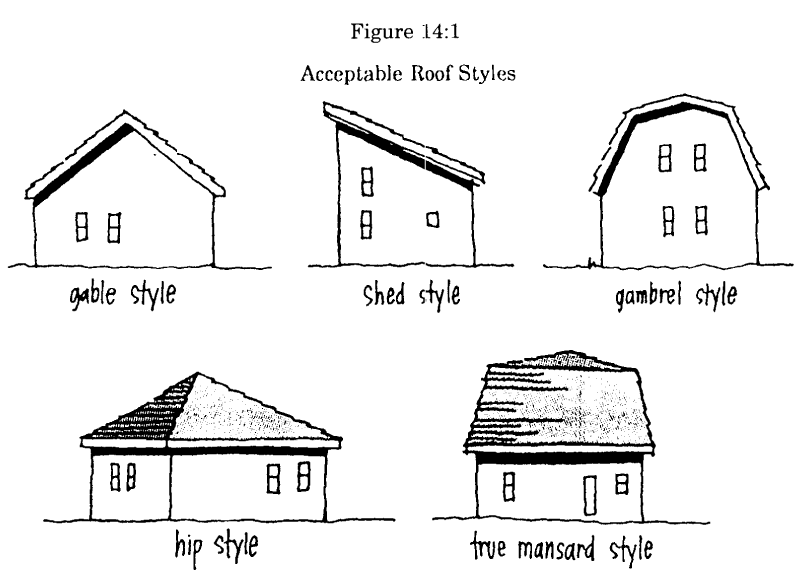
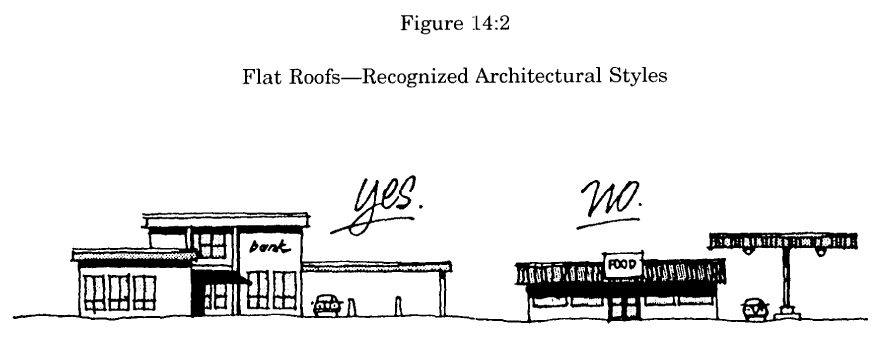
The design of visible roof structures shall be of shed, hip, gambrel, mansard and gable styles, and of such height, bulk and mass so as to appear structural even when the design is nonstructural. The minimum permitted slope shall be 4:12.
Flat roofs may be permitted if determined to be an integral feature of a recognized architectural style, or when otherwise meeting the requirements of paragraph (4) below.
(2)
Materials utilized on visible roof structures shall consist of wood, concrete, synthetic, or fiberglass shingles, barrel tile, clay tile or similar finished material having a natural appearance. Metal roofs may be permitted if determined to be an integral feature of a recognized architectural style. Flat roofing systems may only be permitted in accordance with paragraph (4) below.
(3)
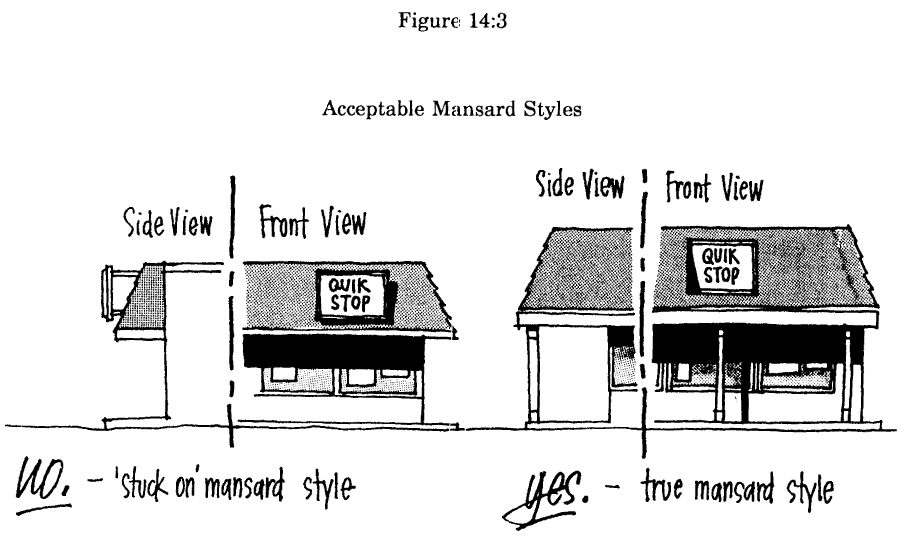
Roof-like architectural appurtenances such as false roofs, parapets, lean-to roofs, and other similar features may be permitted if determined to be required for acoustical mitigation of mechanical equipment or to visually screen such equipment, and to be an integral feature of a recognized architectural style. Such features shall be placed on all sides of the structure, as design permits. "Stuck-on" mansards shall not be permitted.
(4)
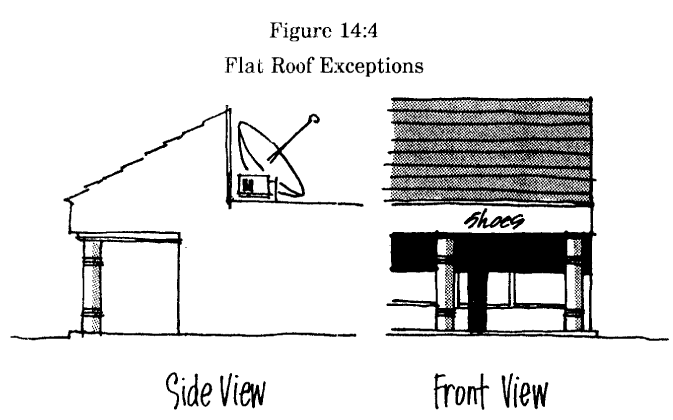
Flat roofing systems shall only be permitted for those nonvisible areas described below:
(a)
Roof areas incorporated with the design of a shed, hip, gambrel, mansard or gable roof system, which, when viewed from the street perspective, are not visible or apparent, and do not detract from the "structural" appearance of the visible roof design. Such roof areas shall primarily be used to support roof-mounted mechanical equipment or to provide acoustical mitigation of roof-mounted mechanical equipment to comply with the noise regulations set forth in the Code of Ordinances of the City of Port Orange, Florida.
(b)
Roof areas where use of a flat roof has been determined to be an integral feature of a recognized architectural style.
(b)
Exterior walls. Exterior walls shall be constructed of finished materials such as stucco, natural brick or stone, finished concrete, wood or other similar material on all sides. Exposed smooth concrete block or metal finishes shall not be permitted, except where determined to be an integral feature of a recognized architectural style.
(c)
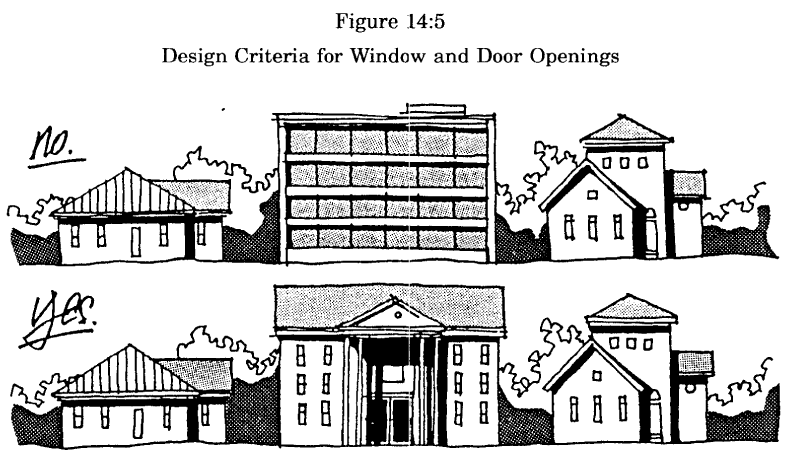
Windows and doors. The pattern of placement, proportions and materials of windows and doors shall be harmonious with surrounding structures. The ratio of wall surface to openings and the ratio of the width and height of windows and doors shall also be consistent and compatible with surrounding structures. This requirement may be waived where the established appearance and purpose of specific uses within the city would indicate that a change in the pattern of placement, proportions and materials would be consistent with the intent of this chapter.
(d)
Colors. Colors shall be earth-tones and pastels. The selection of earth-tones shall be in accordance with the definition provided in this code. The selection of pastels shall be limited to those colors having a minimum white content of 90 percent. Other colors, excluding flourescents, may be permitted as accent colors, not to exceed 20 percent of the surface area of any one elevation.
The requirement for earth-tones and pastels shall not apply to colors commonly found in natural materials such as brick or stone, unless such material has been artificially colored in a manner which would be contrary to the intent of these regulations.
A color or color scheme which is directly inherent to a unique recognized architectural style, but not otherwise in compliance with this section may be permitted through the development plan approval process.
(e)
Signage. Freestanding and wall signs, as permitted by this code, shall be designed to be compatible and integral with the structure to be identified. Sign boards, canopies, fascias and other architectural features shall be designed to incorporate signage or a uniform sign program as applicable. The base treatment of all freestanding signs shall be compatible with the principal structure with regards to style, color and finish. No sign base or sign face shall use any color not permitted by this chapter.
(f)
Orientation and design. Structures which are situated on corner lots, through lots, or by the nature of the site layout are clearly visible from rights-of-way and public areas of adjoining properties shall be designed with full architectural treatment on all visible sides. Such treatment shall include roof design, wall materials, and door and window openings as applicable.
(g)
Service areas. All service areas and mechanical equipment (ground, wall, or roof), including, but not limited to, air conditioning condensers, heating units, satellite dishes, irrigation pumps, ice machines and dispensers, outdoor vending machines, and propane tanks, displays and refilling areas, shall be screened using architectural features consistent with the structure, or landscaping of sufficient density and maturity at planting to provide opaque screening. Wall-mounted equipment such as electric meters, irrigation meters, phone/cable boxes, external vents and louvers, etc., shall be painted to match the wall on which it is mounted or otherwise consistent with the color(s) of the building.
(h)
Fences and walls. Any fence or wall which is visible from any public right-of-way shall be designed as an integral feature of the architectural design of the principal structure. Such design shall include the use of similar materials, colors and finishes as the principal structure and, to the greatest extent possible, avoid extensive, monotonous sections by having breaks and bends and incorporating landscaping and other natural features.
(1)
The use of decorative fences, other than chain-link fences, or walls around retention areas may be permitted as part of the development plan approval process.
(2)
The use of chain-link fences shall only be permitted for industrial uses which do not front on an arterial or major collector roadway. An exemption may be made from this requirement where existing vegetation or proposed landscaping will effectively screen the fence from view.
(3)
The use of chain-link fences for other uses, excluding any development within the Dunlawton Corridor, may be permitted if approved by the planning commission.
(i)
Downspouts. External downspouts shall be enclosed within the building structure on the front and side elevations or any other building elevation visible from a public right-of-way, unless designed to be architecturally compatible with the building in terms of color, material, and location. In locations that are clearly visible from a public right-of-way, downspouts may be installed externally only if they have a high-quality, decorative design and appearance of copper, steel, tin, or silver or similar natural metallic material. In locations that are mostly or completely screened from a public right-of-way, external downspouts are not required to be decorative as above, but shall be painted to match the building exterior on which they are mounted.
(j)
Accessory structures. All accessory structures including, but not limited to, drive-through canopies, motor vehicle service station canopies, storage buildings, auto washes, and dumpster enclosures shall be compatible with the architectural design of the principal structure. Such compatibility shall be determined by roof design, colors, materials, finishes, scale and any other feature deemed significant by the administrative official.
(k)
Site furnishings. Site furnishings including benches, bicycle racks, light standards, trash receptacles, newspaper racks, shopping cart corrals, and any other similar features shall be compatible with the architectural design of the principal structure, and, if located within a multitenant development, consistent with a uniform program established for all properties within said development.
(l)
Shopping cart storage. All permanent shopping cart storage shall be located within the principal structure. Short-term shopping cart storage may be permitted within approved cart corrals or sidewalk areas during regular business hours.
(m)
Miscellaneous outdoor structures. Miscellaneous outdoor structures such as coin-operated rides and other amusement devices shall only be permitted within the principal structure. Installation of such outdoor structures on any public or private sidewalk shall not be permitted.
(Ord. No. 1993-58, 1-18-94; Ord. No. 1995-25, §§ 1, 2, 8-8-95; Ord. No. 1999-6, § 29, 2-23-99; Ord. No. 2011-27, § 9, 10-25-11)
Section 5: - Administrative variance procedure.
If the department agrees that a structure required to comply with the provisions of this chapter cannot meet such standards as a result of its function and/or structural design, a variance may be approved through the development plan approval process. The administrative variance procedure shall not be construed to permit those architectural styles specifically prohibited under subsection 2(d) of this chapter.
If the department objects to a proposed variance from this chapter, a formal variance procedure shall be required in accordance with chapter 19 of this code.
(Ord. No. 1993-58, 1-18-94)
Section 6: - Noise impacts.
(a)
General requirements.The architectural design and site planning of all development shall be designed and planned to ensure that noise does not adversely impact surrounding residential uses.
(b)
Mechanical equipment setbacks and screening. All mechanical equipment shall be located as far as reasonably possible from adjoining residential uses. Such equipment shall be screened to reduce noise and conceal equipment. Mechanical equipment noise shall comply with the noise regulations set forth in the Code of Ordinances of the City of Port Orange, Florida.
(1)
Roof-mounted mechanical equipment shall be located within the area of the roof surface that is farthest away from adjacent residential uses or residential zoned property.
(2)
Ground-mounted mechanical equipment shall be located within 20 feet of the principal structure.
(3)
All mechanical equipment shall be shielded on all sides with acoustically lined walls that are at least two feet higher than the top of the equipment.
(Ord. No. 1995-25, § 3, 8-8-95)

