
Port Orange City Zoning Code
CHAPTER 2
DEFINITIONS AND INTERPRETATIONS
Section 1: - Interpretations of certain terms and words.
(a)
The singular includes the plural and vice versa.
(b)
The masculine includes the feminine and neuter and vice versa.
(c)
The present tense includes the future.
(d)
The word "shall" is mandatory and the word "may" is permissive.
(e)
The word "person" includes an individual, child, firm, association, joint venture, partnership, estate, trust, syndicate, fiduciary, corporation, and all other groups or combinations.
(f)
The word "writing" includes handwriting, printing, typewriting, and all other methods and means of forming letters and characters upon paper, stone, wood or other materials.
(g)
The word "lot" includes the words parcel of land, plot, or tract.
(h)
The word "land" includes the words "water," "marsh," "swamp," "gross land area" and "gross acre of land."
(i)
The word "street" includes the words "avenue," "highway," "road," "boulevard," "lane," "thoroughfare," "easement," "public right-of-way," "private right-of-way" and other similar words.
(j)
All words and terms defined in any code adopted by reference are hereby incorporated in this code. However, if a word is also defined in this chapter, the latter definition shall apply in all cases except when interpreting the referenced code.
(k)
All words not defined in this code shall carry their customary meaning as found in Merriam Webster's Collegiate Dictionary, Tenth Edition.
(Ord. No. 1996-33, § 1, 11-19-96)
Section 2: - Definitions.
[For the purpose of this code, the following words and terms shall have the meanings respectively ascribed to them, unless the context requires otherwise:]
Abandon. To cease actively using a structure. In making the determination that a structure has been abandoned, nonuse of a structure for six consecutive months shall be prima facie evidence for abandonment. The administrative official shall consider any or all of the following: existence or absence of a current occupational license, utility service deposit or account, use of premises, and relocation of the use, so that temporary or short-term interruption to an activity shall not be subject to inclusion under this term.
Abandoned sign.
(a)
Any sign face which advertises a business no longer conducted or product no longer sold. In making the determination that a sign advertises a business no longer being conducted, the administrative official shall consider any or all of the following: the existence or absence of a current occupational license, utility service deposit or account, use of the premises, and relocation of the business;
(b)
Any sign structure which has not been used for business purposes for over six months, that is nonconforming as to existing codes regarding height, setback or sign area; or
(c)
Any previously permitted portable or temporary sign of which permitted time has expired.
Accessory structure (appurtenant structure). A structure that is located on the same parcel of property as the principal structure and the use of which is incidental to the use of the principal structure. Accessory structures shall constitute a minimal investment, shall not be used for human habitation, and shall be designed to have minimal flood damage potential. Examples of accessory structures are detached garages, carports, storage sheds, pole barns, and hay sheds. For floodplain management purposes, the term includes only accessory structures used for parking and storage.
Actual cost. The true cost of a transportation concurrency improvement project, determined once the project is entirely completed and all known costs are available including design, right-of-way acquisition, planning, engineering, inspection, utility relocation, construction and any other applicable costs directly associated with the construction of the improvement.
Administrative official. The municipal official appointed by the city manager to administer the land development code.
Adult day care center. A caretaking arrangement, whether operated for profit or not, where care is provided for a part of the 24-hour day to three or more adults that are unrelated by blood or marriage to the owner/operator of the facility. This care may include, but not be limited to, providing a protective setting, social activities, leisure time activities, self-care training, rest, nutritional services, and speech and physical therapy. Such a facility must be licensed by the Florida Department of Health and Rehabilitative Services, in accordance with F.S. § 400.55.
Adult entertainment. Use of property as an "adult entertainment establishment" as defined in the Code of Ordinances.
Adult/vocational education. An establishment for the instruction or guidance in an occupation, profession, civic activity or art form, and may include, but not limited to, the teaching of a trade apprenticeship, acting/drama, citizenship, cooking, and music and voice.
Agriculture: field crops/wholesale nursery. The production, keeping or maintenance for sale, lease, or personal use, of plants useful to man, and may include, but not limited to, forage and sod crops, grain and seed crops, fruits of all kinds, vegetables, and nursery, floral, ornamental, and greenhouse products.
Agriculture: pasture/forestry. The production, keeping or maintenance, for sale, lease or personal use, of animals and forests which are useful to man, and may include, but not limited to, the following:
Livestock. Beef cattle, dairy cows, goats, horses, mules, ponies, poultry, sheep, swine, or any mutations or hybrids thereof, including the breeding and grazing of any or all such animals in pasture areas. Apiary and aviary pursuits are also included in this category.
Forestry management. Lands devoted to silviculture and the production of tree and forest products and to soil conservation.
Agriculture: processing/hatcheries. The production, keeping, maintenance, or processing, for sale, lease, or personal use, of animals and plants useful to man, and may include, but not limited to, dairy animals and dairy products, grain mills, poultry and poultry products, aquaculture and sawmills.
Airport hazard. Any structure or use of land which obstructs the airspace required for the flight of aircraft in landing or taking off at an airport or which is otherwise hazardous to such landing or taking off. A structure shall be deemed to be an airport hazard if it obstructs such airspace or encroaches into an airport hazard area. Any other structure may be deemed to be an airport hazard based on the specific facts presented.
Airport hazard area. An airport hazard area shall be measured on a 20:1 slope, increasing gradually in width from 50 feet on both sides of the extended runway centerline at the ends of each usable runway to a width of 350 feet on both sides of the extended runway centerline at a distance of 3,000 feet outward from the ends of the runway. The area as measured is intended to correspond to the approach zone extending from the ends of an airport runway within which an airplane approaches or departs a runway in landing or taking off.
Alteration. Any change in a building's structural parts, stairways, type of construction, kind or class of occupancy, means of ingress and egress, wiring, plumbing, heating or cooling system, and other changes affecting or regulated by the City of Port Orange building codes or this land development code, except to minor changes or repairs not involving the aforesaid features. The word alteration may include, but not be limited to the words altered, repaired, modification to construction or reconstructed.
Alteration of a watercourse. A dam, impoundment, channel relocation, change in channel alignment, channelization, or change in cross-sectional area of the channel or the channel capacity, or any other form of modification which may alter, impede, retard or change the direction and/or velocity of the riverine flow of water during conditions of the base flood.
Altered wetland. Wetlands which have been substantially affected by man, but which continue to be dominated by wetland or transitional vegetation.
Alternative support structure. A structure, other than a communication tower, which is used to support one or more antennas. The term includes, but is not limited to buildings, water towers, light poles, power poles and any other similar structures.
Amateur radio antenna. An antenna used to engage in amateur radio communications utilized by a Federal Communications Commission (FCC) licensed amateur radio operator.
Animated sign. Any sign or part of a sign, other than a digital sign, that changes physical position or light intensity by any movement, rotation, strobing, illumination or other means, or that gives the visual impression or illusion of movement, rotation, illumination or rotation.
Antenna. A transmitting and/or receiving device mounted on a tower, building or structure and used in telecommunications personal wireless services that radiates or captures electromagnetic waves, digital signal, analog signals, and radio frequencies, directional antennas such as panel and microwave dish antennas, and omni-directional antennas such as whips but excluding small wireless facilities as defined in the Port Orange communications rights-of-way ordinance, chapter 58, article IV of the Code of Ordinances, radar antennas, amateur radio antennas, and satellite earth stations.
Appeal. A request for a review of the City of Port Orange's interpretation of any provision of this code or a request for a variance; or when used in chapter 8, article III, the term shall mean a request for a review of the floodplain administrator's interpretation of any provision of this code or a request for a variance.
Appliance/electronic repair shop. A retail establishment offering for sale the repair services of small appliances and electronic equipment, with such repair generally occurring on the premises.
Applicant [owner, licensed contractor, and/or lessee]: For purposes of chapter 16, section 9 of the Land Development Code, a person or entity with property owner authorization, with an application before the city for a permit for a wireless communications facility.
Art sculpture. An artistic form in which materials are worked into three-dimensional art objects that do not contain a commercial message.
ASCE 24. A standard titled Flood Resistant Design and Construction that is referenced by the Florida Building Code. ASCE 24 is developed and published by the American Society of Civil Engineers, Reston, VA.
Assisted living facility. See "congregate living facility".
Athletic/sports facility. A site or building where competitive athletic pursuits are carried out, generally on a scheduled basis through direct participation. This type of facility may include, but not be limited to, golf course, golf driving range, handball and racquetball courts, swimming club, and tennis club.
Attention getting device. A sign, device, or ornamentation designed for the purpose of attracting attention or promotion this code. This includes feather flags, teardrop banner sign, pennants, streamers, lighter than air objects, or other similar wind driven signs, inflatable object, sign, or material placed on the ground or on buildings or tethered to other objects or structures, and rope lights, string lights, LED, neon tubes, or similar lighting strings of light bulbs surrounding a sign face or otherwise drawing attention to a sign, except strings of lights during holidays or in conjunction with an approved outdoor seating areas as approved by the city, or on residential property.
Atypical lot. A lot within a subdivision which, as a result of subdivision design, abuts a street at one end and any of the following at the opposite end:
(a)
A waterway or body of water, either of which is 100 feet or more in width, including, but not limited to, the Halifax River, Spruce Creek, or a designated common open space area within the same subdivision which is a body of water; or
(b)
A golf course fairway or green within the same subdivision.
Auction house. Land or a building where items are sold to the highest bidder. Such activity could be private or public and may include, but not be limited to, the sale of antiques, art, and jewelry.
Audible sign. A sign that projects an audible message intended to be heard by either pedestrians or vehicles.
Awning. An architectural projection that provides weather protection, identity or decoration, and is partially or wholly supported by the building to which it is attached. An awning is comprised of a lightweight frame structure over which a covering is attached.
Awning sign. Any sign painted, printed, attached, or otherwise applied to any facet or support structure of an awning.
Bank. A business establishment in which money is kept for savings or commercial purposes, or is invested, supplied for loans, or exchanged. This term shall include credit unions and similar establishments which typically include automatic teller machines (ATMs) and drive-through facilities.
Banner. A sign made of fabric, cloth, bunting, plastic, paper, or any other non-rigid material with no enclosing framework. This definition does not include flags, pennants or streamers.
Bars, lounges, and nightclubs. An establishment devoted primarily to the selling, dispensing, serving or providing of alcoholic beverages for consumption on the premises, where dancing or floor shows may be permitted. The term bars, lounges, and nightclubs may include, but not be limited to, the terms barroom, cabaret, cocktail lounge, discotheque, pub, saloon, and tavern, but shall not include those premises where alcoholic beverages are sold in conjunction with the sale of food for consumption on the premises, and the sale of said beverages comprises less than 49 percent of the gross receipts.
Base flood. A flood having a one percent chance of being equaled or exceeded in any given year (also called the "100-year flood" and the "one-percent-annual chance flood"). "Base flood" is the term used throughout this code.
Base station. A structure or equipment at a fixed location that enables FCC-licensed or authorized wireless communications between user equipment and a communications network. To the extent not inconsistent with applicable law, this term base station does not include a utility pole for the co-location of a small wireless facility in the city's public rights-of-way pursuant to the Port Orange communications rights-of-way ordinance, chapter 58, article IV, of the city code. The term base station does not encompass a tower as defined herein or any equipment associated with a tower. Base station includes but is not limited to:
(a)
Equipment associated with wireless communications services such as private, broadcast, and public safety services, as well as unlicensed wireless services and fixed wireless services such as microwave backhaul;
(b)
Radio transceivers, antennas, coaxial or fiber-optic cable, regular and backup power supplies, and comparable equipment, regardless of technological configuration (including distributed antenna systems ("DAS") and small-cell networks); and
(c)
Any structure other than a tower that, at the time the relevant application is filed with the city under chapter 16, section 9, supports or houses equipment described in subparagraphs (a)-(b) above, and that has been reviewed and approved under the applicable zoning or siting process, or under another state or local regulatory review process, even if the structure was not built for the sole or primary purpose of providing such support. Base station does not include any structure that, at the time the relevant application is filed under chapter 16, section 9, does not support or house equipment described in (a) or (b) above.
Base flood elevation. The elevation of the base flood, including wave height, relative to the National Geodetic Vertical Datum (NGVD), North American Vertical Datum (NAVD) or other datum specified on the flood insurance map (FIRM).
Basement. That portion of a building having its floor subgrade (below ground level) on all sides. [Also defined in FBC, B, Section 1612.2.]
Bed and breakfast inn. A house or portion thereof where short-term lodging rooms are provided, and meals may be provided. The operator of the inn shall live on the premises or in adjacent premises.
Benthic community. An identifiable assemblage of organisms living on or at the bottom of a water body.
Best management practices. Design, construction, operational, or management techniques for stormwater pollution control, which have been developed by the USACOE and are accepted by the city for application as specified in the city's stormwater management regulations found in chapter 10 of this code.
Billboard. A sign structure and/or sign utilized for advertising a product or service which is sold, produced, manufactured, located, available or furnished at a place other than on the property on which the sign is located; or a sign utilized to advertise an establishment that provides an activity, entertainment, or sells, produces, manufactures, or makes available a product or service at a place other than on the property on which the sign is located.
Breakaway wall. A wall that is not part of the structural support of the building and is intended through its design and construction to collapse under specific lateral loading forces without causing damage to the elevated portion of the building or the supporting foundation system.
Brewery. An establishment primarily engaged in the production of beer and other fermented malt beverages for sale on premises and in packages for later consumption off premises via retail carryout, or through distribution and may include accessory uses such as a tasting room, restaurant, retail, demonstration area, education and training facilities, and other uses incidental to the brewing business that may be open and accessible to the public.
Broadcasting facility. Any communication tower built primarily for the purpose of broadcasting licensed AM, FM or television signals pursuant to 47 C.F.R. Part 73 of the FCC rules, as it may be amended.
Buffer or landscape buffer. The portion of property reserved for landscaping, located between the primary structure on the property and the road on which it fronts, as well as around the structure itself. Buffers are designed to enhance the visual appeal of roadside properties and roadway corridors and to minimize the negative impact of paved vehicular use areas for passing motorists and pedestrians.
Bufferyard. The land area used to separate one type of land use from another, from a physical, visual and auditory standpoint, often incorporating landscaping and opaque fences or walls.
Buildable area. That portion of a lot remaining after required building setbacks have been established in the lot front, rear, and side yards.
Building. Any structure that encloses a space used for sheltering occupancy or providing storage. Each portion of a building separated from other portions by a fire wall shall be considered a separate building.
Building coverage. That portion of a lot which is occupied by principal and accessory buildings.
Building elevation. The view of any building or other structure from any one of its sides.
Building frontage. The face of the building meeting front setback requirements towards the principal road, street, highway or easement serving the building.
Building height. The vertical distance measured from the proposed finished grade along the front of the building to the highest point of a flat roof, or to the deck line of a mansard roof, or to average height level between eaves and ridge for gable, hip, and gambrel roofs.
Building permit review. A review for compliance with building constructions standards adopted by the city under F.S. ch. 553, and chapter 14, article III of the City Code of Ordinances and does not include a review for compliance with land development regulations.
Building setback. The minimum required distance a building must be set back from the property line, as measured perpendicular to the property line, or from mean high water along rivers, lakes, or other water bodies.
Building setback lines. The lines established by setback requirements beyond which no principal building shall extend.
Building setback, waterfront. The required depth measured along a perpendicular to the bulkhead line of the ocean, river, watercourse, or canal on which the lot is located. In the event there is no bulkhead line, the measurement shall be made from the ordinary high water mark. A waterfront building setback is required for all lots that have waterfront locations, as set out in chapter 17, section 27, schedule of district regulations equal to a rear building setback.
Bulkhead. A manmade wall or encroachment, parallel to the shoreline, made to protect a shore from erosion and to retain the earth or fill behind it.
Bumper sticker. A strip of adhesive paper or plastic of up to two square feet bearing a printed message affixed to any part of a motor vehicle.
Business service. An establishment where the performance of duties related to business operations are provided within or outside of the confines of such an establishment, and may include, but not be limited to, business machine repair, computer service and repair, microfilming, secretarial and typing service, and telephone answering service.
Cabinet sign. A sign structure consisting of the frame and face(s), not including the internal components, embellishments or support structure.
Caliper. The minimum trunk diameter of replacement tree as measured at a predetermined point measurement. Trunk diameter for trees up to four inches are to be measured six inches above the soil line. All trees over four inches in diameter will be measured 12 inches above the soil line.
Camouflage equipment building or antenna structure. A designed structure that encloses, obscures or conceals the presence of an antenna, equipment building and/or a communication tower such that the tower, equipment building and/or antenna reasonably blends into the environment. For example, the following may be determined to be a camouflage tower, equipment building or antenna: towers and antennas integrated into man-made trees that are reasonably similar in height, branches and leaf coverage to resemble natural trees occurring on the proposed site or surrounding areas, clock towers, bell steeples, light poles, architecturally screened roof mounted antennas, equipment buildings installed below grade or not visible beyond the property as a result of landscaping or other buffering, and similar alternative designs.
Canopy. A permanent structure or architectural projection of rigid construction over which a covering is attached that provides weather protection, identity or decoration. A canopy may be structurally independent (a "detached canopy") or supported by attachment to a building on one or more sides.
Canopy detached. A canopy that is structurally independent of a building.
Canopy sign. Sign permanently affixed to a canopy.
Capacity increase. The number of additional trips that can be accommodated on a roadway or at an intersection as a result of a completed transportation concurrency improvement project.
Carport. An attached or freestanding structure primarily used to shelter motor vehicles, having a roof structure supported by two or four posts or a combination of posts and wall structure, provided that no elevation shall be enclosed in any manner above three feet above the finished floor elevation of the structure.
Carrier. A company licensed by the Federal Communications Commission (FCC) that provides wireless communications services. A communication tower builder, manager, or owner is not a carrier unless it is licensed to provide wireless communications services.
Cell site. A lot or parcel, or a specified area of land within a lot or parcel, on which one or more communication towers or antennas are located or proposed to be located.
Cemetery. Land where burial of the deceased occurs, whether persons or pets. This term shall include mausoleums where they are within the boundaries of a cemetery.
Certificate of occupancy. A certificate issued by the building official allowing occupancy of a building. Such certificate shall not be issued until the building official has certified that all required electrical, gas, mechanical, plumbing and fire protection systems have been inspected for compliance with the technical codes and other applicable laws and ordinances. Said certificate shall state the type of occupancy permitted, the number of persons for each floor when limited by law, and the allowable load per square foot.
Change of occupancy. A discontinuance of an existing use and the substitution of a different kind or class of use. Change of occupancy is not intended to include a change in tenants or proprietors unless accompanied by a change of use.
Changeable copy sign. Copy, other than digital copy, that can be manually changed or rearranged without altering the sign face or sign structure.
Channel letter. A fabricated or formed three-dimensional letter, number, logo or symbol.
Character. Any letter, number, symbol, picture, or logo.
Charter boat. Any watercraft available to the public for hire, rent, or charter for a specified fee or price, with a captain on board at all times, and ready to leave the dock with the charter party. Such watercraft shall be limited to a maximum of 150 passengers and shall include, but not be limited to, fishing charters, pleasure/sightseeing charters, and special event charters (i.e. wedding charters).
Child care center. An arrangement or establishment which provides child care for more than five children unrelated to the operator, for compensation, and for a period less than 24 hours. Such a facility must be licensed by the Florida Department of Health and Rehabilitative Services and comply with their requirements, pursuant to F.S. § 402.305. This term may include, but not be limited to, day-care center, day-care services, day nurseries, kindergartens, nursery school, play-school and preschool.
Chronic nonmalignant pain. A pain unrelated to cancer, which persists beyond the usual course of the disease or the injury that is the cause of the pain, or for more than 90 days after the surgery.
City. City of Port Orange, Florida.
Clearing. The removal of any trees or vegetation from the land, but shall not include mowing of lawn and field grasses.
Clubs, lodges, and fraternal organizations. A building or facility owned or operated by a corporation or association for a social, education, civic, or recreational purpose, but not primarily for profit or to render a service that is customarily carried on as a business.
Coastal construction control line. The line established by the State of Florida pursuant to F.S. § 161.053, and recorded in the official records of the community, which defines that portion of the beach-dune system subject to severe fluctuations based on a 100-year storm surge, storm waves or other predictable weather conditions.
Coastal high hazard area. When used in chapter 8, article III, shall mean a special flood hazard area extending from offshore to the inland limit of a primary frontal dune along an open coast and any other area subject to high velocity wave action from storms or seismic sources. Coastal high hazard areas are also referred to as "high hazard areas subject to high velocity wave action" or "V zones" and are designated on flood insurance rate maps (FIRM) as zone V1-V30, VE, or V. [Note: The FBC, B defines and uses the term "flood hazard areas subject to high velocity wave action" and the FBC, R uses the term "coastal high hazard areas."]
Co-location. For purposes of an eligible facilities modification as set forth in chapter 16, section 9, the mounting or installation of transmission equipment on an eligible support structure for the purpose of transmitting and/or receiving radio frequency signals for communications purposes. "Co-location" for all other purposes, means the situation when a second or subsequent wireless carrier use an existing structure to locate a second or subsequent antennas. The term includes the ground, platform, or roof installation of equipment enclosures, cabinets, or buildings, and cables, brackets, and other equipment associated with the location and operation of the antenna.
Co-location requirements. Specific requirements listed under section 9 of chapter 16 which the applicant shall satisfy when applying for a permit to construct a communication tower or to install an antenna.
Commercial/industrial equipment and supplies. An establishment which offers the wholesale or retail sale or rental of goods and merchandise used in commerce and industry, and not generally purchased by the individual consumer, and may include, but not be limited to, air or gas compressors, backhoes, bricks, chemicals, food processing equipment, hoists, manufactured building components, medical supplies, traffic signs, valves, and waterproofing material.
Commercial/industrial service. An establishment which provides work performance related to commerce and industry, and may include, but not be limited to, linen supply, machine shop, medical waste removal service, publishing plant, screen printing, tool and die shop, and welding.
Commercial/industrial warehouse. A building used primarily for the dead space storage of goods and materials used by or in association with commerce and industry.
Commercial message. Any sign text, logo, or other representation that, directly or indirectly, names, advertises, or calls attention to a business, product, service, or other commercial activity.
Commercial stable. A facility where horses are boarded and cared for and may include, but not be limited to, provision for instruction in riding, jumping, and showing, and the hiring to the public of riding horses for a fee.
Communication facility operator. A provider of wireless communications services, or an owner or operator of a wireless communications facility.
Communication tower. A freestanding tower designed and constructed for the sole or primary purpose of supporting one or more antennas and their associated equipment intended for transmitting or receiving wireless communications services, telephone, radio and similar communication purposes, licensed or authorized by the FCC to the extent required. The term shall not include those towers used exclusively for receive-only antennas, or two-way dispatch. To the extent not inconsistent with applicable law, the term communication tower does not include a utility pole for the co-location of a small wireless facility in the city public rights-of-way pursuant to the Port Orange communications rights-of-way ordinance, chapter 58, article IV, of the city code. A communication tower shall not include the following:
1.
A cell-on-wheels or temporary communication tower authorized pursuant to chapter 16, section 9;
2.
A structure supporting a utility transmission line(s) only;
3.
A structure up to 150 feet in height supporting a 69KV or higher voltage utility transmission line(s), and antenna(e), when located in non-residential zoning districts;
4.
An amateur radio antenna or its support apparatus;
5.
A wireless facilities support pole; or
6.
A structure supporting a radio, television or satellite receiving antenna for residential uses only.
Communication towers shall be classified as follows:
(a)
Camouflaged: A communication tower designed to blend into and conform in appearance with existing or proposed surroundings. An example of a camouflaged communication tower is a tower which is designed and constructed to resemble a tree in form, shape, color, height, branches and leaf coverage to reasonably resemble natural trees occurring on the proposed site or surrounding areas.
(b)
Guyed: A communication tower which is anchored with guy wires.
(c)
Lattice: A communication tower which is self-supporting and has three or more sides of open-framed supports and without the use of guy wires or other supports.
(d)
Monopole: A single self-supporting communication tower of spin-cast concrete, concrete, steel, or other similar materials containing no guy wires, ground anchors, or other supports that is constructed or proposed to be constructed on a permanent foundation.
Communication tower height. When referring to a communication tower, the distance measured from the finished grade of a parcel to the highest point on the communications tower, including the base pad and any antenna, but excluding lights and lightning rods or warning devices.
Community gardens. Land used for the cultivation of food crops, such as fruits, vegetables, and herbs, and/or nonfood, ornamental plants, flowers, or herbs, by multiple users for personal or group use, consumption, or donation.
Community residential homes. A dwelling unit providing a living environment for a limited number of residents who have no family to live with or are in need of assistance with daily living and who operate as the functional equivalent of a family. Supervision and care by support staff may be necessary to meet the physical, emotional, and social needs of the residents. These facilities are licensed by the Florida Department of Health and Rehabilitative Services and include adult congregate living facilities, residential treatment facilities—levels II and IV, residential child care agency facility, intermediate care facility for the mentally retarded/developmentally disabled, foster care facility, and group home pursuant to F.S. ch. 419. These facilities are classified by the number of residents as follows:
Single-family community residential home. Providing for one to six residents in a dwelling unit which is located in a residential zoning district.
Multifamily community residential home. Providing for seven to 14 residents in a dwelling which is located in a multifamily residential zoning district.
Compensatory storage. An artificially excavated, hydraulically equivalent volume of storage within the flood hazard area used to balance the loss of natural flood storage capacity when artificial fill or structures are placed within the floodplain.
Comprehensive plan. The "City of Port Orange Comprehensive Plan Update," adopted by the city council in Ordinance No. 1990-11, and amendments thereto in compliance with the requirements of the Local Government Planning and Land Development Regulation Act, F.S. ch. 163.
Concurrency. A principle stating that public facilities or services necessary to support a proposed development shall be available or made available concurrent with the impacts of the development, as required by Florida Statutes and the Florida Administrative Code.
Concurrency analysis. The determination of whether a public facility or service is capable of adequately and safely handling the impacts from a proposed development according to the adopted level of service standards.
Concurrency certification letter. Written documentation from a local jurisdiction, whose facility is being negatively impacted stating that the jurisdiction is aware of the development's impacts to its facility(s) and, based on a concurrency analysis, certifies that the impact(s) does not create or contribute to a LOS deficiency or that the jurisdiction has agreed to collect proportionate fair-share funds from the development to help pay for the improvement of the facility.
Concurrency improvement project. A level-of-service improvement project that is necessary to be constructed to accommodate the impact of the proposed development, and is can be funded with proportionate fair-share funds.
Concurrency management system. The process the city uses for tracking the current and future level-of-service on roadways and intersections, vested trip information for pending and approved developments, plans for transportation improvements, and the most recent traffic count data, which provide information about future transportation needs. See also long-term concurrency management system.
Concurrency service area (CSA). For the purpose of measuring school concurrency, the specific geographic unit within a school district in which school concurrency is applied and measured.
Concurrency service area level-of-service standards. For the purpose of determining school concurrency, the maximum acceptable percentage of school utilization, calculated by dividing the total number of students for all schools of each type in each concurrency service area by the total number of permanent student stations for that type of school in each concurrency service area.
Congregate living facility. A residential facility, for more than three persons unrelated to the owner, where shelter and services are provided and may include meals, housekeeping, and personal care assistance. Residents shall not be under in-house nursing/medical care. This term shall include, but not be limited to, assisted living facility, child care agency facility, drug and alcohol treatment facility, and shelters for abused persons and unwed mothers. Facilities of this type which provide for 14 or fewer residents may need to be licensed with the Florida Department of Health and Rehabilitative Services as a "community residential home" and comply with the requirements provided in F.S. ch. 419.
Conservation easement. An easement precluding future or additional development of the land, and the removal or disturbance of any vegetation without the permission of the easement holder. Such an easement is typically used to preserve significant natural features such as wetlands, specimen trees, required tree preservation areas and other required natural buffer areas.
Conserve Florida. Name of a statewide water conservation effort by water management districts and the Florida DEP to develop and implement an accountable and measurable program to allow public water supply utilities to tailor cost effective conservation programs to reflect their individual circumstances to achieve greater efficiency for water use.
Construction and home improvement contractor. Land and building where an office and construction materials are kept in association with contracting businesses or trades of a type that are specialized to assist in building construction and remodeling for residential or commercial customers and may include, but not be limited to, air conditioning/heating, landscaping, fencing, plumbing, pavers, painting, and aluminum-building construction, roofing, solar energy systems, but not including uses defined as infrastructure construction contractor's yard and storage.
Construction sign. A sign announcing and identifying the construction project scheduled or underway on the site where the sign is located.
Construction, real estate sign. A construction sign, as described above, which also advertises the real property where the sign is located for sale, lease or rent.
Construction, start of. The placing of construction materials in permanent position and fastened in a permanent manner, except that when demolition, excavation, or removal of an existing structure has been substantially begun preparatory to new construction, such excavation, demolition, or removal shall be deemed to be the start of construction, provided that work shall be continuously carried on until the completion of the new construction involved. Start of construction shall include only work begun under a valid development permit. The phrase "start of construction" shall include the term "erected."
Convenience store. An establishment which offers for sale a limited line of food and household goods and is designed for quick service to customers with small purchases. Such an establishment may or may not offer for sale fuel by way of self-service gasoline/diesel pumps or LP gas tanks.
Copy. Any words, letters, numbers, figures, designs or other symbolic representations incorporated into a sign.
Craft food and beverage producer. An establishment, not exceeding 20,000 square feet in gross floor area, that engages in onsite commercial production of beverage and/or food products to a final form employing batch-processing or handcrafting using traditional methods, and distributes to customers on-site via product tasting and direct sales and/or offsite to retailers and wholesalers. Typical products may include, but are not limited to coffee roasting, ice cream, baked goods, confectioneries, liquor, wine, and any other craft beverage manufacturing.
Crematorium. An establishment in which a deceased body is reduced to ashes in a furnace. This type of facility must be licensed with the Florida Department of Professional Regulation and meet the criteria of the Florida Department of Health and Rehabilitative Services and the Florida Department of Environmental Regulation, pursuant to F.S. § 470.025.
Cross-jurisdictional impact. A development impact that is caused by a development in one jurisdiction and is impacting a facility or service in another jurisdiction.
Cultural facility. Land, a building, or a group of buildings which affords the pursuit of arts, letters, manners, professional and scholarly matters, and may include, but not be limited to, an auditorium, convention/lecture hall, and museum.
Dark sky. Lighting technology intended to provide safe exterior lighting while emphasizing the reduction or elimination of night glare above the light source. Various technologies are approved by the International Dark Sky Association.
Defensible space. An area, either natural or man-made, where material capable of allowing a fire to spread unchecked to the principal structure has been treated, cleared or modified to slow the rate and intensity of an advancing wildfire and to create an area for fire suppression operations to occur.
Density. The total number of dwelling units per gross acre of land.
Department. City of Port Orange Department of Community Development.
Design flood. The flood associated with the greater of the following two areas: [Also defined in FBC, B, Section 1612.2.]
(1)
Area with a floodplain subject to a one-percent or greater chance of flooding in any year; or
(2)
Area designated as a flood hazard area on the community's flood hazard map, or otherwise legally designated.
Design flood elevation. The elevation of the "design flood," including wave height, relative to the datum specified on the community's legally designated flood hazard map. In areas designated as zone AO, the design flood elevation shall be the elevation of the highest existing grade of the building's perimeter plus the depth number (in feet) specified on the flood hazard map. In areas designated as zone AO where the depth number is not specified on the map, the depth number shall be taken as being equal to two feet. [Also defined in FBC, B, Section 1612.2.]
Developer. Any person who engages in or proposes to engage in a development either as the owner or as the agent of an owner of property.
Development. Any manmade change to improved or unimproved real estate, including, but not limited to, buildings or other structures, mining, dredging, filling, grading, paving, excavating, permanent storage of materials, or the dividing of land into two or more parcels. Development includes, but is not limited to, the following:
(a)
A reconstruction, alteration of the size, or structural change in the external appearance of a structure on land.
(b)
A change in the intensity of use of land, such as an increase in the number of dwelling units in a structure or on land or, a material increase in the number of businesses, manufacturing establishments, offices, or dwelling units or on the land as may be determined by the local government.
(c)
Alteration of a shore or bank of a seacoast, river, stream, lake, pond, canal, or stormwater management facilities, including any "coastal construction" as defined in F.S. § 161.021.
(d)
Mining or excavation on a parcel of land.
(e)
Demolition or removal of a structure.
(f)
Clearing of land as an adjunct of construction.
(g)
Deposit of refuse, solid or liquid waste, or fill on a parcel of land.
When used in chapter 8, article III, the term shall mean any manmade change to improved or unimproved real estate, including, but not limited to, buildings or other structures, tanks, temporary structures, temporary or permanent storage of equipment or materials, mining, dredging, filling, grading, paving, excavating, drilling operations or any other land disturbing activities.
Development district. A zoning district designed with special provisions to encourage the development or redevelopment thereof.
Development of regional impact (DRI). A development project that is considered to have a regional impact because of its character, magnitude or location, and its ability to have a substantial effect on the health, safety, and welfare of the citizens of more than one county, as dictated by Florida Statute.
Development order. Any order granting, with or without conditions, approval of an application for development, including any subdivision, site plan, rezoning, special exception, and variance. Issuance of a development order allows for the application of development permits and reserves public infrastructure capacity for site plan and subdivision projects for a limited period of time.
Development permit. Any building permit, site construction permit, or other official action of local government having the effect of permitting the development of land.
Development trip. A vehicular trip generated by a development or phase thereof.
Diameter at breast height (dbh). The trunk diameter of a tree measured four and one-half feet above the average ground level at the base of the tree. Provided, however, if the tree forks four and one-half feet above ground level, it is measured below the swell resulting from the double stem. Stems that fork below four and one-half feet above ground level should be considered separate trees.
Digital copy. Static images that are controlled by electronic communications that allow the images to be turned on or off intermittently.
Digital sign. A sign that displays digital copy, including any illuminated sign on which the illumination is not kept stationary or constant in intensity and color when the sign is in use, including any light emitting diode (LED) or digital panel, and which varies in color or intensity. In the sign industry, digital signs are also referred to as dynamic signs, changeable electronic variable message signs (CEVMS), electronic message centers (EMCs), etc.
Dock. A fixed or floating structure, including moorings, used for the purpose of harboring boats.
Double-faced sign. A sign with two parallel, identical faces or two identical sign faces that are not parallel but diverge from a common point.
Dredging. Excavation by any means in water or wetland. It also means the excavation or creation of a water body which is, or is to be, connected to waters, directly or via excavated water bodies or a series of excavated water bodies.
Dripline. The ground area surrounding the trunk of a tree that is described by the vertical plane enclosing the outermost branches of the tree. For asymmetrical specimens, or those with unusually small crown spread, the drip line area shall in no case be less than that area described by a radial dimension of one foot for each one inch of trunk radius.
Drive-thru sign. A sign oriented to occupants of a vehicle utilizing a drive-through lane at an establishment that offers transactions or exchanges through a window, with or without ordering capability.
Driveway or drive. A vehicular accessway, serving one or more properties, further defined as follows:
Residential A driveway. An accessway serving a single-family detached, single-family attached or multifamily building of four units or less.
Residential B driveway. An accessway serving a multifamily development of five to 25 units.
Light commercial driveway. An accessway serving office and nonresidential uses of 80,000 square feet or less, and multifamily development of more than 25 units.
Heavy commercial driveway. An accessway serving office and nonresidential uses of more than 80,000 square feet, warehouse and industrial uses, and other uses with heavy truck traffic.
Limited use service drive. An accessway which is not a part of the general circulation pattern for access to public parking areas, but for specific low traffic service access for functions such as loading, utility access, vehicle storage and other similar uses.
Access drive. An accessway which is generally part of the internal circulation pattern for access to public parking areas, service areas, drive-throughs and other similar vehicular use areas. Access drives are sometimes referred to as cruise lanes, stacking/storage lanes, entranceways and parking lanes.
Dwelling. A building or part thereof with cooking, sleeping, and sanitary facilities that is designed in whole or part as the separate and independent residence or living quarters for one or more persons, but which does not include the terms bed and breakfast inn, hotel, mobile home, motel, recreational vehicle, or tent. This term does include the following categories:
(a)
Dwelling, single-family. A building containing one dwelling unit which would include the following types:
Single-family attached.
Single-family detached.
(b)
Dwelling, two-family. A building containing two dwelling units which would include the following types:
Single-family attached (two units per building).
Duplex.
(c)
Dwelling, multifamily. A building containing three or more dwelling units which would include the following types:
Single-family attached.
Apartments, low and mid-rise.
Townhouses.
Earth-tones. Earth tones shall include the following colors:
(a)
Any tint or tone of brown, including beige, tan, ocher and olive.
(b)
Any tone of green, having a minimum black content of six percent.
(c)
Any tone of orange (warm red and yellow base), having a minimum black content of three percent.
(d)
Any warm or cold shade of gray.
(e)
Any tone of yellow, having a minimum black content of five percent.
(f)
Any tone of warm red, having a minimum black content of five percent and a minimum warm red content of 45 percent.
(g)
White.
Earth tones shall not include any metallic colors.
Elevated building. A non-basement building built to have the lowest floor elevated above the ground level by foundation walls, pilings, columns (posts and piers) or shear walls.
Eligible facilities modification application. A written document submitted to the city pursuant to the Land Development Code for review and approval of a proposed eligible facilities modification.
Eligible facilities modification. Any request for modification of an existing tower or base station that does not result in a substantial change in the physical dimensions of such tower or base station, involving:
(a)
Co-location of new transmission equipment;
(b)
Removal of transmission equipment; or
(c)
Replacement of transmission equipment.
Eligible facilities modification permit. A written document issued by the city pursuant to chapter 16, section 9 of the Land Development Code, approving an eligible facilities modification application.
Eligible support structure. Any tower or base station as defined in this section, provided that it is existing at the time the relevant application is filed with the city.
Embellishment. An addition to the sign structure on which a continuation of the copy is placed. Standard bases and standard trim are not considered embellishments. If copy is placed on an embellishment, the embellishment is considered part of the sign area.
Emitting sign. A sign that emits smoke, open flames, visible vapors, particles, sound, or odor.
Encroachment. The placement of fill, excavation, buildings, permanent structures or other development into a flood hazard area which may impede or alter the flow capacity of a flood capacity or riverine flood hazard areas.
Energy Star. A joint program of the U.S. Environmental Protection Agency and the U.S. Department of Energy to encourage use of energy efficient products and practices. Qualified projects may receive Energy Star certification.
Environmental corridor. An open space area which connects natural communities and provides protection of environmentally sensitive and significant areas from development activities and their associated impacts.
Equipment building. The cabinets, shelter, building or other such structure which contains the electronic equipment used in the operation of the antenna. Unless the context indicates otherwise, the term includes generators, generator fuel supplies, cable connections and supports, electrical panels and similar accessory components.
Essential services. Those services provided by the city and other governmental entities that directly relate to the health and safety of residents, including fire, police and rescue.
Existing. For purposes of an eligible facilities modification, a constructed tower or base station that has been reviewed or approved under the applicable zoning or siting process of the city, or under another state or local regulatory review process, provided that a tower that has not been reviewed and approved because it was not in a zoned area when it was built, but was lawfully constructed, is existing for purposes of this definition.
Existing building/structure. Any buildings and structures for which the start of construction commenced before May 16, 1977. [Also defined in FBC, B, Section 1612.2.]
Existing structure. As used in chapter 16, section 9, means a structure that exists at the time an application for permission to place antennas on a structure is filed with the city. The term includes any structure that can structurally support the attachment of antennas in compliance with applicable codes.
Exposed Neon. A neon sign in which the neon tubes are not enclosed by an opaque covering.
FAA. The Federal Aviation Administration.
Façade. The exterior wall of a building exposed to public view or a wall viewed by persons not within the building.
Fair-share improvement. A concurrency improvement project that is funded with proportionate fair-share funds.
Fair-share payment. Private funds, land contributions, facility contributions and/or facility construction that are paid and/or provide to meet a development's fair-share obligation, based on its impacts to a concurrency improvement project.
Fall radius. The greater of the height of a communication tower or the calculated distance measured from the center of the base of a communication tower which defines the maximum circular area into which the tower and any further distance in which any part of a tower may fall in case of structural failure or collapse.
Family. One or more persons all living together and interrelated by blood, marriage, or legal adoption, and occupying one dwelling unit. Boarding of no more than three unrelated persons with a family shall be permitted.
Family child care home. An occupied residence in which child care is provided for a period of less than 24 hours a day on a regular basis, for no more than five preschool children including those related to the resident care giver. An additional five elementary school age children may also be cared for after school hours if they are related to the permitted school age children. Any elementary school children not related to the permitted preschool children shall be counted as one of the five permitted preschool children.
Farmers/flea market. An occasional or periodic sales activity held within a building, structure, or open area where groups of individual sellers offer goods, new and used, for sale to the public, not to include private garage sales or similar activities held by churches and other nonprofit organizations.
Fascia. The horizontal plain of a building just below the roof or coping, and above the wall or supports.
Fascia sign. A sign located on the fascia of a roof or canopy, or affixed to the front plane of a mansard roof that is a maximum of 30 degrees from vertical, including signs that extend the plane of the structural fascia such that the vertical dimension of the sign is no more than one-third the distance from the ground to the bottom of the fascia, and no lateral supports are used.
FCC. The Federal Communications Commission.
FDEP. The Florida Department of Environmental Protection.
Feather sign. A sign made of flexible material in the shape of a feather, quill, sail, blade or teardrop, and mounted on a solid or flexible pole or cord. These are sometimes referred to as "quill signs" or "sail banners."
FEMA. The Federal Emergency Management Agency.
FGBC. An acronym for the Florida Green Building Coalition, Inc., a Florida 501(c)3 not-for-profit corporation whose mission is to establish and maintain a Florida system of statewide green building standards and third-party certification programs with environmental and economic benefits.
FGBC green local government designation. A designation given by FGBC that recognizes outstanding efforts and practices in environmental stewardship. Green local governments have demonstrated a certain level of commitment to environmental performance as measured by a ranking system of best practices for all local government functions. Levels of "gold", "silver", "bronze", and "certified" can be achieved.
FISH—Florida Inventory of School Houses. An official inventory report of all facilities owned by the school district.
Financial feasibility. Sufficient revenues are currently available or will be available from committed funding sources for the first three years, or will be available from committed funding sources for years four and five, of a five-year capital improvement schedule for financing capital improvements, such as ad valorem taxes, bonds, state and federal funds, tax revenues, impact fees, and developer contributions, which are adequate to fund the projected costs of the capital improvements identified in the comprehensive plan necessary to ensure that adopted level-of-service standards are achieved and maintained within the period covered by the five-year schedule of capital improvements, as defined by Florida Statute.
Financial service. An establishment engaged in the management of money and credit, and may include, but not be limited to, accounting, bookkeeping, investment securities, money transfer, mortgage loans, pension plans, stock and bond brokerage, and tax planning. This term would not include the term bank.
Finger pier. A narrow walkway extending over water to provide access between docked boats and the main access pier connection to land.
Finished grade. The completed surface of lawns, walks, and driveways brought to grade as shown on building plans or designs relating thereto.
Fire flow. The quantity of water measured in gallons per minute (gpm) that is needed to extinguish a fire involving a particular building, block, area or material.
Flag. A piece of fabric or other flexible material, with distinctive colors and patterns, customarily mounted on a pole or similar freestanding structure or a pole mounted on a building.
Fleet based service. An establishment whose primary purpose is to provide mobile services to residential and/or commercial customers, including, but not limited to, pest control, cable television, mobile detailing, septic tank, lawn care, and other similar types of services.
Flood or flooding. A general and temporary of partial or complete inundation of normally dry land areas from: [also defined in FBC, B Section 1612.2.]
(1)
The overflow of inland or tidal waters.
(2)
The unusual and rapid accumulation or runoff of surface waters from any source.
Flood damage-resistant materials. Any construction material capable of withstanding direct and prolonged contact with floodwaters without sustaining any damage that requires more than cosmetic repair. [Also defined in FBC, B, Section 1612.2.]
Flood hazard area. The greater of the following two areas: [Also defined in FBC, B, Section 1612.2.]
(a)
The area within a floodplain subject to a one percent-percent or greater chance of flooding in any year.
(b)
The area designated as a flood hazard area on the community's flood hazard map, or otherwise legally designated.
Flood insurance rate map (FIRM). The official map of the community on which the Federal Emergency Management Agency has delineated both special flood hazard areas and the risk premium zones applicable to the community.
Flood insurance study (FIS). The official report provided by the Federal Emergency Management Agency that contains the flood insurance rate map, the flood boundary and floodway map (if applicable), the water surface elevations of the base flood, and supporting technical data. [Also defined in FBC, B, Section 1612.2.]
Floodplain administrator. The office or position designated and charged with the administration and enforcement of chapter 8, article III, Floodplain Management (may be referred to as the floodplain manager).
Floodplain development permit or approval. An official document or certificate issued by the community, or other evidence of approval or concurrence, which authorizes performance of specific development activities that are located in flood hazard areas and that are determined to be compliant with this code.
Floodway. The channel of a river or other riverine watercourse and the adjacent land areas that must be reserved in order to discharge the base flood without cumulatively increasing the water surface elevation more than one-foot. [Also defined in FBC, B, Section 1612.2.]
Floodway encroachment analysis. An engineering analysis of the impact that a proposed encroachment into a floodway is expected to have on the floodway boundaries and base flood elevations; the evaluation shall be prepared by a qualified Florida licensed engineer using standard engineering methods and models.
Floor. The top surface of an enclosed area in a building (including basement), i.e., top of slab in concrete slab construction or top of wood flooring in wood-frame construction. The term does not include the floor of a garage used solely for parking vehicles.
Floor area, gross. The sum of the gross horizontal area of all floors of a building measured from the exterior faces of the exterior walls or from the centerline of walls separating two buildings.
Florida Building Code (FBC). The family of codes adopted by the Florida Building Commission, including: Florida Building Code, Building; Florida Building Code, Residential; Florida Building Code, Existing Building; Florida Building Code, Mechanical; Florida Building Code, Plumbing; Florida Building Code, Fuel Gas.
Florida friendly landscaping. Nine principles to guide Florida yard and neighborhood landscaping programs. The nine principles are to locate the right plant in the right place, water efficiently, fertilize appropriately, mulch, attract wildlife, manage pests responsibly, recycle, reduce stormwater runoff and protect the waterfront.
Freestanding sign. A single or double-faced sign supported by pole(s), post(s), or braces placed upon or in the ground or supported by the ground and not attached to any building. A flagpole shall not be considered a freestanding sign.
Front-foot, building. Each lineal foot, or major portion thereof, measured along the main entry side of a building. Where buildings form an L-shape or U-shape, all main entry sides are measured.
Front-foot, property. Each lineal foot, or major portion thereof, measured along the public right-of-way where the subject property abuts said right-of-way.
Front-foot, tenant. Each lineal foot, or major portion thereof, measured along the main entry side of a tenant space.
Frontage. The linear frontage(s) of a lot or parcel abutting on a private or public street that provides principal access to, or visibility of, the premises.
Functionally dependent use. A use which cannot perform its intended purpose unless it is located or carried out in close proximity to water, including only docking facilities, port facilities that are necessary for the loading and unloading of cargo or passengers, and ship building and ship repair facilities; the term does not include long-term storage or related manufacturing facilities.
Game/recreation facility. An establishment which provides indoor or outdoor opportunities for casual entertainment by patrons of all ages, and may include, but not be limited to, amusement park, bingo club (as permitted under F.S. § 849.0931, as amended), bowling alley, go-kart track, miniature golf, pool hall, skateboard park, skating rink, and game arcade, unless prohibited by local, state or federal law.
Garage apartment. An accessory building containing both a storage area for one or more motor vehicles and one single-family dwelling in one or more floors.
Gazebo. A freestanding roofed structure that is open or screened on all sides.
GBI. Acronym for the Green Building Initiative, a not-for-profit organization whose mission is to accelerate the adoption of building practices that result in energy-efficient, healthier and environmentally sustainable buildings by promoting credible and practical green building approaches for residential and commercial construction.
Green building. A designation given to buildings that have achieved the requirements of the green building rating system defined in the green building program in chapter 7, section 8 of this code.
Green building program. The program outlined in chapter 7, section 8 of this code for obtaining incentives for green buildings.
Green building program certification. The final designation awarded to a green building program (chapter 7, section 8) participant for satisfying all requirements associated with the program for a particular project.
Green building program participant. Any person or entity seeking green building program (chapter 7, section 8) certification for a particular project.
Green building project. Any construction associated with the creation, development, or erection of any building eligible for the green building program (chapter 7, section 8).
Green building subprogram. Any area of construction covered by the green building program (chapter 7, section 8).
Green development. A development approach that goes beyond conventional development practice by integrating the following elements: environmental responsiveness, resource efficiency, sensitivity to existing culture and community; and brings these elements together through the green development approach and provides numerous environmental and economic benefits by capitalizing on the interconnections between them.
Green globes. The U.S. commercial/institutional building rating system of the Green Building Initiative.
Green roof. A roof of a building that is partially or completely covered with vegetation and a growing medium, planted over a waterproofing membrane. It may also include additional layers such as a root barrier and drainage and irrigation systems.
Gun and hunting club. An outdoor facility, including accessory buildings, for shooting and hunting by sportsmen, where little disturbance to the property occurs in association with such pursuits.
Halifax River bulkhead line. An imaginary line established in or along the Halifax River in order to fix and establish the maximum distance from the water's edge within which property improvements may be permitted, more particularly described in chapter 9, article III.
Halo lit. Illumination created by concealing the light source behind three-dimensional opaque letters, numbers, or other characters of a sign, resulting in the nighttime perception of a halo around the silhouette of each character. This is also referred to as "reverse channel" or "reverse lit" illumination. A halo lit sign is not considered an internally illuminated sign.
Figure 2:1 Examples of signs with halo lit illumination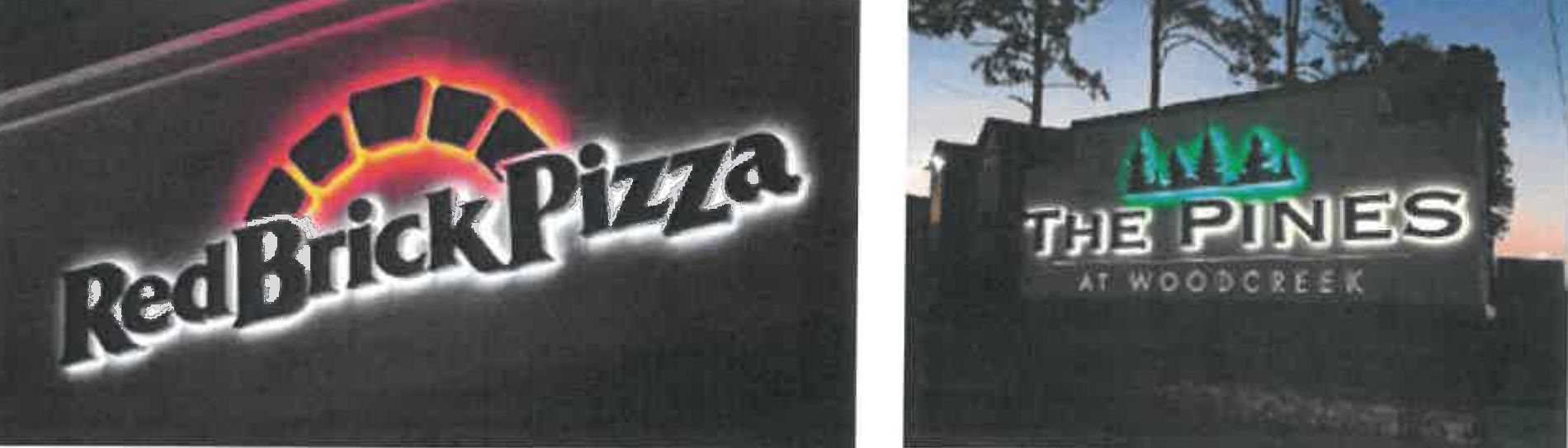
Handheld sign. A temporary sign held, suspended, or supported by an individual. Handheld signs do not include handheld signs utilized for traffic control or safety purposes. Also known as a human directional, sign spinner, or sign twirler sign.
Hardship. As related to variances from this code, means the exceptional hardship associated with the land that would result from a failure to grant the requested variance. The community requires that the variance is exceptional, unusual, and peculiar to the property involved. Mere economic or financial hardship alone is not exceptional. Inconvenience, aesthetic considerations, physical handicaps, personal preferences, or the disapproval of one's neighbors likewise cannot, as a rule, qualify as an exceptional hardship. All of these problems can be resolved through other means without granting a variance, even if the alternative is more expensive, or requires the property owner to build elsewhere or put the parcel to a different use than originally intended.
Harmful to minors.
[(1)]
With regard to sign content, any description or representation, in whatever form, of nudity, sexual conduct, or sexual excitement, when it:
(a)
Predominately appeals to the prurient, shameful, or morbid interest of minors in sex; and
(b)
Is patently offensive to contemporary standards in the adult community as a whole with respect to what is suitable sexual material for minors; and
(c)
Taken as a whole, lacks serious literary, artistic, political, or scientific value.
[(2)]
The term "harmful to minors" shall also include any nonerotic work or picture when it:
(a)
Is patently offensive to contemporary standards in the adult community as a whole with respect to what is suitable for viewing by minor;, and
(b)
Taken as a whole, lacks serious literary, artistic, political, or scientific value.
Hazardous material. Any material defined, listed, characterized, or classified as a hazardous material, hazardous substance, hazardous waste, or toxic substance according to any of the following state or federal codes or regulations:
(a)
Florida Administrative Code, ch. 38f-41 (Florida substance list).
(b)
Title 40, Code of Federal Regulations, part 261 (identification and listing of hazardous wastes).
(c)
Title 40, Code of Federal Regulations, part 302.4 (designation of hazardous substances).
(d)
Title 40, Code of Federal Regulations, part 355, appendices A and B (list of extremely hazardous substances).
(e)
Title 49, Code of Federal Regulations, parts 172.101 and 172.102 (hazardous materials tables).
Hazardous materials includes any solution, mixture, or formulation containing such material, and any material which, due to its chemical or physical characteristics, is determined by the city manager to pose a substantial threat to life, health, or safety of persons or property, or to the environment. The term includes, but is not limited to, explosives, radioactive materials, petroleum or petroleum products, gases, poisons, etiologic (biologic) agents, flammables and corrosives.
Health/exercise club. An establishment which provides for athletic and physical force training or health and recreational exercise. This term may include, but not be limited to, the terms "aerobics instruction," "dance instruction," "fitness center," "gymnasium (private)," "gymnastics school," "karate," "martial arts," "self defense instruction," and "weight room."
Highest adjacent grade. The highest natural elevation of the ground surface, prior to the start of construction, next to the proposed walls or foundation of a structure.
Historic structure. Any structure that is:
(a)
Listed individually in the National Register of Historic Places (a listing maintained by the United States Department of the Interior) or preliminarily determined by the Secretary of the Interior as meeting the requirements for individual listing on the National Register;
(b)
Certified or preliminarily determined by the Secretary of the Interior as contributing to the historical significance of a registered historic district or a district preliminarily determined by the Secretary to qualify as a registered historic district;
(c)
Individually listed on the Florida inventory of historic places which has been approved by the Secretary of the Interior; or
(d)
Individually listed on a local inventory of historic places in communities with historic preservation programs that have been certified either:
(1)
By the approved Florida program as determined by the Secretary of the Interior; or
(2)
Directly by the Secretary of the Interior.
(e)
Any structure that is determined eligible for the exception to the flood hazard area requirements of the Florida Building Code, Existing Building, chapter 11 Historic Buildings.
Historic structure, site, object, or district. When used in chapter 16, section 9, means any building, resource, structure, site, object, or district that has been officially designated as a historic building, historic resource, historic structure, historic site, historic object, or historic district through a federal, state or local designation program.
Historic tree. Any Live Oak (Quercus virginiana) or Bald Cypress (Taxodium distichum) 36 inches diameter at breast height (DBH) or greater or any other tree which is 36 inches DBH or greater and is determined by the city council to be of such unique and intrinsic value to the general public because of its size, age, historic association or ecological value to justify this classification. This term shall also include any tree in the city selected and designated as a Florida State Champion, United States Champion or World Champion by the American Forestry Association.
Hotel. A multi-story, transient lodging facility as defined in F.S. § 509.013(4)(a), containing sleeping room accommodations accessible through interior corridors for 25 or more guests, advertised and held out to the public for rental to transients and travelers, and which is recognized as a hotel in the community in which it is situated or by the industry. This term shall not include motels, but may include public meeting rooms, recreational facilities, and eating, drinking, and banquet services which are ancillary to the principal facility.
Illuminated awning. Any awning lighted by or exposed to artificial lighting, either by lights on or in the awning, or directed toward the awning.
Illuminated sign. Any sign that incorporates illumination on or in the sign, or that directs illumination toward or over all or part of the sign, or that is created by the projection of illumination onto a surface (such as a building wall.)
Illumination. An artificial light source incorporated internally or externally to emanate light from, or direct light to, a surface. Light sources may include exposed tubing, electrical bulbs, fluorescent lights, neon tubes, light emitting diodes (LED), liquid crystal displays, or other artificial sources of light.
Illumination, external. A sign that is illuminated by an external light source.
Figure 2:2 Examples of signs with external illumination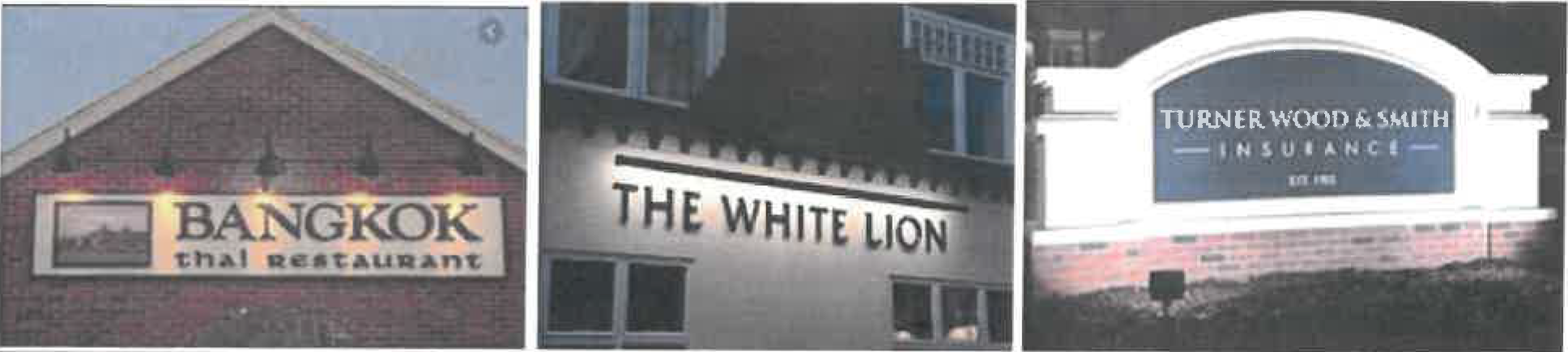
Illumination, internal, Illumination created by a light source internal to the sign, transparent or translucent material from a light source within the sign structure or panel, or exposed lighting on the sign face.
Figure 2:3 Examples of signs with internal illumination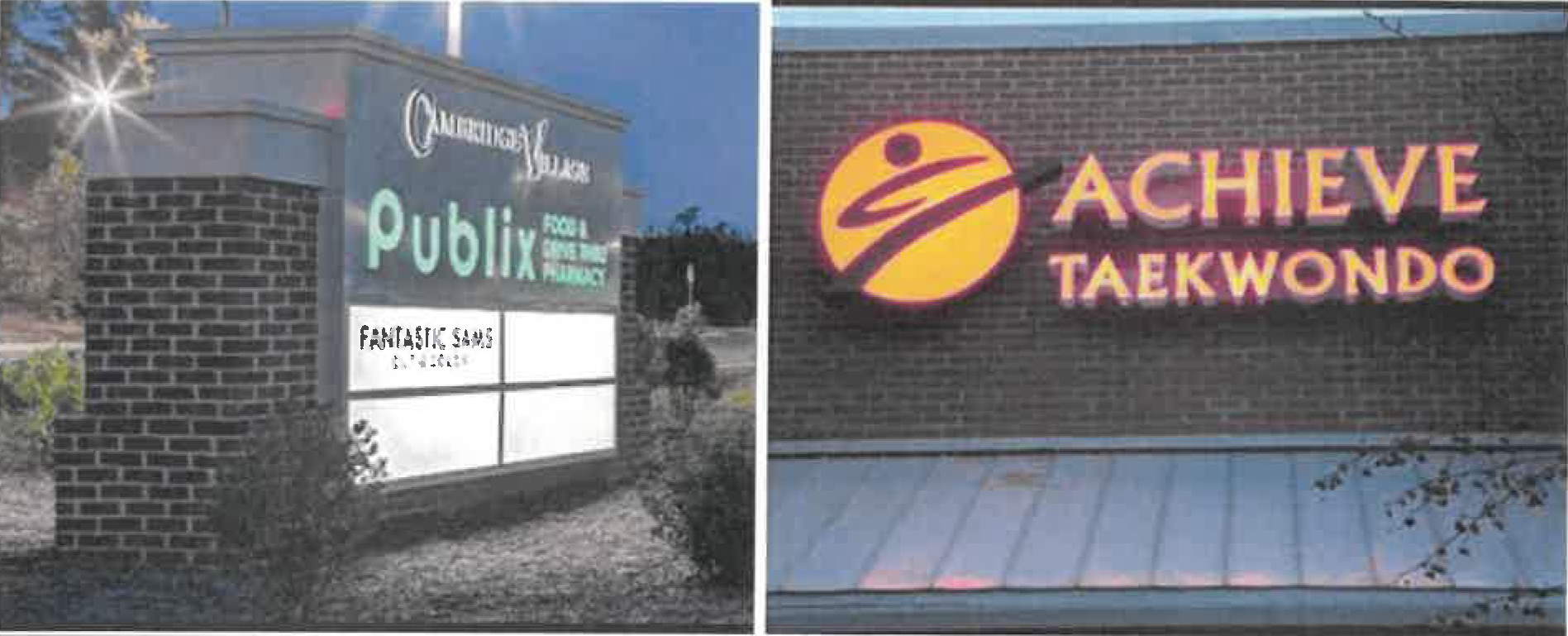
Incidental sign. A sign with copy located on a panel and mounted on a pole or a wall or similar structure, with or without a structural frame, that is normally incidental to the allowed use of the property but can contain any message or content.
Industrial complex. Any industrial development containing two or more tenant spaces that are under common land ownership or that share common property frontage.
Industrial wastes. Nondomestic pollutants from an industrial facility, including, but not limited to dredged spoil, solid waste, incinerator residue, sewage sludge, garbage, munitions, chemical wastes, biological materials, radioactive materials, heat, wrecked or discharged equipment, rock, sand, and cellar dirt.
Infrastructure construction contractor's yard. Land or building where construction materials are kept in association with heavy construction contractors engaged in activities that may include, but not be limited to, paving, highway construction, utility construction, road construction, hauling, machine construction, and utility system installation.
Interference or interfere. For purposes of chapter 16, section 9, the impairment of transmission or reception of any desired communications or radio frequencies.
Internally accessed building. An enclosed structure usually having one or two main entrances, and having individual tenants with entrances on an internal corridor, hallway or atrium.
Internet cafe or cybercafe. A commercial establishment where one can use a computer with internet access for a fee or by purchasing a pass. It may or may not serve as a regular cafe as well, with food and drinks being served.
Intersection capacity. The number of vehicles that can safely travel through an intersection at any given time, but not limited to, turn lane configurations, signal timings and peak-hour demands, as determined by a licensed professional traffic engineer using nationally accepted standards.
Isolated wetlands. Wetlands that have no hydrological or vegetative connections with "waters of the state" as defined in F.S. § 403.031(3).
Kennel. Any premises which provides facilities and/or services for the boarding, breeding, buying, grooming, rearing, or selling of five or more adult animals or 11 or more non-adult animals and which may include the ancillary retail sales of pet supplies.
Laboratory/research and development. An establishment engaged in the investigation, testing and experimentation of the natural, physical or social sciences, or engaged in engineering and development as an extension of investigation with the object of creating end products. This type of facility may include, but not be limited to, asphalt and concrete testing, foundation testing, materials testing, and soils, geology, and groundwater testing.
Laundry and dry cleaning plant. A building where the washing, drying, ironing, and/or dry cleaning of laundry occurs on a large scale and without retail transactions on the premises.
Laundry and dry cleaning retail service. An establishment where washing, drying, ironing, and/or dry cleaning machines are available for rental by the public for their use on the premises, or are available for use by the establishment's personnel in cleaning laundry for public patrons. Such an establishment might also involve the intake of laundry from public patrons to be sent off the premises to a laundry and dry cleaning plant.
LED display screen. A type of changeable copy sign with a screen that utilizes light emitting diodes (LED) arranged in pixels to create messages changeable by electronic means.
LEED. The Leadership in Energy and Environmental Design rating system of the U.S. Green Building Council.
Letter of map change (LOMC). An official determination issued by FEMA that amends or revises an effective flood insurance rate map or flood insurance study. Letters of map change include:
(a)
Letter of map amendment (LOMA): An amendment based on technical data showing that a property was incorrectly included in a designated special flood hazard area. A LOMA amends the current effective flood insurance rate map and establishes that a specific property, portion of a property, or structure is not located in a special flood hazard area.
(b)
Letter of map revision (LOMR): A revision based on technical data that may show changes to flood zones, flood elevations, special flood hazard area boundaries and floodway delineations, and other planimetric features.
(c)
Letter of map revision based on fill (LOMR-F): A determination that a structure or parcel of land has been elevated by fill above the base flood elevation and is, therefore, no longer located within the special flood hazard area. In order to qualify for this determination, the fill must have been permitted and placed in accordance with the community's floodplain management regulations.
(d)
Conditional letter of map revision (CLOMR): A formal review and comment as to whether a proposed flood protection project or other project complies with the minimum NFIP requirements for such projects with respect to delineation of special flood hazard areas. A CLOMR does not revise the effective flood insurance rate map or flood insurance study; upon submission and approval of certified as-built documentation, a letter of map revision may be issued by FEMA to revise the effective FIRM.
Level-of-service (LOS), roadway. A qualitative measure that characterizes operational conditions and the perception of those conditions by users.
Level of service deficiency. The inability of a public facility, service, infrastructure or program to function at its adopted level-of-service standard.
License agreement. An agreement between the city and a property owner/developer that allows for the private installation and maintenance of landscape/hardscape materials, paving, irrigation, lighting, and certain accessory structures within the municipal public right-of-way.
Licensed engineer. A person who satisfies the requirements of F.S. § 471.003.
Light-duty truck. As defined in 40 C.F.R. 86.082-2, any motor vehicle rated at 8,500 pounds gross vehicular weight rating or less which has a vehicular curb weight of 6,000 pounds or less and which has a basic vehicle frontal area of 45 square feet or less, which is:
(a)
Designed primarily for purposes of transportation of property or is a derivation of such a vehicle; or
(b)
Designed primarily for transportation of persons and has a capacity of more than 12 persons; or
(c)
Available with special features enabling off-street or off-highway operation and use.
Light pole sign. A sign applied to fabric or other flexible, durable material and attached to a light pole located on private property.
Listed species. Any plant species or animal species (vertebrate) indicated as endangered, threatened, or species of special concern as found in the "Regulated Plant Index" of F.S. § 581.185(5), the "Designation of Endangered Species," "Designation of Threatened Species," and the "Designation of Species of Special Concern," of Sections 39-27.003—39-27.005, Florida Administrative Code, and the "Federally Listed Species by State—Florida" issued by the United States Fish and Wildlife Service.
Listed species evidence. Indication of the presence of a listed species, including sightings, signs, tracks, trails, suggestions of feeding.
Live-work units. These units are a special type of mixed-use building, in which the ground floor of multistory buildings or up to 50 percent of single-story buildings may be used for office or commercial purposes. The units typically have the appearance of residential buildings, and are therefore appropriate as intermediate uses located between predominantly residential and nonresidential areas. The intensity of the use is governed by the size of the building.
Living area. Space in a structure in which the air is conditioned by heating and/or air conditioning and the space is habitable or enclosed.
Living wall. A row of evergreen plants closely planted together to form an opaque, dense boundary or wall.
Long-term concurrency management system. A financially feasible ten or 15-year plan for transportation improvements to support the amount of development for which a local government has planned in its comprehensive plan.
Lot. A designated parcel, tract, or area of land established by plat, subdivision or otherwise permitted by law, to be used, developed, or built upon as a unit.
Lot classification. For the purpose of this land development code lots shall be classified as corner lots, interior lots, and through lots. The diagram illustrates these lot types:
Figure 2:4 Lot types/classifications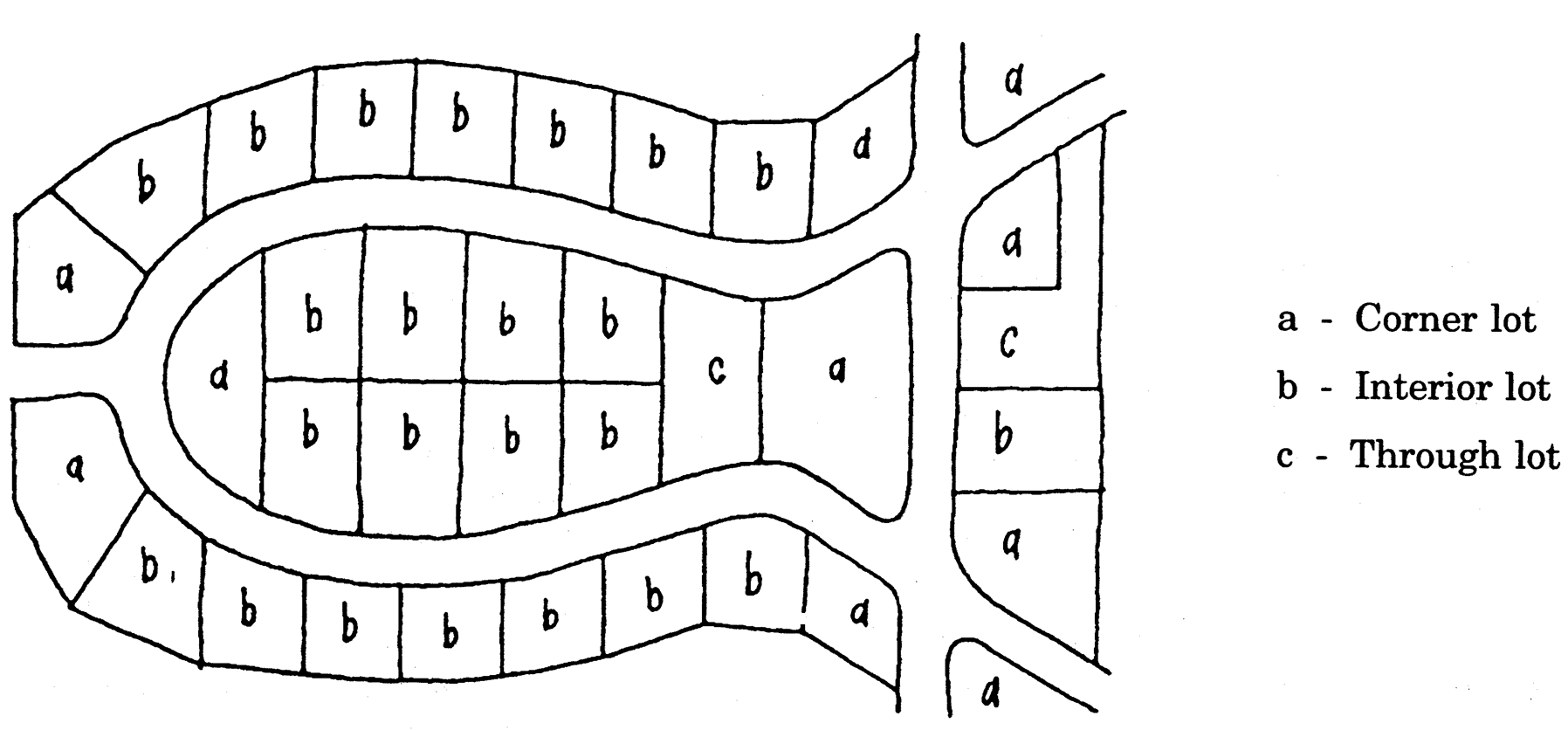
Lot, corner. A lot located at the intersection of two or more streets. A lot abutting on a curved street or streets shall be considered a corner lot if straight lines drawn from the foremost points of the side lot lines to the foremost point of the lot meet at an interior angle of less than 135 degrees.
Lot, depth. The distance between the midpoints of the front and rear lot lines.
Lot line. A line of record bounding a lot which divides one lot from another lot or from a public or private street or any other public space.
Lot line, front. Any side of a lot which fronts upon a street, be it public or private. The primary front lot line is that frontage on which the address is given. For lots with multiple frontages, such as corner lots, the remaining front lot lines are considered to be secondary.
Lot line, rear. The lot line(s) most distant from and most nearly parallel to the primary front lot line. For pie-shaped lots having three sides, the rear lot line shall be the line drawn perpendicular to the line which bisects the pie-shaped lot, at a distance equal to or greater than the required rear yard setback, unless otherwise indicated on the recorded plat. For other types of irregular shaped lots, the administrative official shall determine the rear lot line based upon an evaluation of which building orientation would be most consistent with surrounding lots.
Figure 2:5 Lot lines and setbacks for pie-shaped lot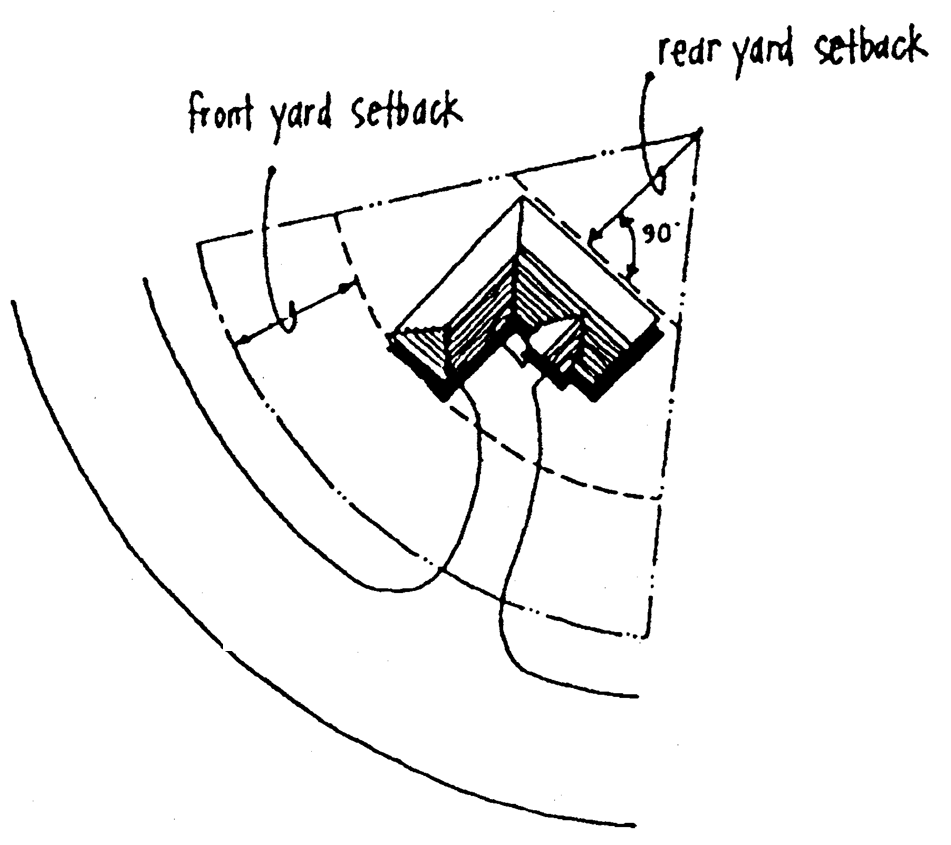
Lot of record. A lot that is part of a subdivision, the plat of which has been recorded in the office of Clerk of the Circuit Court of the County of Volusia, or any parcel of land, whether or not part of a subdivision, that has been officially recorded by a deed in the office of the clerk, provided such lot was of a size that met the minimum dimensional requirements for lots in the district in which it was located at the time of recording or was recorded prior to April 11, 1972.
Lot width. The width of a lot as measured at the required front yard setback.
Lowest floor. The lowest floor of the lowest enclosed area of a building or structure, including basement, but excluding any unfinished or flood resistant enclosure, other than a basement, used solely for vehicles parking, building access, or limited storage, provided that such enclosure is not built so as to render the structure in violation of the non-elevation requirements of the Florida Building Code or ASCE 24.
Main access pier. A walkway extending over water from land, used as the means of access to boat docking facilities.
Maintenance contractor. An establishment which provides routine business and residential maintenance activities at the place of business or residence needing such treatment. This type of contractor may include, but not be limited to, exterminators, janitors and house cleaners, and swimming pool service.
Manufactured building. A building made or assembled in manufacturing facilities away from a building site for the installation or the assembly and installation on the building site.
These buildings must meet all of the building code requirements of the City of Port Orange and may include residential, commercial, industrial, institutional, and storage structures, but shall not include mobile homes.
Manufactured home. A structure, transportable in one or more sections, which is eight feet or more in width and greater than 400 square feet, and which is built on a permanent, integral chassis and designed for use with or without a permanent foundation when attached to the required utilities. The term "manufactured home" does not include a "recreational vehicle" or "park trailer." [Also defined in 15C-1.0101, F.A.C.].
Manufactured home park or subdivision. A parcel (or contiguous parcels) of land divided into two or more manufactured home lots for rent or sale.
Manufacturing: craftsman shop. A trade type of establishment where products are made based on a specific manual skill or art, and may include, but not be limited to, cabinetmaking, fireworks, painting, pottery, stained glass, upholstery and woodworking.
Manufacturing: fabrication. An establishment engaged in the making of a finished product by means of the assembly of standard parts or sections, and may include, but not be limited to, audio/video equipment, boxes, fiberglass materials, hardware, home furnishings, robots, septic tanks, and telephone equipment and supplies.
Manufacturing: limited. Establishments which are engaged in the making of a finished product, primarily by means of assembly of component parts. Limited manufacturing uses shall encompass those manufacturing uses defined by this code as "craftsman shop," but shall be distinguished from other manufacturing uses defined as "fabrication" or "processing" by the scale and intensity of the facility and its operations, and its impacts on surrounding properties.
Manufacturing: processing. An establishment engaged in the making of a finished product by means of changing materials into a different form through a series of actions and may include, but not be limited to, chemical production, fish cleaning and preparation, food products (packaging, canning, bottling, or processing), paint production and tire production.
Marijuana. Any form or variant or species of the cannabis plant including, but not limited to, cannabis sativa L., C. rederaliis, C. indica and its constituent cannabinoids, such as tetrahydrocannabinol (THC) and cannabidiol (CBD) commonly referred to as marijuana.
Marina, commercial/industrial. An establishment with a waterfront location for docking vessels related to commerce and industry. Such vessels shall include, but are not limited to, cruise ships, casino ships, barges, freight ships, cargo ships, and commercial fishing boats (excluding fishing charter boats), whose primary operations involve the import/export of goods or products or the transport of passengers outside Ponce de Leon Inlet.
Marina, recreational. An establishment with a waterfront location for docking pleasure or charter boats or providing services to pleasure and charter boats and the occupants thereof, including sale of fuel and supplies, provisions for food, beverages, and entertainment as accessory uses, and minor servicing and repair to boats. Minor servicing and repair includes, but is not limited to, replacement of engine parts such as spark plugs, fuel filters/water separators, and minor electronic repairs. Minor repairs and servicing shall not include activities that require the use of lifts, specialized tools or the removal of the engine block, carburetor, lower unit, powerhead, or flywheel. The replacement of tiller-driven motors typically used for trolling, emergency power or temporary motors for sailboats shall not be considered to be a repair or service. A yacht club shall be considered a recreational marina, but a hotel, motel, or similar use, where docking of boats and provision of services thereto is an accessory use, shall not be considered a recreational marina. Boat docks accessory to a residential project shall not be considered a recreational marina. A recreational marina shall not include those vessels listed in the "Marina, commercial/industrial" definition of this section.
Market value. The price at which a property will change hands between a willing buyer and a willing seller, neither party being under compulsion to buy or sell and both having reasonable knowledge of relevant facts. As used in chapter 8, article III, the term refers to the market value of buildings and structures, excluding the land and other improvements on the parcel. Market value may be established by a qualified independent appraiser, actual cash value (replacement cost depreciated for age and quality of construction), or tax assessment value adjusted to approximate market value by a factor provided by the property appraiser.
Master development agreement (MDA). An agreement between the city and a property owner/developer generally prepared in conjunction with a planned unit development, planned commercial development or development of property within the PC-R (Planned Community—Port Orange Riverwalk) zoning district or the PC-A (Planned Community—Agriculture) Workplace zoning district. The agreement allows unique and innovative land development proposals by establishing new development parameters, conditions, and requirements.
Mean high water. The average height of high waters over a 19-year period. For shorter periods of observation, "mean high water" means the average height of high waters after corrections are applied to eliminate known variations and to reduce the result to the equivalent of a mean 19-year value.
Mean low water. The average height of low waters over a 19-year period. For shorter periods of observation, "mean low water" means the average height of low waters after corrections are applied to eliminate known variations and to reduce the result to the equivalent of a mean 19-year value.
Mechanical equipment. Exterior equipment used for heating, cooling, ventilation, refrigeration, utility service and monitoring, and other similar purposes.
Medical marijuana. Marijuana used or intended to be used for a medical purpose that is currently legal to possess, or may become legal to possess in the State of Florida.
Medical office/clinic. An establishment where the diagnosis and treatment of human patients occurs without the provision of overnight care facilities and may include, but not be limited to, the services of acupuncture, alcoholism counseling, chiropractor, dental office and clinic, family planning, medical doctor office, mental health clinic, occupational therapist, speech and language pathologist, walk-in medical center, and weight control service. This term shall not include pain management clinic.
Membership sign. A sign identifying affiliation with a travel club, business association, credit card company, or professional association.
Microbrewery. An establishment, not exceeding 20,000 square feet in gross floor area, primarily engaged in the production of beer and other fermented malt beverages for sale on premises and in packages for later consumption off premises via retail carryout, or through distribution and may include accessory uses such as a tasting room, restaurant, retail, demonstration area, education and training facilities, and other uses incidental to the brewing business that may be open and accessible to the public.
Microwave dish antenna. A dish-shaped device used to transmit and/or receive microwave signals in a straight line to and from similarly earth bound point sources.
Mini-warehouse. A self-service storage facility in a building consisting of individual self-contained units of varying size that are leased or owned for the storage of business and household goods, or for contractor's supplies.
Minor engineering permit. An application for minor site work such as clearing and grubbing, filling and excavation, sidewalks, driveways, pavement repairs or overlays, minor drainage improvements, and other minor site work that is not otherwise incorporated into a building permit or site construction permit.
Mitigation. Actions including, but not limited to, restoration, enhancement, or creation of wetlands, required to be taken by a person to offset environmental impacts of permitted activities.
Mobile home. A structure, transportable in one or more sections, which is eight body feet or more in width and which is built on an integral chassis and designed to be used as a dwelling when connected to the required utilities and subject to all regulations applying thereto, including a vehicle registration and title issued by the Florida Department of Motor Vehicles, whether wheels, axles, hitch, or other appurtenances of mobility are removed, and regardless of the nature of the foundation provided. The term includes the plumbing, heating, air conditioning, and electrical systems contained therein. The term shall not include recreational vehicles, except for purposes of article III, chapter 8 of this code.
Mobile home park. A single parcel or tract of land where lots are rented to accommodate mobile homes.
Mobile home subdivision. A subdivision of land in which only mobile homes are permitted.
Model home. A residential building used for demonstration and sales purposes, not occupied as a dwelling unit. and open to the public for inspection, tours and negotiation or execution of sales contracts for the sale of that builder's homes or products.
Monument sign. A freestanding sign whose sign face is attached to a base or structural frame with a width and thickness of at least two-thirds the width of the widest part of the sign face or sign face mounted between two decorative columns.
Motel. A transient lodging facility as defined in F.S. § 509.013(4)(a), typically characterized by a single-story building containing accommodations for at least six sleeping rooms accessible from exterior corridors or directly from an outdoor parking area, advertised and held out to the public for rental to transients and travelers, and which is recognized as a motel in the community in which it is situated or by the industry. This term shall not include hotels.
Motor vehicle. An automobile, motorcycle, truck tractor and semi-trailer combination, or any other vehicle legally operated on the roads of this state, used to transport persons or property, and propelled by power other than muscular power, but not including tractor engines, road rollers, such vehicles as run only upon a track, bicycles, or mopeds, in accordance with F.S. ch. 320.
Motor vehicle and boat storage facility. Land where the long-term parking of motor vehicles and boats is accommodated.
Motor vehicle/boat sales. An area used for the display, sale, or rental of new or used motor vehicles and boats in operable condition and where no repair work is done.
Motor vehicle repair facility. An establishment where major mechanical overhaul and repairs, paint and body work, and rebuilding of vehicle components is done.
Motor vehicle service center. An establishment engaged in the servicing of motor vehicles allowing over the counter sale and installation of new replacement parts, equipment and accessories, including minor adjustments, oil change, tune-ups, wheel alignment and balancing, tire changing and repair, installation of exhaust system parts, brake linings, electrical repairs, and the like; where all work shall be carried out within the sales building or service bays attached thereto. Specifically prohibited are engine rebuilding, body repair work or repainting, sale of vehicles or the outside storage of same, or the outside storage of parts and equipment other than for temporary display purposes.
Motor vehicle service station. An establishment primarily engaged in the fueling, servicing, and washing of motor vehicles which may include the sale of refreshments from vending machines, fuel, lubricants, and products necessary to the operation and maintenance of motor vehicles, and may include the sale and installation of accessories, tires, batteries, minor engine tune-ups, wheel balancing and alignment, brake service, but not including major mechanical or body repair or the sale of motor vehicles.
Mulch. Nonliving, organic materials customarily used in landscape design to retard erosion, retain moisture, inhibit weed growth, and moderate soil temperature.
Mullion. Vertical posts between the portion of a window through which day light may pass, such as a pane of glass.
Multi-tenant building. Any building containing two or more commercial, office, or industrial tenants that are under common land ownership or that share common property frontage.
Multi-tenant complex. Any development containing two or more business, office, or industrial tenants that are under common land ownership or that share common property frontage.
Mural. A sign which consists of a picture or graphic illustration applied directly to a wall of a building or structure that does not contain a commercial message.
Natural community. An association of plant and animal species which inhabit and interact within the same environment characterized by certain hydrological, biological, ecological, and chemical qualities.
Neon. A source of light supplied by a glass tube that is filled with neon gas, argon, mercury or other inert gas that produces ultraviolet light, and bent to form letters, symbols, or other shapes. Neon includes all tubular light sources that employ a charged gas to illuminate a tube that glows, similar gas-activated tubular light systems that emit colors, and other tubular light sources (including fiber optics) that are used to form letters and shapes.
Figure 2:6 Examples of signs with neon
New construction. For floodplain management purposes, any structure for which the start of construction commenced on or after the effective date of the initial floodplain management code, ordinance, or standard based upon specific technical base flood elevation data that establishes the area of special flood hazard, May 16, 1977, and includes any subsequent improvements to such structures.
Nit. A unit of illuminative brightness equal to one candle per square meter, measured perpendicular to the rays of the source.
Noncommercial message. Any message that is not a commercial message.
Nonconforming sign. Any sign that does not conform to one or more applicable provisions of this code, but that was lawfully erected and maintained, or approved in an official development plan, prior to the applicable provision or provisions.
Nonorganic decorative material. Material such as crushed rock, gravel, marble, etc., used as a groundcover. This material shall be that which is commonly used for landscape purposes and shall not include construction type crushed rock or gravel, sawdust, or other such construction type materials not generally used for landscape purposes.
Nonvehicular access easement. An easement precluding the construction of any accessway to the property from the adjoining street.
Nursing home. An extended or intermediate care facility which provides full time convalescent or chronic care to individuals who, by reason of advanced age, chronic illness or infirmity, are unable to care for themselves. This type of facility shall be licensed by the Florida Department of Health and Rehabilitative Services and meet their criteria, pursuant to F.S. ch. 400 and shall provide nursing services as defined in F.S. ch. 464. This term may include, but not be limited to the terms extended care facility, intermediate care facility, and long-term care facility.
Office. An establishment where services are performed involving predominantly administrative, professional, or clerical operations for a business, government, industry, profession, or service.
Office complex. Any office development containing two or more tenant spaces that are under common land ownership or that share common property frontage.
Office supply. An establishment which offers the sale of materials predominately used by the office community and may include, but not be limited to, the sale of accounting and bookkeeping materials, beepers-pagers, business forms, systems, and machines, computer equipment and supplies, inserting and mailing machines, office furniture, and typewriters.
Office/warehouse facility. An establishment where an office building will provide an attached warehouse to accommodate the office use. The building housing these two uses must be designed so that its appearance from a street will be that of an office building, and with any truck loading areas associated with the use not being visible from that street.
Off-site advertising sign. Any sign which directs attention to a business, commodity, service, product or activity not conducted, sold, offered or available on the premises where such sign is located or to which it is affixed.
On-site sign. A sign that identifies or advertises only goods, services, facilities, events or attractions available on the premises where the sign is located.
Open space. The land area within a development which is retained in its natural condition or improved in a manner for the enjoyment of all persons owning property within the development. Open space includes, but is not limited to, tree and environmental preservation areas, water bodies, green roofs, community gardens, and common area parcels, and is not developed with impervious surface unless it is common open space. Open space also includes those portions of the right-of-way which are pervious.
Open space, common. Open space which is accessible for enjoyment by all persons owning in a subdivided lot or parcel within a development. Common open space may include impervious areas developed with recreational facilities, clubhouses, docks, walkways, green roofs, community gardens, and related parking and support features.
Outdoor fruit and vegetable or craft market. Outdoor market uses expressly permitted in the Riverwalk Overlay District. These uses are generally small-scale in nature, pedestrian oriented, tend to serve the everyday needs of residents of and visitors to the district, and are intended to occur within and help create an active streetscape environment in conjunction with outdoor seating, reduced or eliminated setbacks, and centralized off-site parking.
Outparcel. A parcel of land generally related to and subdivided from a larger surrounding tract, which contains a freestanding structure when developed and is primarily accessed from within the larger surrounding tract.
Outstanding Florida waters. A special designation by the FDEP, for waters worthy of special protection because of their natural attributes, pursuant to the criteria set forth in Section 17-3.041 of the Florida Administrative Code. In the City of Port Orange, this designation is applied to the portion of Spruce Creek within which is that part of the water body abutting the state recreation shoreline to the centerline of Spruce Creek.
Pain management clinic. A privately owned clinic, facility, or office, whatever its title, including, but not limited to, a "wellness center," "urgent care facility," or "detox center," which engages in pain management by the issuance of prescription controlled substances. This definition includes the following:
(a)
An entity shall be a pain management clinic if the entity engages in one or more of the following:
(1)
It employs one or more physicians licensed under F.S. ch. 458 or F.S. ch. 459, who in a single day issue more than 20 prescriptions of a controlled substance for the treatment of pain;
(2)
It holds itself out through advertising as being in business to prescribe a controlled substance for the treatment of pain;
(3)
It holds itself out through advertising as being in business to provide services for the treatment of pain wherein the services are accompanied with prescription of a controlled substance for the treatment of pain; or
(4)
It meets the definition of pain management clinic in F.S. § 458.3265 or § 459.0137, as may be amended from time to time.
(b)
A pain management clinic does not include any privately owned clinic, medical facility or office which has at least one of the following characteristics:
(1)
It employs physicians, the majority of whom perform services in the clinic, facility, or office to provide surgical services in excess of 50 percent of the services rendered (excluding interventional pain management procedures that are invoiced or coded as surgical procedures) as measured over a one-month time period;
(2)
It is licensed as a facility pursuant to F.S. ch. 395, (hospitals and other licensed facilities) excluding outpatient facilities that provide pain management services as outlined in subsection (a)(1) above; or
(3)
It does not prescribe or dispense controlled substances for the treatment of pain.
Painted sign. Paint that is applied directly on a building wall to create a sign.
Panel. A plate, backing material, or other delineating surface that contains copy within a sign structure.
Parasite sign. Any sign not exempted from permitting by this sign code, for which no permit has been issued, and which is attached to another sign.
Park trailer. A transportable unit which has a body width not exceeding 14 feet and which is built on a single chassis and is designed to provide seasonal or temporary living quarters when connected to utilities necessary for operation of installed fixtures and appliances. [Defined in F.S. § 320.01.]
Pennant. A sign made of flexible materials that typically features a series of geometric shapes (e.g., triangles), suspended from one or two corners fastened to a string, which is secured or tethered so as to allow movement and used as an attention-getting form of media.
Pergola. A freestanding or attached structure of parallel colonnades supporting an open roof of crossing rafters or trellis'.
Permanent student capacity. The estimated number of students that can attend an educational facility at any given time based upon a percentage of permanent student stations. In Volusia County portables are not included in permanent student capacity.
Permanent student station. The net square footage necessary to be provided for each student based on the instructional program of a particular educational facility. Permanent student stations in Volusia County do not include student stations in portables.
Personal service. An establishment which provides for the care of a person or a person's apparel, and may include, but not be limited to, beauty/barber shop, nail salon, tanning salon, application of cosmetic permanent eye makeup, laundry, dry cleaning (retail store), garment service, and shoe repair. This term shall not include pain management clinic or tattoo establishment.
Personal wireless service. Commercial mobile services, licensed wireless services, and common carrier wireless exchange access services, and shall include "wireless service" as defined in F.S. § 365.172, as amended, as well as "personal wireless services" as defined in 47 USC §322(c)(7)(C)(i), as amended.
Personal wireless service facilities. Facilities for the provision of personal wireless services. A power, light, or other utility pole used exclusively as such prior to attachment of a personal wireless service facility shall not be considered a personal wireless service facility because of such attachment.
Pet store. Any type of retail sales facility that is licensed by the city and that offers for sale animals, animal-related food and accessories and/or same-day animal grooming services. On-site breeding of animals is prohibited.
Pixel pitch. the distance (generally in millimeters) between the center of a light-emitting diode (LED) cluster (pixel) and the center of the adjacent LED pixel.
Pleasure boat. Any watercraft used for recreational purposes by the owners or others, where no charge is made for fishing from or riding upon the watercraft.
Pole sign. A sign which is supported by one or two poles of no greater than eight inches in diameter and otherwise separated from the ground by air.
Port Orange Town Center. The area bounded by Dunlawton Avenue at Spruce Creek Road east to South Peninsula Drive and Ridgewood Avenue from the Port Orange/South Daytona city limits south to Rogers Avenue shown on figure 1 of the Port Orange Town Center Redevelopment Plan, as may be amended from time to time.
Post sign. A freestanding sign that projects perpendicular from a post, or that is suspended from or mounted between one or more posts constructed of wood, masonry, iron, or similar materials.
Poster frame sign. A frame or similar structurally delineated area on the exterior wall of a building designed to accept pre-printed signs that are generally displayed for weeks or months at a time.
Pre-existing antenna. An antenna for which a permit has been issued prior to the effective date of ordinance 1997-23, and its amendments, or antenna for which a permit has been properly issued and finalized, including antennas that have not yet been constructed so long as such approval and permit is current and not expired.
Pre-existing communication tower. A communication tower for which a permit has been issued prior to the effective date of ordinance 1997-23, and its amendments, or any communication tower for which a permit has been properly issued and finalized, including permitted communication towers that have not yet been constructed so long as such approval and permit is current and not expired.
Premises. The lot or lots, plots, portions or parcels of land considered as a unit for a single development or activity.
Primary front lot line. See Lot line, front.
Principal use or structure. The primary use of or structure on any land which is allowed as a permitted use, special exception or conditional use in the zoning district, or allowed as a continuing nonconforming use under provisions of this code.
Projecting sign. A sign supported by, and with any part extending at least 18 inches from, a building wall.
Prop dredging. The excavation of the bottom of a water body by a boat propeller, which is caused by an inadequate water depth to accommodate the boat size.
Proposed facilities modification: Any request for modification of an eligible support structure which the applicant asserts is subject to review under the Middle Class Tax Relief and Job Creation Act ("Spectrum Act") (PL-122-96; codified at 47 U.S.C. §1455(a)), as amended, and FCC orders promulgated thereto, codified at 47 C.F.R. §1.40001, as amended, and involving:
(a)
Co-location of new transmission equipment;
(b)
Removal of transmission equipment; or
(c)
Replacement of transmission equipment.
Public improvement. A physical improvement to real property which is designed and used for public benefit, including, but not limited to, sanitary sewer, potable and reclaimed water, drainage, stormwater management, roads and sidewalks/bike paths.
Public Property. Any property, real or personal, owned, leased or licensed by the city, county, state or federal government, including public rights-of-way, and for which the right to possess and control such property has not been legally surrendered, granted, licensed, or conveyed to a private person or entity.
Public safety communications facility. Any wireless communications facilities used by a government agency for the primary purpose of providing public safety related communications, including, but not limited to, wireless communications for police, fire and emergency services.
Public sign. A sign erected by any governmental entity in conjunction with the conduct of any governmental program, operation or activity, including, but not limited to, federal, state, county, and city governments, and local school districts.
Public utility station. Equipment and structures necessary for the conducting of service by a publicly owned or regulated agency, and may include, but not be limited to, electric power plants, stations, and substations, gas transfer stations, municipal water system wells and tanks, sewage and water treatment plants, buildings, and lift stations, and telephone exchanges and repeater stations.
Raceway. An enclosed box that functions as a mounting mechanism, and electronic component enclosure for wall mounted signage.
Rain barrel. A barrel that is used to collect and store rainwater runoff, typically from rooftops via rain gutters. A rain barrel is usually outfitted with a fine mesh screen to keep out debris and insects, a spigot for accessing the stored water, overflow portals and possibly a pump.
Real estate sign. A sign erected by the owner, or his agent, advertising the real property where the sign is located for sale, lease, or rent.
Recreational vehicle. A vehicle, including a park trailer, which is: [Defined in F.S. § 320.01(1).]
(a)
Built on a single chassis;
(b)
Four hundred square feet or less when measured at the largest horizontal projection;
(c)
Designed to be self-propelled or permanently towable by a light duty truck; and
(d)
Designed primarily not for use as a permanent dwelling but as temporary living quarters for recreational, camping, travel, or seasonal use.
Recreational vehicle park and campground. Land which has been developed for rental of space to accommodate seasonal or other temporary living arrangements (camping, recreational, and travel) for recreational vehicles, and may include, but not be limited to, travel trailer and motor home parks.
Redevelopment district. A district created under the Community Redevelopment Act, F.S. ch. 163.
Reserved capacity. Capacity that is provided by an approved and vested city concurrency and fair-share project, which the city owns and is financially responsible for providing within a specific timeframe.
Reservation deposit. The initial fair-share payment from a developer to the city based on the estimated cost of the concurrency improvement in the year the improvement project is to be completed.
Restaurant. An establishment where meals are prepared, and food, including beverages and confections, are served to customers, with the food and nonalcoholic beverage sales amounting to at least 51 percent of the total food sales. Restaurants are hereby classified as follows:
Type A. Restaurants with dining tables and counter stools having all service indoors and providing no service to persons inside vehicles or at walk-up windows.
Type B. Restaurants which have limited indoor service and may serve food for consumption on or off the premises and which specialize in short order foods and beverages, including "drive-through" service.
Retail home building materials. An establishment which offers for retail sale materials and equipment for home and garden construction and maintenance, and may include, but not be limited to, aluminum, cabinets, caulking material and equipment, doors, fill material, fireplace, gutters, lighting and fan products, lumber and plywood, plant materials, siding, tiles, and windows and shutters.
Retail nurseries and garden supplies. An establishment which offers to the public for retail sale, plants and/or associated materials and may include, but not be limited to, fences, fill material, firewood, gravel, sand, and rock products, lawn and garden supplies, and topsoil. Plant materials sold at such an establishment could be grown on the premises in a field or greenhouse.
Retail pharmacy. A retail establishment primarily offering goods for retail sale and on-site dispensing of prescription drugs, nonprescription drugs or both. A retail pharmacy may also offer accessory services such as photo processing, eyeglass care, and other convenience services. This term shall include a licensed medical marijuana treatment center dispensing facility operating in accordance with state law. This term shall not include pain management clinic.
Retail sales and services. An establishment engaged in the selling of products and service to the public for personal or household consumption, including, but not limited to, beauty/barber shop, laundry and dry cleaning store, newsstand/bookstore, xerographic printing, clothing stores, home electronic equipment, food/grocery stores, retail pharmacy, and sporting goods. This term shall not include pain management clinic.
Riprap. A retaining wall made to reduce the force of waves as well as to protect a shore from erosion and consists of unconsolidated boulders, rocks, or clean concrete rubble with no exposed reinforcing rods or similar protrusions.
Riverwalk district. The special character district area shown on figure 3 of the Port Orange Town Center Redevelopment Plan, as may be amended from time to time and legally described in exhibit A attached hereto.
Editor's note— Ord. No. 2004-28, Exh. A, adopted Sept. 28, 2004, is referenced as if fully set out herein. A copy of Ord. No. 2004-28, Exh. A, is on file and available for inspection in the office of the city manager.
Road. All roads within the city shall be classified as follows:
Local road. A route of relatively low traffic volume and travel speed that provides primary access to the majority of individual lots in subdivisions, and connects those lots to the collector and arterial system.
Minor collector road. A route that provides primary access to or through a subdivision or subdivisions, and connects those developments to the major collector and arterial system.
Major collector road. A route providing service which is of relatively moderate average traffic volume, moderately average trip length, and moderately average operating speed. Such a route also collects and distributes traffic between local roads or arterial roads and serves as a linkage between land access and mobility needs.
Minor arterial road. A route which generally interconnects with, and augments, principal arterial routes and provides service to trips of shorter length and a lower level of travel mobility. Such a route would include any arterial not classified as 'principal' and containing facilities that place more emphasis on land access than the higher system.
Principal arterial road. A route which generally serves the major centers of activity of an urban area, the highest traffic volume corridors, and the longest trip purpose and carries a high proportion of the total urban area travel on a minimum of mileage. Such a route would be integrated, both internally and between major rural connections.
Roadway capacity. The number of vehicles that can safely travel on a roadway at any given time, but not limited to, the level-of-service standard, roadway type, typical section, speed limit, and access type, as determined by a licensed professional traffic engineer using nationally accepted standards.
Roof-mounted. Any appurtenance or equipment attached to any building in such a manner that the height of the appurtenance or equipment exceeds the height of the wall elevation of the structure.
Roof sign. A sign painted on or affixed to the roof of a building and primarily supported by that roof structure, except fascia signs as defined in this sign code.
Roofline. The eave or fascia of any wall plane.
Sand dunes. Naturally occurring accumulations of sand in ridges or mounds landward of the beach.
Sandwich board sign. A portable sign that is ordinarily displayed as an A-frame with back-to-back sign faces, an easel, or a similar configuration.
School board. The governing body of the school district, a body corporate pursuant to F.S. § 230.21 which operates, controls and supervises all free public schools within the school district and determines the rate of school district taxes within the limits prescribed of state law.
School district. The geographic unit created and existing pursuant to section 4, article IX of the State Constitution, for the control, organization, and administration of schools in Volusia County.
School district five-year facilities work program. The School District of Volusia County Five-Year Work Plan and Capital Budget, as authorized by F.S. § 1013.35, detailing how the school district shall achieve and maintain the level-of-service for public school facilities.
Screen room. An addition to a structure or integral part of a structure which is enclosed with screen, permitting unobstructed flow of air in and out of the addition. A screen room may have a permanent floor and roof structure integral to the principal structure, however, for purposes of this code, no elevation of any wall of the room shall have less than 60 percent open screen area.
Search area. The geographic area, in which a wireless communications facility must be located to provide FCC required coverage of the applicant's designed service areas, as certified by radio frequency (RF) licensed engineer, or other such appropriate technical expert.
Secondary front lot line. See Lot line, front.
Senior independent living community. A residential community for residents aged 55 and older which incorporates multiple attached dwelling units with common dining and recreation facilities and other amenities.
Shopping center. Any commercial building or development containing two or more tenant spaces on one ownership parcel. This term shall also include commercial developments approved under any planned shopping center zoning district.
Shoreline. A line marking the edge of a body of water.
Sign. Any object, device, flag, display, structure, or part thereof, situated outdoors or indoors, that is used to advertise, identify, display, direct, or attract attention to an object, person, institution, organization, business, product, service, event, or location by any means, including, but not limited to, words, letters, figures, designs, symbols, fixtures, colors, illumination, or projected images. A sign includes the sign structure.
Sign, area. The entire sign face, including the display surface and any framing, trim, or molding, but not including the supporting structure.
Sign copy. The graphic content of a sign in either permanent or removable words, letters, figures, designs, symbols, fixtures, colors, illumination, or projected images.
Sign face. The area or display surface used for the graphic message.
Sign height. The vertical distance measured from the highest point of a sign to the lowest grade beneath the sign.
Sign permit. A permit authorizing the display, installation, construction or maintenance of a sign pursuant to the code.
Sign structure. Any combination of materials or structures constructed for the purpose of attaching, fixing, or otherwise supporting a sign, whether installed on, above, or below the surface of the land, a building, or any other solid surface.
Simulated gambling establishment. An establishment conducted or operated for commercial or pecuniary gain or for the collection of donations or gifts that simulates a casino-type atmosphere, or has any simulated casino game, or simulated gambling device, or simulated slot machine, including the use of video or other machines or games appearing to be the same, or substantially similar, to those machines or games typically or commonly used in casinos or casino venues. This definition shall be interpreted consistent with the definitions as provided in chapter 18, article XI, of the Port Orange Code of Ordinances and state law.
Site construction permit. A development permit issued by the city to commence construction on a property subject to an approved site plan or subdivision development order. The site construction permit is issued after the preconstruction meeting is held, conditions on the development order have been met, and the site inspection fee has been submitted.
Site sign. A temporary freestanding sign constructed of vinyl, plastic, wood, metal, or similar material and designed or intended to be displayed for a limited period of time on a site with an active listing for sale or for rent, or on properties with active building permits.
Snipe sign. A sign illegally attached to a utility pole or utility box or affixed to a public sign or placed in a public right-of-way.
Solar collector. Any of various devices that absorb and convert solar energy into heat or electricity. Thermal systems are used to heat water or buildings, while photovoltaic (PV) systems power buildings, equipment, and other devices.
Solar collector height. The distance between the tip of the panel at its highest angle and the average grade elevation below it, or the centerline grade of the adjacent roadway, whichever is less. The height of the solar collector shall be measured to surface roads only and shall not be measured to bridges, overpasses or similar elevated roads.
Special flood hazard area. An area in the floodplain subject to a one percent or greater chance of flooding in any given year. Special flood hazard areas are shown on FIRMs as zone A, AO, A1-A30, AE, A99, AH, V1-V30, VE or V. [Also defined in FBC, B, Section 1612.2.]
Specimen tree. The following species of trees with the minimum specified diameter at breast height are determined to be specimen trees in Volusia County, Florida:
Speculative home. A new residential dwelling that a home builder builds on the speculation that it will sell and shall not be used for demonstration and sales purposes or open to the public.
Standard construction details. The Standard Utility Details, The Standard Construction Details: Paving and Drainage, and any other standard details adopted by resolution of the city council of the City of Port Orange, Florida.
Start of construction. The date of issuance for new construction and substantial improvements to existing structures, provided the actual start of construction, repair, reconstruction, rehabilitation, addition, placement, or other improvements is within 180 days of the date of the issuance. The actual start of construction means either the first placement of permanent of a building (including a manufactured home) on a site, such as the pouring of slab or footings, the installation of piles, the construction of columns. Permanent construction does not include land preparation (such as clearing, grading, or filling), the installation of streets or walkways, excavation for a basement, footings, piers, or foundations, the erection of temporary forms or the installation of accessory buildings such as garages or sheds not occupied as dwelling units or not part of the main buildings. For a substantial improvement, the actual start of construction means the first alterations of any wall, ceiling, floor, or other structural part of a building, whether or not that alteration affects the external dimensions of the building. [Also defined in FBC, B, Section 1612.2.]
State water quality standards. Criteria set forth in Chapter 17-3 of the Florida Administrative Code as the minimum levels of ambient water quality parameters permissible in a water body to protect the designated uses of a water body.
Streamer. An attention-getting device consisting of two or more balloons, ribbons, reflectors, fringes or similar objects strung together on a common line, pole, or sign structure, or attached to one or more products offered for sale.
String light. A lighting fixture that is composed of electrical wiring encased in plastic with sockets for bulb placement.
Structure. Generally, that which is built or constructed.
Subdivision entry sign. A monument sign located along the entry to a subdivision from a collector, arterial, or local street.
Subdivision/site improvement agreement (SIA). An agreement between the city and a property owner/developer that guarantees completion of public improvements (on-site or off-site) depicted on an approved set of subdivision or site construction plans referenced therein.
Substantial change. A modification that changes the physical dimensions of an eligible support structure if it meets any of the following criteria:
(a)
For towers other than towers in the public rights-of-way, it increases the height of the tower by more than ten percent or by the height of one additional antenna array with separation from the nearest existing antenna not to exceed 20 feet, whichever is greater; for other eligible support structures, it increases the height of the structure by more than ten percent or more than ten feet, whichever is greater;
(b)
For towers other than towers in the public rights-of-way, it involves adding an appurtenance to the body of the tower that would protrude from the edge of the tower more than 20 feet, or more than the width of the tower structure at the level of the appurtenance, whichever is greater; for other eligible support structures, it involves adding an appurtenance to the body of the structure that would protrude from the edge of the structure by more than six feet;
(c)
For any eligible support structure, it involves installation of more than the standard number of new equipment cabinets for the technology involved, but not to exceed four cabinets; or, for towers in the public rights-of-way and base stations, it involves installation of any new equipment cabinets on the ground if there are no pre-existing ground cabinets associated with the structure, or else involves installation of ground cabinets that are more than ten percent larger in height or overall volume than any other ground cabinets associated with the structure;
(d)
It entails any excavation or deployment outside the current site;
(e)
It would defeat the concealment elements of the eligible support structure; or
(f)
It does not comply with conditions associated with the siting approval of the construction or modification of the eligible support structure or base station equipment, provided however that this limitation does not apply to any modification that is non-compliant only in a manner that would not exceed the thresholds identified in sub-paragraphs (a)—(d) above.
Substantial damage. Damage of any origin sustained by a building or structure whereby the cost of restoring the building or structure to its before-damaged condition would equal or exceed 50 percent of the market value of the building or structure before the damage occurred. The term also includes flood-related damage sustained by a structure on two separate occasions during a ten-year period for which the cost of repairs at the time of each such flood event, on average, equals or exceeds 25 percent of the market value of the structure before the damage occurred. [Also defined in FBC, B, Section 1612.2.]
Substantial improvement. Any combination of repair, reconstruction, rehabilitation, addition or other improvement of a building or structure taking place during a five-year period, the cumulative cost of which equals or exceeds 50 percent of the market value of the building or structure before the improvement or repair is stated. For each building or structure, the five-year period begins on the date of the first improvement or repair of that building or structure subsequent to the effective date of the ordinance from which this section derives. If the structure has incurred substantial damage, any repairs are considered substantial improvement regardless of the actual repair work performed. The term does not, however, include either: [Also defined in FBC, B, Section 1612.2.]
(a)
Any project for improvement of a building required to correct existing health, sanitary, or safety code violations identified by the building official and that are the minimum necessary to assure safe living conditions.
(b)
Any alteration of a historic structure provided the alteration will not preclude the structure's continued designation as a historic structure.
Supplementary wall sign. A nonpermanent sign installed within a poster frame, window, door, clip frame, or other similar display fixture or area. Temporary window signs are considered supplementary wall signs.
Surface area sign. A sign located on the front of a building, tenant space, residence, structure, post or pole, or similar feature within a front yard, or an authorized United States Postal Service mailbox, that displays copy for public safety and delivery of mail and official governmental notification.
Figure 2:7 Examples of surface area signs
Sustainable design. Utilizing environmentally sensitive, resource-efficient site selection, preparation, design, construction, and building operation techniques.
Tattoo establishment. An establishment whose principle business activity, either in terms of operation or as held out to the public, is the practice of placing of designs, letters, figures, symbols, or other marks upon or under the skin of any person, using ink or other substances that result in the permanent coloration or alteration of the skin by means of the use of needles or other instruments designed to contact or puncture the skin. This use does not include tattooing by licensed medical professional exclusively for medical or dental purposes, or the application of cosmetic permanent eye makeup as an accessory use of a personal services establishment.
Teardrop banner sign. A type of temporary sign consisting of cloth, bunting, canvas, or similar fabric, attached to a single vertical support structure with distinctive color, words, patterns, or symbolic logos for display. Also known as a feather banner, flying banner, or a wave banner sign.
Temporary communication tower (also known as "cellulars on wheels" (COWS)). A mobile wireless communication unit operating temporarily.
Temporary sign. A sign based upon its materials, location, and/or means of construction, e.g., light fabric, cardboard, wallboard, plywood, paper, or other light materials, with or without a frame, intended or designed to be displayed for a limited period of time.
Temporary sign cover. A sign based upon its materials, placement, and/or means of construction, e.g., light fabric, plastic, or other light materials, intended or designed to cover a permitted monument sign for a limited period of time.
Tenant. That portion of a facade attached to interior space that is occupied by one occupant that has a ground floor entry that provides public or customer access to the occupant. An "occupant" includes one tenant, owner or business.
Tenant frontage. The side of the tenant space oriented towards the principal road, street, highway or easement serving the multi-tenant building or tenant space.
Terminal dock platform. A platform over water at the end of a pier which may serve as a boat docking space or as a staging area for boating, fishing, or other water related activities. Such a platform would be wider than the pier leading to it.
Traffic control sign. A sign erected in a public right-of way by an authorized governmental agency for the purposes of traffic regulation and safety.
Traffic impact analysis (TIA). A study of the current roadway network, planned transportation improvements, background traffic, and other factors, used to evaluate whether the future roadway network can handle the traffic impacts from a particular development or phase thereof.
Transition duration. The time interval it takes the display to change from one complete static message to another complete static message.
Transition method. A visual effect applied to a message to transition from one message to the next. Transition methods include:
(a)
Dissolve a frame effect accomplished by varying the light intensity or pattern, where the first frame gradually appears to dissipate and lose legibility simultaneously with the gradual appearance and legibility of the second frame.
(b)
Fade a frame effect accomplished by varying the light intensity, where the first frame gradually reduces intensity to the point of not being legible (i.e. fading to black) and the subsequent frame gradually increases intensity to the point of legibility.
Transitional natural communities. Lands of low topographic relief or sloping to upland ridge, which indicate a gradation between upland and wetland zones. These areas are occasionally inundated or saturated by surface water or ground water, so that mesic vegetation is the main plant type supported, with a variety of xeric or hydric vegetation associated therewith, depending on the frequency and duration of wetness in the community.
Transmission equipment. Equipment that facilitates transmissions for any FCC-licensed or authorized wireless communication service, including, but not limited to, radio transceivers, antennas, coaxial or fiber-optic cable, and regular and backup power supply. The term includes equipment associated with wireless communications services including, but not limited to, private, broadcast, and public safety services, as well as unlicensed wireless services and fixed wireless services such as microwave backhaul and the associated site, and shall not include for example: utility poles, light poles, pedestrian signalized poles or signalized intersection poles, masts, or similar vertical structures that have a primary purpose or function independent of supporting a wireless telecommunications facility.
Transportation service. An establishment which provides transportation for animals, automobiles and other motor vehicles, and persons, and may include, but not be limited to, air ambulance, airport and motel transport, armored car security transport, boat transport, bus line service, horse and pet transport, and limousine service. The parking or storing of vehicles associated with the business shall occur on the premises.
Travel trailer. A travel trailer or park trailer as defined in F.S. § 320.01.
Tree. Any woody self-supporting plant characterized by having a single trunk of at least two inches DBH or multistem trunk system with well developed crown of at least ten feet high as measured from its base shall be considered a tree, with the exception of those exempted trees listed in chapter 9, article II, section 21.
Truck stop. A facility designed to provide those services customarily performed at a motor vehicle service station for semi, tractor-trailer, and other large trucks and commercial vehicles. Accessory uses of a truck stop may include one or all of the following: fast food or sit-down restaurant, convenience store, public showers or sleeping accommodations.
Trucking terminal. Land or buildings where trucks, including tractor or trailer units, are parked, stored, or serviced, (to the extent permitted at a motor vehicle service center) including the transfer, loading or unloading of goods. A trucking terminal may include facilities for the temporary storage of loads prior to transshipment, and may include, but not be limited to, businesses of armored truck delivery and pickup, freight forwarding, motor freight and local cartage trucking, and parcel shipping.
Under-canopy sign. A sign painted on or attached to the underside of a canopy or marquee.
Unified development. A development that includes one or more tenants that operates as a consolidated or integrated development through common ownership or through a legal agreement that unites the development in some manner, including, but not limited to, shared stormwater facilities, parking, access, and other facilities.
Unity-of-title agreement (UTA). An agreement between the city and a property owner/ developer that binds multiple parcels or lots together for the purposes of meeting site development requirements, allowing them to be treated as a single, unified development site. Once executed, the agreement requires city approval before any of the subject parcels can be sold, to ensure that development requirements for the site can still be met.
Upland natural communities. Lands with some topographic relief which are identified by infrequent inundation by surface water, and soils with high permeability and a low water table, so that xeric types of vegetation are supported in such systems.
USACOE. The United States Army Corps of Engineers.
USGBC. An acronym for the United States Green Building Council, a nonprofit organization whose mission is to transform the way buildings and communities are designed, built and operated, enabling an environmentally and socially responsible, healthy and prosperous environment that improves the quality of life.
Used motor vehicle parts yard. Land on which inoperative motor vehicles and parts are stored, salvaged, or sold.
Utility shed. An all-weather, permanent or temporary, fixed or movable accessory building used for the sole purpose of storage.
Variance. A grant of relief from the requirements of this code which permits construction in a manner otherwise prohibited by this code where specific enforcement would result in unnecessary hardship; or a grant of relief from the requirements of floodplain management ordinance, or the flood resistant construction requirements of the Florida Building Code, which permits construction in a manner that would not otherwise be permitted by the floodplain management ordinance or the Florida Building Code.
Vehicle sign. A sign that is printed, painted upon, or attached to a motor vehicle, including semi-truck trailers, used primarily for the delivery of products, transporting passengers or services or for business purposes other than primarily serving as a sign.
Veterinary clinic. An establishment for the medical and surgical treatment of sick or injured animals, where limited overnight facilities are provided in association with such treatment. This term may include, but not be limited to, veterinarian office, veterinary hospital, and animal clinic, but shall not include the term kennel.
Wall sign. A sign that is fastened to or painted on the wall of a building or other structure so that the wall becomes the supporting structure for, or forms the background surface of, the sign; and does not extend more than 12 inches from a building surface.
Warning sign. A sign that warns of a dangerous condition on a parcel of property or that posts the property warning of restrictions or that gives notice to the public of information required by law
Water use zone. An area where landscaping materials having similar water use/irrigation requirements are located together, according to the following organization:
(a)
High water use zone. Area where landscaping materials are grouped which are not drought resistant and require supplemental irrigation in addition to natural rainfall. Plant species associated with this zone would include wetland/moist soil vegetation, many exotics, and most manicured lawn grasses.
(b)
Moderate water use zone. Area where landscaping materials are grouped which are moderately drought resistant and require supplemental irrigation during seasonal dry periods. Plant species associated with this zone would include St. Augustine and Bahia lawn grasses.
(c)
Low water use zone. Area where landscaping materials are grouped which are drought resistant and able to survive on natural rainfall without supplemental irrigation.
Watercourse. A river, creek, stream, channel or other topographic feature in, on, through or over which waters flow at least periodically.
Wetland natural communities. Lands of low topographic relief which are identified by being inundated or saturated by surface water or ground water at a frequency and duration sufficient to support, and that under normal circumstances do or would support, a prevalence of vegetation typically adapted for life in saturated soil conditions.
Wetland vegetation. As defined in Rule 17-3.022, Florida Administrative Code.
Wetlands. Lands which are identified by being inundated or saturated by surface water or ground water at a frequency and duration sufficient to support, and that under normal circumstances do or would support, a prevalence of vegetation typically adapted for life in saturated soil conditions. The definition includes all contiguous and noncontiguous or isolated wetlands to waters, water bodies, and watercourses. Wetlands include, but are not limited to, swamp hammocks, hardwood hybrid hammocks, riverine cypress, cypress ponds, bayheads, bogs, wet prairies, freshwater marshes, tidal flats, salt marshes, mangrove swamps, and marine meadows. Dominant wetland vegetation shall be determined as provided in Rule 17-3.022, Florida Administrative Code. In circumstances where the natural boundary of wetland vegetation is unclear, the line of demarcation may be approximated at a surveyed elevation measured at a location in the same wetland where the natural line is clear. In the event an undeveloped area has been recently cleared of all vegetation, the wetland boundary may be determined by a study of the soils, aerial mapping, photography, hydrology, and other historical information as appropriate.
Wholesalers and distributors. An establishment engaged in the storage, wholesale, and distribution of manufactured products, supplies, and equipment, and incidental retail sales, exclusive of bulk storage of materials that are inflammable or explosive or that create hazardous or commonly recognized offensive conditions.
Wildland. An area in which development is essentially nonexistent, except for roads, railroads, power lines and similar facilities.
Wildland-urban interface area. That geographical area where principal structures and other human development meets or intermingles with wildland or vegetative fuels.
Wind energy system, small. A wind energy conversion system consisting of a wind turbine, a tower, and associated control or conversion electronics, which has a rated capacity of not more than 100 kW and which is primarily intended to power the building, site, or equipment on which it is located.
Wind sign. An attention-getting device with or without copy, or a series of devices such as streamers, balloons, feather signs, and pennants with or without copy, fastened in such a manner as to move in the wind.
Wind turbine height. The distance between the tip of the rotor/turbine blade when it reaches its highest elevation and the average grade elevation below it, or centerline grade of the adjacent roadway, whichever is less. The height of the wind turbine shall be measured to surface roads only and shall not be measured to bridges, overpasses or similar elevated roads.
Window. An opening constructed in a wall and which admits light or air to an enclosure, is framed and spanned with glass, and which may be mounted to permit opening and closing.
Window sign. A sign posted, painted, placed, or affixed to a window and inside a building, but clearly visible from outside the building. This includes any sign that is mounted within three feet of a window and oriented to the window in a manner that is visible from the outside of the building or wraps or film that reduce the transparency of the window.
Wireless communications facility. Any equipment or facility used to provide wireless communications service and may include, but is not limited to, antennas, towers, equipment enclosures, cabling, antenna brackets, and other such equipment. Placing a wireless communications facility on an existing structure does not cause the existing structure to become a wireless communications facility. Such definition shall not include facilities of a governmental entity where such facilities are utilized to provide intra-governmental communications, not generally available to the public, to protect the health, safety and welfare of the public.
Wireless communications service. Personal wireless service or "commercial mobile radio service" as provided under §§ 3(27) and 332(d) of the Telecommunications Act of 1996, 47 U.S.C. §151 et seq., and the Omnibus Budget Reconciliation Act of 1993, Pub. L. No. 103-66, August 10, 1993, 107 Stat. 312. The term includes service provided by any wireless real-time two-way communication device, including radio-telephone communications used in cellular telephone service; personal communications service; or the functional or competitive equivalent of a radio-telephone communications line used in cellular telephone service, a personal communications service, or a network radio access line. The term does not include wireless providers that offer mainly dispatch service in a more localized, noncellular configuration; providers offering only data, one-way, or stored-voice services on an interconnected basis; providers of air-to-ground services; or public coast stations.
Wireless facility support pole. A pole or similar structure that resembles and functions as a light or traffic control pole that is no less than ten feet or more than 50 feet in height and is used to support a camouflaged antenna or antennas for wireless communications service, and where electronic equipment associated with the antenna is either contained within the pole or installed below grade so as not to be visible.
Yard. The open space between a primary structure and lot line that may include pavement, landscaping, accessory structures or other improvements as allowed by this code. The terms front, side and rear yards refer to the yards adjacent to the front, side and rear property lines. On irregularly shaped buildings, the yard is defined by the plane of the longest facade parallel or nearly parallel to the corresponding lot line. Where building facades are at an angle to lot lines, the yard shall be defined by a line parallel to the corresponding lot line, which intersects the furthest building corner of any plane facing the lot line.
Yard, required. A yard of required depth established by the minimum building setbacks, as specified in the schedule of dimensional requirements.
Yard sign. A temporary freestanding sign constructed of paper, vinyl, plastic, wood, metal, or other comparable material, and designed or intended to be displayed for a limited period of time on a lot with one or more existing permanent structures.
Yard, waterfront. A yard of required depth measured along and perpendicular to the bulkhead line of the ocean, river, watercourse, stormwater pond, or canal on which the lot is located. In the event there is no bulkhead line, the measurement shall be taken from the mean high water mark. A waterfront yard, of the same dimension as the required rear yard, is required for all lots that have waterfront locations, as specified in the schedule of dimensional requirements.
(Ord. No. 1991-20, 8-27-91; Ord. No. 1991-35, 12-17-91; Ord. No. 1992-29, 11-3-92; Ord. No. 1993-58, 1-18-94; Ord. No. 1994-32, § 1, 11-1-94; Ord. No. 1995-43, §§ 3—5, 12-19-95; Ord. No. 1996-32, §§ 1, 2, 12-17-96; Ord. No. 1996-33, §§ 1, 2, 11-19-96; Ord. No. 1997-23, § 1, 4-29-97; Ord. No. 1997-28, § 1, 5-13-97; Ord. No. 1997-53, § 1, 10-28-97; Ord. No. 1998-22, § 1, 7-21-98; Ord. No. 1998-51, § 1, 8-18-98; Ord. No. 1999-4, §§ 1, 2, 2-16-99; Ord. No. 1999-6, §§ 2, 3, 2-23-99; Ord. No. 1999-10, § 1, 3-16-1999; Ord. No. 2000-61, § 1, 1-9-01; Ord. No. 2000-53, §§ 1, 2, 2-20-01; Ord. No. 2001-57, § 1, 9-18-01; Ord. No. 2001-84, § 1, 10-16-01; Ord. No. 2002-21, § 1, 5-21-02; Ord. No. 2003-6, § 1, 4-22-03; Ord. No. 2004-11, § 1, 6-15-04; Ord. No. 2004-28, § 1, 9-28-04; Ord. No. 2005-55, § 1, 1-17-06; Ord. No. 2006-45, § 1, 11-14-06; Ord. No. 2007-5, § 1, 3-6-07; Ord. No. 2008-3, § 1, 1-22-08; Ord. No. 2009-12, § 2, 7-28-09; Ord. No. 2009-24, § 1, 11-10-09; Ord. No. 2010-2, § 1, 3-16-10; Ord. No. 2010-3, § 1, 3-16-10; Ord. No. 2010-4, § 1, 3-16-10; Ord. No. 2010-17, § 1, 7-20-10; Ord. No. 2011-27, § 1, 10-25-11; Ord. No. 2011-29, § 1, 11-8-11; Ord. No. 2011-32, § 1, 12-13-11; Ord. No. 2011-39, § 1, 1-3-12; Ord. No. 2012-16, § 1, 12-11-12; Ord. No. 2012-27, § 1, 11-13-12; Ord. No. 2013-5, § 1, 5-21-13; Ord. No. 2014-2, § 8, 1-28-14; Ord. No. 2015-13, § 1, 4-21-15; Ord. No. 2015-34, § 1, 10-6-15; Ord. No. 2016-10, § 1, 8-2-16; Ord. No. 2016-19, § 1, 10-4-16; Ord. No. 2017-16, § 1, 5-16-17; Ord. No. 2017-28, § 1, 9-19-17; Ord. No. 2019-5, § 2, 2-5-2019; Ord. No. 2019-28, § 1, 9-5-19; Ord. No. 2020-7, § 1, 6-16-20; Ord. No. 2020-31, § 1, 10-6-20; Ord. No. 2021-6, §§ 1, 2, 3-2-21; Ord. No. 2021-26, § 1, 10-5-21; Ord. No. 2021-13, § 1, 10-19-21; Ord. No. 2022-10, § 1, 5-3-22; Ord. No. 2022-22, § 1, 9-6-22; Ord. No. 2023-18, § 1, 12-12-23)

