
Port Orange City Zoning Code
CHAPTER 13
LANDSCAPING AND BUFFERS1
Code of Ordinances references—Commercial property maintenance standards, § 14-311 et seq.; garbage, junk and undergrowth, § 42-26 et seq.
Section 1: - Purpose and intent.
To ensure quality landscape design and maintain and enhance an attractive natural environment within the city, the following chapter specifies landscaping criteria required for all development as stated herein. This chapter is intended to serve the following purposes:
(a)
Create and maintain the established natural and suburban character of the city by preserving areas of natural vegetation between land uses, along roadways and within the interior of developed sites;
(b)
Ensure that landscaping is native, drought tolerant, sensitive to site constraints, low maintenance, and an enhancement of the site by requiring that plans be prepared by a registered landscape architect where required herein;
(c)
Carefully balance the natural environment with new landscape installations which are complementary;
(d)
Foster civic pride and community spirit by maximizing the positive impact of development;
(e)
Promote water conservation through use of native and xeriscape plantings, and water recharge through irrigation with effluent reuse;
(f)
Reduce landscape, irrigation and maintenance costs by preserving the maximum area of existing vegetation on each site wherever possible; and
(g)
Provide for use of existing landscaping and landscape buffers to minimize the impact of adjoining differing land uses, enhance and protect the integrity of roadway corridors, and reduce the surface heat and negative visual impact of paved vehicular use areas.
Section 2: - General provisions.
(a)
Application to development. The requirements of this chapter shall apply to all uses within the city. Special provisions related to single- and two-family residences are addressed in section 5.5 of this chapter.
Subdivision development shall comply with provisions which are specifically noted to apply to such herein.
(b)
Landscape plan required. A landscape plan showing proposed landscape areas shall be submitted for review and approval by the city. Such plan shall be required for all new development, and if required, with application for a building permit for rehabilitation/renovation projects. Landscape plans shall include and indicate the following:
(1)
Location, type and size of all existing trees to be preserved;
(2)
Location of all structures, freestanding signs, parking areas, drives, vehicular use areas and other improvements proposed for the property;
(3)
Location of overhead power lines and adjacent rights-of-way;
(4)
Location of existing vegetative communities to remain undisturbed;
(5)
Indication of soil types found on the subject site by soil boundary line and description, as well as the specifications for soil amendment where such is needed;
(6)
Location, type, and quantity of all proposed landscape materials;
(7)
Plant list including quantity, type and specifications of proposed landscape materials;
(8)
General notes including mulching requirements, fertilization and installation instructions, and other such information as needed;
(9)
Planting details as needed;
(10)
Dimensions of the property; and
(11)
Tabulations which clearly show relevant statistical information necessary to evaluate compliance with provisions of this code. This shall include required buffers, vehicular use landscaping/screening, supplemental landscaping, and other such information as necessary.
(c)
Irrigation plan required. An irrigation plan shall be submitted for review and approval by the city in all instances where a separate landscape plan is required. Such plan shall indicate use of an automatic low-volume irrigation system designed specifically for the proposed landscape installation, delineation of irrigation zones as high water use, moderate water use, or low water use, and clearly illustrate compliance with section 7 of this chapter.
(d)
Installation of landscape materials.
(1)
Installation of landscape materials shall strictly be in accordance with the approved landscape plan. Any request for substitution or relocation of materials shall be submitted in writing to the planning division for approval. This provision shall not be construed to preclude the landscape contractor from his/her responsibility to secure approval from the property owner, developer or landscape architect to substitute or relocate landscape materials.
(2)
All landscape materials shall be installed in a sound, workmanlike manner and in accordance with recognized and accepted good planting procedures, and details contained in section 6 of this chapter.
(3)
No certificate of occupancy shall be issued for any structure on a property until the improvements shown on the approved landscape plan are installed and accepted by the city, unless such improvements are bonded as provided in [subsection] (4) below.
(4)
Bonding: A certificate of occupancy may be granted where installation of all required landscape materials is not possible due to special circumstances such as:
(a)
Unavailability of materials due to a hard freeze,
(b)
Unavailability of sod due to flooded fields, or
(c)
Late delivery of a limited number of back-ordered items which are to be installed outside of public areas on the site. If the city determines that the above circumstances apply, the developer shall post a cash bond in an amount which is 110 percent of the actual cost of the work to be completed. The developer shall provide an itemized cost breakdown of the work to the city for approval prior to posting the cash bond.
(e)
Landscape architect required; exemptions.
(1)
Unless otherwise exempted by Florida Statutes, landscape plans for the following development projects shall be prepared by and bear the seal of a registered landscape architect:
(a)
All new development, except one- and two-family residences.
(b)
Expansion of the building area of any existing development, other than one- and two-family dwellings, in excess of 5,000 square feet.
(c)
Any renovation project in a planned development (PUD or PCD).
(2)
All other landscape plans may be prepared by the following:
(a)
Architects, where applicable;
(b)
Engineers, where applicable;
(c)
Nurserymen;
(d)
Nursery stock dealers; and
(e)
Nursery agents.
(Ord. No. 1993-58, 1-18-94; Ord. No. 1995-43, §§ 66, 67, 12-19-95)
Section 3: - Landscape buffers.
Landscape buffers shall be established and maintained in accordance with this section.
(a)
In general. One or more of the following provisions may be applicable to a specific use. In such case, the most stringent requirement shall apply.
(b)
Bufferyards. Landscaped bufferyards shall be developed between differing land uses based on this section. These requirements shall be deemed the minimum necessary to achieve compatibility between land uses. Bufferyards shall be developed by the more intense use based on existing contiguous uses, zoning, or land use plan designation, whichever is most intense. Special provisions for properties within the Ridgewood Development District (subsection (c)) and along rights-of-way (subparagraph (b)(3)(b) and subsection (d)) are also prescribed within this section.
(1)
Bufferyard requirements. Bufferyard requirements shall be determined by subtracting the land use intensity factor of the less intense use from that of the more intense use. The various land uses and corresponding intensity factors are shown in the following table. Once the applicable bufferyard calculations have been completed, the resulting number indicates the appropriate bufferyard design type, as shown by the table in paragraph (b)(2) below.
1 "ISR" refers to Impervious Surface Ratio, or the ratio of impervious (building and paved) surface to total surface area. ISR measurement shall not include landscape buffers along rights-of-way as described in subsection (d) of this section.
(2)
Bufferyard design types. Bufferyard design types shall be based on the table below, and shall comply with the following additional requirements:
(a)
The number of specified plantings shall be applied for every 100 linear feet of the bufferyard.
(b)
The landscape materials used in required bufferyard plantings shall be selected from the list of evergreen species in section 6 of this chapter.
(3)
Optional bufferyard reduction. The required bufferyard design type may be reduced by one or more levels of intensity as set forth below.
(a)
With the installation of a six-foot high opaque fence or wall, the bufferyard design type may be reduced by one level. Such a reduction shall be permitted when the intensity factor difference is five or greater, and in situations where no fence or wall would otherwise be required by this code.
(b)
Where two differing land uses are located opposite each other across a right-of-way, the bufferyard design type shall be further reduced as follows:
(c)
Bufferyards for uses within the Ridgewood Development District. Bufferyards shall not be required within the Ridgewood Development District, except along rear property lines which abut any residential zone. In such case, the bufferyard type shall be determined by the impact of the specific use at the rear of the property, rather than by the use of the entire site.
(d)
Landscape buffers along rights-of-way.
(1)
Minimum width. The following minimum landscape buffer widths shall be established and measured perpendicular to rights-of-way.
(a)
Development shall provide a minimum landscape buffer of 50 feet along the following roadways:
(1)
Dunlawton Avenue from a point 750 feet west of Spruce Creek Road to Interstate 95.
(2)
South Williamson Boulevard (east coast beltline) north of Taylor Road.
(3)
South Williamson Boulevard (east coast beltline) south of Spruce Creek.
(4)
Interstate 95.
(5)
Taylor Road (Dunlawton Avenue west of Taylor Branch Road) from Interstate 95 to a point 1,900 feet west of South Williamson Boulevard.
(b)
Development shall provide a minimum landscape buffer of 20 feet in width along all arterial roadways,* except as provided herein.
(c)
Development shall provide a minimum landscape buffer of ten feet in width along all local and collector roadways*, Ridgewood Avenue, and Dunlawton Avenue east of Halifax Drive.
(d)
Multifamily development shall provide a minimum landscape buffer of 20 feet along all roadways.
(e)
Neighborhood commercial (NC) development shall provide a minimum landscape buffer of 30 feet along all roadways.
(f)
Development shall provide a minimum landscape buffer of 35 feet in width along Tomoka Farms Road.
*Roadway classification shall be based on future functional classification as shown in the comprehensive plan.
(2)
Minimum length. Landscape buffers shall extend along the entire length of the property boundary abutting the right-of-way, and may only be altered for the following purposes:
(a)
Construction of accessways as necessary and in compliance with an approved development plan.
(b)
Installation of stormwater, drainage or utility improvements as necessary and in compliance with an approved development plan.
(c)
Grading for retention as necessary and in compliance with an approved development plan.
(d)
Selective clearing for visibility of freestanding signs.
(e)
The regular pruning of trees to provide clear trunk and visibility between three feet and 15 feet above grade. Such pruning shall only be permitted for trees with height and maturity necessary to reasonably accommodate such activity.
(f)
The regular removal of dead materials and debris.
(g)
Installation of additional landscape materials required by this code.
(3)
Minimum planting requirements. Minimum planting requirements within landscape buffers along rights-of-way shall be determined based upon the required buffer width.
*Placement of shrubs shall be nonlineal, wherever possible, and in clusters containing no less than seven shrubs each.
**Applicable to uses within the Ridgewood Development District only.
(e)
Perimeter landscape buffers.
(1)
Minimum width. A minimum landscaped area shall be established along the entire length of all internal property lines, as described below.
(a)
Five feet measured perpendicular to the property line for all uses, except as provided in [subsections] (b) and (c) below.
(b)
Two and one-half feet measured perpendicular to the property line for uses within the Ridgewood Development District.
(c)
Ten feet measured perpendicular to the property line for all multifamily uses.
(2)
Minimum planting requirements. One shade tree shall be required per 50 lineal feet, or fraction thereof. Uses within the Ridgewood Development District shall only be required to provide one shade tree per 100 lineal feet, or fraction thereof. This reduction shall result in the ultimate provision of one shade tree for every 50 lineal feet for two adjoining properties.
(f)
Landscape buffers for double frontage residential lots.
(1)
The minimum landscape buffer for all double frontage residential lots shall be 25 feet. This requirement may be reduced when opaque screening is utilized in lieu of a natural vegetative screen, and shall be determined through the development plan approval process. In the absence of vegetation having sufficient density, the city may require a greater width than 25 feet or a human-made opaque screen, or a combination of the two.
(2)
Landscaping adjacent to opaque screening utilized in lieu of a natural vegetative screen described in paragraph (1) above shall comply with section 5(c) of this chapter.
(3)
In the absence of sufficient dense vegetation to provide a natural vegetative screen and as an alternative to opaque screening (e.g., a masonry wall), the city may consider a human-made landscape buffer utilizing any combination or arrangement of berms, walls, and/or landscaping which provides an equivalent opaque screen of five feet in height minimum.
(g)
Buffer design guidelines.
(1)
Landscape material selection. Landscape materials within buffers along rights-of-way shall be designed to display variety and color by utilizing flowering and variegated species wherever possible. Such variety and color may be accomplished by using a combination of shrubs and ornamentals from the approved lists provided herein. Ornamentals may be substituted for required shrubs in accordance with the shrub equivalency chart in section 6(b), however, in no case shall more than 50 percent of the required shrubs be substituted with ornamentals.
(2)
Location of landscaping.
(a)
The placement of landscape materials within landscape buffers shall have a rational relationship to the existing patterns and densities of adjoining areas which have been preserved. Arrangements shall be organic or curvilinear, and shall not be linear unless dimensional limitations necessitate such arrangement.
(b)
Landscape materials shall be clustered into groupings which simulate a natural, rather than man-made, appearance.
(3)
Maximum vegetation removal.
(a)
A minimum of 65 percent of any landscape buffer over ten feet in width shall be set aside for the preservation of existing trees.
(b)
Removal of understory trees and shrubs may be permitted to provide for shallow swales without removal or damage to any existing shade trees in order to create retention areas. In no instance shall more than 50 percent of the preserved undercanopy be removed.
(Ord. No. 1993-58, 1-18-94; Ord. No. 1999-6, §§ 24, 25, 2-23-99; Ord. No. 2000-61, § 2, 1-9-01; Ord. No. 2002-21, §§ 2, 3, 5-21-02)
Section 3.5: - Opaque fence or wall requirements.
(a)
A minimum six-foot high opaque fence, wall, or living wall shall be installed and set back a minimum of three feet from the common lot lines between existing or future single-family developments and developments with the following city (or similar county) zoning designations: R-3L, R-3M, R-3H, RMH, PUD (with duplexes, townhomes, apartments, or other multi-family development), PCD, PO, NC, CC, HC, ICD, CI, LI, RD, GPU. This fence/wall shall be required in addition to any bufferyard plantings required by this chapter. The three-foot setback may be reduced if justification is provided for the use of alternative materials or construction methods that do not require a three-foot setback for installation or maintenance. The alternative materials and construction methods shall comply with all other requirements of this code.
(l)
The responsibility for financing, installing and maintaining the fence/wall or living wall shall fall to the R-3L, R-3M, R-3H, RMH, PUD (with townhomes or apartments),PCD, PO, NC, CC, HC, lCD, CI, LI, RD or GPU-zoned property when it abuts other property which has a single-family residential zoning and/or land use currently in place. If the single-family residential land use is not in place, but is then proposed and approved, then the residential development shall finance, and install the fence/wall or living wall. The owner/developer or the property owner association shall be responsible for the maintenance of the fence/wall or living wall and replacement of landscaping materials to maintain the living wall as necessary.
(2)
In situations where the abutting development may give rise to negative security, visual, and/or auditory implications, for which a standard six-foot high fence/wall or living wall may not sufficiently mitigate, the administrative official may require the height to be increased to as much as ten feet, and/or may require a wall to be constructed of masonry block or similar noise-attenuating material, as deemed necessary to mitigate the impact on adjoining residential property. Where significant grade differentials exist between the residential and nonresidential property, such that headlights from parking vehicles would shine directly onto the adjacent residential structure(s), the height of the fence/wall shall be measured from the finished grade elevation of the non-residential parking lot.
(3)
The fence/wall or living wall requirement may be waived or else reduced by the administrative official in situations where the adjoining developments are separated from one another by, but not limited to, any of the following: a retention pond, a common area, a golf course, a soccer/ball field, a significant change in slope, a bufferyard design type in excess of that which is required by [sub]section 3(b)(2), or an existing fence/wall or living wall of a character which complies with the requirements of this code.
(4)
Prior to the issuance of the certificate of occupancy or letter of completion, all permanent opaque fences, walls, or living walls shall be constructed or installed pursuant to a city issued building permit or approved site plan.
(5)
In locations where site clearing and/or construction activities will expose a residential zoning district to either an arterial or major collector road—as defined by the comprehensive plan—either the permanent fence/wall required under this section or a temporary construction shall be installed. Temporary construction fences shall comply with chapter 16, section 3 of this code. The temporary fence or permanent fence/wall shall be erected immediately after clearing of the site.
(6)
The temporary construction fence is intended to remain no longer than necessary to mitigate the impacts of construction. Before a certificate of occupancy or letter of completion is issued, the temporary construction fence shall be removed and replaced with the permanent fence/wall or living wall as required by this section.
(b)
New single-family, duplex, and multi-family subdivisions shall be required to install an opaque vinyl fence, masonry wall or landscape berm along all perimeter boundaries abutting arterial and collector roadways. The fence, wall or berm shall be required in addition to any landscape buffer planting required by this chapter. However, the fence, wall or berm shall not be required if there is a minimum of 100 feet of common area between the platted rear lot lines and the abutting roadway. This requirement may also be waived or reduced by the administrative official in situations where the grade difference between an arterial or collector roadway and the rear yard of a lot and the required right-of-way landscape buffer provides sufficient screening for the rear yard.
(1)
The opaque fence, masonry wall or landscape berm shall be installed by the developer prior to the issuance of the first certificate of occupancy.
(2)
The opaque fence, masonry wall or landscape berm shall be located in common area. The opaque fence, masonry wall or landscape berm shall be installed and set back a minimum of three feet from the platted rear lot lines to provide sufficient space for installation and maintenance. The three-foot setback may be reduced if justification is provided for the use of alternative materials or construction methods that do not require a three-foot setback for installation or maintenance. The alternative materials and construction methods shall comply with all other requirements of this code.
(3)
If an opaque fence or masonry wall is required, then it shall be installed behind the required landscape buffer so that the landscaping fronts onto the adjacent roadway.
(4)
If a landscape berm is utilized in lieu of an opaque fence or masonry wall, then the berm shall be designed to provide equivalent opaque screening as would a masonry wall or opaque fence.
(5)
The home owners' association for the development or phase of the development shall be primarily responsible for maintaining the fence, wall or landscaped berm.
(c)
All fences/walls or living walls shall be landscaped with shrubs, understory trees and shade trees as per section 5 of this chapter.
(d)
Any fence/wall which is visible from a public right-of-way, shall be designed as an integral feature of the architectural design of the principal structure as per chapter 14, section 4(h).
(e)
All fences/walls or living walls, shall be located, constructed and maintained in compliance with chapter 16, section 3.
(f)
Living walls shall be at least six feet in height and sufficient in density and maturity at the time of planting to provide opaque screening.
(g)
See chapters 14 and 16 for other fence requirements that may apply.
(Ord. No. 2000-61, § 3, 1-9-01; Ord No. 2005-55, § 2, 1-17-06; Ord. No. 2009-23, § 1, 11-10-09; Ord. No. 2011-27, § 8, 10-25-11; Ord. No. 2012-16, § 8, 12-11-2012; Ord. No. 2021-15, § 2, 7-20-21)
Section 4: - Vehicular use/parking landscaping.
The landscape materials required in this section are in addition to any landscape materials which may otherwise be required in this code, except as stated herein. Parking lot landscaping may encroach into required buffers, however, landscaping required by this section may not be substituted in lieu of any required buffer or other landscaping, except as stated herein.
(a)
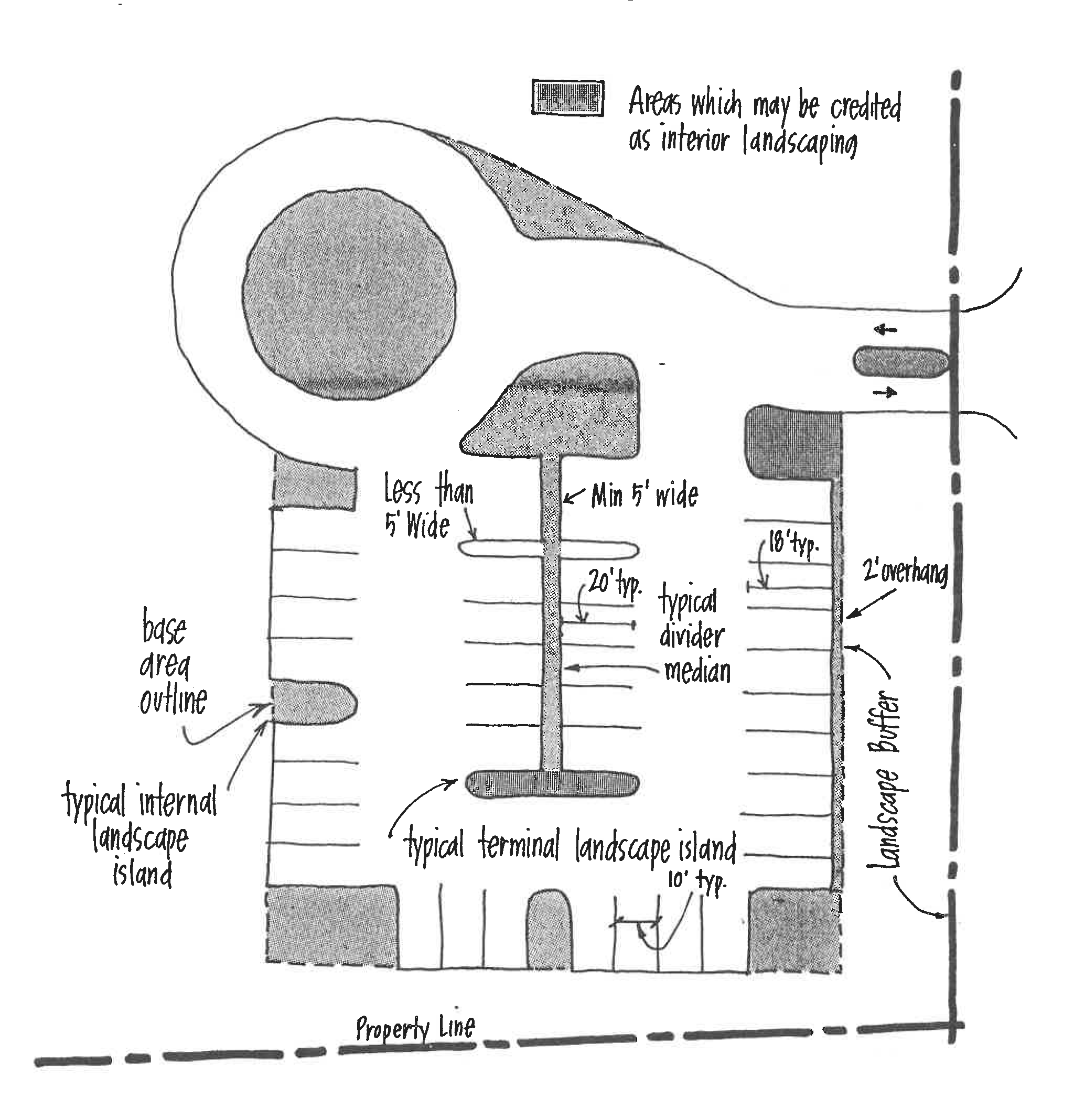
Minimum landscaped area. Ten percent of the area designed for vehicular use shall be devoted to the creation of interior landscaping, except for uses within the Zoning Districts as described in subsection (b) below, and except for lots with ten or fewer parking spaces and less than 4,000 square feet of paved area. The base area of the vehicular use area shall be measured along the outer edge and include all parking and loading spaces, access drives, cruise lanes, service areas, landscaped islands at the corners of and within parking areas, and other areas for vehicular use. Access drives located within required buffer yards shall not be included in the base area. Developers shall be required to provide a diagram indicating base area and internal landscaping, and the necessary calculations to verify that this requirement has been satisfied. The following diagram illustrates an example of areas which may be credited as internal landscaping.
Figure 13:1
Minimum Parking Landscaped Area
(b)
Minimum landscaped area for uses within the Ridgewood Development, Commercial Industrial, and Light Industrial Zoning Districts. Five percent of the area designed for vehicular use and visible from any public rights-of-way shall be devoted to the creation of interior landscaping. No interior landscaping shall be required for those vehicular use areas which are fully screened and/or not visible from any public rights-of-way. All other applicable provisions of this section shall be required.
(c)
Design of landscaped areas.
(1)
Terminal islands. Each row of parking spaces shall be terminated by landscaped islands to separate parking from adjacent drive aisles which measure not less than five feet in width and not less than 18 feet in length.
(2)
Interior islands. Interior islands shall be provided to satisfy internal landscaping requirements. Islands less than five feet in width shall not be credited as internal landscaping.
(3)
Divider medians. Landscaped divider medians may be used to meet interior landscape requirements. If divider medians are used, they shall form a continuous landscaped strip between abutting rows of parking. The minimum width of a divider median shall be five feet, not including vehicle overhang of two feet.
(4)
Islands at T-intersections. Landscaped interior islands shall be required at all T-intersections which are considered major traffic points. Such islands shall be a minimum of 20 feet in width.
(d)
Protection of landscaped areas.
(1)
Curbing. Terminal islands, interior islands and other landscaped areas adjacent to driveways or susceptible to vehicular turning movements shall be separated from vehicular use by nonmountable, reinforced concrete curbing of a type approved by the city. Curbed landscaped areas shall be backfilled to a height of four inches below the back of curb, except where such backfill would impact an existing tree. Unreinforced extruded curbing shall be prohibited. The width of curbing shall be excluded from the calculation of the minimum dimensions of all required landscape areas.
(2)
Wheel stops. All landscaped areas adjacent to off-street parking areas shall be protected from encroachment or intrusion of vehicles through the use of wheel stops. Wheel stops shall have a minimum height of six inches above finished grade of the parking area. Wheel stops shall be properly anchored and maintained in good condition.
(e)
Minimum planting requirements.
(1)
Terminal islands.
(a)
One shade tree or two understory trees shall be required for every 300 square feet of interior landscape area located in terminal islands, or fraction thereof. A minimum of one shade tree or two understory trees shall be required in any one terminal island area.
(b)
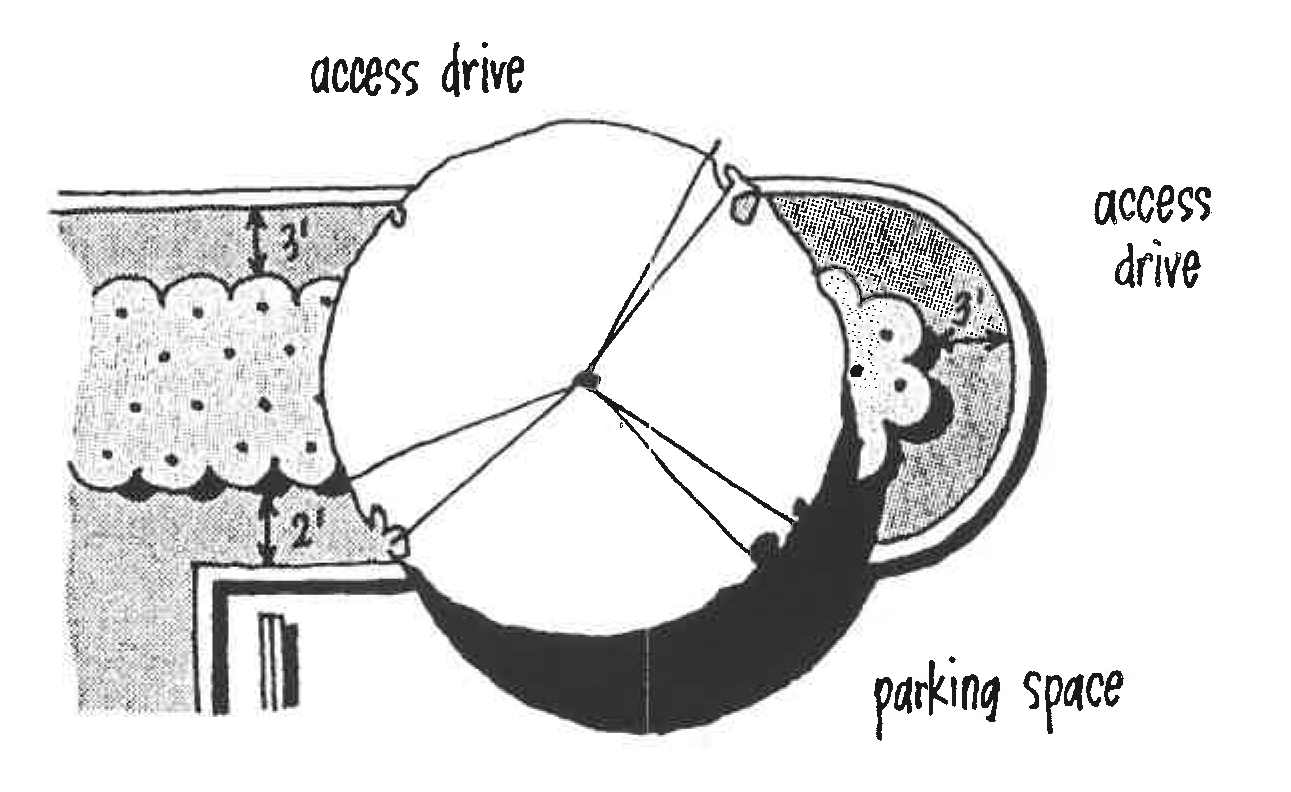
Ornamentals or shrubs in any combination or arrangement shall be required to provide 35 percent coverage of terminal islands, leaving a minimum two-foot clear zone of sod or mulch adjacent to parking spaces and a minimum three-foot clear zone adjacent to access drives. Spacing of landscape materials shall provide 100 percent aerial coverage within two years after planting. Shrubs should be those types which are easily maintained at three-foot mature height. The following diagram illustrates a typical landscape design for compliance with this requirement.
Figure 13:2
Minimum Planting Requirements for Terminal Islands
(2)
Interior islands.
(a)
One shade tree or two understory trees shall be required for every 300 square feet of interior landscaped area located in interior islands, or fraction thereof. A minimum of one shade tree or two understory trees shall be required in any one interior island area.
(3)
Divider medians.
(a)
One shade tree or two understory trees shall be required for each 30 linear feet of divider median, or fraction thereof.
(b)
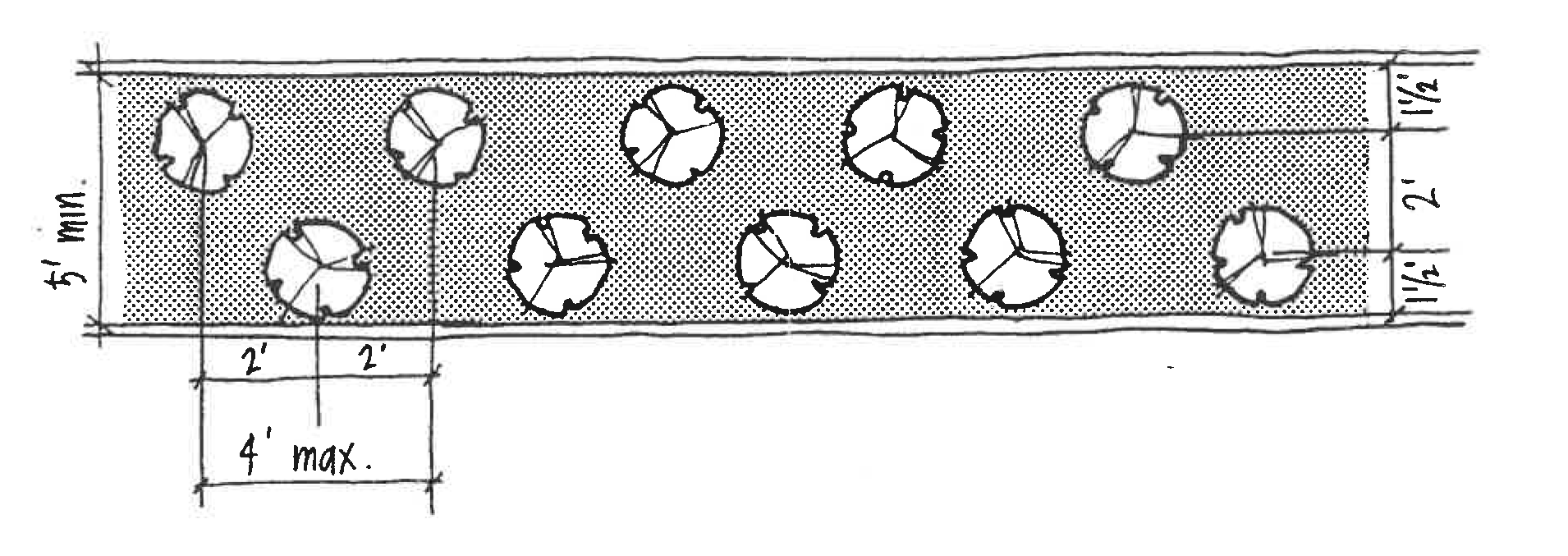
Shrubs shall be planted as shown in the following diagram to form a continuous hedge the full length of divider medians which separate parking areas from access drives.
Figure 13:3
Minimum Planting Requirements for Divider Medians
Figure 13:3
Minimum Planting Requirements for Divider Medians
(4)
Location of landscape materials.
(a)
Landscape materials in islands adjacent to parking spaces shall be set back a minimum of two feet behind the back of the curb to provide for vehicle access.
(b)
The placement of all landscape materials shall be designed to comply with visual clearance requirements of this code.
(f)
Vehicular use screening. Vehicular use and parking areas shall be screened in accordance with the following provisions:
Off-street parking and vehicular use areas which are visible from any public or private street or right-of-way shall be screened with any combination of hedge, fence, walls or berms which provide a minimum three-foot high visual barrier within a maximum of two years after installation. The location of such screening features shall be adjacent to the entire area perimeter.
(g)
Transfer of interior landscape area to perimeter of property. The requirement to provide interior landscaping within specialized vehicular use areas, in some instances, can result in obstacles which impede the function of such areas. This provision allows for the transfer of required internal landscaping to other areas of the site in order to avoid potential vehicular use conflicts. Types of uses approved for application of this provision and required landscaping are described below.
(1)
Public specialized vehicular use areas. Vehicular use areas which are not used for off-street parking, but which are open to the general public, shall include motor vehicle service stations; stacking lanes for banks, fast food restaurants, car washes and other similar uses; outdoor retail sales and display areas for new or used motor vehicles; or other similar uses.
(2)
Nonpublic specialized vehicular use areas. Generally, specialized vehicular use areas which are not open to the public shall include storage areas for new, used or rental motor vehicles; trucking terminals; industrial yards; outside storage compounds; commercial or industrial loading bay areas; or other similar uses.
(3)
Required internal landscaping area. Required landscaping in the interior of a vehicular use area as described in paragraphs (1) and (2) above may be eliminated provided that a landscape area equal to the required ten percent landscape area is established elsewhere on the property. Such transfer shall also include an equivalent number of landscape materials in accordance with [subsection] (g)(4) below. Landscape materials may be located in areas other than the transferred area if desired. Transferred landscape areas as permitted herein shall supplement and be in addition to any other landscaping or buffer required by this code, except such landscaping may be utilized to satisfy requirements of section 5(c), landscaping adjacent to walls and fences. This provision shall only apply to that portion of the lot that is actually used for specialized vehicular uses. It shall not apply to any paved areas open to the public for off-street parking or accessways, or employee parking. Developers shall be required to provide a diagram indicating the gross paved area and location of transferred internal landscaping, and the necessary calculations to verify that requirements of the option to transfer have been satisfied.
(4)
Required landscape materials.
(a)
A minimum of one shade tree or two understory trees shall be required for every 200 square feet of interior landscape area, or fraction thereof.
(b)
A minimum of 25 shrubs shall be required for every 400 square feet of interior landscape area, or fraction thereof.
(c)
Vehicular use screening shall be required in accordance with subsection (f) above.
(Ord. No. 1991-20, 8-27-91; Ord. No. 1992-29, 11-3-92; Ord. No. 2000-61, § 4, 1-9-01; Ord. No. 2022-19, § 1, 8-2-22)
Section 5: - Supplemental landscaping.
(a)
Landscaping adjacent to structures.
(1)
Minimum planting requirements. The interior of any site, including those areas directly adjacent to structures, shall be landscaped in accordance with the following provisions. Landscape materials required in this section are in addition to any landscape materials which may otherwise be required in this code, unless stated herein.
The measurement of any exterior building perimeter to determine the required number of plantings shall not include overhead or loading area doors, openings for motor vehicle bays or entrances, or the perimeter of attached or detached canopies. Measurements shall also exclude minor building projections or recesses that add architectural interest to the building facades, and building areas located within 25 feet of required landscape buffers or natural areas which will be preserved.
Special provisions for uses within the Ridgewood Development District are described in subsection (d) below.
(a)
Individual office or institutional uses, or multi-tenant office uses, or office park complexes.
(1)
One foundation plant shall be required for every one foot of the exterior building perimeter, excluding rear building areas not designed for public view or access.
(2)
One understory tree shall be required for every 30 feet of the exterior building perimeter, excluding rear building areas not designed for public view or access.
(b)
Shopping centers, individual business or industrial uses, or multi-tenant business or industrial uses.
(1)
Two foundation plants shall be required for every three feet of the exterior building perimeter, excluding rear building areas not designed for public view or access.
(2)
One understory tree shall be required for every 30 feet of the exterior building perimeter, excluding rear building areas not designed for public view or access.
(c)
Developments in multifamily zones.
(1)
One foundation plant shall be required for every one foot of the exterior building perimeter.
(2)
One understory tree shall be required for every 30 feet of the exterior building perimeter.
(2)
Design of landscape areas.
(a)
Foundation plantings. Foundation plantings required in this section may be comprised of shrubs or ornamental plants in any arrangement or combination, provided that no less than 50 percent of the total required materials are shrubs. Ornamental plants shall be provided in quantity in accordance with the equivalency chart for shrubs in section 6(b).
(b)
Function of landscape materials. Landscape materials required by this subsection should be located to achieve the following in order of priority:
(1)
Screen mechanical equipment, air conditioning units, or any other visible outdoor equipment;
(2)
Screen service areas, including dumpster pads;
(3)
Provide transition between the building and the ground;
(4)
Provide visual breaks along monotonous building facades;
(5)
Enhance walkways, entrances, seating areas, bus stops or any other pedestrian areas;
(6)
Separate and buffer pedestrian and public areas from cruise lanes, drives and parking areas; and
(7)
Provide direction to focal areas and main entrances.
(c)
Location of landscape materials. Generally, landscape materials required by this subsection should be located within 15 to 25 feet of the building foundation. Emphasis should be afforded to those areas which are visible from any public or private street or from any public area internal to the site.
(b)
Landscaping adjacent to outdoor activity areas. Outdoor activity areas such as community pools, shuffleboard courts, tennis and racquetball courts, basketball courts or other recreational features shall be landscaped in accordance with the following standards:
(1)
One shrub shall be required for each two feet of perimeter of the activity area.
(2)
One understory tree shall be required for every 20 feet of perimeter of the activity area.
(c)
Landscaping adjacent to fences, walls or dumpster enclosures. Any opaque fence, wall or dumpster enclosure which is visible from any public or private street or right-of-way shall be landscaped as follows:
(1)
One shrub shall be required for every four linear feet of wall or fence. Shrubs shall be clustered in groups of no less than seven, each, with groups being spaced no further than 25 feet apart or from the end of any wall or fence.
(2)
One understory tree shall be required for every 25 linear feet of wall or fence, or fraction thereof.
(3)
One shrub shall be required for every two linear feet of dumpster enclosure, or fraction thereof.
(4)
One shade tree shall be required for every 50 linear feet of wall or fence, or fraction thereof.
(5)
Landscape materials which are required in landscape buffers may be utilized to satisfy these requirements, provided the wall, fence or dumpster enclosure is located in the buffer.
(6)
Landscaping should be grouped into cluster arrangements.
(7)
Landscape materials shall be installed on the right-of-way or street side of the fence, wall or dumpster enclosure.
(d)
Landscaping for uses within the Ridgewood Development District. Landscaping for uses within the Ridgewood Development District, which is required by this section, shall only be required in those specified areas which are visible from any public right-of-way or public area of the site. In addition, the calculations to determine the required number of plants shall only be derived by measuring along those sides of any structure which are visible from any public right-of-way or public area of the site.
(Ord. No. 1991-20, 8-27-91; Ord. No. 1992-29, 11-3-92)
Section 5.5: - Landscaping for single- and two-family residences.
(a)
Materials. All residential lots shall maintain the following minimum landscaping:
(1)
Trees.
(a)
Lots 6,000 square feet or greater in area: One shade tree per 2,500 square feet of lot area.
(b)
Lots less than 6,000 square feet in area: One shade tree per 2,500 square feet of lot area. When site specific conditions exist, which do not reasonably permit installation of the required number of shade trees, then the administrative official may allow for:
(i)
The use of understory trees at a 2:1 basis as shade trees;
(ii)
The upsizing of a shade tree from a two-inch, ten-foot tall tree at the time of planting to a four-inch 14-foot tall tree at the time of planting and to count the upsized shade tree as two shade trees;
(iii)
Contribution to the city's tree bank in an amount established by resolution of the city council; or
(iv)
Combination of all of the above.
(2)
Shrubs:
(a)
A lot greater than 20,000 square feet is required to install 20 shrubs;
(b)
A lot that is 20,000 square feet to 6,000 square feet is required to install 12 shrubs; and
(c)
A lot less than 6,000 square feet is required to install eight shrubs.
(b)
Quality, size, species, and location of required trees and shrubs.
(1)
Quality and size. Shade trees shall be No. 1 Grade or better, shall have a minimum two-inch caliper, and shall be a minimum of ten feet high when planted. Replacement trees for single- and two-family lots subsequent to the issuance of a certificate of occupancy shall be a minimum size of two-inch caliper, ten feet high.
(2)
Species. Approved tree and shrub species are listed in subsection 6(b) of this chapter.
(3)
Location. At least one-half of the required shade trees and three-quarters of the required shrubs shall be located in the front half of the property, unless the administrative official determines that the required trees and shrubs may be located elsewhere on the property due to the unique shape or characteristics of the lot.
(c)
Crediting existing materials.
(1)
For purposes of developing lots as single-family and two-family residences, existing trees of approved species and shrubs, including preserved natural areas of palmetto and wax myrtle, shall be credited toward the requirements of this section. Existing palm trees, with clear trunks (CT) of at least eight feet above grade, shall be credited in accordance with paragraph 6(b)(1) of this chapter for up to one-half of the total required trees. Large specimen trees may be credited for more than one required tree, based on canopy coverage.
(2)
For purposes of tree removal on existing single-family and two-family residential lots, palm trees may be credited on a 2:1 basis as shade trees, or on a 1:1 basis as understory trees.
(d)
Replacements required. Replacement trees and shrubs shall be required whenever the proposed removal will result in less trees and/or shrubs than indicated in the above schedule. Replacements shall be provided on a one-for-one basis.
(1)
Substitution of species may be made so long as the total minimum number of trees is maintained, e.g., one shade tree to replace one shade tree, or two understory trees to replace one shade tree, or one shade tree to replace two understory trees, etc. A single understory tree shall not be substituted for a single shade tree.
(2)
Lots which do not meet the above requirements on the effective date of this provision shall have legal nonconforming status with respect to landscaping. Replacements shall only be required to ensure that the extent of the nonconformity is in no way enhanced or enlarged by tree or vegetation removal activities.
(e)
Repair of disturbed yard areas. All yard areas disturbed or damaged during any type of construction work shall be restored by being graded and planted with sod, except as follows:
(1)
Planter areas. Planter areas directly under trees and shrubs may be left with clean soil. However, where the area is larger than the direct shrub coverage, or greater than four feet diameter around trees, such planter areas shall be covered with a minimum of two inches of natural mulch, gravel or similar materials.
(2)
Edges of natural areas. The disturbed edges of natural areas shall be cleared of weeds, with sod or mulch installed back to the edge of natural materials.
(3)
Garden areas. Areas actually separated and developed as a garden area are not required to be restored.
(4)
Substitute finish ground covers. Decorative gravel, crushed stone, mulch and plantings used as substitute ground cover shall be of a kind which is commonly used for landscape purposes, and shall not include construction type, crushed stone or gravel, sawdust or other such materials. Decorative gravel, crushed stone, mulch and/or plantings may be substituted for sod as follows:
(a)
Side and rear yard areas. Permissible where such material is not subject to erosion or where deep shade conditions preclude the use of common turf grasses.
(b)
Front yard areas. Permissible where deep shade conditions preclude the use of common turf grasses. Also permissible for use as part of a xeriscape landscape design, provided that no more than 25 percent of the front yard area is covered in exposed gravel, crushed stone or mulch.
(c)
Mobile home lots. Permissible for all yard areas, including up to 100 percent of the front yard area covered with decorative gravel or crushed stone.
(Ord. No. 1995-43, § 68, 12-19-95; Ord. No. 1997-39, § 3, 6-24-97; Ord. No. 1999-6, §§ 26—28, 2-23-99; Ord. No. 2001-57, § 2, 9-18-01; Ord. No. 2018-21, § 1(Exh. A), 9-4-18; Ord. No. 2019-2, § 1, 2-5-19)
Section 6: - Landscape materials.
(a)
Landscape material selection. The species of required landscape materials shall be selected based on the existing and neighboring vegetative communities, soil types, proposed function of the materials, cold tolerance, existence of utilities or overhead power lines and aesthetics. In addition, landscape materials shall be selected in accordance with the following.
(1)
A minimum of 75 percent of the required shade trees to be planted on any one site shall be native trees. A list of approved species is provided by separate resolution as may be amended from time to time.
(2)
Aside from lawn areas, a minimum of 75 percent of the required landscape materials to be planted on any one site shall be drought or moderate drought resistant plantings incorporated into a low or moderate water use zone. A list of approved plantings to satisfy this requirement is provided by separate resolution as may be amended from time to time.
(3)
Landscape plans shall be designed to group landscape materials together into zones according to water use needs as follows:
(a)
High water use zone.
(b)
Moderate water use zone.
(c)
Low water use zone.
Plant materials may be grouped with those associated with the same or a higher water use zone.
(4)
A maximum of 40 percent of the total landscape area may be planted with lawn grasses. Such grasses should be consolidated and limited to areas subject to pedestrian traffic or recreational use, where soil erosion control is needed, or where it will serve as a design unifier or some other practical use. Deferred parking and grass parking areas shall not be considered part of the total landscape area for purposes of calculating the allowable lawn percentage. Parks and recreation areas shall be exempt from this lawn percentage limitation.
(5)
A maximum of 20 percent of the landscape areas on a site may be covered with an impervious surface.
(6)
All planting beds shall be filled with a minimum of two inches of clean, weed free organic mulch, with three inches being the preferable mulch depth. A maximum of 25 percent of these mulch areas may consist of nonorganic decorative material such as crushed rock, gravel, marble, and other similar materials.
(b)
Minimum specifications. All landscape material required to satisfy this code shall be Florida No. 1 Grade or better, according to the current Grades and Standards for Nursery Plants, State of Florida Department of Agriculture. In addition, all landscape material shall satisfy the minimum specifications established by resolution as may be amended from time to time.
(1)
Shade trees. Shade tree species shall be a minimum of two-inch caliper and ten feet in height at the time of planting. For purposes of this paragraph, the caliper shall be measured at six inches above the ground for trees up to four inches in diameter at planting and 12 inches above the ground for trees over four inches in diameter at planting. Palms may be used for up to 25 percent of required shade trees when planted in the quantities specified in the established landscape material resolution. Understory trees may be substituted for up to 25 percent of required shade trees when planted in groups of two or more per required tree. All shade trees shall be staked and guyed at the time of planting in accordance with the details of this section.
(2)
Understory trees. Understory tree species shall be a minimum of one and one-half-inch caliper and eight feet in height at the time of planting. For purposes of this paragraph, the caliper shall be measured at six inches above the ground for trees up to four inches in diameter at planting and 12 inches above the ground for trees over four inches in diameter at planting. Multi-trunk species shall be full and upright. All understory trees shall be staked and guyed at the time of planting in accordance with the details of this section.
(3)
Shrubs. Shrubs shall be a minimum of three-gallon container 18 to 24 inches in height immediately after planting. Shrubs shall be planted no more than 30 inches apart on centers, and in groups of no less than three each. Alternate spacing and grouping, when appropriate to ensure proper growth and screening, may be approved through the administrative variance procedure specified in section 9 of this chapter. Below is a list of approved shrubs. Variegated and other similar variations of species shall also be permitted provided identical dimensional and functional results are achieved.
(4)
Ornamentals. Ornamental plantings, shall be minimum one-gallon container grown species, unless otherwise noted in the landscape material resolution, and spaced on centers necessary to provide 100 percent aerial coverage within a maximum of two years, applicable to each plant type. Where this code permits shrub equivalency, the quantity listed in the landscape materials resolution shall be required to equal one shrub. Variegated varieties and other similar variations shall also be permitted provided identical dimensional and functional results are maintained.
(5)
Lawn grass. All grassed areas, except large open turf areas such as retention area bottoms and play fields, shall be sodded with any species of grass common to Central Florida. The use of St. Augustine sod is recommended for areas subject to regular manicuring and heavy pedestrian traffic. Generally, this type of grass should be used in areas which are viewed at a close distance. Bahia sod is recommended for retention areas, slopes, repair of rights-of-way, overflow grassed parking, play fields and other large turf areas which are not generally manicured.
The city may approve other lawn grasses in addition to those listed in the landscape materials resolution, providing that documentation defining the characteristics of the proposed grass, including appearance, growing requirements, and growth rate, substantiate its suitability for its intended purpose.
(6)
Mulch. All planting beds shall be filled with a minimum of two inches of clean, weed free organic mulch, with three inches being the preferable mulch depth. A maximum of 25 percent of these mulch areas may consist of nonorganic decorative material such as crushed rock, gravel, marble, and other similar materials.
(7)
Alternative landscaping materials. The city may approve alternative landscape materials to satisfy xeriscape requirements when such materials are determined to be drought resistant. Determination shall be based on certified documentation provided by a registered landscape architect or printed in a recognized professional or informational publication.
(8)
Prohibited vegetative species. Prohibited species identified in the landscape materials resolution shall not be included in any landscaping design due to their aggressive, invasive nature.
In addition, no plant species prohibited by the Florida Department of Environmental Protection (DEP) shall be included in any landscape design.
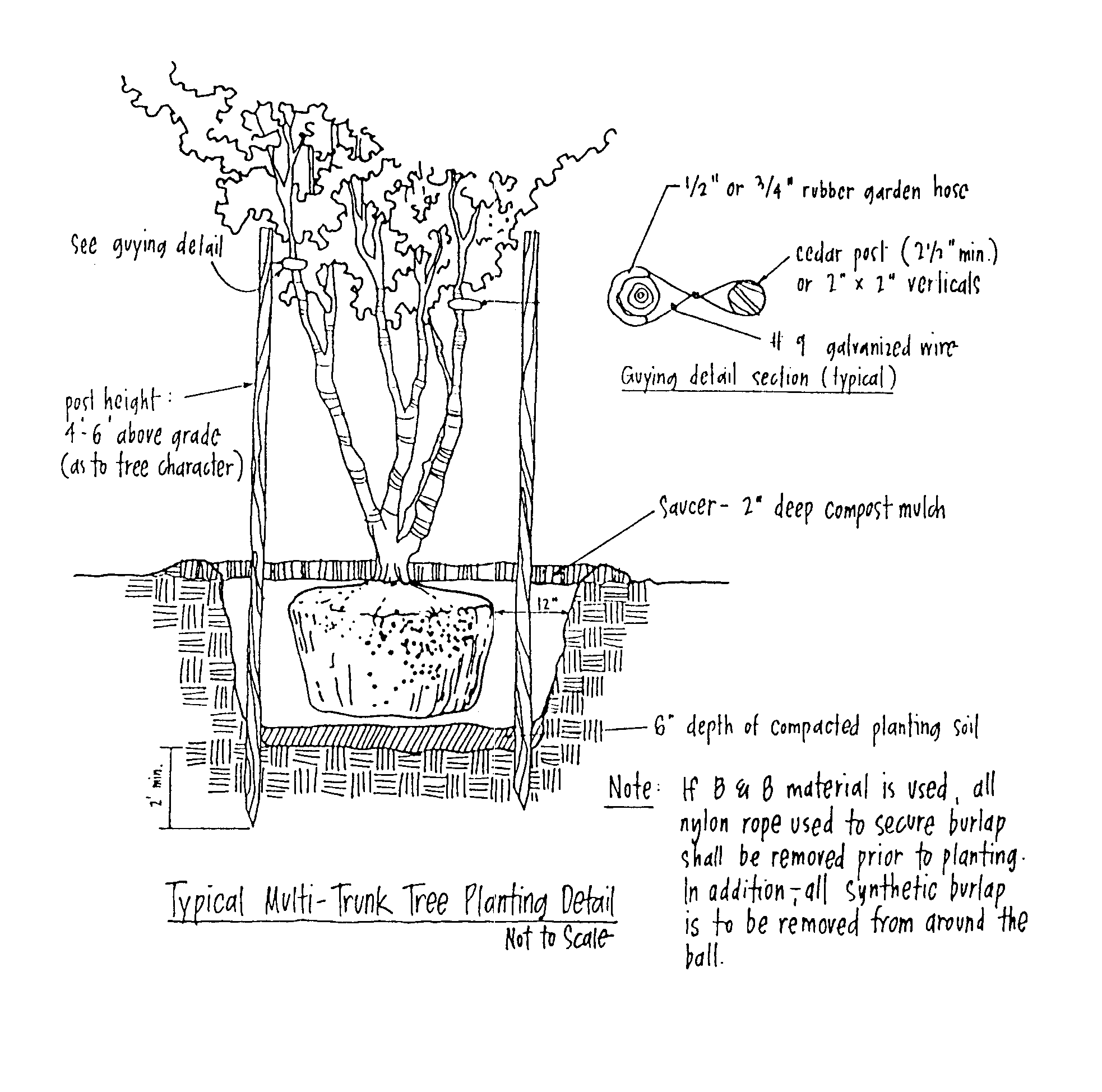
(c)
Planting and staking and guying details. Installation of landscape materials shall be in accordance with the following details. Other recognized and professionally accepted methods may be acceptable provided they are approved by the city.
Figure 13:4
Planting and Staking and Guying Details
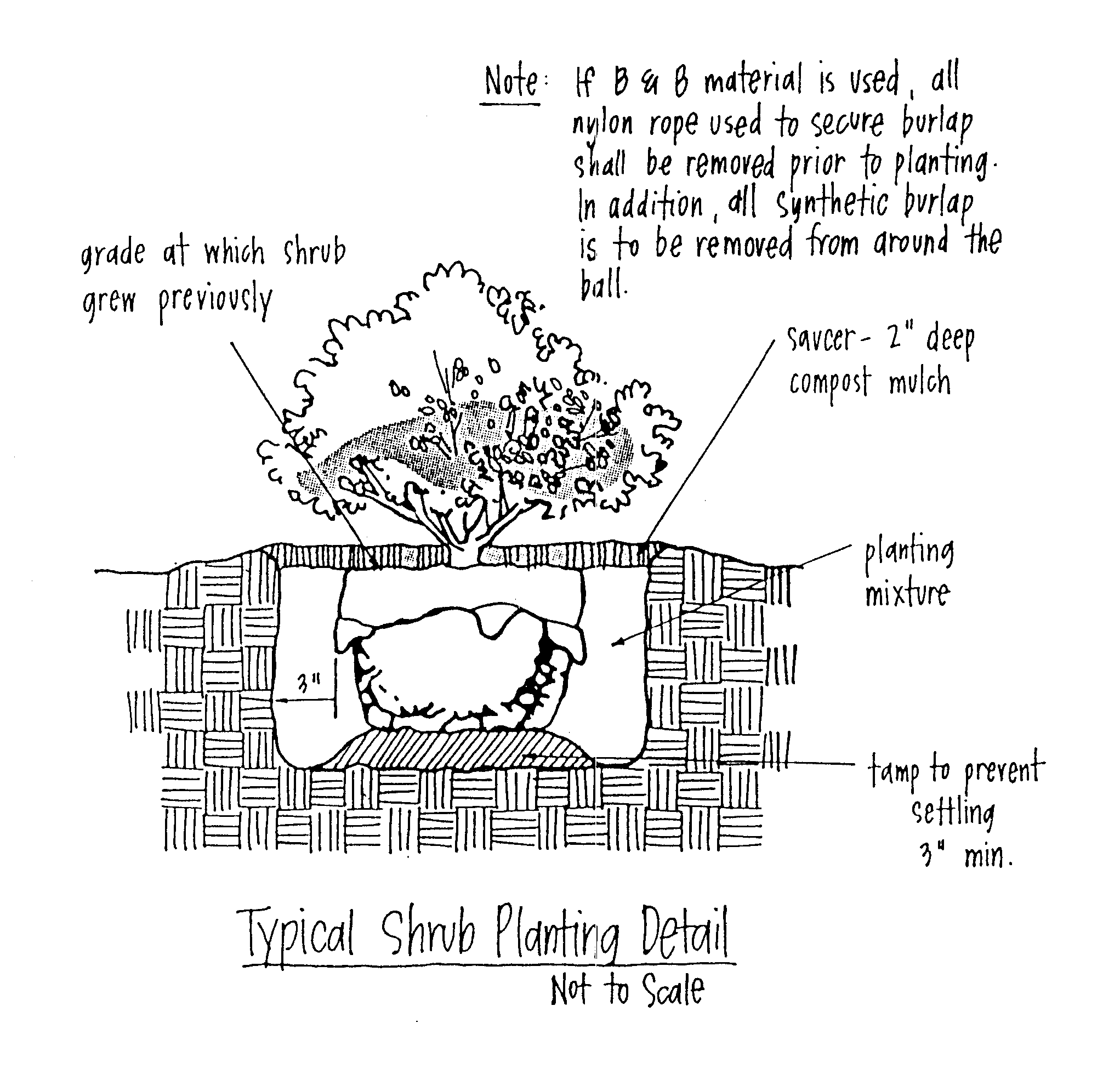
Figure 13:5
\Planting and Staking and Guying Details
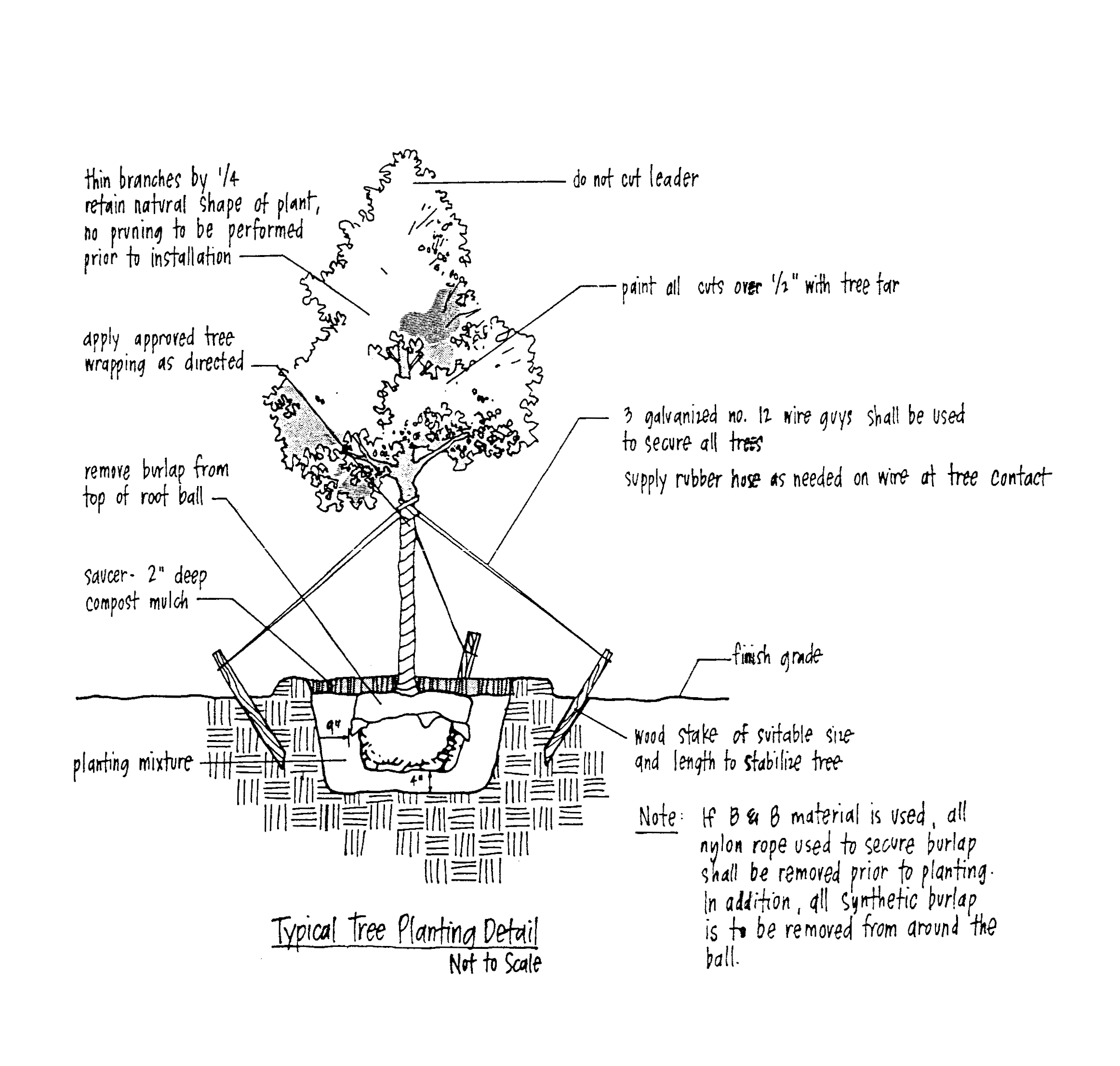
Figure 13:6
Planting and Staking and Guying Details
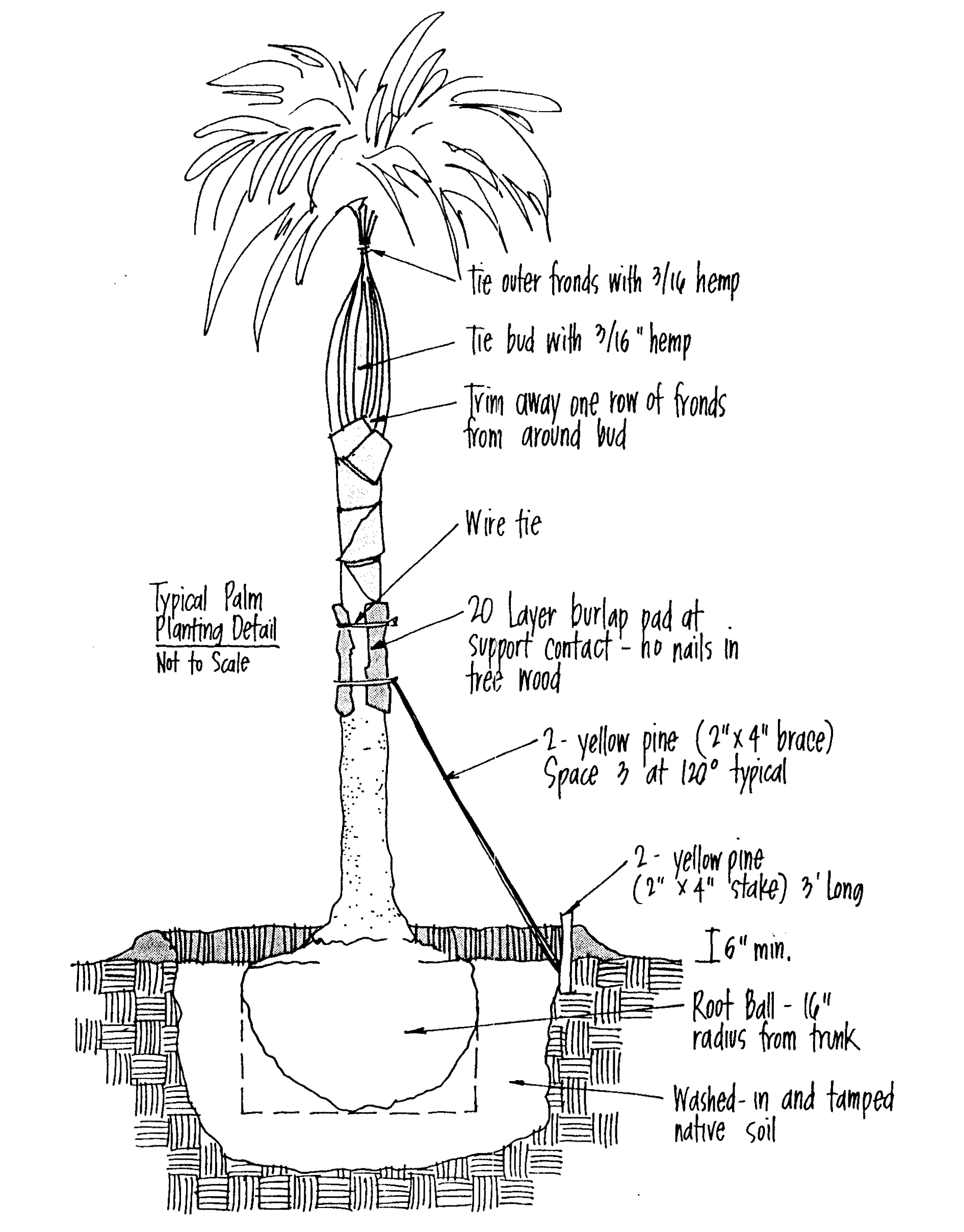
Figure 13:7
Planting and Staking and Guying Details
(d)
Credit for existing vegetation. Existing vegetation may be credited for landscape materials required by this section. Such vegetation shall meet the minimum specifications for new landscape material and be located within the area for which credit is requested. Credit for trees shall only be granted when trees would have been required within a 20-foot radius of any existing shade tree or understory tree, excluding planting requirements for vehicular use areas. No credit shall be granted where existing vegetation does not satisfy screening purposes, serve necessary functions or meet minimum planting standards, as defined in this code.
The city may grant additional credit for existing trees which are defined as specimen trees in this code. Such credit shall generally be given against requirements for additional landscape material within the general vicinity (i.e., parking island) of the specimen tree. This provision shall be reviewed on a case-by-case basis depending on surrounding existing vegetation, and the age, health, type, size and location of the specimen tree. Where credit has been given, the developer shall note on the landscape plan the landscape materials which would have been required if the tree did not exist. If the tree dies, the developer shall be required to install the materials described in the note.
(Ord. No. 1992-29, 11-3-92; Ord. No. 1993-58, 1-18-94; Ord. No. 1995-43, §§ 69—71, 12-19-95; Ord. No. 1996-6, §§ 1—3, 3-19-96; Ord. No. 2018-21, § 1(Exh. A), 9-4-18; Ord. No. 2020-28, § 2, 9-15-20)
Section 7: - Irrigation.
(a)
Irrigation required. Underground automatic irrigation systems are required for all development. New construction which does not require any supplemental landscaping or contain cultivated landscape areas may be exempt from this provision.
(b)
Irrigation system design.
(1)
Landscape demand.
(a)
Irrigation of existing and undisturbed vegetation shall not be required.
(b)
Irrigation of reestablished native vegetative communities shall be required for a minimum of one year after initial installation. Once the landscape materials have been firmly established, the irrigation system may be abandoned.
(c)
Cultivated landscape areas shall be watered with an underground irrigation system designed to provide 100 percent coverage on a day when winds are no more than five miles an hour. Cultivated landscape areas shall include all areas not described in paragraphs (a) and (b) above.
(2)
Required system features.
(a)
All landscape irrigation systems shall be low-volume irrigation systems. A low-volume irrigation system is designed to provide no more than the minimum amount of water required by any specific landscape material to ensure survival of that material. Such a system utilizes a combination of sprinkler mechanisms and zones to accommodate the individual irrigation requirements of each type of landscape material, including trees, shrubs, ornamentals and turf areas.
(b)
All underground irrigation systems shall be regulated by an automatic timer or controller.
(c)
The design of the system shall include sprinkler heads and devices appropriate for the landscape material to be irrigated.
(d)
Low trajectory heads or low-volume water distributing devices shall be used to irrigate confined areas in order to prevent overspray onto impervious areas.
(e)
Irrigation systems shall be designed to place high water demand areas, such as lawns, on separate zones from those areas with reduced water requirements.
(f)
Automatically controlled irrigation systems shall be operated by an irrigation controller that is capable of irrigating high requirement areas on a different schedule from low water requirement areas, provided that separate zones exist as described in subparagraph (e) above.
(g)
Irrigation systems shall be designed so that impervious areas are not watered.
(h)
Moisture sensing devices (i.e., rain check valve) shall be installed to regulate the controller's operation during wet weather.
(i)
Precipitation rates for each zone shall be calculated and noted on the irrigation plans.
(j)
The watering schedule recommended by the landscape architect shall be noted on the irrigation plans.
(3)
Reclaimed water.
(a)
Landscape irrigation systems shall be required to connect to reclaimed water lines if the city has made reclaimed water available to the property and planned for its connection. The use of reclaimed water shall be required.
(b)
Landscape irrigation systems shall be designed for ultimate connection to proposed reclaimed water lines where it is determined that the property is planned for ultimate connection to the reclaimed water system.
(c)
All connections to the city reclaimed water system shall comply with the Standard Construction Details as adopted by resolution by the city council.
(Ord. No. 1992-29, 11-3-92; Ord. No. 1993-58, 1-18-94)
Section 8: - As-builts.
(a)
In general. As-built drawings shall be provided to the city subsequent to landscape installation in accordance with the provisions of this section.
(b)
Landscape plan as-built. One mylar and two copies of the as-built of the landscape plan shall be provided to the city prior to the release or acceptance of any project. Such as-built plan shall be signed and sealed by a landscape architect licensed in the State of Florida, for those landscape plans which were required to have a landscape architect's signature and seal as provided in section 2(e) of this chapter. All other as-builts of landscape plans shall be signed by the person who prepared the as-builts. The landscape as-built shall only indicate the number and general location of landscape materials which have been installed at the site, and not the actual installation superimposed over the planned installation.
(Ord. No. 1995-43, § 72, 12-19-95)
Section 9: - Administrative variance procedure.
Where the department concurs that unique dimensional considerations exist on a specific site which do not reasonably permit installation of all landscape materials required by this chapter, a variance from requirements of this chapter may be approved through the development plan approval process. In such case, the developer shall clearly demonstrate that compliance with requirements of this chapter is not possible, and that there are no alternative locations for the required landscape materials.
The department may also approve modifications or substitutions to the type, quality, size and location of landscape materials required by this chapter, provided such modifications serve to meet the overall intent of this chapter. Such modifications approved by the department shall be clearly noted on the landscape plan. If the department objects to a proposed variance from this chapter, a formal variance procedure shall be required in accordance with chapter 19 of this code.
(Ord. No. 1991-20, 8-27-91)
Section 10: - Maintenance.
Maintenance or replacement of landscape materials, irrigation systems or other improvements required by this chapter shall be in accordance with commercial property maintenance standards, Code of Ordinances.
(Ord. No. 1991-20, 8-27-91)

