
Port Orange City Zoning Code
CHAPTER 16
MISCELLANEOUS REGULATIONS
Section 1: - Accessory uses and structures.
(a)
In general. Specific accessory uses and structures shall comply with the following regulations.
(b)
Principal use and/or principal structure required. Accessory uses and structures shall:
(1)
Be customarily incidental to the principal use established on the same lot;
(2)
Be subordinate to and serve such principal use;
(3)
Be subordinate in area, extent and purpose to such principal use; and
(4)
Contribute to the comfort, convenience or necessity of users of such principal use.
No accessory structure or use shall be permitted on any lot which does not have an established principal use conforming to the requirements of this code. No accessory structure shall be permitted on any lot which does not have a permitted principal structure.
(c)
General provisions.
(1)
Outdoor storage shall be prohibited, except as specifically permitted herein.
(2)
Signs, fences, walls, parking and loading areas, and other such features which are typically located within required yard areas shall comply with the applicable provisions of this code for such uses and structures.
(3)
Any specific accessory use which is not addressed within this chapter shall not be located on any lot. If any accessory structure is not specifically addressed within this chapter, the administrative official or their designee shall use the setback applicable to the most clearly comparable accessory structure.
(d)
Size limitations. Any residential accessory structure in a residential zoning district shall be required to comply with the following conditions:
(1)
The size of the accessory residential structure shall not cause the building coverage on the lot to exceed the maximum building coverage established for the zoning district;
(2)
In the event that this code does not establish a maximum building coverage for a zoning district, the maximum building coverage shall based on the most similar zoning district, as determined by the administrative official;
(3)
The accessory residential structure shall not be located within any required yard, unless otherwise permitted by this chapter. Additionally, no accessory residential structure shall be permitted in the front yard, unless specifically permitted by this code;
(4)
No accessory residential structure shall be used as a guest house, apartment, or other residential quarters, unless otherwise permitted by this code; and
(5)
No accessory residential structure shall be used in any manner for a home occupation, except for the storage of customary homeowner tools and equipment.
(e)
Outside storage. Outside storage of new and used equipment and materials shall be regulated as follows.
(1)
Residential uses.
(a)
Outside storage of materials and equipment shall be restricted to the rear or side yard area and screened by an opaque fence or hedge so that such materials and equipment are not visible from any public right-of-way or adjoining lot.
(b)
Unlicensed/unregistered, disabled, abandoned, or inoperable motor vehicles shall not be stored outside. Unlicensed/unregistered, disabled, abandoned or inoperable recreational vehicles or equipment (as defined in section 70-48 of this Code of Ordinances) shall not be stored outside unless awaiting repair and stored pursuant to section 70-48(h). This prohibition shall not apply to licensed/registered and operable motor vehicles, recreational vehicles and equipment and other such vehicles, which are merely being parked on-site. However, such vehicles shall be subject to other provisions of this code, such as those relating to driveways, which may regulate or restrict their location on site.
(c)
Unless otherwise stated, temporary storage containers (e.g. PODS) shall be restricted to the driveway for a period not to exceed 72 hours in any continuous 30-day period. However, if said container is placed as permitted and is related to an improvement that has been issued a building permit, said container will be permitted for the duration of the building permit and shall be removed prior to the city's issuance of a certificate of occupancy or completion.
(2)
Office uses. Outside storage of equipment or materials shall not be permitted for office uses.
(3)
Commercial uses. Outside storage of equipment and materials shall be permitted only when associated with a commercial use and located in designated areas approved for such display as part of a development plan, or as part of a building permit, if the required right-of-way landscape buffer is provided. Additional restrictions are specified below.
(a)
Storage of licensed and operable motor vehicles, boats, recreational vehicles, tractor trailers, storage trailers and other such vehicles shall be located out of view from any abutting rights-of-way, private streets, waterways and residential uses.
(b)
Outdoor display and/or storage may be permitted in conjunction with special sales events such as those permitted under chapter 58, article III, Code of Ordinances, and other uses when permitted by special exception or approved as part of a development plan.
(c)
Licensed and inoperable motor vehicles awaiting repair may be stored within screened areas on the site of motor vehicle repair facilities and motor vehicle service centers, provided that no such vehicle shall be stored for more than 28 consecutive days.
(4)
Industrial uses. Outside storage of equipment or materials shall be permitted for industrial uses, when in compliance with the following requirements.
(a)
All storage areas shall be enclosed by an opaque wall, fence or landscaping of sufficient maturity, density and height to screen such areas from any public right-of-way or adjoining property.
(b)
All equipment or materials shall be secured, if necessary, to withstand winds.
(c)
Screening shall not be required around storage areas for operable motor vehicles and landscape materials.
(d)
No licensed and inoperable motor vehicles shall be stored for a period exceeding 28 consecutive days within screened areas on the site of motor vehicle repair facilities and motor vehicle service centers.
(f)
Atypical lots. The atypical lot requirements are intended to preserve and protect views to significant natural and human-made features within the city. These features include, but are not limited to the Halifax River, bodies of water 100 feet or more in width, golf courses and subdivision dedicated common open spaces that are a body of water 100 feet or more in width. The atypical lot provisions are not intended to apply to subdivision common areas that are utility or gas easements, or that function as buffers between adjacent roadways or neighboring subdivisions.
The administrative official shall have the authority to determine whether the atypical lot provisions are being applied as intended in situations where utility easements are greater than 100 feet in width, or in situations where the common area width varies. However, in these situations, if the administrative official determines the subject property shall be defined as the atypical lot, the atypical lot provisions shall be enforced, unless a formal variance is obtained in accordance with chapter 19 of this code.
Section 3(b)(2) and section 5(b) of this chapter lists the structures that are prohibited from being located within the required rear yard of an atypical lot.
(Ord. No. 1993-58, 1-18-94; Ord. No. 1995-43, § 77, 12-19-95; Ord. No. 1999-6, § 35, 2-23-99; Ord. No. 2001-84, § 2, 10-16-01; Ord. No. 2018-21, § 1(Exh. A), 9-4-18; Ord. No. 2020-31, § 1, 10-6-20; Ord. No. 2020-32, § 1, 10-6-20; Ord. No. 2021-15, § 3, 7-20-21; Ord. No. 2025-17, § 1, 8-5-25)
Section 2: - Home-based businesses.
(a)
A home-based business that operates from a residential property may operate in an area zoned for residential use in compliance with this section and F.S. § 559.955, as amended. A business is considered a home-based business if it operates, in whole or in part, from a residential property. All home-based businesses shall comply with the following criteria as conditions of a home-based business local business tax receipt:
(1)
The employees of the business who work at the residential dwelling must also reside in the residential dwelling, except that up to a total of two employees or independent contractors who do not reside at the residential dwelling may work at the business. The business may have additional remote employees that do not work at the residential dwelling.
(2)
Parking related to the business activities of the home-based business complies with local zoning requirements, and the need for parking generated by the business may not be greater in volume than would normally be expected at a similar residence where no business is conducted.
(3)
The parking of commercial vehicles and trailers related to home-based businesses shall be regulated in the same manner as any other commercial vehicle or trailer parked or stored on residential property, and shall not be parked:
(a)
Within the right-of-way;
(b)
On or over a sidewalk; or,
(c)
On any unimproved surfaces.
(4)
Outside storage of materials and equipment shall comply with chapter 16, section 1(e)(1)(a). Heavy equipment, as defined in F.S. § 559.955, shall be restricted to the rear or side yard area and screened by an opaque fence or hedge so that such heavy equipment is not visible from any public right-of-way or adjoining lot.
(5)
As viewed from the street, the use of the residential property must be visually consistent with the uses of the residential areas that surround the property. External modifications made to a residential dwelling to accommodate a business must conform to the residential character and architectural aesthetics of the neighborhood.
(6)
The home-based business may not conduct retail transactions at a structure other than the residential dwelling; however, incidental business uses and activities may be conducted at the residential property.
(7)
The activities of the home-based business are secondary to the property's use as a residential dwelling.
(8)
The home-based business activities comply with any relevant local or state regulations with respect to signage and equipment or processes that create noise, vibration, heat, smoke, dust, glare, fumes, or noxious odors. Any local regulations on a home-based business with respect to noise, vibration, heat, smoke, dust, glare, fumes, or noxious odors may not be more stringent than those that apply to a residence where no home-based business is conducted.
(9)
All home-based business activities comply with any relevant local, state, and federal regulations with respect to the use, storage, or disposal of any corrosive, combustible, or other hazardous or flammable materials or liquids. Any local regulations on a home-based business with respect to the use, storage, or disposal of any corrosive, combustible, or other hazardous or flammable materials or liquids may not be more stringent than those that apply to a residence where no home-based business is conducted.
(10)
The application of this section does not supersede local laws, ordinances, or regulations related to transient public lodging establishments, as defined in Florida Statutes, that are not otherwise preempted under Florida Statutes.
(11)
Home-based businesses shall be subject to all other applicable ordinances and regulations.
(12)
Any business that does not meet the definition of a home-based business in F.S. § 559.955, is not considered a home-based business, and is not permitted to operate in a residential zoning district.
(Ord. No. 2025-17, § 1, 8-5-25)
Editor's note— Ord. No. 2025-17, § 1, adopted Aug. 5, 2025, amended § 2 in its entirety, in effect repealing and reenacting said § 2 to read as set out herein. The former § 2 pertained to home occupations and derived from Ord. No. 1993-58, adopted Jan. 18, 1994; Ord. No. 2003-6, §§ 2—5, adopted April 22, 2003; Ord. No. 2015-34, § 3, adopted Oct. 6, 2015; Ord. No. 2017-16, § 3, adopted May 16, 2017; Ord. No. 2017-28, § 2, adopted Sept. 19, 2017; Ord. No. 2018-21, § 1(Exh. A), adopted Sept. 4, 2018.
Section 3: - Fences and walls.
(a)
In general. All fences and walls shall be constructed in compliance with applicable building codes and in accordance with the following dimensional and use regulations.
(b)
General provisions.
(1)
Restrictions.
(a)
No barbed wire, razor wire or similar material shall be allowed for residential uses.
(b)
Barbed wire, razor wire, or similar material shall be prohibited for commercial and industrial uses, except when installed at an eight-foot height or greater.
(c)
Temporary construction fencing.
(1)
Temporary construction fencing shall be allowed for sites in all zoning districts that have been issued a development order by the city.
(2)
The city shall require the installation of a temporary construction fence in areas where construction activities create impacts to adjoining properties and rights-of-way such as debris, glare, and noise, which cannot otherwise be mitigated.
(3)
A building permit shall be obtained prior to the erection of the temporary construction fence.
(4)
The fence shall be constructed according to the adopted standard construction detail for a temporary construction fence. Approved fence materials shall include opaque privacy fencing or other semipermanent materials deemed appropriate by the administrative official.
(5)
If the fence or gate is not properly maintained in an upright position with all fabric materials fully attached, or the fence or gates are not in working order, a stop work order shall be issued for the construction site until the fence is determined to be in proper working order as originally permitted.
(6)
The temporary construction fence is intended to remain no longer than necessary to mitigate the conflict with other construction infrastructure for the project. Before a certificate of occupancy is issued, the temporary construction fence shall be removed and replaced with the permanent fence and/or wall as required by chapter 13, section 3.5 of this Code.
(7)
In the event that the property remains cleared and vacant for a period of one year after the issuance of a development order or a development permit, whichever is in force at the time, the temporary construction fence shall be removed. If vegetation has not been established by the expiration date, the property must be seeded and mulched, or sodded, and vegetation established prior to the removal of the fence. The removal of the fence and established of vegetation shall be required prior to approval of any requested development order or development permit extension.
(8)
If the city in its discretion deems it necessary, the city may upon notice to the property owner, install or remove a temporary construction fence to comply with the requirements of this code at the expense of the property owner. The expense shall be recorded as a lien against the property in noncompliance and the lien shall have such priority as prescribed by ordinance.
(9)
A temporary construction fence shall in no way relieve the property owner from performing other construction-related activities that are required by this code or requirements from other jurisdictional agencies.
(2)
Height.
(a)
For individual single-family and two-family residential lots, no permanent fence or wall shall exceed six feet in height in rear or side yards, except as provided in subparagraph (e) below. In addition, fences and walls shall not exceed four feet in height when erected on an atypical lot within the required rear yard setback, except as provided in subsection (h) below.
(b)
For individual single-family and two-family residential lots, no permanent fence or wall shall exceed four feet in height in required front yards abutting rights-of-way, except as provided in subsections (e), (f) and (g) below.
(c)
For nonresidential uses, no permanent fence or wall shall exceed ten feet in height unless approved as part of a development plan to meet the buffering requirements between different types of uses, per chapter 13, section 3.5.
(d)
No permanent fence or wall located adjacent to any public right-of-way and designed to be an integral part of a new or existing subdivision improvement, including but not limited to subdivision entrances and subdivision walls, shall exceed 12 feet in height, including columns.
(e)
For residential uses adjacent to Interstate 95 right-of-way, no permanent fence or wall shall exceed 12 feet in height adjacent to any property line abutting such right-of-way.
(f)
For individual single-family and two-family residential corner lots with a secondary front lot line abutting a local street, a six-foot-tall privacy fence may be placed up to the front plane of the house. For corner lots with a secondary front lot line abutting an arterial or collector road, the six-foot-tall fence may further encroach into the required front yard to within five feet of the secondary front lot line. Fence placement per this subsection shall also be allowed on legal nonconforming lots, provided visual clearance requirements of section 6 of this chapter can still be met. Please see Figure 16:A below.
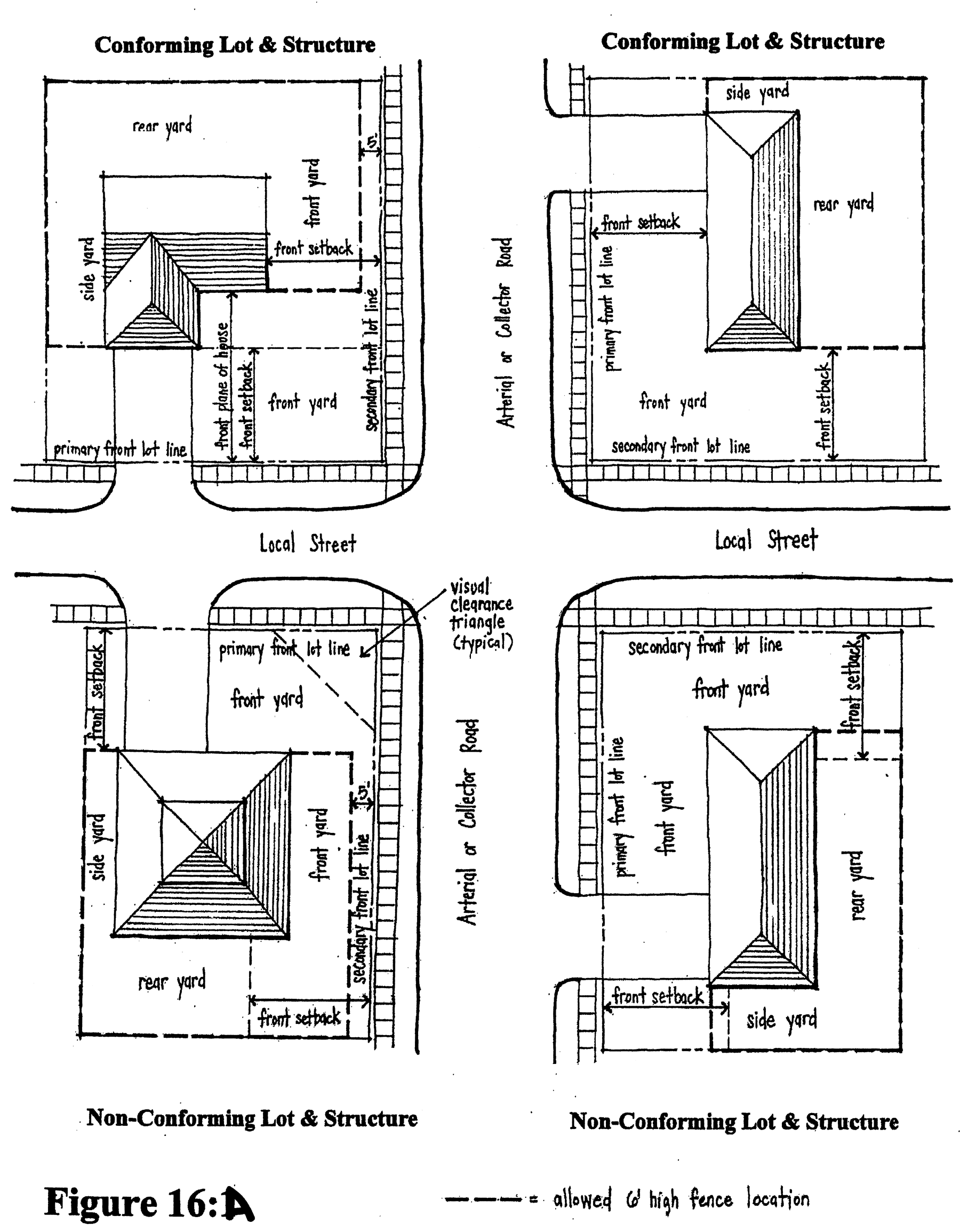
Figure 16:A
(g)
For individual single-family and two-family residential through lots with a rear lot line abutting the right-of-way line of a local street or arterial or collector road, a privacy fence not to exceed six feet in height may be placed on the rear lot line.
(h)
On atypical lots, chain link fences and other non-privacy fences (e.g. clear glass or plastic and metal/aluminum picket fences) that are not opaque, but function similarly to a chain link fence in that they do not obstruct the view of the common area may not exceed six feet in height when erected within the required rear yard.
(i)
Where a fence or wall transitions from a higher to a lower height, the transition must be complete at or before the point where the lower height must begin. For example, where a six-foot-tall fence transitions to a four-foot-tall fence, the transition from higher to lower must be completed where the four-foot height limitation begins, such that no portion of the fence exceeds the height limitation.
(3)
Location.
(a)
No permanent fence or wall shall be located closer than five feet to any right-of-way line, unless otherwise permitted in this chapter.
(b)
No permanent fence or wall shall be located within areas required to provide clearance for visibility in accordance with this chapter.
(4)
Design and maintenance.
(a)
All fences and walls shall be designed to comply with the architectural and landscaping requirements of this code when applicable.
(b)
All fences shall be maintained in their original upright condition.
(c)
Fences and walls designed for painting or similar surface finishes shall be maintained in their original condition as designed.
(d)
Missing boards, pickets, or posts shall be replaced in a timely manner with material of the same type and quality.
(e)
Fences or walls having a side with exposed or irregular structural components and a more finished, uniform and aesthetically attractive side shall be constructed so that the more finished, uniform and aesthetically attractive side faces outward from the fenced property toward the adjoining property. This requirement shall not be construed as to require post components of fences to be invisible from the adjoining property. This requirement may be waived by the administrative official upon approval of a written agreement between the two adjoining property owners.
(f)
The side of a fence or wall oriented to an adjoining property shall not create an adverse visual impact on such adjoining property.
(5)
Exemptions.
(a)
Customary fencing around tennis courts and other approved recreational amenities shall be exempt from height restrictions.
(b)
Reserved.
(Ord. No. 1991-20, 8-27-91; Ord. No. 1993-58, 1-18-94; Ord. No. 1996-33, § 9, 11-19-96; Ord. No. 1998-51, § 2, 8-18-98; Ord. No. 1999-47, § 1, 11-16-99; Ord. No. 2001-84, §§ 2, 3, 10-16-01; Ord. No. 2005-55, § 3, 1-17-06; Ord. No. 2009-23, § 2, 11-10-09; Ord. No. 2015-14, § 1, 4-21-15; Ord. No. 2020-31, § 2, 10-6-20)
Section 4: - Height.
(a)
In general. Unless otherwise described in this section, the maximum permitted height for any structure shall be as outlined in the schedule of district regulations.
(b)
Established height for specific structures.
(c)
Additional height for architectural appurtenances and other structures.
* Only permitted on buildings when buildings are 45 feet or greater in height.
(Ord. No. 1991-20, 8-27-91; Ord. No. 1992-29, 11-3-92; Ord. No. 1997-23, § 3, 4-29-97; Ord. No. 1999-10, § 2, 3-16-99; Ord. No. 2010-3, § 2, 3-16-10; Ord. No. 2019-5, § 5, 2-5-19)
Section 5: - Special setbacks.
(a)
In general. This section provides for specific accessory structures and architectural appurtenances and features to be located within required building setback areas. Recorded easements and required landscaped buffers shall supersede the minimum dimensions permitted by this section.
(b)
Special setbacks.
NOTES:
(1)
In no case shall the special setback exceed 50 percent of the minimum yard dimension.
(2)
Location within required yards permitted in rear and side yards only.
(3)
Setback shall be measured from the leading vertical edge of the structure. Where the structure is movable, creating an adjustable vertical edge, the setback dimension shall be measured from the greatest possible vertical edge.
(4)
Structures elevated and attached to the top of aboveground pools shall be set back in accordance with the special setback provisions established for decks in this section.
(5)
Location within required yards permitted in rear yards only. Structures may be allowed in side yards provided they are screened from public view by an opaque fence.
(6)
Location within the side corner yard is allowed, provided that the deck is screened by an opaque fence.
(7)
Location within the required rear yard is prohibited on an atypical lot if structure is greater than four feet in height.
(8)
Structure shall be screened from rights-of-way and adjacent properties using architectural features, opaque fencing or walls, consistent with the surrounding primary structures, or landscaping of sufficient density and maturity at planting to provide opaque screening. For generators and LP fuel storage tanks, there shall be a three-foot clearance area in front of the service panel, if applicable, for maintenance. For rain barrels, screening shall not be required if the structure is decorative in nature, or if its color is light or dark brown, dark green, or black, or painted light or dark brown, dark green, black, or consistent with that of the primary structure.
(Ord. No. 1991-20, 8-27-91; Ord. No. 1992-29, 11-3-92; Ord. No. 1994-32, § 11, 11-1-94; Ord. No. 1995-43, § 78, 12-19-95; Ord. No. 1998-51, § 3, 8-18-98; Ord. No. 1999-47, § 2, 11-16-99; Ord. No. 2001-84, § 4, 10-16-01; Ord. No. 2007-20, § 1, 6-5-07; Ord. No. 2009-12, § 4, 7-28-09; Ord. No. 2011-27, § 11, 10-25-11; Ord. No. 2019-5, § 6, 2-5-19; Ord. No. 2020-31, § 2, 10-6-20; Ord. No. 2025-24, § 1, 9-2-25)
Section 6: - Visual clearance.
(a)
In general. The following areas shall be designed and maintained to allow visibility between three feet and eight feet above grade. Tree trunks trimmed of foliage to eight feet, and newly planted landscape material with immature crown development shall be exempt.
(1)
At the intersection of two public rights-of-way, a triangle described by the intersection of the right-of-way lines extended, and a line joining points on those lines 25 feet from said intersection.
Figure 16:1 Visual Clearance Zones—Intersections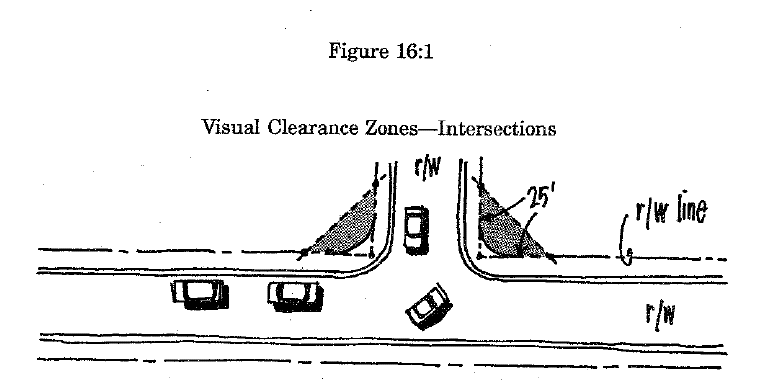
(2)
At the intersection of a private driveway and a public right-of-way, a triangle described by the intersection of the edge of the driveway and the right-of-way line, and a line joining points on those lines ten feet from said intersection.
Figure 16:1 Visual Clearance Zones—Private Driveways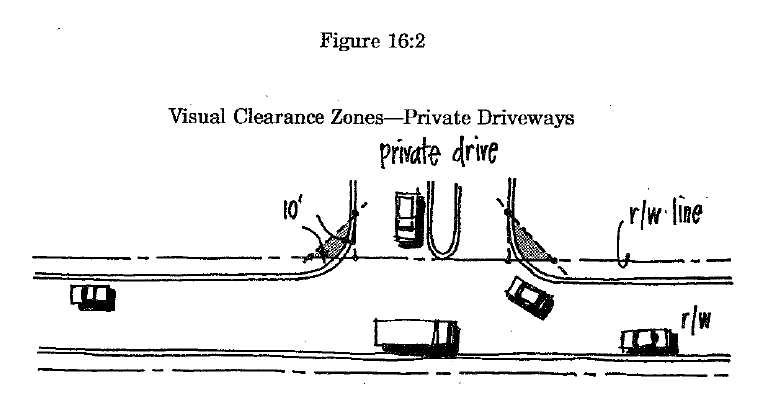
(3)
In the area along all public rights-of-way measured five feet perpendicular from said right-of-way.
Figure 16:3 Visual Clearance Zones—along Public Rights-of-Way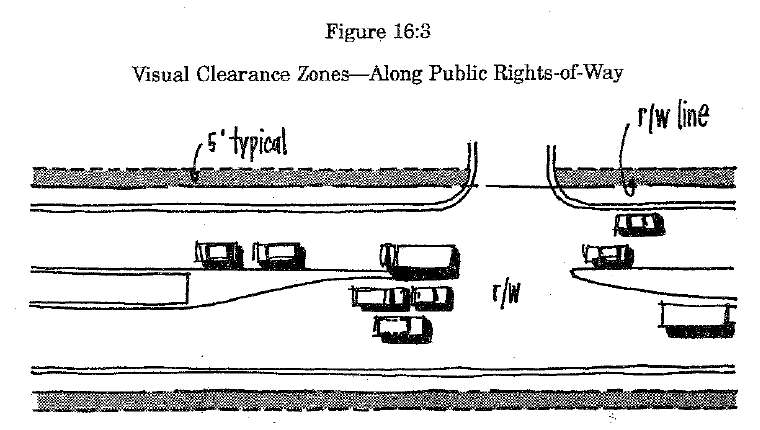
(4)
In the area along all access driveways measured three feet perpendicular to the edge of the drive.
Figure 16:4 Visual Clearance Zones—Along Access Driveways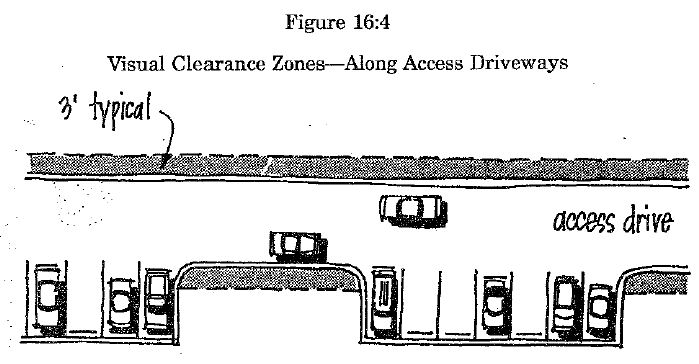
(5)
In all cases, minimum sight distances necessary to satisfy the requirements of the Manual of Uniform Traffic Control Devices (MUTCD) and FDOT Manual of Uniform Standards for Design, Construction and Maintenance For Streets and Highways shall be maintained. Additional clear zone areas may be required based on the specific geometry of a particular location.
Section 7: - Renewable energy systems.
(a)
Purpose and intent. This section is intended to:
(1)
Promote the use and development of renewable energy to increase energy self-sufficiency, and reduce pollution and greenhouse gas emissions;
(2)
Accommodate the growing use and desire for renewable energy systems, as established by state law, including, but not limited to, F.S. § 163.04 regarding energy devices based on renewable resources;
(3)
Make efficient use of existing structures by allowing renewable energy systems to be co-located;
(4)
Minimize any adverse impacts associated with renewable energy systems; and
(5)
Establish requirements which will allow the city to act upon a request to install or modify a renewable energy system.
(b)
Small wind energy systems.
(1)
Permitted use. Small wind energy systems shall be a permitted accessory use in all zoning classifications, subject to the requirements set forth below:
(c)
Solar collectors.
(1)
Permitted use. Solar collectors shall be a permitted accessory use in all zoning classifications, subject to the requirements set forth below:
(Ord. No. 2010-3, § 3, 3-16-10; Ord. No. 2021-13, § 3, 10-19-21)
Section 8: - Administrative variance procedure.
(a)
In general. The department may grant administrative variances from the height and setback requirements of this chapter when deemed appropriate by the administrative official.
(b)
Application for administrative variances. Application for administrative variance from the dimensional requirements of this chapter shall be made on the appropriate forms provided by the department for that purpose, and shall be accompanied by the appropriate review fee.
(c)
Review criteria. When reviewing any variance request, the administrative official shall consider the following:
(1)
The extent of the variance requested. In no case shall an administrative variance be granted when such variance exceeds ten percent of the required dimension. In such case, the applicant shall be required to make application in accordance with the variance procedure established in chapter 19.
(2)
The review criteria for all other variances described in paragraph 1(g)(2) of chapter 19 of this code.
(Ord. No. 1993-58, 1-18-94)
Section 9: - Wireless communications facilities siting.
(a)
Purpose. The purpose of this section is to establish regulations and requirements for the siting of wireless telecommunications facilities. All new towers or antennas in the city shall be subject to these regulations, except where specifically excluded. The section is intended to accomplish the following:
(1)
Protect and promote the public health, safety and general welfare of the residents of the city;
(2)
Accommodate the growing need and demand for reliable wireless communications services by permitting the siting of wireless communication towers and antennas within the city's boundaries and provide reasonable accommodation to promote and to encourage innovations in technology and fair and reasonable competition among telecommunications service providers or providers of functionally equivalent services on a neutral and nondiscriminatory basis;
(3)
Minimize potential impacts of towers upon residential areas and land uses;
(4)
Encourage and promote the location of towers in nonresidential areas, where the adverse impact on the community is minimal;
(5)
Minimize the total number of towers throughout the community by strongly encouraging the co-location of antennas on new and pre-existing tower sites as a primary option rather than construction of additional single-use towers;
(6)
Encourage and promote users of telecommunication towers and antennas to configure them in a way that minimizes the adverse visual impact of the communication towers and antennas through careful design, siting, landscape screening, and innovative camouflaging techniques;
(7)
Minimize potential damage to property from wireless communication towers and telecommunications facilities by requiring such structures be soundly designed, constructed, modified and maintained and in compliance with all requirements of the Florida Building Code applicable to similar structures;
(8)
Enhance the ability of the providers of wireless telecommunications services to provide such services to the community through an efficient and timely application process;
(9)
Encourage the location and co-location of antennas on existing structures thereby minimizing new visual impacts and reducing the need for additional antenna support structures;
(10)
Further the balance between predictability for the communications industry in the placement of wireless telecommunications facilities and appropriate land use regulations to protect the aesthetic integrity and public safety of the city's residents, visitors and businesses;
(11)
Establish appropriate zoning requirements, including, but not limited to, setback and distance separation requirements, aesthetics, landscaping, land use based location priorities, and structural design for wireless communication towers and antennas within the city's boundaries, with due consideration to the city's comprehensive plan, zoning map, existing land uses and environmentally sensitive areas, including hurricane preparedness areas;
(12)
Establish setback and distance separation requirements for towers that do not exceed the minimum distance necessary to satisfy structural safety or aesthetic concerns;
(13)
Adopt regulations that are consistent with applicable federal and state laws, including, but not limited to, the Telecommunications Act of 1996, which as set forth in 47 U.S.C. § 332(c)(7)(B)(iv), expressly preempts, state and local government regulation of the placement, construction, and modification of personal wireless service facilities on the basis of the environmental effects of radio frequency emissions to the extent that such facilities comply with the FCC's regulations concerning such emissions, and F.S. § 365.172(13);
(14)
Establish procedural requirements and substantive criteria applicable for the review and approval or denial of applications for eligible facilities modification;
(15)
Ensure that application submittal requirements for eligible facilities modifications are related to information reasonably necessary to the determination of whether or not the proposed modification will result in a substantial change in the physical dimensions of the eligible structure;
(16)
Exempt facilities modifications approved under this section as eligible facilities requests from zoning and development regulations that are inconsistent with Section 6409 of the Spectrum Act, Middle Class Tax Relief and Job Creation Act ("Spectrum Act") (PL-122-96; codified at 47 U.S.C. § 1455(a)) and FCC orders promulgated thereto, codified at 47 C.F.R. §1.40001;
(17)
Confirm that this ordinance shall not apply to wireless communications facilities or applications for wireless facilities in the public rights-of-way. Such facilities and applications shall be governed by the Port Orange Communications Rights-of-Way Ordinance;
(18)
Confirm that this ordinance will not govern any communication tower or the installation of any antenna that is for the use of a broadcasting facility or is used exclusively for receiving only antennas;
(19)
Confirm that communications facilities owned by the city shall not be subject to this ordinance, except as specifically referred to herein to the extent not inconsistent with applicable law;
(20)
Establish specific regulations for Federal Communications Commission (FCC) licensed amateur radio; and
(21)
Preserve the city's right to continue to enforce and condition approvals pursuant to this section on compliance with generally applicable building, structural, electrical, and safety codes and with other laws codifying objective standards reasonably related to health, safety and welfare.
In furtherance of these goals, the city will at all times give due consideration to the city's comprehensive plan, zoning maps, existing land uses, and environmentally sensitive areas, including hurricane preparedness areas, in approving sites for the location of towers and antennas.
(b)
General siting provisions.
(1)
Hierarchy of siting alternatives. Placement of new antennas, communication towers, and communications facilities shall be in accordance with the following siting alternatives hierarchy. The order of ranking is from highest (b)(2)a. to lowest (b)(3)h. Where a lower ranked alternative is proposed, the applicant must demonstrate in its application that higher ranked options are not available. The availability of a less expensive lease on a lower ranked site is not sufficient in and of itself to justify using the lower ranked alternative where a higher ranked alterative is otherwise available.
(2)
Co-location preference. Consistent with federal and state law, the city hereby establishes a preference for co-location of antennas on existing communication towers and structures, as opposed to constructing a new communication tower. The preference for co-location shall have a secondary priority as follows with the higher preference listed in (b)(2)a., followed by (b)(2)b., through (b)(2)d., the lowest ranked preference.
a.
Co-location of camouflage antenna(s) on an existing camouflaged communication tower in any zoning district, for example, additional antennas within a camouflaged communication tower designed as a flagpole, co-location of antenna(s) on a communication tower on property used for a municipal purpose including, but not limited to, parks, public service and city maintenance yards, police and fire stations, city hall, community centers and similar city properties (hereinafter "municipal use property"), or antennas attached to a structure on municipal use property.
b.
Co-location of antennas on existing non-camouflaged communication tower on municipal use property.
c.
Co-location of antennas on an existing non-camouflaged communication tower on private property or attached camouflage antennas on a structure on private property.
d.
Attached non-camouflage antennas to an existing structure on private property.
(3)
New communication towers. If co-location or attachment of antennas as listed above is not possible as demonstrated through the factors listed below, an applicant may propose a new communication tower. The priority rankings for a new communication tower are set forth below from (b)(3)a. highest to (b)(3)h. lowest.
a.
Camouflaged communication tower on municipal use property.
b.
Non-camouflaged communication tower on municipal use property.
c.
Camouflaged communication tower on light industrial and commercial industrial zoning district private property.
d.
Non-camouflaged communication tower on light industrial and commercial industrial zoning district private property in the following preferred order: monopole, guyed and lattice.
e.
Camouflaged communication tower in other zoning districts on private or other governmental property other than residential.
f.
Non-camouflaged communication tower in the following preferred order monopole, guyed and lattice, in other zoning districts on private or other governmental property other than residential.
g.
New communication towers are not permitted in a residential zoning district. If an applicant seeks to locate a communication tower in a residential zoning district, the applicant may apply to the city, with payment of the appropriate fee, for the city to cooperate in determining an appropriate site. Such application for cooperation, however, shall not be subject to the timeframes for action on an application as otherwise provided in this ordinance.
h.
New communication towers are not permitted in the following zoning districts without a variance approved by the city council pursuant to chapter 16, section 9(d)(10), following a recommendation of the planning commission:
1.
The Port Orange Town Center Riverwalk District Community Redevelopment Agency;
2.
The PC-A Zoning District (West Town Center, Neighborhood and Community Districts);
3.
Floodplain Conservation (F-C) District;
4.
Agricultural (A) District; and
5.
A residential zoning district.
(c)
Regulations for communications facilities.
(1)
Lease required for city property.
a.
Any new construction, installation or placement of a communications facility on any property owned, leased, and/or controlled by the city including municipal use property shall require a lease agreement executed by the city and the owner of the facility. The city may refuse to enter into a lease for communications facilities on municipal use property in its sole discretion. Notwithstanding any provision in the city code to the contrary, subject to applicable state and federal law, communication towers shall not be allowed in the public rights-of-way controlled by the city. The city cannot and hereby expressly does not waive or relinquish any of its land use, regulatory, permitting and police power authority, approval or enforcement rights and obligations, as they may relate to government regulations of general applicability which may govern property subject to a lease or sublease with the city, any improvements thereon, or any operations on the property. Wireless communications facilities shall not interfere with any facilities of the city or governmental entity used to provide essential services. Nothing in any lease or sublease with the city shall be deemed to create an affirmative duty of the city to abrogate its right to exercise its police power and governmental powers by approving or disapproving or taking any other action in accordance with its zoning and land use codes, administrative codes, ordinances, rules and regulations, federal laws and regulations, state laws and regulations and grant agreements, as they may be amended.
b.
The city may require, as a condition of entering into a lease agreement with a communications service provider, the dedication of space on the facility for public health and safety purposes or to provide essential services, as well as property improvements on the leased space. Any dedications and improvements shall be negotiated prior to execution of the lease.
c.
No lease granted under this section shall convey any right, title, or interest in the public lands other than a leasehold interest, but shall be deemed only to allow the use of the public lands for the limited purpose and term stated in the lease agreement. No lease granted under this section shall be construed as a conveyance of a fee title interest in the property.
(2)
A proposed communication tower must include the attachment of a wireless communications facility such as antennas to be used for the provision of wireless communications services. A proposed communication tower that does not include wireless communications facilities to be used for the provision of wireless communications service or an executed lease or license for the co-location or attachment of antenna within a reasonable period of time after construction of the tower shall not be approved in any zoning district.
(3)
Subject to the siting priorities above, new communication towers may be located as a permitted use on municipal use property and in the light industrial and commercial industrial districts. A new communication tower in all other districts shall require a variance pursuant to the requirements of this chapter 16, section 9(d)(10).
*
Includes: A, AP, RR, RMH, R-2D, R-7SF, R-8SF, R-10SF, R-20SF, R-3L, R-3M, R-3H, NP,
PUD, and PC-A (West Town Center, Neighborhood and Community Districts).
— = Not allowed
PU = Permitted Use
(4)
Satisfaction of priority siting requirements. If an applicant is proposing new communications antennas on a communication tower other than the highest ranked priority or a new communication tower as opposed to co-location or attachment on an existing structure, the applicant shall demonstrate the lack of availability of a higher priority. No new communication tower shall be approved unless the applicant demonstrates to the reasonable satisfaction of the city that no pre-existing tower, structure or economically or technically feasible alternative technology that does not require the use of new communication tower or new structures can accommodate, or be modified to accommodate, the applicant's proposed antenna. Evidence submitted to demonstrate that no higher ranked alternative for a proposed antenna or that a pre-existing communication tower, structure or alternative technology is not available shall consist of any of the following:
a.
An affidavit demonstrating that the applicant made diligent efforts but was unable to obtain permission to install or collocate the applicant's antenna within as applicable, the search area or a one-mile radius of the proposed communication tower site.
b.
An affidavit demonstrating that the applicant made diligent efforts to install or co-locate the applicant's antenna on pre-existing towers or useable antenna support structures on municipal use property or owned by other persons located within as applicable, the search area or a one-mile radius of the proposed communication tower site, but was unable to obtain permission.
c.
Pre-existing towers or structures do not have sufficient structural strength and cannot reasonably be modified to support applicant's proposed antenna and related equipment as demonstrated by supporting plans and calculations by a licensed engineer experienced in the design of wireless communications facilities.
d.
The applicant's proposed antenna would cause interference with the antenna on the pre-existing towers or structures, or the antenna on the pre-existing towers or structures would cause interference with the applicant's proposed antenna and such interference cannot reasonably be eliminated as demonstrated by a licensed engineer.
e.
The fees, costs, or contractual provisions required by the owner to share an existing tower or structure or to adapt an existing tower or structure for co-location or attachment are unreasonable. Costs exceeding new tower development are presumed to be unreasonable.
f.
The applicant demonstrates with support from a licensed engineer that no pre-existing tower or structure located within the search area has the capacity to provide reasonable technical service, is of sufficient height to meet applicable requirements, or there are other limiting factors that render pre-existing towers or structures unsuitable.
g.
The applicant demonstrates that alternative technology used in the wireless communications industry and within the scope of applicant's FCC license, is economically or technically not feasible.
h.
Other factors which demonstrate the reasonable need for a new communication tower or for an antenna on a lower ranked priority.
(5)
Communication towers may be located on the same property as another use. A different existing use on the same lot or parcel that is proposed to have a communication tower located on it shall not preclude the installation of that communication tower if the other requirements of this section can be met.
(6)
Communication tower cell sites shall not be required to comply with minimum living area, minimum lot area, minimum lot width, maximum building coverage, or minimum open space requirements, when such cell sites constitute a specified area within a lot or parcel.
(7)
Principal use. Every cell site shall be deemed to be a principal use of the parcel or lot which constitutes the cell site or on which the cell site is located. An existing principal use and/or an existing structure on a lot or parcel shall not preclude a specified area within that lot or parcel from being utilized as a cell site as provided herein. For purposes of determining whether a cell site complies with the regulations of the applicable zoning district, including, but not limited to, setback, lot coverage and other such requirements, the dimensions of the entire lot or parcel shall control, even if the cell site is located on a specified area within such lot or parcel.
(8)
Setbacks. The following setback requirements shall apply to all communication towers in addition to the separation requirements in this chapter 16, section 9. In establishing these setback requirements, the city council finds that such setbacks are the minimum distance necessary to satisfy structural safety and aesthetic concerns for owners of adjacent properties, residents, and users of nearby public rights-of-way. Such setbacks shall be measured from the base of said communication towers. Setback standards shall be calculated and applied to communication tower facilities located in the city irrespective of municipal and county jurisdictional boundaries.
a.
All communication towers shall be setback from all property lines of the parcel on which it is to be constructed a minimum distance of 110 percent of the fall radius of the tower or the minimum setback for the zoning district, whichever is greater.
b.
The setback for the base of any guys for guyed towers and any equipment buildings must satisfy the minimum zoning district setback requirements.
c.
Communication towers shall be set back a minimum of the fall radius or 200 feet from Dunlawton Avenue and 100 feet from all other street rights-of-ways, whichever is greater.
d.
All buildings which are ancillary to communication transmission and reception, shall be set back a minimum of ten feet from property lines or shall meet the minimum setback requirements of the district in which they are located, whichever is greater.
(9)
Separation. In addition to the setback from the property line, the following separation requirements shall apply to all communication towers. Communication tower separation shall be measured from the base of the proposed communication tower to the lot line of the off-site and/or designated areas. The city council hereby finds that the separation requirements for towers in this section are the minimum distance necessary to satisfy structural safety and aesthetic concerns of nearby existing or potential residents. Communication tower separation standards shall be calculated and applied to communication tower facilities located in the city irrespective of municipal and county jurisdictional boundaries.
a.
For a guyed, lattice or non-camouflaged monopole communication tower, such proposed tower shall be separated at least four times its height from the property line of a lot with any habitable residential structure or from vacant land in a residentially zoned district.
b.
For a camouflaged communication tower, such proposed tower shall be separated at least two times its height from the property line of a lot with any habitable residential structure or vacant land in a residentially zoned district.
c.
A proposed communication tower shall be separated a minimum of one-half mile from existing communication towers.
(10)
Height.
a.
Communication towers shall not be required to comply with district height limitations applicable to buildings and structures.
b.
Communication towers (including mounted antennas) shall not exceed 300 feet in height. However, when reviewing an application for a communication tower which would constitute an airport hazard or result in an obstruction within an airport hazard area, the administrative official may reduce the maximum height to less than 300 feet. Appeal of the administrative official's decision to reduce the maximum height shall comply with the provisions of subsection 7.1(b), chapter 3 of this code.
c.
Subject to applicable law, antennas attached to alternative support structures shall not extend more than 20 feet above the overall height of such structures. Buildings may be used as alternative support structures only when they are 45 feet or greater in height.
(11)
Spruce Creek Fly-In Airport. Any person proposing to construct a communication tower within the city limits west of Interstate 95 and within a four-mile radius of the ends of the runways of the Spruce Creek Fly-In Airport shall be required to send a copy of the completed application for the communication tower by registered mail to the last known address of the owner, operator or licensee of the Spruce Creek Fly-In Airport by reference to the latest ad valorem tax records. The owner, operator or licensee shall have ten days from receipt of the application to provide written comments to the administrative official relating solely to height and/or lighting concerns arising from the location of the proposed communication tower. The administrative official shall consider such comments and based on such comments shall be authorized to:
a.
Reduce the maximum height allowed for the proposed communication tower if the tower would constitute an airport hazard or result in an obstruction within an airport hazard area, as provided in section 9(c)(10) of this chapter 16; or
b.
Impose lighting requirements to eliminate or reduce potential airport hazards, as provided in section 9(c)(12) of this chapter 16.
(12)
Lighting and signs.
a.
Communication towers shall not be artificially lighted, unless required by the administrative official, FAA, or other governmental entity having authority over such matters. If lighting is required, the administrative official shall review the permitted lighting alternatives and shall have authority to require as a condition of the building permit that the lighting alternative used balance the need for safety and cause the least adverse impact to adjoining properties.
b.
No commercial signage or advertising shall be permitted on a communication tower unless otherwise required by law or the signage pertains only to the posting of the property relative to trespassing and public safety.
c.
Warning signs may be attached to free standing poles if the content of the signs may be obstructed by landscaping.
d.
The city reserves the right to modify or waive the above requirements to avoid visual clutter and to better apply the goals of this section.
e.
Warning signs shall include the name of the owner(s) and operators and a twenty-four-hour emergency telephone number posted adjacent to the gate.
f.
If high voltage is necessary for the operation of the telecommunications tower or any accessory structures, "HIGH VOLTAGE—DANGER" warning signs shall be permanently attached to the fence or wall surrounding the structure and spaced no more than 40 feet apart.
g.
"NO TRESPASSING" warning signs shall be permanently attached to the fence or wall and spaced no more than 40 feet apart.
h.
The height of the lettering of the warning signs shall be at least 12 inches in height. The warning signs shall be installed at least five feet above the finished grade.
(13)
Compound and landscaping.
a.
Communication towers shall be enclosed by a wall or fence as prescribed by chapter 14 of this code. The wall or fence shall be not less than six feet in height and shall be equipped with an appropriate anti-climbing device unless the administrative official waives the need for such device based on consideration of public safety. Access to the communication tower through the wall or fence shall be through a locked gate. Vehicles may be parked only while construction or maintenance is occurring.
b.
Landscaping requirements. In addition to the requirements of chapter 13 of this code, the following landscaping and buffering shall be required:
1.
Around the perimeter of any wall or fence installed on a cell site, a row of shade trees spaced at ten feet on center shall be planted around the perimeter of the wall or fence. In addition, a continuous hedge at least 30 inches high at planting and capable of growing to at least 36 inches in height within 18 months shall be planted in front of the row of shade trees.
2.
In addition to the plantings required in the immediately preceding subsection 1., the required buffer yard design type for a communication tower shall be calculated by assigning a land use intensity factor of nine to the cell site.
3.
The minimum amount of planting required adjacent to an equipment building/storage structure located on a cell site shall be the same as in subparagraph 5(a)(1)(a) of chapter 13 of this code.
4.
If the tower compound perimeter abuts a public or private street or public right-of-way, the minimum buffer width shall be 15 feet. Existing mature growth, not including exotics, and natural land forms on the site shall be preserved to the maximum extent possible. In some cases, such as towers sited on large, wooded lots, natural growth around the property perimeter may be a sufficient buffer. The administrative official or designee shall be responsible for determining if the existing native perimeter vegetation meets the intent of this code. All areas disturbed during project construction shall be replanted with vegetation according to this code.
5.
All landscaping shall be properly maintained to ensure good health and viability at the expense of the owner.
(14)
Certification and inspections. All communication towers shall be certified by a licensed engineer to be structurally sound and in conformance with the requirements of the standard building code and all other construction standards set forth by this code, federal and state law. Such certification shall be submitted with the application for letter of completion. Owners and/or operators of towers shall certify that all licenses required by law for the construction and/or operation of a wireless communications system in the city have been obtained and shall file a copy of all required licenses with the city. In addition, for monopole communication towers, such certification shall be submitted every five years after the initial certification, and for lattice and guyed communication towers such certification shall be submitted every two years after initial certification. Notwithstanding this provision, an owner of a communication tower shall provide such certification following recovery from a declaration of a state of emergency by the city or by an appropriate state official that included the area of the tower. In addition to the foregoing, the city shall have authority to require the communication tower owner or operator to submit to more frequent certification submissions if the city has reason to believe that the structural and electrical integrity of the communication tower is jeopardized. The city's officers, employees and agents, shall have the authority to enter onto the property upon which a tower is located, at such times as the city may deem necessary, for the purpose of inspecting the communication tower to determine whether it complies with the standard building code and all other construction standards provided by this code, federal and state law. The city shall have authority to conduct such inspections at any time, upon reasonable notice to the communication tower owner. All expenses related to such inspections by the city shall be reimbursed by the communication tower owner.
(15)
Design requirements. Except for design elements that are necessary to enable a communication tower, antennas and/or associated facilities to be camouflage, the following design requirements shall apply.
a.
Communication towers shall either maintain a galvanized steel finish or, subject to any applicable standards of the FAA, be painted a neutral color, so as to reduce visual obtrusiveness.
b.
Antennas shall be of a neutral color that is identical to, or closely compatible with, the color of the supporting structure so as to make the antenna as visually unobtrusive as possible. If an antenna is installed on a structure other than a communication tower, the antenna and supporting electrical and mechanical equipment must be of a neutral color that is identical to, or closely compatible with, the color of the supporting structure so as to make the antenna and related equipment as visually unobtrusive as possible.
c.
In addition to meeting applicable requirements of chapter 14 of this code, the design of any equipment and/or building(s) ancillary to communication transmission and reception shall use materials, colors and textures that will blend the equipment and/or building(s) into the natural setting and built environment.
d.
Microwave dish antennas located less than 65 feet above the ground may not exceed six feet in diameter. Microwave dish antennas located 65 feet and higher above the ground may not exceed eight feet in diameter. Ground-mounted microwave dish antennas must be located or screened so as not to be visible from abutting public streets to the extent consistent with applicable law.
(16)
Pre-existing communication towers.
a.
All lawfully constructed communication towers existing on the effective date of this ordinance shall be permitted to continue to be used and maintained as they presently exist.
b.
Nonconforming structures. An antenna co-located on or attached to a communication tower or alternative support structure which is deemed nonconforming as provided in section 8 of chapter 3 of this code, shall not be deemed to increase the degree of nonconformity notwithstanding the provisions of section 8 of chapter 3.
c.
Routine maintenance shall be permitted for any pre-existing communication tower. However, except as provided in subparagraph d. of this paragraph any such communication tower which is undergoing expansion of use or new construction shall comply with all requirements of this code for new communication towers.
d.
Any pre-existing communication tower may be modified to accommodate co-location of additional antennas. In such instance the height restrictions herein of chapter 16, section 9 shall apply with respect to the communication tower and all antennas. Any pre-existing communication tower may be rebuilt and relocated on the same lot or parcel and may be moved on site within 50 feet of its existing location to accommodate co-location, subject to applicable setback and separation requirements. However, if it is impossible for a pre-existing communication tower to be rebuilt in compliance with applicable setback requirements, the city council may approve a variance to such setback and separation requirements to allow the tower to be rebuilt in its exact previous location.
e.
A tower which previously received a conditional use or special exception approval may be rebuilt according to the conditions under which the conditional use or special exception was approved.
f.
After the tower is rebuilt to accommodate co-location, only one tower may remain on the site. The initial tower shall be removed within 30 days following the final inspection for the new tower.
(17)
Co-location and attachment of antennas on existing towers and structures. A proposed antenna to be attached to an existing tower and that is not subject to section 9(e) of this chapter 16, proposed facilities modifications, shall be approved provided such co-location or attachment is accomplished in a manner consistent with the following:
a.
The city shall grant or deny each properly completed application that is not subject to section 9(e) of this chapter 16, proposed facilities modifications, as provided in this section, for the co-location of a wireless communications facility within the city's jurisdiction within the normal time frame for a similar building permit review but in no case later than 45 business days after the date the application is determined to be properly completed in accordance with the city's application procedures.
b.
Co-locations on towers, including nonconforming towers that meet the requirements in subparagraphs 1. through 3. below, are subject to only building permit review, which may include a review for compliance with this subparagraph, such co-locations are not subject to any design or placement requirements of the city's land development regulations in effect at the time of the co-location that are more restrictive than those in effect at the time of the initial antennas placement approval, to any other portion of the land development regulations, or to public hearing review. This subparagraph shall not preclude a public hearing for any appeal of the decision on the co-location application, provided the following:
1.
The co-location does not increase the communications tower height to which the antennas are to be attached, measured to the highest point of any part of the tower or any existing antenna attached to the tower; and
2.
The co-location does not increase the ground space area, commonly known as the compound, approved in the site plan for equipment enclosures and ancillary facilities; and
3.
The co-location consists of antennas, equipment enclosures, and ancillary facilities that are of a design and configuration consistent with all applicable regulations, restrictions, or conditions, if any, applied to the initial antennas placed on the tower and to its accompanying equipment enclosures and ancillary facilities and, if applicable, applied to the tower supporting the antenna. Such regulations may include the design and aesthetic requirements, but not procedural requirements, other than those authorized by this section, of the city's land development regulations in effect at the time the initial antennas placement was approved.
c.
Except for a historic building, structure, site, object, or district, a co-location on all other existing structures that meet the requirements in subparagraphs 1. through 4. below shall be subject to no more than building permit review, and an administrative review for compliance with this subparagraph. Such co-locations are not subject to any portion of the city's land development regulations not addressed herein, or to public hearing review. Nothing herein shall preclude a public hearing for any appeal of the decision on the co-location application:
1.
The co-location does not increase the height of the existing structure to which the antennas are to be attached, measured to the highest point of any part of the structure or any existing antenna attached to the structure;
2.
The co-location does not increase the ground space area, otherwise known as the compound, if any, approved in the site plan for equipment enclosures and ancillary facilities;
3.
The co-location consists of antenna, equipment enclosures, and ancillary facilities that are of a design and configuration consistent with any applicable structural or aesthetic design requirements and any requirements for location on the structure, but not prohibitions or restrictions on the placement of additional co-locations on the existing structure or procedural requirements, other than those authorized by this section, of the city's land development regulations in effect at the time of the co-location application; and
4.
The co-location consists of antenna, equipment enclosures, and ancillary facilities that are of a design and configuration consistent with all applicable restrictions or conditions, if any, that do not conflict with subparagraph 3. and were applied to the initial antenna placed on the structure and its accompanying equipment enclosures and ancillary facilities and, if applicable, applied to the structure supporting the antennas.
d.
If only a portion of the co-location does not meet the requirements of this subparagraph, such as an increase in the height of the proposed antenna over the existing structure height or a proposal to expand the ground space approved in the site plan for the equipment enclosure, where all other portions of the co-location meet the requirements of this subparagraph, the portion of the co-location only may be reviewed under the city's regulations applicable to an initial placement of that portion of the facility, including, but not limited to, its land development regulations, and within the review time frame specified in this chapter for the placement of new communications towers. The rest of the co-location shall be reviewed in accordance with this subparagraph. A co-location proposed under this subparagraph that increases the ground space area, otherwise known as the compound, approved in the original site plan for equipment enclosures and ancillary facilities by no more than a cumulative amount of 400 square feet or 50 percent of the original compound size, whichever is greater, shall, however, require no more than administrative review for compliance with the city's regulations, including, but not limited to, land development regulations review, and building permit review, with no public hearing. This subparagraph shall not preclude a public hearing for any appeal of the decision on the co-location application.
e.
The communication facility operator of the existing tower or existing structure on which the proposed antennas are to be co-located shall remain responsible for compliance with any applicable condition or requirement of a permit or agreement, or any applicable condition or requirement of the land development regulations to which the existing tower or structure had to comply at the time the tower was permitted, including any aesthetic requirements, provided the condition or requirement is not inconsistent with this paragraph.
f.
An existing tower, including a nonconforming tower, may be structurally modified in order to permit co-location or may be replaced through no more than site plan and building permit review process for approval, and is not subject to public hearing review, if the overall height of the tower is not increased and, if a replacement, the replacement tower is a monopole tower or, if the existing tower is a camouflaged tower, the replacement tower is a like-camouflaged tower. The subparagraph shall not preclude a public hearing for any appeal of the decision on the application.
g.
An existing tower may be structurally modified or rebuilt up to the same height or to a taller height, to accommodate the co-location of an additional antenna(s), only if the modification or reconstruction is in full compliance with the building code and requirements consistent with the original site approval process including, but not limited to, submission of a site plan and compliance with any camouflage requirements. The city shall require a modified setback based on the modification or increased height of the tower to accommodate structural safety or aesthetic concerns. The city shall review an application to increase the height of an existing tower or substantially modify an existing tower under the city's regulations, including, but not limited to, land development regulations applicable to the placement of a new tower, to the extent not inconsistent with applicable law.
h.
Antennas to be attached to an existing tower or an alternative support structure that do not satisfy the requirements herein for co-location on an existing tower or alternative support structure shall be subject to review consistent with the review procedures for new towers. Antennas proposed to be attached to an alternative support structure in a zoning district that prohibits new towers shall require a variance to the zoning district as provided in this chapter 16, section 9(d)(10). Such antennas proposed to be attached to an alternative support structure shall be camouflage, and finished, screened or designed using architectural features consistent with the structure, or landscaping of sufficient density and maturity at planting to provide opaque screening. Wall-mounted antennas shall be painted to match the wall on which it is mounted or otherwise consistent with the color(s) of the alternative support structure.
(18)
Equipment storage facilities. It is recognized that antennas will have some type of associated electronic support and equipment buildings at or near the communications facility. Depending on the type of facility being erected, the following general standards shall apply, in addition to the other general provisions of the code.
a.
Rooftop mounted wireless communications facilities shall comply with the following requirements:
1.
Rooftop equipment buildings and storage cabinets shall be set back a minimum of 15 feet from the edge of the roof or one-quarter of the distance along the perpendicular axis of the roof, whichever is less. The height of a roof for the installation of wireless communications facilities must be at least 45 feet.
2.
All rooftop wireless communications facilities associated with antennas including cabinets and equipment buildings shall be camouflage, and finished, screened or designed so that they blend into the architecture of the building on which they are located using architectural features consistent with the structure, or landscaping of sufficient density and maturity at planting to provide opaque screening. Wall-mounted facilities and equipment shall be painted to match the wall on which they are mounted or otherwise consistent with the color(s) of the alternative support structure.
3.
All cabinets and equipment buildings shall meet all city design standards and comply with the building codes.
4.
No commercial advertising or logo shall be allowed on an antenna, screen or equipment building.
5.
No signals, lights, or illumination shall be permitted on an antenna or equipment building unless required by the FCC, OSHA, or the FAA. Security lighting around the base of the antenna and equipment building may be provided if such light conforms to the overspill requirement in the city code.
b.
The only signage that may be permanently attached to the equipment building shall be for the purpose of identifying the party responsible for operation and maintenance of the facility, its address, and telephone number for safety and security and shall comply with this section.
c.
Mobile or stationary equipment not located within the building upon which the antenna is mounted, or in an equipment building or cabinet, shall not be stored or parked on the site of a building mounted antenna, unless repairs to the antenna are being made.
d.
Generators may be used only when other power sources are not available, and as an emergency back-up power source. Generators and fuel storage shall comply with the city code, including chapter 14, section 4(g) of the Land Development Code. Noise emitted by generators shall be limited to allowable thresholds set forth in chapter 42, article IV of the Code of Ordinances.
(19)
Wireless facility support poles. Notwithstanding other provisions of this chapter 16, section 9, the city may process an application for a wireless facility support pole on municipal use property subject to a lease approved by the city and in light industrial and commercial industrial districts (LI & CI) through a building permit review only. Wireless facility support poles shall be subject to setback requirements as set forth in this chapter 16, section 9(b). Wireless facility support poles may be approved in other zoning districts pursuant to a variance in accordance with chapter 16, section 9(d)(10).
(d)
Procedural requirements.
(1)
Any person proposing to construct a communication tower shall be required to comply with the site development plan approval process as set forth in chapter 3 of this land development code. The application for site plan approval shall include a full legal description of the lot, parcel, or specified area within a lot or parcel which the applicant proposes to use as a cell site, and a survey of the entire lot or parcel.
(2)
For purposes of reviewing the application for site plan approval and determining the applicability of the provisions of this section, a cell site shall be deemed to be the lot or parcel legally described in the public records unless the applicant demonstrates that the applicant has leased a specified area of the lot or parcel from the owner thereof for the purpose of constructing a communication tower.
(3)
Prior to submitting an application for a new communication tower or antenna, the applicant shall engage in a pre-application meeting with the administrative official or his/her designee consistent with chapter 3, section 3 of the Land Development Code, as amended. At the discretion of the administrative official, such meeting may be waived, or may be conducted via telephone or electronic communications. Applicants may request a subsequent or additional pre-application conference with the city.
(4)
Requirement of site plan and engineering report. All applicants for new communication towers and communication towers which are modified or reconstructed to accommodate additional antennas shall submit a written report certified by a licensed engineer. The report shall include: all information required by chapter 6 and chapter 16, section 9 of the Land Development Code except to the extent such information is determined to be not applicable by the city or otherwise prohibited by applicable state or federal law. In addition, the report shall include the following:
a.
Site plan development consistent with chapter 6 including, but not limited to:
1.
A tax parcel number, legal description of the parent tract and leased parcel, and total acres of the subject property;
2.
The entire parcel including the leased parcel fully dimensioned, including property lines, setbacks, roads on or adjacent to the subject property, easements;
3.
Outline of all existing buildings, including a purpose (i.e., residential buildings, garages, accessory structures, etc.) located within a radius of three times the communication tower height of the proposed tower;
4.
All existing vegetation, by mass or individually by diameter, measured four feet from the ground and each stand-alone tree with a six inch caliper DBH (diameter at breast height) located within a radius of three times the communication tower height of the proposed tower;
5.
Proposed/existing security barrier, indicating type, height, and extent as well as point of controlled entry;
6.
Proposed/existing access easements, utility easements, and parking for the communication tower;
7.
All proposed changes to the subject property, including grading, vegetation removal, temporary or permanent roads and driveways, storm water management facilities and any other construction or development attendant to the communication tower;
b.
Type of tower and specifics of design. Such information shall include all of the following:
1.
Scaled renderings of elevations depicting the design of the tower and associated equipment including, but not limited to, the antennas, mounts, equipment shelters, cable as well as cable runs, fencing, landscaping and security barrier, if any.
2.
A statement that the proposed tower, within a reasonable period following the completion of construction, will be used for the provision of wireless communications services. If the applicant or tower owner is not a carrier or provider of wireless communications services, the application shall include appropriate documentation confirming that the tower will be used for the attachment of wireless communications facilities for the provision of wireless communications services. Such documentation may include a lease or license, with confidential information redacted, between the tower owner and a carrier or provider of wireless communications services. The administrative official may deny an application that does not contain satisfactory information to demonstrate that a communication tower will be used for wireless communications service.
3.
Materials of the proposed tower specified by generic type and specific treatment (i.e., anodized aluminum, stained wood, painted fiberglass, etc. These shall be provided for the antennas, mounts, equipment shelters, cable as well as cable runs, and security barrier, if any.
4.
Colors of the proposed tower represented by a color board or equivalent showing actual colors proposed. Colors shall be provided for the antennas, mounts, equipment buildings, cable as well as cable runs, and security barrier, if any.
5.
Dimensions of the tower specified for all three directions: height, width and breadth. These shall be provided for the antennas, mounts, equipment shelters and security barrier, if any; and
6.
An accurate visual impact analysis, with a minimum of two photo digitalization or photographic superimpositions of the tower within the subject property. The photo digitalization or photographic superimpositions shall be provided for all attachments, including: the antennas, mounts, equipment shelters, cables as well as cable runs, and security barrier, if any for the total height, width and breadth, as well as at a distance of 250 feet and 500 feet from the subject property line or leased area from all properties within that range, or at other points agreed upon in a pre-application conference.
7.
Prior to issuance of a building permit, current wind-loading capacity and a projection of wind-loading capacity using different types of antennas as contemplated by the applicant. No communication tower shall be permitted or be permitted to be modified so as to exceed its wind-loading capacity.
8.
A statement that the proposed tower, including reception and transmission functions, will not interfere with the customary transmission or reception of radio, television or similar services as well as other wireless services enjoyed by adjacent residential and nonresidential properties.
9.
Specification on decibel levels produced by on-site generator and statement that the proposed generator as constructed will not exceed the applicable noise threshold set forth in chapter 42, article IV of the Code of Ordinances.
c.
Non-interference with public safety communications facilities. A wireless communication facility shall not create interference with any public safety communication facility. Any application for a wireless communications facility or tower pursuant to this chapter 16, section 9 shall include a certification from a licensed engineer that the proposed facility is not expected to interfere with or obstruct transmissions to and from existing public safety communications facilities. In the event that the city manager or his/her designee determines that a proposed wireless communications facility or tower interferes with a public safety communications facility or public safety communications, the city manager or his/her designee may recommend denial of the application and set forth in writing the reasons for the recommendation of denial. In the event that a constructed wireless communications facility or tower does interfere with public safety communication facilities, it shall be the responsibility of the owner and/or permittee of the wireless communications facility or tower which creates the interference or obstruction to make all necessary repairs, and/or accommodations to alleviate the problem at the owner/permittee's expense. The city shall be held harmless in this occurrence. To the extent not inconsistent with applicable law, if the service provider refuses to rectify interference within 24 hours of receiving notice, said violation shall be considered a zoning violation and all applicable remedies thereto may be imposed for such violation. In addition, the city may, in addition to the foregoing, file a complaint with the FCC for resolution and/or seek an injunction and pursue other actions including criminal sanctions against the service provider pursuant to Florida law, including, but not limited to, F.S. §§ 843.025 and 843.165. Any person who is found to have violated this chapter shall be subject to sanctions as provided by applicable law.
d.
For all towers and antennas attached to existing structures, a statement shall include certification that the structure can support the load superimposed from the communication tower and antennas. Except where provided herein, all towers shall have the capacity to permit multiple users; at a minimum, monopole towers shall be able to accommodate two users and, at a minimum, lattice or guyed towers shall be able to accommodate three users.
e.
Any additional information reasonably deemed necessary by the city to assess compliance with this code and applicable law.
(5)
Special fee. In addition to the application fee, the city shall have the right to retain independent consultants and/or experts that it deems necessary to properly evaluate applications for communication towers. The special fee shall be based upon the reasonable hourly rate of the independent consultant and/or expert the city deems necessary to properly evaluate applications for a tower or towers. The special fee shall be applied to those applications requiring special assistance, review or evaluation. The special fee shall be paid by the applicant to the city by the deadline established by the city. An application in which the applicant has not paid the special fee by the deadline established by the city shall be considered incomplete and the city may suspend processing such application or may deny such application.
(6)
The city shall grant or deny each properly completed application for a communication tower or any wireless communications facility, that does not constitute an eligible facilities modification, based on the applicant's compliance with the city's applicable regulations, including, but not limited to, land development regulations, consistent with this subsection and within the normal time frame for a similar type of review but in no case later than 90 business days for a new communication tower or antenna and 45 business days for co-location of an antenna after the date the application is determined to be properly completed in accordance with this section.
(7)
Completeness of applications. An application is deemed submitted or resubmitted on the date the application is received by the city. If the city does not notify the applicant in writing that the application is not completed in compliance with the city's regulations within 20 business days after the date the application is initially submitted or additional information resubmitted, the application is deemed, for administrative purposes only, to be properly completed and properly submitted. However, the determination shall not be deemed as an approval of the application. If the application is not completed in compliance with the city's regulations, the city shall so notify the applicant in writing and the notification must indicate with specificity any deficiencies in the required documents or deficiencies in the content of the required documents or deficiencies in the content of the required documents which, if cured, make the application properly completed. Upon resubmission of information to cure the stated deficiencies, the city shall notify the applicant, in writing, within the normal time frame of review, but in no case longer than 20 business days after the additional information is submitted, of any remaining deficiencies that must be cured. Deficiencies in document type or content not specified by the city do not make the application incomplete. Notwithstanding this subparagraph, if a specified deficiency is not properly cured when the applicant resubmits its application to comply with the notice of deficiencies, the city may continue to request the information until such time as the specified deficiency is cured. The city may establish reasonable time frames within which the required information to cure the application deficiency is to be provided or the application will be considered withdrawn or closed.
(8)
Supplements to applications. If an application is subject to a state or federal timeframe for review and determination (i.e. "shot clock"), to allow sufficient time for review, an applicant may not submit corrected, new or supplemental materials without the consent of the administrative official, unless an applicant was notified that the application was incomplete. The administrative official may determine not to review or to provide comment on corrected, new or supplemental materials after the application is scheduled for a public hearing without good cause.
(9)
The time frames specified in this chapter 16, section 9 may be extended by the city only to the extent that the application has not been granted or denied because the city's procedure generally applicable to all other similar types of applications permits, require action by the city manager and such action has not taken place within the time frames specified. Under such circumstances, the city will act to either grant or deny the application at its next regularly scheduled meeting. The city may request, but not require, a waiver of the timeframes by the applicant, except that, with respect to a specific application, a one-time waiver may be required in the case of a declared local, state, or federal emergency that directly affects the administration of all permitting activities of the city. The applicant and city may mutually agree to waive the timeframes set forth in this section.
(10)
Variances.
a.
Applicants may file an application for a variance to the setback, separation and other provisions of this chapter 16, section 9, on the form that may be provided by the city with the appropriate review fee. A pre-application conference is required prior to submitting the variance application. The city administrative official may waive this mandatory pre-application conference when the application is simple and good cause is shown by the applicant. Notwithstanding other provisions of the city Land Development Code, the city council shall hear applications for variances to the provisions of this chapter 16, section 9, at a public hearing to the extent not prohibited by applicable law.
b.
A request for a variance shall be filed either prior to or contemporaneously with the application. The request for variance shall contain each provision for which a variance is sought. A request for a variance shall include the following information:
1.
A detailed explanation, with supporting engineering information by a licensed engineer or other data as applicable, as to why a variance from the requirements of this chapter 16, section 9 is required, including a detailed explanation addressing the relevant engineering criteria;
2.
What special conditions exist that create an unreasonable hardship or practical difficulty with complying with the specific requirements for which a variance is requested;
3.
Nature and characteristics of the surrounding neighborhood;
4.
The impact the variance would have on the surrounding neighborhood, including photo simulations if applicable;
5.
Whether the variance requested arises from a condition that is unique and peculiar to the land involved and is not created by the actions of the property owner or applicant;
6.
If applicable, topography, tree coverage and foliage in the immediate surrounding area of the proposed wireless communications facility or within the surrounding neighborhood;
7.
Design of the proposed wireless communications facility with particular reference to achieving compatibility with the surrounding neighborhood and eliminating adverse visual impacts;
8.
Whether there is an alternative location or wireless communications facility that would not require a variance or would have less impact than the requested variance;
9.
Any other information the city may reasonably require to process the request for variance.
c.
It is the city's intention that the city's requirements shall not prohibit or have the effect of prohibiting the provision of personal wireless services in violation of federal law, specifically 47 U.S.C. Sections 253(a) and 332(c)(7)(B)(i)(II). If an applicant maintains that compliance with one or more of the provisions of this chapter 16, section 9 will prohibit or have the effect of prohibiting the provision of wireless services in violation of federal law, in addition to addressing the criteria above in the application for a variance, the applicant shall include an affidavit from a licensed engineer specifying in detail why such restriction would prohibit or have the effect of prohibiting the provision of personal wireless service and what modifications or exemptions, if any, to the provisions of this chapter 16, section 9 may be necessary.
d.
Procedures for processing variance applications.
1.
To the extent consistent with applicable law, the timeframes set forth in this chapter 16, section 9 for processing applications for wireless communications facilities shall not apply to applications for variances. If the applicant takes the position that applicable state or federal law mandates a specific timeframe for processing the application for a variance, the applicant shall include such information in its application, with citation to the applicable provision setting the timeframe. The timeframes set forth in this section 9(d)(10) may be extended by mutual consent of the applicant and city or by the city in the event of a force majeure event with impacts the city's permitting processes. Applications that have been scheduled for a hearing by the city council may be continued by the city council. The city may engage its own licensed engineer and consultants, at the applicant's expense, to assist the city's review and processing of the application.
2.
The city administrative official shall review an application for a variance for completeness and shall notify the applicant as to whether the application is complete or additional information is required within 30 days.
3.
Notwithstanding the language in chapter 19 of the city Land Development Code, the city council shall consider the information as applicable identified above in chapter 16, section 9(d)(10)b. for a variance to chapter 16, section 9.
4.
Special requirements for variances from the setback requirements or to the separation requirements to habitable residential structures, and to vacant residentially zoned land. No variance shall permit a separation or setback distance that will be detrimental or injurious to surrounding properties or will endanger public safety.
5.
The city administrative official, may, in the exercise of discretion, or at the request of the applicant, schedule a variance application for a public hearing by the planning commission to make a recommendation to the city council. Applications to construct a communications tower or antennas in a zoning district where such wireless communications facility may only be permitted by variance shall require a public hearing before the planning commission, which shall make a recommendation to the city council.
6.
The city council shall consider an application for a variance at a public hearing to be held within 90 days of submission of a complete application. The city council may grant, grant with conditions or deny the application for variance by resolution that shall be provided to the applicant substantially contemporaneously with the decision. If denied, the resolution shall include a basis for the denial.
(11)
No person shall commence construction of a wireless communications facility including a communications tower prior to obtaining a building permit.
(e)
Specific regulations and procedures for proposed facilities modification applications.
(1)
The city shall approve proposed facilities modification applications that do not result in a substantial change of a tower or base station and comply with the requirements as set forth in this subsection.
(2)
This subsection shall not apply to proposed facility modifications to an eligible support structure that is not a legal conforming, or legal nonconforming structure at the time a completed eligible facilities modification application is filed with the city.
(3)
This subsection shall not apply to a proposed facility modification to a structure, other than a tower, that does not, at the time of submittal of the application, already house or support transmission equipment lawfully installed within, or upon, or attached to, the structure.
(4)
Eligible facilities modification application requirements. Applications for eligible facilities modification must meet the following standards:
a.
All applications for eligible facilities modification shall be in writing and accompanied by the applicable application and fee established by resolution of the city council and attested to by the authorized person submitting the application on behalf of the applicant, certifying the truth and accuracy of the information provided in the application.
b.
No application for eligible facilities modification shall be approved unless it includes the following information:
1.
The legal and dba names, mailing address, tax identification number, and contact phone number(s) of applicant.
2.
If a corporation, the name and address of the registered agent of applicant in the State of Florida and the state of incorporation of the applicant.
3.
If applicant is an entity, other than a corporation, such a partnership or limited liability company, the names and business addresses of the principles.
4.
An assertion that the proposed facilities modification is subject to review under Section 6409 of the Spectrum Act and that the modification does not constitute a substantial change to the tower or base station.
5.
If the applicant is not the owner or person in control of the eligible support structure and/or site, the following shall be required:
(i)
An attestation that the owner or person in control of the eligible support structure and/or site has consented to the proposed facilities modification.
(ii)
If the eligible support structure is located in a public right-of-way, the applicant must also attest that applicant has authorization to install, maintain and operate transmission equipment in, under and above the public right-of-way.
6.
If the applicant proposes a modification that will result in an increase in height of the eligible support structure, the application shall include record drawings, as built plans, or the equivalent, showing the height of the eligible support structure, (1) as originally constructed and granted approval by the city or other applicable local zoning or similar regulatory authority, or (2) as of the most recent modification that received city, or other local zoning or regulatory approval, prior to the passage of the Spectrum Act, whichever height is greater.
7.
If the applicant proposes a modification to an eligible support structure, which structure, or proposed modification of the same, is subject to pre-existing restrictions or requirements imposed by a reviewing official or decision-making body pursuant to authority granted under the city code, or an ordinance or a municipal code of another local government authority, the application shall include a copy of the document (e.g., permit or conditional approval) setting forth such pre-existing restrictions or requirements together with a certification that the proposed facilities modification conforms to such restrictions or requirements; provided that, such certification shall have no application to the extent the proposed facilities modification relates solely to an increase in height, increase in width, addition of cabinets, or new excavation, that does not result in a substantial change in the physical dimensions of the eligible support structure.
8.
If the applicant proposes a modification to an eligible support structure, which structure, or proposed modification of the same, is subject to pre-existing concealment restrictions or requirements, or was constructed with concealment elements, the following shall be required:
(i)
Applicant shall set forth the facts and circumstances demonstrating that the proposed modification would not defeat the existing concealment elements of the eligible support structure.
(ii)
If the proposed modification will alter the exterior dimensions or appearance of the eligible support structure, applicant shall include a detailed visual simulation depicting how the eligible support structure will appear after the proposed modification is complete. The visual simulation shall depict to scale the eligible support structure in relation to the trees, landscaping and other structures adjacent to, or in the immediate vicinity of, the eligible support structure.
9.
If the applicant proposes a modification that will protrude from the edge of a non-tower eligible support structure, the application shall include record drawings, as-built plans, or the equivalent, showing at a minimum the edge of the eligible support structure at the location of the proposed modification.
10.
If the applicant proposes a modification to an eligible support structure that will include any excavation or would result in a protrusion from the edge of a tower that exceeds an existing protrusion of any transmission equipment attached to a tower, or would protrude from the edge of a non-tower eligible support structure, the following shall be required:
(i)
A description of the boundaries of the site together with a scale drawing based on an accurate traverse, with angular and lineal dimensions, depicting the boundaries of the site in relation to the tower or base station proposed to be modified and depicting the proposed location, elevation and dimensions of the new or replacement transmission equipment.
(ii)
The city may require a survey by a land surveyor licensed in the state of Florida when, in the judgment of the approval authority, a survey is reasonably necessary to verify the boundaries of the site to determine if the proposed facilities modification would result in a substantial change in the physical dimensions of the eligible support structure.
11.
If the applicant proposes a modification to the eligible support structure that includes hardening through structural enhancement, the following shall be required:
(i)
A technical report by a qualified licensed engineer, demonstrating that the structural enhancement is performed in connection with and is necessary to support the proposed co-location, removal, or replacement of transmission equipment and conforms to applicable code requirements.
(ii)
The city may retain the services of an independent technical expert to review, evaluate, and provide an opinion regarding the applicant's demonstration of necessity.
12.
If the applicant proposes a modification to a tower, the following shall be required:
(i)
A stamped report by a licensed engineer demonstrating that the tower with the proposed modifications will comply with applicable structural, electrical and safety codes, including by way of example, and not limitation, EIA/TIA-222-Revision G, published by the American National Standards Institute (as amended), allowable wind speed for the applicable zone in which the tower is located, and describing the general structural capacity of the tower with the proposed modifications, including:
i.
The number and type of antennas that can be accommodated;
ii.
The basis of calculation of capacity; and
iii.
A written statement that the proposed complies with all federal guidelines regarding interference and ANSI standards as adopted by the FCC, including, but not limited to, nonionizing electromagnetic radiation (NIER) standard.
(ii)
The city may retain, at the expense of the applicant, the services of an independent technical expert to review, evaluate and provide an opinion regarding the applicant's demonstration of compliance.
13.
If the applicant proposes a modification to a base station, the application shall include a stamped report by a Florida licensed engineer demonstrating that the base station, with the proposed modifications, will comply with applicable structural, electrical and safety codes.
14.
If the applicant proposes a modification requiring, alteration to the eligible support structure, excavation, installation of new equipment cabinets, or any other activities impacting or altering the land, existing structures, fencing, or landscaping on the site, the following shall be required:
(i)
A detailed site plan and drawings, showing the true north point, a graphic scale and, drawn to an appropriate decimal scale, indicating and depicting:
i.
The location, elevation and dimensions of the existing eligible support structure;
ii.
The location, elevation and dimensions of the existing transmission equipment;
iii.
The location, elevation and dimensions of the transmission equipment, if any, proposed to be collocated or that will replace existing transmission equipment;
iv.
The location, elevation and dimensions of any proposed new equipment cabinets and the intended use of each;
v.
Any proposed modification to the eligible support structure;
vi.
The location of existing structures on the site, including fencing, screening, trees, and other significant site features; and
vii.
The location of any areas where excavation is proposed showing the elevations, depths, and width of the proposed excavation and materials and dimensions of the equipment to be placed in the area excavated.
15.
Copies of any environmental documents required by any federal agency. These shall include the environmental assessment required by 47 C.F.R. Part 1 (PART 1—PRACTICE AND PROCEDURE), Section 1.1307, as amended, or, in the event that an FCC environmental assessment is not required, a statement that described the specific factors that obviate the requirement for an environmental assessment.
(5)
Review of application.
a.
The city shall review applications for eligible facilities modification pursuant to this section, to determine whether the application qualifies.
b.
The city shall notify the applicant within 30 days after the date the application is initially submitted or additional information resubmitted, whether the application is properly completed in compliance with the city's requirements. If the application is not completed in compliance with the city's requirements, the city shall so notify the applicant in writing delineating all missing documents and information required in the application that if are cured would deem the application properly completed.
c.
Upon resubmission of information to cure the stated deficiencies, the city shall notify the applicant, in writing, no later than ten days after the additional information is submitted, of any remaining deficiencies that must be cured, delineating missing information. If a specified deficiency is not properly cured when the applicant resubmits its application to comply with the notice of deficiencies, the city may continue to request the information until such time as the specified deficiency is cured, or may establish a reasonable time frame within which the required information to cure the application deficiency is to be provided. The timeframe is tolled in the case of second or subsequent notices pursuant to the procedures identified herein. If the curative information is not provided within such time frame, the application will be considered withdrawn or closed and the application will be denied.
d.
Completeness review; time limitation. The city shall grant or deny a properly completed application for eligible facilities modification within 60 days of the date of the applicant's submission of an application seeking approval under this subsection (e), after it is determined to be properly completed. An application is deemed submitted or resubmitted on the date the application is received by the city. The 60 day review period begins to run when the application is filed and may be tolled by mutual agreement of the city and the applicant or in cases where the city determines that the application is incomplete. The timeframe is not tolled by a moratorium on review of applications.
(6)
Eligible facilities modification permit: An eligible facilities modification permit issued pursuant to this subsection, and any deemed approved application, shall be valid for a term of 180 days from the date of issuance, or the date the application is valid for a term of 180 days from the date of issuance, or the date the application is deemed approved.
(f)
Public safety considerations.
(1)
Building codes/safety standards. The construction, maintenance, operation and repair of communications facilities are subject to the supervision of the city to the extent not otherwise prohibited by F.S. § 365.172, the Telecommunications Act of 1996, or the Spectrum Act, and shall be performed in compliance with all applicable laws, ordinances, departmental rules and regulations and practices affecting such structures including, but not limited to, land development codes, building codes, and safety codes, and as provided below.
a.
All communication towers must meet or exceed current standards and regulations of the FAA, the FCC, OSHA including radio frequency emission standards and regulations of the state or federal government with the authority to regulate towers. If such applicable standards and regulations are changed, then the owners or operators of the communication towers governed by this ordinance shall bring such towers and antennas into compliance with such revised standards within six months of the effective date of such standards and regulations, unless a different compliance schedule is mandated by the controlling state or federal agency. Unless otherwise prohibited by applicable federal or state law, failure to bring towers and antennas into compliance with such revised standards and regulations shall constitute a violation of this ordinance and grounds for the removal of the tower at the expense of the owner. All owners and operators of communication towers and their contractors shall comply with applicable Occupational Safety and Health Administration (OSHA) standards and regulations and standards and regulations of any other agency of the federal government with the authority to regulate communications facilities.
b.
To ensure the structural integrity of communication towers, the owner shall construct and maintain the communication tower in compliance with all applicable building codes, other applicable codes and standards as amended from time to time. A statement shall be submitted to the city by a licensed engineer certifying compliance with this subsection. Where a preexisting structure, including light and power poles, is requested as a camouflage facility by the owner, the facility, and all modifications thereof, shall comply with all requirements as provided in this section.
c.
Although the city will not require wireless providers to provide evidence of a wireless communication facility's compliance with federal regulations except evidence of compliance with applicable FAA requirements, and evidence of proper FCC license or other evidence of FCC authorized spectrum use, the city may request the FCC to provide information as to a wireless provider's compliance with federal regulations, as authorized by federal law.
(2)
Temporary communication towers.
a.
Notwithstanding any other provisions of this chapter 16, section 9, the administrative official may allow the installation of a temporary communication tower including a cell-on-wheels in accordance with the following:
1.
During documented states of emergency as declared by the city;
2.
To continue the provision of personal wireless service during construction or maintenance of a wireless communications facility;
3.
For testing purposes;
4.
For city-recognized special events; or
5.
As otherwise authorized by the FCC, the state or the city.
b.
The administrative official is limited to allowing the installation of each temporary communication tower for up to 30 total days. Approval by the administrative official of a COW or temporary communication tower on city property shall not convey any title, equitable or legal, in city property. The city council may extend the period of time in which a temporary communication tower is allowed for good cause by resolution. The owner of the temporary communication tower shall agree to indemnify the city and shall provide appropriate evidence of insurance and the security fund in compliance with this chapter.
(3)
Security fund. Every communication facility operator or owner shall establish a cash security fund, or provide the city with an irrevocable letter of credit acceptable to the city attorney in the same amount, to secure the cost of removing a communication tower, an antenna, antenna array, or equipment cabinet that has been determined to be abandoned, in the event the owner fails to comply with the provisions of this chapter. The security fund shall be submitted to the city prior to the issuance of a building permit and shall be returned to the operator or owner upon the removal of the applicable communications facility, less any amounts drawn down by the city as provided herein. The amount of the cash security fund or letter of credit to be provided as follows:
(4)
Indemnification and insurance requirements.
a.
Indemnification.
1.
The city shall not enter into any lease agreement or otherwise allow tower siting by a communication service provider until and unless the city obtains adequate indemnification from such provider. This indemnification must at least:
2.
Release the city from and against any and all liability and responsibility in or arising out of the construction, operation, or repair of the communication facility. Each communication facility operator must further agree not to use or seek any money or damages from the city in connection with the above-mentioned matter;
3.
Indemnify and hold harmless the city, its elected and appointed officers, agents, servants and employees, from and against any and all claims, demands, or causes of action whatsoever kind or nature, and the resulting losses, costs, expenses, reasonable attorney's fees, liabilities, damages, orders, judgments or decrees, sustained by the city or any third party arising out of, or by reason of, or resulting from, or out of each communication facility operator's, or its agent's, employee's, or servant's negligent acts, errors, or omissions; and,
4.
Provide that the covenants and representations relating to the indemnification provision shall survive the term of any agreement and continue in full force and effect as to the responsibility of the party to indemnify.
b.
Insurance.
1.
The city may not enter into any lease agreement, or otherwise authorize a tower site by any communication service provider until and unless the city obtains assurance that such operator (and those acting on its behalf) have adequate insurance as determined by the city risk manager. At a minimum, the following insurance requirements shall be satisfied:
(i)
A communication facility operator shall not commence construction or operation of the facility without obtaining all insurance required under this section and approval of such insurance by the city personnel/risk manager, nor shall a communication facility operator allow any contractor or subcontractor to commence work on its contract or subcontract until all similar such insurance required of the same has been obtained and approved by the city personnel/risk manager. The required insurance must be obtained and maintained for the entire period the communications facility is in existence. If the operator, its contractors or subcontractors do not have the required insurance, the city may order such entities to cease operation of the facility until such insurance is obtained and approved.
(ii)
Certificate(s) of such insurance, reflecting evidence of the required insurance shall be filed with the city personnel/risk manager. For entities that are entering the market, the certificates shall be filed prior to the commencement of construction and once a year thereafter, and as provided below in the event of a lapse in coverage.
(iii)
The certificate(s) of insurance shall contain a provision that coverages afforded under such policies shall not be cancelled until at least 30 days prior written notice has been given to the city. All insurance policies shall be issued by companies authorized to do business under the laws of the State of Florida.
(iv)
Where applicable, in the event that the insurance certificate provided indicates that the insurance shall terminate or lapse during the term of the lease agreement with the city, then in that event the communication facility operator shall furnish, at least 30 days prior to the expiration of the date of such insurance, a renewed certificate of insurance as proof that equal and like coverage remains in effect for the balance of the lease term.
(v)
A communications facility operator and its contractors or subcontractors engaged in work on the operator's behalf, shall maintain minimum insurance, in the amounts determined by the city personnel/risk manager, to cover liability, bodily injury and property damage. The insurance shall cover the following exposures: premises, operations, and certain contracts. Such coverage shall be written on an occurrence basis and shall also be required under any lease agreement between the city and the communication facility operator.
(5)
Removal of abandoned wireless communication towers, facilities and antennas. Any communication tower, wireless communication facility or antenna that is not used or operated for a continuous period of six consecutive months shall be considered abandoned, and the owner or operator of such communication tower, facility or antenna shall remove the same at its cost within 90 days of receipt of notice from the city notifying the owner of such abandonment and in accordance with applicable permits. Failure to remove an abandoned communication tower, facility or antenna within the 90 days shall be grounds for the city to remove the tower, facility, or antenna at the expense of the owner or for the city to allow another person to remove the facility at the owner's expense. Following notice to the owner, the city may draw down the security fund to pay for the costs of removal. The owner of the communication facility shall be responsible for all damage to property, facilities or utilities damaged as a result of such removal and shall restore or pay for restoration as required in the city code. If there are two or more users of a single communication tower or facility, the communication tower or facility shall not be considered abandoned until all users cease using the communication tower or facility for a continuous period of six consecutive months. Upon determination by a tower, facility or antenna owner that its tower, facility or antenna is to be abandoned, the owner shall notify the city no later than 90 days from such determination, or no later than 30 days following such abandonment, whichever is sooner. The city may independently establish that a wireless communications facility has been abandoned. In reaching such determination, the city may request documentation and/or affidavits from the owner of the wireless communications facility regarding the active use of the facility. If the owner fails to provide the requested documentation within 30 days, a rebuttable presumption shall exist that the owner has abandoned the wireless communications facility.
(6)
Amateur radio antennas and support apparatus utilized by FCC licensed amateur radio operator.
a.
Applicability and findings: Amateur radio antennas and their support apparatus are subject solely to the regulations contained in this subsection to the extent not inconsistent with applicable federal or state law, and are not subject to other provisions of this chapter, including, but not limited to, priority siting, setback, camouflage and separation requirements. The city council recognizes that the amateur radio service is a voluntary, noncommercial communication service that plays an important role in providing emergency communications. Moreover, the amateur radio service provides a reservoir of trained operators, technicians and electronic experts who can be called on in times of national or local emergencies. Accordingly, the regulations adopted herein are designed to protect the ability to operate amateur radio antennas while protecting important public safety and aesthetic interests.
b.
Amateur radio antennas and their support apparatus shall be limited to maximum height measured from the finished grade of the parcel to the highest point of the amateur radio antenna of 70 feet except where a higher antenna is allowed pursuant to the FCC's preemptive ruling PRB-1 (Federal Preemption of State and Local Regulations Pertaining to Amateur Radio Facilities, Memorandum Opinion and Order, PRB-1, 101 FCC 2d 952 (1985) (PRB-1)) and provided that an administrative determination is made by the city administrator or designee, based on evidence submitted by the applicant, that the proposed height is technically necessary to engage in amateur radio communications.
c.
A building permit from the city shall be required for the installation or substantial modification to the installation of an amateur radio antenna and its support apparatus. A building permit shall not be required for:
1.
Adjustment, replacement or repair of the elements of an amateur radio antenna array affixed to the antenna support apparatus;
2.
Amateur radio antenna facilities erected temporarily for less than 24 hours for test purposes or for emergency communications; or
3.
Co-location of additional amateur radio antenna on an existing amateur radio antenna support apparatus installed pursuant to a permit or pre-existing amateur radio antenna support apparatus installed prior to the effective date of this ordinance.
d.
The following requirements shall apply provided they do not prohibit the operation of the amateur radio antennas.
1.
Building site location. Amateur radio antennas and their support apparatus shall be located behind the required primary/principal building within the rear and interior side yard of the property. They are prohibited within the front and side street yard areas. Amateur radio antennas and their support apparatus shall not be installed in city public rights-of-way.
2.
Setbacks. Amateur radio antennas and their support apparatus shall maintain the same rear and side setbacks as required for the principal building of the building site and shall be installed a minimum of eight feet from any overhead utility line(s) and power line(s). Where such amateur radio antennas and their support apparatus are located on a building site which is fronting upon two or more streets and/or alleys, the amateur radio antennas and support apparatus shall maintain the same primary/principal building setback as required from each such street or alley.
3.
As with the height limit, the administrative official or designee may allow an exception to the building site location and setback requirements if technically necessary to engage in amateur radio communications.
e.
Installation. The installation or substantial modification of an amateur radio antennas and their support apparatus and foundation shall be in accordance with the manufacturer's prescribed installation and safety procedures and shall meet all applicable city, state and federal requirements, as amended including, but not limited to, the Florida Building Code, city code, National Electric Code and FCC regulations.
f.
Notwithstanding the provisions of this subsection, existing amateur radio antennas and their support apparatus, installed prior to the effective date of this ordinance shall be allowed to continue operations and to undergo routine maintenance without having to comply with the provisions of this ordinance. Existing amateur radio antennas and their support structures installed prior to the effective date of this ordinance shall not require a permit unless they are being replaced or substantially modified.
(g)
Enforcement. Any person, firm or corporation who knowingly breaches any provision of this chapter 16, section 9, as it may be amended shall upon receipt of written notice from the city be given a time schedule to cure the violation. Failure to commence to cure within 30 days and to complete a cure, to the city's satisfaction, within 60 days, or such longer time as the city may specify, shall result in revocation of any permit or license and the city shall seek any remedy or damages to the full extent of the law. This shall not preclude other penalties allowed by law.
(Ord. No. 2019-5, §§ 3, 4, 2-5-19)
Editor's note— Ord. No. 2019-5, § 3, adopted February 5, 2019, repealed ch. 16, § 9 and enacted a new § 9 as set out herein. Former § 9 pertained to personal wireless communications and derived from Ord. No. 1997-23, adopted April 29, 1997; Ord. No. 1999-10, adopted March 16, 1999; Ord. No. 2001-57, adopted September 18, 2001; and Ord. No. 2012-16, December 11, 2012.
Section 10: - Green roofs.
(a)
Purpose and intent. This section is intended to encourage green roofs in order to reduce stormwater runoff, enhance building cooling and insulation, reduce the urban heat island effect, offer area cooling, improve air quality, and promote innovative green spaces.
(b)
General provisions. Nonresidential and mixed-use developments that include a green roof shall be permitted to count the green roof area toward the required open space for the development as follows:
(1)
Each square foot of vegetated green roof earns a one-square-foot reduction in the required open space.
(2)
Roof-top vegetation must be maintained for the life of the building. Contact information for the property owner or manager along with maintenance responsibilities shall be provided to the city with the building permit application. Green roofs are subject to periodic inspections by the community development department to ensure proper maintenance, as part of the city's commercial property maintenance program.
(3)
A green roof must be certified by a licensed professional architect that it is in compliance with the Florida Building Code.
(Ord. No. 2010-17, § 2, 7-20-10)
Section 11: - Dog friendly dining program.
(a)
Purpose and intent; program created; exception.
(1)
With the exception of service animals, as defined in section 50-1, City of Port Orange Code of Ordinances, and police K-9 units used for law enforcement, dogs are not permitted in "public food service establishments", which term for use in this section shall have the same meaning as provided in F.S. § 509.013, except as provided herein.
(2)
The purpose and intent of this part is to establish a local exemption procedure pursuant to F.S. § 509.233, thereby permitting public food service establishments, within the City of Port Orange, Florida, subject to the terms and conditions contained herein, to become exempt from certain portions of the United States Food and Drug Administration Food Code, as amended from time to time, and as adopted by the State of Florida Division of Hotels and Restaurants of the Department of Business and Professional Regulation ("division"), in order to allow patrons', which term for use in this section shall have the same meaning as "guest" as defined in F.S. § 509.013, "dogs" (for purposes of this section defined as an animal of the subspecies canis lupus familiaris,) within certain designated outdoor portions of such establishments.
(3)
Pursuant to F.S. § 509.233(2), there is hereby created in the City of Port Orange, Florida, a local exemption procedure to certain provisions of the United States Food and Drug Administration Food Code, as amended from time to time, and as adopted by the State of Florida Division of Hotels and Restaurants of the Department of Business and Professional Regulation, in order to allow patrons' dogs within certain designated outdoor portions of public food service establishments, which exemption procedure may be known as the City of Port Orange Dog Friendly Dining Program.
(b)
Permit required: submittals.
(1)
In order to protect the health, safety, and general welfare of the public, a public food service establishment is prohibited from having any dog on its premises unless it possesses a valid permit issued in accordance with this part.
(2)
Applications for a permit under this part shall be made to the administrative official, on a form provided for such purpose by the zoning official, and shall include, along with any other such information deemed reasonably necessary by the administrative official in order to implement and enforce the provisions of this part, the following:
(a)
The name, location, and mailing address of the subject public food service establishment.
(b)
The name, mailing location, and telephone contact information of the permit applicant.
(c)
A diagram and description of the outdoor area to be designated as available to patrons'/guests' dogs, including dimensions of the designated area; a depiction of the number and placement of tables, chairs, and restaurant equipment, if any; the entryways and exits to the designated outdoor area; the boundaries of the designated area and of any other areas of outdoor dining not available for patrons'/guests' dogs; any fences or other barriers; surrounding property lines and public rights-of-way, including sidewalks and common pathways; and such other information reasonably required by the administrative official. The diagram or plan shall be accurate and to scale but need not be prepared by a licensed design professional.
(d)
A description of the days of the week and hours of operation that patrons'/guests' dogs will be permitted in the designated outdoor area.
(e)
All application materials shall contain the appropriate issued license number for the subject public food service establishment.
(f)
A fee for the permit shall be submitted along with the application. Said fee shall be set by resolution.
(g)
An annual fee to renew the permit shall be required. Said fee shall be set by resolution.
(c)
General regulations; cooperation; enforcement.
(1)
In order to protect the health, safety, and general welfare of the public, and pursuant to F.S. § 509.233, all permits issued pursuant to this part are subject to the following requirements:
(a)
All public food service establishment employees shall wash their hands promptly after touching, petting, or otherwise handling any dog. Employees shall be prohibited from touching, petting, or otherwise handling any dog while serving food or beverages or handling tableware or before entering other parts of the public food service establishment.
(b)
Patrons in a designated outdoor area shall be advised that they should wash their hands before eating. Waterless hand sanitizer shall be provided at all tables in the designated outdoor area.
(c)
Employees and patrons shall be instructed that they shall not allow dogs to come into contact with serving dishes, utensils, tableware, linens, paper products, or any other items involved in food service operations.
(d)
Patrons shall keep their dogs on a leash at all times and shall keep their dogs under reasonable control. All dogs showing signs of aggression shall be removed immediately.
(e)
Patrons' dogs must be wearing current rabies tags.
(f)
Dogs shall not be allowed on chairs, tables, or other furnishings.
(g)
All table and chair surfaces shall be cleaned and sanitized with an approved product between seating of patrons/guests. Spilled food and drink shall be removed from the floor or ground between seating of patrons.
(h)
Accidents involving dog waste shall be cleaned immediately and the area sanitized with an approved product. A kit with the appropriate materials for this purpose shall be kept near the designated outdoor area.
(i)
At least one sign reminding employees of the applicable rules, including those contained in this part, and those additional rules and regulations, if any, included as further conditions of the permit by the administrative official, shall be posted in a conspicuous location frequented by employees within the public food service establishment. The mandatory sign shall be not less than eight and one-half inches in width and 11 inches in height and printed in easily legible typeface of not less than 20-point font size.
(j)
At least one sign reminding patrons of the applicable rules, including those contained in this part, and those additional rules and regulations, if any, included as further conditions of the permit by the administrative official, shall be posted in a conspicuous location within the designated outdoor portion of the public food service establishment. The mandatory sign shall be not less than eight and one-half inches in width and 11 inches in height and printed in easily legible typeface of not less than 20-point font size.
(k)
At all times while the designated outdoor portion of the public food service establishment is available to patrons/guests and their dogs, at least one sign shall be posted in a conspicuous and public location near the entrance to the designated outdoor portion of the public food service establishment, the purpose of which shall be to place patrons/guests on notice that the designated outdoor portion of the public food service establishment is currently available to patrons/guests accompanied by their dog or dogs. The mandatory sign shall be not less than eight and one-half inches in width and 11 inches in height and printed in easily legible typeface of not less than 20-point font size.
(l)
Dogs shall not be permitted to travel through indoor or undesignated outdoor portions of the public food service establishment, and ingress and egress to the designated outdoor portions of the public food service establishment shall not require entrance into or passage through any indoor or undesignated outdoor portion of the public food service establishment.
(d)
A permit issued pursuant to this part shall not be transferred to a subsequent owner upon the sale or transfer of a public food service establishment, but shall expire automatically upon such sale or transfer. The subsequent owner shall be required to reapply for a permit pursuant to this part if such owner wishes to continue to accommodate patrons'/guests' dogs.
(e)
In accordance with F.S. § 509.233(6), the administrative official shall accept and document complaints related to the dog friendly dining program within the City of Port Orange, Florida, and shall timely report to the State of Florida Division of Hotels and Restaurants all such complaints and the city's enforcement response to such complaint. The administrative official shall also timely provide the State of Florida Division of Hotels and Restaurants with a copy of all approved applications and permits issued pursuant to this part.
(f)
Any public food service establishment that fails to comply with the requirements of this part shall be guilty of violating this part of the City of Port Orange Code and shall be subject to any and all enforcement proceedings consistent with the applicable provisions of the Port Orange City Code and general law. Each day a violation exists shall constitute a distinct and separate offense.
(Ord. No. 2019-35, § 1, 12-17-19)
Editor's note— Ord. No. 2012-13, § 1, adopted June 19, 2012, repealed § 11, which pertained to moratorium—Pain clinics, pain management clinics and derived from Ord. No. 2011-8, §§ 1, 2, 6-7-11.
Section 12: - Moratorium—Internet cafes, game/recreational facilities, adult arcade amusement centers, etc.
(a)
The Land Development Code and the Code of Ordinances of the City of Port Orange, Florida, are hereby amended by placing a moratorium on the issuance of development orders, building permits and zoning approval for business tax receipts for internet cafes, game/recreational facilities, adult arcade amusement centers and other similarly operated facilities as principal or accessory uses. The moratorium imposed herein shall extend to any and all kinds of development orders, building permits and zoning approvals for business tax receipts that relate to internet cafes, game/recreational facilities, adult arcade amusement centers and other similarly operated facilities, except as provided in subsection (b). For purposes herein, the term, "development order," shall have the same meaning as that set forth in F.S. § 163.3164.
(b)
Applications for issuance of a development order or permit for the internet cafes, game/recreational facilities, adult arcade amusement centers and other similarly operated facilities shall be considered pursuant to the following requirements:
(1)
To protect the due process and other constitutional rights of applicants and the general public, applications submitted prior to the date of enactment of a resolution of intent to declare the moratorium whereupon Ordinance No. 2011-9 became a pending ordinance, shall be processed in good faith and development orders/permits, building permits and zoning approvals for business tax receipts for such applications may be issued during the pendency of the moratorium.
(2)
To protect the due process and other constitutional rights of applicants and the general public, applications received on or after the date of enactment of a resolution of intent to declare the moratorium whereupon Ordinance No. 2011-9 became a pending ordinance but prior to the date that this section became effective shall be processed in routine fashion without slowing or accelerating review. However, if no final development order/permit, building permit and zoning approval for business tax receipts has been issued before the effective date of this section, such applications shall be subject to the moratorium on the issuance of development orders/permits, building permits and zoning approvals for business tax receipts as set forth in subsections (a) and (b).
(3)
Applications received on or after the effective date of this section may be received and reviewed. However, no development order, building permit or zoning approval for business tax receipts shall be issued in violation of the moratorium on the issuance of development orders, building permits and zoning approvals for business tax receipts as set forth in subsections (a) and (b) of this section. If amendments to the comprehensive plan or the land development code are adopted by the city council on or before the expiration of the moratorium that revise the substantive or procedural legal requirements regarding the internet cafes, game/recreational facilities, adult arcade amusement centers and other similarly operated facilities, any application not approved for issuance of a development order, building permit and zoning approval for business tax receipts and submitted on or after the date of enactment of a resolution of intent to declare the moratorium whereupon Ordinance No. 2011-9 became pending but before the expiration of the moratorium shall be required to comply with the new substantive or procedural legal requirements.
(c)
The moratorium extended and imposed by this section shall expire 180 days after the expiration date of July 18, 2011, established in Ordinance 2010-38, or the adoption of an ordinance amending the Code of Ordinances and the Land Development Code regarding the permitting of or otherwise regulating the internet cafes, game/recreational facilities, adult arcade amusement centers and other similarly operated facilities, whichever event shall first occur. The moratorium shall be deemed to be in effect over all of the geographic area of the city now existing or which may be hereafter annexed during the pendency of the moratorium. Ordinance No. 2011-9 shall be deemed to be pending on the internet cafes, game/recreational facilities, adult arcade amusement centers and other similarly operated facilities, within the meaning of the term "pending ordinance" as that term is used in Smith v. City of Clearwater, 403 So.2d 407 (Fla. 1981).
(d)
During the pendency of this moratorium the city manager and the community development director shall proceed in good faith to undertake a planning study to determine appropriate amendments to development-related ordinances, if any.
(e)
The community development director shall make interpretations of this section.
(Ord. No. 2011-9, § 1, 6-7-11)
Section 13: - Reserved.
Editor's note— Ord. No. 2017-28, § 3, adopted September 19, 2017, repealed § 13. Former § 13 pertained to a moratorium—medical marijuana related facilities and activities and derived from Ord. No. 2014-17, adopted Oct. 21, 2014.

