
Port Orange City Zoning Code
CHAPTER 15
SIGNS1
Editor's note— Ord. No. 2021-13, § 2, adopted Oct. 19, 2021, repealed the former Ch. 15, §§ 1—12, and enacted a new Ch. 15 as set out herein. The former Ch. 15 pertained to similar subject matter and derived from Ord. No. 1991-6, adopted April 23, 1991; Ord. No. 1991-36, adopted Jan. 21, 1992; Ord. No. 1992-7, adopted April 21, 1992; Ord. No. 1992-29, adopted Nov. 3, 1992; Ord. No. 1993-58, adopted Jan. 18, 1994; Ord. No. 1994-32, §§ 2—10, adopted Nov. 1, 1994; Ord. No. 1995-43, §§ 73—76, adopted Dec. 19, 1995; Ord. No. 1996-33, § 8, adopted Nov. 19, 1996; Ord. No. 1997-53, § 2, adopted Oct. 28, 1997; Ord. No. 1998-22, §§ 5, 6, adopted July 21, 1998; Ord. No. 1999-6, §§ 30—32, 34, adopted Feb. 23, 1999; Ord. No. 2000-53, § 4, adopted Feb. 20, 2001; Ord. No. 2002-21, §§ 4, 5, adopted May 21, 2002; Ord. No. 2004-32, §§ 1, 2, adopted Oct. 26, 2004; Ord. No. 2007-5, §§ 2—4, adopted March 6, 2007; Ord. No. 2009-9, § 1, adopted Sept. 15, 2009; Ord. No. 2009-24, §§ 2—6, adopted Nov. 10, 2009; Ord. No. 2011-27, § 10, adopted Oct. 25, 2011; Ord. No. 2015-12, §§ 2, 5, adopted April 21, 2015; Ord. No. 2019-1, § 1, adopted Jan. 22, 2019; Ord. No. 2019-8, § 17, adopted Aug. 20, 2019.
Section 1: - Purpose, intent, and scope.
It is the purpose of this division to promote the public health, safety and general welfare through reasonable, consistent and non-discriminatory sign standards. The sign regulations in this chapter are also designed and intended to meet the statutory requirement that this municipality adopt land development regulations that regulate signage, a requirement set forth in F.S. § 163.3202(f). The sign regulations in this chapter are not intended to censor speech or to regulate viewpoints, but instead are intended to regulate the adverse secondary effects of signs. The sign regulations are especially intended to address the secondary effects that may adversely impact aesthetics and safety. The sign regulations are designed to serve substantial governmental interests and, in some cases, compelling governmental interests such as traffic safety and warning signs of threats to bodily injury or death.
This chapter regulates signs, as defined in this code, which are placed on private property or on property owned by public agencies including the city and over which the city has zoning authority. This division is not intended to extend its regulatory regime to objects that are not traditionally considered signs for purpose of government regulation.
In order to preserve and promote the city as a desirable community in which to live and do business, a pleasing, visually attractive environment is of foremost importance. The regulation of signs within the city is a highly contributive means by which to achieve this desired end.
These sign regulations have been prepared with the intent of enhancing the visual environment of the city and promoting its continued well-being, and are intended to:
(a)
Encourage the effective use of signs as a means of communication in the city.
(b)
Maintain and enhance the aesthetic environment and the city's ability to attract sources of economic development and growth.
(c)
Improve pedestrian and traffic safety.
(d)
Minimize the possible adverse effect of signs on nearby public and private property.
(e)
Foster the integration of signage with architectural and landscape designs.
(f)
Lessen the visual clutter that may otherwise be caused by the proliferation, improper placement, illumination, animation, excessive height, and excessive size (area) of signs which compete for the attention of pedestrian and vehicular traffic.
(g)
Allow signs that are compatible with their surroundings and aid orientation, while precluding the placement of signs that contribute to sign clutter or that conceal or obstruct adjacent land uses or signs.
(h)
Encourage and allow signs that are appropriate to the zoning district in which they are located.
(i)
Establish sign size in relationship to the scale of the lot and building on which the sign is to be placed or to which it pertains.
(j)
Preclude signs from conflicting with the principal permitted use of the site and adjoining sites.
(k)
Regulate signs in a manner to not interfere with, obstruct the vision of or distract motorists, bicyclists or pedestrians.
(l)
Except to the extent expressly preempted by state or federal law, ensure that signs are constructed, installed, and maintained in a safe and satisfactory manner, and protect the public from unsafe signs.
(m)
Preserve, conserve, protect, and enhance the aesthetic quality and scenic beauty of all districts of the city.
(n)
Allow for traffic control devices consistent with national standards and whose purpose is to promote highway safety and efficiency by providing for the orderly movement of road users on streets and highways, and that notify road users of regulations and provide warning and guidance needed for the safe, uniform, and efficient operation of all elements of the traffic stream.
(o)
Protect property values by precluding, to the maximum extent possible, sign types that create a nuisance to the occupancy or use of other properties because of their size, height, illumination, brightness, or movement.
(p)
Protect property values by ensuring that sign types, as well as the number of signs, are in harmony with buildings, neighborhoods, and conforming signs in the area.
(q)
Regulate the appearance and design of signs in a manner that promotes and enhances the beautification of the city and that complements the natural surroundings in recognition of this city's reliance on its natural surroundings and beautification efforts in retaining economic advantage for its resort community, as well as for its major subdivisions, shopping centers and industrial parks.
(r)
Enable the fair and consistent enforcement of these sign regulations.
(s)
Promote the use of signs that positively contribute to the aesthetics of the community, are appropriate in scale to the surrounding buildings and landscape and advance the city's goals of quality development.
(t)
Provide standards regarding the non-communicative aspects of signs, which are consistent with city, county, state and federal law.
(u)
Provide flexibility and encourage variety in signage, and create an incentive to relate signage to the basic principles of good design; and
(v)
Assure that the benefits derived from the expenditure of public funds for the improvement and beautification of streets, sidewalks, public parks, public rights-of-way, and other public places and spaces, are protected by exercising reasonable controls over the physical characteristics and structural design of signs.
(Ord. No. 2021-13, § 2, 10-19-21)
Section 2: - Applicability.
All signs placed upon lands within the city shall conform to the standards set forth in this chapter except where deviations have been permitted by i. a master development agreement (MDA) for a planned unit development (PUD) or planned commercial development (PCD), ii. variance, or iii. other written agreement with the city.
(a)
Signs may be erected, altered, and maintained only for a permitted use located on the same lot as the permitted use.
(b)
Notwithstanding anything contained in this code to the contrary, any legal sign erected pursuant to the provisions of this code may, at the option of the owner, contain a non-commercial message in lieu of a commercial message and the non-commercial copy may be substituted at any time in place of the commercial copy. The non-commercial message (copy) may occupy the entire sign face or any portion thereof. The sign face may be changed from commercial to non-commercial messages, or from one non-commercial message to another non-commercial message, once per day as desired by the owner of the sign, provided that the size, height, setback, other dimensional criteria and permitting requirements contained in this code have been satisfied.
(c)
Effective date: The effective date of this chapter is October 19, 2021.
(d)
All signs displayed, constructed, erected, or altered after the effective date of these regulations, as adopted on October 19, 2021, by Ordinance 21-13, shall be in conformance with the provisions of these regulations. All signs that are existing at the time of the adoption of these regulations shall not be altered or enlarged without being brought into conformance with these regulations.
(e)
Completion of permits commenced under previous code.
(1)
A valid building permit issued for a permanent or temporary sign issued prior to the effective date of this chapter shall remain valid for the term of approval of the permit.
(2)
A complete building permit application for a sign or any other type of approval for a sign shall be reviewed and considered in accordance with either the provisions of the code in place on the date of submittal of the application or the provisions of this code, at the applicant's option.
(f)
The regulations and limitations contained in this section shall not apply to any signage that is placed or installed by the city, or at the direction of the city, on city property or within a public right-of-way when such signage has been approved by the city council or city manager as serving a public purpose.
(Ord. No. 2021-13, § 2, 10-19-21)
Section 3: - Permit required.
(a)
An application for a sign permit shall be submitted to the community development department on the forms provided by the community development department in order to change copy, erect, move, alter, reconstruct, or repair any permanent or temporary sign, except signs that are exempt from permitting and in compliance with this chapter. Each application for a sign permit shall include the following, unless waived by the administrative official:
(1)
An elevation drawing of the proposed sign, drawn to scale, showing the height, size, sign area, dimensions, the proposed copy, and all other information required to determine zoning compliance for the sign that is proposed to be erected or installed.
(2)
The color, finish, and construction materials of the sign and sign structure.
(3)
A scaled survey of drawing showing the location of the sign to be erected on the property along with distance from a right-of-way or driveway and all other relevant measurements required to determine zoning compliance.
(4)
Measurements of existing signage to remain on the property including the sign height, sign area, location, and number of existing signs, where applicable, to determine zoning compliance for the sign that is proposed to be erected or installed.
(5)
Engineered drawings certified by a State of Florida registered engineer for method of construction, attachment, structural integrity, wind design speed, and other requirements in accordance with the current edition of the Florida Building Code, where applicable.
(6)
A scaled landscaping plan or drawing that includes the dimensions of the landscape area and the number and type of shrubs and groundcover to be installed, if required.
(7)
Documentation and drawings for lighting and/or electrical components of the proposed sign(s) showing all pertinent electrical details are in accordance with the current edition of the Florida Building Code.
(8)
Additional submittal requirements to determine zoning compliance with this chapter, as requested at the discretion of the city.
(9)
The number of copies of application submittal items as determined by the city.
(b)
Upon receipt of a complete application along with payment of the application fee, as established by resolution of city council, the city shall review the application for compliance with this section, all applicable Florida Building Code requirements, and any other applicable city codes and regulations, and either approve, approve with conditions, or deny the application.
(c)
The city shall have the right to inspect the proposed sign location prior to acting on the application and shall also have the right to inspect the sign after construction to ensure compliance with these regulations and any conditions of approval.
(d)
A sign permit shall expire and become invalid after the timeframe specified in the current edition of the Florida Building Code for all building permits.
(e)
If an applicant wishes to appeal a decision on an application for a sign, the applicant must file a request for appeal as provided in chapter 3, article I, section 7.1.
(Ord. No. 2021-13, § 2, 10-19-21)
Section 4: - Exempt signs.
(a)
The following signs are exempt from the permit requirements of section 3; however, exempt signs remain subject to the remaining provisions of this chapter. Exempt signs shall otherwise be in conformance with all applicable requirements of this chapter, and the construction and safety standards of the city. Exempt signs shall be placed on private property by the property owner or by consent of the property owner and shall not reduce otherwise allowed signage for a property. Unless otherwise specifically provided, exempt signs may not incorporate illumination.
(b)
Exempt signs include:
(1)
Ordinary repair and upkeep of an existing sign.
(2)
Changing the changeable copy of a sign unless the changeable copy is being replaced with a permanent sign.
(3)
Surface area sign less than four square feet.
(a)
On the front of a building, tenant space, residence, or structure.
(b)
On each side of an authorized United States Postal Service mailbox.
(c)
On one post which measures no more than 48 inches in height and six inches in width.
(d)
Within the front yard.
(4)
Signs required to be installed by law or specifically authorized for a public purpose and erected by a government entity, including, but not limited to transit or bus stop signs, interpretive signs, commemorative or historic plaques or signs, wayfinding signs for public facilities, towing signs, traffic control signs, and civic or public event signs. These signs may utilize illumination for safety purposes.
(5)
Warning sign not exceeding four square feet in area.
(6)
Temporary decorations or displays that are displayed for a period of not more than 45 consecutive days nor more than 75 days in any one calendar year. Such decorations or displays may be of any type, number, area, height, location, illumination, or animation, provided that such decorations or displays:
(a)
Are maintained and do not constitute a fire hazard; and
(b)
Are located so as not to conflict with, interfere with or visually distract from traffic regulatory devices.
Figure 15:1 Examples of temporary decorations or displays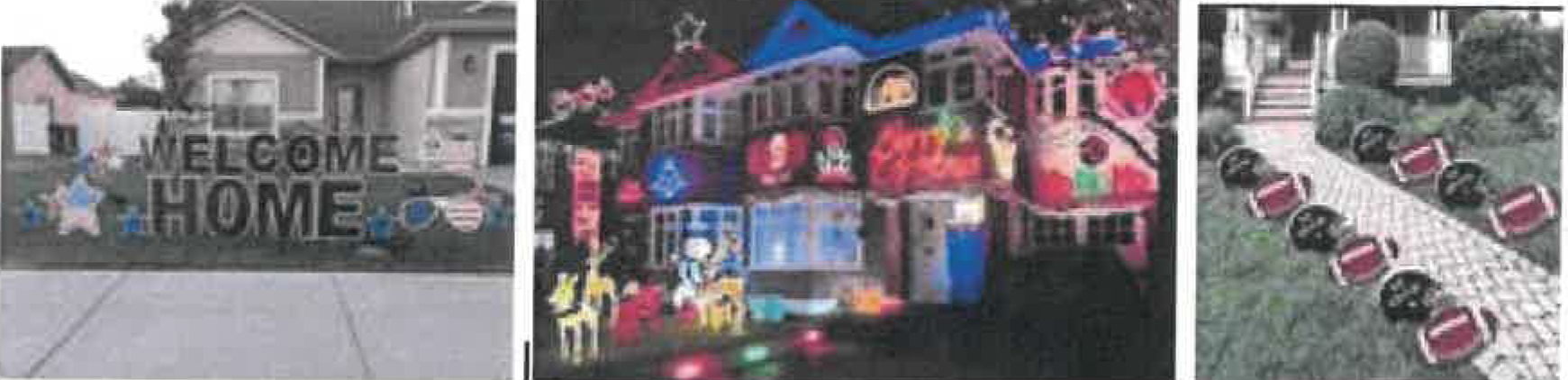
(7)
Merchandise displays behind storefront windows so long as no part of the display moves or contains flashing lights.
(8)
Incidental objects such as small decals less than two square-foot affixed to machines, equipment, fences, gates, walls, gasoline pumps, public telephones, utility cabinets, or windows and door panes/panels.
(9)
A sign affixed to a vehicle, except as provided in section 5 below.
(10)
Window signs, subject to the standards in this chapter.
(11)
Site signs, subject to the standards in this chapter
(12)
Yard signs, subject to the standards in this chapter
(13)
Handheld signs so long as the person or the sign being held does not obstruct or makes hazardous the free passage of pedestrians and motor vehicles on any street, sidewalk, or public-right-of way.
(14)
Flags, subject to the following standards:
(a)
A flag shall not exceed 32 square feet in area and shall be generally rectangular in shape.
(b)
A flag shall be attached to a permanent flagpole or a flag bracket or flag stanchion mounted to a building, dwelling, or accessory structure.
(c)
A maximum of three flags shall be allowed per lot. Unless otherwise required or authorized by law, no more than two flags are allowed on a flagpole, flag bracket or flag stanchion.
(d)
Maximum height of a flagpole shall be according to chapter 16 of this code. A building permit is required to install a flagpole.
(e)
A flag may be externally illuminated in compliance with this code.
(f)
A flag on a lot zoned non-residential or multi-family shall maintain a minimum clearance of eight feet from any surface.
(g)
Flags shall not be torn, tattered or in disrepair.
Figure 15:2 Examples of flags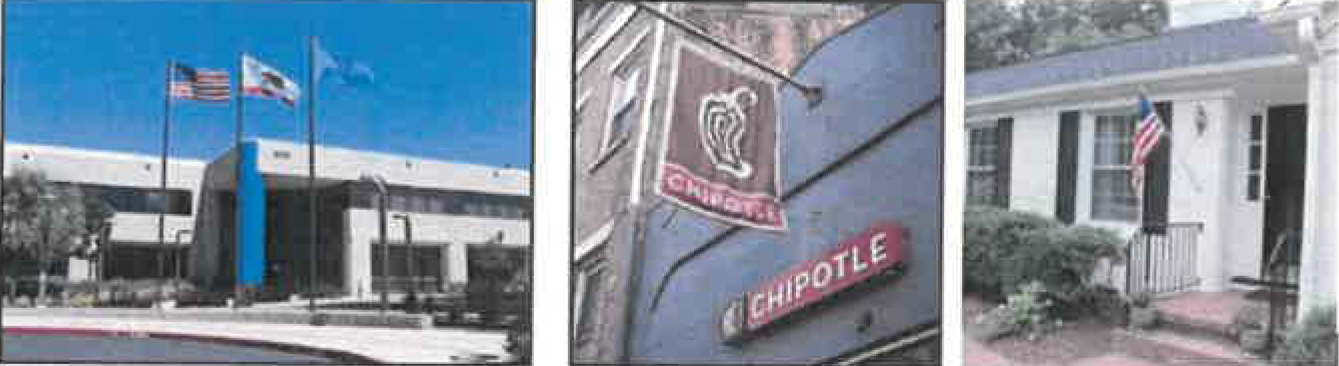
(15)
Umbrella signs subject to the following standards:
(a)
An umbrella having a sign affixed shall only be allowed outside a seating area for a licensed business establishment where the outside seating area is designated on an approved site plan or building permit.
(b)
One umbrella sign per table is allowed.
(c)
An umbrella having an affixed sign shall not exceed ten feet in height.
(d)
An umbrella having an affixed sign shall be mounted on or in the table or in an umbrella holder adjacent to the table.
(e)
Changeable copy is not permitted on umbrellas.
(Ord. No. 2021-13, § 2, 10-19-21)
Section 5: - Prohibited signs.
(a)
The following types of signs are prohibited and shall neither be erected nor maintained within the city, except as noted:
(1)
All signs not expressly permitted in this chapter.
(2)
Signs that communicate obscenities, child pornography, or other unprotected speech as defined by the Unites States Supreme Court.
(3)
Any sign other than traffic control signs, that is erected, constructed, or maintained within, over or upon a public right-of-way or city property, unless pursuant to the express permission of the city.
(4)
Abandoned signs.
(5)
Animated signs.
(6)
Audible signs.
(7)
Beacons or searchlights.
(8)
Emitting sign.
(9)
Billboards.
(10)
Parasite sign
(11)
Attention-getting devices.
Figure 15:3 Examples of attention-getting devices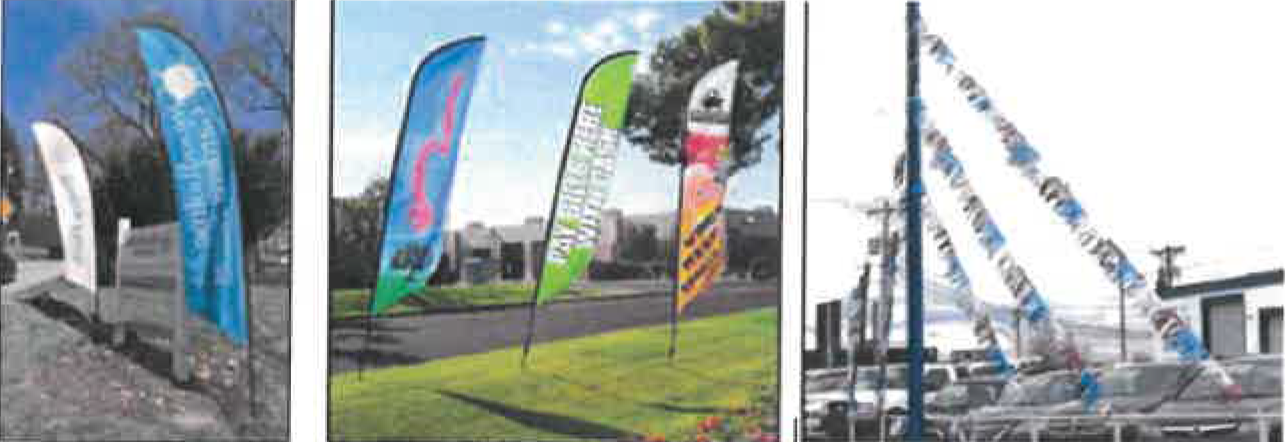
(12)
Commercial off-site advertising sign, unless allowed by an approved variance or development agreement approved by the city.
(13)
Any sign that is projected onto a surface using light from a remote source.
(14)
Any sign painted, erected, or constructed upon, above or over the roof or parapet of any building, unless permitted and installed in accordance with the standards set forth in subsection 11(c)(15) below.
(15)
Snipe sign.
(16)
Any sign which is of a size, location, movement, coloring, or manner which may be confused with, or construed as a traffic control sign, signal or device or which obscure or interfere any traffic or street sign or signal, such as those signs approved and shown in the current edition of the Uniform Traffic Code.
(17)
Any sign which obstructs free ingress to or egress from a door, window, fire escape or other required exit way.
(18)
Any sign, other than a bumper sticker, displayed on a vehicle, trailer, boat, or recreational vehicle that is used primarily to display the sign. Signs are permitted on a vehicle, trailer, boat, or recreational vehicle if the vehicle is used by a business owner or employee of the business primarily as a means of transportation of people or goods or for delivery of services (i.e. tow truck).
(19)
Any sign erected within any navigable waterway within the city so as to be located beyond any established bulkhead line.
(20)
Any signs mounted to fences or walls, except signage that is incorporated as part of an approved entrance feature for a residential subdivision with a recorded plat.
(21)
Any sign that extends into or is placed within a public right-of-way unless specifically authorized by an approved license agreement, variance or other express approval by the city council.
(22)
Any sign structure that no longer contains a sign panel.
(23)
Signs, handbills, circulars, dodgers or other advertising distributed or placed or caused to be distributed or placed on any public or private property in the city any handbills, circulars, dodgers or other advertising matter in such a manner that the same may be blown, carried by water or otherwise scattered by the elements, or so as to constitute litter. Handbill or other similar form of advertising placed on or into vehicles within the city.
(b)
Removal of prohibited signs.
(1)
Prohibited signs located on public property or public rights-of-way shall be removed immediately and may be removed by the city or its agent without notice.
(2)
Any prohibited sign, except abandoned or billboard signs, located on private property shall be removed within 48 hours after receipt of written notification from the city.
(3)
Abandoned or billboard signs shall be removed by the owner, agent or person in charge of the premises within 30 days after receipt of written notification by the city. If the sign is not removed in a timely manner, the city may initiate code enforcement proceedings.
(Ord. No. 2021-13, § 2, 10-19-21; Ord. No. 2022-10, § 2, 5-3-22)
Section 6: - Sign measurement.
(a)
Area of single-faced signs.
(1)
Sign area is the entire surface area of a sign, including non-structural trim, frame, or other material or color forming an integral part of the display or used to differentiate the sign's contents from the background against which they are placed. The supports, uprights, or structures on which any sign is mounted shall not be included in measuring sign area. A building's architectural features, structural supports, and landscape elements shall not be included within the sign area.
(2)
An awning, canopy, projecting, or non-cabinet wall sign's area shall be measured by including within a single continuous rectilinear perimeter of not more than 12 straight lines that enclose the extreme limits of writing, representation, lines, emblems, or figures contained within all modules together with any air space, materials, or colors forming an integral part or background of the display or materials used to differentiate such sign from the structure against which the sign is placed.
Figure 15:4 Example of calculating sign area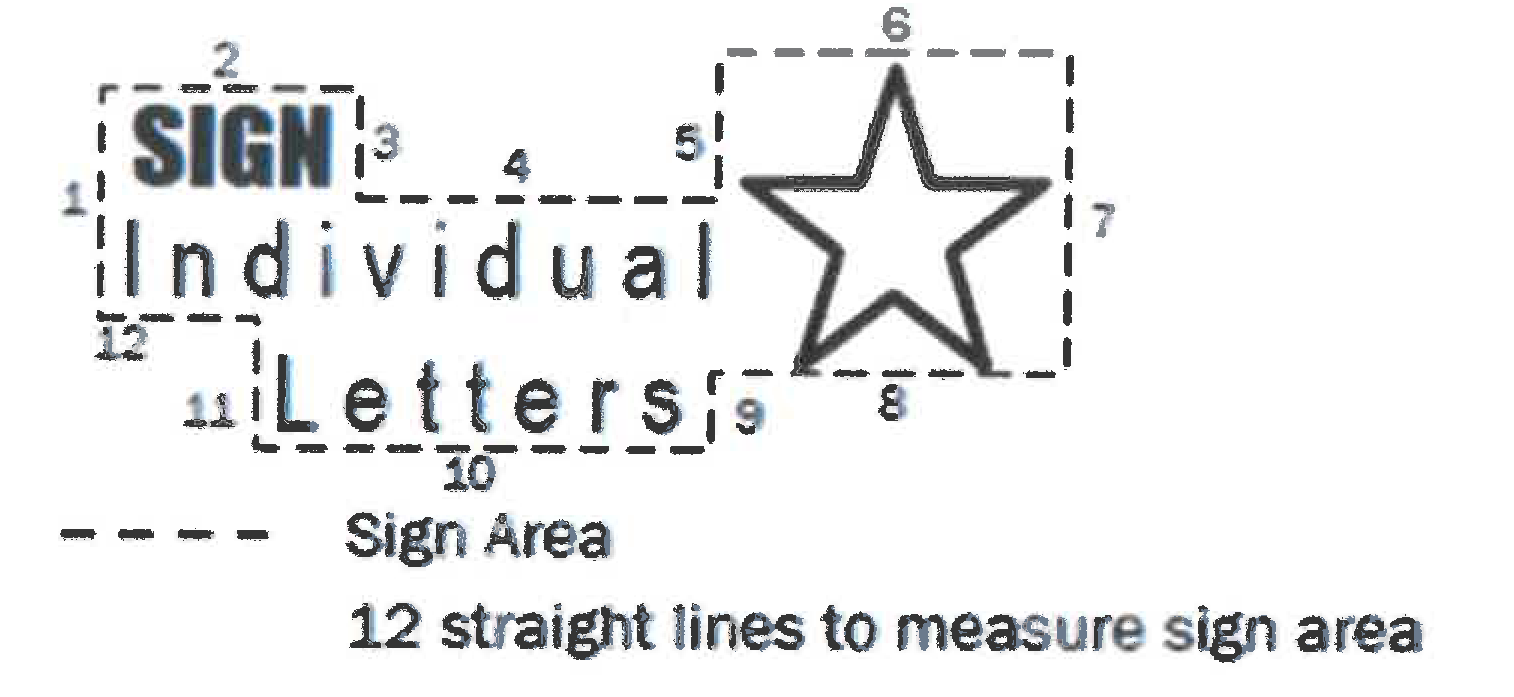
(b)
Area of double-faced signs.
(1)
Sign area is the entire surface area of a sign, including non-structural trim, frame, or other material or color forming an integral part of the display or used to differentiate the sign's contents from the background against which they are placed. The supports, uprights, or structures on which any sign is mounted shall not be included in measuring sign area. If the sign faces are connected in a manner that forms an angle between the two sign faces of greater than 30 degrees, then each sign face is considered a separate sign.
Figure 15:5 Example of double-sided signs and sign area calculations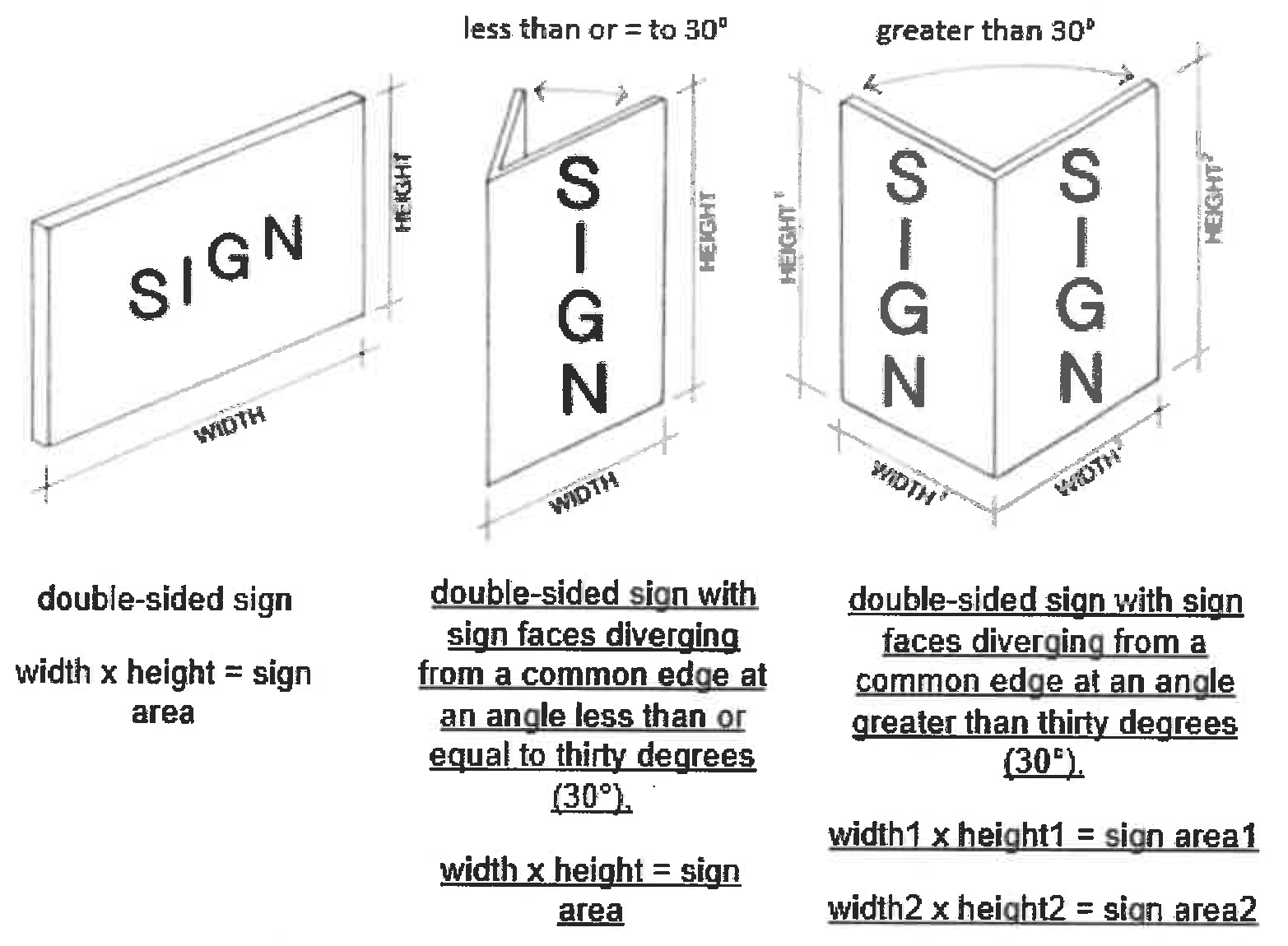
(2)
Sign area of a free form sign shall be the sum of two adjacent vertical faces as seen at the same time from a viewer's perspective, of the smallest cube that can encompass the sign.
Figure 15:6 Example of calculating sign area for a free form sign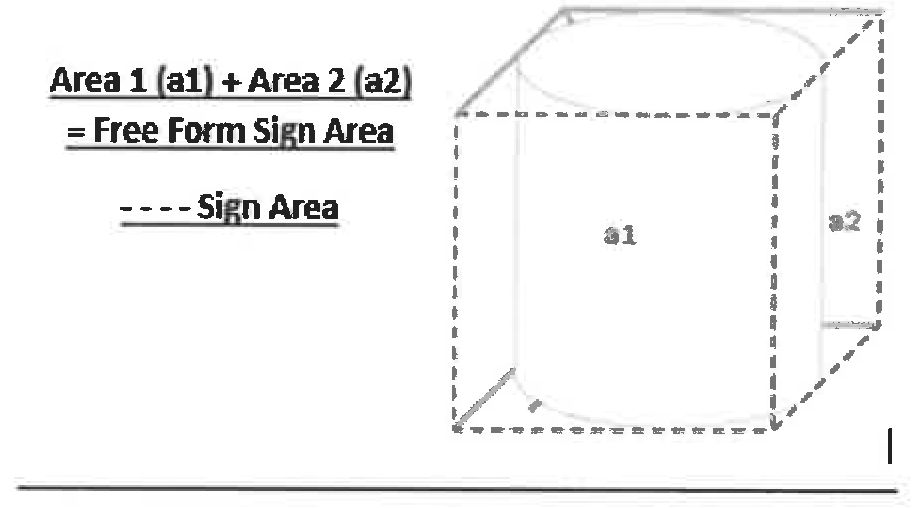
(c)
Area of window signs.
(1)
Window sign area is the total window area of all window signs for a tenant divided by percentage of window signage allowed. If a window includes multiple areas or frames, the outer most frame will determine the extent of the window area.
Figure 15:7 Examples of determining window sign area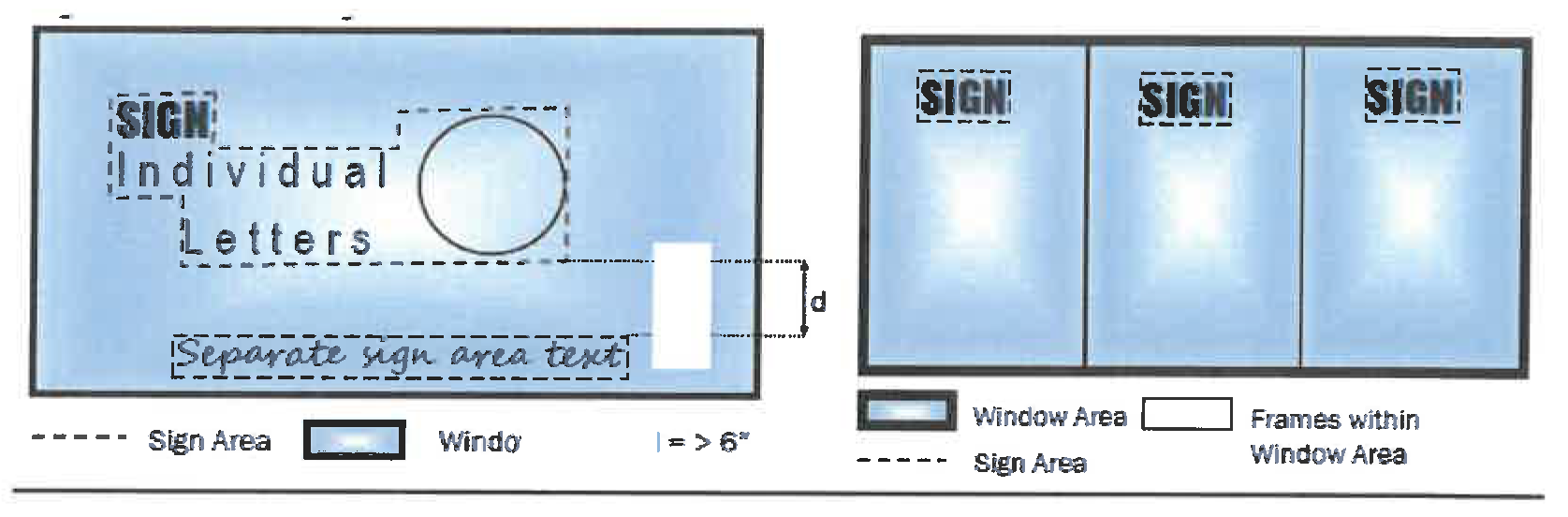
(d)
Area of multiple signs.
(1)
Whenever more than one sign is placed on a freestanding structure, or on a projecting structure, the combination of signs shall be considered as one sign for the purpose of computing sign area and determining the number of signs on a site.
(2)
Total sign area on a building shall be computed by adding the areas of the individual sign elements.
Figure 15:8 Example of determining sign area on a building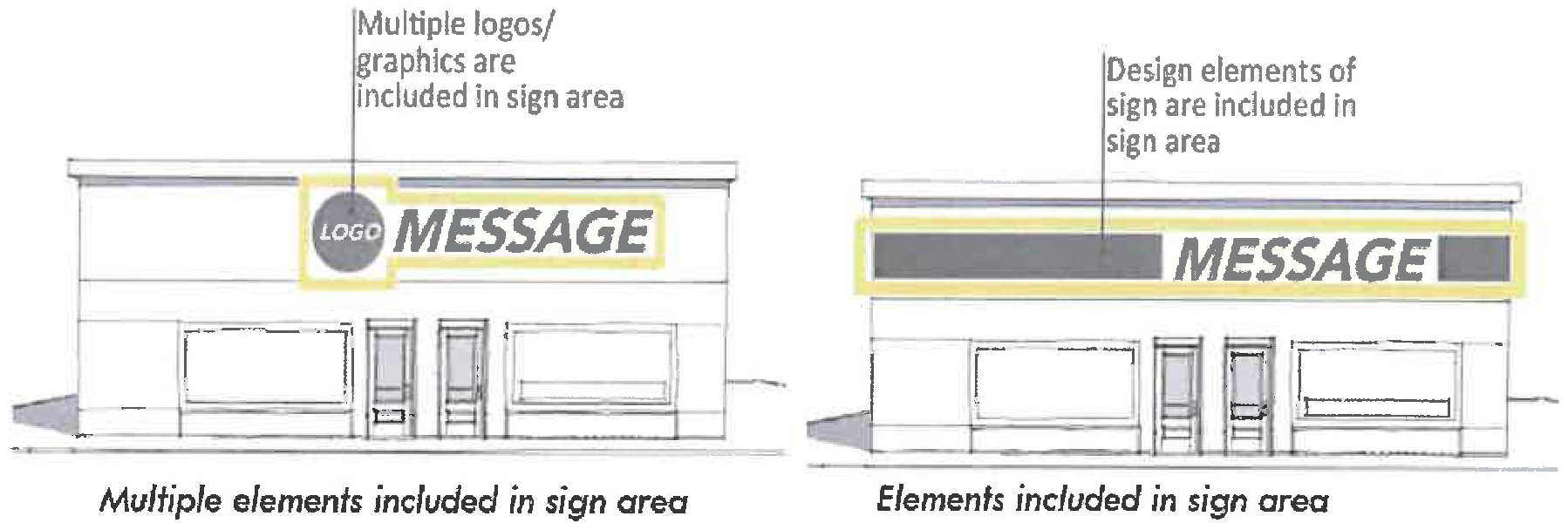
(3)
A distinct cluster of individual letters, figures or elements is considered a single sign for purposes of determining the number of attached signs per facade for each wall.
Figure 15:9 Example of determining distinct cluster of individual letters on a building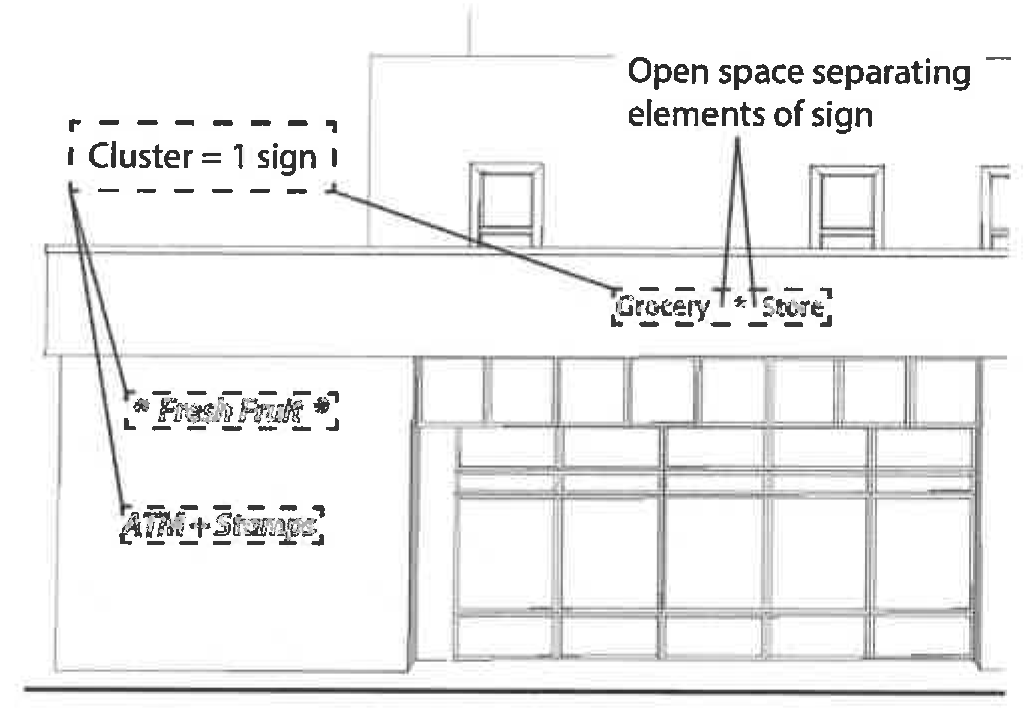
(e)
Projection is measured as the distance from the face of the building to which a sign is mounted to the furthest point on the sign away from the wall.
(f)
Clearance is measured as the shortest distance between the bottom of a sign and the grade below.
Figure 15:10 Example of determining projection and clearance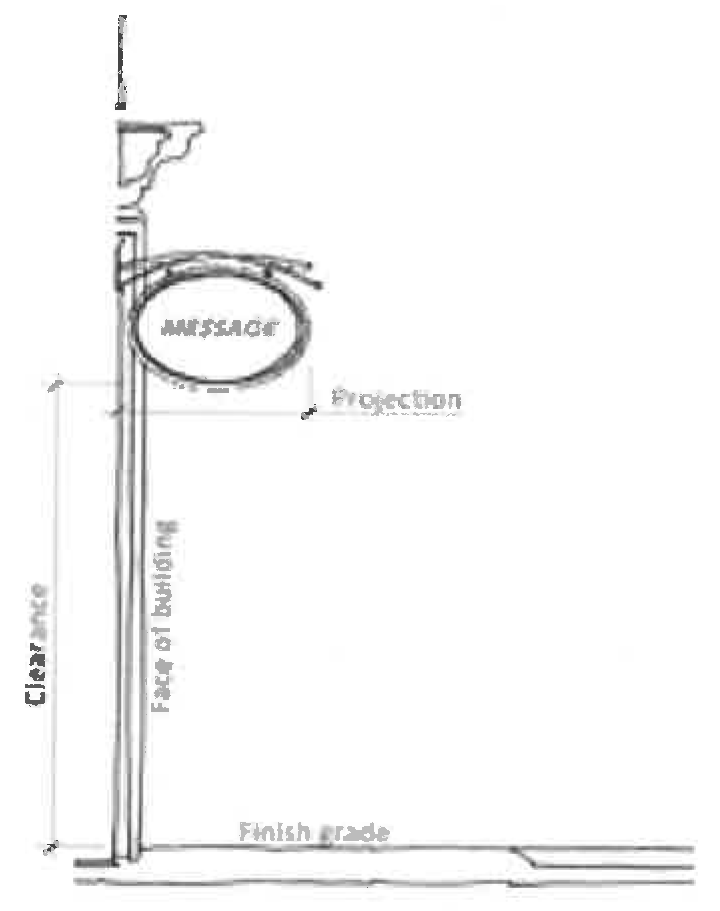
(g)
Height.
(1)
The height of a freestanding sign is the vertical distance to the top of the structure or sign face, whichever is higher, measured from the elevation of average grade in the area within the required landscape area around the base of the sign.
(2)
For freestanding signs adjacent to a street, if average grade around the base of the sign is lower than the average grade of the nearest abutting street, then the height of the sign shall be measured from the roadway line elevation of said street to the top of the sign face or sign structure, whichever is higher. This only applies to surface roadways and shall not apply to bridges, overpasses, or similar elevated roads.
(3)
The sign height of an attached sign is the vertical distance of the sign area.
Figure 15:11 Example of measuring sign height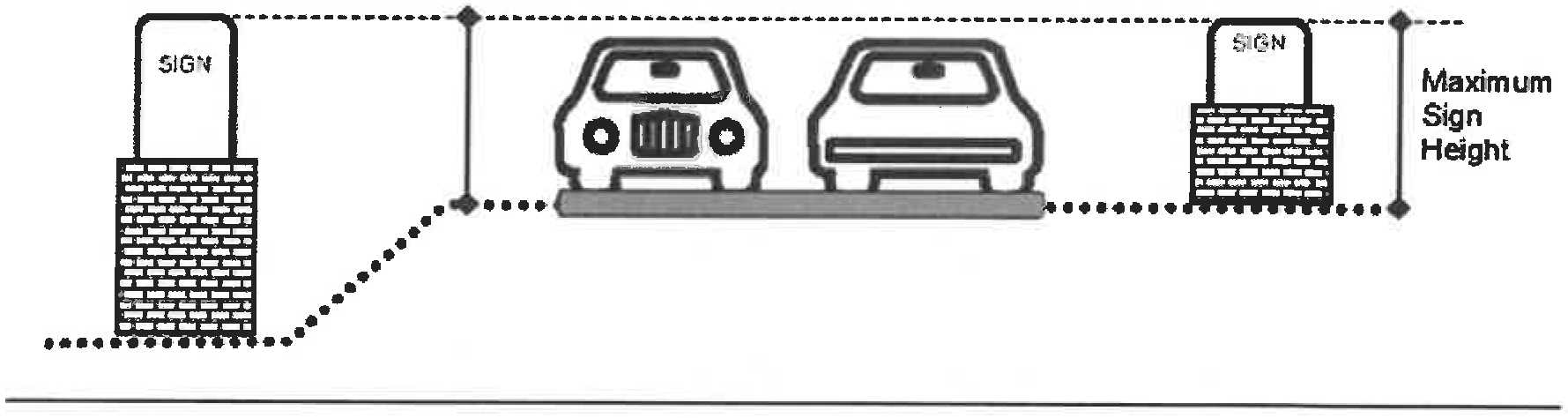
Figure 15:12 Example of measuring sign height on a building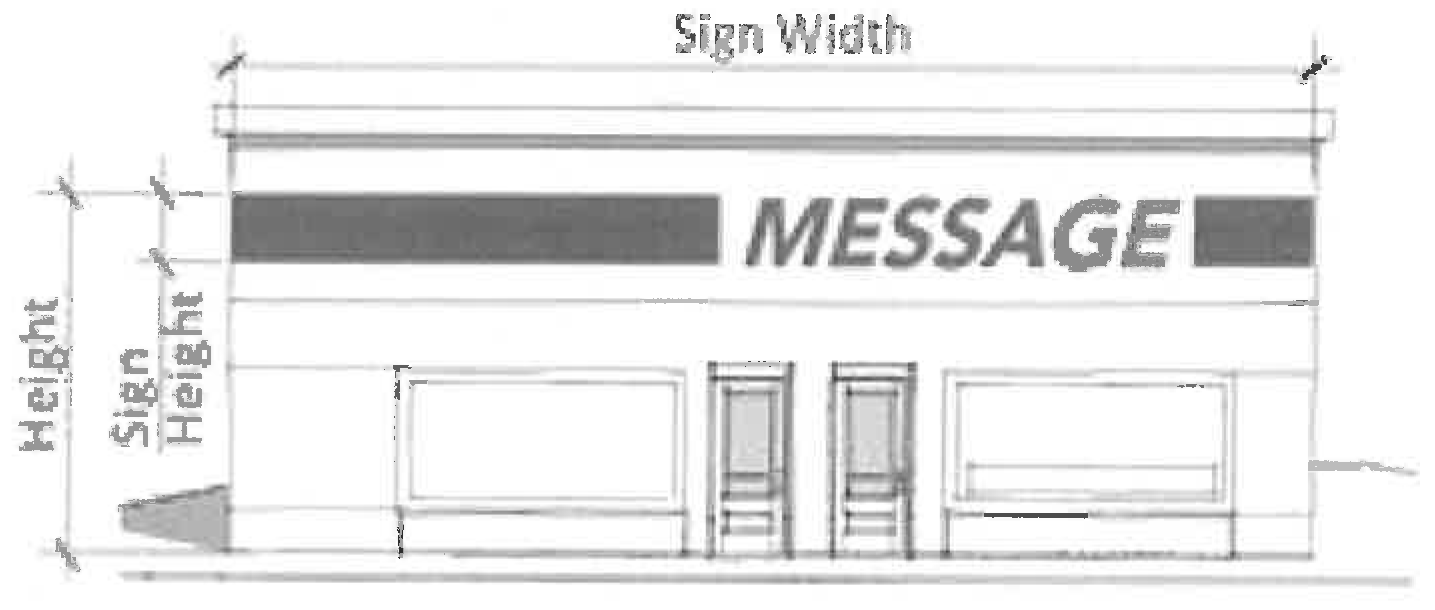
(Ord. No. 2021-13, § 2, 10-19-21)
Section 7: - Sign placement or location.
(a)
A sign shall meet the visual clearance zone and setback requirements in chapter 16 of this code.
(1)
On existing lots of substandard width, where existing conditions or requirements conflict with the ability to meet the signage setback requirements of this chapter, the administrative official may allow the setback to be reduced to the largest dimension available.
(2)
Front setback requirements for signs may be reduced or waived by the administrative official where properties front on a dedicated right-of-way with sufficient width to accommodate any foreseeable future widening and still maintain a minimum 20 feet distance between the sign and the nearest edge of the travel lane.
(b)
A sign shall be setback 25 feet from a side lot line unless reduced by the administrative official pursuant to this section.
(c)
Frontage is the portion of a lot abutting a public right-of-way, alley, access easement, drive aisle, private access, public right-of-way, private right-of-way
(1)
Primary is the frontage that a business or tenant abuts or adjacent to and addressed from.
(2)
Secondary is the frontage that a business or tenant abuts or adjacent to that is not the primary frontage.
(d)
A sign shall not obstruct any window, door, fire escape, stairway, ladder or opening intended to provide light, air, ingress, egress for any building as required by law.
(e)
Window signs shall be arranged so as to provide visibility through windows at eye level, between four and six feet in height.
(f)
Signs shall be located to maintain clearance from all overhead electrical or utility lines. Clearance shall be determined by the electrical or other utility provider.
(Ord. No. 2021-13, § 2, 10-19-21)
Section 8: - Sign design and materials.
(a)
In general, permanent signs and supporting sign structures shall be designed as a compatible architectural element to the principal structure, overall development or neighborhood in which it is located and have common unifying elements which may include materials, primary finish and colors, size, scale with the building it advertises, height, letter style, sign type, shape, lighting, location on buildings, and design theme.
(b)
Signs shall be constructed of durable, all-weather materials and may include but are not limited to metal, galvanized steel or of an equivalent corrosion resistant material, glass, stone, stucco or similar material, concrete, brick, plexiglass, fiberglass, wood, or other approved materials.
(1)
Paint, vinyl, or other similar materials may be used for window or wall signage.
(2)
Plastic substrate, particle board, Masonite, paper, fabric, plywood, unfinished wood, or similar materials are prohibited, unless it is shown to the satisfaction of the administrative official that an otherwise prohibited material has been modified or packaged to eliminate any unacceptable characteristics affecting durability.
(3)
Temporary signs shall be constructed of durable, all-weather materials and may include but are not limited to metal, plexiglass, fiberglass, wood, plastic substrate, plywood, woven fabrics, vinyl fabrics, or other approved materials.
(c)
Exposed raceways shall be as thin and narrow as possible and not exceed eight inches. Exposed raceways shall be finished to match the background wall and shall not extend in width or height beyond the area of the sign's lettering or graphics.
(d)
The numeric street address of the property upon which the sign is located shall be identified on the top portion of the side and front of a monument sign, unless waived by the administrative official. The street address numbers shall be between six to 12 inches in height.
(e)
The supporting features or structures of a sign shall appear to be free of any extra bracing angle iron, guy wires, cables, etc. The supports shall appear to be an architectural and integral part of the building and/or sign.
(Ord. No. 2021-13, § 2, 10-19-21)
Section 9: - Digital signs and string lighting.
(a)
Digital signs. Digital signs are subject to the following standards:
Figure 15:13 Examples of digital signs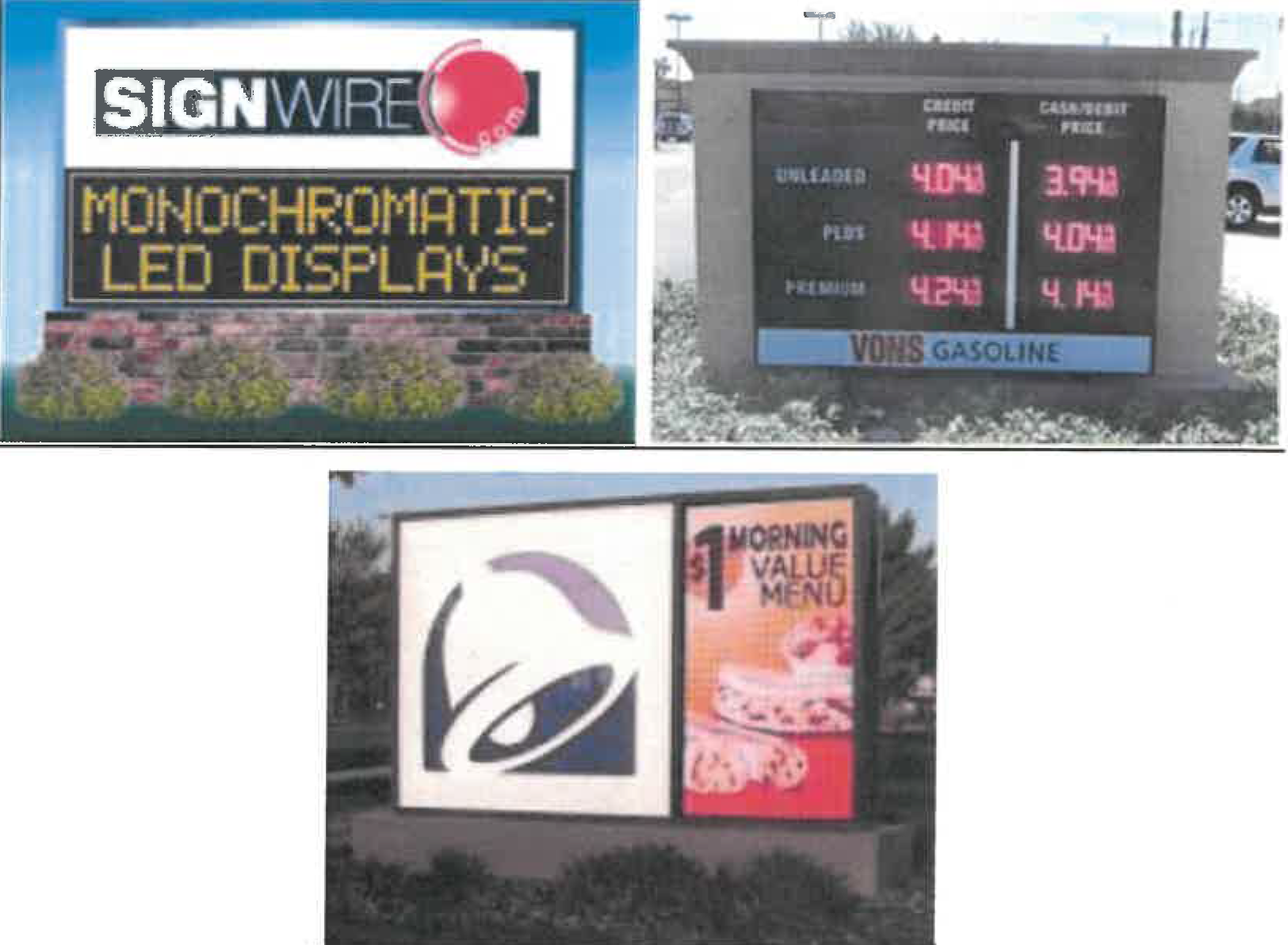
(1)
The digital sign area of a monument sign shall be integrated into the design of the sign. The digital sign area shall not be an add-on feature onto the monument sign, but rather must be fully integrated into the sign design.
Figure 15:14 Examples of electronic message area integrated into a monument sign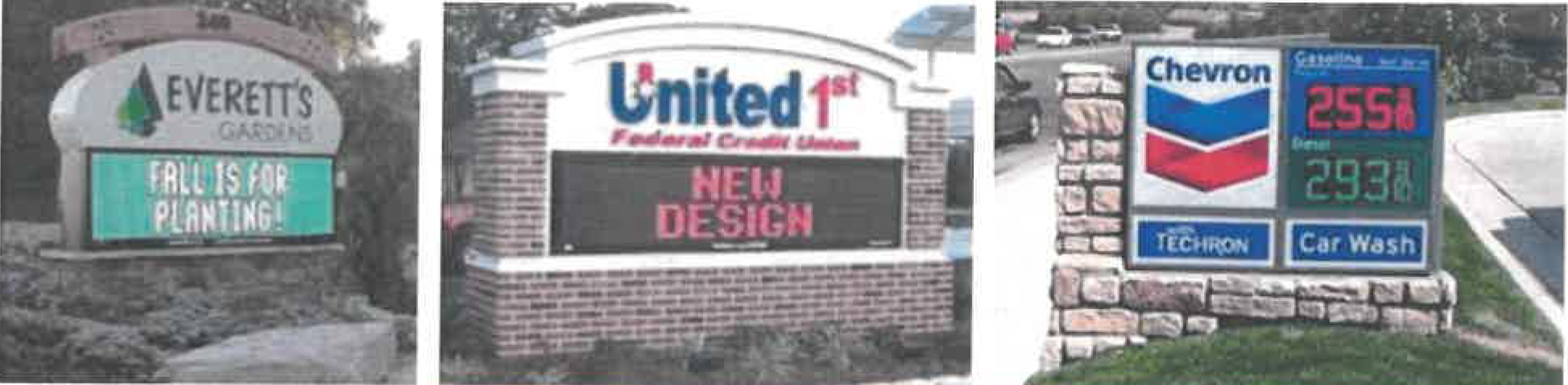
Figure 15:15 Example of the digital sign area not being integrated into a monument
sign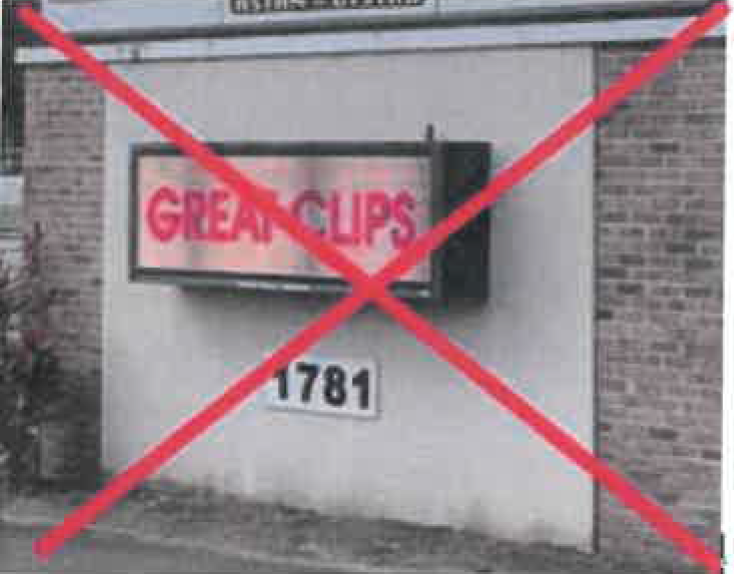
(2)
Each message on the digital sign shall be displayed for at least 10 seconds in duration. Message changes shall be completed instantaneously and shall be unnoticeable.
(3)
Digital signs shall contain static messages changed only through dissolve or fade transitions and shall not have movement or the appearance or optical illusion of movement during the static display period of any part of the sign. A static message shall not include any flashing or the varying of light intensity, and the message shall not scroll. The change of message using dissolve or fade transition shall not exceed one second of time between each message displayed on the sign.
(4)
The intensity of the light source for a digital sign shall not produce glare, the effect of which constitutes a traffic hazard or is otherwise detrimental to the public health, safety, or welfare.
(5)
Digital signs shall not operate at brightness levels of more than 0.3 foot-candles above ambient light as measured using a foot candle (Lux) meter at a preset distance depending on sign area. Illuminance measurement requires two steps: First—ambient light shall be measured with the sign turned off. Second—sign light output shall be measured with the sign turned on as a solid white display. The difference between the two measurements shall be 0.3 foot-candles or less. The distance at which to take measurements is calculated with the following formula and rounded to the next whole number: Measurement distance = √ (Area of sign square feet × 100)
(6)
Prior to the issuance of a sign permit for a digital sign, the applicant shall provide written certification from the sign manufacturer that the light intensity has been factory pre-set not to exceed 0.3 foot-candles above ambient light and that the intensity level is protected from end-user manipulation by password-protected software or other similar method as deemed appropriate by the administrative official. The electronic message center shall have automatic dimmer software or solar sensors to control brightness for nighttime viewing or as ambient light conditions change.
(7)
The technology currently being deployed for digital signs is LED (light emitting diode), but there may be alternate, preferred and superior technology available in the future. Any other technology that complies with the performance standards for digital signs, including the maximum brightness levels as stated above, is permitted.
(8)
A digital sign shall include systems and monitoring to either turn the display off, show "full black" on the display, or include a default mechanism that freezes the sign in one position if a malfunction occurs, and
(9)
Be designed so that a catastrophic power surge will cause the sign to go dark or to deploy the maximum brightness limitations, and
(10)
Digital sign faces shall have a pixel pitch of no more than eight millimeters.
(11)
Prior to the issuance of a sign permit, the applicant shall provide the phone number and email address of a person or company available to be contacted at any time and to turn off the digital sign promptly if a malfunction occurs.
(12)
The light modules for a digital sign shall be repaired or replaced if they become broken, burned-out or substantially dimmed.
(b)
String lights.
(1)
String lights are allowed in all zoning districts as an accent element for outdoor dining area, porches, patios, event spaces, or similar structures or elements.
(2)
String lights are not counted toward the maximum wall sign area allocation in this chapter.
(3)
String lights on non-residential or multi-family zoned lots shall be shown and approved on a site plan, subdivision, building permit, or an approved application form provided by the city.
(4)
The intensity of the light source for string lighting shall not produce glare, the effect of which constitutes a traffic hazard or is otherwise detrimental to the public health, safety, or welfare.
Figure 15:16 Examples of allowed string lighting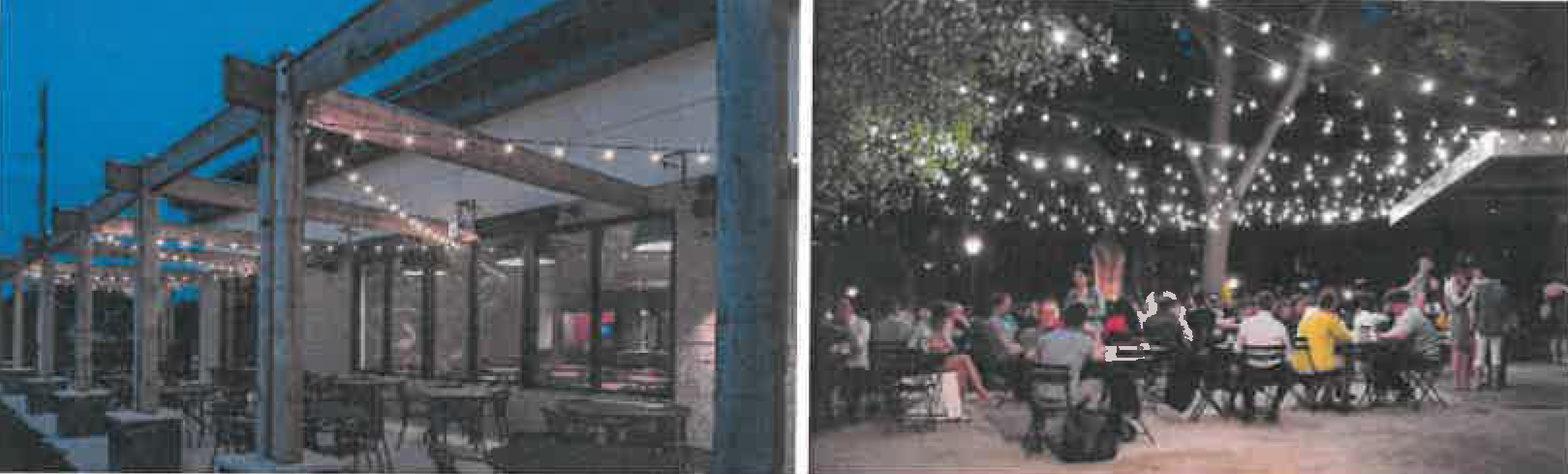
(Ord. No. 2021-13, § 2, 10-19-21; Ord. No. 2025-24, § 1, 9-2-25)
Section 10: - District areas.
(a)
Section 11 below sets forth standards applicable to each of the following districts defined as follows:
(1)
Residential (Res): Generally, this area is comprised of residentially zoned properties, or properties developed with residential uses (attached or detached). This area includes properties zoned AP, A, RMH, RR, R-20SF, R-10SF, R-8SF, R-7SF, NP, PUD, and R-2D. This also may include properties zoned PC-A within districts that allow attached or detached residential uses.
(2)
Multi-family/institutional (MF/I): Generally, this area includes properties with multi-family or institutional zoned properties, or properties developed with multi-family or institutional uses. This area includes properties zoned R-3L, R-3M, R-3H, REC and GPU. This also may include properties zoned PC-A within a district that allows multi-family or institutional uses, PUD, PCD, or PC-R within a project type that allows multi-family or institutional uses.
(3)
Commercial (Comm): Generally, this area includes properties with commercial zoning. This area includes properties that are zoned F-C, PO, NC, CC, HC, ICD, CI, LI, and RD located north of Dunlawton Avenue. This also may include properties zoned PC-A within a district that allows commercial uses, PUD, PCD or PC-R with a project type that allows commercial uses.
(4)
Mixed-use (MXU): Generally, this area includes properties that are zoned MXC, ORT, PC-A within a district that allows mixed-use or PC-R with a project type that allows mixed-use.
(5)
Ridgewood Corridor (RC): This area includes properties with Ridgewood Development (RD) zoning and properties abutting Ridgewood Avenue between Dunlawton Avenue and the Rose Bay Bridge and properties located on the west side of Ridgewood Avenue abutting Ridgewood Avenue from Dunlawton Avenue to the southern city limits.
(Ord. No. 2021-13, § 2, 10-19-21)
Section 11: - Permanent signs.
(a)
The standards of this section apply to all permanent signs. Permanent signs may be subject to additional standards set out elsewhere in these regulations. The standards below do not authorize the installation of a sign without first obtaining any necessary building permit in compliance with the current edition of the Florida Building Code and this code.
(b)
Upon receipt of written notification by the city that a sign is unlawfully illuminated or animated in violation of this chapter, the owner, his agent, or person in control of the premises, shall immediately terminate the prohibited illumination or animation of such sign.
(c)
Permanent sign types. Permanent signs include the following types:
(1)
Monument sign. Monument signs are subject to the following standards:
Figure 15:17 Examples of monument signs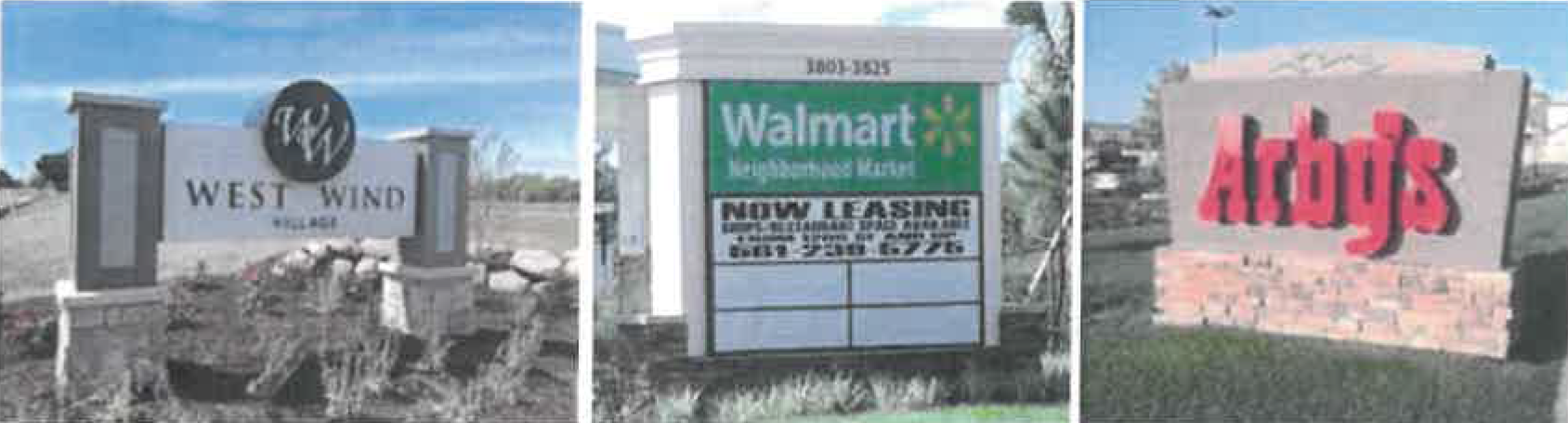
(a)
All monument signs shall be located along a primary or secondary street frontage. A site only has one primary frontage which is determined by the street identified in its address. Sites may have one or more secondary frontage.
(b)
I-95 frontage monument sign: I-95 frontage areas are defined as those properties with at least 100 feet of common property line with the I-95 right-of-way. Each such property shall be permitted one additional monument sign, oriented toward I-95, with a maximum height of 15 feet and a maximum area of two hundred square feet (200 ft. 2 ).
(c)
Monument signs can be designed with the sign placed on a base at least 18 inches in height measured from the average grade elevation or a sign mounted between two decorative columns. Monument sign base and column supports shall be consistent with and/or complement the building design and materials.
(d)
A sign shall be located in a landscaped area. A minimum of three-square feet (3 ft. 2 ) of landscaping area shall be provided for one square foot (1 ft. 2 ) of sign area. Only one face of a two-sided sign shall be counted for sign area. The minimum quantity of shrubs or groundcover plants shall be based on the following formula:
(1)
Total area of the sign face (in square feet) × 0.45 = the number of shrubs or groundcover plants, rounded up to the nearest whole number. This requirement is waived if the sign is installed within an approved right-of-way landscape buffer required by this code.
(e)
Two additional feet in height for a monument sign shall be allowed for architectural embellishments that are consistent with and/or complement the building design and materials. The border on all sides of the sign shall be consistent with and/or complement the building design and materials. Illuminated sign containing internal illumination within a cabinet without a border are prohibited.
(f)
For all monument signs located on a lot in the commercial or mixed-use district areas, the border on all sides of the sign shall be consistent with and/or complement the building design and materials. Illuminated signs using internal illumination within a cabinet without a decorative base or columns and border around the cabinet are prohibited. The sign base or columns and cabinet border shall be constructed of brick, stone, stucco, wood, decorative concrete, high quality metal, or other similar materials as approved by the administrative official.
Figure 15:18 Examples of monument signs with a base, and/or columns consistent with
and/or that complements the building design and materials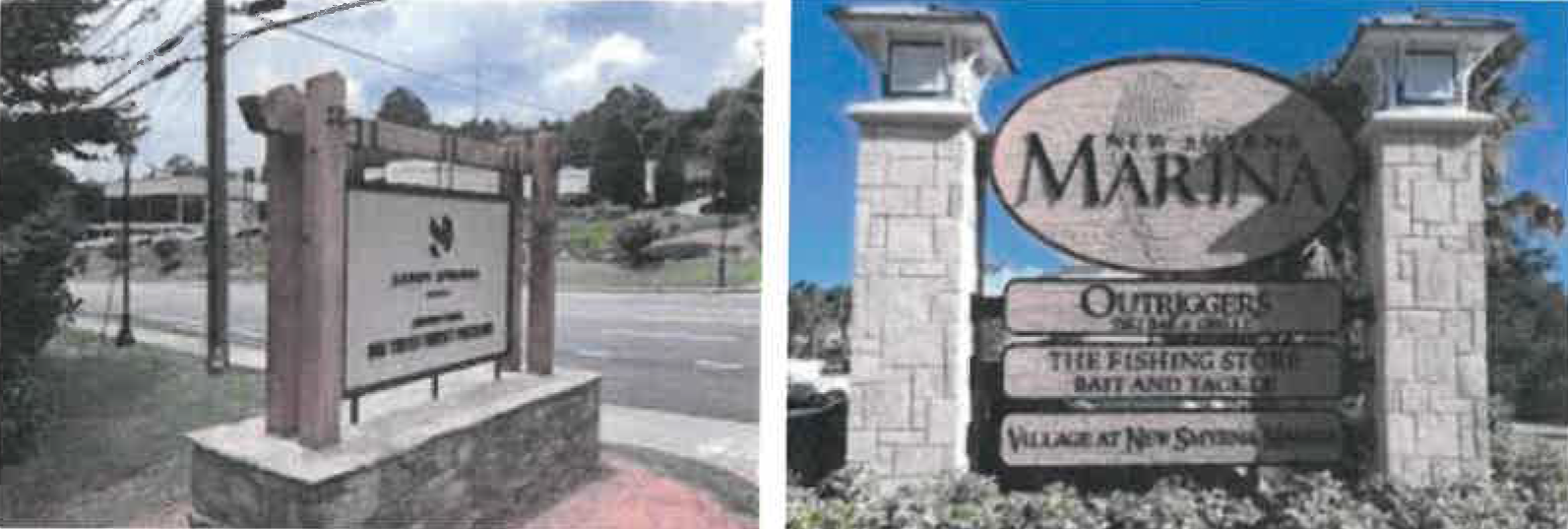
(g)
The minimum dimensional requirements and number of signs allowed for each district shall be as follows:
(2)
Post sign. Post signs are subject to the following standards:
Figure 15:19 Examples of a post sign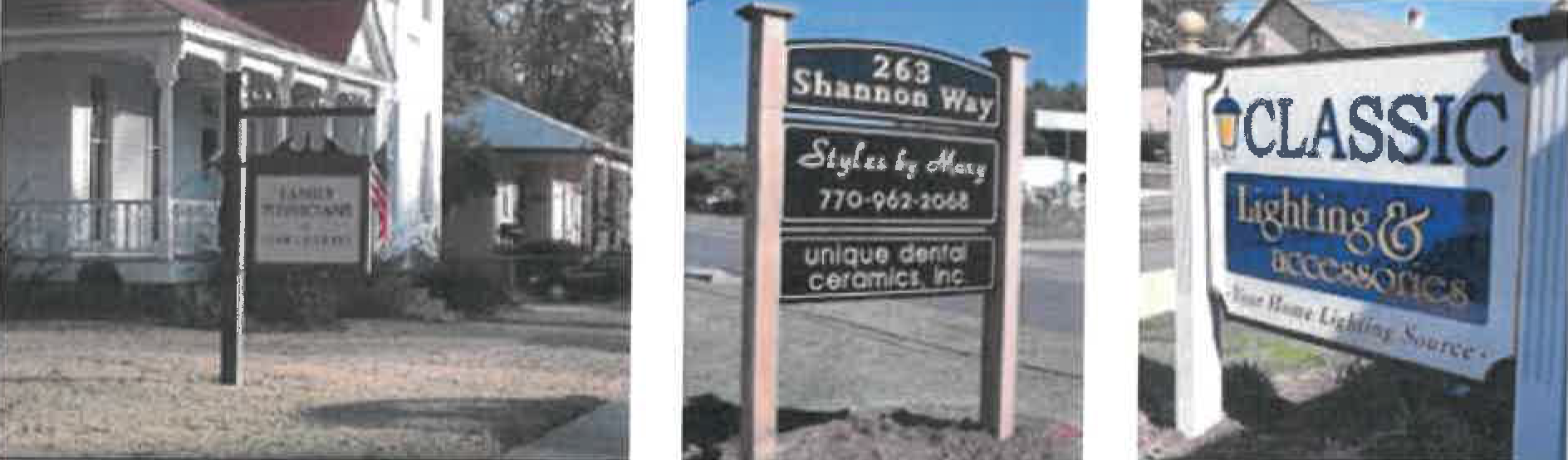
(a)
A post sign may be installed in lieu of a monument sign on a lot in the Ridgewood Corridor (RC) area.
(b)
The design of the post(s) for a post sign shall include a decorative base, decorative cap, ball or other similar embellishment, and be consistent with and/or complement the building design and materials.
(c)
The sign copy shall be engraved into or affixed onto a beveled edge sign panel or using similar materials and design to achieve an attractive appearance.
(d)
A sign shall be located in a landscaped area. A minimum of one square feet of landscaping area shall be provided for one square foot of sign area. Only one face of a two-sided sign shall be counted for sign area. The minimum quantity of shrubs or groundcover plants shall be based on the following formula: Total area of the sign face (in square feet) × 0.45 = the number of shrubs or groundcover plants, rounded up to the nearest whole number. The administrative official may reduce or waive this requirement if the sign is installed within an approved right-of-way landscape buffer required by this code or in areas without reasonable access to water for irrigation.
(e)
The minimum dimensional requirements and number of signs allowed for each district shall be as follows:
(3)
Subdivision entry sign. These regulations apply to all subdivision entry signs:
Figure 15:20 Examples of subdivision entry signs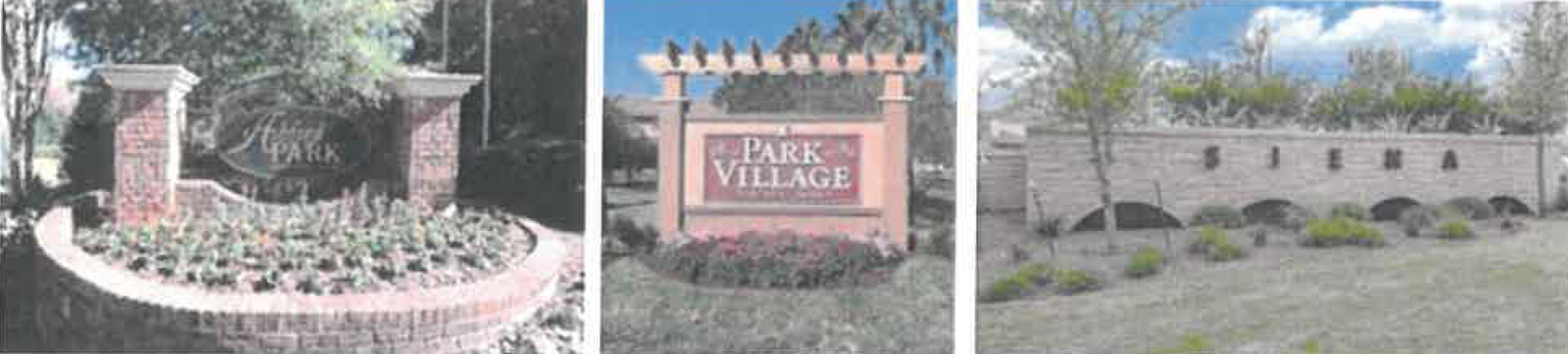
(a)
A sign may be affixed to a wall that complies with the architectural requirements in chapter 14 of this code, provided the wall is expressly authorized by an approved subdivision plan, site plan, or building permit and is not located in a public right-of-way.
(b)
A sign shall be located at a primary or secondary subdivision entrance or entry drive, on privately owned common area, or a privately owned and maintained median. Such signs shall be setback at least ten feet from the nose of the median.
(c)
A sign must be constructed of an opaque background or uniform color and shall be of high-quality materials that are compatible with the character of the neighborhood. Freestanding sign bases or column supports shall be constructed of stone, brick, wood, decorative concrete, high-quality metal, or other similar materials.
(d)
A sign shall only be permitted for subdivisions with an active homeowners' associations (HOA) to ensure signs are properly maintained over time. If a HOA dissolves, the HOA shall be responsible for removal of the sign prior to dissolving.
(e)
In place of one sign at a subdivision entrance, a sign may be placed on each side of the street at the neighborhood entrance, provided the maximum area of both signs combined does not exceed the permitted maximum area for one sign.
(f)
A sign shall be located in a landscaped area on privately owned common area. A minimum of three-square feet of landscaping area shall be provided for every one-square foot of sign area. Only one face of a two-sided sign shall be counted for sign area. The minimum quantity of shrubs or groundcover plants shall be based on the following formula: Total area of the sign face (in square feet) × 0.45 = the number of shrubs or groundcover plants, rounded up to the nearest whole number. The administrative official may reduce or waive this requirement if the sign is installed within an approved right-of-way landscape buffer required by this code.
(g)
The minimum dimensional requirements and number of signs allowed for each district shall be as follows:
(4)
Incidental sign. Incidental signs are subject to the standards below:
Figure 15:21 Examples of incidental signs with four square feet or less of sign area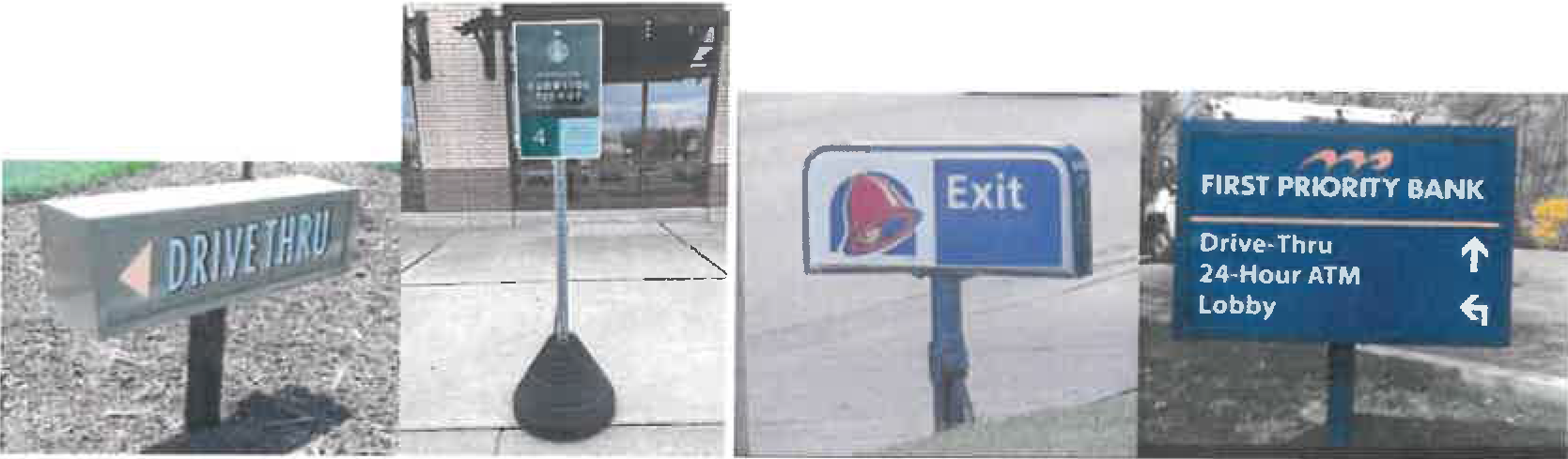
Figure 15:22 Examples of incidental sign with greater than four square feet of sign
area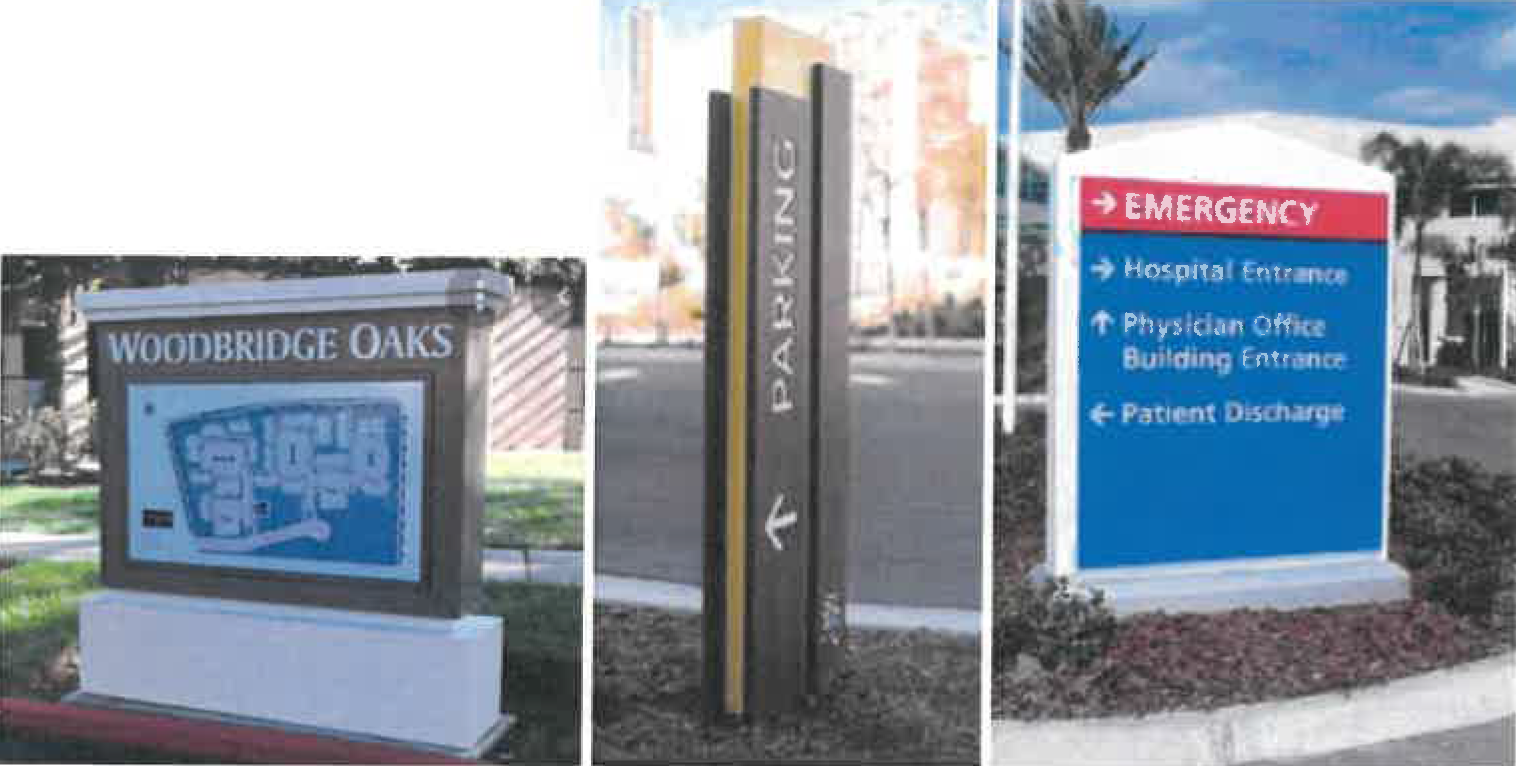
(a)
Sign shall consist of a rigid background with a structural frame or similar frame.
(b)
Signs with four square feet or less sign area can be mounted on a base or pole.
(c)
Signs greater than four square feet of sign area shall be designed with a base at least 18 inches in height measured from the average grade elevation or mounted between two decorative columns and shall be constructed of brick, stone, stucco, wood, decorative concrete, high quality metal, or other similar materials and consistent with and/or complement the building design and materials.
(d)
The minimum dimensional requirements and number of signs allowed for each district shall be as follows:
(5)
Drive-thru signs. Drive-thru signs are subject to the standards below:
Figure 15:23 Examples of drive-thru signs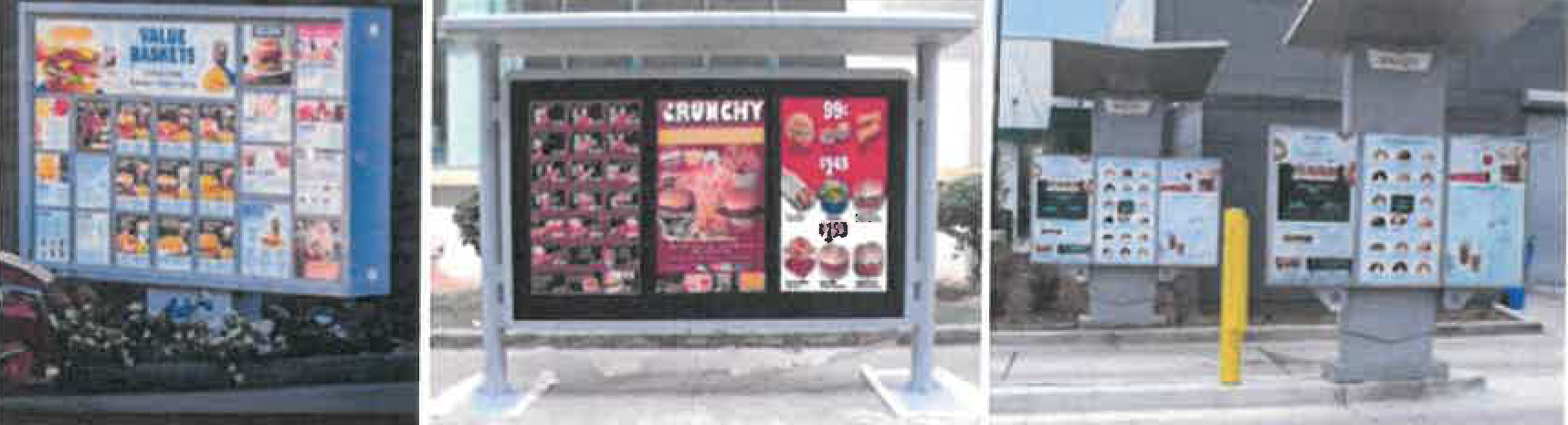
(a)
A sign may emit sound only as part of a business transaction subject to chapter 42 of the Code of Ordinances.
(b)
A sign is allowed in addition to freestanding and wall signs permitted by this chapter.
(c)
The sign support shall be constructed from similar materials and consistent with and/or complementary to the building design and materials.
(d)
The sign shall be screened from a public right-of-way by placement. landscape, or wall or fence.
(e)
The sign shall comply with section 9 of this chapter.
(f)
The minimum dimensional requirements and number of signs allowed for each district shall be as follows:
(6)
Awning sign. Awning signs are subject to the standards below.
Figure 15:24 Examples of awning signs
(a)
The sign displayed on an awning shall be used to determine the sign area. The entire awning area shall not be included in sign area calculation.
(b)
No awnings with signs shall extend above the roof line of a building, or the first story, whichever is lesser in height.
(c)
No sign affixed to an awning shall project beyond, above, or below the face of the awning.
(d)
The principal function of any awning with a sign shall be to provide shelter for a window, a door, or an outdoor seating area.
(e)
Awnings that contain signs shall be designed to be compatible with the storefront in scale, proportion, material, and color.
(f)
The minimum dimensional requirements and number of signs allowed for each district shall be as follows:
(7)
Canopy signs in vehicular areas. Canopy signs in vehicular areas are subject to the standards below:
Figure 15:25 Examples of canopy signs in vehicular areas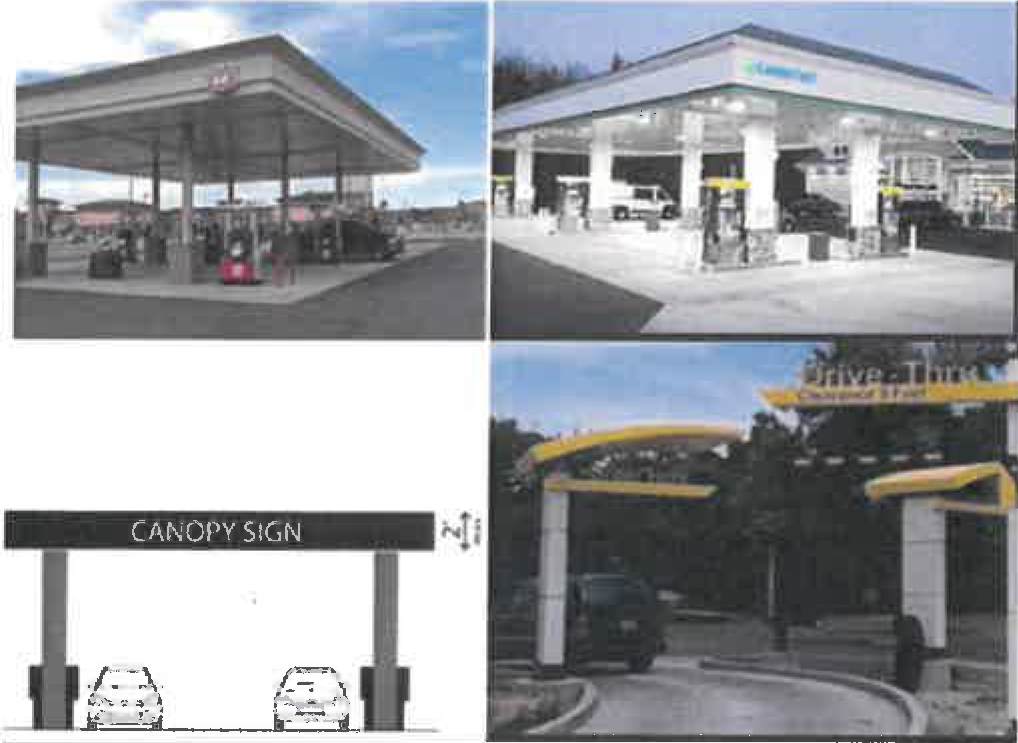
(a)
Canopies in vehicular areas with signs shall be designed to be compatible with the associated building(s) in scale, proportion, and color.
(b)
Sign on a canopy in a vehicular area shall be located on the face of the canopy that abuts a public roadway.
(c)
Corporate stripes, logos, and designs proposed on the canopy in a vehicular area shall be counted as part of the overall permitted sign area.
(d)
The minimum dimensional requirements and number of signs allowed for each district shall be as follows:
(8)
Canopy signs in pedestrian areas. Canopy signs in a pedestrian area are subject to the standards below:
Figure 15:26 Examples of canopy signs in a pedestrian area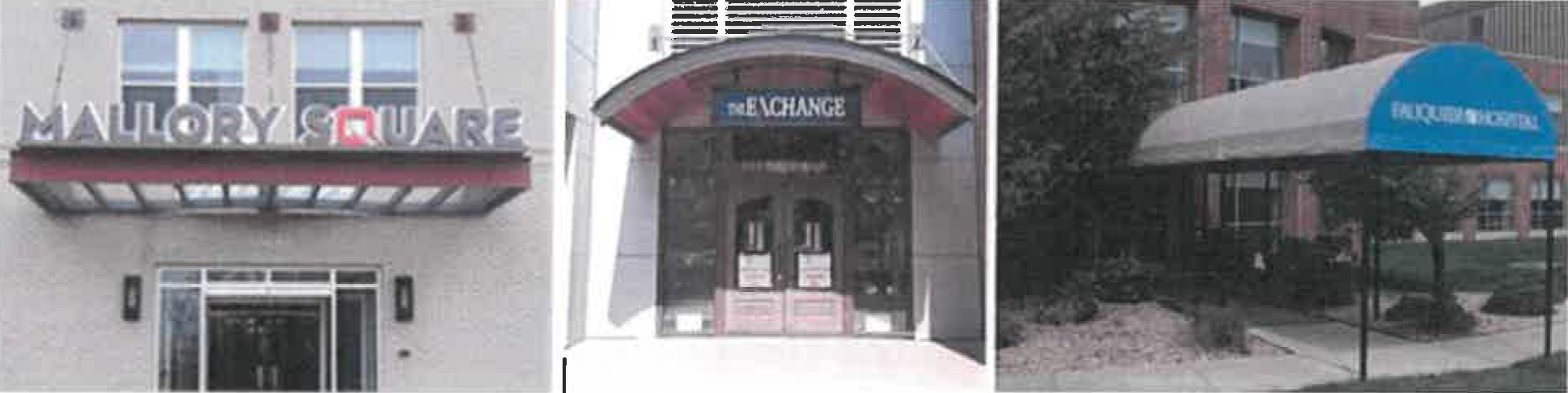
(a)
Signs mounted to the top of a canopy shall be designed such that:
(1)
Sign can be affixed to the canopy and shall only be comprised of channel letters or other three-dimensional forms.
(2)
Mounting hardware and supporting structures of the sign are to be concealed from view unless hardware and supporting structures are integral to the design of the structure.
(3)
Sign does not extend more than two feet above the top of the canopy, or extend above the nearest roofline, whichever is lesser in height.
(b)
Sign shall not extend beyond the vertical edge of the canopy.
(c)
Canopy with a sign shall be designed to be compatible with the building in scale, proportion, material, and color.
(d)
Corporate stripes, logos, and designs proposed on the canopy in a pedestrian area shall be counted as part of the overall permitted sign area.
(e)
The minimum dimensional requirements and number of signs allowed for each district shall be as follows:
(9)
Projecting signs. Projecting signs are subject to the following standards:
Figure 15:27 Examples of projecting signs
(a)
Projecting signs may be attached vertically or horizontally to any building frontage that abuts an arterial or collector roadway.
(b)
Projecting signs shall not extend four feet above the top of the building wall to which it is attached.
(c)
Projecting signs shall be spaced a minimum of ten feet apart on multi-tenant buildings, unless there is less than ten feet separating tenant entrances.
(d)
The minimum dimensional requirements and number of signs allowed for each district shall be as follows:
(10)
Suspended signs. Suspended signs are subject to the following standards:
Figure 15:28 Examples of suspended signs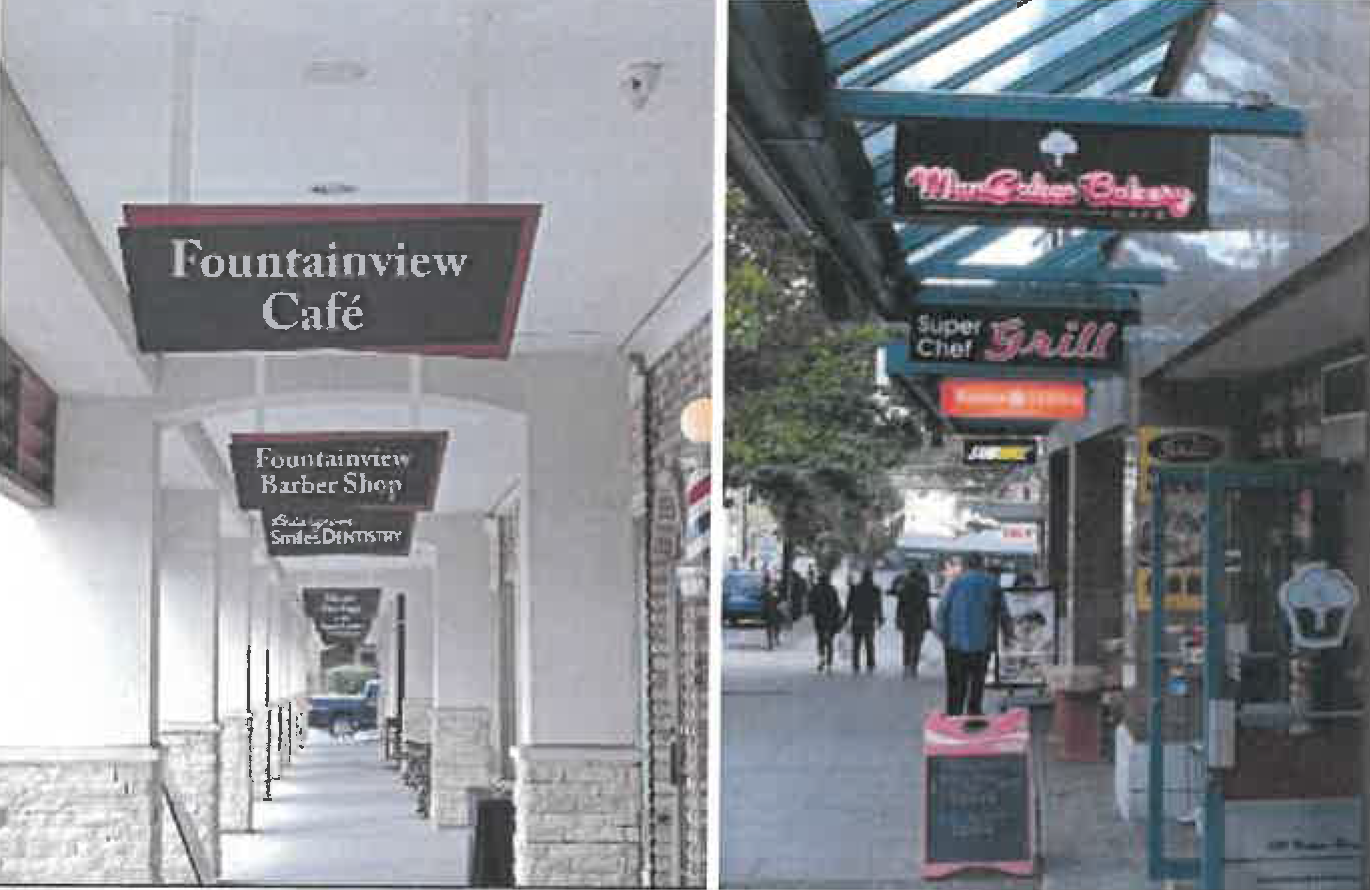
(a)
Sign shall be perpendicular to the primary face of the building wall and located under an overhang of a covered porch or walkway, within ten feet of the primary pedestrian entrance of the associated tenant or use.
(b)
The minimum dimensional requirements and number of signs allowed for each district shall be as follows:
(11)
Murals and art sculptures. Murals and art sculptures are subject to the following standards:
(a)
Murals may be located on a principal structure, accessory structure, fence or wall, or other structure on a lot.
(b)
Art sculptures may be located on a lot outside of required buffers and yard setbacks.
(c)
The minimum dimensional requirements and number of murals and art sculptures allowed for each district shall be as follows:
(12)
Wall signs. The standards below apply to all wall signs:
(a)
No sign part, including channel letters, shall project more than 12 inches.
(b)
Signage area is determined, as shown below, based on the liner feet of the building frontage. Any sign area not used on the building frontage may be distributed onto the sides and/or rear of a building that is finished with a similar architectural facade treatment.
(c)
Signage shall not be oriented toward an adjacent residential use.
(d)
The sign area allowance for wall signs shall include any sign area utilized on a canopy sign, awning sign, illuminated window sign, or a projecting sign.
(e)
Signage attached to a multi-story (greater than two stories) multi-tenant building shall be arranged so the signs share a common horizontal centerline along the façade, spaced evenly across the building facade, and are separated vertically from all other signs a minimum of twice the height of the largest sign on the building.
(f)
The minimum dimensional requirements and number of signs allowed for each district shall be as follows:
(13)
Window signs. Window signs are subject to the following standards:
Figure 15:29 Examples of window signs
(a)
A window sign may be painted on, attached to, or placed within three feet of the inside of a window.
(b)
The minimum dimensional requirements and number of signs allowed for each district shall be as follows:
(14)
Light pole signs. Light pole signs are subject to the following standards:
Figure 15:30 Examples of light pole signs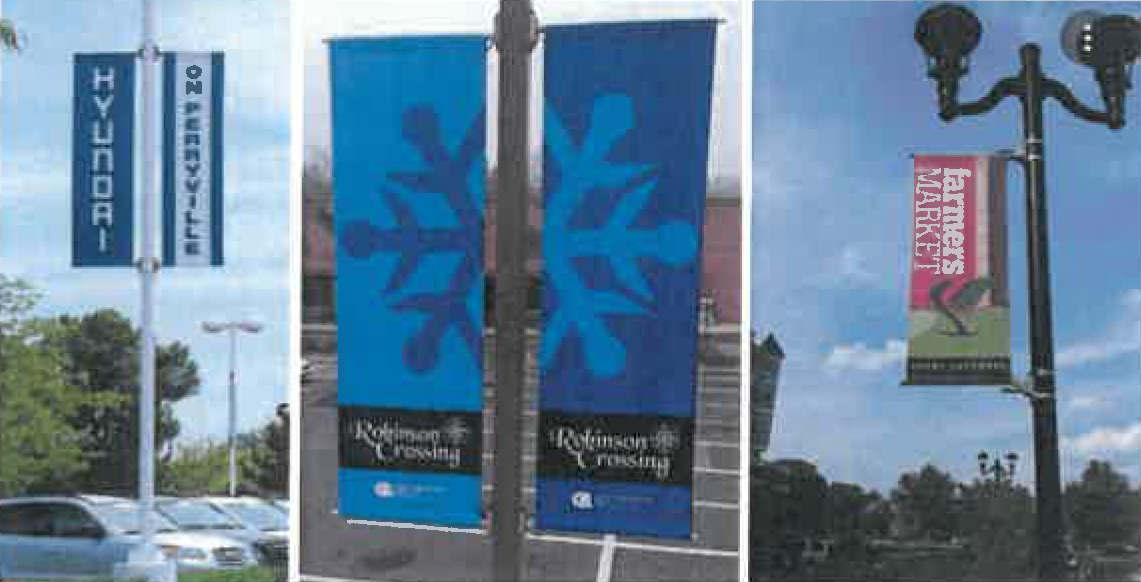
(a)
Light pole signs shall only be attached on a decorative parking light pole, walk light pole, or streetlight pole located on private property or within a private right-of-way that has been approved through city-approved site plan, subdivision, or building permit.
(b)
Light pole signs shall be consistent throughout the site, including size, height, cohesive theme and colors.
(c)
Light pole signs shall not encroach into existing tree canopies and trees shall not be unnecessarily trimmed in an effort to accommodate light pole signs.
(d)
Light pole signs shall be attached securely to a decorative parking light pole, walk light pole, or streetlight pole on all four corners to ensure they do not move, or flap and shall maintain the minimum clearance requirement.
(e)
All existing light poles on a property shall comply with the regulations in this code before a light pole sign permit is issued for any portion of the property.
(f)
Light pole signs can be changed out on intervals throughout the year as long as the sign continues to comply with the regulations in this chapter.
(g)
If light pole signs are not maintained in an accordance with this code the light pole signs are to be removed and replaced within 30 days with a new light pole sign in compliance with this chapter. Failure to maintain and replace the light pole signs in compliance with this code shall require the property owner to remove all light pole signs within 30 days.
(h)
Light pole signs shall be allowed only with approval from the owner(s) of the underlying real property and the light pole.
(i)
The minimum dimensional requirements and number of signs allowed for each district shall be as follows:
(15)
Roof sign. Roof signs are subject to the following standards:
(a)
A roof sign may be erected on a building located in the Down Under Special Character District within the Commercial District (Comm) Area and the Riverwalk Special Character District within the Mixed-use (MXU) District Area. The boundaries of the Down Under and Riverwalk Special Character Districts are defined in the most current version of the Port Orange Town Center Community Redevelopment Area (CRA) Plan.
(b)
Roof signs shall not be oriented toward an adjacent residential use.
(c)
No portion of any roof sign structure shall project beyond an exterior wall.
(d)
A roof sign shall not extend higher than four feet beyond the highest point of a parapet wall or the roof upon which it is placed.
(e)
The minimum dimensional requirements and number of signs allowed for each district shall be as follows:
(Ord. No. 2021-13, § 2, 10-19-21; Ord. No. 2022-10, § 2, 5-3-22)
Section [12]: - Temporary signs.
(a)
The standards of this section apply to all temporary signs. Temporary signs may be subject to additional standards set out elsewhere within these regulations.
(b)
The purpose of a temporary sign is to display a message for a temporary duration. Temporary signs shall not be used to circumvent the regulations that apply to permanent signs or to add permanent signage to a property in addition to that which is allowed by these regulations.
(c)
If any person erects, or any business or organization causes to be erected, a temporary sign that requires a permit without first obtaining a permit, as herein provided, the person, business or organization shall be ineligible to receive a permit for a temporary sign for six months from the date of the violation, if the violation occurs more than once in any 12-month period.
(d)
In general, a temporary sign shall be removed as of the date:
(1)
The sign becomes an abandoned sign, as defined in this code;
(2)
The sign is no longer in the condition in which it was installed. This includes no longer being in an upright position, is missing structural components or has become detached from the structure to which it was affixed, or the sign copy is no longer legible; or
(3)
It becomes expired as per the number of days in the tables below.
(e)
Temporary sign types. Temporary signs include the following types:
(1)
Banner.
Figure 15:31 Examples of banners
(a)
Banners shall be attached to the wall of the building front elevation and shall not obstruct any portion of a window, doorway, or other architectural detail.
(b)
Banners shall not be attached to trees, non-metal poles or support, or landscaping. A banner can be attached between two temporarily installed metal poles not exceeding six feet in height.
(c)
The minimum dimensional requirements and number of signs allowed for each district shall be as follows:
(2)
Sandwich board sign. Sandwich board signs are subject to the standards below:
Figure 12:32 Examples of sandwich board signs
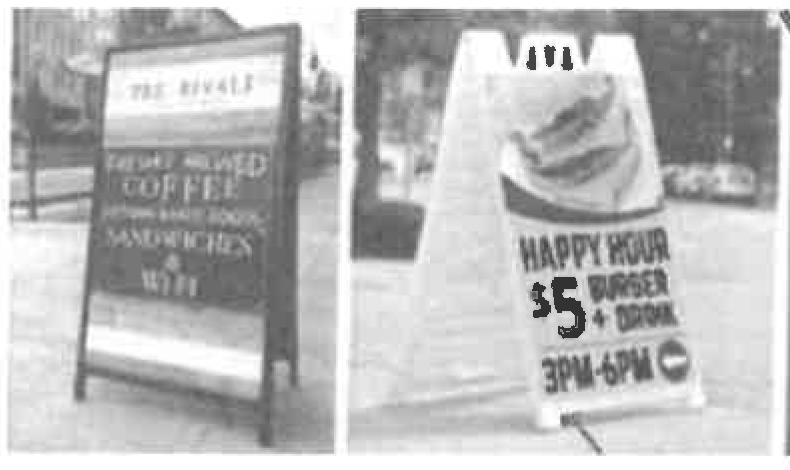
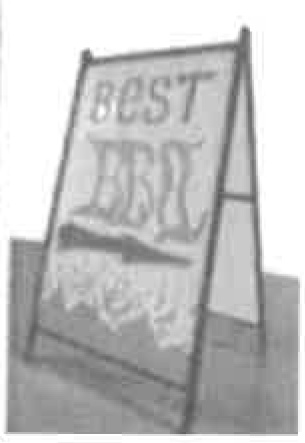
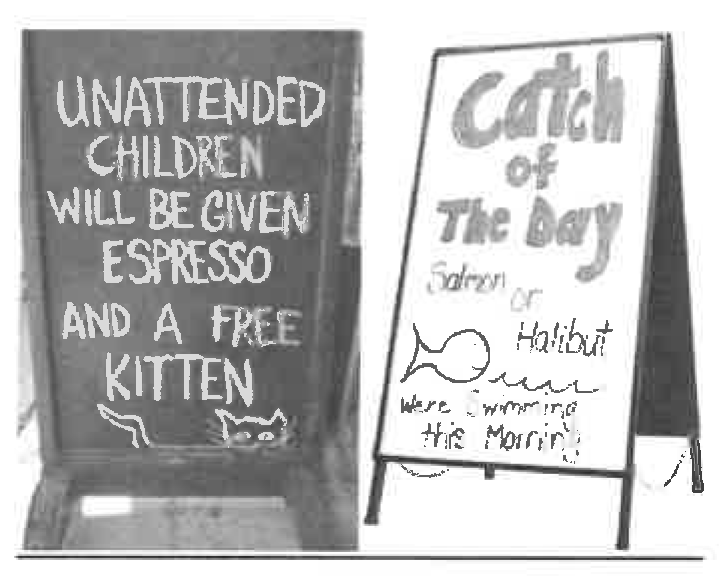
(a)
A sandwich board may convey changeable messages through the use of re-writable surfaces, such as chalkboards or dry-erase boards. Individual changeable copy plastic letters shall not be permitted, and paper signs shall not be attached to a sandwich board sign. Sandwich board signs with changeable copy shall not be composed of plastic.
(b)
A sandwich board sign shall not obstruct pedestrian access or movement. A minimum of four feet of sidewalk clearance or as otherwise required by law, including, but not limited to, the Americans with Disabilities Act (ADA) requirements, whichever is greater shall be maintained at all times.
(c)
Sandwich board signs must be removed each day at close of business and stored indoors.
(d)
Sandwich board signs shall be located no more than 15 feet from the main pedestrian entrance of the use. This distance may be increased only by the minimum amount necessary to achieve the minimum width for pedestrian ingress and egress or as required by the ADA.
(e)
Sandwich board signs must be anchored to the ground or weighted sufficiently to prevent movement by wind.
(f)
Other sign types similar to a conventional sandwich board sign such as an "A-frame", "T-frame", or other design may be approved by the administrative official.
(g)
The minimum dimensional requirements and number of signs allowed for each district shall be as follows:
(3)
Site sign. Site signs are subject to the following standards:
Figure 15:33 Examples of site signs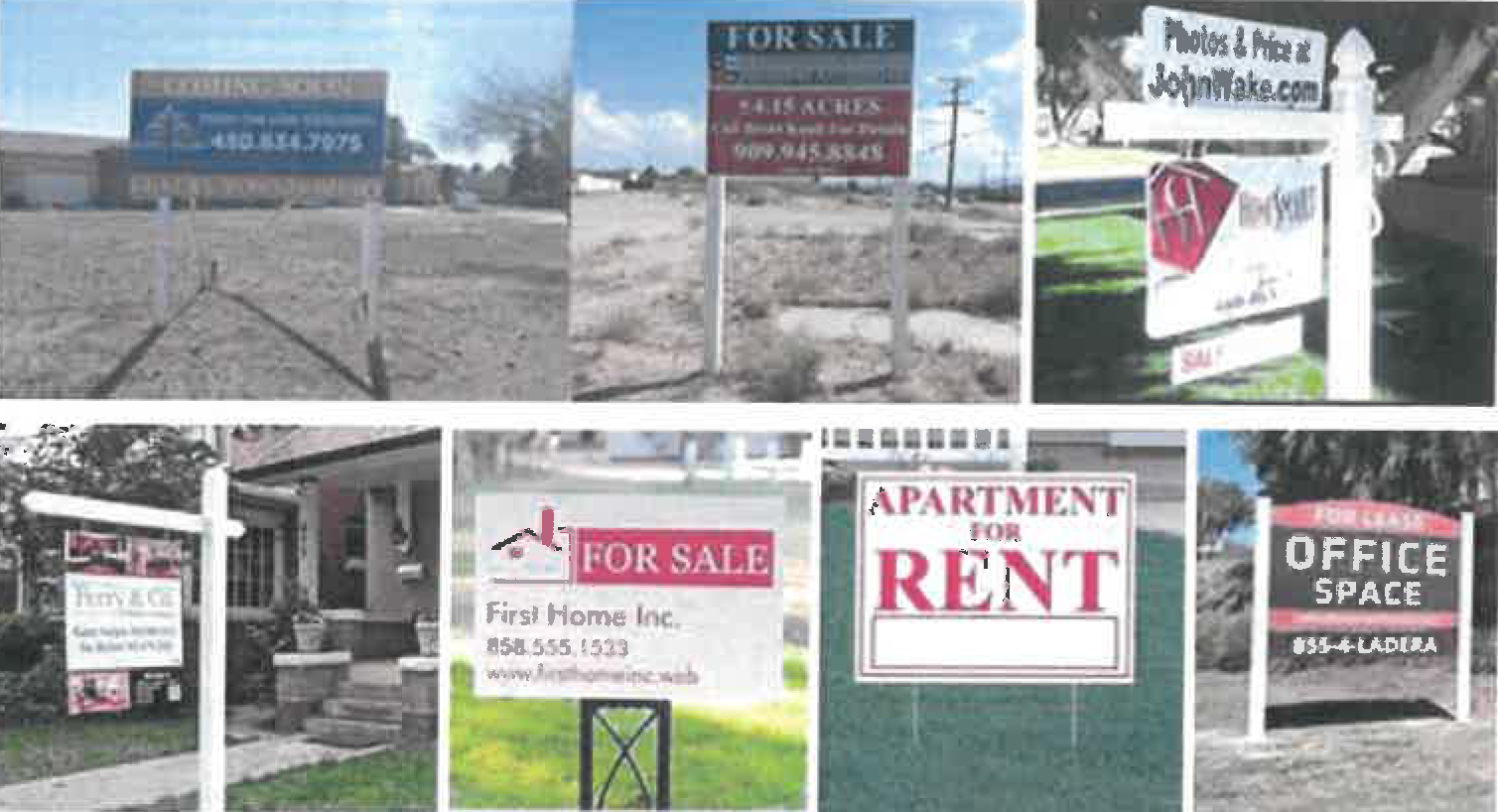
(a)
Site signs shall not be installed as an alternative to or in place of a permanent sign.
(b)
Site signs are only allowed on properties with active listings for sale or for rent, or on properties with an active building permit, site development permit, a subdivision development permit, or a special event permit approved by the city.
(c)
The minimum dimensional requirements and number of signs allowed for each district shall be as follows:
(4)
Yard sign. Yard signs are subject to the standards below.
Figure 15:34 Examples of yard signs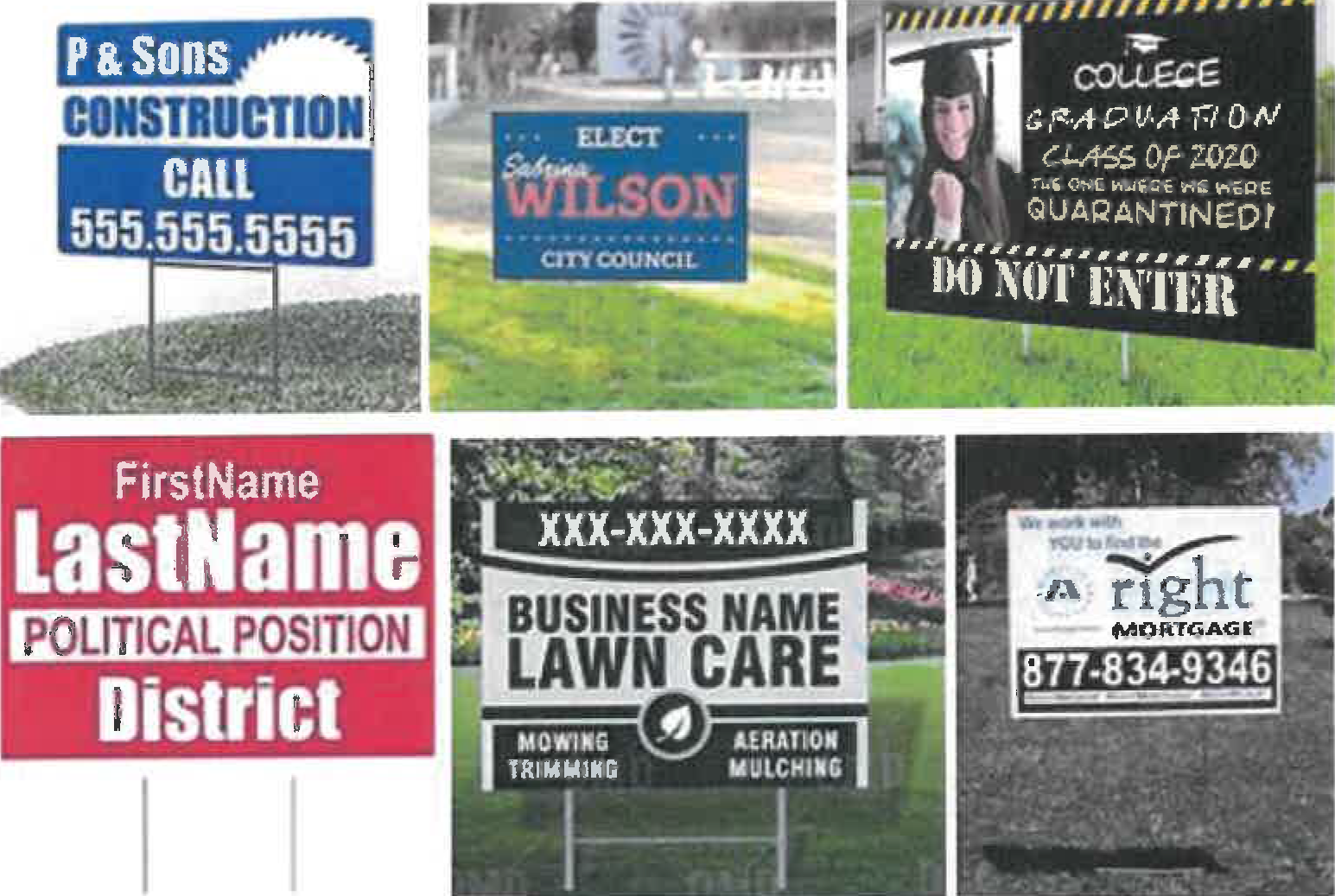
(a)
Yard signs may not be placed in a visual clearance area as defined in chapter 16 of this code.
(b)
In addition to the maximum number of yard signs shown in the table below, three additional small yard signs may be allowed during each period that is 45 days prior to an election day, as such term is defined in F.S. § 97.021 on any lot regardless of zoning district, or on a vacant property. Within five days after each election day, any additional yard sign authorized by this subsection shall be removed.
(c)
The minimum dimensional requirements and number of signs allowed for each district shall be as follows:
(5)
Temporary sign cover. Temporary sign cover is subject to the standards below:
(a)
Applies to a temporary covering placed over a monument sign that has been constructed pursuant to an approved building permit.
(b)
Temporary sign cover shall be fitted tightly and be secured to the permanent monument sign to avoid movement in windy conditions.
(c)
A temporary sign cover may be displayed no more than a total of 60 days in a calendar year.
(d)
A permit is required each time a temporary sign cover is placed over a permanent sign.
(Ord. No. 2021-13, § 2, 10-19-21; Ord. No. 2022-10, § 2, 5-3-22)
Section [13]: - Maintenance.
(a)
The owner or lessee of any sign shall be responsible for taking all reasonable actions to maintain signs and/or sign structures in accordance with this section.
(b)
All signs and sign structures shall be maintained in good condition, in compliance with this section and in accordance with the following:
(1)
A sign or sign structure that is broken, torn, bent, has a broken, bent, or damaged support, or is not vertical, level and plumb, shall be repaired or reinstalled.
(2)
A sign or sign structure that is disfigured, cracked, rippled, or peeling material or paint shall be repaired or repainted.
(3)
A sign or sign structure, including lighting, shall function properly at all times as approved by a permit and/or required by this code.
(4)
A sign panel that is broken or damaged shall be replaced with a tenant sign panel or a blank neutral color sign panel.
(5)
The vegetation around, in front of, behind, and underneath an approved freestanding sign with column supports shall be kept trimmed and free of trash and debris as required by this code and the Code of Ordinances.
(6)
A sign with a solid base shall be maintained so there is not visible area between the sign base and ground, except for an approved freestanding monument sign with columns.
(7)
A sign that no longer contains a sign panel shall be removed or replaced with a blank neutral color sign panel within 30 days of the date on which the sign panel was removed.
(8)
A permitted temporary sign that has not been maintained in accordance with this code shall be removed within 48 hours after issuance of a notice of violation. In addition to any applicable code enforcement remedies available, failure to remove or repair the temporary sign within 48 hours after issuance of a notice of violation shall result in the person responsible for removal or repair of the temporary sign being ineligible to display a temporary sign for six months from the date of the violation, if the violation occurs more than once in any 12-month period.
(c)
All signs and sign structures shall be maintained in a safe condition, in compliance with all applicable building and electrical codes and this code. If it is determined that a violation has occurred, the city shall give written notice to the owner or lessee of such sign and sign structure. If the owner or lessee fails to remove or alter the sign and sign structure to comply with the regulations set forth in this chapter within the time prescribed in the notice, such sign or sign structure may be removed or altered to comply by the city at the expense of the owner or lessee of the property upon which it is located.
(d)
The issuance of any sign permit shall be conditioned upon the restoration of any building facade which has been damaged by placement of a previous sign. Such restoration shall include, but not be limited to, patching, repainting, and concealing visible electrical components, when applicable.
(e)
Repair work required by this code shall comply with the permit requirements in this code.
(f)
Should any sign become unsecured or in danger of falling, in disrepair or deteriorated, or otherwise unsafe in the opinion of the building official, the owner thereof, or person or firm maintaining it, shall, upon receipt of written notification from the building official immediately, in the case of imminent danger, or within ten days in other instances, secure the sign or cause it to be placed in good repair in a manner approved by the building official, or said sign shall be removed by the owner thereof. If such order is not complied with, the city may remove the sign at the expense of the owner and may place a lien for the cost thereof upon the property on which the sign was located together with any other cost incurred by the city by filing such lien. The lien may be foreclosed in the same manner provided by law for the foreclosure of mortgages and the city shall have the right to receive all costs of court including reasonable attorney fees.
(Ord. No. 2021-13, § 2, 10-19-21)
Section [14]: - Nonconforming signs.
(a)
It is the intent of this chapter to allow nonconforming signs permitted before the adoption of this code to continue until they are no longer used, or become hazardous, but not to encourage their survival. Such signs are hereby declared to be incompatible with the overall intent of this chapter.
(b)
All nonconforming and nonpermitted signs, except as provided herein, shall be removed immediately or as otherwise provided under this chapter.
(c)
Use of a nonconforming sign may be continued, subject to the following regulations:
(1)
No nonconforming sign shall be enlarged or increased in any way from its lawful size at the time it was installed or constructed, nor shall a nonconforming sign be relocated from its lawful location at the time it was installed or constructed.
(2)
Nonconforming signs or sign structures that are considered abandoned signs under this chapter shall not be permitted for reuse.
(3)
Except as authorized in subsections (e)(1) and (f)(1), hereinbelow, use of a nonconforming sign shall immediately terminate upon a change of business type, business ownership or business name, regardless of whether property ownership of the lot on which the nonconforming sign is located has been transferred.
(4)
Signs existing as of the date this chapter is adopted, whose height and/or sign area do not exceed 115 percent of that allowed by this chapter, shall be deemed conforming. Installation or construction of all new signs, and any modification or replacement of signs permitted under this subsection, shall comply with all applicable height, sign area, and other requirements of this chapter.
(5)
Any sign that is nonconforming and is determined by the administrative official to be in good repair shall be permitted to continue past the compliance deadline established in subsection (4). Signs that have substantial rust, missing parts, dents, or other structural or aesthetic deficiencies shall not be considered in good repair.
(6)
Nonconforming real estate or construction signs shall be removed no later than six months after the adoption of this chapter. Thereafter, all such nonconforming signs shall be deemed unlawful and prohibited and subject to the enforcement provisions of this chapter.
(d)
Normal repairs, maintenance and improvements may be made to nonconforming signs or sign structures; however, the cost of such repairs, maintenance or improvements made during any two-year period shall not exceed 25 percent of the overall replacement cost of the sign or sign structure at the end of the two-year period.
(e)
If any nonconforming sign is damaged by fire, flood, explosion, collapse, wind, war or other catastrophe to such an extent that the cost of repair and reconstruction will exceed 50 percent of the overall replacement cost of the sign at the time of damage, it shall not be repaired or reconstructed except in full conformity with the provisions of this code, except as follows:
(1)
A nonconforming offsite sign damaged by catastrophe exceeding 50 percent of the overall replacement cost of the sign may be reconstructed pursuant to the authority set forth in F.S. § 70.20, if the reconstruction agreement complies with all of the requirements set forth as follows:
(a)
The reconstructed sign shall be located on the same property as the damaged sign.
(b)
The reconstructed sign shall be located within a commercially zoned district, not including a planned commercial development or a planned unit development zoned district and shall comply with the requirements of this chapter regarding prohibited signs.
(c)
The sign owner shall submit a proposed agreement for the reconstructed sign to the city for review.
(d)
City council shall determine whether to approve or deny the proposed agreement submitted in accordance with this section; The reconstructed sign shall be a nonconforming sign.
(e)
The sign owner agrees to remove or to abstain from rebuilding other damaged nonconforming signs within the city at a ratio of at least four sign faces for each reconstructed sign face
(f)
The sign owner agrees to remove or to abstain from rebuilding other damaged nonconforming signs within the city at a ratio of at least four sign faces for each reconstructed sign face.
(g)
The vertical dimension for the reconstructed sign face shall not exceed 25 percent of the permitted building height in the commercial district or 12 feet, whichever is greater in height.
(h)
The reconstructed sign face shall not exceed the square footage of the largest damaged sign face for any one sign display being removed or not rebuilt, notwithstanding the location within the city of the sign face removed or not rebuilt.
(i)
Structural components surrounding the sign face shall not exceed a size of ten percent of the sign face.
(j)
The reconstructed sign face may change copy and if electronic or digital, the frequency of copy change shall not be less than eight second intervals, and the maximum transition time between messages shall not exceed one second.
(k)
The reconstructed sign, if electronic or digital, shall provide a high-resolution picture quality with pixel spacing of 20 millimeters or less. Messages shall not display any illumination that moves, appears to move, flashes, scrolls, or changes in intensity during the static display period, but static graphic pictures may be displayed with no limitations on color. Messages shall not operate at a brightness level of more than 5,000 foot-candles during the day and 500 foot-candles from dusk to dawn. Each digital sign shall have a light-sensing device to adjust the brightness of the sign face as ambient light conditions change. A malfunctioning sign face must be turned off or display a blank screen. Sign shall display emergency announcements or alerts, including, but not limited to Amber Alerts, Silver Alerts, and Evacuation Alerts on the sign at no charge on an as-needed basis as determined by the city.
(l)
The tallest portion of the reconstructed sign, including appurtenances, shall not exceed the permitted building height in the commercial district.
(m)
The sign agreement shall not contain any provision that would require the city to pay compensation for any sign removed or not rebuilt pursuant to the agreement.
(n)
The reconstructed sign shall comply with setback, landscaping, and architectural standards consistent with the requirements for the construction of a building within the zoning district and applicable design manuals.
(f)
In an effort to reduce the number of nonconforming signs located within the city that have a sign face greater than 200 square feet, an existing nonconforming sign with a sign face greater than 200 square feet may be reconstructed pursuant to the authority set forth in F.S. § 70.20, provided that the number of reconstructed sign faces result in a net reduction in the number of sign faces greater than 200 square feet within the city and the reconstruction agreement complies with all of the requirements set forth as follows:
(1)
Only an existing nonconforming sign with a sign face greater than 200 square-feet located along Ridgewood Avenue or the I-95 corridor can be reconstructed with a new sign face. A new sign face may be reconstructed on a new sign structure in exchange for the removal of at least two sign faces located within the city so long as each sign face to be removed is greater than 200 square-feet. The reconstruction of a nonconforming sign with a new sign face (s) may be in the same location as the removed nonconforming sign and sign face(s). This exchange shall comply with all of the requirements set forth as follows:
(a)
The reconstructed nonconforming sign structure and sign face(s) shall either be (1) reconstructed in generally the same location, on the same property where the existing nonconforming sign structure and sign face(s) is located; or (2) reconstructed in generally the same location, on the same property as an existing nonconforming sign and sign face(s) located along I-95 that is to be removed in the course of reconstruction.
(b)
A reconstructed sign can only be located on property that abuts Ridgewood Avenue or the I-95 right-of-way, or is within the I-95 right-of-way. A reconstructed sign cannot be located on property within a residential zoning district.
(c)
The sign owner shall submit a proposed reconstruction agreement to reconstruct a sign for the city for review.
(d)
City council shall determine whether to approve or deny the proposed reconstruction agreement submitted in accordance with this section; The reconstructed sign shall continue to be a nonconforming sign.
(e)
The sign face for a reconstructed sign shall not exceed the square footage of the largest sign face removed as part of the exchange.
(f)
Structural components surrounding the reconstructed sign face shall not exceed a size of ten percent of the sign face.
(g)
The reconstructed sign may have a sign face with a change copy, and if electronic or digital, the frequency of copy change shall not be less than eight-second intervals, and the maximum transition time between messages shall not exceed one second.
(h)
If electronic or digital, the reconstructed sign face, shall provide a high-resolution picture quality with pixel spacing of 20 millimeters or less. Messages shall not display any illumination that moves, appears to move, flashes, scrolls, or changes in intensity during the static display period, but static graphic pictures may be displayed with no limitations on color. Messages shall not operate at a brightness level of more than 5,000 foot-candles during the day and 500 foot-candles from dusk to dawn. Each digital sign shall have a light-sensing device to adjust the brightness of the sign face as ambient light conditions change. A malfunctioning sign face must be turned off or display a blank screen. Sign shall display emergency announcements or alerts, including, but not limited to Amber Alerts, Silver Alerts, and Evacuation Alerts on the sign at no charge on an as-needed basis as determined by the city.
(i)
The tallest portion of the reconstructed sign, including appurtenances, shall not exceed the current height of the sign on the same property and same location as the sign being removed.
(j)
All new utilities to the reconstructed sign shall be undergrounded.
(k)
The nonconforming sign and its sign face(s) being removed as part of the exchange shall be removed prior to the issuance of the building permit to reconstruct a nonconforming sign and its sign face(s), subject to an approved reconstruction agreement.
(g)
The casual, temporary, or illegal use of any sign shall not be sufficient to establish the existence of a nonconforming use or to create any rights in the continuance of such use.
(Ord. No. 2021-13, § 2, 10-19-21; Ord. No. 2025-19, § 1, 10-7-25)
Section [15]: - Enforcement.
(a)
It shall be unlawful for any person to violate any provision of this chapter or fail to comply with any of the requirements of this chapter. Any person who has violated, causes to be violated or continues to violate the provisions of this article shall be subject to appropriate code enforcement action. Furthermore, any continuing violation of any of the provisions of this chapter shall be deemed a public nuisance and may be abated by the city as provided by law.
(Ord. No. 2021-13, § 2, 10-19-21)
Section [16]: - Variances and appeals.
(a)
Appeals from technical decisions of the administrative official or any other official empowered to rule on sign issues shall be processed according to the procedures as outlined in chapter 3 of this code.
(b)
Variances from the requirements of this chapter shall be processed according to the provisions of chapter 19 of this code.
(Ord. No. 2021-13, § 2, 10-19-21)
Section [17]: - Severability.
(a)
Generally. If any part, section, subsection, paragraph, subparagraph, sentence, phrase, clause, term, or word of this chapter is declared unconstitutional by the valid judgment or decree of any court of competent jurisdiction, the declaration of such unconstitutionality shall not affect any other part, section, subsection, paragraph, subparagraph, sentence, phrase, clause, term, or word of this chapter.
(b)
Severability where less speech results. Without diminishing or limiting in any way the declaration of severability set forth above in subsection (a), or elsewhere in this chapter, this code, or any adopting ordinance, if any part, section, subsection, paragraph, subparagraph, sentence, phrase, clause, term, or word of this chapter is declared unconstitutional by the valid judgment or decree of any court of competent jurisdiction, the declaration of such unconstitutionality shall not affect any other part, section, subsection, paragraph, subparagraph, sentence, phrase, clause, term, or word of this chapter, even if such severability would result in a situation where there would be less speech, whether by subjecting previously exempt signs to permitting or otherwise.
(c)
Severability of provisions pertaining to prohibited signs. Without diminishing or limiting in any way the declaration of severability set forth above in subsection (a), or elsewhere in this chapter, this code, or any adopting ordinance, if any part, section, subsection, paragraph, subparagraph, sentence, phrase, clause, term, or word of this chapter or any other law is declared unconstitutional by the valid judgment or decree of any court of competent jurisdiction, the declaration of such unconstitutionality shall not affect any other part, section, subsection, paragraph, subparagraph, sentence, phrase, clause, term, or word of this chapter that pertains to prohibited signs, including specifically those signs and sign-types prohibited and not allowed in this chapter. Furthermore, if any part, section, subsection, paragraph, subparagraph, sentence, phrase, clause, term, or word of section 3 is declared unconstitutional by the valid judgment or decree of any court of competent jurisdiction, the declaration of such unconstitutionality shall not affect any other part, section, subsection, paragraph, subparagraph, sentence, phrase, clause, term, or word of section 3.
(d)
Severability of prohibition on billboards. If any part, section, subsection, paragraph, subparagraph, sentence, phrase, clause, term, or word of this chapter and/or any other code provisions and/or laws are declared invalid or unconstitutional by the valid judgment or decree of any court of competent jurisdiction, the declaration of such unconstitutionality shall not affect the prohibition on billboards as contained herein.
(Ord. No. 2021-13, § 2, 10-19-21)

