
Ridgefield City Zoning Code
CHAPTER 18
401 - PLANNED UNIT DEVELOPMENTS13
Editor's note— Ord. No. 1132, § 2(Exh. A), adopted July 11, 2013, amended Ch. 18.401 in its entirety to read as herein set out. Former Ch. 18.401, §§ 18.401.010—18.401.170, pertained to similar subject matter, and derived from Ord. No. 1108, § 2, 7-26-2012; Ord. 743 § 1 (part), 1999.
18.401.010 - Purpose.
The purpose of this chapter is to provide for public spaces, parks and trails consistent with the adopted community vision and plans, thereby creating an integrated system of linked local and regional trails, public rights-of-way and utility corridors for the use and enjoyment of all Ridgefield residents and the general public. The purpose of the planned unit development (PUD) approval process is to allow flexibility in site planning, building design, open space, parks and trails, circulation facilities and other features, while providing for the orderly development of the city consistent with the RUACP and the following objectives:
A.
Allow for planned development equal to or superior to traditional lot-by-lot subdivisions by providing for a mixture of single-family or multifamily residential buildings, including but not limited to single-family homes, townhouses and condominiums in one development that are architecturally and spatially compatible;
B.
Promote flexibility, variety and innovation in site and building design subject to provisions of this chapter. Buildings in groups shall be related by common materials and roof styles, but contrast shall be provided throughout the site by the use of varied materials, architectural detailing, building scale and orientation;
C.
Encourage efficient street design, utility systems and public services and uses of land that could include development clustering;
D.
Provide and ensure preservation and enhancement of usable open spaces, parks and trails;
E.
Ensure that pedestrian and vehicular circulation facilities, parking facilities and other pertinent amenities are an integral part of the landscape and provide a safe integration of pedestrian, bicycle and vehicular traffic;
F.
Ensure that recreational areas (active and passive) generally are dispersed throughout the development and easily accessible from all dwelling units;
G.
Preserve and enhance natural vegetation and natural landscape features of the site; avoid development on steep slopes, wetlands and riparian areas; and protect and enhance critical fish and wildlife habitat areas, pursuant to Chapter 18.280;
H.
Maintain surface water and groundwater quality through employment of best management practices and recent science in planning and designing stormwater drainage systems that are uniquely adapted to the site and the affected environment;
I.
Provide for a multi-modal transportation system;
J.
Provide for the transition of new developments into the existing community through innovative design, screening, buffering, building setbacks and other measures to assure compatibility with existing zoning and plan districts, and adjacent existing neighborhoods.
(Ord. No. 1132, § 2(Exh. A), 7-11-2013)
18.401.020 - Applicability.
A.
The PUD process is required for all developments in the RLD or RMD zones that create ten or more lots through a subdivision process and include critical areas within the project boundaries, except for sites zoned RMD being developed under the RMUO overlay, which is exempt from the PUD process. The PUD process is discretionary for all other developments, including developments created through short plat.
B.
All PUDs shall be reviewed under Type III procedures, in accordance with Chapter 18.310, Review Procedures. PUD proposals which include mixed-use development shall be finally approved through a Type III review by the city council after recommendation from the review authority.
(Ord. No. 1132, § 2(Exh. A), 7-11-2013; Ord. No. 1179, § 2(Exh. A), 2-26-2015; Ord. No. 1207, § 2(Exh. A), 5-26-2016; Ord. No. 1232, § 2(Exh. A), 4-27-2017)
18.401.030 - Permitted uses.
A.
Where the proposed uses are permitted outright in the underlying zone, the review authority shall approve the proposed development, or approve it with conditions designed to mitigate identified impacts, provided that the proposal meets the criteria and standards of this chapter.
B.
PUD approval involving uses that are not permitted outright or conditionally in the underlying zone is discretionary. Such uses may only be approved by the city council after consideration of the recommendation of the review authority and adoption of a finding that the proposal is consistent with the policies of the RUACP.
C.
Land Divisions. Whenever the division or re-division of property for the purpose of sale, lease or transfer of ownership is proposed, the applicant must also meet the requirements of Chapter 18.600, Subdivisions—General. Modifications to subdivision standards may be approved by the review authority or city council in accordance with Chapter 18.350 and Chapter 18.401.
(Ord. No. 1132, § 2(Exh. A), 7-11-2013; Ord. No. 1178, § 2(Exh. A), 2-12-2015; Ord. No. 1207, § 2(Exh. A), 5-26-2016)
18.401.040 - Information requirements.
The planning director shall not consider an application for a PUD unless it satisfies all of the requirements of this section. The review authority shall not accept an application which proposes development, other than required public facilities, on unbuildable land as defined in Chapter 18.280. Accuracy of all data and information submitted on or with a preliminary development plan shall be the responsibility of the applicant. The review authority shall determine whether an application is technically complete, pursuant to Chapter 18.310, and shall thereafter process an application.
A.
Preliminary PUD application requirements. An application for a preliminary PUD shall include one original copy of all application materials and electronic copies of all materials. The applicant shall provide a proposed site plan which shall include (but is not limited to) the following:
1.
The proposed boundaries and legal description of the property to be developed, together with the names, addresses and telephone numbers of the recorded owners of the land and the applicant, and if applicable, the name and telephone number of any architect, planner, designer or engineer responsible for the preparation of the plan, and of any authorized representative of the applicant;
2.
A calculation of site area including:
a.
Gross site area.
b.
Protected critical areas and buffers.
c.
Right-of-way to be dedicated.
d.
Additional public and private infrastructure, including private streets and stormwater facilities.
e.
Net developable area, as defined in RDC 18.100.036.
f.
Open space area, consistent with the requirements of RDC 18.401.080.B, including total area, main facility area, area for each dispersed facility, total developable and undevelopable portions across the site, and developable and undevelopable portions for each facility.
3.
A calculation of net density based on net developable acres, including any density modifications proposed under RDC 18.280.070 or 18.401.100. Indicate whether the applicant elects to include or exclude open space in the calculation of net developable acres as allowed under RDC 18.401.080.B.10. Calculations shall be provided for the entire site as well as broken down for each project area or phase.
4.
Concept plan(s) showing all proposed improvements and natural features, including (but not limited to):
a.
Proposed uses, lot dimensions and building envelopes for all lots and tracts,
b.
Open space and recreational facilities, including parks and trails, showing conceptual development plans and noting proposed ownership,
c.
Existing site features to be retained and removed (natural slopes, stands of trees, etc.), and proposed features including walls, fences, refuse areas, streets, sidewalks, paths, landscaping ,
d.
Proposed building areas and densities, setbacks and height,
e.
Topographical maps of existing and proposed terrain showing a maximum five-foot contour interval where slopes equal or exceed twenty-five percent and a maximum two-foot contour interval where slopes are less than twenty-five percent, including one hundred-year floodplains (identified under the National Flood Insurance program),
f.
Proposed site grading including cut and fill areas and site elevations after development,
g.
All existing and proposed transportation systems for vehicles and people, including streets, sidewalks, trails, other pedestrian facilities, and any transit facilities, showing circulation within the site and connections off-site in compliance with the Ridgefield Engineering Standards,
h.
All existing and proposed utility systems, including sanitary sewers, water, public facilities and storm drainage collection, conveyance and treatment systems,
i.
Proposed off-street parking facilities,
j.
Proposed landscaping, including existing trees of six inches dbh and vegetation communities proposed to be retained, and
k.
The proposed lot dimensions, yard setbacks and treatment of the perimeter of the PUD, including materials and techniques such as screens, fences and walls;
5.
Geotechnical and environmental reports required by the city engineer or planning director;
6.
Vicinity map showing the development in relation to the surrounding area and its uses, both existing and proposed, including land uses, zoning classifications, densities, circulation systems, public facilities and critical areas or other prominent natural features
7.
A proposed phasing and/or timing schedule indicating the approximate date when construction of the PUD or stages of the PUD can be expected to begin and be completed;
8.
Compliance with Chapter 18.810, Environmental Standards, by filing of a SEPA checklist.
9.
Map of dedication showing all land dedicated to the public for the purpose of roadway, drainage, flood control, utility line, emergency or service vehicle access, or other public use, and all easement rights dedicated for private purposes, including, but not limited to, trails, open space, parks, and storm ponds.
B.
Final PUD Application. An application for a final PUD shall include a site development plan which shall contain (but is not limited to) all of the following:
1.
Final and complete set of plans, specifically showing all requirements contained in Section 18.401.040(A);
2.
Road, drainage and utility plans with recommendations by the city engineer;
3.
Assurance of building code compliance with recommendations by the city building department;
4.
Assurance of fire code compliance with recommendations by the fire marshal;
5.
Documentation of compliance with any conditions of approval required by the review authority;
6.
Maps showing existing and finished contours at two-foot intervals, provided, however, that five-foot contours shall be sufficient for unbuildable areas where no development is proposed;
7.
Submission of declaration of covenants, conditions and restrictions for the planned unit development;
8.
Documentation of bonding or other security in compliance with Section 18.401.120;
9.
Binding site plan and other documentation required by Sections 18.401.130 and 18.401.160; and
10.
Documentation of compliance with Chapter 18.810, Environmental Standards;
11.
Documentation of compliance with the subdivision final plat process.
(Ord. No. 1132, § 2(Exh. A), 7-11-2013; Ord. No. 1178, § 2(Exh. A), 2-12-2015; Ord. No. 1232, § 2(Exh. A), 4-27-2017; Ord. No. 1234, § 2(Exh. A), 6-22-2017; Ord. No. 1253, § 2(Exh. A), 12-7-2017; Ord. No. 1296, § 2(Exh. A), 10-10-2019; Ord. No. 1426, § 2(Exh.), 7-25-2024)
18.401.050 - Approval procedures.
A.
Pre-Application Conference. Prior to making application, the applicant shall participate in a pre application conference held pursuant to RDC 18.310.030. The conference is mandatory and may not be waived.
B.
Community Information Meeting. Prior to submitting an application for preliminary PUD, the developer shall host a community information meeting, in a workshop format. The community information meeting shall be required for any proposed PUD located in a residential zone or within two hundred feet of a residential zone. The meeting shall be held at a publicly accessible location within city limits, on a weekday between the hours of five and nine p.m. At this meeting the applicant shall present the development proposed to interested residents. Information shall reflect updated studies and concepts based on input of the pre-application conference. Notice shall be posted on the city website and given in the local newspaper of record at least fourteen days prior to the meeting date. Written notice, including a fact sheet describing the proposed plan of development, shall be mailed first-class to all property owners within a radius of not less than three hundred feet of the exterior boundary of the property subject to the application and a copy shall be posted in city hall in the customary place. A copy of all the information intended for use at the meeting shall be available at the city hall for public review at least fourteen days prior to the meeting date. Any alleged failure of any property owner to actually receive the notice of meeting shall not invalidate the proceedings.
C.
Preliminary Development Plan Review.
1.
An applicant shall submit a PUD application and SEPA checklist pursuant to Section 18.401.040. The application shall address the entire property and shall include the information and guidance from the pre-application conference and community workshop.
2.
The planning director shall make a determination of technical completeness, pursuant to Chapter 18.310.050 and shall consider the recommendations from the community information meeting.
3.
If, after the planning director determines the application to be technically complete, the applicant makes major modifications to the proposed PUD, the planning director may toll the one hundred twenty-day decision clock to allow the public an opportunity to review and comment on the proposed modifications. A modification will be considered major or minor consistent with the provisions of RDC 18.401.060(B). If the application is determined to be a major modification the planning director shall conduct a new review for technical completeness.
4.
The city clerk shall provide public notification of the determination of major modification in the local newspaper of record and shall mail the notice to property owners within three hundred feet of the proposed site boundaries.
D.
Hearings Requirements.
1.
Each preliminary development plan shall require a public hearing pursuant to Chapter 18.310.080. At the public hearing the applicant will present the preliminary PUD development plan and the other technical documents pertaining to the application.
2.
A decision of the hearing examiner shall be final and is subject to appeal pursuant to Section 18.310.100.
E.
Final Development Plan. Where the PUD request involves a subdivision of land, the applicant shall submit a final development plan in accordance with the requirements of Section 18.401.040(B), together with the final subdivision plat, map of dedication, and any required and SEPA documentation, to the planning director. The final PUD shall be submitted within the subdivision vesting timeframe established by RCW 58.17.140, generally within five years following the approval of the preliminary plan unless qualifying for an exemption under RCW 58.17.140. Where the PUD request does not involve a subdivision of land, within three years following issuance of a final decision on the preliminary plan, the applicant shall submit a final development plan in accordance with the requirements of Section 18.401.040(B), together with any required map of dedication and SEPA documentation, to the planning director.
1.
An extension of time for development permit application may be made in writing by the applicant. The planning director may grant no more than one extension of time for a period not to exceed one year if:
a.
Unforeseen circumstances or conditions necessitate the extension of the preliminary development plan;
b.
Termination of the preliminary development plan would result in unreasonable hardship to the applicant, and the applicant is not responsible for the delay; and
c.
An extension of the preliminary development plan will not cause substantial detriment to existing uses in the immediate vicinity of the subject property or to the community as a whole.
2.
If the city does not issue a development permit within the applicable period, including an extension of time, the PUD approval shall become null and void and shall not take effect.
3.
Final approval/disapproval of the final PUD shall be made by the city council combined with final approval/disapproval of the final subdivision plat, if the PUD involves a subdivision of land. A public hearing is not required if the final development plan does not vary substantially from the previously approved preliminary development plan. If substantial modifications are proposed, the provisions of Section 18.401.060(B)(2) shall apply. If the final plan complies with the approved preliminary plan, required SEPA mitigation measures and all other standards of this code, the final plan shall be approved.
(Ord. No. 1132, § 2(Exh. A), 7-11-2013; Ord. No. 1178, § 2(Exh. A), 2-12-2015; Ord. No. 1207, § 2(Exh. A), 5-26-2016; Ord. No. 1232, § 2(Exh. A), 4-27-2017; Ord. No. 1296, § 2(Exh. A), 10-10-2019; Ord. No. 1426, § 2(Exh.), 7-25-2024)
18.401.060 - Mix of housing types required.
A.
Purpose.
1.
To provide a variety of housing choices for different segments of the population.
2.
To provide more smaller and more affordable housing choices.
3.
To make more efficient use of Ridgefield's limited developable land and public infrastructure investments.
4.
To implement the Ridgefield Comprehensive Plan Housing Element.
B.
RMD-16 zone.
1.
Applicability. All new PUD subdivisions in the RMD-16 zone
2.
Standard. No more fifty percent of new units shall be single-family detached and accessory dwelling units in applicable PUDs. Other housing types available include but are not limited to:
a.
Cottage housing.
b.
Duplexes.
c.
Triplexes.
d.
Townhouses.
e.
Multifamily.
C.
See RDC Chapter 18.206 for related residential use standards.
D.
See RDC 18.205.030 for other single-family detached standards.
Figure 18.401.060.B
Example of an RMD-16 subdivision with a mixture of housing types.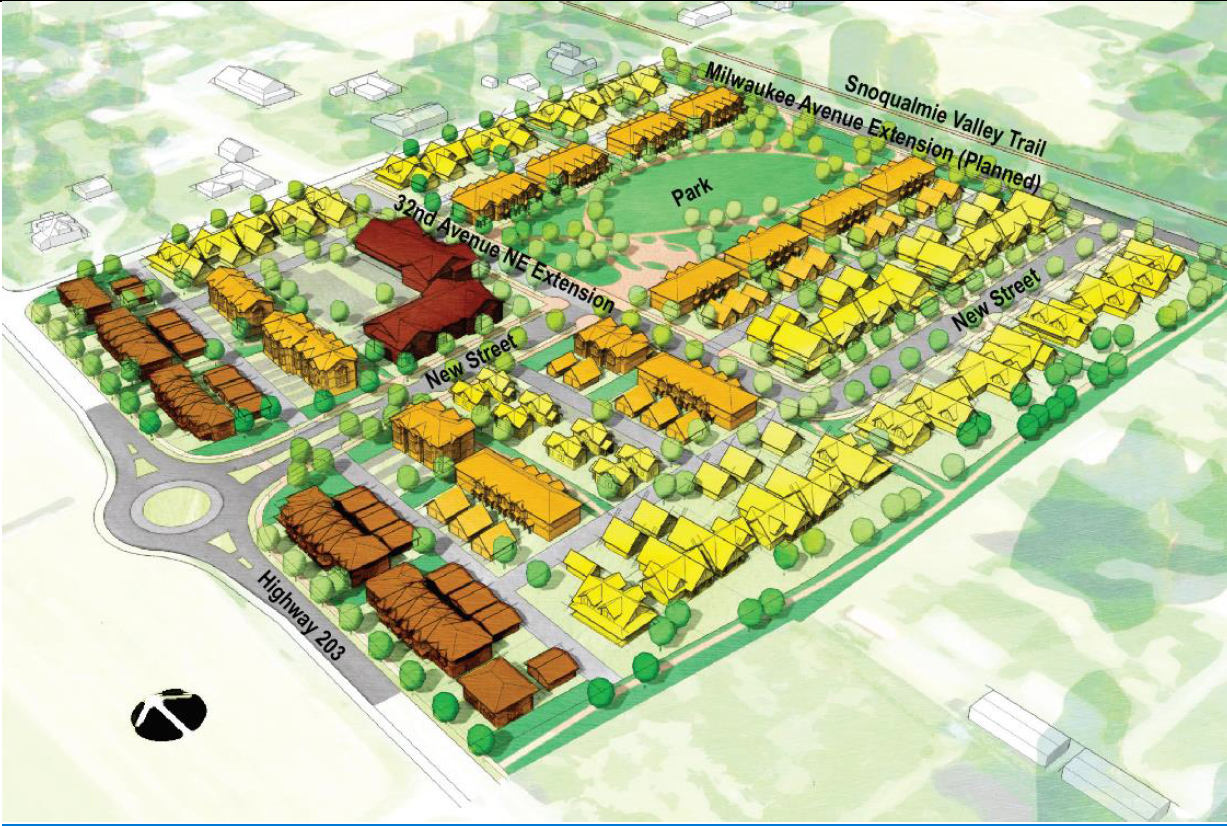
(Ord. No. 1339, § 2(Exh. A), 5-27-2021)
18.401.065 - Trails.
A.
Applicability. All PUD subdivisions shall comply with this standard.
B.
General Standards.
1.
Quantity. One foot of trail (as measured at the trail centerline) shall be provided for each three feet of the PUD's total outside perimeter. For example: A ten-acre PUD with an outside perimeter of two thousand six hundred forty feet is required to provide eight hundred eighty lineal feet of trails.
2.
Design. Trails shall be classified as either multi-modal trails or recreational trails, based on their designed use and function. Multi-modal trails, which are primarily designed to support transportation and connectivity, are further defined as arterial trails and collector trails. Recreational trails, which are intended to provide recreational experiences and outdoor access, are further defined as hiking trails or semi-primitive trails.
All trail design and construction shall adhere to the Ridgefield Engineering Standards for Public Works Construction Volume III, which establishes specific requirements for trail classification and designed use, design tread width, design surface and surface material depth, design grade and cross slope, design clearing and shoulder widths, design turns and switchbacks, base material depth and compacted material depth, and trail-constructed features including but not limited to boardwalks, puncheons, waterbars, and other erosion control and accessibility structures. Compliance with these standards is required for all new trail construction and significant trail modifications within the city of Ridgefield.
3.
Multi-Use Trail Bonus. For the purpose of the quantity requirement under subsection (B)(1) of this section, each lineal foot of trail classified as multi-modal, counts as two lineal feet, provided the trail meets all the standards of this section.
4.
Location.
a.
Trails should be located throughout the PUD subdivision to ensure connectivity within the PUD and to neighboring properties, parks, businesses, or other desirable features.
b.
Trails are encouraged to use critical areas and woodlands where permitted by the standards of this title, and to provide recreational and aesthetic access to natural features like streams, ponds, and landscape views.
c.
Trails are encouraged to be continuous and provide unobstructed access throughout and through the PUD without significant changes to trail classification where possible.
d.
Standard sidewalks and roadways not meeting the requirements of subsection (2) above, including crosswalks, shall not be considered as part of a trail for the quantitative requirements of this section.
5.
Fence and walls. Fences and walls abutting trail corridors should be designed to balance safety and visibility of trail users with privacy for residents in their rear yards. To accomplish this, the portion of any fences or walls within twenty feet of a trail and taller than five feet must be at least fifty percent transparent. Vegetative matter which functions as a fence has no height limit. Notes referencing this standard shall be included on the plat.
6.
Separation and landscaping. Trails must be separated from rear property lines with landscaping that softens the appearance of fences or walls.
Figure 18.401.065-B
Trail examples.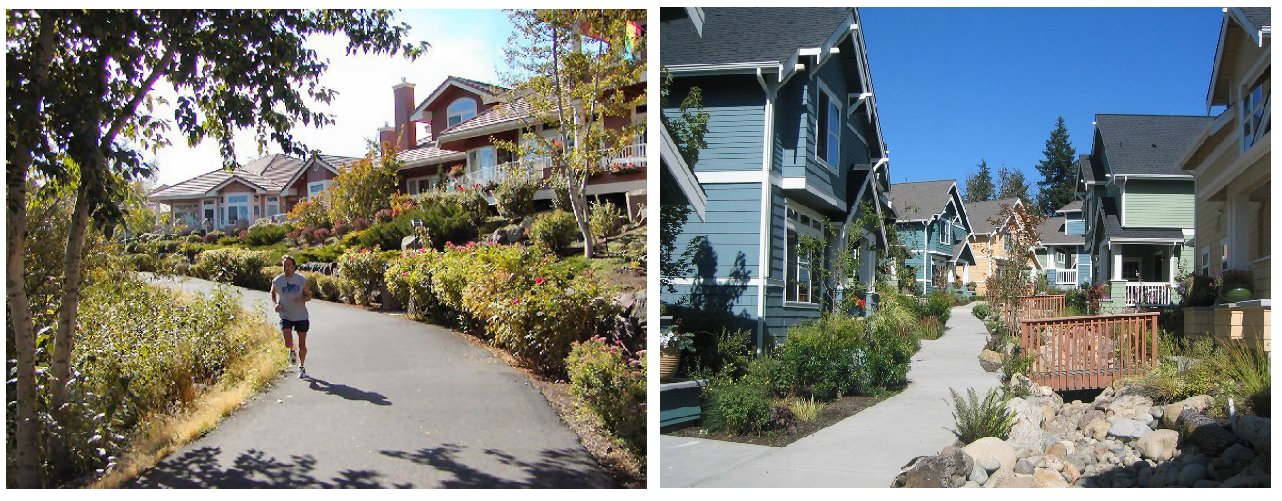
Left: Multi-modal trail. Right: Sidewalk-like trail between dwelling units.
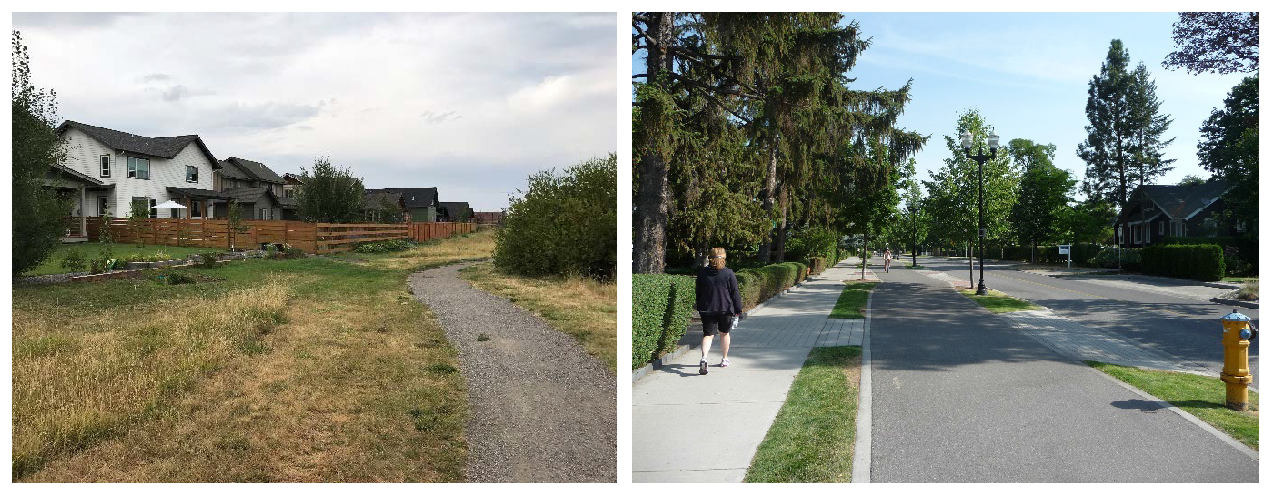
Left: Recreational trail. Right: Multi-modal trail integrated into a local street.
C.
Connections.
1.
PUD subdivisions with a planned public trail mapped in the Ridgefield Parks and Recreation Comprehensive Plan shall build the public trail. Required public trails count toward the trail quantity required in subsection (B) of this section.
2.
To the extent practical, new trails shall connect to adjacent built and planned private trails in order to create a continuous and useable network of residential trails across the city.
3.
Dead-end trails are prohibited, unless the end of the trail is at the edge of the subdivision and adjacent to another property that the Director determines is likely to be developed with trails in the future based on zoning and suitability of the adjacent site for development. This provision does not prohibit typical trail endpoints that lead to or from a street, park, viewpoint, water body, or similar points.
4.
In addition to providing recreational benefits, trails shall facilitate convenient pedestrian connections (such as mid-block connections) and connect to parks and open spaces.
Figure 18.401.065-C
Trail network examples.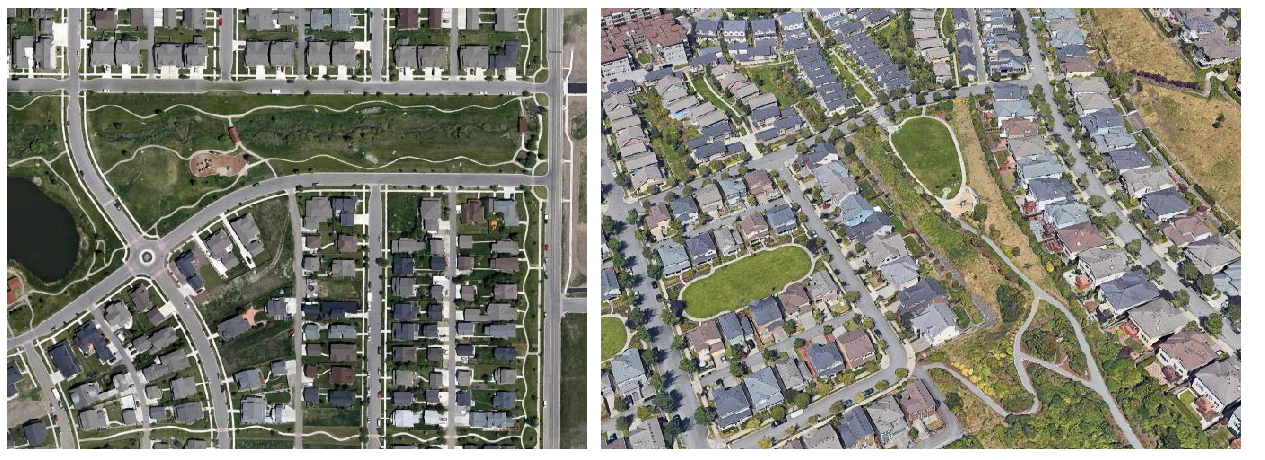
Left: Trail network through blocks and a natural area. Right: Variety of trails on hillsides, integrated into park spaces, and acting as frontage for homes. (Google Earth)
D.
Relation to Open Space Requirement. Required public and private trails may be integrated into parks that qualify as Main Facilities and Dispersed Facilities required under RDC 18.401.080.B.
(Ord. No. 1339, § 2(Exh. A), 5-27-2021; Ord. No. 1464, § 2(Exh.), 12-4-2025)
18.401.070 - Zero lot line standards.
A.
Purpose. To allow a house and/or garage to be built up to one of the side property lines, providing the opportunity for more usable side setback space.
B.
Applicability. Zero lot line configuration is an option for single-family lots in PUD subdivisions.
C.
Relation to other standards. Also see RDC 18.206.020 for single-family standards, including minimum usable open space requirements. Dimensional standards for townhouse developments are in RDC 18.206.060.
D.
Standards.
1.
Dwelling units and accessory structures may be placed on one interior side property line that is part of the development. The opposite side setback shall be at least ten feet. The horizontal distance between homes shall not be less than ten feet, including when a zero lot line lot is adjacent to a standard lot.
2.
Privacy wall. In order to maintain privacy, no windows, doors, air conditioning units, or any other types of openings in the walls along a zero lot line structure are allowed except for windows that do not allow for visibility into the interior side setback of the adjacent lot. Examples include clere-story or obscured windows. See Figure 18.410.070-D below for an example of a privacy wall for a zero lot line house.
3.
Eaves along a zero lot line may project a maximum of eighteen inches over the interior side property line.
4.
Lots intended for zero lot line homes shall be noted on the plat, together with minimum side setback areas and maximum building envelopes.
5.
Lot lines which are contiguous with the development's exterior property line shall meet the standard setback requirements of the underlying zone.
Figure 18.401.070-D
Zero lot line design.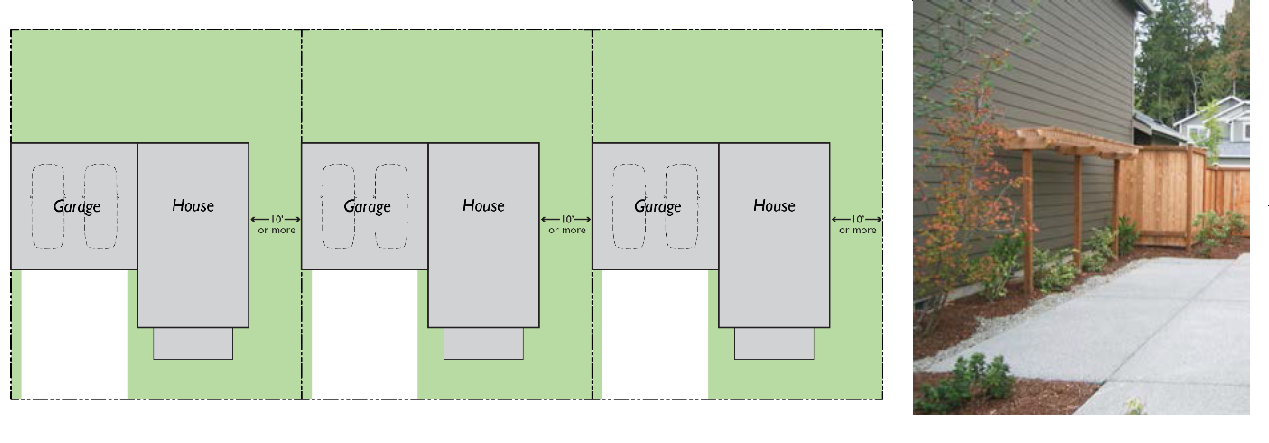
Zero lot line layout example (left). The right image shows the side setback and privacy wall for a zero lot line house.
(Ord. No. 1339, § 2(Exh. A), 5-27-2021; Ord. No. 1426, § 2(Exh.), 7-25-2024)
18.401.075 - Alternative parking configurations.
A.
Purpose.
1.
To encourage and facilitate smaller lots and more diverse residential development.
2.
To reduce the visual and functional impacts of shared parking in subdivisions.
B.
Applicability.
1.
Use of alternative parking configurations is required for PUD subdivisions when twenty-five percent or more lots with single-family dwellings are less than forty feet wide.
a.
Applicable subdivisions shall provide two and one-half parking spaces per single-family dwelling unit on a lot less than forty feet wide.
b.
The spaces required in (a) may be provided with standard off-street parking (garage and driveway). Any remaining required spaces shall be provided in off-street parking lots meeting the standards of this section. No required off-street spaces may be met through on-street parking.
2.
Alternative parking configurations are an option for all other PUD subdivisions with single-family dwellings, duplexes, triplexes, or townhomes. Parking standards for cottage housing are provided by RDC 18.206.040.
3.
Where there is a conflict with other sections of the RDC, this section prevails.
C.
Shared off-street parking. Required or extra parking spaces for individual dwelling units may be collected in shared parking lots (parking pods) within the subdivision, provided the standards of this section are met.
1.
Size and quantity.
a.
Up to one hundred percent of the total spaces in a subdivision may be placed in shared parking lots.
b.
Shared parking lots shall each contain a maximum of twenty parking spaces. A maximum of ten parking spaces shall be in any row.
c.
See Chapter 18.720 for sizing of parking spaces and drive aisles.
2.
Location.
a.
Required parking spaces shall be located within two hundred feet walking distance of associated dwelling units. Extra or guest parking spaces have no proximity limit.
b.
Parking lots primarily used for extra or guest parking should be located near parks and trailheads, when feasible.
c.
Off-street parking lots accessed by the same street shall be separated from each other by at least two hundred feet, measured along the centerline of the street.
d.
Parking lots shall not be located at street corners or on corner lots.
e.
Parking spaces may be located within required setbacks.
f.
Off-street parking lots shall be placed in a separate tract maintained by the homeowner association.
3.
Landscaping. Shared parking lots are exempt from RDC 18.720.040.C.2 and RDC 18.725.050. Provide at least five feet of L2 or L3 landscaping on sides of the tract adjacent to residential uses and at least five feet of L2 landscaping adjacent to streets and alleys.
4.
Access.
a.
Driveways may only be provided from one street and/or alley, and shall not continue through a block to another street. Drive aisles shall be two-way and shall not be one-way or configured as a loop.
b.
Through-block pedestrian access and walkways connecting to adjacent streets, alleys, and trails are encouraged.
5.
Construction. Parking lots shall be paved and are encouraged to use non-standard paving such as impervious concrete, "grasscrete," or pavers.
6.
See RDC 18.720.040.G for other development and maintenance standards for off-street parking areas.
Figure 18.401.075-C
Shared parking lot example.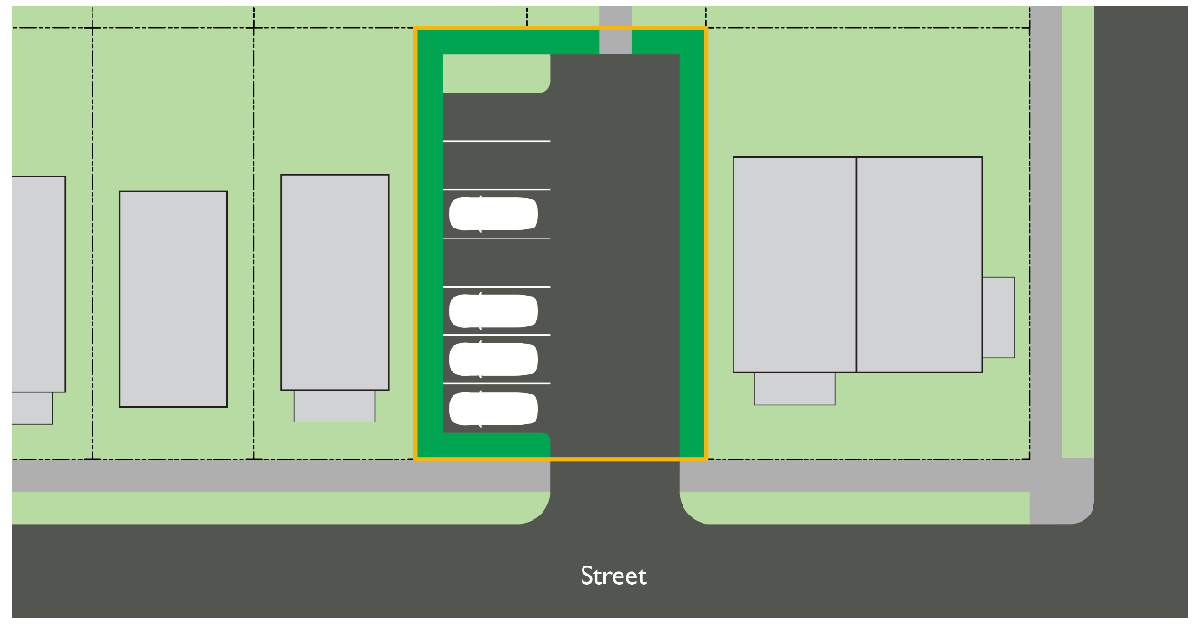
(Ord. No. 1339, § 2(Exh. A), 5-27-2021)
18.401.080 - General conditions.
A.
Residential Density.
1.
The minimum density of residential development for any PUD shall be the minimum density for the underlying zoning district. Minimum density may only be reduced through the modification process in RDC 18.350, and may not be varied through the PUD process.
2.
The maximum density of residential development for any PUD shall be the maximum density for the underlying zoning district, unless modified through the PUD process under RDC 18.401.100.A.6 or the critical areas density transfer provisions in RDC 18.280.070.
3.
On sites with more than one residential zoning designation, the applicant may distribute the density across the developable area of the site, provided that:
a.
The permitted uses, development standards, and other provisions of the unique base zones shall be applied to individual lots in the PUD based on the proportion of developable area in each base zone. Lots developed to the standards of one base zone are not required to be adjacent to other lots developed to the standards of the same base zone, nor are they required to be located in the area of the PUD mapped as that base zone.
4.
See RDC Chapter 18.206 for related residential use standards and density incentives.
B.
Open Space. Every PUD shall provide a minimum of twenty-five percent of the gross site area for common open space which shall be used for the collective enjoyment of occupants of the development. Open space shall not include public or private streets or rights-of-way, driveways, above-ground utility facilities including stormwater facilities, parking areas unless developed as part of a park or trail facility consistent with standards in the Ridgefield Parks and Recreation Comprehensive Plan, or the required yards for buildings or structures. Open space areas may include critical areas and buffers. Open space areas not counted toward minimum active and passive recreation requirements may include submerged critical areas.
1.
Main Facility. At least fifty-percent of the required common open space (twelve and one-half percent of the gross site area) shall be located on a single parcel to provide a larger, central facility for the PUD. A minimum of fifty-percent of the main facility shall be buildable land suitable for development of active recreation uses, and consistent with RDC 18.280 may include any portion of critical areas buffers proposed for passive recreation facilities such as a trail or wildlife viewing structure. The remaining fifty-percent or less of the main facility may include critical areas and buffers not proposed for passive recreation improvements.
a.
If the main facility is two acres or larger, meets the standards for a neighborhood or community park in the Ridgefield Parks and Recreation Comprehensive Plan, is listed as a system-wide project on the Ridgefield Parks Capital Facilities Plan, and is dedicated to the City, the value of the land dedication shall be credited against the amount charged for city park impact fees, pursuant to RDC Chapter 18.070. The developer may elect to provide more than twelve and one-half percent of the site in a single parcel in order to create a two-acre parcel eligible for PIF credits.
b.
If the main facility is less than two acres in size and is eligible for future development as a neighborhood or community park consistent with the Parks and Recreation Comprehensive Plan, the parcels should be located adjacent to the perimeter of the PUD such that it would be feasible to expand the open space area onto the adjacent property. If there are existing open space parcels adjacent to a proposed PUD, the open space in the proposed PUD should be located adjacent to existing open space parcels in order to facilitate creation of larger facilities that meet sizing requirements for park facilities in the Parks and Recreation Comprehensive Plan. The value of the land may be credited against the amount charged for city park impact fees, pursuant to RDC Chapter 18.070, if the community development director determines that the parcel can be used as part of a future park facility that meets the standards for a neighborhood or community park in the Ridgefield Parks and Recreation Comprehensive Plan and the park is listed as a system-wide project on the Ridgefield Parks Capital Facilities Plan, and the parcel is dedicated to the city.
c.
Improvement of facilities created under subsections (a) and (b) above will not be required. However, the cost of improvements may be eligible for PIF credits if the developer elects to construct park improvements that meet the standards for a neighborhood or community park in the Ridgefield Parks and Recreation Comprehensive Plan.
d.
If the main facility is less than two acres in size or does not meet the requirements of subsections (a) or (b) above, it shall be developed consistent with the requirements for dispersed facilities in RDC 18.401.080.B.2.
e.
See subsection (3)(a) below for park integration standards for the main facility.
2.
Dispersed facilities. A maximum of fifty percent of the required open space (twelve and one-half percent of the gross site area) may be provided as dispersed facilities.
a.
A minimum of fifty percent of the total dispersed facilities shall be buildable land suitable for development of active recreation uses, and consistent with RDC 18.280 may include any portion of critical areas buffers proposed for improvements such as a trail or wildlife viewing structure. The remaining fifty percent or less of the dispersed facilities may include critical areas and buffers not proposed for passive recreation improvements. A minimum of fifty percent of the area reserved for active and passive recreation facilities, or twenty-five percent of total required dispersed facilities, shall be improved with irrigated lawn area and landscaping, playfields, pedestrian paths, picnic tables and seating areas, play equipment and swings, pedestrian-scale lighting along paths, sport courts, other active recreation facilities, trails, wildlife viewing structures, or similar amenities approved by the community development director.
b.
Parcels shall meet a minimum size of ten thousand square feet with the exception of trail facilities required by RDC 18.401.065 or the Ridgefield Parks and Recreation Comprehensive Plan.
c.
See subsection (3)(b) below for park integration standards for dispersed facilities.
3.
Open space within the PUD is to be designed as an integrated part of the project rather than an isolated element of the project. It should be located within the development such that it is available for the enjoyment of the residents in an equitable manner. Specifically:
a.
Main facility. At least sixty-percent of the useable open space perimeter shall be bound by streets or dwelling units that face the main facility.
b.
Dispersed facilities. At least thirty-percent of the useable open space perimeter shall be bound by streets or dwelling units that face the park, unless the facility is a trail meeting the standards of RDC 18.41.070.
The community development director may relax these standards in unique contexts and/or where measures have been successfully integrated to ensure that the park is accessible, welcoming, and integrated into as a major-character defining feature of the subdivision.
4.
Open space may contain such structures and improvements as are necessary and appropriate for the out-of-doors enjoyment of the residents of the PUD.
5.
All dwelling units within the PUD must have legal access to the proposed area for dedication at the time of final PUD approval. Private or access roads, trees or other landscaping may separate the area proposed for dedication. However, access should not be blocked by major obstacles such as arterials or collectors, canyons, ravines or other obstructions.
6.
Areas developed for active recreational use shall have reasonable access from street frontages. Design measures should accomplish the purposes of access and security.
Figure 18.401.080-B
Open space integration examples.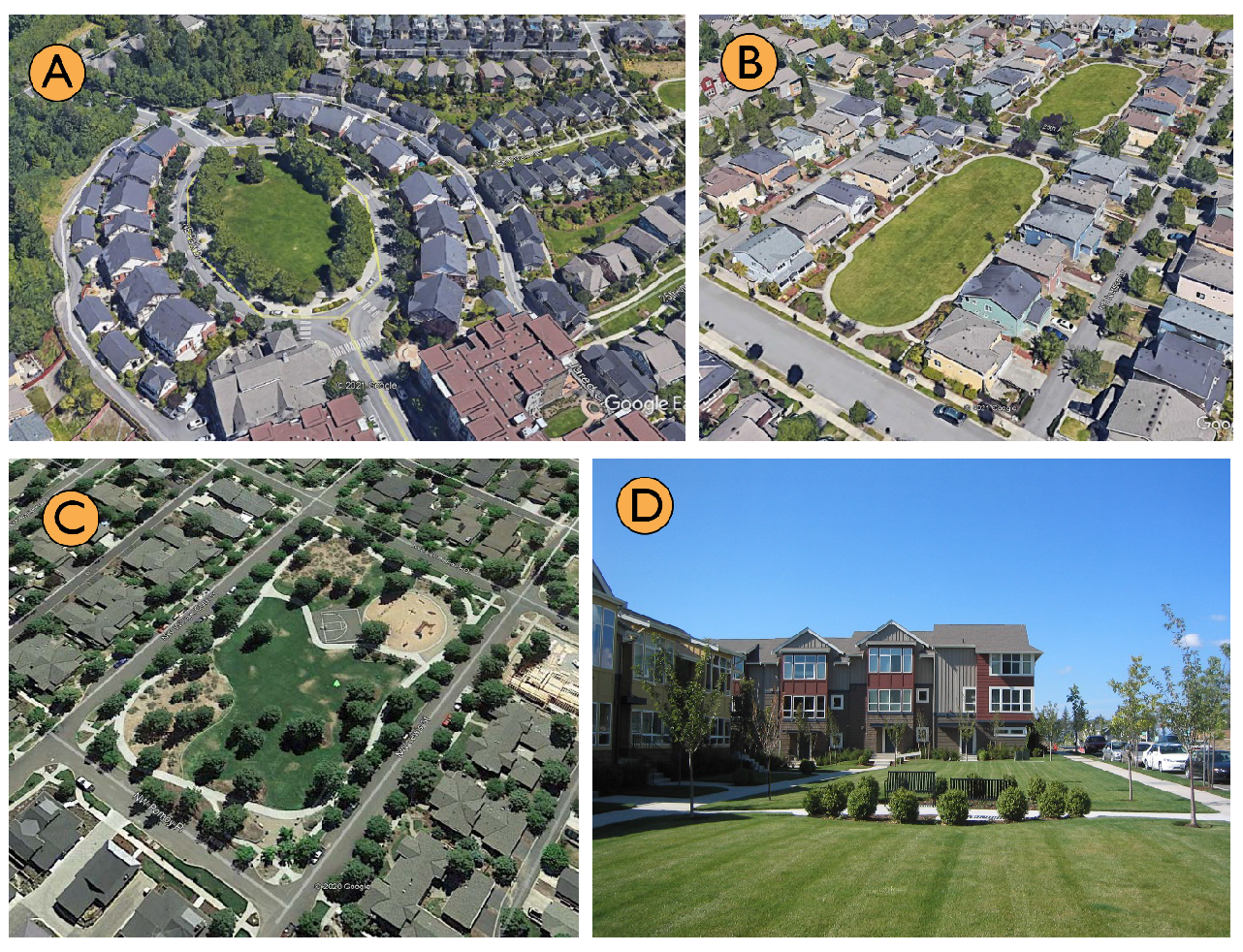
A. Circular park surrounded by a street functions as the neighborhood's focal point.
B. Small parks are bordered by streets on one or two sides with pathways and front yards along other sides. Note that alleys provide access to the adjacent homes.
C. Rectangular-shaped neighborhood park bound by streets on all four sides.
D. Small "green" is bound by pathways and townhouses on three sides and a street on one side.
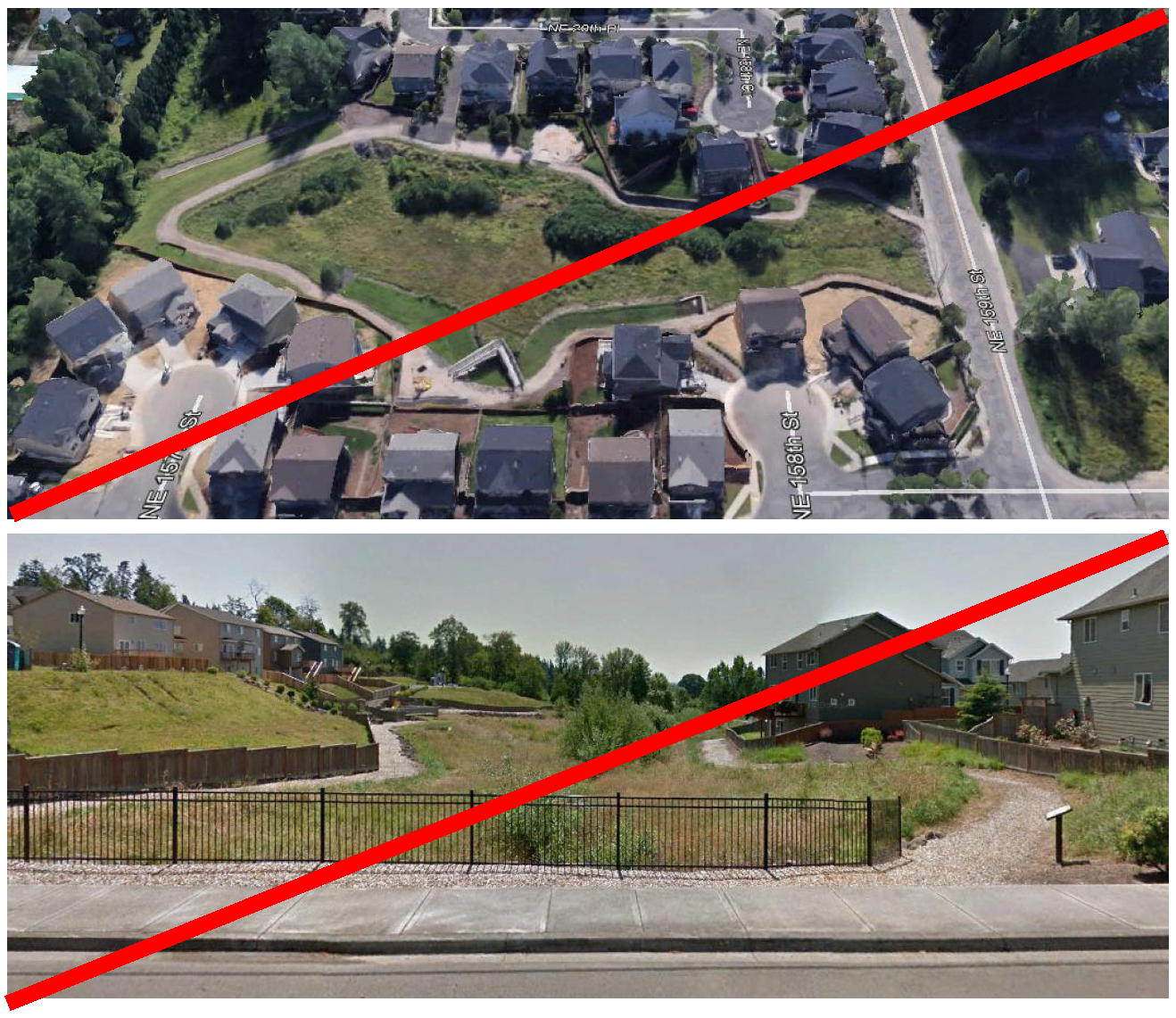
Above open space is poorly integrated open space example. Although there are pathways from three cul-de-sacs that access the space, the space functions more as an unused after-thought, with homes facing away from the space and backyard fences encroaching on a relatively crude pathway. A small children's play area (barely visible in the aerial image above) is relatively hidden up against backyard fences and not visible from nearby streets.
7.
The developer shall provide a bond or other financial assurance acceptable to the city council that any improvements made in the common open space will be completed. The city shall release the bond or other assurance when the improvements have been completed in accordance with the development plan. (See Section 18.401.120.)
8.
All developed open space areas shall be landscaped in accordance with the landscaping plan submitted by the applicant and approved by the city. Natural landscape features which are to be preserved, such as existing trees, drainage ways, etc., may be accepted as part of the landscaping plan. Developed open spaces (excluding trails and sport fields) shall contain a minimum of twenty trees per acre. The community development director will allow for credits of up to four required trees for each existing native tree preserved depending on the size, health, and maturity of the tree.
9.
The city may accept dedication of open space, trails, and recreation areas built to city standards for parks and trails adopted in the Ridgefield Parks and Recreation Comprehensive Plan at its discretion.
10.
In the event that parks, open space or trails created under this Title are owned by the developer or a homeowners' association, the facilities shall be made available for public use and be maintained by the developer or homeowners' association. The city shall be granted the right of third-party enforcement to ensure that the parks, open space and trails are maintained to standards under which they were approved and created.
11.
At the applicant's discretion, the applicant may elect to include or exclude the buildable portion of parcels designated as main or dispersed facilities under this section in the calculation of net developable acres for the purposes of calculating minimum and maximum density for the project. If the applicant elects to include the buildable acres in the density calculation, the applicant may reduce the minimum lot size and minimum lot width and depth dimensions for the zone by up to twenty percent in order to accommodate the additional lots allowed. Any further reduction to lot size, width or depth greater than twenty percent shall comply with RDC 18.401.100.A.
C.
Perimeter compatibility.
1.
Purpose. The development of the perimeter of the PUD shall achieve substantial compatibility with abutting residentially zoned properties so that there will be a graduated transition between existing and new residential development.
2.
Applicability. This section shall apply to lots abutting the perimeter of the PUD where the neighboring property is zoned RLD or RMD, and is less than five acres and greater than twenty thousand square feet at the time the PUD application is vested. Exceptions:
a.
This section shall not apply where the proposed PUD lots abut mapped or platted critical areas on the abutting property.
b.
This section shall not apply to lots that are separated from the PUD perimeter by an open space tract with a minimum width of twenty feet, critical areas tract, public or private street, or similar intervening element.
3.
Compatibility measures.
a.
Lot size for lots subject to this section shall comply with the minimum size established in RDC 18.401.100.A.4 and may not be further reduced through the variance process.
b.
Setbacks and coverage standards for perimeter lots shall meet the minimum requirements for the underlying zone and shall not be modified or reduced through the PUD or variance process.
c.
Allowed uses for perimeter lots in the RLD zone shall be limited to single-family detached residential and accessory dwelling units.
D.
Phased Development. Phased development of any PUD may be permitted provided that:
1.
A phasing schedule is provided as part of the application;
2.
The total development for the project is completed within the time limit for the approval of the final development plan (see Section 18.401.110); and
3.
Bonding or other assurances acceptable to the city council are provided by the developer that guarantees that all common open spaces, recreation spaces and other public or common utilities, streets and facilities approved in the final PUD shall be constructed and maintained. (See Section 18.401.120).
(Ord. No. 1132, § 2(Exh. A), 7-11-2013; Ord. No. 1179, § 2(Exh. A), 2-12-2015; Ord. No. 1207, § 2(Exh. A), 5-26-2016; Ord. No. 1225, § 2(Exh. A), 12-1-2016; Ord. No. 1232, § 2(Exh. A), 4-27-2017; Ord. No. 1234, § 2(Exh. A), 6-22-2017; Ord. No. 1253, § 2(Exh. A), 12-7-2017; Ord. No. 1290, § 2(Exh. A), 4-25-2019; Ord. No. 1339, § 2(Exh. A), 5-27-2021; Ord. No. 1345, § 2(Exh. A), 7-8-2021)
18.401.090 - Site plan requirements.
The development standards in this chapter are intended to accomplish the following design criteria objectives in all PUDs. The applicant shall bear the burden of supporting any change in requirements. If a modification of any criteria is proposed, the applicant must provide justification, including clear demonstration that the proposed modification complies with the purposes of this chapter as stated in Section 18.401.010. The city may increase any requirement necessary to make the project conform to the purposes of this chapter.
A.
Natural Landscape and Topography. Residential lots, open spaces, pedestrian and vehicular circulation facilities, parking facilities and other amenities shall be integrated into the existing landscape. Site design shall preserve and maximize the use of natural landscape features and reduce adverse impacts on existing natural features. Natural topography shall be maintained to the extent practicable by designing the PUD to fit natural slopes and limiting retaining wall height to six feet or less.
B.
Facilities and Utilities. The layout of structures and other facilities shall effect conservation in street and utility improvements.
C.
Recreation. Recreational areas (active and passive) shall be located to maximize access from all dwelling units, in consultation with the community development director.
D.
Improvements and Amenities. Every PUD shall make adequate provision for utilities, drainage, lighting, pedestrian and vehicular circulation and access, public safety, landscaping and accommodation of environmentally sensitive features and other similar items. With respect to drainage:
1.
All lots shall be provided with adequate storm drainage connected to the storm drainage system of the city or other system approved by the city engineer; and
2.
When there is a need to use a stream for stormwater control purposes, public improvement and maintenance easements at least twenty feet wide shall be provided for storm drainage, and when possible, such easements shall be located along the centerlines of such facilities.
E.
Street Design. All streets shall be constructed consistent with City of Ridgefield Engineering Standards, except through a modification of standards approved through the PUD review process or engineering review process.
F.
Multifamily and Commercial Off-Street Parking. Except as modified below, off-street parking shall be as required in RDC Chapter 18.720. Parking shall be located in the rear or side of multifamily residential and all nonresidential structures.
G.
Attachment of Conditions. In conjunction with the approval of a preliminary PUD, final PUD or modified final PUD; conditions shall be attached which will assure that the property will be developed and maintained in accordance with this title, other applicable state or federal statues or regulations, and the approved development plan and subdivision plat. (See Section 18.401.120.)
H.
Perpetual Maintenance. All improvements and amenities that are held in common and are part of the PUD shall be perpetually maintained in a good, safe and serviceable condition at no expense to the city. The city shall have the right to compel the maintenance of such improvements, amenities or common areas if the review authority finds that the public health, safety or welfare may be compromised unless such maintenance is completed. The documents necessary to provide assurance of perpetual maintenance shall be approved by the city attorney. (See Section 18.401.120.)
I.
Minimum Frontage.
1.
Each lot used for single-family detached residential development shall have a thirty-five-feet minimum frontage on a public or private street, except for a lot fronting the bulb of a cul-de-sac, which shall have a twenty-five-feet minimum frontage.
2.
Each lot used for duplex, triplex, townhouse, and multifamily residential development shall have a twenty-five-feet minimum frontage on a public street, except for a lot fronting the bulb of a cul-de-sac, which shall have a twenty-feet minimum frontage.
3.
Lots developed consistent with the cottage housing provisions of RDC 18.206.040 are exempt from these frontage requirements.
J.
Through Lots.
1.
Through lots are strongly discouraged. The following standards apply to through lots in PUD subdivisions abutting collector and arterial roads which are not major corridors (the collector and arterial roads listed in RDC 18.210.060):
a.
Provide a separate tract at least ten-feet wide between the collector or arterial right-of-way and the rear property lines of the through lots.
b.
Establish landscaping in the tract which softens the appearance of fences and walls and/or which provides a measure of privacy for residents in their rear yards.
c.
The tract shall be maintained by the homeowner association.
2.
Except on major corridors, alternative lot designs are strongly encouraged. An alternative design includes alley-loaded lots with deep front yards and alley access running parallel to the collector or arterial street.
Figure 18.401.090.J
Through lot alternative.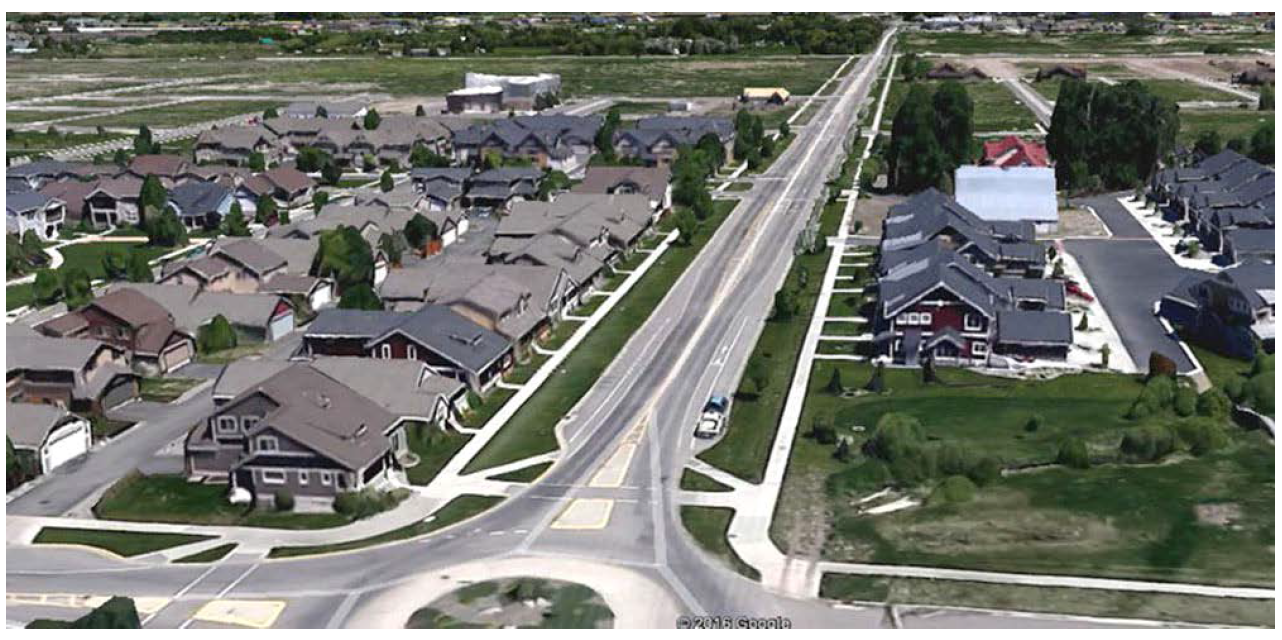
Alley-loaded lots with generous front yards are a desirable alternative for new lots adjacent to collector streets.
K.
Minimum Yards and Setbacks.
1.
The minimum setbacks of the underlying zone shall apply to lots abutting or adjacent to exterior project boundaries, consistent with RDC 18.401.080.C.
2.
Setbacks for lots within the interior of the PUD may be adjusted, provided that side and rear setbacks may not be less than five feet.
3.
For lots within the interior of the PUD, front yard setbacks shall be modulated to avoid repetitive design, consistent with all of the following standards. Corner lots and lots on curving streets are exempt.
a.
No more than three consecutive homes on the same side of the street may feature identical setbacks.
b.
Minimum front yard setbacks may be reduced by up to thirty percent. Porch projections shall be at least four feet from the property line (see also RDC 18.210.040.C.f and 18.220.040.B.f).
c.
A balance in increased and decreased yard setbacks is encouraged.
d.
Setbacks meeting this standard shall be noted on the face of the plat.
Figure 18.401.090.K
Examples of front yard setback variety.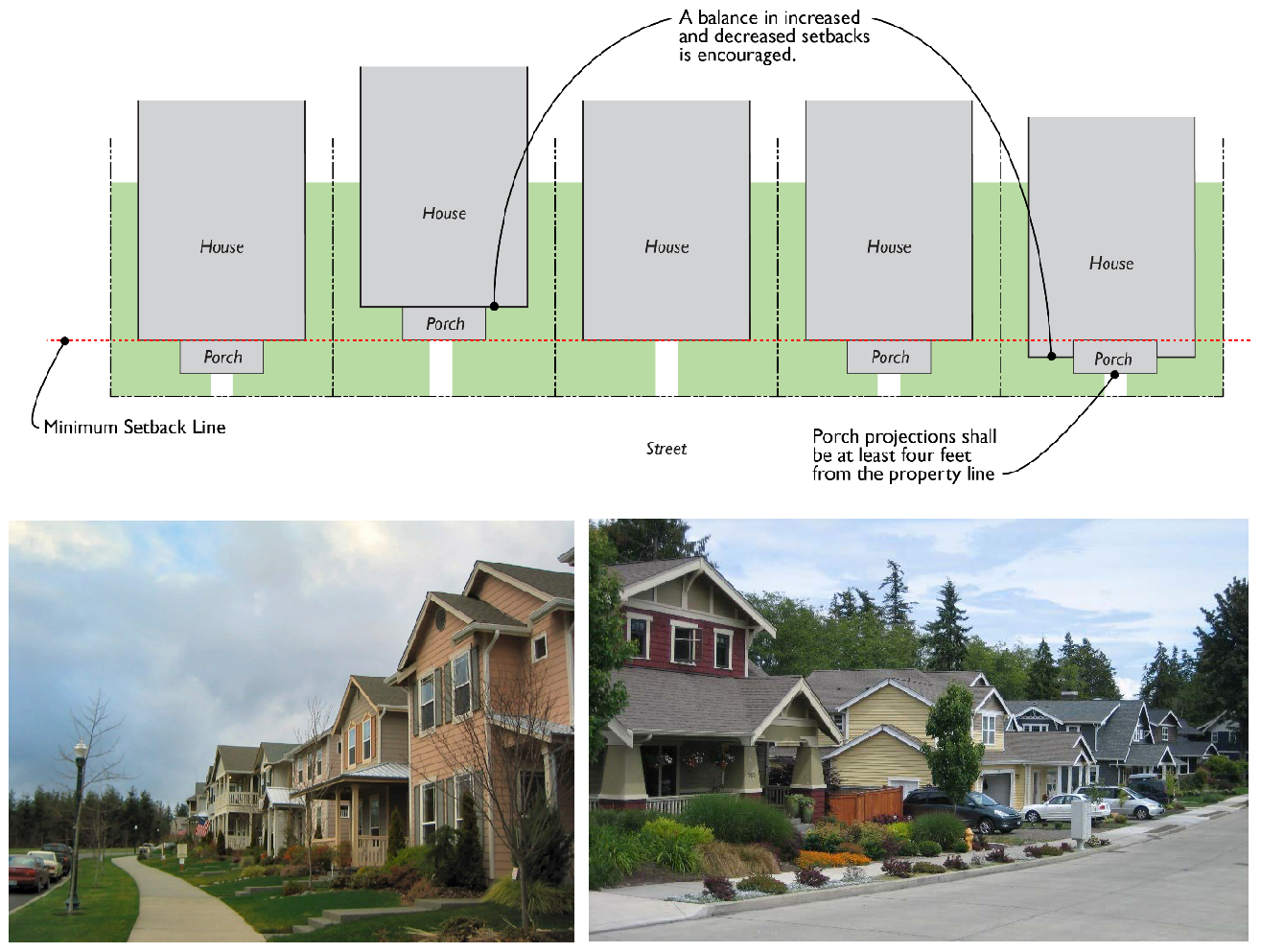
L.
Maximum Building Height. A building or structure within a PUD shall not exceed thirty-five feet in height as measured from the established grade of the building.
M.
Signage Standards. Signage standards for uses in the PUD shall be as provided in RDC Chapter 18.710.
N.
Storage Standards. All storage in the PUD shall be within a closed building, except for the storage of retail products which are for sale or rent which may be stored outdoors during business hours only, and not within any required front or side yard nor in any public or private street, road right-of-way or pedestrian circulation route. The review authority may approve screened outdoor storage of recreation vehicles, boats or similar items of property.
O.
Refuse Storage. All outdoor trash, garbage and refuse storage areas shall be screened on all sides from public view and, at a minimum, be enclosed on three sides with a five and one-half feet high sight-obscuring fence or wall with a sight-obscuring gate for access. Design of exterior storage areas shall comply with engineering standards and the Comprehensive Stormwater Management Plan (CSMP), including roof cover, paving, and runoff containment, to prevent nonstormwater discharges from entering the stormwater drainage system.
P.
Mechanical Equipment. All rooftop mechanical equipment shall be placed behind a permanent screen, completely screened from public view.
Q.
Utilities. All utilities shall be underground.
R.
Pedestrian Circulation Facilities. Within the PUD, sidewalks shall be constructed in accordance with city of Ridgefield engineering standards. Additional pedestrian facilities shall be required to be dedicated and constructed at the developer's expense, including connections with planned city and county trail systems (see RDC 18.401.065 for trail standards), public accessways to connect to cul-de-sac streets and to pass through oddly shaped or unusually long blocks. These facilities shall create a network of public paths which shall be:
1.
Functionally and safely convenient to each dwelling unit served;
2.
Functionally and safely convenient to schools and to industrial, commercial, recreational and utility areas within or adjacent to the project, and functionally convenient to a larger pedestrian circulation system outside the PUD;
3.
Hard surfaced to accommodate a variety of users; and
4.
Compliant with city engineering standards.
S.
Public Transit. All PUDs requiring twenty or more parking spaces shall provide transit loading and shelter facilities if so required by the review authority in consultation with Clark Transit (C-Tran).
T.
Traffic Impacts. The developer shall be responsible for determining traffic impacts and construct improvements necessary to mitigate identified impacts, consistent with service levels established in the Comprehensive Plan, and:
1.
Private access to collector and arterial streets shall be minimized; and
2.
No development shall exceed adopted level of service (LOS) standards.
U.
Attractive Streetscapes. The PUD design shall ensure an attractive streetscape, especially along collector and arterial streets, by planting street trees and other vegetative buffers, minimizing the visibility of parking lots and garages, and providing attractive street-facing facades.
V.
Subdivisions. Except where specifically exempted under this section, the subdivision standards and procedural requirements of RDC Chapters 18.600, 18.620, and 18.630 shall also apply to PUDs.
W.
Lighting. All lighting shall be shielded and aimed downward to prevent light trespass and glare as provided in RDC 18.715.
(Ord. No. 1132, § 2(Exh. A), 7-11-2013; Ord. No. 1178, § 2(Exh. A), 2-12-2015; Ord. No. 1207, § 2(Exh. A), 5-26-2016; Ord. No. 1232, § 2(Exh. A), 4-27-2017; Ord. No. 1234, § 2(Exh. A), 6-22-2017; Ord. No. 1339, § 2(Exh. A), 5-27-2021; Ord. No. 1345, § 2(Exh. A), 7-8-2021; Ord. No. 1406, § 2(Exh. A), 7-13-2023; Ord. No. 1426, § 2(Exh.), 7-25-2024)
18.401.100 - Limits on modifying standards.
A.
The city, using the PUD process, may allow the following development standards to be modified if the proposed modifications are consistent with the requirements of this chapter and provided the applicant demonstrates that the modifications are consistent with the PUD objectives in RDC 18.401.010:
1.
Building setbacks, including front yard setbacks as necessary to the meet the front yard modulation standard (RDC 18.401.080.J) and side yard setbacks as necessary to meet the optional zero lot line standard (RDC 18.401.070).
2.
Height of non-residential buildings or structures;
3.
Landscaping requirements;
4.
Lot size, provided that no lot is less than sixty-five-percent of the minimum lot area in the underlying zone, or four thousand square feet, whichever is greater, except in the RMD-16 zone;
5.
Lot width;
6.
Maximum density—Density may only be increased a maximum of twenty-percent of the underlying base zone or to a maximum of eight dwelling units per acre, whichever is less;
7.
Width of street right-of-way and pavement; or
8.
On-street or off-street parking (see RDC 18.401.075).
B.
The following zoning code requirements may not be varied with the PUD process:
1.
Any provision of this chapter, except that the open space provisions in RDC 18.401.080.B may be modified by a maximum of twenty percent for PUDs in the RLD-4 zone.
2.
Standards pertaining to SEPA and development in environmentally sensitive areas;
3.
Any provision that specifically applies to development on a regulated slope;
4.
Regulations pertaining to uses permitted in the underlying zone;
5.
Any provision pertaining to the installation and maintenance of stormwater retention/detention facilities;
6.
Any provision pertaining to the installation of public improvements;
7.
Any provision regulating signs; and
8.
Any provision regulating arterial or collector streets.
9.
Modifications cannot be used to modify explicit policy provisions of the RUACP.
(Ord. No. 1132, § 2(Exh. A), 7-11-2013; Ord. No. 1207, § 2(Exh. A), 5-26-2016; Ord. No. 1232, § 2(Exh. A), 4-27-2017; Ord. No. 1253, § 2(Exh. A), 12-7-2017; Ord. No. 1260, § 2(Exh. A), 4-26-2018; Ord. No. 1290, § 2(Exh. A), 4-25-2019; Ord. No. 1339, § 2(Exh. A), 5-27-2021; Ord. No. 1426, § 2(Exh.), 7-25-2024)
18.401.110 - Time requirements and extensions.
A.
Where the PUD involves a subdivision of land, if no construction has begun within the subdivision vesting period established by RCW 58.17.140, typically five years from the date of approval of the preliminary plat and PUD, such approval shall automatically expire and all permits and approvals issued shall become null and void, and a new application, subject to the applicable laws and regulations then in effect, shall be required for any development on subject property. The review authority may extend approval for one additional year period if an application for extension is received at least thirty days before the authorization expires. If no construction has begun at the end of this extension the authorization granted for the final development plan shall terminate.
B.
Where the PUD does not involve a subdivision of land, if no construction has begun within two years of the date of the preliminary PUD approval, such approval shall automatically expire and all permits and approvals issued shall become null and void, and a new application, subject to the applicable laws and regulations then in effect, shall be required for any development on the subject property.
C.
If construction has been commenced but the work has been discontinued for a period of one year or more and an extension of time for completion has not been requested and granted by the review authority, for good cause shown and at its discretion, the authorization shall expire and the land and the structures thereon may be used only for a lawful purpose permissible within the zone in which the PUD is located.
D.
The time period of commencing or continuing construction shall not include periods of time during which commencement of construction or continuation of construction was reasonably halted or reasonably delayed due to the filing of a pendant legal action challenging an approval granted by the city pursuant to this chapter; provided, that in all cases, when more than five years have elapsed subsequent to the date of approval of the preliminary development plan, whether due to pendency of litigation, city approved extensions of time for development, or otherwise, the permittee shall be required to comply with all current building, construction, subdivision and other applicable standards of the city; provided further, that a change in zoning classification enacted subsequent to approval of the final development plan shall not affect the project.
(Ord. No. 1132, § 2(Exh. A), 7-11-2013; Ord. No. 1178, § 2(Exh. A), 2-12-2015)
18.401.120 - Bonding and enforcement.
A.
Prior to final acceptance by the city of any public improvements, the developer shall file a warranty bond or other suitable security in a form approved by the city attorney and in an amount approved by the city engineer, but no less than twenty percent of the cost of all public and private improvements, guaranteeing the repair or replacement of any improvement which proves defective within a minimum two-year time period after final acceptance of the improvements by the city. The city shall withhold acceptance of the public improvements until any required security for completion is filed.
1.
Private improvements under this subsection are defined as any improvements that are to be maintained by future lot owners in common.
B.
If the PUD is to be developed in stages, sureties required by this subsection shall be required for each phase prior to final acceptance of any public improvement constructed as part of that phase.
C.
The city may enforce the bonds or other security required by this section according to their terms, pursuant to any and all legal and equitable remedies. In addition, any bond or other security filed pursuant to this section shall be subject to enforcement in the following manner:
1.
In the event the improvements are not completed as required, or warranty is not performed satisfactorily, the city engineer shall notify the developer and the guarantor in writing which shall set forth the specific defects which must be remedied or repaired and shall state a specific time by which such shall be completed.
2.
In the event repairs or warranty are not completed as specified in the notice referred to in subsection (C)(1) of this section by the specified time, the city may proceed to repair the defect or perform the warranty by other force account, using city forces, or by private contractor. Upon completion of the repairs or maintenance, the cost thereof, plus interest at twelve percent per annum, shall be due and owing to the city from the developer and guarantor as joint and several obligation. In event the city is required to bring suit to enforce maintenance, the developer shall be responsible for any costs and attorneys' fees incurred by the city as a result of the action.
(Ord. No. 1132, § 2(Exh. A), 7-11-2013; Ord. No. 1232, § 2(Exh. A), 4-27-2017; Ord. No. 1370, § 2(Exh. A), 9-8-2022)
18.401.130 - Parties bound.
A.
Once the preliminary development plan is approved, all persons and parties, their successors, heirs or assigns, who own, have or will have by virtue of purchase, inheritance or assignment, any interest in the real property within the proposed PUD, shall be bound by the conditions attending the approval of the development and the provisions of this title.
B.
Reserved.
(Ord. No. 1132, § 2(Exh. A), 7-11-2013; Ord. No. 1232, § 2(Exh. A), 4-27-2017)
18.401.140 - Homeowner association.
Every PUD shall have a homeowners' association and agreements to fund such an organization as follows:
A.
Before approval of the final development plan may be granted, the developer shall submit to the city covenants, deeds and/or homeowners' association bylaws and other documents. These documents shall be reviewed and approved by the city attorney and community development director to ensure that they comply with the requirements of this chapter prior to approval of the final development plan by the city. Such documents and conveyances shall be accomplished and be recorded, as applicable, with the county auditor as a condition of any final development plan approval. (See Section 18.401.160.) These documents shall address:
1.
Maintenance of Private Common Areas and Infrastructure. All common open space, community facilities, stormwater facilities, private roads and drives, and all other commonly owned and operated property located within the development shall be maintained in perpetuity by the homeowners' association. The covenants, declarations and restrictions shall provide for the maintenance of all common areas and infrastructure by the homeowners' association in accordance with all applicable provisions of the city code. Said covenants, declarations and restrictions shall provide authority for the city, after providing reasonable written notice to the homeowners' association and opportunity to perform required maintenance, to recover any costs incurred by the city to maintain private infrastructure or common areas due to a failure of the homeowners' association to adequately maintain privately owned improvements, including a lien on the property or other appropriate assurance device, as determined by the city.
2.
Maintenance of Lots, Buildings and Facilities. The covenants, declarations and restrictions shall provide that buildings, utilities and facilities on individual lots shall be maintained by the property owner in accordance with city codes and the requirements of such covenants, declarations and restrictions.
B.
A homeowners' association bylaws, once reviewed and approved by the city, shall contain the following provisions:
1.
The following clause: "Changes in these documents must be approved by the city of Ridgefield through the city council or if the council designates an agency or department, by that agency or department." Any changes suggested shall be reviewed by the city attorney, who will make a written report to the city council concerning the effect of the proposed changes. The cost of review by the city attorney will be paid by the homeowners' association;
2.
A clause whereby unpaid taxes on all property owned in common shall constitute a proportioned lien on all property of each owner in common;
3.
Subject to due process, the city may enforce the terms of the covenants, conditions and restrictions and place a lien on property if the city is compelled to correct a problem which threatens public health, safety or welfare, or is compelled to undertake construction, repairs or modifications necessary to protect or preserve public property or facilities.
C.
A homeowners' association bylaws, once reviewed and approved by the city, shall not contain any of the following provisions:
1.
Any clause which prohibits residential leasing and/or renter occupation.
2.
Any clause which restricts the development of specific residential uses or housing types which are permitted on the lot by Title 18 of the Ridgefield Municipal Code.
(Ord. No. 1132, § 2(Exh. A), 7-11-2013; Ord. No. 1178, § 2(Exh. A), 2-12-2015; Ord. No. 1339, § 2(Exh. A), 5-27-2021)
18.401.150 - Building permits.
The city shall issue building permits and other permits required for the construction or development of the property under the provision of this section only when the following conditions are met:
A.
In the opinion of the planning director, the work to be performed meets the requirements and conditions of approval of the final plan and program elements of the PUD.
B.
In the opinion of the planning director, the proposed building meets the applicable standards for facade differentiation in RDC 18.206.
C.
The building permit application must identify the location and dimensions of the proposed building in relation to all lot lines for the site and must provide proposed building elevations.
D.
No vertical construction may take place until the necessary fire flow and emergency vehicle access have been provided to the building(s).
E.
All required improvements have been completed or contracts have been entered into or security guarantees have been approved in Section 18.401.120 such that improvements approved in the final PUD will be completed.
F.
Partial or complete construction of structures shall not relieve the developer from, nor impair city enforcement of, conditions of PUD approval.
G.
Once issued, any building permit shall be valid only so long as there is compliance with the final development plan as accepted by the city. Any deviation from that plan shall operate to automatically invalidate the building permit and shall be a violation of this chapter.
(Ord. No. 1132, § 2(Exh. A), 7-11-2013; Ord. No. 1426, § 2(Exh.), 7-25-2024)
18.401.160 - Recording.
The approved final development plan is binding and shall be a restriction on development which runs with the land. A binding site plan of the PUD and accompanying documents, together with covenants running with the land, binding the site to development in accordance with all the terms and condition of approval shall be recorded by the county auditor.
(Ord. No. 1132, § 2(Exh. A), 7-11-2013)
18.401.170 - Revocation.
The review authority may revoke preliminary approval of a PUD upon a finding that the applicant has failed to comply with the standards and requirements established for the PUD. A PUD shall be revoked only after a public hearing pursuant to Section 18.310.080. The planning director or the superintendent of public works has the authority to stop work on the project or use any other enforcement mechanism or remedy allowed pursuant to the provisions of Chapter 18.390 et seq.
(Ord. No. 1132, § 2(Exh. A), 7-11-2013)

