
Ridgefield City Zoning Code
CHAPTER 18
206 - RESIDENTIAL USE STANDARDS
18.206.010 - Purpose.
To provide standards for the development and design of residential uses.
(Ord. No. 1339, § 2(Exh. A), 5-27-2021)
18.206.020 - Single-family design standards.
A.
Purpose. The purposes of these standards are to ensure compatibility and continuity between and within developments, as well as variety in architecture. The standards are intended to complement the site with quality building design.
B.
Applicability. The standards of this section apply to new single-family development in the RLD zones and the RMD-16 zone.
C.
Small Single Family Dwelling Incentives.
1.
In developments in RLD zones, single family dwellings with less than one thousand six hundred square feet of floor area (excluding garages with up to five hundred square feet) may be counted as one-half a dwelling unit for the purpose of calculating density. Once the cap is reached, such units are counted as one unit.
This bonus is available for a limited percentage of each development's total dwelling units as follows. Once the percentage cap is reached, such dwelling units are counted as one full dwelling unit.
a.
RLD-4: Up to ten percent of qualifying small single family dwelling units qualify.
For example, a subdivision on a net ten-acre parcel has a default maximum capacity of forty units. If four of the units are small single family dwellings, the calculated density is thirty-eight units, but the functional total is forty-two units (a bonus of two units).
b.
RLD-6: Up to fifteen percent of such units qualify.
c.
RLD-8: Up to twenty percent of such units qualify.
2.
Where such small single family dwellings are integrated with other housing types qualifying for density bonuses, RDC 18.210.025.F.2 sets forth the cumulative limitations to the percentage of qualifying bonus dwelling units in a development.
3.
For plat recording requirements, see RDC 18.210.025.F.3.
D.
Every home shall contain the following features:
1.
All wall openings, regardless of visibility from a public right-of-way, shall have:
a.
Contrasting trim (minimum three inches wide);
b.
Recess (windows) at least one and one-half-inches from the façade; or
c.
Other design treatments that add depth, richness, and visual interest to the façade.
2.
Roof overhang (minimum six inches);
3.
Porch or other covered entry at least three feet deep for the primary entrance.
4.
A front door visible from the street (applies only to front-loaded lots less than fifty feet wide).
5.
Minimum useable open space [see standards in subsection (E) below].
6.
Minimum front façade window transparency: At least ten percent. This applies to all vertical surfaces of the façade elevation (excluding rooflines). Windows and their frames shall be used in the calculations, while trim may not be included. Garage door windows may be used to meet up to fifty percent of the minimum transparency requirement.
Figure 18.206.020-D
Example of required design features.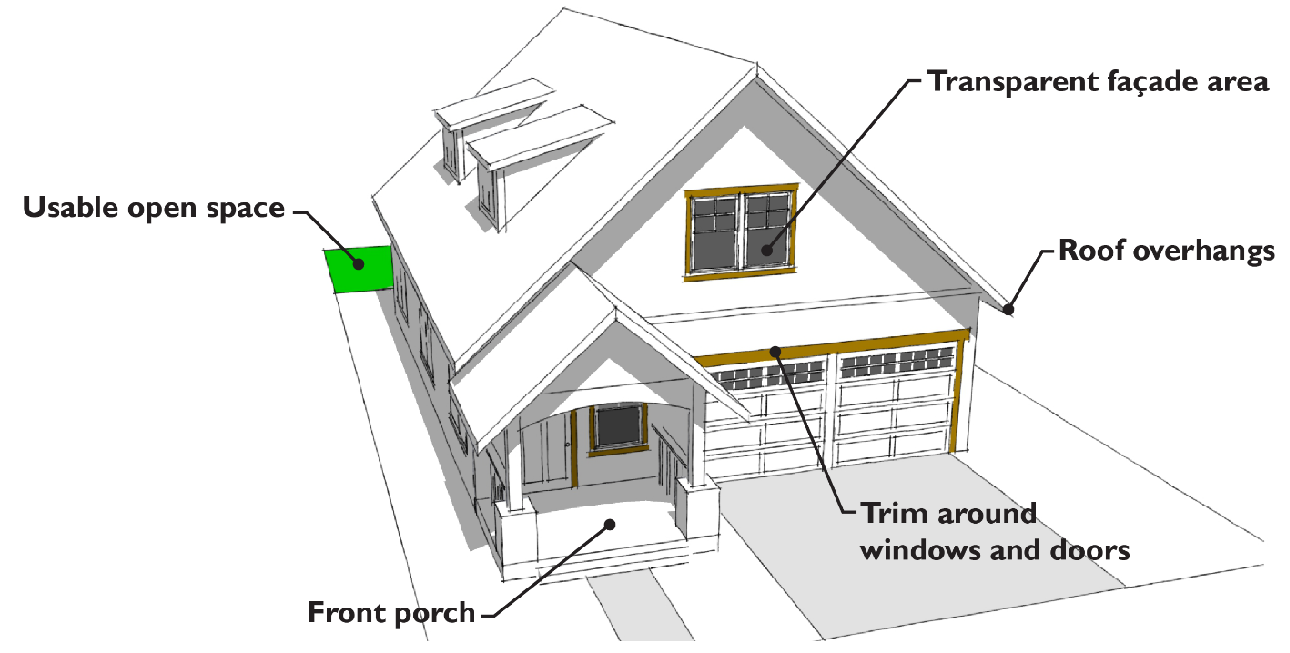
E.
Architectural design. To ensure variety in architecture and to reduce the dominance of garages on the streetscape, applicants for new residential developments shall demonstrate compliance with the following provisions at the time of building permit application:
1.
Front façade variety. Dwellings with the same front façade located on the same side of a street shall be separated by no less than four lots, and dwellings with the same front façade located on opposite sides of a street shall be separated by no less than four lots, with the lot directly across the street not included in the four-lot calculation. In this context, the lot "directly across the street" means the lot with which the greatest portion of frontage aligns with the frontage of the subject lot.
a.
Structural elements.
i.
Covered porch area with a minimum of fifteen square feet.
ii.
Dormers.
iii.
Gables.
iv.
Hipped, gable, gambrel, mansard or similar pitched roof.
v.
Bay windows.
vi.
Twelve-inch offset from one exterior wall to another.
vii.
Balconies.
viii.
Roofline offset of at least two feet from the top surface of one roof to the other.
ix.
Vertical breaks/horizontal walls.
x.
Recessed building entry at least two feet deep by four feet wide.
xi.
Other structural element that adds comparable visual interest to the features above, as approved by the community development director.
b.
Decorative elements.
i.
Decorative garage doors.
ii.
Pillars/posts.
iii.
Decorative eave or barge boards with two material variations.
iv.
Decorative shingles or varied siding in gables.
v.
Decorative siding (shingles, shake, batten board, wainscoting, or similar).
vi.
Brick, stone or cedar accents covering at least ten percent of the front facade wall surface area.
vii.
Variable siding; the use of two or more types of siding.
viii.
Fiber-cement horizontal lap siding between three and seven inches wide.
ix.
Shed roof above window(s).
x.
Belly Band cladding.
xi.
Functional shutters or louvers.
xii.
Corner boards/posts.
xiii.
Knee or eave braces.
xiv.
Enlarged trim on garage door headers at least six inches wide.
xv.
Other architectural elements, other than color, glass or lighting, approved by the community development director.
Figure 18.206.020-E.1
Example of front façade features.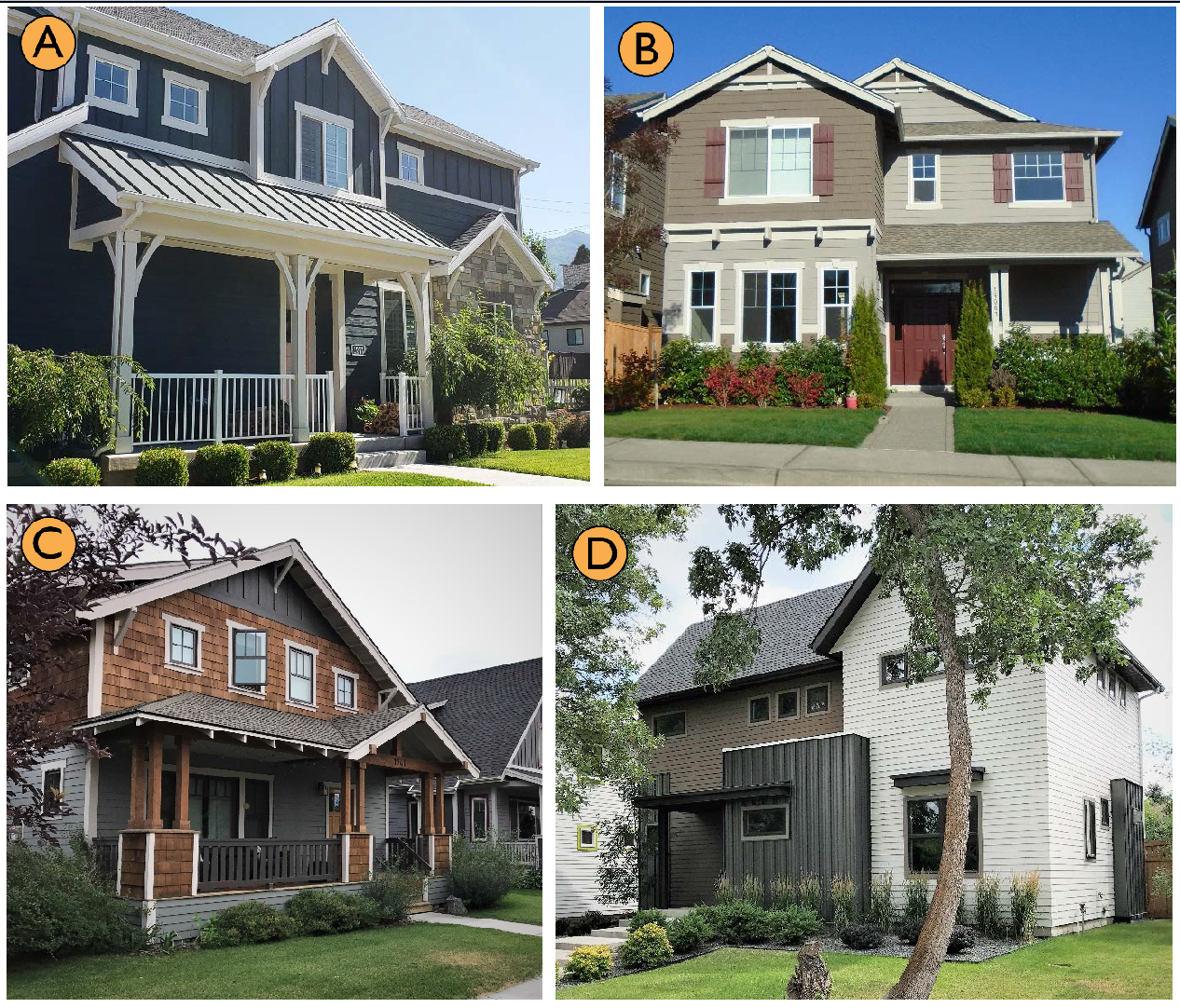
A. Covered porch, dormer, pitched roof, pillars/posts, stone accents, variable siding, belly band cladding, knee/eave braces.
B. Covered porch, pitched roof, exterior wall offsets, roofline offsets, pillars/posts, variable siding, and "other" decorative elements being window trim keystones and extruding joists.
C. Covered porch, pitched roof, pillars/posts, variable siding, decorative windows/trim, and knee/eave braces.
D. Pitched roof, covered porch, exterior wall offsets, variable siding, and decorative window treatments.
2.
Garage design and integration. Garages or carports detached from or attached to the main structure and facing the street shall comply with at least one of the following features listed below. For lots less than fifty feet wide and featuring driveways wider than twelve feet wide and/or two-car garages facing the street, see the garage design and integration standards in subsection (E)(3) of this section.
a.
Set back the garage or carport from the front building facade or front face of a covered porch, by a minimum of four feet. To qualify as a porch under this subsection, the porch must extend along a minimum of fifty percent of the street-facing building facade that is not devoted to the garage, and must be at least six feet wide.
b.
Provide enhanced architectural details. Under this option, the front façade shall contain a minimum of six elements from elements lists under subsection (E)(1) of this section, including at least two elements from the structural elements list and at least two elements from the decorative elements list.
Figure 18.206.020-E.2
Garage design integration examples.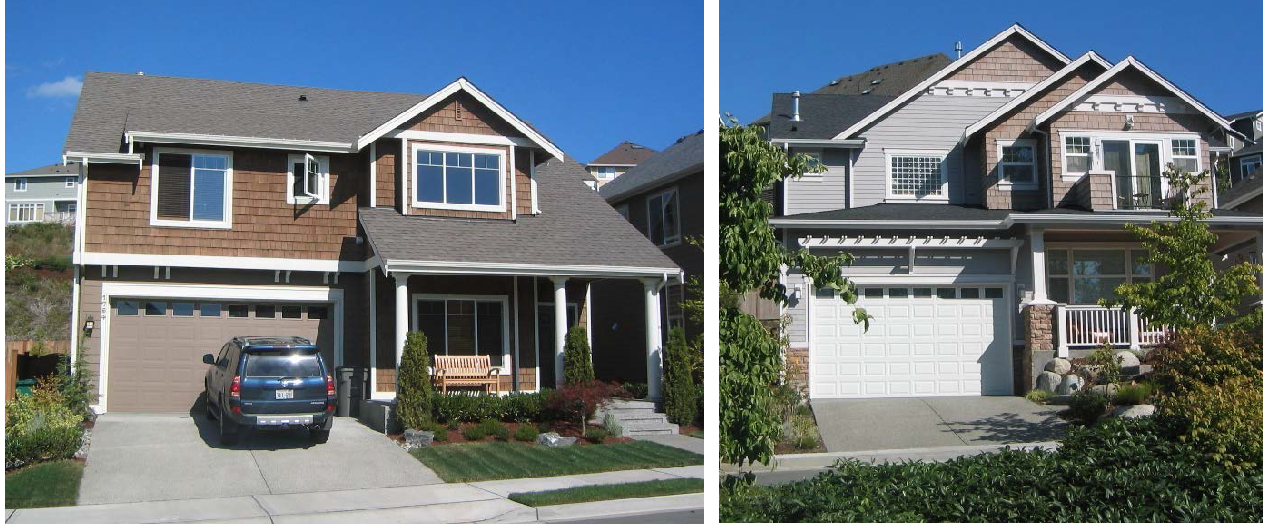
Left: Garage set back from the front covered porch at least four feet. Right: Garage set back less than four feet, and the front façade includes enhanced architectural details including a covered porch, variable siding, pillars/posts, balcony, and other details.
3.
Garage design and integration for lots less than fifty feet wide and featuring driveways wider than twelve feet wide and/or two-car garages facing the street. Standards:
a.
The home must feature at least one of the following massing elements:
i.
Upper floor living space and/or covered deck that projects at least eighteen inches in front of ground level street façade surrounding the garage. The projecting living space and/or covered deck area must occupy a space at least seventy-five percent of the width of the garage door.
ii.
An upper floor living space that is recessed from the ground level street façade surrounding the garage by at least eighteen inches. A roofline must separate the first floor from the façade of the second floor. The second floor roofline must be modulated (one continuous roofline is not allowed).
iii.
Other massing designs that effectively deemphasize the garage doors and add visual interest to the streetscape.
See
Figure 18.206.020-E.3 for acceptable and unacceptable examples of both subsections (i) and (ii).
b.
The home must also comply with at least one of the following design/detail options:
i.
Minimum front façade window transparency: At least twelve percent. This applies to all vertical surfaces of the street façade elevation (excluding rooflines). Windows and their frames shall be used in the calculations, while trim may not be included. Garage door windows may be used to meet up to fifty percent of the minimum transparency requirement.
ii.
Provide enhanced architectural details on the street facade, using minimum of eight elements from elements lists under subsection (E)(1) of this section, including at least three elements from the structural elements list and at least three elements from the decorative elements list.
c.
Any balconies over the driveway should have structural design, materials, and color that is well-integrated into the composition of the façade.
d.
The front door must be located on the street façade elevation. Front doors that are tucked behind the garage door do not meet this requirement. For clarification, the homes in images C and D in Figure 18.206.020-E.3 meet this requirement, while the homes in images E and F do not meet this requirement.
e.
Garage doors are encouraged to be colored consistent with the body of the house. Transparent and semi-transparent garage doors are an exception.
Figure 18.206.020-E.3
Garage design integration examples on narrow lots.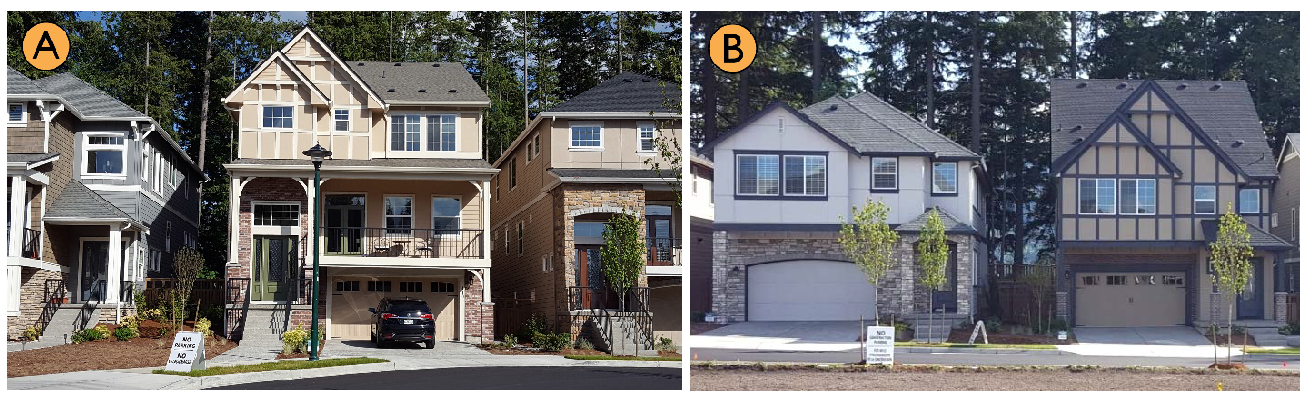
A.
Acceptable: Covered deck projects over garage/driveway. The prominent entry, mix of materials, detailing, and roofline modulation also help emphasize the living areas over the garage.
B.
Acceptable: Living areas project over the garage/driveway. The mix of materials, detailing, and roofline modulation also help.
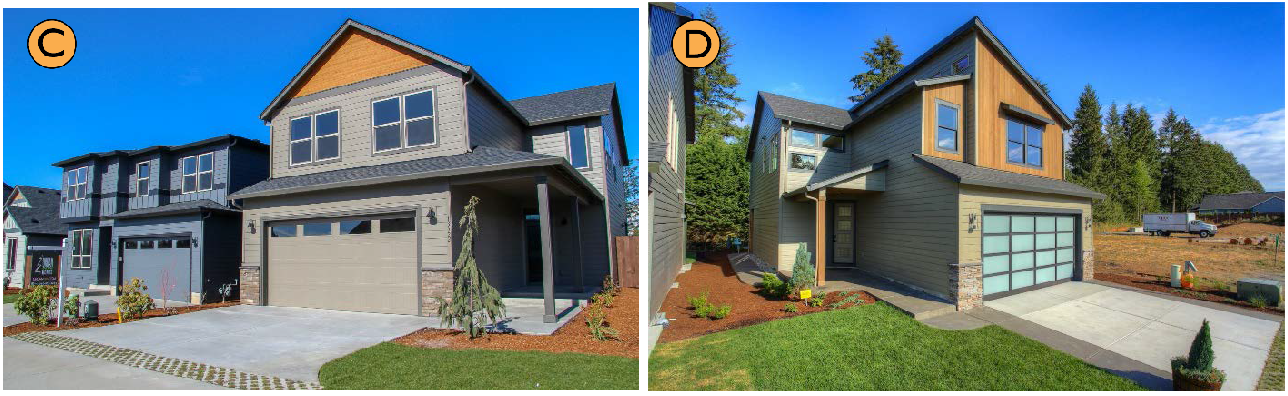
C and D.
Acceptable: Upper floor living area is recessed behind garage-wall and separated by rooflines in both examples. While the front doors are set back from the street, they are facing the street and visible from the street. The mix of materials, detailing, and roofline modulation also help. Images courtesy of urbannw.com.
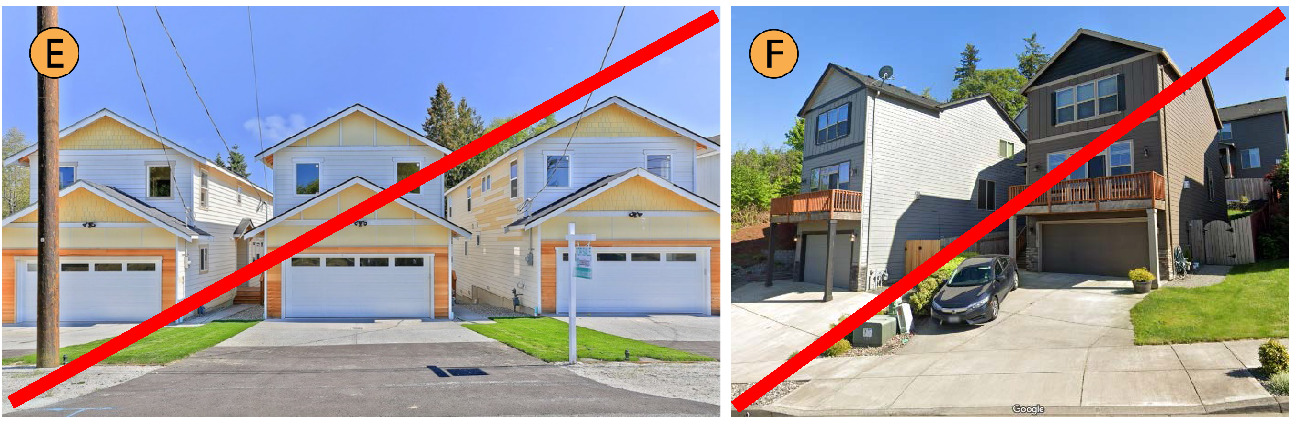
E.
NOT acceptable: The front door is tucked behind the garage and largely not visible from the street. While the recessed second floor, rooflines, material changes and detailing help, the garage takes up the entire ground level of the street façade. Also, the façade transparency does not meet the minimum twelve percent threshold.
F.
NOT acceptable: These homes feature flat street facades with the garage door dominating the ground level elevation. While the balcony helps, it's not covered and appears tacked-on to the façade. Also, the front doors are not visible from the street.
4.
Where houses are served by alleys, all garages and on-site parking shall be accessible from the alley and the facade of the house facing the street shall be designed as the front of the house including, but not limited to, a primary building entrance consisting of inward swinging door(s), porch(es), window(s) and pathway(s) to the street.
F.
Minimum Useable Open Space.
1.
Every home shall provide a minimum one hundred-square-foot covered outdoor area at the side or rear of the dwelling.
2.
Every lot shall provide a useable open space equivalent to at least ten percent of the lot area, with a minimum dimension of fifteen feet on all sides of the useable open space. For example, a four thousand-square-foot lot would require a contiguous open space of at least four hundred square feet. Porches, patios, and the covered outdoor area required above may be used to fulfill this requirement provided they are part of an open space that meets the minimum dimension requirement.
3.
If the rear edge of the usable open space is within five feet of an alley, any fence between the rear edge and the alley shall be limited to four feet in height except where the portion of the fence between four and six feet in height is at least fifty percent transparent. Vegetative matter which functions as a fence has no height limit.
4.
Driveways shall not count in the calculations for usable open space.
5.
Additions must not create or increase any nonconformity with this standard.
Figure 18.206.020-F.1
Examples of how to integrate minimum useable open space on small lots.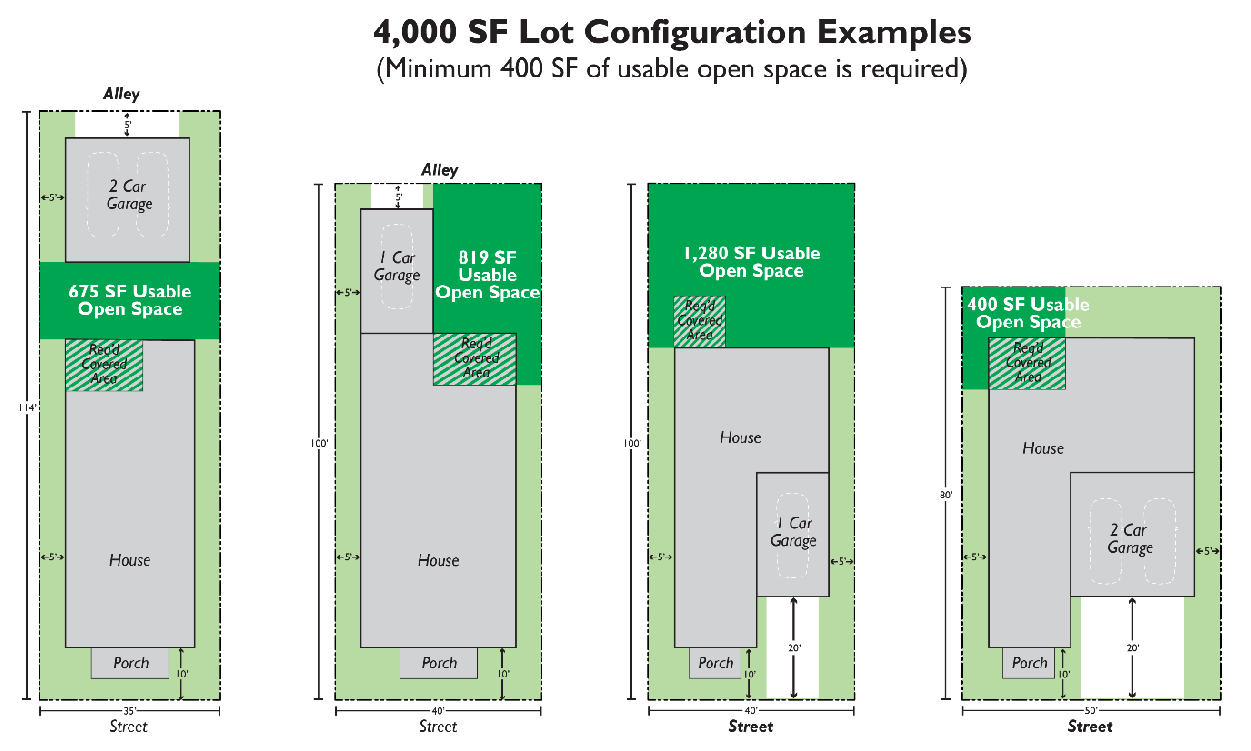
Figure 18.206.020-E.2
Good and bad examples of useable open spaces.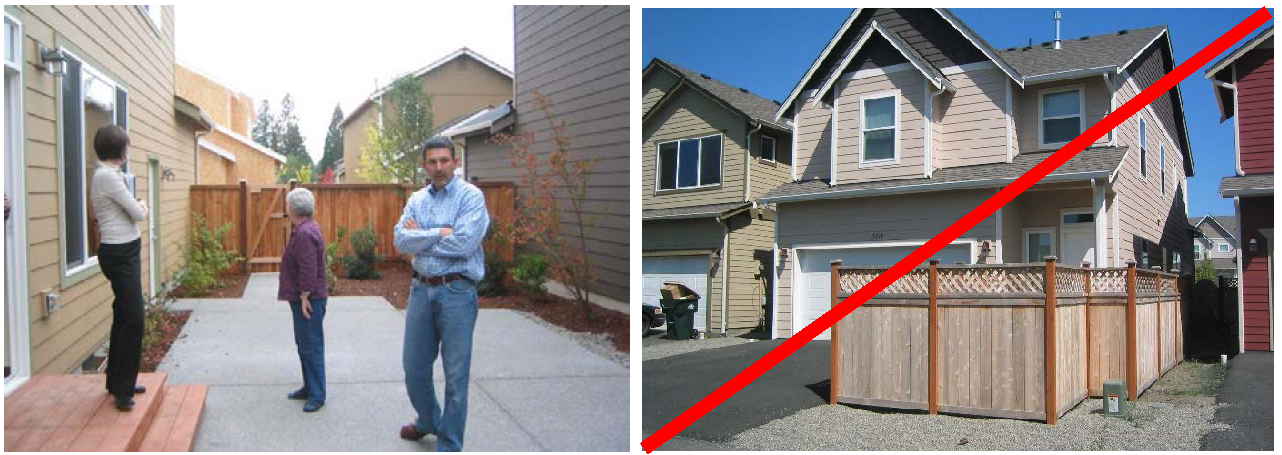
Left: Alley loaded lot that uses a zero-lot line configuration that allows for a wider/consolidated side yard (at least fifteen feet wide) where the adjacent home excludes windows on the facing wall. Right: Open space that is both too narrow and awkwardly located to be useable.
G.
Driveway standards. The following standards apply to driveways on lots less than fifty feet wide with vehicular access from the street.
1.
Driveways are limited to twelve feet in width, except as provided in subsection (2) below.
2.
Driveways may be up to twenty feet in width when on-street parking is prohibited on the near side of the street and the subject homes comply with the design provisions of subsection (E)(3) of this section.
H.
Tree Standards. Trees shall be integrated on new lots at the time of occupancy as provided below.
1.
Lots less than seven thousand square feet in area: Minimum three trees.
2.
Lots seven thousand square feet in area or greater: Minimum four trees.
3.
Where one or more existing native trees (as set forth in RDC 18.830.050) are preserved and integrated into the design of the development, the community development director will allow for credits of up to four required trees for each preserved tree depending on the size, health, and maturity of the tree.
4.
See RDC Chapter 18.725 for related landscaping plans, installation, and maintenance standards.
Figure 18.206.020-G
Examples of integrating existing trees into a new subdivision.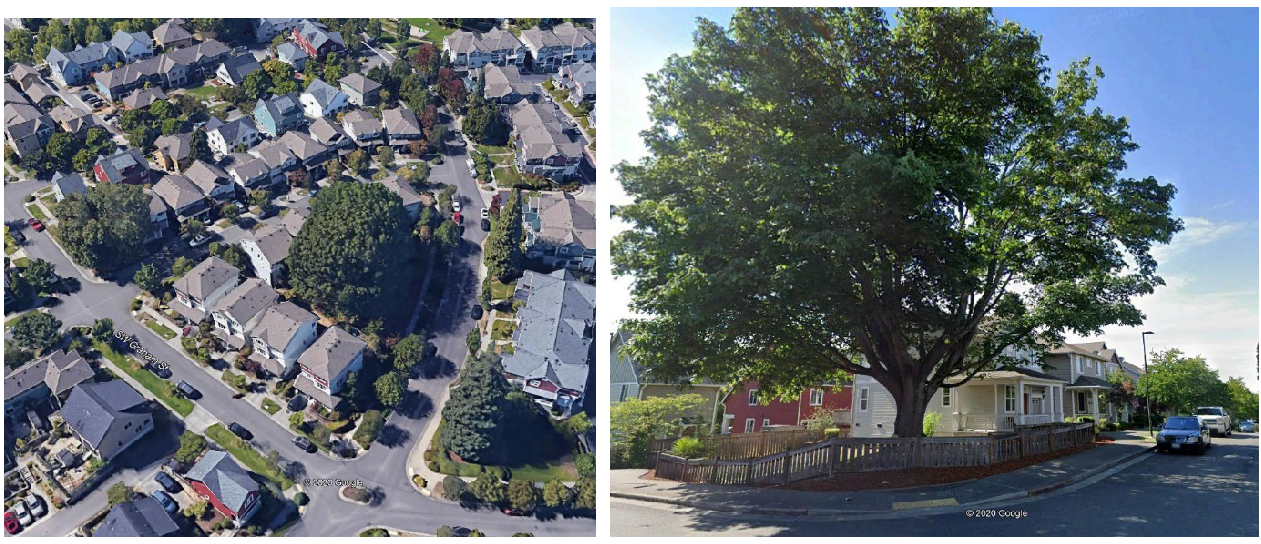
Right: Google Streetview showing one of those large trees, where the lot pattern was shifted to accommodate the tree.
(Ord. No. 1339, § 2(Exh. A), 5-27-2021; Ord. No. 1406, § 2(Exh. A), 7-13-2023; Ord. No. 1426, § 2(Exh.), 7-25-2024)
18.206.030 - Accessory dwelling units (ADU).
A.
Purpose.
1.
To add affordable units and make housing units available to moderate-income people who might otherwise have difficulty finding homes within the city.
2.
To promote the development of additional housing options in residential neighborhoods that are appropriate for people at a variety of stages of their lives.
3.
To provide homeowners with a means of obtaining, through tenants in either the accessory dwelling unit or the principal residence, rental income, companionship, or security.
4.
To protect neighborhood stability, property values, and the character of the neighborhood.
B.
Standards.
1.
No lot may have more than two accessory dwelling units.
2.
Accessory dwelling unit(s) may be located in the principal residence or in detached structures.
3.
Accessory dwelling units, whether attached or detached, shall be designed in the same style as the primary dwelling and shall use like kind materials on exterior elements.
4.
Individual accessory dwelling units shall not be larger than fifty percent of the living area of the primary residence or one thousand square feet, whichever is greater.
5.
An accessory dwelling unit in a detached structure shall be located behind the primary street facade of the primary dwelling.
6.
The maximum height of accessory dwelling units shall be twenty-four feet unless a lower limit is established for single-family residences in the base zone.
C.
Accessory Dwelling Unit Incentive. For every five single family homes that integrate an ADU, those homes count as only four dwelling units, for density purposes.
D.
Ownership. The accessory dwelling unit shall not be subdivided or otherwise segregated in ownership from the primary residence.
E.
Approval Criteria. The community development director shall process a request for accessory dwelling approval as Type II review consistent with RDC 18.310.070.
1.
An application for an accessory dwelling shall include a dimensioned site plan showing the location of the proposed dwelling on the subject property and its relationship to all property lines and easements on-site.
2.
In addition to the notice requirements of RDC 18.310.070, the city shall provide the applicable homeowner's association and/or the neighborhood association with notice of the application for accessory dwelling.
3.
Prior to approval of an accessory dwelling the community development director shall make the following findings:
i.
The location of the accessory dwelling complies with the underlying zoning district setbacks, lot area coverage requirements, and other applicable zoning district standards with the following exceptions.
a.
Detached accessory dwelling units may be sited at a lot line if the lot line abuts a public alley and the other provisions of subsection of (3) are met.
b.
Existing structures that violate current code requirements for setbacks or lot coverage may be converted to accessory dwelling units. Any increase to the nonconformity with current code requirements for setbacks or lot coverage is subject to the review procedures for alteration of a nonconforming development under RDC 18.340.050.
ii.
Location of the accessory dwelling shall not interfere with any proposed public facilities or services or with private easements.
iii.
The proposed accessory dwelling does not adversely affect public health, safety, or welfare.
F.
Impact Fees. Impact fees assessed on the construction of an accessory dwelling unit shall be assessed at fifty percent of the impact fees that would be imposed on the principal unit as defined in RCW 36.70A.696.
(Ord. No. 1339, § 2(Exh. A), 5-27-2021; Ord. No. 1464, § 2(Exh.), 12-4-2025)
18.206.040 - Cottage housing.
A.
Purpose.
1.
Provide opportunities for creative, diverse and high-quality infill development that is compatible with existing neighborhoods.
2.
Promote housing affordability and greater choice by encouraging smaller and more diverse home sizes in accordance with the Ridgefield Urban Area Comprehensive Plan.
3.
Support compatibility with existing neighborhoods by promoting high-quality design.
4.
Support more efficient use of urban residential land.
5.
Enhance the character of the residential neighborhood.
6.
Provide usable open space for residents.
7.
Create a sense of community among residents.
Figure 18.206.040-A
Cottage housing site plan example.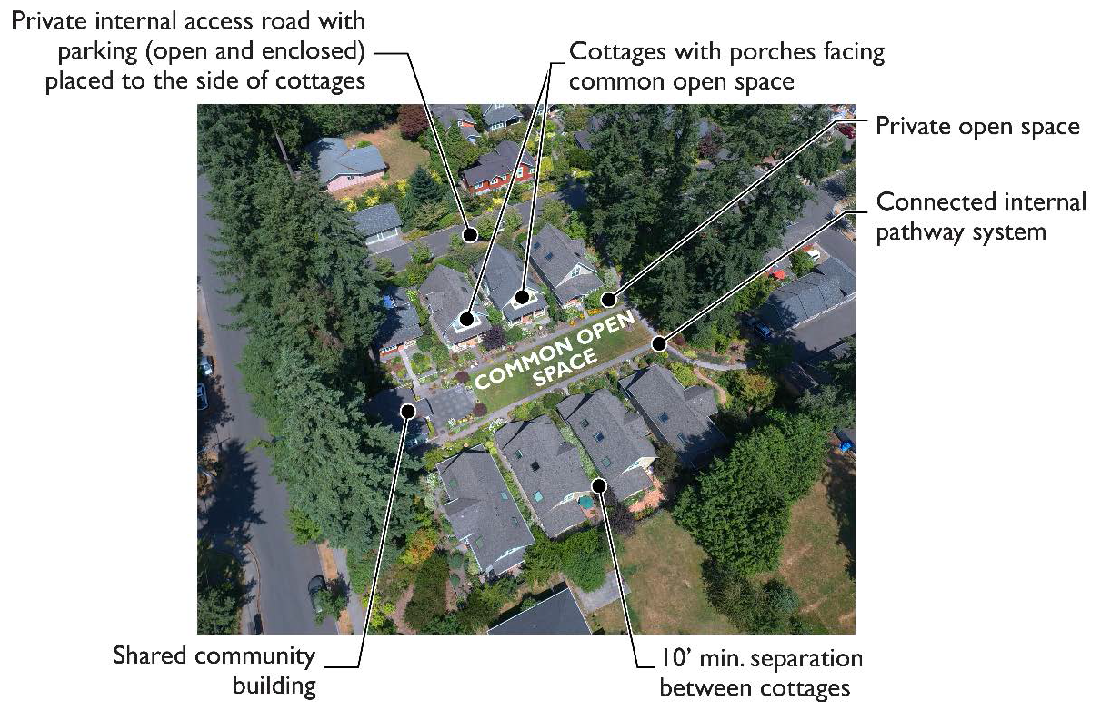
B.
Standards.
1.
Lot Standards.
a.
Cottages are exempt from minimum lot area and lot width standards, provided they comply with density and design standards herein.
b.
Impervious surface is calculated for the entire development and must meet the standard for the zone.
2.
Cottage size.
a.
Cottages must contain no more than one thousand two hundred square feet gross floor area in total, not including attached garages. A covenant restricting any increases in unit size after initial construction shall be recorded against the property. Vaulted space may not be converted to habitable space.
b.
Garages attached to cottages shall not exceed three hundred square feet.
3.
Density.
a.
Due to the smaller relative size of cottage units, each cottage may be counted as one-half a dwelling unit for the purpose of calculating density. For example, a cluster of six cottages would be equivalent to three dwelling units.
b.
Where cottage dwellings are integrated with other housing types qualifying for density bonuses, RDC 18.210.025.F.2 sets forth the cumulative limitations to the percentage of qualifying bonus dwelling units in a development.
4.
Minimum and maximum number of cottages.
a.
Cottage housing developments must contain a minimum of three cottages.
b.
Three to twelve cottage structures may make up a cluster. There is no limit on the number of clusters, provided all other standards are met.
c.
In the RLD-6, RLD-8, and RMD-16 zones, attached duplex cottages are allowed. In the RMD-8 and RMD-16 zones, attached triplex cottages are allowed.
d.
Existing single-family detached dwelling units may remain on the subject property and each will be counted as one dwelling unit for the purpose of density calculations.
5.
Setbacks and separation.
a.
The minimum setbacks of the zone apply to the development frontage and external side and rear property lines of the entire cottage development.
b.
Individual cottages must be separated from other cottages by at least ten feet. Permitted projections into required side yard setbacks in RDC 18.210.040 and 18.220.040 apply.
c.
Cottages must be set back at least five feet from any internal pedestrian path. Permitted projections into required front yard setbacks in RDC 18.210.040 and 18.220.040 apply.
d.
Cottages must be set back at least ten feet from any internal access lanes that provide access to four or more cottages. For access lanes serving less than four cottages, at least five feet of separation is required between access lanes and cottages. Permitted projections into required front yard setbacks in RDC 18.210.040 and 18.220.040 apply for setbacks to internal access lanes.
6.
Building height.
a.
Cottages have a maximum building height of twenty-five feet. All parts of the roof above eighteen feet must be pitched with a minimum roof slope of 6:12.
b.
Accessory structures in cottage housing developments are subject to the standards of the underlying zone.
7.
Design features. Each cottage shall contain the following features:
a.
Contrasting trim measuring a minimum of three inches wide on all wall openings.
b.
Roof overhang measuring a minimum of six inches.
c.
Clear and obvious pedestrian access between the sidewalk (or the street if there is no sidewalk) and the cottage entry.
d.
Covered pedestrian entry with minimum weather protection of three feet by three feet (a covered porch or recessed entry).
e.
Transparent windows and/or doors are required on at least ten percent of facades featuring the primary entrance and facing streets and common open spaces. For corner lots, this standard is only applied to the elevation containing the primary entrance.
8.
Design variety. Cottages within a cluster shall have a cohesive design signature, however, adjacent cottages may not be identical to one another.
9.
Common open space.
a.
Minimum Size. Common open space must be at least four hundred square feet per cottage.
b.
Minimum Dimensions. Common open space must have no dimension less than fifteen feet. Areas used to meet private open space requirements may not be double-counted as common open space.
c.
Elements. Common open space may include a lawn, courtyard, plaza, garden, or other shared central open space and may not include parking areas. Common open space must be usable and may not include critical areas, critical area buffers, or slopes greater than fifteen percent. LID stormwater BMPs, like rain gardens, may be integrated in up to twenty-five percent of the minimum required usable open space area.
d.
Orientation. Common open space must have cottages abutting on at least two sides. At least fifty percent of the cottages in each cottage housing cluster must abut common open space. Cottages abutting the common open space must be oriented around and have the primary entrance face the common open space.
e.
Access. Cottages must be within one hundred feet walking distance of the common open space and feature a direct pedestrian connection to the common open space.
f.
Fences. Fences are not allowed within required open space areas unless required as a condition of approval.
g.
Landscaping. Landscaping located in common open space areas shall be designed to allow for easy access and use of the space by all residents, and to facilitate maintenance needs (see related standards in RDC 18.725.090). Integration of existing trees into common open space is encouraged (see related standards in RDC Chapter 18.840).
10.
Shared community buildings.
a.
A shared community building may be integrated into the required common open space but it must not be included in the minimum common open space area calculations.
b.
Nonresidential use. A shared community building may include uses such as, but not limited to, a multi-purpose entertainment space, recreation center, kitchen, library, storage space, workshop, or similar amenities that promote shared use and a sense of community. Commercial uses other than daycare I are prohibited (see RDC 18.205.030.K).
c.
Height. Shared community buildings have a maximum building height of twenty-five feet. All parts of the roof above eighteen feet must be pitched with a minimum roof slope of 6:12.
d.
Size. Shared community buildings have a maximum ground floor footprint of one thousand two hundred square feet.
e.
Other standards. Except for the height and size exceptions identified in subsections (10)(c)—(d) of this section, shared community buildings are subject to the accessory structure standards of the underlying zone.
11.
Private open space.
a.
Minimum size. The minimum private open space adjacent to each cottage must be at least two hundred square feet.
b.
Minimum dimensions. The private open space must have no dimension less than ten feet.
c.
Access. The private open space must have direct access from the cottage via a door or porch.
d.
The required porch [see subsection (12)(e) of this section)] does not count as private open space for the size or dimension requirements of this section. The private open space is encouraged to be located between the cottage and the common open space.
e.
Porches. Cottage facades facing the common open space or common pathway must feature a roofed porch at least seventy square feet in size with a minimum dimension of seven feet on any side. Cottages sited between a street and the common open space are also subject to the entry requirements in subsection (B)(7) of this section.
f.
Private open space must be usable and may not include critical areas or critical area buffers, including slopes greater than fifteen percent.
12.
Access and parking.
a.
See the Ridgefield Engineering Standards for driveway and access requirements.
b.
Off-street parking standards, including guest parking provisions, are set forth in RDC Chapter 18.720.
c.
Parking areas must be located to the side or rear of cottage clusters. Parking must not be located between the street and cottages nor between cottages and common open space.
d.
Parking and access lanes must be screened from adjacent residential uses by landscaping or architectural screens. For parking areas and access abutting residential uses, at least five feet of Type L1, L2, or L3 landscaping (see RDC 18.725.030) must be provided between the parking area and the abutting residential use.
e.
Parking is encouraged to be consolidated under cover. Shared detached garage structures may not exceed four single-wide garage doors per building, a total of one thousand two hundred square feet. The massing, materials, and roof pitch of shared detached garages must be similar and compatible to the dwelling units within the development.
f.
Uncovered parking must be located in clusters of not more than six adjoining spaces (except where adjacent to an alley). Driveway space in front of private garages is exempt from this provision.
g.
Attached garages must not be located adjacent to the common open spaces. This requirement may be waived provided the combination of the common open space design, garage location and design, and landscaping/architectural design features helps to create a common open space that meets the purposes of the standards and the design mitigates the impact of the garages on the common open space.
13.
Impervious surface standards. The maximum impervious surface standards of the base zone apply to the whole cottage development rather than for individual cottage dwellings.
14.
Tree standards. Trees shall be integrated into cottage developments at the time of occupancy as provided below.
a.
A minimum of two deciduous and one and one-half evergreen trees are required per cottage.
b.
Required trees shall be distributed around the site in front, side, and rear yards, adjacent to parking areas, within private open space adjacent to cottages, and/or within common areas.
c.
Where one or more existing native trees (as set forth in RDC 18.830.050) are preserved and integrated into the design of the development, the community development director will allow for credits of up to four required trees for each preserved tree depending on the size, health, and maturity of the tree.
d.
See RDC Chapter 18.725 for related landscaping plans, installation, and maintenance standards.
15.
Accessory dwelling units are not permitted in cottage housing developments.
(Ord. No. 1339, § 2(Exh. A), 5-27-2021; Ord. No. 1426, § 2(Exh.), 7-25-2024)
18.206.050 - Duplex and triplex.
A.
Purpose.
1.
Provide opportunities for creative, diverse and high-quality infill development that is compatible with existing neighborhoods.
2.
Promote housing affordability and greater choice by encouraging smaller and more diverse home sizes in accordance with the Ridgefield Urban Area Comprehensive Plan.
3.
Support compatibility with existing neighborhoods by promoting high-quality design.
4.
Support more efficient use of urban residential land.
5.
Enhance the character of the residential neighborhood.
6.
Provide usable open space for residents.
B.
Duplex and Triplex Density Calculations and Incentives. RDC 18.210.030.F.2 sets forth the cumulative limitations to the percentage of qualifying bonus dwelling units in a development.
1.
On existing lots (created as of May 27, 2021), duplex units may be counted as one-half a dwelling unit and triplex units may be counted as one-third a dwelling unit, for the purpose of calculating density.
2.
On all corner lots in subdivisions, duplex units may be counted as one-half a dwelling unit for the purpose of calculating density. This incentive may not be combined with subsection (3).
3.
In subdivision developments in RLD zones, each duplex or triplex unit less than one thousand four hundred square feet in gross floor area and not on a corner lot may be counted as one-half a dwelling unit for the purpose of calculating density. This bonus is available for a limited number of units as follows. Once the cap is reached, additional duplex and triplex units are counted as one unit.
a.
RLD-4 zone: Up to twelve percent of dwelling units may be duplex units using the density bonus, and up to eight percent of the units may be triplex units using the density bonus.
For example, a subdivision on a net ten-acre parcel has a default maximum capacity of forty dwelling units. If thirty-six dwelling units are single-family homes, up to two duplexes (four dwelling units) and one triplex (three dwelling units) could be integrated. The calculated density is thirty-nine and one-half units, but the functional total is forty-three units (a bonus of three units).
b.
RLD-6 zone: Up to eighteen percent of dwelling units may be duplex units using the density bonus, and up to twelve percent of units may be triplex units using the density bonus.
c.
RLD-8 zone: Up to twenty-five percent of dwelling units may be duplex units using the density bonus, and up to twenty-five percent of units may be triplex units using the density bonus.
d.
Where duplex or triplex dwellings are integrated with other housing types qualifying for density bonuses, RDC 18.210.025.F.2 sets forth the cumulative limitations to the percentage of qualifying bonus dwelling units in a development.
4.
For plat recording requirements, see RDC 18.210.025.F.3.
C.
Required Design Features.
1.
All wall openings, regardless of visibility from a public right-of-way, shall have:
i.
Contrasting trim (minimum three inches wide);
ii.
Recess (windows) at least one and one-half-inches from the façade; or
iii.
Other design treatments that add depth, richness, and visual interest to the façade.
2.
Roof overhang (minimum six inches) or other design feature with comparable visual impact that adds depth and richness to the home design.
3.
Covered entry at least three feet deep for the primary entrances.
4.
Minimum useable open space [see standards in subsection (E) below].
5.
Minimum front façade window transparency: At least ten percent. This applies to all vertical surfaces of the façade elevation (excluding rooflines). Windows and their frames shall be used in the calculations, while trim may not be included. Garage door windows may be used to meet up to fifty percent of the minimum transparency requirement.
D.
Architectural Design Guidelines and Standards.
1.
Character. Generally, duplexes and triplexes should maintain the traditional character and quality of detached single-family dwelling units by using similar traditional design elements and materials such as wood siding, trim, porches, and chimneys. More detailed standards are provided throughout this section.
2.
Front façade articulation. Duplexes and triplexes shall utilize a combination of roofline and façade modulation to distinguish each unit located on the ground floor that faces the street. This is not required for stacked unit configurations or front-and-rear configurations that appear as a single-family home with only one entry facing the street.
3.
Front façade features. Every front façade of a duplex and triplex shall contain a minimum of three elements from the lists, including at least one element from the structural elements list and at least one element from the decorative elements list.
a.
Structural elements. Qualifying features shall be integrated on the façade of each dwelling unit.
i.
Covered porch area with a minimum of fifteen square feet.
ii.
Dormers.
iii.
Gables.
iv.
Hipped, gable, gambrel, mansard or similar pitched roof.
v.
Bay windows.
vi.
Twelve-inch offset from one exterior wall to another.
vii.
Balconies.
viii.
Roofline offset of at least two feet from the top surface of one roof to the other.
ix.
Vertical breaks/horizontal walls.
x.
Recessed building entry at least two feet deep by four feet wide.
xi.
Other structural element that adds comparable visual interest to the features above, as approved by the community development director.
b.
Decorative elements. Qualifying features shall be integrated on the façade of each dwelling unit.
i.
Decorative garage doors. Standard squares on a garage door will not qualify as a decorative detail.
ii.
Pillars/posts.
iii.
Decorative eave or barge boards with two material variations.
iv.
Decorative shingles or varied siding in gables.
v.
Decorative siding (shingles, shake, batten board, wainscoting, or similar).
vi.
Brick, stone or cedar accents covering at least ten percent of the front facade wall surface area.
vii.
Variable siding; the use of two or more types of siding.
viii.
Fiber-cement horizontal lap siding between three and seven inches wide.
ix.
Shed roof above window(s).
x.
Belly Band cladding.
xi.
Functional shutters or louvers.
xii.
Corner boards/posts.
xiii.
Knee or eave braces.
xiv.
Enlarged trim on garage door headers at least six inches wide.
xv.
Other architectural elements, other than color, glass or lighting, approved by the community development director.
Figure 18.206.050-D
Examples emphasizing façade articulation and details.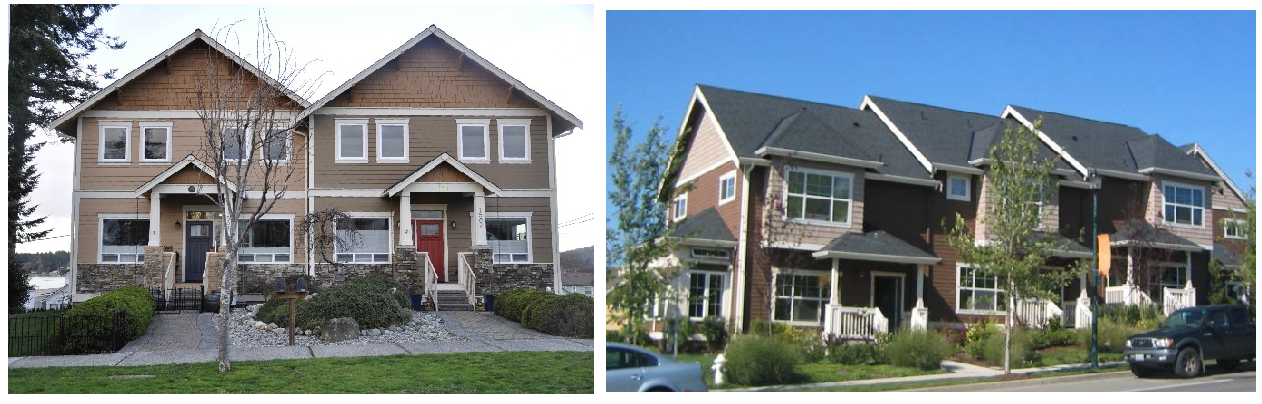
Left example: Duplex with covered entry, separate gabled roofs, pillars/posts, decorative
shingles, stonework, and eave braces.
Right example: Triplex with covered porches, pillars/posts, roofline offsets, variable
siding, projecting window bays and multi-paned windows.
4.
Pitched roof. Roofs must be pitched with slopes between 2:12 and 15:12, and along street frontages roof design for a duplex or triplex building shall not repeat unless separated by three different types of roofs (a design is determined by the predominate axis and pitch of the roof form together with intersecting secondary roof forms). Porches and dormers are exempt from this standard.
5.
Exterior materials. Building exteriors shall be constructed from quality and durable materials such as stone, brick, wooden lap siding, fiber cement siding, or similar materials. Insubstantial materials, such as fiberglass, and materials such as mirrored glass, corrugated siding, exposed concrete block, and plywood or T-111 siding are not permitted.
E.
Garage Location and Design.
1.
Garages or carports detached from or attached to the main structure and facing the street shall comply with at least one of the following:
a.
Set back the garage or carport from the front building facade or front face of a covered porch, by a minimum of four feet. To qualify as a porch under this subsection, the porch must extend along a minimum of 50 percent of the street-facing building facade that is not devoted to the garage, and must be at least six feet wide.
b.
Provide enhanced architectural details. Under this option, the front façade shall contain a minimum of six elements from elements lists under subsection (D)(3) of this section, including at least two elements from the structural elements list and at least two elements from the decorative elements list.
2.
No more than fifty percent of any ground floor façade may be occupied by a garage, and detached garages and all carports shall not protrude beyond the front building façade. This limit may be increased to a maximum of sixty-five percent provided at least three of the following design details are utilized:
a.
A decorative trellis over at least the entire width of the garage door(s).
b.
A window or windows are placed above the garage on a second story or attic wall.
c.
A balcony that extends out over the driveway.
d.
Utilizing all single-vehicle car doors as an alternative to wider garage doors suitable for two-car garages.
e.
Windows in the garage door.
f.
Decorative details on the garage door. Standard squares on a garage door will not qualify as a decorative detail.
F.
Driveways and Access.
1.
Where the dwellings are served by alleys, all garages and on-site parking shall be accessible from the alley and the façade(s) facing the street shall be designed as the front of the dwellings including, but not limited to, a primary building entrance consisting of inward swinging door(s), porch(es), window(s) and pathway(s) to the street.
2.
When no alleys are present, the following apply:
a.
Side- and rear-facing parking areas and garages are encouraged.
b.
When located on a corner lot, both streets must be utilized for vehicle access, unless one street is designated as an arterial. Such driveways must be located as far from the street corner as feasible.
c.
Driveways for duplexes are limited to:
i.
One twenty-foot wide (maximum) driveway; or
ii.
Two twelve-foot wide (maximum) driveways, provided the driveways are spaced at least twenty feet apart.
Figure 18.206.050-F.2.b
Duplex corner lot driveway location examples.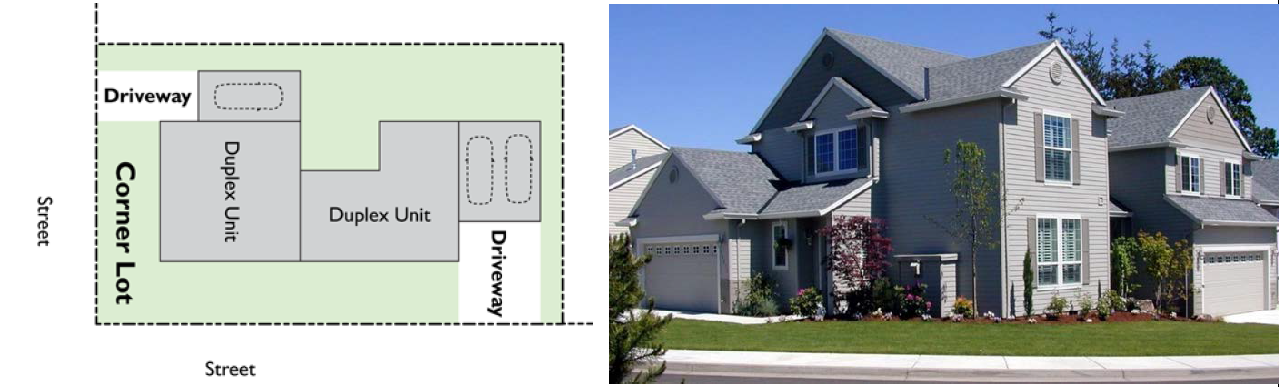
Figure 18.206.050-F.2.c
Duplex driveway and garage example.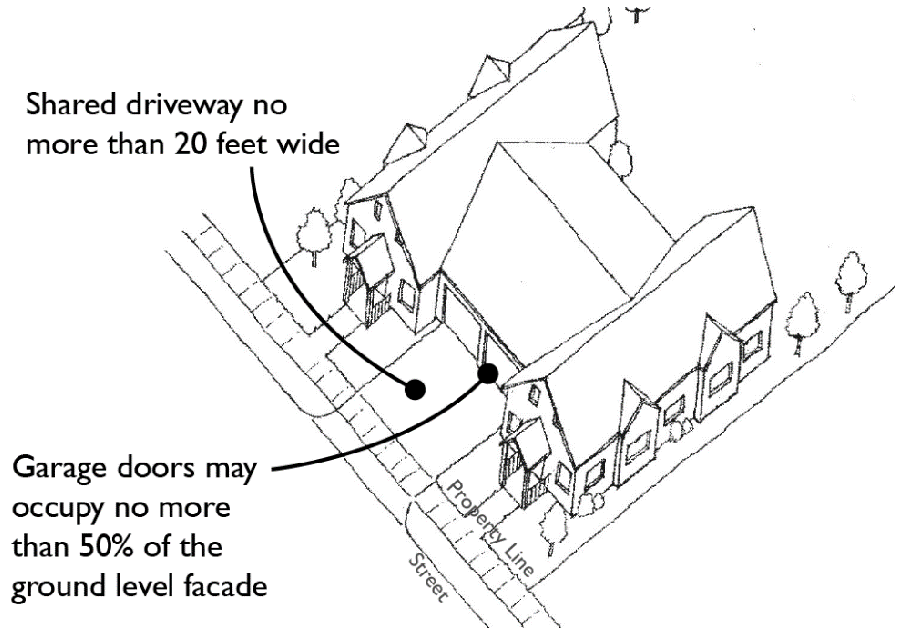
G.
Open Space Standards.
1.
All new duplex and triplex developments shall provide usable open space with a collective size equal to ten percent of the lot area. For example, an eight thousand square-foot lot would require at least eight hundred square feet of usable open space. Usable open space may be a single large space or separate spaces.
2.
All useable open space shall a minimum dimension of fifteen feet on all sides.
3.
Where the usable open space is located within a front yard setback, the open space must be defined with a fence, hedge, or wall between eighteen and thirty-six inches tall (meeting the standards of RDC Chapter 18.740). See Figure 18.206.050-G for an example.
4.
If the rear edge of the usable open space is within five feet of an alley, any fence between the rear edge and the alley shall be limited to four feet in height except where the portion of the fence between four and six feet in height is at least fifty percent transparent. Vegetative matter which functions as a fence has no height limit.
5.
Unenclosed decks, porches, patios, and entries may be used as a part of the usable open space, provided they are a part of a space that meets the standards herein.
6.
Driveways shall not count in the calculations for usable open space.
7.
Additions shall not create or increase any nonconformity with this standard.
Figure 18.206.050-G
Duplex front yard open space example.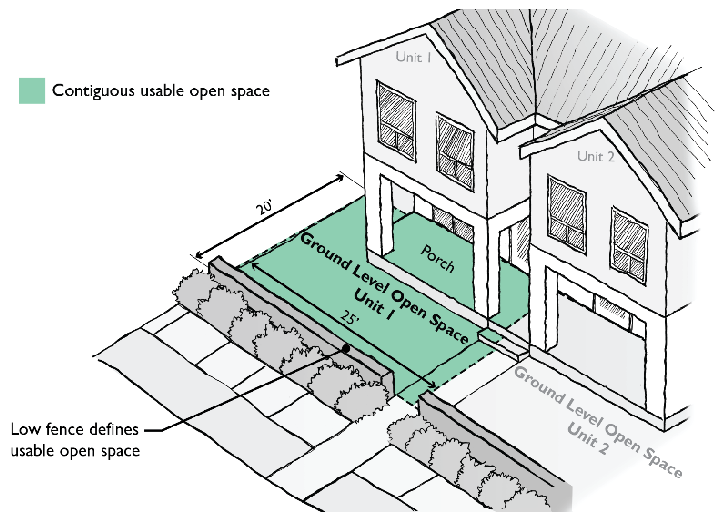
H.
Tree Standards. Trees shall be integrated on new lots at the time of occupancy as provided below.
1.
Lots less than seven thousand square feet in area:
a.
Minimum two deciduous trees.
b.
Minimum one evergreen tree.
2.
Lots seven thousand square feet in area or greater:
a.
Minimum two deciduous.
b.
Minimum two evergreen trees.
3.
Where one or more existing native trees (as set forth in RDC 18.830.050) are preserved and integrated into the design of the development, the community development director will allow for credits of up to four required trees for each preserved tree depending on the size, health, and maturity of the tree.
4.
See RDC Chapter 18.725 for related landscaping plans, installation, and maintenance standards.
Figure 18.206.050-H
Example of integrating tree preservation into a duplex/triplex housing development.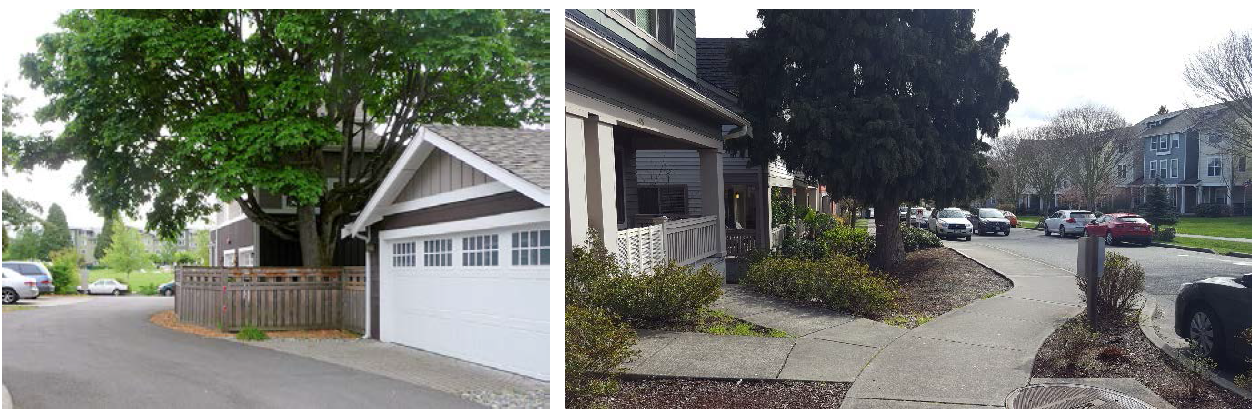
(Ord. No. 1339, § 2(Exh. A), 5-27-2021; Ord. No. 1464, § 2(Exh.), 12-4-2025)
18.206.060 - Townhouse.
A.
Purpose.
1.
Provide opportunities for creative, diverse and high-quality infill development that is compatible with existing neighborhoods.
2.
Promote housing affordability and greater choice by encouraging the integration of townhouses into new subdivisions.
3.
Support compatibility with existing neighborhoods by promoting high-quality design.
4.
Support more efficient use of urban residential land.
5.
Enhance the character of residential neighborhoods.
6.
Provide usable open space for residents.
B.
Townhouse Density Calculations and Incentives in the RLD-6-8 Zones.
1.
In subdivision developments in RLD-6 and RLD-8 zones, each townhouse unit less than one thousand four hundred square feet in gross floor area may be counted as one-half a dwelling unit for the purpose of calculating density. This bonus is available for a limited number of units as follows. Once the cap is reached, additional townhouse units are counted as one unit.
a.
RLD-6 zone: Up to fifteen percent of dwelling units may be townhouse units using the density bonus.
For example, a subdivision on a net ten-acre parcel has a default maximum capacity of sixty dwelling units. If fifty-five dwelling units are single-family homes, up to nine townhouses could be integrated. The calculated density is fifty-nine and one-half units, but the functional total is sixty-four units (a bonus of four units).
b.
RLD-8 zone: Up to twenty-five percent of dwelling units may be townhouse units using the density bonus.
2.
Where townhouses are integrated with other housing types qualifying for density bonuses, RDC 18.210.025.F.2 sets forth the cumulative limitations to the percentage of qualifying bonus dwelling units in a development.
3.
For plat recording requirements, see RDC 18.210.025.F.3.
C.
Dimensional Standards. The townhouse standards in Table 18.206.060-A supersede the dimensional requirements for the RLD-4, -6, and -8 and RMD-16 zones in RDC 18.210.030 and 18.220.030, respectively, provided the applicable density standards are met. Other standards of the base zone apply.
Table 18.206.060-A
Townhouse dimensional standards.
1.
Reduced side yards. The minimum side yard for a townhouse shall be zero feet for the side yard where the townhouse attaches to another townhouse and five feet where the townhouse is not attached to another townhouse, which shall not be reduced through the PUD or adjustment or variance process. For zero-lot line development, eaves may project across the property line if the developer or property owners record an easement expressly describing the purpose, dimensions, and duration of the easement.
2.
Major corridors. See RDC 18.210.060 for special setback and design requirements along major corridors.
3.
Building separation. The minimum building separation between townhouse buildings shall be ten feet.
D.
Required Design Features:
1.
All wall openings, regardless of visibility from a public right-of-way, shall have:
i.
Contrasting trim (minimum three inches wide);
ii.
Recess (windows) at least one and one-half-inches from the façade; or
iii.
Other design treatments that add depth, richness, and visual interest to the façade;
Where
no wall openings exist on a façade, contrasting materials must be incorporated.
2.
Roof overhang (minimum six inches) or other design feature with comparable visual impact that adds depth and richness to the home design.
3.
Covered entry at least three feet deep for the primary entrances [see related standards in subsection (E)(3) of this section].
4.
Minimum useable open space [see standards in subsection (E) below].
5.
Minimum front façade window transparency: At least ten percent. This applies to all vertical surfaces of the façade elevation (excluding rooflines). Windows and their frames shall be used in the calculations, while trim may not be included. Garage door windows may be used to meet up to fifty percent of the minimum transparency requirement.
E.
Architectural Design Standards.
1.
Articulation.
a.
Townhouse buildings must include façade articulation features at intervals to create a human-scaled pattern. The maximum horizonal length of the intervals is the width of individual townhouse units.
b.
Articulation is required on all facades facing a street, common or other shared open space, and common parking areas.
c.
At least three of the following articulation features must be employed with each articulation interval, and at least two of these features shall be substantially different from the features on abutting units:
i.
Use of windows and/or entries.
ii.
Use of weather protection features (such as covered porches).
iii.
Change in roofline, such as vertical or horizontal offsets or variations in roof pitch.
iv.
Dormers.
v.
Change or decorative use of building material, siding style, and/or window pattern (applies to all floors of the façade).
vi.
Pillars or posts.
vii.
Providing vertical building modulation of at least twelve inches in depth if tied to a change in roofline or a change in building material, siding style, or color.
viii.
Balconies that are recessed or projected from the facade by at least eighteen inches.
ix.
Other design techniques that effectively reinforce a pattern of small facades compatible with the building's surrounding context.
2.
Repetition with variety.
a.
No townhouse building shall have the same front façade design as any other townhouse building within two hundred linear feet, on either side of the street, as measured from the nearest point of the subject property lines. If a rear facade is visible from a public right-of-way and there is not a buildable lot fully between the nearest point of the rear property line of the subject property and the nearest point of a public right-of-way or private street, the rear facade of the subject dwelling shall also comply with this standards.
b.
Townhouse developments shall employ one or more of the following "repetition with variety" articulation methods:
i.
Reversing the elevation of dwellings.
ii.
Providing different building elevations for external townhouses (units on the end or corner of a building) by changing the roofline, articulation, windows, and/or building modulation patterns.
iii.
Adding a different dwelling design or different scale of the same design, such as adding a two-story version of the basic dwelling design where three stories are typical.
iv.
Other design treatments that add variety or provide special visual interest, such as different cladding materials, window sizes and groupings, roof slopes, porch designs, balconies, etc. While the variable use of color on buildings can be effective in reducing the perceived scale of the building and adding visual interest, color changes alone are not sufficient to meet the purpose of the standards.
c.
The community development director may allow relief from the repetition with variety provisions above where high-quality materials (such as brick) are employed and combined with effective details and or other site features that reduce monotony and add a sense of depth and richness to the building and development.
Figure 18.206.060-C.2
Repetition with variety examples.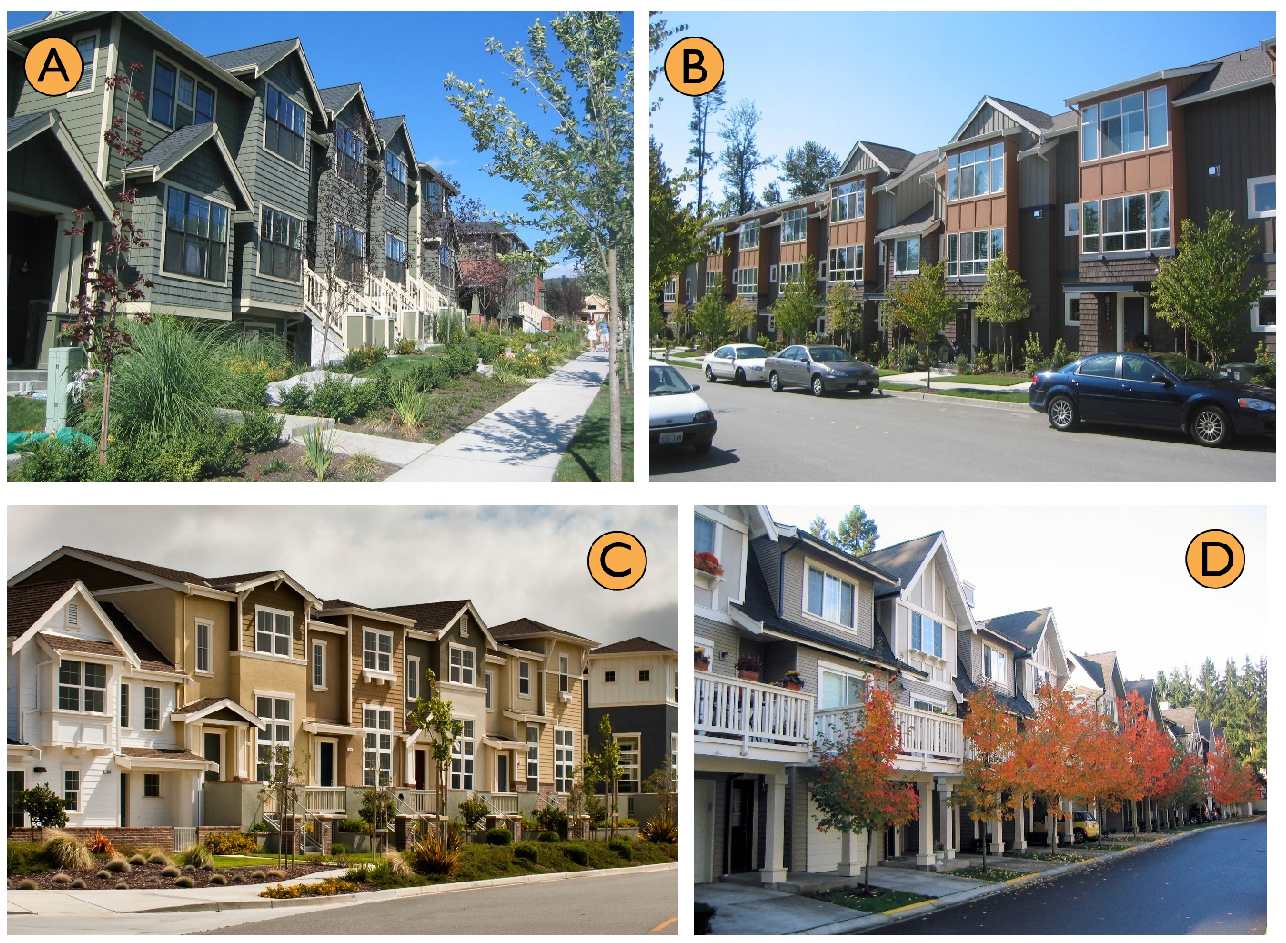
A. Different elevation for end units.
B. Alternating roofline.
C & D. Alternating articulation (roofline, siding style, color, and window fenestration).
3.
Entries.
a.
Clear and obvious pedestrian access between the street and the building entry is required for new dwellings.
b.
All new dwellings must provide a covered pedestrian entry with minimum weather protection of three feet by three feet (a covered porch or recessed entry). This entry may be integrated into usable open space required under subsection (G) of this section.
c.
For townhouses where the primary pedestrian access to the dwelling is from an alley or private internal vehicular access, buildings must emphasize individual pedestrian entrances over private garages by using both of the following measures:
i.
Enhance entries with a trellis, small porch, or other architectural features that provide cover for a person entering the unit and a transitional space between outside and inside the dwelling.
ii.
Provide a planted area in front of each pedestrian entry of at least 20 square feet in area, with no dimension less than four feet.
4.
Exterior materials. Building exteriors shall be constructed from quality and durable materials such as stone, brick, wooden lap siding, fiber cement siding, or similar materials. Insubstantial materials, such as fiberglass, and materials such as mirrored glass, corrugated siding, exposed concrete block, and plywood or T-111 siding are not permitted.
F.
Parking and Garage Location and Design.
1.
Rear parking. Individual garages facing the street are not allowed for townhouse dwellings. Garages shall be provided to the rear of the dwelling via alley access or a shared driveway as depicted in Figure 18.206.060-F.1, and the following standards apply.
Exception:
This standard does not apply for townhouse buildings with two units, and such buildings shall comply with the duplex driveway standards of RDC 18.206.050.E-F.
a.
Garages that take vehicle access from an alley shall be set back a minimum of three feet from an alley right-of-way.
b.
Internal drive aisles must meet minimum widths and other standards such as turning radii of the city-adopted International Fire Code.
c.
Minimum building separation along internal drive aisles must be twenty-four feet. Projections into this minimum building separation standard are permitted for each building consistent with the side yard setback projections allowed under this title. The purpose is to provide adequate vehicular turning radius, allow for landscaping elements on at least one side, and provide adequate light and air on both sides of the dwelling units and vehicle areas, which often function as usable open space for residents.
d.
Street-access driveways leading to townhouse garages shall not be considered parking lots for the purposes of RDC 18.220.100.C.
Figure 18.206.060-F.1
Townhouse driveway examples.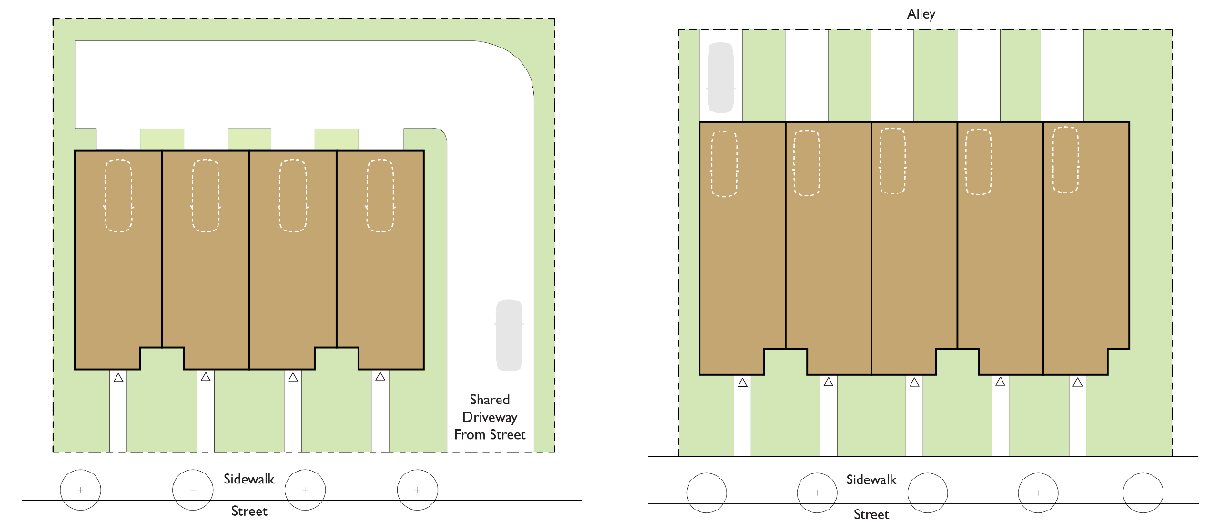
Both examples show a driveway with private garages placed to the rear of units. In the left image, there is no alley and access is provided from the street. In the right image, access from an alley is available and access is provided from the alley.
Figure 18.206.060-F.2
Acceptable and unacceptable townhouse driveway/orientation.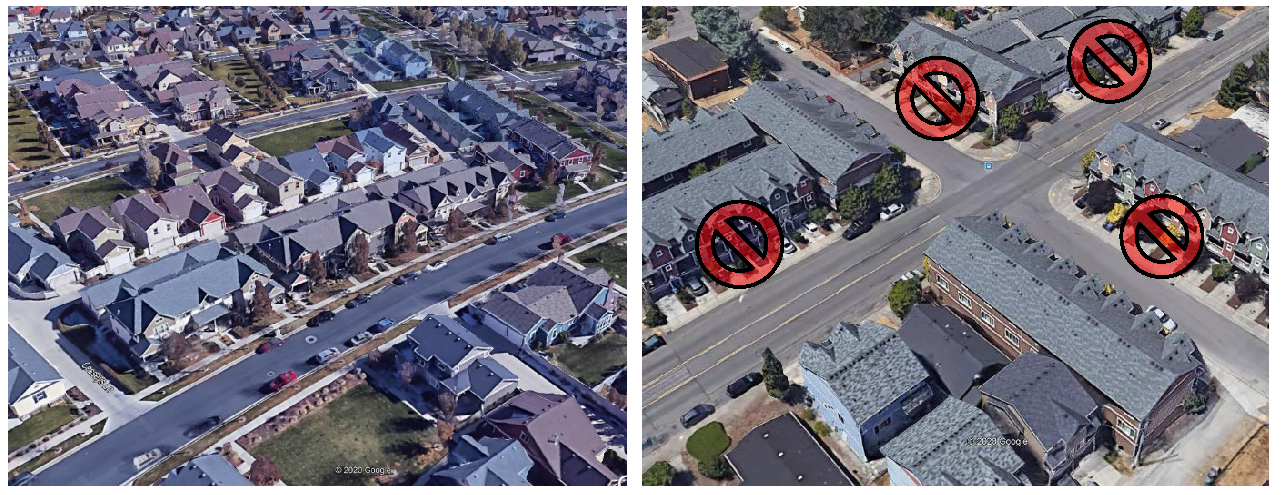
Left: Alley loaded townhouses (South Jordan, Utah) allow for landscaped front yards and inviting streetscapes. Right: The front-loaded townhouse examples are unacceptable because they degrade the streetscape and pedestrian environment and increase safety conflicts on public streets.
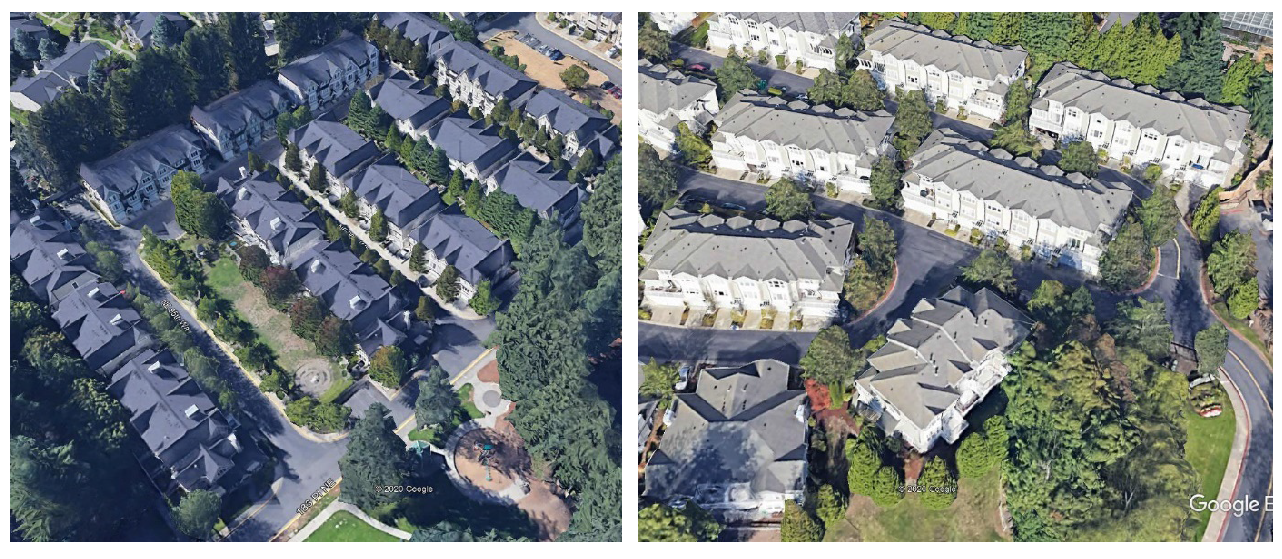
For larger townhouse developments, units can front onto smaller private access streets. Note the use of landscaped areas between each driveway in both examples. Both examples above also illustrate how trees can successfully be integrated into such developments.
2.
Street-facing driveways and garages.
a.
Individual garages and driveways facing the street [if allowed by exception under subsection (F)(1) of this section] are limited to twelve feet in width. Shared driveways, which have a maximum width of twenty feet, may be required by the community development director.
b.
Garages must be set back a minimum of twenty feet from the back of the sidewalk.
c.
No more than forty percent, as measured in square feet, of the wall area of the front elevation of an individual townhouse unit facing a street shall be dedicated to garage door space.
d.
Twenty percent of the garage wall area facing a street shall contain windows or doors placed to create the impression of habitable residential space.
e.
In each townhouse building, no more than fifty percent of the garages may extend beyond the front plane of the primary facade of the associated dwelling unit.
3.
If common parking areas other than driveways and garages are provided, the following access and location standards shall be met:
a.
Access to parking areas shall be provided from alleys where possible.
b.
Parking areas shall be located behind or to the side of buildings.
c.
Common parking areas must provide pedestrian connections to dwelling units.
G.
Open Space Standards. All townhouse dwelling units must provide open space at least equal to ten percent of the gross floor area of the unit. The required open space may be provided by one or more of the following:
1.
Private ground level open space that is directly adjacent and accessible to dwelling units.
a.
Such space must have minimum dimensions of at least twelve feet on all sides and be configured to accommodate human activity such as outdoor eating, gardening, toddler play, etc.
b.
Front yard setbacks may be used to meet this standard, provided they are defined with a low fence (meeting standards of RDC Chapter 17.740, Fences and Walls).
c.
Outdoor covered areas may be used to meet up to half of the required area if is located anywhere except the front of the lot.
d.
Driveways shall not count in the calculations for usable open space.
2.
Balconies, roof decks, or porches.
3.
In PUD subdivisions, shared open space that meets the design requirements of a main facility under RDC 18.401.080.B may be used to meet the useable open space requirement, provided such space is visible and directly accessible to the subject townhouse dwelling units.
Figure 18.206.060-G
Townhouse open space example.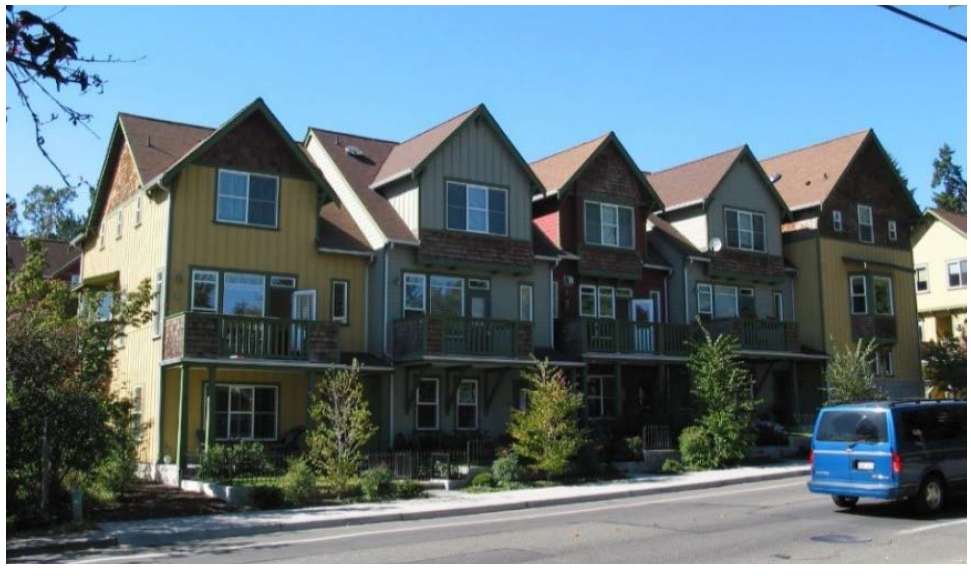
These townhouses utilize a combination of decks and ground-level yards to meet the required open space standard.
H.
Tree standards. Trees shall be integrated into townhouse developments at the time of occupancy at the rate one tree per townhouse unit.
a.
Trees may be either evergreen or deciduous.
b.
Required trees shall be distributed around the site in front, side, and rear yards, adjacent to parking areas, and/or within private open space adjacent to townhouses.
c.
Where one or more existing native trees (as set forth in RDC 18.830.050) are preserved and integrated into the design of the development, the community development director will allow for credits of up to four required trees for each preserved tree depending on the size, health, and maturity of the tree.
d.
See RDC Chapter 18.725 for related landscaping plans, installation, and maintenance standards.
(Ord. No. 1339, § 2(Exh. A), 5-27-2021)
18.206.070 - Multifamily design standards.
A.
Applicability. This section applies to multifamily development in the RMD-16 zone and when referenced by other sections of this code.
B.
Exterior Materials. Building exteriors shall be constructed from quality and durable materials such as stone, brick, wooden lap siding, fiber cement siding, or similar materials. Insubstantial materials, such as fiberglass, and materials such as mirrored glass, corrugated siding, exposed concrete block, and plywood or T-111 siding are not permitted.
C.
Facade Standards.
1.
All new residential building facades shall feature at least three of the following design features per dwelling unit that makes up the facade:
a.
Windows and door treatments which embellish the facade, such as trim a minimum of two inches wide around the windows facing a public street;
b.
Porches or covered entries;
c.
Dormers;
d.
Fascia boards at least six inches wide;
e.
Bay windows;
f.
Cupolas or towers;
g.
Pillars or posts;
h.
Eaves, with a minimum six-inch projection;
i.
Balconies;
j.
Decorative patterns on exterior finish (e.g., scales/shingles, wainscoting, ornamentation, and similar features);
k.
Use of contrasting materials, such as brick or stone, on a minimum of twenty-five percent of the facade;
l.
Other architectural elements, other than color, glass or lighting, including varying texture and materials within the same building, or massing, window voids, trellis or arcade, or other elements the Director finds compatible with the residential character of the zone.
2.
Large buildings shall be broken into smaller components to reflect the character and scale of the surrounding neighborhood through repetition of roof lines, patterns of door and window placement, and use of the characteristic entry features.
3.
Continuous building facades longer than fifty feet which face the street or low density residential zones shall incorporate modifications to the vertical plane of the facade. The facade shall incorporate building elements such as embellished entrances, courtyards, bays, balconies, and other architectural elements to visually divide the facade every thirty feet or less.
4.
Blank walls shall be articulated in one or more of the following ways:
a.
Installing a vertical trellis in front of the wall with climbing vines or planting materials.
b.
Providing a landscaped planting bed a minimum of five feet wide in front of the wall with plant materials that can obscure at least fifty percent of the wall's surface within three years.
c.
Providing texture or artwork (mosaic, mural, sculpture, relief, etc.) over the blank wall surface.
d.
Other equivalent method that provides for enhancement of the wall.
D.
Rooflines. Buildings shall avoid straight, unvaried rooflines exceeding sixty lineal feet and shall employ devices such as various elevations, gables, dormers, and chimneys. Roofline variation shall be achieved using one or more of the following methods:
1.
Vertical offset in ridge line;
2.
Horizontal offset in ridge line;
3.
Variations in roof pitch;
4.
Gables;
5.
Dormers;
6.
Decorative cornices and rooflines (e.g., for flat roofs).
E.
Garages or carports either detached from or attached to the main structure shall not protrude beyond the primary building facade.
F.
Open Space and Recreation Areas.
1.
A minimum twenty-five percent of the net developable acres of each multifamily development shall be provided as landscaped open space or common recreation areas. Open space and recreation areas developed to satisfy this section may also be credited towards the PUD open space requirements of RDC 18.401.080.B. The standards of this section and the PUD section must be met.
2.
Common recreation areas shall be provided as follows:
a.
Minimum one hundred seventy square feet per three-bedroom unit or larger.
b.
Minimum one hundred thirty square feet per two-bedroom unit.
c.
Minimum one hundred square feet per studio or one-bedroom unit.
3.
Common recreation areas must be accessible by all residents and may include the following:
a.
Outdoor common recreation areas including parks, trails, and sports facilities.
b.
Play areas at least four hundred square feet in size. Any play apparatus that is provided must meet consumer product safety standards for equipment, soft surfacing, and spacing.
c.
Community garden plots. The community garden area must be fenced, and must include a shared tool shed and water source for irrigation. Community gardens are not subject to the requirements of the city's community garden program.
d.
Indoor common recreation areas including community centers and recreation rooms.
e.
Common roof decks, balconies, and patios.
f.
Indoor or outdoor swimming pools.
g.
Other active recreation facilities as defined by RDC 18.100.
h.
Other features determined by the community development director to be materially similar to the above-listed common recreation areas.
4.
Common recreational areas shall be centrally located, and visibly accessible from dwelling units and sited away from arterial streets and parking areas, with a grade and surface suitable for their intended use, and have a smallest minimum dimension (length or width) of twenty feet, except for trail segments.
5.
Recreation areas shall be connected by trail or walkway to dwelling units and to any existing or planned public park, open space or trails on adjoining properties.
6.
Open space and common recreational areas shall be fully described and made a condition of approval. Such areas shall be maintained by a homeowner's association or equivalent mechanism approved by the city.
(Ord. No. 1339, § 2(Exh. A), 5-27-2021)

