
Ridgefield City Zoning Code
CHAPTER 18
100 - DEFINITIONS1
Editor's note— Ord. No. 1132, § 2(Exh. A), adopted July 11, 2013, amended Ch. 18.100 in its entirety to read as herein set out. Former Ch. 18.100, §§ 18.100.010—18.100.060, pertained to similar subject matter, and derived from Ord. No. 1108, § 2, 7-26-2012; Ord. No. 883, § 1, 2004; Ord. No. 757, § 1, 1999; Ord. No. 676, § 1(part), 1995.
18.100.010 - "A" definitions.
Abandonment. To cease operation for a period of twelve or more consecutive months.
Abate. To repair, replace, remove, destroy or otherwise remedy a condition which constitutes a code violation by such means, in such a manner, and to such an extent as the director determines is necessary in the interest of the general health, safety and welfare of the community and the environment.
Abut. To physically touch or border upon; or to share a common property line but not overlap.
Accent lighting. See "Lighting: Accent lighting."
Access. A way or means of approach to provide vehicular or pedestrian physical entrance to a property.
Accessway. The place, means or way by which pedestrians, bicycles or vehicles have safe, adequate and usable ingress and egress to a property or use, as required by this title.
Access facility, shared. A frontage or service road generally parallel to an arterial, connecting parcel to an arterial; alternately, a common access way serving businesses with one or more ownerships.
Access point. The location of the intersection of a highway or street or driveway with a street.
Accessory Dwelling Unit (ADU). A dwelling unit in addition to the primary dwelling, that is designed, constructed and used for the purpose of providing separate living accommodations that provides basic requirements for living, sleeping, eating, cooking, and sanitation. An accessory dwelling is incidental to the primary dwelling and the scale or location of the accessory dwelling does not dominate the site. It may be within, attached to or detached from the primary dwelling or existing accessory structures, such as a garage.
Accessory equipment structure. See "Wireless: Accessory equipment structure."
Accessory structure. A structure that is incidental and subordinate to the principal building located on the same lot. Accessory structures are not designed for human habitation and are not synonymous with accessory dwelling units (ADU) which are governed by RDC 18.206.030. Accessory structures include, but are not limited to, garages, mechanical structures, garden structures, detached decks and stairways, tennis courts, swimming pools, greenhouses, storage buildings.
Accessory use. See "Use: Accessory use."
Acre. A measure of land area containing forty-three thousand five hundred sixty square feet.
Adjacent. Properties directly across a public right-of-way. For example, an industrial district across the street or highway from a commercial district shall be considered as being adjacent. Properties in zoning districts separated by a public right-of-way abut the right-of-way and do not necessarily abut each other.
Adult entertainment.
A.
Any exhibition, performance or dance of any type conducted in a premises where such exhibition, performance, or dance involves a person who is unclothed or in such costume, attire, or clothing as to expose any portion of the female breast below the top of the areola or any portion of the pubic region, anus, buttocks, vulva or genitals, or wearing any device or covering exposed to view which simulates the appearance of any portion of the female breast below the top of the areola or any portion of the pubic region, anus, buttocks, vulva or genitals, or human male genitals in a discernibly turgid state, even if completely and opaquely covered; or
B.
Any exhibition, performance or dance of any type conducted in a premises where such exhibition, performance or dance is distinguished or characterized by a predominant emphasis on the depiction, description, simulation or relation to the following specified sexual activities:
1.
Human genitals in a state of sexual stimulation or arousal;
2.
Acts of human masturbation, sexual intercourse or sodomy; or
3.
Fondling or other erotic touching of human genitals, pubic region, buttocks or female breasts; or
C.
Any exhibition, performance or dance which is intended to sexually stimulate any member of the public and which is conducted on a regular basis or as a substantial part of the activity on the premises. This includes, but is not limited to, any such exhibition, performance or dance performed for, arranged with, or engaged in with fewer than all members of the public on the premises at the time, and which is commonly referred to as table dancing, couch dancing, lap dancing, private dancing and straddle dancing.
Adult family home. A residential home in which a person or persons provide personal care, special care, room, and board to more than one but not more than six adults who are not related by blood or marriage to the person or persons providing the services. Eight adults may be allowed with proof of approval and compliance with RCW 70.128.066.
Adult use facility. Any facility where adult entertainment is featured.
Adverse impact. A condition that creates, imposes, aggravates, or leads to inadequate, unsafe, or unhealthy conditions on a site or critical area proposed for development or on off-site property, facilities, or conditions.
Agricultural. The use of the land for limited, low impact, agricultural purposes, including farming, pasturage, horticulture, floriculture, viticulture, apiaries and limited animal and poultry husbandry. Low impact agricultural purposes are those activities which create minimal environmental disturbances, such as soil compaction, wind erosion, increased stream sedimentation or warming, loss of wildlife habitat cover. The term also includes necessary accessory uses, provided that such accessory uses have no greater impacts than primary uses. The above uses shall not include processing agricultural products, for example, slaughter houses, meat packing, commercial composting; or commercial feeding of animals in confined areas. Does not include any activities associated with the production or processing of marijuana; see "marijuana processing," "marijuana production" and "medical cannabis collective garden."
Agriculture, community supported.
A.
"[A] type of direct marketing, which consists of a community of individuals who pledge to support a farm operation so that the farmland becomes, either legally or spiritually, the community's farm, with growers and consumers providing mutual support and sharing the risks and benefits of food production." Community supported agriculture (CSA) includes community gardens, farmer's markets, food membership distribution facilities, and market gardens. See https://www.nal.usda.gov/farms-and-agricultural-production-systems/community-supported-agriculture.
B.
CSA farmer's markets, food membership distribution facilities and market gardens are secondary uses to the primary residential use on the same residential lot.
Airport and heliport. Includes aircraft runways, landing strips and uses supporting airport operations such as control towers, hangars, and fuel storage facilities. Includes areas designed to accommodate all phases of operation of helicopters with suitable space and facilities for a terminal, loading, unloading, service and storage of such aircraft. Also includes uses incidental to airports or heliports such as aerial mapping; air cargo warehousing and distribution, airport pilot training schools; aircraft sales and repair; aviation clubs and museums; and public transportation transfer areas. Such a facility that has regional or state-wide significance is classified as an essential public facility by the provisions of the Growth Management Act.
Alley. A service roadway providing a primary or secondary means of vehicle access to abutting property and not intended for primary traffic or pedestrian circulation.
Amateur. See "Wireless: Amateur."
Amenity. A natural or created feature that enhances the aesthetic quality, visual appeal, or makes more attractive or satisfying a particular property, place, or area.
American with Disabilities Act (ADA). A 1990 Federal law designed to bring disabled Americans into the economic mainstream by providing them equal access to jobs, transportation, public facilities, and services.
Animal kennel and shelter. Either:
1.
Any premises used to conduct a commercial business involving the breeding, buying, selling, letting for hire, boarding or training of dogs, cats and other domestic pets; or
2.
Any premises at which four or more dogs, cats and other domestic pets which are at least six months old are kept for any purpose, including animal shelters, pet shops, and dog day care, but excluding veterinary clinics and animal hospitals where dogs are kept only for treatment by licensed veterinarians.
3.
See also RMC Chapter 7.
Annexation. The incorporation of land within the Ridgefield UGA into the corporate limits of the city of Ridgefield consistent with RCW 3670A and RCW 35A.
ANSI. See "Wireless: ANSI."
Antenna. See "Wireless: Antenna."
Apartment. A dwelling located in a building containing three or more dwelling units that may be located one over the other in a multi-unit configuration.
Appellant. A person, organization, or party who files a complete and timely appeal of a city decision.
Applicant. A person who applies for land use review or building permit. An applicant may be the owner of the property or someone representing the owner such as a builder, developer, optional purchaser, consultant, or architect.
Arborist. A person or firm with specialized knowledge of the horticultural requirements of trees, certified by the International Society of Arboriculture or the National Arborist Association.
Artisan and specialty goods production. Small scale businesses that manufacture artisan goods or specialty foods and makes them available for purchase and/or consumption onsite, with an emphasis on direct sales rather than the wholesale market. Examples include: candy, fruit and vegetable preserving and specialty foods, bakeries and tortilla manufacturing; artisan leather, glass, cutlery, hand tools, wood, paper, ceramic, textile and yarn products; microbreweries, microdistilleries, and wineries.
Axe throwing lounge. An indoor space designed to allow people to throw axes, hatchets, and other similar items at targets. Food and/or drinks may be offered for sale. This use type may or may not also include the accessory sale of alcohol for on-premises consumption subject to applicable standards in WAC 314-03-060.
(Ord. No. 1132, § 2(Exh. A), 7-11-2013; Ord. No. 1163, § 2(Att.), 10-23-2014; Ord. No. 1164, § 2(Att.), 10-23-2014; Ord. No. 1178, § 2(Exh. A), 2-12-2015; Ord. No. 1296, § 2(Exh. A), 10-10-2019; Ord. No. 1339, § 2(Exh. A), 5-27-2021; Ord. No. 1345, § 2(Exh. A), 7-8-2021; Ord. No. 1370, § 2(Exh. A), 9-8-2022; Ord. No. 1406, § 2(Exh. A), 7-13-2023; Ord. No. 1440, § 2(Exh. A), 2-27-2025)
18.100.012 - "B" definitions.
Base density. See "Density: Base density."
Base flood. See "Flood: Base flood."
Base flood elevation. See "Flood: Base flood elevation."
Basement. Any area of the building having its floor subgrade (below ground level) on all sides.
Battery charging station. See "Electric vehicle infrastructure: Battery charging station."
Battery exchange station. See "Electric vehicle infrastructure: Battery exchange station."
Bed and breakfast. A business enterprise which offers six or fewer lodging units and a meal to transient guests. Located in, or accessory to, single-family dwellings.
Best management practices—BMPs. A system of practices and management measures that minimize adverse impacts to an identified resource.
Bicycle parking space. A space provided for locking a single bicycle to a rack element or for the storage of a single bicycle in a bicycle locker.
Billboard. See "Sign: Billboard."
Binding site plan. A plan drawn to scale, which identifies and shows the areas and locations of all streets, roads, improvements, utilities, open spaces, critical areas, parking areas, landscaped areas, surveyed topography, water bodies and drainage features and building envelopes. Binding site plan is an alternative to the subdivision of land.
Biologist. A person who has earned at least a Bachelor of Science degree in the biological sciences from an accredited college or university or who has equivalent educational training and experience.
Blank wall. Any portion of a wall without windows or doors that is greater than thirty LF.
Boarding house. Either:
1.
A building wherein furnished rooms without cooking facilities are rented for compensation to three or more nontransient persons, not included in the family unit of the owner or tenant of the premises; or
2.
A home or other institution which provides housing, basic services, and assuming general responsibility for the safety and well-being of the residents, and may also provide domiciliary care, licensed by the state pursuant to RCW 18.20. Excludes other licensed group homes such as community residential facilities and nursing homes, as well as any independent senior housing or retirement communities.
Boating facility. A facility or structure providing access in and out of the water for vessels, such as marinas, launching ramps, rails, or lift station. For purposes of the Shoreline Master Program, boating facilities excludes docks serving four or fewer single-family residences.
Bond. A surety bond, cash deposit, escrow account assignment of savings, irrevocable letter of credit or other means acceptable to, or required by, the director to guarantee work is in compliance with all applicable requirements.
Broadcasting and telecommunications facility. Facilities used for radio, television, cable and telecommunications and services related to those activities. Does not include any use regulated as a wireless communication facility (see RDC 18.760).
Buffer—Wetland. See "Wetland buffer."
Buildable area/land. The area of a lot or parcel remaining after any critical areas and buffers are subtracted from the gross area.
Building. Any structure having a roof supported by columns or walls and intended for the shelter, housing, or enclosure of any individual, animal, process, equipment, goods, or materials of any kind.
Building coverage. The ratio of the horizontal area measured from the exterior surface of the exterior wall, footing or foundation of the ground floor of all principal and accessory buildings on a lot to the total lot area. (See building definition in RDC 18.100.012)
Building envelope. Any area in which buildings may be constructed. Building envelopes are defined by building setbacks, either as a result of zoning district standards, or through the PUD process. Building envelopes shall be specifically defined for each lot wherever building is proposed on sensitive or constrained land.
Building scale. The relationship of a particular building, in terms of building mass, to other nearby and adjacent buildings.
Building setback. The area in which no buildings may be placed, usually measured from the front, side or rear property lines. Building setbacks may also be required to buffer intensive land uses from less intensive land uses, or protective buffers for wetlands, streams, and other sensitive (critical) lands.
Bus base. An establishment for the storage, dispatch, repair and maintenance of coaches and other vehicles of a public transit system or school transit system.
Business complex. Two or more commercial businesses on a lot or contiguous lots with common access and parking.
(Ord. No. 1132, § 2(Exh. A), 7-11-2013; Ord. No. 1406, § 2(Exh. A), 7-13-2023)
18.100.014 - "C" definitions.
Cannabis plant. An organism having at least three distinguishable and distinct leaves, each leaf being at least three centimeters in diameter, and a readily observable root formation consisting of at least two separate and distinct roots, each being at least two centimeters in length. Multiple stalks emanating from the same root ball or root system shall be considered part of the same single plant.
Cannabis, usable. Dried flowers of the cannabis plant having a THC concentration greater than three-tenths of one percent. Useable cannabis excludes stems, stalks, leaves, seeds, and roots. Dried means containing less than fifteen percent moisture content by weight. The term useable cannabis does not include cannabis products.
Caliper. American Nursery and Landscape Association standard for measurement of the diameter of a tree trunk. Caliper of the trunk shall be measured six inches above the ground.
Capital facilities plan. See "Ridgefield Capital Facilities Plan."
Care. Room and board and the provision of a planned treatment program; "planned treatment" means a previously determined program of counseling, therapy or other rehabilitative social service provided for a group of persons of similar or compatible circumstances or conditions.
Carport. A garage which is open on one or more sides.
Cemetery. An open space site for burial, entombment, inurnment, interment, cremation or funeral purposes.
City. The city of Ridgefield, Washington and all land within its corporate boundaries. The city council is the legislative body of the city. Actions taken on behalf of the city are authorized by the city council or its designee.
City attorney. The city of Ridgefield's contract attorney.
City clerk/treasurer. Referred to in this code as the "city clerk," this person is responsible for accepting counter-complete applications and providing public notice in accordance with the provisions of this title.
City engineer. The Ridgefield city engineer who is responsible for ensuring compliance with city public works and engineering standards or authorized representative.
Clearing. The limbing, pruning, trimming, topping, cutting or removal of vegetation or other organic plant matter by physical, mechanical, chemical or other means.
Clinic. See "Medical clinic/laboratory."
Closed record appeal. An appeal of a land use decision in which new evidence is not allowed.
Code violation. An act or omission contrary to:
A.
An ordinance of the city, or
B.
The conditions of any permit, notice, or stop work order issued pursuant to city ordinance or regulation.
College and university. Public and non-profit institutions of higher education. Accessory uses may include classrooms, laboratories, theaters, auditoriums, libraries, dormitories, eating facilities, bookstores, other small-scale retail, general offices, and parking. Excludes private, profit-making trade, specialized instructional, and vocational schools.
Colocation. See "Wireless: Colocation."
Columbarium. A structure of vaults lined with recesses for urns containing cremated human remains, or any other structure or space, including a space of ground, used or intended to be used for the placement of urns containing cremated human remains.
Commercial parking lot. A vehicle parking facility that does not provide required parking for a primary use on the parcel. The lot may be operated by the city or a business, and may or may not charge a fee for parking.
Community garden. A community garden is a noncommercially oriented garden where the residents of a community are empowered to design, build, and maintain spaces in the community for the purpose of raising produce, native plants, or flowers.
Community recreation and social facility. Public, private, and non-profit recreational, social and multi-purpose facilities that are open to the public for free or fee (including membership fees). Examples include: community centers; senior centers; social and fraternal organizations; health/fitness clubs; indoor or outdoor tennis/racquetball and soccer clubs and other sports fields; indoor/outdoor swimming pools; golf courses; and shooting ranges, to include firearms, archery, and axe throwing. Outdoor firearm ranges are prohibited. Accessory uses include clubhouses, pro shops, offices, locker rooms, restaurants/delis/concession stands, child care facilities, rest rooms, maintenance facilities, and parking. Excludes uses meeting the definition of "indoor entertainment facility."
Community residential facility. Living quarters meeting applicable federal and state standards that function as a single housekeeping unit and provide supportive services, including but not limited to counseling, rehabilitation and medical supervision, excluding drug and alcohol detoxification which is classified as health services. Includes group homes for children, for those with disabilities, or for the elderly; homes for recovering, non-using alcoholics and addicts; or shelters for domestic violence victims. CRFs are further classified as follows:
A.
CRF-I: Seven to ten residents and staff;
B.
CRF-II: Eleven or more residents and staff.
If staffed by nonresident staff, each twenty-four staff hours per day equals one full-time residing staff member for purposes of classifying CRFs.
Comprehensive plan map. The map or maps that implement the Ridgefield Comprehensive Plan and delineate the boundaries of comprehensive plan districts.
Computer and electronics manufacturing. Uses primarily engaged in manufacturing and/or assembling electronic computers, such as mainframes, personal computers, workstations, laptops, and computer servers, and other similar uses according to the North American Industry Classification.
Concurrency. See RCW 36.70A.070(6)(e) for transportation and 36.70A.020(12) for other public facilities and services.
Conditional use. See "Use: Conditional use."
Conditional use permit (CUP). A permit by the approving agency stating that the conditional use meets all conditions set forth in local ordinances.
Condominium. A building, or group of buildings, in which dwelling units, offices, or floor area are owned individually, and the structure, common areas, and facilities are owned by all the owners on a proportional, undivided basis.
Conference center. An establishment developed primarily as a meeting facility; including accessory facilities for recreation, overnight lodging, and related activities provided for conference participants.
Consultant. A person who is licensed to practice in the professional field of the requested consultation or who has equivalent educational training and at least four years of professional experience.
Contiguous. Next to, abutting, or touching and having a boundary, or portion thereof, in common.
Corner lot. See "Lot: Corner lot."
Corridor—Transportation. See "Transportation corridor."
Corridor—Stream. See "Stream corridor."
Cottage. A cottage is a small, detached dwelling unit that is developed at a density greater than the underlying zone. More than one cottage may occupy a single lot. See cottage development standards in RDC 18.206.040.
Cottage housing development. A cottage housing development is a single-family housing cluster of dwelling units around a central open space. See cottage development standards in RDC 18.206.040.
Crematorium. A place where bodies are consumed by incineration and the ashes of the deceased are collected for permanent burial or storage in urns.
Critical aquifer recharge areas. See RDC 18.280.170, Critical Areas Protection Definitions.
Critical areas. Any of the following areas or ecosystems: wetlands, critical aquifer recharge areas, streams, fish and wildlife habitat conservation areas, frequently flooded areas, and geologically hazardous areas as defined by the Growth Management Act (RCW 36.70A.170). See additional definitions in RDC 18.280.170, Critical Areas Protection.
Cul-de-sac. The bulb shaped turnaround at the end of a dead-end street.
Curb. Cement, concrete, or other improved boundary designed to delineate the edge of the street and to separate the vehicular portion from that provided for pedestrians.
Cultural institution. Public or non-profit cultural facilities including libraries, museums, historic sites, and galleries.
Cut-off angle (of a luminaire). See "Lighting: Cut-off angle (of a luminaire)."
(Ord. No. 1132, § 2(Exh. A), 7-11-2013; Ord. No. 1164, § 2(Att.), 10-23-2014; Ord. No. 1178, § 2(Exh. A), 2-12-2015; Ord. No. 1207, § 2(Exh. A), 5-26-2016; Ord. No. 1296, § 2(Exh. A), 10-10-2019; Ord. No. 1339, § 2(Exh. A), 5-27-2021; Ord. No. 1406, § 2(Exh. A), 7-13-2023; Ord. No. 1440, § 2(Exh. A), 2-27-2025)
18.100.016 - "D" definitions.
Daycare facility. An establishment for group care of nonresident adults or children.
A.
Daycare shall include child daycare centers and the following:
1.
Adult daycare, such as adult day health centers or social daycare as defined by the Washington State Department of Social and Health Services;
2.
Nursery schools for children under minimum age for education in public schools;
3.
Privately conducted kindergartens or pre-kindergartens when not a part of a public or parochial school; and
4.
Programs covering after-school care for school-age children.
B.
Daycare facilities are sub classified as follows:
1.
Daycare I: A maximum of twelve adults or children in any twenty-four-hour period; and
2.
Daycare II: Over twelve adults or children in any twenty-four-hour period.
Days. Calendar days, unless specifically stated as "working days."
Dedication. A conveyance of land by the owner of the land to a public agency through a legal instrument recorded with Clark County.
Deed. A recorded legal document conveying ownership of real property.
Density definitions.
Base density. The base density is a number calculated by multiplying the site area (in acres) by the applicable number of dwelling units.
Density. The ratio of dwelling units to land area, expressed as the number of residential dwelling units per acre of land in a residential development.
Density bonus. Density bonuses are based on the buildable land area of a site and occur when a developer provides specific amenities; increased density resulting from density bonuses cannot occur on unbuildable land.
Density transfer. Occurs when development is prohibited in common or public open space, and densities are increased on buildable land on the same site; density may not be transferred to unbuildable land.
Gross Density. The density of development on all the land area within a development project, including but not limited to, right-of-ways, open space, critical areas, parking areas, landscaping and buildings.
Net Density. The density of development on net developable acres including buildable lands, after removing public rights-of-way and conserved open space or critical areas.
Department. Community development department of the city of Ridgefield.
Design. The appearance of a structure including such features as material, color, and shape.
Design standards. A set of guidelines defining parameters to be followed in site and/or building design and development.
Detention or post-detention facility. Uses devoted to the housing, training and supervision of those under judicial detention. Examples include prisons; jails; probation centers; juvenile detention homes; secure community transition facilities; work release facilities; and related post-incarceration and half-way houses. Such a facility that has regional or state-wide significance is classified as an essential public facility by the provisions of the Growth Management Act.
Developer. Any person undertaking development or responsible for carrying out conditions of development, including property owners and assigns, operators, contractors, representatives or agents.
Development. Any artificial change to improved or unimproved real estate, including but not limited to buildings or other structures, mining, dredging, filling, grading, paving, excavation, storage of materials or equipment, parking of vehicles, drilling, driving of pilings, landscaping, modifications of water courses or vegetation removal.
Development regulations. Controls or conditions placed upon development or land use activities by the city or county, the purpose of which is to implement the RUACP.
The Ridgefield Development Code (RDC, or Title 18) and the city of Ridgefield Engineering Standards for Public Works shall constitute the principal development regulations of the city of Ridgefield.
This code means Volume III, the Ridgefield Development Code and Volume IV, the city of Ridgefield Engineering Standards for Public Works Construction.
Development review body. The city official or tribunal having statutory or code authority to approve a development.
Diameter at breast height (DBH). Tree diameter at a point four and one-half feet above ground, excluding any tree swellings or branches.
Director. The community development director of the city of Ridgefield. Used interchangeably with "planning director."
Display, exterior. The outdoor display of items to attract retail sales. Examples include vehicle sales lots, garden stores, sidewalk cafes, etc.
Doorway identification nameplate. See "Signs: Doorway identification nameplate."
Drive-through facility. A facility or structure that is designed to allow drivers to remain in their vehicles before and during an activity on site. Drive-through facilities include drive-through restaurants, banks and credit unions, and other similar uses. The following are excluded:
A.
Vehicle service facilities including gas pump islands, car wash facilities, oil and lube facilities, and other similar uses.
B.
Pick-up windows where no ordering takes place, including drive-through ATMs, pharmacy pick-up windows, restaurant windows designed for picking up online/phone orders only, and other similar uses.
C.
Drive-in theaters.
D.
Espresso stands that are less than five hundred square feet in floor area and do not have an indoor customer area.
E.
Freestanding drop boxes for, including but not limited to, voter ballots, library books, and mail (both private and public carriers).
Driveway. An area which provides vehicular access to a site. A driveway is the same width as the curb cut excluding any aprons or extensions of the curb cut. A driveway begins at the property line and extends into the site. Driveways do not include parking, maneuvering, or circulation areas in parking areas.
Dwelling definitions.
Dwelling or dwelling unit. Living accommodations serving an individual family or household, comprised of one or more rooms and kitchen facilities including any building or portion thereof, designed or used as the residence. See also definitions of specific dwelling types: accessory dwelling unit, apartment, duplex, live/work unit, townhouse.
Dwelling—Duplex. A building on a single lot containing two individual dwelling units that are separated from each other by a wall or floor/ceiling. This definition does not include accessory dwelling units.
Dwelling—Multifamily. A building or portion thereof designed or used as a residence by four or more families, and containing four or more dwelling units. The term also includes one to three dwelling units in a mixed-use building. The land underneath the structure is not divided into separate lots. This definition includes apartments.
Dwelling—Single-family. A building designed or used for residence purposes by not more than one family, and containing one dwelling unit only. The term "single family home" or "home" is also used to describe a single family dwelling.
Dwelling—Single-family detached. A dwelling that is physically separated from other dwellings.
Dwelling—Single-family detached, small lot. A dwelling that is physically separated from other dwellings and on a lot 5,000 square feet or less in area.
Dwelling—Townhouse. A dwelling unit, located on its own lot, in a row of at least two such units in which each unit has its own front and rear access to the outside, no unit is located over another unit, and each unit is separated from any other unit by one or more common walls.
Dwelling—Triplex. A building on a single lot containing three individual dwelling units that are separated from each other by walls or floors/ceilings. This definition does not include accessory dwelling units.
(Ord. No. 1132, § 2(Exh. A), 7-11-2013; Ord. No. 1178, § 2(Exh. A), 2-12-2015; Ord. No. 1337, § 3(Exh. A), 2-25-2021; Ord. No. 1339, § 2(Exh. A), 5-27-2021)
18.100.018 - "E" definitions.
Early notice. See "SEPA: Early notice."
Easement. A grant by the property owner of the use of a strip of land by the public, corporation, or persons for specific purposes.
Eating and drinking establishments. Establishments that sell prepared food and beverages for consumption on-site or take-away including restaurants, delicatessens, bars, taverns, brew pubs, and espresso bars.
Egress. An exit.
Electric vehicle infrastructure definitions.
Battery charging station. An electrical component assembly or cluster of component assemblies designed specifically to charge batteries within electric vehicles, which meet or exceed any standards, codes, and regulations set forth by chapter 19.28 RCW and consistent with rules adopted under RCW 19.27.540.
Battery exchange station. A fully automated facility that will enable an electric vehicle with a swappable battery to enter a drive lane and exchange the depleted battery with a fully charged battery through a fully automated process, which meets or exceeds any standards, codes, and regulations set forth by chapter 19.27 RCW and consistent with rules adopted under RCW 19.27.540.
Electric scooters and motorcycles. Any two-wheel vehicle that operates exclusively on electrical energy from an off-board source that is stored in the vehicle's batteries and produces zero-emissions or pollution when stationary or operating.
Electric vehicle. Any vehicle that operates, either partially or exclusively, on electrical energy from the grid, or an off-board source, that is stored on-board for motive purpose. "Electric vehicle" includes: (1) a battery electric vehicle; (2) a plug-in hybrid electric vehicle; (3) a neighborhood electric vehicle; and (4) a medium-speed electric vehicle.
Electric vehicle charging station. A public or private parking space that is served by battery charging station equipment that has as its primary purpose the transfer of electric energy (by conducive or inductive means) to a battery or other energy storage device in an electric vehicle.
Electric vehicle charging station—Public. An electric vehicle charging station that is: (1) publicly owned and publicly available (e.g., Park and Ride parking, public library parking lot, on-street parking); or (2) privately owned and publicly available (e.g., shopping center parking, non-reserved parking in multi-family parking lots).
Electric vehicle charging station—Restricted. An electric vehicle charging station that is: (1) privately owned and restricted access (e.g., single-family home, executive parking, designated employee parking); or (2) publicly owned and restricted (e.g., fleet parking with no access to the general public).
Electric vehicle infrastructure. Structures, machinery, and equipment necessary and integral to support and electric vehicle, including battery charging stations, rapid charging station, and battery exchange stations.
Medium-speed electric vehicle. A self-propelled, electrically powered four-wheeled motor vehicle whose speed attainable in one mile is more than twenty miles per hour and not more than twenty-five miles per hour and conforms to federal regulations under Title 49 C.F.R. Part 571.500.
Plug-in hybrid electric vehicle (PHEV). An electric vehicle that: (1) contains an internal combustion engine and also allows power to be delivered to drive wheels by an electric motor; (2) charges its battery primarily by connecting to the grid or other off-board electrical source; (3) may additionally be able to sustain battery charge using an on-board internal-combustion-driven generator; and (4) has the ability to travel powered by electricity.
Rapid charging station. An industrial-grade electrical outlet that allows for faster recharging of electric vehicle batteries through higher power levels and that meets or exceeds and standards, codes, and regulations set forth by chapter 19.28 RCW and consistent with rules adopted under RCW 19.27.540. The term "rapid" is used interchangeably with level 3 and fast charging.
Electronic message. See "Sign: Electronic message."
Elevation.
A.
A vertical distance above or below a fixed reference level;
B.
A fully dimensioned drawing of the front, rear, or side of a building showing features such as windows, doors, and relationship of grade to floor level.
Emergency. A situation which requires immediate action to prevent or eliminate an immediate threat to the health or safety of persons, property, or the environment.
Emergency services. Public safety facilities including police and fire stations, law enforcement training facilities, and emergency communications, but not including ambulance services (see "Fleet service"). Outdoor firearm ranges are prohibited.
Employees. All persons, including proprietors, working on the premises throughout one average work day.
EMUO master plan. A conceptual master plan for a development located on EMUO property, which is usually implemented in phases. The project may be located on a single parcel or on several parcels that are owned by one or more parties working cooperatively and collectively. Each of the parcels within the master plan need not be contiguous as long as the master plan achieves physical and functional integration.
Engineer. A professional engineer licensed to practice in the State of Washington.
Engineering standards. The city of Ridgefield Engineering Standards for Public Works Construction.
Enhancement. An action which increases the functions and values of a stream, wetland or other sensitive area or buffer.
Erosion. The process by which soil particles are mobilized and transported by natural agents such as wind, rain-splash, frost action or surface water flow.
Erosion hazard areas. See RDC 18.280.170, Critical Areas Protection Definitions.
Exterior display. See "Display, exterior."
Exterior lighting. See "Lighting: Exterior lighting."
Exterior lighting fixture. See "Lighting: Exterior lighting fixture."
(Ord. No. 1132, § 2(Exh. A), 7-11-2013; Ord. No. 1406, § 2(Exh. A), 7-13-2023)
18.100.020 - "F" definitions.
FAA. See "Wireless: FAA."
Facade. All the wall planes of a structure as seen from one side or view.
Family. An individual; two or more persons related by blood or marriage, or a group of persons who may or may not be related, living together as a single housekeeping unit and using common cooking facilities.
Family wage. The income and benefit package needed to support a three-person, single-earner family that precludes them from eligibility for supplemental public assistance. The threshold family wage includes them from eligibility for supplemental public assistance. The threshold family wage includes a cash wage and a minimum benefit package. The benefit package must be present, but is not generally included in the value of the cash wage. A cash wage that meets the threshold but does not include benefits does not meet the definition.
1.
The threshold cash wage is measured by calculating the county's average annual covered wages, plus twenty-five percent. The annual covered wage data is calculated by and shall be obtained from the Washington State Employment Securities Department. "Covered wages," means wages covered under unemployment compensation laws.
2.
To be considered for inclusion in the threshold family wage, a minimum benefit package equal to twelve and one-half percent of the average covered wage of the industry or actual average annual covered wages of the employees, whichever is lower, must be provided and available. Benefits provided by the employer must include, but are not limited to, an employer-paid health insurance, retirement or defined benefit program and a personal leave program.
3.
Any benefits with a cash equivalent value in excess of seventeen and one-half percent of the cash wage may be credited toward cash wage if it falls under the threshold. Excess benefit value may include, but is not limited to, such things as a cafeteria plan, dental, vision, or childcare; however, the definition does not include the value of stock options or other investment-based benefits.
Farmer's market. A farmer's market is a market or group of stalls and booths where local farmers and makers sell locally grown or sourced fruits, vegetables, herbs, flowers, meat or fish, cheese, wine or beer, or similar items approved in writing by the community development director.
FCC. See "Wireless: FCC."
Fence. A barrier for the purpose of enclosing space or separating lots, composed of:
A.
Masonry or concrete walls, excluding retaining walls; or
B.
Wood, vinyl, metal or concrete posts connected by boards, rails, panels, wire or mesh.
Fence, sight-obscuring. A fence or evergreen planting, or combination of fence and planting arranged in such a way as to visually obstruct at least ninety percent of the screened object.
Final plat. See "Plat, final."
Fish and wildlife habitat conservation areas. See RDC 18.280.170, Critical Areas Protection Definitions.
Fixture (also called a "luminaire"). See "Lighting: Fixture."
Flag lot. See "Lot: Flag lot."
Fleet service. Use utilizing a fleet of vehicles for the delivery of people, goods or services, where such vehicles are not available for sale or long-term lease. Typical uses include taxi services, ambulance services, private bus lines, towing, and messenger and courier services. Such uses generally include dispatching offices and facilities for vehicle storage and maintenance. This does not include bus bases or moving or cartage firms involving vehicles with a gross vehicle weight of more than ten thousand eight hundred eighty-five kg (defined as a "heavy equipment and truck related use").
Floating home. A structure designed and operated substantially as a permanently-based, over-water residence. Floating homes are not vessels and lack adequate self-propulsion and steering equipment to operate as a vessel. They are typically served by permanent utilities and semi-permanent anchorage/moorage facilities.
Floating home moorage. A moorage or marina facility designed to accommodate floating homes, typically with permanent utilities. Accessory uses may include administration, parking, storage, and public launching. Must meet all requirements of the city's adopted Shoreline Master Program and RDC 18.820.
Flood definitions. See definitions in RDC 18.750.010, Flood Control.
Floor area. See "Gross floor area."
Floor area ratio (FAR). The gross floor area of all buildings or structures on a lot divided by the total lot area.
Foot-candle. See "Lighting: Foot-candle."
Food cart. Mobile food services provided in a motorized vehicle, trailer or pushcart on public streets, or on public or private property with permission of the property owners. The services must be provided on wheels, otherwise, will be subject to code requirements for a structure. No food cart shall take up any required parking spaces and must comply with street parking requirements. Food carts are prohibited in all residential zones except for when permitted through the city's special events permitting process.
Food cart: Permanent. Any food cart that does not leave the site on which it is located outside of operating hours.
Food cart pod. A site with one or more permanent food carts.
Food membership distribution. Food membership distribution is an intermittent activity, managed by a food bank or a community supported agricultural use, which is an accessory to a lawfully permitted primary use.
Fossil fuel light. See "Lighting: Fossil fuel light."
Franchise. A contractual agreement, under the authority of state law, between a utility and the city setting forth the terms and conditions under which the city grants the utility authority to install and maintain facilities in public right-of-ways or property.
Freight/cargo movement and storage. Uses involved in the movement of large quantities of materials or products indoors and/or outdoors; associated with significant truck and/or rail traffic. Examples include household moving trucks; wholesale distribution centers; truck, marina and air freight terminals and dispatch centers.
Frequently flooded areas. See RDC 18.280.170, Critical Areas Protection Definitions and RDC 18.750.010, Flood Control Definitions.
Front yard setback. See "Setback, front yard."
Frontage. That portion of a parcel of property which abuts a dedicated public street or highway, or private road or driveway approved by the city.
Funeral home. A building or part thereof used for human or animal funeral services. Such building may contain space and facilities for: (a) embalming and the performance of other services used in the preparation of the dead for burial, (b) the performance of autopsies and other surgical procedures, (c) the storage of caskets, funeral urns and other related funeral supplies, and (d) the storage of funeral vehicles.
(Ord. No. 1132, § 2(Exh. A), 7-11-2013; Ord. No. 1296, § 2(Exh. A), 10-10-2019; Ord. No. 1345, § 2(Exh. A), 7-8-2021; Ord. No. 1419, § 2(Exh. A), 3-28-2024; Ord. No. 1440, § 2(Exh. A), 2-27-2025)
18.100.022 - "G" definitions.
Gambling use. One of those gambling activities regulated by the state which involve staking or risking something of value upon the outcome of a contest of chance or a future contingent event not under the person's control or influence, upon an agreement or understanding that the person or someone else will receive something of value in the event of a certain outcome. Gambling uses include those uses regulated by the Washington State Horse Racing Commission and the Washington State Gambling Commission with the following exceptions as these uses are defined in Chapter 9.46 RCW:
• Punch boards and pull tabs.
• Bingo and joint bingo games operated by bona fide not for profit organizations.
• Commercial amusement games.
• Raffles.
• Fund raising events.
• Business promotional contests of chance.
• Sports pools and turkey shoots.
• Golfing and bowling sweepstakes.
• Dice or coin games for music, food, or beverages.
• Fishing derbies.
• Bona fide business transactions.
• Activities regulated by the state lottery commission.
Excludes public card rooms, as defined in WAC 230-02-410.
Garage. An accessory building or that portion of a dwelling intended and primarily used for the storage of motor vehicles, which is secondary in scale and massing to the main structure of the occupants.
Garage entrance. The facade of the garage facing a driveway and which has vehicle doors. The width of the garage entrance includes the garage door width plus one foot on either side of the garage door.
Garbage. All putrescible wastes, except sewage and body wastes, including vegetable wastes, animal offal, and the carcasses of dead animals, but not including recognized industrial byproducts.
Gasoline service stations. Establishments engaging in the sale of gasoline, diesel fuel, and oil products for cars, trucks, recreational vehicles, and boats.
General retail trade/services. Includes the following:
a.
Sales-oriented. Establishments which provide consumer-oriented sales, leasing and rental of consumer, home and business goods including art; art supplies; bicycles; clothing; dry goods; electronic equipment; fabric; gifts; groceries; hardware; household products; jewelry; pets and pet products; pharmaceuticals; plant; printed materials; stationery; and videos. Excludes those sold primarily outdoors.
b.
Personal services. Establishments which provide consumer services such as banks and credit unions; barber and beauty shops; automated teller machines (ATMs) and related automated vending facilities; pet grooming; laundromats and dry cleaners; copy centers; and photographic studios.
c.
Repair-oriented. Establishments which engage in the repair of consumer and business goods including television and radios; bicycles; clocks; jewelry; guns; small appliances and office equipment; tailors and seamstresses; shoe repair; locksmiths; and upholsterers.
Geologist. A person who has earned at least a Bachelor of Science degree in the geological sciences from an accredited college or university or who has equivalent educational training and at least four years of professional experience.
Geologically hazardous areas. See RDC 18.280.170, Critical Areas Protection Definitions.
Geotechnical engineer. A practicing geotechnical/civil engineer licensed as a professional civil engineer by the State of Washington who has at least four years of professional employment as a geotechnical engineer.
Glare. See "Lighting: Glare."
Grade.
A.
The average elevation of the land around a building;
B.
The percent of rise or descent of a sloping surface;
C.
Leveling or clearing land, a land disturbing activity.
Grading. Any excavation, filling, removing the duff layer or any combination thereof.
Gross floor area (GFA). The total floor area of that portion of a building or structure that is above ground. Gross floor area is measured from the exterior facades of a building or structure, for each level or story of the structure.
Gross acres. The total acres of parcel or lot.
Gross density. See "Density: Gross density."
Groundcover. Living plants designed to grow low to the ground (generally one foot or less) and intended to stabilize soils and protect against erosion.
Ground floor area. The gross floor area of the ground floor area, exclusive of basement, second story or above floor areas. Ground floor area is measured from the exterior facades of a building or structure.
Growth Management Act (GMA). That body of statute codified within RCW 36.70A et seq.
Guesthouse. "Guesthouse" means an accessory building designed, constructed and used for the purpose of providing temporary living accommodations for guests, or for members of the same family as that occupying the main structure, and containing no kitchen facilities. Any kitchen-like area must be minimal in all aspects: no stove, no oven, nor power or fuel source routed for such, nor provisions made for such (teed gas line, wiring, dedicated breaker, junction boxes, etc.) Only one "bar-style" sink may be provided which may be no larger than two hundred fifty-six square inches. No built-in appliances or outlets for such will be allowed (microwaves, hoods, dishwashers and similar).
(Ord. No. 1132, § 2(Exh. A), 7-11-2013; Ord. No. 1406, § 2(Exh. A), 7-13-2023)
18.100.024 - "H" definitions.
Hazardous waste definitions.
Hazardous substance. A substance as defined in RCW 70.105.010.
Hazardous waste. All dangerous and extremely hazardous waste as defined in RCW 70.105.010.
Hazardous waste storage. The holding of dangerous waste for a temporary period as regulated by the State Dangerous Waste Regulations, Chapter 173-303 WAC.
Hazardous waste treatment. The physical, chemical or biological processing of dangerous waste to make such wastes non-dangerous or less dangerous, safer for transport, amenable for energy or material recovery, amenable for storage, or reduced in volume.
Hazardous waste treatment and storage facility—Off-site. Facilities that treat and store waste from generators on properties other than those on which the off-site facilities are located.
Hazardous waste treatment and storage facility—On-site. Facilities that treat and store waste generated on the same geographically contiguous or bordering property.
Hearing examiner. A person meeting the qualifications of RMC 2.24.040 who shall hear and issue decisions on Type III quasi-judicial land use applications and shall hear and issue decisions on appeals of Type II administrative decisions.
Heavy equipment and truck related use. Sale, rental, leasing, repair, and service of heavy equipment and heavy trucks.
Height. The height of a structure measured from the average existing grade to the highest point of the roof or structure.
Heliport. See "Airport and heliport."
Historic. Of or pertaining to buildings, structures, sites, districts, or objects listed in the Clark County or Ridgefield Inventory of Historic and Cultural Resources or the National Register of Historic Places.
Home occupation. A business use conducted entirely within a residential building, which use is clearly incidental and secondary to the use of the dwelling for dwelling purposes.
Homeowners association. A nonprofit organization operating under recorded land agreements through which the following take place:
A.
Each person owning or purchasing a lot in a planned unit or other described land area is automatically a member by such ownership or purchase.
B.
Each lot is automatically subject to a charge for a proportionate share of the expenses for the organization's activities, such as maintaining a common property.
C.
Construction and maintenance responsibilities for any undivided property are identified and assigned.
Horizontal mixed use. A mixed use development with a variety of uses in separate buildings located on the same site.
Hospital. An institution which maintains and operates facilities for persons for the delivery of health services on primarily an inpatient basis, including outpatient services and convalescence. Usually developed in a campus setting. This definition includes all licensed hospitals. Accessory uses may include diagnostic and treatment facilities; laboratories; surgical suites; kitchen/food service facilities; laundry; housekeeping and maintenance facilities; administrative offices; and parking. Such a facility that has regional or state-wide significance is classified as an essential public facility by the provisions of the Growth Management Act and the RDC. This definition excludes nursing homes; see "Nursing and personal care facilities."
Hotel. A building in which lodging is provided and offered to the public for compensation, and which is open to transient guests.
Hydric soil. Soil which is saturated, flooded or ponded long enough during the growing season to develop anaerobic conditions in the upper part. The presence of hydric soil shall be determined following the methods described in the Wetlands Delineation Manual.
(Ord. No. 1132, § 2(Exh. A), 7-11-2013; Ord. No. 1260, § 2(Exh. A), 4-26-2018; Ord. No. 1266, § 2(Exh. A), 9-13-2018)
18.100.026 - "I" definitions.
Impervious surface. Any material that prevents or significantly limits absorption of stormwater into the ground.
Indoor entertainment facility. Commercial indoor facilities such as skating rinks, bowling alleys, arcades, shooting ranges (to include firearms, archery, and axe throwing), and movie and live performance theaters.
Industrial complex. Two or more industrial businesses on a lot or contiguous lots with common access and parking.
Infiltration rate. The rate of water entry into the soil expressed in inches per hour.
Inflatable commercial display. See "Signs: Inflatable commercial display."
Ingress. Access or entry.
Interim recycling facility. A site or establishment engaged in collection or treatment of recyclable materials, which is not the final disposal site, and including:
A.
Drop boxes;
B.
Collection, separation and shipment of glass, metal, paper or other recyclables.
Interior lot. See "Lot: Interior lot."
Issued. The date a recommendation or decision is sent to the parties of record.
(Ord. No. 1132, § 2(Exh. A), 7-11-2013; Ord. No. 1406, § 2(Exh. A), 7-13-2023)
18.100.030 - "K" definitions.
Kennel. See "Animal kennel and shelter."
(Ord. No. 1132, § 2(Exh. A), 7-11-2013)
18.100.032 - "L" definitions.
Lamp. See "Lighting: Lamp."
Land use action. Any decision by the planning director, planning commission, hearing examiner, or city council related to land use, including but not limited to development approvals, and plan or code amendments.
Land use application. An application for approval to develop property consistent with Title 18 on forms prepared by the city of Ridgefield.
Land use decision. A final determination on a land use action or application made by the applicable review authority.
Landfill. A disposal site or part of a site at which refuse is deposited.
Landscape architect. A person licensed by the State of Washington to engage in the practice of landscape architecture as defined by RCW 18.96.030.
Landscaping. An approved arrangement of vegetation including trees, grass, bushes, shrubs, flowers and garden areas. For purposes of calculating landscape area, vegetated critical areas, critical area buffers, parks, trails and recreational areas may be included. Landscaping does not include fountains, patios, street furniture, ornamental concrete or stonework areas, or utility facilities including stormwater facilities.
Landslide. Episodic down slope movement of a mass of soil or rock that includes, but is not limited to, rock falls, slumps, mudflows, and earth flows.
Landslide hazard areas. See RDC 18.280.170, Critical Areas Protection Definitions.
Light. See "Lighting: Light."
Light manufacturing. A use in which articles are produced by hand or by machinery, from raw or prepared materials, by giving to those materials new forms, qualities, properties, or combinations, in a process characterized by the repetitive production of items made to the same or similar specifications. Light manufacturing uses typically have little or no potential of creating noise, smoke, dust, vibration or other environmental impacts or pollution. Items produced are generally sold directly to other businesses, or are sold at wholesale. The retail sale of items to the general public is incidental to the production of goods.
Light pollution. See "Lighting: Light pollution."
Light trespass. See "Lighting: Light trespass."
Lighting definitions.
Accent lighting. Any luminaire that emphasizes a particular object or draws attention to a particular area for aesthetic purposes.
Cut-off angle (of a luminaire). The angle, measured from the lowest point between a vertical line from the center of the lamp extended to the ground and the first line of sight at which the bare source is not visible.
Exterior lighting. Temporary or permanent lighting that is installed, located or used in such a manner to cause light rays to shine outside. Fixtures that are installed indoors that are intended to light something outside are considered exterior lighting for the intent of this ordinance.
Exterior lighting fixture. A luminaire outside of an enclosed building or structure or any luminaire directed such that it primarily illuminates outdoor areas.
Fixture (also called a "luminaire"). A complete lighting unit including the lamps, together with the parts required to distribute the light, to position and protect the lamps, and to connect the lamps to the power supply.
Floodlight. Light that produces up to one thousand eight hundred lumens (see Addendum 1 for light output of various lamps) and is designed to "flood" a well-defined area with light. Generally, floodlights produce from one thousand to one thousand eight hundred lumens.
Foot-candle. A measure of illuminance or a measure of how bright a light appears to the eye. One foot-candle is equal to one lumen/ft2. As an example, a typical sixty-watt incandescent lamp (eight hundred forty lumens) produces an illuminance of 0.1 foot-candles at a distance of about twenty-five feet.
Fossil fuel light. Any exterior lighting fixture producing light directly by the combustion of natural gas or other fossil fuel.
Glare. Intense light that results in discomfort and/or a reduction of visual performance and visibility.
Lamp. The light-producing source installed in the socket portion of a luminaire.
Light. The form of radiant energy acting on the retina of the eye to make sight possible; brightness; illumination; a lamp, as defined above.
Light pollution. General sky glow caused by the scattering of artificial light in the atmosphere and resulting in decreased ability to see the natural night sky.
Light trespass. Any light emitted by an exterior luminaire that shines directly beyond the property on which the luminaire is installed, or indirectly shines beyond the property on which the luminaire is installed at a brightness (illuminance) that exceeds 0.1 foot-candles when measured at a point five feet within the adjacent property line at a height of five feet and facing the light fixture(s).
Lighting. Any or all parts of a luminaire that function to produce light.
Luminaire. See definition for "Lighting: Fixture."
Shielding. Materials or orientation such that no light rays are emitted by a fixture above the horizontal plane running through the lowest point of the fixture.
Spotlight. Any lamp that incorporates a reflector or a refractor to concentrate the light output into a directed beam in a particular direction.
Limited use. See "Use: Limited use."
Live/work unit. A structure or portion of a structure: (1) that combines a commercial or manufacturing activity that is allowed in the zone with a residential living space for the owner of the commercial or manufacturing business, or the owner's employee, and that person's household; (2) where the resident owner or employee of the business is responsible for the commercial or manufacturing activity performed; and (3) where the commercial or manufacturing activity conducted takes place subject to a valid business license associated with the premises.
Loading space. A space for the temporary parking and maneuvering of a vehicle while loading or unloading cargo or passengers.
Loop. Road of limited length forming a loop, having no other intersecting road, and functioning mainly as direct access to abutting properties. A loop may be designated for one-way or two-way traffic.
Lot definitions.
Corner lot. A lot abutting two or more streets at their intersection, or a lot abutting a street with an interior angle of one hundred thirty degrees or less.
Flag lot. A lot containing two distinct portions that does not meet minimum frontage requirements and where access to the public road is by a narrow, private right-of-way or driveway. A flag lot consists of the flag portion, the main portion of the lot suitable for building, and the pole portion, which is the narrow portion connecting the flag to the street which provides the only street frontage for the lot.
Interior lot. A lot or parcel of land other than a corner lot.
Lot. A parcel of land used or which is capable of being used under the regulations of this title, lawfully created as such in accordance with the subdivision laws or ordinances in effect at the time of its creation.
Lot area. The computed area contained within the lot lines, exclusive of street or alley rights-of-way.
Lot coverage. That portion of the lot that is covered by buildings, structures or impervious surface.
Lot depth. The horizontal distance between the midpoint of the front and opposite, usually, the rear lot line. In the case of a corner lot, the depth shall be the length of its longest front lot line.
Lot frontage. The length of the front lot line measured at the street right-of-way line.
Lot line. A line of record bounding a lot that divides one lot from another lot or from a public or private street or any other public space.
Lot line—Front. The property line abutting or facing a street, or approved private road or easements; where there is a question, the street address shall determine the front lot line.
Lot line—Rear. A lot line opposite and most distant from the front lot line; there may be more than one rear lot line if the lot is irregularly shaped.
Lot line—Side. Lot lines which are not a front lot line or a rear lot line.
Lot line—Street side. A corner lot side lot line abutting a street.
Lot of record. A lot as shown on the records of the county assessor or county auditor which meets the following:
1.
The lot existed at the time of the passage of the ordinance codified in this chapter;
2.
The lot was created in accordance with laws and regulations in effect at that time.
Lot width. The horizontal distance measured at the building setback line between the two opposite side lot lines. Average lot width shall be the average of the front and rear lot lines.
Minimum lot area. The smallest lot area established by the code on which a use or structure may be located in a particular district.
Through lot. An interior lot having a frontage on two streets and/or highways. Through lots are strongly discouraged by this title.
Low impact development (LID). A set of techniques that mimic natural watershed hydrology by slowing, evaporating/transpiring, and filtering water, which allows water to soak into the ground closer to its source.
Lowest floor. The lowest floor of the lowest enclosed area (including basement). An unfinished or flood resistant enclosure, usable solely for parking of vehicles, building access or storage, in an area other than a basement area, is not considered a building's lowest floor, provided that such enclosure is not built so as to render the structure in violation of this title.
Luminaire. See "Lighting: Fixture."
(Ord. No. 1132, § 2(Exh. A), 7-11-2013; Ord. No. 1207, § 2(Exh. A), 5-26-2016; Ord. No. 1232, § 2(Exh. A), 4-27-2017; Ord. No. 1426, § 2(Exh.), 7-25-2024)
18.100.034 - "M" definitions.
Maintain. To cause or allow to continue in existence. When the context indicates, the word means to preserve and care for a structure; improve or condition an area to such an extent that it remains attractive, safe, presentable, and carries out the purpose for which it was installed, constructed or required.
Manufactured home. A factory-built home constructed in accordance with federal manufactured housing construction and safety standards (HUD code) in effect after June 15, 1976. It is capable of being transported in one or more sections, which are built on a permanent chassis and is designed for use with or without a permanent foundation when connected to the required utilities. For floodplain management purposes the term "manufactured home" also includes park trailers, travel trailers and other similar vehicles placed on a site for greater than one hundred eighty consecutive days. For insurance purposes the term "manufactured home" does not include park trailers, travel trailers and other similar vehicles. See Chapter 14.84.
Manufactured home park. A subdivision or PUD designed, equipped and maintained for the siting of manufactured homes on individual lots. The lots or manufactured homes may be individually owned or leased. If reductions in subdivision standards are sought, this must occur through the PUD process. To the extent that manufactured home parks are allowed in the city of Ridgefield in compliance with RDC 18.730, such parks must be approved through the subdivision and/or PUD process.
Manufacturing. See "Light manufacturing."
Map of dedication. A map that delineates all public and private dedications in a single document, to be reviewed in conjunction with a subdivision, planned unit development, binding site plan, site plan, or with other land use actions for which the community development director determines a map of dedication is appropriate.
Marijuana. As defined by RCW 69.50.101, all parts of the plant cannabis, whether growing or not, with a THC concentration greater than 0.3 percent on a dry weight basis; the seeds thereof; the resin extracted from any part of the plant; and every compound, manufacture, salt, derivative, mixture or preparation of the plant, its seeds or resin. For the purposes of this chapter, "cannabis" or "marijuana" does not include the mature stalks of the plant, fiber produced from the stalks, oil or cake made from the seeds of the plant, any other compound, manufacture, salt, derivative, mixture or preparation of the mature stalks, except the resin extracted therefrom, fiber, oil, or cake, or the sterilized seed of the plant which is incapable of germination.
Marijuana-infused products. Products that contain marijuana or marijuana extracts and are intended for human use. The term "marijuana-infused products" does not include useable marijuana.
Marijuana processing. A facility licensed by the Washington State Liquor Control Board as a marijuana processor under the terms of WAC 314-55-077 to transform marijuana into useable marijuana and marijuana-infused products, package and label useable marijuana and marijuana-infused products for sale in retail outlets, and sell marijuana and marijuana-infused products at wholesale to marijuana retailers.
Marijuana production. A facility licensed by the Washington State Liquor Control Board as a marijuana producer or processor under the terms of WAC 314-55-075 for the growing and sale at wholesale of marijuana to marijuana processors and other marijuana producers.
Marijuana retail. A facility licensed by the Washington State Liquor Control Board as a marijuana retailer under the terms of WAC 314-55-079 for the sale to consumers of useable marijuana and marijuana-infused products
Marijuana, usable. Dried marijuana flowers. The term "usable marijuana" does not include marijuana-infused products.
Marina. A water-dependent commercial use that consists of a system of piers, buoys, or floats which provides moorage for at least ten boats. Large community moorage facilities, yacht club facilities, and camp or resort moorage areas are also considered marinas. Boat launch facilities and supplies and services for small commercial or pleasure craft are often associated with marinas. Uses accessory to marinas may include fuel docks and storage, boating equipment sales and rental, repair services, public launching, bait and tackle shops, potable water, waste disposal, administration, parking, groceries, and dry goods.
Market garden. A market garden is a commercially oriented, small-scaled agricultural use that can be compatible with the character of residential neighborhoods, provided that the area of the market garden does not exceed twenty-five thousand square feet. The area of a market garden includes the area under cultivation, the area covered by any structures associated with the garden, the compost pile, any off-street parking, or any other area associated with the activities of the garden. On-site sales are allowed accessory to a lawfully permitted primary use.
Marquee. Any permanent roof-like structure projecting beyond a building or extending along and projecting beyond the wall of the building, generally designed and constructed to provide protection from the weather.
Mayor. The chief elected official of the city of Ridgefield.
Medical cannabis collective garden. Gardens authorized under RCW 69.51A.085, which allows qualifying patients to assume responsibility for acquiring and supplying the resources required to produce and process cannabis for medical use.
Medical clinic/laboratory. A facility, independent or part of a hospital, that is devoted to the diagnosis and care of outpatients, including but not limited to offices for doctors, dentists, chiropractors, psychiatrists and other health care practitioners; freestanding outpatient health care facilities; urgency clinics; naturopathic and homeopathic facilities; and home health organizations that provide on-site services to patients. Laboratory, research, and associated office uses are permitted as primary or accessory uses.
Medium-speed electric vehicle. See "Electric vehicle infrastructure: Medium-speed electric vehicle."
Menu board. See "Signs: Menu board."
Mini-storage. See self-storage.
Minimum lot area. See "Lot: Minimum lot area."
Missing middle or missing middle housing means housing products and dwelling units other than standard single-family dwellings and multifamily dwellings. Duplexes, triplexes, townhouses, accessory dwelling units, cottage housing, and small-lot single family are included in this definition.
Mitigation. See "SEPA: WAC 197-11-700 Definitions" or RDC 18.280.170, Critical Areas Protection Definitions.
Mixed-use building. A building that includes ground level floor area designed for permitted non-residential uses and at least one residential dwelling unit above the ground level.
Mixed-use development. A group of structures planned and developed as a single entity and containing within and/or among them a variety of complementary, integrated, or mutually supporting uses. The group as a whole must achieve physical and functional integration.
Mixed-use structure. A single structure containing at least two complementary, integrated, or mutually supporting uses (such as any combination of the permitted or conditional uses permitted in an EMUO Master Plan set forth in RDC 18.240.110). The structure must achieve physical and functional integration within itself.
Mobile home. Any unit over forty feet in length, used or designed to be used for living or sleeping purposes or both, and which is designed to be equipped with wheels for the purpose of transporting said unit from place-to-place. A mobile home is not constructed to the standards of the uniform building code, nor is it constructed to HUD standards.
Monopole. See "Wireless: Monopole."
Motel. A building or group of buildings used for transient residential purposes, containing guest rooms or dwelling units with automobile parking space provided in connection therewith; which building or group is designed, intended or used primarily for the accommodation of transient automobile travelers, including groups designated as auto cabins, motor courts, motor hotels, and similar designations.
Motor vehicle related use. Sale, rental, leasing, repair, and service of automobiles, light trucks, mobile homes, watercraft and recreational vehicles.
Multifamily residential. See "Dwelling—Multifamily."
(Ord. No. 1132, § 2(Exh. A), 7-11-2013; Ord. No. 1163, § 2(Att.), 10-23-2014; Ord. No. 1164, § 2(Att.), 10-23-2014; Ord. No. 1245, § 2(Exh. A), 11-2-2017; Ord. No. 1296, § 2(Exh. A), 10-10-2019; Ord. No. 1325, § 2(Exh. A), 9-24-2020; Ord. No. 1339, § 2(Exh. A), 5-27-2021; Ord. No. 1440, § 2(Exh. A), 2-27-2025)
18.100.036 - "N" definitions.
NAICS. The North American Industry Classification System (NAICS) is the standard for use by federal statistical agencies in classifying business establishments (uses). NAICS groups businesses into industries according to similarity in the means used to produce goods and services. The city of Ridgefield will refer to NAICS to determine whether unlisted uses that are similar to listed uses shall be allowed.
Native vegetation, native plant(s). A tree, shrub, or groundcover plant of a species that is native to western Washington.
Neighborhood. A geographically localized community within a larger city, town, or suburb. Neighborhoods are often social communities with considerable face-to-face interaction among members.
Neighboring. In the general neighborhood. "Neighboring" includes all adjacent properties and properties which are affected by the immediate impacts of development.
Net density. See "Density: Net density."
Net developable acres. Land that is permitted for improvements including buildings, other structures, parking and loading areas, landscaping, paved or graveled areas, and other allowed site improvements. Net developable acres is calculated by adjusting the gross acreage of a parcel or lot by deducting the amount of "non-developable" land. Non-developable land includes public right-of-way and other land used for public infrastructure, private infrastructure, unbuildable land, undisturbed areas, critical areas, and geologically hazardous areas as defined elsewhere in this chapter; and land required in the RDC as buffer areas adjacent to these non-developable areas. Used interchangeably with "net developable area."
New construction. Structures which have building permit approval, and for which construction substantially has begun on or after the effective date of this title.
NIER. See "Wireless: NIER."
Nonconforming use. See "Use: Nonconforming use."
Noxious weed. Any plant which is highly destructive, competitive or difficult to control by cultural or chemical practices, limited to those plants on the state noxious weed list contained in Chapter 16-750 WAC.
Nuisance. Includes those definitions contained in RCW 9.66 and RCW 7.48. Any violation of this title shall constitute a nuisance, per se. The standards of this code are designed specifically to prevent nuisances, including but not limited to soil erosion, increased flooding, water quality degradation, air pollution and the like, which may result from development.
Nursing and personal care facility. Residential facilities offering twenty-four-hour skilled nursing care for patients who are recovering from an illness, or receiving care for chronic conditions, mental or physical disabilities, terminal illness, or alcohol or drug treatment. Care may include in-patient administration of medicine, preparation of special diets, bedside nursing care, and treatment by a physician or psychiatrist. Out-patient care is limited to prior patients only, and excludes any opiate substitution treatment. This definition excludes medical clinics and hospitals.
(Ord. No. 1132, § 2(Exh. A), 7-11-2013; Ord. No. 1178, § 2(Exh. A), 2-12-2015; Ord. No. 1207, § 2(Exh. A), 5-26-2016; Ord. No. 1232, § 2(Exh. A), 4-27-2017; Ord. No. 1325, § 2(Exh. A), 9-24-2020)
18.100.038 - "O" definitions.
Occupant. A person who is occupying, controlling, or possessing real property, or his/her agent or representative.
Office. Government, business and professional offices that operate during typical weekday hours. Examples include local, regional, state, and federal offices and agencies; offices for attorneys, architects, accountants, engineers, stockbrokers, real estate agents, mortgage bankers, insurance brokers, and other consultants; headquarters offices; sales offices. Also includes painting, land scaping, building and janitorial contractors where the indoor storage of materials and equipment are incidental to the office use. Offices that are part of and are located within a firm in another use category are considered accessory to the firm's primary activity. Does not involve outside storage or fabrication, or on-site sale or transfer of commodity except commodities related and accessory to the permitted office use. This definition excludes medical offices; see "medical clinic/laboratory."
Off-street parking space. An area accessible to vehicles, exclusive of roadways, sidewalks, and other pedestrian facilities, that is improved, maintained, and used for the purpose of parking a motor vehicle.
Open record hearing. A hearing that creates a record through testimony and submission of evidence and information. An open record hearing may be held prior to a decision on a project permit application. An open record hearing can only be held on an appeal if no open record hearing was conducted prior to the decision on the application.
Open space. Land designated for common or public use, and land where development is prohibited under this title. Open space includes all unbuildable land. Open space shall be shown clearly on the preliminary plat and site development plan approved by the planning commission. Open space may be publicly (dedicated) or privately owned.
Ordinance. A regulation adopted by the city council as a result of a public hearing.
Ordinary high water mark (OHWM). That mark found by examining the bed and banks of a body of water and ascertaining where the presence and action of waters are so common and usual, and so long continued in all ordinary years as to mark upon the soil a character distinct from that of the abutting upland, in respect to vegetation as that condition exists on June 1, 1971, as it may naturally change thereafter, or as it may change thereafter in accordance with permits issued by a local government or ecology; provided that in any area where the ordinary high water mark cannot be found, the ordinary high water mark adjoining salt water shall be the line of mean higher high tide and the OHWM adjoining fresh water shall be the line of mean high water (RCW 90.58.030(2)(b) and WAC 173-22-030(6)).
Outdoor storage. See "Storage, outdoor."
Outdoor performance center. An establishment with open-air seating for viewing performing arts and sporting events. Such establishments may include related services such as food and beverage sales and other concessions. Such establishments do not include race tracks, raceways, or race courses, or similar facilities built for racing of motor vehicles or animals.
Overlay district. Mapped areas of the city with specific geographic or capital facilities limitations, which require special standards to minimize adverse impacts to the public health, safety and welfare. Overlay districts are necessary to mitigate adverse environmental or social impacts or nuisances of development which would otherwise occur in the absence of area-specific limitations.
Over-water structure. A structure or other construction located waterward of the ordinary high water mark (OHWM) or a structure or other construction erected on piling above the surface of the water, or upon a float.
Owner. The owner of record of real property as shown on the tax rolls of the county, or person purchasing a piece of property under contract. For the purposes of this title, in terms of violations and binding agreements between the county and the owner, "owner" shall also mean a leaseholder, tenant or other person in possession or control of the premises or property at the time of agreement, violations of agreement, or the provisions of this title. For the purpose of processing an application for a land use approval or permit under this title, where such application or permit must be filed by an owner, the term "owner" also includes a governmental entity contemplating acquisition of a parcel for a use which would require such permit or approval.
Owner of record. The person or entity listed as the owner of the property in the records of the Clark County auditor.
(Ord. No. 1132, § 2(Exh. A), 7-11-2013; Ord. No. 1178, § 2(Exh. A), 2-12-2015; Ord. No. 1460, § 2(Att.), 11-6-2025)
18.100.040 - "P" definitions.
Parent parcel. Those lawfully established lots, parcels or tracts of land that exist with separate deeds, from which subsequent lots, parcels or tracts are created.
Park. Parks shall include natural areas consisting mostly of vegetative landscaping that facilitate passive and active outdoor recreation, including play structures, sports fields, sports courts, picnic areas, community gardens, etc. Parks shall meet the definitions of "parks" in the Ridgefield Comprehensive Parks and Recreation Plan.
Parking area. Any public or private area, within, under or outside of a building or structure, designed and used for parking motor vehicles including parking lots, garages, private driveways, and legally designated areas of public streets. Parking areas include parking spaces, turnaround areas, loading areas and driveways
Park and ride lot. Parking facilities that serve motorists transferring to or from public transportation vehicles or private car-pool vehicles.
Parking space. An area accessible to vehicles, improved, maintained, and used for the sole purpose of parking a motor vehicle.
Parking lot. A facility for parking motor vehicles governed by RDC 18.720. See also "Park and ride lot."
Pavement width. Paved area on shoulder-type roads or paved surface between curb, thickened edge or gutter flow line on all other roads.
PCS. See "Wireless: PCS."
Permit. Written permission issued by the city, empowering the holder thereof to do some act not forbidden by law but not allowed without such authorization.
Permitted use. See "Use: Permitted use."
Person. Shall include any person, partnership, association, or corporation. This term may apply to applicants or non-applicants.
Pet animal. Means any animal other than livestock, wild or exotic animals that live and breed in a tame condition. This generally refers to dogs, cats and some birds.
Physical and functional integration. This shall be achieved through the establishment of pedestrian and transit access ways, pathways or other connections between buildings within the project and the properties within the master plan and connections to outside of the project, consistent landscaping and/or open space areas, common building design, landscaping schemes and plant material, shared infrastructure, parking and services, and other features which, to the most practicable extent possible, integrate the public areas inside and outside of the site with each other.
Plan designation. Areas within the UGA which are designated for urban uses at some time during the twenty-year planning period. Plan designations do not confer an immediate right to develop land at urban densities. However, no development may occur which is inconsistent with the plan designation applied to a particular property.
Planned unit development (PUD) process. A method of developing land, and may be combined with the subdivision or site plan review processes. In exchange for providing specific amenities and for conserving open space, density bonuses and increased development flexibility are provided. The PUD process allows for higher densities on buildable lands while restricting development on critical areas. See Chapter 18.401.
Planning commission. The city of Ridgefield planning commission. The planning commission serves in an advisory role to the city council on legislative planning issues.
Planning director. The city of Ridgefield's planner, or a duly authorized designee. This person is responsible for reviewing land use applications to ensure compliance with the provisions of this code.
Plat.
A.
A map representing a tract of land showing the boundaries and location of individual properties and streets;
B.
A map of a subdivision or site plan.
Plat, final. A map of all or a portion of a subdivision or binding site plan that is presented to the city council or review authority for final approval.
Plat, preliminary. An accurate drawing of a proposed subdivision showing the general layout of streets and alleys, lots, tracts, and other elements of a subdivision consistent with Chapter 18.600 et seq.
Plat, short. See "Short subdivision/plat."
Plot.
A.
A single unit parcel of land;
B.
A parcel of land that can be identified and referenced to a recorded plat or map.
Plug-in hybrid electric vehicle (PHEV). See "Electric vehicle infrastructure: Plug-in hybrid electric vehicle."
Potable water. Water suitable for human consumption.
Preliminary plat. See "Plat, preliminary."
Premises. A tract or parcel of land with or without habitable buildings.
Primary use. See "Use: Primary use."
Prohibited use. See "Use: Prohibited use."
Public agency. Any agency, political subdivision or unit of local government of this state including, but not limited to, municipal corporations, special purpose districts and local service districts, any agency of the state of Washington, the United States or any state thereof or any Indian tribe recognized as such by the federal government.
Public agency or utility yard. Outdoor yards for material storage, vehicle maintenance, and equipment storage for road maintenance, facility maintenance, parks facilities, and similar uses by a public agency or utility.
Public facilities. Streets, roads, highways, sidewalks, street and road lighting systems traffic signals, domestic water systems, storm and sanitary sewer systems, parks and recreational facilities, public trails, and schools.
Public services. Fire protection and suppression, law enforcement, public health, education, recreation, environmental protection and other governmental services. Such facilities are owned, operated and maintained by a public agency.
Public works director. The public works director of the city of Ridgefield, or duly authorized designee.
(Ord. No. 1132, § 2(Exh. A), 7-11-2013; Ord. No. 1207, § 2(Exh. A), 5-26-2016; Ord. No. 1266, § 2(Exh. A), 9-13-2018; Ord. No. 1325, § 2(Exh. A), 9-24-2020)
18.100.042 - "Q" definitions.
Qualified professional. A person with experience, training and competence in the pertinent discipline. A qualified professional must be licensed to practice in the State of Washington in the related professional field, if such field is licensed. If not licensed, a qualified professional must have a national certification in the pertinent field. If national certification in the field does not exist, the minimum qualification should be a bachelor's degree with ten years of related professional work, or master's degree in the field and three years of related professional work. See also RDC 18.280.170, Critical Areas Protection Definitions.
(Ord. No. 1132, § 2(Exh. A), 7-11-2013)
18.100.044 - "R" definitions.
Rapid charging station. See "Electric vehicle infrastructure: Rapid charging station."
Record. The oral testimony and written exhibits submitted at a hearing. The tape or digital recording of the proceeding shall be included as part of the record.
Rear yard setback. See "Setback, rear yard."
Recreation area. An area for active and passive recreation facilities that shall be improved and maintained for its intended use.
Recreation facility—Active. Includes the following facilities or facility types: athletic fields, buildings or structures for recreational activities, picnic areas, concessions, community gardens, sport courses or courts, swimming pools, children's play areas, dog play areas, or paved paths. May include indoor and outdoor areas.
Recreation facility—Passive. Facilities on undeveloped land or minimally improved lands designated for limited recreational activities with minimal impacts, such as, trails for walking, running, hiking; areas for standing, sitting, resting, scenic viewing, birdwatching, plant identification, nature study; cultural, historical or environmental education interpretation signage.
Recreational vehicle. A vehicle designed primarily for recreational camping, travel or seasonal use which has its own motive power or is mounted on or towed by another vehicle, including but not limited to:
A.
Travel trailer;
B.
Folding camping trailer;
C.
Park trailer;
D.
Truck camper;
E.
Motor home; and
F.
Multi-use vehicle.
Recreational vehicle park. A parcel of land in which three or more sites are primarily for occupancy by recreational vehicles for travel, recreation or vacation uses. For the purposes of these regulations, the recreational vehicle park shall include camping clubs as defined in RCW 19.105.010.
Recycling facility. See "Interim recycling facility."
Refuse. Garbage, rubbish, ashes, swill, and all putrescible and nonputrescible wastes, except sewage, from all public and private establishments and residences. Refuse also includes organic substances such as grass clippings, leaves, branches, other vegetation, and debris left from landscaping and cleaning of premises.
Religious institution. A place where religious services are conducted, and including accessory uses in the primary or accessory buildings such as religious education, reading rooms, assembly rooms, and residences for nuns and clergy. This definition does not include facilities for training of religious orders.
Remediation. To restore a site to a condition that compiles with critical area or other regulatory requirements as they existed when the violation occurred; or, for sites that have been degraded under prior ownerships, restore to a condition which does not pose a probable threat to the environment or to the public health, safety or welfare.
Research and development. Facility featuring a mix of uses including office, research laboratories, and prototype manufacturing. If the use contains no on-site manufacturing component, then it is considered as an office use.
Restoration. Returning a stream, wetland, other sensitive area, or any associated buffer to a state in which its stability and functions approach its unaltered state as closely as possible.
Review authority. The person, commission or representative body authorized by that particular chapter or section of the RDC to review and act upon a land use request on behalf of the city. Generally the review authority is the city council, planning director or hearing examiner.
RF. See "Wireless: RF."
Ridgefield Capital Facilities Plan (RCFP). As used in this title, the RCFP includes all adopted volumes of the city's capital facilities plan.
Ridgefield Urban Area Comprehensive Plan (RUACP). As used in this title, the RUACP includes all adopted volumes of the Ridgefield comprehensive plan.
Right-of-way. Property granted or reserved for, or dedicated to, public use for street purposes and utilities, together with property granted or reserved for, or dedicated to, public use for walkways, sidewalks, bikeways, and parking whether improved or unimproved, including the air rights, sub-surface rights and easements thereto.
Road. A public or recorded private thoroughfare providing pedestrian and vehicular access through neighborhoods and communities and to abutting property.
Road—Private. A private vehicular access that serves multiple parcels.
Runoff. Water not absorbed by the soil in the landscape area to which it is applied.
(Ord. No. 1132, § 2(Exh. A), 7-11-2013)
18.100.046 - "S" definitions.
Scale.
A.
The relationship between distances on a map and actual ground distances;
B.
The proportioned relationship of the size of parts to one another.
Scale of development. The relationship of a particular project or development, in terms of size, height, bulk, intensity, and aesthetics, to its surroundings.
School: Elementary/middle/high. Public and private institutions of learning offering instruction in the several branches of learning and study required by the Education Code of the State of Washington in grades kindergarten through twelve, including associated meeting rooms, auditoriums, athletic facilities, administrative offices, kitchen/cafeterias, classrooms and laboratories. The programs and activities of other public and non-profit organizations including those associated with adult education, after-school care, recreation and social services may collocate in a school facility.
Scoreboard. See "Signs: Scoreboard."
Secondary Use. See "Use: Secondary use."
Secure community transitional facility. A residential facility for persons civilly committed and conditionally released to a less restrictive alternative. A secure community transition facility has supervision and security, and either provides or ensures the provision of sex offender treatment services. Secure community transition facilities include but are not limited to facilities established pursuant to RCW 71.09.250.
Seismic hazard areas. See RDC 18.280.170, Critical Areas Protection Definitions.
Self-storage. Of, relating to, or being a commercial facility in which customers can rent space to store possessions. Rental of moving vehicles may be included as an accessory use at a self-storage facility.
SEPA definitions.
Department. Any division, subdivision, or organizational unit of the city established by ordinance, rule or order.
Early notice. The city's response to an applicant stating whether it considers issuance of a determination of significance likely for the applicant's proposal (mitigated determination of nonsignificance (DNS) procedures).
SEPA rules. WAC Chapter 197-11 adopted by the department of ecology.
WAC 197-11-700 Definitions. The city also adopts the following sections by reference, as supplemented by WAC 173-806-040:
702 Act
704 Action
706 Addendum
708 Adoption
710 Affected tribe
712 Affecting
714 Agency
716 Applicant
718 Built environment
720 Categorical exemption
722 Consolidated appeal
724 Consulted agency
726 Cost-benefit analysis
728 County/city
732 Department
734 Determination of nonsignificance (DNS)
736 Determination of significance (DS)
738 EIS
740 Environment
744 Environmental document
742 Environmental checklist
746 Environmental review
748 Environmentally sensitive area
750 Expanded scoping
752 Impact
754 Incorporation by reference
756 Lands covered by water
758 Lead agency
762 Local agency
764 Major action
766 Mitigated DNS
768 Mitigation
770 Natural environment
772 NEPA
774 Nonproject
776 Phase review
778 Preparation
780 Private project
782 Probable
784 Proposals
786 Reasonable alternative
788 Responsible official
790 SEPA
792 Scope
793 Scoping
794 Significant
796 State agency
798 Threshold determination
799 Underlying governmental action
Setback. The minimum allowable horizontal distance from a given point or line of reference, such as a street or right-of-way, to the nearest vertical wall or other element of a building or structure as defined herein.
Setback—Front yard. A space extending the full width of the lot between the front property line and the yard setback line which is measured perpendicular from the front lot line to the minimum yard setback line.
Setback—Rear yard. A space extending across the full width of the lot between the rear lot line and the yard setback line which is measured perpendicular from the rear lot line to the minimum yard setback line.
Setback—Side yard. A space extending from the front yard to the rear yard measured perpendicular from the side lot line to the minimum yard setback line.
Setback—Street side yard. A space extending from the front yard to the rear yard adjacent to a public right-of-way or private street measured perpendicular from the street side lot line to the minimum yard setback line.
Shielding. See "Lighting: Shielding."
Shorelands or shoreland areas. Those lands extending landward for two hundred feet in all directions as measured on a horizontal plane from the OHWM; floodways and contiguous floodplain areas landward two hundred feet from such floodways; and all wetlands and river deltas associated with the streams, lakes and tidal waters that are subject to the provisions of this program, as may be amended; the same to be designated as to location by ecology, as defined by RCW 90.58.
Shorelines. All of the water areas of the state, including reservoirs, and their associated shorelands, together with the lands underlying them, except: (a) shorelines of statewide significance; (b) shorelines on segments of streams upstream of a point where the mean annual flow is twenty cubic feet per second or less, and the wetlands associated with such upstream segments; and (c) shorelines on lakes less than twenty acres in size and wetlands associated with such small lakes. See RCW 90.58.030(2)(d) and WAC 173-18, 173-26 and 173-22.
Shoreline Master Program (SMP). As used in this title, the SMP includes all adopted elements of the city of Ridgefield Shoreline Master Program.
Short subdivision/plat. A subdivision of nine or fewer lots.
Short subdivision/plat—Final. A surveyed map of a short subdivision to be recorded with the county.
Short subdivision/plat—Preliminary. A subdivision which has been preliminarily found to successfully meet all requirements for approval but whose improvements have not yet been constructed, are under construction or are completed but not yet inspected and found to be in compliance with the conditions of approval.
Side yard setback. See "Setback, side yard."
Sidewalk. All hard-surface walkways within public rights-of-way in the area between the street margin and the roadway, including driveways.
Sight-obscuring fence. See "Fence, sight-obscuring."
Sign definitions.
A-frame sign. A moveable sign not secured or attached to the ground or surface upon which it is located, but supported by its own frame and most often forming the cross-sectional shape of an A.
Abandoned sign. A sign, which no longer identifies a bona fide business, lessor, service, owner, product or activity, time of event passed, and/or for which no legal owner can be found. The definition shall also include any sign structure which no longer supports the sign for which it was designed.
Awning sign. A building mounted sign that provides additional functionality as shelter.
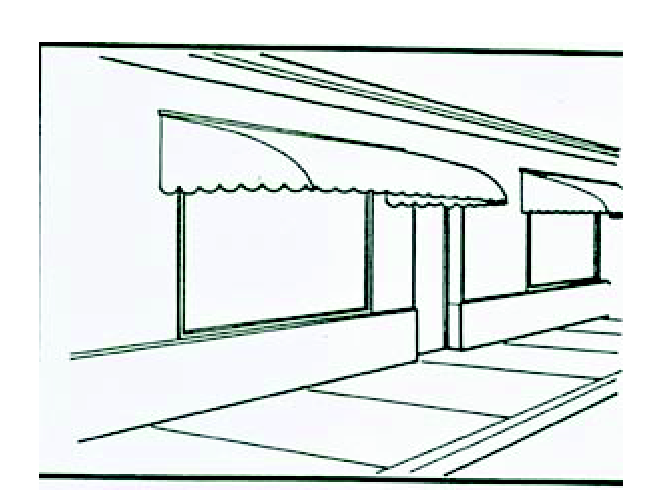
Awning
Banner. An on-site sign such as those used to announce an open house, a grand opening, or to make a special announcement. Normally, it is constructed of cloth, canvas, or similar material, and is without a rigid frame. It will be considered either as a wall or freestanding sign, depending on the method of attachment, and will have to comply with the normal zone requirements.
Billboard. A sign, including both the supporting structural framework and attached billboard faces, used principally for advertising a business activity, use, product, or service unrelated to the primary use or activity of the property on which the billboard is located; excluding off-premises directional, or temporary real estate signs.
Business complex sign. A sign, which is designed to identify a business complex where no single business identification and/or advertisement occupies more than fifty percent of the sign area.
Conforming sign. A sign that is legally installed in accordance with federal, state, and local laws and ordinances.
Directional sign. A sign that is designed and erected solely for the purpose of traffic or pedestrian direction, and which is placed on the property to which or on which the public is directed. See also "Off-premise directional sign."
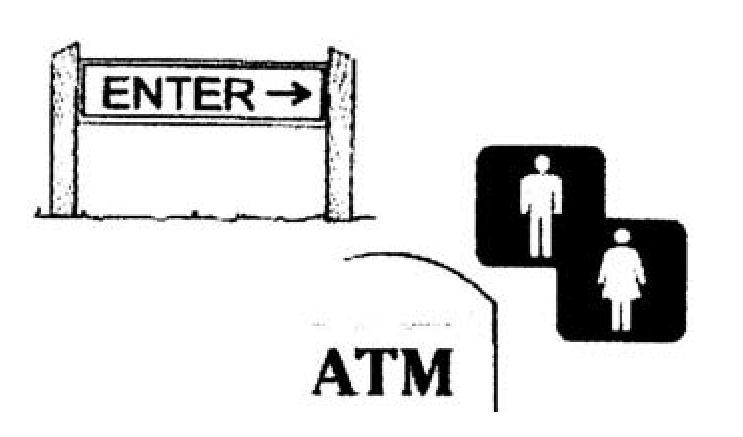
Directory. A sign that identifies the names and locations of tenants in a multi-tenant building or in a development made up of a group of buildings.
Doorway identification nameplate. A non-illuminated sign, which is limited to the name, address, and number of the building, institution or person, and to the activity carried on in the building or institution, or the occupancy of the person. Provided that the lettering, excluding numbers, of each sign shall not exceed two square feet.
Electronic message. A sign on which one-color copy changes automatically on a lamp bank or through mechanical means, to include electrical or electronic time and temperature units.
Fascia (or wall) sign. A flat sign which projects one and one-half feet or less horizontally from the vertical face of the wall of a building or vertical face of a canopy awning or parapet upon which it is affixed, painted, or attached, running parallel for its whole length to the face or wall of the building, and which does not extend beyond the horizontal width of such wall, awning or parapet.
Freestanding sign. A sign not attached to or forming part of a building.
Freeway sign. A sign placed within three hundred feet of Interstate (I-5) right-of-way.
Height of. The vertical distance measured from lowest grade at the point of support, or average grade for multiple supports and monument signs, to the highest point on the sign and sign structure.
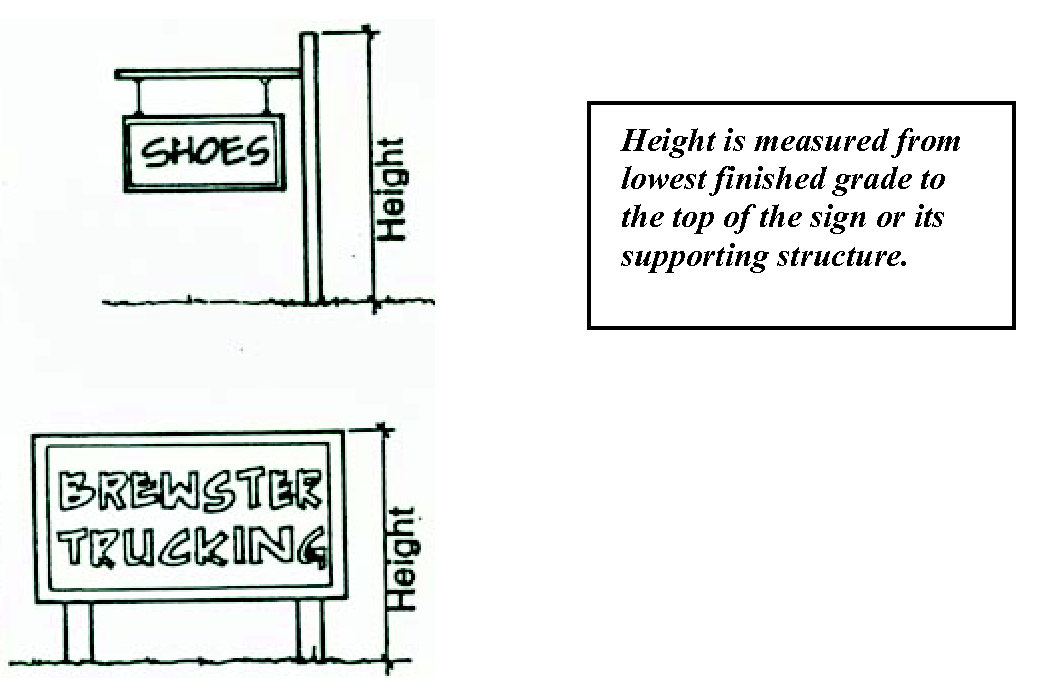
Historical sign. A replication of a sign erected prior to 1975 and is considered code exempt upon meeting the city's sign permitting requirements and proof, via public record, photo, etc. of the original sign, which is being replicated.
Industrial complex sign. A sign, which is designated to identify an industrial complex, where no single business identification and advertisement occupies more than fifty percent of the sign.
Inflatable commercial display. An inflatable advertising sign used to advertise products or services for commercial purposes.
Marquee sign. A sign attached to, in any manner, or made a part of a marquee.
Menu board. A variable message sign that allows a retailer to list products and prices. For example, the bill of fare for a fast food restaurant.
Mobile sign. A portable sign mounted on a trailer.
Monument sign. A sign and supporting structure which has similar top and bottom dimensions, and is constructed as a solid structure or one which gives the appearance of a continuous, non-hollow, unbroken, un-fenestrated mass. Further, similar top and bottom dimensions shall mean dimensions, which are within ten percent of each other.
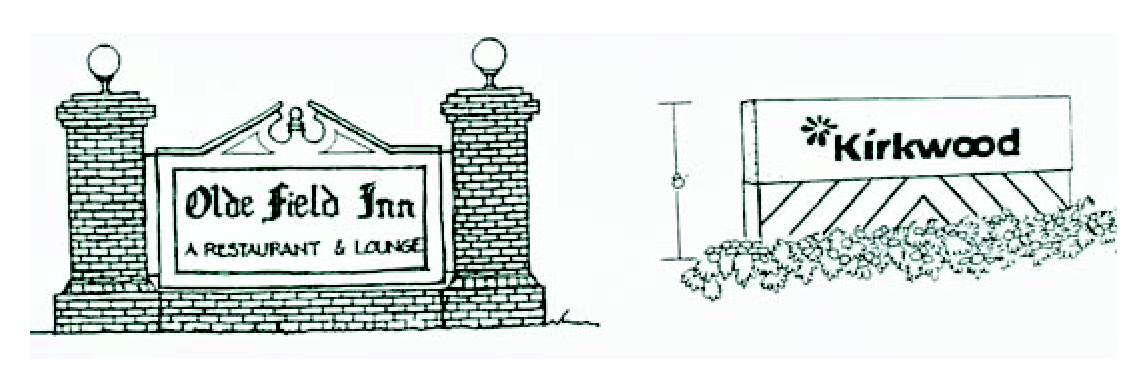
Monument Sign
Neon sign. A sign manufactured utilizing neon tubing, which is visible to the viewer.
Nonconforming sign. A sign which was erected legally but which does not comply with currently applicable sign restrictions and regulation, provided, a sign which does not conform to the currently applicable sign code requirements, but for which a variance or conditional use permit was issued, shall not be considered a nonconforming sign.
Off-premise directional sign. A sign, which directs people to premises different from where the sign is located. These signs typically include an address or street name, or directions such as "… two blocks north on the right."
Off-premise sign. A sign that advertises goods, products, services, or facilities, or directs persons to a premises different from where the sign is installed.
On-premise sign. A sign which carries only advertisement strictly related to a lawful use of the premises on which it is located, including signs or sign devices indicating the business transacted, services rendered, goods sold or produced on the premises, name of the business, and name of the person, firm, or corporation occupying the premises. "On-premise sign" also means a sign, which contains religious, political, social and other noncommercial messages.
Political sign. Any sign that advertises a candidate or an issue, which is to be voted on in a local, state, or federal election process.
Portable sign. Any sign designed to move or be moved by trailer or vehicle to advertise at different locations. Further, these signs include any sign, which is not firmly fastened to a building or ground.
Projecting sign. A sign which projects more than one and one-half feet horizontally from the vertical face of a building, awning, canopy or parapet.
Real estate sign. A temporary sign advertising the real estate upon which the sign is located as being for rent, lease, or sale.
Regulatory sign. A sign having the primary purpose of conveying information concerning rules, ordinances, or laws.
Rooftop sign. A sign erected upon the roof of a building or canopy, or a sign attached to a building, which projects vertically above the roof, eave, awning, or parapet. However, this does not include signs attached to the vertical face of a parapet, awning or canopy, providing the sign does not project above the vertical face of the parapet, awning or canopy to which it is attached.
Rotating sign. A sign in which the sign itself or any portion of the sign moves in a revolving or similar manner.
Scoreboard. A freestanding sign located at publicly owned athletic fields to display schedules, scores, statistics and similar athletic event information. Scoreboards may include no more than thirty percent of total sign area for commercial purposes.
Sign area. Includes:
1.
The area of a freestanding sign or structure not using an integral part of the building for its background means the largest cross-sectional area of the sign measured to a line encompassing all portions of the sign structure, including tubing used in lighting such sign or structure, but excluding posts without attached lighting. Further, the base on which a monument-type sign is set may be excluded provided there is no attached lighting.
2.
The area of a double-faced sign, i.e., a sign marked on two sides, or signs which are erected in a "V" configuration with an angle between the two faces not exceeding thirty degrees, shall be the largest area on one side of the sign. Further, this type of sign shall be considered one sign for the purpose of determining the number of signs allowed.
3.
The area of any sign or structure using an integral part of the building or awning as a background means the area within the shortest line drawn to include all letters, design, and tubing which are part of the sign or structure. Provided, that for illuminated awnings the area shall be limited to the area within the shortest line drawn to include all copy and graphics, excluding illuminated areas outside of these lines.
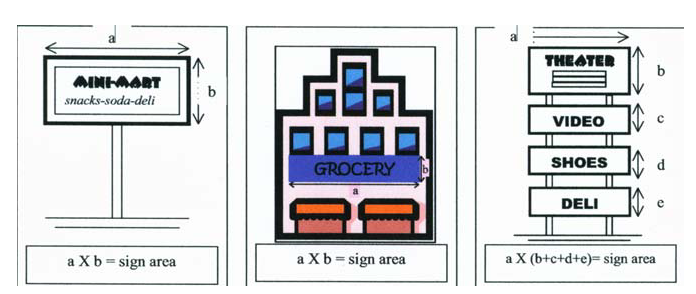
Sign Area Measurements
Sign display. A device affixed to the ground, attached to a building or other structure, using graphics, symbols, and/or written copy designated specifically for the display of a commercial or other advertisement to the public.
Sponsorboard. A sign erected on publicly owned property sold to obtain funds to support youth activities or recreational programs. Sponsorboards are typically located on or near athletic fields. They must be erected such that they are directed toward the spectator audience or the field of play and such that the view from the public right-of-way or adjacent residential neighborhoods is minimized. A sponsorboard may measure no more than thirty-six square feet in sign area.
Temporary sign. Any sign, which is not permanently installed or affixed to any sign structure or building, and not displayed for longer than thirty to sixty days. In cases of construction project signs, they may be maintained for the duration of the construction. Temporary signs shall also include balloons attached to buildings or property.
Two-story sign allowance. Projecting signs in the DMU/WMU district must meet a minimum standard two-story building height of twenty feet.
Unlawful sign. Any sign ever erected which does not have a valid permit, or after erection, did not comply with all applicable provisions of the permit under which it was constructed and erected, or did not comply with all provisions of codes, or which does or did not meet the necessary requirements to be considered nonconforming.
Video billboard. An electronic display board providing electronic, programmable outdoor advertising using an LCD display, plasma display, or similar device.
Wall (fascia) sign. A building mounted sign.
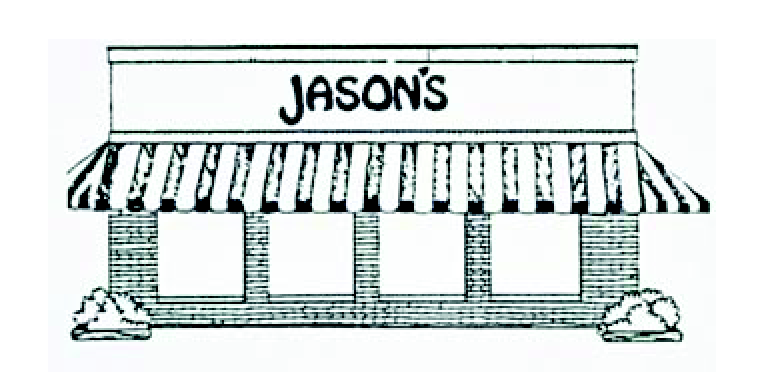
Wall Sign
Window sign. A sign that is displayed in a window.
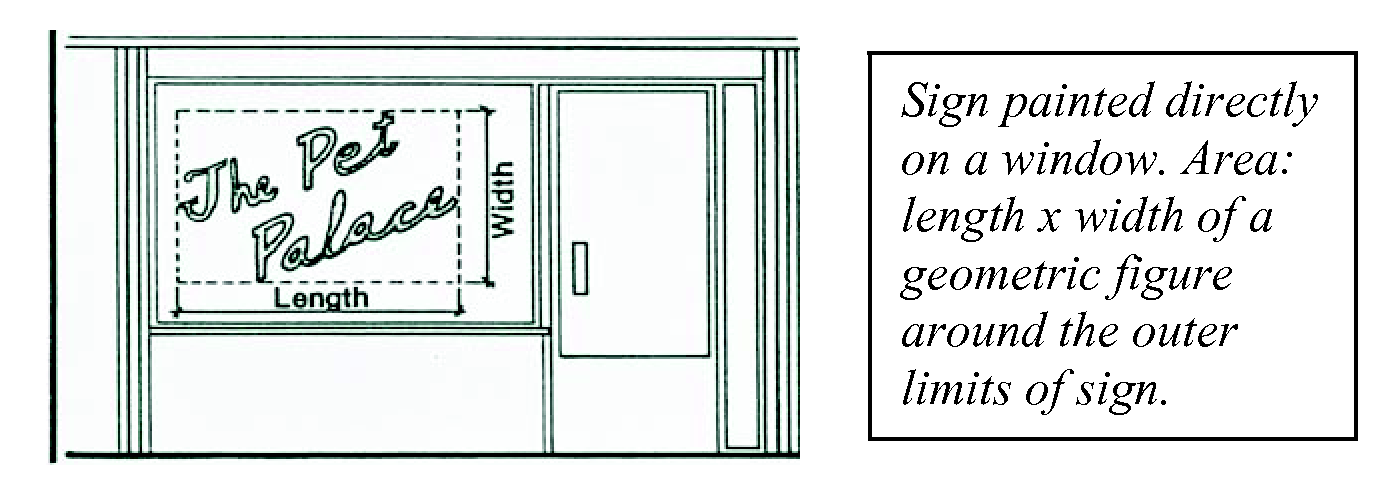
Window Sign
Sign permit. Required for all signs, which are authorized in the city sign code and shall only be issued upon compliance of all applicable provisions.
Single-family detached residential. See "Dwelling—Single-family detached."
Site plan. The development plan for one or more lots on which is shown the existing and proposed conditions of the lot, including topography, vegetation, drainage, floodplains, wetlands, and waterways; landscaping and open spaces; walkways; means of ingress and egress; circulation; utility services; structures and buildings; signs and lighting; berms, buffers, and screening devices; surrounding development; and any other information that reasonably may be required in order that an informed decision can be made by the approving authority. See also "Binding site plan."
Solid waste. All putrescible and nonputrescible solid and semisolid wastes including, but not limited to, garbage, rubbish, ashes, industrial wastes, swill, sewage sludge, demolition and construction wastes, abandoned vehicles or parts thereof, and recyclable materials. Excludes sludge from wastewater treatment plants, septage from septic tanks, extremely hazardous waste, dangerous waste, special waste and problem wastes. Includes "garbage" and "refuse."
Specialized instruction and vocational school. An institution which teaches trades, business courses, hairdressing and similar skills on a post-secondary level, or which provides specialized instruction in areas including, but not limited to, academic tutoring, foreign languages, art, dance, music, cooking, yoga, martial arts and related disciplines. Excludes truck driving instructional schools and heavy equipment operational schools, which are regulated as a "heavy equipment and truck related use."
Sponsorboard. See "Signs: Sponsorboard."
Spotlight. See "Lighting: Spotlight."
Standing. A showing that a party's interests are arguably within the zone of interests protected by the land use review process, and that the decision may cause the party injury-in-fact.
Storage, outdoor. The storage of materials and equipment outside of a fully enclosed building, which is usually not displayed to attract retail sales. Examples include lumber yards, machine rentals, contractor's storage yards, junkyards, etc.
Stormwater management facility. A surface water control structure installed by a project proponent to retain, detain or otherwise limit runoff from an individual or group of developed sites specifically served by the structure.
Story. That portion of a building included between the upper surface of any floor and the upper surface of the floor next above, except that the topmost story shall be that portion of a building included between the upper surface of the topmost floor and the ceiling or roof above. If the finished floor level directly above a basement or unused under-floor space is more than three feet above grade for more than fifty percent of the total perimeter or is more than six feet above grade at any point, such basement or unused under-floor space shall be considered as a story.
Stream corridor. A stream corridor consists of stream identified on the city critical area map and a stream's attendant riparian buffer as described in RDC 18.280.
Streams. Those areas where surface waters produce a defined channel or bed, not including irrigation ditches, canals, storm or surface water runoff devices or other entirely artificial watercourses, unless they are used by salmonids or are used to convey streams naturally occurring prior to construction. A channel or bed need not contain water year-round; provided that there is evidence of at least intermittent flow during years of normal rainfall.
Street frontage. The linear frontage of a parcel of property abutting a single public street.
Street tree. See "Tree—Street tree."
Streets. As used in this title, is broadly interpreted. "Streets" includes all roads, streets, sidewalks, bicycle lanes, landscaped park rows and median strips, signs and signalization, street trees, drainage and slope easements, highways, freeways, utility easements and public rights-of-way used for or designed for vehicular access or use including private roads. A side street is a street, which for purposes of identifying the location of a building or structure does not provide a street address for the building or structure.
Structural alteration. Any change or repair which would tend to prolong the life of the supporting members of a building or structure. Any change in the external dimensions of the building is a structural alteration.
Structure. Anything which is built or constructed. This definition is intentionally broad, and includes any piece of work artificially built up or composed of parts joined together in some definite manner. Structures include buildings, garages, carports, swimming pools, sheds, parking areas, streets, fences, decks, towers, signs, and public improvements.
Structure, accessory. See "Accessory structure."
Subdivision. The division of a lot, tract, or parcel of land into two or more lots, tracts, parcels, or other divisions of land for sale, development, or lease.
Subdivision, short. See "Short subdivision/plat."
Submerged land. Any land at or below the ordinary high water mark.
Substantial construction, start of. Includes substantial improvement, and means the date the building permit was issued, provided the actual start of construction, repair, reconstruction, placement or other improvement was within thirty days of the permit date. The actual start means either the first placement of permanent construction of a structure on a site, such as the pouring of slab or footings, the installation of piles, the construction of columns, or any substantial work beyond the stage of excavation; or the placement of a manufactured home on the foundation. Permanent construction does not include land preparation, such as clearing, grading and filling; nor does it include the installation of streets and/or walkways; nor does it include excavation for a basement, footings, piers or foundations or other erections of temporary forms; nor does it include the installation on the property of accessory buildings, such as garages or sheds not occupied as dwelling units or not part of the main structure. See also "new construction."
Substantial improvement. Any maintenance, repair, structural modification, addition or other improvement of a structure, the cost of which equals or exceeds fifty percent of the market value of the structure either before the maintenance, repair, modification or addition is started or before the damage occurred, if the structure has been damaged and is being restored.
Superintendent of public works. This person is responsible for ensuring that public facilities are constructed and maintained in accordance with the provisions of this code.
Surveyor. A person licensed by the State of Washington to engage in the practice of land surveying, as defined by RCW 18.43.020.
(Ord. No. 1132, § 2(Exh. A), 7-11-2013; Ord. No. 1178, § 2(Exh. A), 2-12-2015; Ord. No. 1245, § 2(Exh. A), 11-2-2017; Ord. No. 1325, § 2(Exh. A), 9-24-2020; Ord. No. 1339, § 2(Exh. A), 5-27-2021)
18.100.048 - "T" definitions.
Temporary use. See "Use: Temporary use."
Temporary use permit. A use permit which is of limited duration. See RDC 18.205.015.F.
Tent city. An emergency homeless encampment, hosted by a recognized religious assembly, school, or institution that owns or controls real property, which provides temporary housing to homeless persons whether within buildings located on the property or elsewhere on the property outside of buildings.
Through lot. See "Lot: Through lot."
Tobacco store. An establishment primarily engaged in retailing cigarettes, cigars, tobacco, pipes, and other tobacco and vape supplies.
Tower, guyed. See "Wireless: Tower—Guyed."
Tower, lattice. See "Wireless: Tower—Lattice."
Trail. A multi-use facility meeting the requirements of the Ridgefield Engineering Standards for Public Works Construction for non-motorized users for transportation and recreational purposes.
Trailer, residential. A mobile home which was not constructed in accordance with federal manufactured housing construction and safety standards (HUD code) in effect after June 15, 1976. Residential trailers are not permitted within the city of Ridgefield.
Trailer, travel. Any transportable trailer available for recreational use forty feet or less in length or eight feet or less in width, built on a chassis and equipped with wheels. This term also includes "recreational vehicles."
Transfer station. Staffed collection and transportation facility used by private individuals and route collection vehicles to deposit solid waste collected off-site into larger transfer vehicles for transport to permanent disposal sites, and may also include recycling facilities involving collection or processing for shipment.
Transportation corridor. A transportation corridor is a significant arterial or highway which is the primary route for inter-community travel in a metropolitan area or region. Transportation corridors typically accommodate a high percentage or regional commercial and mass transit use.
Tree. A woody plant which at maturity is usually twenty feet or more in height and generally has a single trunk, un-branched for three feet or more above the ground, and a more or less definite crown.
Tree canopy. The total area of the tree or trees where the leaves and outermost branches extend, also known as the "dripline."
Tree—Deciduous. Trees that shed or otherwise loose their foliage at the end of the growing season, such as maples, alders, oaks, and willows.
Tree—Evergreen. Trees that maintain the majority of their foliage each year when grown in the Ridgefield area. Examples of evergreen trees include pines, firs, Douglas fir, and the Pacific Madrone.
Tree—Significant. Any healthy, windfirm, and nonhazardous tree eight inches or greater in diameter breast height if it is a conifer and twelve inches or greater in diameter at breast height if deciduous.
Tree—Street. A tree located within a street right-of-way or street tree easement, adjacent to public or private streets, including undeveloped areas.
Trees—Windfirm. Trees able to withstand strong winds and resist windthrow (blowdown), wind-rocking, and major breakage.
Tree and vegetation removal. Removal of a tree(s) or vegetation, through either direct or indirect actions including, but not limited to, clearing, cutting, causing irreversible damage to roots or trunks; poisoning; destroying the structural integrity; and/or any filling, excavation, grading, or trenching in the dripline area of a tree which has the potential to cause irreversible damage to the tree, or relocation of an existing tree to a new planting location.
(Ord. No. 1132, § 2(Exh. A), 7-11-2013; Ord. No. 1339, § 2(Exh. A), 5-27-2021; Ord. No. 1460, § 2(Att.), 11-6-2025)
18.100.050 - "U" definitions.
Unbuildable land. Land designated as critical areas or open space on the Ridgefield Critical Areas Map. All unbuildable land is deemed open space.
Undisturbed areas. Those areas where (a) native vegetation shall be retained, and where (b) lawns, gardens and impervious services are prohibited. Undisturbed areas shall be defined wherever building is proposed on constrained or sensitive land.
University. See "College and university."
Urban growth area (UGA). That area identified in the adopted RUACP and CFP and adopted by Clark County pursuant to the Growth Management Act. The UGA includes land needed for Ridgefield's population during the twenty-year planning period. Also known as the Final UGA (FUGA).
Use definitions.
Accessory use. A use or activity which is subordinate in area, extent, and/or purpose to a primary use, and which is clearly incidental to a primary use on a site.
Conditional use. A use which may be approved, approved with conditions or denied, subject to discretionary review standards.
Limited use. A use which is allowable within a zoning district or overlay district, subject to limitations articulated in RDC 18.205.030.
Nonconforming use. A use which meets all of the following criteria: (a) lawfully established and maintained; (b) prior to the effective date of the ordinance codifying zoning or of an amendment to the zoning ordinance; and which (c) is not permitted, either outright or conditionally, in the zone in which it is located.
Permitted use. A use which is allowable within a zoning district or overlay district, subject to specific siting standards.
Primary use. An activity or combination of activities of chief importance on the site. One of the main purposes for which the land or structures are intended, designed, or ordinarily used. A site may have more than one primary use.
Prohibited use. Any use specifically identified as "prohibited" in a zoning district and any use which is not specifically enumerated or interpreted as allowable in that district.
Temporary use. A use established for a limited duration with the intent to discontinue such use upon the expiration of the time period.
Water-dependent use. A use or portion of a use that cannot exist in a location which is not adjacent to the water and which is dependent on the water by reason of the intrinsic nature of its operations.
Water-oriented use. A water-dependent, water-related, or water-enjoyment use, or a combination of such uses, as defined in the city's adopted Shoreline Master Program.
Use. Any activity or purpose for which land, water or air, or a structure thereon is designed, arranged or intended, or for which it is occupied or maintained, let or leased.
Utility. Private or municipal corporations owning or operating, or proposing to own or operate facilities that comprise a system or systems for public service. Private utilities include only gas, electric, telecommunications, or water companies that are subject to the jurisdiction of the state utilities and transportation commission and that have not been classified as competitive by the commission.
Utility facility. A facility necessary for the operation of a utility, further classified as major and minor facilities:
1.
Major utility facilities include, but not be limited to, water treatment facilities, water reservoirs, public water wells, sewage treatment plants, electrical substations or other similar uses identified in the RCFP or determined by the planning director.
2.
Minor utility facilities include those identified in the RCFP which may not have a significant adverse effect on the surrounding uses or the community in terms of generating traffic or creating noise or adverse visual effects. Minor utility facilities include underground electric, telephone or cable television lines; water, gas, and electric metering sites; underground gas and water distributions systems; pump or lift stations; and the drainage or sewerage collection systems or similar uses essential for the functioning of the community consistent with the RUACP.
(Ord. No. 1132, § 2(Exh. A), 7-11-2013; Ord. No. 1178, § 2(Exh. A), 2-12-2015; Ord. No. 1325, § 2(Exh. A), 9-24-2020)
18.100.052 - "V" definitions.
Variance. A special administrative procedure by which one may obtain an exception to zoning rules such as height, setback, and type of use. See 18.350.
Vegetation. Any and all plant life growing at, below, or above the soil surface.
Vehicle repair. Upholstering of, replacement of parts for, motor service; rebuilding or reconditioning of engines, motor vehicles or trailers; and overall painting or paint.
Veterinary clinic and hospital. Any establishment or premises operated under the supervision of a duly licensed veterinarian for surgical or medical treatment of domestic animals and pets.
Video billboard. See "Signs: Video billboard."
Visual obstruction. Any fence, hedge, tree, shrub, device, wall or structure exceeding forty-two inches in height above the elevation of the top of the curb, as determined by the city; and located at a street, accessway or alley intersection as to dangerously limit the visibility of persons in motor vehicles on said streets or alleys. This does not include trees kept trimmed of branches to a minimum height of at least six feet.
Vocational school. See "Specialized instruction and vocational school."
(Ord. No. 1132, § 2(Exh. A), 7-11-2013)
18.100.054 - "W" definitions.
WAC 197-11-700 Definitions. See "SEPA definitions: WAC 197-11-700."
Warehousing. The storage of large quantities of materials or products indoors and/or outdoors. Does not include self-storage.
Waste related facility. Uses that receive solid or liquid wastes from others for disposal on the site or for transfer to another location, uses that collect sanitary wastes or uses that manufacture or produce goods or energy from the composting of organic material. Examples include: recycling/garbage transfer stations; landfills; composting, energy recovery and sewage treatment plants; and hazardous waste handling and transfer facilities that do not treat or dispose of hazardous waste, as that term is defined in the Code of Federal Regulations, Title 40, Part 261. Such a facility that has regional or state-wide significance is classified as an essential public facility by the provisions of the Growth Management Act. Hazardous waste or disposal facilities are not included in this classification and are therefore not permitted in the city of Ridgefield. Excludes "Interim recycling facility."
Wastewater treatment facility. A plant for collection, decontamination and disposal of sewage, including residential, industrial and agricultural liquid wastes, and including any physical improvement within the scope of the definition of "water pollution control facility" set forth in WAC 173-90-015(4) as amended.
Water-dependent use. See "Use: Water-dependent use."
Water feature. A pond, pool or fountain used as a decorative component of a development.
Water-oriented use. See "Use: Water-oriented use."
Wetlands. "Wetland" or "wetlands" means those areas that are inundated or saturated by surface water or groundwater at a frequency and duration sufficient to support, and that under normal circumstances do support, a prevalence of vegetation typically adapted for life in saturated soil conditions. Wetlands generally include swamps, marshes, bogs, and similar areas. Wetlands do not include those artificial wetlands intentionally created from non-wetland sites, including, but not limited to, irrigation and drainage ditches, grass-lined swales, canals, detention facilities, wastewater treatment facilities, farm ponds, and landscape amenities, or those wetlands created after July 1, 1990, that were unintentionally created as a result of the construction of a road, street, or highway. Wetlands may include those artificial wetlands intentionally created from non-wetland areas created to mitigate conversion of wetlands. See also RDC 18.280.170, Critical Areas Protection Definitions.
Wetland buffer. A setback area which surrounds and protects a wetland from adverse impacts to the function of a wetland.
Wholesale retail. Involves sales, leasing or rental of equipment or products primarily intended for industrial, institutional or commercial businesses. Businesses may or may not be open to the general public, but sales to the general public are limited. Examples include the sale or rental of machinery, equipment, building materials, special trade tools, welding supplies, machine parts, electrical supplies, janitorial supplies, restaurant equipment, and store fixtures; mail order houses; and wholesalers of food, clothing, auto parts, and building hardware.
Wildlife habitat. Land which contains significant food, water or cover for native terrestrial or aquatic species of animals. Examples include: forests, fields, riparian areas, wetlands and water bodies.
Windfirm tree. See "Tree—Windfirm."
Wireless communication facility. See "Wireless: Wireless communication facility."
Wireless definitions.
Accessory equipment structure. An un-staffed structure used to house and protect the equipment necessary for processing wireless communications signals. Associated equipment may include air conditioning and emergency generators.
Amateur. Radio facilities operated for noncommercial purposes by individuals licensed by the FCC with an interest in construction and operation of radio equipment, usually as a hobby.
ANSI. The American National Standards Institute.
ANSI Standards. The FCC has adopted ANSI standard C95.1-1992, together with subsequent revisions, as the maximum permissible exposure of the general population to electromagnetic radiation from wireless communication facilities.
Antenna. A device commonly in the form of a metal rod, wire panel or dish, for transmitting or receiving electromagnetic radiation. It is typically mounted on a supporting tower, pole or mast.
Colocation. Use of a common wireless communication facility by two or more wireless service providers or by one wireless service provider for more than one type of communication technology.
FAA. The Federal Aviation Administration.
FCC. The Federal Communications Commission.
Monopole. A self-supporting antenna, ground-mounted, consisting of a single shaft that is typically made of wood, steel, or concrete and provides a rack (or racks) for mounting antennas at its top.
NIER. Non-ionizing electromagnetic radiation (i.e., electromagnetic radiation primarily in the visible, infrared and radio frequency portions of the electromagnetic spectrum).
PCS. The personal communications services, a fully digital wireless technology.
RF. The radio frequency or the electromagnetic energy used to transmit communication signals through space.
Tower—Guyed. A monopole or lattice tower that is tied to the ground or other surface by diagonal cables.
Tower—Lattice. A type of mount that is self-supporting with multiple legs and cross-bracing of structural metal.
Wireless communication facility. An unstaffed facility for the transmission or reception of radio frequency (RF) signals, usually consisting of an equipment shelter, cabinet or other enclosed structure containing electronic equipment, a support structure, antennae or other transmission or reception devices.
Work release facility. A facility providing an alternative to imprisonment, including pre-release and work/training release programs that are under the supervision of a court, or a federal, state or local agency. This definition excludes at-home electronic surveillance.
(Ord. No. 1132, § 2(Exh. A), 7-11-2013; Ord. No. 1245, § 2(Exh. A), 11-2-2017; Ord. No. 1325, § 2(Exh. A), 9-24-2020)
18.100.058 - "Y" definitions.
Yard. An open space that lies between the principal building or buildings and the nearest lot line. The minimum required yard as set forth in the ordinance is unoccupied and unobstructed from the ground upward except by vegetation and except as may be specifically provided in the code.
(Ord. No. 1132, § 2(Exh. A), 7-11-2013)
18.100.060 - "Z" definitions.
Zero lot line development. A development where a building is located on a lot in such a manner that one or more of the building's sides rest directly on a lot line.
Zone. A specifically delineated area or district in a municipality within which uniform regulations and requirements govern the use, placement, spacing, and size of land and buildings.
Zoning. The delineation of districts and the establishment of regulations governing the use, placement, spacing, and size of land and buildings.
Zoning district. Mapped areas of the city where there are specific standards governing the use of land, water and air, and where development is uniformly regulated. Zoning districts implement the policies and map designations of the RUACP.
Zoning map. The map or maps that implement the Ridgefield Development Code and delineate the boundaries of zone districts.
(Ord. No. 1132, § 2(Exh. A), 7-11-2013)

