
Ridgefield City Zoning Code
CHAPTER 18
230 - COMMERCIAL DISTRICTS CNB, CCB, CRB5
Editor's note— Ord. No. 1108, § 2, adopted July 26, 2012, amended Ch. 18.230 in its entirety to read as herein set out. The former Ch. 18.230, §§ 18.230.010—18.3.090, pertained to commercial and mixed use districts (CMB, CCB, CRB, WMU, CMU), and derived from Ord. No. 676, § 1(part), 1995; Ord. No. 802, § 4(part), 2002; Ord. No. 815, § 1, 2003; Ord. No. 908, § 2(part), 2006; Ord. No. 910, § 2, 2006; and Ord. No. 1072, § 2(Exh. A), adopted Jan. 13, 2011.
18.230.010 - Purpose.
A.
The purpose of the commercial districts is to encourage multiple commercial uses within each district of appropriate scale relative to the surrounding districts. The commercial districts implement RUACP policies that promote commercial development that meets local and regional needs, with particular emphasis on low-intensity neighborhood commercial development.
1.
The purpose of the neighborhood business (CNB) zone is to allow for-low intensity office, business, retail and service uses located on or with convenient access to arterial streets. Development is intended to serve the needs of the surrounding neighborhood.
2.
The purpose of the community business zone (CCB) is to provide location for a wide variety of business activities, such as convenience and comparison retail, personal services for local needs, and to allow for limited higher-intensity residential opportunities as part of mixed use developments.
3.
The purpose of the regional business (CRB) zone is to provide for the location of integrated complexes made up of business and office uses serving regional market areas with significant employment opportunities. Such a zone requires accessibility to regional transportation corridors. Development of taller buildings, a mix of uses excluding residential, and transit supportive uses are encouraged in this zone.
B.
The city encourages building design and site planning so that development relates visually and physically to the surrounding area, compliments the existing character of specific neighborhoods, and promotes pedestrian activity.
C.
Design in commercial zones should protect residential neighborhoods adjacent to commercial zones from intrusion in their privacy, character, and quality of life.
D.
Commercial development should provide a pedestrian environment with amenities, visual interest, and safety features which encourage more people to use these areas.
(Ord. No. 1108, § 2, 7-26-2012; Ord. No. 1220, § 2(Exh. A), 10-27-2016)
18.230.020 - Applicability.
A.
The CNB zoning district implements the Neighborhood Commercial (NC) comprehensive plan designation and shall be applied to all newly annexed NC lands.
B.
The CCB and CRB zoning districts implement the General Commercial (GC) comprehensive plan designation. All newly annexed GC lands shall be zoned CCB or CRB.
C.
Full site improvements are required for parking, lighting, landscaping, walkways, storage space, and service areas if a development proposal is:
1.
New development;
2.
Expanding the square footage of an existing structure by twenty percent; or
3.
The construction valuation is fifty percent of the existing site and building valuation.
(Ord. No. 1108, § 2, 7-26-2012)
18.230.030 - Uses.
All uses shall comply with the provisions Chapter 18.205.
(Ord. No. 1108, § 2, 7-26-2012)
18.230.040 - Lot requirements.
A.
The minimum lot area shall be as follows:
1.
CNB: Five thousand square feet.
2.
CCB: Ten thousand square feet.
3.
CRB: Ten thousand square feet.
B.
There are no maximum lot area standards in the CNB, CCB, or CRB zones.
C.
The minimum lot width for all zones shall be fifty feet.
(Ord. No. 1108, § 2, 7-26-2012; Ord. No. 1220, § 2(Exh. A), 10-27-2016; Ord. No. 1234, § 2(Exh. A), 6-22-2017)
18.230.045 - Dimensional standards.
A.
Dimensional standards shall comply with Table 18.230.035-1. Additional landscaping buffers may apply that exceed the minimum setbacks listed below; see RDC 18.725.050-1.
Table Notes:
(1)
Front and street side yard setbacks shall be measured from the property line as defined in RDC 18.100.046, except that front and street side yard setbacks on properties incorporating a slip lane parking lot as allowed per RDC 18.230.080.C. shall be measured from back edge of the required sidewalk between the parking area and the interior of the site.
(2)
Bonus height for mixed use development in the CNB zone: In order to provide flexibility in types of housing and to meet the policies of the RUACP promoting mixed-use development, the base height may be increased for mixed-use development with at least one story of residential use up to forty-five feet. Residential dwelling units shall not occupy the ground floor.
(3)
Maximum height for hospital uses in the CRB zone is 180 feet.
B.
When development is proposed on two or more contiguous parcels, the dimensional standards of this section shall be applied treating the development as one parcel for purposes of this section. Setbacks shall be required for the exterior perimeter of the development, and shall not apply along property lines interior to the development provided that building separation requirements for fire and life safety are met.
(Ord. No. 1108, § 2, 7-26-2012; Ord. No. 1220, § 2(Exh. A), 10-27-2016; Ord. No. 1234, § 2(Exh. A), 6-22-2017; Ord. No. 1253, § 2(Exh. A), 12-7-2017)
18.230.050 - Site planning.
A.
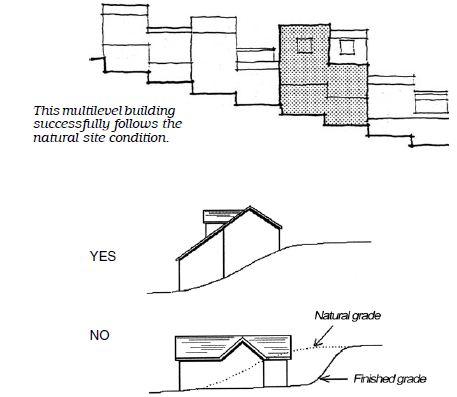
Topography. Site design should preserve and maximize the use of natural features and reduce adverse impacts on existing natural features.
1.
Retain natural topography to the extent practicable by designing buildings and parking lots to fit natural slopes.
2.
The grade difference between building entrance and nearest public right-of-way shall not exceed ten feet, and intervening setback shall not exceed a slope of 1:1.
3.
Retaining walls shall not exceed six feet high to promote more gradual, terraced development working with the natural slopes.
B.
Types of street frontage. Development standards are differentiated based on two types of street frontages:
1.
Pedestrian streets. Pedestrian streets include all local streets. Pedestrian streets are intended to be developed with a "main street" feel that generally includes on-street parking, wide sidewalks with pedestrian amenities, buildings close to the sidewalk, and pedestrian-scale building design with minimal inactivated space such as parking lots.
2.
Major corridors. Major corridors include all arterials, minor arterials, and collectors as classified in the city's transportation capital facilities plan. Major corridors are intended to serve primarily as vehicular access routes with less pedestrian activity, where medium to large-scale commercial development is anticipated.
C.
Street frontage.
1.
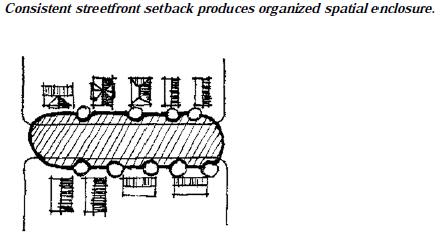
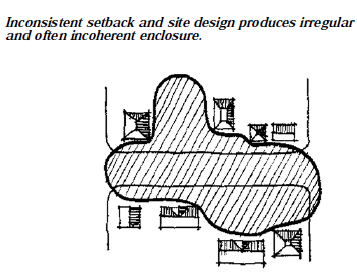
For commercial development along pedestrian streets, buildings and/or common open space must be placed within the minimum and maximum setback area along a minimum of eighty percent of the site's street frontage not encumbered by critical areas or significant vegetation.
a.
Enhanced landscaping buffers may be substituted as an alternative to buildings and/or common open space to satisfy this standard provided the enhanced landscaping buffer extends the full distance from the property line to the maximum setback line and is developed to an L4 standard or equivalent.
2.
For commercial development along major corridors, buildings and/or common open space must be placed within the minimum and maximum setback area along a minimum of fifty percent of the site's street frontage not encumbered by critical areas or significant vegetation.
a.
Enhanced landscaping buffers may be substituted as an alternative to buildings and/or common open space to satisfy this standard provided the enhanced landscaping buffer extends the full distance from the property line to the maximum setback line and is developed to an L4 standard or equivalent.
b.
On sites that incorporate a slip lane parking lot as allowed per RDC 18.230.080.C, buildings and/or common open space must be placed within the minimum and maximum setback area as measured from back edge of the required sidewalk between the parking area and the interior of the site.
3.
For developments located on a corner lot where at least one street frontage is a pedestrian street, buildings and/or common open space must be placed within the minimum and maximum setback area along both street frontages for a minimum of one hundred feet or twenty-five percent of the street frontage length, whichever is less, beginning from the corner of the lot, excepting any portion of the street frontage encumbered by critical areas or significant vegetation. Sites must also meet the overall requirement for buildings and/or common open space along the site's street frontage in subsections (1) and (2) above, and may count buildings and/or common open space developed under this subsection towards the overall requirement.
4.
The requirements for buildings and/or common space in subsections (1)—(3) may be reduced with written approval from the community development director where one or more of the following apply:
a.
In master-planned commercial centers.
b.
Where there are safety considerations associated with the proposed use.
c.
In other situations where existing or built conditions justify departure from strict adherence to the standard.
The applicant shall demonstrate that the requirement is being met to the extent practicable.
When this reduction is applied, enhanced landscaping buffers developed to the L4 standard or equivalent are required where buildings and/or common open space are not placed within the minimum and maximum setback area.
5.
The area between the property line and the buildings and/or common open space, with the exception of any pedestrian connections, shall be fully landscaped to an L2 standard.
D.
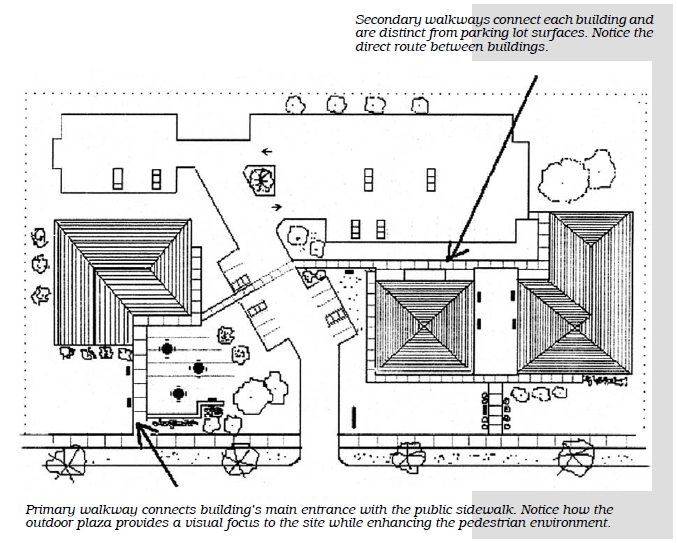
Pedestrian Connectivity. Sites shall establish internal and external pedestrian connections throughout the development.
1.
Provide an external pedestrian connection between the building's primary entrance and the primary frontage street.
2.
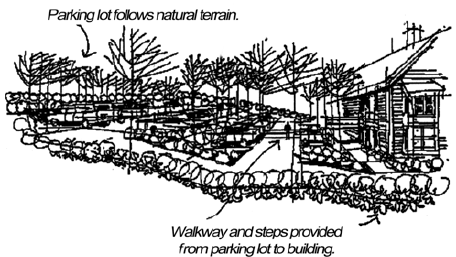
Provide internal pedestrian connections between individual buildings, though parking areas, and between parking areas and buildings, superseding requirements for pedestrian access corridors per RDC 18.720.040.C.5. Public sidewalks may be considered part of the internal pedestrian circulation system if they provide convenient connections between buildings and/or parking areas.
3.
For large development sites over two acres, the combined external and internal pedestrian connection system shall provide cross-circulation functionally equivalent to a street grid by providing through connections no less than every five hundred feet.
4.
Internal and external pedestrian connections must meet all of the following requirements:
a.
Provide connections via the most direct route.
b.
Separate pedestrians safely from motor vehicle traffic, except for crossings of vehicle travel ways.
c.
Be a minimum of five feet wide. External pedestrian connections shall be a minimum of eight feet wide for developments with a ground floor area in excess of twenty thousand square feet.
d.
Be well lit with pedestrian-scale lighting at a level averaging at least two foot candles and with free-standing or building-mounted lighting fixtures mounted no higher than fourteen feet.
e.
Be accented with landscaping buffers a minimum of five feet wide including trees a minimum of every twenty-five feet, shrubs at the rate of one per twenty square feet of landscaped area, and groundcover sufficient to provide at least eighty-five percent coverage of the landscaped area. One side of all pedestrian connections must be landscaped except for crossings of vehicle travel ways.
f.
Use concrete or other approved unit-paving surfaces distinct from parking lot surface by texture, pattern, and/or color to differentiate and maximize the visibility of the pedestrian path. Path shall be elevated six inches above parking lot grade except for crossings of vehicle travel ways. Superficial treatments such as painted pedestrian paths are not sufficient to meet this requirement. Paint may be used only in combination with other techniques.
g.
Crossings of vehicle travel ways shall be well articulated with pavement markings, pedestrian warning signs, and lighting.
E.
Building entrances.
1.
Buildings must have a primary entrance that incorporates at least two of the following entry enhancement features:
a.
At least one hundred square feet of landscaping or planters incorporating trees, shrubs, and/or flowers, in addition to the minimum landscaping requirements for the site;
b.
At least one hundred square feet of paving materials different from the street sidewalk or parking lot surfacing;
c.
At least one hundred square feet of awning, marquee, or arcade over the entry where the feature is at least eight feet above the walking surface and projects at least five feet horizontally from the structure;
d.
Decorative outdoor features such as benches, fountains, sculptures or other similar features as determined by the planning director;
e.
Entry recessed or projected from the facade surface by at least three feet; or
f.
Pedestrian-scale accent lighting.
2.
Buildings along pedestrian streets outside of commercial centers are required to have a primary entrance facing the street providing primary access to the site. Entrances shall be built to the sidewalk's edge or be connected to the sidewalk with a direct external pedestrian connection.
3.
Buildings along pedestrian streets in commercial centers and buildings along major corridors are encouraged to have a primary entrance facing the street providing primary access to the site. As an alternative, the primary entrance may face a parking area or secondary access street provided that a secondary entrance is provided that faces the street providing primary access to the site. A secondary entrance shall be built to the sidewalk's edge or be connected to the sidewalk with a direct external pedestrian connection. When a primary entrance does not face the street providing primary access to the site, other features such as gateways, entry plazas, or similar are encouraged to create a welcoming point of entry to the site.
F.
Outdoor common areas. Common areas encourage outdoor activities and leisure in outdoor spaces associated with commercial development. For developments with five thousand square feet or more gross floor area, excluding area of garages, warehouses and similar unheated support structures, outdoor common areas equal to five percent of the gross floor area is required.
1.
The minimum size for a common area is two hundred fifty square feet, with a minimum dimension of ten feet. Fewer, larger common areas are strongly preferred over multiple, smaller common areas.
2.
Common areas shall be in high pedestrian traffic locations within the development such as along street frontages, on lot corners, along internal or external pedestrian connections, or near building entrances. Common areas shall not be located in isolated or undevelopable space where low pedestrian traffic is anticipated.
3.
Common areas must be accessible to users of the site but do not need to be made accessible to the general public.
4.
Common areas must be accessible by internal and/or external pedestrian connections.
5.
Common areas shall be developed as one of, or a combination of, the following:
a.
Patio, deck or balcony attached to building, provided area can be accessed from the building's exterior.
b.
Plaza with colored or textured pavement surface, e.g., brick, stone, exposed aggregate concrete or colored and textured concrete. To provide pattern and enhance the texture of the pavement, any concrete surfaces shall be scored or otherwise divided into smaller sections.
c.
Landscaping areas of grass, trees, shrubbery and flowers, combined with paths and pavement areas for tables and/or benches.
d.
Other similar areas approved by the planning director.
6.
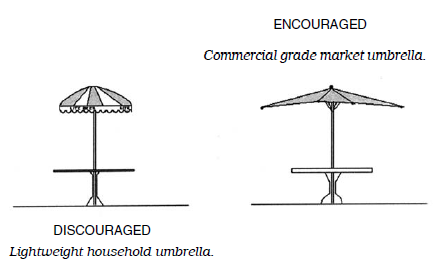
Common area amenities must include a minimum of one bench or table and one trash receptacle per two hundred fifty square feet. Amenities may also include water feature, raised landscaping planter beds, drinking fountain, moveable seating such as for outdoor dining, distinctive paving, and/or public artwork. All outdoor furnishings shall be commercial grade designed for heavy public use.
7.
Pedestrian-scaled lighting is required at a level averaging at least two foot candles throughout the area. Lighting may be free-standing or building-mounted and shall not be mounted higher than fourteen feet.
8.
The following are not allowable as part of outdoor common areas:
a.
Asphalt pavement.
b.
Adjacent and unscreened chain link fences, dumpsters or service areas.
c.
Unscreened blank walls.
9.
Active use of outdoor common areas is encouraged provided it does not impede pedestrian flow along adjacent pedestrian connections or public sidewalks. Allowed activities within common areas, subject to area limitations in RDC 18.230.110, include:
a.
Food or flower carts, limited to one portable food or flower cart for common areas less than one thousand square feet and two carts for common areas one thousand square feet or greater. Carts must be portable and be stored away after hours.
b.
Temporary art displays or performances.
c.
Outdoor sales such as a sidewalk sale or farmers market. Commercial activity by vendors with no permanent indoor vending space on the property must be reviewed through either site plan review for recurring uses per RDC 18.500 or temporary use review consistent with RDC 18.205.015(F).
d.
Outdoor seating.
e.
Transit stops, coordinated with transit service provider.
f.
Similar active uses as determined by the Planning Director.
G.
Service areas shall be located and screened to minimize negative visual impacts from the public right-of-way, within the site, and from adjacent users.
1.
Loading areas, service areas, and outdoor storage areas shall be located in the areas of the site least visible from the public right-of-way and on-site pedestrian connections, typically in the rear or sides of the building, and shall be screened from view by a fence, landscaping to a value of eighty percent year-round opacity, or a combination of both. Fences shall be masonry or similar materials, and shall not be chain link.
2.
Garbage collection and recycling areas, not including individual trash receptacles for public use, must be in an enclosed area and located in the areas of the site least visible from the public right-of-way and on-site pedestrian connections, typically in the rear or sides of the building. Enclosures should be complementary in design to the main buildings, and shall be constructed of fencing, walls, landscaping to a value of eighty percent year-round opacity, or a combination. If used, fences shall comply with RDC 18.230.100. Design of exterior storage areas shall comply with engineering standards and the comprehensive stormwater management plan (CSMP), including roof cover, paving, and runoff containment, to prevent nonstormwater discharges from entering the stormwater drainage system.
3.
Mechanical units, utility equipment, elevator equipment, and telecommunication equipment located on the roof shall be grouped together and incorporated into the roof design. Such equipment located on the ground shall be screened from adjacent pedestrian connections or sidewalks by a fence or landscaping to a value of eighty percent year-round opacity. If used, fences shall comply with RDC 18.230.100.
4.
Delivery vehicles shall not impede drive aisles or required parking during normal business hours.
H.
Drive-through lanes shall be sited to minimize adverse effects of vehicular traffic on the adjacent neighborhood and businesses, to minimize conflicts with pedestrian traffic, and to minimize visual impacts.
1.
The requirements of this subsection shall apply to all drive-through facilities as defined in RDC 18.100.016. The requirements in subsections (3) through (10) also apply to pick-up windows as defined in RDC 18.200.016.B.
2.
The total number of drive-through facilities is limited as follows:
a.
In the Ridgefield Junction Subarea, a maximum of fifteen total drive-through facilities are permitted.
3.
Multiple drive-through facilities on a site shall be clustered adjacent to one another to optimize traffic flow and minimize conflict between drive-through and non-drive-through uses. Shared facilities where multiple businesses use one drive-through or pick up lane are encouraged.
4.
No more than two adjacent drive-through facilities shall be permitted on a single street frontage.
5.
Drive-through queuing (stacking) lanes shall have a minimum capacity of six spaces as measured from the pickup window. This amount may be adjusted, higher or lower, if peak average monthly volume for the business (or similar businesses) shows a need for a different amount of queuing spaces, as documented by the applicant. A stacking space shall be an area which at a minimum accommodates the width and necessary turn radius of a vehicle measuring eight feet by twenty feet, with direct forward access to a service window of a drive-through facility. Stacking lanes must be designed so that they do not interfere with parking, parking access, and vehicle circulation. Ordering stations must be located forward in the stacking lane such that queuing vehicles do not back up into the adjacent parking area, drive aisle, or street. Stacking lanes are not required to be linear.
6.
Drive-through lanes shall not be located between the building and the street unless the planning director determines such location is not feasible because of lot geometry or access. In situations where drive-through lanes must be located between the building and the street with no feasible alternative:
a.
Additional screening and landscaping meeting the requirements in subsection (9) shall be required.
b.
The maximum setback from the street may be increased to accommodate the drive-through lane and screening.
c.
The building entrance requirements in RDC 18.230.050.E.2-3 are waived.
7.
Developments creating ten or greater PM peak hour trips are subject to a traffic study, requiring the applicant to demonstrate that the roadway network, pedestrian network, intersections and driveways will support the traffic generated by drive-throughs, or will be improved to mitigate for any impacts from traffic generated by drive-throughs. Proposals are also subject to review by the city engineer for safe ingress and egress.
8.
Pedestrian and vehicle crossings of drive-through lanes shall be minimized and where necessary, shall be clearly marked. Pedestrian crossings shall meet requirements for pedestrian connections in RDC 18.230.050.D. Likewise, signs and other visual cues shall be provided to alert drive-through users of the pedestrian and vehicle crossings.
9.
Drive-through lanes shall be screened to obscure the vehicles and to keep the drive-through vehicle headlights from shining onto public rights-of-way and adjacent properties. A ten-foot wide L4 landscaping buffer incorporating shrubs of at least six feet at the time of planting or equivalent treatment incorporating landscaping, decorative walls, berms, and/or fencing shall be required between any drive-through lanes and adjacent properties or public rights-of-way.
10.
Outdoor seating areas shall not be adjacent to drive-through lanes unless shielded by a ten-foot wide L4 landscaping buffer incorporating shrubs of at least six feet at the time of planting or equivalent treatment incorporating landscaping, decorative walls, berms, and/or fencing. Buffers, fences and walls must be designed so they do not result in poor visibility for, and of, pedestrians crossing the drive-through lane or vehicles exiting the drive-through lane.
(Ord. No. 1108, § 2, 7-26-2012; Ord. No. 1178, § 2(Exh. A), 2-12-2015; Ord. No. 1220, § 2(Exh. A), 10-27-2016; Ord. No. 1296, § 2(Exh. A), 10-10-2019; Ord. No. 1337, § 3(Exh. A), 2-25-2021; Ord. No. 1406, § 2(Exh. A), 7-13-2023; Ord. No. 1460, § 2(Att.), 11-6-2025)
18.230.055 - Building design and features.
A.
Applicability. The requirements of section 18.230.055 apply to buildings within the CNB, CCB and CRB zoning districts. The requirements of this chapter apply to:
1.
New buildings of any size,
2.
The addition to or remodel of an existing building that increases the square footage of the building by twenty percent, and
3.
The addition to or remodel of an existing building where the construction valuation is fifty percent or greater of the existing site and building valuation.
B.
Context-sensitive building design. Development shall consider the cohesive integration of one property along with all adjacent properties in a district so that the "whole is greater than the sum of the parts." Elements of context-sensitive design include:
1.
Orienting primary building facades towards the street with the highest street classification,
2.
Ordering building height and scale between adjacent buildings so that a building is no more than fifty percent taller or larger than an adjacent building,
3.
Extending horizontal planes between adjacent buildings, such as roof lines, cornices, rows of windows, belt courses, stories, and storefronts,
4.
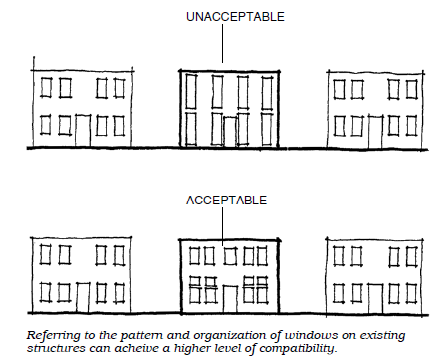
Ordering window size or patterns similarly to adjacent buildings;
5.
Use of similar materials in adjacent buildings, for example, if the front façade surface area of building A is primarily faced with brick, adjacent buildings must incorporate similar materials in at least 25% of the primary façade, and
6.
Use of similar plant materials, landscape fixtures and street furniture between adjacent buildings.
7.
Elements of any individual site shall include exposed wood beam construction as part of the primary structure. This construction type adds balance to trellises, awnings, canopies, etc.
C.
Mass and scale. Mass is the physical bulk or volume of a building. In architectural terms, a single-mass building is a single geometric form such as a rectangle or square, and may include a simple roof form with no variation in the roof line. "Massing" refers to variation in the mass and may involve multiple masses joined together. The purpose of the mass standards is to break large structures down into smaller building modules.
1.
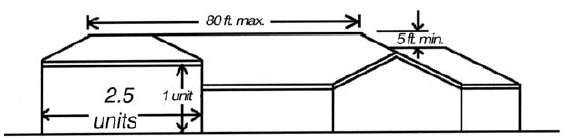
Where the lot has frontage on a pedestrian street, the facades of all new buildings longer than fifty feet (measured horizontally along the facade) shall incorporate relief to the perceived building mass through such features as wall projections or recesses, projecting windows, entrances, or other visual relief. Where the lot has frontage on a major corridor, the facades of all new buildings longer than one hundred feet (measured horizontally along the facade) shall incorporate relief to the perceived building mass through such features as wall projections or recesses, projecting windows, entrances, or other visual relief.
a.
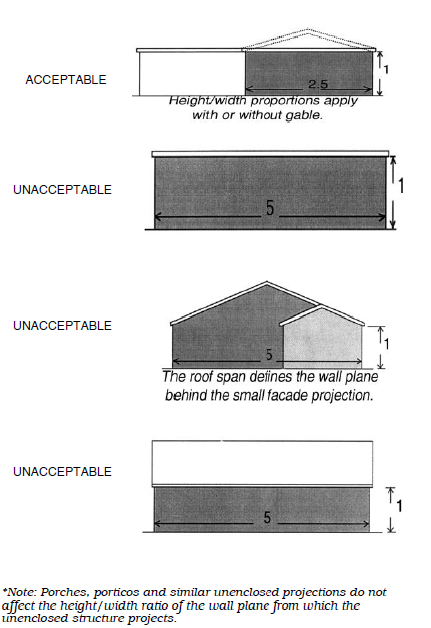
No single wall plane shall be wider than two and one-half times the height of the wall plane. Unenclosed projections do not affect the height/width ratio of the wall plane from which the unenclosed structure projects.
b.
Exterior walls and roof forms shall be a true reflection of interior space. False projections of wall or roof forms are not allowed, except that parapets and gables may rise above the true roof line if they include side returns or roof planes that (a) extend back at least one and one-half times the width of the parapet or gable, or (b) extend back to a point that is not visible from any public vantage point.
c.
Building walls visible from a public right-of-way shall employ at least three of the following articulation methods at intervals no greater than sixty feet:
i.
Window patterns and/or entries that reinforce the pattern of storefront spaces; e.g., groups of windows that repeat no more than every 60 feet as opposed to a uniform row, or "ribbon," of windows.
ii.
Weather protection features that reinforce storefronts. For example, for a building façade that is one hundred eighty feet wide, use three separate awnings to articulate the façade.
iii.
Providing vertical building modulation of at least two feet in depth and four feet in width if tied with a change in roofline or change in building materials or siding style. Otherwise, the minimum depth and width of the modulation shall be ten and twenty feet, respectively.
iv.
Placement of building columns or vertical piers or vertical elements such as planters, trellises, art pieces, or other features that repeat at intervals of sixty feet or less that reinforce a storefront pattern.
d.
The doorways on buildings abutting or within three feet of the sidewalk shall be recessed in order to avoid conflicts with pedestrians.
e.
Additional standards for large format uses in any zone. Individual uses with at least fifty thousand square feet of gross floor area or a façade greater than one hundred fifty feet in width shall provide:
i.
Prominent entry. The building front shall integrate a prominent entry feature combining substantial roofline modulation with vertical building modulation and a distinctive change in materials and/or colors.
ii.
Roofline modulation. The minimum vertical dimension of roofline modulation is the greater of six feet or 0.3 multiplied by the wall height (finish grade to top of the wall).
iii.
Façades wider than three hundred feet shall incorporate at least two entry/articulation features (if there is only one entry, the second feature may be less prominent).
2.
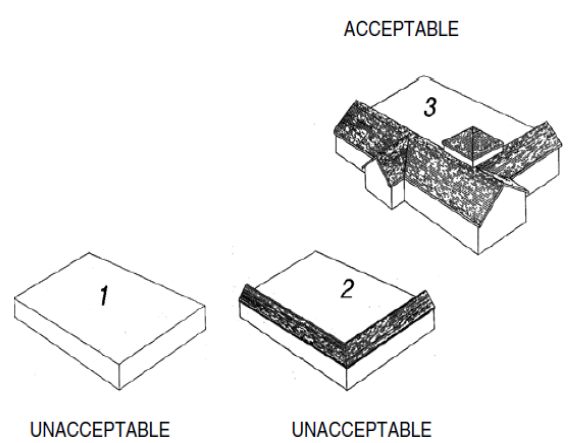
Roofs. All structures shall have a visual cap. This may be achieved with either a pitched or flat roof if designed according to one of the following options:
a.
Lower pitched roof with extended eaves. A lower pitched roof with a minimum 4/12 pitch is allowed provided eaves extend at least two feet beyond exterior building walls.
b.
Steep pitch hip, gable or saltbox roof form. Conform to the following roof pitch requirements: Minimum pitch: 6/12 in all areas. Maximum pitch: 12/12 in all areas. Exceptions: Steeples, bell towers and other ancillary structures.
c.
False pitch roof with appearance of true hip gable or saltbox. Single story and multiple story buildings may have a flat roof with a false pitch if (a) the roof appears to be true hip or gable from all public vantage points, and (b) there are extending wings on each corner of the building which allow for a true hip or gable to extend out from the false hip or gable. Roofs shall conform to the minimum roof pitch standards specified in subsection (D)(1) of this section.
d.
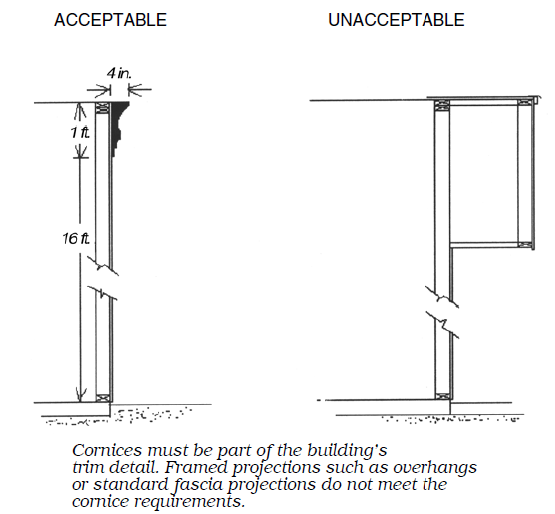
Flat roof with projecting cornice. Cornice dimensions must be one foot high for every sixteen feet of building height and must protrude forward at least one-third the cornice height dimension. The protrusion may include the entire cornice or the cornice may be a graduated protrusion with full protrusion at the top. Cornices must be at or near the top of the wall or parapet. Pediments may extend above the cornice.
D.
Hierarchy in building design. The following standards apply to all commercial sites with more than one building or with one or more multitenant buildings.
1.
Design primary structures as a focal point. Primary structures shall be designed to serve as a visual draw to a site. Primary structures shall be designed as follows:
a.
Must be prominently visible to the public. Primary structures shall be the focal point of development and must be prominently visible to the public right-of-way giving access to the project, unless significant vegetation warrants a less visible structure.
b.
Must have the appearance of at least two levels.
i.
Primary structures shall have at least two floors (minimum eight feet apart). The second floor level shall be at least one-third the area of the lower floor area.
ii.
Alternatively, primary structures may be single-floor buildings with roofs having a minimum pitch of 8/12, and which contain dormer windows on every roof plane having a ridge length of forty feet or more. One dormer window with a glazing area of at least fifteen square feet shall be required for every forty feet of ridge length (or portion thereof). Dormer windows shall be functional, providing natural light into the finished and heated area of the building.
c.
Must provide a prominent entrance. Primary structures shall include a prominent entrance which faces the street providing primary access to the site. The entrance shall be defined by a projecting or recessed portico or a clearly defined doorway designed as a focal point in the facade design.
2.
Integrate common outdoor areas per RDC 18.230.050.F into primary structure design.
a.
Porticos, courtyards, or similar structures shall be visible to the public and usable to customers or clients.
b.
The outdoor common areas shall be integrated into the building design by means of either a roof-like structure (e.g., sheathed roof or open pergola style) or perimeter wall extending from the building.
3.
Integrate primary structure design elements into secondary structures. Secondary structures (all structures other than primary structures) must include design elements that visually link them to the primary structure site.
a.
Secondary structures must include siding, trim, roofing materials and colors common to the primary structure of a site.
b.
Specific combinations of materials and colors may be varied from building to building; provided, that any material or color used on secondary structures has, in some application, been used on the primary structure. (For example, if the primary structure is a red brick building with gray clapboard in the gables, then the secondary structure may be a gray clapboard building with red brick accents.)
E.
Windows and doors.
1.
Glass Style. Mirrored glass is prohibited. Bird-friendly glass is encouraged.
2.
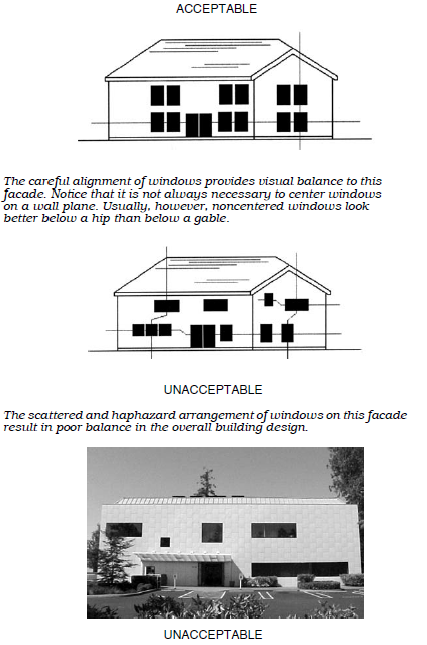
Multiple windows on a single wall plane shall be spaced and aligned with other windows and doors on the same wall plane. Single grouped windows on a wall plane shall relate to other architectural features such as roof forms, doors, or façade projections.
3.
Windows and doors shall constitute at least twenty-five percent of the total wall area of prominent façade wall planes.
a.
The provision in (3) may be reduced with written approval from the community development director if the applicant demonstrates that:
i.
It is not practical to meet the full extent of the requirement due to existing conditions or proposed interior uses.
a.
Glazed windows which allow view out from but not in to the building are encouraged as a method to meet the transparency requirements where the interior use requires privacy.
ii.
The requirement is being met to the extent practicable.
iii.
A more welcoming and interesting streetscape is achieved by implementing all four façade articulation methods in RDC 18.230.055.C.1.c, at least three of the entry enhancement features in RDC 18.230.050.E.1, or an equivalent combination of design features.
4.
Transparency Zone. The transparency zone regulations apply to building facades which front pedestrian streets. The purpose of transparency requirements is to maintain "eyes on the street" for safety of pedestrians and to create a more welcoming and interesting streetscape and give an indication of the types of uses and activities occurring in buildings. Transparent windows and doors may be used to meet transparency requirements. Glazed windows, where visibility is obscured, shall not be used to meet transparency requirements.
a.
The transparency zone refers to the ground floor between thirty vertical inches and eight vertical feet above grade, or where the ground, terrace, or stoop meets the façade. The transparency zone extends along the primary street-facing façade of the building and may include additional façades such as those that face primary internal circulation routes within a development, minor arterials, arterials, or collector streets, or other highly visible façades.
b.
A minimum of sixty percent window and door transparency is required within the transparency zone. The transparency requirement may be reduced to a minimum of forty-eight percent (a twenty percent reduction) without application for an administrative adjustment if the applicant demonstrates that:
i.
It is not practical to meet the minimum sixty percent transparency requirement due to existing conditions or proposed interior uses.
a.
Glazed windows which allow view out from but not into the building are encouraged as a method to meet the transparency requirements where the interior use requires privacy.
ii.
The requirement is being met to the extent practicable.
iii.
A more welcoming and interesting streetscape is achieved by implementing all four façade articulation methods in RDC 18.230.055.C.1.c or at least three of the entry enhancement features in RDC 18.230.050.E.1, or an equivalent combination of design features.
c.
In commercial centers, the standard in (b) may be reduced below forty-eight percent subject to compliance with the provisions in (b)(i) through (iii) and written approval from the community development director.
d.
For sloping frontages, the city may grant flexibility to the transparency zone dimensions provided the design of the façade adds visual interest to pedestrians and that untreated blank wall areas are avoided.
e.
Where structured parking facilities occupy a portion of the ground floor frontage, the vehicular entrance is exempt from the transparency requirement.
f.
Display windows may be used to meet up to fifty percent of the transparency requirements provided they are at least eighteen inches deep and integrated into the architecture of the building. Tack-on display cases do not qualify as transparent areas.
F.
Siding and trim.
1.
Building siding materials shall be wood, brick, stone, stucco, or terra cotta.
2.
Metal siding materials shall not exceed thirty-five percent of the total wall area of any wall.
a.
Only high quality architectural metals are permitted, raised rib design, or vertical standing seem siding is permitted subject to approval by the community development director.
3.
Stacked and scored concrete blocks may be used if installed so as to provide added relief, shadow lines, and dimensional interest to a façade, provided:
a.
All prominent facades shall be fifty percent sided with the materials allowed in subsection F.1;
b.
Masonry pilasters are regularly spaced every fifteen to twenty-five feet on center (depending on the scale of the building); and
c.
Recessed panels, a minimum of four inches deep, shall provide frame and panel relief between all pilasters and which shall comprise approximately seventy percent of the width and height of the space between pilasters.
G.
Roofing materials.
1.
Use roofing materials which provide texture and shadow lines. Cedar shingles, architectural grade asphalt shingles, tile, slate, and standing-seam metal roofs are allowed. Other roofing materials are prohibited except on roofs having slopes less than 1/12.
2.
Limit roofing colors to darker earth tone and forest colors. Only forest greens, charcoal or medium grays and dark clay colors are allowed.
H.
Design details.
1.
The following building treatments or additions are prohibited:
a.
Tenant specific motifs - Fanciful or unusual detailing, excluding signs, used to promote a particular theme or to identify a specific.
b.
Outlining - Architectural features shall not be outlined in neon, LED, tube-type, or other lights, either exposed or concealed lights.
c.
Back-lit Awnings - Awnings may not be back-lit or otherwise illuminated from behind unless the awning fabric is completely opaque.
d.
Nonfunctioning Awnings - Awnings shall be limited to traditional locations over windows, walkways, and entrances or over other architectural features where weather protection is needed. Awnings must be applied to walls or posts and may not be applied to existing projections over walkways or windows.
e.
Faux Windows - All windows must be true windows that let in light to occupied space or to large attic areas that provide at least limited standing room.
f.
False Fronts - Building facades must be designed to reflect the mass and bulk of the structure behind the facade. Design details that create a false appearance of building mass, or that otherwise make a building appear to be something that it is not, are prohibited.
g.
Architectural Anomalies - Application of materials or details that are not integrated into the overall building design, or that do not reflect the materials or details characteristic of the overall building design, are prohibited.
2.
Awnings, canopies and marquees may not obscure architectural details of the facade and may not be the prominent design element of the building. They must appear as a secondary and complimentary element of the building design. Awnings may not extend more than twelve inches beyond the outer edges of windows or groups of windows, and they may not come any closer than twelve inches to building corners or thirty-six inches to eaves or cornices.
I.
Color. The following standards apply to commercial development in the CRB and CCB zoning districts:
1.
Field or base colors (the main color of exterior walls) shall be earth tone colors, such as: sands, grays, sage greens, pale yellows, deep, rich clay colors, and similar.
2.
Trim colors (fascia, cornice, window and door trim, kick panels, etc.) shall contrast to complement the field colors and shall not be neon, bright or primary colors.
3.
Accent colors may be brighter than field or trim colors. Appropriate areas for accent colors are those details such as moldings or molding indentations, medallions, and shadow lines of windows and doors and door frames.
4.
Painting or staining stone and brick is prohibited.
(Ord. No. 1108, § 2, 7-26-2012; Ord. No. 1178, § 2(Exh. A), 2-12-2015; Ord. No. 1220, § 2(Exh. A), 10-27-2016; Ord. No. 1234, § 2(Exh. A), 6-22-2017; Ord. No. 1266, § 2(Exh. A), 9-13-2018; Ord. No. 1296, § 2(Exh. A), 10-10-2019; Ord. No. 1325, § 2(Exh. A), 9-24-2020; Ord. No. 1345, § 2(Exh. A), 7-8-2021; Ord. No. 1352, § 2(Exh. A), 11-4-2021; Ord. No. 1370, § 2(Exh. A), 9-8-2022; Ord. No. 1460, § 2(Att.), 11-6-2025; Ord. No. 1468, Att., 2-26-2026)
18.230.060 - Signs.
Signs are permitted according to the provisions of Chapter 18.710.
(Ord. No. 1108, § 2, 7-26-2012)
18.230.070 - Lighting.
A.
Lighting shall comply with the provisions of Chapter 18.715.
B.
Parking area light post height shall not exceed twenty-five feet.
C.
All building entrances shall be illuminated with LED lamps and shall be shielded.
(Ord. No. 1108, § 2, 7-26-2012; Ord. No. 1178, § 2(Exh. A), 2-12-2015)
18.230.080 - Off-street parking and loading.
A.
Off-street parking and loading shall be provided as required in Chapter 18.720, including the EV infrastructure requirements in RDC 18.720.040.C.8.
B.
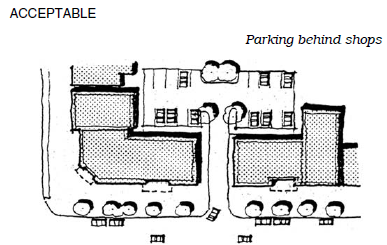
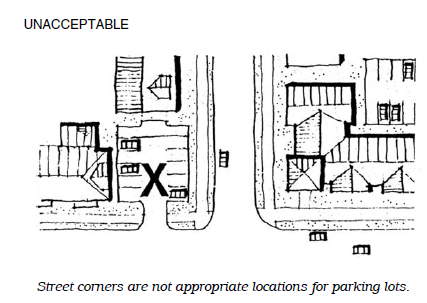
Parking areas shall be located to minimize their visual and functional impact, generally by locating parking areas along the rear and sides of the buildings, and shall comply with the following standards in lieu of compliance with RDC 18.720.040.C.1.
1.
For sites along pedestrian streets, parking areas shall not be placed forward of the maximum setback or the front building façade, whichever is closer to the property line, for more than twenty percent of the site's street frontage not encumbered by critical areas or significant vegetation, with the exception of driveways and drive aisles perpendicular to the street frontage.
2.
For sites along major corridors, parking areas shall not be placed forward of the maximum setback or the front building façade, whichever is closer to the property line, for more than fifty percent of the site's street frontage not encumbered by critical areas or significant vegetation, with the exception of driveways and drive aisles perpendicular to the street frontage. Slip lane parking lots per RDC 18.230.080.C. are also exempt from this standard.
3.
For sites located on a corner lot or other lot with multiple frontages, both frontages must meet the applicable limitations for parking area locations. No parking area shall be closer than one hundred feet to any corner formed by two public streets, unless the length of the frontage along both streets is less than one hundred feet in which case the parking area shall be located as far as practicable from the corner.
4.
The area between the property line and the parking area, with the exception of driveways and drive aisles providing access to the parking area, shall be fully landscaped to an L2 standard.
C.
Slip lane parking lots are permitted along the street frontage of major corridors, and are exempt from the 50 percent street frontage limitation for parking lots in RDC 18.720.040.C.1.
1.
Slip lane parking lots may consist of one, one-way drive aisle and one row of parking stalls arranged parallel or angled, meeting the dimensional standards of RDC Table 18.720.040-1. The combined width of the drive aisle and parking stalls shall not exceed forty-four feet.
2.
Slip lane parking lots shall include a sidewalk with a minimum width of five feet between the parking lot and the interior of the site, running the full length of the slip lane parking lot.
3.
Along a minimum of seventy-five percent of the length of the slip lane parking lot, buildings shall be set back no more than five feet from the back edge of the required sidewalk.
4.
Buildings fronting the slip lane parking lot shall provide a primary pedestrian entrance directly facing the parking lot.
5.
Where practicable, slip lane parking lots shall extend to the edge of the property line to allow seamless continuation along the adjoining properties.
6.
Slip lane parking lots shall only be allowed if the public works director approves access onto the arterial, which may include limitations on driveway spacing and restricted turn movements.
(Ord. No. 1108, § 2, 7-26-2012; Ord. No. 1220, § 2(Exh. A), 10-27-2016; Ord. No. 1234, § 2(Exh. A), 6-22-2017; Ord. No. 1253, § 2(Exh. A), 12-7-2017; Ord. No. 1426, § 2(Exh.), 7-25-2024; Ord. No. 1464, § 2(Exh.), 12-4-2025)
18.230.085 - Driveways.
A.
Number and separation of driveways. Parking lot entrances shall be restricted to no more than one entrance and exit lane per three hundred lineal feet of frontage, unless otherwise recommended by the city engineer on the basis of traffic impacts. Properties with less than three hundred lineal feet of frontage shall be restricted to one entrance and exit lane for vehicular access. For corner properties, the separate street frontages shall be measured separately unless both streets are classified as an arterial or collector.
B.
Corner lots. Vehicular access to corner lots shall be located on the lowest classified roadway and as close as practical to the property line most distant from the intersection.
C.
Driveway widths. Driveway lanes shall be no wider than eleven feet per entry or exit lane unless the responsible official determines wider lanes are appropriate for the use and that the design does not significantly impact vehicular circulation, public safety, pedestrian movement, or visual qualities.
D.
Driveway throat depth. The minimum required driveway throat depth along arterial and collector streets shall be at least sixty feet in the CRB district.
(Ord. No. 1178, § 2(Exh. A), 2-12-2015; Ord. No. 1234, § 2(Exh. A), 6-22-2017)
18.230.090 - Landscaping.
A.
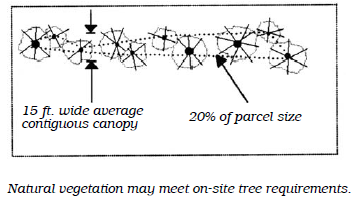
Purpose. Landscaping shall be integrated into the site in the form of landscaping in off-street parking areas, as buffers between uses, within street planter strips, and to soften the appearance of large building elevations, and shall comply with the requirements of this chapter and RDC 18.725. Landscaping shall include a combination of existing vegetation and new plant materials.
B.
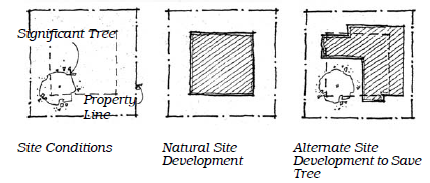
Existing Vegetation. While it is inevitable that some existing trees will be removed with new development, existing vegetation should be preserved where practicable or otherwise replanted in required landscape areas. All new developments and redevelopment projects should be designed to preserve existing, mature vegetation as part of the site and shall protect all existing vegetation that is outside of planned building and parking areas.
1.
All healthy, existing trees having a diameter at breast height (dbh) of six inches or greater shall be identified and marked on the existing conditions site plan.
2.
A minimum of twenty percent of existing vegetation shall be incorporated into the required landscaping areas and preserved. The applicant may reduce required building setbacks by up to twenty percent, exempt from the requirements for an administrative adjustment in RDC 18.350, if such a reduction can be shown to allow greater retention of existing vegetation.
3.
Existing vegetation that is not within building envelopes and not within areas that are required to be graded or excavated (e.g., for public improvement requirements, utilities, foundations, and parking areas) shall be integrated into the project's landscape design to the greatest extent practicable, and may exceed the minimum twenty percent retention required.
4.
If the applicant proposes an adjustment or variance consistent with RDC 18.350 to reduce the existing vegetation retention requirements of this section, the applicant must provide mitigation planting of equivalent inches of tree diameter. For example, if the applicant proposes to remove an existing twelve-inch dbh tree, it must be replaced with tree(s) totaling twelve inches diameter. The minimum size for replacement trees is three inches dbh.
(Ord. No. 1108, § 2, 7-26-2012; Ord. No. 1220, § 2(Exh. A), 10-27-2016)
18.230.100 - Street fences and walls.
A.
Fences shall meet the requirements of Chapter 18.740.
B.
Fence and wall materials.
1.
Fences shall be consistent with the overall building design and constructed of treated wood, wrought iron, brick, stone or concrete block (CMU). Smooth-faced concrete block must have a veneer finish on the side(s) visible to public view. Other materials which have the general appearance and visual quality of approved fence materials may be approved by the planning director. However, the use of plywood or composite sheeting as a fence material is not permitted.
2.
Chain link fences are discouraged and may only be used in areas not visible from any public right-of-way, adjacent property, or onsite common open area. If used, black, dark brown or dark-toned coated chain link fencing with matching posts and rails shall be required.
3.
Barbwire and razor wire fences shall not be used except for specific condition where the applicant demonstrates they are required for security reasons and that they will not be visible from adjacent rights-of-way.
C.
Fences and walls facing pedestrian streets shall not be allowed and fences and walls facing major corridors shall be discouraged unless the applicant demonstrates the fences or walls are necessary for business safety, screening the development from adjacent residential uses, or screening the parking area, service areas, or drive-through lanes. If fences or walls facing public streets are used, they shall be set back ten feet from sidewalk or right-of-way and shall provide landscaping within the setback area at an L2 standard.
(Ord. No. 1178, § 2(Exh. A), 2-12-2015; Ord. No. 1220, § 2(Exh. A), 10-27-2016; Ord. No. 1325, § 2(Exh. A), 9-24-2020)
Editor's note— Ord. No. 1178, § 2(Exh. A), adopted Feb. 12, 2015, repealed the former § 18.230.100, and enacted a new section as set out herein. The former § 18.230.100 pertained to fences and derived from Ord. No. 1108, § 2, adopted July 26, 2012.
18.230.110 - Outdoor storage, seating and events.
A.
Outdoor storage or display areas, excluding outdoor seating or event areas, shall occupy an area no larger than ten percent of gross floor area except for plant sales that shall occupy no more than seventy-five percent of gross floor area.
B.
Permanent outdoor seating and event areas, cumulatively, are limited to twenty percent of the gross site area, excluding uses in the public right-of-way. The planning director may issue a temporary use permit for the use of up to thirty percent of the gross site area for temporary outdoor seating and event space consistent with Section 18.205.015(F).
C.
Outdoor uses such as outdoor seating, sidewalk sales, or special events in the public right-of-way must be approved through either site plan review for permanent uses per RDC 18.500 or temporary use review consistent with RDC 18.205.015(F). A minimum six-foot wide pedestrian zone must be maintained within the right-of-way. Outdoor seating within the right-of-way must be separated from the pedestrian zone by means of movable separation thirty-six to forty-eight inches tall such as planters, bollards, fence, or similar. Use of the public right-of-way is discretionary and must be approved by the public works director.
(Ord. No. 1108, § 2, 7-26-2012; Ord. No. 1220, § 2(Exh. A), 10-27-2016)

