
Rockville City Zoning Code
ARTICLE 10
- SINGLE DWELLING UNIT RESIDENTIAL ZONES
Sec. 25.10.01.- Purpose.
The purpose of the single dwelling unit residential zones is to:
1.
Provide appropriately located areas for residential development that are consistent with the plan and public health and safety;
2.
Consistent with the environmental guidelines, ensure adequate light, air, privacy, and open space for each dwelling;
3.
Protect residents from adverse environmental effects;
4.
Promote a suitable environment for residential living through the provision of recreational, religious, and educational facilities as basic elements of a balanced neighborhood;
5.
Stabilize and protect the essential characteristics of existing residential development; and
6.
Foster development compatible with the topography and other natural characteristics of the area.
Sec. 25.10.02. - Zones established.
The individual single dwelling unit residential zones include the following:
Sec. 25.10.03. - Land use tables.
The uses permitted in the single dwelling unit residential zones are shown in the table below. All special exceptions are subject to the requirements of article 15.
Key: P = Permitted Use; S = Special Exception; C = Conditional Use; N = Not Permitted
1 Except as otherwise provided, no more than one (1) single unit detached dwelling may be built on a recorded lot.
(Ord. No. 29-09, § 10, 10-26-09; Ord. No. 7-11, § 10, 6-6-11; Ord. No. 17-23, § 2, 10-9-23; Ord. No. 13-24, § 3, 9-16-24)
Sec. 25.10.04. - Prohibition on the creation of new pipe stem lots.
No new pipe stem lots may be created in any single dwelling unit residential zone.
Sec. 25.10.05. - Development standards.
a.
Table of development standards.
1 Impervious surfaces include driveways, parking areas and sidewalks. In cases where the Department of Public Works approves a pervious paving material, the area of the front yard devoted to vehicle movement and parking is still limited to the percentage shown in the table above.
2 In the case of an institution of higher learning located on a site greater than seventy-five (75) acres, the maximum building height is 75 feet where the use adjoins property in a single dwelling unit residential zone or a park zone, and building height cannot penetrate a layback slope formed by an angle of thirty (30) degrees measured from the property boundary of the adjoining residential or park zone.
b.
Maximum lot coverage.
1.
Inclusion of accessory buildings. Maximum lot coverage includes accessory buildings; however, historic accessory buildings, located in a historic district zone, are exempt from the calculation.
2.
Special provision in the R-200 zone. In the R-200 zone, the maximum lot coverage is twenty-five (25) percent, except as provided for in subsections 25.15.02.j. and 25.15.02.k. for housing for senior adults and persons with disabilities and life care facilities.
c.
Impervious surface limits for corner lots and through lots.
1.
Corner lots. On corner lots, the maximum impervious surface limits for the front yard are one-half (½) the percentage requirements shown in the development standards table in subsection 25.10.05.a. above.
2.
Through lots. On through lots, the maximum impervious surface limits for the two (2) front yards are calculated as follows: Each front yard is defined as the area along the full width of the lot and the depth of the minimum front yard setback required in the zone. Each front yard must not exceed the maximum impervious surface limits shown in the development standards table in subsection 25.10.05.a. above.
d.
Exclusions from impervious surface requirements. Institutional uses in the single dwelling unit residential zones must normally meet the requirements set forth in subsection 25.10.05.a. above for the maximum impervious surface area in a front yard. However, through site plan review in accordance with the provisions of article 7, the approving authority may waive this requirement if it finds that such a waiver will reduce impacts of paved areas on adjoining residential uses, provide more efficient on-site traffic circulation, or address practical difficulties.
e.
Setbacks.
1.
Side setbacks where street abuts. A street along a side lot is deemed to be a side street only if the lot abutting the rear of the subject lot does not front on the street, otherwise the front setback requirement must apply.
2.
Front setback where established setback exceeds the standard setback. In cases where more than half of the lots located on one (1) side of a street between two (2) intersecting streets are occupied by buildings having a front setback different from the normal specified, any building hereafter must conform to the setback line up to the maximum specified in the development standards table in subsection 25.10.05.a. above.
3.
Minimum setbacks. A 50-foot setback is required from a right-of-way of limited access and a major or arterial highway unless the lot or lots are shown on an approved preliminary subdivision plan or an approved final record plat prior to January 1, 1980.
(Ord. No. 29-09, § 10, 10-26-09; Ord. No. 16-10, § 3, 9-13-10; Ord. No. 13-22, 7-18-22)
Sec. 25.10.06. - Additional neighborhood districts.
Historic district and neighborhood conservation district regulations are contained in article 14 and the boundaries of such districts are shown on the zoning map.
Sec. 25.10.07. - Accessory uses and structures.
All accessory uses and structures within the single dwelling unit residential zones must comply with the provisions of article 9 of this chapter.
Sec. 25.10.08. - Moderately priced dwelling units.
Any development that includes residential units must comply with the moderately priced dwelling unit requirements of chapter 13.5 of the Code.
Sec. 25.10.09. - Special regulations for building height in the R-60, R-75, and R-90 zones.
a.
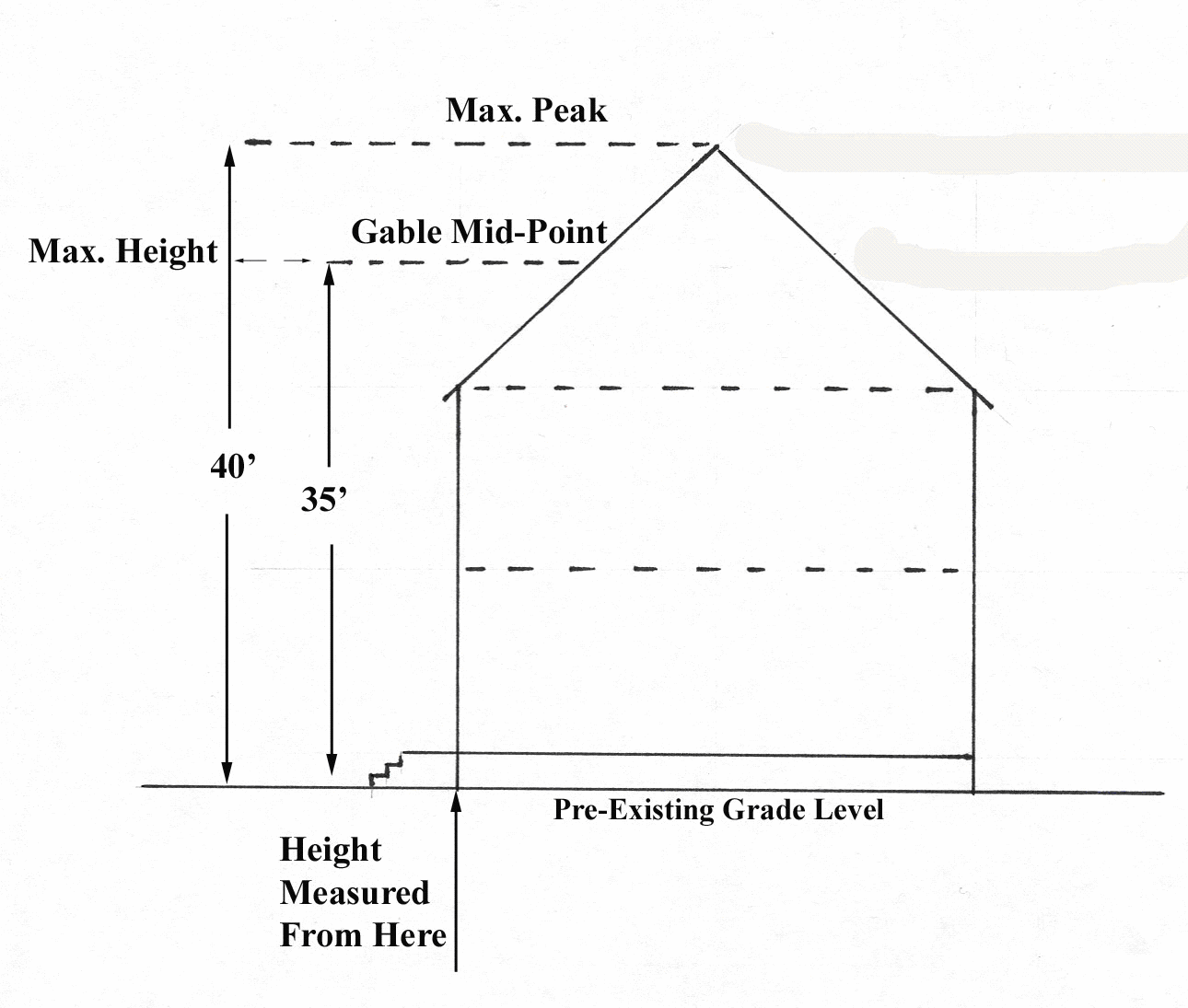
Height of residential buildings. The height of residential dwellings in the R-60, R-75, and R-90 zones is limited to thirty-five (35) feet, measured at the mid-point of the front of the building from the surface of the pre-existing grade to the mid-point of a gable, hip, or mansard roof or to the roof surface of a flat roof. In the case of a gable, hip or mansard roof, the height to the peak of the roof cannot exceed forty (40) feet.
b.
In cases where the existing grade of the lot slopes below the street grade, building height will be measured from the finished street grade, provided that construction of the dwelling requires re-grading of the lot for purposes of positive drainage of wastewater and stormwater to the street.
Sec. 25.10.10. - Nonconformities.
All nonconforming uses and structures within the single dwelling unit residential zones must comply with the provisions of article 8 of this chapter.
Sec. 25.10.11. - Parking and loading requirements.
All parking and loading within the single dwelling unit residential zones must comply with the provisions of article 16 of this chapter.
Sec. 25.10.12. - Landscaping and buffer requirements.
All landscaping and buffering within the single dwelling unit residential zones must comply with the provisions of article 17 of this chapter and, where applicable, the forest and tree preservation ordinance.
Sec. 25.10.13. - Signs.
All signs within the single dwelling unit residential zones must comply with the provisions of article 18 of this chapter.
Sec. 25.10.14. - Design guidelines.
No building permit may be issued for a structure in a single dwelling unit residential zone unless the structure conforms to any applicable design guidelines approved by the Mayor and Council consistent with an adopted plan.
Adopted design guideline plans referenced herein by their title and date of adoption are:
a.
East Rockville Design Guidelines, February 1, 2021.
(Ord. No. 2-21, 2-1-21)
Sec. 25.10.15. - Regulations for attached accessory dwelling units.
a.
An attached accessory dwelling unit is allowed subject to the following requirements:
1.
Only one (1) attached accessory dwelling unit is permitted on a lot.
2.
The owner of the lot on which the attached accessory dwelling unit is located must occupy either the attached accessory dwelling unit or the main building on the lot, except for bona fide temporary absences not exceeding six (6) months in any 12-month period.
3.
A separate entrance to the attached accessory dwelling unit must be located on the side or rear of the main building, or at the front of the main building if it is a single entrance door for use of the primary dwelling and the attached accessory dwelling unit.
4.
All external modifications and improvements to the single unit detached dwelling in which the attached accessory dwelling unit is to be created, or to which it is to be added, must be compatible with the existing dwelling and any applicable neighborhood design guidelines.
5.
The attached accessory dwelling unit must have the same street address (house number) as the main building.
6.
The gross floor area of the attached accessory dwelling unit shall be:
i.
Equal to less than fifty (50) percent of the total floor area of the primary dwelling; or
ii.
If the attached accessory dwelling unit is located in a basement or cellar, the gross floor area for the attached accessory dwelling unit may equal the square footage of the basement or cellar.
b.
The lot on which an attached accessory dwelling unit is constructed must include at least two (2) off-street parking spaces unless the lot is located within seven-tenths ( 7/10 ) of a mile walking distance to a Metro station, as delineated in the Rockville 2040 Comprehensive Plan, in which case the lot must include at least one (1) off-street parking space. Notwithstanding the foregoing:
1.
The Chief of Zoning may permit an attached accessory dwelling unit on a lot with no off-street parking spaces if the applicant demonstrates that sufficient on-street parking capacity is provided on the same block as the lot.
2.
An attached accessory dwelling units added to an existing main building that does not require modifications to the exterior of the existing building is not required to include off-street parking spaces.
c.
An accessory apartment permitted by a special exception approved by the Board of Appeals prior to April 9, 2024, shall be deemed a conforming attached accessory dwelling unit if it complies the requirements of subsections 25.10.15.a.1, a.2, a.5, and b. Any accessory apartment permitted by a special exception approved by the Board of Appeals prior to April 9, 2024, that does not comply with the requirements of subsections 25.10.15.a.1, a.2, a.5, and b. may continue as a nonconforming use.
d.
The owner of an attached accessory dwelling unit constructed before October 9, 2023, without conforming to the requirements of this chapter at the time of construction must apply for conditional use approval under this section. Notwithstanding the requirements of this section, if such a unit's gross floor area exceeds the gross floor area limitations of this section, the unit's gross floor area is deemed conforming. Failure to apply for conditional use approval thirty (30) days after a citation or to receive approval of a conditional use for such a unit by April 9, 2025, shall constitute a violation of this chapter.
(Ord. No. 17-23, § 2, 10-9-23)

