
Rockville City Zoning Code
ARTICLE 13
- MIXED-USE ZONES
Sec. 25.13.01.- Purpose.
a.
The purposes of the mixed-use zones are as follows:
1.
To create high-quality neighborhoods and zones that are attractive and pedestrian-oriented;
2.
To allow for a mix of different types of land uses in a compatible manner, both vertically and horizontally;
3.
Consistent with the Environmental Guidelines, to ensure the provision of public spaces that enhance the built environment;
4.
To minimize automobile use and maximize the use of public transportation, bicycle, and pedestrian access within the City;
5.
To promote a variety of uses in close proximity to each other in compliance with the master plan's recommendations;
6.
To establish performance standards to ensure that allowed uses will not create a nuisance for other uses within the same development;
7.
To provide standards and guidelines for assuring that the appearance and design of buildings, structures, and neighborhoods are compatible with existing nearby buildings and structures, and/or complies with any adopted design guidelines in the relevant plan for the area in which the building or structure is to be located;
8.
To provide for a variety of residential uses and diverse styles of housing which are compatible with the intent of each of the mixed-use zones; and
9.
To provide for more efficient land use, particularly a development pattern more flexible in adjusting to market conditions and local growth fluctuations.
b.
In order to achieve these purposes, the mixed-use zones permit a variety of uses within the allowable building envelopes, which can include residential, offices, and retail sales, and in certain zones light industrial uses.
Sec. 25.13.02. - Zones established.
To achieve the intent of the recommendations of the master plan, each mixed-use zone contains different sets of standards and requirements to respond to the needs of individual neighborhoods of the City. These mixed-use zones are listed below, along with a description of the purpose of each zone.
Note: Provisions for development in planned development areas are contained in article 14.
(Ord. No. 1-18, 1-22-18; Ord. No. 15-19, 7-8-19)
Sec. 25.13.03. - Land use tables.
The uses permitted in the mixed-use zones are as shown in the table below. Uses are subject to applicable conditions of site plan approval. All special exceptions are subject to the requirements of article 15.
Key: P = Permitted Use; C = Conditional Use; S = Special Exception; N = Not Permitted
1 Conditional use in the MXC zone is not permitted when adjoining a residential zone.
2 Special provisions for motor vehicle and trailer sales:
a. All buildings, off-street parking and loading areas and all outdoor storage and display of motor vehicles must be set back fifty (50) feet from any adjoining or abutting land classified in a residential zone. Where the plan recommends a setback from a public street greater than the minimum required, the plan takes precedence.
b. The storage of waste material, auto parts, refuse and motor vehicles is prohibited in any required setback area.
c. The requirement for providing public use space may be met in whole or in part through the fee-in-lieu process as set forth in article 17.
3 Except that new and/or expanded motor vehicle and trailer sales including new and reconditioned parts and accessories and service incidental thereto are permitted on those properties on which such uses are located as of March 16, 2009.
4 If this condition is not met, see subsection 25.08.05.d. for non-conforming status.
(Ord. No. 29-09, § 13, 10-26-09; Ord. No. 7-11, § 13, 6-6-11; Ord. No. 13-14, 10-13-14; Ord. No. 2-15, 2-2-15; Ord. No. 1-18, 1-22-18; Ord. No. 15-19, 7-8-19; Ord. No. 14-21, 9-27-21; Ord. No. 18-21, 10-25-21; Ord. No. 8-24, 7-29-24)
Sec. 25.13.04. - Special regulations for conditional uses.
a.
Residential. Where residential uses are permitted as conditional uses in a mixed-use zone, other than the MXC zone, they are only allowed in those areas of the zone recommended for such use in the plan. The Planning Commission in approving such conditional uses shall establish such development standards as deemed necessary to render such uses suitable and compatible with the surrounding uses and in accordance with the intent of the plan. In the mixed-use commercial (MXC) zone, multiple-unit dwellings are not permitted at the ground floor level.
b.
Drug store with drive-through service window. In the MXTD zone, the drive-through must be incorporated and enclosed within a building or structure. In the other zones where allowed, the drive-through must be arranged so as to not obstruct traffic circulation within the site. Sufficient reservoir spaces must be provided and must be located so as not to obstruct vehicle or pedestrian circulation or parking within the site or accessing the site.
c.
Banks and financial institution with drive-through. In the MXTD zone, the drive-through must be incorporated and enclosed within a building or structure. In the other zones where allowed, the drive-through must be arranged so as to not obstruct traffic circulation within the site. Sufficient reservoir spaces must be provided and must be located so as not to obstruct vehicle or pedestrian circulation or parking within the site or accessing the site.
d.
Commercial parking facility. A commercial parking facility is only permitted in the form of a parking structure. At least seventy-five (75) percent of the ground level floor street frontage must be devoted to commercial uses.
e.
Restaurant with drive-through window in the MXE zone. The use must be located on a site that has frontage on and access to a major arterial roadway at the front lot line.
f.
Tobacco and vape shop. Where a tobacco and vape shop is allowed as a conditional use, it must meet the following standards:
1.
A tobacco and vape shop must not be located on a parcel that is within one thousand (1,000) feet of a parcel on which one or more of the following uses are located:
a.
Destination Park, Citywide Park, or Neighborhood Park as classified by the City of Rockville Recreation and Parks Strategic Plan, as adopted December 7, 2020;
b.
Public or private elementary school;
c.
Public or private middle school; or
d.
Public or private high school.
2.
A tobacco and vape shop is deemed a nonconforming use subject to the requirements of section 25.08.05 if a use listed in subsection 25.13.04.f.1 is established on a parcel within one thousand (1,000) feet of the parcel on which the tobacco and vape shop is located after the tobacco and vape shop began lawfully operating.
3.
A retail establishment operating under a valid occupancy permit approved before [date of ordinance effective date] that meets the definition of "tobacco and vape shop" under section 25.03.02 shall be classified as a tobacco and vape shop and may continue as a conforming use if it meets the requirements of sections 25.12.03, 25.13.03, and 25.13.04.f.1. Any such retail establishment that does not meet the requirements of these sections shall be classified as a tobacco and vape shop and may continue as a nonconforming use subject to the requirements of section 25.08.05.
(Ord. No. 29-09, § 13, 10-26-09; Ord. No. 13-14, 10-13-14; Ord. No. 8-24, 7-29-24)
Sec. 25.13.05. - Development standards.
a.
Build-to lines.
1.
Where a build-to line established in the Town Center Master Plan is required, at least seventy (70) percent of the length of the building wall facing that line must be set at the build-to line. Development must also comply with the building restriction line provisions set forth in section 25.17.08.
2.
(a)
Build-to lines established by the Rockville Pike Neighborhood Plan are located within the area bounded by Dodge Street, Richard Montgomery Drive, Fleet Street (including the unimproved right-of-way), Wootton Parkway, East Jefferson Street (existing and proposed extension), the City boundary, the CSX/Metro tracks, and Veirs Mill Road.
(b)
The following build-to lines are established within the Rockville Pike Neighborhood Plan area for properties fronting on Rockville Pike:
i.
Within the South Pike Area, one hundred twenty-six (126) feet from and parallel to the centerline of Rockville Pike.
ii.
In the area north of the South Pike area bounded by Richard Montgomery Drive, Fleet Street (including the unimproved right-of-way), Wootton Parkway, East Jefferson Street (existing and proposed extension), the South Pike Area boundary and the west line of Rockville Pike, one hundred twenty-six (126) feet from the centerline of Rockville Pike.
iii.
In the area north of the South Pike area boundary and bounded by the South Pike Area boundary, the CSX/Metro right-of-way, Veirs Mill Road, Dodge Street, and the east line of Rockville Pike, one hundred sixteen (116) feet from the centerline of Rockville Pike. For any parcel located in an area where the distance between the Rockville Pike right-of-way and the Veirs Mill Road right-of-way, or the Rockville Pike right-of-way and the CSX/Metro right-of-way, is less than three hundred (300) feet, a reduced build-to line may be applied under either subsection A. or B. below:
A.
The build-to line must be adjusted by establishing the build-to line at a point three-quarters of the distance from the CSX/Metro right-of-way to the Rockville Pike right-of-way or from the Veirs Mill Road right-of-way to the Rockville Pike right-of-way. The build-to line may be reduced to eighty-five (85) feet from the centerline of Rockville Pike so long as inter-site vehicular and bicycle movement and a continuous public sidewalk are provided; or
B.
The build-to line may be further reduced to a point less than eighty-five (85) feet from the centerline of Rockville Pike where the Approving Authority finds that planned transportation infrastructure, inter-site vehicular and bicycle movement, tree lawn, and a continuous public sidewalk can still be provided.
C.
In addition, the standards and requirements set forth in subsection (d) still apply to building facades if the build-to line is reduced.
iv.
For a Champion Project, as defined in article 3, the build-to line is one hundred three (103) feet from the centerline of Rockville Pike if no access drive is provided. If an access drive is provided, the build-to line is one hundred twenty-six (126) feet.
(c)
For properties fronting all other roadway classifications within the Rockville Pike Neighborhood Plan area, the build-to line is established at the property line.
(d)
The percentage of a building facade that must be located at the build-to line varies by the roadway classification that the property fronts. The following table provides the minimum percentage of building facade that should be located at the build-to line:
(e)
The requirement that buildings be placed at the build-to-line only applies to the first two (2) floors of a building. The first two (2) floors of a building must meet the minimum percent building facade requirement set forth in subsection (d). In order to provide some degree of flexibility in achieving these requirements, the percentage of facades at the build-to line may be distributed between the first two (2) floors. For example, if a minimum of seventy (70) percent of the building facade is required to be at the build-to line, an applicant who chooses to place one hundred (100) percent of the ground floor at the build-to line would be required to place only forty (40) percent of the second story at the build-to line.
(f)
Except as allowed under subsection (g), the minimum percentages established in subsection (d) must be adhered to during the review and approval of any development project. To provide flexibility of design, a facade articulation of up to two (2) feet behind the build-to line is allowed.
(g)
At the time of project plan approval or site plan approval in accordance with article 7, these minimum percentages may be reduced for good cause shown and where the reduction is found to be consistent with the recommendations and intent of the master plan.
b.
Development standards table.
1.
The following table sets forth the development standards for each of the mixed-use zones:
1 Nonresidential land abutting side setback—This term also includes multi-unit residential uses with a height of forty-five (45) feet or greater.
2 Height is subject to the provisions of subsection 25.13.05.b.2 below.
3 Where the applicable master plan establishes specific recommendations or standards for the provision of amenity area and public use space requirements, the master plan recommendation must be taken into consideration by the approving authority when reviewing a development project.
4 Open area and public use space requirements for development above forty-five (45) feet are shown in subsection 25.13.05.b.2(c).
2.
Building height.
(a)
MXTD zone.
(i)
Building facades should have a range of heights of between forty-five (45) and sixty-five (65) feet at the street. Additional height up to one hundred twenty (120) feet at the street may be allowed where recommended by the plan or where approved by the Mayor and Council as part of a project plan under section 25.07.07. Building facades that exceed two hundred fifty (250) feet in length should vary the facade height by at least ten (10) feet for some distance along the length of the facade in order to avoid a monotonous, monolithic appearance.
(ii)
Where recommended in the plan, or if approved by the Mayor and Council as part of a project plan approval in accordance with section 25.07.07, building height may be increased beyond one hundred twenty (120) feet up to one hundred fifty (150) feet under the following conditions:
A.
The public use space requirement must be provided on the site, except in the Rockville Pike Neighborhood Plan area, where the public use space requirement can be met either on site or through fee-in-lieu payment;
B.
The building footprint cannot occupy more than eighty (80) percent of the net lot area;
C.
The building design exceeds the urban design recommendations of the applicable master plan; and
D.
The building must exceed any energy conservation standards set forth in this Code.
(iii)
Height for a Champion Project may be allowed up to two hundred (200) feet.
(b)
MXCD zone.
(i)
Building facades should have a range of heights of between thirty-five (35) and fifty (50) feet at the street. Additional height up to seventy-five (75) feet at the street may be allowed where recommended by the Plan or where approved by the Mayor and Council as part of a Project Plan or Planning Commission as part of a Site Plan under section 25.07.06 or Section 25.07.05 as applicable. Building facades that exceed two hundred fifty (250) feet in length should vary the facade height by at least ten (10) feet for some distance along the length of the facade in order to avoid a monotonous, monolithic appearance.
(ii)
Height for a Champion Project may be allowed up to one hundred twenty-five (125) feet.
(c)
MXNC zone. Building height may be increased up to a maximum of sixty-five (65) feet in accordance with the plan. If the plan makes no other recommendation, development between forty-five (45) feet and sixty-five (65) feet must provide fifteen (15) percent open area, of which ten (10) percent must be public use space.
(d)
MXCT zone. Building facades should have a range of heights of between thirty-five (35) and fifty (50) feet at the street. Additional height up to seventy-five (75) feet at the street may be allowed where recommended by the Plan or where approved by the Mayor and Council as part of a Project Plan under Section 25.07.06, or Planning Commission as part of a Site Plan under Section 25.07.05 as applicable. Building facades that exceed two hundred fifty (250) feet in length should vary the facade height by at least ten (10) feet for some distance along the length of the facade in order to avoid a monotonous, monolithic appearance.
(e)
Layback slope. In addition to the height limits set forth in this Article 13, building height on a confronting property cannot penetrate a layback slope line of thirty (30) degrees, beginning from the closest ground point of the lot line of any property in any residential zone where single unit detached, semi-detached, attached, or townhouse development exists or such development is recommended in the Plan, without regard to intervening roads or other transportation facilities as shown in Figure 13.1. This layback slope requirement does not apply to:
(i)
Areas adjacent to the MXT zone;
(ii)
Nonresidential historic sites in the mixed use zones;
(iii)
Sites in single unit detached residential zones developed or recommended for non residential uses;
(iv)
Areas adjacent to Metro rapid transit or railroad right-of-way that are north of the Veirs Mill Road intersection with the railroad right-of-way;
(v)
Areas within a PD zone;
(vi)
Areas adjacent to the MXC zone; or
(vii)
Any area within the Rockville Pike Core Area.
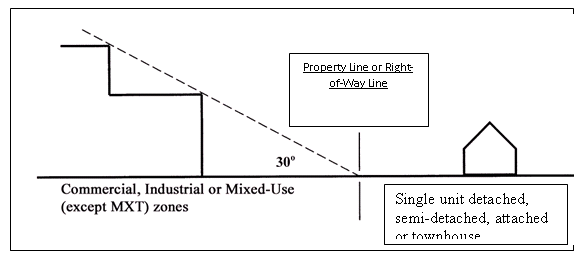
Figure 13.1 - Layback Slope Example
c.
Other standards and requirements for new development or redevelopment.
1.
Conversion of space. Areas of a building originally designed for commercial or office use are encouraged to be designed to accommodate the conversion of the space to residential uses.
2.
Entryways. Areas of a building originally designed for residential use at the ground floor level, having individual entries to the units, should have the entry from the ground level raised at least two (2) feet, or have another form of demarcation between the public sidewalk and the private entry. In order to be readily convertible to retail space, such areas must have a minimum ceiling height of fifteen (15) feet.
3.
Access. Areas of a building intended for nonresidential uses must not have any access to areas of the building used for residential purposes. The residential areas must have their own private entries.
4.
Moderately priced dwelling unit ordinance compliance. Any development that includes residential units must comply with the moderately priced dwelling unit requirements of chapter 13.5 of the Code.
5.
Public use space. In the mixed-use zones, public use space shall be provided consistent with the provisions of section 25.17.01.
6.
Floor area limitation.
(a)
Except as provided in subsection (b) below, retail commercial uses by a single tenant cannot occupy more than sixty-five thousand (65,000) square feet of floor area at the ground level. This limit only applies to the ground area footprint, and does not limit additional floors devoted to the single tenant so long as each of the additional floors does not exceed sixty-five thousand (65,000) square feet.
(b)
For a Champion Project, the Mayor and Council may allow the floor area limit for a single retail tenant within the project to increase to no more than one hundred thousand (100,000) square feet of floor area at the ground level and at each additional floor. As a condition of approval of the Champion Project, the following applies:
i.
Each of the exterior walls at the ground level, along any public street or way, must be activated with points of access for street-fronting retail, restaurants and/or service establishments that contribute to a vibrant walkable environment; and
ii.
The building design must be consistent with the additional design guidelines set forth in section 25.13.06.
(Ord. No. 29-09, § 13, 10-26-09; Ord. No. 16-10, § 4, 9-13-10; Ord. No. 17-10, 9-20-10; Ord. No. 7-11, § 13, 6-6-11; Ord. No. 1-18, 1-22-18; Ord. No. 7-18, 4-9-18; Ord. No. 14-21, 9-27-21)
Sec. 25.13.06. - Additional design guidelines.
a.
Purpose. It is the purpose of this section to establish guidelines that will promote the highest quality of development in the mixed use zones. New development or redevelopment should be consistent with the intent and purpose of the following guidelines.
b.
Aesthetic and visual characteristics for all zones.
1.
Facades and exterior walls including sides and backs. Buildings should be designed in a way that avoids massive scale and uniform and impersonal appearance and that will provide visual interest consistent with the community's identity, character, and scale. It is recommended that building walls greater than one hundred (100) feet long include projections, recessions, or other treatments sufficient to reduce the unbroken massing of the facade along all sides of the building facing public streets.
(a)
Along any public street frontage building, design should include windows, arcades, awnings or other acceptable features along at least sixty (60) percent of the building length. Arcades and other weather protection features must be of sufficient depth and height to provide a light-filled and open space along the building frontage. Architectural treatment, similar to that provided to the front facade must be provided to the sides and rear of the building to mitigate any negative view from any location off-site and any public area (e.g. parking lots, walkways, etc.) on site.
(b)
Buildings should include architectural features that contribute to visual interest at the pedestrian scale and reduce the massive aesthetic effect by breaking up the building wall along those sides fronting on public streets with color, texture change, wall offsets, reveals, or projecting ribs.
2.
Roofs. Roof design should provide variations in rooflines where appropriate and add interest to, and reduce the massive scale of, large buildings. Roof features should complement the architectural and visual character of adjoining neighborhoods. Roofs should include two (2) or more roof planes. Parapet walls should be architecturally treated to avoid a plain, monotonous look. For energy-saving purposes, roof design should also include a light color surface or be planted with vegetation.
3.
Materials and color.
(a)
General provisions. Buildings should have exterior building materials and colors that are compatible with materials and colors that are used in adjoining neighborhoods. Certain types of colors should be avoided such as fluorescent or metallic, although brighter colors may be considered at the discretion of the Planning Commission.
(b)
Materials not desired. Construction materials such as tilt-up concrete, smooth-faced concrete block, prefabricated steel panels, and other similar materials should be avoided unless the exterior surface is covered.
4.
Items allowed not facing a public street. The following items are only allowed either on sides not facing a public street or in the rear yard:
(a)
Window and wall air conditioners;
(b)
Electric utility meters;
(c)
Air conditioning compressors; and
(d)
Irrigation and pool pumps;
This provision does not apply to single-unit detached, semi-detached, attached or townhouse dwellings that may be located in a mixed-use zone.
5.
Entryways. Building design must include design elements which clearly indicate to customers where the entrances are located and which add aesthetically pleasing character to buildings by providing highly visible customer entrances.
6.
Screening of mechanical equipment. Mechanical equipment must be screened to mitigate noise and views in all directions. If roof-mounted, the screen must be designed to conform architecturally to the design of the building either with varying roof planes or with parapet walls. A wood fence or similar treatment is not acceptable.
c.
Site design and relationship to surrounding community.
1.
Buffers. Each site must provide visual and noise buffers to nearby residential uses. This can be accomplished by providing a substantial building setback from a residential use or residentially zoned property that is adjacent to the site. A landscape buffer of substantial width should be provided adjacent to any property line where it adjoins residential uses or zones. The landscape buffer should include a variety of tree types at regular intervals with groupings of trees to provide noise, light, and visual screening. No other uses, such as, but not limited to, parking or storage, are permitted within the buffer area.
2.
Outdoor sales and storage.
(a)
General standards. Areas for outdoor sales of products may be permitted if they are extensions of the sales floor into which patrons are allowed free access. Such areas must be incorporated into the overall design of the building and landscaping and must be permanently defined and screened with walls and/or fences. Materials, colors, and design of screening walls and/or fences shall conform to those used as predominant materials and colors on the building. If such areas are to be covered, then the covering shall be similar in materials and colors to those that are predominantly used on the building facade. Outdoor sales areas shall be considered as part of the gross floor area of the retail establishment, except for motor vehicle and trailer sales.
(b)
Prohibition of certain sales and storage. Outdoor storage of products in an area where customers are not permitted is prohibited. This prohibition includes outdoor storage sheds and containers. Outdoor storage of motor vehicles in connection with a motor vehicle sales business is allowed.
3.
Trash recycling, waste oil/grease collection area.
(a)
Location. Trash, recycling, and waste oil/grease collection areas must be located at least fifty (50) feet from any residential use, residentially zoned property, or street that is adjacent to the site, unless such operations are located entirely within an enclosed building or underground. All such areas must be properly covered or secured.
(b)
Screening. All trash recycling, and waste oil/grease collection areas that are not within an enclosed building or underground must be properly secured and covered and screened or recessed so that they are not visible from public streets, public sidewalks, internal pedestrian walkways, or adjacent residential properties. Screening and landscaping of these areas must conform to the predominant materials used on the site.
4.
Parking lots and structures.
(a)
Parking area standards. Parking areas must provide safe, convenient, and efficient access. They should be distributed around large buildings in order to shorten the distance to other buildings and public sidewalks, and to reduce the overall scale of the paved surface. Landscaping should be used to define parking areas, primary vehicular drives, and pedestrian areas in an aesthetically and environmentally pleasing manner.
(b)
Parking structure appearance. Parking structure facades should achieve the same high quality design and appearance as the buildings they serve. The parking structures' utilitarian appearance should be minimized by utilizing effective design treatments such as colonnades, planted ("green") walls, arcades, awnings, street furniture and other public amenities. Compatible materials, coordinated landscaping and screening, appropriate building color, sensitive lighting, and signage should all be considered for garage facades.
5.
Pedestrian and bicycle flows. Each site must provide for pedestrian accessibility, safety, and convenience to reduce traffic impacts and enable the development of the project. Continuous internal pedestrian walkways, no less than six (6) feet in width should be provided from the public sidewalk or right-of-way to the principal customer entrance of all principal buildings on the site. Sidewalks should also connect retail uses to transit stops on or off-site and to nearby residential neighborhoods. Sidewalks should be provided along the full length of any building where it adjoins a parking lot. On-site bicycle travel must be provided in accordance with section 25.16.06.
6.
Central features and community spaces. Development should provide attractive and inviting pedestrian scale features, spaces, and amenities. Entrances and parking lot locations shall be functional and inviting with walkways conveniently tied to logical destinations. Bus stops should be considered integral parts of the configuration whether they are located on-site or along the street. Customer drop-off/pick-up points that may be provided should also be integrated into the design and should not conflict with traffic lanes or pedestrian paths. Special design features such as towers, arcades, porticos, light fixtures, planter walls, seating areas, and other architectural features that define circulation paths and outdoor spaces should anchor pedestrian ways. Examples are outdoor plazas, patios, courtyards, and window shopping areas. Each development should have at least two (2) of these areas.
7.
Delivery and loading spaces, hours of operation.
(a)
Design. Delivery and loading operations must be designed in accordance with the provisions of article 16 and located so as to mitigate visual and noise impacts to adjoining residential neighborhoods. If there is a residential use or residentially zoned property adjacent to the site, such operations must not be permitted between 10:00 p.m. and 7:00 a.m. For good cause shown, the Planning Commission may permit deliveries at additional times provided the applicant submits evidence that sound barriers between all areas for such operations effectively reduce emissions to a level of fifty-five (55) dB or less, as measured at the lot line of any adjoining property. Delivery and loading areas should be substantially set back from a residential use or residentially zoned property that is adjacent to the site. A landscape buffer of substantial width should be provided adjacent to the delivery and loading area where it adjoins residential uses or zones. The landscape buffer should include evergreen shrubs and/or trees plus deciduous canopy trees at regular intervals, as appropriate, to provide light, and visual screening. If the delivery and loading spaces are located within an enclosed building or underground, no such setback and buffer area shall be required.
(b)
Parking of delivery trucks. Delivery trucks must not be parked in close proximity to or within a designated delivery or loading area during non-delivery hours with motor and/or refrigerators/generators running, unless the area where the trucks are parked is set back at least fifty (50) feet from residential property to mitigate the truck noise.
(c)
Screening. The delivery and loading areas should be screened or enclosed so that they are not visible from public streets, public sidewalks, internal pedestrian walkways, or adjacent properties. The screen must be of masonry or other suitable opaque material and at least ten (10) feet high, measured from the loading dock floor elevation, to screen the noise and activity at the loading dock.
8.
Ancillary uses. The applicant must demonstrate that any ancillary uses will not have negative impacts on adjacent residential uses, residentially zoned properties, or adjacent properties. Any ancillary use should be oriented to face away from any residential use or residentially zoned property that is adjacent to the site.
9.
Noise abatement. A noise mitigation plan must be provided that indicates how the noise initiated by the land use will be mitigated to comply with noise regulations applicable in the City. This includes compliance with the noise regulations set forth in chapter 31B of the Montgomery County Code.
10.
Outdoor lighting. Outdoor lighting shall be in conformance with the landscaping, screening and lighting manual.
11.
Landscaping. Landscaping shall be in conformance with the landscaping screening and lighting manual.
(Ord. No. 29-09, § 13, 10-26-09; Ord. No. 18-21, 10-25-21)
Sec. 25.13.07. - Special design regulations for individual mixed-use zones.
a.
Mixed-Use Transit District Zone (MXTD). The MXTD zone is intended to foster the implementation of the relevant master plan recommendations for areas in close proximity to the Metro rail stations.
1.
Building location. In order to meet the intent of the master plan, buildings in the MXTD zone should be located at the front property line(s), including corner lots, or the build-to line where established by the plan. Access to the rear, if required, should be via alleys. If access is required from the front, the driveway entry should be a portal penetrating the facade of the building. The continuity of the building facade must be maintained above the drive entry.
2.
Uses by floor. the ground floor must contain retail or public-related service uses along those streets designated in the master plan as major pedestrian spines. Ground floor retail is the preferred use along other streets, but is not required. The ground floor should normally have a ceiling height of at least fifteen (15) feet. At the time of site plan review or project plan review, the Approving Authority may consider a lower ceiling height if appropriate in the particular circumstance. The upper floors may be additional retail, office, residential, or a combination of uses. If the building contains only residential units, the ground floor may consist of residential units, but should be designed to facilitate conversion to retail or other commercial uses.
3.
Facade. The facade design must be consistent with the standards set forth in subsection 25.13.05.b.2(a). Where the facade height exceeds thirty-five (35) feet, the facade should include an expression line above the first floor level and a defined cornice line at the top of the facade wall.
4.
Fenestration. Generally, fenestration of the stories above the ground floor should be by individual framed windows. Continuous strip windows may be allowed by the Approving Authority if they are used to maintain compatibility with existing contiguous projects.
5.
Sidewalks. Where sidewalks must be built new or rebuilt as part of redevelopment, they should comply with the provisions of section 25.17.05.
6.
Parking. On-site parking must be provided in accordance with the requirements of article 16. Parking must be located to the side or in the rear of the buildings unless ground floor retail is provided, in which case limited parking may be allowed in the front to serve the retail uses. Structured parking, either above or below grade, is preferred. Any parking structure facades visible from the street or a transitway must be treated in the same manner as the primary building facades. All parking must be screened to prevent vehicle headlights from shining into adjoining residential properties.
b.
Mixed-Use Corridor District Zone (MXCD). This zone is intended for areas along major highway corridors in areas near the MXTD zone. It allows for moderate density development of retail, office, service, and residential uses. Because of the nature of the locations where it is applied, the zone provides some flexibility in the siting of buildings relative to major highways to accommodate service drives and required parking.
1.
Building location. In order to meet the intent of the plan, buildings in the MXCD zone should be located at the front property line or the build-to line where established by the plan. Access should be to the rear, via alleys with access from the side street(s).
2.
Uses by floor. The ground floor must contain retail or service uses dealing directly with the public along those streets designated in the plan as major pedestrian spines. Ground floor retail is the preferred use along other streets, but is not required. The ground floor should normally have a ceiling height of at least fifteen (15) feet. At the time of site plan review or project plan review, the Approving Authority may consider a lower ceiling height if appropriate in the particular circumstance. The upper floors may be additional commercial, residential, or a combination of uses. If the building contains only residential units, the ground floor may consist of residential units, but should be designed to facilitate conversion to retail or other commercial uses.
3.
Facades. The facade design must be consistent with the standards set forth in subsection 25.13.05.b.2(b). Where the facade height exceeds thirty-five (35) feet, the facade should include an expression line above the first floor level and a defined cornice line at the top of the facade wall.
4.
Fenestration. Generally, fenestration of the stories above the ground floor should be by framed individual windows. Continuous strip windows may be allowed by the Approving Authority if they are used to maintain compatibility with existing contiguous projects.
5.
Sidewalks. Where sidewalks must be built new or rebuilt as part of redevelopment, they should comply with the provisions of subsection 25.17.05.
6.
Parking. On-site parking must comply with the standards and requirements of article 16. Most parking should be located to the side or in the rear of the buildings. Structured parking, either above or below grade, is preferred. Any parking structure facades visible from the street or a transitway must be treated in a similar manner as the primary building facades. All parking at the sides or rear must be screened to prevent vehicle headlights from shining into adjoining residential properties.
c.
Mixed-Use Employment Zone (MXE). This zone is intended for areas that are either currently developed or are recommended for development primarily for office and industrial park uses.
1.
Building location. Where recommended by the plan, buildings in the MXE zone should be located close to the front property line or at a build-to line (vis-à-vis, a service drive) where established by the plan.
2.
Uses by floor. The ground floor may contain retail and other commercial uses along those streets designated in the plan as major pedestrian spines. The upper floors may be additional retail, office, residential, or a combination of uses.
3.
Facade. Along the front lot line, the building facade is normally a minimum of twenty (20) feet high. Building facades taller than thirty-five (35) feet should generally include an expression line at the first floor level, and a defined cornice line at the top of the facade wall.
4.
Sidewalks. Where sidewalks must be built new or rebuilt as part of redevelopment, they should comply with the provisions of section 25.17.05.
5.
Parking. On-site parking must comply with the standards and requirements of article 16. Most parking should be located to the side or in the rear of the buildings. Structured parking, either above or below grade, is preferred. Any parking structure facades visible from the street or a transitway must be treated in a similar manner as the primary building facades. All parking must be screened to prevent vehicle headlights from shining into adjoining residential properties.
6.
Special regulations for residential development in the MXE zone.
(a)
Residential uses may be allowed in those areas recommended for such uses in the relevant plan, or where the Mayor and Council or the Planning Commission, as the case may be, determines that the use is compatible with adjoining and confronting uses by means of landscaping, screening, or other measures. In this case, residential development is limited to townhouses, multi-unit, or live-work units. Ground floor retail uses primarily intended to serve the residents may be included.
(b)
Residential uses are permitted in buildings containing principally office uses, but are limited to no more than twenty (20) percent of the gross floor area.
(c)
In order to maintain compatibility, residential uses other than live-work units are not permitted in buildings that house primarily service industrial or other primarily industrial uses.
d.
Mixed-Use Business Zone (MXB). Except as may be otherwise determined by the plan, this zone is intended for areas that are either currently developed or recommended for development primarily for community business and retail services.
1.
Building location. Buildings in the MXB zone should be located at or close to the front property line or the build-to line where required by the master plan.
2.
Uses by floor. The ground floor must contain commercial or service uses. The upper floors may be additional commercial, residential, or a combination of uses. If the building contains only residential units, the ground floor may consist of residential units, but should be designed to facilitate conversion to retail or other commercial uses. This provision does not apply where the applicable master plan recommends residential uses only.
3.
Facade. Along the front lot line, the building facade is normally a minimum of 15 feet high. Variations of up to five (5) feet are encouraged to achieve some variety in the facade appearance. Building facades taller than thirty-five (35) feet should include an expression line at the first floor level, and a defined cornice line at the top of the facade wall.
4.
Fenestration. Fenestration is to be by framed individual windows. Continuous strip windows are discouraged unless they are used to maintain compatibility with existing contiguous projects.
5.
Sidewalks. Where sidewalks must be built new or rebuilt as part of redevelopment, they should comply with the provisions of section 25.17.05.
6.
Parking. On-site parking must comply with the standards and requirements of article 16. Most parking should be located to the side or in the rear of the buildings. Structured parking, either above or below grade, is preferred. Any parking structure facades visible from the street or a transitway must be treated in a similar manner as the primary building facades, and the ground level facing the street must be occupied by commercial or personal service uses. All parking must be screened to prevent vehicle headlights from shining into adjoining residential properties.
7.
Adjacent to residential. Where the MXB zone confronts or is immediately adjacent to any property used or recommended in the plan for single unit residential development, the architectural design of buildings adjoining, adjacent, or confronting such single unit residential uses should reflect compatible design and character with the existing residential buildings in the immediate vicinity.
e.
Mixed-Use Neighborhood Commercial Zone (MXNC). This zone is intended for areas that are either currently developed or recommended for development primarily for neighborhood retail services.
1.
Building location. Buildings in the MXNC zone should be located at or close to the front property line or the build-to line where required by the plan.
2.
Uses by floor. The ground floor may include both commercial and residential uses. The upper floors may contain additional commercial, residential, or a combination of uses.
3.
Facade. Along the front lot line, the building facade is normally a minimum of fifteen (15) feet high. Variations of up to five (5) feet are encouraged to achieve some variety in the facade appearance. Building facades taller than thirty-five (35) feet should include an expression line at the first floor level, and a defined cornice line at the top of the facade wall.
4.
Fenestration. Fenestration is to be by framed individual windows. Continuous strip windows are discouraged unless they are used to maintain compatibility with existing contiguous projects.
5.
Sidewalks. Where sidewalks must be built new or rebuilt as part of redevelopment, they should comply with the provisions of section 25.17.05.
6.
Parking. On-site parking must comply with the standards and requirements of article 16. Most parking should be located to the side or in the rear of the buildings. Structured parking, either above or below grade, is preferred. Any parking structure facades visible from the street must be treated in the same manner as the primary building facades. All parking must be screened to prevent vehicle headlights from shining into adjoining residential properties.
f.
Mixed-Use Commercial Zone (MXC). This zone is intended for areas that are either currently developed or recommended for development primarily for neighborhood retail services.
1.
Building location. Consistent with the operational characteristics of the use, buildings in the MXC zone should be located close to the front property line or at the build-to line where required by the plan.
2.
Uses by floor. Except in the case of single-unit detached residential buildings, the ground floor must contain commercial uses. The upper floors may contain additional commercial, residential, or a combination of uses.
3.
Facade. Along the front lot line, the building facade is normally a minimum of fifteen (15) feet high. Variations of up to five (5) feet are encouraged to achieve some variety in the facade appearance.
4.
Fenestration. Fenestration of the upper floors is to be by framed individual windows. Continuous strip windows are discouraged unless they are used to maintain compatibility with existing contiguous projects.
5.
Sidewalks. Where sidewalks must be built new or rebuilt as part of redevelopment, they should comply with the provisions of section 25.17.05.
6.
Parking. On-site parking must comply with the standards and requirements of article 16. Parking should be located to the side or in the rear of buildings to the extent possible. Structured parking, either above or below grade, is preferred. Any parking structure facades visible from the street must be treated in the same manner as the primary building facades. All parking must be screened to prevent vehicle headlights from shining into adjoining properties.
g.
Mixed-Use Transition Zone (MXT). This zone is intended for areas that are located between medium and high-intensity development and single-unit dwelling detached residential neighborhoods. This zone allows for development of multi-unit and townhouse residential development, and may include neighborhood-serving retail uses.
1.
Building location. Buildings in the MXT zone should be located at or close to the front property line or the build-to line where established by the plan.
2.
Uses by floor. The ground floor may contain retail, public-related service, office, or residential uses. The upper floors may be additional retail, office, residential, or a combination of uses.
3.
Facade. Building facades should be generally consistent with the facade designs in the immediate neighborhood. Roofs should have a pitch compatible with nearby single-unit residential development.
4.
Fenestration. Fenestration is to be by framed individual windows. Continuous strip windows are discouraged unless they are used to maintain compatibility with existing contiguous projects.
5.
Sidewalks. Where sidewalks must be built new or rebuilt as part of redevelopment, they should comply with the provisions of section 25.17.05.
6.
Parking. On-site parking must comply with the standards and requirements of article 16. Most parking should be located to the side or in the rear of the buildings. Structured parking, either above or below grade, is preferred and may not be visible from a public street. Any parking structure facades visible from the street must be treated in the same manner as the primary building facades. All parking must be screened to prevent vehicle headlights from shining into adjoining residential properties.
7.
Adjacent to residential. Where the MXT zone is opposite or immediately adjacent to any property zoned or recommended in the plan for single-unit detached residential development, the architectural design of buildings adjoining or confronting one-family residential uses should reflect the design and character of the existing residential buildings in the immediate vicinity.
h.
Mixed-Use Corridor Transition Zone (MXCT). This zone is intended for areas that are located between areas currently developed or recommended for development as medium to high-intensity development and areas developed or recommended for residential development or parks within residentially zoned areas. This zone allows for medium density development of residential and office uses, as well as neighborhood-serving retail and service uses.
1.
Building location. In order to meet the intent of the Plan, buildings in the MXCT Zone should be located at the front property line or the build-to line where established by the Plan. Access for commercial development should be to the rear, via alleys with access from the side street(s).
2.
Uses by floor. The ground floor may contain office, commercial, residential or a combination of uses. If the building contains only residential units, the ground floor must be designed to facilitate conversion to retail or other commercial uses. The ground floor must have a ceiling height of at least fifteen (15) feet but not more than twenty-five (25) feet. At the time of Site Plan review or Project Plan review, the Approving Authority may consider approving a higher ceiling height if appropriate in the particular circumstance. The upper floors may contain office, commercial, residential, or a combination of uses.
3.
Facades. The facade design must be consistent with the standards set forth in subsection 25.13.05.b.2(d). Where the facade height exceeds thirty-five (35) feet, the facade should include an expression line above the first floor level and a defined cornice line at the top of the facade wall.
4.
Fenestration. Generally, fenestration of the stories above the ground floor should be by framed individual windows. Continuous strip windows may be allowed by the Approving Authority if they are used to maintain compatibility with existing contiguous projects.
5.
Sidewalks. Where sidewalks must be built new or rebuilt as part of redevelopment, they should comply with the provisions of section 25.17.05.
6.
Parking. On-site parking must comply with the standards and requirements of article 16. Most parking should be located to the side or in the rear of the buildings. Structured parking, either above or below grade, is preferred. Any parking structure facades visible from the street or a transitway must be treated in a similar manner as the primary building facades. All parking at the sides or rear must be screened to prevent vehicle headlights from shining into adjoining residential properties.
(Ord. No. 29-09, § 13, 10-26-09; Ord. No. 1-18, 1-22-18)
Sec. 25.13.08. - Accessories.
a.
All accessory uses within mixed-use zones must comply with the provisions of article 9 of this chapter.
b.
New accessory buildings in the MXT Zone constructed after July 18, 2022 and located within a historic district zone are subject to the provisions of:
1.
Subsection 25.09.03.a.2(a); and
2.
Subsection 25.09.03.a.2(b).
c.
Accessory buildings that were constructed in conformance with the standards in effect at the time they were erected are considered conforming and may be modified, repaired or replaced so long as they conform to the standards under which there were built, except they must maintain a minimum setback of three (3) feet from any property line.
(Ord. No. 13-22, 7-18-22)
Sec. 25.13.09. - Nonconformities.
All nonconforming uses and structures within mixed-use zones must comply with the provisions of article 8 of this chapter.
Sec. 25.13.10. - Parking and loading requirements.
All parking and loading within mixed-use zones must comply with the provisions of article 16 of this chapter.
Sec. 25.13.11. - Landscaping and buffer requirements.
All landscaping and buffering within mixed-use zones must comply with the provisions of article 17 of this chapter and, where applicable, the forest and tree preservation ordinance.
Sec. 25.13.12. - Signs.
All signs within mixed-use zones must comply with the provisions of article 18 of this chapter.

